Finished viewing? Save it for later —
Download CBSE Class 11 History 2021-22 (PDF · 13 pages)About CBSE Class 11 History 2021-22
CBSE Class 11 History 2021-22 is available here for free download. Published by CBSE for Class 11, this syllabus can be viewed online or downloaded as a PDF (13 pages). Candidates preparing for Class 11 can use CBSE Class 11 History 2021-22 to understand the exam pattern, the type of questions asked, and the overall difficulty level.
Frequently Asked Questions
How can I download CBSE Class 11 History 2021-22?
Open this page and click the Download button to save CBSE Class 11 History 2021-22 as a PDF. It is completely free on AglaSem Docs.
Is CBSE Class 11 History 2021-22 free to download?
Yes. CBSE Class 11 History 2021-22 can be viewed online and downloaded as a PDF free of cost on AglaSem Docs.
How many pages does CBSE Class 11 History 2021-22 have?
CBSE Class 11 History 2021-22 contains 13 pages, which you can read online or download together as a single PDF.
Where can I find more Class 11 study material?
You can find more Class 11 question papers, sample papers, syllabus, and answer keys on AglaSem Docs.
CBSE Class 11 History 2021-22 – Text
Read the full text of this syllabus below — useful to quickly search, copy and reference the content online without downloading the PDF.
📄 View text version (13 pages)
Page 1
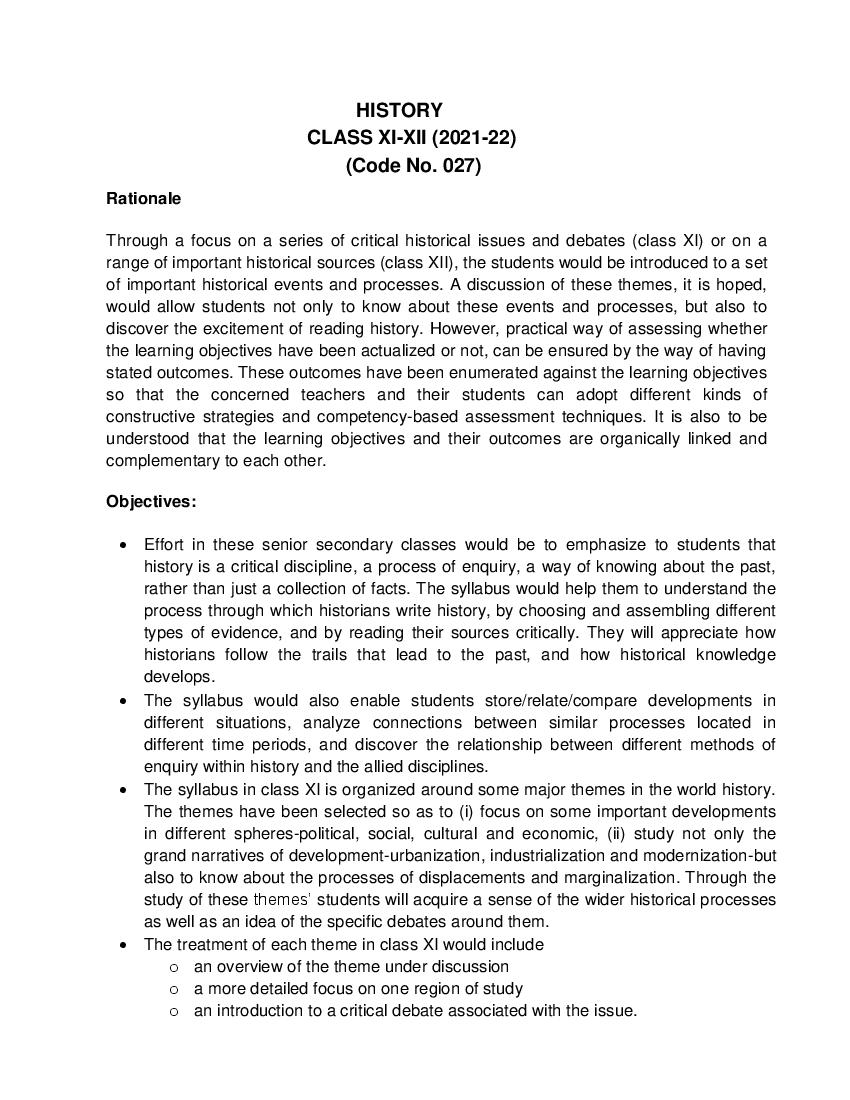
CLASS XI-XII (2021-22)
(Code No. 027)
Rationale
Through a focus on a series of critical historical issues and debates (class XI) or on a
range of important historical sources (class XII), the students would be introduced to a set
of important historical events and processes. A discussion of these themes, it is hoped,
would allow students not only to know about these events and processes, but also to
discover the excitement of reading history. However, practical way of assessing whether
the learning objectives have been actualized or not, can be ensured by the way of having
stated outcomes. These outcomes have been enumerated against the learning objectives
so that the concerned teachers and their students can adopt different kinds of
constructive strategies and competency-based assessment techniques. It is also to be
understood that the learning objectives and their outcomes are organically linked and
complementary to each other.
Objectives:
Effort in these senior secondary classes would be to emphasize to students that
history is a critical discipline, a process of enquiry, a way of knowing about the past,
rather than just a collection of facts. The syllabus would help them to understand the
process through which historians write history, by choosing and assembling different
types of evidence, and by reading their sources critically. They will appreciate how
historians follow the trails that lead to the past, and how historical knowledge
develops.
The syllabus would also enable students store/relate/compare developments in
different situations, analyze connections between similar processes located in
different time periods, and discover the relationship between different methods of
enquiry within history and the allied disciplines.
The syllabus in class XI is organized around some major themes in the world history.
The themes have been selected so as to (i) focus on some important developments
in different spheres-political, social, cultural and economic, (ii) study not only the
grand narratives of development-urbanization, industrialization and modernization-but
also to know about the processes of displacements and marginalization. Through the
study of these themes’ students will acquire a sense of the wider historical processes
as well as an idea of the specific debates around them.
The treatment of each theme in class XI would include
o an overview of the theme under discussion
o a more detailed focus on one region of study
o an introduction to a critical debate associated with the issue.
Page 2
and modern Indian history although the attempt is to soften the distinction between
what is conventionally termed as ancient, medieval and modern. The object would be
to study a set of these themes in some detail and depth rather than survey the entire
chronological span of Indian history. In this sense the course will be built on the
knowledge that the students have acquired in the earlier classes.
Each theme in class XII will also introduce the students to one type of source for the
study of history. Through such a study, students would begin to see what different
types of sources can reveal and what they cannot tell. They would come to know how
historians analyze these sources, the problems and difficulties of interpreting each
type of source, and the way a larger picture of an event, a historical process, or a
historical figure, is built by looking at different types of sources.
Each theme for class XII will be organized around four sub heads:
o a detailed overview of the events, issues and processes under discussion
o a summary of the present state of research on the theme
o an account of how knowledge about the theme has been acquired
o an excerpt from a primary source related to the theme, explaining how it has
been used by historians.
While the themes in both the classes (XI and XII) are arranged in a broad
chronological sequence, there are overlaps between them. This is intended to convey
a sense that chronological divides and periodization do not always operate in a neat
fashion.
In the text books each theme would be located in a specific time and place. But these
discussions would be situated within a wider context by
plotting the specific event within time-lines
discussing the particular event or process in relation to developments in other places
and other times.
Page 3
CLASS XI (2021-22)
One -Theory Paper 80 Marks
3 Hours
Part Units No. of Marks
Periods
1. Introduction to World History 8
Section A: Early Societies 40 18
2. Introduction 7
3. From the beginning of time 18
4. Early cities 15
Section B: Empires 50 19
5. Introduction 7
6. An empire across three continents 15
7. Central Islamic lands 15
8. Nomadic Empires 13
Section C: Changing Traditions 50 19
9. Introduction 7
10. Three orders 14
11. Changing cultural traditions 15
12. Confrontation of cultures 14
Section D: Paths to Modernization 52 19
13. Introduction 7
14. The Industrial Revolution 15
15. Displacing indigenous People 15
16. Paths to modernization 15
Map work (units 1-11 ) 10 5
Project Work 10 20
Total 220 Periods 100 marks
Page 4
THEMES LEARNING LEARNING OUTCOMES
OBJECTIVES
Introduction to World Familiarize the At the completion of this unit
History learner with ways students will be able to:
of reconstructing Analysis on the Darwin
SECTION 1: EARLY human evolution. theory and evidences of
SOCIETIES Discuss whether progression in order to
1 Introduction : .From the the experience of understand the stages
Beginning of Time present-day of human evolution.
Focus: Africa, Europe till hunting-gathering Examine the realms of
15000 BCE people can be Feedback Mechanism in
a) Views on the origins used to order to understand the
of human beings understand early anatomical and
b) Early societies societies. neurological
c) Historians’ views on development of human
present-day species
gathering-hunting Identify the element of
societies continuity with change
and explains that the
hunter gatherer
societies are still
continuing in some parts
of the world with
variations in their
present-day lifestyles
from the past.
Familiarize the At the completion of this unit
2.Writing and City Life learner with the students will be able to:
Focus: Iraq, 3rd millennium nature of early Compare and analyze
BCE urban Centre’s. the transformation from
a) Growth of towns Discuss whether Neolithic to Bronze Age
b) Nature of early writing is Civilization in order to
urban societies significant as a understand the myriad
c) Historians’ Debate marker of spheres of human
on uses of writing civilization. development.
Elucidate the interwoven
social and cultural
aspects of civilization in
order to understand the
connection between city
life and culture of
contemporary
civilizations.
Analyze the outcomes of
a sustained tradition of
writing.
Page 5
Introduction learner with the students will be able to:
3.An Empire across Three history of a major Explain and relate the
Continents world empire dynamics of the Roman
Focus: Roman Empire, 27 Discuss whether Empire in order to
BCE to 600 CE slavery was a understand their polity,
a) Political evolution significant economy, society and
b) Economic element in the culture.
Expansion economy. Analyze the implications
c) Religion-culture of Roman’s contacts
foundation with the subcontinent
d) Late Antiquity Empires
e) Historians’ view on Examine the domains
the Institution of of cultural
Slavery transformation in that
period
4.Central Islamic Lands Familiarize the At the completion of this unit
Focus: 7th to 12th centuries learner with the students will be able to:
a) Polity rise of Islamic Explain the relationship
b) Economy empires in the between livelihood
c) Culture Afro-Asian patterns and the
d) Historians’ territories and its geographical condition
viewpoints on the implications for of the area inhabited by
nature of the economy and the tribes and the
crusades society. nomadic pastoralists
Understand what Describe the arenas of
the crusades Islam in reference to its
meant in these emergence, rise of
regions and how Caliphate and Empire
they were building.
experienced. Analyze the causes,
events and effects of
Crusade.
Examine their economic
life in order to
understand their
connectivity with various
continents.
Comprehend their
learning and cultural
developments in varied
fields like astronomy,
medicine, architecture,
sufism, etc.
5.Nomadic Empires Familiarize the At the completion of this unit
Focus: The Mongol, 13th to learner with the students will be able to:
14th century varieties of
a) The nature of nomadic society
Page 6
b) Formation of institutions. patterns of nomadic
empires Discuss whether pastoralists society.
c) Conquests and state formation is Trace the rise and
relations with other possible in growth of Genghis Khan
states nomadic societies. in order to understand
d) Historians’ views on him as an oceanic ruler.
nomadic societies Analyze socio-political
and state formation and economic changes
during the period of the
descendants of Genghis
Khan
Distinguish between the
Mongolian people’s
perspective and the
world’s opinion about
Genghis Khan.
SECTION -III: Familiarize the At the completion of this unit
CHANGING TRADITIONS learner with the students will be able to:
Introduction nature of the
6.The Three Orders. economy and Explain the myriad
Focus: Western Europe society of this aspects of feudalism with
13th-16th century period and the special reference to first,
a) Feudal society and changes within second, third and fourth
economy them. order of the society.
b) Formation of state Show how the Relate between ancient
c) Church and society debate on the slavery and serfdom
d) Historians’ views on decline of Assess the 14th century
decline of feudalism feudalism helps in crisis and rise of the
understanding nation states.
processes of
transition.
7.Changing Cultural At the completion of this unit
Traditions Explore the students will be able to
Focus: Europe 14th-17th intellectual trends Analyze the causes,
century in the period. events, and effects of the
a) New ideas and new Familiarize Renaissance, Reformation,
trends in literature students with the Scientific Revolution, and
and arts paintings and Age of Exploration.
b) Relationship with buildings of the Relate the different
earlier ideas period. facets of Italian cities to
c) The contribution of Introduce the understand the
West Asia debate around the characteristics of
d) Historians’ idea of Renaissance
viewpoint on the ‘Renaissance’. Humanism and
validity of the notion Realism.
‘European Compare and contrast
Renaissance the condition of women
Page 7
period.
Recognize major
influences on the
architectural, artistic,
and literary
developments in order
to understand the
facades of
Renaissance.
Critical analysis
of the Roman Catholic
Church by Martin
Luther and Erasmus
and their impact on
later reforms.
Evaluate the Roman
Catholic Church”s
response to the
Protestant Reformation
in the forms of the
Counter and Catholic
Reformations
8.Confrontation of cultures Discuss changes in At the completion of this unit
Focus: America 15th to the European students will be able to
18thcentury economy that led to
a) European voyages the voyages. Synthesize information
of exploration Discuss the about the ancient
b) Search for gold, implications of the civilizations of Latin
enslavement, raids, conquests for the America.
extermination indigenous people. Compare,
c) Indigenous people Explore the debate contextualize and
and cultures- The on the nature of the contrast the political,
Arawaks, the slave trade and see social, economic and
Aztecs and the what this debate tells cultural history of
Incas us about the meaning central American
d) History of of these “discoveries”. civilizations.
displacements Analyze how the quest
e) Historians’ for exploration
viewpoint on slave stimulated
trade developments.
Examine the
consequences of
voyages in order to
understand the
expansion of Europe,
America and Africa.
Page 8
IV:TOWARDS nature of growth students will be able to
MODERNISATION in the period and Comprehend the
Introduction its limits. arenas of the Industrial
9.The Industrial Initiate students to Revolution in Great
Revolution the debate on the Britain and other
Focus: England 18th to 19th idea of industrial countries
century revolution. Elucidate the
a) Innovations and technological
technological innovations that spurred
change industrialization in
b) Patterns of growth Britain.
c) Emergence of a Analyze the social,
working class economic, and
d) Historians’ environmental impact of
viewpoint, Debate the Industrial
on ‘Was there an Revolution in order to
Industrial understand the
Revolution?’ revolutionary and
ideological
transformation.
Compare and contrast
the positive and
negative aspects of
Industrial Revolution.
Empathy for the
suffering of the workers
during the Industrial
Revolution.
10. Displacing Sensitize students At the completion of this unit
Indigenous People to the processes students will be able to
Focus: North America and of displacements
Australia, 18th to 20th that accompanied Recount some aspects
century the development of the history of the
a) European colonists of America and native people of America
in North America Australia. to understand their
and Australia Understand the condition.
b) Formation of White implications of To analyze the realms
Settler societies such processes of settlement of
c) Displacement and for the displaced Europeans in Australia
repression of local populations. and America.
people Compare and contrast
d) Historians’ the lives and roles of
viewpoint on the indigenous people in
impact of European these continents
settlement on
indigenous
population
Page 9
Modernization aware that students will be able to
Focus: East Asia, late 19th transformation in Deduce the histories of
to 20th century the modern world China and Japan from
a) Militarization and takes many the phase of imperialism
economic growth in different forms. to modernization
Japan Explore the Japanese
b) China and the Show how notions political, cultural and
communist like ‘modernization’ economic system prior
alternative need to be to and after the Meiji
c) Historians’ Debate critically assessed. Restoration.
on the meaning of Analyze the domains of
modernization Japanese nationalism
prior and after the
Second World War.
Comprehend the history
of China from
colonization to era of
socialism.
Summarize the
nationalist upsurge in
China from Dr Sun Yet
Sen to Mao Ze Dong to
understand the era of
communism.
To analyze the Chinese
(NOTE- Keeping in view path to modernization
the importance of the under Deng Xio Ping
themes i.e. Japan and and Zhou en Lai in order
China, it is advised that to understand the
both must be taught in transformation from rigid
the schools) communism to liberal
socialism.
MAP WORK ON UNITS 1-
11
Page 10
INTRODUCTION
History is one of the most important disciplines in school education. It is the study of the
past, which helps us to understand our present and shape our future. It promotes the
acquisition and understanding of historical knowledge in breath and in depth across
cultures.
The course of history in senior secondary classes is to enable students to know that history
is a critical discipline, a process of enquiry, a way of knowing about the past rather than just
a collection of facts. The syllabus helps them to understand the process, through which a
historian collects, chooses, scrutinizes and assembles different types of evidences to write
history.
The syllabus in class-XI is organized around some major themes in world history. In class
XII the focus shifts to a detailed study of some themes in ancient, medieval and modern
Indian history.
CBSE has decided to introduce project work in history for classes XI and XII in 2013-14 as
a part of regular studies in classroom, as project work gives students an opportunity to
develop higher cognitive skills. It takes students to a life beyond text books and provides
them a platform to refer materials, gather information, analyze it further to obtain relevant
information and decide what matter to keep and hence understand how history is
constructed.
OBJECTIVES
Project work will help students:
To develop skill to gather data from a variety of sources, investigate diverse
viewpoints and arrive at logical deductions.
To develop skill to comprehend, analyze, interpret, evaluate historical evidence and
understand the limitation of historical evidence.
To develop 21st century managerial skills of co-ordination, self-direction and time
management.
To learn to work on diverse cultures, races, religions and lifestyles.
To learn through constructivism-a theory based on observation and scientific study.
To inculcate a spirit of inquiry and research.
To communicate data in the most appropriate form using a variety of techniques.
To provide greater opportunity for interaction and exploration.
To understand contemporary issues in context to our past.
To develop a global perspective and an international outlook.
Page 11
independent choices.
To develop lasting interest in history discipline.
GUIDELINES TO TEACHERS
This section provides some basic guidelines for the teachers to take up projects in History.
It is very necessary to interact, support, guide, facilitate and encourage students while
assigning projects to them.
The teachers must ensure that the project work assigned to the students individually/
In-groups and discussed at different stages right from assigning topic, draft review to
finalization.
Students should be facilitated in terms of providing relevant materials, suggesting
websites, obtaining of required permission for archives, historical sites, etc.
The 20 periods assigned to the Project Work should be suitably spaced from April to
September in classes XI and XII so that students can prepare for theory part in term -
II.
One Project should be given to the students in the month of April/May before the
summer vacation and assessment of the project to be completed by September.
The teachers must ensure that the students submit original work.
Project report should be hand written only.
(Eco-friendly materials can be used by students)
The following steps are suggested:
1. Teacher should design and prepare a list of 15-20 projects and should give an option
to a student to choose a project as per his/her interest.
2. The project must be done individually / In-groups.
3. The topic should be assigned after discussion with the students in the class to avoid
repetition and should then be discussed at every stage of submission of the
draft/final project work.
4. The teacher should play the role of a facilitator and should closely supervise the
process of project completion, and should guide the children by providing necessary
inputs, resources etc. so as to enrich the subject content.
5. The project work(one per year) can culminate in the form of Power Point
Presentation/Exhibition/Skit/albums/files/song and dance or culture show /story
telling/debate/panel discussion, paper presentation and so on. Any of these activities
which are suitable to visually impaired candidates can be performed as per the
choice of the student.
Page 12
also include newspaper cuttings, photographs, film footage and recorded
written/speeches. Secondary sources may also be used after proper authentication.
7. Evaluation will be done by external examiner appointed by the Board in class XII and
internal in class XI.
ASSESSMENT
Allocation of Marks (20)
The marks will be allocated under the following heads:
1 Project Synopsis 2 Marks
2 Data/Statistical analysis/Map work 3 Marks
3 Visual/overall presentation 5 Marks
4 Analysis/explanation and interpretation 5 Marks
5 Bibliography 1 Mark
6 Viva 4 Marks
Total 20 Marks
Note: The project reports are to be preserved by the school till the final results are
declared, for scrutiny by CBSE.
FEW SUGGESTIVE TOPICS FOR PROJECTS
1. Anthropological Research based on Darwin’s Theory
2. Critique of the industrialization in Britain
3. Relations and impacts of past crusades
4. Making and unmaking of Mesopotamia
5. Paradigms of Greeco-Roman civilization
6. Aspirations of women in Renaissance period
7. Paths to Modernization of Japan /China
8. An Exploratory study into Humanism
9. Piecing together the past of Genghis Khan
10. An in-depth study into “now and then” paradigm of Christianity
11. An exploratory study into the realism and the transmission of Humanistic ideas
12. Scientific Revolution and the origins of modern science
13. An exploratory study into the making of America
14. Myriad Realms of Slavery in ancient, medieval and modern world
15. Learning about global Sufism
16. History of aborigines – America /Australia
Note: Please refer Circular No. Acad.16/2013 dated 17.04.2013 for complete
guidelines.
Page 13
SUBJECT CODE 027 (Session 2021-22)
TIME: 3 Hours Maximum Marks: 80
Sr. Competencies Total Marks % Weightage
No.
1 Remembering: Exhibit memory of previously learned
material by recalling facts, terms, basic concepts, and
answers. 40
Understanding: Demonstrate understanding of facts and
50%
ideas by organizing, comparing, translating, interpreting,
giving descriptions and stating main ideas
2 Applying: Solve problems to new situations by applying
acquired knowledge, facts, techniques and rules in a different 15
way. 18.75%
3 High Order Thinking Skills- (Analysis & Synthesis-
Classify, Apply, solve, compare, contrast, or differentiate
between different pieces of information; Organize and/or
integrate unique pieces of information from a variety of 20
sources) 25%
Evaluation- (Appraise, Argue, judge, support, critique,
and/or justify the value or worth of a decision or outcome, or
to predict outcomes)
4 Map skill-based question- Identification, location, 5
significance
6.25%
Total Questions 80 100%
Document Details
| Board / Org | CBSE |
| Exam | Class 11 |
| Type | Syllabus |
| Pages | 13 |
| Updated | 15 Jul 2026 |