UGC NET 2021 Question Paper Mass Communication and Journalism Shift 1
Finished viewing? Save it for later —
Download UGC NET 2021 Question Paper Mass Communication and Journalism Shift 1 (PDF · 60 pages)About UGC NET 2021 Question Paper Mass Communication and Journalism Shift 1
UGC NET 2021 Question Paper Mass Communication and Journalism Shift 1 is available here for free download. Published by NTA for UGC NET, this question paper can be viewed online or downloaded as a PDF (60 pages). Candidates preparing for UGC NET can use UGC NET 2021 Question Paper Mass Communication and Journalism Shift 1 to understand the exam pattern, the type of questions asked, and the overall difficulty level.
Frequently Asked Questions
How can I download UGC NET 2021 Question Paper Mass Communication and Journalism Shift 1?
Open this page and click the Download button to save UGC NET 2021 Question Paper Mass Communication and Journalism Shift 1 as a PDF. It is completely free on AglaSem Docs.
Is UGC NET 2021 Question Paper Mass Communication and Journalism Shift 1 free to download?
Yes. UGC NET 2021 Question Paper Mass Communication and Journalism Shift 1 can be viewed online and downloaded as a PDF free of cost on AglaSem Docs.
How many pages does UGC NET 2021 Question Paper Mass Communication and Journalism Shift 1 have?
UGC NET 2021 Question Paper Mass Communication and Journalism Shift 1 contains 60 pages, which you can read online or download together as a single PDF.
Where can I find more UGC NET study material?
You can find more UGC NET question papers, sample papers, syllabus, and answer keys on AglaSem Docs.
UGC NET 2021 Question Paper Mass Communication and Journalism Shift 1 – Text
Read the full text of this question paper below — useful to quickly search, copy and reference the content online without downloading the PDF.
📄 View text version (60 pages)
Page 1
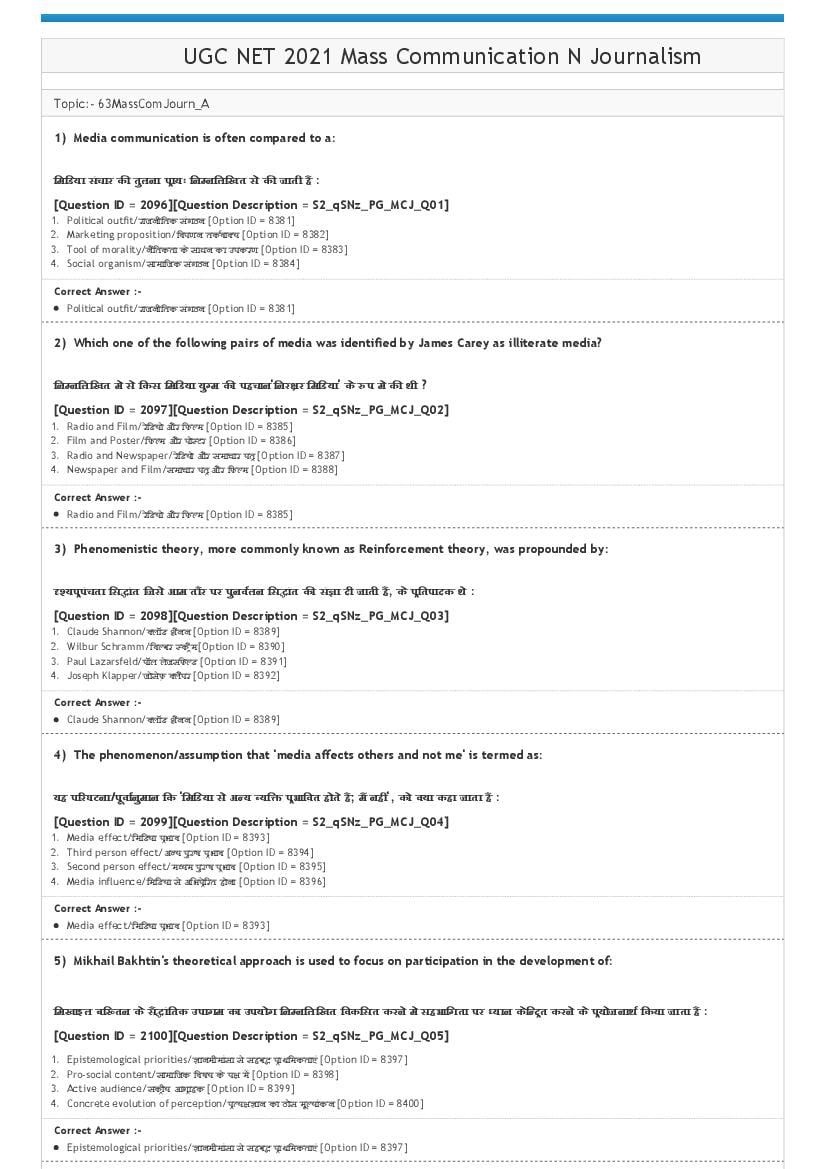
Topic:‐ 63MassComJourn_A
1) Media communication is often compared to a:
िमिडया संचार क तुलना पायः िन निलिखत से क जाती है :
[Question ID = 2096][Question Description = S2_qSNz_PG_MCJ_Q01]
1. Political outfit/राजनीितक संगठन [Option ID = 8381]
2. Marketing proposition/िवपणन तकवा य [Option ID = 8382]
3. Tool of morality/नैितकता के साधन का उपकरण [Option ID = 8383]
4. Social organism/सामािजक संगठन [Option ID = 8384]
Political outfit/राजनीितक संगठन [Option ID = 8381]
2) Which one of the following pairs of media was identified by James Carey as illiterate media?
िन निलिखत म से िकस िमिडया यु म क पहचान'िनर र िमिडया' के प म क थी ?
[Question ID = 2097][Question Description = S2_qSNz_PG_MCJ_Q02]
1. Radio and Film/रेिडयो और िफ म [Option ID = 8385]
2. Film and Poster/िफ म और पो टर [Option ID = 8386]
3. Radio and Newspaper/रेिडयो और समाचार पत [Option ID = 8387]
4. Newspaper and Film/समाचार पत और िफ म [Option ID = 8388]
Radio and Film/रेिडयो और िफ म [Option ID = 8385]
3) Phenomenistic theory, more commonly known as Reinforcement theory, was propounded by:
यपपंचता िस ांत िजसे आम तौर पर पुनवलन िस ांत क सं ा दी जाती है, के पितपादक थे :
[Question ID = 2098][Question Description = S2_qSNz_PG_MCJ_Q03]
1. Claude Shannon/ लॉड शैनन [Option ID = 8389]
2. Wilbur Schramm/िव बर क ै म [Option ID = 8390]
3. Paul Lazarsfeld/पॉल लेजसफे ड [Option ID = 8391]
4. Joseph Klapper/जोसेफ़ लैपर [Option ID = 8392]
Claude Shannon/ लॉड शैनन [Option ID = 8389]
4) The phenomenon/assumption that 'media affects others and not me' is termed as:
यह प रघटना/पूवानुमान िक 'िमिडया से अ य यि पभािवत होते है; म नह ', को या कहा जाता है :
[Question ID = 2099][Question Description = S2_qSNz_PG_MCJ_Q04]
1. Media effect/िमिडया पभाव [Option ID = 8393]
2. Third person effect/अ य पु ष पभाव [Option ID = 8394]
3. Second person effect/म यम पु ष पभाव [Option ID = 8395]
4. Media influence/िमिडया से अिभपे रत होना [Option ID = 8396]
Media effect/िमिडया पभाव [Option ID = 8393]
5) Mikhail Bakhtin's theoretical approach is used to focus on participation in the development of:
िमखाइल बि तन के सै ांितक उपागम का उपयोग िन निलिखत िवकिसत करने म सहभािगता पर यान केि दत करने के पयोजनाथ िकया जाता है :
[Question ID = 2100][Question Description = S2_qSNz_PG_MCJ_Q05]
1. Epistemological priorities/ ानमीमांसा से सहब पाथिमकताएं [Option ID = 8397]
2. Pro‐social content/सामािजक िवषय के प म [Option ID = 8398]
3. Active audience/सकीय आगाहक [Option ID = 8399]
4. Concrete evolution of perception/प य ान का ठोस मू यांकन [Option ID = 8400]
Epistemological priorities/ ानमीमांसा से सहब पाथिमकताएं [Option ID = 8397]
Page 2
िन निलिखत म से कौन सा संगठन अपनी से व ाओं के पचार के िलए कठपुतिलय का उपयोग कर रहा है ?
[Question ID = 2101][Question Description = S2_qSNz_PG_MCJ_Q06]
1. LIC/एल आई सी [Option ID = 8401]
2. RBI/आर बी आई [Option ID = 8402]
3. SBI/एस बी आई [Option ID = 8403]
4. UTI/यु टी आई [Option ID = 8404]
LIC/एल आई सी [Option ID = 8401]
7) The present international information order reflects:
वतमान अंतररा ीय सूचना यव था िकसे पितिबि बत करती है :
[Question ID = 2102][Question Description = S2_qSNz_PG_MCJ_Q07]
1. Social equity on a global scale/िव तर पर सामािजक सा यता [Option ID = 8405]
2. Ideological subversion and submission/िवचारधारा भंजन और आधीनता [Option ID = 8406]
3. Counter measures for contra‐ flow/िवपरीत पवाह के िलए पित‐उपाय [Option ID = 8407]
4. Corporate hegemony/कारपोरेट अिधप य [Option ID = 8408]
Social equity on a global scale/िव तर पर सामािजक सा यता [Option ID = 8405]
8) The early opposition to the dominant paradigm emanated from:
पमुख पावली पैराडाइम का पारंिभक िवरोध उ प न हआ :
[Question ID = 2103][Question Description = S2_qSNz_PG_MCJ_Q08]
1. Asian moderates/एिशयाई नरम पंथ से [Option ID = 8409]
2. African tribes/अफीका क जनजाितय से [Option ID = 8410]
3. European rightists/यूरोप के दि ण पंिथय से [Option ID = 8411]
4. Latin American socialists/लैिटन अमे रक समाजवादी िवचारधारा के अनुयाियय से [Option ID = 8412]
Asian moderates/एिशयाई नरम पंथ से [Option ID = 8409]
9) When an event is given contradictory interpretations by individuals involved, it is called:
जब िकसी पघटना (इव ट) क संलियत यि य ारा क गई या या म िवरोधाभास हो तो इसे कहा जाता है :
[Question ID = 2104][Question Description = S2_qSNz_PG_MCJ_Q09]
1. Fake News/कूटरिचत समाचार (फेक यूज) [Option ID = 8413]
2. Editorialising/संपादक यकरण [Option ID = 8414]
3. Roshomon effect/रोशोमोन पभाव [Option ID = 8415]
4. Cognitive dissonance/सं ाना मक िवसंवािदता [Option ID = 8416]
Fake News/कूटरिचत समाचार (फेक यूज) [Option ID = 8413]
10) Which among the following journalists wrote the book Interview with History?
िन निलिखत म से कौन पतकार "इंटर यू िवद िह टी" पु तक के रिचयता ह ?
[Question ID = 2105][Question Description = S2_qSNz_PG_MCJ_Q10]
1. Barbara Walsh/बरबरा वै श [Option ID = 8417]
2. Tim Sebastian/िटम सेबिै टयन [Option ID = 8418]
3. Oriana Fallaci/ओ रआना फैलैसी [Option ID = 8419]
4. Umberto Eco/अ बेर टो एको [Option ID = 8420]
Barbara Walsh/बरबरा वै श [Option ID = 8417]
11) Which among the following methods is used to open up the interviewee in a conversation?
िकरती वातालाप म सा ा कार देने वाले को वाता हेतु पवृ करने के िलए िन निलिखत म से िकस प ित का उपयोग िकया जाता है ?
[Question ID = 2106][Question Description = S2_qSNz_PG_MCJ_Q11]
Page 3
े न) [Option ID = 8421]
2. GOAL Method/गोल मेथड (ल य प ित) [Option ID = 8422]
3. FORK Method/फोक मेथड (कांटा प ित) [Option ID = 8423]
4. Silence treatment/साइलस टीटमट (मूक यवहार) [Option ID = 8424]
Match making/मै च मेिकंग (सुमल
े न) [Option ID = 8421]
12) Which among the following structure/technique is used for writing news events with dramatic action?
नाटक य कृ य के साथ साथ समाचार लेखन के िलए िन नांिकत म से िकस संरचना/तकनीक का पयोग िकया जाता है ?
[Question ID = 2107][Question Description = S2_qSNz_PG_MCJ_Q12]
1. Section technique/खंड तकनीक (से शन टेकनीक) [Option ID = 8425]
2. Hourglass Structure/आवर लास संरचना (आवर लास ट चर) [Option ID = 8426]
3. List Technique/सूिच तकनीक (िल ट टेकनीक) [Option ID = 8427]
4. The Wall Street Journal Structure/द वाल टीट जनल संरचना (द वाल टीट जनल ट चर) [Option ID = 8428]
Section technique/खंड तकनीक (से शन टेकनीक) [Option ID = 8425]
13) Which of the following media is criticised as "Empathy Machine" by Chris Milk in 2015:
िन निलिखत म से िकस िमिडया क 2015 म िकस िम क ारा ''सहानुभिू त मशीन'' के प म आलोचना क गई है :
[Question ID = 2108][Question Description = S2_qSNz_PG_MCJ_Q13]
1. Television/टेलीिवजन [Option ID = 8429]
2. Mobile/मोबाइल [Option ID = 8430]
3. Augmented Reality/संविधत वा तिवकता [Option ID = 8431]
4. Virtual Reality/आभासी वा तिवकता [Option ID = 8432]
Television/टेलीिवजन [Option ID = 8429]
14) Advertising that promotes legally prohibited intoxicant products in the disguise of some other products, falls in the
category of:
िजस िव ापन म िविधक प से पितिष मादक उ पाद को िकसी अ य उ पाद के छ प म बढ़ावा देते ह तो यह िन निलिखत क शेणी म आता है :
[Question ID = 2109][Question Description = S2_qSNz_PG_MCJ_Q14]
1. Abstract advertising/सारभूत िव ापन [Option ID = 8433]
2. Consumer advertising/उपभो ा िव ापन [Option ID = 8434]
3. Surrogate advertising/पितिनयु िव ापन [Option ID = 8435]
4. Trade advertising/ यापा रक िव ापन [Option ID = 8436]
Abstract advertising/सारभूत िव ापन [Option ID = 8433]
15) The term describing perceived brand value in the minds of the customer is:
गाहक के मन म प यि क बांड मोल क िववेचना के िलए पयु पद है :
[Question ID = 2110][Question Description = S2_qSNz_PG_MCJ_Q15]
1. Brand identity/बांड आइडिटटी (बांड प रचय) [Option ID = 8437]
2. Brand equity/बांड इि वटी (बांड इि वटी) [Option ID = 8438]
3. Brand image/बांड इमेज (बांड क छिव) [Option ID = 8439]
4. Brand loyalty/बांड लोया टी (बांड क िव सनीयता) [Option ID = 8440]
Brand identity/बांड आइडिटटी (बांड प रचय) [Option ID = 8437]
16) Buzz marketing is a trend in word‐of‐mouth communication with an effort to reach out to:
ं िच हांकन (बज मािकग) मौिखक संचार म एक पवृि है िजसम िन नांिकत से अिभगम का पयास िकया जाता है :
गुज
[Question ID = 2111][Question Description = S2_qSNz_PG_MCJ_Q16]
1. Older consumers/पौढ़ उपभो ा [Option ID = 8441]
2. Younger consumers/िकशोर उपभो ा [Option ID = 8442]
3. Women consumers/मिहला उपभो ा [Option ID = 8443]
4. Children consumers/बाल उपभो ा [Option ID = 8444]
Older consumers/पौढ़ उपभो ा [Option ID = 8441]
Page 4
िकसी संगठन के ल य क पाि हेतु "सहमित िनमाण" क संक पना िन निलिखत म से िकनका पवतनकारी िवचार है :
[Question ID = 2112][Question Description = S2_qSNz_PG_MCJ_Q17]
1. Robert Kaiser/रॉबट कैसर [Option ID = 8445]
2. William Wolff Smith/िविलयम उ फ ि मथ [Option ID = 8446]
3. George Creel/जॉज कील [Option ID = 8447]
4. Edward Bernays/एडवाड बनस [Option ID = 8448]
Robert Kaiser/रॉबट कैसर [Option ID = 8445]
18) In PR, 'provocation' is a technique which is used for:
जनस पक म, "पकोपन" एक तकनीक है िजसका पयोग िन नांिकत के िलए िकया जाता है :
[Question ID = 2113][Question Description = S2_qSNz_PG_MCJ_Q18]
1. PR Strategy/जनस पक काय िनित या कह रचना [Option ID = 8449]
2. PR Planning/जनस पक योजना िनमाण [Option ID = 8450]
3. Propaganda/पोपेगे डा [Option ID = 8451]
4. Publicity/पचार [Option ID = 8452]
PR Strategy/जनस पक काय िनित या कह रचना [Option ID = 8449]
19) Which one of the following is called the Magna Carta of Public relations?
िन निलिखत म से िकसे जनस पक का मै नाकाटा कहा जाता है :
[Question ID = 2114][Question Description = S2_qSNz_PG_MCJ_Q19]
1. Code of Professional Standards/ यावसाियक मानक संिहता [Option ID = 8453]
2. Accreditation in Public Relations/जन स पक म प यायन [Option ID = 8454]
3. Code of Athens/एथस संिहता (कोड ऑफ़ एथस) [Option ID = 8455]
4. UN Declaration of Human Rights/संयु रा संघ का मानवािधकार का घोषणा पत [Option ID = 8456]
Code of Professional Standards/ यावसाियक मानक संिहता [Option ID = 8453]
20) The other name for public relations is:
जनस पक का अ य नाम है :
[Question ID = 2115][Question Description = S2_qSNz_PG_MCJ_Q20]
1. Propaganda/मन‐पचार [Option ID = 8457]
2. Press agency/पस
े एजसी [Option ID = 8458]
3. Persuasive publicity/अनुनयनकारी पचार [Option ID = 8459]
4. Media linkage/िमिडया संपक [Option ID = 8460]
Propaganda/मन‐पचार [Option ID = 8457]
21) The automatic suspension of Article 19 of the constitution of India during internal emergency was revoked by:
आतं रक आपातकाल के दौरान भारतीय संिवधान का अनु छेद 19 का वतः िनलंबन िन नांिकत ारा पितसं त िकया गया था :
[Question ID = 2116][Question Description = S2_qSNz_PG_MCJ_Q21]
1. The 42nd constitutional amendment/42 वां संिवधान संशोधन [Option ID = 8461]
2. The 43r d constitutional amendment/43 वां संिवधान संशोधन [Option ID = 8462]
3. The 44th constitutional amendment/44 वां संिवधान संशोधन [Option ID = 8463]
4. The 45th constitutional amendment/45 वां संिवधान संशोधन [Option ID = 8464]
The 42nd constitutional amendment/42 वां संिवधान संशोधन [Option ID = 8461]
22) Article 361A, inserted by the 44th constitutional amendment is related to:
44 व संिवधान संशोधन ारा अंतः थािपत अनु छेद 361 'क' िन निलिखत म से िकससे संबंिधत है :
[Question ID = 2117][Question Description = S2_qSNz_PG_MCJ_Q22]
1. Right to privacy/िनजता का अिधकार [Option ID = 8465]
2. Reporting legislative, and parliamentary proceedings/िवधायी और संसदीय कायवािहय क रपोिटग [Option ID = 8466]
3. Contempt of court/ यायालय क अवमानना [Option ID = 8467]
4. Film censorship/िफ म ससरिशप [Option ID = 8468]
Page 5
23) Which of the following entitiles a media person for qualified privilege?
िन निलिखत म से या िमिडया कम को अहक िवशेषािधकार का हक़दार बनता है ?
[Question ID = 2118][Question Description = S2_qSNz_PG_MCJ_Q23]
1. Reproduction of a defamatory statement/अवमानकारी व य क पुनः प तुित [Option ID = 8469]
2. Publication of a false statement/िम या कथन का पकाशन [Option ID = 8470]
3. Statements made while performing a duty without malice/क य का िनवाह करते हए बुरी िनयत के िबना िदए गए व य [Option ID = 8471]
4. Imputation of illegitimacy/अवैध होने का आरोप [Option ID = 8472]
Reproduction of a defamatory statement/अवमानकारी व य क पुनः प तुित [Option ID = 8469]
24) The right of media to know, in any country of the world, is considered:
िव के िकसी भी देश म िमिडया को पद जानने का अिधकार माना जाता है :
[Question ID = 2119][Question Description = S2_qSNz_PG_MCJ_Q24]
1. Absolute/िनरपे [Option ID = 8473]
2. Infinite/असीिमत [Option ID = 8474]
3. Non‐legal/गैर‐िविधमा य [Option ID = 8475]
4. Limited/सीिमत [Option ID = 8476]
Absolute/िनरपे [Option ID = 8473]
25) In media organizations, one can find the absence of:
िमिडया संगठन म िन नांिकत का अभाव हो सकता है :
[Question ID = 2120][Question Description = S2_qSNz_PG_MCJ_Q25]
1. Information flow/सूचना पवाह (इ फॉमशन लो) [Option ID = 8477]
2. Timeline/काल िनधारण (टाइमलाइन) [Option ID = 8478]
3. Unity of command/कमान का एक व (यूिनटी ऑफ़ कमांड) [Option ID = 8479]
4. Job performance/काय िन पादन (जॉब परफॉमस) [Option ID = 8480]
Information flow/सूचना पवाह (इ फॉमशन लो) [Option ID = 8477]
26) A new issue emerging in many countries of the world in relation to media operations is:
िमिडया के कामकाज के संबंध म िव के बहत से देशो म उभर रहा नया मु ा है :
[Question ID = 2121][Question Description = S2_qSNz_PG_MCJ_Q26]
1. Government ownership of media/िमिडया का सरकारी वािम व [Option ID = 8481]
2. Privatisation of media/िमिडया का िनजीकरण [Option ID = 8482]
3. Free software for media production/िमिडया प तुित िनमाण के िलए िनःशु क सॉ टवेयर [Option ID = 8483]
4. Media cartelization/िमिडया उ पादक संघ िनमाण [Option ID = 8484]
Government ownership of media/िमिडया का सरकारी वािम व [Option ID = 8481]
27) The technological task approach in media management is which one of the following in character?
िमिडया पबंध म पौ ोिगक य काय उपागम क पकृित है :
[Question ID = 2122][Question Description = S2_qSNz_PG_MCJ_Q27]
1. Functional/पकाया मक [Option ID = 8485]
2. Theoretical/सै ांितक [Option ID = 8486]
3. Remote/सुदरू [Option ID = 8487]
4. Indirect/अप य [Option ID = 8488]
Functional/पकाया मक [Option ID = 8485]
28) The final edited version of a TV commercial for client's approval is called:
गाहक क वीकृित के िलए टेलीिवजन के मा यम से वािणि यक िव ापन का अंितम प से संपािदत सं करण कहलाता है :
[Question ID = 2123][Question Description = S2_qSNz_PG_MCJ_Q28]
Page 6
2. Exact print/इ जै ट िपटं (सटीक मुदण) [Option ID = 8490]
3. Clear print/ि लयर िपटं ( प मुदण) [Option ID = 8491]
4. Answer print/आ सर िपटं (प यु र मुदण) [Option ID = 8492]
Fine print/फाइन िपटं (सू म मुदण) [Option ID = 8489]
29) Which among the following describes Cyber Space as 'a consensual hallucination' experienced daily by billions of
legitimate operators in every nation?
िन नांिकत म से िक ह ने साइबर पेस क या या प येक रा म अरब िविधस मत ऑपरेटर के सम उ प न होनेवाली "सहमित ज य िवभांित" के प म क है
:
[Question ID = 2124][Question Description = S2_qSNz_PG_MCJ_Q29]
1. Jean Baudrillard/जीन बिडलाड [Option ID = 8493]
2. Gonzalo Frasca/गूंजैलो फ ै का [Option ID = 8494]
3. William Gibson/िविलयम िग सन [Option ID = 8495]
4. Marshall Mcluhan/माशल मैकलुहन [Option ID = 8496]
Jean Baudrillard/जीन बिडलाड [Option ID = 8493]
30) Which among the following sites indexes millions of blogs and updates the references by tracking posts and links to
them?
िन निलिखत म से िकस साइट पर लाख लॉग क अनुकमिणका बनाई जाती है और पो ट एवं िलंक का पता लगाकर संदभ को अघतन िकया जाता है :
[Question ID = 2125][Question Description = S2_qSNz_PG_MCJ_Q30]
1. Trackbacks/टैकबै स [Option ID = 8497]
2. Permalink/परमािलंक [Option ID = 8498]
3. RSS/आर.एस.एस. [Option ID = 8499]
4. Technorati/टे नोरैटी [Option ID = 8500]
Trackbacks/टैकबै स [Option ID = 8497]
31) The sound created in a studio that replaces the original sound is called:
टूिडय म मूल विन को पित थािपत करने वाले सृिजत कृितम विन को या कहा जाता है :
[Question ID = 2126][Question Description = S2_qSNz_PG_MCJ_Q31]
1. Zolleying/जौलीइंग [Option ID = 8501]
2. Perambulator/परै बुलटे र [Option ID = 8502]
3. Foley/फोले [Option ID = 8503]
4. Sound bridging/साउंड िबिजंग [Option ID = 8504]
Zolleying/जौलीइंग [Option ID = 8501]
32) According to David Brewer, the ethical issue which applies to Twitter is:
डेिवड बेवर के अनुसार ि वटर के संदभ म लागू आचार का िवषय है :
[Question ID = 2127][Question Description = S2_qSNz_PG_MCJ_Q32]
1. Independence/ वतंतता [Option ID = 8505]
2. Integrity/स यिन ा [Option ID = 8506]
3. Conflict of Interest/िहत का टकराव [Option ID = 8507]
4. Freebies/मु त उपहार [Option ID = 8508]
Independence/ वतंतता [Option ID = 8505]
33) Who directed the ten‐part television mini series 'Samvidhaan': The Making of The Constitution of India?
दस भाग म प तुत टेलीिवजन िमनी सीरीज 'संिवधान: द मेिकंग ऑफ़ द कां टी यूशन ऑफ़ इंिडया' के िनदेशक थे :
[Question ID = 2128][Question Description = S2_qSNz_PG_MCJ_Q33]
1. Suman Das/सुमन दास [Option ID = 8509]
2. Dr. Chandraprakash Dwivedi/डा. चंदपकाश ि वेदी [Option ID = 8510]
3. Shyam Benegal/ याम बेनेगल [Option ID = 8511]
4. Gautam Gosh/गौतम घोष [Option ID = 8512]
Suman Das/सुमन दास [Option ID = 8509]
Page 7
light source?
ु और िमत ययी तरीका है :
िन नांिकत म से िकस पकार क पकाश यव था म एकल पकाश को सा य सुगम पकाश सोत म संप रवितत करने का दत
[Question ID = 2129][Question Description = S2_qSNz_PG_MCJ_Q34]
1. Broad lighting/बॉड लाइिटंग [Option ID = 8513]
2. Flat lighting/ लैट लाइिटंग [Option ID = 8514]
3. Butterfly lighting/बटर लाई लाइिटंग [Option ID = 8515]
4. Umbrella lighting/अ बेला लाइिटंग [Option ID = 8516]
Broad lighting/बॉड लाइिटंग [Option ID = 8513]
35) Which one of the following is a precise measurement of the amount of light actually striking the film?
िफ म पर सीधे पड़नेवाले पकाश के प रमाण क सटीक माप है :
[Question ID = 2130][Question Description = S2_qSNz_PG_MCJ_Q35]
1. F‐ number/एफ‐सं या [Option ID = 8517]
2. T‐ number/टी‐सं या [Option ID = 8518]
3. Sunny 16/सु नी 16 [Option ID = 8519]
4. ISO/आई एस ओ [Option ID = 8520]
F‐ number/एफ‐सं या [Option ID = 8517]
36) Who among the following directors received the maximum number of National film awards for best direction?
िन निलिखत म से िकस िफ म िनदशक को सव कृ िनदशन के िलए सबसे अिधक बार राि य पुर कार से स मािनत िकया गया :
[Question ID = 2131][Question Description = S2_qSNz_PG_MCJ_Q36]
1. Adoor Gopalakrishnan/अदूर गोपालकृ णन [Option ID = 8521]
2. Ritwik Ghatak/ऋि वक घटक [Option ID = 8522]
3. G. Aravindan/जी. अरिवंदन [Option ID = 8523]
4. Gireesh Kasaravally/िगरीश कासरव ली [Option ID = 8524]
Adoor Gopalakrishnan/अदूर गोपालकृ णन [Option ID = 8521]
37) When the values and contributions of a research study is assessed, it is termed as:
जब शोध परक अ ययन के मान और अंशदान का मू यांकन िकया जाता है तो इसे कहा जाता है :
[Question ID = 2132][Question Description = S2_qSNz_PG_MCJ_Q37]
1. Post‐evaluation/मू यांकन‐प ात [Option ID = 8525]
2. Axiology/मू यमीमांसा [Option ID = 8526]
3. Process evaluation/पकम मू यांकन [Option ID = 8527]
4. Procedure evaluation/पिकया मू यांकन [Option ID = 8528]
Post‐evaluation/मू यांकन‐प ात [Option ID = 8525]
38) The researchers broadly agreeing on a phenomenon 'through independent findings' is termed as:
शोधकता ओं म " वतंत िन कष के मा यम से" प रघटना के बारे म मोटे तौर पर सहमित बनने को या सं ा दी जाती है :
[Question ID = 2133][Question Description = S2_qSNz_PG_MCJ_Q38]
1. Scientific positivism/वै ािनक प य वाद [Option ID = 8529]
2. Intercommunity/अ तः समुदाय [Option ID = 8530]
3. Intersubjective/अ तः यि िन ता [Option ID = 8531]
4. Paradigmatic/ पिव यासी [Option ID = 8532]
Scientific positivism/वै ािनक प य वाद [Option ID = 8529]
39) A quantitative aggregation of several research findings on the same issue, is called
एक ही मु े पर अनेक शोध परक िन कष के माता मक समु चयन को या सं ा दी जाती है :
[Question ID = 2134][Question Description = S2_qSNz_PG_MCJ_Q39]
Page 8
2. Meta analysis/परा िव ेषण [Option ID = 8534]
3. Panel analysis/फलक िव ेषण [Option ID = 8535]
4. Collective analysis/सामूिहक िव ेषण [Option ID = 8536]
Cluster analysis/गु छ िव ेषण [Option ID = 8533]
40) A one‐tail test predicts that the result will move in:
िकसी एक पा प र ण से िन कष पा होता है िक प रणाम िन निलिखत िदशा म संचािलत होगा :
[Question ID = 2135][Question Description = S2_qSNz_PG_MCJ_Q40]
1. The positive direction only/केवल घना मक िदशा म [Option ID = 8537]
2. Either positive or negative direction/या तो घना मक या ऋणा मक िदशा म [Option ID = 8538]
3. The negative direction only/केवल ऋणा मक िदशा म [Option ID = 8539]
4. Several directions/अनेक िदशाओं म [Option ID = 8540]
The positive direction only/केवल घना मक िदशा म [Option ID = 8537]
41) Which of the following are the philosophical assumptions of communication?
A. Epistemology
B. Ontology
C. Metatheory
D. Semantics
E. Pragmatics
Choose the correct answer from the options given below:
िन निलिखत म से कौन‐सी संचार क दशन शा तीय अवधारणाएँ ह ?
A. ानमीमांसा
B. स मीमांसा
C. अिधिस ांत
D. अथिव ान
E. संकटे पयोगिव ान
नीचे िदए गए िवक प म से सही उ र चुन :
[Question ID = 2136][Question Description = S2_qSNz_PG_MCJ_Q41]
1. A, B and C only/केवल A, B, C [Option ID = 8541]
2. B, C and D only/केवल B, C, D [Option ID = 8542]
3. C, D and E only/केवल C, D, E [Option ID = 8543]
4. A, C and D only/केवल A, C, D [Option ID = 8544]
A, B and C only/केवल A, B, C [Option ID = 8541]
42) According to Henry Jenkins which of the following are the types of convergence in the context of media
A. Computational convergence
B. Technological convergence
C. Content convergence
D. Economic convergence
E. Cultural convergence
Choose the correct answer from the options given below:
हेनरी जेनिकंस के अनुसार मीिडया के स दभ म िन निलिखत म से कौन सा अिभसरण का पकार है ?
A.क पुटश
े नल अिभसरण
B. तकनीक अिभसरण
C. सामगी अिभसरण
D. आिथक अिभसरण
Page 9
नीचे िदए गए िवक प म से सही उ र चुन :
[Question ID = 2137][Question Description = S2_qSNz_PG_MCJ_Q42]
1. A, B and C only/केवल A, B, C [Option ID = 8545]
2. B, D and E only/केवल B, D, E [Option ID = 8546]
3. C, D and A only/केवल C, D, A [Option ID = 8547]
4. A, C and E only/केवल A, C, E [Option ID = 8548]
A, B and C only/केवल A, B, C [Option ID = 8545]
43) Which of the following are considered as the defects of the western model of development?
It is:
A. Mechanistic
B. Transmission‐oriented
C. Intended to invade
D. Extremely realistic
E. Extensively participatory
Choose the correct answer from the options given below:
िन निलिखत म से कौन‐सी िवकास पि मी पित व क किमयाँ मानी जाती ह ? यह
A. यंतवादी है
B. पसरणो मुख है
C. दूसरे ेत म पवेश करने का उ े य रखता है
D. बड़ा ही यथाथवादी है
E. यापक प से सहभागी है
नीचे िदए गए िवक प म से सही उ र चुन :
[Question ID = 2138][Question Description = S2_qSNz_PG_MCJ_Q43]
1. A, B and C only/केवल A, B, C [Option ID = 8549]
2. B, C and D only/केवल B, C, D [Option ID = 8550]
3. C, D and E only/केवल C, D, E [Option ID = 8551]
4. A, D and E only/केवल A, D, E [Option ID = 8552]
A, B and C only/केवल A, B, C [Option ID = 8549]
44) The modern societies are characterized by:
A. Limited aspirations
B. Social mobility
C. Cosmopolitanism
D. Innovativeness
E. Wholesale inequities
Choose the correct answer from the options given below:
आधुिनक समाज क िवशेषताएँ होती है :
A. िसिमत आकां ाएँ
B. सामािजक गितशीलता
C. िव नाग रकता
D. नवपवतनका रता
E. थोक म अ यायताएँ
नीचे िदए गए िवक प म से सही उ र चुन :
[Question ID = 2139][Question Description = S2_qSNz_PG_MCJ_Q44]
Page 10
2. B, C and D only/केवल B, C, D [Option ID = 8554]
3. C, D and E only/केवल C, D, E [Option ID = 8555]
4. A, D and E only/केवल D, E, A [Option ID = 8556]
A, B and C only/केवल A, B, C [Option ID = 8553]
45) JD Lesica sorted the media forms used in Citizen Journalism into six types. Which among the following are part of that?
A. Audience participation
B. Embedded media
C. Niche media
D. Thin media
E. Personal broadcasting sites
Choose the correct answer from the options given below:
जे. डी. लेिसका ने नाग रक पतका रता म पयोग िकए जाने वाले प को छह पकार म िवभािजत िकया िन निलिखत म से कौन उनके िह से ह ?
A. दशक / शोताग़ज क भागीदारी
B. चारण िमिडया
C. िविश वग िमिडया
D. िशिथल िमिडया
E. वैयि क पसारण साइट
नीचे िदए गए िवक प म से सही उ र चुन :
[Question ID = 2140][Question Description = S2_qSNz_PG_MCJ_Q45]
1. A, C and D only/केवल A, C, D [Option ID = 8557]
2. B, C and D only/केवल B, C, D [Option ID = 8558]
3. C, D and E only/केवल C, D, E [Option ID = 8559]
4. A, D and E only/केवल A, D, E [Option ID = 8560]
A, C and D only/केवल A, C, D [Option ID = 8557]
46) Roy Peter Clark of the Poynter Institute cautions against which of the following acts of unacceptable plagiarism?
A. Using news releases verbatim
B. Using the works of fellow reporters
C. Restating the source's original idea
D. Using old stories all over again
E. Putting source's exact words in quotation marks
Choose the correct answer from the options given below:
पॉइंटर सं थान के रॉय पीटर लाक अ वीकाय सािहि यक चोरी के िन निलिखत म से िकस कम के पित सावधान करते ह ?
A. समाचार िव ि य का श दशः पयोग करना
B. साथी रपोटर क रचनाओं का पयोग करना
C. सोत के मूल िवचार का पुनकथन
D. पुराने समाचार का पुनः पयोग करना
E. सोत के श द को हबह उ रण िच ह म रखना
नीचे िदए गए िवक प म से सही उ र चुन :
[Question ID = 2141][Question Description = S2_qSNz_PG_MCJ_Q46]
1. C, D and E only/केवल C, D, E [Option ID = 8561]
2. A, B and E only/केवल A, B, E [Option ID = 8562]
3. B, C and D only/केवल B, C, D [Option ID = 8563]
4. A, B and D only/केवल A, B, D [Option ID = 8564]
C, D and E only/केवल C, D, E [Option ID = 8561]
Page 11
A. Will readers understand this?
B. Are the facts correct?
C. Are there unanswered questions or inconsistencies in the story?
D. Is the grammar sound?
E. Does this agree with what is known from previous stories on the subject?
Choose the correct answer from the options given below:
िन निलिखत म से कौन‐से प िकसी समाचार िववरण के सू म संपादन के िह से ह ?
A. या पाठक इसे समझगे ?
B. या त य सही ह ?
C. या समाचार म अनु रत प या िवसंगितयाँ ह ?
D. या याकरण सश है ?
E. या इस िवषय से स बंिधत िपछले समाचार से यह सहमित रखता है ?
नीचे िदए गए िवक प म से सही उ र चुन :
[Question ID = 2142][Question Description = S2_qSNz_PG_MCJ_Q47]
1. A, C and E only/केवल A, C, E [Option ID = 8565]
2. A, B and E only/केवल A, B, E [Option ID = 8566]
3. A, C and D only/केवल A, C, D [Option ID = 8567]
4. B, C and D only/केवल B, C, D [Option ID = 8568]
A, C and E only/केवल A, C, E [Option ID = 8565]
48) Which among the following are descriptive techniques used in writing a news story?
A. Usage of adjectives
B. Usage of creative tone or mood
C. Usage of analogies
D. Setting the scene
E. Usage of foreshadowing
Choose the correct answer from the options given below:
िन निलिखत म से िकस वणना मक तकनीक का पयोग समाचार िववरण िलखने म होता है ?
A. िवशेषण का पयोग
B. रचना मक शैली व मनोदशा का पयोग
C. सा य का पयोग
D. य तैयार करना
E. पूव संकत
े का पयोग
नीचे िदए गए िवक प म से सही उ र चुन :
[Question ID = 2143][Question Description = S2_qSNz_PG_MCJ_Q48]
1. A, B and D only/केवल A, B, D [Option ID = 8569]
2. B, C and D only/केवल B, C, D [Option ID = 8570]
3. A, C and D only/केवल A, C, D [Option ID = 8571]
4. C, D and E only/केवल C, D, E [Option ID = 8572]
A, B and D only/केवल A, B, D [Option ID = 8569]
49) A. C. Nielsen's research has revealed that consumer promotions are most effective:
A. When used on established brands with a declining market share
B. When used on established brands with no product change
C. When there is a major functional improvement
D. Where the brand is on the rise in terms of competitive share
E. When used only occasionally
Page 12
ए. सी. नीलसेन के शोध म यह बात सामने आई है िक उपभो ा संवधन पभावी होते ह
A. जब इनका पयोग ऐसे थािपत बांड पर होता है िजसका बाजार शेयर िगर रहा हो
B. जब इनका पयोग ऐसे थािपत बांड पर होता है िजनम कोई उ पाद प रवतन नह हो
C. जहाँ कोई बड़ा पकाया मक सुधर होना है
D. जहाँ पितयोगी शेयर क ी म बांड ऊपर उठ रहा है
E. जब केवल कमी‐कमी उनका पयोग हो
नीचे िदए गए िवक प म से सही उ र चुन :
[Question ID = 2144][Question Description = S2_qSNz_PG_MCJ_Q49]
1. A, B and C only/केवल A, B, C [Option ID = 8573]
2. C, D and E only/केवल C, D, E [Option ID = 8574]
3. B, C and D only/केवल B, C, D [Option ID = 8575]
4. A, E and D only/केवल E, D, A [Option ID = 8576]
A, B and C only/केवल A, B, C [Option ID = 8573]
50) The main elements of 'Brand Idea' are:
A. Uniquely ours
B. The relationship of the brand to the consumer
C. Can be different for different groups/target
D. Temporary, Short‐term
E. Sustainable for the long term
Choose the correct answer from the options given below:
'बांड िवचार' के मु य त व ह :
A. केवल हमारा
B. बांड का उपभो ा से संबंध
C. अलग‐अलग ल य समूह के िलए अलग‐अलग हो सकता है
D. अ थायी, अ पाविधक
E. दीघाविध के िलए संधारणीय
नीचे िदए गए िवक प म से सही उ र चुन :
[Question ID = 2145][Question Description = S2_qSNz_PG_MCJ_Q50]
1. B, C and D only/केवल B, C, D [Option ID = 8577]
2. B, E and D only/केवल B, E, D [Option ID = 8578]
3. A, E and D only/केवल A, E, D [Option ID = 8579]
4. A, B and E only/केवल A, B, E [Option ID = 8580]
B, C and D only/केवल B, C, D [Option ID = 8577]
51) In Public Relations, Communication Audit is an important exercise for effective communication because:
A. It examines the threat and success of other competitors
B. It investigates the scope of communication to determine whether all existing or potential publics are covered
C. It analyses the decisions of the organization
D. It evaluates their current attitude and behaviour; whether they are required to conform or change
E. It identifies communication gaps and information needs of all the key publics
Choose the correct answer from the options given below:
जनस पक म पभावी संचार के िलए 'संचार मू यांकन' मह वपूण काय है य िक :
A. यह दूसरे पितयोिगय क आशंका और सफलता का परी ण करता है
B. यह संचार के ेत का अ वेषण करता है िक या सभी वतमान या संभा य िविश जनसमूह इसके अंदर आती ह
Page 13
े ण करता है
D. यह उनके वतमान अिभवृि कर यवहार का मू यांकन करता है िक या उ ह सुिनि त करना चािहए या उनम प रवतन लाना चािहए
E. यह सभी मह वपूण िविश जनसमूह क संवादहीनता और सूचना संबंधी आव यकताओं क पहचान करता है
नीचे िदए गए िवक प म से सही उ र का चयन क िजए :
[Question ID = 2146][Question Description = S2_qSNz_PG_MCJ_Q51]
1. A, B and C only/केवल A, B और C [Option ID = 8581]
2. A, C and D only/केवल A, C और D [Option ID = 8582]
3. B, A and D only/केवल A, B और D [Option ID = 8583]
4. B, D and E only/केवल B, D और E [Option ID = 8584]
A, B and C only/केवल A, B और C [Option ID = 8581]
52) According to John Dalla Costa, the Relationship Marketing Model focuses on:
A. The process for serving customers
B. Feeding and nourishing the relationship
C. Extending respect and value to customers
D. Defining the target group
E. Developing an audience service, philosophy
Choose the correct answer from the options given below:
जॉन डैला कॉ टा के अनुसार 'संबंध ‐ आधा रत िवपणन पित प' िकन पर यानकिदत करता है ?
A. गाहक क सेवा करने क पिकया
B. संबंध को पोिषत और संपवह करना
C. गाहक को स मान पदान करना और मोल देना
D. ल य समूह को प रभािषत करना
E. दशक / शोतागण सेवा दशन िवकिसत करना
नीचे िदए गए िवक प म से सही उ र का चयन क िजए :
[Question ID = 2147][Question Description = S2_qSNz_PG_MCJ_Q52]
1. A, C and D only/केवल A, C और D [Option ID = 8585]
2. A, B and C only/केवल A, B और C [Option ID = 8586]
3. A, B and E only/केवल B, A और E [Option ID = 8587]
4. C, D and E only/केवल C, D और E [Option ID = 8588]
A, C and D only/केवल A, C और D [Option ID = 8585]
53) The defenses to an action against defamation are:
A. Judicial discretion
B. Reputation of the accused
C. Justification
D. Fair comment
E. Privilege
Choose the correct answer from the options given below:
अवमान क कारवाई के बचाव ह :
A. याियक िववेक
B. अिभयु क पित ा
C. औिच य
D. िन प िट पणी
E. िवशेषािधकार
नीचे िदए गए िवक प म से सही उ र का चयन क िजए :
[Question ID = 2148][Question Description = S2_qSNz_PG_MCJ_Q53]
Page 14
2. B, C and D only/केवल B, C और D [Option ID = 8590]
3. C, D and E only/केवल C, D और E [Option ID = 8591]
4. B, C and E only/केवल B, C और E [Option ID = 8592]
A, B and C only/केवल A, B और C [Option ID = 8589]
54) Which of the following ratings are prescribed by CBFC?
A. U
B. M
C. PG
D. UA
E. S
Choose the correct answer from the options given below:
िन निलिखत म से कौनसी रेिटंग CBFC ारा िनधा रत क गई है :
A. U
B. M
C. PG
D. UA
E. S
नीचे िदए गए िवक प म से सही उ र का चयन क िजए :
[Question ID = 2149][Question Description = S2_qSNz_PG_MCJ_Q54]
1. A, B and C only/केवल A, B और C [Option ID = 8593]
2. B, C and D only/केवल B, C और D [Option ID = 8594]
3. C, D and E only/केवल C, D और E [Option ID = 8595]
4. A, D and E only/केवल A, D और E [Option ID = 8596]
A, B and C only/केवल A, B और C [Option ID = 8593]
55) According to Schein (1985), leaders____ have the ability to communicate organizational messages in the following
ways:
A. Endorsing corporate ideologies
B. Focussing on and measuring and controlling variables
C. Focusing on employee feedback
D. Coaching and teaching
E. Promoting, recruiting and excommunicating
Choose the correct answer from the options given below:
शाइन (1985) के अनुसार ने त ाओं म संगठन के संदेश को स पेिषत करने क मता िन निलिखत तरीक से होती है :
A. कॉप रेट िवचारधाराओं का समथन करना
B. चर पर यान देना और उ ह मापना व िनयंितत करना
C. कमचा रय से पा पितपुि पर यान किदत करना
D. पिश ण व िश ा पदान करना
E. पदो नित करना, भत करना और बिह कृत करना
नीचे िदए गए िवक प म से सही उ र का चयन क िजए :
[Question ID = 2150][Question Description = S2_qSNz_PG_MCJ_Q55]
1. A, D and E only/केवल A, D और E [Option ID = 8597]
2. A, C and E only/केवल A, C और E [Option ID = 8598]
3. B, D and E only/केवल B, D और E [Option ID = 8599]
4. B, C and E only/केवल B, C और E [Option ID = 8600]
A, D and E only/केवल A, D और E [Option ID = 8597]
Page 15
one(s)
A. Nascent stage is when sales are low
B. Infancy is when a product enters the market
C. Decline is the final stage when consumers lose interest
D. Maturity occurs when a product finds its placement in its segment
E. Competitive stage is when sales are high
Choose the correct answer from the options given below:
बजेल और कुक (1969) ने िकसी उ पाद के जीवन चक क पांच अव थाओं के प म िन निलिखत क चचा क सही िवक प क पहचान कर :
A. नवजात अव था, जब िवकय कम होता है
B. शैशव वह अव था है जब उ पाद बाजार म पवेश करता है
C. अवनित वह अंितम अव था है जब उपभो ाओं क िच समा हो जाती है
D. प रप वता वह होती है जब उ पाद को अपने खंड म थान िमलता है
E. पितयोगी अव था, जब िवकय अिधक होता है
नीचे िदए गए िवक प म से सही उ र का चयन क िजए :
[Question ID = 2151][Question Description = S2_qSNz_PG_MCJ_Q56]
1. A, D and E only/केवल A, D और E [Option ID = 8601]
2. A, B and C only/केवल A, B और C [Option ID = 8602]
3. B, C and E only/केवल B, C और E [Option ID = 8603]
4. B, C and D only/केवल B, C और D [Option ID = 8604]
A, D and E only/केवल A, D और E [Option ID = 8601]
57) According to Boyd and Ellison, which among the following are popular areas of research on Social Networking Sites (SNS)
A. Impression management
B. Post‐humanism
C. Anti reality
D. Privacy
E. Network and Network structure
Choose the correct answer from the options given below:
बॉयड और एिलसन के अनुसार िन निलिखत म से कौन ‐ से सोशल नेटविकग साइट (एस एन एस) पर शोध के लोकिपय ेत ह ?
A. पभाव पबंधन
B. उ र मानववाद
C. पित यथाथ
D. िनजता
E. नेटवक व नेटवक संरचना
नीचे िदए गए िवक प म से सही उ र चयन क िजए :
[Question ID = 2152][Question Description = S2_qSNz_PG_MCJ_Q57]
1. C, D and E only/केवल C, D और E [Option ID = 8605]
2. A, D and E only/केवल A, D और E [Option ID = 8606]
3. B, A and C only/केवल B, A और C [Option ID = 8607]
4. B, C and D only/केवल B, C और D [Option ID = 8608]
C, D and E only/केवल C, D और E [Option ID = 8605]
58) Which of the following are true in the case of media management?
A. In the 'Sandwich style', the small‐scale idea appears suitable, at the outset
B. Introduction of technology in a media house can have many types of impact
C. Agenda‐setting is part of the technology adoption process in a media house
D. Experienced media managers do not require skill upgradation
Page 16
Choose the correct answer from the options given below:
मीिडया पबंधन के मामले म िन निलिखत म से कौन ‐से स य ह ?
A. 'सडिवच शैली' म पारंभ म छोटे आकार का िवचार उपयु लगता है
B. िकसी िमिडया घराने म टे नोलॉजी के पवेश के कई पकार के पभाव हो सकते ह
C. कायसूची ‐ िनधारण िकसी मीिडया घराने म टे नोलॉजी अपनाने क पिकया का िह सा है
D. अनुभवी िमिडया पबंधक को कौशल उ नयन क आव यकता नह होती है
E. मीिडया घराने ारा टे नोलॉजी का अपनाया जाना गैर‐ पितयोगी होता है
नीचे िदए गए िवक प म से सही उ र का चयन क िजए :
[Question ID = 2153][Question Description = S2_qSNz_PG_MCJ_Q58]
1. A, B and C only/केवल A, B और C [Option ID = 8609]
2. B, C and D only/केवल B, C और D [Option ID = 8610]
3. C, D and E only/केवल C, D और E [Option ID = 8611]
4. A, D and E only/केवल A, D और E [Option ID = 8612]
A, B and C only/केवल A, B और C [Option ID = 8609]
59) Augmented Reality can be defined as a system that fulfills which of the following basic features?
A. Combination of real and virtual world
B. Real‐time interaction
C. Accurate 3D registration of virtual and real objects
D. Replacement of user's real‐world environment with a simulated one
E. User's perception of reality is completely based on virtual information
Choose the correct answer from the options given below:
अिभविधत वा तिवकता को ऐसे तंत के प म प रभािषत कर सकते ह जो िन निलिखत मूल िवशेषताएँ पूरी करता है :
A. वा तिवक और आभासी जगत का संयोजन
B. रीयल ‐ टाइम अंतःिकया
C. का पिनक और वा तिवक व तु ओ ं का सही ‐ सही 3D पंजीकरण
D. पयो ा के वा तिवक ‐ जगत प रवेश का अनुकत
ृ प रवेश से पित थापन
E. पयो ा का वा तिवकता का बोध आभासी सूचना पर पूरी तरह से आधा रत है
नीचे िदए गए िवक प म से सही उ र का चयन क िजए :
[Question ID = 2154][Question Description = S2_qSNz_PG_MCJ_Q59]
1. A, D and E only/केवल A, D और E [Option ID = 8613]
2. B, D and E only/केवल B, D और E [Option ID = 8614]
3. B, C and D only/केवल B, C और D [Option ID = 8615]
4. A, B and C only/केवल A, B और C [Option ID = 8616]
A, D and E only/केवल A, D और E [Option ID = 8613]
60) Which among the following statements hold true in cinematography?
A. Depth of field is comparatively deep when wide‐angle lens is used
B. Angles make a subject powerless
C. Extreme close‐up shots are used to capture emotions
D. Object size corresponds closely to human vision when normal lens is used
E. Prime lens are used when the highest optical quality is not required
Choose the correct answer from the options given below:
िन निलिखत म से कौन ‐ से कथन िसनेमैटोगाफ म स य ह ?
A. ेत क गहराई अपे ाकृत गहरी होती है जब वाइड ‐ ऐंगल लस का पयोग िकया जाता है
Page 17
C. भावनाओं से स बंिधत िचत लेने के िलए अित लोज ‐ अप शॉ स का पयोग िकया जाता है
D. जब सामा य लस का पयोग होता है, तो व तु का आकर मानव ि के समीप होता है
E. जब उ चतम पकाशीय गुणव ा क आव यकता नह होती है, तो पाइम लस का पयोग िकया जाता है
नीचे िदए गए िवक प म से सही उ र का चयन क िजए :
[Question ID = 2155][Question Description = S2_qSNz_PG_MCJ_Q60]
1. A, C and D only/केवल A, C और D [Option ID = 8617]
2. A, B and C only/केवल A, B और C [Option ID = 8618]
3. C, D and E only/केवल C, D और E [Option ID = 8619]
4. B, C and D only/केवल B, C और D [Option ID = 8620]
A, C and D only/केवल A, C और D [Option ID = 8617]
61) Which among the following are the major characteristics of Italian‐neorealism?
A. Usage of non‐professional actors
B. Usage of Schüfftan process
C. Documentary style of film making
D. Shooting at outdoor location
E. Discoutinuity editing
Choose the correct answer from the options given below:
िन निलिखत म कौन ‐ सी इटालवी नव यथाथवाद क मु य िवशेषताएं ह ?
A. गैर ‐ यावसाियक अिभनेताओं का पयोग
B. शुि टयन
C. िफ म बनाने क वृ िचत शैली
D. बा थान पर शूिटंग
E. िड कंिट युइटी संपादन
नीचे िदए गए िवक प म से सही उ र का चयन क िजए :
[Question ID = 2156][Question Description = S2_qSNz_PG_MCJ_Q61]
1. A, D and E only/केवल A, D और E [Option ID = 8621]
2. A, C and D only/केवल A, C और D [Option ID = 8622]
3. B, C and D only/केवल B, C और D [Option ID = 8623]
4. C, D and E only/केवल C, D और E [Option ID = 8624]
A, D and E only/केवल A, D और E [Option ID = 8621]
62) Which among the following techniques can be used to indicate elapse of a short time?
A. Slow fade out
B. Changes in personal appearances
C. A calendar changes pages or date changes
D. De focus shot
E. Highlighting changes with passing time
Choose the correct answer from the options given below:
िन निलिखत म से कौन ‐ सी तकनीक का पयोग कम समय बीतने को सूिचत करने के िलए िकया जा सकता है ?
A. धीमा फेड ‐ आउट
B. वैयि क प म प रवतन
C. कैलडर के पृ बदलते ह या ितिथ बदलती है
D. िड ‐ फोकस शॉट
E. समय बीतने के साथ प रवतन को उजागर करना
नीचे िदए गए िवक प म से सही उ र का चयन क िजए :
[Question ID = 2157][Question Description = S2_qSNz_PG_MCJ_Q62]
Page 18
2. B, C and D only/केवल B, C और D [Option ID = 8626]
3. A, D and E only/केवल A, D और E [Option ID = 8627]
4. C, D and E only/केवल C, D और E [Option ID = 8628]
A, B and C only/केवल A, B और C [Option ID = 8625]
63) The disadvantages of the case study method are:
A. It is highly quantitative
B. Scientific rigour is absent
C. There is greater scope for generalisation
D. Generalisation is difficult
E. It is time‐consuming
Choose the correct answer from the options given below:
केस अ ययन िविध क हािनयाँ ह :
A. यह अित प रमाणा मक होता है
B. वै ािनक कठोरता का अभाव होता है
C. सामा यीकरण क अिधक गुज
ं ायश होती है
D. सामा यीकरण किठन है
E. इसम बहत समय लगता है
नीचे िदए गए िवक प म से सही उ र का चयन क िजए :
[Question ID = 2158][Question Description = S2_qSNz_PG_MCJ_Q63]
1. A, B and C only/केवल A, B और C [Option ID = 8629]
2. B, C and D only/केवल B, C और D [Option ID = 8630]
3. C, D and E only/केवल C, D और E [Option ID = 8631]
4. B, D and E only/केवल B, D और E [Option ID = 8632]
A, B and C only/केवल A, B और C [Option ID = 8629]
64) Which of the following are the advantages of simple random sampling?
A. Possibility of a representative sample in all cases is remote
B. Classification error can be eliminated
C. A representative group can be collected easily
D. Statistical inference of external validity is possible
E. Periodicity bias is possible
Choose the correct answer from the options given below:
िन निलिखत म से कौन ‐ से सरल दैव िनदशन के लाभ ह ?
A. सभी मामल म पितिनिध पितदश क संभावना बहत कम है
B. वग करण तुिट को बिह कृत िकया जा सकता है
C. पितिनिध समूह का संगहण आसानी से हो सकता है
D. बा वैधता का सांि यक य िन कष संभव है
E. आवितता पूवागह संभव है
नीचे िदए गए िवक प म से सही उ र का चयन क िजए :
[Question ID = 2159][Question Description = S2_qSNz_PG_MCJ_Q64]
1. A, B and C only/केवल A, B और C [Option ID = 8633]
2. B, C and D only/केवल B, C और D [Option ID = 8634]
3. C, D and E only/केवल C, D और E [Option ID = 8635]
4. A, D and E only/केवल A, D और E [Option ID = 8636]
A, B and C only/केवल A, B और C [Option ID = 8633]
Page 19
A. Survey
B. Experiment
C. Focus group discussion
D. Case studies
E. Field observation
Choose the correct answer from the options given below:
िन निलिखत म से कौन ‐ सी गुणा मक शोध म डाटा संगहण क िविधयां ह ?
A. सव ण
B. पयोग
C. फोकस समूह चचा
D. केस अ ययन
E. ेत ‐ िवषयक पे ण
नीचे िदए गए िवक प म से सही उ र का चयन क िजए :
[Question ID = 2160][Question Description = S2_qSNz_PG_MCJ_Q65]
1. A, B and C only/केवल A, B और C [Option ID = 8637]
2. B, C and D only/केवल B, C और D [Option ID = 8638]
3. C, D and E only/केवल C, D और E [Option ID = 8639]
4. A, D and E only/केवल A, D और E [Option ID = 8640]
A, B and C only/केवल A, B और C [Option ID = 8637]
66) Match List I with List II
List I List II
Theory Objective(s)
A. Authoritarian I. Audience's role is critical
B. Libertarian II. Instrument of state policy
C. Communist III. Checks on government
D. Democratic‐participant IV. State‐owned media for political propaganda
Choose the correct answer from the options given below:
सूची ‐I को सूची ‐II से सुमेिलत क िजए :
सूची ‐I सूची ‐II
(िस ांत) (उ े य)
A. अिधनायकवादी I. आगाहक क भूिमका मह वपूण है
B. उदारीकरण II. रा य नीित का साधन
C. सा यवादी III. सरकार पर िनयंतण
D. लोकतांितक ‐ IV. राजनीितक मत ‐ पचार के िलए रा य के वािम व वाला
सहभागी िमिडया
नीचे िदए गए िवक प म से सही उ र चुिनए :
[Question ID = 2161][Question Description = S2_qSNz_PG_MCJ_Q66]
1. A ‐IV, B ‐ III, C ‐I, D ‐ II [Option ID = 8641]
2. A ‐II , B ‐III , C ‐IV , D ‐I [Option ID = 8642]
3. A ‐III , B ‐IV , C ‐II , D ‐I [Option ID = 8643]
4. A ‐I , B ‐III , C ‐II , D ‐IV [Option ID = 8644]
A ‐IV, B ‐ III, C ‐I, D ‐ II [Option ID = 8641]
67) Match List I with List II
List I List II
Development Concept Source
A. Media dependency I. IOWA school
B. Urbanisation II. APJ Abdul Kalam
C. Development support communicationIII. Daniel Lerner
D. PURA IV. Latin American scholars
Choose the correct answer from the options given below:
Page 20
सूची ‐I सूची ‐II
(िवकास क अवधारणा) (सोत)
A. मीिडया पर िनयंतण I. आईओवा कूल
B. शहरीकरण II. एपीजे अ दुल कलाम
C. िवकास सहयोग संचार III. डेिनयल लनर
D. पी यू आर ए IV. लैिटन अमे रक शोध अ येता
नीचे िदए गए िवक प म से सही उ र चुिनए :
[Question ID = 2162][Question Description = S2_qSNz_PG_MCJ_Q67]
1. A ‐IV , B ‐III , C ‐I , D ‐II [Option ID = 8645]
2. A ‐III , B ‐IV , C ‐II , D ‐I [Option ID = 8646]
3. A ‐I , B ‐II , C ‐IV , D ‐III [Option ID = 8647]
4. A ‐II , B ‐I , C ‐III , D ‐IV [Option ID = 8648]
A ‐IV , B ‐III , C ‐I , D ‐II [Option ID = 8645]
68) Match List I with List II
List I List II
A. Mug shot I. A short story used at the end of a long story
B. Crony journalism II. Ignoring negative news about friends
C. Rowback III. Head shot
D. Shirttail IV. A story that corrects a previous story without informing the error
Choose the correct answer from the options given below:
सूची ‐I को सूची ‐II से सुमेिलत क िजए :
सूची ‐I सूची ‐II
A. मग शॉट I. िकसी लंबी कथा के अंत म लघु कथा
B. कोनी
II. िमत से संबंिधत नकारा मक समाचार पर यान नह देना
पतका रता
C. रोबैक III. हेडशॉट
IV. ऐसी कथा िजसम तुिट या यितकम का उ लेख िकए िबना पूव ‐
D. शटटेल
कथानक म शुि क जाती है
नीचे िदए गए िवक प म से सही उ र चुिनए :
[Question ID = 2163][Question Description = S2_qSNz_PG_MCJ_Q68]
1. A ‐III , B ‐II , C ‐IV , D ‐I [Option ID = 8649]
2. A ‐II , B ‐III , C ‐I , D ‐IV [Option ID = 8650]
3. A ‐I , B ‐IV , C ‐II , D ‐III [Option ID = 8651]
4. A ‐IV , B ‐I , C ‐III , D ‐II [Option ID = 8652]
A ‐III , B ‐II , C ‐IV , D ‐I [Option ID = 8649]
69) Match List I with List II
List I List II
Research method Description
A. Tachistoscope testing I. Demographics
B. VALS research II. Testing random viewer response
C. Theatre testing III. Advertising readership
D. Starch scores IV. Recall of advertisement
Choose the correct answer from the options given below:
सूची ‐I को सूची ‐II से सुमेिलत क िजए :
सूची ‐I सूची ‐II
(शोधप ित) ( या या)
A. टैिक टो कोप परी ण I. जनांिकक
B. वी ए एल एस शोध II. या ि छक दशक प यु र परी ण
C. िथएटर परी ण III. पाठक क सं या का िव ापन
D. टाच कोस IV. िव ापन का मरण
नीचे िदए गए िवक प म से सही उ र चुिनए :
[Question ID = 2164][Question Description = S2_qSNz_PG_MCJ_Q69]
Page 21
2. A ‐II , B ‐III , C ‐IV , D ‐I [Option ID = 8654]
3. A ‐IV , B ‐I , C ‐II , D ‐III [Option ID = 8655]
4. A ‐III , B ‐ IV, C ‐I , D ‐II [Option ID = 8656]
A ‐I , B ‐II , C ‐IV , D ‐III [Option ID = 8653]
70) Match List I with List II
List I List II
Authors Book
A. Cutlip, Center and Broom I. Public Relations: Theory and Practice
B. Grunng and Hunt II. Managing Public Relations
C. J M Kaul III. Effective Public Relations
D. Jane Johnston IV. Public Relations in India
Choose the correct answer from the options given below:
सूची ‐I को सूची ‐II से सुमेिलत क िजए :
सूची ‐I सूची ‐II
(लेखन) (पु तक)
A. काटिलप सटर और बमू I. पि लक रलेशंस : योरी एंड पैि टस
B. गु ग और हंट II. मैनेिजंग पि लक रलेशंस
C. जे. एम. कॉल III. इफेि टव पि लक रलेशंस
D. जेन जॉं टन IV. पि लक रलेशंस इन इंिडया
नीचे िदए गए िवक प म से सही उ र चुिनए :
[Question ID = 2165][Question Description = S2_qSNz_PG_MCJ_Q70]
1. A ‐III , B ‐IV , C ‐II , D ‐I [Option ID = 8657]
2. A ‐II , B ‐IV , C ‐III , D ‐I [Option ID = 8658]
3. A ‐III , B ‐II , C ‐IV , D ‐I [Option ID = 8659]
4. A ‐III , B ‐I , C ‐IV , D ‐II [Option ID = 8660]
A ‐III , B ‐IV , C ‐II , D ‐I [Option ID = 8657]
71) Match List I with List II
List I List II
A. Copyright Act I. Mandamus
B. Official secrets Act II. Assignment
C. Indian Constitution III. Trial by media
D. Contempt of Court IV. Wrongful communication
Choose the correct answer from the options given below:
सूची ‐I को सूची ‐II से सुमेिलत क िजए :
सूची ‐I सूची ‐II
A. पितिल यािधकार I. परमादेश
B. शासक य गु बात अिधिनयम II. समनुदेशन
C. भारतीय संिवधान III. मीिडया ारा िवचारण
D. यायालय क अवमानता IV. गलत संचार
नीचे िदए गए िवक प म से सही उ र चुिनए :
[Question ID = 2166][Question Description = S2_qSNz_PG_MCJ_Q71]
1. A ‐II , B ‐IV , C ‐I , D ‐III [Option ID = 8661]
2. A ‐II , B ‐I , C ‐IV , D ‐III [Option ID = 8662]
3. A ‐IV , B ‐III , C ‐I , D ‐II [Option ID = 8663]
4. A ‐IV , B ‐I , C ‐II , D ‐III [Option ID = 8664]
A ‐II , B ‐IV , C ‐I , D ‐III [Option ID = 8661]
72) Match List I with List II
List I List II
Media House Acquired by
A. NBC I. Disney
B. ABC II. Viacom
C. CBS III. Time Warner Corp
Page 22
Choose the correct answer from the options given below:
सूची ‐I को सूची ‐II से सुमेिलत क िजए :
सूची ‐I सूची ‐II
(िमिडया घराना) (िजनके ारा अिजत िकया गया)
A. एन बी सी I. िड नी
B. ए बी सी II. वायाकॉम
C. सी बी एस III. टाइम वानर कॉप रेशन
D. सी एन एन IV. जनरल इलेि टकल
नीचे िदए गए िवक प म से सही उ र चुिनए :
[Question ID = 2167][Question Description = S2_qSNz_PG_MCJ_Q72]
1. A ‐III , B ‐II , C ‐I , D ‐IV [Option ID = 8665]
2. A ‐IV , B ‐I , C ‐II , D ‐III [Option ID = 8666]
3. A ‐IV , B ‐II, C ‐I , D ‐III [Option ID = 8667]
4. A ‐III , B ‐IV , C ‐I , D ‐II [Option ID = 8668]
A ‐III , B ‐II , C ‐I , D ‐IV [Option ID = 8665]
73) Match List I with List II
List I List II
Concept Comed by
A. Web 2.0 I. Alvin Toffler
B. Hyperreality II. William Gibson
C. Prosumer III. Jean Baudrillard
D. Cyberspace IV. Tim O' Really
Choose the correct answer from the options given below:
सूची ‐I को सूची ‐II से सुमेिलत क िजए :
सूची ‐I सूची ‐II
(अवधारणा) (पितपादक)
A. वेब 2.0 I. एि वन टॉ लर
B. हाइपर रएिलटी II. िविलयम िग सन
C. पो यूमर III. जीन बॉिडलड
D. साइबर पेस IV. िटम ओ रयली
नीचे िदए गए िवक प म से सही उ र चुिनए :
[Question ID = 2168][Question Description = S2_qSNz_PG_MCJ_Q73]
1. A ‐I , B ‐IV , C ‐II , D ‐III [Option ID = 8669]
2. A ‐II , B ‐IV , C ‐III , D ‐I [Option ID = 8670]
3. A ‐IV , B ‐I , C ‐III , D ‐II [Option ID = 8671]
4. A ‐IV , B ‐III , C ‐I , D ‐II [Option ID = 8672]
A ‐I , B ‐IV , C ‐II , D ‐III [Option ID = 8669]
74) Match List I with List II
List I List II
National Award for Best Actor Film
A. Naseerudin Shah I. Piravi
B. Premji II. Anumati
C. Vikram Gokhale III. Nagar Kirtan
D. Riddhi Sen IV. Paar
Choose the correct answer from the options given below:
सूची ‐I को सूची ‐II से सुमेिलत क िजए :
सूची ‐I सूची ‐II
(सवशे अिभनेता के िलए रा ीय पुर कार) (िफ म)
A. नसी ीन शाह I. िपरावी
B. पमे जी II. अनुमित
C. िवकम गोखले III. नगरक तन
D. ऋि सेन IV. पार
नीचे िदए गए िवक प म से सही उ र चुिनए :
Page 23
1. A ‐IV , B ‐I , C ‐II , D ‐III [Option ID = 8673]
2. A ‐IV , B ‐II , C ‐I , D ‐III [Option ID = 8674]
3. A ‐I , B ‐III , C ‐IV , D ‐II [Option ID = 8675]
4. A ‐II , B ‐IV , C ‐I , D ‐III [Option ID = 8676]
A ‐IV , B ‐I , C ‐II , D ‐III [Option ID = 8673]
75) Match List I with List II
List I List II
A. Positivist Research I. Thick description Writing
B. Bricolage Research II. Memo Writing
C. Observation Research III. Value free
D. Grounded Method Research IV. Combining skills, knowledge and methods
Choose the correct answer from the options given below:
सूची ‐I को सूची ‐II से सुमेिलत क िजए :
सूची ‐I सूची ‐II
I. सारगिभत लेखन (िथक डेि क शन
A. प य वादी शोध (पौिजिटिव ट रसच)
राइिटंग)
B. िबकोलेज शोध (िबकोलेज रसच) II. मृितपरक लेख (मेमो राइिटंग)
C. पे ण ‐ शोध (ऑ जवशन रसच) III. मू य िनरपे (वै यू ‐ फी)
D. आधा रत िविध शोध (गाउ डेड मेथड
IV. कौशल ान और प ितय का संयोजन
रसच)
नीचे िदए गए िवक प म से सही उ र चुिनए :
[Question ID = 2170][Question Description = S2_qSNz_PG_MCJ_Q75]
1. A ‐II , B ‐I , C ‐IV , D ‐III [Option ID = 8677]
2. A ‐I , B ‐II , C ‐III , D ‐IV [Option ID = 8678]
3. A ‐IV , B ‐III , C ‐II , D ‐I [Option ID = 8679]
4. A ‐III , B ‐IV , C ‐I , D ‐II [Option ID = 8680]
A ‐II , B ‐I , C ‐IV , D ‐III [Option ID = 8677]
76) Arrange the presidents of INS (Indian Newspapers Society) chronologically, from the earliest to the most recent
A. Kiran B. Vadodaria
B. Somesh Sharma
C. P. V. Chandran
D. Ravindra Kumar
E. Shailesh Gupta
Choose the correct answer from the options given below
आईएनएस (इंिडयन यूजपेपस सोसाइटी) के अ य को कालानुकिमक प से सबसे पहले से अब तक के कम म यवि थत कर,
A. िकरण वी. वदोड रया
B. सोमेश शमा
C. पी. वी. च दन
D. रवी द कुमार
E. शैलेश गु ा
नीचे िदए गए िवक प म से सही उ र का चयन क िजए :
[Question ID = 2171][Question Description = S2_qSNz_PG_MCJ_Q76]
1. A, D, C, E, B [Option ID = 8681]
2. B, C, D, A, E [Option ID = 8682]
3. C, D, E, B, A [Option ID = 8683]
4. D, A, C, B, E [Option ID = 8684]
A, D, C, E, B [Option ID = 8681]
77) Arrange in sequence the steps in production of an instructional television program
Page 24
B. Select a subject
C. Involve experts
D. Plan evaluation
E. Identify the goal
Choose the correct answer from the options given below
शै िणक टेलीिवजन कायकम िनमाण का सही कम या है ?
A. टीटमट को अंितम प देना
B. िवषय का चयन करना
C. िवशेष को काय स पना
D. मू यांकन क योजना बनाना
E. ल य क पहचान करना
नीचे िदए गए िवक प म से सही उ र का चयन क िजए :
[Question ID = 2172][Question Description = S2_qSNz_PG_MCJ_Q77]
1. A, B, D, E, C [Option ID = 8685]
2. D, E, B, C, E [Option ID = 8686]
3. B, A, C, E, D [Option ID = 8687]
4. C, D, E, A, B [Option ID = 8688]
A, B, D, E, C [Option ID = 8685]
78) Arrange the following components of the Freytag Pyramid in chronological order.
A. Rise of action
B. Fall of action
C. Exposition
D. Climax
E. Resolution
Choose the correct answer from the options given below
फ े ट ै गिपरािमड के िन निलिखत संघटक को कालकमानुसार यवि थत क िजए :
A. आरोह िकया
B. अवरोह िकया
C. उ ाषण िकया
D. चरमो कष
E. समाधान
नीचे िदए गए िवक प म से सही उ र का चयन क िजए :
[Question ID = 2173][Question Description = S2_qSNz_PG_MCJ_Q78]
1. A, C, B, E, D [Option ID = 8689]
2. A, B, C, E, D [Option ID = 8690]
3. C, A, D, E, B [Option ID = 8691]
4. C, A, D, B, E [Option ID = 8692]
A, C, B, E, D [Option ID = 8689]
79) Arrange the stages of persuasion in the correct sequence
A. Appeal to the heart
B. Offer gratification
C. Appeal to emotion
D. Accomplish Sale
E. Point out the clients need
Page 25
अनुनयन के कंध को सही कम म यवि थत क िजए :
A. दयागह
B. पिततोष क पेशकश
C. संवेगागह
D. िवकय काय संप न करना
E. गाहक क अपे ा का उ लेख करना
नीचे िदए गए िवक प म से सही उ र का चयन क िजए :
[Question ID = 2174][Question Description = S2_qSNz_PG_MCJ_Q79]
1. C, A, E, B, D [Option ID = 8693]
2. C, E, B, A, D [Option ID = 8694]
3. A, B, D, E, C [Option ID = 8695]
4. E, D, A, C, B [Option ID = 8696]
C, A, E, B, D [Option ID = 8693]
80) Arrange in sequence the important developments in Public Relations
A. Institute of Public Relations (IPR)
B. Public Relations Society of America (PRSA)
C. International Public Relations Association (IPRA)
D. Code of Athens
E. Dattaram & Co.
Choose the correct answer from the options given below
जनस पक के ेत म हई गितिविधय का सही अनुकम है :
A. जनसंपक सं थान (आई पी आर)
B. पि लक रलेशन सोसायटी ऑफ अमे रका (पी आर एस एच)
C. अंतररा ीय जन संपक संघ (आई पी आर ए)
D. एथ स संिहता (कोड ऑफ एथ स)
E. दाताराम एंड कंपनी
नीचे िदए गए िवक प म से सही उ र का चयन क िजए :
[Question ID = 2175][Question Description = S2_qSNz_PG_MCJ_Q80]
1. E, B, A, C, D [Option ID = 8697]
2. E, A, B, D, C [Option ID = 8698]
3. A, B, C, D, E [Option ID = 8699]
4. B, A, E, D, C [Option ID = 8700]
E, B, A, C, D [Option ID = 8697]
81) Identify the chronological order of the cases related to press freedom in India.
A. Ramesh Thappar vs. State of Madras
B. Express Newspapers vs. Union of India
C. Bennet Coleman vs. Union of India
D. Sakaal Newspapers vs. Union of India
E. Secretary, I & B Ministry vs. Bengal Cricket Association
Choose the correct answer from the options given below
भारत म पेस क वतंतता से संबंिधत वाद को कालकमानुसार यवि थत क िजए :
A. रमेश थापर बनाम मदास रा य
B. ए सप ेस यूजपेपस बनाम भारत संघ
Page 26
D. सकाल यूजपेपस बनाम भारत संघ
E. सिचव, सूचना और पसारण मंतालय बनाम बंगाल िककेट एसोिसएशन
नीचे िदए गए िवक प म से सही उ र का चयन क िजए :
[Question ID = 2176][Question Description = S2_qSNz_PG_MCJ_Q81]
1. A, B, C, E, D [Option ID = 8701]
2. B, C, D, E, A [Option ID = 8702]
3. C, E, D, A, B [Option ID = 8703]
4. A, B, D, C, E [Option ID = 8704]
A, B, C, E, D [Option ID = 8701]
82) Arrange the following countries in descending order of online news consumption (Based on FICCI Report,2020)
A. United States of America
B. Brazil
C. Indonesia
D. India
E. China
Choose the correct answer from the options given below
िफ क रपोट, 2020 के आधार पर िन नांिकत देश को ऑन ‐ लाइन समाचार के लाभािथय (प यो ाओं) के आधार पर अवरोही कम म यवि थत क िजए :
A. संयु रा य अमे रका
B. बाजील
C. इंडोनेिशया
D. भारत
E. चीन
नीचे िदए गए िवक प म से सही उ र का चयन क िजए :
[Question ID = 2177][Question Description = S2_qSNz_PG_MCJ_Q82]
1. E, A, D, B, C [Option ID = 8705]
2. A, B, D, C, E [Option ID = 8706]
3. E, D, A, B, C [Option ID = 8707]
4. A, D, E, C, B [Option ID = 8708]
E, A, D, B, C [Option ID = 8705]
83) Arrange the following social media platforms on the basis of highest to lowest popularity in India (FICCI Report, 2020)
A. Facebook
B. WhatsApp
C. FB Messenger
D. YouTube
E. Instagram
Choose the correct answer from the options given below
िन नांिकत सोशल मीिडया लेटफाम को भारत म उनक लोकिपयता के आधार पर यवि थत क िजए (िफ क रपोट, 2020)
A. फेसबुक
B. हा स ऐप
C. फेसबुक मेसजर
D. यू यूब
E. इं टागाम
नीचे िदए गए िवक प म से सही उ र का चयन क िजए :
[Question ID = 2178][Question Description = S2_qSNz_PG_MCJ_Q83]
1. D, B, A, C, E [Option ID = 8711]
Page 27
3. B, A, D, C, E [Option ID = 8709]
4. B, A, D, E, C [Option ID = 8710]
B, A, D, C, E [Option ID = 8709]
84) Arrange the following National Film awardees in the best actress category in the order of highest to lowest number of
winning titles.
A. Rekha
B. Shabana Azmi
C. Sharada
D. Archana
Choose the correct answer from the options given below
सवशे अिभनेती क शेणी म रा ीय िफ म पुर कार से स मािनत होनेवाली अिभनेितय को स मान से िवभूिषत िकए जाने के आधार पर अवरोही कम (सवािधक से
यूनतम) म यवि थत क िजए :
A. रेखा
B. शबाना आज़मी
C. शारदा
D. अचना
नीचे िदए गए िवक प म से सही उ र का चयन क िजए :
[Question ID = 2179][Question Description = S2_qSNz_PG_MCJ_Q84]
1. B, C, D, A [Option ID = 8713]
2. B, A, C, D [Option ID = 8714]
3. A, B, D, C [Option ID = 8715]
4. A, C, B, D [Option ID = 8716]
B, C, D, A [Option ID = 8713]
85) The correct sequence of research phases in mass communication (media) is:
A. Effects of the medium
B. How the medium can be used ‐ uses and users of the medium
C. The medium itself
D. New media uses and issues
E. How the medium can be improved
Choose the correct answer from the options given below
जनसंचार (िमिडया) म शोध के चरण का सही कम या है :
A. मा यम का पभाव
B. िजस पकार से मीिडया का पयोग िकया जा सकता है ‐ मा यम का पयोग और पयो ा
C. मा यम वयं
D. यू मीिडया के पयोग और मु े
E. मा यम का प र करण िकस पकार िकया जा सकता है
नीचे िदए गए िवक प म से सही उ र का चयन क िजए :
[Question ID = 2180][Question Description = S2_qSNz_PG_MCJ_Q85]
1. A, C, D, B, E [Option ID = 8717]
2. B, D, E, C, A [Option ID = 8718]
3. C, B, A, E, D [Option ID = 8719]
4. D, E, A, B, C [Option ID = 8720]
A, C, D, B, E [Option ID = 8717]
86) Given below are two statements, one is labelled as Assertion A and the other is labelled as Reason R
Assertion A: Media texts will be decoded differently from that of encoders.
Page 28
In light of the above statements, choose the correct answer from the options given below
नीचे दो कथन िदए गए ह : एक अिभकथन (Assertion A) के प म और दूसरा उसके कारण (Reason R) के पम:
अिभकथन (A) : िमिडया पा य का िवसंकत
े न संकत
े िनमा ताओं के िवसंकत
े न से िभ न होगा
कारण (R) : िवसंकत
े क क सामािजक ि थितय के आधार पर अिभपाय प तुत िकए जाते ह
उपरो कथन के आलोक म, नीचे िदए िवक प म से सही उ र का चयन क िजए :
[Question ID = 2181][Question Description = S2_qSNz_PG_MCJ_Q86]
1. Both A and R are true and R is the correct explanation of A/(A) और (R) दोन सही ह और (R), (A) क सही या या है [Option ID = 8721]
2. Both A and R are true but R is NOT the correct explanation of A/(A) और (R) दोन सही ह पर तु (R), (A) क सही या या नह है [Option ID = 8722]
3. A is true but R is false/(A) सही है पर तु (R) सही नह है [Option ID = 8723]
4. A is false but R is true/(A) सही नह है पर तु (R) सही है [Option ID = 8724]
Both A and R are true and R is the correct explanation of A/(A) और (R) दोन सही ह और (R), (A) क सही या या है [Option ID = 8721]
87) Given below are two statements
Statement I: Participation, co‐creation and collaboration are the key concepts in community media
Statement II: Community media is always top drum and technocentric in its approach
In light of the above statements, choose the correct answer from the options given below
नीचे दो कथन िदए गए ह :
कथन ‐ I : सामुदाियक मीिडया म भागीदारी, सहयोग और सह ‐ िनमाण पमुख अवधारणाएं है
कथन ‐ II : सामुदाियक मीिडया हमेशा अपने ि कोण म शीष थ और तकनीक है
उपयु कथन के आलोक म िन निलिखत िवक प म से सही उ र चुन :
[Question ID = 2182][Question Description = S2_qSNz_PG_MCJ_Q87]
1. Both Statement I and Statement II are true/कथन I और II दोन स य ह [Option ID = 8725]
2. Both Statement I and Statement II are false/कथन I और II दोन अस य ह [Option ID = 8726]
3. Statement I is true but Statement II is false/कथन I स य है, लेिकन कथन II अस य है [Option ID = 8727]
4. Statement I is false but Statement II is true/कथन I अस य है, लेिकन कथन II स य है [Option ID = 8728]
Both Statement I and Statement II are true/कथन I और II दोन स य ह [Option ID = 8725]
88) Given below are two statements, one is labelled as Assertion A and the other is labelled as Reason R
Assertion A: News is considered as a special genre of media by the governments all over the world.
Reason R: News has the ability to educate its consumers and enflame their passions as its role is complex in a democracy.
In light of the above statements, choose the correct answer from the options given below
नीचे दो कथन िदए गए ह : एक अिभकथन (Assertion A) के प म और दूसरा उसके कारण (Reason R) के पम:
अिभकथन (A) : पुरे िव म सरकार ारा समाचार को मीिडया क एक िवशेष िवधा माना जाता है
कारण (R) : समाचार म यह मता है िक वह उपभो ाओं को िशि त करे और उनक भावनाओं को प विलत करे य िक लोकतंत म इसक भूिमका जिटल है
उपरो कथन के आलोक म, नीचे िदए िवक प म से सही उ र का चयन क िजए :
[Question ID = 2183][Question Description = S2_qSNz_PG_MCJ_Q88]
1. Both A and R are true and R is the correct explanation of A/(A) और (R) दोन सही ह और (R), (A) क सही या या है [Option ID = 8729]
2. Both A and R are true but R is NOT the correct explanation of A/(A) और (R) दोन सही ह पर तु (R), (A) क सही या या नह है [Option ID = 8730]
3. A is true but R is false/(A) सही है पर तु (R) सही नह है [Option ID = 8731]
4. A is false but R is true/(A) सही नह है पर तु (R) सही है [Option ID = 8732]
Both A and R are true and R is the correct explanation of A/(A) और (R) दोन सही ह और (R), (A) क सही या या है [Option ID = 8729]
89) Given below are two statements
Statement I: According to Article 19 (1) a of Indian constitution all citizens shall have the right to freedom of speech and
expression
Statement II: Article 19 (2) of Indian constitution allows for reasonable restrictions be imposed on freedom of speech and
Page 29
In light of the above statements, choose the correct answer from the options given below
Note: An alternative question needs to be suggested
नीचे दो कथन िदए गए ह :
कथन ‐ I : भारतीय संिवधान के अनु छेद 19 (1) के अनुसार सभी नाग रक को बोलने और और अिभ यि क वतंतता का अिधकार होगा
कथन ‐ II : भारतीय संिवधान के अनु छेद 19 (2) म पीच और अिभ यि क वतंतता पर उिचत पितबंध लगाने क अनुमित है
उपरो कथन के आलोक म, नीचे िदए िवक प म से सही उ र का चयन क िजए :
[Question ID = 2184][Question Description = S2_qSNz_PG_MCJ_Q89]
1. Both Statement I and Statement II are true/कथन I और II दोन स य ह [Option ID = 8733]
2. Both Statement I and Statement II are false/कथन I और II दोन अस य ह [Option ID = 8734]
3. Statement I is true but Statement II is false/कथन I स य है, िक तु कथन II अस य है [Option ID = 8735]
4. Statement I is false but Statement II is true/कथन I अस य है, िक तु कथन II स य है [Option ID = 8736]
Both Statement I and Statement II are true/कथन I और II दोन स य ह [Option ID = 8733]
90) Given below are two statements
Statement I: In the business of communication, the information processing professionals should always respond to the needs
and expectations of consumers.
Statement II: The information processing people should consider first the management's priorities more than the people that
they are supposed to reach.
In light of the above statements, choose the correct answer from the options given below
नीचे दो कथन िदए गए ह :
कथन ‐ I : संचार के यवसाय म सूचना पकमण यवसाियय को हमेशा उपभो ाओं क आव यकताओं के अनुकल
ू पितिकया करना चािहए
कथन ‐ II : सूचना पकमण के लोग को िजन लोग तक उनके पहच
ँ ने क आशा क जाती है उनसे अिधक पबंधन क प ाथिमकताओं पर यान देना चािहए
उपरो कथन के आलोक म, नीचे िदए िवक प म से सही उ र का चयन क िजए :
[Question ID = 2185][Question Description = S2_qSNz_PG_MCJ_Q90]
1. Both Statement I and Statement II are true/कथन I और II दोन स य ह [Option ID = 8737]
2. Both Statement I and Statement II are false/कथन I और II दोन अस य ह [Option ID = 8738]
3. Statement I is true but Statement II is false/कथन I स य है , िक तु कथन II अस य है [Option ID = 8739]
4. Statement I is false but Statement II is true/कथन I अस य है , िक तु कथन II स य है [Option ID = 8740]
Both Statement I and Statement II are true/कथन I और II दोन स य ह [Option ID = 8737]
Topic:‐ 63MassComJourn_B
1) Read the given passage carefully and answer the questions that follow
Historical research offers an investigator interesting ways of looking at how our ideas about various topics, events, and
personalities have evolved. Such research can be inexpensive to conduct, and many of the materials (at least those you will
need for this exercise) are relatively easy to work with. All you will need for the purposes of this exercise is a decent
library. If you have access to a computer and information on the Internet, that is even better.
Consider, for example, a subject similar to the one you will be undertaking: the image of professional athletes in the
popular press. By popular press, I mean newspapers, magazines, and popular books (we could add radio and television
commentaries also, collecting data from those sources is more difficult). By researching historical coverage of athletes in the
popular press, you can see for yourself how. Americans' ideas about athletes have evolved over the years, from (to simplify
matters somewhat) adulation to rather negative attitudes in many cases. You might be able to find articles about certain
events (such as when Mike Tyson bit the ear of Evander Holyfield) that you think have been of major importance in leading
to these changes. You could cite these events and make an argument about their significance. There is something exciting
about investigating a subject from a historical perspective and drawing conclusions. In the case of Americans' attitudes
toward professional athletes, you may conclude that our attitudes have changed ‐ or, if you wish to be cautious, you may
say only that they seem to have changed.
Disadvantages of a Historical Approach
One problem with a historical approach is that you can never be certain how accurate or correct your sources are. When
you read articles by sports writers, are you getting factual information, opinion, or some combination of both? How do you
separate fact from opinion or interpretation? This is one of the most common problems that historical researchers
Page 30
िन निलिखत ग ांश को पढ़े और प ो के उ र द :
ऐितहािसक अनुसंधान से अ वेषक को यह देखने के रोचक तरीके िमलते ह िक िविभ न िवषय , घटनाओं और यि य के बारे म हमारे िवचार म िकस पकार
प रवतन आया है ऐसा अनुसंधान करने म अिधक यय नह होता और बहत‐सी सामिगय (कम से कम इस काय म िजन सामिगय क आव यकता होती है ) से
काय करना अपे ाकृत सरल होता है इस काय के िलए आपको केवल एक उपयु पु तकालय क आव यकता होगी यिद आपके पास कं यूटर और इंटरनेट पर
सूचना क उपल धता तक पहच ं हो तो और भी बेहतर है उदाहरण के िलए आप जो िवषय चुनगे उससे िमलते‐ जुलते िवषय को ले ल: लोकिपय पेस म यावसाियक
ऐथलीट क छिव "लोकिपय पेस" से मेरा ता पय है समाचारपत, पितकाएँ और लोक‐पचिलत पु तक (हम इनम रेिडयो और टेलीिवजन क कमिटय को भी
सि मिलत कर सकते ह, पर इन सोत से आंकड़े संगिहत करना अिधक किठन है ) लोकिपय पेस म ऐथलीट के ऐितहािसक कवरेज का अनुस धान करने पर आप
वयं देख सकते ह िक िवगत वष म एथलीट के िवषय म अमरीिकय के िवचार म िकस पकार प रवतन आया है ‐ अ यिधक पशंसा (थोड़ा सरलीकरण करते हए) से
लेकर कई मामल म काफ हद तक नकारा मक ि कोण तक ये प रवतन लाने म मह वपूण भूिमका िनभाने वाली कुछ घटनाओं (जैसे जब माइक टाइसन ने इवडर
होलीफ ड का कान काट िलया था) पर आपको लेख िमल सकते ह आप इन घटनाओं क चचा कर इनके मह व का तक दे सकते ह ऐितहािसक प रपे य म
िकसी िवषय का अ वेषण कर िन कष िनकलने म एक िवशेष पकार क रोचकता आती है यावसाियक ऐथलीट के पित अमे रिकय के ि कोण के मामले म आप
यह िन कष िनकाल सकते ह िक हमारे ि कोण म प रवतन आया है ‐ या, यिद आप सावधानी बरतना चाह, आप केवल यह कह सकते ह िक "ऐसा पतीत होता है"
िक उनम प रवतन आया है
ऐितहािसक ि कोण क हािनयाँ
ऐितहािसक ि कोण क एक सम या है िक आप कभी भी आ त नह हो सकते ह िक आपके सोत िकतने सटीक या सही ह जब आप खेलकूद लेखक के लेख
पढ़ते ह, तो या आपको त या मक जानकारी िमल रही है, या अिभमत, या दोन का सि मशण ? आप त य को अिभमत या या या से अलग कैसे करगे? यह उन
सबसे आम सम याओं म से है िजनका सामना ऐितहािसक अनुसंधानकता करते ह (कभी‐कभी बाद म पता चलता है िक िजसे हमने त य समझा था वह तो वा तव
म लेखक क या या या उसका अिभमत था )
What are the materials/things which are to be accessible to a scholar for historical research?
वे कौन‐सी सामिगयाँ /व तुएँ ह िजन तक ऐितहािसक अनुसंधान के िलए िकसी िव ान क पहच
ँ होनी चािहए ?
[Question ID = 2186][Question Description = S2_qSNz_PG_MCJ_Q91]
1. Library/पु तकालय [Option ID = 8741]
2. Computer and information/कं यूटर और सूचना [Option ID = 8742]
3. Library, Computer, and Information/पु तकालय, कं यूटर और सूचना [Option ID = 8743]
4. Stored material/भंडा रत सामगी [Option ID = 8744]
Library/पु तकालय [Option ID = 8741]
2) Read the given passage carefully and answer the questions that follow
Historical research offers an investigator interesting ways of looking at how our ideas about various topics, events, and
personalities have evolved. Such research can be inexpensive to conduct, and many of the materials (at least those you will
need for this exercise) are relatively easy to work with. All you will need for the purposes of this exercise is a decent
library. If you have access to a computer and information on the Internet, that is even better.
Consider, for example, a subject similar to the one you will be undertaking: the image of professional athletes in the
popular press. By popular press, I mean newspapers, magazines, and popular books (we could add radio and television
commentaries also, collecting data from those sources is more difficult). By researching historical coverage of athletes in the
popular press, you can see for yourself how. Americans' ideas about athletes have evolved over the years, from (to simplify
matters somewhat) adulation to rather negative attitudes in many cases. You might be able to find articles about certain
events (such as when Mike Tyson bit the ear of Evander Holyfield) that you think have been of major importance in leading
to these changes. You could cite these events and make an argument about their significance. There is something exciting
about investigating a subject from a historical perspective and drawing conclusions. In the case of Americans' attitudes
toward professional athletes, you may conclude that our attitudes have changed ‐ or, if you wish to be cautious, you may
say only that they seem to have changed.
Disadvantages of a Historical Approach
One problem with a historical approach is that you can never be certain how accurate or correct your sources are. When
you read articles by sports writers, are you getting factual information, opinion, or some combination of both? How do you
separate fact from opinion or interpretation? This is one of the most common problems that historical researchers
face. (Sometimes, one discovers that what one thought was a fact is in reality, a writer's interpretation or opinion.)
िन निलिखत ग ांश को पढ़े और प ो के उ र द :
ऐितहािसक अनुसंधान से अ वेषक को यह देखने के रोचक तरीके िमलते ह िक िविभ न िवषय , घटनाओं और यि य के बारे म हमारे िवचार म िकस पकार
प रवतन आया है ऐसा अनुसंधान करने म अिधक यय नह होता और बहत‐सी सामिगय (कम से कम इस काय म िजन सामिगय क आव यकता होती है ) से
काय करना अपे ाकृत सरल होता है इस काय के िलए आपको केवल एक उपयु पु तकालय क आव यकता होगी यिद आपके पास कं यूटर और इंटरनेट पर
सूचना क उपल धता तक पहच ं हो तो और भी बेहतर है उदाहरण के िलए आप जो िवषय चुनगे उससे िमलते‐ जुलते िवषय को ले ल: लोकिपय पेस म यावसाियक
ऐथलीट क छिव "लोकिपय पेस" से मेरा ता पय है समाचारपत, पितकाएँ और लोक‐पचिलत पु तक (हम इनम रेिडयो और टेलीिवजन क कमिटय को भी
Page 31
वयं देख सकते ह िक िवगत वष म एथलीट के िवषय म अमरीिकय के िवचार म िकस पकार प रवतन आया है ‐ अ यिधक पशंसा (थोड़ा सरलीकरण करते हए) से
लेकर कई मामल म काफ हद तक नकारा मक ि कोण तक ये प रवतन लाने म मह वपूण भूिमका िनभाने वाली कुछ घटनाओं (जैसे जब माइक टाइसन ने इवडर
होलीफ ड का कान काट िलया था) पर आपको लेख िमल सकते ह आप इन घटनाओं क चचा कर इनके मह व का तक दे सकते ह ऐितहािसक प रपे य म
िकसी िवषय का अ वेषण कर िन कष िनकलने म एक िवशेष पकार क रोचकता आती है यावसाियक ऐथलीट के पित अमे रिकय के ि कोण के मामले म आप
यह िन कष िनकाल सकते ह िक हमारे ि कोण म प रवतन आया है ‐ या, यिद आप सावधानी बरतना चाह, आप केवल यह कह सकते ह िक "ऐसा पतीत होता है"
िक उनम प रवतन आया है
ऐितहािसक ि कोण क हािनयाँ
ऐितहािसक ि कोण क एक सम या है िक आप कभी भी आ त नह हो सकते ह िक आपके सोत िकतने सटीक या सही ह जब आप खेलकूद लेखक के लेख
पढ़ते ह, तो या आपको त या मक जानकारी िमल रही है, या अिभमत, या दोन का सि मशण ? आप त य को अिभमत या या या से अलग कैसे करगे? यह उन
सबसे आम सम याओं म से है िजनका सामना ऐितहािसक अनुसंधानकता करते ह (कभी‐कभी बाद म पता चलता है िक िजसे हमने त य समझा था वह तो वा तव
म लेखक क या या या उसका अिभमत था )
What did the author want to convey to the readers through the example of the 'professional athlete'?
" यावसाियक ऐथलीट " के उदहारण के मा यम से लेखक ने पाठक को या स देश देना चाहा है ?
[Question ID = 2187][Question Description = S2_qSNz_PG_MCJ_Q92]
1. Athletes change over time/समय के साथ ऐथलीट म प रवतन हो जाता है [Option ID = 8745]
2. Evolution of ideas during a period of time/एक समयाविध के दौरान िवचार म प रवतन आना [Option ID = 8746]
3. Easy to conduct historical study/ऐितहािसक अ ययन म सरलता [Option ID = 8747]
4. Popular press does not conduct research/लोकिपय पसे अनुस धान नह करता है [Option ID = 8748]
Athletes change over time/समय के साथ ऐथलीट म प रवतन हो जाता है [Option ID = 8745]
3) Read the given passage carefully and answer the questions that follow
Historical research offers an investigator interesting ways of looking at how our ideas about various topics, events, and
personalities have evolved. Such research can be inexpensive to conduct, and many of the materials (at least those you will
need for this exercise) are relatively easy to work with. All you will need for the purposes of this exercise is a decent
library. If you have access to a computer and information on the Internet, that is even better.
Consider, for example, a subject similar to the one you will be undertaking: the image of professional athletes in the
popular press. By popular press, I mean newspapers, magazines, and popular books (we could add radio and television
commentaries also, collecting data from those sources is more difficult). By researching historical coverage of athletes in the
popular press, you can see for yourself how. Americans' ideas about athletes have evolved over the years, from (to simplify
matters somewhat) adulation to rather negative attitudes in many cases. You might be able to find articles about certain
events (such as when Mike Tyson bit the ear of Evander Holyfield) that you think have been of major importance in leading
to these changes. You could cite these events and make an argument about their significance. There is something exciting
about investigating a subject from a historical perspective and drawing conclusions. In the case of Americans' attitudes
toward professional athletes, you may conclude that our attitudes have changed ‐ or, if you wish to be cautious, you may
say only that they seem to have changed.
Disadvantages of a Historical Approach
One problem with a historical approach is that you can never be certain how accurate or correct your sources are. When
you read articles by sports writers, are you getting factual information, opinion, or some combination of both? How do you
separate fact from opinion or interpretation? This is one of the most common problems that historical researchers
face. (Sometimes, one discovers that what one thought was a fact is in reality, a writer's interpretation or opinion.)
िन निलिखत ग ांश को पढ़े और प ो के उ र द :
ऐितहािसक अनुसंधान से अ वेषक को यह देखने के रोचक तरीके िमलते ह िक िविभ न िवषय , घटनाओं और यि य के बारे म हमारे िवचार म िकस पकार
प रवतन आया है ऐसा अनुसंधान करने म अिधक यय नह होता और बहत‐सी सामिगय (कम से कम इस काय म िजन सामिगय क आव यकता होती है ) से
काय करना अपे ाकृत सरल होता है इस काय के िलए आपको केवल एक उपयु पु तकालय क आव यकता होगी यिद आपके पास कं यूटर और इंटरनेट पर
सूचना क उपल धता तक पहच ं हो तो और भी बेहतर है उदाहरण के िलए आप जो िवषय चुनगे उससे िमलते‐ जुलते िवषय को ले ल: लोकिपय पेस म यावसाियक
ऐथलीट क छिव "लोकिपय पेस" से मेरा ता पय है समाचारपत, पितकाएँ और लोक‐पचिलत पु तक (हम इनम रेिडयो और टेलीिवजन क कमिटय को भी
सि मिलत कर सकते ह, पर इन सोत से आंकड़े संगिहत करना अिधक किठन है ) लोकिपय पेस म ऐथलीट के ऐितहािसक कवरेज का अनुस धान करने पर आप
वयं देख सकते ह िक िवगत वष म एथलीट के िवषय म अमरीिकय के िवचार म िकस पकार प रवतन आया है ‐ अ यिधक पशंसा (थोड़ा सरलीकरण करते हए) से
लेकर कई मामल म काफ हद तक नकारा मक ि कोण तक ये प रवतन लाने म मह वपूण भूिमका िनभाने वाली कुछ घटनाओं (जैसे जब माइक टाइसन ने इवडर
होलीफ ड का कान काट िलया था) पर आपको लेख िमल सकते ह आप इन घटनाओं क चचा कर इनके मह व का तक दे सकते ह ऐितहािसक प रपे य म
िकसी िवषय का अ वेषण कर िन कष िनकलने म एक िवशेष पकार क रोचकता आती है यावसाियक ऐथलीट के पित अमे रिकय के ि कोण के मामले म आप
यह िन कष िनकाल सकते ह िक हमारे ि कोण म प रवतन आया है ‐ या, यिद आप सावधानी बरतना चाह, आप केवल यह कह सकते ह िक "ऐसा पतीत होता है"
िक उनम प रवतन आया है
ऐितहािसक ि कोण क हािनयाँ
ऐितहािसक ि कोण क एक सम या है िक आप कभी भी आ त नह हो सकते ह िक आपके सोत िकतने सटीक या सही ह जब आप खेलकूद लेखक के लेख
Page 32
सबसे आम सम याओं म से है िजनका सामना ऐितहािसक अनुसंधानकता करते ह (कभी‐कभी बाद म पता चलता है िक िजसे हमने त य समझा था वह तो वा तव
म लेखक क या या या उसका अिभमत था )
What did the author want the researcher to do with historical events?
लेखक ऐितहािसक घटनाओं से अनुसंधानकता से या करवाना चाहता है ?
[Question ID = 2188][Question Description = S2_qSNz_PG_MCJ_Q93]
1. Investigate and develop a perspective for conclusion/अ वेषण कर िन कष के िलए प रपे य िवकिसत करे [Option ID = 8749]
2. Write an elaborate note/िव तृत िट पणी िलखे [Option ID = 8750]
3. Present a narrative of several similar events/कई स श घटनाओं का िववरण प तुत करे [Option ID = 8751]
4. Change attitude/ ि कोण म प रवतन लाए [Option ID = 8752]
Investigate and develop a perspective for conclusion/अ वेषण कर िन कष के िलए प रपे य िवकिसत करे [Option ID = 8749]
4) Read the given passage carefully and answer the questions that follow
Historical research offers an investigator interesting ways of looking at how our ideas about various topics, events, and
personalities have evolved. Such research can be inexpensive to conduct, and many of the materials (at least those you will
need for this exercise) are relatively easy to work with. All you will need for the purposes of this exercise is a decent
library. If you have access to a computer and information on the Internet, that is even better.
Consider, for example, a subject similar to the one you will be undertaking: the image of professional athletes in the
popular press. By popular press, I mean newspapers, magazines, and popular books (we could add radio and television
commentaries also, collecting data from those sources is more difficult). By researching historical coverage of athletes in the
popular press, you can see for yourself how. Americans' ideas about athletes have evolved over the years, from (to simplify
matters somewhat) adulation to rather negative attitudes in many cases. You might be able to find articles about certain
events (such as when Mike Tyson bit the ear of Evander Holyfield) that you think have been of major importance in leading
to these changes. You could cite these events and make an argument about their significance. There is something exciting
about investigating a subject from a historical perspective and drawing conclusions. In the case of Americans' attitudes
toward professional athletes, you may conclude that our attitudes have changed ‐ or, if you wish to be cautious, you may
say only that they seem to have changed.
Disadvantages of a Historical Approach
One problem with a historical approach is that you can never be certain how accurate or correct your sources are. When
you read articles by sports writers, are you getting factual information, opinion, or some combination of both? How do you
separate fact from opinion or interpretation? This is one of the most common problems that historical researchers
face. (Sometimes, one discovers that what one thought was a fact is in reality, a writer's interpretation or opinion.)
िन निलिखत ग ांश को पढ़े और प ो के उ र द :
ऐितहािसक अनुसंधान से अ वेषक को यह देखने के रोचक तरीके िमलते ह िक िविभ न िवषय , घटनाओं और यि य के बारे म हमारे िवचार म िकस पकार
प रवतन आया है ऐसा अनुसंधान करने म अिधक यय नह होता और बहत‐सी सामिगय (कम से कम इस काय म िजन सामिगय क आव यकता होती है ) से
काय करना अपे ाकृत सरल होता है इस काय के िलए आपको केवल एक उपयु पु तकालय क आव यकता होगी यिद आपके पास कं यूटर और इंटरनेट पर
सूचना क उपल धता तक पहच ं हो तो और भी बेहतर है उदाहरण के िलए आप जो िवषय चुनगे उससे िमलते‐ जुलते िवषय को ले ल: लोकिपय पेस म यावसाियक
ऐथलीट क छिव "लोकिपय पेस" से मेरा ता पय है समाचारपत, पितकाएँ और लोक‐पचिलत पु तक (हम इनम रेिडयो और टेलीिवजन क कमिटय को भी
सि मिलत कर सकते ह, पर इन सोत से आंकड़े संगिहत करना अिधक किठन है ) लोकिपय पेस म ऐथलीट के ऐितहािसक कवरेज का अनुस धान करने पर आप
वयं देख सकते ह िक िवगत वष म एथलीट के िवषय म अमरीिकय के िवचार म िकस पकार प रवतन आया है ‐ अ यिधक पशंसा (थोड़ा सरलीकरण करते हए) से
लेकर कई मामल म काफ हद तक नकारा मक ि कोण तक ये प रवतन लाने म मह वपूण भूिमका िनभाने वाली कुछ घटनाओं (जैसे जब माइक टाइसन ने इवडर
होलीफ ड का कान काट िलया था) पर आपको लेख िमल सकते ह आप इन घटनाओं क चचा कर इनके मह व का तक दे सकते ह ऐितहािसक प रपे य म
िकसी िवषय का अ वेषण कर िन कष िनकलने म एक िवशेष पकार क रोचकता आती है यावसाियक ऐथलीट के पित अमे रिकय के ि कोण के मामले म आप
यह िन कष िनकाल सकते ह िक हमारे ि कोण म प रवतन आया है ‐ या, यिद आप सावधानी बरतना चाह, आप केवल यह कह सकते ह िक "ऐसा पतीत होता है"
िक उनम प रवतन आया है
ऐितहािसक ि कोण क हािनयाँ
ऐितहािसक ि कोण क एक सम या है िक आप कभी भी आ त नह हो सकते ह िक आपके सोत िकतने सटीक या सही ह जब आप खेलकूद लेखक के लेख
पढ़ते ह, तो या आपको त या मक जानकारी िमल रही है, या अिभमत, या दोन का सि मशण ? आप त य को अिभमत या या या से अलग कैसे करगे? यह उन
सबसे आम सम याओं म से है िजनका सामना ऐितहािसक अनुसंधानकता करते ह (कभी‐कभी बाद म पता चलता है िक िजसे हमने त य समझा था वह तो वा तव
म लेखक क या या या उसका अिभमत था )
What, according to the author, is the most uncertain aspect of historical research?
लेखक के अनुसार ऐितहािसक अनुस धान का सबसे अिव सनीय पहलू या है ?
[Question ID = 2189][Question Description = S2_qSNz_PG_MCJ_Q94]
Page 33
2. Certainty about the sources/सोत क िव सनीयता [Option ID = 8754]
3. Certainty about the problem/सम या क िव सनीयता [Option ID = 8755]
4. Certainty about the research parameters/अनुसध ं ान मापदंडो क िव सनीयता [Option ID = 8756]
Certainty about history itself/इितहास क अपनी िव सनीयता [Option ID = 8753]
5) Read the given passage carefully and answer the questions that follow
Historical research offers an investigator interesting ways of looking at how our ideas about various topics, events, and
personalities have evolved. Such research can be inexpensive to conduct, and many of the materials (at least those you will
need for this exercise) are relatively easy to work with. All you will need for the purposes of this exercise is a decent
library. If you have access to a computer and information on the Internet, that is even better.
Consider, for example, a subject similar to the one you will be undertaking: the image of professional athletes in the
popular press. By popular press, I mean newspapers, magazines, and popular books (we could add radio and television
commentaries also, collecting data from those sources is more difficult). By researching historical coverage of athletes in the
popular press, you can see for yourself how. Americans' ideas about athletes have evolved over the years, from (to simplify
matters somewhat) adulation to rather negative attitudes in many cases. You might be able to find articles about certain
events (such as when Mike Tyson bit the ear of Evander Holyfield) that you think have been of major importance in leading
to these changes. You could cite these events and make an argument about their significance. There is something exciting
about investigating a subject from a historical perspective and drawing conclusions. In the case of Americans' attitudes
toward professional athletes, you may conclude that our attitudes have changed ‐ or, if you wish to be cautious, you may
say only that they seem to have changed.
Disadvantages of a Historical Approach
One problem with a historical approach is that you can never be certain how accurate or correct your sources are. When
you read articles by sports writers, are you getting factual information, opinion, or some combination of both? How do you
separate fact from opinion or interpretation? This is one of the most common problems that historical researchers
face. (Sometimes, one discovers that what one thought was a fact is in reality, a writer's interpretation or opinion.)
िन निलिखत ग ांश को पढ़े और प ो के उ र द :
ऐितहािसक अनुसंधान से अ वेषक को यह देखने के रोचक तरीके िमलते ह िक िविभ न िवषय , घटनाओं और यि य के बारे म हमारे िवचार म िकस पकार
प रवतन आया है ऐसा अनुसंधान करने म अिधक यय नह होता और बहत‐सी सामिगय (कम से कम इस काय म िजन सामिगय क आव यकता होती है ) से
काय करना अपे ाकृत सरल होता है इस काय के िलए आपको केवल एक उपयु पु तकालय क आव यकता होगी यिद आपके पास कं यूटर और इंटरनेट पर
सूचना क उपल धता तक पहच ं हो तो और भी बेहतर है उदाहरण के िलए आप जो िवषय चुनगे उससे िमलते‐ जुलते िवषय को ले ल: लोकिपय पेस म यावसाियक
ऐथलीट क छिव "लोकिपय पेस" से मेरा ता पय है समाचारपत, पितकाएँ और लोक‐पचिलत पु तक (हम इनम रेिडयो और टेलीिवजन क कमिटय को भी
सि मिलत कर सकते ह, पर इन सोत से आंकड़े संगिहत करना अिधक किठन है ) लोकिपय पेस म ऐथलीट के ऐितहािसक कवरेज का अनुस धान करने पर आप
वयं देख सकते ह िक िवगत वष म एथलीट के िवषय म अमरीिकय के िवचार म िकस पकार प रवतन आया है ‐ अ यिधक पशंसा (थोड़ा सरलीकरण करते हए) से
लेकर कई मामल म काफ हद तक नकारा मक ि कोण तक ये प रवतन लाने म मह वपूण भूिमका िनभाने वाली कुछ घटनाओं (जैसे जब माइक टाइसन ने इवडर
होलीफ ड का कान काट िलया था) पर आपको लेख िमल सकते ह आप इन घटनाओं क चचा कर इनके मह व का तक दे सकते ह ऐितहािसक प रपे य म
िकसी िवषय का अ वेषण कर िन कष िनकलने म एक िवशेष पकार क रोचकता आती है यावसाियक ऐथलीट के पित अमे रिकय के ि कोण के मामले म आप
यह िन कष िनकाल सकते ह िक हमारे ि कोण म प रवतन आया है ‐ या, यिद आप सावधानी बरतना चाह, आप केवल यह कह सकते ह िक "ऐसा पतीत होता है"
िक उनम प रवतन आया है
ऐितहािसक ि कोण क हािनयाँ
ऐितहािसक ि कोण क एक सम या है िक आप कभी भी आ त नह हो सकते ह िक आपके सोत िकतने सटीक या सही ह जब आप खेलकूद लेखक के लेख
पढ़ते ह, तो या आपको त या मक जानकारी िमल रही है, या अिभमत, या दोन का सि मशण ? आप त य को अिभमत या या या से अलग कैसे करगे? यह उन
सबसे आम सम याओं म से है िजनका सामना ऐितहािसक अनुसंधानकता करते ह (कभी‐कभी बाद म पता चलता है िक िजसे हमने त य समझा था वह तो वा तव
म लेखक क या या या उसका अिभमत था )
What is the most common problem that a researcher faces while conducting historical research?
ऐितहािसक अनुसंधान करते समय अनुसंधानकता के सामने सबसे आम सम य या आती है ?
[Question ID = 2190][Question Description = S2_qSNz_PG_MCJ_Q95]
1. Collection of proper facts/सही त य संगहृ ीत करना [Option ID = 8757]
2. Authenticity of the material/सामगी क पमािणकता [Option ID = 8758]
3. Writers may have multiple copies of the same material/लेखक के पास एक ही सामगी क कई पितयाँ हो सकती ह [Option ID = 8759]
4. Separating facts from views/त य को ि कोण से अलग करना [Option ID = 8760]
Collection of proper facts/सही त य संगहृ ीत करना [Option ID = 8757]
Topic:‐ 63MassComJourn_C
Page 34
One important lesson for communication study from the work of the Palo Alto group is to focus on problems of
communication, as well as on the presumed positives. "The attention paid by Bateson, Watzlawick, and others to paradox,
confusion, manipulation, noncontingency, and even disinformation...suggests a very different way of looking at human
communication from that which has reigned in recent wisdom" (Wilder 1979). So, for example, communication study of such
topics as self‐disclosure and openness should be balanced by the study of ambiguity(Eisenberg 1984), deception, and
deviousness. Certain situations like diplomacy, love, and business negotiation call for deliberate ambiguity rather than
directness and clarity. The perspective of the Palo Alto group presses for an awareness of equivocal communication (Bavelas
and others 1990), an understanding of communication pathologies, search for the nature of self‐referential contradiction
like paradox, and to question whether more and clearer communication is always functional.
The group states that human communication is not just conscious, intentional, and successful as a step towards mutual
understanding by two or more participants. The exchange of information between individuals can also be nonverbal,
unintentional, paradox‐creating, and useful as a therapeutic technique. The perspective of the relational communication
scholars is cybernetic, ecological, and based on systems theory. It does not fit with the dominant epistemology of
communication study, which is one reason why the interactional theory of the Palo Alto group has not had more impact on
communication study. The dominant focus of communication research is on investigating effects. In contrast, interactionist
theory seeks to answer an entirely different kind of important question. This difference may explain why the Palo Alto
group has not received more attention by mainstream communication scholars in the United States, who are chiefly
concerned with studying effects.
The Palo Alto scholars oppose effects research, cast in terms of one‐way models. "It could be argued that S‐M‐C‐R (source‐
message‐channel‐receiver) was not extended as a 'model' of communication, that it met none of the tests of theoretical
modeling, and that it was developed as an audiovisual aid to stimulate recall of the components of a communication
relationship"(Berlo 1977, p.12). One‐way models may be quite appropriate for persuasion, propaganda, and studying mass
communication effects, but the linear causality assumed by such directional models does not fit with a version of human
communication as interrelationships and as a process of mutual influence.
नीचे िदए गए ग ांश को यानपूवक पढ़कर उस पर आधा रत प के उ र दीिजए :
पेलो अ टो समूह के संचार ‐ अ ययन के िलए िकए गये काय से एक िवचार उभरता है, िक संचार क सम याओं पर यान किदत करने के साथ ‐ साथ पूवमा य
सकारा मक व प य प पर भी यान देता है ''बेटसन वा लािवक और अ य िव तजन ारा िवड बना, िवभांित, कायसाधन, गैर ‐ आकि मकता'' और यहां
तक िक या ि छक प से दी गई भामक सुचना क ओर िदए गए यान से मानव संचार के बारे म एक बहत िभ न नज़ रया पो ूत होता है जो हािलया प ा म पबल
रहा है (वाइ डर 1979) इस पकार उदाहरण के तौर पर आ म पकटीकरण और पारदिशता जैसे िवषय के संचार अ ययन को संिद धाथकता के अ ययन ारा
संतुिलत िकया जाना चािहए (आइजनबग 1984), छल और लोलुपता कूटनीित, पम े और यावसाियक वाता म प य ता और प ता क बजाय सो े य
ि अथकता अपेि त होती है पेलो अ टो समूह के संदश म ि अथ संचार क जागृित, संचार िवकृित िव ान क सूझबूझ, व ‐ संदभ य िवरोधाभाष यथा ‐ िवड बना
और इस बात को प गत करना िक या और अिधक तथा अपे ाकृत अिधक प संचार सदैव पकाया मक है अथवा नह ; पर बल िदया गया है (बैवलस एवं
अ य, 1990)
इस समूह का कहना है िक मानव संचार दो अथवा दो से अिधक पितभािगय ारा पर पर समझ क िदशा म मात सचेतन, सो े य और सफल कदम नह है यि य
के म य सूचना का आदान ‐ पदान अशाि दक , िन े य, िवडंबनो पादी और उपचारा मक तकनीक के प म उपयोगी भी हो सकता है संबध ं ा मक संचार के
िव ान का संदश साइबरनेिटक, पा रि थितक य और पणाली िस ांत आधा रत है यह संचार अ ययन क पमुख ानमीमांसा के अनु प नह है, इसी एक कारण से
पैलो अ टो समूह के अंतःिकया मक िस ांत का संचार अ ययन पर अिधक पभाव नह रहा है संचार शोध म पमुखतः पभाव के अ वेषण पर यान किदत िकया
जाता रहा है इसके िवपरीत, अंतःिकया मक िस ांतवे ा का आशय संपूणतः िभ न पकार के प का उ र देना है इस िवभेद से इस त य क या या हो सकती िक
पैलो अ टो समूह संयु रा य अमे रका म मु यधारा के संचार शोधाथ गण जो मु यतः पभाव के अ ययन से संबंिधत है, उनका अिधक यान आकिषत करने म य
िवफल रहा है पैलो अ टो के शोधाथ एक ‐ िदशीय पित प के स दभ म पभाव शोध के िवरोध म ह ''यह तक िदया जा सकता है िक एस एम सी आर (सोत ‐ संदेश
‐ मा यम ‐ आगाहक) का िव तार संचार के ऐसे पित प' के प म नह िकया गया िक इसम सै ांितक पित पण के िकसी भी परी ण क अपे ाओं को पूरा नह
िकया और यह िक इसे संचार ‐ संबंध के संघटक के पुनः मरण को बढ़ाने के िनिम श य ‐ य उपकरण के प म िवकिसत िकया गया '' (बल , 1977, पृ
12) एक िदशीय पित प अनुनयन, पचार और जनसंचार अ ययन के िनिम िब कुल समुपयु हो सकता है िक तु इस तरह के िदशीय पित प के प रणाम व प
पो ूत रेखीय आकि मकता अ तः संबंध और पर पर पभाव क पिकया के प म मानव संचार के दशन के अनु प नह है
What is meant by 'relational communication'?
'संबध
ं ा मक संचार' से या अिभपेत है ?
[Question ID = 2191][Question Description = S2_qSNz_PG_MCJ_Q96]
1. Communication related to objectives/उ े य से संबिं धत संचार [Option ID = 8761]
2. Communication taking into Consideration the verbal aspects/शाि दक प पर िवचार करते हए िकया गया संचार [Option ID = 8762]
3. Communication encompassing all types of components present in the context/संदभ म सि निहत सभी पकार के संघटक को समािहत करते हए िकया गया संचार [Option
ID = 8763]
4. Communication between sender and receiver only/पष े क और पिे षती के म य संचार [Option ID = 8764]
Communication related to objectives/उ े य से संबिं धत संचार [Option ID = 8761]
2) Read the given passage carefully and answer the questions that follow
One important lesson for communication study from the work of the Palo Alto group is to focus on problems of
communication, as well as on the presumed positives. "The attention paid by Bateson, Watzlawick, and others to paradox,
Page 35
communication from that which has reigned in recent wisdom" (Wilder 1979). So, for example, communication study of such
topics as self‐disclosure and openness should be balanced by the study of ambiguity(Eisenberg 1984), deception, and
deviousness. Certain situations like diplomacy, love, and business negotiation call for deliberate ambiguity rather than
directness and clarity. The perspective of the Palo Alto group presses for an awareness of equivocal communication (Bavelas
and others 1990), an understanding of communication pathologies, search for the nature of self‐referential contradiction
like paradox, and to question whether more and clearer communication is always functional.
The group states that human communication is not just conscious, intentional, and successful as a step towards mutual
understanding by two or more participants. The exchange of information between individuals can also be nonverbal,
unintentional, paradox‐creating, and useful as a therapeutic technique. The perspective of the relational communication
scholars is cybernetic, ecological, and based on systems theory. It does not fit with the dominant epistemology of
communication study, which is one reason why the interactional theory of the Palo Alto group has not had more impact on
communication study. The dominant focus of communication research is on investigating effects. In contrast, interactionist
theory seeks to answer an entirely different kind of important question. This difference may explain why the Palo Alto
group has not received more attention by mainstream communication scholars in the United States, who are chiefly
concerned with studying effects.
The Palo Alto scholars oppose effects research, cast in terms of one‐way models. "It could be argued that S‐M‐C‐R (source‐
message‐channel‐receiver) was not extended as a 'model' of communication, that it met none of the tests of theoretical
modeling, and that it was developed as an audiovisual aid to stimulate recall of the components of a communication
relationship"(Berlo 1977, p.12). One‐way models may be quite appropriate for persuasion, propaganda, and studying mass
communication effects, but the linear causality assumed by such directional models does not fit with a version of human
communication as interrelationships and as a process of mutual influence.
नीचे िदए गए ग ांश को यानपूवक पढ़कर उस पर आधा रत प के उ र दीिजए :
पेलो अ टो समूह के संचार ‐ अ ययन के िलए िकए गये काय से एक िवचार उभरता है, िक संचार क सम याओं पर यान किदत करने के साथ ‐ साथ पूवमा य
सकारा मक व प य प पर भी यान देता है ''बेटसन वा लािवक और अ य िव तजन ारा िवड बना, िवभांित, कायसाधन, गैर ‐ आकि मकता'' और यहां
तक िक या ि छक प से दी गई भामक सुचना क ओर िदए गए यान से मानव संचार के बारे म एक बहत िभ न नज़ रया पो ूत होता है जो हािलया प ा म पबल
रहा है (वाइ डर 1979) इस पकार उदाहरण के तौर पर आ म पकटीकरण और पारदिशता जैसे िवषय के संचार अ ययन को संिद धाथकता के अ ययन ारा
संतुिलत िकया जाना चािहए (आइजनबग 1984), छल और लोलुपता कूटनीित, पम े और यावसाियक वाता म प य ता और प ता क बजाय सो े य
ि अथकता अपेि त होती है पेलो अ टो समूह के संदश म ि अथ संचार क जागृित, संचार िवकृित िव ान क सूझबूझ, व ‐ संदभ य िवरोधाभाष यथा ‐ िवड बना
और इस बात को प गत करना िक या और अिधक तथा अपे ाकृत अिधक प संचार सदैव पकाया मक है अथवा नह ; पर बल िदया गया है (बैवलस एवं
अ य, 1990)
इस समूह का कहना है िक मानव संचार दो अथवा दो से अिधक पितभािगय ारा पर पर समझ क िदशा म मात सचेतन, सो े य और सफल कदम नह है यि य
के म य सूचना का आदान ‐ पदान अशाि दक , िन े य, िवडंबनो पादी और उपचारा मक तकनीक के प म उपयोगी भी हो सकता है संबध ं ा मक संचार के
िव ान का संदश साइबरनेिटक, पा रि थितक य और पणाली िस ांत आधा रत है यह संचार अ ययन क पमुख ानमीमांसा के अनु प नह है, इसी एक कारण से
पैलो अ टो समूह के अंतःिकया मक िस ांत का संचार अ ययन पर अिधक पभाव नह रहा है संचार शोध म पमुखतः पभाव के अ वेषण पर यान किदत िकया
जाता रहा है इसके िवपरीत, अंतःिकया मक िस ांतवे ा का आशय संपूणतः िभ न पकार के प का उ र देना है इस िवभेद से इस त य क या या हो सकती िक
पैलो अ टो समूह संयु रा य अमे रका म मु यधारा के संचार शोधाथ गण जो मु यतः पभाव के अ ययन से संबंिधत है, उनका अिधक यान आकिषत करने म य
िवफल रहा है पैलो अ टो के शोधाथ एक ‐ िदशीय पित प के स दभ म पभाव शोध के िवरोध म ह ''यह तक िदया जा सकता है िक एस एम सी आर (सोत ‐ संदेश
‐ मा यम ‐ आगाहक) का िव तार संचार के ऐसे पित प' के प म नह िकया गया िक इसम सै ांितक पित पण के िकसी भी परी ण क अपे ाओं को पूरा नह
िकया और यह िक इसे संचार ‐ संबंध के संघटक के पुनः मरण को बढ़ाने के िनिम श य ‐ य उपकरण के प म िवकिसत िकया गया '' (बल , 1977, पृ
12) एक िदशीय पित प अनुनयन, पचार और जनसंचार अ ययन के िनिम िब कुल समुपयु हो सकता है िक तु इस तरह के िदशीय पित प के प रणाम व प
पो ूत रेखीय आकि मकता अ तः संबंध और पर पर पभाव क पिकया के प म मानव संचार के दशन के अनु प नह है
What kind of communication was paid attention to by the Palo Alto group of researchers?
पेलो अ टो समूह के शोधकता ओं ने िकस पकार के संचार क ओर यान िदया :
[Question ID = 2192][Question Description = S2_qSNz_PG_MCJ_Q97]
1. Straight and clear communication/प य और प संचार [Option ID = 8765]
2. Communication which are not clear/ऐसे संचार जो प नह है [Option ID = 8766]
3. Communication which are directly addressed/संचार िजनम प य संबोधन होता है [Option ID = 8767]
4. Communication related to wisdom/प ा से संबिं धत संचार [Option ID = 8768]
Straight and clear communication/प य और प संचार [Option ID = 8765]
3) Read the given passage carefully and answer the questions that follow
One important lesson for communication study from the work of the Palo Alto group is to focus on problems of
communication, as well as on the presumed positives. "The attention paid by Bateson, Watzlawick, and others to paradox,
confusion, manipulation, noncontingency, and even disinformation...suggests a very different way of looking at human
communication from that which has reigned in recent wisdom" (Wilder 1979). So, for example, communication study of such
topics as self‐disclosure and openness should be balanced by the study of ambiguity(Eisenberg 1984), deception, and
deviousness. Certain situations like diplomacy, love, and business negotiation call for deliberate ambiguity rather than
Page 36
and others 1990), an understanding of communication pathologies, search for the nature of self‐referential contradiction
like paradox, and to question whether more and clearer communication is always functional.
The group states that human communication is not just conscious, intentional, and successful as a step towards mutual
understanding by two or more participants. The exchange of information between individuals can also be nonverbal,
unintentional, paradox‐creating, and useful as a therapeutic technique. The perspective of the relational communication
scholars is cybernetic, ecological, and based on systems theory. It does not fit with the dominant epistemology of
communication study, which is one reason why the interactional theory of the Palo Alto group has not had more impact on
communication study. The dominant focus of communication research is on investigating effects. In contrast, interactionist
theory seeks to answer an entirely different kind of important question. This difference may explain why the Palo Alto
group has not received more attention by mainstream communication scholars in the United States, who are chiefly
concerned with studying effects.
The Palo Alto scholars oppose effects research, cast in terms of one‐way models. "It could be argued that S‐M‐C‐R (source‐
message‐channel‐receiver) was not extended as a 'model' of communication, that it met none of the tests of theoretical
modeling, and that it was developed as an audiovisual aid to stimulate recall of the components of a communication
relationship"(Berlo 1977, p.12). One‐way models may be quite appropriate for persuasion, propaganda, and studying mass
communication effects, but the linear causality assumed by such directional models does not fit with a version of human
communication as interrelationships and as a process of mutual influence.
नीचे िदए गए ग ांश को यानपूवक पढ़कर उस पर आधा रत प के उ र दीिजए :
पेलो अ टो समूह के संचार ‐ अ ययन के िलए िकए गये काय से एक िवचार उभरता है, िक संचार क सम याओं पर यान किदत करने के साथ ‐ साथ पूवमा य
सकारा मक व प य प पर भी यान देता है ''बेटसन वा लािवक और अ य िव तजन ारा िवड बना, िवभांित, कायसाधन, गैर ‐ आकि मकता'' और यहां
तक िक या ि छक प से दी गई भामक सुचना क ओर िदए गए यान से मानव संचार के बारे म एक बहत िभ न नज़ रया पो ूत होता है जो हािलया प ा म पबल
रहा है (वाइ डर 1979) इस पकार उदाहरण के तौर पर आ म पकटीकरण और पारदिशता जैसे िवषय के संचार अ ययन को संिद धाथकता के अ ययन ारा
संतुिलत िकया जाना चािहए (आइजनबग 1984), छल और लोलुपता कूटनीित, पम े और यावसाियक वाता म प य ता और प ता क बजाय सो े य
ि अथकता अपेि त होती है पेलो अ टो समूह के संदश म ि अथ संचार क जागृित, संचार िवकृित िव ान क सूझबूझ, व ‐ संदभ य िवरोधाभाष यथा ‐ िवड बना
और इस बात को प गत करना िक या और अिधक तथा अपे ाकृत अिधक प संचार सदैव पकाया मक है अथवा नह ; पर बल िदया गया है (बैवलस एवं
अ य, 1990)
इस समूह का कहना है िक मानव संचार दो अथवा दो से अिधक पितभािगय ारा पर पर समझ क िदशा म मात सचेतन, सो े य और सफल कदम नह है यि य
के म य सूचना का आदान ‐ पदान अशाि दक , िन े य, िवडंबनो पादी और उपचारा मक तकनीक के प म उपयोगी भी हो सकता है संबध ं ा मक संचार के
िव ान का संदश साइबरनेिटक, पा रि थितक य और पणाली िस ांत आधा रत है यह संचार अ ययन क पमुख ानमीमांसा के अनु प नह है, इसी एक कारण से
पैलो अ टो समूह के अंतःिकया मक िस ांत का संचार अ ययन पर अिधक पभाव नह रहा है संचार शोध म पमुखतः पभाव के अ वेषण पर यान किदत िकया
जाता रहा है इसके िवपरीत, अंतःिकया मक िस ांतवे ा का आशय संपूणतः िभ न पकार के प का उ र देना है इस िवभेद से इस त य क या या हो सकती िक
पैलो अ टो समूह संयु रा य अमे रका म मु यधारा के संचार शोधाथ गण जो मु यतः पभाव के अ ययन से संबंिधत है, उनका अिधक यान आकिषत करने म य
िवफल रहा है पैलो अ टो के शोधाथ एक ‐ िदशीय पित प के स दभ म पभाव शोध के िवरोध म ह ''यह तक िदया जा सकता है िक एस एम सी आर (सोत ‐ संदेश
‐ मा यम ‐ आगाहक) का िव तार संचार के ऐसे पित प' के प म नह िकया गया िक इसम सै ांितक पित पण के िकसी भी परी ण क अपे ाओं को पूरा नह
िकया और यह िक इसे संचार ‐ संबंध के संघटक के पुनः मरण को बढ़ाने के िनिम श य ‐ य उपकरण के प म िवकिसत िकया गया '' (बल , 1977, पृ
12) एक िदशीय पित प अनुनयन, पचार और जनसंचार अ ययन के िनिम िब कुल समुपयु हो सकता है िक तु इस तरह के िदशीय पित प के प रणाम व प
पो ूत रेखीय आकि मकता अ तः संबंध और पर पर पभाव क पिकया के प म मानव संचार के दशन के अनु प नह है
Why was the work of members of the Palo Alto group not given importance?
पेलो अ टो समूह के शोधकाय को य नह मह व िदया गया ?
[Question ID = 2193][Question Description = S2_qSNz_PG_MCJ_Q98]
1. The group's study was on non‐effect and non‐mainstream issues/इस समूह का अ ययन पभाव शू य और मु यधारा िवषयक मु से संबिं धत नह था [Option ID = 8769]
2. They studied only 'effects' of communication/उ ह ने केवल संचार के 'पभाव' का अ ययन िकया [Option ID = 8770]
3. The group was indifferent to communication/यह समूह संचार के पित उदासीन था [Option ID = 8771]
4. The group did not know how to conduct mainstream studies/समूह मु यधारा का अ ययन करने क िविध से अनिभ था [Option ID = 8772]
The group's study was on non‐effect and non‐mainstream issues/इस समूह का अ ययन पभाव शू य और मु यधारा िवषयक मु से संबिं धत नह था [Option ID = 8769]
4) Read the given passage carefully and answer the questions that follow
One important lesson for communication study from the work of the Palo Alto group is to focus on problems of
communication, as well as on the presumed positives. "The attention paid by Bateson, Watzlawick, and others to paradox,
confusion, manipulation, noncontingency, and even disinformation...suggests a very different way of looking at human
communication from that which has reigned in recent wisdom" (Wilder 1979). So, for example, communication study of such
topics as self‐disclosure and openness should be balanced by the study of ambiguity(Eisenberg 1984), deception, and
deviousness. Certain situations like diplomacy, love, and business negotiation call for deliberate ambiguity rather than
directness and clarity. The perspective of the Palo Alto group presses for an awareness of equivocal communication (Bavelas
and others 1990), an understanding of communication pathologies, search for the nature of self‐referential contradiction
like paradox, and to question whether more and clearer communication is always functional.
The group states that human communication is not just conscious, intentional, and successful as a step towards mutual
Page 37
unintentional, paradox‐creating, and useful as a therapeutic technique. The perspective of the relational communication
scholars is cybernetic, ecological, and based on systems theory. It does not fit with the dominant epistemology of
communication study, which is one reason why the interactional theory of the Palo Alto group has not had more impact on
communication study. The dominant focus of communication research is on investigating effects. In contrast, interactionist
theory seeks to answer an entirely different kind of important question. This difference may explain why the Palo Alto
group has not received more attention by mainstream communication scholars in the United States, who are chiefly
concerned with studying effects.
The Palo Alto scholars oppose effects research, cast in terms of one‐way models. "It could be argued that S‐M‐C‐R (source‐
message‐channel‐receiver) was not extended as a 'model' of communication, that it met none of the tests of theoretical
modeling, and that it was developed as an audiovisual aid to stimulate recall of the components of a communication
relationship"(Berlo 1977, p.12). One‐way models may be quite appropriate for persuasion, propaganda, and studying mass
communication effects, but the linear causality assumed by such directional models does not fit with a version of human
communication as interrelationships and as a process of mutual influence.
नीचे िदए गए ग ांश को यानपूवक पढ़कर उस पर आधा रत प के उ र दीिजए :
पेलो अ टो समूह के संचार ‐ अ ययन के िलए िकए गये काय से एक िवचार उभरता है, िक संचार क सम याओं पर यान किदत करने के साथ ‐ साथ पूवमा य
सकारा मक व प य प पर भी यान देता है ''बेटसन वा लािवक और अ य िव तजन ारा िवड बना, िवभांित, कायसाधन, गैर ‐ आकि मकता'' और यहां
तक िक या ि छक प से दी गई भामक सुचना क ओर िदए गए यान से मानव संचार के बारे म एक बहत िभ न नज़ रया पो ूत होता है जो हािलया प ा म पबल
रहा है (वाइ डर 1979) इस पकार उदाहरण के तौर पर आ म पकटीकरण और पारदिशता जैसे िवषय के संचार अ ययन को संिद धाथकता के अ ययन ारा
संतुिलत िकया जाना चािहए (आइजनबग 1984), छल और लोलुपता कूटनीित, पम े और यावसाियक वाता म प य ता और प ता क बजाय सो े य
ि अथकता अपेि त होती है पेलो अ टो समूह के संदश म ि अथ संचार क जागृित, संचार िवकृित िव ान क सूझबूझ, व ‐ संदभ य िवरोधाभाष यथा ‐ िवड बना
और इस बात को प गत करना िक या और अिधक तथा अपे ाकृत अिधक प संचार सदैव पकाया मक है अथवा नह ; पर बल िदया गया है (बैवलस एवं
अ य, 1990)
इस समूह का कहना है िक मानव संचार दो अथवा दो से अिधक पितभािगय ारा पर पर समझ क िदशा म मात सचेतन, सो े य और सफल कदम नह है यि य
के म य सूचना का आदान ‐ पदान अशाि दक , िन े य, िवडंबनो पादी और उपचारा मक तकनीक के प म उपयोगी भी हो सकता है संबध ं ा मक संचार के
िव ान का संदश साइबरनेिटक, पा रि थितक य और पणाली िस ांत आधा रत है यह संचार अ ययन क पमुख ानमीमांसा के अनु प नह है, इसी एक कारण से
पैलो अ टो समूह के अंतःिकया मक िस ांत का संचार अ ययन पर अिधक पभाव नह रहा है संचार शोध म पमुखतः पभाव के अ वेषण पर यान किदत िकया
जाता रहा है इसके िवपरीत, अंतःिकया मक िस ांतवे ा का आशय संपूणतः िभ न पकार के प का उ र देना है इस िवभेद से इस त य क या या हो सकती िक
पैलो अ टो समूह संयु रा य अमे रका म मु यधारा के संचार शोधाथ गण जो मु यतः पभाव के अ ययन से संबंिधत है, उनका अिधक यान आकिषत करने म य
िवफल रहा है पैलो अ टो के शोधाथ एक ‐ िदशीय पित प के स दभ म पभाव शोध के िवरोध म ह ''यह तक िदया जा सकता है िक एस एम सी आर (सोत ‐ संदेश
‐ मा यम ‐ आगाहक) का िव तार संचार के ऐसे पित प' के प म नह िकया गया िक इसम सै ांितक पित पण के िकसी भी परी ण क अपे ाओं को पूरा नह
िकया और यह िक इसे संचार ‐ संबंध के संघटक के पुनः मरण को बढ़ाने के िनिम श य ‐ य उपकरण के प म िवकिसत िकया गया '' (बल , 1977, पृ
12) एक िदशीय पित प अनुनयन, पचार और जनसंचार अ ययन के िनिम िब कुल समुपयु हो सकता है िक तु इस तरह के िदशीय पित प के प रणाम व प
पो ूत रेखीय आकि मकता अ तः संबंध और पर पर पभाव क पिकया के प म मानव संचार के दशन के अनु प नह है
Why did the Palo Alto group not recognize SMCR as a theoretical model?
पैलो अ टो समूह ने एस.एम.सी.आर. (सोत‐संदेश‐मा यम‐आगहक) को सै ांितक पित प क मा यता य नह दी ?
[Question ID = 2194][Question Description = S2_qSNz_PG_MCJ_Q99]
1. It was a linear procedure/यह रेखीय पिकया थी [Option ID = 8773]
2. It was not related to Palo Alto group's work/यह पेलो अ टो समूह के शोधकाय से संबिं धत नह था [Option ID = 8774]
3. It was only to stimulate one person, i.e, the receiver/यह केवल एक यि अथात आगहक (पिे षती) को बढ़ावा देने के िनिम था [Option ID = 8775]
4. It was for remembrance purposes/ये मरण रखने के पयोजनाथ था [Option ID = 8776]
It was a linear procedure/यह रेखीय पिकया थी [Option ID = 8773]
5) Read the given passage carefully and answer the questions that follow
One important lesson for communication study from the work of the Palo Alto group is to focus on problems of
communication, as well as on the presumed positives. "The attention paid by Bateson, Watzlawick, and others to paradox,
confusion, manipulation, noncontingency, and even disinformation...suggests a very different way of looking at human
communication from that which has reigned in recent wisdom" (Wilder 1979). So, for example, communication study of such
topics as self‐disclosure and openness should be balanced by the study of ambiguity(Eisenberg 1984), deception, and
deviousness. Certain situations like diplomacy, love, and business negotiation call for deliberate ambiguity rather than
directness and clarity. The perspective of the Palo Alto group presses for an awareness of equivocal communication (Bavelas
and others 1990), an understanding of communication pathologies, search for the nature of self‐referential contradiction
like paradox, and to question whether more and clearer communication is always functional.
The group states that human communication is not just conscious, intentional, and successful as a step towards mutual
understanding by two or more participants. The exchange of information between individuals can also be nonverbal,
unintentional, paradox‐creating, and useful as a therapeutic technique. The perspective of the relational communication
scholars is cybernetic, ecological, and based on systems theory. It does not fit with the dominant epistemology of
communication study, which is one reason why the interactional theory of the Palo Alto group has not had more impact on
Page 38
theory seeks to answer an entirely different kind of important question. This difference may explain why the Palo Alto
group has not received more attention by mainstream communication scholars in the United States, who are chiefly
concerned with studying effects.
The Palo Alto scholars oppose effects research, cast in terms of one‐way models. "It could be argued that S‐M‐C‐R (source‐
message‐channel‐receiver) was not extended as a 'model' of communication, that it met none of the tests of theoretical
modeling, and that it was developed as an audiovisual aid to stimulate recall of the components of a communication
relationship"(Berlo 1977, p.12). One‐way models may be quite appropriate for persuasion, propaganda, and studying mass
communication effects, but the linear causality assumed by such directional models does not fit with a version of human
communication as interrelationships and as a process of mutual influence.
नीचे िदए गए ग ांश को यानपूवक पढ़कर उस पर आधा रत प के उ र दीिजए :
पेलो अ टो समूह के संचार ‐ अ ययन के िलए िकए गये काय से एक िवचार उभरता है, िक संचार क सम याओं पर यान किदत करने के साथ ‐ साथ पूवमा य
सकारा मक व प य प पर भी यान देता है ''बेटसन वा लािवक और अ य िव तजन ारा िवड बना, िवभांित, कायसाधन, गैर ‐ आकि मकता'' और यहां
तक िक या ि छक प से दी गई भामक सुचना क ओर िदए गए यान से मानव संचार के बारे म एक बहत िभ न नज़ रया पो ूत होता है जो हािलया प ा म पबल
रहा है (वाइ डर 1979) इस पकार उदाहरण के तौर पर आ म पकटीकरण और पारदिशता जैसे िवषय के संचार अ ययन को संिद धाथकता के अ ययन ारा
संतुिलत िकया जाना चािहए (आइजनबग 1984), छल और लोलुपता कूटनीित, पम े और यावसाियक वाता म प य ता और प ता क बजाय सो े य
ि अथकता अपेि त होती है पेलो अ टो समूह के संदश म ि अथ संचार क जागृित, संचार िवकृित िव ान क सूझबूझ, व ‐ संदभ य िवरोधाभाष यथा ‐ िवड बना
और इस बात को प गत करना िक या और अिधक तथा अपे ाकृत अिधक प संचार सदैव पकाया मक है अथवा नह ; पर बल िदया गया है (बैवलस एवं
अ य, 1990)
इस समूह का कहना है िक मानव संचार दो अथवा दो से अिधक पितभािगय ारा पर पर समझ क िदशा म मात सचेतन, सो े य और सफल कदम नह है यि य
के म य सूचना का आदान ‐ पदान अशाि दक , िन े य, िवडंबनो पादी और उपचारा मक तकनीक के प म उपयोगी भी हो सकता है संबध ं ा मक संचार के
िव ान का संदश साइबरनेिटक, पा रि थितक य और पणाली िस ांत आधा रत है यह संचार अ ययन क पमुख ानमीमांसा के अनु प नह है, इसी एक कारण से
पैलो अ टो समूह के अंतःिकया मक िस ांत का संचार अ ययन पर अिधक पभाव नह रहा है संचार शोध म पमुखतः पभाव के अ वेषण पर यान किदत िकया
जाता रहा है इसके िवपरीत, अंतःिकया मक िस ांतवे ा का आशय संपूणतः िभ न पकार के प का उ र देना है इस िवभेद से इस त य क या या हो सकती िक
पैलो अ टो समूह संयु रा य अमे रका म मु यधारा के संचार शोधाथ गण जो मु यतः पभाव के अ ययन से संबंिधत है, उनका अिधक यान आकिषत करने म य
िवफल रहा है पैलो अ टो के शोधाथ एक ‐ िदशीय पित प के स दभ म पभाव शोध के िवरोध म ह ''यह तक िदया जा सकता है िक एस एम सी आर (सोत ‐ संदेश
‐ मा यम ‐ आगाहक) का िव तार संचार के ऐसे पित प' के प म नह िकया गया िक इसम सै ांितक पित पण के िकसी भी परी ण क अपे ाओं को पूरा नह
िकया और यह िक इसे संचार ‐ संबंध के संघटक के पुनः मरण को बढ़ाने के िनिम श य ‐ य उपकरण के प म िवकिसत िकया गया '' (बल , 1977, पृ
12) एक िदशीय पित प अनुनयन, पचार और जनसंचार अ ययन के िनिम िब कुल समुपयु हो सकता है िक तु इस तरह के िदशीय पित प के प रणाम व प
पो ूत रेखीय आकि मकता अ तः संबंध और पर पर पभाव क पिकया के प म मानव संचार के दशन के अनु प नह है
What would make a theory as per the Palo Alto group's understanding?
पेलो अ टो समूह क समझ के अनुसार िस ांत का िनमाण िकस दशा म होगा ?
[Question ID = 2195][Question Description = S2_qSNz_PG_MCJ_Q100]
1. If components were isolated and explained/यिद संघटक िवलिगत ह और उनक या या क गई हो [Option ID = 8777]
2. If effect was intended in a pre‐determined manner/यिद पभाव का आशय पूव अवधा रत हो [Option ID = 8778]
3. If propaganda was included/यिद पचार को सि मिलत िकया गया हो [Option ID = 8779]
4. If communication takes the context, inter‐relationships and process into consideration/पिकया का यान रखा गया हो [Option ID = 8780]
If components were isolated and explained/यिद संघटक िवलिगत ह और उनक या या क गई हो [Option ID = 8777]
Topic:‐ GP_20NOV_A_SH2
1)
The given table presents the percentage distribution of teachers and ratio of male to female teachers working in a
university in six different subjects (A‐F). There is a total number of 1600 teachers in the University. Based on the data in
the table, answer the questions that follow
Subject‐wise Distribution of Teachers
Subjects Percentage (%) of TeachersRatio of Male to Female Teachers
A 13% 1:7
B 18% 5:3
C 12% 1:3
D 21% 3:4
E 14% 9:5
F 22% 7:9
सारणी म िदए गए आँकड़ के आधार पर प के उ र दीिजए :
Page 39
को प तुत करती है िव िव ालय म कुल अ यापक क सं या 1600 है सारणी म िदये गये आँकड़ो के आधार पर प 1‐5 तक के उ र द :
अ यापक का िवषयवार बंटन :
िवषय अ यापक क पितशतता (%)अ यापक और अ यािपकाओं क पितशतता
A 13% 1:7
B 18% 5:3
C 12% 1:3
D 21% 3:4
E 14% 9:5
F 22% 7:9
Total number of teachers in Subject‐C is approximately what percent of the total number of female teachers in Subject‐D
and Subject‐A together?
िवषय‐C म अ यापक क कुल सं या, िवषय‐D और िवषय‐A म सि मिलत प से अ यािपकाओं क कुल सं या का पितशत है ?
[Question ID = 3626][Question Description = S2_qSNz_PG_GP4_Q01]
1. 58
[Option ID = 14501]
2. 43
[Option ID = 14502]
3. 47
[Option ID = 14503]
4. 51
[Option ID = 14504]
58
[Option ID = 14501]
2)
The given table presents the percentage distribution of teachers and ratio of male to female teachers working in a
university in six different subjects (A‐F). There is a total number of 1600 teachers in the University. Based on the data in
the table, answer the questions that follow
Subject‐wise Distribution of Teachers
Subjects Percentage (%) of TeachersRatio of Male to Female Teachers
A 13% 1:7
B 18% 5:3
C 12% 1:3
D 21% 3:4
E 14% 9:5
F 22% 7:9
सारणी म िदए गए आँकड़ के आधार पर प के उ र दीिजए :
िन निलिखत सारणी िकसी िव िव ालय म अलग ‐ अलग िवषय म (ए‐एफ) कायरत अ यापक का पितशत बंटन और अ यापक तथा अ यािपकाओं के अनुपात
को प तुत करती है िव िव ालय म कुल अ यापक क सं या 1600 है सारणी म िदये गये आँकड़ो के आधार पर प 1‐5 तक के उ र द :
अ यापक का िवषयवार बंटन :
िवषय अ यापक क पितशतता (%)अ यापक और अ यािपकाओं क पितशतता
A 13% 1:7
B 18% 5:3
C 12% 1:3
D 21% 3:4
E 14% 9:5
F 22% 7:9
Page 40
Subject‐A and Subject‐B together?
िवषय‐F म कुल अ यापक क सं या और िवषय‐A तथा िवषय‐B म सि मिलत प से अ यापक क सं या के बीच िकतना अंतर है ?
[Question ID = 3627][Question Description = S2_qSNz_PG_GP4_Q02]
1. 192
[Option ID = 14505]
2. 182
[Option ID = 14506]
3. 146
[Option ID = 14507]
4. 136
[Option ID = 14508]
192
[Option ID = 14505]
3)
The given table presents the percentage distribution of teachers and ratio of male to female teachers working in a
university in six different subjects (A‐F). There is a total number of 1600 teachers in the University. Based on the data in
the table, answer the questions that follow
Subject‐wise Distribution of Teachers
Subjects Percentage (%) of TeachersRatio of Male to Female Teachers
A 13% 1:7
B 18% 5:3
C 12% 1:3
D 21% 3:4
E 14% 9:5
F 22% 7:9
सारणी म िदए गए आँकड़ के आधार पर प के उ र दीिजए :
िन निलिखत सारणी िकसी िव िव ालय म अलग ‐ अलग िवषय म (ए‐एफ) कायरत अ यापक का पितशत बंटन और अ यापक तथा अ यािपकाओं के अनुपात
को प तुत करती है िव िव ालय म कुल अ यापक क सं या 1600 है सारणी म िदये गये आँकड़ो के आधार पर प 1‐5 तक के उ र द :
अ यापक का िवषयवार बंटन :
िवषय अ यापक क पितशतता (%)अ यापक और अ यािपकाओं क पितशतता
A 13% 1:7
B 18% 5:3
C 12% 1:3
D 21% 3:4
E 14% 9:5
F 22% 7:9
What is the difference between the number of female teachers in Subject‐F and the number of male teachers in Subject‐
C?
िवषय‐F म अ यािपकाओं क सं या और िवषय‐C म अ यापक क सं या के बीच िकतना अंतर है ?
[Question ID = 3628][Question Description = S2_qSNz_PG_GP4_Q03]
1. 156
[Option ID = 14509]
2. 160
[Option ID = 14510]
3. 150
[Option ID = 14511]
4. 153
Page 41
156
[Option ID = 14509]
4)
The given table presents the percentage distribution of teachers and ratio of male to female teachers working in a
university in six different subjects (A‐F). There is a total number of 1600 teachers in the University. Based on the data in
the table, answer the questions that follow
Subject‐wise Distribution of Teachers
Subjects Percentage (%) of TeachersRatio of Male to Female Teachers
A 13% 1:7
B 18% 5:3
C 12% 1:3
D 21% 3:4
E 14% 9:5
F 22% 7:9
सारणी म िदए गए आँकड़ के आधार पर प के उ र दीिजए :
िन निलिखत सारणी िकसी िव िव ालय म अलग ‐ अलग िवषय म (ए‐एफ) कायरत अ यापक का पितशत बंटन और अ यापक तथा अ यािपकाओं के अनुपात
को प तुत करती है िव िव ालय म कुल अ यापक क सं या 1600 है सारणी म िदये गये आँकड़ो के आधार पर प 1‐5 तक के उ र द :
अ यापक का िवषयवार बंटन :
िवषय अ यापक क पितशतता (%)अ यापक और अ यािपकाओं क पितशतता
A 13% 1:7
B 18% 5:3
C 12% 1:3
D 21% 3:4
E 14% 9:5
F 22% 7:9
What is the total number of male teachers in the University?
िव िव ालय म अ यापक क कुल सं या िकतनी है ?
[Question ID = 3629][Question Description = S2_qSNz_PG_GP4_Q04]
1. 696
[Option ID = 14513]
2. 702
[Option ID = 14514]
3. 712
[Option ID = 14515]
4. 668
[Option ID = 14516]
696
[Option ID = 14513]
5)
The given table presents the percentage distribution of teachers and ratio of male to female teachers working in a
university in six different subjects (A‐F). There is a total number of 1600 teachers in the University. Based on the data in
the table, answer the questions that follow
Subject‐wise Distribution of Teachers
Subjects Percentage (%) of TeachersRatio of Male to Female Teachers
Page 42
B 18% 5:3
C 12% 1:3
D 21% 3:4
E 14% 9:5
F 22% 7:9
सारणी म िदए गए आँकड़ के आधार पर प के उ र दीिजए :
िन निलिखत सारणी िकसी िव िव ालय म अलग ‐ अलग िवषय म (ए‐एफ) कायरत अ यापक का पितशत बंटन और अ यापक तथा अ यािपकाओं के अनुपात
को प तुत करती है िव िव ालय म कुल अ यापक क सं या 1600 है सारणी म िदये गये आँकड़ो के आधार पर प 1‐5 तक के उ र द :
अ यापक का िवषयवार बंटन :
िवषय अ यापक क पितशतता (%)अ यापक और अ यािपकाओं क पितशतता
A 13% 1:7
B 18% 5:3
C 12% 1:3
D 21% 3:4
E 14% 9:5
F 22% 7:9
Which is the ratio of the number of female teachers in Subject‐E to the number of male teachers in Subject‐D?
िवषय‐E म अ यािपकाओं क सं या के पितशत का अनुपात िवषय‐D म अ यापक क सं या का िकतना है ?
[Question ID = 3630][Question Description = S2_qSNz_PG_GP4_Q05]
1. 5 : 9
[Option ID = 14517]
2. 2 : 9
[Option ID = 14518]
3. 3 : 7
[Option ID = 14519]
4. 5 : 3
[Option ID = 14520]
5:9
[Option ID = 14517]
Topic:‐ GP_20NOV_B_SH2
1) The variability or flexibility of delivery during the presentation of a lesson by a teacher is called as
एक अ यापक ारा पाठ के प तुतीकरण के दौरान प तुित के प रवतनशीलता अथवा न यता को िकस प म जाना जाता है ?
[Question ID = 3631][Question Description = S2_qSNz_PG_GP4_Q06]
1. Thinking curriculum/िचंतन पा यकम [Option ID = 14521]
2. Instructional variety/नैिमि क िविवधता [Option ID = 14522]
3. Comprehension/समझ [Option ID = 14523]
4. Procedural knowledge/पिकया मक ान [Option ID = 14524]
Thinking curriculum/िचंतन पा यकम [Option ID = 14521]
2) Ministry of Education, Government of India's, SWAYAM platform for offering MOOCs has how many quadrants for
designing courses?
भारत सरकार के िश ा मंतालय ारा संचािलत एम.ओ.ओ. सी. (MOOCs) पदान करने हेतु वयं (SWAYAM) मंच के कोस को बनाने (िडजाइिनंग) के िलए
िकतने चतुथक है ?
[Question ID = 3632][Question Description = S2_qSNz_PG_GP4_Q07]
Page 43
2. 4 Quadrants/4 चतुथक [Option ID = 14526]
3. 6 Quadrants/6 चतुथक [Option ID = 14527]
4. 8 Quadrants/8 चतुथक [Option ID = 14528]
2 Quadrants/2 चतुथक [Option ID = 14525]
3) Given below are two statements
Statement I: All components of working memory are in place by the age of 4 in a child as a development stage
Statement II: If a child does not continue to pay attention to information, the activation level weakens and finally drops so
low that the information cannot be reactivated and it disappears altogether
In light of the above statements, choose the most appropriate answer from the options given below
नीचे दो कथन िदए गए ह :
कथन ‐ I : िवकास क अव था के प म 4 वष क उम के बालक म िकयाशील मृित के सभी घटक अपने थान पर होते ह
कथन ‐ II : सूचनाओं के पित यिद एक बालक लगातार यान नह देता, तो उ पेरण तर कमजोर होता है और अ त म इतना िगर जाता है िक सूचना को पुनः
उ पे रत नह िकया जा सकता और यह पूण प से िवलु हो जाता है
उपरो कथन के आलोक म, नीचे िदए गए िवक प म से सही उ र का चयन क िजए :
[Question ID = 3633][Question Description = S2_qSNz_PG_GP4_Q08]
1. Both Statement I and Statement II are correct/कथन I और II दोन सही ह [Option ID = 14529]
2. Both Statement I and Statement II are incorrect/कथन I और II दोन गलत ह [Option ID = 14530]
3. Statement I is correct but Statement II is incorrect/कथन I सही है, िक तु कथन II गलत है [Option ID = 14531]
4. Statement I is incorrect but Statement II is correct/कथन I गलत है, िक तु कथन II सही है [Option ID = 14532]
Both Statement I and Statement II are correct/कथन I और II दोन सही ह [Option ID = 14529]
4) Match List I with List II
Neural system of BrainType of Memory
A. Conscious I. Implicit Memory
B. Unconscious II. Procedural Memory
C. Motor skills III. Explicit Memory
D. Own experiences IV. Episodic Memory
Choose the correct answer from the options given below:
सूची ‐I को सूची ‐II से सुमेिलत क िजए :
सूची ‐I सूची ‐II
(मि त क का यूरॉन संबंधी तंत) ( मृित पकार)
A. चेतन I. अंतिनिहत मृित
B. अचेतन II. कायिविधक मृित
C. पेशीय कौशल (मोटर ि क स) III. सु य मृित
D. आ मानुभव IV. सांयोिगक मृित
नीचे िदए गए िवक प म से सही उ र चुिनए :
[Question ID = 3634][Question Description = S2_qSNz_PG_GP4_Q09]
1. A ‐ IV, B ‐ III, C ‐ I, D ‐ II [Option ID = 14533]
2. A ‐ III, B ‐ I, C ‐ II, D ‐ IV [Option ID = 14534]
3. A ‐ I, B ‐ II, C ‐ IV, D ‐ III [Option ID = 14535]
4. A ‐ II, B ‐ IV, C ‐ III, D ‐ I [Option ID = 14536]
A ‐ IV, B ‐ III, C ‐ I, D ‐ II [Option ID = 14533]
5) Cognitive domain for behavioural objectives comprises which of these objectives?
A. Evaluation
B. Valuing
C. Comprehension
D. Precision
E. Knowledge
Choose the correct answer from the options given below:
Page 44
A. मू यांकन
B. मू य िनधारण करना
C. समझ
D. यथाथता
E. ान
नीचे िदए गए िवक प म से सही उ र चुन :
[Question ID = 3635][Question Description = S2_qSNz_PG_GP4_Q10]
1. A, B and C only/केवल A, B, C
[Option ID = 14537]
2. B, C and D only/केवल B, C, D
[Option ID = 14538]
3. A, C and E only/केवल A, C, E
[Option ID = 14539]
4. C, D and E only/केवल C, D, E
[Option ID = 14540]
A, B and C only/केवल A, B, C
[Option ID = 14537]
6) During research when we avoid speculative and metaphysical approaches and instead concentrate on studying
observable facts, it is called:
शोध के दौरान जब हम मीमांसा मक और ताि वक ि कोण से बचते ह और पे णीय त य पर यान केि दत करते ह तो इसे िन निलिखत म से या कहा जाता है
:
[Question ID = 3636][Question Description = S2_qSNz_PG_GP4_Q11]
1. Feminism/नारीवाद [Option ID = 14541]
2. Ethnomethodology/नृजाितिव ान [Option ID = 14542]
3. Constructionism/संरचना मकता [Option ID = 14543]
4. Positivism/िन या मकता [Option ID = 14544]
Feminism/नारीवाद [Option ID = 14541]
7) In research, the combination of different methods, study groups, local and temporal settings, and different theoretical
perspectives in dealing with a phenomenon is called:
िकसी प रघटना के संबंध म काय करते समय शोध म िविभ न प ितय , अ ययन समूह थानीय और अ थायी िव यास के संयोजन को कहते ह :
[Question ID = 3637][Question Description = S2_qSNz_PG_GP4_Q12]
1. Triangulation/ितभुजन [Option ID = 14545]
2. Content analysis/िवषय सामगी िव ेषण [Option ID = 14546]
3. Corpus/कापस [Option ID = 14547]
4. Mediation/म य थता [Option ID = 14548]
Triangulation/ितभुजन [Option ID = 14545]
8) Identify the CORRECT sequence of steps for the centroid method of factor analysis
A. Work out the sum of coefficients in each column of the correlation matrix
B. Compute a matrix of correlation
C. Obtain the Sum (T) of columns
D. Divide the sum of each column by the square root of (T)
Choose the correct answer from the options given below
फै टर िव े ण क के दक प ित के िलए कदम के सहीकम क पहचान कर :
ष
Page 45
B. सहसंबंध के मैिट स क गणना कर
C. कालम का योगफल (T) पा कर
D. प येक कालम के योगफल को (T) के वगमूल से िवभािजत कर
नीचे िदए गए िवक प म से सही उ र चुन :
[Question ID = 3638][Question Description = S2_qSNz_PG_GP4_Q13]
1. A, C, D, B [Option ID = 14549]
2. C, B, A, D [Option ID = 14550]
3. B, A, C, D [Option ID = 14551]
4. B, C, A, D [Option ID = 14552]
A, C, D, B [Option ID = 14549]
9) Match List I with List II for scale construction techniques
List I List II
A.
I. Number of individual items are developed into
Arbitrary
a test which is given to a group of respondents
approach
B.
Consensus II. Scale is developed on an ad‐hoc basis
approach
C. Item III. Chosen on the basis of their conforming to
Analysis some ranking of items with ascending and
approach descending discriminating power
D.
IV. Panel of Judges evaluate the items chosen
Cumulative
for inclusion in the instrument
scales
Choose the correct answer from the options given below:
सूची ‐I को सूची ‐II से सुमेिलत क िजए :
सूची ‐I सूची ‐II
A. या ि छक I. अलग‐अलग मद क सं या को एक पाठ म िवकिसत िकया जाता है
ि कोण िजसे उ रदाताओं के समूह को िदया जाता है
B. सवस मत
II. तदथ आधार पर पैमाने को िवकिसत िकया जाता है
ि कोण
C. मद िव े ण III. आरोही और अवरोही िवभेदकारी शि
ष सिहत कुछ मद क शेणीकरण
ि कोण क अनु पता के आधार पर चयिनत
D. संचयी IV. िलखत म शािमल करने के िलए चुनी गई मद का मू यांकन करने के
पैमाना िलए िनणायक का पैनल
नीचे िदए गए िवक प म से सही उ र चुिनए :
[Question ID = 3639][Question Description = S2_qSNz_PG_GP4_Q14]
1. A ‐ III, B ‐ II, C ‐ I, D ‐ IV
[Option ID = 14553]
2. A ‐ II, B ‐ IV, C ‐ I, D ‐ III
[Option ID = 14554]
3. A ‐ I, B ‐ III, C ‐ II, D ‐ IV
[Option ID = 14555]
4. A ‐ IV, B ‐ I, C ‐ III, D ‐ II
[Option ID = 14556]
A ‐ III, B ‐ II, C ‐ I, D ‐ IV
[Option ID = 14553]
Page 46
Statement I: The base of the binary number system is 2.
Statement II: Binary addition is just like decimal addition except that the rules are much simpler.
In light of the above statements, choose the correct answer from the options given below
नीचे दो कथन िदए गए ह :
कथन ‐ I : ि आधारी सं या पणाली का आधार 2 है
कथन ‐ II : ि आधारी योग, दशमलव जोड़ के समान ही होता है िसवाय इसके िक िनयम काफ सरल ह
उपरो कथन के आलोक म, नीचे िदए गए िवक प म से सही उ र का चयन क िजए :
[Question ID = 3640][Question Description = S2_qSNz_PG_GP4_Q15]
1. Both Statement I and Statement II are true/कथन I और II दोन स य ह [Option ID = 14557]
2. Both Statement I and Statement II are false/कथन I और II दोन अस य ह [Option ID = 14558]
3. Statement I is true but Statement II is false/कथन I स य है , िक तु कथन II अस य है [Option ID = 14559]
4. Statement I is false but Statement II is true/कथन I अस य है , िक तु कथन II स य है [Option ID = 14560]
Both Statement I and Statement II are true/कथन I और II दोन स य ह [Option ID = 14557]
11) More and more informal exchanges within a group to resolve conflicts is an example of
टकराव का समाधान करने के िलए एक समूह के भीतर अिधक से अिधक अनौपचा रक आदान‐पदान उदाहरण है ‐
[Question ID = 3641][Question Description = S2_qSNz_PG_GP4_Q16]
1. Vertical communication/उ वाधर संपषे ण का [Option ID = 14561]
2. Horizontal communication/ िै तज संपष े ण का [Option ID = 14562]
3. Risk communication/जोिखम संपष े ण का [Option ID = 14563]
4. Personal communication/वैयि क संपष े ण का [Option ID = 14564]
Vertical communication/उ वाधर संपष
े ण का [Option ID = 14561]
12) Which of the following are identified as verbal communication skills?
A. Use of aggressive language
B. Assertiveness
C. Opening feedback channels
D. Taking credit for oneself
E. Use of affirmative words
Choose the correct answer from the options given below:
िन निलिखत म से िकसक पहचान वािचक संपेषण कौशल के प म क जाती है
A. आकामक भाषा का पयोग
B. आगिहता
C. फ डबैक के चैनल का पावधान
D. वयं को शेय देना
E. वीकारा मक श द का पयोग
नीचे िदए गए िवक प म से सही उ र चुन :
[Question ID = 3642][Question Description = S2_qSNz_PG_GP4_Q17]
1. A, B and C only/केवल A, B और C [Option ID = 14565]
2. B, C and D only/केवल B, C और D [Option ID = 14566]
3. C, D and E only/केवल C, D और E [Option ID = 14567]
4. B, C and E only/केवल B, C और E [Option ID = 14568]
A, B and C only/केवल A, B और C [Option ID = 14565]
13) Given below are two statements
Statement I: Body language is the basis of deceptive communication.
Page 47
In light of the above statements, choose the correct answer from the options given below
नीचे दो कथन िदए गए ह :
कथन ‐ I : सांकिे तक भाषा, भामक भाषा का आधार होती है
कथन ‐ II : गैर‐वािचक संकेत का अपना साझा अथ होता है
उपरो कथन के आलोक म, नीचे िदए गए िवक प म से सही उ र का चयन क िजए :
[Question ID = 3643][Question Description = S2_qSNz_PG_GP4_Q18]
1. Both Statement I and Statement II are true/कथन I और II दोन स य ह [Option ID = 14569]
2. Both Statement I and Statement II are false/कथन I और II दोन अस य ह [Option ID = 14570]
3. Statement I is true but Statement II is false/कथन I स य है , िक तु कथन II अस य है [Option ID = 14571]
4. Statement I is false but Statement II is true/कथन I अस य है , िक तु कथन II स य है [Option ID = 14572]
Both Statement I and Statement II are true/कथन I और II दोन स य ह [Option ID = 14569]
14) Identify the CORRECT sequence of categories of grapevine communication
A. Cluster chain
B. Probability chain
C. Gossip chain
D. Single strand chain
Choose the correct answer from the options given below
जनपवाद संपेषण क शेिणय के सही कम क पहचान कर :
A. समूह शख
ंृ ला
B. संभा यता शख
ंृ ला
C. गपशप शख
ंृ ला
D. एकल टांड शख
ंृ ला
नीचे िदए गए िवक प म से सही उ र चुन :
[Question ID = 3644][Question Description = S2_qSNz_PG_GP4_Q19]
1. A, B, C, D [Option ID = 14573]
2. B, C, D, A [Option ID = 14574]
3. D, C, B, A [Option ID = 14575]
4. C, D, A, B [Option ID = 14576]
A, B, C, D [Option ID = 14573]
15) Match List I with List II
List I List II
Categories of communication Features
A. Lateral I. Touch communication
B. Haptics II. Between equals
C. Semantics III. Interpretation of signs
D. Semiotics IV. Concerned with meanings
Choose the correct answer from the options given below:
सूची ‐I को सूची ‐II से सुमेिलत क िजए :
सूची ‐I सूची ‐II
(संपेषण शेिणयाँ) (िवशेषताएँ)
A. पाि क I. संपेषण पश
B. पश िव ान II. समक के बीच संपेषण
C. अथपूरक III. संकेत क या या
D. सांकिे तक IV. अथ से संबंिधत
नीचे िदए गए िवक प म से सही उ र चुिनए :
[Question ID = 3645][Question Description = S2_qSNz_PG_GP4_Q20]
Page 48
2. A ‐ III, B ‐ II, C ‐ I, D ‐ IV [Option ID = 14578]
3. A ‐ IV, B ‐ III, C ‐ II, D ‐ I [Option ID = 14579]
4. A ‐ I, B ‐ IV, C ‐ III, D ‐ II [Option ID = 14580]
A ‐ II, B ‐ I, C ‐ IV, D ‐ III [Option ID = 14577]
16) What comes next in the following sequence?
8, 6, 4.5, 3.5, ___
8, 6, 4.5, 3.5 के अनुकम म अगला कौन‐सा अंक होगा ?
[Question ID = 3646][Question Description = S2_qSNz_PG_GP4_Q21]
1. 1/1 [Option ID = 14581]
2. 2/2 [Option ID = 14582]
3. 2.5/2.5 [Option ID = 14583]
4. 3/3 [Option ID = 14584]
1/1 [Option ID = 14581]
17) X has one and a quarter times as many as Y, and Z has one and a quarter times as many as X. Altogether, they have 61.
How many do Z, Y and X have, respectively?
X के पास Y का सवा गुना है और Z के पास X का सवा गुना है ये सभी के पास सि मिलत प से 61 ह Z, Y और X के पास कमशः िकतने ह ?
[Question ID = 3647][Question Description = S2_qSNz_PG_GP4_Q22]
1. 25, 16, 20/25, 16, 20 [Option ID = 14585]
2. 20, 16, 12/20, 16, 12 [Option ID = 14586]
3. 25, 20, 16/25, 20, 16 [Option ID = 14587]
4. 16, 20, 25/16, 20, 25 [Option ID = 14588]
25, 16, 20/25, 16, 20 [Option ID = 14585]
18) Showing the man in a photo, Kavita said, "He is the brother of my uncle's daughter".
How is the man realted to Kavita?
एक फोटो म एक यि को िदखाते हए किवता ने कहा, वह मेरे चाचा क बेटी का भाई है उस यि से किवता का या र ता है ?
[Question ID = 3648][Question Description = S2_qSNz_PG_GP4_Q23]
1. Nephew/भतीजा [Option ID = 14589]
2. Cousin/चचेरा भाई (किजन) [Option ID = 14590]
3. Uncle/चाचा [Option ID = 14591]
4. Son/पुत [Option ID = 14592]
Nephew/भतीजा [Option ID = 14589]
19) Given below are two statements
Statement I: In one minute, the minute hand of a clock gains 5° over the hour hand.
Statement II: If both the minute and hour hands start moving together from the same position, both the hands will coincide
after 64 minutes.
In light of the above statements, choose the correct answer from the options given below
नीचे दो कथन िदए गए ह :
कथन ‐ I : एक िमनट म िकसी दीवार घडी क िमनट क सुई, घंटे क सुई से 5° आगे बढ़ जाती है
कथन ‐ II : यिद िमनट और घंटे क सुइयाँ एक ही ि थित म आगे बढ़ना शु करती ह तो दोन सुइयाँ 64 िमनट बाद एक, दूसरे से िमलगी
उपरो कथन के आलोक म, नीचे िदए गए िवक प म से सही उ र का चयन क िजए :
[Question ID = 3649][Question Description = S2_qSNz_PG_GP4_Q24]
1. Both Statement I and Statement II are true/कथन I और II दोन स य ह [Option ID = 14593]
2. Both Statement I and Statement II are false/कथन I और II दोन अस य ह [Option ID = 14594]
3. Statement I is true but Statement II is false/कथन I स य है , िक तु कथन II अस य है [Option ID = 14595]
4. Statement I is false but Statement II is true/कथन I अस य है , िक तु कथन II स य है [Option ID = 14596]
Page 49
20)
[Question ID = 3650][Question Description = S2_qSNz_PG_GP4_Q25]
1. A and B only/केवल A और B [Option ID = 14597]
2. B and C only/केवल B और C [Option ID = 14598]
3. A and C only/केवल A और C [Option ID = 14599]
4. A only/केवल A [Option ID = 14600]
A and B only/केवल A और B [Option ID = 14597]
21) In the context of uses of language, which of the following is the fallacy that pertains to the relationship between a
person's beliefs and his circumstances?
िन निलिखत म से कौन‐सा तक दोष है जो यि के िव ास और प रि थितय के बीच संबंध को य करता है
[Question ID = 3651][Question Description = S2_qSNz_PG_GP4_Q26]
1. Argumentum and Baculum (force)/आगुमटम एंड बैकल
ु म (शि ) [Option ID = 14601]
2. Argumentum ad Hominem (circumstantial)/आगुमटम एंड होिमनेम (प रि थितज य) [Option ID = 14602]
3. Argumentum ad lgnorantiam (ignorance)/आगुमटम एंड इ नोरिटयन (अ ानता) [Option ID = 14603]
4. Argumentum ad Verecundiam (authority)/आगुमटम एंडवेरक
े िंु डयन (पािधकार) [Option ID = 14604]
Argumentum and Baculum (force)/आगुमटम एंड बैकल
ु म (शि ) [Option ID = 14601]
22) If 'Some members are not voters' is false in a square of the opposition of proposition, which of the following code can
be correctly picked
A. 'All members are voters' is false
B. 'Some members are voters' is true
C. 'All members are voters' is true
D. 'No members are voters' is true
Choose the correct answer from the options given below:
तक वा य के िवरोधी वग म यिद "कुछ सद य मतदाता नह ह" अस य है, तो िन निलिखत म से िकस कूट को सही माना जा सकता है
A. "सभी सद य मतदाता ह" अस य ह
B. "कुछ सद य मतदाता ह" स य है
C. "सभी सद य मतदाता है" स य है
D. "कोई सद य मतदाता नह ह" स य है
नीचे िदए गए िवक प म से सही उ र चुन :
[Question ID = 3652][Question Description = S2_qSNz_PG_GP4_Q27]
Page 50
2. A and B only/केवल A और B [Option ID = 14606]
3. B and C only/केवल B और C [Option ID = 14607]
4. C and D only/केवल C और D [Option ID = 14608]
A and D only/केवल A और D [Option ID = 14605]
23) Which of the following codes correctly represents the figure and mood of the argument?
All businessmen are self‐confident
No self‐confident men are religious
Therefore, No religious men are businessmen
Choose the correct answer from the options given below
िन निलिखत कौन‐सा कूट तकवा य के आकार और पकार को सही प म प तुत करता है :
सभी यापारी आ म‐िव ासी होते है
आ म‐िव ास रिहत कोई भी यि धािमक नह होता
इसिलए कोई भी धािमक यि यापारी नह होता
[Question ID = 3653][Question Description = S2_qSNz_PG_GP4_Q28]
1. AEE ‐ I
[Option ID = 14609]
2. AEE ‐ II
[Option ID = 14610]
3. AEE ‐ III
[Option ID = 14611]
4. AEE ‐ IV
[Option ID = 14612]
AEE ‐ I
[Option ID = 14609]
24) The knowing self knows objects through the instrumentality of the sense organs (Indriyas) but the existence of Indriya
is proved by
ाता इि दय क सहायता से पदाथ के बारे म जानकारी पा करता है इि दय का अि त व पमािणत िकया जाता है िन न म से िकसके ारा :
[Question ID = 3654][Question Description = S2_qSNz_PG_GP4_Q29]
1. Anumana Pramana/अनुमान पमाण ारा [Option ID = 14613]
2. Śabda pramana/श द पमाण ारा [Option ID = 14614]
3. Arthapatti Pramana/अथापि ारा [Option ID = 14615]
4. Upamana Pramana/उपमान पमाण ारा [Option ID = 14616]
Anumana Pramana/अनुमान पमाण ारा [Option ID = 14613]
25) Which form of knowledge is NOT derived through the instrumentality of other knowledge?
ान के िकस व प को अ य ान क सहायता से पा नह िकया जाता है
[Question ID = 3655][Question Description = S2_qSNz_PG_GP4_Q30]
1. Perception/प य [Option ID = 14617]
2. Inference/अनुमान [Option ID = 14618]
3. Word‐testimony/श द पमाण [Option ID = 14619]
4. Comparison/उपमान [Option ID = 14620]
Perception/प य [Option ID = 14617]
26) In respect of computer software, features of a typical operating system include:
A. The interface‐allowing communication between the user and the computer
Page 51
the external memory devices
C. Resource handling‐controlling peripheral devices (input and output devices) and handling user requests for peripheral
devices
D. Internet access‐providing connectivity to the services on the Internet
Choose the correct answer from the options given below:
कं यूटर सॉ टवेअर के संबंध म िकसी पितिनिधक आपरेिटंग िस टम क िवशेषताओं म िन निलिखत शािमल होते है
A. िद इंटरफेस ‐ पयो ा व कं यूटर के बीच संपेषण क अनुमित देता है
B. मेमोरी पबंधन ‐ पयोग हो रहे पोगाम और आंकड़ के िलए आतं रक मेमोरी (आर ए एम) का आवंटन और बा मेमोरी डेवाइसेस पर आंकड़ क पुनःपाि
व भंडारण
C. संसाधन संभालना ‐ प रधीय डेवाइस (इनपुट व आउटपुट डेवाइस) को िनयंितत करना व प रघीय डेवाइस के िलए पयो ा अनुरोध को संभालना
D. इंटरनेट पहच
ं ‐ इंटरनेट पर से व ाओं के िलये संपक पदान करना
नीचे िदए गए िवक प म से सही उ र चुन :
[Question ID = 3656][Question Description = S2_qSNz_PG_GP4_Q31]
1. A, C and D only/केवल A, C और D [Option ID = 14621]
2. B, C and D only/केवल B, C और D [Option ID = 14622]
3. A, B and C only/केवल A, B और C [Option ID = 14623]
4. A, B and D only/केवल A, B और D [Option ID = 14624]
A, C and D only/केवल A, C और D [Option ID = 14621]
27) Match List I with List II
List I List II
(Description) (Appropriate Technical Term)
A. Authoring language used to create
documents to be viewed on the World I. Browser
Wide Web
B. Computer that responds to requests
to provide information and services II. HTTP
over the Internet
C. Defines how messages are
transmitted and formatted over the III. HTML
Internet
D. Software that enables users to
access/view documents and other IV. Internet server
resources on the Internet
Choose the correct answer from the options given below:
सूची ‐I को सूची ‐II से सुमेिलत क िजए :
सूची ‐I सूची ‐II
(िववरण) (उपयु तकनीक पद)
A. डॉ युमट बनाने के िलए ल वेज िलखना िजसे व ड वाइड
I. बाउजर
वेब पर देखा जाए
B. इंटरनेट पर सूचनाएँ एवं सेवाएँ देने के िलए िकए गए आगह
II. एच.टी.टी.पी.
का उ र देने वाले कं यूटर
C. इंटरनेट पर टांसिमट एवं फॉम ट होने वाले मैसेजेज को
III. एच.टी.एम.एल.
प रभािषत करना
D. ऐसा सॉ टवेयर जो पयोगक ा को इंटरनेट पर डॉ यूमट
IV. इंटरनेट सवर
और दूसरे संसाधन को ऐ सेस/देखने के यो य बनाता हो
नीचे िदए गए िवक प म से सही उ र चुिनए :
[Question ID = 3657][Question Description = S2_qSNz_PG_GP4_Q32]
1. A ‐ III, B ‐ IV, C ‐ I, D ‐ II
Page 52
2. A ‐ I, B ‐ IV, C ‐ II, D ‐ III
[Option ID = 14626]
3. A ‐ IV, B ‐ III, C ‐ I, D ‐ II
[Option ID = 14627]
4. A ‐ III, B ‐ IV, C ‐ II, D ‐ I
[Option ID = 14628]
A ‐ III, B ‐ IV, C ‐ I, D ‐ II
[Option ID = 14625]
28) Arrange the following optical storage devices in decreasing order of their storage capacity
A. DVD
B. CD‐ROM
C. Blu‐Ray
Choose the correct answer from the options given below
टोरेज कैपेिसटी के घटते कम म िन नांिकत टोरेज िडवाइसेस को यवि थत क िजए:
A. डी.वी.डी.
B. सी.डी. ‐ रौम
C. लू रे
नीचे िदए गए िवक प म से सही उ र चुन :
[Question ID = 3658][Question Description = S2_qSNz_PG_GP4_Q33]
1. C, B, A [Option ID = 14629]
2. C, A, B [Option ID = 14630]
3. B, C, A [Option ID = 14631]
4. A, C, B [Option ID = 14632]
C, B, A [Option ID = 14629]
29) Given below are two statements
Statement I: An operating system controls peripherals, and allocates memory and processor time.
Statement II: An operating system provides Internet access.
In light of the above statements, choose the correct answer from the options given below
नीचे दो कथन िदए गए ह :
कथन ‐ I : एक ऑपरेिटंग िस टम पे रफेर स को िनयि तत करता है, और मेमोरी और पोसेसर समय का आवंटन करता है
कथन ‐ II : एक ऑपरेिटंग िस टम इंटरनेट ऐ सेस पदान करता है
उपरो कथन के आलोक म, नीचे िदए गए िवक प म से सही उ र का चयन क िजए :
[Question ID = 3659][Question Description = S2_qSNz_PG_GP4_Q34]
1. Both Statement I and Statement II are true/कथन I और II दोन स य ह [Option ID = 14633]
2. Both Statement I and Statement II are false/कथन I और II दोन अस य ह [Option ID = 14634]
3. Statement I is true but Statement II is false/कथन I स य है , िक तु कथन II अस य है [Option ID = 14635]
4. Statement I is false but Statement II is true/कथन I अस य है , िक तु कथन II स य है [Option ID = 14636]
Both Statement I and Statement II are true/कथन I और II दोन स य ह [Option ID = 14633]
30) Which of the following is the appropriate GUI (Graphical User Interface) component used to select one from multiple
alternatives?
िन नांिकत म से कौन उपयु जी.यू.आई. (गैिफकल यूजर इंटरफेस) घटक है जो बह िवक प म से एक को चुनने म पयोग िकया जाता है
[Question ID = 3660][Question Description = S2_qSNz_PG_GP4_Q35]
1. Scroll bar/ कॉल बार [Option ID = 14637]
2. Push button/पुश बटन [Option ID = 14638]
3. Progress bar/पोगसे बार [Option ID = 14639]
4. Radio button/रेिडयो बटन [Option ID = 14640]
Page 53
31) Which one among the following diseases is NOT caused due to exposure to ultra‐violet radiation?
िन निलिखत म से कौन‐सा रोग परा बैगनी िविकरण पभावन के कारण नह होता है ?
[Question ID = 3661][Question Description = S2_qSNz_PG_GP4_Q36]
1. Bronchitis/ ासनली शोथ [Option ID = 14641]
2. Melanoma/मेलानोमा [Option ID = 14642]
3. Ocular damage/नेत ित [Option ID = 14643]
4. Erythema/ वकि मा [Option ID = 14644]
Bronchitis/ ासनली शोथ [Option ID = 14641]
32) Match List I with List II
List I List II
Class of water
Example/Explanation
pollutants
A. Disease‐causing I. Organic wastes decomposed by aerobic
agents bacteria
B. Oxygen depleting
II. Acids, salts, compounds of toxic metals
wastes
C. Inorganic plant
III. Bacteria, protozoa, worms etc.
nutrients
D. Water‐soluble IV. Water‐soluble nitrates and phosphate cause
inorganic chemicals excessive growth of algae etc
Choose the correct answer from the options given below:
सूची ‐I को सूची ‐II से सुमेिलत क िजए :
सूची ‐I सूची ‐II
जल पदूषक का वग उदाहरण / या या
A. रोगजनक कारक I. वायुजीवी जीवाणु ारा िवघिटत काबिनक अपिश
B. ऑ सीजन कम करने वाले
II. अ ल,लवण, िवषा धातु ओ ं के यौिगक
अपिश
C. पौध के अकाबिनक पोषक
III. जीवाणु, पजीवाणु (पोटोजोआ) कृिम इ यािद
तव
D. जल म घुलनशील IV. जल म घुलनशील नाइटेट और फॉ फेट शैवाल इ यािद
अकाबिनक रसायन क अित वृि करते ह
नीचे िदए गए िवक प म से सही उ र चुिनए :
[Question ID = 3662][Question Description = S2_qSNz_PG_GP4_Q37]
1. A ‐ I, B ‐ IV, C ‐ II, D ‐ III
[Option ID = 14645]
2. A ‐ II, B ‐ III, C ‐ I, D ‐ IV
[Option ID = 14646]
3. A ‐ III, B ‐ I, C ‐ IV, D ‐ II
[Option ID = 14647]
4. A ‐ IV, B ‐ II, C ‐ III, D ‐ I
[Option ID = 14648]
A ‐ I, B ‐ IV, C ‐ II, D ‐ III
[Option ID = 14645]
33) Given below are two statements
Statement I: Nitrification results in an increase in effluent ammonia toxicity
Statement II: Denitrification reduces nitrate to nitrogen gas using bacteria
Page 54
नीचे दो कथन िदए गए ह :
कथन ‐ I : बिहःसाव क अमोिनया िवषा ता म वृि नाइटीकरण का प रणाम है
कथन ‐ II : िवनाइटीकरण म जीवाणु का पयोग कर नाइटेट को नाइटोजन गै स म अपचियत करते ह
उपरो कथन के आलोक म, नीचे िदए गए िवक प म से सही उ र का चयन क िजए :
[Question ID = 3663][Question Description = S2_qSNz_PG_GP4_Q38]
1. Both Statement I and Statement II are correct/कथन I और II दोन सही ह [Option ID = 14649]
2. Both Statement I and Statement II are incorrect/कथन I और II दोन गलत ह [Option ID = 14650]
3. Statement I is correct but Statement II is incorrect/कथन I सही है , िक तु कथन II गलत है [Option ID = 14651]
4. Statement I is incorrect but Statement II is correct/कथन I गलत है , िक तु कथन II सही है [Option ID = 14652]
Both Statement I and Statement II are correct/कथन I और II दोन सही ह [Option ID = 14649]
34) Flotation is a unit operation, used in wastewater treatment to
A. Remove the lighter suspended solids
B. Concentrate biological sludge
C. Remove oil and grease
D. Remove the temporary hardness of the water
Choose the correct answer from the options given below:
लवन एक इकाई िकया है िजसका उपयोग अपिश जल से या शु करने म िकया जाता है:
A. हिषत िनलंिबत ठोस पदाथ को हटाने म
B. सांद जैिवक य गाढ़े क चड़ के िलए
C. तेल और गीस (गीज) को हटाने म
D. जल के अ थायी कठोरता को हटाने म
नीचे िदए गए िवक प म से सही उ र चुन :
[Question ID = 3664][Question Description = S2_qSNz_PG_GP4_Q39]
1. A, B and C only/केवल A, B और C [Option ID = 14653]
2. B, C and D only/केवल B, C और D [Option ID = 14654]
3. A, B and D only/केवल A, B और D [Option ID = 14655]
4. A, B, C and D/A, B, C और D [Option ID = 14656]
A, B and C only/केवल A, B और C [Option ID = 14653]
35) Match List I with List II
List I List II
Ozone depleting substanceName
A. C3HF7 I. HCFC
B. C2FH3Cl2 II. Halons
C. C2F4Cl2 III. HFC
D. CF3Br IV. CFC
Choose the correct answer from the options given below:
सूची ‐I को सूची ‐II से सुमेिलत क िजए :
सूची ‐I सूची ‐II
ओजोन रत पदाथ नाम
A. C3HF7 I. HCFC
B. C2FH3Cl2 II. हैलो स
C. C2F4Cl2 III. HFC
D. CF3Br IV. CFC
नीचे िदए गए िवक प म से सही उ र चुिनए :
[Question ID = 3665][Question Description = S2_qSNz_PG_GP4_Q40]
1. A ‐ II, B ‐ IV, C ‐ III, D ‐ I [Option ID = 14659]
2. A ‐ IV, B ‐ II, C ‐ I, D ‐ III [Option ID = 14660]
3. A ‐ I, B ‐ III, C ‐ II, D ‐ IV [Option ID = 14657]
Page 55
A ‐ I, B ‐ III, C ‐ II, D ‐ IV [Option ID = 14657]
36) The country which has the highest number of higher education institutions is:
वह देश जहाँ पर उ च िश ा सं थान क सवािधक सं या है :
[Question ID = 3666][Question Description = S2_qSNz_PG_GP4_Q41]
1. India/भारत [Option ID = 14661]
2. China/चीन [Option ID = 14662]
3. USA/यु.एस.ए. [Option ID = 14663]
4. Russia/ स [Option ID = 14664]
India/भारत [Option ID = 14661]
37) Arrange the following in chronological order of their occurrence
A. Hartog Commission
B. Sadler Commission
C. Macaulay's Minutes
D. Sargent plan
E. Wood's Despatch
Choose the correct answer from the options given below
िन निलिखत को उनके गठन कम कालकमानुसार यवि थत क िजए
A. हाट ग आयोग
B. सेडलर आयोग
C. मैकाले कायवृत (िमन स)
D. साजट योजना ( लान)
E. वुड िड पैच
नीचे िदए गए िवक प म से सही उ र चुन :
[Question ID = 3667][Question Description = S2_qSNz_PG_GP4_Q42]
1. C, E, A, B, D [Option ID = 14665]
2. C, E, B, A, D [Option ID = 14666]
3. C, E, B, D, A [Option ID = 14667]
4. C, B, E, A, D [Option ID = 14668]
C, E, A, B, D [Option ID = 14665]
38) Which of the following are NOT statutory bodies?
A. NAAC
B. NMC
C. NCERT
D. AICTE
E. NCTE
Choose the correct answer from the options given below:
िन निलिखत म से कौन से सांिविधक िनकाय ह :
A. NAAC
B. NMC
C. NCERT
D. AICTE
E. NCTE
नीचे िदए गए िवक प म से सही उ र चुन :
Page 56
1. A and B only/केवल A और B [Option ID = 14669]
2. C and D only/केवल C और D [Option ID = 14670]
3. A and C only/केवल A और C [Option ID = 14671]
4. D and E only/केवल D और E [Option ID = 14672]
A and B only/केवल A और B [Option ID = 14669]
39) UGC is established for:
A. Promoting research and innovations in higher education in the country
B. Coordination, determination and maintenance of standards of university education
C. Increasing access to higher education in the country
D. Disbursing grants to the universities and colleges
E. Serving as a vital link between the Union and State governments and institutions of higher learning
Choose the correct answer from the options given below:
यू जी सी क थापना िकस उ े य के िलए हई है ?
A. देश म उ च िश ा म अनुसंधान और नवपवतन को बढ़ावा देना
B. िव िव ालयी िश ा के मानक का सम वयन, िनधारण और देखभाल
C. देश म उ च िश ा तक पहच
ँ को बढ़ाना
D. िव िव ालय और कॉलेज को अनुदान का िवतरण करना
E. संघ तथा रा य सरकार और उ च िश ा अिधगम सं थान के बीच मह वपूण कड़ी के प म सेवा पदान करना
नीचे िदए गए िवक प म से सही उ र का चयन क िजए :
[Question ID = 3669][Question Description = S2_qSNz_PG_GP4_Q44]
1. A, C and E only/केवल A, C और E [Option ID = 14673]
2. A, B and C only/केवल A, B और C [Option ID = 14674]
3. A, B, C and D only/केवल A, B, C और D [Option ID = 14675]
4. B, D and E only/केवल B, D और E [Option ID = 14676]
A, C and E only/केवल A, C और E [Option ID = 14673]
40) Match List I with List II
List I List II
A. AICTE I. Promotes research in Philosophy
B. ICHR II. Promotes research in History
C. ICPR III. Promotion of quality in Technical Education
D. ICSSR IV. Promotes research in Social Sciences
Choose the correct answer from the options given below:
सूची ‐I को सूची ‐II से सुमेिलत क िजए :
सूची ‐I सूची ‐II
A. AICTE I. दशनशा त म अनुसंधान को बढ़ाना
B. ICHR II. इितहास म अनुसंधान को बढ़ाना
C. ICPR III. तकनीक िश ा क गुणव ा को बढ़ावा देना
D. ICSSR IV. सामािजक िव ान म अनुसंधान को बढ़ाना
नीचे िदए गए िवक प म से सही उ र चुिनए :
[Question ID = 3670][Question Description = S2_qSNz_PG_GP4_Q45]
1. A ‐ III, B ‐ II, C ‐ I, D ‐ IV [Option ID = 14677]
2. A ‐ III, B ‐ II, C ‐ IV, D ‐ I [Option ID = 14678]
3. A ‐ II, B ‐ III, C ‐ I, D ‐ IV [Option ID = 14679]
4. A ‐ IV, B ‐ II, C ‐ III, D ‐ I [Option ID = 14680]
A ‐ III, B ‐ II, C ‐ I, D ‐ IV [Option ID = 14677]
Topic:‐ GP_20NOV_C_SH2
Page 57
Social exclusion is a multi‐dimensional concept conceived to capture different aspects of social disadvantage‐economic,
social, political and cultural‐that exist in multiple variations across nations. Stripped to its essence, the term focuses on the
groups excluded in economic, social and cultural terms as well as on the mechanisms that work to relegate them to the
status of social outsiders. Originating mainly in the writings of French sociologists, the concept is receiving growing scholarly
attention in Western Europe. The emergence of the term, in fact, reflects an attempt to reconceptualise the changing
nature of social disadvantage in post‐industrial societies in the face of major technological change and economic
restructuring. The West, for example, has been experiencing an intensifying process of social integration that is occurring
because of long‐term unemployment, increasing migration and the rolling back of the welfare state. Consequently, new
vulnerable social groups have been emerging and are labelled in different ways: 'the new industrial poor', 'immigrants',
'ethnic groups', 'single parents', among others. Interest in social exclusion has grown in relation to the growth of new social
problems in the west. Two important issues are worth considering here. First, does the concept add anything new which
cannot be provided by analysis within a more conventional framework of, say, poverty, inequality, deprivation and so on.
Second and more important, can this concept be extended beyond a European perspective to a development setting? Can it
be exported from the North to the South, from a situation where the majority are well‐off to a situation where the majority
are poor? Clearly, a great deal of attention has been paid, in development analysis, to related issues such as poverty,
inequality, deprivation, entitlements and capabilities.
िदये गए ग ांश को पढ़ और नीचे िदए गए प के उ र द :
सामािजक बिह कार एक बह ‐ आयामी अवधारणा है जो स पूण देश म िविवध प म अि त ववान आिथक, सामािजक, राजनीितक और सां कृितक ‐ सामािजक
किमय के िविभ न पहलुओं को समािव करने क धारणा है इसके स व के िलए खुले हए; यह श द, उन समूह जो आिथक, सामािजक और सां कृितक प से
बिह कृत समूह पर यान किदत करता है और साथ ही यह श द सामािजक प से बाहरी लोग को उनक ि थित से बाहर िनकालने का काय करने वाले तंत पर
यान किदत करता है फाँस के समाज शाि तय के लेख म मु य प उ ूत यह अवधारणा पि मी यूरोप म बढ़ते हए प म िव ान का यान पा कर रही है इस
श द क उ पि , वा तव म मु य तकनीक बदलाव और आिथक पुनसरचना के चलते उ र ‐ आ ोिगक समाज म सामािजक कमी के बदलते व प को
पुनअवधारणा बनाने के एक पयास को पदिशत करती है उदाहरण के िलए पि म सामािजक िवख डन क एक घनीभूत होती पिकया का अनुभव कर रहा है जो
इसिलए हो रहा है य िक वहां लंबे समय क बेरोजगारी, बढ़ता अपवासन और क याणकारी रा य से पीछे हटने क गितिविधयाँ पायी जा रही है फल व प नये
सुभे सामािजक समूह का उ व हो रहा है और वे दूसर के बीच म िविभ न प म जाने जाते ह; 'नव औ ोिगक गरीब', 'अपवासी', 'नृजातीय समूह', 'एकल
अिभभावक' पि म म नयी सामािजक सम याओं के वृि के संबंध म सामािजक बिह कार म िच बढ़ गयी है यहाँ दो मह वपूण मु े मू यवान िवचार के ह पथम
या अवधारणा म नया शािमल होता है जो िव ष े ण ारा गरीबी, असमानता, वंचन इ यािद के जैसे अिधक परंपरागत फ े म वक के तहत नह पदान िकया जा
सकता दूसरा और अिधक मह वपूण, िक या इस अवधारणा का यूरोपीय प रपे य से िवकास यव था (सेिटंग) के अित र िव ता रत िकया जा सकेगा ? या यह
उ र क तरफ से दि ण क तरफ जा सकेगा, एक ऐसी ि थित िजसम बहसं यक लोग धनी ह से एक ऐसी ि थित िजसम बहसं यक लोग गरीब हो ? प प
से गरीबी, असमानता, वंचन हकदारी और मताओं वाले संबंिधत मु पर िवकास िव ष े ण म यापक प से यान िदया गया है
The concept of social exclusion is multidimensional because of:
सामािजक बिह कार क अवधारणा िकस कारण से बहआयामी है :
[Question ID = 3671][Question Description = S2_qSNz_PG_GP4_Q46]
1. multiple groups to focus on/िविवध समूह पर किदत [Option ID = 14681]
2. variations in deprivations/वंचना के व प म िभ नता [Option ID = 14682]
3. the prevalent notion about social outsiders/सामािजक प से बाहरी लोग के बारे म पचिलत अवधारणा [Option ID = 14683]
4. social statuses across nations/संपूण देश म सामािजक ि थित [Option ID = 14684]
multiple groups to focus on/िविवध समूह पर किदत [Option ID = 14681]
2) Read the given passage and answer the questions that follow
Social exclusion is a multi‐dimensional concept conceived to capture different aspects of social disadvantage‐economic,
social, political and cultural‐that exist in multiple variations across nations. Stripped to its essence, the term focuses on the
groups excluded in economic, social and cultural terms as well as on the mechanisms that work to relegate them to the
status of social outsiders. Originating mainly in the writings of French sociologists, the concept is receiving growing scholarly
attention in Western Europe. The emergence of the term, in fact, reflects an attempt to reconceptualise the changing
nature of social disadvantage in post‐industrial societies in the face of major technological change and economic
restructuring. The West, for example, has been experiencing an intensifying process of social integration that is occurring
because of long‐term unemployment, increasing migration and the rolling back of the welfare state. Consequently, new
vulnerable social groups have been emerging and are labelled in different ways: 'the new industrial poor', 'immigrants',
'ethnic groups', 'single parents', among others. Interest in social exclusion has grown in relation to the growth of new social
problems in the west. Two important issues are worth considering here. First, does the concept add anything new which
cannot be provided by analysis within a more conventional framework of, say, poverty, inequality, deprivation and so on.
Second and more important, can this concept be extended beyond a European perspective to a development setting? Can it
be exported from the North to the South, from a situation where the majority are well‐off to a situation where the majority
are poor? Clearly, a great deal of attention has been paid, in development analysis, to related issues such as poverty,
inequality, deprivation, entitlements and capabilities.
Page 58
सामािजक बिह कार एक बह ‐ आयामी अवधारणा है जो स पूण देश म िविवध प म अि त ववान आिथक, सामािजक, राजनीितक और सां कृितक ‐ सामािजक
किमय के िविभ न पहलुओं को समािव करने क धारणा है इसके स व के िलए खुले हए; यह श द, उन समूह जो आिथक, सामािजक और सां कृितक प से
बिह कृत समूह पर यान किदत करता है और साथ ही यह श द सामािजक प से बाहरी लोग को उनक ि थित से बाहर िनकालने का काय करने वाले तंत पर
यान किदत करता है फाँस के समाज शाि तय के लेख म मु य प उ ूत यह अवधारणा पि मी यूरोप म बढ़ते हए प म िव ान का यान पा कर रही है इस
श द क उ पि , वा तव म मु य तकनीक बदलाव और आिथक पुनसरचना के चलते उ र ‐ आ ोिगक समाज म सामािजक कमी के बदलते व प को
पुनअवधारणा बनाने के एक पयास को पदिशत करती है उदाहरण के िलए पि म सामािजक िवख डन क एक घनीभूत होती पिकया का अनुभव कर रहा है जो
इसिलए हो रहा है य िक वहां लंबे समय क बेरोजगारी, बढ़ता अपवासन और क याणकारी रा य से पीछे हटने क गितिविधयाँ पायी जा रही है फल व प नये
सुभे सामािजक समूह का उ व हो रहा है और वे दूसर के बीच म िविभ न प म जाने जाते ह; 'नव औ ोिगक गरीब', 'अपवासी', 'नृजातीय समूह', 'एकल
अिभभावक' पि म म नयी सामािजक सम याओं के वृि के संबंध म सामािजक बिह कार म िच बढ़ गयी है यहाँ दो मह वपूण मु े मू यवान िवचार के ह पथम
या अवधारणा म नया शािमल होता है जो िव ष े ण ारा गरीबी, असमानता, वंचन इ यािद के जैसे अिधक परंपरागत फ े म वक के तहत नह पदान िकया जा
सकता दूसरा और अिधक मह वपूण, िक या इस अवधारणा का यूरोपीय प रपे य से िवकास यव था (सेिटंग) के अित र िव ता रत िकया जा सकेगा ? या यह
उ र क तरफ से दि ण क तरफ जा सकेगा, एक ऐसी ि थित िजसम बहसं यक लोग धनी ह से एक ऐसी ि थित िजसम बहसं यक लोग गरीब हो ? प प
से गरीबी, असमानता, वंचन हकदारी और मताओं वाले संबंिधत मु पर िवकास िव ष े ण म यापक प से यान िदया गया है
The new reflection on social exclusion has emerged from
सामािजक बिह कार पर नव ‐ िचंतन कहाँ से उ प न हआ है ?
[Question ID = 3672][Question Description = S2_qSNz_PG_GP4_Q47]
1. The industrialisation process in Europe/यूरोप म औ ोगीकरण पिकया [Option ID = 14685]
2. The arrival of new scholarship in sociology/समाजशा त म नये पांिड य ( कालरिशप) का आगमन [Option ID = 14686]
3. The technological impact on societies/समाज पर तकनीक पभाव [Option ID = 14687]
4. The changes in the nature of social inclusion/सामािजक समावेशन के व प म बदलाव [Option ID = 14688]
The industrialisation process in Europe/यूरोप म औ ोगीकरण पिकया [Option ID = 14685]
3) Read the given passage and answer the questions that follow
Social exclusion is a multi‐dimensional concept conceived to capture different aspects of social disadvantage‐economic,
social, political and cultural‐that exist in multiple variations across nations. Stripped to its essence, the term focuses on the
groups excluded in economic, social and cultural terms as well as on the mechanisms that work to relegate them to the
status of social outsiders. Originating mainly in the writings of French sociologists, the concept is receiving growing scholarly
attention in Western Europe. The emergence of the term, in fact, reflects an attempt to reconceptualise the changing
nature of social disadvantage in post‐industrial societies in the face of major technological change and economic
restructuring. The West, for example, has been experiencing an intensifying process of social integration that is occurring
because of long‐term unemployment, increasing migration and the rolling back of the welfare state. Consequently, new
vulnerable social groups have been emerging and are labelled in different ways: 'the new industrial poor', 'immigrants',
'ethnic groups', 'single parents', among others. Interest in social exclusion has grown in relation to the growth of new social
problems in the west. Two important issues are worth considering here. First, does the concept add anything new which
cannot be provided by analysis within a more conventional framework of, say, poverty, inequality, deprivation and so on.
Second and more important, can this concept be extended beyond a European perspective to a development setting? Can it
be exported from the North to the South, from a situation where the majority are well‐off to a situation where the majority
are poor? Clearly, a great deal of attention has been paid, in development analysis, to related issues such as poverty,
inequality, deprivation, entitlements and capabilities.
िदये गए ग ांश को पढ़ और नीचे िदए गए प के उ र द :
सामािजक बिह कार एक बह ‐ आयामी अवधारणा है जो स पूण देश म िविवध प म अि त ववान आिथक, सामािजक, राजनीितक और सां कृितक ‐ सामािजक
किमय के िविभ न पहलुओं को समािव करने क धारणा है इसके स व के िलए खुले हए; यह श द, उन समूह जो आिथक, सामािजक और सां कृितक प से
बिह कृत समूह पर यान किदत करता है और साथ ही यह श द सामािजक प से बाहरी लोग को उनक ि थित से बाहर िनकालने का काय करने वाले तंत पर
यान किदत करता है फाँस के समाज शाि तय के लेख म मु य प उ ूत यह अवधारणा पि मी यूरोप म बढ़ते हए प म िव ान का यान पा कर रही है इस
श द क उ पि , वा तव म मु य तकनीक बदलाव और आिथक पुनसरचना के चलते उ र ‐ आ ोिगक समाज म सामािजक कमी के बदलते व प को
पुनअवधारणा बनाने के एक पयास को पदिशत करती है उदाहरण के िलए पि म सामािजक िवख डन क एक घनीभूत होती पिकया का अनुभव कर रहा है जो
इसिलए हो रहा है य िक वहां लंबे समय क बेरोजगारी, बढ़ता अपवासन और क याणकारी रा य से पीछे हटने क गितिविधयाँ पायी जा रही है फल व प नये
सुभे सामािजक समूह का उ व हो रहा है और वे दूसर के बीच म िविभ न प म जाने जाते ह; 'नव औ ोिगक गरीब', 'अपवासी', 'नृजातीय समूह', 'एकल
अिभभावक' पि म म नयी सामािजक सम याओं के वृि के संबंध म सामािजक बिह कार म िच बढ़ गयी है यहाँ दो मह वपूण मु े मू यवान िवचार के ह पथम
या अवधारणा म नया शािमल होता है जो िव ष े ण ारा गरीबी, असमानता, वंचन इ यािद के जैसे अिधक परंपरागत फ े म वक के तहत नह पदान िकया जा
सकता दूसरा और अिधक मह वपूण, िक या इस अवधारणा का यूरोपीय प रपे य से िवकास यव था (सेिटंग) के अित र िव ता रत िकया जा सकेगा ? या यह
उ र क तरफ से दि ण क तरफ जा सकेगा, एक ऐसी ि थित िजसम बहसं यक लोग धनी ह से एक ऐसी ि थित िजसम बहसं यक लोग गरीब हो ? प प
से गरीबी, असमानता, वंचन हकदारी और मताओं वाले संबंिधत मु पर िवकास िव ष े ण म यापक प से यान िदया गया है
The post‐industrial society and economic restructuring have contributed for
उ र ‐ औ ोिगक समाज और आिथक पुनसरचना ने िकसके िलए योगदान िदया है ?
[Question ID = 3673][Question Description = S2_qSNz_PG_GP4_Q48]
Page 59
2. Strategies aimed at social integration/सामािजक एक करण हेतु लि त रणनीितयाँ [Option ID = 14690]
3. Fragmentation of welfare state/क याणकारी रा य का िबखराव [Option ID = 14691]
4. Social disintegration into new deprived groups/नव वंिचत समूह म सामािजक िवख डन [Option ID = 14692]
The reconsideration of employment issue/रोजगार मु े पर पुनिवचार [Option ID = 14689]
4) Read the given passage and answer the questions that follow
Social exclusion is a multi‐dimensional concept conceived to capture different aspects of social disadvantage‐economic,
social, political and cultural‐that exist in multiple variations across nations. Stripped to its essence, the term focuses on the
groups excluded in economic, social and cultural terms as well as on the mechanisms that work to relegate them to the
status of social outsiders. Originating mainly in the writings of French sociologists, the concept is receiving growing scholarly
attention in Western Europe. The emergence of the term, in fact, reflects an attempt to reconceptualise the changing
nature of social disadvantage in post‐industrial societies in the face of major technological change and economic
restructuring. The West, for example, has been experiencing an intensifying process of social integration that is occurring
because of long‐term unemployment, increasing migration and the rolling back of the welfare state. Consequently, new
vulnerable social groups have been emerging and are labelled in different ways: 'the new industrial poor', 'immigrants',
'ethnic groups', 'single parents', among others. Interest in social exclusion has grown in relation to the growth of new social
problems in the west. Two important issues are worth considering here. First, does the concept add anything new which
cannot be provided by analysis within a more conventional framework of, say, poverty, inequality, deprivation and so on.
Second and more important, can this concept be extended beyond a European perspective to a development setting? Can it
be exported from the North to the South, from a situation where the majority are well‐off to a situation where the majority
are poor? Clearly, a great deal of attention has been paid, in development analysis, to related issues such as poverty,
inequality, deprivation, entitlements and capabilities.
िदये गए ग ांश को पढ़ और नीचे िदए गए प के उ र द :
सामािजक बिह कार एक बह ‐ आयामी अवधारणा है जो स पूण देश म िविवध प म अि त ववान आिथक, सामािजक, राजनीितक और सां कृितक ‐ सामािजक
किमय के िविभ न पहलुओं को समािव करने क धारणा है इसके स व के िलए खुले हए; यह श द, उन समूह जो आिथक, सामािजक और सां कृितक प से
बिह कृत समूह पर यान किदत करता है और साथ ही यह श द सामािजक प से बाहरी लोग को उनक ि थित से बाहर िनकालने का काय करने वाले तंत पर
यान किदत करता है फाँस के समाज शाि तय के लेख म मु य प उ ूत यह अवधारणा पि मी यूरोप म बढ़ते हए प म िव ान का यान पा कर रही है इस
श द क उ पि , वा तव म मु य तकनीक बदलाव और आिथक पुनसरचना के चलते उ र ‐ आ ोिगक समाज म सामािजक कमी के बदलते व प को
पुनअवधारणा बनाने के एक पयास को पदिशत करती है उदाहरण के िलए पि म सामािजक िवख डन क एक घनीभूत होती पिकया का अनुभव कर रहा है जो
इसिलए हो रहा है य िक वहां लंबे समय क बेरोजगारी, बढ़ता अपवासन और क याणकारी रा य से पीछे हटने क गितिविधयाँ पायी जा रही है फल व प नये
सुभे सामािजक समूह का उ व हो रहा है और वे दूसर के बीच म िविभ न प म जाने जाते ह; 'नव औ ोिगक गरीब', 'अपवासी', 'नृजातीय समूह', 'एकल
अिभभावक' पि म म नयी सामािजक सम याओं के वृि के संबंध म सामािजक बिह कार म िच बढ़ गयी है यहाँ दो मह वपूण मु े मू यवान िवचार के ह पथम
या अवधारणा म नया शािमल होता है जो िव ष े ण ारा गरीबी, असमानता, वंचन इ यािद के जैसे अिधक परंपरागत फ े म वक के तहत नह पदान िकया जा
सकता दूसरा और अिधक मह वपूण, िक या इस अवधारणा का यूरोपीय प रपे य से िवकास यव था (सेिटंग) के अित र िव ता रत िकया जा सकेगा ? या यह
उ र क तरफ से दि ण क तरफ जा सकेगा, एक ऐसी ि थित िजसम बहसं यक लोग धनी ह से एक ऐसी ि थित िजसम बहसं यक लोग गरीब हो ? प प
से गरीबी, असमानता, वंचन हकदारी और मताओं वाले संबंिधत मु पर िवकास िव ष े ण म यापक प से यान िदया गया है
The scholarship on social exclusion has gone beyond
सामािजक बिह कार पांिड य ( कॉलरिशप) इसके परे जा चुका है :
[Question ID = 3674][Question Description = S2_qSNz_PG_GP4_Q49]
1. The reach of governments/सरकार क पहच ँ [Option ID = 14693]
2. The conventional thinking/परंपरागत सोच [Option ID = 14694]
3. The normal issues of deprivation/वंचना के सामा य मु े [Option ID = 14695]
4. Common perspectives of inclusion/समावेशन के सामा य प रपे य [Option ID = 14696]
The reach of governments/सरकार क पहच
ँ [Option ID = 14693]
5) Read the given passage and answer the questions that follow
Social exclusion is a multi‐dimensional concept conceived to capture different aspects of social disadvantage‐economic,
social, political and cultural‐that exist in multiple variations across nations. Stripped to its essence, the term focuses on the
groups excluded in economic, social and cultural terms as well as on the mechanisms that work to relegate them to the
status of social outsiders. Originating mainly in the writings of French sociologists, the concept is receiving growing scholarly
attention in Western Europe. The emergence of the term, in fact, reflects an attempt to reconceptualise the changing
nature of social disadvantage in post‐industrial societies in the face of major technological change and economic
restructuring. The West, for example, has been experiencing an intensifying process of social integration that is occurring
because of long‐term unemployment, increasing migration and the rolling back of the welfare state. Consequently, new
vulnerable social groups have been emerging and are labelled in different ways: 'the new industrial poor', 'immigrants',
'ethnic groups', 'single parents', among others. Interest in social exclusion has grown in relation to the growth of new social
problems in the west. Two important issues are worth considering here. First, does the concept add anything new which
cannot be provided by analysis within a more conventional framework of, say, poverty, inequality, deprivation and so on.
Page 60
be exported from the North to the South, from a situation where the majority are well‐off to a situation where the majority
are poor? Clearly, a great deal of attention has been paid, in development analysis, to related issues such as poverty,
inequality, deprivation, entitlements and capabilities.
िदये गए ग ांश को पढ़ और नीचे िदए गए प के उ र द :
सामािजक बिह कार एक बह ‐ आयामी अवधारणा है जो स पूण देश म िविवध प म अि त ववान आिथक, सामािजक, राजनीितक और सां कृितक ‐ सामािजक
किमय के िविभ न पहलुओं को समािव करने क धारणा है इसके स व के िलए खुले हए; यह श द, उन समूह जो आिथक, सामािजक और सां कृितक प से
बिह कृत समूह पर यान किदत करता है और साथ ही यह श द सामािजक प से बाहरी लोग को उनक ि थित से बाहर िनकालने का काय करने वाले तंत पर
यान किदत करता है फाँस के समाज शाि तय के लेख म मु य प उ ूत यह अवधारणा पि मी यूरोप म बढ़ते हए प म िव ान का यान पा कर रही है इस
श द क उ पि , वा तव म मु य तकनीक बदलाव और आिथक पुनसरचना के चलते उ र ‐ आ ोिगक समाज म सामािजक कमी के बदलते व प को
पुनअवधारणा बनाने के एक पयास को पदिशत करती है उदाहरण के िलए पि म सामािजक िवख डन क एक घनीभूत होती पिकया का अनुभव कर रहा है जो
इसिलए हो रहा है य िक वहां लंबे समय क बेरोजगारी, बढ़ता अपवासन और क याणकारी रा य से पीछे हटने क गितिविधयाँ पायी जा रही है फल व प नये
सुभे सामािजक समूह का उ व हो रहा है और वे दूसर के बीच म िविभ न प म जाने जाते ह; 'नव औ ोिगक गरीब', 'अपवासी', 'नृजातीय समूह', 'एकल
अिभभावक' पि म म नयी सामािजक सम याओं के वृि के संबंध म सामािजक बिह कार म िच बढ़ गयी है यहाँ दो मह वपूण मु े मू यवान िवचार के ह पथम
या अवधारणा म नया शािमल होता है जो िव ष े ण ारा गरीबी, असमानता, वंचन इ यािद के जैसे अिधक परंपरागत फ े म वक के तहत नह पदान िकया जा
सकता दूसरा और अिधक मह वपूण, िक या इस अवधारणा का यूरोपीय प रपे य से िवकास यव था (सेिटंग) के अित र िव ता रत िकया जा सकेगा ? या यह
उ र क तरफ से दि ण क तरफ जा सकेगा, एक ऐसी ि थित िजसम बहसं यक लोग धनी ह से एक ऐसी ि थित िजसम बहसं यक लोग गरीब हो ? प प
से गरीबी, असमानता, वंचन हकदारी और मताओं वाले संबंिधत मु पर िवकास िव ष े ण म यापक प से यान िदया गया है
The concept of social exclusion is now
सामािजक बिह कार क आजकल अवधारणा है :
[Question ID = 3675][Question Description = S2_qSNz_PG_GP4_Q50]
1. The focus theme of Europeans/यूरोपीय लोग पर किदत िवषय (थीम) [Option ID = 14697]
2. An issue of developmental capability/िवकासा मक साम य का मु ा [Option ID = 14698]
3. A commodity for export from the North to the South/उ र से दि ण क तरफ िनयात के िलए व तु [Option ID = 14699]
4. Universal in character, going beyond the western hemisphere/वैि क व प वाली, पि मी गोलाध से बाहर जाती हई [Option ID = 14700]
The focus theme of Europeans/यूरोपीय लोग पर किदत िवषय (थीम) [Option ID = 14697]
Document Details
| Board / Org | NTA |
| Exam | UGC NET |
| Type | Question Paper |
| Pages | 60 |
| Updated | 22 Jul 2026 |