MAHA SET 2015 Question Paper 3 Environmental Sciences
Finished viewing? Save it for later —
Download MAHA SET 2015 Question Paper 3 Environmental Sciences (PDF · 20 pages)About MAHA SET 2015 Question Paper 3 Environmental Sciences
MAHA SET 2015 Question Paper 3 Environmental Sciences is available here for free download. Published by Maharashtra Exams for MAHA SET, this question paper can be viewed online or downloaded as a PDF (20 pages). Candidates preparing for MAHA SET can use MAHA SET 2015 Question Paper 3 Environmental Sciences to understand the exam pattern, the type of questions asked, and the overall difficulty level.
Frequently Asked Questions
How can I download MAHA SET 2015 Question Paper 3 Environmental Sciences?
Open this page and click the Download button to save MAHA SET 2015 Question Paper 3 Environmental Sciences as a PDF. It is completely free on AglaSem Docs.
Is MAHA SET 2015 Question Paper 3 Environmental Sciences free to download?
Yes. MAHA SET 2015 Question Paper 3 Environmental Sciences can be viewed online and downloaded as a PDF free of cost on AglaSem Docs.
How many pages does MAHA SET 2015 Question Paper 3 Environmental Sciences have?
MAHA SET 2015 Question Paper 3 Environmental Sciences contains 20 pages, which you can read online or download together as a single PDF.
Where can I find more MAHA SET study material?
You can find more MAHA SET question papers, sample papers, syllabus, and answer keys on AglaSem Docs.
MAHA SET 2015 Question Paper 3 Environmental Sciences – Text
Read the full text of this question paper below — useful to quickly search, copy and reference the content online without downloading the PDF.
📄 View text version (20 pages)
Page 1
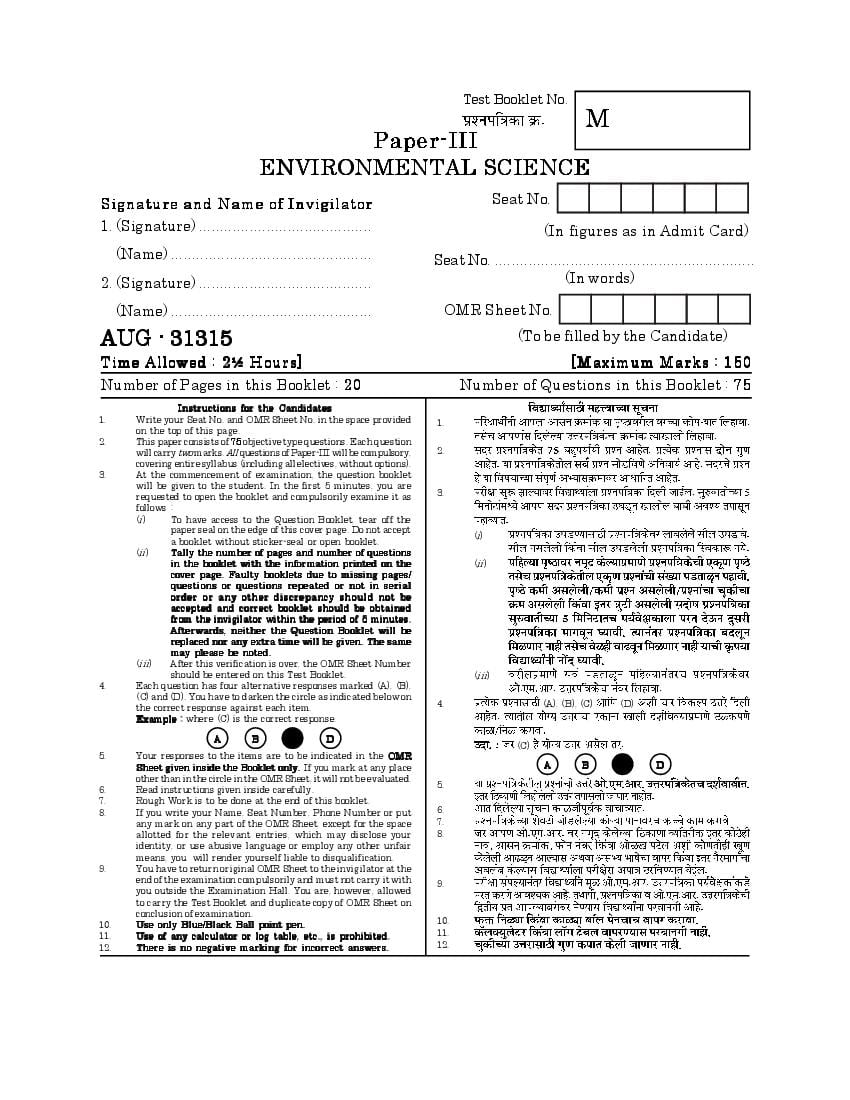
M
ENVIRONMENTAL SCIENCE
Signature and Name of Invigilator Seat No.
1. (Signature) ......................................... (In figures as in Admit Card)
(Name) ................................................ Seat No. ..............................................................
2. (Signature) ......................................... (In words)
(Name) ................................................ OMR Sheet No.
AUG - 31315 (To be filled by the Candidate)
Time Allowed : 2½ Hours] [Maximum Marks : 150
Number of Pages in this Booklet : 20 Number of Questions in this Booklet : 75
Instructions for the Candidates
1. Write your Seat No. and OMR Sheet No. in the space provided 1.
on the top of this page.
2. This paper consists of 75 objective type questions. Each question
will carry two marks. All questions of Paper-III will be compulsory, 2.
covering entire syllabus (including all electives, without options).
3. At the commencement of examination, the question booklet
will be given to the student. In the first 5 minutes, you are
requested to open the booklet and compulsorily examine it as 3.
follows :
(i) To have access to the Question Booklet, tear off the
paper seal on the edge of this cover page. Do not accept
(i)
a booklet without sticker-seal or open booklet.
(ii) Tally the number of pages and number of questions
in the booklet with the information printed on the (ii)
cover page. Faulty booklets due to missing pages/
questions or questions repeated or not in serial
o rder or any other discre pancy should not be
accepted and correct booklet should be obtained
from the invigilator within the period of 5 minutes.
Afterwards, neither the Question Booklet will be
replaced nor any extra time will be given. The same
may please be noted.
(iii) After this verification is over, the OMR Sheet Number
should be entered on this Test Booklet. (iii)
4. Each question has four alternative responses marked (A), (B),
(C) and (D). You have to darken the circle as indicated below on
the correct response against each item. 4. (A), (B), (C) (D)
Example : where (C) is the correct response.
A B D
(C)
5. Your responses to the items are to be indicated in the OMR
Sheet given inside the Booklet only. If you mark at any place A B D
other than in the circle in the OMR Sheet, it will not be evaluated.
5.
6. Read instructions given inside carefully.
7. Rough Work is to be done at the end of this booklet.
8. If you write your Name, Seat Number, Phone Number or put 6.
any mark on any part of the OMR Sheet, except for the space 7.
allotted for the relevant entries, which may disclose your 8.
identity, or use abusive language or employ any other unfair
means, you will render yourself liable to disqualification.
9. You have to return original OMR Sheet to the invigilator at the
end of the examination compulsorily and must not carry it with 9.
you outside the Examination Hall. You are, however, allowed
to carry the Test Booklet and duplicate copy of OMR Sheet on
conclusion of examination.
10. Use only Blue/Black Ball point pen. 10.
11. Use of any calculator or log table, etc., is prohibited. 11.
12. There is no negative marking for incorrect answers. 12.
Page 2
Page 3
Paper III
Time Allowed : 2½ Hours] [Maximum Marks : 150
Note : This Paper contains Seventy Five (75) multiple choice questions, each
question carrying Two (2) marks. Attempt All questions.
1. Ozone layer is found in the : 3. The unit of pressure ‘hPa’ commonly
used in meteorology is equal to :
(A) Ionosphere
(A) 1 dyne/cm2
(B) Troposphere
(B) 1 dyne/m2
(C) Mesosphere
(C) 100 dyne/m2
(D) Stratosphere
(D) 1000 dyne/cm2
2. The value of environmental lapse
4. Tropopause is at its highest level
rate is :
at :
(A) ~10°C per km
(A) Poles
(B) ~6°C per km
(B) Equator
(C) ~1°C per km (C) Subtropics
(D) ~4°C per km (D) Mid-latitude
3 [P.T.O.
Page 4
5. How many agreements are there in
and animals are only .................. years
Agenda 21 ? old and if these were the remains of
the original living organisms, the
(A) 2 planet would have been lifeless for
almost .................... years.
(B) 5
(A) 0.6-0.7; 4.0 billion
(C) 6 (B) 0.5-0.6; 3.0 billion
(C) 0.4-0.5; 2.0 billion
(D) 7
(D) 0.3-0.4; 1.0 billion
6. Darwin’s finches are a good 8. Which of the following air
pollutant(s) is (are) mainly
example of :
responsible for poor air quality
at most of the Indian sites ?
(A) Convergent evolution
(A) Carbon soot
(B) Industrial menalism
(B) Atmospheric dust
(C) Connecting link (C) Carbon soot + atmospheric
dust
(D) Adaptive radiation
(D) CO2
4
Page 5
rice sheath blight pathogen, analysis of metals is :
Pellicularia sasakii ? (A) Ion chromatography
(A) Polyoxin D
(B) Atomic absorption spectroscopy
(B) Polyoxin B
(C) Mass spectrometry
(C) Polyoxin L
(D) Titrimetry
(D) Polyoxin
12. A radioactive sample shows an
10. Acetylene reduction technique is an activity of 40,000 cpm. What will be
important assay to measure : its activity after four half lives ?
(A) Rate of phosphate solubilization (A) 10,000
(B) Rate of Nitrogen fixation (B) 4,000
(C) Rate of Carbon fixation (C) 2,500
(D) Rate of photosynthesis (D) 2,000
5 [P.T.O.
Page 6
of the globe, rain water in India has only one element ?
an excess of : (A) Sand
(A) Chloride (B) Marble
(B) Calcium (C) Glass
(D) Diamond
(C) Sodium
16. Carrying capacity is :
(D) Methyl sulphonic acid
(A) prevention of population
14. Which of the following is correct
explosion
order with respect to solubility
(B) the maximum number of
product ?
organisms that a habitat can
(A) AgI < AgBr < AgCl
sustain
(B) AgI > AgBr > AgCl
(C) the limiting factors existing in
(C) AgI < AgCl < AgBr an ecosystem
(D) AgI > AgCl > AgBr (D) the upper limit of J curve
6
Page 7
plants in any ecosystem is :
an abiotic component of the
(A) Glucose
ecosystem ?
(B) Sunlight
(A) Bacteria
(C) ATP
(B) Plants
(D) Protein
(C) Fungi
20. The largest number of species on
(D) Humus earth belongs to :
18. The total biomass of any organism (A) Fungi
is determined by the nutrients (B) Angiosperms
present in the minimum (C) Insects
concentration in relation to the (D) Crustaceans
requirements of that organism, 21. The commonly used medium for
known as : submerged bacterial fermentation at
commercial scale is :
(A) Liebig’s law of the minimum
(A) Molasses
(B) Shelford’s law of tolerance
(B) Liver extract
(C) Liebig’s law of tolerance
(C) Germinated seed
(D) Shelford’s law of minimum (D) Peptone
7 [P.T.O.
Page 8
interacting systems of : system is also known as a Blue
Planet.
(A) Individuals
(A) Venus
(B) Populations
(B) Jupiter
(C) Communities and their soils
(C) Earth
(D) Biotic and abiotic components
(D) Mars
23. GIS and remote sensing are very
26. Which one of the following is
useful to analyse : an example for assessing Land
(A) Quality of life quality ?
(B) Spatio-temporal data (A) Fauna
(B) Sulfur
(C) Behavioral pattern of flora and
fauna (C) Slope
(D) Sound-economic data (D) Community
27. Vegetation cover has maximum
24. The earth’s atmosphere is divided
reflectance level in which one of
into layers based on the vertical
the following electromagnetic
profile of :
radiation spectrum ?
(A) Air pressure
(A) Middle infrared
(B) Air temperature
(B) Visible
(C) Air density (C) Near infrared
(D) Wind speed and direction (D) Ultraviolet
8
Page 9
hazards during winter ? fossil fuel affect largely :
(A) Floods (A) Sulphur cycle
(B) Fog and coldwave (B) Nitrogen cycle
(C) Tropical cyclones (C) Carbon cycle
(D) Dust storms (D) Water cycle
29. Salinity of sea water depends upon
32. The rich source of energy that
evaporation and precipitation
never causes atmospheric pollution
difference. Thus it is highest near :
is :
(A) Poles
(A) Nuclear energy
(B) Equator
(B) Solar energy
(C) Subtropics
(C) Fossil fuel
(D) Mid-latitudes
(D) Biomass energy
30. GIS is an efficient tool for :
33. A photovoltaic cell is not limited in
(A) analysing spatial and aspatial
efficiency by :
data
(A) top surface emissivity
(B) analysing attribute data only
(B) quantum efficiency
(C) manipulating behaviour of
(C) excess photon energy
flora and fauna
(D) top surface reflection
(D) assessing ecological pyramids
9 [P.T.O.
Page 10
a mixture of : (A) Nuclear fission reactions
(A) Petrol and Diesel (B) Nuclear fusion reactions
(B) Petrol and Methane (C) Physical melting
(C) Petrol and Alcohol (D) Atomic collision
(D) Petrol and Kerosene 38. In a typical sewage treatment plant
35. Greenhouse gases usually comprise : the following is the flow diagram of
the plant :
(A) CO2 only
(A) Collection Pre-treatment
(B) CH4 only
Secondary Treatment
(C) CH 4, CO 2 mainly and NOx
Disinfection
slightly
(B) Collection Pre-treatment
(D) CH4 and CO2 only
Primary Treatment
36. The optimum range of wind
Disinfection
speed for generating energy with
(C) Collection Pre-treatment
windmills is :
Primary Treatment
(A) 5 to 30 km/hr
Secondary Treatment
(B) 5 to 20 km/sec Disinfection
(C) 0 to 10 km/sec (D) Collection Primary
(D) 0 to 20 km/hr Treatment Disinfection
10
Page 11
accumulation of intracellular uptake
often expressed in unit of dB(A).
and storage by microorganisms is
What does ‘A’ refer to ?
mainly due to :
(A) frequency weighting
(A) Active cation transport system
(B) amplitude weighting
(B) Passive cation transport system
(C) phase weighting (C) Active anion transport system
(D) category of noise zone (D) Passive anion transport system
40. Indicator used in hardness 42. Air pollutants are toxic to plants in
the following ascending order of
measurement of water is :
severeness :
(A) Methyl orange
(A) SO2, NO2, HF, CO
(B) Eriochrome black
(B) NO2, HF, CO, SO2
(C) Phenolphthalein
(C) CO, NO2, SO2, HF
(D) Potassium chromate (D) SO2, NO2, CO, HF
11 [P.T.O.
Page 12
wastewater treatment. UASB stands
ozone is :
for :
(A) SO2
(A) Urban Area Sewage Board
(B) NO2
(B) Upflow Anaerobic Sludge
(C) N2O Blanket
(D) H2S (C) Upflow Aerobic Sludge Blanket
(D) Urban Area Sludge Board
44. Fraction of atmospheric sulphur
contributed by the anthropogenic 47. Lichens indicate pollution by :
sources is : (A) Ozone
(B) SO2
(A) ~10%
(C) NO2
(B) ~25%
(D) CO
(C) ~75%
48. “The pollutants emitted to the
(D) ~99% atmosphere are uniformly mixed in
45. After N2 and O2, the third most a volume of air.” Which of the
following models is based on this
abundant gas found in the air is :
assumption ?
(A) CO 2
(A) Fugitive dust Model
(B) Ar
(B) Vossler Model
(C) He (C) Box Model
(D) CH4 (D) Screen Model
12
Page 13
Impact Assessment for policies for various developmental project is
programs and plan is :
carried out by a team of experts.
(A) Rapid Environmental Impact
Each expert member associated for
Assessment
EIA requires accrediation from :
(B) Short-run Environmental
(A) NEERI
Impact Assessment
(B) NABET/QCI
(C) Special Environmental Impact
Assessment (C) CPCB
(D) Strategic Environmental (D) SPCB
Impact Assessment
52. The secondary and tertiary impacts
50. Which of the following forms of land
of developmental action can be
degradation is dominently prevalent
addressed by :
in India ?
(A) Simple matrix
(A) Desertification
(B) Stepped or cross impact matrix
(B) Soil erosion
(C) Checklists
(C) Landslides
(D) Soil submergence (D) Overlay maps
13 [P.T.O.
Page 14
belts is often mitigated by treating
characteristic of hazardous waste ?
the land with :
(A) Urea (A) Toxicity
(B) Organic compost (B) Corrosivity
(C) Superphosphate
(C) Ignitability
(D) Calcium sulphate
(D) Porosity
54. Interpretation of the anticipated
impacts of any developmental 57. The emissions of air pollutants
project does not consider :
from automobiles were initially
(A) Individual species
regulated under :
(B) Characteristics of habitat
(A) The Air (Protection and Control
(C) Characteristics of ecosystem
of Pollution) Act, 1981
(D) Monetary cost of project
55. Natural decomposition of solid (B) The Environment (Protection)
waste is a :
Act, 1986
(A) Biodegradable process
(C) The Water (Protection and
(B) Pyrolysis
Control of Pollution) Act, 1974
(C) Carbonization
(D) Corrosion (D) Forest (Conservation) Act, 1980
14
Page 15
passed by Indian Government in (Conservation) Act was passed ?
confirmation to the United Nation’s (A) 1974
Conference ?
(B) 1981
(A) The Water (Prevention and
(C) 1980
Control of Pollution) Act, 1974
(D) 1986
(B) The Environment (Protection)
61. In order to cover the areas not
Act, 1986
covered by other laws regarding
(C) The Air (Prevention and
environmental pollution in the wake
Control of Pollution) Act, 1981
of Bhopal Tragedy, the notable
(D) The Indian Forest Act, 1927 legislation passed in India is :
59. All the members of a State Pollution (A) The Wildlife (Protection) Act,
Control Board except the member- 1972
secretary can hold the office for a
(B) The Environmental (Protection)
term of :
Act, 1986
(A) Six years
(C) The Water (Prevention and
(B) Three years Control of Pollution) Act, 1974
(C) Four years (D) The Air (Prevention and
(D) Five years Control of Pollution) Act, 1981
15 [P.T.O.
Page 16
with the growth rate of 2% per expressed in terms of normalized
x
parameter z = ; where symbols
year. After how many years it will 2
have their usual meaning. The
double ?
standard deviation of such a
(A) ~25 years
distribution, (z) is :
(B) ~70 years
(A) 2
(C) ~35 years (B) 0.5
(D) ~30 years (C) 1.0
63. A Log-Normal distribution has a (D) 0
mean of 5 and standard deviation 65. The eigenvalues of the matrix
of 2. Its ~67% of the area under the 2 1
curve is between the values of the 1 2
variable lying between :
are :
(A) 3 and 7
(A) 1 and 0
(B) 2.5 and 10 (B) 2 and 0
(C) 1.25 and 20 (C) 1 and 2
(D) 1 and 9 (D) 1 and 3
16
Page 17
natural gas is :
Y = + x + ;
(A) Methane
the expectation value of the random
(B) Ethane
error term < > is :
(C) Propane
(A) 0 (D) Butane
(B) ; is standard deviation 69. ‘Ozone hole’ over Antarctica is seen
during :
(C) 2
(A) September—November
(D) 2
(B) July—August
67. In a multiple regression analysis, (C) May—June
the explained variance per degree (D) December—January
of freedom is found to be 100 and 70. Carbon intensity of a country is a
the unexplained variance per degree measure of :
of freedom is 20. The value of (A) Carbon dioxide emissions per
unit GDP
F-statistic will be :
(B) Carbon dioxide emissions per
(A) 5
unit electrical energy produced
(B) 0.2 (C) Carbon dioxide emissions per
unit area per year
(C) 80
(D) Carbon dioxide emissions
(D) 120 produced per person
17 [P.T.O.
Page 18
to CO2) of N2O over a time horizon
Dobson unit. One Dobson unit
of 20 years is :
represents a layer of ozone around
(A) 100
the earth which at standard
(B) 280
(C) 170 atmospheric pressure ?
(D) 25 (A) 1 mm thick
72. Grazing cattle suffer mottling of
(B) .1 mm thick
teeth due to emission of ....................
from a factory in the neighbourhood. (C) .3 mm thick
(A) Chlorides
(D) 0.01 mm thick
(B) Fluorides
75. Soil salinity is caused mainly due
(C) Ammonia
to excess concentration of .................
(D) Benzene
in black cotton soil.
73. One of the following waste is not
classified as hazardous waste : (A) Sodium
(A) Electronic waste
(B) Calcium
(B) Chemical waste
(C) Magnesium
(C) Biomedical waste
(D) Kitchen waste (D) Potassium
18
Page 19
19 [P.T.O.
Page 20
20
Document Details
| Board / Org | Maharashtra Exams |
| Exam | MAHA SET |
| Type | Question Paper |
| Pages | 20 |
| Updated | 30 Apr 2026 |