GATE 2025 Syllabus for Life Sciences
Finished viewing? Save it for later —
Download GATE 2025 Syllabus for Life Sciences (PDF · 11 pages)About GATE 2025 Syllabus for Life Sciences
GATE 2025 Syllabus for Life Sciences is available here for free download. Published by IIT for GATE, this syllabus can be viewed online or downloaded as a PDF (11 pages). Candidates preparing for GATE can use GATE 2025 Syllabus for Life Sciences to understand the exam pattern, the type of questions asked, and the overall difficulty level.
Frequently Asked Questions
How can I download GATE 2025 Syllabus for Life Sciences?
Open this page and click the Download button to save GATE 2025 Syllabus for Life Sciences as a PDF. It is completely free on AglaSem Docs.
Is GATE 2025 Syllabus for Life Sciences free to download?
Yes. GATE 2025 Syllabus for Life Sciences can be viewed online and downloaded as a PDF free of cost on AglaSem Docs.
How many pages does GATE 2025 Syllabus for Life Sciences have?
GATE 2025 Syllabus for Life Sciences contains 11 pages, which you can read online or download together as a single PDF.
Where can I find more GATE study material?
You can find more GATE question papers, sample papers, syllabus, and answer keys on AglaSem Docs.
GATE 2025 Syllabus for Life Sciences – Text
Read the full text of this syllabus below — useful to quickly search, copy and reference the content online without downloading the PDF.
📄 View text version (11 pages)
Page 1
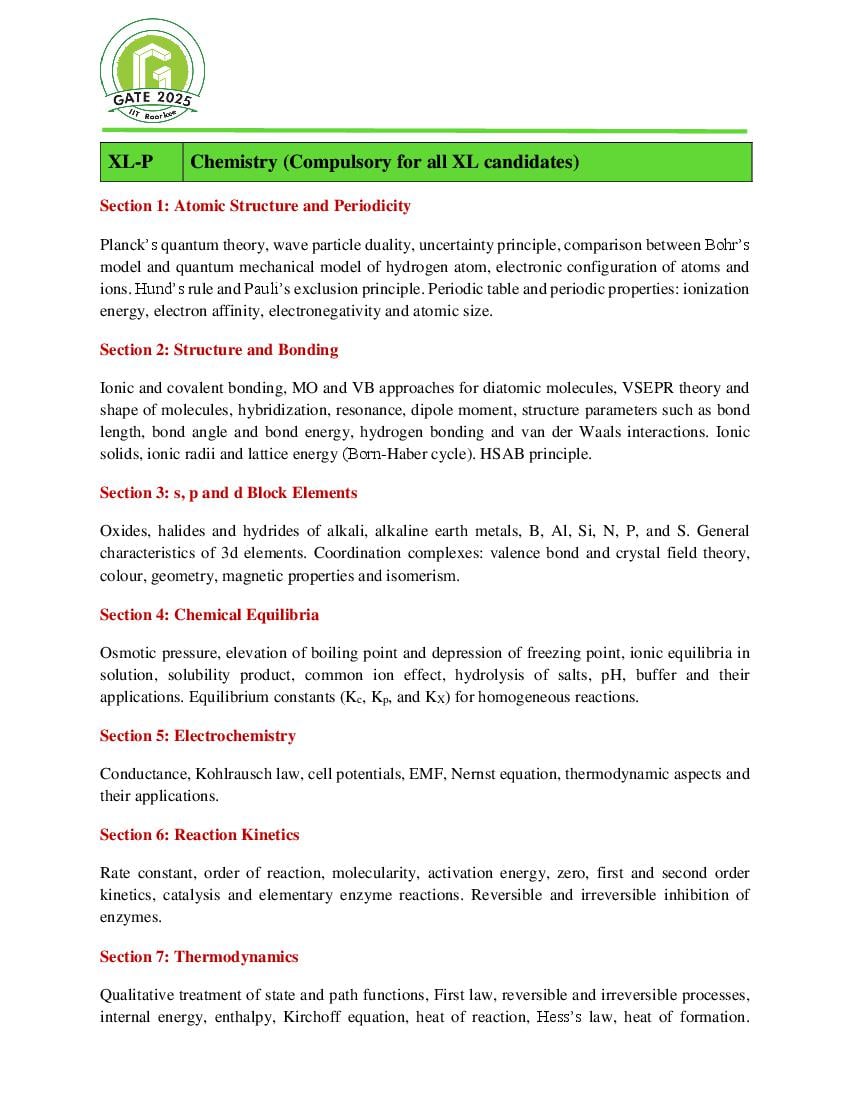
Section 1: Atomic Structure and Periodicity
Planck’s quantum theory, wave particle duality, uncertainty principle, comparison between Bohr’s
model and quantum mechanical model of hydrogen atom, electronic configuration of atoms and
ions. Hund’s rule and Pauli’s exclusion principle. Periodic table and periodic properties: ionization
energy, electron affinity, electronegativity and atomic size.
Section 2: Structure and Bonding
Ionic and covalent bonding, MO and VB approaches for diatomic molecules, VSEPR theory and
shape of molecules, hybridization, resonance, dipole moment, structure parameters such as bond
length, bond angle and bond energy, hydrogen bonding and van der Waals interactions. Ionic
solids, ionic radii and lattice energy (Born‐Haber cycle). HSAB principle.
Section 3: s, p and d Block Elements
Oxides, halides and hydrides of alkali, alkaline earth metals, B, Al, Si, N, P, and S. General
characteristics of 3d elements. Coordination complexes: valence bond and crystal field theory,
colour, geometry, magnetic properties and isomerism.
Section 4: Chemical Equilibria
Osmotic pressure, elevation of boiling point and depression of freezing point, ionic equilibria in
solution, solubility product, common ion effect, hydrolysis of salts, pH, buffer and their
applications. Equilibrium constants (Kc, Kp, and KX) for homogeneous reactions.
Section 5: Electrochemistry
Conductance, Kohlrausch law, cell potentials, EMF, Nernst equation, thermodynamic aspects and
their applications.
Section 6: Reaction Kinetics
Rate constant, order of reaction, molecularity, activation energy, zero, first and second order
kinetics, catalysis and elementary enzyme reactions. Reversible and irreversible inhibition of
enzymes.
Section 7: Thermodynamics
Qualitative treatment of state and path functions, First law, reversible and irreversible processes,
internal energy, enthalpy, Kirchoff equation, heat of reaction, Hess’s law, heat of formation.
Page 2
spontaneity, Free energy changes from equilibrium constant.
Section 8: Structure-Reactivity Correlations and Organic Reaction Mechanisms
Acids and bases, electronic and steric effects, Stereochemistry, optical and geometrical isomerism,
tautomerism, conformers and concept of aromaticity. Elementary treatment of SN1, SN2, E1, E2
and radical reactions, Hoffmann/Saytzeff rules, addition reactions, Markownikoff rule and
Kharasch effect. Elementary hydroboration reactions. Grignard’s reagents and their uses.
Aromatic electrophilic substitutions, orientation effect as exemplified by various functional
groups. Identification of common functional groups by chemical tests.
Section 9: Chemistry of Biomolecules
Amino acids, proteins, nucleic acids and nucleotides. Peptide sequencing by chemical and
enzymatic proteolytic methods. DNA sequencing by chemical and enzymatic methods.
Carbohydrates (upto hexoses only). Lipids (triglycerides only). Principles of biomolecule
purification-Ion exchange and gel filtration chromatography. Identification of these biomolecules
and Beer-Lambert’s law.
Page 3
Section 1
Organization of life; Importance of water; Structure and function of biomolecules: Amino acids,
Carbohydrates, Lipids, Proteins and Nucleic acids; Protein structure, folding/misfolding and
function; Myoglobin, Hemoglobin, Lysozyme, Ribonuclease A, Carboxypeptidase and
Chymotrypsin.
Section 2
Enzyme kinetics, regulation and inhibition; Vitamins and Coenzymes; Bioenergetics and
metabolism; Generation and utilization of ATP; Metabolic pathways and their regulation:
glycolysis, TCA cycle, pentose phosphate pathway, oxidative phosphorylation, gluconeogenesis,
glycogen and fatty acid metabolism; Metabolism of Nitrogen containing compounds: nitrogen
fixation, amino acids and nucleotides. Photosynthesis, Calvin cycle.
Section 3
Biochemical separation techniques: Ion exchange, size exclusion and affinity chromatography,
centrifugation; Characterization of biomolecules by electrophoresis; DNA- protein and protein –
protein interactions; UV-visible and fluorescence spectroscopy; Mass spectrometry.
Section 4
Cell structure and organelles; Biological membranes; Action potential; Transport across
membranes; Membrane assembly and Protein targeting; Signal transduction; Receptor-ligand
interaction; Hormones and neurotransmitters.
Section 5
DNA replication, transcription and translation; DNA damage and repair; Biochemical regulation
of gene expression; Recombinant DNA technology and applications: PCR, site directed
mutagenesis, DNA-microarray; Next generation sequencing; Gene silencing and editing.
Section 6
Immune System: Innate and adaptive; Cell of the immune system; Active and passive immunity;
Complement system; Antibody structure, function and diversity; B cell and T Cell receptors; B
cell and T cell activation; Major histocompatibilty complex; Immunological techniques: Immuno
diffusion, immune-electrophoresis, RIA and ELISA, flow cytometry; monoclonal antibodies and
their applications.
Page 4
Section 1: Plant Systematics
Botanical nomenclature, history of plant taxonomy, diversity and classification of plants, APG
system of plant classification; phylogenetics and cladistics, molecular taxonomy and DNA
barcoding; Centers for plant taxonomy and herbaria in India.
Section 2: Plant Anatomy
Anatomy of root, stem and leaves, floral organs, embryo and young seedlings, Primary and
secondary meristems, stellar organization, vascular system and their ontogeny, xylem and phloem
structure, secondary growth in plants and wood anatomy, plant cell structure and differences from
animal cells.
Section 3: Plant Development; Cell and Tissue Morphogenesis
Life cycle of an angiosperm, development of male and female gametophyte; cell fate determination
and tissue patterning; spacing mechanisms in trichomes and stomata. Embryogenesis,
organization and function of shoot and root apical meristems. Transition to flowering:
photoperiodism and vernalization, ABC model of floral organ patterning, pollen germination,
double fertilization, seed development; Xylem and phloem cell differentiation,
photomorphogenesis; phytochrome, cryptochrome, phototropin. Role of auxin, cytokinin,
gibberellins, and brassinosteroids on plant development.
Section 4: Plant Physiology and Biochemistry
Plant water relations, mechanisms of uptake and transport of water, ions, solutes from soil to
plants, apoplastic and symplastic transport mechanisms. Mechanism of stomatal movements,
nitrogen metabolism, photosynthesis; C3, C4 and CAM cycles, photorespiration, respiration:
glycolysis, TCA cycle and electron transport chain. Plant responses and mechanisms of abiotic
stresses including drought, salinity, freezing and heat stress, metal toxicity; role of abscisic acid in
abiotic stresses. Structure and function of biomolecules (proteins, carbohydrates, lipids, nucleic
acid), enzyme kinetics. Structure and biosynthesis of major plant secondary metabolites (alkaloids,
terpenes, phenylpropanoids, flavonoids). Biosynthesis, mechanism of action and physiological
effects of auxin, cytokinin, gibberellic acids, brassinosteroid, ethylene, strigolactone, abscisic acid,
salicylic and jasmonic acid. Senescence and programmed cell death.
Section 5: Genetics and Genomics
Cell cycle and cell division. Principles of Mendelian inheritance, linkage, recombination, genetic
mapping; extra chromosomal inheritance; Introduction to epigenetics; gene silencing- transgene
Page 5
eukaryotic genome structure, gene expression, gene mutation and repair, chromosomal aberrations
(numerical: euploidy and aneuploidy and structural: deletion, duplication, inversion,
translocation), transposons. Model organisms for functional genetics and genomics; Introduction
to transcriptomics, proteomics and metabolomics.
Section 6: Plant Breeding, Genetic Modification, Genome Editing
Principles, methods – selection, hybridization, heterosis; male sterility, genetic maps and
molecular markers, embryo rescue, haploid and doubled haploids, plant tissue culture:
micropropagation, embryo culture and in vitro regeneration, somatic embryogenesis, artificial
seed, cryopreservation, somaclonal variation, somatic cell hybridization, marker-assisted
selection, gene transfer methods viz. direct and vector-mediated, generation of transgenic plants;
Introduction to genome editing: CRISPR/Cas9, Cre-Lox system to generate chimeras; plastid
transformation; chemical mutagenesis.
Section 7: Economic and Applied Botany
A general account of economically and medicinally important plants- cereals, pulses, plants
yielding fibers, timber, sugar, beverages, oils, rubber, pigments, dyes, gums, drugs and narcotics.
Economic importance of algae, fungi, lichen and bacteria. Major Indian cash crops. Effect of
industrialization on agricultural botany such as plastic on fiber economy. Genetically modified
crops and its regulation, e.g. Bt cotton, Bt brinjal, golden rice etc.
Section 8: Plant Pathology
Nature and classification of plant diseases, diseases of important crops caused by fungi, bacteria,
nematodes and viruses, and their control measures (chemical and biological) mechanism(s) of
pathogenesis, resistance: basal, systemic, induced systemic resistance, gene for gene concept.
Molecular detection of pathogens; plant-microbe interactions: symbionts and mycorrhiza,
pathogens and pests. Signaling pathways in plant defence response; salicylic acid (SA) and
jasmonic acid (JA) in plant-pathogen and plant-herbivore interaction, necrosis; host-parasitic plant
interaction (such as Cuscuta).
Section 9: Ecology and Environment
Ecosystems – types, dynamics, degradation, biogeochemical cycles, ecological succession; food
webs and energy flow through ecosystem; vegetation types of the world, Indian vegetation types
and biogeographical zones, climate and flora endemism; pollution and global climate change,
speciation and extinction, biodiversity and conservation strategies, ecological hotspots,
afforestation, habitat restoration; plant interactions with other organisms; epiphytes, parasites and
endophytes.
Page 6
Section 1: Historical Perspective
Discovery of microbial world; Landmark discoveries relevant to the field of microbiology;
Controversy over spontaneous generation; Role of microorganisms in transformation of organic
matter and in the causation of diseases.
Section 2: Methods in Microbiology
Pure culture techniques; Principles of microbial nutrition; Enrichment culture techniques for
isolation of microorganisms; antigen and antibody detection methods for microbial diagnosis;
Light-, phase contrast-, fluorescence- and electron-microscopy; PCR, real-time PCR for
quantitation of microbes; Next generation sequencing technologies in microbiology.
Section 3: Microbial Taxonomy and Diversity
Bacteria, Archea and their broad classification; Eukaryotic microbes: Yeasts, molds and protozoa;
Viruses and their classification; Molecular approaches to microbial taxonomy and phylogeny.
Section 4: Prokaryotic Cells: Structure and Function
Prokaryotic Cells: Cell walls, cell membranes and their biosynthesis, mechanisms of solute
transport across membranes, Flagella and Pili, Capsules, Cell inclusions like endospores and gas
vesicles; Bacterial locomotion, including positive and negative chemotaxis.
Section 5: Microbial Growth
Definition of growth; Growth curve; Mathematical expression of exponential growth phase;
Measurement of growth and growth yields; Synchronous growth; Continuous culture; Effect of
environmental factors on growth; Bacterial biofilm and biofouling.
Section 6: Control of Micro-organisms
Disinfection and Sterilization: Principles, methods and assessment of efficacy.
Section 7: Microbial Metabolism
Energetics: redox reactions and electron carriers; Electron transport and oxidative
phosphorylation; An overview of metabolism; Glycolysis; Pentose-phosphate pathway; Entner-
Doudoroff pathway; Glyoxalate pathway; The citric acid cycle; Fermentation; Aerobic and
anaerobic respiration; Chemolithotrophy; Photosynthesis; Calvin cycle; Biosynthetic pathway for
Page 7
major metabolic pathways.
Section 8: Microbial Diseases and Host Pathogen Interaction
Normal microbiota; Classification of infectious diseases; Reservoirs of infection; Nosocomial
infection; Opportunistic infections; Emerging infectious diseases; Mechanism of microbial
pathogenicity; Nonspecific defense of host; Antigens and antibodies; Humoral and cell mediated
immunity; Vaccines; passive immunization; Immune deficiency; Human diseases caused by
viruses, bacteria, and pathogenic fungi.
Section 9: Chemotherapy/Antibiotics
General characteristics of antimicrobial drugs; Antibiotics: Classification molecular mechanism
of mode of action and resistance; Antifungal and antiviral drugs.
Section 10: Microbial Genetics
Types of mutation; UV and chemical mutagens; Selection of mutants; Ames test for mutagenesis;
Bacterial genetic system: transformation, conjugation, transduction, recombination, plasmids,
transposons; DNA repair; Regulation of gene expression: repression and induction; Operon model;
Bacterial genome with special reference to E.coli; Phage λ and its life cycle; RNA ; mutation in
virus genomes, virus recombination and reassortment; Basic concept of microbial genomics.
Section 11: Microbial Ecology
Microbial interactions; Carbon, sulphur and nitrogen cycles; Soil microorganisms associated with
vascular plants; Bioremediation; Uncultivable microorganisms; basic concept of metagenomics
and metatranscriptomics.
Page 8
Section 1: Animal Diversity
Distribution, systematics and classification of animals, phylogenetic relationships (based on
classical and molecular phylogenetic tools).
Section 2: Evolution
Origin and history of life on earth, theories of evolution, natural selection, adaptation, speciation.
Section 3: Genetics
Basic Principles of inheritance, molecular basis of heredity, sex determination and sex-linked
characteristics, cytoplasmic inheritance, linkage, recombination and mapping of genes in
eukaryotes, population genetics, genetic disorders, roles of model organisms in understanding
genetic principles.
Section 4: Biochemistry and Molecular Biology
Nucleic acids, proteins, lipids and carbohydrates; replication, transcription and translation, Krebs
cycle, glycolysis, enzyme catalysis, hormones and their actions, roles of vitamins and minerals.
Section 5: Cell Biology
Basic principles of cellular microscopy, structure of cell, cytoskeletal organization, cellular
organelles and their structure and function, cell cycle, cell division, chromosomes and chromatin
structure.
Section 6: Gene expression in Eukaryotes
Eukaryotic genome organization and regulation of gene expression, transposable elements.
Section 7: Animal Anatomy and Physiology
Comparative physiology, the respiratory system, Muscular system, circulatory system, digestive
system, the nervous system, the excretory system, the endocrine system, the reproductive system,
the skeletal system.
Section 8: Parasitology and Immunology
Nature of parasite, host-parasite relation, protozoan and helminthic parasites, the immune
response, cellular and humoral immune response.
Page 9
Gametogenesis, Embryonic development, cellular differentiation, organogenesis, metamorphosis,
Model organisms used in developmental biology, genetic and molecular basis of development,
stem cells.
Section 10: Ecology
The ecosystem, Animal distribution, ecological niche and its contribution to ecological diversity,
the food chain, population dynamics, species diversity, zoogeography, biogeochemical cycles,
conservation biology, ecotoxicology.
Section 11: Animal Behaviour
Type of behaviours, courtship, mating and territoriality, instinct, learning and memory, social
behaviour across the animal taxa, communication, pheromones, evolution of behavior in animals.
Page 10
Section 1: Food Chemistry and Nutrition
Carbohydrates: Structure and functional properties of mono-, oligo-, & poly- saccharides including
starch, cellulose, pectic substances and dietary fibre, gelatinization and retrogradation of starch.
Proteins: classification and structure of proteins in food, biochemical changes in post mortem and
tenderization of muscles. Lipids: classification and structure of lipids, rancidity, polymerization
and polymorphism. Pigments: carotenoids, chlorophylls, anthocyanins, tannins and myoglobin.
Food flavours: terpenes, esters, aldehydes, ketones and quinines. Enzymes: specificity, simple and
inhibition kinetics, coenzymes, enzymatic and non- enzymatic browning. Nutrition: balanced diet,
essential amino acids and essential fatty acids, protein efficiency ratio, water soluble and fat
soluble vitamins, role of minerals in nutrition, co-factors, anti-nutrients, nutraceuticals, nutrient
deficiency diseases. Chemical and biochemical changes: changes occur in foods during different
processing.
Section 2: Food Microbiology
Characteristics of Microorganisms: Morphology of bacteria, yeast, mold and actinomycetes,
spores and vegetative cells, gram-staining. Microbial growth: growth and death kinetics, serial
dilution technique. Food spoilage: spoilage microorganisms in different food products including
milk, fish, meat, egg, cereals and their products. Toxins from microbes: pathogens and non-
pathogens including Staphylococcus, Salmonella, Shebelle, Escherichia, Bacillus, Clostridium,
and Aspergillums genera. Fermented foods and beverages: curd, yoghurt, cheese, pickles, soya-
sauce, sauerkraut, idly, dose, vinegar, alcoholic beverages and sausage.
Section 3: Food Products Technology
Processing Principles: Thermal processing, chilling, freezing, dehydration, addition of
preservatives and food additives, irradiation, fermentation, hurdle technology, intermediate
moisture foods. Food pack aging and storage: packaging materials, aseptic packaging, controlled
and modified atmosphere storage. Cereal processing and products: milling of rice, wheat, and
maize, parboiling of paddy, bread, biscuits, extruded products and ready to eat breakfast cereals.
Oil processing: expelling, solvent extraction, refining and hydrogenation. Fruits and vegetables
processing: extraction, clarification, concentration and packaging of fruit juice, jam, jelly,
marmalade, squash, candies, tomato sauce, ketchup, and puree, potato chips, pickles. Plantation
crops processing and products: tea, coffee, cocoa, spice, extraction of essential oils and oleoresins
from spices. Milk and milk products processing: pasteurization and sterilization, cream, butter,
ghee, ice- cream, cheese and milk powder. Processing of animal products: drying, canning, and
freezing of fish and meat; production of egg powder. Waste utilization: pectin from fruit astes,
uses of by-products from rice milling. Food standards and quality maintenance: FPO, PFA, A-
Mark, ISI, HACCP, food plant sanitation and cleaning in place (CIP).
Page 11
Mass and energy balance: Momentum transfer: Flow rate and pressure drop relationships for
Newtonian fluids flowing through pipe, Reynolds number. Heat transfer: heat transfer by
conduction, convection, radiation, heat exchangers. Mass transfer: molecular diffusion and Flick's
law, conduction and convective mass transfer, permeability through single and multilayer films.
Mechanical operations: size reduction of solids, high pressure homogenization, filtration,
centrifugation, settling, sieving, mixing & agitation of liquid. Thermal operations: thermal
sterilization, evaporation of liquid foods, hot air drying of solids, spray and freeze-drying, freezing
and crystallization. Mass transfer operations: psychometric, humidification and dehumidification
operations.
Document Details
| Board / Org | IIT |
| Exam | GATE |
| Type | Syllabus |
| Pages | 11 |
| Updated | 30 Apr 2026 |