NCERT Book Class 6 Social Science (History) Chapter 10 Buildings, Paintings and Books
Finished viewing? Save it for later —
Download NCERT Book Class 6 Social Science (History) Chapter 10 Buildings, Paintings and Books (PDF · 11 pages)About NCERT Book Class 6 Social Science (History) Chapter 10 Buildings, Paintings and Books
NCERT Book Class 6 Social Science (History) Chapter 10 Buildings, Paintings and Books is available here for free download. Published by NCERT for Class 6, this books can be viewed online or downloaded as a PDF (11 pages). Candidates preparing for Class 6 can use NCERT Book Class 6 Social Science (History) Chapter 10 Buildings, Paintings and Books to understand the exam pattern, the type of questions asked, and the overall difficulty level.
Frequently Asked Questions
How can I download NCERT Book Class 6 Social Science (History) Chapter 10 Buildings, Paintings and Books?
Open this page and click the Download button to save NCERT Book Class 6 Social Science (History) Chapter 10 Buildings, Paintings and Books as a PDF. It is completely free on AglaSem Docs.
Is NCERT Book Class 6 Social Science (History) Chapter 10 Buildings, Paintings and Books free to download?
Yes. NCERT Book Class 6 Social Science (History) Chapter 10 Buildings, Paintings and Books can be viewed online and downloaded as a PDF free of cost on AglaSem Docs.
How many pages does NCERT Book Class 6 Social Science (History) Chapter 10 Buildings, Paintings and Books have?
NCERT Book Class 6 Social Science (History) Chapter 10 Buildings, Paintings and Books contains 11 pages, which you can read online or download together as a single PDF.
Where can I find more Class 6 study material?
You can find more Class 6 question papers, sample papers, syllabus, and answer keys on AglaSem Docs.
NCERT Book Class 6 Social Science (History) Chapter 10 Buildings, Paintings and Books – Text
Read the full text of this books below — useful to quickly search, copy and reference the content online without downloading the PDF.
📄 View text version (1 page)
Page 1
BUILDINGS, PAINTINGS AND BOOKS
Marutasami and the iron pillar
Marutasami was so excited. His brother had propelled
his wheelchair all along the dusty, stony path, past the
Qutb Minar, and up the metal ramp. It had been tough,
but now he was here, in front of the famous iron pillar.
It was an unforgettable experience.
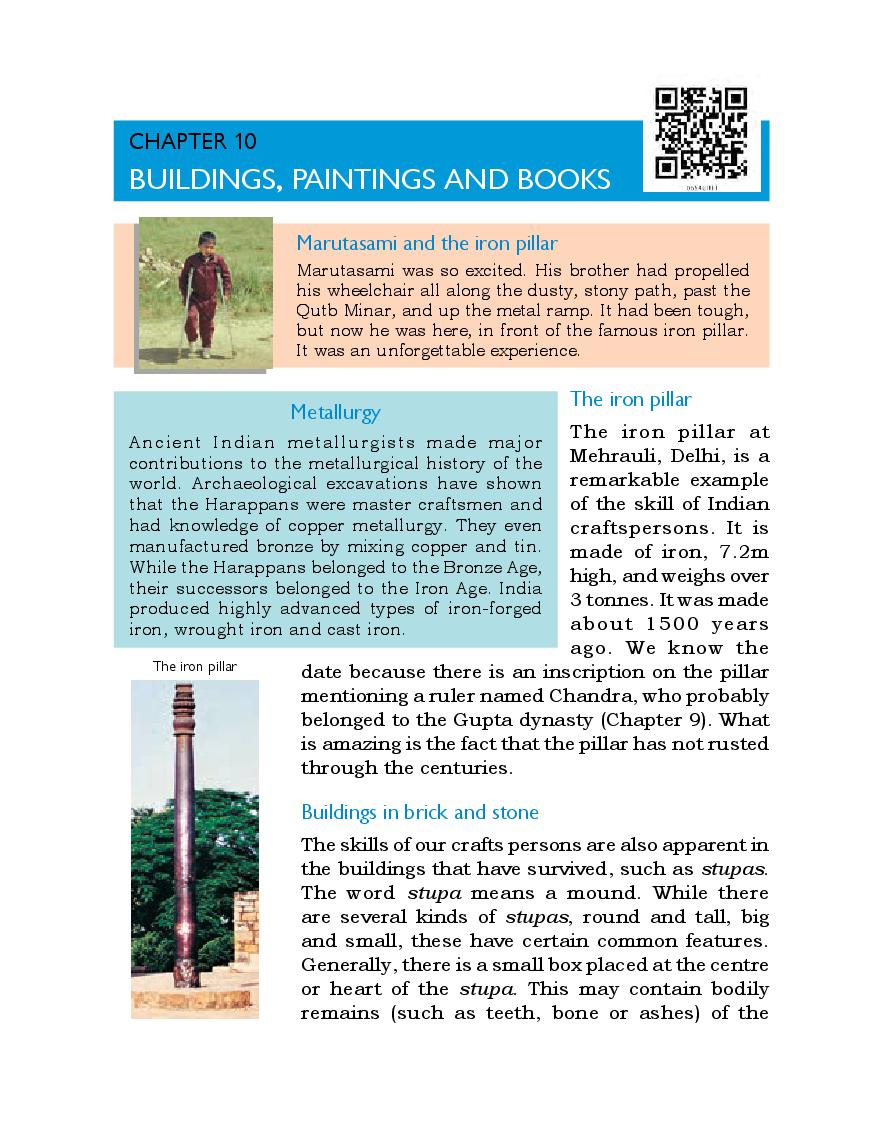
The iron pillar
Metallurgy
Ancient Indian metallurgists made major
The iron pillar at
contributions to the metallurgical history of the Mehrauli, Delhi, is a
world. Archaeological excavations have shown remarkable example
that the Harappans were master craftsmen and of the skill of Indian
had knowledge of copper metallurgy. They even craftspersons. It is
manufactured bronze by mixing copper and tin. made of iron, 7.2m
While the Harappans belonged to the Bronze Age,
high, and weighs over
their successors belonged to the Iron Age. India
produced highly advanced types of iron-forged 3 tonnes. It was made
iron, wrought iron and cast iron. about 1500 years
ago. We know the
The iron pillar date because there is an inscription on the pillar
mentioning a ruler named Chandra, who probably
belonged to the Gupta dynasty (Chapter 9). What
is amazing is the fact that the pillar has not rusted
through the centuries.
Buildings in brick and stone
The skills of our crafts persons are also apparent in
the buildings that have survived, such as stupas.
The word stupa means a mound. While there
are several kinds of stupas, round and tall, big
and small, these have certain common features.
Generally, there is a small box placed at the centre
or heart of the stupa. This may contain bodily
remains (such as teeth, bone or ashes) of the
Chapter 9-10.indd 96 22 April 2022 02:53:33
Showing the first page only. Download the PDF above for the complete document.
Document Details
| Board / Org | NCERT |
| Exam | Class 6 |
| Type | Books |
| Pages | 11 |
| Updated | 30 Apr 2026 |