MAHA SET 2024 Paper II Psychology Set A Question Paper
Finished viewing? Save it for later —
Download MAHA SET 2024 Paper II Psychology Set A Question Paper (PDF · 44 pages)About MAHA SET 2024 Paper II Psychology Set A Question Paper
MAHA SET 2024 Paper II Psychology Set A Question Paper is available here for free download. Published by Maharashtra Exams for MAHA SET, this question paper can be viewed online or downloaded as a PDF (44 pages). Candidates preparing for MAHA SET can use MAHA SET 2024 Paper II Psychology Set A Question Paper to understand the exam pattern, the type of questions asked, and the overall difficulty level.
Frequently Asked Questions
How can I download MAHA SET 2024 Paper II Psychology Set A Question Paper?
Open this page and click the Download button to save MAHA SET 2024 Paper II Psychology Set A Question Paper as a PDF. It is completely free on AglaSem Docs.
Is MAHA SET 2024 Paper II Psychology Set A Question Paper free to download?
Yes. MAHA SET 2024 Paper II Psychology Set A Question Paper can be viewed online and downloaded as a PDF free of cost on AglaSem Docs.
How many pages does MAHA SET 2024 Paper II Psychology Set A Question Paper have?
MAHA SET 2024 Paper II Psychology Set A Question Paper contains 44 pages, which you can read online or download together as a single PDF.
Where can I find more MAHA SET study material?
You can find more MAHA SET question papers, sample papers, syllabus, and answer keys on AglaSem Docs.
MAHA SET 2024 Paper II Psychology Set A Question Paper – Text
Read the full text of this question paper below — useful to quickly search, copy and reference the content online without downloading the PDF.
📄 View text version (45 pages)
Page 1
MAHA SET 2024 Paper
II Psychology Set A
Question Paper
EXAM YEAR TYPE
MAHA SET 2024 Question Paper
Notes · Sample Papers · Previous Year Papers · Mock Tests
Page 2
m .co
m .co s e m
se g l a
a
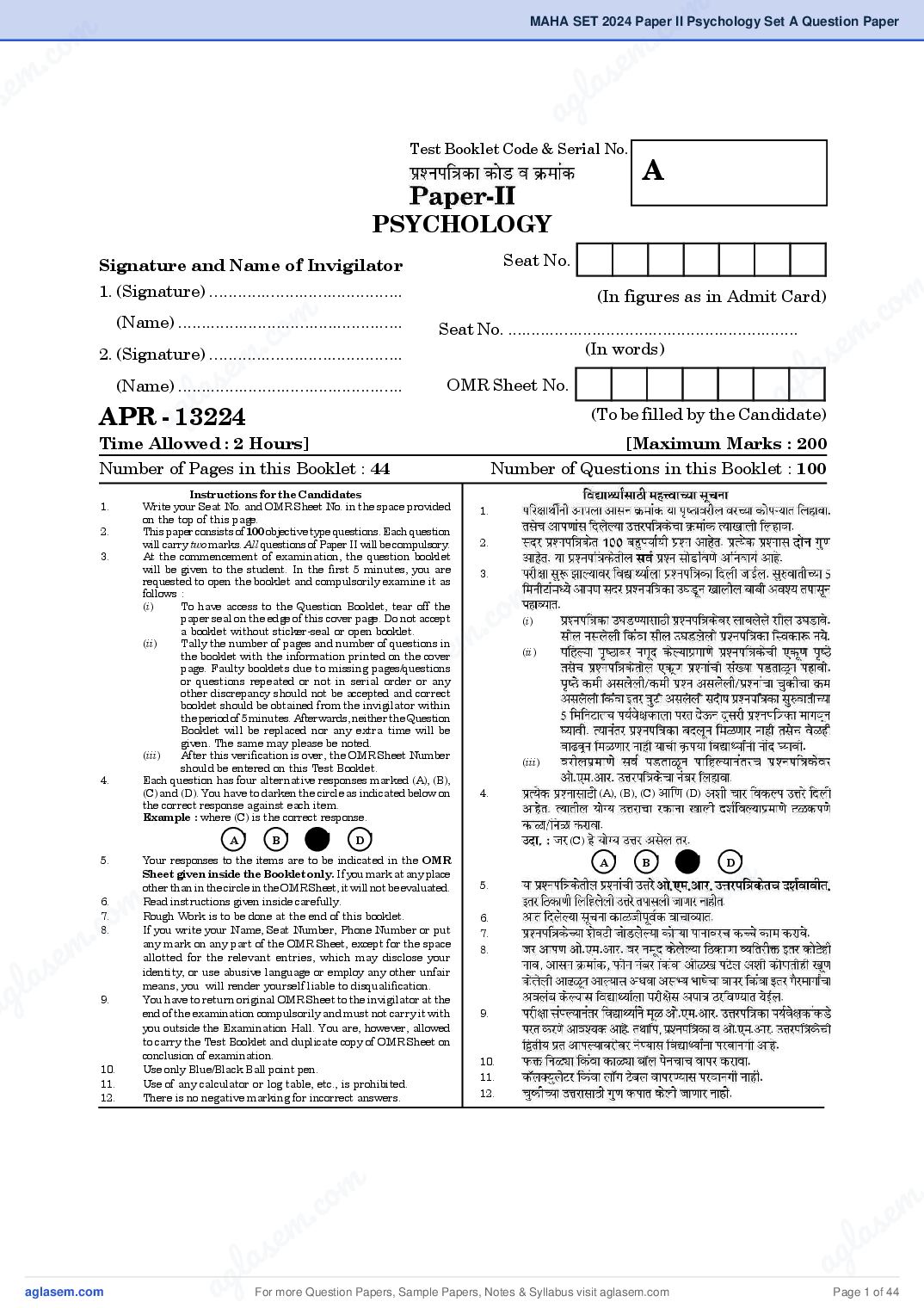
Test Booklet Code & Serial No.
A
PSYCHOLOGY
Signature and Name of Invigilator Seat No.
m
.co
1. (Signature) ......................................... (In figures as in Admit Card)
o m m
c
(Name) ................................................
.
Seat No. ..............................................................
m (In words)
s e
s e
2. (Signature) .........................................
g l a
gl a
(Name) ................................................ OMR Sheet No.
a
APR -a13224 (To be filled by the Candidate)
Time Allowed : 2 Hours] [Maximum Marks : 200
Number of Pages in this Booklet : 44 Number of Questions in this Booklet : 100
Instructions for the Candidates
1. Write your Seat No. and OMR Sheet No. in the space provided 1.
on the top of this page.
2. This paper consists of 100 objective type questions. Each question
will carry two marks. All questions of Paper II will be compulsory. 2.
3. At the commencement of examination, the question booklet
will be given to the student. In the first 5 minutes, you are 3.
requested to open the booklet and compulsorily examine it as
m
.co
follows :
(i) To have access to the Question Booklet, tear off the
paper seal on the edge of this cover page. Do not accept (i)
m
a booklet without sticker-seal or open booklet.
(ii)
s e
Tally the number of pages and number of questions in
(ii)
la
the booklet with the information printed on the cover
page. Faulty booklets due to missing pages/questions
ag
or questions repeated or not in serial order or any
other discrepancy should not be accepted and correct
booklet should be obtained from the invigilator within
the period of 5 minutes. Afterwards, neither the Question
Booklet will be replaced nor any extra time will be
given. The same may please be noted.
(iii) After this verification is over, the OMR Sheet Number
(iii)
should be entered on this Test Booklet.
4. Each question has four alternative responses marked (A), (B),
(C) and (D). You have to darken the circle as indicated below on 4. (A), (B), (C) (D)
the correct response against each item.
Example : where (C) is the correct response.
A B D (C)
5. Your responses to the items are to be indicated in the OMR A B D
m
.co
Sheet given inside the Booklet only. If you mark at any place
5.
m
other than in the circle in the OMR Sheet, it will not be evaluated.
.co
6. Read instructions given inside carefully.
7. Rough Work is to be done at the end of this booklet. 6.
e m
m s
8. If you write your Name, Seat Number, Phone Number or put 7.
s e
any mark on any part of the OMR Sheet, except for the space
allotted for the relevant entries, which may disclose your
8.
g l a
la a
identity, or use abusive language or employ any other unfair
g
means, you will render yourself liable to disqualification.
a 9. You have to return original OMR Sheet to the invigilator at the
end of the examination compulsorily and must not carry it with
you outside the Examination Hall. You are, however, allowed
9.
to carry the Test Booklet and duplicate copy of OMR Sheet on
conclusion of examination.
10.
10. Use only Blue/Black Ball point pen.
11.
11. Use of any calculator or log table, etc., is prohibited.
12. There is no negative marking for incorrect answers. 12.
m .
.co s e m
s em l a
g la ag
a For more Question Papers, Sample Papers, Notes & Syllabus visit Page 1 of 44
Page 3
For more Question Papers, Sample Papers, Notes & Syllabus visit Page 2 of 44
Page 4
m .co
m .co s e m
se g l a
a
PSYCHOLOGY
Paper II
m
o m .co
c [Maximum Marks : 200 em
II
Time Allowed : .2 Hours]
em Paper contains Hundred (100) multiple choice questions.
l as
l as
Note : This Question
ag
ag
Each question carries Two (2) marks. Attempt All questions.
(100) (2)
1. Speech fluency is worst affected with 1.
damage to :
(A) Pyramidal tract
o m
(A)
. c (B)
(B) Broca’s area
e m
las
(C) Pontine region
ag (C)
(D) Wernicke’s area (D)
2. Conforming to an expectation or a 2.
request despite one does not believe
in the activity is an example of :
m
m
c. o (A) Conformity m.co
m
(A)
s e
s e g l a
la a
(B) Obedience (B)
ag
(C) Compliance (C)
(D) Acceptance (D)
3 [P.T.O.
m .
.co s e m
s em l a
g la ag
a For more Question Papers, Sample Papers, Notes & Syllabus visit Page 3 of 44
Page 5
which state of sleep ?
(A) Stage I (A) I
(B) Stage II (B) II
(C) Stage III (C) III
(D) Stage IV (D) IV
4. In the POSH Act, the ICC has an 4. ICC
important role, and the full form of
ICC is : (A)
(A) International Co-ordination
Committee (B)
(B) Internal Complaints Committee
(C)
(C) Inquiry Co-ordinating Committee
(D) International Governor Council (D)
5. Which among the following is closely 5.
related to Osmotic thirst ?
(A)
(A) Plasma
(B)
(B) Angiotensin
(C)
(C) Cholecystokinin
(D)
(D) GABA
4
For more Question Papers, Sample Papers, Notes & Syllabus visit Page 4 of 44
Page 6
m .co
m .co s e m
se g l a
a
6. Fiedler’s least preferred co-worker 6.
measure provides an index of :
m
(A) Popularity
c o m (A)
m .co
m
(B) Impression . formation (B)
s e
s e style l a
l a
(C) Leadership
g
(C)
ag
(D) aReactance (D)
7. The process of breaking down the 7.
goals into subgoals during problem
solving is called .................. .
(A) Means-end analysis (A)
m
(B) General problem solver c. o (B)
e m
(C) Flash bulb analysis
las (C)
(D) Heuristic ag (D)
8. Balance theories of Interpersonal 8.
attraction make the assumption
that :
(A) People are basically good (A)
m
m (B) People need to be self-actualize
c. o (C) Most behaviour is externally
(B)
m.co
m s e
s e g l a
la
(C)
g
motivated
a
a (D) People attempt to achieve (D)
consistency in their thought and
action
5 [P.T.O.
m .
.co s e m
s em l a
g la ag
a For more Question Papers, Sample Papers, Notes & Syllabus visit Page 5 of 44
Page 7
following :
(A) Conditioned stimulus (CS) (A)
precedes the unconditioned
stimulus (UCS)
(B) Unconditioned stimulus (UCS) (B)
precedes the conditioned
stimulus (CS)
(C) Conditioned stimulus (CS) and (C)
unconditioned stimulus (UCS)
begin at the same time
(D) Conditioned stimulus (CS) and (D)
unconditioned stimulus (UCS)
ends at the same time
10. You are at a party and meet 10.
someone you are really interested in.
You get that person’s phone number
but have no way to write it down,
so you use the process of ................
to get into memory.
(A)
(A) Retrieval
(B)
(B) Storage
(C) Encoding (C)
(D) Rehearsal (D)
6
For more Question Papers, Sample Papers, Notes & Syllabus visit Page 6 of 44
Page 8
m .co
m .co s e m
se g l a
a
11. Adaptation, selection and shaping 11.
are related to which type of
m
.co
intelligence according to the
m
.co m
Triarchic Theory of Intelligence ?
s e
em
(A)
s
(A) Experiential
l a
g la (B)
ag
a
(B) Componential
(C)
(C) Contextual
(D)
(D) Creative
12. Albert Bandura suggests that social 12.
learning is ................ not only a
person’s behaviour learned but the
m
social learning environment is
m .co
s e
la
altered by the person’s behaviour.
(A) Bilateral ag (A)
(B)
(B) Reciprocally determined
(C) Bipolar (C)
(D) Interactive (D)
13. Post test counselling is an 13.
m
m .co
important part of the handling of
c. o cases of : s e m
e m (A)
l a
las (A) Cancer
ag
ag (B) Alzheimer’s disease
(B)
(C)
(C) Senile dementia
(D)
(D) HIV AIDS
7 [P.T.O.
m .
.co s e m
s em l a
g la ag
a For more Question Papers, Sample Papers, Notes & Syllabus visit Page 7 of 44
Page 9
of WISC IV contributes to which
index ?
(A)
(A) Verbal Comprehension Index
(VCI) (B)
(B) Perceptual Reasoning Index
(PRI) (C)
(C) Working Memory Index (WMI)
(D)
(D) Processing Speed Index (PSI)
15. In the context of alternate 15.
sexualities, the term cisgender
denotes :
(A) People whose gender identity (A)
matches their sex assigned at
birth
(B)
(B) People whose sexuality is
undefined
(C) People whose gender identity (C)
does not match the sex assigned
at birth
(D) People who are gender queer (D)
16. The following tool is best suited to 16.
assess personality disorders :
(A) MCMI (A)
(B) MMPI (B)
(C) MOCA (C)
(D) NEOPI (D)
8
For more Question Papers, Sample Papers, Notes & Syllabus visit Page 8 of 44
Page 10
m .co
m .co s e m
se g l a
a
17. Which of the following is connected 17. SOI
with Guilford’s SOIs divergent
m
thinking ability ?
c o m (A)
m .co
(A) Guilford -. Zimerman Survey s e
s em l a
la Remote Association ag
(B)
ag
(B) Mednik
(C) DIQ
(C) Wechsler’s DIQ
(D) Crystallized intelligence (D)
18. The Children’s Apperception Test 18.
uses this material in the stimulus
m
c. o (A)
cards :
e m
s
(A) Photographs
g la (B)
(B) Animal pictures
a (C)
(C) Cartoons
(D) Human figures (D)
19. The term Development means a 19.
progressive series of changes which
m
m occurs as a result of ............ and .......
c. o (A) Biological and Psychological m.co
m s e
s e
(A)
g l a
g la (B) Age and Maturation (B) a
a (C)
(C) Maturation and Experience
(D) Psychological and Social (D)
9 [P.T.O.
m .
.co s e m
s em l a
g la ag
a For more Question Papers, Sample Papers, Notes & Syllabus visit Page 9 of 44
Page 11
phenomenology in Western
Psychology is :
(A)
(A) to focus on objective reality and
facts
(B)
(B) to study human experience and
subjectivity
(C)
(C) to analyze the social
construction of reality
(D) to explore power dynamics and (D)
hidden assumptions in society
21. The branch of metaphysics that 21.
deals with the nature of being is
called as :
(A)
(A) Ontology
(B)
(B) Epistemology
(C)
(C) Methodology
(D) Positivism (D)
22. The letter Q in the acronym 22. LGBTQIA + Q
LGBTQIA + stands for :
(A) Questionable (A)
(B) Queer (B)
(C) Questing (C)
(D) Quark (D)
10
For more Question Papers, Sample Papers, Notes & Syllabus visit Page 10 of 44
Page 12
m .co
m .co s e m
se g l a
a
23. Match each definition with one of the 23.
four terms below :
m
Definition
m .co
.co s e m
em
(a) Aggression is caused by an
a
(a)
s l
a ag
inborn aggressive instinct
g l
(b) aAggression is a natural reaction (b)
to aversine events, such as
frustration, pain, and heat
(c) People act aggressively only if (c)
they have learned to do so
m
c. o (d)
(d) Certain beliefs make people and
nations more likely to engage
e m
in violence
las
Terms ag
(i)
(i) Social learning theory
(ii)
(ii) Freud’s instinct theory
(iii)
(iii) Frustration-aggression theory
(iv)
(iv) Cognitive theory
m
m (a) (b) (c)
.co
(d)
.co em
(a) (b) (c) (d)
e m (A) (iii) (i)
las (iv) (ii)
las (A) (iii) (i) (iv) (ii)
g
a (i) (iv)
ag (B) (ii) (iii) (i) (iv)
(B) (ii) (iii)
(C) (i) (iv) (iii) (ii)
(C) (i) (iv) (iii) (ii)
(D) (ii) (i) (iv) (iii) (D) (ii) (i) (iv) (iii)
11 [P.T.O.
m .
.co s e m
s em l a
g la ag
a For more Question Papers, Sample Papers, Notes & Syllabus visit Page 11 of 44
Page 13
communication and exchange of
information between left and right
hemispheres. (A)
(A) Cerebellum
(B)
(B) Corpus callosum
(C)
(C) Cerebral Cartex
(D) Limbic system (D)
25. According to Asch conformity 25.
decreased when :
(A)
(A) At least four confederates were
present (B)
(B) At least one confederate agreed
with the participant
(C)
(C) The participant was a male
(D)
(D) The participant had high self-
esteem
26. The person’s genetic make up, 26.
obstetric complications and
personality known as ................
factors in Psychopathology.
(A)
(A) Precipitating
(B)
(B) Predisposing
(C) Perpetuating (C)
(D) Prenatal (D)
12
For more Question Papers, Sample Papers, Notes & Syllabus visit Page 12 of 44
Page 14
m .co
m .co s e m
se g l a
a
27. Which among the following is a 27.
spinal nerve ?
(A)
m
.co
(A) Optic
m
.co
(B)
(B) Olfactory
e m
(C) Vagus
em
(C)
l as
las (D) ag
g
(D) Coccygeal
a after a stroke had a difficulty
28. Anil 28.
in recognizing faces. This condition
is known as ..................... .
(A)
(A) Agnosia
(B)
(B) Apraxia
(C)
(C) Aphasia
m
(D) Astereognosis c. o (D)
s em29.
la
29. Which among the following
statement/s is/are true about
crystallized intelligence ? ag
(i)
(i) It is acquired through past
experiences and acculturalization
(ii) More the exposure better the (ii)
crystallized intelligence becomes
(iii) Crystallized intelligence
m
.co
(iii)
m
.co
increases rapidly during
m
e m
infancy and declines thereafter.
(i) la
se
las (A) Only (i) (A)
a g
ag (B) Only (ii) (B) (ii)
(C) Both (i) and (ii) (C) (i) (ii)
(D) All (i), (ii) and (iii) (D) (i), (ii) (iii)
13 [P.T.O.
m .
.co s e m
s em l a
g la ag
a For more Question Papers, Sample Papers, Notes & Syllabus visit Page 13 of 44
Page 15
a behavioural addiction :
(A) Heroin (A)
(B) Alcohol (B)
(C) Gaming (C)
(D) Nicotine (D)
31. For Wason Selection Task, if the rule 31.
is ‘If P, then Q’, the correct answer P Q’
is :
(A) P, Q
(A) P, Q
(B) P, Q
(B) P, Not Q
(C) P, Q
(C) Not P, Q
(D) Not P, Not Q (D) P, Q
32. In the context of integral Yoga, 32.
what does the term ‘‘Psychic
transformation’’ refer to ?
(A)
(A) Cultivating inner peace
through meditation
(B) Awakening the inner divine (B)
consciousness
(C)
(C) Annihilation of the ego
(D)
(D) Achieving detachment from
worldly desires
14
For more Question Papers, Sample Papers, Notes & Syllabus visit Page 14 of 44
Page 16
m .co
m .co s e m
se g l a
a
33. Which school of Philosophy would 33.
favour the statement, ‘‘Since both
m
.co
pain and pleasure are the wealth of
m
.co m
man, they are his good teachers’’ ?
s e
s em
(A) Naturalism (A)
l a
g la (B) ag
a
(B) Idealism
(C) Pragmatism (C)
(D) Existentialism (D)
34. In the case of domestic violence, only 34.
the following statements is true :
m
c. o (A)
(A) The abuser alone is responsible
m
for the violence
s e
la
(B) The victim is responsible for the (B)
violence ag (C)
(C) Both abuser and victim are
responsible for the violence
(D)
(D) Neither abuser nor victim are
responsible for the violence
m
.co
35. In the Wechsler memory scale, 35.
mwhich subtest consists of passages ?
m .co s e m
s e (A) Mental control (A)
g l a
g la (B) Memory span a
a (C) Associate learning
(B)
(C)
(D) Logical memory
(D)
15 [P.T.O.
m .
.co s e m
s em l a
g la ag
a For more Question Papers, Sample Papers, Notes & Syllabus visit Page 15 of 44
Page 17
and MMPI II are represented by the
following alphabets :
(A) T, F, C
(A) T, F, C
(B) L, F, K
(B) L, F, K
(C) M, P, R (C) M, P, R
(D) Y, N, C (D) Y, N, C
37. A blank card is used in : 37.
(A) CAT (A)
(B) Rorschach (B)
(C) TAT (C)
(D) BGT (D)
38. According to Kelley’s theory of 38.
causal attribution we are most likely
to attribute another’s behaviour to
external factors when :
(A) Consensus is low but
(A)
distinctiveness and consistency
is high
(B)
(B) Consensus, distinctiveness and
consistency is high
(C) Consensus and consistency are (C)
high but distinctiveness is low
(D) Consensus, distinctiveness and (D)
consistency are low
16
For more Question Papers, Sample Papers, Notes & Syllabus visit Page 16 of 44
Page 18
m .co
m .co s e m
se g l a
a
39. According to Piaget’s theory of 39.
cognitive development, the earliest
m
.co
development stage from those listed
m
.co m
below is : (A)
s e
s em
(A) Sensori-motor
l a
la ag
(B)
ag
(B) Preoperational
(C)
(C) Concrete operations
(D)
(D) Formal operations
40. ‘‘Glimpses of Abhidhamma’’ a famous 40.
book is written by whom ?
m
.co
(A) Eric Fromm (A)
(B) Dalai Lama
s em (B)
g la (C)
a
(C) Daniel Golman
(D) Chogyam Trungpa (D)
41. Interaction effect in 2 × 2 completely 41. 2×2
randomised factorial design is best
described by :
(A) IV 1 IV 2
(A) Effect of IV 1 on IV 2
m
m
(B) IV 1 IV 2
c.DVo
c. o (B) IV 1 and IV 2 significantly
s em
e m impact DV
l1a IV 2
las (C) DV
ag
IV
ag (C) Effect of DV on IV 1 and IV 2
leads to interaction
(D) IV 1 DV IV
(D) Effect of IV 1 on DV changes
for different levels of IV 2
17 [P.T.O.
m .
.co s e m
s em l a
g la ag
a For more Question Papers, Sample Papers, Notes & Syllabus visit Page 17 of 44
Page 19
of need for power ?
(1) Need to impress, influence
(1)
(2) Readiness for performance to
(2)
influence people
(3) Readiness for warm and
communicative (3)
(4) Desire to do better and be (4)
successful
(A) (1)
(A) only (1)
(B) (1) (2)
(B) Only (1) and (2)
(C) (2) (3)
(C) Only (2) and (3)
(D) (1), (2) (4)
(D) Only (1), (2) and (4)
43. The five-factor model draws strength 43.
primarity from :
(A) Cross-cultural stability of (A)
questionnaire factor structure,
antogenesis, and gender
difference (B)
(B) Strong experimental evidence
(C)
(C) Cross-cultural stability of
lexically derived FFM
(D)
(D) Strong genetic and biological
basis for all dimensions
18
For more Question Papers, Sample Papers, Notes & Syllabus visit Page 18 of 44
Page 20
m .co
m .co s e m
se g l a
a
44. The time it takes the intentional 44.
system to become prepared for
m
.co
something fresh is known as a :
m
.co
(A) Refractory period (A)
s e m
s em l a
a ag
(B) Refectory period (B)
g l
(C) aAttenuation period (C)
(D) Feature integration period (D)
45. Lexical research on personality 45.
shows that :
(A) Big-five are universal (A)
m
(B) Some cultures show different
c. o (B)
factors
e m
las (C)
g
(C) Every culture has unique
a
structure (D) Big Five
(D) Big-five and FFM are same
46. When clinician takes detail history 46.
of delinquency and criminal offences
with punishments received by
m
m .co
person. This format of case history
c. o known as .................. . s e m
e m l a
las (A) Family history (A)
ag
ag (B) Medical history (B)
(C) Personal history (C)
(D) Forensic history (D)
19 [P.T.O.
m .
.co s e m
s em l a
g la ag
a For more Question Papers, Sample Papers, Notes & Syllabus visit Page 19 of 44
Page 21
(A) Frontal and occipital lobe (A)
(B) Occipital and parietal lobe (B)
(C)
(C) Frontal from temporal and
parietal lobes (D)
(D) Frontal from parietal lobe
48. .................... is a fiber bundle that 48.
connects the hippocampus with
other parts of the brain.
(A)
(A) Basal ganglia
(B)
(B) Corpus callosum
(C)
(C) Fornix
(D) Choroid plexus (D)
49. Which of the following is a correct 49.
order for steps in interpretative
phenomenological analysis ? (1)
(1) Theme identification
(2)
(2) Encounter with text
(3)
(3) Make summary table
(4)
(4) Clustering
(A) (1) (2) (4) (3)
(A) (1) (2) (4) (3)
(B) (2) (4) (3) (1)
(B) (2) (4) (3) (1)
(C) (4) (3) (2) (1)
(C) (4) (3) (2) (1)
(D) (2) (1) (4) (3)
(D) (2) (1) (4) (3)
20
For more Question Papers, Sample Papers, Notes & Syllabus visit Page 20 of 44
Page 22
m .co
m .co s e m
se g l a
a
50. Which of the following model 50.
assumes that velocity, form and
m
.co
orientation of a stimuli are
o m m
c
registered early and automatically
m . are identified s e
a
while objects
s eonly at a later stage ? l
a
gl Integration Model
separately
(A) ag
(A) aFeature
(B) Direct Perception Model (B)
(C) Recognition by Component (C)
Model
(D)
(D) Pandemonium Model
51.
m
.co
51. Which of the following is not a bias
m
of availability heuristics ?
s e
l
(A) Effectiveness of search sets
g a (A)
(B) Ease of retrievability a (B)
(C) Illusory correlation (C)
(D) Misconception of regression (D)
52. Which theory suggests that colour 52.
vision can be explained by the
existence of three types of cones,
m
m
c. o blue, green or red ?
which are maximally sensitive to
m.co
m
(A)
s e
s e g l a
la a
(A) Opponent-process theory
ag (B) Trichromatic theory
(B)
(C)
(C) Signal detection theory
(D) Gate control theory (D)
21 [P.T.O.
m .
.co s e m
s em l a
g la ag
a For more Question Papers, Sample Papers, Notes & Syllabus visit Page 21 of 44
Page 23
depth cue with each example :
Example
(i) One building partly blocking (i)
another
(ii) Railroad tracks converging in (ii)
the distance
(iii)
(iii) Closure objects appearing to
more faster than objects farther
away
(iv)
(iv) Objects further away looking
smaller than near objects
Cues
(a)
(a) Motion parallax
(b)
(b) Linear perspective
(c)
(c) Interposition
(d)
(d) Relative size
(a) (b) (c) (d)
(a) (b) (c) (d)
(A) (iii) (ii) (i) (iv)
(A) (iii) (ii) (i) (iv)
(B) (ii) (i) (iii) (iv)
(B) (ii) (i) (iii) (iv)
(C) (iv) (ii) (i) (iii)
(C) (iv) (ii) (i) (iii)
(D) (iii) (iv) (ii) (i)
(D) (iii) (iv) (ii) (i)
22
For more Question Papers, Sample Papers, Notes & Syllabus visit Page 22 of 44
Page 24
m .co
m .co s e m
se g l a
a
54. ............... perspective considered the 54.
relation relationship between
m
.co
individuals and their physical
m
.co m
cognitive, personality and social
s e
world.
s em l a
g la humanistic
(A) The
(A)
ag
a (B)
(B) The biological
(C) The eclectic (C)
(D) The contexual (D)
55. The three assumptions made by 55.
m
.co
lifespan developmentalists include :
e m
s
(1) A focus on human development (1) (2)
g lain
(2) An understanding of stability
a and
addition to growth and change
(3) .....................
(3) ............................ .
(A) The development persist (A)
throughout our entire lives
(B) The childhood developmental
m
.co
(B)
m changes are the only changes
m .co worth studying
s e m
s e g l a
la a
(C) Some periods of the lifespan are (C)
ag more important than others
(D) Development is a stagnant
process (D)
23 [P.T.O.
m .
.co s e m
s em l a
g la ag
a For more Question Papers, Sample Papers, Notes & Syllabus visit Page 23 of 44
Page 25
following paragraph. Read the
following paragraph and answer
the five questions that follow :
A researcher is developing
psychological test for measuring
mathematical ability of normal
sample. She used Item (0, 1)
Response Theory (IRT) for the 300
same. Responses are scored as
IRT model 1 PL b 2PL
correct/incorrect (0, 1). The data
of 300 respondents was collected b a 3PL
on 5-items. IRT models are 1PL
b, a c
(parameter b), 2 PL (Parameter
b and a) and 3 PL (parameter,
b, a and c). The data is as
(b) (a) (c)
follows :
Item 1 1.8 1.0 .03
(b) (a) (c)
Item 1 1.8 1.0 .03 Item 2 2.2 1.3 .002
Item 2 2.2 1.3 .002
Item 3 1.3 0.5 .08
Item 3 1.3 0.5 .08
Item 4 –1.0 2.5 .002
Item 4 –1.0 2.5 .002
Item 5 3.2 2.3 .02 Item 5 3.2 2.3 .02
24
For more Question Papers, Sample Papers, Notes & Syllabus visit Page 24 of 44
Page 26
m .co
m .co s e m
se g l a
a
56. Which single item need to be 56. (Item)
removed from the test to make the
m
.co
test suitable for average ability
m
individuals ?
m .co s e m
s e (A) 2
l a
a ag
(A) Item 2
gl 3
(B) aItem
(B) 3
(C) Item 4 (C) 4
(D) Item 5 (D) 5
57. Item 4 in the test has : 57. Item 4
(A) high discrimination, low
o m
(A)
difficulty, and low guessing
m .c
s e
(B) low discrimination, high
g la (B)
a
difficulty and low guessing
(C) high discrimination, high (C)
difficulty and low guessing
(D) low discrimination, low difficulty (D)
and high guessing
m
m 58.
.co
.co
58. Which of the item/s is easy to guess ?
e m
e m (A) Item 1
l as
las (A) 1
ag
ag (B) Item 3 (B) 3
(C) Item 4 and item 2 (C) 4 2
(D) Item 5 (D) 5
25 [P.T.O.
m .
.co s e m
s em l a
g la ag
a For more Question Papers, Sample Papers, Notes & Syllabus visit Page 25 of 44
Page 27
alternative for the Assertion (A) and
Reason (R) statements ?
Assertion (A) : Significance of F-
statistics is not necessary for multiple (A) : F
comparison procedure (MCP).
Reason (R) : Most recent
(R) :
researches (e.g. Grissom and Kim,
2005; 1995)
2005; Kirk 1995) show that no
F
comparisons are significant even if
the F is significant, and F and MCP F
have different probabilities for
rejecting null.
Codes :
(A) (A) (R) (A)
(A) Both (A) and (R) are true and
(R) is correct explanation of (A) (R)
(B) Both (A) and (R) are true but (B) (A) (R) (A)
(R) is not correct explanation
(R)
of (A)
(C) (A) (R)
(C) (A) is true but (R) is false
(D) (A) is false but (R) is true (D) (A) (R)
26
For more Question Papers, Sample Papers, Notes & Syllabus visit Page 26 of 44
Page 28
m .co
m .co s e m
se g l a
a
60. Match List I with List II and select 60. I II
the correct answer using the codes
m
.co
given below the list :
m
m .co
List–I I
s e m
s e l a
g l a (Paradigm)
ag
(P) aPositivism (P)
(Q) Social constructionism (Q)
(R) Critical (R)
(S) Post-modernism (S)
m
c. o
List-II II
e m
(Emphasis)
las
(1) Objectivity
ag (1)
(2) Inherent problems (2)
(3) Power, inequality (3)
(4) Social context and interaction (4)
m
Codes :
m .co
.co
(P) (Q) (R) (S)
em(4)
(P) (Q) (R) (S)
e m (A) (2)
las
(3) (1)
las (A) (2) (3) (1) (4)
g
a (4) (3)
ag (B) (1) (2) (4) (3) (B) (1) (2)
(C) (1) (4) (3) (2) (C) (1) (4) (3) (2)
(D) (3) (1) (2) (4) (D) (3) (1) (2) (4)
27 [P.T.O.
m .
.co s e m
s em l a
g la ag
a For more Question Papers, Sample Papers, Notes & Syllabus visit Page 27 of 44
Page 29
(A) Bullying (A)
(B) Hacking (B)
(C) Friending (C)
(D) Appreciation (D)
62. The term ‘illness iceberg’ refers to : 62.
(A) When the majority of illness
symptoms are ignored (A)
(B) When the most Psychiatric and
Psychological symptoms
(B)
ignored
(C) When prognosis of disorder
(C)
made on basic symptoms
(D) When the patient shows
comorbidity with other (D)
disorders
63. For a completely randomized design 63.
with IV at three levels, if we carry IV
out t-test, then : t
(A) Type II error remains same (A) II
(B) Type II error increases (B) II
(C) Power is high (C)
(D) Type I error inflates (D) I
28
For more Question Papers, Sample Papers, Notes & Syllabus visit Page 28 of 44
Page 30
m .co
m .co s e m
se g l a
a
64. What is incorrect about Ekman and 64.
Friesen work on the facial
m
m .co
.co
expressions ?
e m
em
(A)
l as
s
(A) Primary expressions include
g la anger, sadness, disgust ag
a
surprise
(B) Primary emotions are universal
(B)
(C) Russell argued it as method
artifact
(C)
m
c. o (D)
(D) Russell argued for maximum
em
universality
s
la 65.
a g
65. High positive correlation between
self-report and observer report on
personality questionnaire indicates :
(A) High reliability of self-report
measure (A)
m
m(B) High reliability of other report .co
.co m
(B)
m s e
s e measure
g l a
g la (C) a
a (C) Normative use of other report
measure (D)
(D) Validity of self-report measure
29 [P.T.O.
m .
.co s e m
s em l a
g la ag
a For more Question Papers, Sample Papers, Notes & Syllabus visit Page 29 of 44
Page 31
research Type I error occurs when : I
(A) A false null-hypothesis is (A)
rejected
(B) A false null-hypothesis is (B)
accepted
(C) A true null-hypothesis is (C)
rejected
(D) A true null-hypothesis is (D)
accepted
67. In the POCSO Act, POCSO is an 67. POCSO
acronym for :
(A)
(A) Protection of Children from
Sexual Offenses
(B) Prevention of Child Sexual (B)
Offenses
(C) Preventive Office for Child (C)
Sexual Offenders
(D) Processing of Crimes of Sexual (D)
Offenders
30
For more Question Papers, Sample Papers, Notes & Syllabus visit Page 30 of 44
Page 32
m .co
m .co s e m
se g l a
a
68. Which of the following alternatives 68. (A) (R)
is true for the statements of
m
c o m
Assertion and Reasoning ?
m .co
Assertion (A). : While studying the e
(A) :
em l as
s
la between gender and ag
g
relationship
a
extraversion researcher used a point
bi-serial correlation. (R) :
Reason (R) : A point bi-serial
correlation can be used when one of
m
.co
the variables is naturally dichotomous
and the other variable is continuously
e m
las
measurable.
ag
Codes : (A) (A) (R) (R)
(A) Both (A) and (R) are true and (A)
(R) is the correct explanation
(B) (A) (R) (R)
of (A)
(A)
m
m .co
.co
(B) Both (A) and (R) are true but
e m (R)
e m (R) is not the correct
(C) (A)
l as
las ag
g
explanation of (A)
a
(C) (A) is true but (R) is false (D) (A) (R)
(D) (A) is false but (R) is true
31 [P.T.O.
m .
.co s e m
s em l a
g la ag
a For more Question Papers, Sample Papers, Notes & Syllabus visit Page 31 of 44
Page 33
meninges ?
(A)
(A) Dura mater
(B)
(B) Pia-mater
(C)
(C) Choroid plexuses
(D) Arachnoid layer (D)
70. Understanding a metaphor or an 70.
analogy involve which of the
following cognitive functions ?
(A)
(A) Episodic memory
(B)
(B) Decision-making
(C) Procedural memory (C)
(D) Abstraction (D)
71. According to analytical therapy 71.
which four stages sequence is a
correct example ?
(A) Education; Elucidation;
Confession, Transformation
(A)
(B) Transformation; Education,
Elucidation, Confession
(B)
(C) Confession; Elucidation;
Education; Transformation (C)
(D) Elucidation; Education,
Confession, Transformation (D)
32
For more Question Papers, Sample Papers, Notes & Syllabus visit Page 32 of 44
Page 34
m .co
m .co s e m
se g l a
a
72. Which of the following is not a 72.
typical component of prejudice ?
m
(A) Stereotyping (A)
m (B)
.co
.co
(B) Catharsis
e m
em
(C) Discrimination (C)
l as
s
la of a psychological test
(D) Negative feeling (D)
ag
73. The g
a that :
validity 73.
reflects (A)
(A) on repeated use it yields similar
results
(B)
(B) Multiple versions of the test
yield similar results
(C) Inter-correlations between (C)
m
items are positive
c. o (D)
(D) The test measures what it
s em
purports to measure a
glthe
74. Social psychologists interestedain 74.
study of altruism have been
especially concerned with its
relationship to :
(A)
(A) Empathy
(B)
(B) Egocentrism
(C)
(C) Social facilitation
m
m
c.75.o Transformational grammar theory
(D) Cognitive dissonance (D)
m.co
m
75.
s e
s e g l a
la
of language by Chomsky argues for :
g (A) a
a
(A) Surface and deep structures
(B) Finite state grammar (B)
(C) Non-modular structure (C)
(D) Relativity (D)
33 [P.T.O.
m .
.co s e m
s em l a
g la ag
a For more Question Papers, Sample Papers, Notes & Syllabus visit Page 33 of 44
Page 35
with abstract social conventions,
rules and expressions is assessed
through which test ? (A)
(A) Information (B)
(B) Similarities
(C)
(C) Picture completion
(D)
(D) Comprehension
77. An instrument in which the 77.
individual’s score is compared with
scores of other individuals is called :
(A) Ipsative instrument (A)
(B) Projective instrument (B)
(C) Norm Referenced instrument (C)
(D) Criterion Referenced instrument (D)
78. Which is correct if the following are 78. I, II III
arranged in order of stratum I,
stratum II and stratum III theory
of intelligence ?
(1) PMA
(1) Thurstone’s PMA
(2) 150
(2) Guilford’s 150 abilities
(3) 9
(3) Spearman’s 9 factor
(A) (1), (2) and (3) (A) (1), (2) (3)
(B) (3), (2) and (1) (B) (3), (2) (1)
(C) (2), (1) and (3) (C) (2), (1) (3)
(D) (2), (3) and (1) (D) (2), (3) (1)
34
For more Question Papers, Sample Papers, Notes & Syllabus visit Page 34 of 44
Page 36
m .co
m .co s e m
se g l a
a
79. Which of the following suggests that 79.
immutable, biological characteristics
(eg. gender) are product of human
m
m .co
.co
definition and interpretation shaped
e m
by culture :
e m l as
las
(A) Critical perspective
(A)
ag
g
(B) aExistential phenomenology (B)
(C) Post-positivism (C)
(D) Social constructionism (D)
80. Who used levels of processing 80.
procedure to investigate the effects
m
.co
of intentionality and awareness on
retrieval ?
e m
las
g
(A) Jacoby and Dallas (A)
(B) Schott et al
a
(B)
(C) Richardson-Klavehn and
(C)
Gardiner
(D) Gardiner and Jawa (D)
81. Which aspects of knowledge 81.
m
m Paradigms refers to the nature of
c. o reality ? m.co
m s e
s e (A)
g l a
la a
(A) Epistemology
ag (B) Positivism
(B)
(C)
(C) Ontology
(D) Constructivism (D)
35 [P.T.O.
m .
.co s e m
s em l a
g la ag
a For more Question Papers, Sample Papers, Notes & Syllabus visit Page 35 of 44
Page 37
factorial design, how to determine
interaction effect ?
(A) Statistical significance of SSIV1 (A) SSIV1 SSIV2
and SSIV2
(B) Statistical significance of (B) SS IV1 × SS IV2
SSIV1 × SSIV2
(C) Graphical presentation where (C)
lines cross each other
(D) Insignificant error term (D)
83. Interaction df for 2 × 3 completely 83. 2×2
randomised factorial design are : df
(A) 1 (A) 1
(B) 2 (B) 2
(C) 4 (C) 4
(D) 6 (D) 6
84. Which of the following theories is not 84.
considered as a part of stimulus–
response theory of learning ?
(A)
(A) Thorndike’s theory
(B)
(B) Pavlov’s theory
(C)
(C) Skinner’s theory
(D) Tolman’s theory (D)
36
For more Question Papers, Sample Papers, Notes & Syllabus visit Page 36 of 44
Page 38
m .co
m .co s e m
se g l a
a
85. Which of the following are defining 85.
aspects of flow ?
m
.co
(1) It’s a state (1)
m
(2) Somewhat rare
.co (2)
s e m
s em l a
ag
(3) Occurs under any condition (3)
g la when skill and challenge
aare imbalanced
(4) Occurs (4)
(A) only (2) (A) (2)
(B) Only (1) and (2) (B) (1) (2)
(C) Only (3) and (4) (C) (3) (4)
om
(D) Only (1), (2) and (3) (D) (1), (2) (3)
86. MacLean’s (1952) influential limbic . c
m
86.
system theory of emotion is based
s e
g la
on ................... theory of emotion.
(A) Papez’s
a (A)
(B)
(B) Cannon Bard’s
(C) James Lange (C)
(D) Two-stage (D)
87. The concept of consensus, 87.
m
m consistency and distinctiveness are
c. o most closely associated with : m .co
m s e
s e (A)
g l a
la
(A) Attitude change
g a
a (B) Persuasion (B)
(C)
(C) Propinquity
(D)
(D) Attribution
37 [P.T.O.
m .
.co s e m
s em l a
g la ag
a For more Question Papers, Sample Papers, Notes & Syllabus visit Page 37 of 44
Page 39
stimuli as top-down processing is to
.................. stimuli.
(A) Unfamiliar; familiar (A)
(B) Visual; auditory (B)
(C) Familiar; unfamiliar (C)
(D) Perceptual; subliminal (D)
89. The process that leads to the 89.
awakening of inner being is called :
(A) Meditation (A)
(B) Yoga (B)
(C) Sadhana (C)
(D) Prayer (D)
90. Which of the following is the correct 90.
description of the Kruskal-Wallis
test ?
(A)
(A) It requires the assumptions of
parametric test (B)
(B) It is a non-parametric
alternative to one-way ANOVA
(C) ‘t’
(C) It is a non-parametric
alternative to correlated ‘t’ test
(D) It is used when there is a large (D)
sample size data
38
For more Question Papers, Sample Papers, Notes & Syllabus visit Page 38 of 44
Page 40
m .co
m .co s e m
se g l a
a
91. Following are the statements of
91. (A) (R)
Assertion (A) and Reason (R).
Answer them with the help of the
m
following code :
c o m m .co
m . : It is appropriate to s e
eand end heuristic for a
Assertion (A)
s
(A) :
l a
l
use means
g a ag
a of completing the academic
target
syllabus in four months.
Reason (R) : Because it requires
one to identify the end and divide (R) :
the syllabus into attainable chunks
m
.co
to reach the end.
(A) Both (A) and (R) are true and
e m
las
(R) is the correct explanation
(A) (A) (R)
of (A) a g (R) (A)
(B) Both (A) and (R) are true but (B) (A) (R)
(R) is not the correct
(R) (A)
explanation of (A)
(C) (A) (R)
(C) (A) is true but (R) is false
m
c. (R)o
(D) (A) is false but (R) is true (D) (A)
m
m .co
92. Gita upholds the necessity of : 92.
s e m
s e (A) Rewards, Puraskar (A)
g l a
g la a
a (B) Action, Karma (B)
(C) Self, Visada (C)
(D) Knowledge, Vidhya (D)
39 [P.T.O.
m .
.co s e m
s em l a
g la ag
a For more Question Papers, Sample Papers, Notes & Syllabus visit Page 39 of 44
Page 41
approach to grounded theory ?
(A) Modern feminist epistemology
(A)
(B) Post-modern feminist epistemology
(C) Modern gender-neutral (B)
epistemology
(C)
(D) Post-modern gender-neutral
(D)
epistemology
94. Which of the following alternatives 94. (A) (R)
is correct for the following ‘‘Assertion
and Reasoning’ statements ?
Assertion (A) : Cloninger’s tri-
(A) :
dimensional model of personality
provide novelty seeking as a
biologically based dimension.
Reason (R) : According to this
model, low level of serotonin drives (R) :
to seek experience (or substance) to
increase serotonin and novelty and
thrill make up for low serotonin.
Codes :
(A) Both (A) and (R) are true and
(R) is a correct explanation (A) (A) (R)
of (A)
(R) (A)
(B) Both (A) and (R) are true but
(B) (A) (R)
(R) is not a correct explanation
of (A) (R) (A)
(C) (A) is true but (R) is false (C) (A) (R)
(D) (A) is false but (R) is true (D) (A) (R)
40
For more Question Papers, Sample Papers, Notes & Syllabus visit Page 40 of 44
Page 42
m .co
m .co s e m
se g l a
a
95. Which of the following are 95.
components of Sensation Seeking
m
m .co
.co
Scale (SSS) ?
e m
em
(1)
l as
l as
(1) Thrill and adventure seeking
ag
g
(2) aExperience seeking
(2)
(3)
(3) Boredom susceptibility
(4)
(4) Novelty seeking
(A) Only (1) and (2) (A) (1) (2)
m
c. o (B) (2) (3)
m
(B) Only (2) and (3)
s e
(C) Only (1), (2) and (3)
g la (C) (1), (2) (3)
a
(D) Only (2), (3) and (4) (D) (2), (3) (4)
96. Which of the Five-Factor model 96.
domain is further separated by HEXA Co
HEXA Co ?
m
.co
(A) (E)
m
c. o (A) Extraversion (E) s e m
e m (B)
l a (N)
las (B) Neuroticism (N) g
a (A)
ag (C)
(C) Agreeableness (A)
(D) (C)
(D) Conscientiousness (C)
41 [P.T.O.
m .
.co s e m
s em l a
g la ag
a For more Question Papers, Sample Papers, Notes & Syllabus visit Page 41 of 44
Page 43
the correct answer using the codes
given below :
I
List–I
(Theoretical Perspective of
(P)
Lifespan Development)
(P) Socioculture (Q)
(Q) Psychosocial (R)
(R) Sociocognitive (S)
(S) Bioecological II
List-II
(Theorist) (1)
(1) Urie Bronfenbrenner (2)
(2) Lev Vygotsky (3)
(3) Albert Bandura (4)
(4) Erik Erikson
Codes :
(P) (Q) (R) (S)
(P) (Q) (R) (S)
(A) (2) (4) (3) (1)
(A) (2) (4) (3) (1)
(B) (1) (3) (2) (4)
(B) (1) (3) (2) (4)
(C) (4) (2) (1) (3)
(C) (4) (2) (1) (3)
(D) (3) (1) (4) (2)
(D) (3) (1) (4) (2)
42
For more Question Papers, Sample Papers, Notes & Syllabus visit Page 42 of 44
Page 44
m .co
m .co s e m
se g l a
a
98. Which of the following is/are true 98.
about the quasi-experimental
design ?
m
c o m
(I) It allows a stringent control on (I)
m .co
m . variables. s e
extraneous
s e assignment of (II)
l a
l a
(II) Random
g ag
aparticipants to different groups
is easily done. (A) (I)
(A) (I) only (B) (II)
(B) (II) only
(C) (I) (II)
(C) Both (I) and (II)
o m
(D) (I) (II)
c
(D) Neither (I) nor (II)
m .
99. To combat bullying and peer
s e 99.
pressure the following training is the
g la
most beneficial : a (A)
(A) Communication
(B)
(B) Martial Arts
(C) Legal knowledge (C)
(D) Assertiveness (D)
m
m .co
100. The theory of response inhibition is 100.
c. o related with the : s e m
e m (A)
l a
las (A) Extinction
ag
g
(B)
a (B) Learned helplessness
(C)
(C) Latent Learning
(D) Spontaneous recovery (D)
43 [P.T.O.
m .
.co s e m
s em l a
g la ag
a For more Question Papers, Sample Papers, Notes & Syllabus visit Page 43 of 44
Page 45
44
For more Question Papers, Sample Papers, Notes & Syllabus visit Page 44 of 44
Document Details
| Board / Org | Maharashtra Exams |
| Exam | MAHA SET |
| Type | Question Paper |
| Pages | 44 |
| Updated | 17 Nov 2026 |