ISC Class 12 Specimen Paper Mass Media and Communication
Finished viewing? Save it for later —
Download ISC Class 12 Specimen Paper Mass Media and Communication (PDF · 23 pages)About ISC Class 12 Specimen Paper Mass Media and Communication
ISC Class 12 Specimen Paper Mass Media and Communication is available here for free download. Published by CISCE for Class 12, this sample paper can be viewed online or downloaded as a PDF (23 pages). Candidates preparing for Class 12 can use ISC Class 12 Specimen Paper Mass Media and Communication to understand the exam pattern, the type of questions asked, and the overall difficulty level.
Frequently Asked Questions
How can I download ISC Class 12 Specimen Paper Mass Media and Communication?
Open this page and click the Download button to save ISC Class 12 Specimen Paper Mass Media and Communication as a PDF. It is completely free on AglaSem Docs.
Is ISC Class 12 Specimen Paper Mass Media and Communication free to download?
Yes. ISC Class 12 Specimen Paper Mass Media and Communication can be viewed online and downloaded as a PDF free of cost on AglaSem Docs.
How many pages does ISC Class 12 Specimen Paper Mass Media and Communication have?
ISC Class 12 Specimen Paper Mass Media and Communication contains 23 pages, which you can read online or download together as a single PDF.
Where can I find more Class 12 study material?
You can find more Class 12 question papers, sample papers, syllabus, and answer keys on AglaSem Docs.
ISC Class 12 Specimen Paper Mass Media and Communication – Text
Read the full text of this sample paper below — useful to quickly search, copy and reference the content online without downloading the PDF.
📄 View text version (23 pages)
Page 1
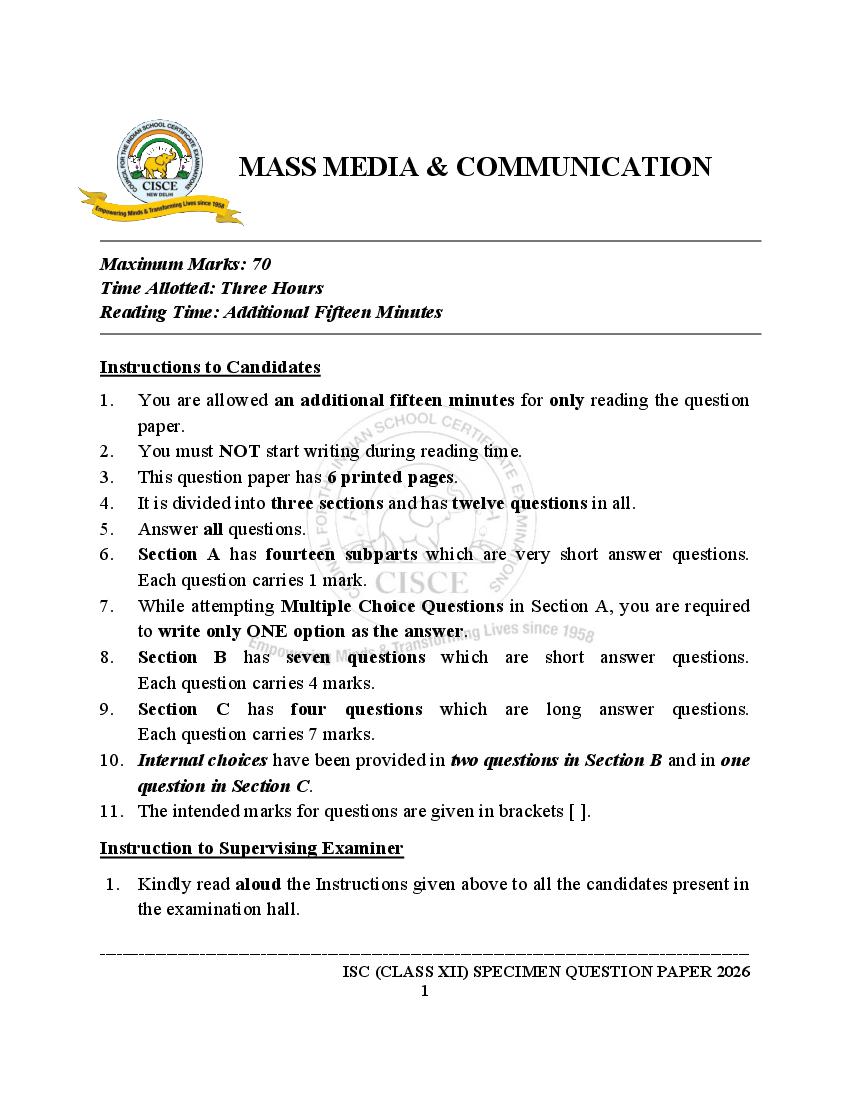
Maximum Marks: 70
Time Allotted: Three Hours
Reading Time: Additional Fifteen Minutes
Instructions to Candidates
1. You are allowed an additional fifteen minutes for only reading the question
paper.
2. You must NOT start writing during reading time.
3. This question paper has 6 printed pages.
4. It is divided into three sections and has twelve questions in all.
5. Answer all questions.
6. Section A has fourteen subparts which are very short answer questions.
Each question carries 1 mark.
7. While attempting Multiple Choice Questions in Section A, you are required
to write only ONE option as the answer.
8. Section B has seven questions which are short answer questions.
Each question carries 4 marks.
9. Section C has four questions which are long answer questions.
Each question carries 7 marks.
10. Internal choices have been provided in two questions in Section B and in one
question in Section C.
11. The intended marks for questions are given in brackets [ ].
Instruction to Supervising Examiner
1. Kindly read aloud the Instructions given above to all the candidates present in
the examination hall.
---------------------------------------------------------------------------------------------------------------------
ISC (CLASS XII) SPECIMEN QUESTION PAPER 2026
1
Page 2
Board Examination Question Paper and should be used as a practice tool. The questions for the
Board Examination can be set from any part of the syllabus, though the format of the Board
Examination Question Paper will remain the same as that of the Specimen Question Paper.
SECTION A – 14 MARKS
Question 1
(i) A camera shot that tilts on the camera's x-axis to create a feeling of uneasiness is [1]
known as ________________.
(a) Bird’s eye view
(b) Dutch angle shot
(c) Oblong
(d) Worm-eye view
(ii) ______________ is an advertisement hidden within a news article. [1]
(a) Sting operation
(b) Paid news
(c) Partisan reporting
(d) Advertorial
(iii) ______________ coined the term ‘documentary’. [1]
(a) John Grierson
(b) John Lumiere
(c) Dada Saheb Phalke
(d) Quentin Tarantino
(iv) Given below are two statements marked Assertion and Reason. Read the [1]
statements carefully and choose the correct option.
Assertion: Smartphones are an example of technological convergence.
Reason: They run one program at a time and need constant internet connectivity.
--------------------------------------------------------------------------------------------------------------------
ISC (CLASS XII) SPECIMEN QUESTION PAPER 2026
2
Page 3
for Assertion.
(b) Both Assertion and Reason are true but Reason is not the correct
explanation for Assertion.
(c) Assertion is true and Reason is false.
(d) Both Assertion and Reason are false.
(v) ________________ refers to the correct portrayal of communities in media. [1]
(vi) A kind of reporting that presents information in a biased manner and may support
a specific political party is known as _________________.
(vii) ___________________ convert(s) electronic signals into sounds that we can
hear, thus allowing us to enjoy music.
(viii) State whether the following are True or False:
(a) Dada Saheb Phalke was inspired by the movie Life of Pi. [1]
(b) Cyber Activism uses social media to spread awareness on pertinent [1]
socio-political issues.
(c) Radio Jockeys require a strong command over written language. [1]
(d) Textual media convergence is the replacement of physical text with online [1]
media.
(ix) Provide one example of Cybercrime. [1]
(x) State an advantage of ‘new media’. [1]
(xi) What is a radio studio? [1]
SECTION B – 28 MARKS
Question 2 [4]
Films and books strongly influence our behaviour and communication in cultural setup.
With the help of a relevant example, explain the relationship between Communication
and Culture.
---------------------------------------------------------------------------------------------------------------------
ISC (CLASS XII) SPECIMEN QUESTION PAPER 2026
3
Page 4
(i) Using appropriate examples, state any four ways by which Representation has
a positive influence on mass media.
OR
(ii) Elaborate on the term culture. How does media in two different countries project
cultures differently?
Question 4 [4]
Empathy allows a journalist to understand an incident from the point of view of those
who have experienced it. Explain the statement with the help of an example.
Question 5 [4]
What are video sharing sites? State any two benefits of sharing videos online.
Question 6 [4]
(i) Differentiate between ‘Call to Action’ and ‘Informercials’, providing an example
for each.
OR
(ii) How are ‘Dolly shots’ and ‘Crane shots’ used to film moving subjects?
Question 7 [4]
(i) Smartphones have forced a change in the strategies that political parties have to
use during campaigns. Explain.
Question 8 [4]
As radios are an audio-only medium, radio jockeys have to create imageries through
storytelling. Explain.
--------------------------------------------------------------------------------------------------------------------
ISC (CLASS XII) SPECIMEN QUESTION PAPER 2026
4
Page 5
Question 9 [7]
What is social media convergence? How has it impacted our participation in media on
the internet?
Question 10
(i) Discuss the genre theory in cinema. [4]
(ii) Explain the crime genre of cinema, elaborating on why it holds the audience’s [3]
attention.
Question 11 [7]
(i) State and explain any three types of Netiquettes, providing an example for each.
OR
(ii) ‘Fake news’ and ‘Paid news’ have become increasingly popular with the rise of
social media and competition among media houses.
Briefly discuss the two types of news referred to above citing three negative
consequences of each.
Question 12
Read the passage given below and answer the questions that follow.
Gender stereotyping is everywhere and causes serious, long-lasting harm. From “boys
will be boys” attitudes in school, to ‘jobs for boys’ and ‘jobs for girls’, these stereotypes
are deeply embedded and last a lifetime.
We need to end the ‘princessification’ of girls and the ‘toxification’ of boys.
The commercial sector too often uses gender stereotypes and segregates boys and girls
to sell more products.
We need to make women and girls visible because the default male is still the prevailing
assumption. Hence, it is important to routinely show and popularize women as leaders
and scientists.
---------------------------------------------------------------------------------------------------------------------
ISC (CLASS XII) SPECIMEN QUESTION PAPER 2026
5
Page 6
change it. They want to see real change initiated by the government and commercial
sector.
(Source (edited): www.fawcett.society.org.uk)
(i) Provide an example, other than the one given above, of a gender stereotype for [1]
girls.
(ii) State any two ways by which stereotyping may be harmful to a child. [2]
(iii) ‘Majority of people recognize that there is a problem and increasingly want [4]
something different.’ Briefly explain any four ways by which this ‘problem’ may
be countered.
--------------------------------------------------------------------------------------------------------------------
ISC (CLASS XII) SPECIMEN QUESTION PAPER 2026
6
Page 7
ANSWER KEY
SECTION A – 14 MARKS
Question 1
(i) (b) or Dutch angle shot [1]
(ii) (d) or Advertorial [1]
(iii) (a) or John Grierson [1]
(iv) (c) or Assertion is true and Reason is false. [1]
(v) Representation [1]
(vi) Partisan reporting [1]
(vii) Speakers [1]
(viii) (a) False [1]
(b) True [1]
(c) True [1]
(d) False [1]
(ix) Online bullying / stalking / trolling / online frauds (Any one) [1]
(x) All broadcasting media / Television / Radio [1]
(xi) • A specially designed place for live broadcast or recording production. [1]
• A studio which includes audio equipment and sound transmission for radio
programming.
• A studio divided between on air and production for pre recording and editing
content.
(Any one)
1
Page 8
Question 2 [4]
Relationship between Communication and Culture
• Culture shapes Communication – Cultural norms, values and beliefs influence how
people communicate, including their language, tone and gestures.
• Communication transmits Culture – Through storytelling, traditions and daily
interactions, culture is passed down from generation to generation.
• Different cultures have different communication styles – Some cultures prefer direct
communication (e.g., Western cultures), while others rely on indirect or high-context
communication (e.g., Asian cultures).
• Language reflects culture – The words and expressions used in a language reflect the
values and priorities of a culture.
• Nonverbal Communication varies across Cultures – Gestures, eye contact and body
language have different meanings in different cultural contexts.
• Culture affects Listening and Interpretation – People from different cultures may
interpret the same message differently based on their cultural backgrounds.
• Intercultural Communication requires Adaptation – Effective communication
between people from different cultures requires understanding and adjusting to
cultural differences.
• Technology influences Cultural Communication – Digital communication has created
new cultural norms and changed how people from different cultures interact.
• Miscommunication can occur due to Cultural differences – Without cultural
awareness, misunderstandings and conflicts may arise.
• Globalisation blends Communication styles – As cultures interact more,
communication styles evolve, creating hybrid ways of speaking and expressing ideas.
(Candidates are required to explain the relationship either through four separate
points or in a paragraph.)
Question 3 [4]
(i) Positive influence of Representation on mass media
• Promotes Inclusivity and Diversity – Showcasing different cultures, identities
and perspectives fosters a more receptive and inclusive society.
• Boosts Self-Esteem and Identity – Seeing people who look like you or share
your experiences in media can enhance confidence and self-worth.
• Reduces Stereotypes and Prejudice – Accurate and diverse portrayals
challenge negative stereotypes and promote understanding and tolerance
among different groups.
2
Page 9
important issues and influence public opinion, leading to policy changes and
activism.
• Encourages Empathy and Understanding – Exposure to diverse stories helps
audiences relate to people from different backgrounds, fostering compassion.
• Expands Career Aspirations – Seeing diverse individuals in various roles
(scientists, leaders, artists) inspires underrepresented groups to pursue
different careers.
• Enhances Cultural Appreciation – Media introduces audiences to different
traditions, languages and customs, encouraging cross-cultural appreciation.
• Creates Role Models for Marginalized Groups – Positive representation
provides aspirational figures for people who may not see themselves reflected
in everyday society.
• Strengthens Social Cohesion – When diverse stories are shared, it helps unite
communities by highlighting common human experiences.
• Encourages Media Industry Growth and Innovation – Inclusive
representation leads to richer storytelling, more creative perspectives and
broader audience engagement.
(Candidates are required to write any four ways by which the representation
has positively influenced mass media.)
OR
(ii) Culture refers to the shared beliefs, values, customs, behaviours, and artifacts that
characterise a particular group of people or society. It influences how individuals
think, communicate and interact with one another. Culture is passed down from
generation to generation through language, traditions and social norms. It can be
seen in various aspects of life, including religion, art, music, cuisine, dress and
even social etiquette.
Culture is dynamic and evolves over time due to external influences such as
globalisation, technological advancements and migration. It also varies
significantly from one society to another, leading to unique cultural identities.
• Language and Communication Styles – Media in France may use formal
language and emphasise intellectual discussions, while media in the U.S. may
favour informal, direct and entertainment-driven content.
• Storytelling Techniques – Indian films often incorporate elaborate musical
sequences and dramatic storytelling, while Japanese films may focus on
minimalism, symbolism and nature.
• Cultural Norms and Values – In South Korea, K-dramas often highlight
themes of family honour and respect for elders, whereas American TV shows
may emphasise individualism and personal success.
• Fashion and Aesthetics – Media in Italy may showcase high fashion and
luxury as a cultural identity, whereas media in Brazil might emphasise
vibrant, colourful clothing reflecting its lively festivals.
3
Page 10
religious values and conservative portrayals, while Scandinavian media may
promote secularism and social equality.
• Media Censorship and Freedom – Chinese media is heavily regulated by the
government, influencing the portrayal of political and social topics, while
media in Canada enjoys more press freedom and diverse representation.
• Sense of Humour and Entertainment – British comedy often relies on sarcasm
and dry wit, while Nigerian comedies lean towards exaggerated expressions
and slapstick humour.
• Gender Roles and Representation – Some cultures may still portray
traditional gender roles in media, while others promote progressive and
diverse representations.
• News Coverage Priorities – Western media may prioritise global politics and
business, while media in Africa might focus more on local community stories
and social development.
• Advertising and Consumerism – American media often emphasises consumer
culture with aggressive advertising, while Japanese media may focus on
craftsmanship and long-term product value.
(Candidates are required to elaborate on the term culture and then
compare projection of culture in media in two different countries.)
Question 4 [4]
Empathy in journalism means understanding and sharing the feelings of those affected by
a news event. A journalist with empathy does not just report facts but also considers the
emotions, struggles and perspectives of the people involved. This helps create fair,
sensitive and impactful stories that go beyond mere statistics and headlines.
Example
Imagine a journalist covering a natural disaster, such as an earthquake in a small town. A
purely factual report might state:
"An earthquake of 6.5 magnitude struck the town, destroying 500 homes and leaving
thousands homeless."
However, an empathetic journalist would go further by interviewing survivors,
understanding their struggles and telling their stories. Their report might include:
"Maria, a mother of three, lost her home in the earthquake. Holding her youngest child in
her arms, she describes the terrifying moment when the walls collapsed. 'We had just sat
down for dinner when everything started shaking. I grabbed my children and ran outside.
We lost everything, but at least we are alive.'"
By incorporating personal stories, the journalist helps readers connect emotionally with
the affected people, encouraging awareness, support, and action.
(Candidates have to explain the statement with the help of an example.)
4
Page 11
Video-sharing sites are online platforms where users can upload, share and watch videos.
These platforms enable individuals, businesses, and content creators to distribute videos
globally. Popular examples include YouTube, TikTok, Vimeo, Facebook Watch, and
Dailymotion.
Benefits of Video-sharing
• Global Reach – Videos can be viewed by people around the world, thereby
expanding the audience beyond local limits.
• Engaging Content – Videos are more engaging and visually appealing compared
to text-based content, making them effective for storytelling.
• Cost-Effective Marketing – Businesses can promote products and services without
the high costs of traditional advertising.
• Easy Accessibility – Viewers can watch videos anytime and anywhere using
smartphones, tablets or computers.
• Monetisation Opportunities – Creators can earn revenue through ads, sponsorships
and memberships on platforms like YouTube.
• Improved Learning & Education – Educational videos make complex topics easier
to understand and are widely used for online learning.
• Viral Potential – Videos can quickly go viral, helping individuals and brands gain
popularity and influence.
• Stronger Audience Engagement – Features like comments, likes and shares allow
creators to interact with their audience directly.
• SEO & Website Traffic Boost – Videos improve search engine rankings and drive
more traffic to websites and social media pages.
• Preservation & Documentation – Videos serve as a record for events, tutorials,
personal memories and historical moments.
(Candidates have to write the meaning of video sharing sights and then write any two
of its benefits in complete sentences.)
Question 6 [4]
(i) 1. Call to Action (CTA)
• Definition: A Call to Action is a short, direct prompt that urges the audience
to take an immediate action, such as “Buy Now,” “Subscribe,” “Vote
Today,” or “Click Here.”
• Purpose: To provoke an instant response from the audience.
• Format: Usually a button, link, or short phrase used in advertisements,
websites, or political campaigns.
• Example: In a political ad:
“Vote for Change – Cast your vote on May 15th!”
5
Page 12
• Definition: An Infomercial is a long-form advertisement that educates the
viewer about a product, service, or cause, often in the style of a TV show
or documentary.
• Purpose: To inform and persuade the audience over time, often using
demonstrations, testimonials, or in-depth storytelling.
• Format: Typically a long video or broadcast, ranging from a few minutes
to half an hour or more.
• Example: A 10-minute televised segment showing how a water purifier
works, including customer reviews, comparisons, and a phone number to
order.
(Candidates have to distinguish by providing relevant examples for
each. The differences must be made on common basis.)
OR
(ii) 1. Dolly Shots
Definition: A dolly shot involves mounting the camera on a wheeled cart (called a
dolly) that moves along tracks or a smooth surface.
How It’s Used:
• To follow a moving subject horizontally or forward/backward (e.g.,
walking, running, driving).
• Often used for tracking shots, where the camera moves alongside or behind
the subject.
• Creates a smooth, grounded motion, drawing the viewer into the scene.
Example:
A character walking down a hallway while the camera moves backward smoothly
in front of them, keeping them centered in frame.
2. Crane Shots
Definition: A crane shot uses a mechanical crane or jib arm to move the camera
vertically, diagonally, or swooping over a large area.
How It’s Used:
• To film a subject moving vertically (e.g., climbing stairs, rising from a
crowd).
• To create dramatic reveals, bird’s-eye views, or sweeping overhead shots
of action.
• Often used to give a sense of scale or elevation.
Example:
A scene ends with the camera rising high above a crowd during a protest rally,
capturing the full scope of the movement.
(Candidates are required to explain the use of the two kinds of shots in filming
moving subjects.)
6
Page 13
• Real-Time Feedback and Polling
Parties use smartphone-based surveys and opinion polls to gauge public mood
instantly, allowing them to fine-tune their messaging and promises.
• Influencer & Micro-Influencer Marketing
Social media influencers, many of whom are followed mainly on smartphones, are
now used to subtly promote political ideologies, especially among younger voters.
• Visual-Centric Campaigning
Since smartphone users prefer visual content, parties invest in short videos, reels,
infographics, and live broadcasts instead of long speeches or manifestos.
• Fact-Checking Pressure
Smartphones make it easy for people to verify claims made by politicians, so parties
have to be more careful with misinformation or face immediate backlash.
• Crowdsourcing Ideas and Donations
Political parties now use mobile apps and platforms to collect suggestions, feedback,
and small donations from supporters, encouraging participation.
• Geo-Targeted Messaging
Using location data from smartphones, campaigns can send region-specific messages,
promises, or event notifications, making outreach more precise.
• 24/7 Voter Access
Campaigning no longer follows a fixed schedule—smartphones allow parties to
connect with voters at any time of day, across time zones.
• Virtual Rallies and Online Town Halls
Especially post-COVID, parties conduct online events optimized for mobile viewing,
which has reduced the dependence on large physical gatherings.
• Opposition Surveillance
Smartphones help parties monitor what opponents are saying and doing in real time,
leading to quicker rebuttals or counter-campaigns.
• Grassroots Empowerment
Individual party workers or supporters with smartphones can act as campaigners,
spreading party messages within their communities without needing official roles.
(Candidates have to explain the changes that smartphones have brought in the
campaign strategies of political parties.)
7
Page 14
Since radio is an audio-only medium, listeners cannot see visuals like in television or films.
This makes storytelling a crucial skill for radio jockeys (RJs) to create mental images and
engage their audience.
• Descriptive Language – RJs use vivid words and expressive descriptions to paint
pictures in the listener’s mind. Example: Instead of saying “It’s a nice morning,”
they might say, “The sun is peeking through the clouds, a gentle breeze is swaying
the trees, and birds are singing their morning melodies.”
• Voice Modulation & Tone – By changing their pitch, pace, and volume, RJs add
emotions to their storytelling, making it more engaging.
• Sound Effects & Background Music – Using sounds like raindrops, traffic noise,
or laughter enhances the storytelling experience and sets the mood.
• Engaging Conversations & Anecdotes – RJs share relatable personal stories,
experiences, or real-life incidents to captivate their audience.
• Interactive Storytelling – Encouraging listeners to imagine scenarios, ask
questions, or participate in contests makes the experience immersive.
• Use of Humor & Emotions – A mix of comedy, drama, or suspense keeps listeners
emotionally invested in the content.
• Creating Characters & Situations – RJs often use different voices or create fictional
characters to make their storytelling dynamic and entertaining.
Example (optional)
If an RJ is narrating a spooky story, they might lower their voice, add eerie background
music, and describe a haunted house in detail to create suspense in the listener’s mind.
Thus, storytelling transforms simple audio into a vivid mental experience, making radio
engaging and impactful.
(Candidates have to explain how storytelling and imagery are used by radio jockeys to
create an impact.)
SECTION C – 28 MARKS
Question 9 [7]
Social media convergence refers to the integration of multiple forms of communication,
content, and digital technologies into a single, interconnected ecosystem. It allows users
to access, create, and share content across various platforms seamlessly. This includes the
blending of text, images, videos, live streaming, messaging, and interactive features into a
unified media experience.
Impact on participation in media:
• Enhanced User Engagement – People can interact with media through likes, shares,
comments, and live discussions, making participation more active.
8
Page 15
devices (smartphones, tablets, laptops) and platforms (Facebook, Instagram,
Twitter, TikTok).
• Faster Information Sharing – News, trends, and events spread rapidly, allowing
people to stay updated in real time.
• Rise of Citizen Journalism – Individuals can report news, share opinions, and
create content, reducing reliance on traditional media.
• Increased Personalization – Algorithms curate content based on user interests,
making media consumption more relevant and engaging.
• Interactive & Immersive Experiences – Features like live streaming, polls, and
augmented reality (AR) enhance audience participation.
• Greater Digital Activism & Social Movements – Social media convergence has
empowered movements like #MeToo and #BlackLivesMatter, allowing global
participation.
• Cross-Platform Branding & Marketing – Businesses and influencers use multiple
social media platforms to promote content and interact with audiences.
• Blurring Lines Between Content Creators & Consumers – Users are no longer just
passive viewers but also content creators, shaping online conversations.
• Concerns Over Misinformation & Privacy – While social media convergence
increases accessibility, it also raises concerns about fake news, data privacy, and
online security.
Question 10
(i) Genre theory in cinema is the study of how films are categorised based on common [4]
themes, narrative structures, stylistic elements and audience expectations. It helps
filmmakers, critics and audiences understand and classify movies into specific
genres such as horror, comedy, action, drama, sci-fi and more.
Key Aspects of Genre Theory
• Conventions & Codes – Each genre follows a set of conventions, such as
jump scares in horror films or high-speed chases in action movies. These
elements help define the genre.
• Audience Expectations – Viewers recognize genres and have expectations
based on previous films. For example, a romantic comedy is expected to
have humor and a love story.
• Hybrid Genres & Subgenres – Many films combine multiple genres, such
as action-comedy (Deadpool) or sci-fi horror (Alien), creating hybrid
genres and subgenres.
• Genre Evolution & Adaptation – Genres change over time based on cultural
shifts, technology, and audience preferences. Example: Early horror films
relied on monsters (Dracula, Frankenstein), while modern horror often
explores psychological fears (Get Out, Hereditary).
9
Page 16
to create unique films. Example: Quentin Tarantino blends crime, action,
and dark humor to redefine genre expectations.
• Industry & Marketing – Studios use genre classifications to market films
effectively. A thriller might be promoted with suspenseful trailers, while a
family movie uses bright colors and uplifting music.
• Social & Cultural Reflection – Genres often reflect societal issues.
Example: Dystopian sci-fi films (The Matrix, Black Mirror) explore
concerns about technology and control.
• Structuralism & Genre Theory – Some theorists, like Claude Lévi-Strauss,
argue that genres work through binary oppositions (e.g., good vs. evil in
superhero films).
• Postmodernism & Genre Blending – Modern cinema often mixes genres
and subverts expectations. Example: Shrek is an animated fantasy that
satirizes fairy tale tropes.
• Impact on Filmmaking – Directors and writers use genre theory to craft
films that either follow or break genre norms, influencing storytelling,
cinematography and audience reception.
(Candidates have to explain genre theory. The key aspects of the theory may
also be referred to.)
(ii) The crime genre in cinema focuses on stories involving criminals, law [3]
enforcement, justice, and the consequences of crime. It often explores themes like
mystery, morality, corruption, justice, and revenge, making it one of the most
engaging and enduring film genres.
Key Elements of Crime Films
• Criminal Activities – The plot revolves around crimes such as murder,
robbery, heists, drug trafficking, or organized crime.
• Law Enforcement vs. Criminals – The tension between criminals and
police, detectives, or vigilantes drives the story.
• Moral Ambiguity – Many crime films blur the lines between good and evil,
often portraying criminals as complex characters.
• Violence & Suspense – Intense action, chase sequences, and unexpected
twists keep the audience engaged.
• Underworld & Gritty Settings – Dark alleys, urban landscapes, and mafia
hideouts are common settings, enhancing the film’s realism.
• Complex Characters – Protagonists can be detectives (Sherlock Holmes),
antiheroes (Joker), or morally ambiguous figures (Breaking Bad).
• Suspense & Mystery – Unraveling crimes, solving puzzles, and unexpected
plot twists keep viewers hooked.
• Psychological Depth – Crime films explore human nature, morality, and
the psychology of criminals.
• Emotional Engagement – The audience empathizes with victims, law
enforcement, or even antiheroes, creating deep emotional investment.
10
Page 17
confrontations add excitement.
• Moral Dilemmas – Viewers are drawn to stories that question justice,
revenge, and ethical choices.
• Realism & Social Commentary – Crime films often reflect real-life issues
like corruption, injustice, and criminal psychology.
• Strong Character Arcs – Complex protagonists, whether a detective or a
criminal, make for compelling storytelling.
• Influence of True Crime – Many crime films are inspired by real events,
making them even more intriguing (Zodiac, The Irishman).
• Cinematic Style – Dark lighting, moody music, and sharp cinematography
enhance the atmosphere.
• Cultural Fascination with Crime – People are naturally curious about crime,
making these films endlessly fascinating.
(Candidates have to elaborate on crime genre and explain the reasons for its
popularity.)
Question 11 [7]
(i) Netiquette refers to the rules of polite and respectful behavior when communicating
online. Following proper netiquette ensures positive and meaningful interactions
in digital spaces.
Types of Netiquettes:
1. Respect Others’ Privacy
• Explanation: Avoid sharing others’ personal information, photos, or
messages without their permission.
• Example: Before posting a group photo online, ask your friends if they are
okay with it.
2. Use Proper Language & Tone
• Explanation: Communicate politely, avoiding offensive language, insults,
or excessive use of capital letters (which can be interpreted as shouting).
• Example: Instead of typing "WHY HAVEN’T YOU REPLIED?!", say
"Hey, just checking in. Let me know when you’re free to chat!"
3. Think Before You Post
• Explanation: Consider the impact of your words and images before sharing
them online, as they can be permanent.
• Example: Before posting a controversial opinion, ensure it's respectful and
not misleading.
4. Avoid Spamming & Overposting
• Explanation: Do not flood social media, chat groups, or emails with
excessive messages, links, or promotions.
11
Page 18
there?", send one polite message and wait for a reply.
5. Use Proper Grammar & Spelling
• Explanation: Well-structured messages make communication clearer and
more professional.
• Example: Instead of typing "u r gr8 lets mt 2mrw", write "You are great!
Let’s meet tomorrow."
6. Be Careful with Humor & Sarcasm
• Explanation: Humor can be misunderstood in text, leading to confusion or
offense. Use emojis or clarify intent when necessary.
• Example: Instead of writing "Oh great, another Monday", which may be
misinterpreted, write "Oh great, another Monday!"
7. Follow Copyright & Plagiarism Rules
• Explanation: Give credit to authors, photographers, and content creators
when using their work.
• Example: When using an image from the internet, add "Photo by John Doe,
Source: Unsplash" instead of posting it without credit.
8. Avoid Engaging in Online Arguments (Flaming & Trolling)
• Explanation: Maintain respectful discussions, even when disagreeing.
Avoid provoking or attacking others online.
• Example: If someone criticizes your opinion on a forum, respond with "I
respect your view, but I see it differently because..." instead of insulting
them.
9. Be Cautious with Sensitive Topics
• Explanation: Discuss sensitive topics (politics, religion, etc.) respectfully
and be open to different perspectives.
• Example: Instead of saying "Your opinion is wrong!", say "I understand
your viewpoint, but I see it differently because..."
10. Use Appropriate Online Communication Channels
• Explanation: Choose the right platform for your message—formal emails
for work, chat apps for casual talks, and public forums for discussions.
• Example: Instead of messaging a professor on WhatsApp at midnight, send
a formal email during office hours.
(Candidates are required to explain any three netiquettes in complete sentences
and provide an example for each.)
OR
(ii) With the rise of social media and increasing competition among media houses, the
spread of fake news and paid news has become a major concern. Both phenomena
distort facts, mislead the public, and harm democratic values.
1. Fake News
Fake news refers to false or misleading information presented as factual news,
often spread intentionally to manipulate public opinion, create panic, or serve
political and financial interests.
12
Page 19
(a) Misinformation & Public Panic
• False information can cause unnecessary panic, confusion, or harmful
actions.
• Example: Fake reports about a natural disaster or pandemic can lead to
widespread fear and hoarding of resources.
(b) Threat to Democracy & Elections
• Fake news spreads political propaganda, influencing elections
unfairly.
• Example: Misleading social media campaigns can damage a
candidate’s reputation or promote false achievements.
(c) Hate Speech & Social Unrest
• False news about religious, ethnic, or political groups can incite
violence.
• Example: Rumors about a community committing crimes can lead to
riots or attacks.
2. Paid News
Paid news refers to news content that is sponsored by political parties, corporations,
or individuals to influence public opinion while disguising itself as independent
journalism.
Three Negative Consequences of Paid News
(a) Loss of Media Credibility
• When news is influenced by money rather than facts, public trust in
journalism declines.
• Example: If a media house only publishes favorable stories about a
company that funds them, audiences may no longer believe in its
objectivity.
(b) Manipulation of Public Opinion
• Paid news misleads people into thinking they are consuming unbiased
journalism when in reality, they are seeing advertisements.
• Example: A politician paying for a "success story" in a newspaper can
shape voters' opinions unfairly.
(c) Unfair Competition & Corruption
• Honest businesses, leaders, and activists struggle against those who
can afford to buy favourable media coverage.
Example: A start-up with an innovative product may lose out to a big company
that pays for positive media attention, regardless of quality.
(Candidates are required to briefly discuss the two types of news and write
three negative consequences of each.)
13
Page 20
(i) 1. “Girls Should Be Gentle and Soft-Spoken” [1]
• Example: A girl who is outspoken or assertive may be labeled as "bossy,"
while the same behavior in boys is seen as leadership.
2. “Girls Are Not Good at Math and Science”
• Example: A teacher assumes boys will perform better in STEM subjects
and encourages them more, while girls are pushed towards arts and
humanities.
3. “Girls Should Like Pink, Dolls, and Makeup”
• Example: A girl who prefers blue, action figures, or sports might be told
she is acting "like a boy."
4. “Girls Are More Emotional and Sensitive”
• Example: A crying girl is comforted, while a crying boy is told to "man
up."
5. “Girls Should Be Modest and Not Too Ambitious”
• Example: A girl aspiring to be a CEO or politician may face
discouragement, while boys are praised for ambition.
6. “Girls Should Focus on Looks Rather Than Intelligence”
• Example: A girl’s appearance is often commented on more than her
achievements (e.g., "You look so pretty!" instead of "You did a great job
on your project!").
7. “Girls Should Be Caregivers and Do Household Work”
• Example: A girl is expected to help in the kitchen while her brother is
encouraged to play outside.
8. “Girls Should Not Be Too Sporty or Strong”
• Example: A girl excelling in weightlifting or boxing may be told it's "not
feminine."
9. “Girls Should Prioritize Family Over Career”
• Example: A young girl is told she will be a "great mother" one day, but not
encouraged to pursue leadership roles.
10. “Girls Should Not Play Video Games or Like Technology”
• Example: A girl interested in gaming or coding may be told, "That’s for
boys," making her feel unwelcome in tech fields.
(Any other relevant example to be accepted.)
14
Page 21
performance, social interactions, and personal growth. Here are ten ways it can be
harmful:
1. Low Self-Esteem & Confidence
• Children who are labeled based on stereotypes may doubt their abilities and
feel inferior.
• Example: A girl constantly told that “math is for boys” may lose confidence
in her math skills.
2. Limited Career Aspirations
• Stereotypes can discourage children from exploring careers that don’t fit
traditional gender or societal roles.
• Example: A boy interested in nursing may avoid pursuing it due to the
belief that it’s a “female profession.”
3. Academic Underperformance
• When children internalize negative stereotypes, they may not try their best
in certain subjects.
• Example: A child labeled as “not smart” may stop participating in class or
trying to improve.
4. Social Exclusion & Bullying
• Children who don’t fit stereotypes may face teasing, exclusion, or bullying
from peers.
• Example: A boy who enjoys ballet may be mocked for engaging in an
activity seen as “for girls.”
5. Increased Anxiety & Stress
• Fear of not fitting in or meeting expectations can cause stress and anxiety
in children.
• Example: A shy child labeled as “too quiet” may feel pressure to act
differently, leading to emotional distress.
6. Discouragement from Leadership Roles
• Stereotypes about leadership abilities may prevent children from taking on
responsibilities in school.
• Example: A girl may hesitate to run for class president if she believes
leadership is “for boys.”
7. Hindered Creativity & Self-Expression
• Children may avoid certain hobbies, activities, or career paths due to fear
of judgment.
• Example: A boy passionate about art may avoid drawing in class because
it’s seen as “less masculine.”
15
Page 22
• Stereotypes can reinforce gender-based discrimination, leading to unequal
treatment in the classroom.
• Example: Teachers may encourage boys to speak up in science class more
than girls, reinforcing gender bias.
9. Difficulty in Making Friends
• Children who don’t conform to stereotypes may struggle to connect with
peers.
• Example: A girl who prefers sports over dolls might find it hard to fit into
gender-divided playgroups.
10. Lack of Inclusivity & Diversity in Learning
• Schools that reinforce stereotypes may fail to promote diversity, making
students feel left out or unheard.
Example: History lessons focusing only on male inventors can make girls feel less
encouraged to pursue science.
(Candidates have to write any two ways in which stereotyping may adversely
affect a child. Any other relevant way will be accepted.)
(iii) Stereotyping can lead to bias, discrimination, and limiting beliefs in children. [4]
Parents can actively work to counter stereotypes by promoting inclusivity, critical
thinking, and diversity.
1. Encourage Open-Mindedness & Critical Thinking
• Teach children to question stereotypes they hear in media, school, or daily
life.
• Example: If a child says, "Girls aren’t good at sports," discuss examples of
female athletes like Serena Williams or Simone Biles.
2. Promote Diverse Experiences & Role Models
• Expose children to books, movies, and real-life stories featuring people
from different backgrounds, genders, and cultures.
• Example: Watching movies with strong female leads (Moana, Mulan)
challenges gender stereotypes.
3. Avoid Gender-Based Toys & Activities Restrictions
• Let children choose their own toys and hobbies rather than enforcing
traditional gender norms.
• Example: If a boy wants to play with a doll or a girl wants to play with a
truck, support their choices.
4. Use Inclusive Language
• Avoid using phrases that reinforce stereotypes (“boys don’t cry,” “girls
should be gentle”).
• Example: Instead of saying "That’s a boy’s job," say "Anyone can do that
job if they work hard."
16
Page 23
• Help children build friendships with kids from diverse backgrounds,
cultures, and abilities.
• Example: Encourage playdates with classmates of different ethnicities and
abilities to foster inclusivity.
6. Discuss Media Representation & Bias
• Teach children to analyze TV shows, cartoons, and advertisements for
stereotypes.
• Example: Ask, "Why do you think all superheroes in this show are men?
Can women be superheroes too?"
7. Set an Example with Inclusive Behavior
• Children learn from their parents, so model respect, fairness, and open-
mindedness in daily interactions.
• Example: Show appreciation for all professions, whether a male nurse or a
female mechanic.
8. Challenge Stereotypical Expectations in Education & Careers
• Encourage children to explore all subjects and careers, regardless of gender
norms.
• Example: Support a girl’s interest in STEM (Science, Technology,
Engineering, Math) or a boy’s passion for dance and art.
9. Teach Empathy & Respect for Differences
• Help children understand different perspectives by encouraging kindness
and acceptance.
• Example: Read books about children with disabilities, different cultural
traditions, or diverse family structures.
10. Correct Stereotypes When You Hear Them
• If a child repeats a stereotype, gently correct them with facts and examples.
Example: If they say, "All boys like video games," respond with, "Many girls love
video games too! Everyone has different interests."
(Candidates have to briefly explain any four ways in which stereotyping can be
countered. They may give their own suggestions.)
17
Document Details
| Board / Org | CISCE |
| Exam | Class 12 |
| Type | Sample Paper |
| Pages | 23 |
| Updated | 24 Sep 2026 |