ISC Class 12 Specimen Paper Legal Studies
Finished viewing? Save it for later —
Download ISC Class 12 Specimen Paper Legal Studies (PDF · 17 pages)About ISC Class 12 Specimen Paper Legal Studies
ISC Class 12 Specimen Paper Legal Studies is available here for free download. Published by CISCE for Class 12, this sample paper can be viewed online or downloaded as a PDF (17 pages). Candidates preparing for Class 12 can use ISC Class 12 Specimen Paper Legal Studies to understand the exam pattern, the type of questions asked, and the overall difficulty level.
Frequently Asked Questions
How can I download ISC Class 12 Specimen Paper Legal Studies?
Open this page and click the Download button to save ISC Class 12 Specimen Paper Legal Studies as a PDF. It is completely free on AglaSem Docs.
Is ISC Class 12 Specimen Paper Legal Studies free to download?
Yes. ISC Class 12 Specimen Paper Legal Studies can be viewed online and downloaded as a PDF free of cost on AglaSem Docs.
How many pages does ISC Class 12 Specimen Paper Legal Studies have?
ISC Class 12 Specimen Paper Legal Studies contains 17 pages, which you can read online or download together as a single PDF.
Where can I find more Class 12 study material?
You can find more Class 12 question papers, sample papers, syllabus, and answer keys on AglaSem Docs.
ISC Class 12 Specimen Paper Legal Studies – Text
Read the full text of this sample paper below — useful to quickly search, copy and reference the content online without downloading the PDF.
📄 View text version (17 pages)
Page 1
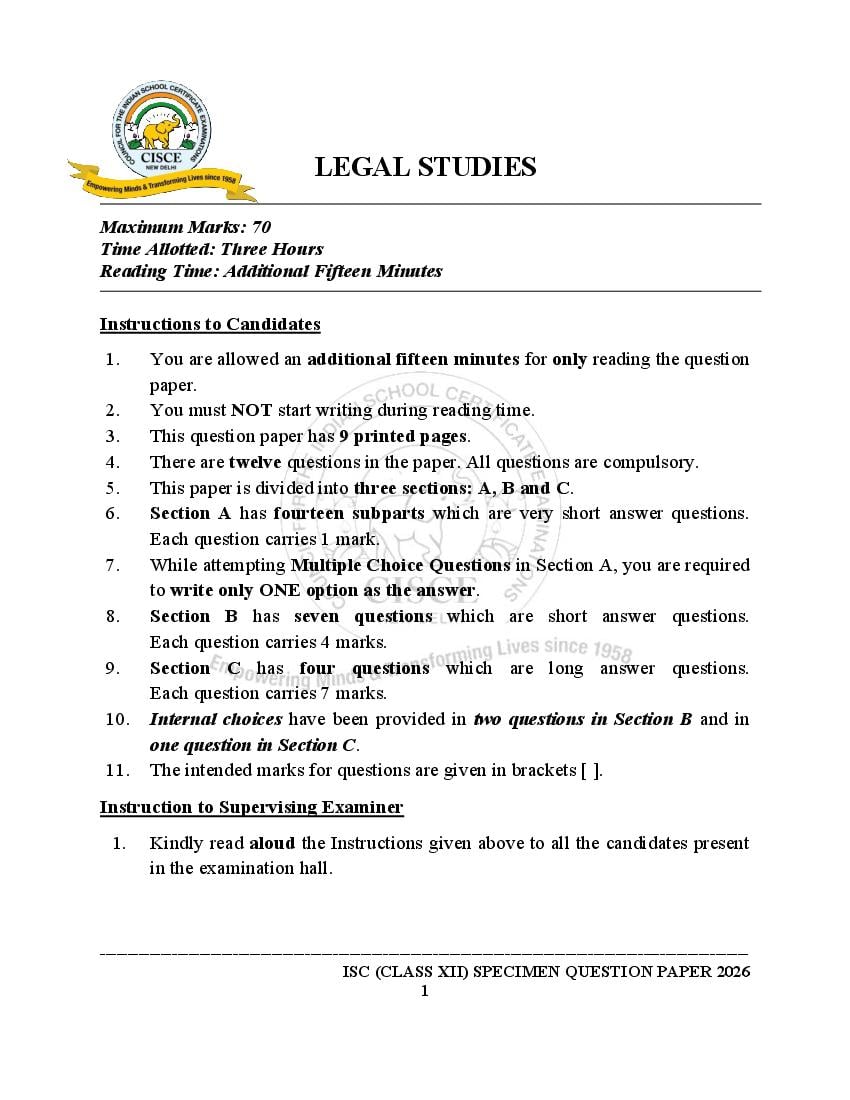
Maximum Marks: 70
Time Allotted: Three Hours
Reading Time: Additional Fifteen Minutes
Instructions to Candidates
1. You are allowed an additional fifteen minutes for only reading the question
paper.
2. You must NOT start writing during reading time.
3. This question paper has 9 printed pages.
4. There are twelve questions in the paper. All questions are compulsory.
5. This paper is divided into three sections: A, B and C.
6. Section A has fourteen subparts which are very short answer questions.
Each question carries 1 mark.
7. While attempting Multiple Choice Questions in Section A, you are required
to write only ONE option as the answer.
8. Section B has seven questions which are short answer questions.
Each question carries 4 marks.
9. Section C has four questions which are long answer questions.
Each question carries 7 marks.
10. Internal choices have been provided in two questions in Section B and in
one question in Section C.
11. The intended marks for questions are given in brackets [ ].
Instruction to Supervising Examiner
1. Kindly read aloud the Instructions given above to all the candidates present
in the examination hall.
---------------------------------------------------------------------------------------------------------------------
ISC (CLASS XII) SPECIMEN QUESTION PAPER 2026
1
Page 2
Board Examination Question Paper and should be used as a practice tool. The questions for the
Board Examination can be set from any part of the syllabus, though the format of the Board
Examination Question Paper will remain the same as that of the Specimen Question Paper.
SECTION A - 14 MARKS
Question 1
(i) Which one of the following situations lacks actus reus, despite the presence of [1]
mens rea? (Application)
(a) A person steals money intending to repay later
(b) A person scratches a neighbour’s car mischievously
(c) A business rival sets a warehouse on fire out of jealousy
(d) A person plans to commit theft and watches the house for several days but
takes no action
(ii) Tanvi noticed that a teacher has left the school computer logged in and [1]
unattended. Out of curiosity, she read confidential remarks about students’
performance stored in the system, without making any changes or sharing the
information. What offence has she committed? (Understanding)
(a) Hacking
(b) Cyber fraud
(c) Cyber trespass
(d) Identity theft
(iii) Given below are two statements marked, Assertion and Reason. Read the two [1]
statements carefully and select the correct option. (Analysis)
Assertion: Special provisions and laws made by the State for socially and
educationally backward classes are constitutionally valid.
Reason: Article 15 of the Indian Constitution permits positive discrimination for
upliftment of these groups.
Which one of the following is correct?
(a) Both Assertion and Reason are true and Reason is the correct explanation
for Assertion.
(b) Both Assertion and Reason are true but Reason is not the correct
explanation for Assertion.
(c) Assertion is true and Reason is false.
(d) Both Assertion and Reason are false.
----------------------------------------------------------------------------------------------------------------------
ISC (CLASS XII) SPECIMEN QUESTION PAPER 2026
2
Page 3
statements carefully and select the correct option. (Analysis)
Assertion: Nothing is an offence which causes slight harm.
Reason: Law deals with all kinds of matters irrespective of their significance.
Which one of the following is correct?
(a) Both Assertion and Reason are true and Reason is the correct explanation
for Assertion.
(b) Both Assertion and Reason are true but Reason is not the correct
explanation for Assertion.
(c) Assertion is true and Reason is false.
(d) Both Assertion and Reason are false.
(v) Legal Principle: In Tort law, Battery is the intentional and unlawful application [1]
of physical force on another person without their consent.
Fact Situation: Aarif and Aslam were neighbours. One day while walking past
Aarif’s garden, Aslam accidentally tripped and fell into the
garden breaking some flowerpots. Aarif was furious. He picked
up a stick and hit Aslam on the shoulder causing him minor
injuries.
Will Aarif’s action amount to Battery? (Evaluate)
(a) Yes, because Aarif picked up a stick.
(b) No, because Aslam entered Aarif’s garden without his permission.
(c) No, because Aarif acted to protect his property.
(d) Yes, because Aarif intentionally hit Aslam causing physical harm.
(vi) Legal principle: Negligence occurs when someone causes injury or loss to [1]
someone else because of their reckless or careless behaviour.
Fact Situation: Sudesh hired Anthony on a contractual basis to paint his house.
Anthony was instructed to lock the house before leaving. One
day he left the house to drink tea, without locking the house. In
his absence, a thief entered the house and stole some expensive
items.
Which one of the following statements is correct in relation to the tort of
Negligence in the above situation? (Evaluate)
ISC (CLASS XII) SPECIMEN QUESTION PAPER 2026
3
Page 4
care of his house.
(b) Anthony is liable for negligence as he had the duty to ensure the house
was secured before he had left.
(c) Anthony cannot be made liable since the theft was an unforeseeable event
beyond his control.
(d) Anthony cannot be held liable because he did his work properly and had
no other responsibility.
(vii) Which of the following statements regarding Article 19(1)(a) are correct? [1]
(Understanding)
(I)
The Right to Freedom of Speech includes the freedom to express
one's opinions through any medium.
(II) Reasonable restrictions can be imposed on this right in the interest
of public order, morality, and sovereignty.
(III) Article 19 provides absolute freedom of speech without any
limitations.
(a) Only (I) and (II) are correct.
(b) Only (II) and (III) are correct.
(c) Only (I) and (III) are correct.
(d) All (I), (II) and (III) are correct.
(viii) Which of the following statements related to lease agreements and contract law [1]
are correct? (Understanding)
Statement I: A lease agreement is a type of contract where the landlord allows
the tenant to use a property for consideration (rent) for a specific
period.
Statement II: A contract remains valid even if the object is immoral, as long as
both parties consent to it.
Statement III: A contract is enforceable only if it is made for a lawful
consideration and a lawful object.
(a) Only (I) and (II) are correct.
(b) Only (II) and (III) are correct.
(c) Only (I) and (III) are correct.
(d) All (I), (II) and (III) are correct.
----------------------------------------------------------------------------------------------------------------------
ISC (CLASS XII) SPECIMEN QUESTION PAPER 2026
4
Page 5
binding and why? (Analysis)
(x) Under which method of Alternate Dispute Resolution, is prior agreement a [1]
prerequisite to settle the dispute? (Recall)
(xi) Nishant entered a jewellery store to buy a ring. But he took an expensive necklace [1]
and hid it in his pocket. When the CCTV footage was examined, he was found
hiding the necklace. Nishant was thus accused of theft.
Which element is required to establish charges of theft against Nishant?
(Application)
(xii) What is the validity of a contract entered through Undue Influence? [1]
(Understanding)
(xiii) An environmentalist, Ramaswamy, known for his extensive research on air [1]
quality, was invited to provide expert insights on Delhi's worsening air pollution
in connection with a Public Interest Litigation (PIL).
Identify the legal maxim which describes the role of Ramaswamy in this context.
(Application)
(xiv) On the basis of procedural formalities, differentiate between judicial and quasi- [1]
judicial bodies. (Understanding)
SECTION B - 28 MARKS
Question 2 [4]
(i) Under the Transfer of Property Act, 1882, Sale and Mortgage are different modes
of transferring immovable property. Explain the nature of rights created in terms
of ‘ownership’ and ‘possession’ in these modes of transfer.
(Understanding)
OR
(ii) Explain the concept of Actionable claim as defined under the Transfer of Property
Act, 1882. Cite two examples of it. (Understanding)
ISC (CLASS XII) SPECIMEN QUESTION PAPER 2026
5
Page 6
Read the extract given below and answer the questions that follow.
Case: Hussainara Khatoon and others versus Home Secretary, State of Bihar
Petitioner: Hussainara Khatoon and others
Respondent: Home Secretary, State of Bihar
An article was published in the Indian Express newspaper in 1979 about the wrongful
detention of under trial prisoners in Bihar jail, including women and children awaiting
trial for years. On reading this, Advocate Pushpa Hingorani filed a writ petition under
Article 32 of the Indian Constitution on behalf of these under trial prisoners. The petition
stated that under trial prisoners who had committed petty offences were suffering in jail
for more than five to ten years, without trial.
(Source (edited): https://lawbhoomi.com)
(i) Name and briefly explain the writ used by Advocate Pushpa Hingorani under [2]
Article 32 of the Constitution of India. (Understanding)
(ii) What does Article 21 of the Indian Constitution state? Briefly discuss the [2]
relevance of this Article in the context of the above case. (Understanding)
Question 4
Tuhin, Alex, and their three friends made detailed preparations to rob a bank.
They procured face masks, ropes, a firearm, and tear gas. However, before they could
execute their plan, one of the suppliers reported them to the police, leading to their arrest.
(i) Identify the stage of crime they were in at the time of arrest. (Understanding) [1]
(ii) Discuss whether this stage is punishable under criminal law, supporting your [3]
answer with appropriate reasoning. (Evaluate)
Question 5
(i) Which national body was set up under the Protection of Human Rights Act, 1993 [1]
to deal with complaints about human rights violations? (Recall)
(ii) The statutory body, referred to above, has the power to act even without a formal [1]
complaint. What is the term used for such action? (Understanding)
(iii) Mention any two important functions performed by this body in safeguarding [2]
human rights. (Understanding)
----------------------------------------------------------------------------------------------------------------------
ISC (CLASS XII) SPECIMEN QUESTION PAPER 2026
6
Page 7
(i) During litigation, nothing new should be introduced.
Name the doctrine applicable here as per the Transfer of Property Act, 1882.
State any three essentials of this doctrine. (Understanding)
OR
(ii) Differentiate between Tort and Contract on four bases. (Understanding)
Question 7
(i) (a) Amita sold her house to Nita which had serious structural damages. Amita [1]
knew of these damages but concealed it during Nita’s visit. She assured
Nita of the house being in a perfect condition. After buying the house, Nita
discovered the structural damages that Amita had deliberately concealed.
How was the consent of Nita obtained by Amita? (Analysis)
(b) Christy sold a painting to Jim, describing it as an original piece of work by [1]
a well-known artist. Christy had obtained this information from the
previous owner of the painting. After buying the painting, Jim discovered
that it was not an original piece but a replica.
How was Jim’s consent obtained? (Analysis)
(ii) Briefly discuss the importance of free consent in a contract. (Understanding) [2]
Question 8 [4]
Discuss the suitability of methods of Alternate Dispute Resolution with the help of an
example for each. (Understanding)
ISC (CLASS XII) SPECIMEN QUESTION PAPER 2026
7
Page 8
Question 9
Gautam owns a fierce dog, Brownie, and displays a clear warning sign: "Beware of Dog,"
outside his home. One day, while being walked within the premises by Gautam’s servant,
Brownie broke free from the servant’s control, ran out of the gate, and bit several children
playing on the street. The servant was unable to keep the dog restrained. The parents of
the injured children filed a compensation claim against Gautam.
(i) What is the nature of liability of Gautam under the law of torts? Outline the [3]
essential conditions for establishing liability. (Application)
(ii) Discuss the principle of vicarious liability. Explain how it applies to Gautam in [4]
the given situation. (Application)
Question 10
(i) Briefly discuss the role played by a mediator in Mediation. What is the sanctity [3]
of the settlement arrived through mediation? (Understanding)
(ii) Briefly explain the following writs: (Understanding) [4]
(a) Mandamus
(b) Quo Warranto
Question 11
Mithila, a tribal woman, migrated to city after the floods destroyed her fields in the
village. She shifted to the city with her three minor children. She worked as a daily wage
labour and earned a meagre amount. One day she joined a protest against the exploitation
of the labourers and was taken into custody by the police.
(i) Identify the four categories under which Mithila can avail free legal aid. [4]
(Understanding)
(ii) Which statutory act has been enacted to achieve the objective of 39A? [3]
State any two of its objectives. (Recall)
----------------------------------------------------------------------------------------------------------------------
ISC (CLASS XII) SPECIMEN QUESTION PAPER 2026
8
Page 9
(i) Compare the concept of Assault under the Law of Torts and Section 130 of the [3]
Bharatiya Nyaya Sanhita (BNS), 2023. (Analysis)
(ii) Explain Petty Organised Crime with its punishment. (Understanding) [4]
OR
(iii) State any three conditions which makes an agreement unlawful under Section 23. [3]
(Recall)
(iv) Though Fundamental Rights and Fundamental Duties are both integral parts of the [4]
Indian Constitution, they differ significantly in their scope and character.
Compare Fundamental Rights and Fundamental Duties on the basis of the
following: (Analysis)
(a) Scope
(b) Enforceability
(c) Applicability
(d) Emergency Provisions
ISC (CLASS XII) SPECIMEN QUESTION PAPER 2026
9
Page 10
ANSWER KEY
SECTION A - 14 MARKS
Question 1
In answering Multiple Choice Questions, candidates have to write either the correct
option number or the explanation against it. Please note that only ONE correct
answer should be written.
(i) (d) or A person plans to commit theft and watches the house for several days but [1]
takes no action
(ii) (c) or Cyber trespass [1]
(iii) (a) or Both Assertion and Reason are true and Reason is the correct explanation [1]
for Assertion.
(iv) (c) or Assertion is true and Reason is false. [1]
(v) (d) or Yes, because Aarif intentionally hit Aslam causing physical harm. [1]
(vi) (b) or Anthony is liable for negligence as he had the duty to ensure the house was [1]
secured before he had left.
(vii) (a) or Only (I) and (II) are correct. [1]
(viii) (c) or Only (I) and (III) are correct. [1]
(ix) Ratio decidendi as it states the reasons behind the particular judgement [1]
(x) Arbitration [1]
(xi) Dishonestly taking movable property out of the possession of another person [1]
without that person's consent.
(xii) At the option of the aggrieved party, the contract is voidable. [1]
(xiii) Amicus curiae. [1]
(xiv) Judicial bodies strictly adhere to the procedural formalities while quasi-judicial [1]
bodies follow simplified and flexible procedures.
SECTION B - 28 MARKS
Question 2 [4]
(i) 1. Sale – Nature of Rights Created
Ownership:
Complete ownership is transferred from seller to buyer.
The buyer becomes the absolute owner of the property.
Possession:
Possession generally passes along with ownership, unless agreed otherwise.
Example: A sells his house to B for ₹50 lakhs. B gets full title and possession.
---------------------------------------------------------------------------------------------------------------
ISC (CLASS XII) SPECIMEN ANSWER KEY 2026
1
Page 11
Ownership:
Ownership remains with the mortgagor (borrower).
The mortgagee (lender) gets a limited right (interest) as security for a loan.
Possession:
Possession may or may not transfer, depending on the type of mortgage (e.g.,
usufructuary mortgage).
Example: A mortgages his house to the bank for a loan. A retains ownership; the
bank has a security interest in the property.
(Candidates are required to explain ownership and possession under sale and
mortgage.)
OR
(ii) • According to section 3 of the Transfer of Property Act, the actionable
claim is a claim to any debt which is not secured by a mortgage, pledge,
and hypothecation.
• An actionable claim is transferable under the Transfer of Property Act.
The term ‘Actionable Claim’ implies that every type of debt in a movable
property which would be enforced by the Court.
• Actionable claim means a debt or a claim on which action can be started
in a Court of law for comfort or relief.
• Examples:
1. Claim for arrear rent.
2. Claim for rent to fall due in future.
3. A choice offered to repurchase the property once again.
4. Book debts or claims
5. The right to claims maintenance
6. Claim the benefit of the contract
7. Deposit receipt.
(Candidates are required to explain the concept of actionable claim and
substantiate the same with two examples.)
Question 3
(i) Advocate Pushpa Hingorani used the writ of Habeas Corpus under Article 32 [2]
of the Indian Constitution.
Habeas Corpus means, “To have the body” or "Bring the body". / A Writ of
Habeas Corpus is a legal recourse where an order issued by a judge in the events
of unlawful arrest, detention or imprisonment, directs the one who holds
another person (custodian) in custody to produce the person (a prisoner or other
detainee) before the court of law.
(Candidates are required to identify the writ used in the case described in the
question and explain it in brief.)
---------------------------------------------------------------------------------------------------------------
ISC (CLASS XII) SPECIMEN ANSWER KEY 2026
2
Page 12
Liberty.
Relevance of Article 21 in the Hussainara Khatoon Vs. State of Bihar case:
The long-term detention of prisoners is violative of Article 21 and against the
basic human rights.
(Optional explanation: In 1979, the Supreme Court held that the right to a speedy
trial is an essential part of the Right to Life and Personal Liberty under
Article 21.)
(Candidates have to discuss the relevance of Article 21 in the context of the
case described in the question.)
Question 4
(i) At the time of arrest, the accused were at the preparation stage of committing [1]
dacoity.
(ii) Although preparation is usually not punishable, the law makes an exception for [3]
dacoity, due to its serious nature. Therefore, under Section 312 of the BNS, they
can be held criminally liable, even though the crime was not attempted or
committed.
(Candidates have to discuss whether the stage identified in subpart (i) is
punishable or not. They must support their opinion with reasons.)
Question 5
(i) National Human Rights Commission [1]
(ii) Suo motto [1]
(iii) a) Inquire, on its own initiative or on a petition presented to it by a victim or [2]
any person on his behalf, into complaint of-
i ) violation of human rights or abetment or
ii) negligence in the prevention of such violation, by a public servant;
b) intervene in any proceeding involving any allegation of violation of
human rights pending before a court with the approval of such court;
c) visit, under intimation to the State Government, any jail or any other
institution under the control of the State Government, where persons are
detained or lodged for purposes of treatment, reformation or protection to
study the living condition of the inmates and make recommendations
thereon;
d) review the safeguards by or under the Constitution or any law for the
time being in force for the protection of human rights and recommend
measures for their effective implementation;
e) review the factors, including acts of terrorism that inhibit the enjoyment
of human rights and recommend appropriate remedial measures;
f) study treaties and other international instruments on human rights and
make recommendations for their effective implementation;
---------------------------------------------------------------------------------------------------------------
ISC (CLASS XII) SPECIMEN ANSWER KEY 2026
3
Page 13
h) spread human rights literacy among various sections of society and
promote awareness of the safeguards available for the protection of these
rights through publications, the media, seminars and other available means;
i) encourage the efforts of non-Governmental organizations and institutions
working in the field of human rights;
j) such other functions as it may consider necessary for the promotion of
human rights.
(Candidates have to mention any two important functions of National Human
Rights Commission.)
Question 6 [4]
(i) Doctrine of Lis Pendens
Essentials:
•
There is a pendency of a suit of proceeding.
•
The suit or proceeding must be pending in a competent Court.
•
A right to immovable property is directly and specifically involved in the
suit.
• The suit or proceeding must not be collusive. (Involving secret or
unlawful cooperation aimed at deceiving or gaining an advantage over
others.)
• The property in dispute must be transferred or otherwise dealt with by
any party to suit.
• The transfer must affect the rights of the other party to litigation.
(Candidates are required to write any three essentials in complete sentences.)
OR
(ii) Basis Tort Contract
Nature of Obligation is imposed by Obligation arises from a
Obligation law, independent of the voluntary agreement
parties’ agreement
Relationship No prior relationship Requires a pre-existing
required legal relationship
Damages Usually unliquidated Often liquidated or
(determined by court based predetermined in the
on harm caused) contract
Purpose To protect rights and To enforce agreements
compensate for civil wrongs and ensure performance
(Candidates have to differentiate between Tort and Contract on four bases.)
Question 7
(i) (a) It was obtained through Fraud. [1]
(b) It was obtained through Misrepresentation. [1]
---------------------------------------------------------------------------------------------------------------
ISC (CLASS XII) SPECIMEN ANSWER KEY 2026
4
Page 14
free consent of parties. If that is not the case, then the contract
becomes voidable at the option of the
aggrieved party.
• Consent is both parties agreeing to the same thing in the same sense.
• Free consent promotes fairness and trust between the parties.
• It ensures parties autonomy and legal rights.
• Contracts become enforceable if it is entered with free consent.
• It protects the rights of weaker parties from being forced to enter into an
agreement.
(Candidates are required to briefly discuss the importance of free consent in a
contract.)
Question 8 [4]
Methods and Examples of Alternate Dispute Resolution
• Arbitration: suitable for commercial disputes, Intellectual property right disputes,
contractual disputes, real estate disputes
• Mediation: suitable for fight in the residential society, partnership, civil dispute,
property dispute, negotiable instrument dispute
• Conciliation: suitable for family dispute, labour dispute, industrial disputes,
matrimonial disputes
• Lok Adalat: motor accidental claim, land and revenue dispute, utility and service-
related disputes, consumer disputes, matrimonial disputes except divorce cases,
compoundable criminal offences, and any other small monetary claims.
(Candidates are required to discuss the suitability of Alternate Dispute Resolution.
They must discuss the suitability of each method with the help of an example.)
SECTION C – 28 MARKS
Question 9
(i) Tort Involved – Liability for Animals (Strict Liability) [3]
The tort applicable in this case is related to liability for harm caused by animals,
particularly under the concept of strict liability.
In cases involving dangerous animals (ferae naturae), the owner may be held
strictly liable for any harm caused, regardless of precautions taken, if the animal
escapes and injures someone.
Essential elements to establish liability:
• Ownership or control of the animal – Gautam is the owner of Brownie.
• Knowledge of the animal’s dangerous nature – Brownie is described as a
fierce dog, and Gautam had put up a “Beware of Dog” sign, showing prior
knowledge.
• Damage caused by the animal – Brownie escaped and bit children,
causing injury.
• Escape from control – Though the dog was leashed and inside the
property, it escaped due to the servant's inability to restrain it.
---------------------------------------------------------------------------------------------------------------
ISC (CLASS XII) SPECIMEN ANSWER KEY 2026
5
Page 15
animals, even though the escape was accidental.
(Candidates have to state the nature of liability evident in the case and then
specify the essential conditions required to establish it.)
(ii) Vicarious Liability and its Application [4]
Vicarious liability refers to a legal principle where a person is held responsible
for the acts of another, usually a subordinate, when the act is done within the
course of employment.
In this case:
Gautam’s servant was handling the dog as part of his assigned duties. The dog
escaped while under the servant's supervision, which constitutes an act within the
scope of employment. Therefore, Gautam, as the master, is vicariously liable for
the servant’s failure to control the dog.
(Candidates are required to discuss the principle of vicarious liability and
demonstrate how it is applicable in the given scenario.)
Question 10
(i) • Mediator plays the role of a facilitator. Mediator’s work is just to facilitate [3]
the parties to reach a settlement of their dispute.
• Mediator does not impose his views and makes no decision about what a
fair settlement should be.
Resolution arrived at through mediation is not binding upon the parties.
(Candidates are required to briefly discuss the role of a mediator and state the
sanctity of the settlement arrived at through mediation.)
(ii) [4]
(a) Mandamus – means ‘we command’
A writ of Mandamus is a court order that compels a government official,
lower court or public authority to perform a legal duty or correct and abuse
of discretion.
(b) Quo Warranto – means ‘by what authority’
A writ of Quo Warranto is a legal proceeding that challenges a person’s
right to hold a public or corporate office it determines if the office holder
is legally authorised to perform their duties.
(Candidates are required to briefly discuss the two writs.)
Question 11
(i) • Woman [4]
• Belonging to Tribal Community
• Income
• In custody
(Candidates are required to identify four categories under which Mithila can
apply for free legal aid.)
---------------------------------------------------------------------------------------------------------------
ISC (CLASS XII) SPECIMEN ANSWER KEY 2026
6
Page 16
Objectives
• Its objective is to establish a nationwide uniform network for providing
free and competent legal services to the weaker sections of the society on
the basis of equal opportunity.
• Holding Lok Adalats.
• Operating various schemes such as free legal aid for disaster victims,
victims of trafficking and commercial sexual exploitation, workers in the
unorganised sector, children, mentally ill and disabled persons, senior
citizens and victims of acid attacks.
(Candidates have to state two objectives of National Legal Services Authorities
Act, 1987.)
Question 12
(i) Assault is recognised under both civil law (Tort) and criminal law (BNS, 2023), [3]
but the nature, objective, and consequences differ in each.
1. Assault under the Law of Torts (Civil Law):
Definition: Assault is an act that causes reasonable apprehension of
imminent harm or offensive contact in the mind of the plaintiff.
Key Elements:
An intentional act by the defendant
A reasonable apprehension of immediate harm
No need for physical contact
Nature: Civil wrong
Remedy: Compensation (damages) is awarded to the victim
Example: Raising a fist or pointing a loaded gun at someone, even without
hitting, can amount to assault.
2. Assault under Section 130 of BNS, 2023 (Criminal Law):
Definition: Section 130 defines assault as a gesture or preparation made
with the intention to cause another person to apprehend immediate use of
criminal force.
Nature: Criminal offence
Punishment: Imprisonment up to 3 months, or
Fine up to ₹1,000, or both
Proceedings: Handled by criminal courts
(Candidates have to compare the concept of assault as given in law of Torts and
Section 130 of the Bhartiya Nyaya Sanhita 2023.)
(ii) (1) Whoever, being a member of a group or gang, either singly or jointly, [4]
commits any act of theft, snatching, cheating, unauthorised selling of tickets,
unauthorised betting or gambling, selling of public examination question
papers or any other similar criminal act, is said to commit petty organised
crime.
Explanation: For the purposes of this sub-section “theft” includes trick theft,
theft from vehicle, dwelling house or business premises, cargo theft, pick
pocketing, theft through card skimming, shoplifting and theft of Automated
Teller Machine.
---------------------------------------------------------------------------------------------------------------
ISC (CLASS XII) SPECIMEN ANSWER KEY 2026
7
Page 17
imprisonment for a term which shall not be less than one year but which may
extend to seven years, and shall also be liable to fine.
(Candidates have to briefly explain petty organised crime and the punishment
specified for it.)
OR
(iii) What considerations and objects are lawful, and what not.—The consideration [3]
or object of an agreement is lawful, unless—
it is forbidden by law ; or
is of such a nature that if permitted, it would defeat the provisions of any law;
or is fraudulent ; or
involves or implies injury to the person or property of another; or
the Court regards it as immoral, or opposed to public policy.
(Candidates have to write three conditions under which an agreement becomes
unlawful under Section 23.)
(iv) [4]
(a) Scope:
Fundamental Rights are broad in scope and aim to protect the basic liberties
and freedoms of individuals, such as the right to equality, freedom of
speech, and protection from exploitation. They act as limitations on the
powers of the state and ensure the development of a just society. In contrast,
Fundamental Duties are narrower in scope. They serve as a reminder to
citizens about their moral and civic responsibilities towards the nation, such
as respecting the Constitution, promoting harmony, and safeguarding
public property.
(b) Enforceability:
Fundamental Rights are justiciable, meaning they are legally enforceable.
If a citizen’s Fundamental Rights are violated, they can directly approach
the courts for redressal under Articles 32 and 226. On the other hand,
Fundamental Duties are non-justiciable. They are not legally enforceable
in a court of law, although they may guide legislative or judicial
interpretation in some cases.
(c) Applicability:
Fundamental Rights are primarily applicable to citizens, though some
rights like the right to life and personal liberty (Article 21) apply to both
citizens and non-citizens. Fundamental Duties, however, are applicable
only to citizens and not to foreigners. They emphasize the citizen’s role in
upholding the dignity, unity, and integrity of India.
(d) Emergency Provisions:
During a national emergency, certain Fundamental Rights (such as those
under Article 19) can be suspended, and the state can impose reasonable
restrictions on others. However, Fundamental Duties remain unaffected
during an emergency. Since they are moral obligations rather than
enforceable rights, they are not subject to suspension under any
circumstance.
(Candidates are required to compare on the bases given in the question.)
---------------------------------------------------------------------------------------------------------------
ISC (CLASS XII) SPECIMEN ANSWER KEY 2026
8
Document Details
| Board / Org | CISCE |
| Exam | Class 12 |
| Type | Sample Paper |
| Pages | 17 |
| Updated | 24 Sep 2026 |