ISC Class 12 Specimen Paper 2022 Sociology Semester 1
Finished viewing? Save it for later —
Download ISC Class 12 Specimen Paper 2022 Sociology Semester 1 (PDF · 14 pages)About ISC Class 12 Specimen Paper 2022 Sociology Semester 1
ISC Class 12 Specimen Paper 2022 Sociology Semester 1 is available here for free download. Published by CISCE for Class 12, this sample paper can be viewed online or downloaded as a PDF (14 pages). Candidates preparing for Class 12 can use ISC Class 12 Specimen Paper 2022 Sociology Semester 1 to understand the exam pattern, the type of questions asked, and the overall difficulty level.
Frequently Asked Questions
How can I download ISC Class 12 Specimen Paper 2022 Sociology Semester 1?
Open this page and click the Download button to save ISC Class 12 Specimen Paper 2022 Sociology Semester 1 as a PDF. It is completely free on AglaSem Docs.
Is ISC Class 12 Specimen Paper 2022 Sociology Semester 1 free to download?
Yes. ISC Class 12 Specimen Paper 2022 Sociology Semester 1 can be viewed online and downloaded as a PDF free of cost on AglaSem Docs.
How many pages does ISC Class 12 Specimen Paper 2022 Sociology Semester 1 have?
ISC Class 12 Specimen Paper 2022 Sociology Semester 1 contains 14 pages, which you can read online or download together as a single PDF.
Where can I find more Class 12 study material?
You can find more Class 12 question papers, sample papers, syllabus, and answer keys on AglaSem Docs.
ISC Class 12 Specimen Paper 2022 Sociology Semester 1 – Text
Read the full text of this sample paper below — useful to quickly search, copy and reference the content online without downloading the PDF.
📄 View text version (14 pages)
Page 1
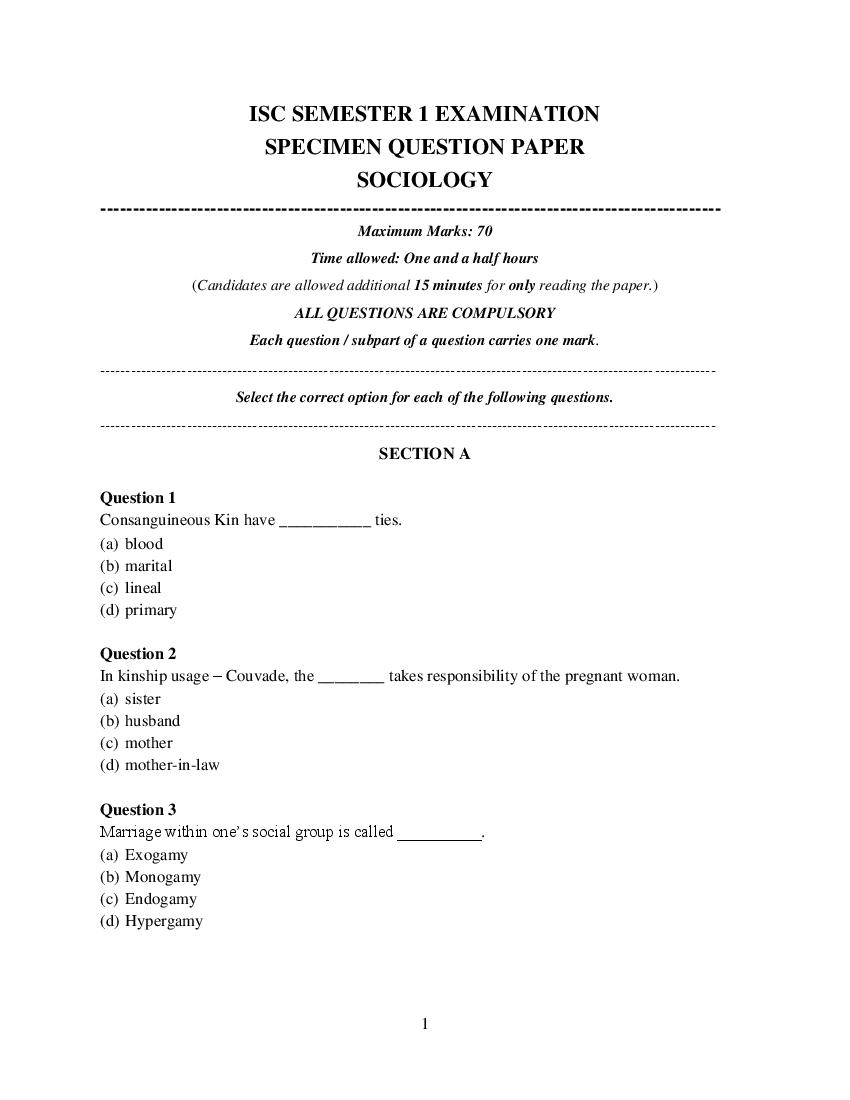
SPECIMEN QUESTION PAPER
SOCIOLOGY
------------------------------------------------------------------------------------------------
Maximum Marks: 70
Time allowed: One and a half hours
(Candidates are allowed additional 15 minutes for only reading the paper.)
ALL QUESTIONS ARE COMPULSORY
Each question / subpart of a question carries one mark.
-------------------------------------------------------------------------------------------------------------------------
Select the correct option for each of the following questions.
-------------------------------------------------------------------------------------------------------------------------
SECTION A
Question 1
Consanguineous Kin have ___________ ties.
(a) blood
(b) marital
(c) lineal
(d) primary
Question 2
In kinship usage – Couvade, the ________ takes responsibility of the pregnant woman.
(a) sister
(b) husband
(c) mother
(d) mother-in-law
Question 3
Marriage within one’s social group is called __________.
(a) Exogamy
(b) Monogamy
(c) Endogamy
(d) Hypergamy
1
Page 2
Worship of the soul is known as __________.
(a) Naturism
(b) Animism
(c) Taboo
(d) Totemism
Question 5
Jhum, Dahi and Koman are _________.
(a) Food Gathering tribes
(b) Shifting Cultivation
(c) Kinship Usages
(d) Rules of Marriage
Question 6
A weekly market is a ________.
(a) Caste-based occupation
(b) Jajmani system
(c) Traditional market
(d) Type of agrarian economy
Question 7
73rd Constitution Amendment Act played a role in empowering __________.
(a) Men
(b) Women
(c) Women and children
(d) Children
Question 8
___________ are a theoretical aspect of religion.
(a) Beliefs
(b) Rituals
(c) Superstitions
(d) Taboo
Question 9
Family of Origin is a ________ family.
(a) consanguineous
(b) conjugal
(c) patriarchal
(d) matriarchal
2
Page 3
The unit with only parents and children is a __________ family.
(a) Patriarchal
(b) Joint
(c) Nuclear
(d) Matriarchal
Question 11
The bond based on blood relationship or marriage is:
(a) Family
(b) Marriage
(c) Descent
(d) Kinship
Question 12
In Joking relationships:
(a) Kin members share an informal relationship.
(b) People worship nature.
(c) Property inheritance through mother’s side.
(d) Three generations living under the same roof.
Question 13
Which of the following term signifies the property inheritance through female’s side?
(a) Matrilocal
(b) Matripotestal
(c) Matrilineal
(d) Matriarchal
Question 14
_________ is a rule of marriage where a man marries a woman from a lower caste.
(a) Hypergamy
(b) Hypogamy
(c) Endogamy
(d) Exogamy
Question 15
Avoidance, Couvade and Tecknonymy are:
(a) Kinship Usages
(b) Kinship Types
(c) Degree of Kinship
(d) Functions of Kinship
3
Page 4
Family as a social unit:
(a) Is not universal
(b) Is not social
(c) Is temporary in nature
(d) Has a nuclear position in a social structure
Question 17
What is Pastoralism?
(a) Domesticating animals
(b) Engaging in cultivation
(c) Religious belief
(d) A form of marriage
Question 18
What are people related by marriage called?
(a) Kindred
(b) Consanguine
(c) Gotra
(d) Affinal kin members
Question 19
Coal, Cotton and Iron are the examples of:
(a) Free goods
(b) Imported goods
(c) Exported goods
(d) Economic goods
Question 20
MGNREGA stands for:
(a) Mahatma Gandhi National Rural Empowerment Guarantee Act.
(b) Mahatma Gandhi Rural Employment Guarantee Act.
(c) Mahatma Gandhi National Rural Employment Guarantee Act.
(d) Mahatma Gandhi Natural Rural Employment Guarantee Act.
Question 21
The kinship term that means keeping bloodlines and collateral clear is:
(a) Descriptive
(b) Classificatory
(c) Polyandry
(d) Polygyny
4
Page 5
_________ is a group with a common mythical totemic ancestor.
(a) Gotra
(b) Clan
(c) Consanguineous
(d) Nuclear
Question 23
_______ is a form of marriage which takes place between an individual and this individual’s
father’s sister’s son/daughter.
(a) Cross-cousin
(b) Parallel
(c) Hypergamy
(d) All the above
Question 24
__________ is a form of marriage where one’s deceased husband’s brother becomes one’s
potential mate.
(a) Sororate
(b) Clan
(c) Levirate
(d) Cross-cousin
Question 25
__________ is the term that signifies the residence with one’s maternal uncle.
(a) Patripotestal
(b) Patrilocal
(c) Avunculocal
(d) Matrilineal
Question 26
The term that refers to uttering the name of the same saint is:
(a) Gotra
(b) Pravara
(c) Clan
(d) Pinda
5
Page 6
The secondary kin of a primary kin is known as:
(a) Primary kin
(b) Tertiary kin
(c) Secondary kin
(d) Unilateral kin
Question 28
_________ is the form of marriage in which the marriage takes place ONLY between two
individuals:
(a) Polygamy
(b) Exogamy
(c) Monogamy
(d) Endogamy
Question 29
When one gets married outside one’s own village, it is known as:
(a) Avoidance
(b) Exogamy
(c) Totemism
(d) Animism
Question 30
Identify the system for organising standardised patterns of social behaviour.
(a) Social Structure
(b) Social Institutions
(c) Social Associations
(d) Social Community
Question 31
With reference to the theory of religion, choose the odd one out:
(a) Animism
(b) Levirate
(c) Totemism
(d) Naturism
Question 32
With reference to Exogamy, choose the odd one out:
(a) Clan
(b) Gotra
(c) Cousin marriage
(d) Sapinda
6
Page 7
With reference to Residence, choose the odd one out:
(a) Matrilocal
(b) Patrilocal
(c) Avunculocal
(d) Patrilineal
Question 34
With reference to Tribal Economy, choose the odd one out:
(a) Food gathering
(b) Shifting-axe cultivation
(c) Animism
(d) Handicraft
Question 35
With reference to kinship usage, choose the odd one out:
(a) Morality
(b) Amitate
(c) Avunculate
(d) Tecknonymy
Question 36
With reference to type of family, choose the odd one out:
(a) Matriarchal
(b) Nuclear
(c) Patriarchal
(d) Pastoralism
Question 37
With reference to Agrarian Economy, choose the odd one out:
(a) Owner
(b) Tenant
(c) Barter Exchange
(d) ShareCropper
Question 38
With reference to the rules of marriage, choose the odd one out:
(a) Levirate
(b) Sororate
(c) Hypergamy
(d) Polyandry
7
Page 8
With reference to concepts of religion, choose the odd one out:
(a) Beliefs
(b) Rituals
(c) Science
(d) Superstition
Question 40
With reference to the degrees of kinship, choose the odd one out:
(a) Descent
(b) Primary
(c) Secondary
(d) Tertiary
Question 41
An important function of family is:
(a) Provision of a home
(b) Socialisation
(c) Both (a) and (b)
(d) Neither (a) nor (b)
Question 42
Dysfunctions of religion are:
(a) It is a divisive agent and it leads to secularism.
(b) It leads to communalism and it is a divisive agent.
(c) Both (a) and (b)
(d) Neither (a) nor (b)
Question 43
Which of the following are the characteristics of the Joint family system?
(a) Arranged marriages and common property.
(b) Self- sufficiency and common worship.
(c) Both (a) and (b)
(d) Neither (a) nor (b)
Question 44
An example of Kinship usage is:
(a) Jhum
(b) Tecknonymy
(c) Jajmani
(d) None of the above
8
Page 9
The features of a family according to Mac Iver are:
(a) Universality and emotional basis.
(b) Emotional basis and educative role.
(c) Persistence and change, and social regulation.
(d) All of the above.
Question 46
Causes for the breakdown of the joint family are:
(a) Universality
(b) Industrialisation
(c) Social solidarity
(d) Practising group’s religion
Question 47
Exogamy is:
(a) Marriage outside ones Sapinda
(b) Marriage to ones cross-cousin
(c) Marriage within ones sub-caste
(d) Marriage with ones wife’s sister
Question 48
Religious code is:
(a) A religious ritual
(b) A religious superstition
(c) Behavioural practices approved by religion
(d) A code that outlines economic organisations
Question 49
What is Polygyny?
(a) Marriage between one man and many women
(b) Marriage between one woman and many men
(c) Marriage to one’s cross- cousin
(d) Marriage between an upper-caste woman and a lower caste man
Question 50
Patrilocal is:
(a) residence with the father’s family
(b) descent traced from the father’s side
(c) residence with the mother’s family
(d) residence with the maternal family.
9
Page 10
What is meant by Moral code?
(a) Religious beliefs and practices
(b) the Good or Evil as manifested to us.
(c) a set of behavioural practices that are accepted by the society
(d) the rules of behaviour
Question 52
Jajmani system is:
(a) a relation between the three tiers of a Panchayat.
(b) reciprocity in inter-caste relation in a village.
(c) a relation between villagers and landlords.
(d) relation with traditional markets.
Question 53
Classificatory kinship terms:
(a) group kin members under the same term.
(b) divide into consanguineous kin members.
(c) specify rules of exogamy.
(d) outline rules of marriage.
Question 54
A large number of Santhal and Gond tribes have migrated to:
(a) the coffee plantation in the Nilgiris.
(b) the manganese mines in Rajasthan.
(c) the tea gardens in the North East.
(d) the ports in Gujarat.
Question 55
Bal panchayat is a platform to:
(a) bring children to play online games.
(b) An exchange programme for children in rural areas
(c) give political empowerment to children.
(d) bring children back to school.
Question 56
Taboo is a form of:
(a) Social Control
(b) Social Process
(c) Social Interaction
(d) Dysfunction of religion
10
Page 11
Which of the following is the kinship usage according to which kin members are informal and
friendly with one another?
(a) Avoidance
(b) Tertiary degree
(c) Kinship terms
(d) Joking relations
Question 58
What determines the closeness of ego to his kin members?
(a) Type of kinship
(b) Degree of Kinship
(c) Joint family
(d) Residence in Kinship
Question 59
Pushpavalli lives in a large family home with her daughters, their children and her sons. Her
daughters’ husbands visit them occasionally. Her sons Ravi and Ram are responsible for bringing
up their sisters’ children. Their sisters’ sons inherit property from them.
(i) With reference to the above passage, match the following by selecting the correct option.
A B
I. Matrilineal 1) residence
II. Avunculocal 2) authority
III. Avunculate 3) descent
IV. Avuncupotestal 4) kinship usage
The correct match for numbers I, II, III, IV is:
(a) 3 1 4 2
(b) 4 1 2 3
(c) 2 3 1 4
(d) 1 2 3 4
(ii) The kind of family mentioned above is:
(a) Joint Family
(b) Nuclear Family
(c) Levirate
(d) Conjugal Family
11
Page 12
(a) Affinal
(b) Conjugal
(c) Consanguineous
(d) Modern
(iv) Select the odd one out:
(a) Family of Procreation
(b) Family of Origin
(c) Tertiary
(d) Taboo
Question 60
Artistic depictions of gods were not literal representations, as their true nature was considered
mysterious. However, symbolic imagery was used to indicate this nature.
The religion of Ancient Egypt lasted for more than 3000 years. Formal religious practice centered
on the Pharaoh, or ruler, of Egypt, who was believed to be divine and acted as an intermediary
between the people and the gods. Egyptians were very concerned about the fate of their souls after
death. They believed ka (life- force) left the body upon death and needed to be fed.
(i) With reference to the above passage, match the following by selecting the correct option.
A B
I. Religion 1) Their nature was considered mysterious.
II. Animism 2) They believed ka(life- force) left the body
upon death and needed to be fed
III. Belief 3) Connects man to the supernatural forces
IV. Superstition 4) Intermediary between the people and the
gods.
The correct match for numbers I, II, III, IV is:
(a) 1 2 3 4
(b) 4 1 2 3
(c) 4 2 3 1
(d) 3 1 4 2
12
Page 13
(a) An economic function
(b) Symbol
(c) A form of family
(d) A rule of marriage
(iii) Ritual is the _____________.
(a) economic concept
(b) symbol of black magic
(c) practical part of religion
(d) cognitive aspect of religion
(iv) Select the odd one out:
(a) Functionalism
(b) Totemism
(c) Naturism
(d) Science
Question 61
For hundreds of years, tribes in India have practised various economic activities. Some of them
gather fruits, roots and berries; engage in agriculture where they shift from one patch of land to
the other, weaving baskets and mats, make beautiful handicrafts and are also pastoralists. With the
onset of industrialisation, many of the tribals of Central India, have been engaged as labourers in
the Mica, and Iron and Steel Industry. Some have also migrated to the tea gardens of the North-
East. Due to these changes and the impact of the money economy, they no longer exchange goods
with one another.
(i) With reference to the above passage, match the following by selecting the correct option.
A B
I. Barter 1) collecting roots and berries.
II. Food Gathering 2) exchange of goods
III. Podu and Bewar 3) weaving baskets and mats
IV. Handicraft making 4) shifting- axe cultivation
The correct match for numbers I, II, III, IV is:
(a) 1 3 2 4
(b) 3 4 1 2
(c) 2 1 4 3
(d) 4 2 3 1
13
Page 14
(a) Afforestation
(b) Deforestation
(c) Green Revolution
(d) Good Rainfall
(iii) A tribe that works in the Iron and Steel industry is _____________.
(a) Toda
(b) Irula
(c) Warli
(d) Santhal
(iv) Select the odd one out:
(a) Involves money
(b) Sunlight
(c) Rare commodity
(d) Economic goods
14
Document Details
| Board / Org | CISCE |
| Exam | Class 12 |
| Type | Sample Paper |
| Pages | 14 |
| Language | english |
| Updated | 22 Jul 2026 |