MP PVFT 2023 Syllabus
Finished viewing? Save it for later —
Download MP PVFT 2023 Syllabus (PDF · 9 pages)About MP PVFT 2023 Syllabus
MP PVFT 2023 Syllabus is available here for free download. Published by MPESB for MP PVFT, this syllabus can be viewed online or downloaded as a PDF (9 pages). Candidates preparing for MP PVFT can use MP PVFT 2023 Syllabus to understand the exam pattern, the type of questions asked, and the overall difficulty level.
Frequently Asked Questions
How can I download MP PVFT 2023 Syllabus?
Open this page and click the Download button to save MP PVFT 2023 Syllabus as a PDF. It is completely free on AglaSem Docs.
Is MP PVFT 2023 Syllabus free to download?
Yes. MP PVFT 2023 Syllabus can be viewed online and downloaded as a PDF free of cost on AglaSem Docs.
How many pages does MP PVFT 2023 Syllabus have?
MP PVFT 2023 Syllabus contains 9 pages, which you can read online or download together as a single PDF.
Where can I find more MP PVFT study material?
You can find more MP PVFT question papers, sample papers, syllabus, and answer keys on AglaSem Docs.
MP PVFT 2023 Syllabus – Text
Read the full text of this syllabus below — useful to quickly search, copy and reference the content online without downloading the PDF.
📄 View text version (9 pages)
Page 1
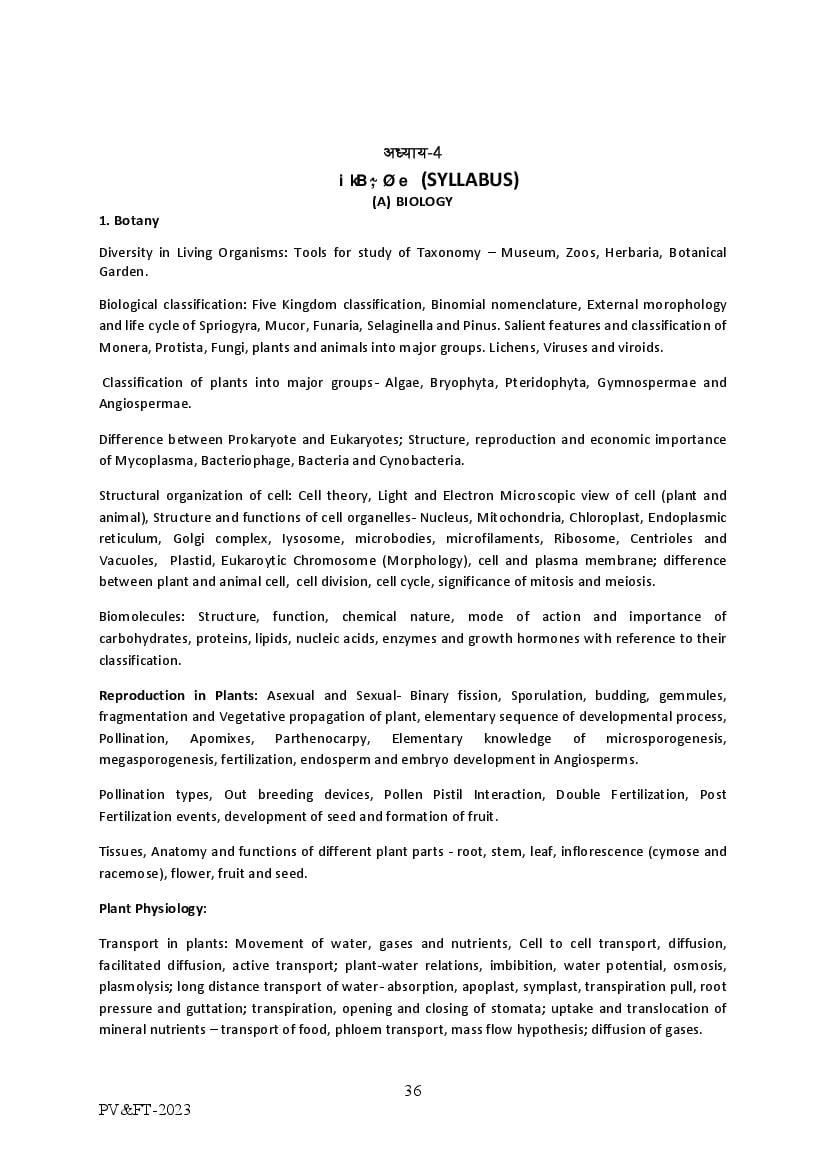
ikB~;Øe (SYLLABUS)
(A) BIOLOGY
1. Botany
Diversity in Living Organisms: Tools for study of Taxonomy – Museum, Zoos, Herbaria, Botanical
Garden.
Biological classification: Five Kingdom classification, Binomial nomenclature, External morophology
and life cycle of Spriogyra, Mucor, Funaria, Selaginella and Pinus. Salient features and classification of
Monera, Protista, Fungi, plants and animals into major groups. Lichens, Viruses and viroids.
Classification of plants into major groups- Algae, Bryophyta, Pteridophyta, Gymnospermae and
Angiospermae.
Difference between Prokaryote and Eukaryotes; Structure, reproduction and economic importance
of Mycoplasma, Bacteriophage, Bacteria and Cynobacteria.
Structural organization of cell: Cell theory, Light and Electron Microscopic view of cell (plant and
animal), Structure and functions of cell organelles- Nucleus, Mitochondria, Chloroplast, Endoplasmic
reticulum, Golgi complex, Iysosome, microbodies, microfilaments, Ribosome, Centrioles and
Vacuoles, Plastid, Eukaroytic Chromosome (Morphology), cell and plasma membrane; difference
between plant and animal cell, cell division, cell cycle, significance of mitosis and meiosis.
Biomolecules: Structure, function, chemical nature, mode of action and importance of
carbohydrates, proteins, lipids, nucleic acids, enzymes and growth hormones with reference to their
classification.
Reproduction in Plants: Asexual and Sexual- Binary fission, Sporulation, budding, gemmules,
fragmentation and Vegetative propagation of plant, elementary sequence of developmental process,
Pollination, Apomixes, Parthenocarpy, Elementary knowledge of microsporogenesis,
megasporogenesis, fertilization, endosperm and embryo development in Angiosperms.
Pollination types, Out breeding devices, Pollen Pistil Interaction, Double Fertilization, Post
Fertilization events, development of seed and formation of fruit.
Tissues, Anatomy and functions of different plant parts - root, stem, leaf, inflorescence (cymose and
racemose), flower, fruit and seed.
Plant Physiology:
Transport in plants: Movement of water, gases and nutrients, Cell to cell transport, diffusion,
facilitated diffusion, active transport; plant-water relations, imbibition, water potential, osmosis,
plasmolysis; long distance transport of water- absorption, apoplast, symplast, transpiration pull, root
pressure and guttation; transpiration, opening and closing of stomata; uptake and translocation of
mineral nutrients – transport of food, phloem transport, mass flow hypothesis; diffusion of gases.
36
Page 2
symptoms; mineral toxicity; elementary idea of hydroponics as a method to study mineral nutrition;
nitrogen metabolism, nitrogen cycle, biological nitrogen fixation.
Photosynthesis: Photosynthesis as a means of autotrophic nutrition, site of photosynthesis, pigments
involved in photosynthesis, photochemical and biosynthetic phases of photosynthesis, cyclic and non
cyclic photophosphorylation, Chemiosmotic hypothesis, Photorespiration, C3 and C4 pathways,
factors affecting photosynthesis.
Respiration: Exchange of gases, Cellular respiration- glycolysis, fermentation (anaerobic), TCA cycle
and electron transport system (aerobic); energy relations- number of ATP molecules generated,
amphibolic pathways, respiratory quotient.
Plant growth and development: Seed germination, phases of plant growth and plant growth rate,
conditions of growth; differentiation, dedifferentiation and redifferentiation; sequence of
developmental process in a plant cell, growth regulators- auxin, gibberellin, cytokinin, ethylene, ABA;
seed dormancy, vernalisation, photoperiodism.
Biodiversity and its conservation: Concept of Biodiversity, patterns of Biodiversity, importance of
Biodiversity, loss of biodiversity, hotspots, endangered organism, extinction, Red data book,
biosphere reserves, National Park and Sanctuaries.
Organisms and environment: Habitat and niche, Population and ecological adaptations, Population
interactions- mutualism, competition, predation, parasitism; Population attributes- growth, birth
rate, death rate and age distribution.
Environmental Issues: Agrochemicals and their effects, radioactive waste management.
Ecosystem: Patterns, components, productivity and decomposition, Energy flow, pyramids of
number, biomass, energy, nutrient cycles (carbon and phosphorous), ecological succession,
ecological services-carbon fixation, pollination, oxygen release.
Structures and functions of major ecosystems i.e. lake and forest, Food chain, food web, energy flow,
Ecological crisis – Role of man in polluting environment (Air, Water and Soil). Biodiversity and its
conservation, deforestation, Green house effect, Global warming, Ozone depletion.
Role of plants in human welfare: A general knowledge of plant products of economic value, Drugs,
Fibres, Cereals; Improvement in food production, Plant breeding, Depletion, biofortification, Animal
husbandry.
2. Zoology
Classification: Classification of animals non chordates up to phyla level and chordates up to class
level.
Multicellularity: Structure and Function of Animal Life.
Structure and function of Animal tissues: Epithelial, Connective, Muscular, Skeletal and Nervous.
Morphology, anatomy and functions of different systems (digestive, circulatory, respiratory, nervous
and reproductive) of cockroach.
Developmental Biology and Genetics: Principle of Heredity and variation,Pleiotropy elementary idea
of polygenic inheritance, Mendelism, Mendel’s Laws of inheritence, Incomplete dominance, Co-
37
Page 3
karyotype and chromosomal abnormalities and syndromes, Hormonal, Chromosomal and Genic
Balance theory of sex determination, Sexlinkage and sex linked inheritance in man, Monohybrid and
dihybrid cross, lineage and crossing over of genetic material, Structure of DNA and RNA, DNA
replication, genetic code, transcription, translation and gene regulation, mutation, gene mutation.
Gene expression and regulation, Lac-Operon, Genome and human genome project, DNA
fingerprinting.
Human Reproduction: Female reproductive cycles in mammals, gametogenesis alongwith structure
of sperm and ovum, Types of eggs, Fertilization, Cleavage-types of cleavage and blastula,
development of mammals upto three germinal layers, foetal membrane, structure and functions,
growth, repair and ageing, aminocentesis, implantation, Pregnancy and Placenta formation,
Parturition and Lactation.
Development of population and environment: Human population, natality, mortality, sex ratio,
population explosion; dynamics of human life with respect to food supply, housing, health and
standard of living; impact of population problems and their control
Biotechnology-Principles and Processes: Genetic Engineering (Brief idea).
Applications of biotech in health and agriculture: Human insulin, Vaccines, Gene therapy; Genetically
modified organisms-Bt Crops, Transgenic Animals, Biosafety issues, Biopiracy and patents.
Strategies for Enhancement in Food Production: Improvement in varieties of wheat, rice, pulse
(gram), oil seeds (Ground nut), sugarcane; Animal Husbandry, Tissue culture, Principle of plant
breeding and its role in improvement of crops. Industrial manufacture of Cheese, Yoghurt, Alcohol.
Food preservation –methods and importance.
Microbes in Human Welfare: In household food processing, sewage treatment, energy generation, as
biocontrol agents and biofertilizer, Antibiotics
Evolution: Origin of life, Biological evolution and evidences for biological evolution (paleontology,
comparative anatomy, embryology and molecular evidence), Darwin’s contribution, Modern
Synthetic theory of Evolution, Mechanism of evolution-Variation and Natural Selection with
examples, Types of natural selection, Gene flow and genetic drift, Hardy-Weinberg’s principle,
Adaptive Radiation, Human evolution.
Economic Zoology: Sericulture, Apiculture, Lac culture, Poultry, Fishery and Pearl industry.
Health and Disease: Protozoan diseases in relation to man, Insect carrying diseases in relation to
man, Cancer-types of cancer and cancer cell, Communicable diseases (Hepatitis, AIDS), STD, Immune
Response, Vaccines and antisera, Allergies, Smoking, alcoholism and drug addition.
Human Physiology:
Digestion and absorption: Alimentary canal and digestive glands, Role of digestive enzymes and
gastrointestinal hormones, Peristalsis; Digestion, absorption and assimilation of proteins,
carbohydrates and fats; Caloric value of proteins, carbohydrates and fats; Egestion; Nutritional and
38
Page 4
jaundice, diarrhoea.
Breathing and Respiration: Respiratory organs in animals, Respiratory system in humans, Mechanism
of breathing and its regulation in humans- exchange of gases, transport of gases and regulation of
respiration, respiratory volume; Disorders related to respiration-asthma, emphysema, occupational
respiratory disorders.
Body fluids and circulation: Composition of blood, blood groups, coagulation of blood; Composition
of lymph and its function, Human circulatory system-Structure of human heart and blood vessels,
Cardiac cycle, cardiac output, ECG, Double circulation, Regulation of cardiac activity, Disorders of
circulatory system-hypertension, coronary artery disease, angina pectoris, heart failure.
Excretory products and their elimination: Modes of excretion- ammonotelism, ureotelism,
uricotelism; Human excretory system-structure and fuction; Urine formation, Osmoregulation,
Regulation of kidney function-Renin-angiotensin, Atrial Natriuretic Factor, ADH and Diabetes
insipidus; Role of other organs in excretion, Disorders- uraemia, renal failure, renal calculi, nephritis;
Dialysis and artificial kidney.
Locomotion and Movement: Types of movement- ciliary, flagellar, muscular; Skeletal muscle-
contractile proteins and muscle contraction; Skeletal system and its functions; Joints; Disorders of
muscular and skeletal system-myasthenia gravis, tetany, muscular dystrophy, arthritis, osteoporosis,
gout.
Neural control and coordination: Neuron and nerves; Nervous system in humans- central nervous
system, peripheral nervous system and visceral nervous system; Generation and conduction of nerve
impulse; Reflex action; Sense organs; Elementary structure and functions of eye and ear.
Chemical coordination and regulation: Endocrine glands and hormones; Human endocrine system-
Hypothalamus, Pituitary, Pineal, Thyroid, Parathyroid, Adrenal, Pancreas, Gonads. Mechanism of
hormone action; Role of hormones as messengers and regulators, Hypo-and hyperactivity and
related disorders; Dwarfism, Acromegaly, Cretinism, Goiter, Exopthalmic Goiter, Diabetes, Addison’s
disease.
(B) PHYSICS
Physical World and Measurement: Accuracy and precision of measuring instruments, errors in
measurement, significant figures.
Units and Dimensions: Dimensional Analysis, S.I. Units,
Kinematics: Motion in straight line, Elementary concepts of differentiation and integration for
describing motion, Uniformly accelerated motion, Velocity time and position time graph, Scalars and
Vectors quantities, Additional and subtraction of vectors, Scalar and vector product of vectors,
Resolution of a vector in plane-rectangular components, Unit Vector, Non uniform motion, Average
speed and instantaneous velocity,
Laws of Motion: Equilibrium of concurrent forces, Force and inertia, Newton’s law of motion,
Conservation of momentum, Motion in two dimensions, Projectile motion and Uniform circular
39
Page 5
examples of circular motion (vehicle on a level circular road, vehicle on banked road)
Work, Energy and Power: Power, Conservative forces, Conservation of mechanical energy (kinetic
and potential energies), non conservative forces, motion in a vertical circle, work energy theorem,
potential energy of spring, elastic and non elastic collisions.
Gravitation: Kepler’s laws of planetary motion, Universal law of gravitation, acceleration due to
gravity and its variation, Gravitational potential energy and gravitational potential, Escape velocity,
Orbital velocity of a satellite, Geo stationary satellites.
Motion of system particles and rigid bodies: Conservation of momentum, Centre of mass of two and
multi particle system, Rigid body rotation, Moment of inertia, Theorems of perpendicular and
parallel axes, Values of moment of inertia for simple geometrical objects, Moment of force, Torque,
Angular momentum, Laws of conservation of Angular momentum with some examples. Equilibrium
of rigid bodies, Equation of rotational motion, Comparison of linear and rotational motion, radius of
gyration.
Properties of Bulk matter: Elastic behavior, Stress strain relationship, , Poisson’s ratio, Elastic Energy,
Reynolds number, Application of surface tension idea to drops, bubbles and capillary rise;
Anomalous expansion, Hooke’s law, Young’s modulus, Bulk modulus, shear modulus of rigidity,
Viscosity, Stoke’s law, terminal velocity, Streamline and turbulent flow, Critical velocity, Bernoulli’s
theorem and its applications, Surface energy, Surface tension, angle of contact, excess of pressure
across a curved surface.
Thermodynamics: Zeroth law of thermodynamics, Heat, Internal energy, First law of
thermodynamics, Isothermal and adiabatic processes, Second law of thermodynamics, Heat engine
and Refrigerator.
Kinetic theory of gases: Concept of pressure, kinetic energy and temperature, Law of equipartition
of energy, Specific heat capacity of gases.
Thermal Properties of Matter: Heat, temperature, thermal expansion, Specific heat capacity, Cp and
Cv- Calorimetry; Change of state, Heat transfer-conduction, convection and radiation; Thermal
conductivity, Black body radiation, Stefan’s law and Newton’s law of cooling.
Oscillation and Waves: Periodic motion-time period, Frequency, displacement as a function of time,
Periodic function. Force constant, Simple pendulum derivation of expression for its time period,
resonance, Simple Harmonic Motion (SHM), Phase, Oscillations of spring and simple pendulum,
energy in SHM; Free, forced and damped oscillations; wave motion, progressive wave equation,
superposition of waves, standing waves in strings and organ pipes, Beats, Doppler effect.
Electrostatics: Electrical charge and their conservation, force between multiple charges, Electric field
lines, electric dipole, electric field due to a dipole, torque on a dipole in a uniform electric field,
Electric flux, potential difference, equipotential surfaces, Conductors and insulators, free charges and
bond charges inside a conductor, Dielectrics and electric polarization, Combination of capacitors in
series and in parallel, Coulomb’s law of electrostatics, Electric field due to point charge, Gauss’s
theorem and its applications in simple geometrics, Electric potential due to a point charge, a dipole
40
Page 6
medium between the plates, Capacitors in series and parallel, energy stored in capacitor, Van de
Graff generator.
Current Electricity: Flow of electric charges in a metallic conductor, Potential difference, combination
of cells in series and parallel for comparing emf of two cells, measurement of internal resistance of a
cell, Electric current, drift velocity, mobility, Ohm’s law, electrical energy and power, Colour code for
carbon resistors, temperature dependence of resistance, Internal resistance of cell, electromagnetic
force, Primary and secondary cells, Kirchhoff’s laws, Wheatstone bridge, Metre Bridge,
Potentiometer and its applications.
Magnetic effect of current and Magnetism: Oersted’s experiment, electric field, concept of magnetic
field, earth magnetic field and magnetic element, torque experienced by a current loop in uniform
magnetic field, Biot-Savart’s law and its application to circular current carrying loop, Ampere’s law
and its applications for solenoid and torroid, Force on a moving charge in a magnetic field, Cyclotron,
Force on a current carrying conductor, Moving coil galvanometer, Conversion to Ammeter and
Voltmeter, Current loop as a magnetic dipole, magnetic dipole moment, Bohr magneton, Magnetic
field intensity due to a dipole along its axis and perpendicular to its axis, neutral points, bar magnet
as an equivalent solenoid, Torque on a magnetic dipole; Para, dia and ferro magnetic substances;
electro magnets and permanent magnets.
Electromagnetic Induction and Alternating Currents: Electro magnetic induction, Resonance, power
in AC circuits, Wattless current, Faraday’s laws, Lenz’s law, Eddy currents, self and mutual induction,
Alternating currents, rms value of alternating current/voltage, reactance, impedance, LCR series
circuits, LC oscillations, AC generator and Transformer.
Electromagnetic waves: Displacement current, Bose and Hertz experiment, Characteristics of e.m.
waves, transverse nature, electromagnetic spectrum, elementary facts and their uses, propagation
of electromagnetic waves, Ground waves, Sky waves, Satellite communication and Remote sensing.
Optics: Magnification power of lens, Coherent and sustained source, Reflection of light, spherical
mirrors, Refraction of light, total internal reflection, Optical fibres, Refraction at spherical surface,
lens maker’s formula, combination of thin lenses in contact combination of lens and a mirror,
refraction and dispersion of light through a prism, scattering of light- blue colour of sky and reddish
apprearance of the sun at sunrise and sunset, Optical instruments, Compound microscope and
Astronomical telescope, terrestrial telescope and reflecting telescope, Resolving power of
microscope and telescope, Human eye, Correction of eye defects – myopia and hypermetropia.
Wave optics: Huygen’s Principle, reflection and refraction of light using Huygen’s Principle,
Interference, Young’s double slit experiment, Diffraction due to a single slit, Polarisation, Methods of
production of polarised light, Law of Malus, Brewester’s law, Polaroids and their applications.
Dual Nature of Matter and Radiation: Photo electric effect, Einstein’s photo electric equation, Dual
nature of matter and radiation, de Broglie’s equation, Davisson-Germer experiment.
Atoms and Nuclei: Alpha particle scattering experiment, Rutherford’s model of atom, Bohr atomic
model, energy levels, hydrogen spectrum, Radio activity, Alpha, beta and gamma rays, Mass defect,
binding energy per nucleon and its variation with mass number, Nuclear fusion and fission.
41
Page 7
forward and reverse bias, PN junction as a rectifier, I-V characteristics of LED, photo diode, solar cell
and zener diode, Zener diode as a regulator, Transistor, Characteristic curves of a transistor,
transistor as an amplifier, and oscillator, Logic Gates (OR, AND, NOT, NAND, and NOR).
Elementary ideas about analogue and digital communication: Elements of communication system
(block diagrams only), need for modulation, amplitude and frequency modulation.
(C) CHEMISTRY
(I) General and Physical Chemistry
Some Basic concepts of Chemistry
Structure of Atom: Constitution of nucleus, Bohr’s atom model, quantum numbers, Aufbau
principle, electronic configuration of elements (upto-Kr), de-Brogile’s relationship, shapes of orbitals,
Dual nature of matter and light, Heisenberg’s uncertainty principle, Concept of orbital, Pauli’s
exclusion principle and Hund’s rule, Stability of half filled and completely filled orbitals.
Chemical Bond: Electrovalent, covalent and coordinate bonds, concept of hybridization, involving s,p
and d orbitals and shapes of some simple molecules, hydrogen bond, shapes of molecules, Valence
Shell Electron Pair Theory, bond polarity, resonance, Elements of Valence bond theory (VBT),
Molecular orbital theory (MOT)
Classification of Elements and Periodicity: Modern periodic law and present form of periodic table,
Periodic trends in properties of element-atomic radii, ionic radii, inert gas radii, ionization enthalpy,
electron gain enthalpy, electronegativity, valency.
Solution: Solubility of gases in liquids, solid solutions, relative lowering of vapour pressure, Elevation
of boiling point, depression of freezing point, Osmotic pressure, Modes of expressing concentrations
of solutions, types of solutions, Raoult’s law of colligative properties, non-ideal solution, abnormal
molecular weights. Determination of molecular masses using colligative properties, Van’t Hoff factor,
Henry law.
Equilibrium: Handerson Equation, Chemical equilibrium, Law of mass action, Kp and Kc, Le Chatelier’s
principle and its application, Ionic Equilibria in solutions, Solubility product, common ion effect,
theories of acids and base hydrolysis of salts, pH, buffers.
Chemical Kinetics: Order and molecularity of a reaction, Activation energy, Rate of reaction, factors
affecting the rate, rate constant, rate expression, order of reaction, Collision theory, first order rate
constant expression and characteristics, Arrhenious equation.
Chemical Bonding and Molecular Structure
States of Matter: Gases and Liquids
Thermochemistry and Thermodynamics: Brief Introduction, First law of thermodynamics -internal
energy and enthalpy, Second law of thermodynamics, Third law of thermodynamics, Energy changes
during a chemical reaction, Hess’s law, Heats of reactions, entropy, free energy, spontaneity of a
42
Page 8
useful work.
Electrochemistry: Oxidation number and ion-electron methods, Electrolytic conduction, Kohlrausch’s
law and collision theory, Faraday’s law, voltaic cell, electrode potentials, electromotive force, Gibb’s
energy and cell potentials, Nernst equation, commercial cells, fuel cells, electrochemical theory of
corrosion.
Surface chemistry: Colloids and Catalysis, Adsorption and Absorption, Colloids (types, preparation
and properties), Emulsions, Miscelles, Catalysis (types and characteristics).
(II) Inorganic Chemistry:
Principles of metallurgical-operations: Furnaces, ore concentration, extraction, purification,
metallurgies and properties of Na, Al, Fe, Cu, Ag, Zn and Pb.
Redox Reaction
Hydrogen: Isomerism (Structural and Stereo), Bonding, Werner's Theory.
Chemical periodicity: s, p, d and f-block elements, Periodic Table, periodicity, atomic and ionic radii
valency, ionization energy,electron affinity, electronegativity, metallic character, comparative study
of the following families of elements- (i) alkali metals (ii) Alkaline earth metals (iii) Nitrogen family
(iv)Oxygen family (v) Halogens (vi) Noble gases. Transition metals, electronic configuration of 3d-
metal ions, oxidation states, other general characteristics properties, potassium permanganate,
potassium dichromate.
Solid State: Unit cell, Packing in solids, packing efficiency, voids, numbers of atoms per unit cell in a
cubic unit cell, point defects, electrical and magnetic properties, band theory of metals, conductors,
semiconductors and insulators.
Chemical analysis: Chemistry involved in simple inorganic qualitative analysis, calculations based on
acid-base titrimetry.
(III) Organic Chemistry:
Some basic principles and homolythic and hetrolytic fission of a covalent, radicals, carbocations,
carboanions, electrophiles, and type of organic reactions, calculations of empirical and molecular
formula of organic compounds, nomenclature of organic compounds, common functional groups,
isomerism structure and shapes of alkanes and benzene, tests of organic compound.
Preparation, properties and uses of alkanes, alkenes, alkynes, alkyl, benzene, petroleum, cracking
octane equation, gasoline additives.
Nomenclature, Physical and chemical properties, correlation of physical properties with structure
and uses of haloalkanes, halobenzenes, alcohols and phenols. General ideas of some polyhalogen
compounds viz., dichlorothanes, dichloroethers, chloroform, carbon tetrachloride, D.D.T., benzene
hexachloride.
43
Page 9
structures and uses of ethers, aldehydes, ketones, carboxylic acids and their derivatives.
Brief account of chemistry of cyanides, isocyanides, amines and nitro compounds.
Polymers: Classification, preparation and uses of common natural and synthetic polymers.
Coordination compounds : Introduction, ligands, Coordination number, color, magnetic properties
and shapes, IUPAC nomenclature of mono nuclear coordination compounds, Isomerism, Warner’s
theory, VBT, CFT, importance of coordination compounds.
Bio-molecules: Carbohydrates- classification (Aldoses and Ketoses), Monosaccharide (Glucose and
Fructose), D and L configurations oilgo saccharides (Sucrose, Lactose, Maltose) polysaccharides
(Starch, Cellulose, Glycogen). Proteins- elementary idea of α - amino acids, peptide bond,
polypeptides, proteins, primary structure, secondary structure, tertiary structure and quaternary
structure (qualitative idea only), denaturation of proteins enzymes.
Vitamins - Classification and functions.
Hormones: Elementary idea
Nucleic Acid: DNA and RNA
Chemistry in everyday life: chemicals in medicines, chemicals in food -preservatives, artificial
sweetening agents; cleansing agents – soaps and detergents, cleansing action.
Environmental Chemistry
44
Document Details
| Board / Org | MPESB |
| Exam | MP PVFT |
| Type | Syllabus |
| Pages | 9 |
| Updated | 27 Aug 2026 |