AP DEECET 2022 Question Paper for Social Studies (Telugu)
Finished viewing? Save it for later —
Download AP DEECET 2022 Question Paper for Social Studies (Telugu) (PDF · 19 pages)About AP DEECET 2022 Question Paper for Social Studies (Telugu)
AP DEECET 2022 Question Paper for Social Studies (Telugu) is available here for free download. Published by APSCHE for AP DEECET, this question paper can be viewed online or downloaded as a PDF (19 pages). Candidates preparing for AP DEECET can use AP DEECET 2022 Question Paper for Social Studies (Telugu) to understand the exam pattern, the type of questions asked, and the overall difficulty level.
Frequently Asked Questions
How can I download AP DEECET 2022 Question Paper for Social Studies (Telugu)?
Open this page and click the Download button to save AP DEECET 2022 Question Paper for Social Studies (Telugu) as a PDF. It is completely free on AglaSem Docs.
Is AP DEECET 2022 Question Paper for Social Studies (Telugu) free to download?
Yes. AP DEECET 2022 Question Paper for Social Studies (Telugu) can be viewed online and downloaded as a PDF free of cost on AglaSem Docs.
How many pages does AP DEECET 2022 Question Paper for Social Studies (Telugu) have?
AP DEECET 2022 Question Paper for Social Studies (Telugu) contains 19 pages, which you can read online or download together as a single PDF.
Where can I find more AP DEECET study material?
You can find more AP DEECET question papers, sample papers, syllabus, and answer keys on AglaSem Docs.
AP DEECET 2022 Question Paper for Social Studies (Telugu) – Text
Read the full text of this question paper below — useful to quickly search, copy and reference the content online without downloading the PDF.
📄 View text version (19 pages)
Page 1
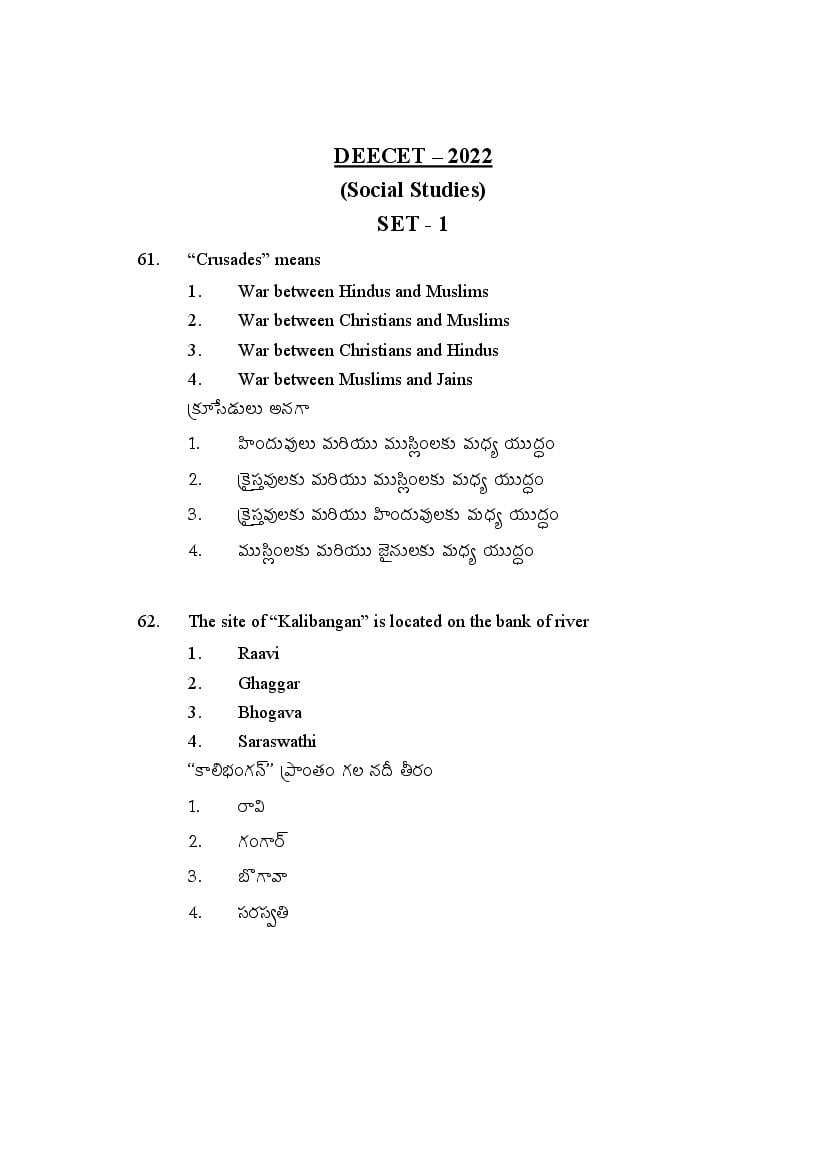
(Social Studies)
SET - 1
61. “Crusades” means
1. War between Hindus and Muslims
2. War between Christians and Muslims
3. War between Christians and Hindus
4. War between Muslims and Jains
çÅ£Ld&T\T nq>±
1. V¾²+<TeÚ\T eT]jáTT eTTd¾+¢ \Å£ eT<ó« jáTT<+Æ
2. ç¿dÕ ïeÚ\Å£ eT]jáTT eTTd¾+¢ \Å£ eT<ó« jáTT<+Æ
3. ç¿dÕ ïeÚ\Å£ eT]jáTT V¾²+<TeÚ\Å£ eT<ó« jáTT<+Æ
4. eTTd¾+¢ \Å£ eT]jáTT CÉqÕ T\Å£ eT<ó« jáTT<+Æ
62. The site of “Kalibangan” is located on the bank of river
1. Raavi
2. Ghaggar
3. Bhogava
4. Saraswathi
»»¿±*uó+ >·Hµ µ çbÍ+Ôá+ >·\ qB rsÁ+
1. s$
2. >·+>±sY
3. u¤>±y
4. dsÁdÇÜ
Page 2
1. Rishabhanatha
2. Vardhamana Mahavira
3. Parsvanatha
4. Neminatha
CÉqÕ eTÔá+ýË 24e rsÁ+Æ ¿£sÁT&T
1. ewuHó <óT &T
2. esÁeÆ Öq eTVäMsÁT&T
3. bÍsÁôÇH<óT&T
4. Hû$TH<óT&T
64. The first historical dynasty of India is
1. Guptas
2. Kushans
3. Mouryas (or) Mauryas
4. Pushyabhutis
uó²sÁÔá<Xû +ø ýË yîTT<{ì #]çÔá¿£ e+Xø+
1. >·T|Ú\ï T
2. Å£cÍDT\T
3. eTòsÁT«\T
4. |Úw«uóÖÜ
Page 3
1. Dhanurveda
2. Gandharvaveda
3. Shilpaveda
4. Ayurveda
jáTT<Æ $<«\Å£ d++~ó+ºq y{ì $e]+#û |y<û +
1. <óq T¹sÇ<+
2. >·+<ósÁÇyû<+
3. ¥\Îyû<+
4. jáTT¹sÇ<+
66. The Brihadeshwar temple built during the Chola period is located at
1. Mysore
2. Mahabalipuram
3. Thanjavur
4. Kanyakumari
#ÃÞø\ ¿±\+ýË V²BXøÇs\jáÖ m¿£Ø& ]+ºq ç|<Xû +ø
1. yîTd® Ö sÁT
2. eTVä*|ÚsÁ+
3. Ôá+C²ePsÁT
4. ¿£H«Å£eÖ]
Page 4
1. Mesopotamian language
2. Akkadian language
3. Chinese language
4. Cuniform
¿ì+~ yýË ç¿¡.|P. 2400 H{ì¿ì dyTû ]jáTH *|¾¿ì <T\T>± y&T¿£ýË¿ì
eºÌq *|¾
1. yîTd|{Ë$TjáÖ çyÔá $<óq+
2. n¿±Ø&jTá H *|¾
3. #îúÕ dt *|¾
4. Å£L«bÍsÁ+
68. The sultan who transferred the capital from Delhi to Daulatabad
1. Qutubuddin Aibak
2. Alauddin Khilji
3. Muhammad Bin Tughlaq
4. Ibrahim Lodi
Ôáq sÈ<ó &ó©¢ qT+& <ê\Ôu²<Å£ eÖ]Ìq dTý²ïqT
1. Å£ÔáTTBÝH ׿ù
2. ný²¢eÚBÝH`Ï©¨
3. eTV²eT<`;H`ÔáT>·¿¢ ù
4. çV¾²+ ýË&
Page 5
1. Alexandria
2. Galen
3. Julius caesar
4. Pliny
sÃeTH kÍçeÖÈ«+ýË >=|Î yîÕ<T«&T
1. nýÉ>±¨+ç&jáÖ
2. >±ýÉH
3. p*jáTdt dÓÈsY
4. |¾¢ú
70. “History is an account of the unchanging past” is suggested by
1. Herodotus
2. Aristotle
3. E.H. Carr
4. Karl Max
»»eÖsÁTÎýñ >·Ôá d+|T ³q\ deÖVäsÁyTû #á]çÔáµµ n |s=Øq Xæçdyï Ô
û ïá
1. V²]&Ã&dt
2. n]kͼ{ìýÙ
3. .V²#Y. ¿±sY
4. ¿±sY¢ eÖsYØà
Page 6
1. Stephenson
2. Humphry Davy
3. Boulton
4. Adams
»d|Óý¼ ²+|tµqT ¿£qT>=qysÁT
1. dÓ¼ |Hd H
2. V²+ç|Ó&û$
3. u \¼H
4. &yTà
72. Which of the following country was not a member of “NATO”
1. England
2. France
3. India
4. Canada
¿ì+~ yýË »»H{˵µýË duó«ÔáÇ+ ýñ <ûXø+
1. +>·¢+&
2. çbÍHà
3. +&jáÖ
4. ¿q&
Page 7
1. Bhagat Singh
2. Suryasen
3. Subhash Chandra Bose
4. Vallabhai Patel
»»qeJeq uó²sÁÔá duóµµ qT çbÍsÁ+_ó+ºq kÍÇÔá+çÔá« deTsÁjîÖ<óT&T
1. uó>·ÔYd¾+>´
2. dÖsÁ«dH
3. dTuó²wt#á+ç<uËdt
4. e\¢uó²jYT|fýñ Ù
74. National Assembly abolished feudal system on
1. 26 August 1789
2. 04 August 1789
3. 18 August 1789
4. 14 August 1789
C²rjáTduó uóÖ kÍÇeT« e«edqÆ T sÁ<T Ý #ûdq¾ d+eÔáàsÁ+
1. 26 >·w§ ,¼ 1789
2. 04 >·w§ ,¼ 1789
3. 18 >·w§¼, 1789
4. 14 >·w§ ¼, 1789
Page 8
1. Total product
2. Average Product
3. Marginal Product
4. Average Price
ÿ¿£ jáTÖ{Ù #ás¿Á ±sÁ¿+£ çXøeTÅ£ q yîTTÔá+ï ÔáÎÜï
1. yîTTÔá+ï ÔáÎÜï
2. d>³ · T ÔáÎÜï
3. bÍ+Ôá ÔáÎÜï
4. d>³ · T <ós Á
76. The Monopolies and Restrictive Trade Practices Act 1969 came
into force from
1. 1st July 1970
2. 1st June 1970
3. 1st May 1970
4. 1st August 1970
@¿£kÍÇeT« y«bÍsÁ jáT+çÔáD #á³+¼ , 1969 neT\TýË¿ì
eºÌq d+eÔáàsÁ+
1. 1 pýÉÕ 1970
2. 1 pH 1970
3. 1 yûT 1970
4. 1 >·w§ ¼ 1970
Page 9
1. Edwin cannan
2. Marshall
3. Adam smith
4. Robbins
»»sC²«\ d+|<µ µ ç>·+<ó sÁ#sá TTÔá
1. m&ÇH ¿±qH
2. eÖsÁýü Ù
3. &+ d¾ÔY
4. s_Hà
78. The present Governor of Reserve Bank of India
1. V.V. Chari
2. Raghuram Rajan
3. Shaktikanta Das
4. Urjit Patel
]ÈsYÇ u²«+¿ù |t +&jáÖ ç|dTïÔá >·esÁsY
1. $.$. #]
2. sÁ|TTs+ sÁÈH
3. Xø¿ïì ¿±+Ôá <dt
4. }]¨ÔY |fýñ Ù
Page 10
1. GNP at market prices (–) Depreciation
2. GNP at market prices (+) Depreciation
3. Personal Income (–) Personal Taxes
4. Consumption (+) Savings
¿ì+~ y{ìýË <û¿ì ¿£sÁ C²rjîÖÔáÎÜï eÖÂsØ{Ù <ósÁ\ e<Ý deÖq+
1. eÖÂsØ{Ù <ós \Á dÖ\Æ C²rjîÖÔáÎÜï – ÔásTÁ >·T<\
2. eÖÂsØ{Ù <ós \Á dÖ\Æ C²rjîÖÔáÎÜï + ÔásÁT>·T<\
3. e«¿ì>ï Ô· á <jáT+ – e«¿ì>ï Ô
· á |qT\T
4. $jîÖ>·+ + bõ<T|Ú
80. The budget in which the total expenditure exceeds the total revenue
1. Surplus budget
2. Balanced budget
3. Deficit budget
4. Zero budget
yîTTÔá+ï e«jáT+, yîTTÔáï+ s& ¿£H n<q+>± q³¢sTTÔû
< @ &î̈{Ù n |¾\TkÍïsÁT.
1. $T>·T\T &î̈{Ù
2. deTÔê\« &î̈{Ù
3. ý˳T &î̈{Ù
4. Jsà &î̈{Ù
Page 11
eT<ó« >·Ô+á 125 eT]jáTT n+¿£eT<ó« eT+ 128 nsTTq
u²VQÞø¿£eTTqT ¿£qT>=q+&.
1. 120.8
2. 119.8
3. 121.8
4. 120
82. According to the 2011 census, density of population in India is
2011 ÈHuó² ýÉ¿Ø£ \ ç|¿±sÁ+ uó²sÁÔ<á Xû ø ÈqkÍ+ç<Ôá
1. 382
2. 385
3. 390
4. 392
83. Absolute poverty in India is measured through
1. Poverty line
2. Education
3. Health
4. None of these
uó²sÁÔá<ûXø+ýË sÁ|¿£ |<]¿£eTTqT ¿ì+~ y <Çs ¿=\TkÍïsÁT.
1. |<]¿£ ^Ôá
2. $<«
3. sÃ>·«+
4. @B¿±<T
Page 12
@ |+#áesÁü ç|D²[¿£ýË bÍ]ç¿£XæMT¿¡¿s£ D
Á Å£ n~ó¿£ çbÍ<óq«Ôá eÇ&yTî q® ~?
1. 1
2. 2
3. 3
4. 4
85. What is the expansion of ICICI?
ICICI qT $d]
ï +#á+&.
1. Institutional credit and Investment corporation of India
2. Industrial credit and investment corporation of India
3. Individual credit and investment corporation of India
4. Incremental credit and investment corporation of India
86. Integrating domestic economy with the world economy relates to
1. Globalisation
2. Privatisation
3. Liberalisation
4. Disinvestment
<ûojáT ]¿e£ «edq T ç||+ #á ]¿£ e«edý qT nqTd+<óq+ #ûjTá &
@eT |¾\TkÍïsTÁ .
1. ç||+ N¿£sD Á
2. ç|Õy{ û ¡¿s£ D
Á
3. dsÁ°¿£sÁD
4. |³T¼&T\ |d+ V²sÁD
Page 13
1. 1st January 1985
2. 1st January 1995
3. 1st January 1997
4. 1st January 1999
ç||+ #á yDìÈ« d+d m|Î{ì qT+& neT\TýË¿ì eºÌ+~.
1. 1 Èqe] 1985
2. 1 Èqe] 1995
3. 1 Èqe] 1997
4. 1 Èqe] 1999
88. The term ‘politics’ is derived from
1. Latin word polis
2. Greek word polis
3. Greek word City state
4. English word political
»bÍ*{ì¿àù µ nHû |<+ <û qT+& ç>·V²¾ +#á&q~?
1. ý²{ìH |<+ bþ*dt
2. ç^Å£ |<+ bþ*dt
3. ç^Å£ |<+ q>·sÁ sÈ«+
4. +^¢wt |<+ bõ*{ì¿ý£ Ù
Page 14
adopted by UNO on
1. 10 December 1946
2. 10 December 1947
3. 10 December 1948
4. 10 December 1949
׿£«sÈ«d$TÜ kÍsÁÇçÜ¿£ eÖqe V²Å£Ø\ ç|¿³
£ q ç|¿{
£ +ì ºq~.
1. 10 &d+sY 1946
2. 10 &d+sY 1947
3. 10 &d+sY 1948
4. 10 &d+sY 1949
90. The meaning of “Jus Sanguinis”
1. Place of birth
2. Mixed principle
3. Kinship or Blood relationship
4. Aliens
»»Èdt kÍ+ÐÇdtµµ nq>±
1. Èqd\Æ +
2. $TçXøeTdÖçÔá+
3. +<óT ÔáÇ+ ýñ< sÁ¿dï£ + +<ó+
4. ç>·Vä+ÔásÁydT\T
Page 15
1. 1940
2. 1943
3. 1945
4. 1946
׿£«sÈ«d$TÜ @sÎfÉ®q d+eÔáàsÁ+
1. 1940
2. 1943
3. 1945
4. 1946
92. Which amendment of the constitution added the word “Secular” in
the Preamble?
1. 41st amendment
2. 42nd amendment
3. 43rd amendment
4. 44th amendment
uó²sÁÔá sC²«+>·+ |Ó]Ä¿£ýË »»ý ¿ì¿£µµ nHû |< #û]Ìq desÁD #á³¼+
1. 41e desÁD #á³+¼
2. 42e desÁD #á³¼+
3. 43e desÁD #á³+¼
4. 44e desÁD #á³+¼
Page 16
1. America
2. India
3. France
4. Britain
n*ÏÔá sC²«+>·+ >·\ <ûX+ø
1. nyîT]¿±
2. uó²sÁÔá<ûXø+
3. çbÍHà
4. ç_³H
94. In the Indian constitution “Untouchability” is to be an offence
according to
1. 14th Article
2. 15th Article
3. 16th Article
4. 17th Article
uó²sÁÔá sC²«+>·+ýË ndÎXø«Ôá ýñ< n+³sÔáq+ bÍ{ì+#á& Hûs+Á >±
|s=Øq n~ó¿£sÁD+
1. 14e ]¼¿ý£ Ù
2. 15e ]¼¿£ýÙ
3. 16e ]¼¿£ýÙ
4. 17e ]¼¿ý£ Ù
Page 17
1. Prime Minister
2. President
3. Vice President
4. Governor
dTç|Ó+¿ÃsÁT¼ ç|<ó q H«jáTeTÖ]ï jáT$T+#áTysÁT.
1. ç|<ó qeT+çÜ
2. sçw¼|Ü
3. |sçw¼|Ü
4. >·esÁsY
96. The book “My presidential years” is written by
1. K.R. Narayanan
2. Neelam Sanjiv Reddy
3. Shankar Dayal Sharma
4. R. Venkatraman
»»yîT® ç|d¾&î j
ü áTýÙ jáTsY൵ nHû |Úd¿ï £ sÁ#sá TTÔá
1. ¿. sY. HsjáTDH
2. ú\+ d+JeÂs&¦
3. Xø+¿£sY <jáÖÞÙ XøsÁ
4. R. yî+¿£ç{²eTH
Page 18
1. Chief Minister
2. Governor
3. State Education Minister
4. High Court Chief Justice
sçw¼ $XøÇ$<«\jáÖ\Å£ Å£\|Ü
1. eTTK«eT+çÜ
2. >·esÁsY
3. sçw¼ $<«XæU²eT+çÜ
4. VÕ²¿ÃsÁT¼ ç|<ó q H«jáTeTÖ]ï
98. The president rule imposed in Andhra Pradesh in
Jai Andhra movement during the year
1. 2000
2. 1975
3. 1973
4. 1980
CÉÕ +ç<ó <«eT deTjáT+ýË +ç<óç |<Xû ýÙ Ë sçw¼|Ü
bÍ\q
$~ó+ºq d+eÔáàsÁ+
1. 2000
2. 1975
3. 1973
4. 1980
Page 19
1. prohibition
2. Certiorari
3. we command
4. by what authority
eÖ+&eTdt nq>±
1. w~+#áT³
2. Ôî*jáT#ûjTá T³
3. yûTeTT C²ã|¾dT Hï eTT
4. @ n~ó¿±sÁ+ÔÃ
100. The freedom of press act in 1766 is implemented in
1. Sweden
2. Canada
3. India
4. America
1766ýË |çÜ¿± kÍÇÔá+çÔá« #á{²¼ neT\T|sºÁ q <ûX+ø
1. dÓÇ&H
2. ¿q&
3. +&jáÖ
4. nyîT]¿±