AP DEECET 2022 Question Paper for Biological Science (Telugu)
Finished viewing? Save it for later —
Download AP DEECET 2022 Question Paper for Biological Science (Telugu) (PDF · 48 pages)About AP DEECET 2022 Question Paper for Biological Science (Telugu)
AP DEECET 2022 Question Paper for Biological Science (Telugu) is available here for free download. Published by APSCHE for AP DEECET, this question paper can be viewed online or downloaded as a PDF (48 pages). Candidates preparing for AP DEECET can use AP DEECET 2022 Question Paper for Biological Science (Telugu) to understand the exam pattern, the type of questions asked, and the overall difficulty level.
Frequently Asked Questions
How can I download AP DEECET 2022 Question Paper for Biological Science (Telugu)?
Open this page and click the Download button to save AP DEECET 2022 Question Paper for Biological Science (Telugu) as a PDF. It is completely free on AglaSem Docs.
Is AP DEECET 2022 Question Paper for Biological Science (Telugu) free to download?
Yes. AP DEECET 2022 Question Paper for Biological Science (Telugu) can be viewed online and downloaded as a PDF free of cost on AglaSem Docs.
How many pages does AP DEECET 2022 Question Paper for Biological Science (Telugu) have?
AP DEECET 2022 Question Paper for Biological Science (Telugu) contains 48 pages, which you can read online or download together as a single PDF.
Where can I find more AP DEECET study material?
You can find more AP DEECET question papers, sample papers, syllabus, and answer keys on AglaSem Docs.
AP DEECET 2022 Question Paper for Biological Science (Telugu) – Text
Read the full text of this question paper below — useful to quickly search, copy and reference the content online without downloading the PDF.
📄 View text version (48 pages)
Page 1
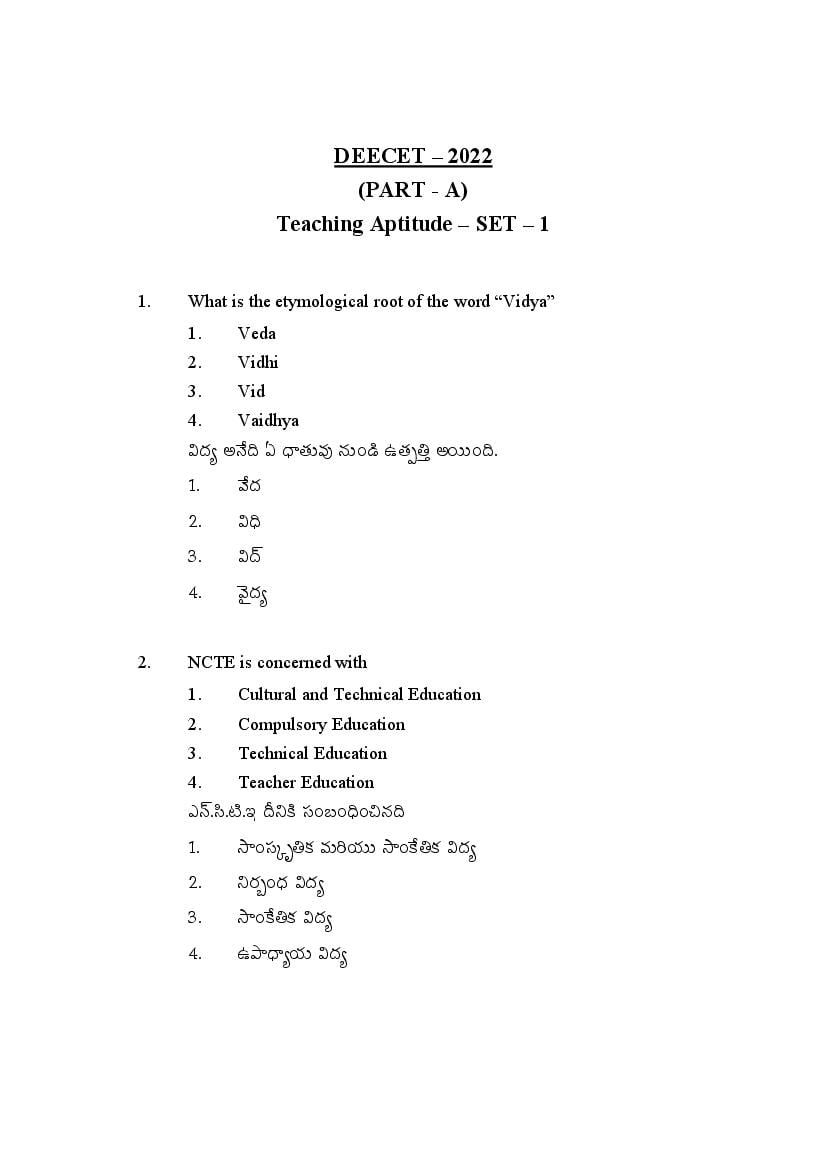
(PART - A)
Teaching Aptitude – SET – 1
1. What is the etymological root of the word “Vidya”
1. Veda
2. Vidhi
3. Vid
4. Vaidhya
$<« nHû~ @ <óÔáTeÚ qT+& ÔáÎÜï nsTT+~.
1. yû<
2. $~ó
3. $<
4. yîÕ<«
2. NCTE is concerned with
1. Cultural and Technical Education
2. Compulsory Education
3. Technical Education
4. Teacher Education
mH.d¾.{ì. B¿ì d++~ó+ºq~
1. kÍ+dØÜ¿£ eT]jáTT kÍ+¹¿Ü¿£ $<«
2. sÁÒ+<ó $<«
3. kÍ+¹¿Ü¿£ $<«
4. bÍ<ó«jáT $<«
Page 2
1. 2008
2. 2009
3. 2010
4. 2011
$<«V²Å£Ø #á³+¼ neT\TýË¿ì eºÌq d+eÔáàsÁ+
1. 2008
2. 2009
3. 2010
4. 2011
4. What is most important for a teacher
1. to maintain discipline in class
2. to be punctual in class
3. to remove learning disorders of students
4. to be a good orator
bÍ<ó«jáTT¿ì eTTK«+>± +&e\d¾q~
1. Ôás>Á Ü
· >·~ ç¿£eT¥¿£D
ýË +#áT³
2. $<óT \Å£ d]>± VäÈsÁ>T· ³
3. $<«sÁT\ nuó« dq n³+¿±\qT Ô=\Ð+#áT³
4. eT+º e¿£>ï ± +&T³
Page 3
1. to evaluate students continuously
2. to give high salary to teachers
3. to revise curriculum
4. to make good school building
$<« ç|eÖD²\qT |+#á&¿ì ~ neds+Á
1. $<«sÁT\ qT sÁ+Ôás+Á eTÖý²«+¿£q+ #ûjTá &+
2. bÍ<ó«jáTT\Å£ n~ó¿£ JÔ\T eÇ&+
3. bÍsÄ«+Xæ\qT de]+#á&+
4. eT+º bÍsÄXÁ æ\ uóe q+ ]+#á&+
Page 4
6. In which city India’s first post office ATM was inaugurated?
1. Chennai
2. New Delhi
3. Hyderabad
4. Mumbai
uó²sÁÔá<Xû +ø ýË yîTT<{ì bþkͼ|dÓ T ATM @ q>·s+Á ýË çbÍsÁ+_ó+#á&+~.
1. #îHîÕ
2. qÖ«&ó©¢
3. VÕ²<su²<
4. eTT+u²sTT
7. Which state has launched the door delivery programme for supply of
ration to general public
1. Andhra Pradesh
2. Haryana
3. Madhya Pradesh
4. Punjab
kÍ<ósÁD ç|C²ú¿±¿ì ¹swH dsÁ|s #ûjáT&+ ¿=sÁÅ£ &ÃsY &î*e¯
¿±sÁ«ç¿£eÖ çbÍsÁ+_ó+ºq sçw+¼ @~?
1. +ç<óç|<ûXÙ
2. V²s«H
3. eT<ó« ç|<Xû Ù
4. |+C²uÙ
Page 5
1. Bali
2. Hague
3. New York, USA
4. Washington, DC
׿£«sÈ«d$TÜ ç|<ó q ¿±s«\jáT+ m¿£Ø& ¿£\<T?
1. u²*
2. V²>´
3. qÖ«jáÖsYØ, jáTTHîÕfÉ& d¼{Ùà |t nyîT]¿±
4. yw¾+>´³H, &d¾.
9. Which day is celebrated as “International women’s Day”?
1. 1st January
2. 23rd February
3. 8th March
4. 10th April
»»n+Ôás¨rjáT eTV¾²Þ² ~HÃÔáàe+µµ @ sÃEq ÈsÁT|ÚÅ£+{²sÁT?
1. 1 Èqe]
2. 23 |¾çe]
3. 8 eÖ]Ì
4. 10 @ç|¾ýÙ
Page 6
1. Veena
2. Tabla
3. Sarod
4. Guitar
¿ì+~ yýË @ ysTT<« n+C²< ©U²H ysTT+#ûysÁT?
1. MD
2. Ôá\
3. dsÃ<
4. Ð{²sY
Page 7
11. Find the one word substitute for the following
One who is present everywhere
1. Monogamy
2. omnipresent
3. theist
4. teetotaler
12. You should complete your B.Ed ___________ your B.Sc to get a
teacher job.
1. in addition to
2. according to
3. in spite of
4. ahead of
13. Kumar was always arguing _____ his brother.
1. at
2. from
3. with
4. of
Page 8
1. right
2. rite
3. write
4. none
15. Find the passive form for the following sentence.
Latha writes a letter.
1. A letter writes by Latha.
2. A letter is written by Latha.
3. A letter was written by Latha.
4. A letter was wrote by Latha.
Page 9
16. ¿ì+~ y{ìýË »»eTVäçbÍD²¿£s +Á µµÔà @sÁÎ&q |<+
1. ÈeTTq
2. ¿£eT\
3. È\+
4. uóÈq
17. ¿ì+~ y{ìýË »»³µµesÁZÅ£ #î+~q n¿£sÁ+
1. ¿£
2. #á
3. q
4. &
18. ¿ì+~ y{ìýË ~ÇÔÇ¿£sÁ |< >·T]ï+#á+&
1. dTý²ïqT
2. ç|Xø
3. ºÅ£Ø
4. yî&\TÎ
Page 10
1. eTT#á̳T¢
2. n#á̳T¢
3. #á|γT¢
4. n|γT¢
20. »»$ÈjYT s¹ |Ú $ÈjáTy& yîÞ²ï&T µµ ` y¿£«+ýË ¿±\+
1. uó$w«ÔY ¿±\+
2. uóÖÔ῱\+
3. esÁïeÖq ¿±\+
4. Ôá<sÆ Á ¿±\+
Page 11
21. »»uóÖ<q+µµ Ôá¿£<¸ sÁ#ásTTÔá
1. lbÍ< dTçV²D«Xæçd¾ï
2. $HÃu² uó²yû
3. &öö d¾. HsjáTDÂs&¦
4. ll
22. »»Èqµµ |<¿ì |s«jáT|<\T
1. Ôá*,¢ neT
2. Ôá+ç&, |¾Ôá
3. |< +, ¿£eT\+
4. Xø¯sÁ+, <ûV² +
23. »»n|ð&|ð&Tµµ |<+ýË d+~ó
1. jáT&>·eTd+~ó
2. sÁT>±>·eTd+~ó
3. çyûT&Ôád+~ó
4. ~ÇsÁT¿£ï³¿±sÁd+~ó
24. »»sE Å£e\jáÖq+<¿£sÁT&Tµµ y¿£«+ýË n\+¿±sÁ+
1. çÔûο±\+¿±sÁ+
2. sÁÖ|¿±\+¿±sÁ+
3. Xâc¢ Í\+¿±sÁ+
4. |eÖ\+¿±sÁ+
Page 12
1. q+&Ö] dTu²ÒseÚ
2. >·TsÁC²& nbÍÎseÚ
3. n&$ u²|¾sE
4. <ûeÚ\|*¢ ¿£wX æçd¾ï
26. »»nÔáqT ¿£\¿£¼sÁT njáÖ«&³µµ @ sÁ¿£yîT®q kÍeÖq«y¿£«+
1. ç|sÁD y¿£«+
2. ÔsÁ¿ £ y¿£«+
3. nqTesÁï¿£y«sÁ¿£ y¿£«+
4. nqTeTÜ y¿£«+
27. »»n+<ó¿ ±sÁeTT nHî& nC²ãqeTTqT Ô=\Ð+#áTy&Tµµ
eÚ«ÔáÎÔá«sÁeÆ TT sjáT+&
1. >·TsÁTeÚ
2. ¥w§«&T
3. Ôáeï TT&T
4. ç|<e¸ TT&T
28. »»d+|PsÁyTî q® $XæÇdeTTµµ deÖd |<e TT >·T]ï+#á+&.
1. $XæÇd+ d+|PsÁ+
2. d+|PsÁ $XæÇd+
3. d+|PsÁ+ ¿± $XæÇd+
4. $XæÇdyûT
Page 13
B¿ì ¿£sÁ Dì y¿£«+ >·T]ï+#á+&.
1. ¥yJ jáTeqçdÓï Ôá*>¢ ± uó²$+#áý<ñ T
2. ¥yJ#û jáTeq<ûXø çdÓï Ôá*>¢ ± uó²$+#á&ý<ñ T
3. ¥yJ#û jáTeq <ûXø çdÓï Ôá*>¢ ± uó²$+#á&+~.
4. jáTeq <ûXø çdÓ#ï û ¥yJ Ôá*>¢ ± uó²$+#á&+~.
30. esÁTd>± sÁT +ç<>D· ²\T, s +&T dÖsÁ«>·D²\T @ |<« +ýË
ekÍïjÖî >·T]ï+#á+&.
1. ¿£+<eTT
2. dÓdeTT
3. ³yî\~
4. Ôû³^Ü
Page 14
31. Who prepared Demlo numbers?
1. Sreenivasa Ramanujan
2. Ramachandra Kaprekar
3. Pythagoras
4. C.R.Rao
&ûyÖî d¢ + K«\qT sÁÖbõ+~+ºq >·DÔ
ì á Xæçdyï Ô
û ïá mesÁT?
1. lyd seÖqTÈH
2. seT#á+ç< ¿£ç|¿£sY
3. |<Õ ¸ >·sdÁ t
4. d¾.sY. seÚ
2
32. Naresh painted part of a house. To complete the work how much
3
part Suresh has to paint?
2
1.
3
2
2. –
3
1
3.
3
4. Can’t Say
q¹swt ÿ¿£ +{ì¿ì 2 e e+ÔáT sÁ+>·T yûdï yîTTÔáï+ | |P]ï ne&¿ì
3
dTs¹ wt m+Ôá uó²>·+ sÁ+>·T yûjÖá *?
2
1.
3
2
2. –
3
1
3.
3
4. #î|Î ýñeTT
Page 15
of the interior angle of the triangle is 50° then find second one value
ÿ¿£ çÜuóTÈ+ýË u²V²«¿ÃD+ 130°, < n+Ôás_óeTTK ¿ÃD²\ýË ÿ¿£
< $\Te 50° nsTTq s +&e ¿ÃD+ $\Te
1. 50°
2. 60°
3. 70°
4. 80°
34. Which of the following is the standard form of Quadratic expression
1. ax2+bx+c
2. ax3 +bx2+c
3. ax+b
4. None
¿ì+~ yýË çbÍeÖDì¿£ sÁÖ|+ýË q ;JjáT deÖd+ @~?
1. ax2+bx+c
2. ax3 +bx2+c
3. ax+b
4. @B¿±<T
Page 16
1. Micro Meter
2. Milli Meter
3. Kilo Meter
4. Deca Meter
10–3m qT eTq+ ¿ì+~ $<ó+
>± #á<T eÚÔ+.
1. yîTç® ¿Ã MT³sY
2. $T*¢ MT³sY
3. ¿ìýË MT³sY
4. & MT³sY
36. In the process of finding cube root of 5832, which one of the
following is second group number?
5832 |T q eTÖ\+ ¿£qT>=qT $<óq+ýË s +&e ç>·Ö|t d+K« m+Ôá?
1. 5
2. 58
3. 583
4. 832
Page 17
1. Closure Property over Addition
2. Distributive Property over Addition
3. Associative Property over Addition
4. Identity over Addition
(2 × x) + (2 × 6) = 2(x+6) dMT¿£sÁD+ @ <ós
dÖºdT+ï ~?
1. d+¿£\q+ýË d+eÔá <ós Á +
2. d+¿£\q+|Õ $uó²>· H«jáT+
3. d+¿£\q+ <cͼ« dV² #ásÁ <ós Á +
4. d+¿£\q+ýË ÔáÔàá eÖ+Xø+
38. A vessel in the shape of cuboid is having length of 30 cm, breadth of
25 cm. Then how much height the vessel should be to store 4.5 litres
of water? (in centimeters)
ÿ¿£ BsÁé |TH¿±sÁ bÍçÔá bõ&eÚ 30d+.MT., yî&\TÎ 25d+.MT. bÍçÔáýË
4.5 ©³sÁ¢ |{²¼\+fñ m+Ôá mÔáTï +&*. (d+{ì MT³sÁ¢ \ýË)
1. 10
2. 9
3. 25
4. 6
Page 18
find the value of x?
1. 7 or –5
2. 8 or –6
3. 9 or –7
4. 10 or –9
_+<TeÚ\T (x, 7) eT]jáTT (1, 15) \ eT<ó« <ÖsÁ+ 10 jáTÖ³T¢
nsTTq x $\Te
1. 7 ýñ< –5
2. 8 ýñ< –6
3. 9 ýñ< –7
4. 10 ýñ< –9
40. A statue stands on the top of a 2m tall pedestal. From a point on the
ground, the angle of elevation of the top of the statue is 600 and from
the same point, the angle of elevation of the top of the pedestal is
45o. Find the height of the statue?
1. 1.464m
2. 1.265m
3. 1.789m
4. 2.285m
ÿ¿£ $ç>·V² + 2MT³sÁ¢ mÔáTï >·\ |ÓsÄ+Á |Õ \uɳ
¼ & +~. < ¿=+Ôá
<ÖsÁ+ qT+º |]o*+ºq $ç>·V² + |Õ uó²>·+ 60° eT]jáTT |Ós+ÁÄ |Õ uó²>·+
45° }sÁÇÆ ¿ÃD²\T #ûdT Hï sTT. $ç>·V² + mÔáTï m+Ôá?
1. 1.464 MT.
2. 1.265 MT.
3. 1.789 MT.
4. 2.285 MT.
Page 19
(Biology)
41. The hollow bones are present in
1. cow
2. sparrow
3. buffalo
4. snake
¿ì+~ yýË uË\T>± +&û meTT¿£\T >·\~.
1. eÚ
2. |¾#Tá Ì¿£
3. ¹><î
4. bÍeTT
42. The muscular tubular structure that connects pharynx with
stomach is
1. Duodenum
2. Buccal cavity
3. Oesophagus
4. Rectum
ç>·d JsXj
ø Tá +ÔÃ ¿£*|¾ +#û ¿£+&sj
Á Tá TÔáyTî q® >=³¼+ e+{ì sD+
1. +çÔáeTÖ\+
2. d«Å£V²sÁ+
3. VäsÁyV¾²¿£
4. |Ú¯wHÞø+
Page 20
1. Polyester
2. Nylon
3. Rayon
4. Acrylic
yîTT<{ì eÖqe ]Ôá <s\T
1. bÍ*w¼sY
2. HîÕý²H
3. ¹sjáÖH
4. nç¿ì*¿ù
44. The excretory organ in cockroach
1. malpighian Tubules
2. raphids
3. ureters
4. nephridia
u¤~Ý+¿£ýË $ds¿Á̈ ±ejáTy\T
1. eÖ*ÎÛjáTH H[¿£\T
2. s|¾&à
3. eTÖçÔá HÞ²\T
4. Hîç|¾&jáÖ
Page 21
1. Thyroid
2. Adrenal
3. Pituitary
4. Islets of Langerhans
eÖqe Xø¯sÁ+ýË nÜ ç|<ó q ç>·+~ó
1. <î̧ÕssTT&
2. mç&q*H
3. |¾³Ö«³¯
4. ×dý{ É Ùà |t ý²+>·sY V²Hà
Page 22
Physical Science
46. Which of the following is not a part of water cycle?
1. Evaporation
2. Condensation
3. rain
4. distillation
È\#áç¿£+ýË uó²>·+ ¿±~
1. uó²wÓÎuóeq+
2. kÍ+çB¿£sÁD+
3. esÁ+ü
4. dÇ<q+
47. The part in a bulb which gives us light is
1. Metal Base
2. Glass chamber
3. Filament
4. Terminals
\TÒýË ¿±+Ü #ûÌ uó²>·+
1. ýËV²|Ú eTÖÔá
2. >±E¿Ã³sÁ+
3. |¾\yîT+{Ù
4. <ó y\T
Page 23
|]kþØ|týË s +&T <sÎÁ D²\ eT<ó« ¿ÃD+
1. 0°
2. 30°
3. 45°
4. 60°
49. Unit of force in SI system
1. Dyne
2. kg – m/s
3. Newton
4. Pascal
SI jáTÖ{¢ýË ý²¿ì ç|eÖD²\T
1. &îÕH
2. kg – m/s
3. qÖ«³H
4. bÍdØýÙ
50. The chemical symbol for sodium is
kþ&jTá + jîTT¿£Ø sÁkÍjáT¿£ kÍ+¹¿Ü¿£+
1. So
2. Sd
3. NA
4. Na
Page 24
51. The planet that has no satellites
1. Uranus
2. Mars
3. Mercury
4. Earth
¿ì+~ yýË |ç>·Vä \T ýñ ç>·V² +
1. jáTT¹sqdt
2. n+>±sÁÅ£ &T
3. T<óT&T
4. uóÖ $T
52. Valley civilization not emerged in the following country
1. Mesopotamia
2. Egypt
3. Israel
4. China
¿ì+~ yýË q~ýËjáT H>·]¿£Ôá e]Æ*q¢ <ûX+ø ¿±~
1. yîTd|{
Ë$TjáÖ
2. |t¼
3. çC²sTTýÙ
4. #îÕH
Page 25
1. Upanishads
2. Brahmanas
3. Aranyakas
4. Rigveda
Ôá, ç|¿£ Ü jîTT¿£Ø sÁV²kÍ«\T Ôî*jáT#ûjTá T eÖÔá¿£ ç>·+<¸\T
1. |wÔTá ï\T
2. çu²V²DT\T
3. nsÁD«¿±\T
4. TT¹>Ç<+
54. The place of origin of democracy
1. Greece
2. Rome
3. India
4. China
ç|C²kÍÇeÖ«¿ì ÈqdÆ\+
1. ç^dt
2. sÃyT
3. uó²sÁÔá<ûXø+
4. #îÕH
Page 26
1. Bauxite
2. Barytes
3. Mica
4. Chromium
n\Ö«$TjáT+ B qT+& rkÍïsTÁ
1. u²Â¿Õà{Ù
2. uÉÂsÕ{ìdt
3. yîT¿® ±
4. ç¿Ã$TjáT+
56. The song “Vandemataram” was written by
1. Mohammed Iqbal
2. Rabindranath Tagore
3. Bankim chandra Chatterjee
4. Sarojini Naidu
»»e+<ûeÖÔásÁ+µµ sÁº+ºq ysÁT
1. eTVäeT< ¿±ÒýÙ
2. sÁM+ç<H<¸ sÄ>·ÖsY
3. +¿ì+#á+ç< #ᳯ¨
4. dsÃú HjáTT&T
Page 27
1. Alam Ara
2. Bhakta Prahalada
3. Bhishma Pratigna
4. Mana Desham
Ôî\T>·TýË yîTT<{ì eTÖ¿¡ ºçÔá+
1. \+ s
2. uó¿ ï£ ç|Vä ¢<
3. ;ów ç|ÜÈã
4. eTq<ûX+ø
58. In which year prohibition of child marriage act was enforced?
1. 2002
2. 2004
3. 2006
4. 2008
u²ý« $yVä\ sÃ<ó¿ £ #á³+¼ @ d+eÔáàsÁ+ qT+& neT\TýË¿ì eºÌq~?
1. 2002
2. 2004
3. 2006
4. 2008
Page 28
1. Clay
2. Yarn
3. Tools
4. Seeds
¿ì+~ yýË d¾sÆ Á eTÖ\<óq + @~?
1. eT{ì¼
2. qÖ\T
3. |eTT³T¢
4. $ÔáHï \T
60. Who is called Lokamanya
1. Gandhi
2. Nelson
3. Tilak
4. Patel
ýË¿£eÖq« n me] |¾\TkÍïsTÁ ?
1. >±+Bó
2. Hî\àH
3. Ü\¿ù
4. |fýñ Ù
Page 29
Inter Botany – SET - 1
61. Gap between meiosis - I and II is called:
1. interphase
2. interkinesis
3. diakinesis
4. metakinesis
¿£jáT¿£sÁD $uóÈq I eT]jáTT II eT<ó« >·\ <Xqø T @eT+{²sÁT?
1. n+ÔásÁÝXø
2. $uóÈq eT<ó«<Xø (+³sY ¿ÕHîd¾dt)
3. &jáÖ¿ÕHîd¾dt
4. yîT{²Â¿HÕ îdd¾ t
62. Which of the following represents the floral characters of liliaceae?
1. Six tepals, zygomorphic, six stamens, trilocular ovary, axile
placentation.
2. Actinomorphic, polyphyllous, unilocular ovary, axile
placentation.
3. Tricarpellary, actinomorphic, polyandrous, superior ovary,
axile placentation
4. Bisexual, zygomorphic, gamophyllous, inferior ovary,
marginal placentation.
¿ì+~ yýË @$ **jûTd¾ |ÚwÎ \¿£D ²\qT Ôî*jáTCñkÍïsTT?
1. sÁT |]|çÔ\T, bÍ¿ì¿£ kåwe¼ jáTTÔá+, sÁT ¹¿ds\T,
çÜ_\jáTTÔá n+&XøjTá +, d+Æ uó n+&H«d kÍÆq+
2. kåwe¼ jáTTÔá+, nd+jáTT¿£ï |]|çÔájTá TÔá+,
@¿£ _\jáTTÔá n+&XøjTá +, d+Æ uó n+&H«dkÍÆq+
3. çÜ|\ jáTTÔá, kåwe÷ jáTTÔá+, VQ¿¹ dsj Á Tá TÔá,
}sÁÇ n+&XøjTá +, d+ï uó n+&H«dkÍÆq+
4. ~Ç*+>·jTá TÔá+, bÍ¿ì¿ £ kåw¼ejáTTÔá+, d+jáTT¿£ï |]|çÔájTá TÔá+,
eTn+&XøjáT+, bÍ+Ôá n+&H«dkÍÆq+
Page 30
1. Proteins
2. Lipids
3. Nucleic acids
4. Carbohydrates
mds¼ Y +<ó+ M{ìýË ¿£\T>·TqT
1. çbþ{¡qT¢
2. *|¾&T¢
3. ¹¿+ç<¿±eÖ¢\T
4. |¾+& |<sÆ\T
64. Which one of the following is an example for Ephemerals plants?
1. Aloe
2. Asparagus
3. Opuntia
4. Tribulus
¿ì+~ yýË n\ο±*¿£ yîTT¿£Ø\Å£ <V²sÁD
1. nýË
2. dÎs>·dt
3. ÿ|üjáÖ
4. ç{ìT«\dt
Page 31
1. Aristotle
2. Mendal
3. Linnaeus
4. Carl woese
sÁT sC²«\ e¯Z¿£sÁDqT ç|ÜbÍ~+ºq ysÁT
1. n]kͼ{ýì Ù
2. yîT+&ýÙ
3. *jáTdt
4. ¿±sY¢ yÃdt
66. Pollination by snails is called
1. Zoophily
2. Entomophily
3. Malacophily
4. Anemophily
qÔáï\ <Çs È]¹> |s>· d+|sØ @eT+{²sÁT?
1. È+ÔáT |s>· d+|sØÁ +
2. ¿¡³¿±\ |s>· d+|sØÁ +
3. yîT\¿Ã|*¾
4. yjáTT |s>· d+|sØÁ +
Page 32
1. Ectocarpus
2. Polysiphonia
3. Spirogyra
4. Fucus
<ÇjáTd¾Ü
Æ ¿£ J$Ôá #áç¿£+ ¿£\~.
1. m¿Ã¼¿±sÁÎdt
2. bÍ*dÕbþ jáT
3. dÎsÃÂ>sÕ
4. |P «¿£dt
68. In a hypogynous flower the position of ovary is
1. Superior
2. half superior
3. Inferior
4. half Inferior
n+&¿ÃXæ<dÜ
ƾ |ÚwÎ+ýË n+&XøjTá kÍÆq+
1. }sÁÆÇ+
2. nsÁÆ}sÁÆÇ+
3. eT+
4. nsÁÆ eT+
Page 33
in the form of
1. Micrographia
2. Heiroglyphcics
3. Species plantarum
4. Historia plantarum
|Ú¼ <ûXdø T \ T |ÕsTÁ yîTT¿£Ø\, |\ e¿±\qT >·T]+ºq deÖ#s
ºçÔ\ sÁÖ|+ýË qyîÖ<T #ûdq¾ $<óq+
1. yîTç® ¿Ãç>±|j ¾ Tá
2. VÓ²sÃТ|¿¾ àù
3. dÓÎw¾H bÍ¢+{²sÁyT
4. V¾²kþ¼]jáÖ bÍ¢+{²sÁyT
70. Which one of the following is not a taxonomic aid?
1. Key
2. Systematics
3. Herbarium
4. Museum
¿ì+~ yýË e¯Z¿s£ D
Á dVä jáT¿±\T ¿±~ @~?
1. ¿¡
2. d¾de¼ Ö{ì¿àù
3. V²¹sÒ]jáT+
4. eTÖ«jáT+
Page 34
1. RuBP carboxylase
2. PEP carboxylase
3. Carbonic anhydrase
4. RuBisCO
C4 yîTT¿£Ø\ýË ¿±sÁÒH &jÖ
á ¿Â àÕ & kÍÆ|q Å£ dV²¿£]+#û m+CÉyÕ T
1. RuBP ¿±sÒ¿ìàýñCÙ
2. PEP ¿±sÒ¿ìàýñCÙ
3. ¿±sÒ¿ù mHVÕ²ç&ûCÙ
4. sÁT_kþØ
72. The theory proposed by Levitt for explaining stomatal movements
1. pH analysis
2. CO2 concentration
3. K+ pump theory
4. All the above
|çÔás+Á ç<ó\ ¿£<* ¿£\T $e]+#á&¿ì ýÉ${Ù ç|ÜbÍ~+ºq d¾<Ý+Ôá+
1. pH $Xâ¢wD
2. CO2>±&óÔá
3. K+ |+|Ú d¾<Ý+ÔáeTT
4. |Õeú
Page 35
cellular respiration
1. P – P bonds
2. C – C bonds
3. N – N bonds
4. S – S bonds
¿£DXæÇdç¿ìjTá ýË @ +<ó\T Ôî>T· ³ Xø¿ïì $&T<\Å£ <] rjáTTqT?
1. P – P +<ó\T
2. C – C +<ó\T
3. N – N +<ó\T
4. S – S +<ó\T
74. Citric acid cycle is also known as
1. Tricarboxylic acid cycle
2. Oxidative decarboxylation
3. fermentation cycle
4. both 1 & 2
d¾ç{ì¿ù eT¢ e\jáT+Å£ +¿=¿£ |sÁT
1. çfÉ¿® ±sÒ¿ìà*¿ù eT¢e\jáT+
2. ¿¡à¿£sÁD & ¿±sÒ¿ìàýñwH
3. ¿ìDÇç|ç¿ìjTá
4. 1 eT]jáTT 2
Page 36
1. Cry I Ac
2. Cry II Ab
3. Cry III Ab
4. Both 1 & 2
ç|Üï ¿±jáTÔ=*#û |ÚsÁT>·T\qT jáT+çÜ+#û ÈqT«eÚ
1. Cry I Ac
2. Cry II Ab
3. Cry III Ab
4. 1 Ê 2 s +&Ö
76. Yeast is used in the production of
1. Soap and perfume
2. Rice and vegetables
3. Bread and beer
4. Cheese and butter
dtq¼ T M{ì ÔájÖá ¯ýË |jÖî ÐkÍïsTÁ .
1. dTÒ eT]jáTT nÔásï TÁ
2. e] eT]jáTT Å£LsÁ>±jáT\T
3. s=fɼ eT]jáTT ;sÁT
4. NCÙ eT]jáTT yîq
Page 37
1. 3 – methyl uracil
2. 2 – methyl uracil
3. 4 – methyl uracil
4. 5 – methyl uracil
<¸jáÖ$TH¿ì +¿=¿£ |sÁT
1. 3 ` $T<î̧ýÕ Ù jáTTsd¾ýÙ
2. 2 ` $T<î̧ýÕ Ù jáTTsd¾ýÙ
3. 4 ` $T<î̧ýÕ Ù jáTTsd¾ýÙ
4. 5 ` $T<î̧ýÕ Ù jáTTsd¾ýÙ
78. During Nitrogen fixation, nitrite is oxidized to nitrate with the help of
bacterium
1. Nitrosomonas
2. Pseudomonas
3. Nitrobacter
4. Thiobacillus
qçÔáÈ kÍÆ|q ýË HîçÕ fÉ{ ® Ù @ u²«¿¡]¼ jáÖ dVä jáT+Ôà HîçÕ fñ{>Ù ± ¿¡à¿£sD
Á +
#î+<TÔáT+~?
1. HîÕç³kþyîÖHdt
2. dÖ&ÃyîÖHdt
3. HîÕç{Ëu²«¿£¼sY
4. <¸j Öî u²d¾\d¢ t
Page 38
1. Wheat
2. Maize
3. Chrysanthemum
4. Radish
çV²dÇB|¾ï ¿±\ yîTT¿£Ø\¿ì <V²sÁD
1. >Ã<óT eT
2. u²¯¢
3. #eT+Ü
4. eTT\¢+Ð
80. Which one of the following is not a part of Biotechnology?
1. test tube baby
2. synthesizing a gene
3. developing a fruit
4. correcting a defective gene
¿ì+~ yýË @~ JekÍ+¹¿Ü¿£ Xæçd|ï < Ü
Æ ¿ì d++~ó+ºq~ ¿±<T?
1. fÉd¼t ³Ö«uÙ uñ;
2. ÈqT« d+Xâ¢wD
3. |ý ²_óe~Æ #ûjTá T³
4. ýË|+ >·\ ÈqT«eÚqT d]#ûjTá T³
Page 39
81. The endothelium that line the interior surface of blood vessels is
1. Cuboidal epithelium
2. Squamous epithelium
3. Columnar epithelium
4. Stratified epithelium
sÁ¿Hï£ Þ²\ jîTT¿£Ø n+Ôádsï e]+º +&û |¿Þ£ ø
1. |T H¿±sÁ |¿Þ£ ø
2. Xø\Ø\ |¿Þ£ ø
3. d+ï u󲿱sÁ |¿Þ£ ø
4. d]ï Ôá |¿Þ£ ø
82. Microtubules arrangement in flagella is
¿£Xæuó+ýË dÖ¿£H[¿£\ neT]¿£
1. 9+1
2. 1+9
3. 2+9
4. 9+2
Page 40
1. Arthropoda
2. Annelida
3. Nematoda
4. Echinodermata
¥sÃe¿£+ esÁ+Z ýË ¿£|¾dT +ï ~
1. çsÃÝbõ&
2. nHî*&
3. eT{Ë&
4. ¿HÕ Ã&s¹ {²
84. The Tidal Volume of human lung is approximately
1. 300 ml
2. 400 ml
3. 500 ml
4. 800 ml
eÖqe }|¾]ÜÔáT\ï XæÇd |T q|]eÖD²\ kÍeTsÁ«Æ +
(fÉ&® ý Ù |T q|]eÖD+)
1. 300 $T.©.
2. 400 $T.©.
3. 500 $T.©.
4. 800 $T.©.
Page 41
1. Rauwolfia vomitoria
2. Vinca rosea
3. Fox glove
4. Digitalis purpurea
$Hu²¢dH¼¾ nqT jáÖ+{ì ¿±qàsY Ww< yîTT¿£Ø qT+& d+ç>·V²¾ kÍïsTÁ .
1. seÚ*ÎÛjáÖ y=eT{Ë]jáÖ
2. $+¿±sÃjáÖ
3. bÍ¿ùà>ây
4. &{²*dt |sÁÖÎ]jáÖ
86. Widal test is used for diagnosis of
1. Malaria
2. Filaria
3. Tuberculosis
4. Typhoid
yîÕ&ýÙ |¯¿£ B sÆsÁDÅ£ |jîÖÐkÍïsÁT
1. eTýñ]jáÖ
2. uË<¿±\T
3. ¿£j Tá
4. fÉ®bÍsTT&
Page 42
1. Down’s syndrome
2. Klinefelter’s syndrome
3. Turner’s syndrome
4. Edward’s syndrome
eÖqeÚýË XXY ¿±]jîÖfÉ|® t MýË #áÖkÍïeTT
1. &êHà d¾+ç&ÃyT
2. ¿Â Õ H¢ |\s¼ Yà d¾+ç&ÃyT
3. ³sÁsYà d¾+ç&ÃyT
4. m&ÇsY¦à d¾+ç&ÃyT
88. When was the Environmental protection Act passed by the
Government of India?
uó²sÁÔá ç|uóTÔáÇ+ |s«esÁD d+sÁ¿£D #á{²¼ m|ð&T neT\TýË¿ì ÔîºÌ+~
1. 1981
2. 1986
3. 1974
4. 1971
Page 43
ELISA $d]
ï +#á>±
1. Enzymatic – linked Immunosorbent Arrangement
2. Enzyme – linked Immunity Search Assay
3. Enzyme-linkage Immuno Sorbent Analysis
4. Enzyme-linked Immuno Sorbent Assay
90. One of the Ex-Situ conservation methods for endangered species is
1. Sanctuaries
2. Biosphere reserves
3. Cryo preservation
4. National parks
n+Ôá]+ºbþÔáTq C²ÔáT\ ¿=sÁÅ£ d\u²V²« d+sÁ¿£DýË |jÖî Ð+#û
ÿ¿£ |<Ü
Æ
1. nuój
Öá sÁD²«\T
2. Je>ÃÞø|Ú dTsÁ¿Ô ì á ¿¹ +ç<\T
3. ç¿£jîÖ ç|¾È¹sÇwH
4. C²rjáT bÍsÁTØ\T
Page 44
1. Synecology
2. Ethology
3. Limnology
4. Autecology
eT+º ú{ì JyesÁD e«edqÆ T n<ó« jáTq+ #ûd XæçkÍï @eT+{²sÁT?
1. d¾¿±\
2. <ó\
3. *eÖ\J
4. n{쿱\
92. Harmone secreted by pineal gland is
1. Parathormone
2. Oxytocin
3. Vasopressin
4. Melatonin
|ÓjáTýÙ ç>·+~ó çd$+#û VäsÃH
1. |s<¸sÃH
2. ¿¡à{²d¾H
3. ykþç|d¾àH
4. yîT\{ËH
Page 45
effect is called.
1. Neo plasia
2. Gigantism
3. Parasitic Castration
4. Hyper trophy
¿= |sq JeÚ\T nÜ<û̧sTT ¿£D²\ |]eÖD² $|¯Ôá+>± |+#áTÔsTT.
B @eT+{²sÁT?
1. jîÖ bÍ¢dj
¾ Öá
2. CÉÕ>·+{ìdyT
3. |sqJ$ ¿±«çd¼wH
4. VÕ²|sY ç{Ë|¾
94. The largest division in Animal kingdom is
1. Insecta
2. Amphibia
3. Pisces
4. Reptilia
È+ÔáTsÈ«+ýË nÜ |<Ý $uó²>·eTT @~?
1. Hd¿±¼
2. uójáT#ás\T
3. |Õddt
4. d¯dbÍ\T
Page 46
1. 1.64%
2. 2.5 %
3. 3%
4. 2.7%
2011 ÈHuó² ýÉ¿Ø£ \ ç|¿±sÁ+ ÈHuó² e~ƹs³T
1. 1.64%
2. 2.5%
3. 3%
4. 2.7%
96. Corpus luteum secretes
1. Estrogen
2. Testosterone
3. Thyroxine
4. Progesterone
¿±sÁÎdt \T{ìjTá + <û ÔáÎÜï #ûdT +ï ~
1. çkþ¼CÉH
2. fÉkþ¼d¼sH
3. <î̧sÕ ¿ìàH
4. çbõCÉd¼sH
Page 47
1. Vitamin – A
2. Vitamin – D
3. Vitamin – E
4. Vitamin – K
V²bÍ]HÅ£ $sÁT<+Ý >± |#ûd $³$TH
1. $³$TH – m
2. $³$TH – &
3. $³$TH –
4. $³$TH – ¿Â
98. Presence of Glucose in the urine is called as
1. Uremia
2. Glycosuria
3. Ketosuria
4. Natriuresis
eTÖçÔá+ýË >·Ö¿¢ ÃCÙ +&{² @eT |¾\TkÍïsTÁ ?
1. jáTT¹s$TjáÖ
2. >Â Õ ¿¢ Ãp]jáÖ
3. ¿¡{ËdÖ]jáÖ
4. Hç{ìjáÖ]d¾H
Page 48
1. India
2. China
3. Netherlands
4. UK
ç||+ #á bÍ\ ÔáÎÜïýË nç>·kÍÆq+ýË q <ûX+ø
1. uó²sÁÔá<ûXø+
2. #îÕH
3. Hî<s¢+&
4. jáTT.¿
100. Molecular structure of DNA was discovered by
1. Charles Darwin
2. Carolus Linnaeus
3. Watson & Crick
4. J.B. Lamark
DNA jîTT¿£Ø nDTsD+qT ¿£qT>=q~
1. #Âsd¢ t &]ÇH
2. ¿£sÃ\dt *HûjáTdt
3. y{ÙàH Ê ç¿ì¿ù
4. CÉ._. ý²eÖsYØ