DUET Question Paper 2019 for M.Sc Fabric & Apparel Science
Finished viewing? Save it for later —
Download DUET Question Paper 2019 for M.Sc Fabric & Apparel Science (PDF · 27 pages)About DUET Question Paper 2019 for M.Sc Fabric & Apparel Science
DUET Question Paper 2019 for M.Sc Fabric & Apparel Science is available here for free download. Published by NTA for DUET, this question paper can be viewed online or downloaded as a PDF (27 pages). Candidates preparing for DUET can use DUET Question Paper 2019 for M.Sc Fabric & Apparel Science to understand the exam pattern, the type of questions asked, and the overall difficulty level.
Frequently Asked Questions
How can I download DUET Question Paper 2019 for M.Sc Fabric & Apparel Science?
Open this page and click the Download button to save DUET Question Paper 2019 for M.Sc Fabric & Apparel Science as a PDF. It is completely free on AglaSem Docs.
Is DUET Question Paper 2019 for M.Sc Fabric & Apparel Science free to download?
Yes. DUET Question Paper 2019 for M.Sc Fabric & Apparel Science can be viewed online and downloaded as a PDF free of cost on AglaSem Docs.
How many pages does DUET Question Paper 2019 for M.Sc Fabric & Apparel Science have?
DUET Question Paper 2019 for M.Sc Fabric & Apparel Science contains 27 pages, which you can read online or download together as a single PDF.
Where can I find more DUET study material?
You can find more DUET question papers, sample papers, syllabus, and answer keys on AglaSem Docs.
DUET Question Paper 2019 for M.Sc Fabric & Apparel Science – Text
Read the full text of this question paper below — useful to quickly search, copy and reference the content online without downloading the PDF.
📄 View text version (28 pages)
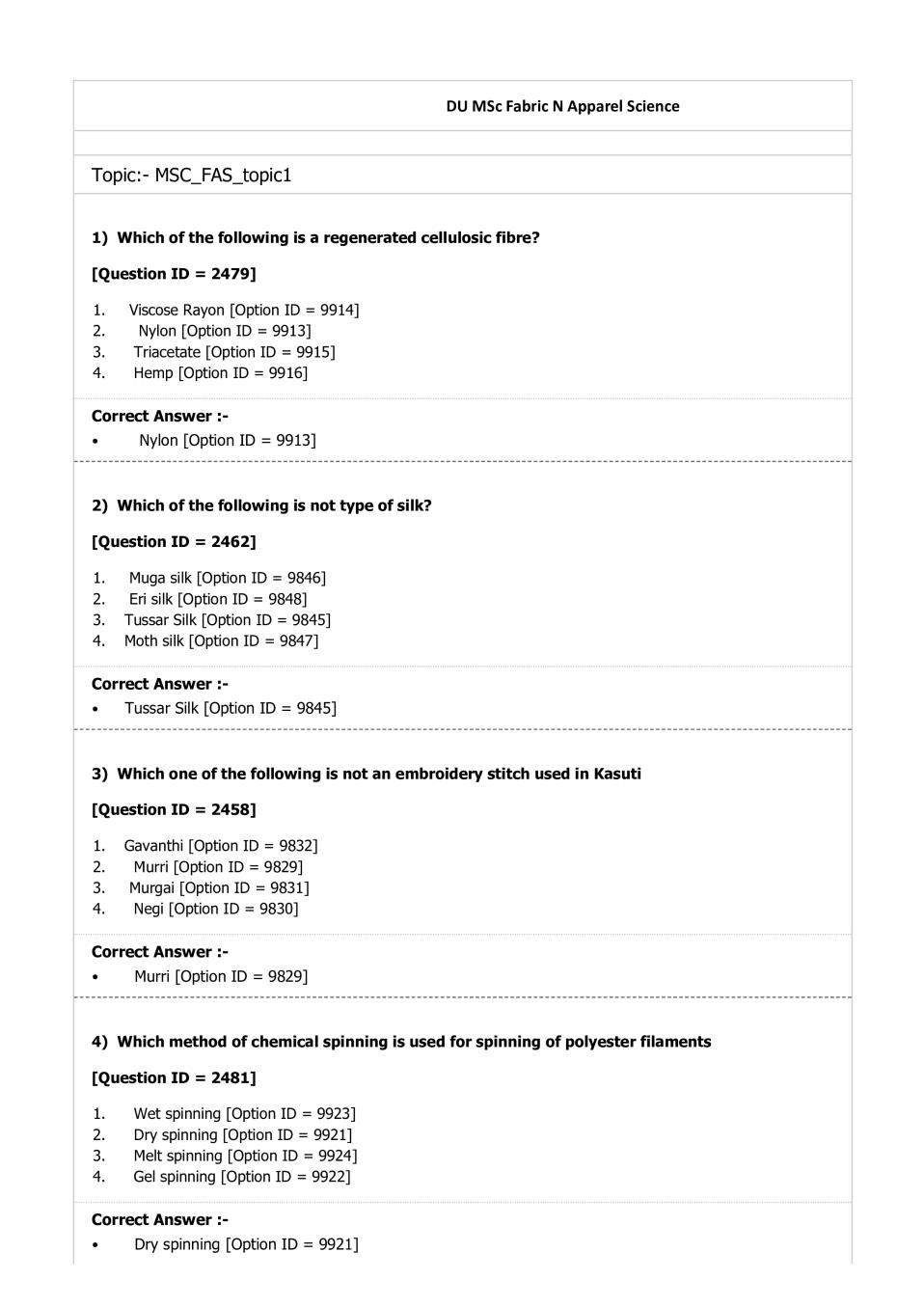
Page 1
Topic:- MSC_FAS_topic1
1) Which of the following is a regenerated cellulosic fibre?
[Question ID = 2479]
1. Viscose Rayon [Option ID = 9914]
2. Nylon [Option ID = 9913]
3. Triacetate [Option ID = 9915]
4. Hemp [Option ID = 9916]
Nylon [Option ID = 9913]
2) Which of the following is not type of silk?
[Question ID = 2462]
1. Muga silk [Option ID = 9846]
2. Eri silk [Option ID = 9848]
3. Tussar Silk [Option ID = 9845]
4. Moth silk [Option ID = 9847]
Tussar Silk [Option ID = 9845]
3) Which one of the following is not an embroidery stitch used in Kasuti
[Question ID = 2458]
1. Gavanthi [Option ID = 9832]
2. Murri [Option ID = 9829]
3. Murgai [Option ID = 9831]
4. Negi [Option ID = 9830]
Murri [Option ID = 9829]
4) Which method of chemical spinning is used for spinning of polyester filaments
[Question ID = 2481]
1. Wet spinning [Option ID = 9923]
2. Dry spinning [Option ID = 9921]
3. Melt spinning [Option ID = 9924]
4. Gel spinning [Option ID = 9922]
Dry spinning [Option ID = 9921]
Page 2
[Question ID = 2461]
1. Picking [Option ID = 9841]
2. Take-up [Option ID = 9842]
3. Shedding [Option ID = 9843]
4. Beating [Option ID = 9844]
Picking [Option ID = 9841]
6) The outermost styleline of the collar that gets affected by fashion changes is called
[Question ID = 2456]
1. Neck line [Option ID = 9821]
2. Break line [Option ID = 9822]
3. Collar edge [Option ID = 9824]
4. Roll line [Option ID = 9823]
Neck line [Option ID = 9821]
7) A midriff yoke is likely to be seen in a
[Question ID = 2449]
1. Bodice [Option ID = 9793]
2. Poncho [Option ID = 9795]
3. Low waist pants [Option ID = 9794]
4. None of these [Option ID = 9796]
Bodice [Option ID = 9793]
8) The minimum length to width ratio of fibres
[Question ID = 2483]
1. 2:100 [Option ID = 9932]
2. 100:1 [Option ID = 9930]
3. 1:100 [Option ID = 9929]
4. 100:50 [Option ID = 9931]
1:100 [Option ID = 9929]
9) Which is the fastest method of obtaining different sizes of a pattern?
[Question ID = 2468]
1. Manual grading [Option ID = 9869]
Page 3
3. Developing separate patterns for all sizes [Option ID = 9871]
4. None of these [Option ID = 9872]
Manual grading [Option ID = 9869]
10) Structural design can be incorporated into the garment through
[Question ID = 2474]
1. The placement of bows and belts [Option ID = 9894]
2. The use of appliqué work [Option ID = 9895]
3. The use of pleats, darts, tucks etc. [Option ID = 9896]
4. The use of fasteners [Option ID = 9893]
The use of fasteners [Option ID = 9893]
11) The two monomer units that combine to form a polyester polymer are:
[Question ID = 2495]
1. Hexamethylene diamine and Adipic acid [Option ID = 9977]
2. Ethylene glycol and Caprolactam [Option ID = 9980]
3. Ethylene glycol and Terphthalic acid [Option ID = 9979]
4. Ethylene glycol and Adipic acid [Option ID = 9978]
Hexamethylene diamine and Adipic acid [Option ID = 9977]
12) An example of a grown-on collar is
[Question ID = 2454]
1. Shawl collar [Option ID = 9815]
2. Ruffled collar [Option ID = 9816]
3. Peter-pan collar [Option ID = 9813]
4. Mandarin collar [Option ID = 9814]
Peter-pan collar [Option ID = 9813]
13) Bias strips are used for
[Question ID = 2455]
1. Finishing a raw edge [Option ID = 9818]
2. Creating fit in a garment area [Option ID = 9817]
3. Making a skirt belt [Option ID = 9819]
4. None of these [Option ID = 9820]
Creating fit in a garment area [Option ID = 9817]
Page 4
[Question ID = 2470]
1. Looming [Option ID = 9879]
2. Knitting [Option ID = 9878]
3. Weaving [Option ID = 9880]
4. Spinning [Option ID = 9877]
Spinning [Option ID = 9877]
15) Even –hem is a kind of
[Question ID = 2452]
1. Hem line [Option ID = 9807]
2. Fastener [Option ID = 9806]
3. Pocket [Option ID = 9805]
4. Placket [Option ID = 9808]
Pocket [Option ID = 9805]
16) Hackling is another name given to this operation
[Question ID = 2476]
1. Pulling [Option ID = 9904]
2. Scutching [Option ID = 9902]
3. Carding [Option ID = 9901]
4. Combing [Option ID = 9903]
Carding [Option ID = 9901]
17) Chinar leaf motif is most abundantly used in the following embroidery:
[Question ID = 2473]
1. Kashida embroidery [Option ID = 9890]
2. Kantha embroidery [Option ID = 9889]
3. Kasuti embroidery [Option ID = 9891]
4. Chikankari embroidery [Option ID = 9892]
Kantha embroidery [Option ID = 9889]
18) Bukhia, Murri, Phanda, Ghas patta and Tepchi are commonly known stitches of:
[Question ID = 2460]
1. Gujarat embroidery [Option ID = 9840]
2. Chikankari embroidery [Option ID = 9839]
Page 5
4. Kasuti embroidery [Option ID = 9837]
Kasuti embroidery [Option ID = 9837]
19) Kalabattun is a kind of:
[Question ID = 2486]
1. Polyester thread [Option ID = 9944]
2. Cotton thread [Option ID = 9943]
3. Silk thread [Option ID = 9942]
4. Gold and silver thread [Option ID = 9941]
Gold and silver thread [Option ID = 9941]
20) Geeta approached Ravi for data collection on drug abuse. She asked him to suggest more
names to be included in the sample. The method of sampling used here is:
[Question ID = 2494]
1. Direct sampling [Option ID = 9973]
2. Snowball sampling [Option ID = 9975]
3. Random sampling [Option ID = 9974]
4. Multistage sampling [Option ID = 9976]
Direct sampling [Option ID = 9973]
21) The length of garments is generally cut on
[Question ID = 2463]
1. True bias [Option ID = 9851]
2. Cross grain [Option ID = 9850]
3. Straight grain [Option ID = 9849]
4. None of these [Option ID = 9852]
Straight grain [Option ID = 9849]
22) Kalamkari is from
[Question ID = 2488]
1. Andhra Pradesh [Option ID = 9950]
2. Punjab [Option ID = 9951]
3. Madhya Pradesh [Option ID = 9952]
4. Gujarat [Option ID = 9949]
Gujarat [Option ID = 9949]
Page 6
[Question ID = 2478]
1. Fiber [Option ID = 9909]
2. Yarn [Option ID = 9910]
3. Cotton [Option ID = 9912]
4. Thread [Option ID = 9911]
Fiber [Option ID = 9909]
24) Thread used for Phulkari embroidery is:
[Question ID = 2472]
1. Kalabattun [Option ID = 9885]
2. Pat [Option ID = 9886]
3. Twisted silk thread [Option ID = 9887]
4. Cotton threads [Option ID = 9888]
Kalabattun [Option ID = 9885]
25) “Forecasting of consumer demand is a challenging task”. This statements holds true to
which of the following merchandise categories:
[Question ID = 2490]
1. Fashion merchandise [Option ID = 9959]
2. Staple merchandise [Option ID = 9957]
3. None of these [Option ID = 9960]
4. Seasonal merchandise [Option ID = 9958]
Staple merchandise [Option ID = 9957]
26) Line, ease, grain, balance and set are
[Question ID = 2451]
1. Factors that influence fit [Option ID = 9803]
2. Fabric and garment qualities [Option ID = 9804]
3. Elements of design [Option ID = 9802]
4. Basic principles of design [Option ID = 9801]
Basic principles of design [Option ID = 9801]
27) Saris produced in Murshidabad are known as
[Question ID = 2489]
1. Brocade [Option ID = 9955]
Page 7
3. Baluchari [Option ID = 9953]
4. Kanjeevaram [Option ID = 9956]
Baluchari [Option ID = 9953]
28) In which of the following, the apex of the dart ends at pivot point?
[Question ID = 2464]
1. Fish dart [Option ID = 9855]
2. Dress makers dart [Option ID = 9853]
3. Dart tuck [Option ID = 9856]
4. Designer’s dart [Option ID = 9854]
Dress makers dart [Option ID = 9853]
29) A French dart in garment will be seen located at
[Question ID = 2467]
1. Shoulder seam [Option ID = 9866]
2. Centre front at waist level [Option ID = 9867]
3. Side seam close to waist [Option ID = 9865]
4. Waist line upwards [Option ID = 9868]
Side seam close to waist [Option ID = 9865]
30) It refers to the amount of roominess in a garment. [Question ID = 2447]
1. Grain line [Option ID = 9785]
2. Ease [Option ID = 9787]
3. Tuck [Option ID = 9788]
4. Dart [Option ID = 9786]
Grain line [Option ID = 9785]
31) A cuff is a component of
[Question ID = 2450]
1. Sleeve [Option ID = 9798]
2. Neckline [Option ID = 9799]
3. Collar [Option ID = 9797]
4. Placket [Option ID = 9800]
Collar [Option ID = 9797]
32) On microscopic examination, the cross section of silk is
Page 8
1. Round [Option ID = 9926]
2. Triangular [Option ID = 9925]
3. Irregular [Option ID = 9927]
4. Kidney bean shaped [Option ID = 9928]
Triangular [Option ID = 9925]
33) Shawl in pair sewn back to back are
[Question ID = 2491]
1. Odhni [Option ID = 9962]
2. Doshala [Option ID = 9961]
3. Phulkari [Option ID = 9963]
4. None of these [Option ID = 9964]
Doshala [Option ID = 9961]
34) A line in a sleeve that separates the sleeve cap and the lower part is called
[Question ID = 2453]
1. Roll line [Option ID = 9812]
2. Bicep line [Option ID = 9811]
3. Center line [Option ID = 9810]
4. Control line [Option ID = 9809]
Control line [Option ID = 9809]
35) A method of developing a pattern directly from body measurements is
[Question ID = 2466]
1. Clothing construction [Option ID = 9861]
2. Drawing [Option ID = 9862]
3. Drafting [Option ID = 9864]
4. Draping [Option ID = 9863]
Clothing construction [Option ID = 9861]
36) Observation method is of no use in collecting data of
[Question ID = 2493]
1. Present events [Option ID = 9971]
2. Full events [Option ID = 9969]
3. All of these [Option ID = 9972]
4. Past events [Option ID = 9970]
Page 9
37) Lapped seam is an example of:
[Question ID = 2484]
1. Flat seam [Option ID = 9934]
2. Plain seam [Option ID = 9933]
3. Ridge seam [Option ID = 9935]
4. Decorative seam [Option ID = 9936]
Plain seam [Option ID = 9933]
38) It is defined as the equal distribution of weight, maybe actual or virtual from a central point
or area
[Question ID = 2457]
1. Balance [Option ID = 9827]
2. Proportion [Option ID = 9826]
3. Emphasis [Option ID = 9825]
4. Rhythm [Option ID = 9828]
Emphasis [Option ID = 9825]
39) Leather jackets were first popular among lower income groups and then gained acceptance
among the higher income groups.
Which fashion adoption theory is illustrated in the above statement?
[Question ID = 2448]
1. Horizontal flow [Option ID = 9790]
2. Trickle down [Option ID = 9789]
3. Trickle up [Option ID = 9791]
4. Trickle across [Option ID = 9792]
Trickle down [Option ID = 9789]
40) Gujarat is known for producing the following printed textile:
[Question ID = 2492]
1. Dabu [Option ID = 9967]
2. Bagh [Option ID = 9968]
3. Kalamkari [Option ID = 9965]
4. Ajrakh [Option ID = 9966]
Kalamkari [Option ID = 9965]
Page 10
[Question ID = 2469]
1. None of these [Option ID = 9876]
2. Plackets [Option ID = 9874]
3. Collars [Option ID = 9873]
4. Necklines [Option ID = 9875]
Collars [Option ID = 9873]
42) Denim fabric is an example of which of these weaves
[Question ID = 2475]
1. Sateen [Option ID = 9900]
2. Twill [Option ID = 9898]
3. Satin [Option ID = 9899]
4. Plain [Option ID = 9897]
Plain [Option ID = 9897]
43) A seam allowance of a facing used on a concave curve will require which of the following
treatment?
[Question ID = 2465]
1. Notching [Option ID = 9857]
2. Easing [Option ID = 9859]
3. Clipping [Option ID = 9858]
4. None of these [Option ID = 9860]
Notching [Option ID = 9857]
44) Which of the following is a term for ready to wear garment? [Question ID = 2446]
1. None of these [Option ID = 9784]
2. Avant grade [Option ID = 9783]
3. Haute couture [Option ID = 9781]
4. Prêt-e-porter [Option ID = 9782]
Haute couture [Option ID = 9781]
45) Colour scheme which includes two hues that lie opposite to one another on a colour wheel
such as red and green is known as
[Question ID = 2477]
1. Split complementary [Option ID = 9906]
2. Complementary [Option ID = 9905]
3. Triad [Option ID = 9907]
4. Tetrad [Option ID = 9908]
Page 11
46) The Ikat practiced in Odisha is called
[Question ID = 2487]
1. Bandhas [Option ID = 9945]
2. Telia rumal [Option ID = 9946]
3. Patola [Option ID = 9947]
4. None of these [Option ID = 9948]
Bandhas [Option ID = 9945]
47) The process by which thorough removal of impurities is done from fabric is known as
[Question ID = 2480]
1. Scouring [Option ID = 9919]
2. Desizing [Option ID = 9918]
3. Boiling [Option ID = 9917]
4. Cleaning [Option ID = 9920]
Boiling [Option ID = 9917]
48) The property of bending without breaking is
[Question ID = 2471]
1. Flexibility [Option ID = 9882]
2. Spinning quality [Option ID = 9883]
3. Tenacity [Option ID = 9884]
4. Bending strength [Option ID = 9881]
Bending strength [Option ID = 9881]
49) It refers to the degree of darkness or lightness of a color.
[Question ID = 2485]
1. Value [Option ID = 9937]
2. Hue [Option ID = 9938]
3. Chrome [Option ID = 9940]
4. Intensity [Option ID = 9939]
Value [Option ID = 9937]
50) Satdal Padma is a popular motif of:
Page 12
1. Kantha [Option ID = 9836]
2. Kashidakari [Option ID = 9833]
3. Phulkari [Option ID = 9834]
4. Chikankari [Option ID = 9835]
Kashidakari [Option ID = 9833]
Topic:- MSC_FAS_topic2
1) Following question have more than one choice. Select the right code
2. Draping as a method for pattern making is
i) 3-Dimensional
ii) Time consuming
iii) Done on paper
iv) Is not a pattern making method
[Question ID = 2498]
1. (ii) & (iii) [Option ID = 9991]
2. (i) & (iii) [Option ID = 9989]
3. (i) & (ii) [Option ID = 9990]
4. (i) & (iv) [Option ID = 9992]
(i) & (iii) [Option ID = 9989]
2) Following question have more than one choice. Select the right code
Which among the following are not natural fibres
i) Nylon
ii) Linen
iii) Acrylic
iv) Polyester
[Question ID = 2518]
1. (i), (ii) & (iii) [Option ID = 10069]
2. (ii), (iii) & (iv) [Option ID = 10070]
3. (i), (iii) & (iv) [Option ID = 10071]
4. (i), (ii) & (iv) [Option ID = 10072]
(i), (ii) & (iii) [Option ID = 10069]
3) Following question have more than one choice. Select the right code
Which of the following are ways to dispose fullness in a garment
i) Fish dart
ii) Dart apex
iii) French dart
Page 13
[Question ID = 2516]
1. (i), (iii) & (iv) [Option ID = 10063]
2. (i), (ii) & (iii) [Option ID = 10061]
3. (i), (ii) & (iv) [Option ID = 10062]
4. (ii), (iii) & (iv) [Option ID = 10064]
(i), (ii) & (iii) [Option ID = 10061]
4) Following question have more than one choice. Select the right code
3. Which of the following are used to stop the raw edge of a seam from fraying?
i) Pinking
ii) Over-locking
iii) Inter-locking
iv) Flat lock seam
[Question ID = 2499]
1. (i) & (ii) [Option ID = 9995]
2. (i) & (iv) [Option ID = 9993]
3. (i) & (iii) [Option ID = 9994]
4. (ii) & (iii) [Option ID = 9996]
(i) & (iv) [Option ID = 9993]
5) Following question have more than one choice. Select the right code
1. Following are the elements of design
i) Balance
ii) Line
iii) Shape
iv) Rhythm
[Question ID = 2497]
1. (ii) & (iii) [Option ID = 9987]
2. (i) & (ii) [Option ID = 9986]
3. (i) & (iv) [Option ID = 9988]
4. (i) & (iii) [Option ID = 9985]
(i) & (iii) [Option ID = 9985]
6) Following question have more than one choice. Select the right code
Which of the following are the Tie and dye techniques of Rajasthan
i) Patola
ii) Lehariya
iii) Ikat
Page 14
[Question ID = 2510]
1. (i) & (iii) [Option ID = 10039]
2. (ii) & (iv) [Option ID = 10040]
3. (ii) & (iii) [Option ID = 10037]
4. (i) & (ii) [Option ID = 10038]
(ii) & (iii) [Option ID = 10037]
7) Following question have more than one choice. Select the right code
Which of the following are examples of pile weave fabrics
i) Dobby
ii) Velvet
iii) Jacquard
iv) Terry
[Question ID = 2507]
1. (i) & (ii) [Option ID = 10027]
2. (ii) & (iii) [Option ID = 10026]
3. (iii) & (iv) [Option ID = 10028]
4. (ii) & (iv) [Option ID = 10025]
(ii) & (iv) [Option ID = 10025]
8) Following question have more than one choice. Select the right code
Which of the following are examples of applied design in garments?
i) Embroidery
ii) Applique
iii) Lace trim
iv) French dart
[Question ID = 2520]
1. (ii), (iii) & (iv) [Option ID = 10078]
2. (i), (ii) & (iii) [Option ID = 10077]
3. (i), (ii) & (iv) [Option ID = 10079]
4. (i), (iii) & (iv) [Option ID = 10080]
(i), (ii) & (iii) [Option ID = 10077]
9) Following question have more than one choice. Select the right code
Which of these are basic finishes applied to wool fabrics:
i) Carbonising
ii) Mercerisation
iii) Decating
Page 15
[Question ID = 2519]
1. (i), (iii), & (iv) [Option ID = 10076]
2. (ii), (iii), & (iv) [Option ID = 10075]
3. (i), (ii), & (iii) [Option ID = 10073]
4. (i), (ii), & (iv) [Option ID = 10074]
(i), (ii), & (iii) [Option ID = 10073]
10) Following question have more than one choice. Select the right code
The French curve is not helpful in
i) Marking a corner
ii) Measuring crotch depth
iii) Marking neckline
iv) Measuring length of curved lines
[Question ID = 2514]
1. (i), (ii) & (iii) [Option ID = 10053]
2. (i), (iii) & (iv) [Option ID = 10054]
3. (i), (ii) & (iv) [Option ID = 10055]
4. (ii), (iii) & (iv) [Option ID = 10056]
(i), (ii) & (iii) [Option ID = 10053]
11) Following question have more than one choice. Select the right code
Andhra Pradesh is known for:
i) Embroidered textiles
ii) Painted textiles
iii) Printed textiles
iv) Dyed textiles
[Question ID = 2521]
1. (ii), (iii) & (iv) [Option ID = 10082]
2. (i), (ii) & (iii) [Option ID = 10081]
3. (i), (iii) & (iv) [Option ID = 10084]
4. (i), (ii) & (iv) [Option ID = 10083]
(i), (ii) & (iii) [Option ID = 10081]
12) Following question have more than one choice. Select the right code
Necklines in a garment can be finished by:
i) Self folding
ii) Bindings
iii) Facings
Page 16
[Question ID = 2523]
1. (i), (iii) & (iv) [Option ID = 10090]
2. (i), (ii) & (iii) [Option ID = 10089]
3. (ii), (iii) & (iv) [Option ID = 10092]
4. (i), (ii) & (iv) [Option ID = 10091]
(i), (ii) & (iii) [Option ID = 10089]
13) Following question have more than one choice. Select the right code
Cities famous as the major international fashion centres of the world
i) Colombo
ii) New York
iii) Islamabad
iv) Paris
[Question ID = 2501]
1. (ii) & (iii) [Option ID = 10003]
2. (i) & (ii) [Option ID = 10002]
3. (ii) & (iv) [Option ID = 10004]
4. (i) & (iii) [Option ID = 10001]
(i) & (iii) [Option ID = 10001]
14) Following question have more than one choice. Select the right code
Following are the types of baghs made in Phulkari:
i) Darshan dwar
ii) Panchranga
iii) Suber
iv) Thirma
[Question ID = 2502]
1. (i) & (iv) [Option ID = 10005]
2. (i) & (iii) [Option ID = 10006]
3. (i) & (ii) [Option ID = 10007]
4. (ii) & (iii) [Option ID = 10008]
(i) & (iv) [Option ID = 10005]
15) Following question have more than one choice. Select the right code
Which of the following are the kinds of polymer arrangement in fibre
i) Amorphous
ii) Crystalline
iii) Straightened
Page 17
[Question ID = 2505]
1. (i) & (iii) [Option ID = 10017]
2. (i) & (ii) [Option ID = 10018]
3. (i) & (iv) [Option ID = 10019]
4. (ii) & (iv) [Option ID = 10020]
(i) & (iii) [Option ID = 10017]
16) Following question have more than one choice. Select the right code
Which of the following are the major Ikat producing centres:
i) Andhra Pradesh
ii) Gujarat
iii) Rajasthan
iv) West Bengal
[Question ID = 2503]
1. (i) & (iv) [Option ID = 10009]
2. (i) & (iii) [Option ID = 10010]
3. (ii) & (iii) [Option ID = 10012]
4. (i) & (ii) [Option ID = 10011]
(i) & (iv) [Option ID = 10009]
17) Following question have more than one choice. Select the right code
Which of the following fabrics do not require the laying-out of pattern pieces in one direction
only?
i) Corduroy
ii) Polka dots
iii) Velvet
iv) Checked
[Question ID = 2500]
1. (ii) & (iv) [Option ID = 9997]
2. (ii) & (iii) [Option ID = 10000]
3. (i) & (ii) [Option ID = 9999]
4. (i) & (iii) [Option ID = 9998]
(ii) & (iv) [Option ID = 9997]
18) Following question have more than one choice. Select the right code
Probability sampling includes:
i) Random sampling
ii) Stratified sampling
iii) Cluster sampling
Page 18
[Question ID = 2524]
1. (i), (ii) & (iii) [Option ID = 10093]
2. (i), (ii) & (iv) [Option ID = 10094]
3. (ii), (iii) & (iv) [Option ID = 10096]
4. (i), (iii) & (iv) [Option ID = 10095]
(i), (ii) & (iii) [Option ID = 10093]
19) Following question have more than one choice. Select the right code
Raw materials used in Phulkari embroidery are:
i) Khaddar fabric
ii) Pat
iii) Needle
iv) Ari
[Question ID = 2522]
1. (i), (ii) & (iv) [Option ID = 10088]
2. (ii), (iii) & (iv) [Option ID = 10087]
3. (i), (iii) & (iv) [Option ID = 10086]
4. (i), (ii) & (iii) [Option ID = 10085]
(i), (ii) & (iii) [Option ID = 10085]
20) Following question have more than one choice. Select the right code
Superior resistance to alkalis is a property of
i) Silk
ii) Linen
iii) Wool
iv) Cotton
[Question ID = 2512]
1. (i) & (iv) [Option ID = 10047]
2. (i) & (iii) [Option ID = 10045]
3. (ii) & (iii) [Option ID = 10048]
4. (ii) & (iv) [Option ID = 10046]
(i) & (iii) [Option ID = 10045]
21) Following question have more than one choice. Select the right code
Which of the following are methods of finishing a plain seam
i) Turn and stitch
ii) Over lapping
iii) Pinking
Page 19
[Question ID = 2515]
1. (i), (iii) & (iv) [Option ID = 10058]
2. (i), (ii) & (iii) [Option ID = 10057]
3. (i), (ii) & (iv) [Option ID = 10059]
4. (ii), (iii) & (iv) [Option ID = 10060]
(i), (ii) & (iii) [Option ID = 10057]
22) Following question have more than one choice. Select the right code
Which of the following stages of the product life cycle is a period of slow sales:
i) Introduction stage
ii) Maturity stage
iii) Decline stage
iv) Growth stage
[Question ID = 2504]
1. (i) & (iii) [Option ID = 10013]
2. (i) & (iv) [Option ID = 10016]
3. (i) & (ii) [Option ID = 10015]
4. (ii) & (iv) [Option ID = 10014]
(i) & (iii) [Option ID = 10013]
23) Following question have more than one choice. Select the right code
Which of the following are types of looms
i) Rapier
ii) Water jet
iii) Raschel
iv) Flat bed
[Question ID = 2506]
1. (i) & (iii) [Option ID = 10021]
2. (iii) & (iv) [Option ID = 10024]
3. (ii) & (iii) [Option ID = 10022]
4. (i) & (ii) [Option ID = 10023]
(i) & (iii) [Option ID = 10021]
24) Following question have more than one choice. Select the right code
Which of the following sleeves are examples of sleeve-bodice combination?
i) Drop shoulder
ii) Bishop
iii) Raglan
Page 20
[Question ID = 2513]
1. (i), (iii) & (iv) [Option ID = 10050]
2. (i), (ii) & (iii) [Option ID = 10049]
3. (ii), (iii) & (iv) [Option ID = 10052]
4. (i), (ii) & (iv) [Option ID = 10051]
(i), (ii) & (iii) [Option ID = 10049]
25) Following question have more than one choice. Select the right code
Mercerization is a chemical finish applied on cellulosic textiles to improve
i) Tenacity
ii) Elasticity
iii) Lustre
iv) Absorbency
[Question ID = 2517]
1. (ii), (iii) & (iv) [Option ID = 10066]
2. (i), (ii) & (iii) [Option ID = 10065]
3. (i), (iii) & (iv) [Option ID = 10068]
4. (i), (iii) & (iv) [Option ID = 10067]
(i), (ii) & (iii) [Option ID = 10065]
26) Following question have more than one choice. Select the right code
Methods for direct style of printing include
i) Block printing
ii) Batik printing
iii) Roller printing
iv) Tritik
[Question ID = 2511]
1. (i) & (iv) [Option ID = 10043]
2. (i) & (iii) [Option ID = 10042]
3. (ii) & (iv) [Option ID = 10044]
4. (i) & (ii) [Option ID = 10041]
(i) & (ii) [Option ID = 10041]
27) Following question have more than one choice. Select the right code
Which of the following embroideries commonly uses herringbone stitch
i) Chikankari
ii) Kasuti
iii) Kutch embroidery
Page 21
[Question ID = 2508]
1. (iii) & (iv) [Option ID = 10032]
2. (ii) & (iii) [Option ID = 10029]
3. (i) & (ii) [Option ID = 10030]
4. (i) & (iii) [Option ID = 10031]
(ii) & (iii) [Option ID = 10029]
28) Following question have more than one choice. Select the right code
Which of the following are the Printed textiles
i) Dabu
ii) Kalamkari
iii) Namda
iv) Jamdani
[Question ID = 2509]
1. (ii) & (iii) [Option ID = 10033]
2. (i) & (iii) [Option ID = 10035]
3. (iii) & (iv) [Option ID = 10036]
4. (i) & (ii) [Option ID = 10034]
(ii) & (iii) [Option ID = 10033]
Topic:- MSC_FAS_topic3
1) Read the following statements carefully & select the appropriate code
Assertion (A): A bias binding when put on any curved edge requires a little pull in its attachment
to get a smooth finish.
Reason (R): Pull is required for a concave curve and not for a convex curve.
[Question ID = 2530]
1. Both (A) and (R) are correct [Option ID = 10117]
2. Both (A) and (R) are not correct [Option ID = 10120]
3. (A) is not correct but (R) is correct [Option ID = 10118]
4. (A) is correct and (R) is not correct [Option ID = 10119]
Both (A) and (R) are correct [Option ID = 10117]
2) Read the following statements carefully & select the appropriate code
Assertion (A): Manmade fibers have problem of static buildup
Reasoning (R):Manmade fibers have poor moisture regain
[Question ID = 2527]
Page 22
2. (A) is correct, but (R) is not correct [Option ID = 10107]
3. Both (A) and (R) are not correct [Option ID = 10106]
4. (A) is not correct, but (R) is correct [Option ID = 10108]
Both (A) and (R) are correct. [Option ID = 10105]
3) Read the following statements carefully & select the appropriate code
Assertion (A): A welt pocket is a commonly used pocket.
Reason (R): It is seen in Men’s waist coats, Jackets and Pants.
[Question ID = 2531]
1. Both (A) and (R) are not correct [Option ID = 10124]
2. Both (A) and (R) are correct [Option ID = 10123]
3. (A) is correct but (R) is not correct [Option ID = 10121]
4. (A) is not correct but (R) is correct [Option ID = 10122]
(A) is correct but (R) is not correct [Option ID = 10121]
4) Read the following statements carefully & select the appropriate code
Assertion (A): If the pleated area width is constant, then two knife pleats or a single box pleat
require the same amount of width of fabric
Reason (R): The only difference is in the direction of the pleat folds
[Question ID = 2529]
1. (A) is not correct but (R) is correct [Option ID = 10114]
2. (A) is correct but (R) is not correct [Option ID = 10113]
3. Both (A) and (R) are not correct [Option ID = 10116]
4. Both (A) and (R) are correct [Option ID = 10115]
(A) is correct but (R) is not correct [Option ID = 10113]
5) Read the following statements carefully & select the appropriate code
Assertion (A): Kantha was traditionally done on old dhotis or discarded sarees.
Reason (R): It was meant for royal people.
[Question ID = 2534]
1. Both (A) and (R) are correct [Option ID = 10133]
2. Both (A) and (R) are not correct [Option ID = 10134]
3. (A) is not correct but (R) is correct [Option ID = 10136]
4. (A) is correct but (R) is not correct [Option ID = 10135]
Both (A) and (R) are correct [Option ID = 10133]
Page 23
Assertion (A): Kasuti is done on Dasuti fabric
Reason (R): It is done by counting of yarns
[Question ID = 2535]
1. Both (A) and (R) are correct [Option ID = 10137]
2. Both (A) and (R) are not correct [Option ID = 10138]
3. (A) is not correct but (R) is correct [Option ID = 10140]
4. (A) is correct but (R) is not correct [Option ID = 10139]
Both (A) and (R) are correct [Option ID = 10137]
7) Read the following statements carefully & select the appropriate code
Assertion (A): In pattern making, waist line dart can be shifted to any location as long as it
starts from a seam and ends towards a bulge.
Reason (R): This changes the shape and fit of the garment pattern.
[Question ID = 2532]
1. Both (A) and (R) are not correct [Option ID = 10126]
2. (A) is not correct but (R) is correct [Option ID = 10128]
3. Both (A) and (R) are correct [Option ID = 10125]
4. (A) is correct but (R) is not correct [Option ID = 10127]
Both (A) and (R) are correct [Option ID = 10125]
8) Read the following statements carefully & select the appropriate code
Assertion (A): Kalamkari is a painted textile.
Reason (R): It uses pen for creating design.
[Question ID = 2533]
1. Both (A) and (R) are correct [Option ID = 10132]
2. (A) is correct but (R) is not correct [Option ID = 10131]
3. Both (A) and (R) are not correct [Option ID = 10130]
4. (A) is not correct but (R) is correct [Option ID = 10129]
(A) is not correct but (R) is correct [Option ID = 10129]
9) Read the following statements carefully & select the appropriate code
Assertion (A): Spandex is used in apparel items like active sportswear.
Reasoning (R): It has poor stretchability with good resistance to heat and perspiration.
[Question ID = 2528]
1. Both (A) and (R) are not correct. [Option ID = 10110]
2. Both (A) and (R) are correct. [Option ID = 10109]
3. (A) is correct, but (R) is not correct. [Option ID = 10111]
Page 24
Both (A) and (R) are correct. [Option ID = 10109]
10) Read the following statements carefully & select the appropriate code
Assertion (A): Rhythm can be created by the use of radiating lines.
Reason (R): The radiating lines are created by gathers that fan out from a central area. These
lines direct the eye movement from one feature on the dress to another creating rhythm.
[Question ID = 2526]
1. Both (A) and (R) are not correct [Option ID = 10102]
2. (A) is correct, but (R) is not correct [Option ID = 10103]
3. Both (A) and (R) are correct. [Option ID = 10101]
4. (A) is not correct, but (R) is correct [Option ID = 10104]
Both (A) and (R) are correct. [Option ID = 10101]
Topic:- MSC_FAS_topic4
1) Match the items in column I to appropriate entries in column II & select the appropriate code
Match the fabric name given in column I with the type of weave used for its construction, given
in column II:
Column I Column II
1) Calico i) Basket weave
2) Dimity ii) Rib Weave
3) Denim iii) Plain Weave
4) Monk’s Cloth iv) Twill Weave
[Question ID = 2543]
1. (iii) (i) (ii) (iv) [Option ID = 10172]
2. (iii) (ii) (iv) (i) [Option ID = 10171]
3. (i) (ii) (iii) (iv) [Option ID = 10170]
4. (ii) (iv) (i) (iii) [Option ID = 10169]
(ii) (iv) (i) (iii) [Option ID = 10169]
2) Match the items in column I to appropriate entries in column II & select the appropriate code
Match the items in column I to appropriate entries in column II & select the appropriate code
Column I Column II
1.Weaving i) Separation of cotton fibres from seeds
2.Spinning ii) Thin thread like structure
3.Fibre iii) Process of making yarn from fibres
4.Ginning iv) Process of arranging two sets of yarns together to make a fabric
v) Over lapping scale under microscope
[Question ID = 2542]
Page 25
2. (iv) (i) (v) (iii) [Option ID = 10167]
3. (iv) (iii) (i) (ii) [Option ID = 10165]
4. (iv) (iii) (ii) (i) [Option ID = 10168]
(iv) (iii) (i) (ii) [Option ID = 10165]
3) Match the items in column I to appropriate entries in column II & select the appropriate code
Match the following terms in column I with terms in column II
Column I Column II
1. Z-twist i) Simple Yarn
2. S-twist ii) Clock-wise
3. Cord Yarn iii) Complex yarn
4. Chenille Yarn iv) Anti-clockwise
[Question ID = 2544]
1. (i) (ii) (iii) (iv) [Option ID = 10174]
2. (iii) (ii) (iv) (i) [Option ID = 10175]
3. (iv) (ii) (i) (iii) [Option ID = 10173]
4. (iii) (i) (ii) (iv) [Option ID = 10176]
(iv) (ii) (i) (iii) [Option ID = 10173]
4) Match the items in column I to appropriate entries in column II & select the appropriate code
Match the terms given in column I with their keywords given in column II:
Column I Column II
1. Moti Bharat (i) Chain Stitch
2. Abhla Bharat (ii) Nomads
3. Mochi Bharat (iii) Mirror
4. Rabari Bharat (iv) Beads
[Question ID = 2538]
1. (ii), (i), (iv), (iii) [Option ID = 10150]
2. (iv), (iii), (i), (ii) [Option ID = 10149]
3. (iii), (iv), (i), (ii) [Option ID = 10152]
4. (iv), (i), (ii), (iii) [Option ID = 10151]
(iv), (iii), (i), (ii) [Option ID = 10149]
5) Match the items in column I to appropriate entries in column II & select the appropriate code
Match the following terms in column I with their meaning given in column II:
Column I Column II
1. Grain i) Fabric defect -when warp and weft are not aligned at 90˚ to one
another
2. Selvedge ii) A 24” ruler partly curved with two different curves on both edges
3. Bowing and skewing iii) Made of plastic about 10” long with a spiral curve shape at the
end
4. French curve iv) The direction of the interlacing yarns in a woven fabric
Page 26
[Question ID = 2539]
1. (i) (ii) (v) (iii) (iv) [Option ID = 10153]
2. (v) (iv) (ii) (iii) (i) [Option ID = 10156]
3. (iv) (v) (i) (iii) (ii) [Option ID = 10155]
4. (iv) (iii) (i) (v) (ii) [Option ID = 10154]
(i) (ii) (v) (iii) (iv) [Option ID = 10153]
6) Match the items in column I to appropriate entries in column II & select the appropriate code
Match the following terms in column I with their keywords given in column II:
Column I Column II
1. Bias binding i) Turning the seam easily
2. Under stitching ii) Finishing the raw edges
3. Notches iii) Removing extra fullness
4. Stay stitching iv) To retain shape
[Question ID = 2540]
1. (iii) (iv) (ii) (i) [Option ID = 10160]
2. (i) (ii) (iii) (iv) [Option ID = 10158]
3. (ii) (i) (iii) (iv) [Option ID = 10159]
4. (iv) (ii) (i) (iii) [Option ID = 10157]
(iv) (ii) (i) (iii) [Option ID = 10157]
7) Match the items in column I to appropriate entries in column II & select the appropriate code
Match the items in column I to appropriate entries in column II
Column I Column II
1. Peter pan collar i) Grown-on
2. Bushirt collar ii) Stand
3. Mandarin iii) Non-convertible
4. Shawl iv) Convertible
[Question ID = 2537]
1. (iii), (iv), (ii), (i) [Option ID = 10145]
2. (ii), (i), (iv), (iii) [Option ID = 10146]
3. (iv), (i), (ii), (iii) [Option ID = 10147]
4. (iv), (iii), (ii), (i) [Option ID = 10148]
(iii), (iv), (ii), (i) [Option ID = 10145]
8) Match the items in column I to appropriate entries in column II & select the appropriate code
Match the following terms in column I with their keywords given in column II:
Column I Column II
1. Grain i) Collar
Page 27
3. Shawl iii) 45 degrees to warp and weft
4. Body form iv) Fabric
[Question ID = 2541]
1. (ii) (iii) (i) (iv) [Option ID = 10163]
2. (iv) (iii) (i) (ii) [Option ID = 10162]
3. (iii) (iv) (i) (ii) [Option ID = 10161]
4. (i) (iv) (ii) (iii) [Option ID = 10164]
(iii) (iv) (i) (ii) [Option ID = 10161]
Topic:- MSC_FAS_topic5
1) Select the appropriate code depicting the correct sequence in the following Questions:
The process of making a Patola consists of the following stages. Identify the correct order.
i) Weaving
ii) Weft preparation
iii) Warping
iv) Yarn pretreatment
v) Dyeing
vi) Yarn preparation for resist
[Question ID = 2547]
1. (ii), (iii), (iv), (vi), (i), (v) [Option ID = 10185]
2. (iv), (iii), (ii), (i), (v), (vi) [Option ID = 10186]
3. (iv), (vi), (v), (iii), (ii), (i) [Option ID = 10188]
4. (iii), (ii), (vi), (i), (iv), (v) [Option ID = 10187]
(ii), (iii), (iv), (vi), (i), (v) [Option ID = 10185]
2) Select the appropriate code depicting the correct sequence in the following Questions:
Arrange the correct sequence of making a french seam
i) Ironing the seam to make fold on seam line
ii) Marking seam lines
iii) Making a seam to conceal the first seam
iv) Making the seam with wrong sides together
[Question ID = 2549]
1. (ii), (iv), (iii), (i) [Option ID = 10195]
2. (ii), (iv), (i), (iii) [Option ID = 10194]
3. (i), (ii), (iii), (iv) [Option ID = 10193]
4. (ii), (iv), (i), (iii) [Option ID = 10196]
(i), (ii), (iii), (iv) [Option ID = 10193]
Page 28
The correct order of general steps in spinning of woollen yarn
i) Carding
ii) Sorting and grading
iii) Carbonising
iv) Scouring
[Question ID = 2546]
1. (i), (iii), (ii), (iv) [Option ID = 10182]
2. (ii), (iv), (i), (iii) [Option ID = 10184]
3. (ii), (iv), (iii), (i) [Option ID = 10183]
4. (i), (ii), (iii), (iv) [Option ID = 10181]
(i), (ii), (iii), (iv) [Option ID = 10181]
4) Select the appropriate code depicting the correct sequence in the following Questions:
The correct sequence of weaving operations
i) Picking
ii) Battening
iii) Shedding
iv) Taking up and letting off
[Question ID = 2548]
1. (ii), (iv), (iii), (i) [Option ID = 10191]
2. (i), (ii), (iii), (iv) [Option ID = 10189]
3. (iii), (i), (ii), (iv) [Option ID = 10190]
4. (ii), (iv), (i), (iii) [Option ID = 10192]
(i), (ii), (iii), (iv) [Option ID = 10189]
Document Details
| Board / Org | NTA |
| Exam | DUET |
| Type | Question Paper |
| Pages | 27 |
| Updated | 30 Apr 2026 |