CBSE Class 11 Biotechnology Syllabus 2021-22
Finished viewing? Save it for later —
Download CBSE Class 11 Biotechnology Syllabus 2021-22 (PDF · 3 pages)About CBSE Class 11 Biotechnology Syllabus 2021-22
CBSE Class 11 Biotechnology Syllabus 2021-22 is available here for free download. Published by CBSE for Class 11, this syllabus can be viewed online or downloaded as a PDF (3 pages). Candidates preparing for Class 11 can use CBSE Class 11 Biotechnology Syllabus 2021-22 to understand the exam pattern, the type of questions asked, and the overall difficulty level.
Frequently Asked Questions
How can I download CBSE Class 11 Biotechnology Syllabus 2021-22?
Open this page and click the Download button to save CBSE Class 11 Biotechnology Syllabus 2021-22 as a PDF. It is completely free on AglaSem Docs.
Is CBSE Class 11 Biotechnology Syllabus 2021-22 free to download?
Yes. CBSE Class 11 Biotechnology Syllabus 2021-22 can be viewed online and downloaded as a PDF free of cost on AglaSem Docs.
How many pages does CBSE Class 11 Biotechnology Syllabus 2021-22 have?
CBSE Class 11 Biotechnology Syllabus 2021-22 contains 3 pages, which you can read online or download together as a single PDF.
Where can I find more Class 11 study material?
You can find more Class 11 question papers, sample papers, syllabus, and answer keys on AglaSem Docs.
CBSE Class 11 Biotechnology Syllabus 2021-22 – Text
Read the full text of this syllabus below — useful to quickly search, copy and reference the content online without downloading the PDF.
📄 View text version (3 pages)
Page 1
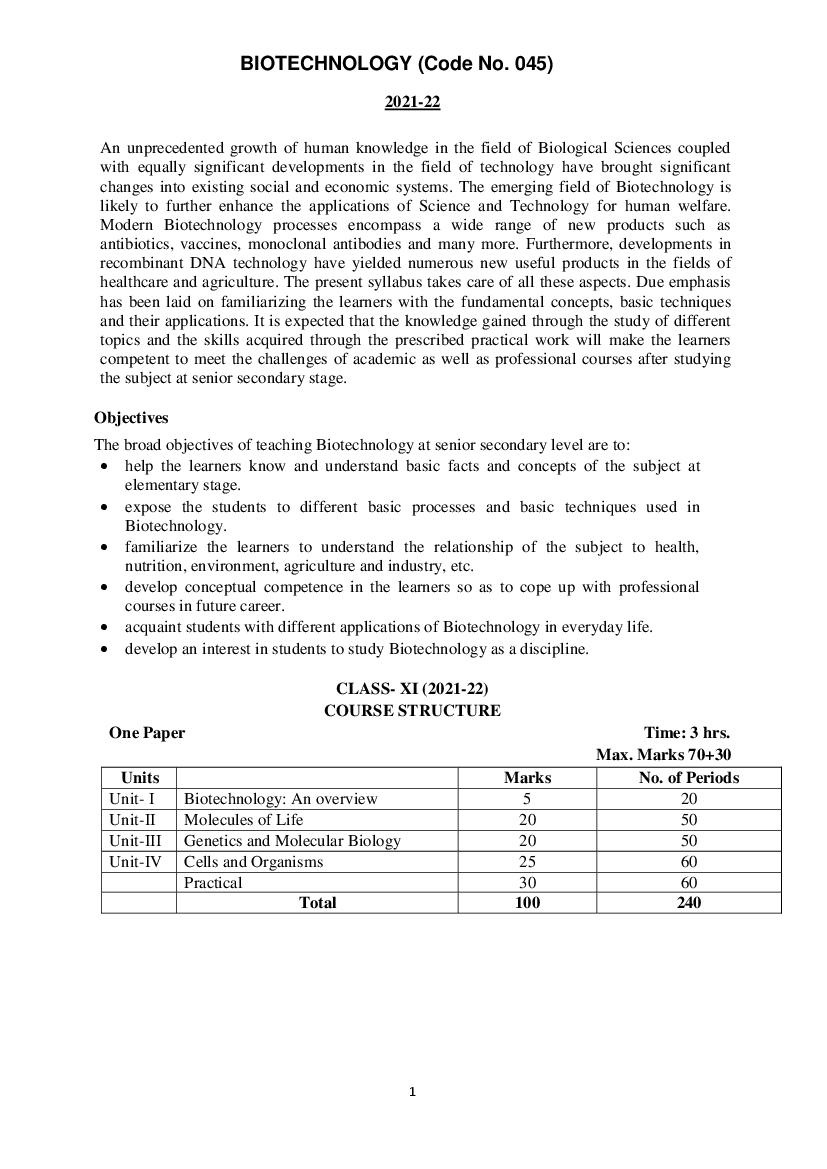
An unprecedented growth of human knowledge in the field of Biological Sciences coupled
with equally significant developments in the field of technology have brought significant
changes into existing social and economic systems. The emerging field of Biotechnology is
likely to further enhance the applications of Science and Technology for human welfare.
Modern Biotechnology processes encompass a wide range of new products such as
antibiotics, vaccines, monoclonal antibodies and many more. Furthermore, developments in
recombinant DNA technology have yielded numerous new useful products in the fields of
healthcare and agriculture. The present syllabus takes care of all these aspects. Due emphasis
has been laid on familiarizing the learners with the fundamental concepts, basic techniques
and their applications. It is expected that the knowledge gained through the study of different
topics and the skills acquired through the prescribed practical work will make the learners
competent to meet the challenges of academic as well as professional courses after studying
the subject at senior secondary stage.
Objectives
The broad objectives of teaching Biotechnology at senior secondary level are to:
help the learners know and understand basic facts and concepts of the subject at
elementary stage.
expose the students to different basic processes and basic techniques used in
Biotechnology.
familiarize the learners to understand the relationship of the subject to health,
nutrition, environment, agriculture and industry, etc.
develop conceptual competence in the learners so as to cope up with professional
courses in future career.
acquaint students with different applications of Biotechnology in everyday life.
develop an interest in students to study Biotechnology as a discipline.
CLASS- XI (2021-22)
COURSE STRUCTURE
One Paper Time: 3 hrs.
Max. Marks 70+30
Units Marks No. of Periods
Unit- I Biotechnology: An overview 5 20
Unit-II Molecules of Life 20 50
Unit-III Genetics and Molecular Biology 20 50
Unit-IV Cells and Organisms 25 60
Practical 30 60
Total 100 240
1
Page 2
(Theory)
One Paper Time: 3 hrs.
Total Marks: 70
Unit-I Biotechnology: An overview 5 Marks
Chapter 1: Biotechnology: An Overview
Historical Perspectives, Technology and Applications of Biotechnology, Global market and
Biotech Products, Public Perception of Biotechnology, Biotechnology in India and Global
Trends
Unit-II Molecules of Life 20 Marks
Chapter 1: Biomolecules: Building Blocks
Building Blocks of Carbohydrates - Sugars and their Derivatives, Building Blocks of
Proteins - Amino Acids, Building Blocks of Lipids - Simple Fatty Acids, Sphingosine,
Glycerol and Cholesterol, Building Blocks of Nucleic Acids - Nucleotides, Biochemical
Transformations
Chapter 2: Macromolecules: Structure & Function
Carbohydrates - The Energy Givers, Proteins - The Performers, Enzymes - The Catalysts,
Lipids and Biomembranes - The Barriers, Nucleic Acids - The Managers
Unit-III Genetics and Molecular Biology 20 Marks
Chapter 1: Concepts of Genetics
Historical Perspective, Multiple Alleles, Linkage and Crossing Over, Genetic Mapping, Gene
Interaction, Sex-Linked Inheritance, Extra nuclear Inheritance, Quantitative Inheritance,
Genes at the Population Level
Chapter 2: Genes and Genomes: Structure and Function
Discovery of DNA as Genetic Material, DNA Replication, Fine Structure of the Genes, From
Gene to Protein, Transcription – The Basic Process, Genetic Code, Translation, Regulation of
Gene Expression, Mutations, DNA Repair, Human Genetic Disorders, Genome Organization
Unit IV: Cells and Organisms 25 Marks
Chapter 1 The Basic Unit of Life
Cell Structure and Components, Tissues and Organs, Stem Cells, Biodiversity, Organization
of Life
Chapter 2: Cell Growth and Development
Cell Division, Cell Cycle, Cell Communication, Nutrition, Gaseous Exchange, Internal
Transport, Maintaining the Internal Environment, Reproduction, Invitro Fertilization, Animal
and Plant Development, Immune Response in Animals, Programmed Cell Death, Defense
Mechanisms in Plants
2
Page 3
Note: Every student is required to do the following experiments during the academic session.
1. Recording practical results and safety rules in the laboratory
2. Preparation of buffers and pH determination
3. Sterilization techniques
4. Preparation of bacterial growth medium
5. Determination of bacterial growth curve
6. Cell counting
7. Isolation of milk protein (Casein)
8. Sugar Estimation using Di Nitro Salicylic Acid test (DNS test)
9. Assay for amylase enzyme
10. Protein estimation by biuret method
11. Study of various stages of mitosis and calculation of mitotic index
12. Preparation of karyotype
3
Document Details
| Board / Org | CBSE |
| Exam | Class 11 |
| Type | Syllabus |
| Pages | 3 |
| Updated | 22 Jul 2026 |