Goa Board Class 12 Question Paper 2025 Sociology
Finished viewing? Save it for later —
Download Goa Board Class 12 Question Paper 2025 Sociology (PDF · 8 pages)About Goa Board Class 12 Question Paper 2025 Sociology
Goa Board Class 12 Question Paper 2025 Sociology is available here for free download. Published by Goa Board for Class 12, this question paper can be viewed online or downloaded as a PDF (8 pages). Candidates preparing for Class 12 can use Goa Board Class 12 Question Paper 2025 Sociology to understand the exam pattern, the type of questions asked, and the overall difficulty level.
Frequently Asked Questions
How can I download Goa Board Class 12 Question Paper 2025 Sociology?
Open this page and click the Download button to save Goa Board Class 12 Question Paper 2025 Sociology as a PDF. It is completely free on AglaSem Docs.
Is Goa Board Class 12 Question Paper 2025 Sociology free to download?
Yes. Goa Board Class 12 Question Paper 2025 Sociology can be viewed online and downloaded as a PDF free of cost on AglaSem Docs.
How many pages does Goa Board Class 12 Question Paper 2025 Sociology have?
Goa Board Class 12 Question Paper 2025 Sociology contains 8 pages, which you can read online or download together as a single PDF.
Where can I find more Class 12 study material?
You can find more Class 12 question papers, sample papers, syllabus, and answer keys on AglaSem Docs.
Goa Board Class 12 Question Paper 2025 Sociology – Text
Read the full text of this question paper below — useful to quickly search, copy and reference the content online without downloading the PDF.
📄 View text version (8 pages)
Page 1
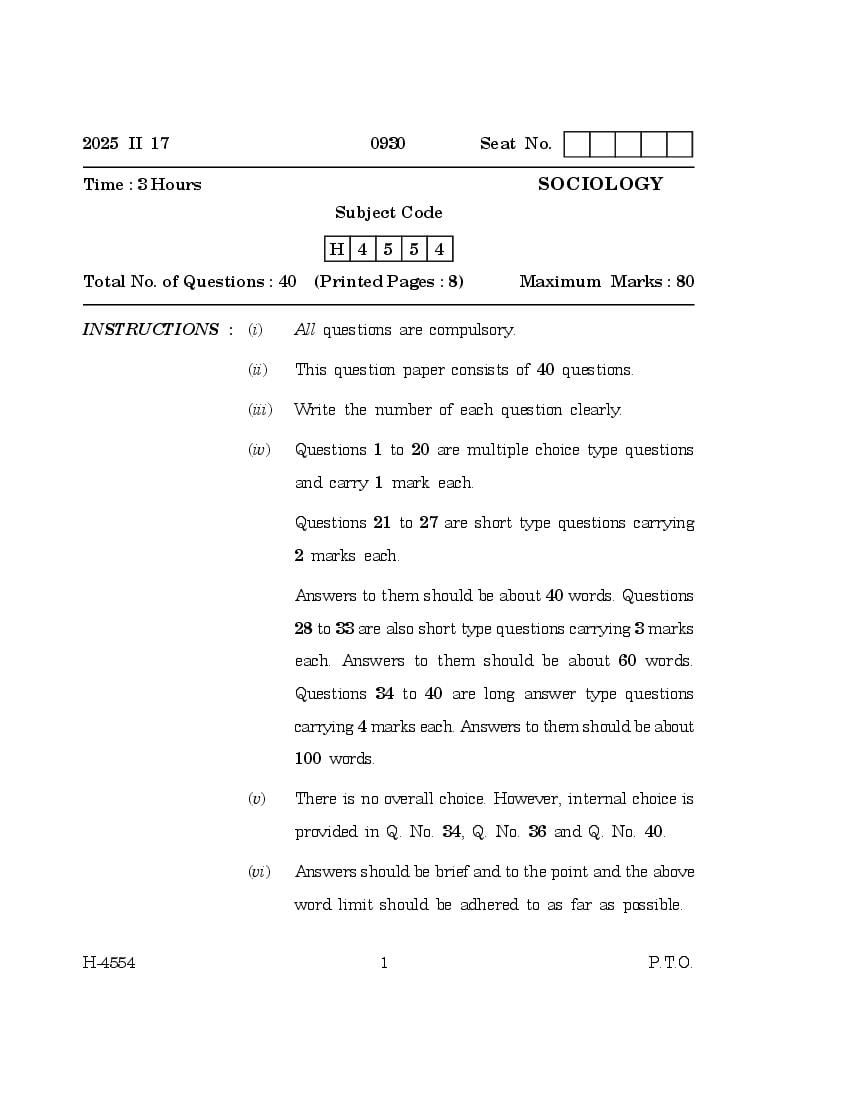
Time : 3 Hours SOCIOLOGY
Subject Code
H 4 5 5 4
Total No. of Questions : 40 (Printed Pages : 8) Maximum Marks : 80
INSTRUCTIONS : (i) All questions are compulsory.
(ii) This question paper consists of 40 questions.
(iii) Write the number of each question clearly.
(iv) Questions 1 to 20 are multiple choice type questions
and carry 1 mark each.
Questions 21 to 27 are short type questions carrying
2 marks each.
Answers to them should be about 40 words. Questions
28 to 33 are also short type questions carrying 3 marks
each. Answers to them should be about 60 words.
Questions 34 to 40 are long answer type questions
carrying 4 marks each. Answers to them should be about
100 words.
(v) There is no overall choice. However, internal choice is
provided in Q. No. 34, Q. No. 36 and Q. No. 40.
(vi) Answers should be brief and to the point and the above
word limit should be adhered to as far as possible.
H-4554 1 P.T.O.
Page 2
is referred to as .....................
• Fertility rate
• Dependency ratio
• Life expectancy
• Life chances
2. The main health factor that affects women differently from men is .............
• Malnutrition
• Childbearing
• Obesity
• Diabetes
3. The 1901 Census sought to collect information on the social hierarchy of caste
under the direction of ......................
• Robert Clive
• Warren Hastings
• Job Charnock
• Herbert Risley
4. A family structure where men exercise authority and dominance is termed
as ...................
• Matrilocal family
• Patriarchal family
• Matriarchal family
• Patrilocal family
H-4554 2
Page 3
• Social inequality
• Social stratification
• Social status
6. The most important state initiative attempting to compensate for past and
present caste discrimination is ........................
• Standardisation
• Restrictions
• Provisions
• Reservations
7. The term adivasi literally means ...................
• Original inhabitants
• Aboriginal inhabitants
• Local inhabitants
• Modern dweller
8. The chief architect of the Indian Constitution is ....................
• Dr. Datta Samant
• Mahatma Gandhi
• Dr. B. R. Ambedkar
• Jawaharlal Nehru
H-4554 3 P.T.O.
Page 4
of the family, but outside the domain of state and market is ....................
• World community
• Civil society
• Human society
• Civic society
10. The emergence of machine production, based on the use of inanimate power
resources like steam or electricity is known as ...................
• Mechanisation
• Modernisation
• Urbanisation
• Industrialisation
11. The movement that strengthened the loyalty to the Indian national economy
is ....................
• Champaran Movement
• Satyagraha Movement
• Swadeshi Movement
• Non-cooperation Movement
• Jahanara Shah Nawas
• Tarabai Shinde
• Begum Rokeya Hossain
• Savitribai Phule
H-4554 4
Page 5
• Daya Pawar
• A. R. Desai
• Vinoba Bhave
• M.N. Srinivas
14. The single most important resource and form of property in rural society
is ........................
• Residential land
• Industrial estate
• Agricultural land
• Commercial land
15. A process where the government tries to sell its share in several public sector
companies is known as ...................
• Investment
• Disinvestment
• Merchandising
• Commercialisation
16. The famous Sociologist who argued that the use of machinery actually
deskills workers is ........................
• Herbert Spencer
• Harry Braverman
• Frederick Taylor
• Charles Wright
H-4554 5 P.T.O.
Page 6
it is termed as .....................
• Lockdown
• Strike
• Revolt
• Lockout
18. Social conflict arises when a social group feels that it is worse off than others
around it. This theory is known as .......................
• Collective action theory
• Relative deprivation theory
• Resource mobilization theory
• Structural strain theory
19. The movement that aims to bring about a change in the personal
consciousness and actions of its individual members is known as ..............
• Redemptive social movement
• Reformist social movement
• Revolutionary social movement
• Alternative social movement
20. The first trade union was established in April 1918 in Madras by ................
• Bindeshwari Dubey
• B.P. Wadia
• Kaka Kalelkar
• B.P. Mandal
H-4554 6
Page 7
22. Literacy is an instrument of empowerment. Elaborate.
23. Explain the features of caste.
24. Explain the impact of National development on tribal communities.
25. Examine the importance of community identity in India.
26. The notion of minority groups is more than merely a numerical distinction.
Explain.
27. Explain the negative effects of contract farming.
28. Examine the dimensions of Untouchability.
29. Explain the different situations of urban impact put forth by the Sociologist
M.S.A. Rao.
31. Explain the Land Ceiling Acts as a major land reform law.
32. Elaborate the risks faced by the workers employed in the mining industry.
33. Social Movements of Dalits show a particular character. Explain.
34. Analyse the Malthusian theory of population growth.
Or
Analyse the Population Policy of India.
H-4554 7 P.T.O.
Page 8
36. Evaluate the role of the social reformers in the 19th Century towards the
struggle for women’s equality and rights in India.
Or
Evaluate the struggles faced by the disabled.
37. Examine Regionalism in the Indian context.
38. Analyse the negative social effects of the Green Revolution in India.
39. Explain the process of making bidis as an important part of the economy.
40. Evaluate the Chipko Movement as an ecological movement.
Or
Evaluate the features of a social movement.
H-4554 8
Document Details
| Board / Org | Goa Board |
| Exam | Class 12 |
| Type | Question Paper |
| Pages | 8 |
| Updated | 24 Sep 2026 |