PU CET PG 2017 Question Paper MSc_2Yr__Microbial Biotechnology_
Finished viewing? Save it for later —
Download PU CET PG 2017 Question Paper MSc_2Yr__Microbial Biotechnology_ (PDF · 11 pages)About PU CET PG 2017 Question Paper MSc_2Yr__Microbial Biotechnology_
PU CET PG 2017 Question Paper MSc_2Yr__Microbial Biotechnology_ is available here for free download. Published by Punjab University for PU CET PG, this question paper can be viewed online or downloaded as a PDF (11 pages). Candidates preparing for PU CET PG can use PU CET PG 2017 Question Paper MSc_2Yr__Microbial Biotechnology_ to understand the exam pattern, the type of questions asked, and the overall difficulty level.
Frequently Asked Questions
How can I download PU CET PG 2017 Question Paper MSc_2Yr__Microbial Biotechnology_?
Open this page and click the Download button to save PU CET PG 2017 Question Paper MSc_2Yr__Microbial Biotechnology_ as a PDF. It is completely free on AglaSem Docs.
Is PU CET PG 2017 Question Paper MSc_2Yr__Microbial Biotechnology_ free to download?
Yes. PU CET PG 2017 Question Paper MSc_2Yr__Microbial Biotechnology_ can be viewed online and downloaded as a PDF free of cost on AglaSem Docs.
How many pages does PU CET PG 2017 Question Paper MSc_2Yr__Microbial Biotechnology_ have?
PU CET PG 2017 Question Paper MSc_2Yr__Microbial Biotechnology_ contains 11 pages, which you can read online or download together as a single PDF.
Where can I find more PU CET PG study material?
You can find more PU CET PG question papers, sample papers, syllabus, and answer keys on AglaSem Docs.
PU CET PG 2017 Question Paper MSc_2Yr__Microbial Biotechnology_ – Text
Read the full text of this question paper below — useful to quickly search, copy and reference the content online without downloading the PDF.
📄 View text version (11 pages)
Page 1
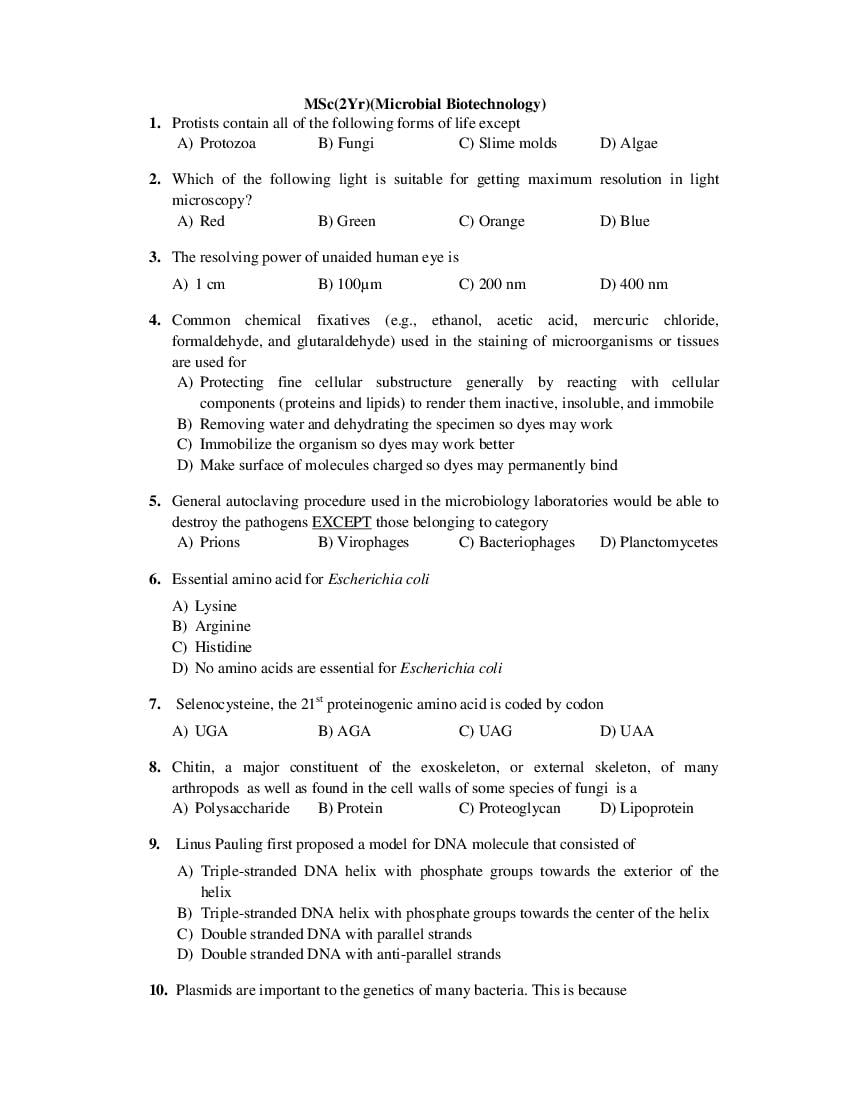
1. Protists contain all of the following forms of life except
A) Protozoa B) Fungi C) Slime molds D) Algae
2. Which of the following light is suitable for getting maximum resolution in light
microscopy?
A) Red B) Green C) Orange D) Blue
3. The resolving power of unaided human eye is
A) 1 cm B) 100µm C) 200 nm D) 400 nm
4. Common chemical fixatives (e.g., ethanol, acetic acid, mercuric chloride,
formaldehyde, and glutaraldehyde) used in the staining of microorganisms or tissues
are used for
A) Protecting fine cellular substructure generally by reacting with cellular
components (proteins and lipids) to render them inactive, insoluble, and immobile
B) Removing water and dehydrating the specimen so dyes may work
C) Immobilize the organism so dyes may work better
D) Make surface of molecules charged so dyes may permanently bind
5. General autoclaving procedure used in the microbiology laboratories would be able to
destroy the pathogens EXCEPT those belonging to category
A) Prions B) Virophages C) Bacteriophages D) Planctomycetes
6. Essential amino acid for Escherichia coli
A) Lysine
B) Arginine
C) Histidine
D) No amino acids are essential for Escherichia coli
7. Selenocysteine, the 21st proteinogenic amino acid is coded by codon
A) UGA B) AGA C) UAG D) UAA
8. Chitin, a major constituent of the exoskeleton, or external skeleton, of many
arthropods as well as found in the cell walls of some species of fungi is a
A) Polysaccharide B) Protein C) Proteoglycan D) Lipoprotein
9. Linus Pauling first proposed a model for DNA molecule that consisted of
A) Triple-stranded DNA helix with phosphate groups towards the exterior of the
helix
B) Triple-stranded DNA helix with phosphate groups towards the center of the helix
C) Double stranded DNA with parallel strands
D) Double stranded DNA with anti-parallel strands
10. Plasmids are important to the genetics of many bacteria. This is because
Page 2
B) They may carry genes that give their host a selective advantage
C) They can render bacteria drug-resistant
D) Statements made in choices A, B, and C above are true for plasmids
11. Some bacteria are considered pleomorphic. This means
A) They are shaped like bent rods B) They have a corkscrew shape
C) They do not have just one shape D) They are not either bacilli or cocci
12. The 70S prokaryotic ribosomes consist of
A) Two 40S subunits. B) A 50S and a 30S subunit
C) A 40S and a 30S subunit D) A 50S and a 20S subunit
13. During Gram staining the Gram positive cells appear so as they
A) Have a second, outer membrane that helps retain the crystal violet stain
B) Have multiple layers of peptidoglycan that help retain the crystal violet stain
C) Have a thick capsule that traps the crystal violet stain
D) Have a periplasmic space that traps the crystal violet
14. Chemotaxis of Bacteria is accomplished by
A) Steering toward better growth conditions
B) Making long, uninterrupted runs when conditions are good
C) Frequently stopping and tumbling to better sense good conditions
D) Stopping movement when conditions are good
15. Bacterial endospores serve the purpose of
A) Allow the bacterium to make hundreds of "seeds" to spread on the wind
B) Help the bacterium to differentiate into faster growing stages of bacteria
C) Allow the bacterium to survive the absence of oxygen
D) Allow the bacterium to survive extended periods of heat or dryness
16. In an exponentially growing culture of Escherichia coli there are 2x10⁵ cells/ml at a
given instance. If the doubling time for Escherichia coli is 20 minutes, how many
cells/ml you would expect in the culture after 2 hours.
A) 2x10⁵ cells/ml B) 1.2x10⁶ cells/ml
C) 1.28x10⁷ cells/ml D) 2x10⁷ cells/ml
17. Which one of the following is the most abundant protein /enzyme in biosphere
A) Actin
B) ATPase
C) Pyruvate dehydrogenase
D) Ribulose 1,5-bisphosphate carboxylase/oxygenase (rubisco)
18. Most of the CO2 is fixed in the biosphere by organisms belonging to the group(s) of
Page 3
C) Plantae and Chlorophytes D) Cyanobacteria
19. Phycobilins are
A) Pigments found in cyanobacteria and red algae
B) Pigments found in some edible Fungi giving it particular taste
C) Small chemicals produced on RBC degradation in liver that help in lipid absorption
D) Small chemicals produced by kidneys to induce RBC production
20. Most abundant microbes on Earth are
A) Eukaryotes B) Prokaryotes
C) Monerans D) Viruses/Virus like particles
21. snoRNA and snRNA play important role in __________and________,respectively
A) Pre-rRNA transcript processing; splicing of pre-mRNA
B) tRNA processing; gRNA processing
C) tRNA splicing; splicing of pre-mRNA
D) miRNA processing; ciRNA processing
22. Red tides are generally
A) Population blooms of dinoflagellates that release red pigments and toxins, which
can lead to paralytic shellfish poisoning
B) Population blooms of red algae that release red pigments and toxins, which can
lead to paralytic shellfish poisoning
C) Seasonal population blooms of red colored algae in coral reef systems that help
sustain the coral reef ecosystem
D) Observed around full red moons
23. "Nod factors" and "Myc factors" are
A) Produced/secreted by microbial symbionts of plants and help in the establishment
of a symbiotic relationship
B) Aids the formation of ‘Heterocysts’ in Anabaena spp. that helps in Nitrogen
fixation
C) Responsible for the formation of galls in the members of Graminae
D) Produced by Agrobacterium tumifaciens that helps in tumor formation
24. ‘Anammox reaction’ refers to
A) Chemolithoautotrophy that employs ammonium ion (NH4 +) as the electron donor
and nitrite (NO2 -) as the terminal electron acceptor producing nitrogen gas (N2)
B) Rare form of Amoxicillin hypersensitivity reaction observed in certain individuals
C) Chemical reaction that generates an adduct of an animal protein and ammonia
D) Both choices A and B are true
Page 4
A) Results from eating grains infected with Claviceps purpurea
B) Often accompanied by gangrene, psychotic delusions, nervous, spasms, abortion,
and convulsions
C) The presence of an active ingredient, lysergic acid diethylamide (LSD) in the
fungus infected grain is primarily responsible for the symptoms of ‘ergotism’
D) Statements made in choices A, B and C are true about ‘ergotism’
26. If no class I MHC is found / recognized on a cell,
A) The NK cell uses cytotoxic granules containing perforin and granzyme to induce
cell death by apoptosis
B) B-cells get activated becoming plasma cells and start producing antibodies
C) TH-cells get activated recruiting Tc for killing such cell
D) MHC II class production is induced and cell is ready to change its lineage
27. Aflatoxins are
A) Produced by Aspergillus flavus and related species
B) Planar, ringed compounds that easily intercalate in nucleic acids and act as potent
frameshift mutagens and carcinogens, primarily affecting liver and causing liver
dysfunction and cancer
C) Heat stable and have been found in milk, beer, cocoa, raisins, peanut butter, and
soybean meal
D) Statements made in choices A, B and C are true about aflatoxin
28. Nucleotide-binding and oligomerization domain (NOD) receptors or NOD-like
receptors (NLRs)
A) Found in phagocytes that detect cytosolic pathogen-associated molecular patterns
(PAMPs), such as the terminal meso-DAP of Gram-negative peptidoglycan, and
host molecules called "damage-associated molecular patterns" (DAMPs), such as
uric acid and heat-shock proteins, endogenous metabolites and regulate/promote
programmed cell death
B) Roots of legumes that detect presence of arbuscular fungi and promote nodule
formation
C) Nucleoplasm of eukaryotic cells that detect nucleotide levels in the cells and
induces salvage pathway of nucleotides.
D) Involved in nucleotide uptake from extracellular medium using proton motive
force
29. ‘Superantigens’ are
A) Molecules that "trick" a huge number of T-cells into activation when no specific
antigen is present.
B) Antigens that induce strong immune reaction so that protective immunity is
generated in a single shot without requiring any booster
Page 5
antigens/pathogens
D) Complex Antigens that induce protective immunity against a number of
antigens/pathogens
30. Which of the following disease is best diagnosed by serologic means?
A) Pulmonary tuberculosis B) Gonorrhea
C) Actinomycosis D) Q Fever
31. In lactic acid fermentation the final electron acceptor would be
A) Oxygen B) Nitrate C) Pyruvate D) Glucose
32. Which of the following best explains why the production of ethanol is important in
yeast cells that are growing under anaerobic conditions?
A) Ethanol keeps the electron transport system functioning
B) Yeast would be unable to activate the enzymes of the Krebs cycle without ethanol
C) The process generates oxygen, which is required for glycolysis
D) The process regenerates NAD+, which is required for glycolysis
33. The enzymes that catalyze the reactions of the Krebs cycle are found in which
subcellular organelle of eukaryotes?
A) Chloroplast B) Endoplasmic reticulum
C) Lysosome D) Mitochondrion
34. Which of the following is accomplished in chemiosmosis?
A) Oxidation of ATP B) Oxidation of water
C) Oxidation of NADH D) Oxidation of H+
35. Fatty acids are oxidized to acetyl-CoA by which of the following pathways?
A) Beta oxidation B) Entner-Doudoroff
C) Tricarboxylic acid pathway D) Embden-Meyerhof pathway
36. Illegitimate recombination refers to
A) Integration of circular plasmid DNA into linear eukaryotic chromosomes
B) Integration of introduced DNA at random locations in the host chromosome
C) Integration of introduced DNA at homologous sites in the host chromosome
D) Recombination involving or in between DNA sequences that do not share
sequence
homology to each other
37. One of the first enzymes synthesized by many bacteriophage is __________, an RNA-
dependent RNA polymerase called
A) RNA replicase B) RNA transcriptase
C) Reverse transcriptase D) RNA polymerase
38. T-even phage binding to Escherichia coli supposedly involves
Page 6
C) Covalent bonds D) Hydrogen bonds
39. In order for CREB to activate transcription:
A) It must act as a heterodimer B) It must be phosphorylated
C) It must bind to cAMP D) It must bind to RNA polymerase
40. Suppose, you like to perform a DNase-I protection experiment to see where the
binding sites for regulatory transcription factors for the mouse GAPDH gene are
located. What would you use for a probe?
A) The GAPDH gene coding sequence
B) A DNA fragment including about 100bp on either side of the promoter
C) A DNA fragment containing upto several thousand bp upstream of the promoter,
one
small piece at a time
D) A DNA fragment including about 500bp downstream of the polyA site of GAPDH
gene
41. In RNA editing, the guide RNA:
A) Must have the same sequence as the end result of the edited RNA.
B) Must have a complementary sequence to the 5' end of the RNA to be edited
C) Can change a uracil to another base
D) Can interact with many different RNAs
42. Which of these would be the best evidence for a functional role of RNA interference
in resistance to viral infection?
A) Cells resistant to double stranded RNA viruses are also likely to be resistant to
single
stranded RNA viruses
B) Cells resistant to DNA viruses tend not to also be resistant to RNA viruses
C) Cells resistant to one double stranded RNA virus tend to be resistant to all double
stranded RNA viruses
D) Cells resistant to a single stranded RNA virus tend to be resistant to DNA viruses
43. Which of the following RNA modifications could best be described as "removal of
intervening sequences"?
A) RNA editing or base modification B) 5' capping
C) Splicing D) Trimming
44. Which of the following statements about RNA splicing is NOT correct?
A) Introns often have a specific function after they are removed
B) Splicing is required for some tRNAs
C) The final step of splicing is formation of a phosphodiester linkage
D) Some introns can splice themselves out
Page 7
introns?
A) A comparison of the DNA and mRNA sequences
B) A comparison of the genomic DNA and cDNA sequences
C) A hybridization between DNA and mRNA molecules
D) Any of the choices stated in A, B or C above would demonstrate it
46. What is true for RNA synthesis process carried out by bacterial RNA polymerase?
A) RNA polymerase requires Zn and Mg ions for activity; the synthesis is DNA
template dependent that does not require a primer
B) The RNA synthesis is stopped/terminated in a rho-dependent and rho-independent
manner
C) The proof reading activity of RNA polymerase slightly decreases the rate of RNA
synthesis
D) Choices A and B are true
47. Which of the following is a critical function of the 5' cap of eukaryotic mRNAs?
A) Protection from inappropriate splicing
B) Synthesis of the polyA tail
C) Transport of mRNAs into the nucleus
D) Protection of the nascent mRNA from degradation and help the ribosome
recognize
the 5' end of the transcript
48. Which of the following is normally found in Gram-negative bacteria but NOT found in
archaea?
A) Outer membrane
B) A complex peptidoglycan network
C) Both outer membrane and a complex peptidoglycan network
D) Circular bacterial chromosome
49. Methanogens are of great importance because
A) They produce methane
B) They consume methane
C) Methane is an excellent energy source
D) Both choices A and C are true
50. A disease that is constantly present in a population is called _____.
A) Pandemic B) Epidemic C) Endemic D) Re-emerging
51. Which of the statements about biofilms is INCORRECT?
A) Biofilms are considered responsible for diseases such as cystic fibrosis
B) Biofilms produce dental plaque, and colonize catheters and prostheses
C) Biofilms colonize open wounds and burned tissue
Page 8
52. Members of the genus Deinococcus, e.g., Deinococcus radiodurans are quite
distinctive in their unusually great resistance to
A) Radiation B) Desiccation
C) Radiation and desiccation D) Extreme temperatures
53. The bacteriochloropyll pigments of purple and green bacteria enable them to live in
A) Saline environments
B) Deeper, anaerobic zones of aquatic habitats
C) Shallow, warm aquatic habitats
D) Aerobic warm zones
54. Whooping cough is caused by
A) Klebsiella pneumonia B) Vibrio parahaemolyticus
C) Bordetella pertussis D) Yersinia pestis
55. Helicobacter pylori is responsible for
A) Gastroenteritis B) Cholera
C) Bacterial dysentery D) Peptic ulcer disease
56. Which of the following statement is true about Agrobacterium tumefaciens?
A) It has been used to introduce foreign DNA into plant cells
B) It causes crown gall disease when it carries a tumor inducing (Ti) plasmid
C) It is not capable of nitrogen fixation
D) Statements made in choices A, B and C are true about Agrobacterium tumefaciens
57. The streptomycetes may represent __________ of the viable organisms in the soil.
A) 5% B) 10% C) 1-20% D) 1-10%
58. _______ exhibit yeast-like growth at human body temperatures and mold-like growth
at room temperature.
A) Slime molds B) Dimorphic fungi C) Club fungi D) Black bread
molds
59. Fungi are important in the production of all of the following commercial produces
EXCEPT
A) Bread B) Beer C) Cheese D) Rubber
60. The fruiting body of a mushroom is called
A) Conidiocarps B) Sorocarps C) Basidiocarps D) Ascocarps
61. Peptide nucleic acid (PNA)
Page 9
recognized by either nucleases or proteases, making them resistant to degradation
by enzymes
B) Oligomers bind to complementary DNAs/ RNAs with greater specificity
C) Is used in the molecular biology procedures as stable homolog of DNA and RNA,
diagnostic assays, and antisense therapies
D) Statements made in choices A, B and C are true about PNA
62. “Golden Rice” and “Golden Mustard”
A) are transgenic varieties developed that have high Vitamin A content
B) are high yielding varieties produced by hybridization that produce golden color
grains
C) are varieties that have been produced to show bioaccumulation of gold in the
grains when grown in gold rich soil
D) are two Indian varieties which were recently marketed by USA firms as their own
63. As per Coombs and Gell classification the Type III hypersensitivity reaction is also
known as………………. and mediated by………….
A) Immune complex disease; IgG, complement and Neutrophils
B) Cytotoxic, antibody-dependent; IgM or IgG, complement and Macrophages
C) receptor mediated autoimmune disease; IgM or IgG and complement
D) Wheal and flare; IgE
64. A genomic library is
A) A database where the sequence of an organism's genome is stored
B) A collection of many clones possessing different DNA fragments from the same
organisms bound to vectors
C) A book that describes how to isolate DNA from a particular organism
D) A place where the information of the genetic organization of organisms are kept
65. Which type of restriction endonuclease cuts the DNA within the recognition site and
does not require ATP
A) Type I B) Type II C) Type III D) Type IV
66. The piece of equipment which is used to introduce DNA into cells via DNA-coated
microprojectiles is popularly known as
A) Laser B) DNA probe C) Gene gun D) Inoculating
needle
67. The advantage of using a DNA polymerases from thermophilic organisms in PCR is
that
A) These DNA polymerases are much faster than those from other organisms
Page 10
the
DNA duplex
C) These DNA polymerases never make mistakes while replicating DNA
D) These DNA polymerases can work in low salt concentration
68. Which of the following is true about T-DNA integration in the plant nuclear DNA?
A) Can occur at many different, apparently random, sites in the plant nuclear DNA
B) Occurs only at one specific sites in the plant nuclear DNA
C) Occurs at two specific sites in the plant nuclear DNA
D) Occurs at one site that may be random in the plant nuclear DNA
69. Protoplasts can be produced from suspension cultures, callus tissues or intact tissues
by enzymatic treatment with
A) Cellulotyic enzymes
B) Pectolytic enzymes
C) Both cellulotyic and pectolytic enzymes
D) Proteolytic enzymes
70. Examples of Probiotics and Prebiotics are___________and _______,respectively
A) Penicillin-G; Penicillin B) Curd; Cheese
C) Yogurt/Yoghurt/ Yoghourt; Garlic D) Garlic; Yogurt/Yoghurt/ Yoghourt
71. Metabolism of dissolved organic material released by phytoplankton allows
heterotrophic bacteria to become part of the particulate organic matter that is passed up
the food web to be metabolized and released as mineral elements and CO2 at each
transfer. This description refers to
A) Microbial loop B) Winogradsky column
C) Redfield ratio D) Sheffields law
72. Because it can be used with a variety of media and allow a resuscitation step
the________technique has become the common and often preferred method of
evaluating the microbiological characteristics of water.
A) Most probable number B) Winogradsky
C) MUG D) Membrane filtration
73. Butanol is obtained by fermenting molasses by
A) Clostridium butyricum and Clostridium acetobutylicum
B) Clostridium butyricum and Clostridium tetanai
C) Clostridium butyricum and Lactobacillus
D) Clostridium butyricum and Clostridium oceanicum
74. Yeast cells are good source of
A) Vitamin A & Vitamin D B) Vitamin B-complex & Vitamin D
C) Vitamin A & Vitamin B-complex D) Vitamin B-complex and K
Page 11
A) Rhizopus spp. B) Nocardia spp.
C) Clostridium spp. D) Ocillatoria spp.
x-x-x
Document Details
| Board / Org | Panjab University |
| Exam | PU CET PG |
| Type | Question Paper |
| Pages | 11 |
| Updated | 22 Jul 2026 |