UGC NET 2021 Question Paper Music
Finished viewing? Save it for later —
Download UGC NET 2021 Question Paper Music (PDF · 138 pages)About UGC NET 2021 Question Paper Music
UGC NET 2021 Question Paper Music is available here for free download. Published by NTA for UGC NET, this question paper can be viewed online or downloaded as a PDF (138 pages). Candidates preparing for UGC NET can use UGC NET 2021 Question Paper Music to understand the exam pattern, the type of questions asked, and the overall difficulty level.
Frequently Asked Questions
How can I download UGC NET 2021 Question Paper Music?
Open this page and click the Download button to save UGC NET 2021 Question Paper Music as a PDF. It is completely free on AglaSem Docs.
Is UGC NET 2021 Question Paper Music free to download?
Yes. UGC NET 2021 Question Paper Music can be viewed online and downloaded as a PDF free of cost on AglaSem Docs.
How many pages does UGC NET 2021 Question Paper Music have?
UGC NET 2021 Question Paper Music contains 138 pages, which you can read online or download together as a single PDF.
Where can I find more UGC NET study material?
You can find more UGC NET question papers, sample papers, syllabus, and answer keys on AglaSem Docs.
UGC NET 2021 Question Paper Music – Text
Read the full text of this question paper below — useful to quickly search, copy and reference the content online without downloading the PDF.
📄 View text version (138 pages)
Page 1
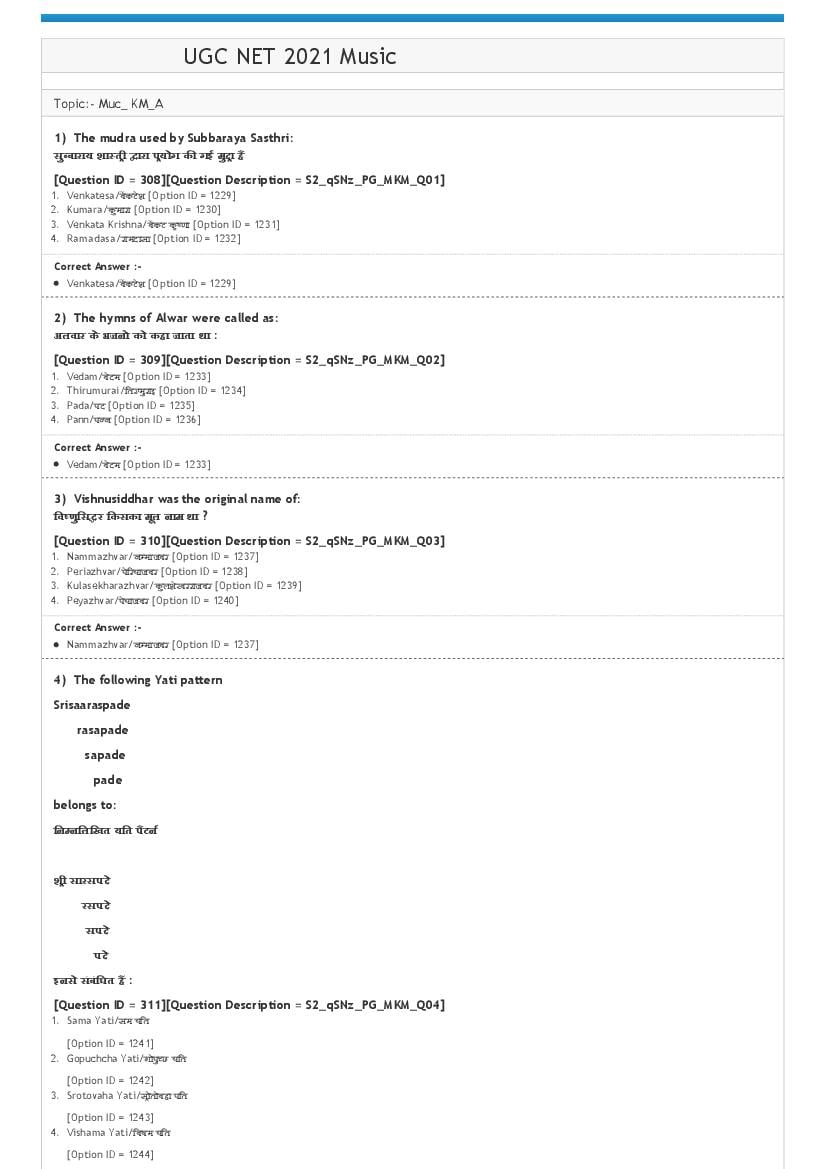
Topic:‐ Muc_ KM_A
1) The mudra used by Subbaraya Sasthri:
सु बाराय शा ती ारा पयोग क गई मुदा है
[Question ID = 308][Question Description = S2_qSNz_PG_MKM_Q01]
1. Venkatesa/वकटेश [Option ID = 1229]
2. Kumara/कुमारा [Option ID = 1230]
3. Venkata Krishna/वकट कृ णा [Option ID = 1231]
4. Ramadasa/रामदासा [Option ID = 1232]
Venkatesa/वकटेश [Option ID = 1229]
2) The hymns of Alwar were called as:
अलवार के भजन को कहा जाता था :
[Question ID = 309][Question Description = S2_qSNz_PG_MKM_Q02]
1. Vedam/वेदम [Option ID = 1233]
2. Thirumurai/ित मुराइ [Option ID = 1234]
3. Pada/पद [Option ID = 1235]
4. Pann/प न [Option ID = 1236]
Vedam/वेदम [Option ID = 1233]
3) Vishnusiddhar was the original name of:
िव णुिस र िकसका मूल नाम था ?
[Question ID = 310][Question Description = S2_qSNz_PG_MKM_Q03]
1. Nammazhvar/न माजवर [Option ID = 1237]
2. Periazhvar/पे रयाजवर [Option ID = 1238]
3. Kulasekharazhvar/कुलशेखरराजवर [Option ID = 1239]
4. Peyazhvar/पेयाजवर [Option ID = 1240]
Nammazhvar/न माजवर [Option ID = 1237]
4) The following Yati pattern
Srisaaraspade
rasapade
sapade
pade
belongs to:
िन निलिखत यित पैटन
शी सारसपदे
रसपदे
सपदे
पदे
इनसे संबंिधत ह :
[Question ID = 311][Question Description = S2_qSNz_PG_MKM_Q04]
1. Sama Yati/सम यित
[Option ID = 1241]
2. Gopuchcha Yati/गोपु छ यित
[Option ID = 1242]
3. Srotovaha Yati/सोतोवहा पित
[Option ID = 1243]
4. Vishama Yati/िवषम यित
[Option ID = 1244]
Page 2
[Option ID = 1241]
5) A collection of hundred compositions by Bhadrachalam Ramadas is known as:
भदाचलम रामदास क सौ बंिदश के संकलन कहा जाता है :
[Question ID = 312][Question Description = S2_qSNz_PG_MKM_Q05]
1. Dasarathi Satakam/दाशरिथ शतकम [Option ID = 1245]
2. Padmanabha Satakam/प नाभा शतकम [Option ID = 1246]
3. Narayana Satakam/नारायण शतकम [Option ID = 1247]
4. Rama Satakam/रामा शतकम [Option ID = 1248]
Dasarathi Satakam/दाशरिथ शतकम [Option ID = 1245]
6) Veena with 2 strings:
दो तार वाली वीणा को कहते ह :
[Question ID = 313][Question Description = S2_qSNz_PG_MKM_Q06]
1. Rudra/ दा
[Option ID = 1249]
2. Sharvari/शवरी
[Option ID = 1250]
3. Nakula/नकुला
[Option ID = 1251]
4. Pinaki/िपनाक
[Option ID = 1252]
Rudra/ दा
[Option ID = 1249]
7) 'Bhoothavethalavakuppu' is written by:
'भूतवेथालवकु पू' क रचना िकसने क थी ?
[Question ID = 314][Question Description = S2_qSNz_PG_MKM_Q07]
1. Muthu Thandavar/मु थुजदवन
[Option ID = 1253]
2. Ponniah Pillai/पोनैयािप लै
[Option ID = 1254]
3. Ramaswami Sivan/रामा वामी िशवम
[Option ID = 1255]
4. Arunagirinathar/अ णािगरीनाथन
[Option ID = 1256]
Muthu Thandavar/मु थुजदवन
[Option ID = 1253]
8) Sangita Samaya Sāra is the work of:
संगीत सा य सार िन निलिखत क रचना है :
[Question ID = 315][Question Description = S2_qSNz_PG_MKM_Q08]
1. Sarngadeva/सारंगदेव [Option ID = 1257]
2. Parsvadeva/पा देव [Option ID = 1258]
3. Narada/नारदा [Option ID = 1259]
4. Matanga/मतंगा [Option ID = 1260]
Sarngadeva/सारंगदेव [Option ID = 1257]
9) Select folk orchestra from the following:
िन निलिखत म से फोक आक टा को चुिनए :
[Question ID = 316][Question Description = S2_qSNz_PG_MKM_Q09]
Page 3
2. Naiyandi Melam/नै या दी मेलम [Option ID = 1262]
3. Thayampaka/ताया पका [Option ID = 1263]
4. Panchari Melam/पंचारी मेलम [Option ID = 1264]
Panchavadyam/पंचवा म [Option ID = 1261]
10) Pick the odd one.
िवषम क पहचान कर :
[Question ID = 317][Question Description = S2_qSNz_PG_MKM_Q10]
1. Mizhavu/िमझाऊ [Option ID = 1265]
2. Tantipanai/त दीपानै [Option ID = 1266]
3. Pulluvan Kudam/पु लुवन कुदम [Option ID = 1267]
4. Bramha Talam/ब तालम [Option ID = 1268]
Mizhavu/िमझाऊ [Option ID = 1265]
11) A desi kriya:
एक देशी िकया :
[Question ID = 318][Question Description = S2_qSNz_PG_MKM_Q11]
1. Dhruva/धुव [Option ID = 1269]
2. Avapa/आवापा [Option ID = 1270]
3. Nishkrama/िन कम [Option ID = 1271]
4. Krishna/कृ णा [Option ID = 1272]
Dhruva/धुव [Option ID = 1269]
12) 'Sooryamoorte' in the raga Saurashtra, tala Dhruva, is a composition of:
राग सौरा ु म 'सूयमूित' िन निलिखत क बंिदश ह :
ताल धव
[Question ID = 319][Question Description = S2_qSNz_PG_MKM_Q12]
1. Saint Thyagaraja/संत यागराज [Option ID = 1273]
2. Muthusvami Dikshithar/मु थु वामी दीि तार [Option ID = 1274]
3. Syama Sastri/ यामा शा ती [Option ID = 1275]
4. Muthaiaha Bhagavalhar/मु य ै ा भागवातार [Option ID = 1276]
Saint Thyagaraja/संत यागराज [Option ID = 1273]
13) Manipravala Kritis are those which have:
मिणपवाल कृितयाँ वे कृितयाँ ह िजनम
[Question ID = 320][Question Description = S2_qSNz_PG_MKM_Q13]
1. Multiple Charanas/अनेक चरण होते ह [Option ID = 1277]
2. Lyrics with multiple languages/अनेक भाषाओँ म संगीत होता है [Option ID = 1278]
3. Multiple Sections/अनेक खंड होते ह [Option ID = 1279]
4. Multiple Mudras/अनेक मुदाएँ होती ह [Option ID = 1280]
Multiple Charanas/अनेक चरण होते ह [Option ID = 1277]
14) A Bhashanga Raga similar to Pan Kausikam:
पण् कौिशकम से िमलता‐जुलता भाषंग राग है :
[Question ID = 321][Question Description = S2_qSNz_PG_MKM_Q14]
1. Mukhari/मुखारी [Option ID = 1281]
2. Ahiri/अहीरी [Option ID = 1282]
3. Nadanamakriya/नादनामिकया [Option ID = 1283]
4. Bhairavi/भैरवी [Option ID = 1284]
Mukhari/मुखारी [Option ID = 1281]
15) 6th Chapter of Natyashastra is tiltled as:
ना यशा त के छठे अ याय का शीषक है :
[Question ID = 322][Question Description = S2_qSNz_PG_MKM_Q15]
Page 4
2. Rasavikalpa/रस िवक प [Option ID = 1286]
3. Bhavavyanjaka/भाव यंजक [Option ID = 1287]
4. Samanyabhinaya/समय अिभनय [Option ID = 1288]
Purvavidhana/पूविवधान [Option ID = 1285]
16) Identify the author of Sangita Saramruta.
संगीत सारामृत के लेखक क पहचान क िजए
[Question ID = 323][Question Description = S2_qSNz_PG_MKM_Q16]
1. Raghunatha Nayak/रघुनाथ नायक [Option ID = 1289]
2. Tulajaji/तुलजाजी [Option ID = 1290]
3. Shahuji/साहजी [Option ID = 1291]
4. Ekoji/इकोजी [Option ID = 1292]
Raghunatha Nayak/रघुनाथ नायक [Option ID = 1289]
17) Which is NOT a wind instrument?
िन निलिखत म से कौन‐सा वायु वा यंत नह है ?
[Question ID = 324][Question Description = S2_qSNz_PG_MKM_Q17]
1. Tiruchinnam/ित िच नम
[Option ID = 1293]
2. Bhuri/भू र
[Option ID = 1294]
3. Davandai/दावनदाय
[Option ID = 1295]
4. Magudi/मागुड़ी
[Option ID = 1296]
Tiruchinnam/ित िच नम
[Option ID = 1293]
18) One tala, among the 108 talas, Bindumalika has the angas:
108 ताल म से एक ताल िबंदम
ु िलका के अंग ह
[Question ID = 325][Question Description = S2_qSNz_PG_MKM_Q18]
1. Guru and Plutam/गु और लूतम [Option ID = 1297]
2. Laghu and Guru/लघु और गु [Option ID = 1298]
3. Guru and Drutam/गु और दुतम [Option ID = 1299]
4. Drutam and Anudrutam/दुतम और अनुदुतम [Option ID = 1300]
Guru and Plutam/गु और लूतम [Option ID = 1297]
19) Nedunkuzhal is a long vertical flute which belongs to:
ु कुझल एक लंबी सीधी बाँसुरी है िजसका संबंध िन निलिखत से ह :
नेदन
[Question ID = 326][Question Description = S2_qSNz_PG_MKM_Q19]
1. Karnatic Music/कनाटक संगीत [Option ID = 1301]
2. Folk Music/लोक संगीत [Option ID = 1302]
3. Western Music/पि मी संगीत [Option ID = 1303]
4. Arabic Music/अरबी संगीत [Option ID = 1304]
Karnatic Music/कनाटक संगीत [Option ID = 1301]
20) Select the Karnatak Music Tala which is equivalent to Dadra of Hindustani Music.
उस कनाटक संगीत ताल का चयन कर जो िहंदु तानी संगीत के दादरा के समक है :
[Question ID = 327][Question Description = S2_qSNz_PG_MKM_Q20]
1. Triputa/तृपुट [Option ID = 1305]
2. Adi/आिद [Option ID = 1306]
3. Roopakam/ पकम [Option ID = 1307]
4. Chapu/चापू [Option ID = 1308]
Triputa/तृपुट [Option ID = 1305]
Page 5
वाित ित नाल ारा अठाना राग म रिचत लोकिपय वणा है
[Question ID = 328][Question Description = S2_qSNz_PG_MKM_Q21]
1. Saarasayata/सरसायत [Option ID = 1309]
2. Sri Kumaranagara/शीकुमारानगर [Option ID = 1310]
3. Sarasijanabha/सरिसजनभा [Option ID = 1311]
4. Sri Raja Raja/शी राज राज [Option ID = 1312]
Saarasayata/सरसायत [Option ID = 1309]
22) Thyagaraja pays homage to Bhadrachalam Ramadas in the Kriti:
यागराज ने िकस कृित म भदचलम रामदास को श ांजिल अिपत क ?
[Question ID = 329][Question Description = S2_qSNz_PG_MKM_Q22]
1. Ramakatha Sudha/रामकथा सूत [Option ID = 1313]
2. Samanamevaru/समानमेव [Option ID = 1314]
3. Kshirasagara Sayana/ ीरसागर सयना [Option ID = 1315]
4. Rama Nannu Brova/राम न नू ब ोवा [Option ID = 1316]
Ramakatha Sudha/रामकथा सूत [Option ID = 1313]
23) Agni‐Sri is the mnemonical representation of the scale:
अि न‐शी िन निलिखत पैमाने का सं या मक प तुतीकरण है
[Question ID = 330][Question Description = S2_qSNz_PG_MKM_Q23]
1. Vakulabharanam/वकुलावणनम [Option ID = 1317]
2. Chakravakam/चकवाकम [Option ID = 1318]
3. Kiravani/क रवाणी [Option ID = 1319]
4. Gaurimanohari/गौरी मनोहारी [Option ID = 1320]
Vakulabharanam/वकुलावणनम [Option ID = 1317]
24) Choose the musician who flourished with GNB Bani.
उस संगीत को चुन िजसक उ नि जी एन बी वाणी के साथ हई :
[Question ID = 331][Question Description = S2_qSNz_PG_MKM_Q24]
1. M. S. Subbalakshmi/एम. एस. सु बाल मी
[Option ID = 1321]
2. D. K. Pattamal/डी. के प ा माल
[Option ID = 1322]
3. M. L. Vasanthakumari/एम. एल. वसंतकुमारी
[Option ID = 1323]
4. K. P. Sundarambal/के.पी. सु दरा बाल
[Option ID = 1324]
M. S. Subbalakshmi/एम. एस. सु बाल मी
[Option ID = 1321]
25) A Varna in Sudha Saveri composed by Muthaiah Bhagavatar:
मु ैया भागवतार ारा कंपोज िकए गए शु सावेरी म एक वण :
[Question ID = 332][Question Description = S2_qSNz_PG_MKM_Q25]
1. Jagadeesa Srijana/जगदीश शीजना
[Option ID = 1325]
2. Sri Mahabala Saila/शी महाबाला शैल
[Option ID = 1326]
3. Ennathuku/ए नतुकु
[Option ID = 1327]
Page 6
[Option ID = 1328]
Jagadeesa Srijana/जगदीश शीजना
[Option ID = 1325]
26) Swati Tirunal in his work "Mahanaprasandya‐prasadi vyavasta" describes the prosocial rules based on the compositions
of:
वाित ित नाल अपनी पु तक 'मोहनपासांदय ‐ पसाद यव था' म िन निलिखत म से िकसक रचना के आधार पर छांिदक िनयम का वणन करते ह ?
[Question ID = 333][Question Description = S2_qSNz_PG_MKM_Q26]
1. Thyagaraja/ यागराज [Option ID = 1329]
2. Bhadrachalam Ramadas/भदचलम रामदास [Option ID = 1330]
3. Sadasiva Brahmendra/सदािशव ब े द [Option ID = 1331]
4. Margadersi Sesha Iyengar/मागदश शेषाअयंगार [Option ID = 1332]
Thyagaraja/ यागराज [Option ID = 1329]
27) A regular Chitta swara, wherein some portions, instead of the solfa syllables, appropriate Jatis are introduced and sung,
is known as:
िनयिमत िच वर, िजसम कुछ भाग सो फा वर क बजाय उपयु जाितयाँ शु कर गाई जाती ह, उ ह कहते ह :
[Question ID = 334][Question Description = S2_qSNz_PG_MKM_Q27]
1. Sangati/संगित [Option ID = 1333]
2. Manipravala/मिणपवाल [Option ID = 1334]
3. Solkattusvara/शोलाक वर [Option ID = 1335]
4. Pallavi/प लवी [Option ID = 1336]
Sangati/संगित [Option ID = 1333]
28) Dhruvatala takes the angas:
ु ताल म िन निलिखत अंग होते ह :
धव
[Question ID = 335][Question Description = S2_qSNz_PG_MKM_Q28]
1. Laghu, Drutam, Laghu, Laghu/लघु, दुतम, लघु, लघु
[Option ID = 1337]
2. Laghu, Laghu, Drutam, Laghu/लघु, लघु, दुतम, लघु
[Option ID = 1338]
3. Laghu, Anudrutam, Drutam, Laghu/लघु, अनुदुतम, दुतम, लघु
[Option ID = 1339]
4. Laghu, Drutam, Anudrutam, Laghu/लघु, दुतम, अनुदुतम, लघु
[Option ID = 1340]
Laghu, Drutam, Laghu, Laghu/लघु, दुतम, लघु, लघु
[Option ID = 1337]
29) A work that is NOT included in Ettuthogai
ए तेगै म शािमल क गई कृित नह है
[Question ID = 336][Question Description = S2_qSNz_PG_MKM_Q29]
1. Paripadal/प रपाडल [Option ID = 1341]
2. Agananooru/अगनानु [Option ID = 1342]
3. Purananooru/पुणानु [Option ID = 1343]
4. Thirukkural/ित कुरल [Option ID = 1344]
Paripadal/प रपाडल [Option ID = 1341]
30) When the Madhyama of Gourimanohari is taken as Shadaja, the resultant scale is:
जब गौरीमनोहारी के मा यमा को ष ज के प म िकया जाता है तो प रणामी केल होता है :
[Question ID = 337][Question Description = S2_qSNz_PG_MKM_Q30]
Page 7
2. Kalyani/क याणी [Option ID = 1346]
3. Charukesi/चा केशी [Option ID = 1347]
4. Natakapriya/नाटकिपया [Option ID = 1348]
Vachaspati/वाच पित [Option ID = 1345]
31) Raave Himagiri ‐ Todi raga ‐ Adi tala
Kamakshi Anudinamu ‐ Bhairavi raga ‐ Chapu tala
Kamakshi nee ‐ Yadukulakambhoji raga ‐ Chapu tala
These three compositions composed by Syama Sastri are:
रावे िहमिग र ‐ तोड़ी राग ‐ आिद ताल
कामा ी अनुिदनामु ‐ भैरवी राग ‐ चापू ताल
कामा ी नी ‐ यदुकल
ु कंबोजी राग ‐ चापू ताल
यामा शा ती ारा क पोज क गई ये तीन बंिदश ह :
[Question ID = 338][Question Description = S2_qSNz_PG_MKM_Q31]
1. Tana Varnas/तान वण
[Option ID = 1349]
2. Pada Varnas/पद वण
[Option ID = 1350]
3. Kritis/कृितयाँ
[Option ID = 1351]
4. Swara jatis/ वरजाितयाँ
[Option ID = 1352]
Tana Varnas/तान वण
[Option ID = 1349]
32) A tala, believed to be introduced by Syama Sastri:
वह ताल िजसे यामा शा ती ारा आर भ िकया गया माना जाता है :
[Question ID = 339][Question Description = S2_qSNz_PG_MKM_Q32]
1. Chapu tala/चापू ताल [Option ID = 1353]
2. Simha nandana/िसंह न दन [Option ID = 1354]
3. Lakshmi tala/ल मी ताल [Option ID = 1355]
4. Sarabha nandana/शरभ नंदन [Option ID = 1356]
Chapu tala/चापू ताल [Option ID = 1353]
33) Pick the odd one.
िन निलिखत म िवषम को िचि त कर :
[Question ID = 340][Question Description = S2_qSNz_PG_MKM_Q33]
1. Rudra/ द [Option ID = 1357]
2. Bramha/ब ा [Option ID = 1358]
3. Tumburu/तु बू [Option ID = 1359]
4. Meru/मे [Option ID = 1360]
Rudra/ द [Option ID = 1357]
34) The chapters of the treatise "Sangita raja" is classified as:
'संगीतराजा' गंथ के अ याय का िकस प म वग करण िकया गया है ?
[Question ID = 341][Question Description = S2_qSNz_PG_MKM_Q34]
1. Adikaranas/आिदकारण [Option ID = 1361]
2. Karanas/कारण [Option ID = 1362]
3. Vivekas/िववेक [Option ID = 1363]
4. Ratnakosas/र नकोश [Option ID = 1364]
Adikaranas/आिदकारण [Option ID = 1361]
Page 8
A. Navaroj
B. Nadhanamakriya
C. Punnagavarali
D. Jingala
Choose the correct answer from the options given below:
िन निलिखत म से कौन से राग ''िनषादा य'' ह :
A. नवरोज
B. नाथनामिकया
C. पु नागवराली
D. िजंगला
नीचे िदए गए िवक प म से सही उ र का चयन क िजए :
[Question ID = 342][Question Description = S2_qSNz_PG_MKM_Q35]
1. A and C only/केवल A और C [Option ID = 1365]
2. A and D only/केवल A और D [Option ID = 1366]
3. B and C only/केवल B और C [Option ID = 1367]
4. B and D only/केवल B और D [Option ID = 1368]
A and C only/केवल A और C [Option ID = 1365]
36) Two varieties of Nagasvaram
A. Mukhavina
B. Otu
C. Bhuri
D. Timiri
E. Bari
Choose the correct answer from the options given below:
नागे रम के दो पकार ह :
A. मुखवीणा
B. ओदु
C. भू र
D. ितिमरी
E. बारी
नीचे िदए गए िवक प म से सही उ र का चयन क िजए :
[Question ID = 343][Question Description = S2_qSNz_PG_MKM_Q36]
1. B and C only/केवल B और C [Option ID = 1369]
2. D and E only/केवल D और E [Option ID = 1370]
3. A and E only/केवल A और E [Option ID = 1371]
4. B and E only/केवल B और E [Option ID = 1372]
B and C only/केवल B और C [Option ID = 1369]
37) Pick out two padavarnams from the following:
A. Sarasijanabha in Kamboji
B. Savamarusha in Khamas
C. Indachowka in Bilahari
D. Pankajakshipai in Kamboji
E. Eranapai in Todi
Choose the correct answer from the options given below:
Page 9
A. क बोजी म सरिसजनाथा
B. खमाज म सवम षा
C. िबलहरी म इ दचौका
D. का बोजी म पंकजा ीपई
E. तोड़ी म एरानापई
नीचे िदए गए िवक प म से सही उ र का चयन क िजए :
[Question ID = 344][Question Description = S2_qSNz_PG_MKM_Q37]
1. A and B only/केवल A और B [Option ID = 1373]
2. B and C only/केवल B और C [Option ID = 1374]
3. C and E only/केवल C और E [Option ID = 1375]
4. B and D only/केवल B और D [Option ID = 1376]
A and B only/केवल A और B [Option ID = 1373]
38) Two of the following composers are related by blood with each other.
A. Kotiswara Ayyar
B. T. Lakshmana Pillay
C. Kavi Kunjara Bharati
D. Mysore Vasudevachar
E. Thenmatam Varadachariyar
Choose the correct answer from the options given below:
िन निलिखत म से दो संगीतकार का एक दूसरे के साथ र संबंध है :
A. कोटी रा अ यर
B. टी. ल मण िप लै
C. किव कुज
ं रा भारती
D. तेनमातम वरदाचा रयार
नीचे िदए गए िवक प म से सही उ र का चयन क िजए :
[Question ID = 345][Question Description = S2_qSNz_PG_MKM_Q38]
1. A and B only/केवल A और B
[Option ID = 1377]
2. A and C only/केवल A और C
[Option ID = 1378]
3. B and D only/केवल B और D
[Option ID = 1379]
4. C and E only/केवल C और E
[Option ID = 1380]
A and B only/केवल A और B
[Option ID = 1377]
39) Choose from the following, two Kritis which have Chitta Swaras.
A. Sreevaralakshmi in Sri
B. Nimadi Challaga in Anandabhairavi
C. Samanamevaru in Kharaharapriya
D. Paradevatha in Dhanyasi
E. Eevasudha Nivanti in Sahana
Choose the correct answer from the options given below:
िन निलिखत म से दो कृितय को चुन िजनम िच वर है :
Page 10
B. आनंद भैरवी म िनमािद च लग
C. खरहरिपया म समानमेव
D. घ यासी म परदेवता
E. सहाना म ईवसुधा नीवंती
नीचे िदए गए िवक प म से सही उ र का चयन क िजए :
[Question ID = 346][Question Description = S2_qSNz_PG_MKM_Q39]
1. A and C/A और C
[Option ID = 1381]
2. B and E/B और E
[Option ID = 1382]
3. C and E/C और E
[Option ID = 1383]
4. D and E/D और E
[Option ID = 1384]
A and C/A और C
[Option ID = 1381]
40) Pick out two compositions composed by Bhadrachalam Ramadas in Kalyani.
A. Pranatartihara
B. Nannu Brova manu
C. Ramadayajudave
D. Ninnuvina
E. Nijadasavarada
Choose the correct answer from the options given below:
भदचलम रामदास ारा क याणी म रिचत दो संगीत रचनाय चुन :
A. पणताष हर
B. न नूबोवमनु
C. रामदयजूडवे
D. िन नूवीना
E. िनजदासवरदा
नीचे िदए गए िवक प म से सही उ र का चयन क िजए :
[Question ID = 347][Question Description = S2_qSNz_PG_MKM_Q40]
1. A and B/A और B
[Option ID = 1385]
2. B and D/B और D
[Option ID = 1386]
3. B and C/B और C
[Option ID = 1387]
4. C and E/C और E
[Option ID = 1388]
A and B/A और B
[Option ID = 1385]
41) Dvimukha Vādyas:
A. Mridangam
B. Ghatam
C. Ganjira
D. Tavil
Page 11
Choose the correct answer from the options given below:
ि मुख वा ह :
A. मृदंगम्
B. घटम
C. मंजीरा
D. तावील
E. मोरेिसंग
नीचे िदए गए िवक प म से सही उ र का चयन क िजए :
[Question ID = 348][Question Description = S2_qSNz_PG_MKM_Q41]
1. A and B only/केवल A और B [Option ID = 1389]
2. A and C only/केवल A और C [Option ID = 1390]
3. A and D only/केवल A और D [Option ID = 1391]
4. A and E only/केवल A और E [Option ID = 1392]
A and B only/केवल A और B [Option ID = 1389]
42) Pick out two vivadi melas from the following.
A. Shadvidha Margini
B. Namanarayani
C. Tanarupi
D. Navanitam
E. Varunapriya
Choose the correct answer from the options given below:
िन निलिखत म से दो िववादी मेल को चुिनए :
A. षडिवदा मािगणी
B. नाम नारायणी
C. तान पी
D. नवनीतम
E. व णिपया
नीचे िदए गए िवक प म से सही उ र का चयन क िजए :
[Question ID = 349][Question Description = S2_qSNz_PG_MKM_Q42]
1. A and B/A और B
[Option ID = 1393]
2. B and C/B और C
[Option ID = 1394]
3. C and D/C और D
[Option ID = 1395]
4. C and E/C और E
[Option ID = 1396]
A and B/A और B
[Option ID = 1393]
43) Kriti in Darbar Raga:
A. Momujupa
B. Pranatarthiharam
C. Nee Padamulanu
D. Smara Manasa
E. Sarasijakshi
Page 12
दरबार राग म कृित है :
A. मोमुजप
ु
B. पणताष हरम
C. नी पादमुलनु
D. मर मनस
E. सरिसजा ी
नीचे िदए गए िवक प म से सही उ र का चयन क िजए :
[Question ID = 350][Question Description = S2_qSNz_PG_MKM_Q43]
1. A and C only/केवल A और C [Option ID = 1397]
2. B and E only/केवल B और E [Option ID = 1398]
3. A and D only/केवल A और D [Option ID = 1399]
4. C and E only/केवल C और E [Option ID = 1400]
A and C only/केवल A और C [Option ID = 1397]
44) Pick out two wrong options from the following.
A. Syamalangi
B. Kantamani
C. Hemavati
D. Dharmavati
E. Latangi
Choose the correct answer from the options given below:
िन निलिखत म से दो गलत िवक प क चुन :
A. यामलांगी
B. कांतामिण
C. हेमवती
D. धमवती
E. लतांगी
नीचे िदए गए िवक प म से सही उ र का चयन क िजए :
[Question ID = 351][Question Description = S2_qSNz_PG_MKM_Q44]
1. A and B/A और B
[Option ID = 1401]
2. A and C/A और C
[Option ID = 1402]
3. B and E/B और E
[Option ID = 1403]
4. C and D/C और D
[Option ID = 1404]
A and B/A और B
[Option ID = 1401]
45) Composers of Tamil Nadu:
A. Gopalakrishna Bharathi
B. Arunachala Kavirayar
C. Purandaradasa
D. Annamacharya
E. Bhadrachalam Ramadasa
Choose the correct answer from the options given below:
Page 13
A. गोपालकृ ण भारती
B. अ णाचल किवरयार
C. पुरदं रदास
D. अ नामाचाय
E. भदाचला रामदासे
नीचे िदए गए िवक प म से सही उ र का चयन क िजए :
[Question ID = 352][Question Description = S2_qSNz_PG_MKM_Q45]
1. A and B only/केवल A और B [Option ID = 1405]
2. B and C only/केवल B और C [Option ID = 1406]
3. C and D only/केवल C और D [Option ID = 1407]
4. D and E only/केवल D और E [Option ID = 1408]
A and B only/केवल A और B [Option ID = 1405]
46) Who are the recipients of Magsaysay Award?
A. Sudha Raghunathan
B. T. M. Krishna
C. Sanjay Subrahmanyam
D. M. S. Subbalakshmi
Choose the correct answer from the options given below:
िन निलिखत म से िक ह मै सेसे पुर कार पा हआ :
A. सुधा रघुनाथन
B. टी. एम. कृ णा
C. संजय सुबम यम
D. एम. एस. सु बाल मी
नीचे िदए गए िवक प म से सही उ र का चयन क िजए :
[Question ID = 353][Question Description = S2_qSNz_PG_MKM_Q46]
1. A and D only/केवल A और D [Option ID = 1409]
2. B and C only/केवल B और C [Option ID = 1410]
3. B and D only/केवल B और D [Option ID = 1411]
4. C and D only/केवल C और D [Option ID = 1412]
A and D only/केवल A और D [Option ID = 1409]
47) Match List I with List II
List I List II
A. Shadajam I. Uzhai
B. Rishabam II. Kural
C. Gandharam III. Jhulħam
D. Madhyamam IV. Kaikilai
Choose the correct answer from the options given below:
सूची ‐I को सूची ‐II से सुमेिलत क िजए :
सूची ‐I सूची ‐II
A. षडजम I. उ हाई
B. ऋषभम II. कुराल
C. गांधारम III. झू हम
D. म यमम IV. कैकल े
नीचे िदए गए िवक प म से सही उ र चुिनए :
[Question ID = 354][Question Description = S2_qSNz_PG_MKM_Q47]
1. A ‐ I, B ‐ II, C ‐ III, D ‐ IV
Page 14
2. A ‐ II, B ‐ III, C ‐ IV, D ‐ I
[Option ID = 1414]
3. A ‐ III, B ‐ IV, C ‐ I, D ‐ II
[Option ID = 1415]
4. A ‐ III, B ‐ I, C ‐ II, D ‐ IV
[Option ID = 1416]
A ‐ I, B ‐ II, C ‐ III, D ‐ IV
[Option ID = 1413]
48) Match List I with List II
List I List II
A. Chittaranjini I. Dvitiya Khanapanchaka
B. Ritigoula II. Arohana vakra
C. Kuntalavarali III. Chamaram
D. Shanmukhapriya IV. Nishadantya raga
Choose the correct answer from the options given below:
सूची ‐I को सूची ‐II से सुमेिलत क िजए :
सूची ‐I सूची ‐II
A. िच रंिगनी I. ि तीय खनपंचका
B. रितगौला II. अरोहना वक
C. कुतं लावाराली III. चामाराम
D. ष मुखिपया IV. िनषादां य राग
नीचे िदए गए िवक प म से सही उ र चुिनए :
[Question ID = 355][Question Description = S2_qSNz_PG_MKM_Q48]
1. A ‐ IV, B ‐ I, C ‐ II, D ‐ III
[Option ID = 1417]
2. A ‐ III, B ‐ I, C ‐ IV, D ‐ II
[Option ID = 1418]
3. A ‐ II, B ‐ IV, C ‐ I, D ‐ III
[Option ID = 1419]
4. A ‐ III, B ‐ IV, C ‐ II, D ‐ I
[Option ID = 1420]
A ‐ IV, B ‐ I, C ‐ II, D ‐ III
[Option ID = 1417]
49) Match List I with List II
List I List II
A. Tivra Suddha Ma I. Sri Raga
B. Trisruti Ri II. Devagandhari
C. Chyuta madhyama Ga III. Kambhoji
D. Trisruti Da IV. Begada
Choose the correct answer from the options given below:
सूची ‐I को सूची ‐II से सुमेिलत क िजए :
सूची ‐I सूची ‐II
A. तीव शु 'म' I. शी राग
B. ित शुित ' र' II. देव गा धारी
C. युत म यम 'ग' III. का भोजी
D. ित शुित 'ध' IV. बेगड़ा
नीचे िदए गए िवक प म से सही उ र चुिनए :
[Question ID = 356][Question Description = S2_qSNz_PG_MKM_Q49]
1. A ‐ IV, B ‐ I, C ‐ II, D ‐ III [Option ID = 1421]
2. A ‐ III, B ‐ II, C ‐ IV, D ‐ I [Option ID = 1422]
3. A ‐ II, B ‐ III, C ‐ IV, D ‐ I [Option ID = 1423]
4. A ‐ I, B ‐ IV, C ‐ II, D ‐ III [Option ID = 1424]
Page 15
50) Match List I with List II
List I List II
A. Natabhairavi I. DU‐NU
B. Vagadeeswari II.DA‐NA
C. Dhavalambari III. DA‐NI
D. Chitrambari IV. DI‐NI
Choose the correct answer from the options given below:
सूची ‐I को सूची ‐II से सुमेिलत क िजए :
सूची ‐I सूची ‐II
A. नटभैरवी I. डू ‐ नू
B. बागदी री II. दा ‐ ना
C. धवला बारी III. दा ‐ नी
D. िचता बरी IV. दी ‐ नी
नीचे िदए गए िवक प म से सही उ र चुिनए :
[Question ID = 357][Question Description = S2_qSNz_PG_MKM_Q50]
1. A ‐ I, B ‐ II, C ‐ III, D ‐ IV [Option ID = 1425]
2. A ‐ IV, B ‐ III, C ‐ II, D ‐ I [Option ID = 1426]
3. A ‐ II, B ‐ I, C ‐ IV, D ‐ III [Option ID = 1427]
4. A ‐ III, B ‐ IV, C ‐ II, D ‐ I [Option ID = 1428]
A ‐ I, B ‐ II, C ‐ III, D ‐ IV [Option ID = 1425]
51) Match List I with List II
List I List II
A. Anudruta I. 2 matras
B. Druta II. 1/4 matra
C. Laghu III. 1/2 matra
D. Guru IV. 1 matra
Choose the correct answer from the options given below:
सूची ‐I को सूची ‐II से सुमेिलत क िजए :
सूची ‐I सूची ‐II
A. अनुदतु I. 2 माता
B. दतु II. 1/4 माता
C. लघु III. 1/2 माता
D. गु IV. 1 माता
नीचे िदए गए िवक प म से सही उ र चुिनए :
[Question ID = 358][Question Description = S2_qSNz_PG_MKM_Q51]
1. A ‐ II, B ‐ III, C ‐ IV, D ‐ I [Option ID = 1429]
2. A ‐ I, B ‐ II, C ‐ III, D ‐ IV [Option ID = 1430]
3. A ‐ I, B ‐ III, C ‐ IV, D ‐ II [Option ID = 1431]
4. A ‐ I, B ‐ IV, C ‐ III, D ‐ II [Option ID = 1432]
A ‐ II, B ‐ III, C ‐ IV, D ‐ I [Option ID = 1429]
52) Match List I with List II
List I List II
A. Chayavathi I. Sarasangi
B. Geethapriya II. Suryakantam
C. Sourasena III. Yagapriya
D. Kalavathy IV. Latangi
Choose the correct answer from the options given below:
सूची ‐I को सूची ‐II से सुमेिलत क िजए :
सूची ‐I सूची ‐II
A. छायावती I. सारसंगी
Page 16
C. सौर सेना III. योगिपया
D. कलावती IV. लतांगी
नीचे िदए गए िवक प म से सही उ र चुिनए :
[Question ID = 359][Question Description = S2_qSNz_PG_MKM_Q52]
1. A ‐ I, B ‐ IV, C ‐ III, D ‐ II [Option ID = 1433]
2. A ‐ III, B ‐ I, C ‐ II, D ‐ IV [Option ID = 1434]
3. A ‐ II, B ‐ IV, C ‐ I, D ‐ III [Option ID = 1435]
4. A ‐ IV, B ‐ III, C ‐ I, D ‐ II [Option ID = 1436]
A ‐ I, B ‐ IV, C ‐ III, D ‐ II [Option ID = 1433]
53) Match List I with List II
List I List II
A. Kandanakutuhalam I. Neekela dayaradu
B. Hindolam II. Sachidanandamaya
C. Pavani III. Chintayami jagadamaba
D. Sarasangi IV. Raghuvamsa Sudha
Choose the correct answer from the options given below:
सूची ‐I को सूची ‐II से सुमेिलत क िजए :
सूची ‐I सूची ‐II
A. कदनकुतहू लम I. नीकेल दयराटु
B. िह दोलम II. सि चदानंदमय
C. पावनी III. िच तयामी जगद बा
D. सरसांगी IV. रघुवशं सुधा
नीचे िदए गए िवक प म से सही उ र चुिनए :
[Question ID = 360][Question Description = S2_qSNz_PG_MKM_Q53]
1. A ‐ II, B ‐ IV, C ‐ III, D ‐ I [Option ID = 1437]
2. A ‐ IV, B ‐ III, C ‐ II, D ‐ I [Option ID = 1438]
3. A ‐ IV, B ‐ I, C ‐ II, D ‐ III [Option ID = 1439]
4. A ‐ IV, B ‐ III, C ‐ I, D ‐ II [Option ID = 1440]
A ‐ II, B ‐ IV, C ‐ III, D ‐ I [Option ID = 1437]
54) Match List I with List II
List I List II
A. Evvaribodha in Abhogi I. Kothavasal Venkataramayyar
B. Enthoprema in Surutti II. Ramnad Srinivasa Iyengar
C. Sarasuda ninne in Saveri III. Pattanam Subrahmanya Iyer
D. Ninnukori in Mohanam IV. Veena Kuppier
Choose the correct answer from the options given below:
सूची ‐I को सूची ‐II से सुमेिलत क िजए :
सूची ‐I सूची ‐II
A. आमोगी म एवरीबोध I. को वासल वकटराम यर
B. सु ती म एंतोपेम II. रामनाद शीिनवास अयंगार
C. सावेरी म शरथुडा िन ने III. प नम सुबम य अ यर
D. मोहनम म िन नकुरी IV. वीणा कु पीयर
नीचे िदए गए िवक प म से सही उ र चुिनए :
[Question ID = 361][Question Description = S2_qSNz_PG_MKM_Q54]
1. A ‐ I, B ‐ IV, C ‐ III, D ‐ II [Option ID = 1441]
2. A ‐ III, B ‐ IV, C ‐ I, D ‐ II [Option ID = 1442]
3. A ‐ II, B ‐ I, C ‐ IV, D ‐ III [Option ID = 1443]
4. A ‐ IV, B ‐ III, C ‐ II, D ‐ I [Option ID = 1444]
A ‐ I, B ‐ IV, C ‐ III, D ‐ II [Option ID = 1441]
55) The sequence of scales (Paalais) that occur in the Vattappaalai in ascending order will be:
A. Sompaalai, Padumalaippaalai, Sevvazhippaalai, Arumpaalai
Page 17
C. Padumalaippaalai, Sompaalai, Sevvazhippaalai, Arumpaalai
D. Arumpaalai, Padumalaippaalai, Sompaalai, Sevvazhippaalai
Choose the correct answer from the options given below:
वाटा पाले म आरोही कम म आने वाले पैमाने का कम (पा लै) होगा :
A. सेमपा लै, पदुमालै पालै, सेवािझ पालै, अ मपालै
B. सेमपा लै, सेवािझ पालै, अ मपालै, पदुमालै पालै
C. पदुमालै पालै, सेमपा लै, सेवािझ पालै, अ मपालै
D. अ मपालै, पदुमालै पालै, सेमपा लै, सेवािझ पालै
नीचे िदए गए िवक प म से सही उ र का चयन क िजए :
[Question ID = 362][Question Description = S2_qSNz_PG_MKM_Q55]
1. A
[Option ID = 1445]
2. B
[Option ID = 1446]
3. C
[Option ID = 1447]
4. D
[Option ID = 1448]
A
[Option ID = 1445]
56) Choose the correct sequence of the chapters in Ragavibodha:
A. Melaviveka, Ragaviveka, Vinabhedaviveka, Srutisvaraviveka
B. Vinabhedaviveka, Srutisvaraviveka, Melaviveka, Ragaviveka
C. Srutisvaraviveka, Vinabhedaviveka, Melaviveka, Ragaviveka
D. Ragaviveka, Melaviveka, Srutisvaraviveka, Vinabhedaviveka
Choose the correct answer from the options given below:
राजिवबोध के िन निलिखत अ याय का सही कम चुिनए :
A. मेलिववेक, रागिववेक, वीणाभेद िववेक, शिु त वरिववेक
B. वीणाभेद िववेक, शिु त वरिववेक, मेलिववेक, रागिववेक
C. शुित वर िववेक, वीणाभेद िववेक, मेलिववेक, रागिववेक
D. रागिववेक, मेलिववेक, शुित वर िववेक, वीणाभेद िववेक
नीचे िदए गए िवक प म से सही उ र का चयन क िजए :
[Question ID = 363][Question Description = S2_qSNz_PG_MKM_Q56]
1. A
[Option ID = 1449]
2. B
[Option ID = 1450]
3. C
[Option ID = 1451]
4. D
[Option ID = 1452]
A
[Option ID = 1449]
57) Choose the correct sequence in chronological order.
A. Silappadikaram, Tolkapiyam, Tala Samudram, Yalnool
B. Tolkapiyam, Silappadikaram, Tala Samudram, Yalnool
C. Tala Samudram, Silappadikaram, Yalnool, Tolkapiyam
Page 18
Choose the correct answer from the options given below:
सही कम का चयन क िजए काल कम अनुसार
A. िशलि धकारम, तोलकािपयम, ताल समुदम, यालनूल
B. तोलकािपयम, िशलि धकारम, ताल समुदम, यालनूल
C. ताल समुदम, िशलि धकारम, यालनूल, तोलकािपयम
D. तोलकािपयम, िशलि धकारम, ताल समुदम, यालनूल
नीचे िदए गए िवक प म से सही उ र का चयन क िजए :
[Question ID = 364][Question Description = S2_qSNz_PG_MKM_Q57]
1. B
[Option ID = 1453]
2. C
[Option ID = 1454]
3. A
[Option ID = 1455]
4. D
[Option ID = 1456]
B
[Option ID = 1453]
58) Choose the correct sequence according to the aksharakala of the tala.
A. Sankirnajati Ekatala ‐ Tisrajati Dhruvatala ‐ Misrajati Atatala ‐ Khantajati Roopaktala
B. Khantajati Roopaktala ‐ Tisrajati Dhruvatala ‐ Sankirnajati Ekatala ‐ Misrajati Atatala
C. Misrajati Atatala ‐ Tisrajati Dhruvatala ‐ Sankirnajati Ekatala ‐ Khantajati Roopaktala
D. Tisrajati Dhruvatala ‐ Sankirnajati Ekatala ‐ Misrajati Atatala ‐ Khantajati Roopaktala
Choose the correct answer from the options given below:
ताल के अ रकाला के अनुसार सही कम को चुन :
A. संक णजाित एकताल ‐ ितसजाित धव
ु ताल ‐ िमसजाित अटाताल ‐ खंटाजाित पकताल
B. खंटाजाित पकताल ‐ ितसजाित धव
ु ताल ‐ संक णजाित एकताल ‐ िमसजाित अटाताल
C. िमसजाित अटाताल ‐ ितसजाित धव
ु ताल ‐ संक णजाित एकताल ‐ खंटाजाित पकताल
D. ितसजाित धव
ु ताल ‐ संक णजाित एकताल ‐ िमसजाित अटाताल ‐ खंटाजाित पकताल
नीचे िदए गए िवक प म से सही उ र का चयन क िजए :
[Question ID = 365][Question Description = S2_qSNz_PG_MKM_Q58]
1. B
[Option ID = 1457]
2. A
[Option ID = 1458]
3. D
[Option ID = 1459]
4. C
[Option ID = 1460]
B
[Option ID = 1457]
59) In the South Indian Tanpura, generally the 4 strings are tuned in the following sequence:
A. Panchamam, Saarani, Anusaarani, Mandaram
B. Panchamam, Rishabham, Mandaram, Saarani
C. Mandaram, Anusaarani, Rishabham, Dhaivatam
Page 19
Choose the correct answer from the options given below:
दि ण भारतीय त बूरा म चार तार क संगित िन निलिखत कम म िबठाई जाती है :
A. पंचमम, सारणी, अनुसारणी, म दरम
B. पंचमम, ऋषभम, म दरम, सारणी
C. म दरम, अनुसारणी, ऋषभम, धैवतम
D. सारणी, ऋषभम, अनुसारणी, म दरम
नीचे िदए गए िवक प म से सही उ र का चयन क िजए :
[Question ID = 366][Question Description = S2_qSNz_PG_MKM_Q59]
1. A
[Option ID = 1461]
2. B
[Option ID = 1462]
3. C
[Option ID = 1463]
4. D
[Option ID = 1464]
A
[Option ID = 1461]
60) Choose the correct sequence of the shadaj grama murchhanas in the order of
Sa to Sȧ, n̥i to ni, d̥a to da, p̥a to pa:
A. Suddhashadaja, Uttaramandra, Rajani, Uttarayata
B. Uttaramandra, Rajani, Uttarayata, Suddhashadaja
C. Rajani, Suddhashadaja, Uttarayata, Uttaramandra
D. Suddhashadaja, Uttarayata, Rajani, Uttaramandra
Choose the correct answer from the options given below:
सा से सां, िन से िन, दा से दा, पा से पा के कम म षडीय गाम का सही कम चुिनए :
A. शु ष ज, उ रमांद, रजनी, उ रायता
B. उ रमांद, रजनी, उ रायता, शु ष ज
C. रजनी, शु ष ज, उ रायता, उ रमांद
D. शु ष ज, उ रायता, रजनी, उ रमांद
नीचे िदए गए िवक प म से सही उ र का चयन क िजए :
[Question ID = 367][Question Description = S2_qSNz_PG_MKM_Q60]
1. A
[Option ID = 1465]
2. B
[Option ID = 1466]
3. C
[Option ID = 1467]
4. D
[Option ID = 1468]
A
[Option ID = 1465]
61) Choose the correct sequence :
A. Kalavati, Raga Choodamani, Gangatarangini, Kumbhini
B. Raga Choodamani, Kalavati, Gangatarangini, Kumbhini
C. Gangatarangini, Raga Choodamani, Kalavati, Kumbhini
Page 20
Choose the correct answer from the options given below:
सही कम म चयन क िजए :
A. कलावती, राग चूड़ामणी, गंगातरंिगणी, कुि भनी
B. राग चूड़ामणी, कलावती, गंगातरंिगणी, कुि भनी
C. गंगा तरंिगणी, राग चूडामणी, कलावती, कुि भनी
D. कलावती, गंगातरंिगणी, राग चूडामणी, कुि भनी
नीचे िदए गए िवक प म से सही उ र का चयन क िजए :
[Question ID = 368][Question Description = S2_qSNz_PG_MKM_Q61]
1. C
[Option ID = 1469]
2. B
[Option ID = 1470]
3. A
[Option ID = 1471]
4. D
[Option ID = 1472]
C
[Option ID = 1469]
62) Choose the correct sequence of tala angas from the following options:
A. Guru ‐ Laghu ‐ Anudrutam ‐ Drutam ‐ Kakapatam ‐ Plutam
B. Anudrutam ‐ Drutam ‐ Laghu ‐ Guru ‐ Plutam ‐ Kakapatam
C. Kakapatam ‐ Laghu ‐ Drutam ‐ Guru ‐ Plutam ‐ Anudrutam
D. Drutam ‐ Anudrutam ‐ Laghu ‐ Plutam ‐ Kakapatam ‐ Guru
Choose the correct answer from the options given below:
िन निलिखत म से ताल अंग के सही कम को चुन :
A. गु ‐ लघु ‐ अनुदत
ु म ‐ दत
ु म ‐ काकपातम ‐ लुतम
B. अनुदत
ु म ‐ दत
ु म ‐ लघु ‐ गु ‐ लुतम ‐ काकपातं
C. काकपातम ‐ लघु ‐ दत
ु म ‐ गु ‐ लुतम ‐ काकपातम
D. दत
ु म ‐ अनुदत
ु म ‐ लघु ‐ लुतम ‐ काकपातम ‐ गु
नीचे िदए गए िवक प म से सही उ र का चयन क िजए :
[Question ID = 369][Question Description = S2_qSNz_PG_MKM_Q62]
1. A
[Option ID = 1473]
2. C
[Option ID = 1474]
3. B
[Option ID = 1475]
4. D
[Option ID = 1476]
A
[Option ID = 1473]
63) Given below are two statements, one is labelled as Assertion A and the other is labelled as Reason R
Assertion A: Since ancient period, Indian Music brought several great musicians through the practice of "Gurukula
Sampradaya".
Reason R: Institutionalised System of Music Eductation ruined the musical concepts in India.
Page 21
नीचे दो कथन िदए गए ह : एक अिभकथन (A) के प म िलिखत है तो दूसरा उसके कारण (R) के पम:
अिभकथन (A) : पाचीन काल से भारतीय संगीत म ''गु कुल स पदाय'' क परंपरा के मा यम से अनेक महान संगीतकार िनकले ह
कारण (R) : भारत म सं थानीकृत संगीत िश ण पणाली ने संगीत संक पनाओं को न कर िदया
उपरो कथन के आलोक म, नीचे िदए गए िवक प म से सबसे उपयु उ र का चयन क िजए :
[Question ID = 370][Question Description = S2_qSNz_PG_MKM_Q63]
1. Both A and R are correct and R is the correct explanation of A/(A) और (R) दोन सही ह और (R), (A) क सही या या है [Option ID = 1477]
2. Both A and R are correct but R is NOT the correct explanation of A/(A) और (R) दोन सही ह पर तु (R), (A) क सही या या नह है [Option ID = 1478]
3. A is correct but R is not correct/(A) सही है पर तु (R) सही नह है [Option ID = 1479]
4. A is not correct but R is correct/(A) सही नह है पर तु (R) सही है [Option ID = 1480]
Both A and R are correct and R is the correct explanation of A/(A) और (R) दोन सही ह और (R), (A) क सही या या है [Option ID = 1477]
64) Given below are two statements, one is labelled as Assertion A and the other is labelled as Reason R
Assertion A: Musical forms that featured in music contert, never appear in dance contert.
Reason R: Music and Dance were performed together in ancient period by the same artist only.
In light of the above statements, choose the most appropriate answer from the options given below
नीचे दो कथन िदए गए ह : एक अिभकथन (A) के प म िलिखत है तो दूसरा उसके कारण (R) के पम:
अिभकथन (A) : संगीत समारोह म संगीत के िजन प का पदशन िकया जाता था, वे नृ य समारोह म कभी पदिशत नह जाते ह
कारण (R) : पाचीन काल म उसी कलाकार ारा ही संगीत और नृ य का पदशन एक साथ िकया जाता था
उपरो कथन के आलोक म, नीचे िदए गए िवक प म से सबसे उपयु उ र का चयन क िजए :
[Question ID = 371][Question Description = S2_qSNz_PG_MKM_Q64]
1. Both A and R are correct and R is the correct explanation of A/(A) और (R) दोन सही ह और (R), (A) क सही या या है [Option ID = 1481]
2. Both A and R are correct but R is NOT the correct explanation of A/(A) और (R) दोन सही ह पर तु (R), (A) क सही या या नह है [Option ID = 1482]
3. A is correct but R is not correct/(A) सही है पर तु (R) सही नह है [Option ID = 1483]
4. A is not correct but R is correct/(A) सही नह है पर तु (R) सही है [Option ID = 1484]
Both A and R are correct and R is the correct explanation of A/(A) और (R) दोन सही ह और (R), (A) क सही या या है [Option ID = 1481]
65) Given below are two statements
Statement I: Veena Kuppayyar is a disciple of saint Tyagaraja.
Statement II: Manambu Chavadi Venkata Subbayyar is a disciple of saint Tyagaraja.
In light of the above statements, choose the most appropriate answer from the options given below
नीचे दो कथन िदए गए ह :
कथन ‐ I : वीणा कु प यर, संत यागराज के िश य ह
कथन ‐ II : माना बु चावडी वकट सु बैयर, संत यागराज के िश य ह
उपरो कथन के आलोक म, नीचे िदए गए िवक प म से सबसे उपयु उ र का चयन क िजए :
[Question ID = 372][Question Description = S2_qSNz_PG_MKM_Q65]
1. Both Statement I and Statement II are correct/कथन I और II दोन सही ह [Option ID = 1485]
2. Both Statement I and Statement II are incorrect/कथन I और II दोन गलत ह [Option ID = 1486]
3. Statement I is correct but Statement II is incorrect/कथन I सही है, लेिकन कथन II गलत है [Option ID = 1487]
4. Statement I is incorrect but Statement II is correct/कथन I गलत है, लेिकन कथन II सही है [Option ID = 1488]
Both Statement I and Statement II are correct/कथन I और II दोन सही ह [Option ID = 1485]
Topic:‐ Muc_ KM_B
1) Read the following passage carefully and answer the questions given below.
Many historians were of the opinion that the Indian Drama had its origin in a cult, that it passed through three distinct stages
of which the first was the "Granthikas" or Kathakas, the second that of the "Yatras" and the third that of the "Natakas". In
the first, an incident is recited by musicians in one or two groups and in the second, the characters were represented by
Page 22
exclusively by means of dialogue in addition to the applicants of Dance, Mimics, Music etc. As time passed, the Dance with
songs gradually assumed the form of regular dramatic spectacles, and the range of subjects treated was extended beyond
the legends connected. Bharata in the first chapter of his Natyasastra, described the origin of Drama that he contemplated
to make the fifth Veda not only for the sake of amusement but also for religious upliftment with the help of 'Natyasutras'
composed by 'Sadasiva, Silalan and 'Krisaswa', he compiled Natyasastra and the art‐loving people of India found it
authoritative and further developed other musical forms, instruments etc.
िन निलिखत ग ांश को यानपूवक पिढ़ए और नीचे िदए गए प के उ र दीिजए :
बहत से इितहासकार का मत था िक भारतीय ना यशा त का उ म किमक प से ही हआ था, और यह िक यह तीन पृथक चरण से होकर गुजरा पहला चरण
गंिथकास या कथाकास था दूसरा चरण यातास और तीसरा नाटकास पथम चरण म िकसी घटना का संगीतकार एक या दो समूह म गायन करते ह और ि तीय
चरण म पात का पित पण पदशन और संवाद के मा यम से अलग ‐ अलग यि य ारा िकया जाता था और तीसरे पकम म संपूण काय नृ य, अनुकरण, संगीत
आिद युि य के अलावा अन य प से संवाद के मा यम से िकया जाता है काला तर म गीत के साथ नृ य का संयोग धीरे ‐ धीरे िनयिमत नाटक य अ ूत व प
को पा कर िलया और इसम यव त िवषय क सीमा का िव तार संबंिधत पौरािणक कथाओं से आगे तक हआ भरत ने अपने ना यशा त के पथम अ याय म
नाटक क उ पि क या या इस पकार क िक उ ह ने पंचम वेद क रचना का िचंतन केवल मनोरंजन मात के िलए नह अिपतु इसका पयोजन धािमक उ थान
करना भी था; सदािशव, िसलािलत, कृशा वी ारा रिचत ना यसूत क सहायता से उ ह ने ना यशा त का संकलन िकया और भारत के कलापम े ी लोग ने इसे
अिधकृत पाठ माना और तदुपरांत संगीत के अ य पकार और वा यंत िवकिसत िकया
Bharata authored Natyasastra by getting inspiration from Natya Sutra of:
भरत ने िन निलिखत से पेरणा लेकर ना यशास क रचना क :
[Question ID = 373][Question Description = S2_qSNz_PG_MKM_Q66]
1. Sadasiva/सदािशव [Option ID = 1489]
2. Kalidasa/कािलदास [Option ID = 1490]
3. Banabhatta/बाणभ [Option ID = 1491]
4. Sudraka/शूद क [Option ID = 1492]
Sadasiva/सदािशव [Option ID = 1489]
2) Read the following passage carefully and answer the questions given below.
Many historians were of the opinion that the Indian Drama had its origin in a cult, that it passed through three distinct stages
of which the first was the "Granthikas" or Kathakas, the second that of the "Yatras" and the third that of the "Natakas". In
the first, an incident is recited by musicians in one or two groups and in the second, the characters were represented by
different individuals through the medium of actions and dialogues, and in the third instance, the whole action is carried out
exclusively by means of dialogue in addition to the applicants of Dance, Mimics, Music etc. As time passed, the Dance with
songs gradually assumed the form of regular dramatic spectacles, and the range of subjects treated was extended beyond
the legends connected. Bharata in the first chapter of his Natyasastra, described the origin of Drama that he contemplated
to make the fifth Veda not only for the sake of amusement but also for religious upliftment with the help of 'Natyasutras'
composed by 'Sadasiva, Silalan and 'Krisaswa', he compiled Natyasastra and the art‐loving people of India found it
authoritative and further developed other musical forms, instruments etc.
िन निलिखत ग ांश को यानपूवक पिढ़ए और नीचे िदए गए प के उ र दीिजए :
बहत से इितहासकार का मत था िक भारतीय ना यशा त का उ म किमक प से ही हआ था, और यह िक यह तीन पृथक चरण से होकर गुजरा पहला चरण
गंिथकास या कथाकास था दूसरा चरण यातास और तीसरा नाटकास पथम चरण म िकसी घटना का संगीतकार एक या दो समूह म गायन करते ह और ि तीय
चरण म पात का पित पण पदशन और संवाद के मा यम से अलग ‐ अलग यि य ारा िकया जाता था और तीसरे पकम म संपूण काय नृ य, अनुकरण, संगीत
आिद युि य के अलावा अन य प से संवाद के मा यम से िकया जाता है काला तर म गीत के साथ नृ य का संयोग धीरे ‐ धीरे िनयिमत नाटक य अ ूत व प
को पा कर िलया और इसम यव त िवषय क सीमा का िव तार संबंिधत पौरािणक कथाओं से आगे तक हआ भरत ने अपने ना यशा त के पथम अ याय म
नाटक क उ पि क या या इस पकार क िक उ ह ने पंचम वेद क रचना का िचंतन केवल मनोरंजन मात के िलए नह अिपतु इसका पयोजन धािमक उ थान
करना भी था; सदािशव, िसलािलत, कृशा वी ारा रिचत ना यसूत क सहायता से उ ह ने ना यशा त का संकलन िकया और भारत के कलापम े ी लोग ने इसे
अिधकृत पाठ माना और तदुपरांत संगीत के अ य पकार और वा यंत िवकिसत िकया
The compositions intended for drama are known as:
नाटक के िलए आशियत बंिदश को कहते ह ?
[Question ID = 374][Question Description = S2_qSNz_PG_MKM_Q67]
1. Prabandha/पबंध [Option ID = 1493]
2. Geeti/गीित [Option ID = 1494]
3. Dhruva/धुव [Option ID = 1495]
4. Gatha/गाथा [Option ID = 1496]
Prabandha/पबंध [Option ID = 1493]
Page 23
Many historians were of the opinion that the Indian Drama had its origin in a cult, that it passed through three distinct stages
of which the first was the "Granthikas" or Kathakas, the second that of the "Yatras" and the third that of the "Natakas". In
the first, an incident is recited by musicians in one or two groups and in the second, the characters were represented by
different individuals through the medium of actions and dialogues, and in the third instance, the whole action is carried out
exclusively by means of dialogue in addition to the applicants of Dance, Mimics, Music etc. As time passed, the Dance with
songs gradually assumed the form of regular dramatic spectacles, and the range of subjects treated was extended beyond
the legends connected. Bharata in the first chapter of his Natyasastra, described the origin of Drama that he contemplated
to make the fifth Veda not only for the sake of amusement but also for religious upliftment with the help of 'Natyasutras'
composed by 'Sadasiva, Silalan and 'Krisaswa', he compiled Natyasastra and the art‐loving people of India found it
authoritative and further developed other musical forms, instruments etc.
िन निलिखत ग ांश को यानपूवक पिढ़ए और नीचे िदए गए प के उ र दीिजए :
बहत से इितहासकार का मत था िक भारतीय ना यशा त का उ म किमक प से ही हआ था, और यह िक यह तीन पृथक चरण से होकर गुजरा पहला चरण
गंिथकास या कथाकास था दूसरा चरण यातास और तीसरा नाटकास पथम चरण म िकसी घटना का संगीतकार एक या दो समूह म गायन करते ह और ि तीय
चरण म पात का पित पण पदशन और संवाद के मा यम से अलग ‐ अलग यि य ारा िकया जाता था और तीसरे पकम म संपूण काय नृ य, अनुकरण, संगीत
आिद युि य के अलावा अन य प से संवाद के मा यम से िकया जाता है काला तर म गीत के साथ नृ य का संयोग धीरे ‐ धीरे िनयिमत नाटक य अ ूत व प
को पा कर िलया और इसम यव त िवषय क सीमा का िव तार संबंिधत पौरािणक कथाओं से आगे तक हआ भरत ने अपने ना यशा त के पथम अ याय म
नाटक क उ पि क या या इस पकार क िक उ ह ने पंचम वेद क रचना का िचंतन केवल मनोरंजन मात के िलए नह अिपतु इसका पयोजन धािमक उ थान
करना भी था; सदािशव, िसलािलत, कृशा वी ारा रिचत ना यसूत क सहायता से उ ह ने ना यशा त का संकलन िकया और भारत के कलापम े ी लोग ने इसे
अिधकृत पाठ माना और तदुपरांत संगीत के अ य पकार और वा यंत िवकिसत िकया
One among the following is NOT a musical form in Natyasastra's drama.
िन निलिखत म से एक कौन ‐ सा 'ना यशास' नाटक म संगीत का प नह है ?
[Question ID = 375][Question Description = S2_qSNz_PG_MKM_Q68]
1. Naandi/नंदी [Option ID = 1499]
2. Asraavana/अशवण [Option ID = 1500]
3. Dhruva/धुव [Option ID = 1497]
4. Roopaka/ पक [Option ID = 1498]
Dhruva/धुव [Option ID = 1497]
4) Read the following passage carefully and answer the questions given below.
Many historians were of the opinion that the Indian Drama had its origin in a cult, that it passed through three distinct stages
of which the first was the "Granthikas" or Kathakas, the second that of the "Yatras" and the third that of the "Natakas". In
the first, an incident is recited by musicians in one or two groups and in the second, the characters were represented by
different individuals through the medium of actions and dialogues, and in the third instance, the whole action is carried out
exclusively by means of dialogue in addition to the applicants of Dance, Mimics, Music etc. As time passed, the Dance with
songs gradually assumed the form of regular dramatic spectacles, and the range of subjects treated was extended beyond
the legends connected. Bharata in the first chapter of his Natyasastra, described the origin of Drama that he contemplated
to make the fifth Veda not only for the sake of amusement but also for religious upliftment with the help of 'Natyasutras'
composed by 'Sadasiva, Silalan and 'Krisaswa', he compiled Natyasastra and the art‐loving people of India found it
authoritative and further developed other musical forms, instruments etc.
िन निलिखत ग ांश को यानपूवक पिढ़ए और नीचे िदए गए प के उ र दीिजए :
बहत से इितहासकार का मत था िक भारतीय ना यशा त का उ म किमक प से ही हआ था, और यह िक यह तीन पृथक चरण से होकर गुजरा पहला चरण
गंिथकास या कथाकास था दूसरा चरण यातास और तीसरा नाटकास पथम चरण म िकसी घटना का संगीतकार एक या दो समूह म गायन करते ह और ि तीय
चरण म पात का पित पण पदशन और संवाद के मा यम से अलग ‐ अलग यि य ारा िकया जाता था और तीसरे पकम म संपूण काय नृ य, अनुकरण, संगीत
आिद युि य के अलावा अन य प से संवाद के मा यम से िकया जाता है काला तर म गीत के साथ नृ य का संयोग धीरे ‐ धीरे िनयिमत नाटक य अ ूत व प
को पा कर िलया और इसम यव त िवषय क सीमा का िव तार संबंिधत पौरािणक कथाओं से आगे तक हआ भरत ने अपने ना यशा त के पथम अ याय म
नाटक क उ पि क या या इस पकार क िक उ ह ने पंचम वेद क रचना का िचंतन केवल मनोरंजन मात के िलए नह अिपतु इसका पयोजन धािमक उ थान
करना भी था; सदािशव, िसलािलत, कृशा वी ारा रिचत ना यसूत क सहायता से उ ह ने ना यशा त का संकलन िकया और भारत के कलापम े ी लोग ने इसे
अिधकृत पाठ माना और तदुपरांत संगीत के अ य पकार और वा यंत िवकिसत िकया
Rangapooja of Natyasastra can be compared to which item of Bharatanatyam?
ना यशा त क रंगपूजा क तुलना भरतना यम क मद से क जा सकती है :
[Question ID = 376][Question Description = S2_qSNz_PG_MKM_Q69]
1. Sabdam/श दम [Option ID = 1501]
2. Varnam/वणनम [Option ID = 1502]
3. Allarippu/अ ला रपु [Option ID = 1503]
4. Jatiswaram/जाित वरम [Option ID = 1504]
Page 24
5) Read the following passage carefully and answer the questions given below.
Many historians were of the opinion that the Indian Drama had its origin in a cult, that it passed through three distinct stages
of which the first was the "Granthikas" or Kathakas, the second that of the "Yatras" and the third that of the "Natakas". In
the first, an incident is recited by musicians in one or two groups and in the second, the characters were represented by
different individuals through the medium of actions and dialogues, and in the third instance, the whole action is carried out
exclusively by means of dialogue in addition to the applicants of Dance, Mimics, Music etc. As time passed, the Dance with
songs gradually assumed the form of regular dramatic spectacles, and the range of subjects treated was extended beyond
the legends connected. Bharata in the first chapter of his Natyasastra, described the origin of Drama that he contemplated
to make the fifth Veda not only for the sake of amusement but also for religious upliftment with the help of 'Natyasutras'
composed by 'Sadasiva, Silalan and 'Krisaswa', he compiled Natyasastra and the art‐loving people of India found it
authoritative and further developed other musical forms, instruments etc.
िन निलिखत ग ांश को यानपूवक पिढ़ए और नीचे िदए गए प के उ र दीिजए :
बहत से इितहासकार का मत था िक भारतीय ना यशा त का उ म किमक प से ही हआ था, और यह िक यह तीन पृथक चरण से होकर गुजरा पहला चरण
गंिथकास या कथाकास था दूसरा चरण यातास और तीसरा नाटकास पथम चरण म िकसी घटना का संगीतकार एक या दो समूह म गायन करते ह और ि तीय
चरण म पात का पित पण पदशन और संवाद के मा यम से अलग ‐ अलग यि य ारा िकया जाता था और तीसरे पकम म संपूण काय नृ य, अनुकरण, संगीत
आिद युि य के अलावा अन य प से संवाद के मा यम से िकया जाता है काला तर म गीत के साथ नृ य का संयोग धीरे ‐ धीरे िनयिमत नाटक य अ ूत व प
को पा कर िलया और इसम यव त िवषय क सीमा का िव तार संबंिधत पौरािणक कथाओं से आगे तक हआ भरत ने अपने ना यशा त के पथम अ याय म
नाटक क उ पि क या या इस पकार क िक उ ह ने पंचम वेद क रचना का िचंतन केवल मनोरंजन मात के िलए नह अिपतु इसका पयोजन धािमक उ थान
करना भी था; सदािशव, िसलािलत, कृशा वी ारा रिचत ना यसूत क सहायता से उ ह ने ना यशा त का संकलन िकया और भारत के कलापम े ी लोग ने इसे
अिधकृत पाठ माना और तदुपरांत संगीत के अ य पकार और वा यंत िवकिसत िकया
In ancient India, the performing artists performed all together which is known as:
पाचीन भारत म पाथना करने वाले कलाकार एक साथ पदशन करते थे िजसे कहा जाता है :
[Question ID = 377][Question Description = S2_qSNz_PG_MKM_Q70]
1. Chhalikya Krida/छािल य िकदा [Option ID = 1505]
2. Touryatrikam/तौयाितकम [Option ID = 1506]
3. Asaarita Geeti/असा रता गीित [Option ID = 1507]
4. Chhalikya Gana/छािल या गाना [Option ID = 1508]
Chhalikya Krida/छािल य िकदा [Option ID = 1505]
Topic:‐ Muc_ KM_C
1) Read the passage carefully and answer the questions that follow.
Indian classical music developed from simple chanting to a highly evolved melodic system of music, the Raga. The transition
from chant to song was gradual with melodic sweetness gaining prominence over the intellectual technique in music. The
Samskrita treatises have been the most important source of information on the development of music, dance and drama,
which Puranas have given importance to sacred music, the Epics give interesting accounts of vocal, instrumental music and
dance. It is through these texts we are able to understand the definition and explanation of musical concepts like Nada,
Sruti, Swara, Raga, Tala, Gamakas, other musical terms etc.
िन निलिखत ग ांश को यानपूवक पिढ़ए और िदए गए प के उ र दीिजए :
भारतीय शा तीय संगीत साधारण प से आलाप लेने से संगीत क अ यिधक उ नत लयराग पणाली, राग के प म िवकिसत हआ आलाप से गीत तक का
प रवतन धीरे धीरे हआ िजसम संगीत के ेत म बौि क तकनीक क तुलना म वर ‐ माधुय को पमुखता पा हई सं कृत के पबंध, संगीत, नृ य और नाटक के
िवकास से संबंिधत जानकारी के पमुख सोत रहे ह पुराण म पिवत संगीत को मह व िदया गया है, पर तु महाका य म गायन, वा संगीत और नृ य संबंधी रोचक
िववरण पा होता है इ ह पु तक के मा यम से सांगीितक संक पनाओं जैसे नाद शुित, वर, राग, ताल, गमका, सांगीितक प आिद क प रभाषाओं और
या याओं को समझ पाते ह
Not a Varna in Natyasastra.
ना यशा त म वण नह है :
[Question ID = 378][Question Description = S2_qSNz_PG_MKM_Q71]
1. Arohi/आरोही [Option ID = 1509]
2. Sthayi/ थायी [Option ID = 1510]
3. Sanchari/संचारी [Option ID = 1511]
4. Abhoga/अभोगा [Option ID = 1512]
Page 25
2) Read the passage carefully and answer the questions that follow.
Indian classical music developed from simple chanting to a highly evolved melodic system of music, the Raga. The transition
from chant to song was gradual with melodic sweetness gaining prominence over the intellectual technique in music. The
Samskrita treatises have been the most important source of information on the development of music, dance and drama,
which Puranas have given importance to sacred music, the Epics give interesting accounts of vocal, instrumental music and
dance. It is through these texts we are able to understand the definition and explanation of musical concepts like Nada,
Sruti, Swara, Raga, Tala, Gamakas, other musical terms etc.
िन निलिखत ग ांश को यानपूवक पिढ़ए और िदए गए प के उ र दीिजए :
भारतीय शा तीय संगीत साधारण प से आलाप लेने से संगीत क अ यिधक उ नत लयराग पणाली, राग के प म िवकिसत हआ आलाप से गीत तक का
प रवतन धीरे धीरे हआ िजसम संगीत के ेत म बौि क तकनीक क तुलना म वर ‐ माधुय को पमुखता पा हई सं कृत के पबंध, संगीत, नृ य और नाटक के
िवकास से संबंिधत जानकारी के पमुख सोत रहे ह पुराण म पिवत संगीत को मह व िदया गया है, पर तु महाका य म गायन, वा संगीत और नृ य संबंधी रोचक
िववरण पा होता है इ ह पु तक के मा यम से सांगीितक संक पनाओं जैसे नाद शुित, वर, राग, ताल, गमका, सांगीितक प आिद क प रभाषाओं और
या याओं को समझ पाते ह
Sacred music includes:
पिवत संगीत म शािमल होते ह :
[Question ID = 379][Question Description = S2_qSNz_PG_MKM_Q72]
1. Devarnama/देवरनामा [Option ID = 1513]
2. Ugabogas/युगबोगा [Option ID = 1514]
3. Churnikas/चूिणका [Option ID = 1515]
4. Sopana Sangeetam/सोपान संगीतम [Option ID = 1516]
Devarnama/देवरनामा [Option ID = 1513]
3) Read the passage carefully and answer the questions that follow.
Indian classical music developed from simple chanting to a highly evolved melodic system of music, the Raga. The transition
from chant to song was gradual with melodic sweetness gaining prominence over the intellectual technique in music. The
Samskrita treatises have been the most important source of information on the development of music, dance and drama,
which Puranas have given importance to sacred music, the Epics give interesting accounts of vocal, instrumental music and
dance. It is through these texts we are able to understand the definition and explanation of musical concepts like Nada,
Sruti, Swara, Raga, Tala, Gamakas, other musical terms etc.
िन निलिखत ग ांश को यानपूवक पिढ़ए और िदए गए प के उ र दीिजए :
भारतीय शा तीय संगीत साधारण प से आलाप लेने से संगीत क अ यिधक उ नत लयराग पणाली, राग के प म िवकिसत हआ आलाप से गीत तक का
प रवतन धीरे धीरे हआ िजसम संगीत के ेत म बौि क तकनीक क तुलना म वर ‐ माधुय को पमुखता पा हई सं कृत के पबंध, संगीत, नृ य और नाटक के
िवकास से संबंिधत जानकारी के पमुख सोत रहे ह पुराण म पिवत संगीत को मह व िदया गया है, पर तु महाका य म गायन, वा संगीत और नृ य संबंधी रोचक
िववरण पा होता है इ ह पु तक के मा यम से सांगीितक संक पनाओं जैसे नाद शुित, वर, राग, ताल, गमका, सांगीितक प आिद क प रभाषाओं और
या याओं को समझ पाते ह
The age of Ramayana was considered the age of:
रामायण काल को िन निलिखत काल माना जाता था
[Question ID = 380][Question Description = S2_qSNz_PG_MKM_Q73]
1. Gaana/गाना [Option ID = 1517]
2. Jaatis/जाित [Option ID = 1518]
3. Gitakas/गीितका [Option ID = 1519]
4. Alapti/अलाि [Option ID = 1520]
Gaana/गाना [Option ID = 1517]
4) Read the passage carefully and answer the questions that follow.
Indian classical music developed from simple chanting to a highly evolved melodic system of music, the Raga. The transition
from chant to song was gradual with melodic sweetness gaining prominence over the intellectual technique in music. The
Samskrita treatises have been the most important source of information on the development of music, dance and drama,
which Puranas have given importance to sacred music, the Epics give interesting accounts of vocal, instrumental music and
Page 26
Sruti, Swara, Raga, Tala, Gamakas, other musical terms etc.
िन निलिखत ग ांश को यानपूवक पिढ़ए और िदए गए प के उ र दीिजए :
भारतीय शा तीय संगीत साधारण प से आलाप लेने से संगीत क अ यिधक उ नत लयराग पणाली, राग के प म िवकिसत हआ आलाप से गीत तक का
प रवतन धीरे धीरे हआ िजसम संगीत के ेत म बौि क तकनीक क तुलना म वर ‐ माधुय को पमुखता पा हई सं कृत के पबंध, संगीत, नृ य और नाटक के
िवकास से संबंिधत जानकारी के पमुख सोत रहे ह पुराण म पिवत संगीत को मह व िदया गया है, पर तु महाका य म गायन, वा संगीत और नृ य संबंधी रोचक
िववरण पा होता है इ ह पु तक के मा यम से सांगीितक संक पनाओं जैसे नाद शुित, वर, राग, ताल, गमका, सांगीितक प आिद क प रभाषाओं और
या याओं को समझ पाते ह
Not a popular folk song of south:
दि ण का लोकिपय लोक संगीत नह है :
[Question ID = 381][Question Description = S2_qSNz_PG_MKM_Q74]
1. Kummi/कु मी [Option ID = 1521]
2. Kolattam/कोला म [Option ID = 1522]
3. Tarangam/तरंगम [Option ID = 1523]
4. Dandakam/दंडकम [Option ID = 1524]
Kummi/कु मी [Option ID = 1521]
5) Read the passage carefully and answer the questions that follow.
Indian classical music developed from simple chanting to a highly evolved melodic system of music, the Raga. The transition
from chant to song was gradual with melodic sweetness gaining prominence over the intellectual technique in music. The
Samskrita treatises have been the most important source of information on the development of music, dance and drama,
which Puranas have given importance to sacred music, the Epics give interesting accounts of vocal, instrumental music and
dance. It is through these texts we are able to understand the definition and explanation of musical concepts like Nada,
Sruti, Swara, Raga, Tala, Gamakas, other musical terms etc.
िन निलिखत ग ांश को यानपूवक पिढ़ए और िदए गए प के उ र दीिजए :
भारतीय शा तीय संगीत साधारण प से आलाप लेने से संगीत क अ यिधक उ नत लयराग पणाली, राग के प म िवकिसत हआ आलाप से गीत तक का
प रवतन धीरे धीरे हआ िजसम संगीत के ेत म बौि क तकनीक क तुलना म वर ‐ माधुय को पमुखता पा हई सं कृत के पबंध, संगीत, नृ य और नाटक के
िवकास से संबंिधत जानकारी के पमुख सोत रहे ह पुराण म पिवत संगीत को मह व िदया गया है, पर तु महाका य म गायन, वा संगीत और नृ य संबंधी रोचक
िववरण पा होता है इ ह पु तक के मा यम से सांगीितक संक पनाओं जैसे नाद शुित, वर, राग, ताल, गमका, सांगीितक प आिद क प रभाषाओं और
या याओं को समझ पाते ह
Not included in classification of Nada:
नाद के वग करण म शािमल नह है :
[Question ID = 382][Question Description = S2_qSNz_PG_MKM_Q75]
1. Udvahita/उ िहत [Option ID = 1525]
2. Sukshma/सू म [Option ID = 1526]
3. Vyakta/ य [Option ID = 1527]
4. Kritrima/कृितम [Option ID = 1528]
Udvahita/उ िहत [Option ID = 1525]
Topic:‐ Mus_RS_A
1) Which poetical work Tagore dedicated to Atulprasad Sen?
िकस का या मक कृित म टैगोर ने अतुलपसाद सेन को समिपत िकया ?
[Question ID = 452][Question Description = S2_qSNz_PG_MRS_Q01]
1. Parisesh/प रशेष [Option ID = 1805]
2. Kalpana/क पना [Option ID = 1806]
3. Chaitali/चैताली [Option ID = 1807]
4. Katha O Kahi/कथा ओ कही [Option ID = 1808]
Parisesh/प रशेष [Option ID = 1805]
2) Where did Tagore compose the song "Path ekhonou sesh holo na"?
Page 27
[Question ID = 453][Question Description = S2_qSNz_PG_MRS_Q02]
1. Budapest/बुडापे ट [Option ID = 1809]
2. Berlin/बिलन [Option ID = 1810]
3. London/ल दन [Option ID = 1811]
4. Munich/ युिनच [Option ID = 1812]
Budapest/बुडापे ट [Option ID = 1809]
3) Who among the following is the Notation maker of "Kaho kaho more priyo"?
िन निलिखत म से कौन 'कहो कहो गोरे िपयो' गीत के रचियता ह ?
[Question ID = 454][Question Description = S2_qSNz_PG_MRS_Q03]
1. Sushil Kumar Bhanjo Chowdhury/सुशील कुमार भंज चौधरी [Option ID = 1813]
2. Sailojaranjan Mazumdar/शैलजा रंजन मजुमदार [Option ID = 1814]
3. Indira Devi Chowdhurani/इ द देवी चौधुरानी [Option ID = 1815]
4. Dinendranath Tagore/िदने दनाथ टैगोर [Option ID = 1816]
Sushil Kumar Bhanjo Chowdhury/सुशील कुमार भंज चौधरी [Option ID = 1813]
4) In which poetical work of Tagore is the poem "Nirjharer Swapnabhanga"?
टैगोर के िकस काल कृित म ''िनझरेर व नभंग'' किवता पायी जाती है ?
[Question ID = 455][Question Description = S2_qSNz_PG_MRS_Q04]
1. Saisab Sangeet/शैशव संगीत [Option ID = 1817]
2. Pravat Sangeet/पभात संगीत [Option ID = 1818]
3. Dharma Sangeet/धम संगीत [Option ID = 1819]
4. Sandhya Sangeet/सं या संगीत [Option ID = 1820]
Saisab Sangeet/शैशव संगीत [Option ID = 1817]
5) To whom did Tagore dedicate his work 'Punascha'?
'पुनः ' इस कृित को टैगोर ने िक ह समिपत िकया था ?
[Question ID = 456][Question Description = S2_qSNz_PG_MRS_Q05]
1. Nitu/नीतू [Option ID = 1821]
2. Ayodhyanath Pakrashi/अयो यानाथ पखराशी [Option ID = 1822]
3. Promothonath Chowdhury/पामोथोनाथ चौधरी [Option ID = 1823]
4. Lokendranath Palit/लोके दनाथ पािलत [Option ID = 1824]
Nitu/नीतू [Option ID = 1821]
6) Who was 'Niroja'?
'िनरोजा' कौन थी ?
[Question ID = 457][Question Description = S2_qSNz_PG_MRS_Q06]
1. Niece of Kadambari Devi/काद बरी क भांजी [Option ID = 1825]
2. Wife of Hemendranath Tagore/हेमे दनाथ टैगोर क प नी [Option ID = 1826]
3. Daughter of Dwipendranath Tagore/ि पे दनाथ टैगोर क बेटी [Option ID = 1827]
4. Elder sister of Soumendranath Tagore/सोम दनाथ टैगोर क बड़ी बहन [Option ID = 1828]
Niece of Kadambari Devi/काद बरी क भांजी [Option ID = 1825]
7) To whom did Tagore dedicate the book 'Sonar Tori'?
टैगोर ने 'सोनार तोरी' पु तक िकसको समिपत िकया है ?
[Question ID = 458][Question Description = S2_qSNz_PG_MRS_Q07]
1. Debendranath Thakur/देवे दनाथ ठाकुर [Option ID = 1829]
2. Debendranath Sen/देवे दनाथ सेन [Option ID = 1830]
3. Lokendranath Palit/लोके दनाथ पािलत [Option ID = 1831]
4. Promothonath Chowdhury/पोमोथोनाथ चौधरी [Option ID = 1832]
Debendranath Thakur/देवे दनाथ ठाकुर [Option ID = 1829]
8) In which Raga is the song 'Yadi keho nahi chay'?
'जोदी केहो नाही चाए' इस गीत के राग का उ लेख क िजए :
[Question ID = 459][Question Description = S2_qSNz_PG_MRS_Q08]
Page 28
2. Ramkeli/रामकेली [Option ID = 1834]
3. Gour sarang/गाउर सारंग [Option ID = 1835]
4. Purabi/पूरबी [Option ID = 1836]
Mishra Khat/िमश खट [Option ID = 1833]
9) Where did Tagore write his song "Tumi Sandhyar Meghmala"?
टैगोर ने 'तूमी स धार मेधो माला' इस गीत क रचना कहाँ करी थी ?
[Question ID = 460][Question Description = S2_qSNz_PG_MRS_Q09]
1. Shantiniketan/शांितिनकेतन [Option ID = 1837]
2. Chalanbil/चलनिबल [Option ID = 1838]
3. Nagar Nodi/नगर नोदी [Option ID = 1839]
4. Dhaka/ढाका [Option ID = 1840]
Shantiniketan/शांितिनकेतन [Option ID = 1837]
10) Mention the first song of 'Path' upaparyaya.
'पाथ' उपपरजा (sub ‐ category) के पथम गीत का उ लेख क िजए :
[Question ID = 461][Question Description = S2_qSNz_PG_MRS_Q10]
1. Ei asa yaoar kheyar/एई आसा जाआर खेयार [Option ID = 1841]
2. Amar ar hobe na deri/आमार आर होने ना देरी [Option ID = 1842]
3. Haoa lage ganor pale/हवा तागे गानेर पाले [Option ID = 1843]
4. Pathe chole yete yete/पथे चोले जेते जेते [Option ID = 1844]
Ei asa yaoar kheyar/एई आसा जाआर खेयार [Option ID = 1841]
11) ' ________________ ki sudhagandho esechhe aji nabobasanto pabone' ‐ The first line of this song is:
'______ क सुगंध एशेछे आजी नव वस तो पवने'' ‐ इस गीत के पहली पंि का उ लेख क िजए ‐
[Question ID = 462][Question Description = S2_qSNz_PG_MRS_Q11]
1. Ore bakul parul/ओरे बोकुल पा ल [Option ID = 1845]
2. Kamalboner madhupraji eso/कमलबौनेर मधुपराजी एशो [Option ID = 1846]
3. Katha kosne lo rai/कथा कोशने लो राई [Option ID = 1847]
4. Kakhan dile paraye/कखन िदले पराए [Option ID = 1848]
Ore bakul parul/ओरे बोकुल पा ल [Option ID = 1845]
12) Who edited Tagore's 'Sangeet Chinta'?
टैगोर क 'संगीत ‐ िचंता' को िकसने संपािदत िकया है ?
[Question ID = 463][Question Description = S2_qSNz_PG_MRS_Q12]
1. Rabindranath Tagore/रवी दनाथ टैगोर [Option ID = 1849]
2. Dilip Kumar Roy/िदलीप कुमार राय [Option ID = 1850]
3. Pulinbihari Sen/पुिलन िबहारी सेन [Option ID = 1851]
4. Dhurjati Prasad Mukhopadhyay/धुजटी पसाद मुखोपा याय [Option ID = 1852]
Rabindranath Tagore/रवी दनाथ टैगोर [Option ID = 1849]
13) Identify the song which is composed in raag 'Khat'.
'खट' राग म रिचत गीत को पहचािनये :
[Question ID = 464][Question Description = S2_qSNz_PG_MRS_Q13]
1. Bahir pathe bibagi hiya/बािहर पाथे िबबागी िहया
[Option ID = 1853]
2. Bipashar tire bhramibare jai/िबपाशार ितरे भिमबारे जाइ
[Option ID = 1854]
3. Birasa din birala kaj/िबरस िदन िबरोलो काज
[Option ID = 1855]
4. Basanti he bhubanamohini/बसंती हे भुवनमोिहनी
[Option ID = 1856]
Bahir pathe bibagi hiya/बािहर पाथे िबबागी िहया
[Option ID = 1853]
Page 29
' व प तौर के जाने' ‐ इस गीत का राग पहचािनये :
[Question ID = 465][Question Description = S2_qSNz_PG_MRS_Q14]
1. Bhimpalasi/भीमपलासी
[Option ID = 1857]
2. Bihag/बेहाग
[Option ID = 1858]
3. Kedar/केदार
[Option ID = 1859]
4. Malkauns/मालक स
[Option ID = 1860]
Bhimpalasi/भीमपलासी
[Option ID = 1857]
15) 'Aji enechhi tnahari ashirbad' ‐ Identify the taal of this song.
'अिज एनेछी तँहारी आशीवाद'‐ इस गीत क ताल पहचािनये :
[Question ID = 466][Question Description = S2_qSNz_PG_MRS_Q15]
1. Ardha Jhaptal/अध ‐ झपताल [Option ID = 1861]
2. Jhaptal/झपताल [Option ID = 1862]
3. Jhampak/झंपक [Option ID = 1863]
4. Surphaktal/सुरफकताल [Option ID = 1864]
Ardha Jhaptal/अध ‐ झपताल [Option ID = 1861]
16) 'Kemone phiriya jao' ‐ Identify the taal of this song.
'केमोने िफ रया जाओ' ‐ इस गीत क ताल पहचािनय :
[Question ID = 467][Question Description = S2_qSNz_PG_MRS_Q16]
1. Surphanktal/सुरफकताल [Option ID = 1865]
2. Chawtal/चौताल [Option ID = 1866]
3. Dadra/दादरा [Option ID = 1867]
4. Dhamar/धामार [Option ID = 1868]
Surphanktal/सुरफकताल [Option ID = 1865]
17) Identify the song which is written by Rajanikanto Sen?
रजनीकांत सेन ारा िलिखत गीत क पहचान क िजए :
[Question ID = 468][Question Description = S2_qSNz_PG_MRS_Q17]
1. Tumi aar ektidin thako/तुिम आर एि िदन थाको [Option ID = 1869]
2. E madhurate balo ke bina bajay/ए मधुराते बोलो के िबना बाजाय [Option ID = 1870]
3. Tume sundar tai tomar biswa/तुिम सु दर ताइ तोमार िब व [Option ID = 1871]
4. Eso prana sakha eso prane/एसो पाण सखा एसो पाणे [Option ID = 1872]
Tumi aar ektidin thako/तुिम आर एि िदन थाको [Option ID = 1869]
18) 'Kshanika' Kabyagrantha is dedicated to:
' िणका' का यगथ
ं िकसे समिपत है :
[Question ID = 469][Question Description = S2_qSNz_PG_MRS_Q18]
1. Debendranath Tagore/देवे दनाथ टैगोर [Option ID = 1873]
2. Santidev Ghosh/शांितदेव घोष [Option ID = 1874]
3. Lokendranath Palit/लोके दनाथ पािलत [Option ID = 1875]
4. Kshitimohan Sen/ि ितमोहन सेन [Option ID = 1876]
Debendranath Tagore/देवे दनाथ टैगोर [Option ID = 1873]
19) The song 'E path gechhe kon khane go kon khane' is used in:
'ए पथ गेछे कोन खाने गो कोन खाने' ‐ गीत का पयोग कहाँ हआ है :
[Question ID = 470][Question Description = S2_qSNz_PG_MRS_Q19]
Page 30
2. Achalayatan/अचलायतन [Option ID = 1878]
3. Jogajog/जोगाजोग [Option ID = 1879]
4. Malancha/मालंच [Option ID = 1880]
Natir puja/नािटर पूजा [Option ID = 1877]
20) In which drama, Rabindranath Tagore has used the song 'jowban sarashi nire'?
िन निलिखत म से कौन से नाटक म रवी दनाथ टैगोर ने 'यौवन सरसी नीरे' गीत का पयोग िकया है :
[Question ID = 471][Question Description = S2_qSNz_PG_MRS_Q20]
1. Rakta Karabi/र करबी [Option ID = 1881]
2. Sodh Bodh/शोध ‐ बोध [Option ID = 1882]
3. Griha Prabesh/गृह पवेश [Option ID = 1883]
4. Bisarjan/िवसजन [Option ID = 1884]
Rakta Karabi/र करबी [Option ID = 1881]
21) Identify the poem 'Bharat Tirtha'.
'भारत तीथ' किवता क पहचान क िजए :
[Question ID = 472][Question Description = S2_qSNz_PG_MRS_Q21]
1. He Bharat aji tomari sabhay/हे भारत आिज तोमा र सभय [Option ID = 1885]
2. He morchitta punna tirthe/हे गोर िच पु ण तीथ [Option ID = 1886]
3. E Bharate rakho nitya prabhu/ए भारते राखो िन य पभु [Option ID = 1887]
4. Aji e Bharat lajjit he/आिज ए भारत लि जत हे [Option ID = 1888]
He Bharat aji tomari sabhay/हे भारत आिज तोमा र सभय [Option ID = 1885]
22) 'Parisodh' is a poem of:
'प रशोध' िन न म से िकसक किवता है :
[Question ID = 473][Question Description = S2_qSNz_PG_MRS_Q22]
1. Kheya/खेया [Option ID = 1889]
2. Naibedya/नै व े [Option ID = 1890]
3. Kshnika/ िणका [Option ID = 1891]
4. Katha‐O‐Kahini/कथा ‐ ओ ‐ कािहनी [Option ID = 1892]
Kheya/खेया [Option ID = 1889]
23) Who wrote the book 'Jiboner Jharapata'?
'जीवोनेर झोड़ापाता' इस पु तक क रचना िकसने क ?
[Question ID = 474][Question Description = S2_qSNz_PG_MRS_Q23]
1. Indira devi Choudhurani/इ ददेवी चौधरानी [Option ID = 1893]
2. Swarna Kumari Devi/सुवण कुमारी देवी [Option ID = 1894]
3. Saraladevi Choudhurani/सरलादेवी चौधरानी [Option ID = 1895]
4. Soudamini Devi/सौदािमनी देवी [Option ID = 1896]
Indira devi Choudhurani/इ ददेवी चौधरानी [Option ID = 1893]
24) The song of Rajanikanta Sen, 'Shunao tomar amrito bani' resembles the Tagore song:
रजनीकांत सेन का गीत 'शोनाओ तोमार अमृतो बानी' टैगोर के िकस गीत से िमलता जुलता है :
[Question ID = 475][Question Description = S2_qSNz_PG_MRS_Q24]
1. Dhanrao mon ananto brombhando majhe/दाड़ाओ मन अ नत ब माडो माझे [Option ID = 1897]
2. Dhanriya acho tumi amar gaaner opare/दािड़ए आछो तूमी आमार गानेरी ओपारे [Option ID = 1898]
3. Dao he hridoy bhore dao/दाओ हे दयो गोरे दाओ [Option ID = 1899]
4. Dharao amar ankhir aage/दाओ हे आमार आँखीर आगे [Option ID = 1900]
Dhanrao mon ananto brombhando majhe/दाड़ाओ मन अ नत ब माडो माझे [Option ID = 1897]
25) What type of Bengali tune is used in the song 'or maaner e bandh tutbe naki' in the drama Prayoshchitto?
'पायि त' नाटक के गीत 'ओ मानेर ए बाँध टूटने ना िक' म िकस पकार के बंगाली सुर का पयोग िकया गया है ?
[Question ID = 476][Question Description = S2_qSNz_PG_MRS_Q25]
Page 31
2. Tarja/तरजा [Option ID = 1902]
3. Baul/बाऊल [Option ID = 1903]
4. Bhatiyali/भाटयाली [Option ID = 1904]
Dhop Kirtan/धप क तन [Option ID = 1901]
26) On which date (and year), Rabindranath wrote the song 'Biswabidya tirtho prangan'?
'िव िव ा तीथ पाणगन' इस गीत क रचना रवी दनाथ ने िकस िदन एवं िकस वष म िकया था ?
[Question ID = 477][Question Description = S2_qSNz_PG_MRS_Q26]
1. 7th July, 1938/7 जुलाई 1938 [Option ID = 1905]
2. 8th May, 1939/8 मई 1939 [Option ID = 1906]
3. 7th August, 1940/7 अग त 1940 [Option ID = 1907]
4. 14th April, 1941/14 अपैल 1941 [Option ID = 1908]
7th July, 1938/7 जुलाई 1938 [Option ID = 1905]
27) Which of the following song was NOT written by Rabindranath Tagore for the wedding ceremony of his grand‐daughter
Nandini?
रवी दनाथ ारा अपनी पोती नि दनी के िववाह समारोह के िलए इनम से िकस गीत क रचना नह क गई थी ?
[Question ID = 478][Question Description = S2_qSNz_PG_MRS_Q27]
1. Premer milondine/पमे रे िमलोनिदने [Option ID = 1909]
2. Prem esechilo nishabdo chorone/पम े एशे ीलो िनश दो चरोने [Option ID = 1910]
3. Sumangali badhu/सुमग ं ोली ब धू [Option ID = 1911]
4. Nabajiboner jatrapathe/नव जीवोनेर जाता पोथे [Option ID = 1912]
Premer milondine/पम
े रे िमलोनिदने [Option ID = 1909]
28) 'Antar Bahir', written while traveling across Arabian Ocean, is the part of which of the following essays?
अरब सागर पर याता करते हए िलखा गया अनुब ध इनम से िकस िनबंध का अंश है :
[Question ID = 479][Question Description = S2_qSNz_PG_MRS_Q28]
1. Sanchay/संचय [Option ID = 1913]
2. Kalantar/काला तर [Option ID = 1914]
3. Pather Sanchay/पोथेर संचय [Option ID = 1915]
4. Sahityer Pathe/सािह येर पोथे [Option ID = 1916]
Sanchay/संचय [Option ID = 1913]
29) Select the name of the composer who composed the song 'Aju bahata sugandha pabana'.
'आजु बहत सुग ध पवन' इस गीत के रचियता को िचि हत क िजए :
[Question ID = 480][Question Description = S2_qSNz_PG_MRS_Q29]
1. Jadubhatta/जदुभ [Option ID = 1917]
2. Manrang/मनरंग [Option ID = 1918]
3. Sanad Piya/सनद िपया [Option ID = 1919]
4. Surdas/सूरदास [Option ID = 1920]
Jadubhatta/जदुभ [Option ID = 1917]
30) "Oke dhorile to dhora debena"‐ Who sang this song in the drama 'Prayoshchitto'?
'पायि त' नाटक म 'ओके धोरीले तो धोरा देबेना' इस गीत को िकसने गाया है ?
[Question ID = 481][Question Description = S2_qSNz_PG_MRS_Q30]
1. Basanta Ray/बस त राय [Option ID = 1921]
2. Dhananjoy/ध नजय [Option ID = 1922]
3. Ram Mohan/राममोहन [Option ID = 1923]
4. Sukumar/सुकमु ार [Option ID = 1924]
Basanta Ray/बस त राय [Option ID = 1921]
31) 'Shodbodh' is the dramatic form of the story:
'शोधबोध' इनम से िकस कहानी का नाटक य प है ‐
[Question ID = 482][Question Description = S2_qSNz_PG_MRS_Q31]
Page 32
2. Poila nombor/पोइला नो बोर [Option ID = 1926]
3. Kormofol/कम फोल [Option ID = 1927]
4. Choraidhon/चोराईधन [Option ID = 1928]
Shesher ratri/शेषरे राती [Option ID = 1925]
32) Which one of the following is NOT included in the Swarabitan series?
ंृ ला म इनम से कौन सा सि मिलत नह िकया गया है ?
सुरोिबतान शख
[Question ID = 483][Question Description = S2_qSNz_PG_MRS_Q32]
1. Shaphali/शेफाली [Option ID = 1929]
2. Kabyagiti/का यगीित [Option ID = 1930]
3. Sangit manjari/संगीत म जरी [Option ID = 1931]
4. Tapati/तपोती [Option ID = 1932]
Shaphali/शेफाली [Option ID = 1929]
33) What is the first song of Swarabitan ‐1?
सुरोिबतान ‐ 1 का पहला गीत या है ?
[Question ID = 484][Question Description = S2_qSNz_PG_MRS_Q33]
1. Anek diner amar je gaan/अनेक िदनेर आमार जे गान [Option ID = 1933]
2. Anek diner shunoyota mor/अनेक िदनेर शू यता मोर [Option ID = 1934]
3. Anek katha bolechilam/अनेक कथा बोलेछीलेम [Option ID = 1935]
4. Anek diyecho nath/अनेक िदएछो नाथ [Option ID = 1936]
Anek diner amar je gaan/अनेक िदनेर आमार जे गान [Option ID = 1933]
34) Identify three characters of 'Bansori'
A.Bivasini
B.Amulya
C.Sushoma
D.Sudhanshu
E.Arun
Choose the correct answer from the options given below:
'बाँसोरी' के तीन पात क पहचान कर :
A. िबवािसनी
B. अमू य
C. सुशोमा
D. सुधांशु
E. अ ण
नीचे िदए गए िवक प म से सही उ र का चयन क िजए :
[Question ID = 485][Question Description = S2_qSNz_PG_MRS_Q34]
1. A, C and D only/केवल A, C और D [Option ID = 1937]
2. B, D and E only/केवल B, D और E [Option ID = 1938]
3. C, D and E only/केवल C, D और E [Option ID = 1939]
4. B, C and D only/केवल B, C और D [Option ID = 1940]
A, C and D only/केवल A, C और D [Option ID = 1937]
35) The song "Desh Desh Nandita Kari" occurs in:
A. The novel 'Kartar ichhay karma'
B. 'Bithika'
C. A song of 'Swadesh' Paryay
D. 'Gitapanchashika'
E. 'Ketaki'
Page 33
''देश देश नि दता कोरी '' ........ संगीत का उ लेख है :
A. 'कतर इ छाय कम ' उप यास
B. बीिथका
C. 'संदेश' पयाय संगीत
D. 'गीत पंचिशखा'
E. केतक
नीचे िदए गए िवक प म से सही उ र का चयन क िजए :
[Question ID = 486][Question Description = S2_qSNz_PG_MRS_Q35]
1. A, C and D only/केवल A , C और D [Option ID = 1941]
2. B, D and E only/केवल B, D और E [Option ID = 1942]
3. C, D and E only/केवल C, D और E [Option ID = 1943]
4. A, D and E only/केवल A, D और E [Option ID = 1944]
A, C and D only/केवल A , C और D [Option ID = 1941]
36) Identify three characters of Natir Puja.
A. Lokeswari
B. Nanibala
C. Malati
D. Nanda
E. Puspa
Choose the correct answer from the options given below:
'नितरपूजा' क तीन िविश ताओं को बताएं :
A. लोके री
B. ननीबाला
C. मालती
D. नंदा
E. पु पा
नीचे िदए गए िवक प म से सही उ र का चयन क िजए :
[Question ID = 487][Question Description = S2_qSNz_PG_MRS_Q36]
1. A, C and D only/केवल A, C और D [Option ID = 1945]
2. B, C and E only/केवल B, C और E [Option ID = 1946]
3. B, D and E only/केवल B, D और E [Option ID = 1947]
4. C, D and E only/केवल C, D और E [Option ID = 1948]
A, C and D only/केवल A, C और D [Option ID = 1945]
37) Identify, from the following, the songs which are composed in Rag 'Khat'.
A. Aandhar rate ekla pagal
B. Aandhar rajoni pohalo
C. Aamar yabar samoy holo
D. E bhanga sukher majhe
E. Ei shrabonbela badaljhara
Choose the correct answer from the options given below:
राग 'खट' म संगीतब िन निलिखत संगीत क पहचान कर :
A. अंधड़ रात एकला पागल
B. अंधड़ रजोनी पोहलो
C. अमार यबार समोय होलो
Page 34
E. एई शबोनबेला बादल झरा
नीचे िदए गए िवक प म से सही उ र का चयन क िजए :
[Question ID = 488][Question Description = S2_qSNz_PG_MRS_Q37]
1. A, B and C only/केवल A, B और C [Option ID = 1949]
2. B, C and D only/केवल B, C और D [Option ID = 1950]
3. A, C and E only/केवल A, C और E [Option ID = 1951]
4. A, B and D only/केवल A, B और D [Option ID = 1952]
A, B and C only/केवल A, B और C [Option ID = 1949]
38) Identify the characters of 'Raja‐o‐Rani'.
A. Debdutta
B. Gobindamanikya
C. Sumitra
D. Bikramdeb
E. Amarmanikya
Choose the correct answer from the options given below:
'राजा ‐ ओ ‐ रानी' के पात क पहचान क िजए :
A. देवद
B. गोिव द मािण य
C. सुिमता
D. िवकम देव
E. अमर मािण य
नीचे िदए गए िवक प म से सही उ र का चयन क िजए :
[Question ID = 489][Question Description = S2_qSNz_PG_MRS_Q38]
1. A, C and D only/केवल A, C और D [Option ID = 1953]
2. B, C and E only/केवल B, C और E [Option ID = 1954]
3. B, C and D only/केवल B, C और D [Option ID = 1955]
4. C, D and E only/केवल C, D और E [Option ID = 1956]
A, C and D only/केवल A, C और D [Option ID = 1953]
39) First part of 'Gitabitan Kalani Kramik Suchi' by Pravat Kumar Mukhopadhyay is dedicated to:
A. Bhimrao Shastri
B. Anadikumar Dastider
C. Indira Devi Choudhurani
D. Shantidev Ghosh
Choose the correct answer from the options given below:
पभात कुमार मुखोपा याय ारा िलिखत 'गीतिबतम कालानुकिमक सूची' को पथम भाग िकसे समिपत है :
A. भीमराव शा ती
B. अनािद कुमार दि तदार
C. इंिदरा देवी चौधरानी
D. शांितदेव घोष
नीचे िदए गए िवक प म से सही उ र का चयन क िजए :
[Question ID = 490][Question Description = S2_qSNz_PG_MRS_Q39]
1. A and B only/केवल A और B [Option ID = 1957]
2. B and D only/केवल B और D [Option ID = 1958]
3. C and D only/केवल C और D [Option ID = 1959]
4. A and D only/केवल A और D [Option ID = 1960]
Page 35
40) 'Eso eso basanta dharatale' occurs in:
A. Mayerkhela
B. Nabin
C. Phalguni
D. Chitrangada
E. Swarabitan 16
Choose the correct answer from the options given below:
'एसो एसो वसंत धरातले' िकस ‐ िकस से संबंिधत है :
A. मायर खेला
B. नवीन
C. फा गुनी
D. िचतांगदा
E. वरिबतान 16
नीचे िदए गए िवक प म से सही उ र का चयन क िजए :
[Question ID = 491][Question Description = S2_qSNz_PG_MRS_Q40]
1. A, C and D only/केवल A, C और D [Option ID = 1961]
2. B, C and D only/केवल B, C और D [Option ID = 1962]
3. C, D and E only/केवल C, D और E [Option ID = 1963]
4. A, B and D only/केवल A, B और D [Option ID = 1964]
A, C and D only/केवल A, C और D [Option ID = 1961]
41) 'Jhankra chuler mayerkatha kaukebalini' occurs in:
A. Tune in Baul Style
B. Swarabitan 16
C. Category prem‐o‐prakriti
D. Tagore wrote in 1935
E. Notation not published
Choose the correct answer from the options given below:
'झांकरा चुलरे मायेर कथा काउकेबालोनी' से या ‐ या संबंिधत है :
A. बाउल शैली म धुन
B. वर िबतान 16
C. पम
े ‐ ओ ‐ पकृित शेणी
D. टैगोर ने 1935 म िलखा
E. वर ‐ िलिप पकािशत नह हई
नीचे िदए गए िवक प म से सही उ र का चयन क िजए :
[Question ID = 492][Question Description = S2_qSNz_PG_MRS_Q41]
1. A, C and E only/केवल A, C और E [Option ID = 1965]
2. B, C and D only/केवल B, C और D [Option ID = 1966]
3. C, D and E only/केवल C, D और E [Option ID = 1967]
4. A, C and D only/केवल A, C और D [Option ID = 1968]
A, C and E only/केवल A, C और E [Option ID = 1965]
42) Which of the following two songs are based on 3/4 beat?
A. Tomaro geeti jagalo smriti
B. Jokhon tunai bandhchile tar
C. Amar prane gorir gopon
Page 36
E. He mon tanre dekho
Choose the correct answer from the options given below:
इनम से कौन से दो गीत 3/4 छंद पर आधा रत ह ?
A. तोमारो गीित जागालो मृित
B. जोखोन तूमी बेधे छीले तार
C. आमार पाने गोभीर गोपन
D. तोमार बोइशाखे छीलो पोखोर रौदेरो वाला
E. हे मोन तारे देखो
नीचे िदए गए िवक प म से सही उ र का चयन क िजए :
[Question ID = 493][Question Description = S2_qSNz_PG_MRS_Q42]
1. A and D/A और D
[Option ID = 1969]
2. B and E/B और E
[Option ID = 1970]
3. C and D/C और D
[Option ID = 1971]
4. D and E/D और E
[Option ID = 1972]
A and D/A और D
[Option ID = 1969]
43) Two songs from the following were written in September 1926 in Hamburg.
A. Sokal belar aloy baje
B. Kar chokher chaoyar haoyay
C. Aakashe tor temni ache chuti
D. Gaane gaane tobo bandhon jak tute
E. Roy je kangal shunyo haate
Choose the correct answer from the options given below:
िन निलिखत म से दो गीत है बग म िसत बर 1926 को िलखे गए थे इनम से सही िवक प को चुिनए :
A. शोकालबेलार आलोए बाजे
B. कार चोखेर चावार हावाए
C. आकाशे तोर तेमनी आछे छूटी
D. गाने गाने तोबो बंधन जाक टूटे
E. रोस जे कांगाल शू नो हाथे
नीचे िदए गए िवक प म से सही उ र का चयन क िजए :
[Question ID = 494][Question Description = S2_qSNz_PG_MRS_Q43]
1. A and C/A और C
[Option ID = 1973]
2. B and E/B और E
[Option ID = 1974]
3. C and D/C और D
[Option ID = 1975]
4. A and D/A और D
[Option ID = 1976]
A and C/A और C
[Option ID = 1973]
Page 37
A. Eto kolahole prabhu
B. Bimol probhate mili ekasthe
C. Nath tumi brahma tumi
D. Purno anando purno mangal rupe
E. Sundor hridiranjan tumi
Choose the correct answer from the options given below:
िन निलिखत म से रवी दनाथ ारा रिचत गीत का चयन क िजए :
A. एतो कोलाहले प भु
B. िबमल पभाते िमली एक साथे
C. नाथ तुिम ब तुिम
D. पूण आनंद पूण मंगल पे
E. सु दर िदरंजन तुिम
नीचे िदए गए िवक प म से सही उ र का चयन क िजए :
[Question ID = 495][Question Description = S2_qSNz_PG_MRS_Q44]
1. A and B only/केवल A और B [Option ID = 1977]
2. B and C only/केवल B और C [Option ID = 1978]
3. A and C only/केवल A और C [Option ID = 1979]
4. D and E only/केवल D और E [Option ID = 1980]
A and B only/केवल A और B [Option ID = 1977]
45) Which musical piece is written in the Bengali year 1288?
A. Gaan Sambandha Probondho
B. Sangit‐o‐Bhab
C. Sangit
D. Sangit‐o‐Kabita
Choose the correct answer from the options given below:
इनम से कौन ‐ कौन सी संगीत रचनाएं बंगाली वष 1288 म िलखी गय थी ?
A. गैन संब धे पबो धो
B. संगीत ओ भाव
C. संगीत
D. संगीत ओ किवता
नीचे िदए गए िवक प म से सही उ र का चयन क िजए :
[Question ID = 496][Question Description = S2_qSNz_PG_MRS_Q45]
1. A and B only/केवल A और B [Option ID = 1981]
2. B and D only/केवल B और D [Option ID = 1982]
3. C and D only/केवल C और D [Option ID = 1983]
4. A and D only/केवल A और D [Option ID = 1984]
A and B only/केवल A और B [Option ID = 1981]
46) Match List I with List II
List I List II
A. Yadi tare naichini go I. Shalbithika
B. Dhire dhire bao ogo utal hawyaII. Karabi
C. Na jeona jeona ko III. Dipshikha
D. Bhanglo hasir bandh IV. Jhumkolata
Choose the correct answer from the options given below:
सूची ‐I को सूची ‐II से सुमेिलत क िजए :
सूची ‐I सूची ‐II
Page 38
B. धीरे ‐ धीरे बाओ अगो उतल हवा II. करबी
C. ना जेओना जेओना को III. दीपिशखा
D. भागल हािसर बंध IV. झुमकोलता
नीचे िदए गए िवक प म से सही उ र चुिनए :
[Question ID = 497][Question Description = S2_qSNz_PG_MRS_Q46]
1. A ‐ I, B ‐ II, C ‐ III, D ‐ IV [Option ID = 1985]
2. A ‐ III, B ‐ I, C ‐ II, D ‐ IV [Option ID = 1986]
3. A ‐ II, B ‐ III, C ‐ IV, D ‐ I [Option ID = 1987]
4. A ‐ IV, B ‐ II, C ‐ I, D ‐ III [Option ID = 1988]
A ‐ I, B ‐ II, C ‐ III, D ‐ IV [Option ID = 1985]
47) Match List I with List II
List I List II
A. Biday yakhon chaibe tumi I. 'Karabi'
B. Ebar biday belar sur II. 'Madhabi'
C. Nare nare bhoy korbona III. 'Jaba'
D. Yadi tare nai chini go IV. 'Akanda'
Choose the correct answer from the options given below:
सूची ‐I को सूची ‐II से सुमेिलत क िजए :
सूची ‐I सूची ‐II
A. िबदाय यखन चाइबे तुमी I. 'कराबी'
B. एबार िबदे बेलार सुर II. माधबी
C. नरे नरे मोय कोरबो ना III. जाबा
D. यिद तारे नाय चीनी गो IV. अकंद
नीचे िदए गए िवक प म से सही उ र चुिनए :
[Question ID = 498][Question Description = S2_qSNz_PG_MRS_Q47]
1. A ‐ I, B ‐ III, C ‐ IV, D ‐ II [Option ID = 1989]
2. A ‐ II, B ‐ IV, C ‐ III, D ‐ I [Option ID = 1990]
3. A ‐ II, B ‐ IV, C ‐ III, D ‐ I [Option ID = 1991]
4. A ‐ III, B ‐ II, C ‐ I, D ‐ IV [Option ID = 1992]
A ‐ I, B ‐ III, C ‐ IV, D ‐ II [Option ID = 1989]
48) Match List I with List II
List I List II
A. Heri tabo sundar muroti I. Jyotirindranath Tagore
B. Subhadin subhokhsan II. Dwijendralal Roy
C. Dekhile tomar sei III. Prativa Devi
D. Eki shyamal sushoma IV. Ganendranath Thakur
Choose the correct answer from the options given below:
सूची ‐I को सूची ‐II से सुमेिलत क िजए :
सूची ‐I सूची ‐II
A. हेरी तब सु दर मूित I. योित दनाथ
B. शुभिदन शुभो ण II. ि जे दलाल राय
C. देिखले तोमार सेई III. पितभा देवी
D. एिक यामल सुशोभा IV. गणदनाथ ठाकुर
नीचे िदए गए िवक प म से सही उ र चुिनए :
[Question ID = 499][Question Description = S2_qSNz_PG_MRS_Q48]
1. A ‐ I, B ‐ III, C ‐ IV, D ‐ II [Option ID = 1993]
2. A ‐ III, B ‐ I, C ‐ IV, D ‐ II [Option ID = 1994]
3. A ‐ IV, B ‐ I, C ‐ II, D ‐ III [Option ID = 1995]
4. A ‐ III, B ‐ II, C ‐ I, D ‐ IV [Option ID = 1996]
A ‐ I, B ‐ III, C ‐ IV, D ‐ II [Option ID = 1993]
49) Match List I with List II
Page 39
A. Swapan parer dak sunechhi I. 'Bithika'
B. Dur rajonir swapan lage II. 'Parisesh'
C. Jani Jani tumi escchho III. 'Sanai'
D. Bani more nahi IV. 'Mahua'
Choose the correct answer from the options given below:
सूची ‐I को सूची ‐II से सुमेिलत क िजए :
सूची ‐I सूची ‐II
A. वपन परेर डाक सुनेिछ I. 'बीिथका'
B. दूर रजनी वपन लागे II. 'प रशेष'
C. जिन जिन तुमी इसे छो III. 'सनाई'
D. बानी मोर तािह IV. 'महआ'
नीचे िदए गए िवक प म से सही उ र चुिनए :
[Question ID = 500][Question Description = S2_qSNz_PG_MRS_Q49]
1. A ‐ III, B ‐ IV, C ‐ II, D ‐ I
[Option ID = 1997]
2. A ‐ IV, B ‐ II, C ‐ I, D ‐ III
[Option ID = 1998]
3. A ‐ III, B ‐ IV, C ‐ I, D ‐ II
[Option ID = 1999]
4. A ‐ IV, B ‐ III, C ‐ II, D ‐ I
[Option ID = 2000]
A ‐ III, B ‐ IV, C ‐ II, D ‐ I
[Option ID = 1997]
50) Match List I with List II
List I List II
A. Drama Basanta I. 1934
B. Drama Natir Puja II. 1931
C. Musical Drama Nabin III. 1923
D. Musical Drama Shraban Gatha IV. 1926
Choose the correct answer from the options given below:
सूची ‐I को सूची ‐II से सुमेिलत क िजए :
सूची ‐I सूची ‐II
A. वसंत नाटक I. 1934
B. नािटर पूजा नाटक II. 1931
C. नवीन गीितना य III. 1923
D. शावण गाथा गीितना य IV. 1926
नीचे िदए गए िवक प म से सही उ र चुिनए :
[Question ID = 501][Question Description = S2_qSNz_PG_MRS_Q50]
1. A ‐ III, B ‐ II, C ‐ I, D ‐ IV [Option ID = 2001]
2. A ‐ III, B ‐ IV, C ‐ II, D ‐ I [Option ID = 2002]
3. A ‐ II, B ‐ III, C ‐ IV, D ‐ I [Option ID = 2003]
4. A ‐ I, B ‐ II, C ‐ III, D ‐ IV [Option ID = 2004]
A ‐ III, B ‐ II, C ‐ I, D ‐ IV [Option ID = 2001]
51) Match List I with List II
List I List II
A. Tumi Dak diyechho kon sakale I. Upali
B. Ogo amar praner thakar II. Shekhar
C. Purba gagana bhage III. Panchak
D. Ami tnarei khunje berai IV. Surangama
Choose the correct answer from the options given below:
सूची ‐I को सूची ‐II से सुमेिलत क िजए :
सूची ‐I सूची ‐II
Page 40
B. ओगो आमर पाणेर ठाकुर II. शेखर
C. पूव गगन भागे III. पंचक
D. अिम ताँरेइ खुज
ं े बेड़ाइ IV. सुरगं मा
नीचे िदए गए िवक प म से सही उ र चुिनए :
[Question ID = 502][Question Description = S2_qSNz_PG_MRS_Q51]
1. A ‐ II, B ‐ III, C ‐ IV, D ‐ I [Option ID = 2005]
2. A ‐ IV, B ‐ I, C ‐ II, D ‐ III [Option ID = 2006]
3. A ‐ III, B ‐ IV, C ‐ I, D ‐ II [Option ID = 2007]
4. A ‐ I, B ‐ II, C ‐ III, D ‐ IV [Option ID = 2008]
A ‐ II, B ‐ III, C ‐ IV, D ‐ I [Option ID = 2005]
52) Match List I with List II
List I List II
A. Joy hok joy hok nabo arunodayo I. Banshori
B. Bhule jai theke theke II. Shishutirtha
C. Mon je bole chini chini III. Muktidhara
D. Byartho praner aborjona IV. Tapati
Choose the correct answer from the options given below:
सूची ‐I को सूची ‐II से सुमेिलत क िजए :
सूची ‐I सूची ‐II
A. जय होय जय हाग नलो अ णोदय I. बाँशरी
B. भूले जाई थेके थेके II. िशशुतीथ
C. मन जे बोले चीनी चीनी III. मुि धारा
D. यथ पाणेर आबोरजोना IV. तपती
नीचे िदए गए िवक प म से सही उ र चुिनए :
[Question ID = 503][Question Description = S2_qSNz_PG_MRS_Q52]
1. A ‐ IV, B ‐ I, C ‐ III, D ‐ II
[Option ID = 2009]
2. A ‐ III, B ‐ IV, C ‐ II, D ‐ I
[Option ID = 2010]
3. A ‐ III, B ‐ II, C ‐ I, D ‐ IV
[Option ID = 2011]
4. A ‐ II, B ‐ III, C ‐ IV, D ‐ I
[Option ID = 2012]
A ‐ IV, B ‐ I, C ‐ III, D ‐ II
[Option ID = 2009]
53) Match List I with List II
List I List II
A. Kon alo te praner pradip jaaliye tumi I. On the death of Dwijendranath Tagore
B. Moron sagar pare tomra amar II. On the death of Jatin Das
C. Kano re ei duar tuku par hota sangshay III. On the death of Maharshi Devendranath Tagore
D. Sarbo khorbo tare dohe tabo krodhdahaIV. On the death of daughter Bela Devi
Choose the correct answer from the options given below:
सूची ‐I को सूची ‐II से सुमेिलत क िजए :
सूची ‐I सूची ‐II
A. कोन आलो ते पाणेर पदीप जािलए तुमी I. ि जे दनाथ टैगोर क मृ यु पर
B. मरन सागर पारे तोगरा अमर II. जितन दास क मृ यु पर
C. कैनो रे एई ार टुकू पार होते संशय III. महिष देवे दनाथ टैगोर क मृ यु पर
D. सव खत तारे देिह तव कोध दाहो IV. अपनी क या बेला देवी क मृ यु पर
नीचे िदए गए िवक प म से सही उ र चुिनए :
[Question ID = 504][Question Description = S2_qSNz_PG_MRS_Q53]
1. A ‐ I, B ‐ II, C ‐ III, D ‐ IV [Option ID = 2013]
Page 41
3. A ‐ IV, B ‐ III, C ‐ II, D ‐ I [Option ID = 2015]
4. A ‐ III, B ‐ I, C ‐ IV, D ‐ II [Option ID = 2016]
A ‐ I, B ‐ II, C ‐ III, D ‐ IV [Option ID = 2013]
54) Arrange sequentially according to Gitabitan:
A. Din yodi holo abosan
B. Din pore yay din
C. Dinasesher ranga mukul
D. Diner pore din ye gelo
E. Diner belay banshi tomar
Choose the correct answer from the options given below
गीत बीतान के अनुसार सही कम चुिनए :
A. िदन यिद होलो अवसान
B. िदन पोरे याय िदन
C. िदन सेशेर रंग मुकल
ु
D. िदने पोरे िदन ये गेलो
E. िदने बेले बंशी तोमार
नीचे िदए गए िवक प म से सही उ र का चयन क िजए :
[Question ID = 505][Question Description = S2_qSNz_PG_MRS_Q54]
1. A, D, C, B, E [Option ID = 2017]
2. B, A, C, D, E [Option ID = 2018]
3. C, B, E, A, D [Option ID = 2019]
4. D, E, C, B, A [Option ID = 2020]
A, D, C, B, E [Option ID = 2017]
55) Arrange the following songs chronologically:
A. Ye taranikhani bhasale
B. Dhire bandhu dhire
C. Amar bhoy kahare
D. Tui phele esechhis
E. Ebar bhasiye dite
Choose the correct answer from the options given below
िन निलिखत गीत को सही कालकमानुसार चुिनए :
A. ये तरनीखनी मसाले
B. धीरं बधु धीरे
C. अमार मय कहारे
D. तुई फेले इसे छीस
E. इबार भािसये िदते
नीचे िदए गए िवक प म से सही उ र चुन :
[Question ID = 506][Question Description = S2_qSNz_PG_MRS_Q55]
1. A, B, C, D, E [Option ID = 2021]
2. B, D, E, C, A [Option ID = 2022]
3. C, D, E, A, B [Option ID = 2023]
4. D, E, A, B, C [Option ID = 2024]
A, B, C, D, E [Option ID = 2021]
56) Arrange the following chronologically:
Page 42
B. Nupur baje yay
C. Nilanjanachhaya, profullo kadambobano
D. Nirabe achho keno bahir
E. Jani Jani tumi
Choose the correct answer from the options given below
िन निलिखत कालकमानुसार यवि थत कर :
A. नृ येर तले तले नटराज
B. नुपुर बेजे जाय
C. नीलांजनछाया पफु लो कद बोबन
D. नीरब अ छो केनो बिहर
E. जिन जिन तुमी
नीचे िदए गए िवक प म से सही उ र का चयन क िजए :
[Question ID = 507][Question Description = S2_qSNz_PG_MRS_Q56]
1. A, C, B, D, E
[Option ID = 2025]
2. B, A, D, C, E
[Option ID = 2026]
3. C, D, A, B, E
[Option ID = 2027]
4. D, A, B, C, E
[Option ID = 2028]
A, C, B, D, E
[Option ID = 2025]
57) Arrange the following chronologically:
A. Somendranath
B. Jyotirindranath
C. Hemendranath
D. Satyendranath
Choose the correct answer from the options given below
िन निलिखत को कालकमानुसार यवि थत क िजए :
A. सोमे दनाथ
B. योितरे दनाथ
C. हेमे दनाथ
D. स ये दनाथ
नीचे िदए गए िवक प म से सही उ र का चयन क िजए :
[Question ID = 508][Question Description = S2_qSNz_PG_MRS_Q57]
1. A, B, C, D
[Option ID = 2029]
2. B, C, D, A
[Option ID = 2030]
3. C, D, A, B
[Option ID = 2031]
4. D, C, B, A
[Option ID = 2032]
A, B, C, D
Page 43
58) Arrange the following chronologically:
A. Bou Thakuranir haat
B. Rajarshi
C. Sesher Kobita
D. Chokher Bali
Choose the correct answer from the options given below
िन निलिखत को कालकमानुसार यि थत क िजए :
A. बउ ठाकुरािनर हाट
B. राजिष
C. शेषेर किवता
D. चोकेर बाली
नीचे िदए गए िवक प म से सही उ र का चयन क िजए :
[Question ID = 509][Question Description = S2_qSNz_PG_MRS_Q58]
1. A, B, D, C
[Option ID = 2033]
2. B, A, D, C
[Option ID = 2034]
3. C, A, B, D
[Option ID = 2035]
4. D, C, B, A
[Option ID = 2036]
A, B, D, C
[Option ID = 2033]
59) Arrange chronologically, the order of Swarabitan:
A. Ketaki
B. Gitabithika
C. Phalguni
D. Tapati
Choose the correct answer from the options given below
िन निलिखत वरिबतान को कालकमानुसार यवि थत कम म लगाइये :
A. केतक
B. गीतवीिथका
C. फा गुनी
D. तपती
नीचे िदए गए िवक प म से सही उ र का चयन क िजए :
[Question ID = 510][Question Description = S2_qSNz_PG_MRS_Q59]
1. A, B, C, D [Option ID = 2037]
2. B, A, D, C [Option ID = 2038]
3. C, A, B, D [Option ID = 2039]
4. D, B, A, C [Option ID = 2040]
A, B, C, D [Option ID = 2037]
60) Arrange chronologically, the following essays of Rabindranath:
A. Dharma
B. Manusher dharma
Page 44
D. Bangla bhasha porichoy
Choose the correct answer from the options given below
रवी दनाथ के िन निलिखत िनबंध को कालकमानुसार िलिखए :
A. धम
B. मानुषरे धम
C. िविचतो पोब धो
D. बांगला भाषा पो रचय
नीचे िदए गए िवक प म से सही उ र का चयन क िजए :
[Question ID = 511][Question Description = S2_qSNz_PG_MRS_Q60]
1. A, B, D, C [Option ID = 2041]
2. B, C, A, D [Option ID = 2042]
3. C, A, B, D [Option ID = 2043]
4. D, C, A, B [Option ID = 2044]
A, B, D, C [Option ID = 2041]
61) Arrange sequentially, the sub category of Puja Paryay as per Gitabitan:
A. Biswa
B. Anando
C. Biroho
D. Path
Choose the correct answer from the options given below
गीतोिबतान के आधार पर पूजा परजाएं क उप ‐ शेिणय को कम म यवि थत क िजए :
A. िव
B. आन दो
C. िवरहो
D. पाथ
नीचे िदए गए िवक प म से सही उ र का चयन क िजए :
[Question ID = 512][Question Description = S2_qSNz_PG_MRS_Q61]
1. A, B, D, C [Option ID = 2045]
2. B, D, C, A [Option ID = 2046]
3. C, B, A, D [Option ID = 2047]
4. D, A, B, C [Option ID = 2048]
A, B, D, C [Option ID = 2045]
62) Arrange chronologically, the poetical essays (Kavya) of Rabindranath:
A. Sanai
B. Balaka
C. Bithika
D. Mahua
Choose the correct answer from the options given below
रवी दनाथ के राजनैितक िनबंध को कालकमानुसार यवि थत क िजए :
A. सनाई
B. बलाका
C. िबिथका
D. महआ
Page 45
[Question ID = 513][Question Description = S2_qSNz_PG_MRS_Q62]
1. A, C, D, B
[Option ID = 2049]
2. B, D, C, A
[Option ID = 2050]
3. C, A, D, B
[Option ID = 2051]
4. D, A, B, C
[Option ID = 2052]
A, C, D, B
[Option ID = 2049]
63) Given below are two statements, one is labelled as Assertion A and the other is labelled as Reason R
Assertion A: We must not claim sympathy or kind treatment with too great an insistence and intensity.
Reason R: He, who causes suffering, becomes small when his victims have the power to rise above it, be their heroism of
fearlessness.
In light of the above statements, choose the most appropriate answer from the options given below
नीचे दो कथन िदए गए ह : एक अिभकथन (A) के प म िलिखत है तो दूसरा उसके कारण (R) के पम:
अिभकथन (A) : हम बहत अिधक आगह और गहनता के साथ सहानुभिू त या दयालु यवहार का दावा नह करना चािहए
कारण (R) : जो पीड़ा देता है वह छोटा हो जाता है जब उसके ारा पीिड़त िकए गए लोग म वीरता या िनभरता क सीमा तक ऊपर उठनेक शि आ जाती है
उपरो कथन के आलोक म, नीचे िदए गए िवक प म से सबसे उपयु उ र का चयन क िजए :
[Question ID = 514][Question Description = S2_qSNz_PG_MRS_Q63]
1. Both A and R are correct and R is the correct explanation of A/(A) और (R) दोन सही ह और (R), (A) क सही या या है [Option ID = 2053]
2. Both A and R are correct but R is NOT the correct explanation of A/(A) और (R) दोन सही ह पर तु (R), (A) क सही या या नह है [Option ID = 2054]
3. A is correct but R is not correct/(A) सही है पर तु (R) सही नह है [Option ID = 2055]
4. A is not correct but R is correct/(A) सही नह है पर तु (R) सही है [Option ID = 2056]
Both A and R are correct and R is the correct explanation of A/(A) और (R) दोन सही ह और (R), (A) क सही या या है [Option ID = 2053]
64) Given below are two statements, one is labelled as Assertion A and the other is labelled as Reason R
Assertion A : In Sriniketan, Rabindranath Tagore worked for rural development with a lot of past experiences.
Reason R : Silaidoha brought Rabindranath close to rural beauty as well as miserable poverty of rural Bengal.
In light of the above statements, choose the correct answer from the options given below
नीचे दो कथन िदए गए ह : एक अिभकथन (A) के प म िलिखत है तो दूसरा उसके कारण (R) के पम:
अिभकथन (A) : शीिनकेतन म, रवी दनाथ टैगोर ने पूव के अनेक अनुभव के साथ गामीण िवकास के िलए काय िकया
कारण (R) : िसलाइदह, रवी दनाथ को गामीण सौ दय तथा गामीण बंगाल क दयनीय गरीबी के करीब से आया
उपरो कथन के आलोक म, नीचे िदए गए िवक प म से सबसे उपयु उ र का चयन क िजए :
[Question ID = 515][Question Description = S2_qSNz_PG_MRS_Q64]
1. Both A and R are true and R is the correct explanation of A/(A) और (R) दोन स य ह और (R), (A) क सही या या है [Option ID = 2057]
2. Both A and R are true but R is NOT the correct explanation of A/(A) और (R) दोन स य ह . लेिकन (R), (A) क सही या या नह है [Option ID = 2058]
3. A is true but R is false/(A) स य है, लेिकन (R) अस य है [Option ID = 2059]
4. A is false but R is true/(A) अस य है, लेिकन (R) स य है [Option ID = 2060]
Both A and R are true and R is the correct explanation of A/(A) और (R) दोन स य ह और (R), (A) क सही या या है [Option ID = 2057]
65) Given below are two statements, one is labelled as Assertion A and the other is labelled as Reason R
Assertion A : In Tagore songs, the rigid structure of Indian Ragas has not been maintained and moulded according to the
need.
Reason R : Rabindranath believed in aesthetic beauty and excellence of expression more than the traditional purity of
Ragas.
In light of the above statements, choose the correct answer from the options given below
Page 46
अिभकथन (A) : टैगोर के गीत म, भारतीय राग क कठोर संरचना को बनाये नह रखा गया है और आव यकतानुसार प रवतन िकया गया है
कारण (R) : रवी दनाथ राग क पार प रक शु ता क तुलना म कला स दय और अिभ यि क उ कृ ता पर अिधक िव ास करते थे
उपरो कथन के आलोक म, नीचे िदए गए िवक प म से सबसे उपयु उ र का चयन क िजए :
[Question ID = 516][Question Description = S2_qSNz_PG_MRS_Q65]
1. Both A and R are true and R is the correct explanation of A/(A) और (R) दोन स य ह और (R), (A) क सही या या है [Option ID = 2061]
2. Both A and R are true but R is NOT the correct explanation of A/(A) और (R) दोन स य ह पर तु (R), (A) क सही या या नह है [Option ID = 2062]
3. A is true but R is false/(A) स य है, लेिकन (R) अस य है [Option ID = 2063]
4. A is false but R is true/(A) अस य है, लेिकन (R) स य है [Option ID = 2064]
Both A and R are true and R is the correct explanation of A/(A) और (R) दोन स य ह और (R), (A) क सही या या है [Option ID = 2061]
Topic:‐ Mus_RS_B
1) Read the following text and answer the next five questions (Q66‐70)
His earliest play produced in this way is Balmiki Pratibha (The Genius of Valmiki) in 1881 when he was barely twenty. In the
writing and staging of this play, his elder brother Jyotirindranath, not only greatly encouraged him but collaborated with him
in setting tunes to the songs. The play is an opera, the first of its kind attempted in this country. In order to render the
music capable of interpreting the characterization and the movements dramatically,the composers did not mind adopting
western modes and tunes where necessary. From the point of view of music, it was a bold and novel experiment. Although,
the opera was composed when the author was yet in his teens, it has been staged quite often and is still held in esteem.
Misfortune seems to have attended its first performance in the month of February 1881, when the stage had been set up
on the roof of the Jorasanko house, and a storm made a clean sweep of the whole bamboo structure. The performance the
less, took place and Bankim Chandra Chatterjee, the celebrated Bengali novelist, who happened to be present, referred to
it in high terms in the pages of the Bangadarsan. Later on it was performed in the courtyard of our house in the presence of
Lady Lansdown.
िन निलिखत ग ांश को पिढ़ए और अगले पांच प के उ र दीिजए :
इस पकार उ ह ने पहला नाटक 'बा मीिक पितभा' (बा मीिक क पितभा) क वष 1881 म रचना क जब वह मात वीस वष के थे इस नाटक को िलखने तथा
इसका मंचन करने म उनके बड़े भाई योित र द नाथ ने उ ह न केवल बहत पो सािहत िकया बि क गीत के सुर सजाने म भी उनक सहायता क यह नाटक एक
ओपेरा है जो इस देश म इस िदशा म िकया गया पहला पयास था
नाटक म च रत िचतण तथा नाटक य प से च रत म अंग ‐ संचालन क या या करने के िलए, संगीत रचनाकार ने जहाँ आव यकता महसूस हई वहां पि मी राग
और सुर यव था को भी अपनाया संगीत के ि कोण से यह एक साहिसक तथा नवीन पयोग था य िप इस ऑपेरा क संगीत रचना तब क गई जब वह
िकशोराव था म थे, तथािप तब से इस नाटक का कई बार मंचन हआ है तथा आज भी बड़ी श ा तथा स मान के साथ आज भी बड़ी श ा तथा स मान के साथ
इसका मंचन िकया जाता है पर फरवरी 1881 म इस नाटक को पहली बार जोरासंको गृह क छत पर प तुत िकया गया था, तो एक दुभा यपूण घटना घटी बांस से
िनिमत स पूण संरचना आंधी ने व त कर िदया तथािप नाटक को प तुत िकया गया तथा िव यात बं ला उप यासकार बंिकम चंद चटज जो वहां उपि थत थे, ने
बंगदशन पितका म इसक भू र ‐ भू र पश त क है तद तर लेडी ल सडाउन क उपि थित म हमारे घर के आँगन म इसे प तुत िकया गया
According to the author of the passage, whose encouragement was an important factor to compose the tunes of 'Balmiki
Prativa'?
इस ग ांश के लेखक के अनुसार, 'बा मीिक पितभा' क रचना म िकनका पो साहन सवािधक मह वपूण कारक था ?
[Question ID = 517][Question Description = S2_qSNz_PG_MRS_Q66]
1. Rabindranath Tagore/रवी दनाथ टैगोर [Option ID = 2065]
2. Bankim Chandra Chattopadhyay/बंिकम च द चटज [Option ID = 2066]
3. Jyotirindranath Tagore/ योित र द नाथ टैगोर [Option ID = 2067]
4. Rathindranath Tagore/रवी द नाथ टैगोर [Option ID = 2068]
Rabindranath Tagore/रवी दनाथ टैगोर [Option ID = 2065]
2) Read the following text and answer the next five questions (Q66‐70)
His earliest play produced in this way is Balmiki Pratibha (The Genius of Valmiki) in 1881 when he was barely twenty. In the
writing and staging of this play, his elder brother Jyotirindranath, not only greatly encouraged him but collaborated with him
in setting tunes to the songs. The play is an opera, the first of its kind attempted in this country. In order to render the
music capable of interpreting the characterization and the movements dramatically,the composers did not mind adopting
western modes and tunes where necessary. From the point of view of music, it was a bold and novel experiment. Although,
the opera was composed when the author was yet in his teens, it has been staged quite often and is still held in esteem.
Misfortune seems to have attended its first performance in the month of February 1881, when the stage had been set up
on the roof of the Jorasanko house, and a storm made a clean sweep of the whole bamboo structure. The performance the
less, took place and Bankim Chandra Chatterjee, the celebrated Bengali novelist, who happened to be present, referred to
Page 47
Lady Lansdown.
िन निलिखत ग ांश को पिढ़ए और अगले पांच प के उ र दीिजए :
इस पकार उ ह ने पहला नाटक 'बा मीिक पितभा' (बा मीिक क पितभा) क वष 1881 म रचना क जब वह मात वीस वष के थे इस नाटक को िलखने तथा
इसका मंचन करने म उनके बड़े भाई योित र द नाथ ने उ ह न केवल बहत पो सािहत िकया बि क गीत के सुर सजाने म भी उनक सहायता क यह नाटक एक
ओपेरा है जो इस देश म इस िदशा म िकया गया पहला पयास था
नाटक म च रत िचतण तथा नाटक य प से च रत म अंग ‐ संचालन क या या करने के िलए, संगीत रचनाकार ने जहाँ आव यकता महसूस हई वहां पि मी राग
और सुर यव था को भी अपनाया संगीत के ि कोण से यह एक साहिसक तथा नवीन पयोग था य िप इस ऑपेरा क संगीत रचना तब क गई जब वह
िकशोराव था म थे, तथािप तब से इस नाटक का कई बार मंचन हआ है तथा आज भी बड़ी श ा तथा स मान के साथ आज भी बड़ी श ा तथा स मान के साथ
इसका मंचन िकया जाता है पर फरवरी 1881 म इस नाटक को पहली बार जोरासंको गृह क छत पर प तुत िकया गया था, तो एक दुभा यपूण घटना घटी बांस से
िनिमत स पूण संरचना आंधी ने व त कर िदया तथािप नाटक को प तुत िकया गया तथा िव यात बं ला उप यासकार बंिकम चंद चटज जो वहां उपि थत थे, ने
बंगदशन पितका म इसक भू र ‐ भू र पश त क है तद तर लेडी ल सडाउन क उपि थित म हमारे घर के आँगन म इसे प तुत िकया गया
The drama 'Balmiki Prativa' resembles which of the following options?
नाटक ''बा मीिक पितभा' िन निलिखत म से िकस िवक प से िमलता जुलता है ?
[Question ID = 518][Question Description = S2_qSNz_PG_MRS_Q67]
1. Opera/ऑपेरा [Option ID = 2069]
2. Novel/उप यास [Option ID = 2070]
3. Nrityanatya/नृ यना य [Option ID = 2071]
4. Western Music/पि मी संगीत [Option ID = 2072]
Opera/ऑपेरा [Option ID = 2069]
3) Read the following text and answer the next five questions (Q66‐70)
His earliest play produced in this way is Balmiki Pratibha (The Genius of Valmiki) in 1881 when he was barely twenty. In the
writing and staging of this play, his elder brother Jyotirindranath, not only greatly encouraged him but collaborated with him
in setting tunes to the songs. The play is an opera, the first of its kind attempted in this country. In order to render the
music capable of interpreting the characterization and the movements dramatically,the composers did not mind adopting
western modes and tunes where necessary. From the point of view of music, it was a bold and novel experiment. Although,
the opera was composed when the author was yet in his teens, it has been staged quite often and is still held in esteem.
Misfortune seems to have attended its first performance in the month of February 1881, when the stage had been set up
on the roof of the Jorasanko house, and a storm made a clean sweep of the whole bamboo structure. The performance the
less, took place and Bankim Chandra Chatterjee, the celebrated Bengali novelist, who happened to be present, referred to
it in high terms in the pages of the Bangadarsan. Later on it was performed in the courtyard of our house in the presence of
Lady Lansdown.
िन निलिखत ग ांश को पिढ़ए और अगले पांच प के उ र दीिजए :
इस पकार उ ह ने पहला नाटक 'बा मीिक पितभा' (बा मीिक क पितभा) क वष 1881 म रचना क जब वह मात वीस वष के थे इस नाटक को िलखने तथा
इसका मंचन करने म उनके बड़े भाई योित र द नाथ ने उ ह न केवल बहत पो सािहत िकया बि क गीत के सुर सजाने म भी उनक सहायता क यह नाटक एक
ओपेरा है जो इस देश म इस िदशा म िकया गया पहला पयास था
नाटक म च रत िचतण तथा नाटक य प से च रत म अंग ‐ संचालन क या या करने के िलए, संगीत रचनाकार ने जहाँ आव यकता महसूस हई वहां पि मी राग
और सुर यव था को भी अपनाया संगीत के ि कोण से यह एक साहिसक तथा नवीन पयोग था य िप इस ऑपेरा क संगीत रचना तब क गई जब वह
िकशोराव था म थे, तथािप तब से इस नाटक का कई बार मंचन हआ है तथा आज भी बड़ी श ा तथा स मान के साथ आज भी बड़ी श ा तथा स मान के साथ
इसका मंचन िकया जाता है पर फरवरी 1881 म इस नाटक को पहली बार जोरासंको गृह क छत पर प तुत िकया गया था, तो एक दुभा यपूण घटना घटी बांस से
िनिमत स पूण संरचना आंधी ने व त कर िदया तथािप नाटक को प तुत िकया गया तथा िव यात बं ला उप यासकार बंिकम चंद चटज जो वहां उपि थत थे, ने
बंगदशन पितका म इसक भू र ‐ भू र पश त क है तद तर लेडी ल सडाउन क उपि थित म हमारे घर के आँगन म इसे प तुत िकया गया
The style of 'Balmiki Prativa' is considered to be:
'बा मीिक पितभा' क शैली को या माना जाता है ?
[Question ID = 519][Question Description = S2_qSNz_PG_MRS_Q68]
1. Written by other Bengali writers also./इस शैली म अ य बं ला लेखक ने भी रचना क है [Option ID = 2073]
2. Was seen before in Tagore's other plays./ऐसा टैगोर के पूव नाटक म भी देख गया था [Option ID = 2074]
3. First one of this kind by Tagore./टैगोर ारा इस पकार क पहली रचना [Option ID = 2075]
4. Seen nowhere ever in Tagore's writing./टैगोर के लेखन म ऐसा कह नह देखा गया है [Option ID = 2076]
Written by other Bengali writers also./इस शैली म अ य बं ला लेखक ने भी रचना क है [Option ID = 2073]
Page 48
His earliest play produced in this way is Balmiki Pratibha (The Genius of Valmiki) in 1881 when he was barely twenty. In the
writing and staging of this play, his elder brother Jyotirindranath, not only greatly encouraged him but collaborated with him
in setting tunes to the songs. The play is an opera, the first of its kind attempted in this country. In order to render the
music capable of interpreting the characterization and the movements dramatically,the composers did not mind adopting
western modes and tunes where necessary. From the point of view of music, it was a bold and novel experiment. Although,
the opera was composed when the author was yet in his teens, it has been staged quite often and is still held in esteem.
Misfortune seems to have attended its first performance in the month of February 1881, when the stage had been set up
on the roof of the Jorasanko house, and a storm made a clean sweep of the whole bamboo structure. The performance the
less, took place and Bankim Chandra Chatterjee, the celebrated Bengali novelist, who happened to be present, referred to
it in high terms in the pages of the Bangadarsan. Later on it was performed in the courtyard of our house in the presence of
Lady Lansdown.
िन निलिखत ग ांश को पिढ़ए और अगले पांच प के उ र दीिजए :
इस पकार उ ह ने पहला नाटक 'बा मीिक पितभा' (बा मीिक क पितभा) क वष 1881 म रचना क जब वह मात वीस वष के थे इस नाटक को िलखने तथा
इसका मंचन करने म उनके बड़े भाई योित र द नाथ ने उ ह न केवल बहत पो सािहत िकया बि क गीत के सुर सजाने म भी उनक सहायता क यह नाटक एक
ओपेरा है जो इस देश म इस िदशा म िकया गया पहला पयास था
नाटक म च रत िचतण तथा नाटक य प से च रत म अंग ‐ संचालन क या या करने के िलए, संगीत रचनाकार ने जहाँ आव यकता महसूस हई वहां पि मी राग
और सुर यव था को भी अपनाया संगीत के ि कोण से यह एक साहिसक तथा नवीन पयोग था य िप इस ऑपेरा क संगीत रचना तब क गई जब वह
िकशोराव था म थे, तथािप तब से इस नाटक का कई बार मंचन हआ है तथा आज भी बड़ी श ा तथा स मान के साथ आज भी बड़ी श ा तथा स मान के साथ
इसका मंचन िकया जाता है पर फरवरी 1881 म इस नाटक को पहली बार जोरासंको गृह क छत पर प तुत िकया गया था, तो एक दुभा यपूण घटना घटी बांस से
िनिमत स पूण संरचना आंधी ने व त कर िदया तथािप नाटक को प तुत िकया गया तथा िव यात बं ला उप यासकार बंिकम चंद चटज जो वहां उपि थत थे, ने
बंगदशन पितका म इसक भू र ‐ भू र पश त क है तद तर लेडी ल सडाउन क उपि थित म हमारे घर के आँगन म इसे प तुत िकया गया
Bankim Chandra was present in the performance of Balmiki Prativa's:
बंिकम चंद 'बा मीिक पितभा' क प तुित म उपि थत थे
[Question ID = 520][Question Description = S2_qSNz_PG_MRS_Q69]
1. First show/पथम मंचन [Option ID = 2077]
2. Second show/ि तीय मंचन [Option ID = 2078]
3. Third show/तृतीय मंचन [Option ID = 2079]
4. Ninth show/नवम् मंचन [Option ID = 2080]
First show/पथम मंचन [Option ID = 2077]
5) Read the following text and answer the next five questions (Q66‐70)
His earliest play produced in this way is Balmiki Pratibha (The Genius of Valmiki) in 1881 when he was barely twenty. In the
writing and staging of this play, his elder brother Jyotirindranath, not only greatly encouraged him but collaborated with him
in setting tunes to the songs. The play is an opera, the first of its kind attempted in this country. In order to render the
music capable of interpreting the characterization and the movements dramatically,the composers did not mind adopting
western modes and tunes where necessary. From the point of view of music, it was a bold and novel experiment. Although,
the opera was composed when the author was yet in his teens, it has been staged quite often and is still held in esteem.
Misfortune seems to have attended its first performance in the month of February 1881, when the stage had been set up
on the roof of the Jorasanko house, and a storm made a clean sweep of the whole bamboo structure. The performance the
less, took place and Bankim Chandra Chatterjee, the celebrated Bengali novelist, who happened to be present, referred to
it in high terms in the pages of the Bangadarsan. Later on it was performed in the courtyard of our house in the presence of
Lady Lansdown.
िन निलिखत ग ांश को पिढ़ए और अगले पांच प के उ र दीिजए :
इस पकार उ ह ने पहला नाटक 'बा मीिक पितभा' (बा मीिक क पितभा) क वष 1881 म रचना क जब वह मात वीस वष के थे इस नाटक को िलखने तथा
इसका मंचन करने म उनके बड़े भाई योित र द नाथ ने उ ह न केवल बहत पो सािहत िकया बि क गीत के सुर सजाने म भी उनक सहायता क यह नाटक एक
ओपेरा है जो इस देश म इस िदशा म िकया गया पहला पयास था
नाटक म च रत िचतण तथा नाटक य प से च रत म अंग ‐ संचालन क या या करने के िलए, संगीत रचनाकार ने जहाँ आव यकता महसूस हई वहां पि मी राग
और सुर यव था को भी अपनाया संगीत के ि कोण से यह एक साहिसक तथा नवीन पयोग था य िप इस ऑपेरा क संगीत रचना तब क गई जब वह
िकशोराव था म थे, तथािप तब से इस नाटक का कई बार मंचन हआ है तथा आज भी बड़ी श ा तथा स मान के साथ आज भी बड़ी श ा तथा स मान के साथ
इसका मंचन िकया जाता है पर फरवरी 1881 म इस नाटक को पहली बार जोरासंको गृह क छत पर प तुत िकया गया था, तो एक दुभा यपूण घटना घटी बांस से
िनिमत स पूण संरचना आंधी ने व त कर िदया तथािप नाटक को प तुत िकया गया तथा िव यात बं ला उप यासकार बंिकम चंद चटज जो वहां उपि थत थे, ने
बंगदशन पितका म इसक भू र ‐ भू र पश त क है तद तर लेडी ल सडाउन क उपि थित म हमारे घर के आँगन म इसे प तुत िकया गया
In 'Balmiki Prativa', western melody was adopted because:
बा मीिक पितभा म पि मी सुर का पयोग िकया गया था य िक
Page 49
1. Rabindranath observed western music./रवी दनाथ ने पि मी संगीत का अवलोकन िकया था [Option ID = 2081]
2. Rabindranath had over respect for western music./रवी दनाथ का पि मी संगीत के पित अ यिधक स मान था [Option ID = 2082]
3. Jyotirindranath Tagore said to him to do so./ योित र दनाथ टैगोर ने उ ह ऐसा करने के िलए कहा था [Option ID = 2083]
4. Of rendering the music, capable of interpreting the characterization and movements rightly./तािक च रत िचतण तथा पात के अंग संचालन क सही तरीके से या या
करने म संगीत सहायक हो सके [Option ID = 2084]
Rabindranath observed western music./रवी दनाथ ने पि मी संगीत का अवलोकन िकया था [Option ID = 2081]
Topic:‐ Mus_RS_C
1) Read the following text and answer the next five questions
I have mentioned, in connection with my personal experience, some songs which I had often heard from wandering village
singers, belonging to a popular sect of Bengal, called Bauls, who have no images, temples, scriptures, or ceremonials, who
declare in their songs the divinity of man, and express for him an intense feeling of love. Coming from men who are
unsophisticated, living a simple life in obscurity, it gives us a clue to the inner meaning of all religions. For it suggests that
these religions are never about a God of cosmic force, but rather about the God of human personality.
At the same time, it must be admitted that even the impersonal aspect of truth dealt with by science belongs to the human
universe. But men of science tell us that truth, unlike beauty and goodness, is independent of our consciousness. They
explain to us, how the belief that truth is independent of the human mind, is a mystical belief, natural to mean but at the
same time inexplicable. But may not the explanation be this, that ideal truth does not depend upon the individual mind of
man, but on the universal mind which comprehends the individual?
For to say that truth, as we see it, exists apart from humanity is really to contradict science itself; because science can only
organise into rational concepts those facts man can know and understand, and logic is a machinery of thinking created by
the mechanic man.
The table that I am using with all its varied meanings appears as a table for man through his special organ of senses and his
special organ of thoughts. When scientifically analysed the same table offers an enormously different appearance to him
from that given by his senses. The evidence of his physical senses and that of his logic and his scientific instruments are
both related to his own power of comprehension; both are true and true for him. He makes use of the table with full
confidence for his physical purposes, and with equal confidence, makes intelligent use of it for his scientific knowledge. But
the knowledge is in his who is a man. If a particular man as an individual did not exist, the table would exist all the same,
but still as a thing that is related to the human mind.
िन निलिखत ग ांश को पिढ़ए और उन पर पूछे गए पांच प के उ र दीिजए :
मैने अपने यि गत अनुभव के संबंध म यह उ लेख िकया है िक मने पायः कोई गीत बंजारा गामीण गायक को गाते सूना था जो बंगाल के एक लोकिपय मत िजसे
'बाउल' कहा जाता है िजसका न कोई प, मंिदर, धमग थ और न कोई समारोह था लेिकन यह अपने गीत म मनु य के दैव व गुण को दशाता था और उसके अपने
े को अिभ य करता है जो लोग से सरल भाव से पा होता है, वह एक साधारण और गुमनामी का जीता है यह हम सभी धम के गूढ़ अथ को बताता है
गहरे पम
यह बताता है िक ये धम ई र के ब हांड शि नह ह बि क यह ई र के मानवीय यि को दशाता है
साथ ही यह भी वीकार करना होगा िक स य के अ यि क पहलू िजसका वणन िव ान ारा िकया जाता है वह भी मानवीय संसार से जुड़ा है िव ान से जुड़े लोग
हम स य बताते ह जबिक स दय और अ छाई हमारी चेतना से अलग है वे हम बताते ह िक िकस तरह स य मानव मन से अलग है जो िक एक रह यपूण मत है, यह
मनु य के िलए पाकृितक भाव है पर तु इसक या या नह क जा सकती है लेिकन यह भी या या नह हो सकती िक आदश स य वैयि क िवचार पर िनभर नह
है बि क यह वैि क िवचार पर िनभर है जो यि को बोधशील बनाता है; यह कहना िक स य जो हम पतीत होता है उसका मानवता से इतर भी अि त व है, वा तव
म हम िव ान के ि कोण का खंडन करते ह य िक िव ान केवल तक आधा रत मत को संगिठत कर सकता है जबिक मनु य उन त य को जान और समझ
सकता है और तकशा त िवचार करने का मा यम है िजसे मशीनी मानव ने अपने िवचार से उ प न िकया है
िजस तािलका का उपयोग 'यहाँ अपने िविभ न अथ म िकया जा रहा है वह मनु य के िलए उसके िविश अनुभिू त अंग एवं स चने क िविश अंग क तािलका के
तौर पर िदखती है जब इस का वै ािनक तौर पर िव ष े ण िकया जाता है तो वही तािलका उसक अनुभिू त से अिभ य पूरी तरह िभ न प तुत होता है उसके
भौितक अनुभिू त का पमाण और उसके तक आधा रत वै ािनक उपकरण दोन ही उसक अपनी ही समझ क शि है, दोन ही स य है जो उसके िलए भी स य है
अपने भौितक पयोजन के िलए भी स य है अपने भौितक पयोजन के िलए पूरे िव ास के साथ वह उस तािलका का उपयोग करता है और उतने ही िव ास के साथ
वह अपने बौि क शि का उपयोग वै ािनक ान के िलए करता है लेिकन उसका यह ान िक वह यि कौन है यिद कोई यि िवशेष एक यि के तौर पर
उसका अि त व नह है तब भी तािलका वही रहेगी लेिकन िफर भी एक एक व तु के प म वह मानव मन से जुड़ा रहेगा
According to the author, the inner meaning of all religions comes from the men who are:
लेखक के अनुसार सभी धम का आंत रक अथ उन यि य से है जो :
[Question ID = 522][Question Description = S2_qSNz_PG_MRS_Q71]
1. God of human personality/मानवीय यि व वाला ई र
[Option ID = 2085]
2. Unsophisticated/अप र कृत
[Option ID = 2086]
3. From the popular sect of Bengal/बंगाल का लोकिपय मत
Page 50
4. Inexplicable/अ या येय
[Option ID = 2088]
God of human personality/मानवीय यि व वाला ई र
[Option ID = 2085]
2) Read the following text and answer the next five questions
I have mentioned, in connection with my personal experience, some songs which I had often heard from wandering village
singers, belonging to a popular sect of Bengal, called Bauls, who have no images, temples, scriptures, or ceremonials, who
declare in their songs the divinity of man, and express for him an intense feeling of love. Coming from men who are
unsophisticated, living a simple life in obscurity, it gives us a clue to the inner meaning of all religions. For it suggests that
these religions are never about a God of cosmic force, but rather about the God of human personality.
At the same time, it must be admitted that even the impersonal aspect of truth dealt with by science belongs to the human
universe. But men of science tell us that truth, unlike beauty and goodness, is independent of our consciousness. They
explain to us, how the belief that truth is independent of the human mind, is a mystical belief, natural to mean but at the
same time inexplicable. But may not the explanation be this, that ideal truth does not depend upon the individual mind of
man, but on the universal mind which comprehends the individual?
For to say that truth, as we see it, exists apart from humanity is really to contradict science itself; because science can only
organise into rational concepts those facts man can know and understand, and logic is a machinery of thinking created by
the mechanic man.
The table that I am using with all its varied meanings appears as a table for man through his special organ of senses and his
special organ of thoughts. When scientifically analysed the same table offers an enormously different appearance to him
from that given by his senses. The evidence of his physical senses and that of his logic and his scientific instruments are
both related to his own power of comprehension; both are true and true for him. He makes use of the table with full
confidence for his physical purposes, and with equal confidence, makes intelligent use of it for his scientific knowledge. But
the knowledge is in his who is a man. If a particular man as an individual did not exist, the table would exist all the same,
but still as a thing that is related to the human mind.
िन निलिखत ग ांश को पिढ़ए और उन पर पूछे गए पांच प के उ र दीिजए :
मैने अपने यि गत अनुभव के संबंध म यह उ लेख िकया है िक मने पायः कोई गीत बंजारा गामीण गायक को गाते सूना था जो बंगाल के एक लोकिपय मत िजसे
'बाउल' कहा जाता है िजसका न कोई प, मंिदर, धमग थ और न कोई समारोह था लेिकन यह अपने गीत म मनु य के दैव व गुण को दशाता था और उसके अपने
े को अिभ य करता है जो लोग से सरल भाव से पा होता है, वह एक साधारण और गुमनामी का जीता है यह हम सभी धम के गूढ़ अथ को बताता है
गहरे पम
यह बताता है िक ये धम ई र के ब हांड शि नह ह बि क यह ई र के मानवीय यि को दशाता है
साथ ही यह भी वीकार करना होगा िक स य के अ यि क पहलू िजसका वणन िव ान ारा िकया जाता है वह भी मानवीय संसार से जुड़ा है िव ान से जुड़े लोग
हम स य बताते ह जबिक स दय और अ छाई हमारी चेतना से अलग है वे हम बताते ह िक िकस तरह स य मानव मन से अलग है जो िक एक रह यपूण मत है, यह
मनु य के िलए पाकृितक भाव है पर तु इसक या या नह क जा सकती है लेिकन यह भी या या नह हो सकती िक आदश स य वैयि क िवचार पर िनभर नह
है बि क यह वैि क िवचार पर िनभर है जो यि को बोधशील बनाता है; यह कहना िक स य जो हम पतीत होता है उसका मानवता से इतर भी अि त व है, वा तव
म हम िव ान के ि कोण का खंडन करते ह य िक िव ान केवल तक आधा रत मत को संगिठत कर सकता है जबिक मनु य उन त य को जान और समझ
सकता है और तकशा त िवचार करने का मा यम है िजसे मशीनी मानव ने अपने िवचार से उ प न िकया है
िजस तािलका का उपयोग 'यहाँ अपने िविभ न अथ म िकया जा रहा है वह मनु य के िलए उसके िविश अनुभिू त अंग एवं स चने क िविश अंग क तािलका के
तौर पर िदखती है जब इस का वै ािनक तौर पर िव ष े ण िकया जाता है तो वही तािलका उसक अनुभिू त से अिभ य पूरी तरह िभ न प तुत होता है उसके
भौितक अनुभिू त का पमाण और उसके तक आधा रत वै ािनक उपकरण दोन ही उसक अपनी ही समझ क शि है, दोन ही स य है जो उसके िलए भी स य है
अपने भौितक पयोजन के िलए भी स य है अपने भौितक पयोजन के िलए पूरे िव ास के साथ वह उस तािलका का उपयोग करता है और उतने ही िव ास के साथ
वह अपने बौि क शि का उपयोग वै ािनक ान के िलए करता है लेिकन उसका यह ान िक वह यि कौन है यिद कोई यि िवशेष एक यि के तौर पर
उसका अि त व नह है तब भी तािलका वही रहेगी लेिकन िफर भी एक एक व तु के प म वह मानव मन से जुड़ा रहेगा
Religion means:
मा यम का धम
[Question ID = 523][Question Description = S2_qSNz_PG_MRS_Q72]
1. God of cosmic force/ब हांडीय शि का ई र
[Option ID = 2089]
2. Love/पम
े
[Option ID = 2090]
3. Spirituality/अ याि मकता
[Option ID = 2091]
4. God of human personality/मानव यि व का ई र
[Option ID = 2092]
Page 51
[Option ID = 2089]
3) Read the following text and answer the next five questions
I have mentioned, in connection with my personal experience, some songs which I had often heard from wandering village
singers, belonging to a popular sect of Bengal, called Bauls, who have no images, temples, scriptures, or ceremonials, who
declare in their songs the divinity of man, and express for him an intense feeling of love. Coming from men who are
unsophisticated, living a simple life in obscurity, it gives us a clue to the inner meaning of all religions. For it suggests that
these religions are never about a God of cosmic force, but rather about the God of human personality.
At the same time, it must be admitted that even the impersonal aspect of truth dealt with by science belongs to the human
universe. But men of science tell us that truth, unlike beauty and goodness, is independent of our consciousness. They
explain to us, how the belief that truth is independent of the human mind, is a mystical belief, natural to mean but at the
same time inexplicable. But may not the explanation be this, that ideal truth does not depend upon the individual mind of
man, but on the universal mind which comprehends the individual?
For to say that truth, as we see it, exists apart from humanity is really to contradict science itself; because science can only
organise into rational concepts those facts man can know and understand, and logic is a machinery of thinking created by
the mechanic man.
The table that I am using with all its varied meanings appears as a table for man through his special organ of senses and his
special organ of thoughts. When scientifically analysed the same table offers an enormously different appearance to him
from that given by his senses. The evidence of his physical senses and that of his logic and his scientific instruments are
both related to his own power of comprehension; both are true and true for him. He makes use of the table with full
confidence for his physical purposes, and with equal confidence, makes intelligent use of it for his scientific knowledge. But
the knowledge is in his who is a man. If a particular man as an individual did not exist, the table would exist all the same,
but still as a thing that is related to the human mind.
िन निलिखत ग ांश को पिढ़ए और उन पर पूछे गए पांच प के उ र दीिजए :
मैने अपने यि गत अनुभव के संबंध म यह उ लेख िकया है िक मने पायः कोई गीत बंजारा गामीण गायक को गाते सूना था जो बंगाल के एक लोकिपय मत िजसे
'बाउल' कहा जाता है िजसका न कोई प, मंिदर, धमग थ और न कोई समारोह था लेिकन यह अपने गीत म मनु य के दैव व गुण को दशाता था और उसके अपने
े को अिभ य करता है जो लोग से सरल भाव से पा होता है, वह एक साधारण और गुमनामी का जीता है यह हम सभी धम के गूढ़ अथ को बताता है
गहरे पम
यह बताता है िक ये धम ई र के ब हांड शि नह ह बि क यह ई र के मानवीय यि को दशाता है
साथ ही यह भी वीकार करना होगा िक स य के अ यि क पहलू िजसका वणन िव ान ारा िकया जाता है वह भी मानवीय संसार से जुड़ा है िव ान से जुड़े लोग
हम स य बताते ह जबिक स दय और अ छाई हमारी चेतना से अलग है वे हम बताते ह िक िकस तरह स य मानव मन से अलग है जो िक एक रह यपूण मत है, यह
मनु य के िलए पाकृितक भाव है पर तु इसक या या नह क जा सकती है लेिकन यह भी या या नह हो सकती िक आदश स य वैयि क िवचार पर िनभर नह
है बि क यह वैि क िवचार पर िनभर है जो यि को बोधशील बनाता है; यह कहना िक स य जो हम पतीत होता है उसका मानवता से इतर भी अि त व है, वा तव
म हम िव ान के ि कोण का खंडन करते ह य िक िव ान केवल तक आधा रत मत को संगिठत कर सकता है जबिक मनु य उन त य को जान और समझ
सकता है और तकशा त िवचार करने का मा यम है िजसे मशीनी मानव ने अपने िवचार से उ प न िकया है
िजस तािलका का उपयोग 'यहाँ अपने िविभ न अथ म िकया जा रहा है वह मनु य के िलए उसके िविश अनुभिू त अंग एवं स चने क िविश अंग क तािलका के
तौर पर िदखती है जब इस का वै ािनक तौर पर िव ष े ण िकया जाता है तो वही तािलका उसक अनुभिू त से अिभ य पूरी तरह िभ न प तुत होता है उसके
भौितक अनुभिू त का पमाण और उसके तक आधा रत वै ािनक उपकरण दोन ही उसक अपनी ही समझ क शि है, दोन ही स य है जो उसके िलए भी स य है
अपने भौितक पयोजन के िलए भी स य है अपने भौितक पयोजन के िलए पूरे िव ास के साथ वह उस तािलका का उपयोग करता है और उतने ही िव ास के साथ
वह अपने बौि क शि का उपयोग वै ािनक ान के िलए करता है लेिकन उसका यह ान िक वह यि कौन है यिद कोई यि िवशेष एक यि के तौर पर
उसका अि त व नह है तब भी तािलका वही रहेगी लेिकन िफर भी एक एक व तु के प म वह मानव मन से जुड़ा रहेगा
What contradicts science?
िव ान का खंडन कौन करता है :
[Question ID = 524][Question Description = S2_qSNz_PG_MRS_Q73]
1. Individual mind of man/मनु य का यि गत िवचार
[Option ID = 2093]
2. Logic of thinking/िवचार क तािककता
[Option ID = 2094]
3. Simple life of obscurity/सामा य जीवन क दुब धता
[Option ID = 2095]
4. Impersonal aspect of truth/स य का अवैयि क पहलू
[Option ID = 2096]
Individual mind of man/मनु य का यि गत िवचार
Page 52
4) Read the following text and answer the next five questions
I have mentioned, in connection with my personal experience, some songs which I had often heard from wandering village
singers, belonging to a popular sect of Bengal, called Bauls, who have no images, temples, scriptures, or ceremonials, who
declare in their songs the divinity of man, and express for him an intense feeling of love. Coming from men who are
unsophisticated, living a simple life in obscurity, it gives us a clue to the inner meaning of all religions. For it suggests that
these religions are never about a God of cosmic force, but rather about the God of human personality.
At the same time, it must be admitted that even the impersonal aspect of truth dealt with by science belongs to the human
universe. But men of science tell us that truth, unlike beauty and goodness, is independent of our consciousness. They
explain to us, how the belief that truth is independent of the human mind, is a mystical belief, natural to mean but at the
same time inexplicable. But may not the explanation be this, that ideal truth does not depend upon the individual mind of
man, but on the universal mind which comprehends the individual?
For to say that truth, as we see it, exists apart from humanity is really to contradict science itself; because science can only
organise into rational concepts those facts man can know and understand, and logic is a machinery of thinking created by
the mechanic man.
The table that I am using with all its varied meanings appears as a table for man through his special organ of senses and his
special organ of thoughts. When scientifically analysed the same table offers an enormously different appearance to him
from that given by his senses. The evidence of his physical senses and that of his logic and his scientific instruments are
both related to his own power of comprehension; both are true and true for him. He makes use of the table with full
confidence for his physical purposes, and with equal confidence, makes intelligent use of it for his scientific knowledge. But
the knowledge is in his who is a man. If a particular man as an individual did not exist, the table would exist all the same,
but still as a thing that is related to the human mind.
िन निलिखत ग ांश को पिढ़ए और उन पर पूछे गए पांच प के उ र दीिजए :
मैने अपने यि गत अनुभव के संबंध म यह उ लेख िकया है िक मने पायः कोई गीत बंजारा गामीण गायक को गाते सूना था जो बंगाल के एक लोकिपय मत िजसे
'बाउल' कहा जाता है िजसका न कोई प, मंिदर, धमग थ और न कोई समारोह था लेिकन यह अपने गीत म मनु य के दैव व गुण को दशाता था और उसके अपने
े को अिभ य करता है जो लोग से सरल भाव से पा होता है, वह एक साधारण और गुमनामी का जीता है यह हम सभी धम के गूढ़ अथ को बताता है
गहरे पम
यह बताता है िक ये धम ई र के ब हांड शि नह ह बि क यह ई र के मानवीय यि को दशाता है
साथ ही यह भी वीकार करना होगा िक स य के अ यि क पहलू िजसका वणन िव ान ारा िकया जाता है वह भी मानवीय संसार से जुड़ा है िव ान से जुड़े लोग
हम स य बताते ह जबिक स दय और अ छाई हमारी चेतना से अलग है वे हम बताते ह िक िकस तरह स य मानव मन से अलग है जो िक एक रह यपूण मत है, यह
मनु य के िलए पाकृितक भाव है पर तु इसक या या नह क जा सकती है लेिकन यह भी या या नह हो सकती िक आदश स य वैयि क िवचार पर िनभर नह
है बि क यह वैि क िवचार पर िनभर है जो यि को बोधशील बनाता है; यह कहना िक स य जो हम पतीत होता है उसका मानवता से इतर भी अि त व है, वा तव
म हम िव ान के ि कोण का खंडन करते ह य िक िव ान केवल तक आधा रत मत को संगिठत कर सकता है जबिक मनु य उन त य को जान और समझ
सकता है और तकशा त िवचार करने का मा यम है िजसे मशीनी मानव ने अपने िवचार से उ प न िकया है
िजस तािलका का उपयोग 'यहाँ अपने िविभ न अथ म िकया जा रहा है वह मनु य के िलए उसके िविश अनुभिू त अंग एवं स चने क िविश अंग क तािलका के
तौर पर िदखती है जब इस का वै ािनक तौर पर िव ष े ण िकया जाता है तो वही तािलका उसक अनुभिू त से अिभ य पूरी तरह िभ न प तुत होता है उसके
भौितक अनुभिू त का पमाण और उसके तक आधा रत वै ािनक उपकरण दोन ही उसक अपनी ही समझ क शि है, दोन ही स य है जो उसके िलए भी स य है
अपने भौितक पयोजन के िलए भी स य है अपने भौितक पयोजन के िलए पूरे िव ास के साथ वह उस तािलका का उपयोग करता है और उतने ही िव ास के साथ
वह अपने बौि क शि का उपयोग वै ािनक ान के िलए करता है लेिकन उसका यह ान िक वह यि कौन है यिद कोई यि िवशेष एक यि के तौर पर
उसका अि त व नह है तब भी तािलका वही रहेगी लेिकन िफर भी एक एक व तु के प म वह मानव मन से जुड़ा रहेगा
What is the function of science?
िव ान का काय या है :
[Question ID = 525][Question Description = S2_qSNz_PG_MRS_Q74]
1. Search the ideal truth./आदश स य क खोज
[Option ID = 2097]
2. Organise rational facts./तक आधा रत वा तिवकताओं क संगिठत करना
[Option ID = 2098]
3. Establish relation between truth and consciousness./स य और चेतनता के बीच संबध
ं थािपत करना
[Option ID = 2099]
4. Establish relationship between truth and logic./स य और तक के बीच संबध
ं थािपत करना
[Option ID = 2100]
Search the ideal truth./आदश स य क खोज
[Option ID = 2097]
5) Read the following text and answer the next five questions
Page 53
singers, belonging to a popular sect of Bengal, called Bauls, who have no images, temples, scriptures, or ceremonials, who
declare in their songs the divinity of man, and express for him an intense feeling of love. Coming from men who are
unsophisticated, living a simple life in obscurity, it gives us a clue to the inner meaning of all religions. For it suggests that
these religions are never about a God of cosmic force, but rather about the God of human personality.
At the same time, it must be admitted that even the impersonal aspect of truth dealt with by science belongs to the human
universe. But men of science tell us that truth, unlike beauty and goodness, is independent of our consciousness. They
explain to us, how the belief that truth is independent of the human mind, is a mystical belief, natural to mean but at the
same time inexplicable. But may not the explanation be this, that ideal truth does not depend upon the individual mind of
man, but on the universal mind which comprehends the individual?
For to say that truth, as we see it, exists apart from humanity is really to contradict science itself; because science can only
organise into rational concepts those facts man can know and understand, and logic is a machinery of thinking created by
the mechanic man.
The table that I am using with all its varied meanings appears as a table for man through his special organ of senses and his
special organ of thoughts. When scientifically analysed the same table offers an enormously different appearance to him
from that given by his senses. The evidence of his physical senses and that of his logic and his scientific instruments are
both related to his own power of comprehension; both are true and true for him. He makes use of the table with full
confidence for his physical purposes, and with equal confidence, makes intelligent use of it for his scientific knowledge. But
the knowledge is in his who is a man. If a particular man as an individual did not exist, the table would exist all the same,
but still as a thing that is related to the human mind.
िन निलिखत ग ांश को पिढ़ए और उन पर पूछे गए पांच प के उ र दीिजए :
मैने अपने यि गत अनुभव के संबंध म यह उ लेख िकया है िक मने पायः कोई गीत बंजारा गामीण गायक को गाते सूना था जो बंगाल के एक लोकिपय मत िजसे
'बाउल' कहा जाता है िजसका न कोई प, मंिदर, धमग थ और न कोई समारोह था लेिकन यह अपने गीत म मनु य के दैव व गुण को दशाता था और उसके अपने
े को अिभ य करता है जो लोग से सरल भाव से पा होता है, वह एक साधारण और गुमनामी का जीता है यह हम सभी धम के गूढ़ अथ को बताता है
गहरे पम
यह बताता है िक ये धम ई र के ब हांड शि नह ह बि क यह ई र के मानवीय यि को दशाता है
साथ ही यह भी वीकार करना होगा िक स य के अ यि क पहलू िजसका वणन िव ान ारा िकया जाता है वह भी मानवीय संसार से जुड़ा है िव ान से जुड़े लोग
हम स य बताते ह जबिक स दय और अ छाई हमारी चेतना से अलग है वे हम बताते ह िक िकस तरह स य मानव मन से अलग है जो िक एक रह यपूण मत है, यह
मनु य के िलए पाकृितक भाव है पर तु इसक या या नह क जा सकती है लेिकन यह भी या या नह हो सकती िक आदश स य वैयि क िवचार पर िनभर नह
है बि क यह वैि क िवचार पर िनभर है जो यि को बोधशील बनाता है; यह कहना िक स य जो हम पतीत होता है उसका मानवता से इतर भी अि त व है, वा तव
म हम िव ान के ि कोण का खंडन करते ह य िक िव ान केवल तक आधा रत मत को संगिठत कर सकता है जबिक मनु य उन त य को जान और समझ
सकता है और तकशा त िवचार करने का मा यम है िजसे मशीनी मानव ने अपने िवचार से उ प न िकया है
िजस तािलका का उपयोग 'यहाँ अपने िविभ न अथ म िकया जा रहा है वह मनु य के िलए उसके िविश अनुभिू त अंग एवं स चने क िविश अंग क तािलका के
तौर पर िदखती है जब इस का वै ािनक तौर पर िव ष े ण िकया जाता है तो वही तािलका उसक अनुभिू त से अिभ य पूरी तरह िभ न प तुत होता है उसके
भौितक अनुभिू त का पमाण और उसके तक आधा रत वै ािनक उपकरण दोन ही उसक अपनी ही समझ क शि है, दोन ही स य है जो उसके िलए भी स य है
अपने भौितक पयोजन के िलए भी स य है अपने भौितक पयोजन के िलए पूरे िव ास के साथ वह उस तािलका का उपयोग करता है और उतने ही िव ास के साथ
वह अपने बौि क शि का उपयोग वै ािनक ान के िलए करता है लेिकन उसका यह ान िक वह यि कौन है यिद कोई यि िवशेष एक यि के तौर पर
उसका अि त व नह है तब भी तािलका वही रहेगी लेिकन िफर भी एक एक व तु के प म वह मानव मन से जुड़ा रहेगा
Which two aspects are true for an individual?
िकसी यि िवशेष के िलए कौन से दो पहलू स य है :
[Question ID = 526][Question Description = S2_qSNz_PG_MRS_Q75]
1. Mystical belief and human personality./रह यवादी स च और मानव यि व
[Option ID = 2101]
2. Cosmic force and human logic./ब ांड क शि और मानव तक
[Option ID = 2102]
3. Physical and logical senses./वा तिवक और तािकक अनुभूित
[Option ID = 2103]
4. Humanity and spiritualism./मानवता और अ या मवाद
[Option ID = 2104]
Mystical belief and human personality./रह यवादी स च और मानव यि व
[Option ID = 2101]
Topic:‐ Mus_HM_A
1) The number of Jati Lakshan referred in Sangeet Ratnakar is:
Page 54
[Question ID = 692][Question Description = S2_qSNz_PG_MHM_Q01]
1. Ten/दस [Option ID = 2765]
2. Nine/नौ [Option ID = 2766]
3. Twelve/बारह [Option ID = 2767]
4. Thirteen/तेरह [Option ID = 2768]
Ten/दस [Option ID = 2765]
2) Dhruva, Nissaruka, Ektaali are the varieties of:
ु , िन सारक, एकताली िकसके पकार ह:
धव
[Question ID = 693][Question Description = S2_qSNz_PG_MHM_Q02]
1. Shuddha Suda/शु सूड [Option ID = 2769]
2. Aali/आिल [Option ID = 2770]
3. Viprakirna/िवपक ण [Option ID = 2771]
4. Salaga Suda/सालग सूड [Option ID = 2772]
Shuddha Suda/शु सूड [Option ID = 2769]
3) In which of the following Antargandhar and Kakali, nishad are compulsorily used?
िन निलिखत म से िकसम अंतर‐गंधार और काकली िनषाद का अिनवाय प से पयोग िकया जाता है :
[Question ID = 694][Question Description = S2_qSNz_PG_MHM_Q03]
1. Shuddha Swar Murcchana/शु वर मू छना [Option ID = 2773]
2. Santra Murcchana/सांतरा मू छना [Option ID = 2774]
3. Sakakli Murcchana/सकाकली मू छना [Option ID = 2775]
4. Sadharnikrita Murcchana/साधारणीकृत मू छना [Option ID = 2776]
Shuddha Swar Murcchana/शु वर मू छना [Option ID = 2773]
4) Sadiq Ali Khan is the author of:
िन निलिखत म से सािदक अली खाँ क कृित कौन सी है :
[Question ID = 695][Question Description = S2_qSNz_PG_MHM_Q04]
1. Sarmaye‐Isarata/सरमाये इसरत [Option ID = 2777]
2. Nagmat e‐asifi/नगमाते ‐ आिसफ [Option ID = 2778]
3. Muraliprakasa/मुरली पकाश [Option ID = 2779]
4. Kitab‐e‐Nauras/िकताब ‐ए ‐नौरस [Option ID = 2780]
Sarmaye‐Isarata/सरमाये इसरत [Option ID = 2777]
5) Which of the following elements has been used by Lochan in his text Raga Tarangini?
लोचन ने अपने ग थ राग‐तरंिगनी म िकस त व का पयोग िकया है :
[Question ID = 696][Question Description = S2_qSNz_PG_MHM_Q05]
1. Mela/मेल [Option ID = 2781]
2. Makam/मक़ाम [Option ID = 2782]
3. Sansthan/सं थान [Option ID = 2783]
4. Sangrachana/संरचना [Option ID = 2784]
Mela/मेल [Option ID = 2781]
6) Quada is denoted as:
कुआड़ िकस प म िन िपत िकया जाता है :
[Question ID = 697][Question Description = S2_qSNz_PG_MHM_Q06]
1. 5/4/5/4 [Option ID = 2785]
2. 3/4/3/4 [Option ID = 2786]
3. 3/6/3/6 [Option ID = 2787]
4. 2/3/2/3 [Option ID = 2788]
5/4/5/4 [Option ID = 2785]
7) The author of 'Introduction to the Study of Indian Music' is:
Page 55
[Question ID = 698][Question Description = S2_qSNz_PG_MHM_Q07]
1. Capt. C. R. Dey/कै टन सी.आर. डे [Option ID = 2789]
2. E. Clements/इ. लीम स [Option ID = 2790]
3. H. A. Popley/एच. ए. पो ली [Option ID = 2791]
4. Alain Danielou/एलेन डेिनएलौ [Option ID = 2792]
Capt. C. R. Dey/कै टन सी.आर. डे [Option ID = 2789]
8) Dhruva Gana is referred in:
ु गान का उ लेख है :
धव
[Question ID = 699][Question Description = S2_qSNz_PG_MHM_Q08]
1. Sangeet Ratnakar/संगीत र नाकर म [Option ID = 2793]
2. Sangeet Parijaat/संगीत पा रजात म [Option ID = 2794]
3. Raga Tarangini/राग तरंिगणी म [Option ID = 2795]
4. Natya Shastra/ना यशा त म [Option ID = 2796]
Sangeet Ratnakar/संगीत र नाकर म [Option ID = 2793]
9) In Prabandh, Tenak anga refers to:
पबंध म तेनक अंग म अिभपाय है :
[Question ID = 700][Question Description = S2_qSNz_PG_MHM_Q09]
1. Any words of song/गीत के कोई भी श द [Option ID = 2797]
2. Varnas relating to percussion instruments/अवन वा से संबिं धत वण [Option ID = 2798]
3. Words relating to praise of God/ई र वंदना से संबिं धत श द [Option ID = 2799]
4. Words articulated in praise to the emperor/राजा क पशंसा म कहे श द [Option ID = 2800]
Any words of song/गीत के कोई भी श द [Option ID = 2797]
10) The total number of Shuddha Jatis in Shadaj gram is:
ष ज गाम म शु जाितय क मूल सं या है :
[Question ID = 701][Question Description = S2_qSNz_PG_MHM_Q10]
1. 03/03 [Option ID = 2801]
2. 04/04 [Option ID = 2802]
3. 07/07 [Option ID = 2803]
4. 18/18 [Option ID = 2804]
03/03 [Option ID = 2801]
11) Initial swara of which of these Moorchhanas is Madhya Shadaj?
इनम से िकस मू छ नाओं के आरंिभक वर म य ष ज है :
[Question ID = 702][Question Description = S2_qSNz_PG_MHM_Q11]
1. Uttarmanda and Sauviri/उ रमंद एवं सौवीरी [Option ID = 2805]
2. Uttarmanda and Shuddhamadhya/उ रमंद एवं शु म य [Option ID = 2806]
3. Uttarayata and Harinashwa/उ रायता एवं ह रणा ा [Option ID = 2807]
4. Sauviri and Shuddhamadhya/सौवीरी एवं शु म य [Option ID = 2808]
Uttarmanda and Sauviri/उ रमंद एवं सौवीरी [Option ID = 2805]
12) Who among the following is NOT a musician?
इनम से एक संगीत शा तकार नह है :
[Question ID = 703][Question Description = S2_qSNz_PG_MHM_Q12]
1. Prof. Premlata Sharma/पो. पमे लता शमा [Option ID = 2809]
2. Vidushi Kishori Amonkar/िवदुषी िकशोरी अमोनकर [Option ID = 2810]
3. Prof. R. C. Mehta/पो. आर. सी. मेहता [Option ID = 2811]
4. Prof. Subhadra Chaudhary/पो. सुभदा चौधरी [Option ID = 2812]
Prof. Premlata Sharma/पो. पम
े लता शमा [Option ID = 2809]
13) In which of the following methods Kriti, Ragam, Jawali etc. are used?
कृित, रागम, जावली इ यािद का पयोग िकस प ित म िकया जाता है :
Page 56
1. Uttari Paddhati/उ री प ित
[Option ID = 2813]
2. Dakshin Sangeet Paddhati/दि ण संगीत प ित
[Option ID = 2814]
3. Vaidik Sangeet/वैिदक संगीत
[Option ID = 2815]
4. Western System/पा ा य प ित
[Option ID = 2816]
Uttari Paddhati/उ री प ित
[Option ID = 2813]
14) Which of the following Talas is used in Sadara Style of Music?
सादरा गान शैली म कौन सा ताल पयु होता है :
[Question ID = 705][Question Description = S2_qSNz_PG_MHM_Q14]
1. Dadara/दादरा [Option ID = 2817]
2. Deepchandi/दीपचंदी [Option ID = 2818]
3. Roopak/ पक [Option ID = 2819]
4. Jhaptaal/झपताल [Option ID = 2820]
Dadara/दादरा [Option ID = 2817]
15) Harinashwa, Kalopanata, Margi are the names of Moorchhanas of the gram:
ह रणा ा, कलोपनता, माग िकस गाम क मू छ नाओं के नाम ह :
[Question ID = 706][Question Description = S2_qSNz_PG_MHM_Q15]
1. Madhyam/म यम [Option ID = 2821]
2. Shadaj/ष ज [Option ID = 2822]
3. Gandhar/गंधार [Option ID = 2823]
4. Nishad/िनषाद [Option ID = 2824]
Madhyam/म यम [Option ID = 2821]
16) How many Shrutis of Dhaivat swara are there in Madhyam gram?
म यम गाम म धैवत वर क िकतनी शुितयाँ ह :
[Question ID = 707][Question Description = S2_qSNz_PG_MHM_Q16]
1. 03/03 [Option ID = 2825]
2. 04/04 [Option ID = 2826]
3. 02/02 [Option ID = 2827]
4. 01/01 [Option ID = 2828]
03/03 [Option ID = 2825]
17) By which name do we know Bhoopali Raga of North Indian Musical Style in the Southern System?
उ र भारतीय संगीत का भूपाली राग, दि ण प ित म इस नाम से जाना जाता है :
[Question ID = 708][Question Description = S2_qSNz_PG_MHM_Q17]
1. Radha Krishnam/राधाकृ णम् [Option ID = 2829]
2. Mohanam/मोहनम् [Option ID = 2830]
3. Sohanam/सोहनम् [Option ID = 2831]
4. Bhoopkalyanam/भूपक याणम् [Option ID = 2832]
Radha Krishnam/राधाकृ णम् [Option ID = 2829]
18) Which one of the following is NOT a Sandhiprakash Raga?
िन निलिखत म से कौन सा राग संिध पकाश राग नह है :
[Question ID = 709][Question Description = S2_qSNz_PG_MHM_Q18]
1. Bhairav/भैरव [Option ID = 2833]
2. Purbi/पूव [Option ID = 2834]
3. Yaman/यमन [Option ID = 2835]
4. Marwa/मारवा [Option ID = 2836]
Page 57
19) How many vikrit swaras are given in Sangeet Ratnakar?
संगीत र नाकर म िकतने िवकृत वर िदए गए ह :
[Question ID = 710][Question Description = S2_qSNz_PG_MHM_Q19]
1. 10/10
[Option ID = 2837]
2. 7/7
[Option ID = 2838]
3. 12/12
[Option ID = 2839]
4. 11/11
[Option ID = 2840]
10/10
[Option ID = 2837]
20) Annotation of Natyashastra is :
ना यशा त क टीका कौन सी है :
[Question ID = 711][Question Description = S2_qSNz_PG_MHM_Q20]
1. Kalanidhi/कलािनिध [Option ID = 2841]
2. Abhinav Bharati/अिभनव भारती [Option ID = 2842]
3. Rag Mala/राग माला [Option ID = 2843]
4. Rag Vibodh/राग िवबोध [Option ID = 2844]
Kalanidhi/कलािनिध [Option ID = 2841]
21) Hafiz Ali Khan is associated with which of the following instruments?
हािफ़ज़ अली खाँ िन निलिखत म से िकस वा यंत से सहयोिजत है :
[Question ID = 712][Question Description = S2_qSNz_PG_MHM_Q21]
1. Sitar/िसतार [Option ID = 2845]
2. Sarangi/सारंगी [Option ID = 2846]
3. Sarod/सरोद [Option ID = 2847]
4. Surbahar/सुर बहार [Option ID = 2848]
Sitar/िसतार [Option ID = 2845]
22) Which one of the following is the example of Langhanmulak Alpatva?
िन निलिखत म से या लंघन मूलक अ प व का उदाहरण है :
[Question ID = 713][Question Description = S2_qSNz_PG_MHM_Q22]
1. Rishabh of Bihag in Aroha/आरोह म िबहाग का ऋषभ [Option ID = 2849]
2. Rishabh of Bihag in Avroha/अवरोह म िबहाग का ऋषभ [Option ID = 2850]
3. Rishabh of Suddha Kalyan in Aroha/आरोह म शु क याण का ऋषभ [Option ID = 2851]
4. Rishabh of Gorakh Kalyan/गोरख क याण का ऋषभ [Option ID = 2852]
Rishabh of Bihag in Aroha/आरोह म िबहाग का ऋषभ [Option ID = 2849]
23) Who introduced 7 Suddha and 7 Komal Swaras?
िन निलिखत म से िक ह ने 7 शु वर और 7 कोमल वर िदए :
[Question ID = 714][Question Description = S2_qSNz_PG_MHM_Q23]
1. Pt. Damodar/पंिडत दामोदर [Option ID = 2853]
2. Pundarik Vitthal/पुड
ं रीक िव ल [Option ID = 2854]
3. Pt. Somnath/पंिडत सोमनाथ [Option ID = 2855]
4. Pt. Bhat Khande/पंिडत भातख डे [Option ID = 2856]
Pt. Damodar/पंिडत दामोदर [Option ID = 2853]
24) Sangeet Sudhakar is a commentry of:
Page 58
[Question ID = 715][Question Description = S2_qSNz_PG_MHM_Q24]
1. Sangit Ratnakar/संगीत र नाकर
[Option ID = 2857]
2. Sangit Sar/संगीत सार
[Option ID = 2858]
3. Sangit Raj/संगीत राज
[Option ID = 2859]
4. Sangit Darpan/संगीत दपण
[Option ID = 2860]
Sangit Ratnakar/संगीत र नाकर
[Option ID = 2857]
25) Which one of the following Granthas was written by Vilayat Hussain Khan?
िन निलिखत म से िकस गंथ क रचना िवलायत हसैन खाँ ारा क गई थी ?
[Question ID = 716][Question Description = S2_qSNz_PG_MHM_Q25]
1. Abhinab Rag Mala/अिभनव राग माला
[Option ID = 2861]
2. Sangeet Mandal/संगीत मंडल
[Option ID = 2862]
3. Sangitajnyo‐ke‐Sansmaran/संगीत के सं मरण
[Option ID = 2863]
4. Sahas Ras/सहस रस
[Option ID = 2864]
Abhinab Rag Mala/अिभनव राग माला
[Option ID = 2861]
26) Which scholar has mentioned about HridyaRama?
ं कार ने क है :
हदय‐रमा क चचा िकस गथ
[Question ID = 717][Question Description = S2_qSNz_PG_MHM_Q26]
1. Krishna Nand Vyas/कृ णानंद यास [Option ID = 2865]
2. Narad/नारद [Option ID = 2866]
3. Hridya Narayan Dev/ दयनारायण दे व [Option ID = 2867]
4. Shri Niwas/शी िनवास [Option ID = 2868]
Krishna Nand Vyas/कृ णानंद यास [Option ID = 2865]
27) In Raga Gunakali, while ascending upto Re of Taar Saptak after considering Re of Madhya Saptak as Sa, which notes will
be obtained?
राग गुणकली म म य स क के रे को सा मानकर तार स क के रे तक आरोह करने से कौन से वर पा होते ह ?
[Question ID = 718][Question Description = S2_qSNz_PG_MHM_Q27]
1. Sa G M P Ni Sȧ/सा ग म प िन सां [Option ID = 2869]
2. Sa G M Dh Ni Sȧ/सा ग म ध िन सां [Option ID = 2870]
3. Sa G
P Ni Sȧ/सा ग म ॑ प िन सां [Option ID = 2871]
4. Sa G
Dh Ni Sȧ/सा ग म ॑ ध िन सां [Option ID = 2872]
Sa G M P Ni Sȧ/सा ग म प िन सां [Option ID = 2869]
28) Dhrupad Shaili was dominant during which era?
िकस काल म धुपद शैली क पधानता रही ?
[Question ID = 719][Question Description = S2_qSNz_PG_MHM_Q28]
Page 59
2. Lodi Era/लोदीकाल [Option ID = 2874]
3. Kanishka Era/किन ककाल [Option ID = 2875]
4. Mughal Era/मुग़लकाल [Option ID = 2876]
Tughlak Era/तुगलक युग [Option ID = 2873]
29) How many Moorchhanas get created by Shuddha Swaras of Shadaj and Madhyam Gram?
ष ज और म यम गाम के शु वर से कुल िकतनी मू छनाएँ बनती है ?
[Question ID = 720][Question Description = S2_qSNz_PG_MHM_Q29]
1. 10
[Option ID = 2877]
2. 12
[Option ID = 2878]
3. 07
[Option ID = 2879]
4. 14
[Option ID = 2880]
10
[Option ID = 2877]
30) In which era there was an exchange between Indian Music and Greek Music?
कौन से काल म भारतीय संगीत और यूनानी संगीत का आदान‐पदान हआ ?
[Question ID = 721][Question Description = S2_qSNz_PG_MHM_Q30]
1. Maurya Era/मौयकाल [Option ID = 2881]
2. Gupta Era/गु काल [Option ID = 2882]
3. Kanishka Era/किन ककाल [Option ID = 2883]
4. Jain Era/जैनकाल [Option ID = 2884]
Maurya Era/मौयकाल [Option ID = 2881]
31) Dasvidhi Raga has been classified in which of the following texts?
दसिविध राग वग करण िकस गंथ म है ?
[Question ID = 722][Question Description = S2_qSNz_PG_MHM_Q31]
1. Brihaddeshi/बृह ेशी [Option ID = 2885]
2. Sangit Makarand/संगीत मकरंद [Option ID = 2886]
3. Sangit Ratnakar/संगीत र नाकर [Option ID = 2887]
4. Bharatbhashya/भरतभा य [Option ID = 2888]
Brihaddeshi/बृह ेशी [Option ID = 2885]
32) "Saam" word has been used for all Geya Mantras of which Veda?
िकस वेद के सम त गेय मंत के िलए "साम" श द का पयोग हआ है ?
[Question ID = 723][Question Description = S2_qSNz_PG_MHM_Q32]
1. Samveda/सामवेद [Option ID = 2889]
2. Rigveda/ऋ वेद [Option ID = 2890]
3. Attharvaveda/अथव वेद [Option ID = 2891]
4. Yajurveda/यजुवद [Option ID = 2892]
Samveda/सामवेद [Option ID = 2889]
33) In Raga Vibhas, while descending upto Mandra Dh after considering Madhya Dh as Sa, which notes will be obtained?
राग िवभास म म य ध को सा मानकर मंद स क के ध तक अवरोह करने से कौन से वर पा होते ह ?
[Question ID = 724][Question Description = S2_qSNz_PG_MHM_Q33]
1. Sȧ Ni D
Page 60
2. Sȧ Ni D M G Sa/सां िन ध म ग सा [Option ID = 2894]
3. Sȧ Ni D M G Sa/सां िन ध म ग सा [Option ID = 2895]
4. Sȧ Ni D M G Sa/सां िन ध म ग सा [Option ID = 2896]
Sȧ Ni D
G Sa/सां िन ध म ॑ ग सा [Option ID = 2893]
34) 'Rohini' is a name of:
'रोिहणी' िन निलिखत म से िकसक सं ा है :
[Question ID = 725][Question Description = S2_qSNz_PG_MHM_Q34]
1. Raga/राग [Option ID = 2897]
2. Geeti/गीित [Option ID = 2898]
3. Murchhana/मू छना [Option ID = 2899]
4. Shruti/शिु त [Option ID = 2900]
Raga/राग [Option ID = 2897]
35) Which of the following ragas are NOT known as Sandhi Prakash Ragas?
A. Yaman Kalyan
B. Purbi
C. Shyam Kalyan
D. Bhairav
E. Bhimpalasi
Choose the correct answer from the options given below:
िन निलिखत म से िकन राग को संिध पकाश राग के प म नह जाना जाता है ?
A. यमन क याण
B. पूब
C. याम क याण
D. भैरव
E. भीमपलासी
नीचे िदए गए िवक प म से सवािधक उपयु उ र चुिनए :
[Question ID = 726][Question Description = S2_qSNz_PG_MHM_Q35]
1. A, C and E only/केवल A, C और E [Option ID = 2901]
2. A, B and C only/केवल A, B और C [Option ID = 2902]
3. C, D and E only/केवल C, D और E [Option ID = 2903]
4. B, C and D only/केवल B, C और D [Option ID = 2904]
A, C and E only/केवल A, C और E [Option ID = 2901]
36) Bhaskar Bua Bakhle was the disciple of:
A. Haddu Khan
B. Bande Ali Khan
C. Natthan Khan
D. L. K. Pandit
E. Alladiya Khan
Choose the correct answer from the options given below:
भा कर बुआ बखले िन निलिखत म से िकनके िश य थे :
A. ह ू खाँ
B. ब दे अली खाँ
Page 61
D. एल. के. पंिडत
E. अ लािदया खाँ
नीचे िदए गए िवक प म से सही उ र का चयन क िजए
[Question ID = 727][Question Description = S2_qSNz_PG_MHM_Q36]
1. B, C and E only/केवल B, C और E [Option ID = 2905]
2. A, B and C only/केवल A, B और C [Option ID = 2906]
3. A, C and D only/केवल A, C और D [Option ID = 2907]
4. C, D and E only/केवल C, D और E [Option ID = 2908]
B, C and E only/केवल B, C और E [Option ID = 2905]
37) Which of the following are the Murchhanas of Madhyam Gram?
A. Uttar Mandra
B. Soubiri
C. Rajani
D. Kalopanota
E. Margi
Choose the correct answer from the options given below:
िन निलिखत म से कौन सी म यम गाम क मू छनाएं ह :
A. उ र मंदा
B. सौिबरी
C. रजनी
D. कलोपनता
E. माग
नीचे िदए गए िवक प म से सही उ र का चयन क िजए :
[Question ID = 728][Question Description = S2_qSNz_PG_MHM_Q37]
1. B, D and E only/केवल B, D और E [Option ID = 2909]
2. A, B and C only/केवल A, B और C [Option ID = 2910]
3. B, C and D only/केवल B, C और D [Option ID = 2911]
4. A, C and E only/केवल A, C और E [Option ID = 2912]
B, D and E only/केवल B, D और E [Option ID = 2909]
38) Which of the following are NOT vocalists?
A. Narayan Vinayak Patvardhan
B. Raghunath Seth
C. Abdul Rashid Khan
D. Brajbhushan Kabra
Choose the correct answer from the options given below:
िन निलिखत म से गायक कलाकार नह ह :
A. नारायण िवनायक पटवधन
B. रघुनाथ सेठ
C. अ दुल रािशद खाँ
D. बजभूषण काबरा
नीचे िदए गए िवक प म से सही उ र का चयन क िजए :
[Question ID = 729][Question Description = S2_qSNz_PG_MHM_Q38]
Page 62
2. B and D only/केवल B और D [Option ID = 2914]
3. A and C only/केवल A और C [Option ID = 2915]
4. A and D only/केवल A और D [Option ID = 2916]
B and C only/केवल B और C [Option ID = 2913]
39) Which of the following statements are true with respect to Rajakhani Gat?
A. Its rendering is succeeded by jhala.
B. It is rendered in the vilambit teentaal.
C. It does not have definite bols.
D. It is rendered in medium and rapid teentaal.
Choose the correct answer from the options given below:
रज़ाखानी गत के संबंध म कौन से कथन सही ह ?
A. इसके वादन के बाद झाला बजाया जाता है
B. यह िवलि बत तीनताल म बजाया जाता है
C. इसके बोल िनि त नह होते ह
D. यह म य व दत
ू तीनताल म बजाया जाता है
नीचे िदए गए िवक प म से सही उ र का चयन क िजए:
[Question ID = 730][Question Description = S2_qSNz_PG_MHM_Q39]
1. A and B only/केवल A और B [Option ID = 2917]
2. A and D only/केवल A और D [Option ID = 2918]
3. B and C only/केवल B और C [Option ID = 2919]
4. B and D only/केवल B और D [Option ID = 2920]
A and B only/केवल A और B [Option ID = 2917]
40) The ragas to be rendered in the second part of the night hours are:
A. Marubihag
B. Madhuvanti
C. Joga
D. Vasant mukhari
Choose the correct answer from the options given below:
इनम राित के ि तीय पहर म प तुत िकये जाने वाले राग ह :
A. मा िबहाग
B. मधुव ती
C. जोग
D. वसंत मुखारी
नीचे िदए गए िवक प म से सही उ र का चयन क िजए :
[Question ID = 731][Question Description = S2_qSNz_PG_MHM_Q40]
1. A and D only/केवल A और D [Option ID = 2921]
2. A and C only/केवल A और C [Option ID = 2922]
3. B and C only/केवल B और C [Option ID = 2923]
4. B and D only/केवल B और D [Option ID = 2924]
A and D only/केवल A और D [Option ID = 2921]
41) Taalas accompanying Dhrupada are:
A. Chaartaal
B. Roopaktaal
C. Sooltaal
Page 63
Choose the correct answer from the options given below:
धुपद के साथ संगत िकये जाने वाली ताल ह :
A. चारताल
B. पकताल
C. सूलताल
D. सवारी ताल
नीचे िदए गए िवक प म से सही उ र का चयन क िजए :
[Question ID = 732][Question Description = S2_qSNz_PG_MHM_Q41]
1. A and D only/केवल A और D [Option ID = 2925]
2. A and B only/केवल A और B [Option ID = 2926]
3. B and C only/केवल B और C [Option ID = 2927]
4. A and C only/केवल A और C [Option ID = 2928]
A and D only/केवल A और D [Option ID = 2925]
42) Which musical forms were created by Amir Khusrau?
A. Naqsh‐o‐Gul
B. Qaul
C. Qalbana
D. Tappa
Choose the correct answer from the options given below:
अमीर खुसरो ने संगीत के िकन सांगीितक िवधाओं क रचना क थी :
A. न श ‐ ओ ‐ गुल
B. कौल
C. कलबाना
D. ट पा
नीचे िदए गए िवक प म से सवािधक उपयु उ र चुिनए :
[Question ID = 733][Question Description = S2_qSNz_PG_MHM_Q42]
1. A, B and C only/केवल A, B और C
[Option ID = 2929]
2. B, C and D only/केवल B, C और D
[Option ID = 2930]
3. A, C and D only/केवल A, C और D
[Option ID = 2931]
4. A, B and D only/केवल A, B और D
[Option ID = 2932]
A, B and C only/केवल A, B और C
[Option ID = 2929]
43) Which texts have mentioned about Rudra Veena?
A. Natya Shastra
B. Rag Vibodh
C. Sangeet Parijaat
D. Brihaddeshi
Choose the correct answer from the options given below:
Page 64
A. ना य शा त
B. राग िवबोध
C. संगीत पा रजात
D. बृह ेशी
नीचे िदए गए िवक प म से सही उ र का चयन क िजए :
[Question ID = 734][Question Description = S2_qSNz_PG_MHM_Q43]
1. A and B only/केवल A और B
[Option ID = 2933]
2. B and C only/केवल B और C
[Option ID = 2934]
3. A and C only/केवल A और C
[Option ID = 2935]
4. A and D only/केवल A और D
[Option ID = 2936]
A and B only/केवल A और B
[Option ID = 2933]
44) Which of the following texts contain description of Raga Ragini Classification System?
A. Natya Shastra
B. Sangeet Darpan
C. Sangeetopnishad Saroddhar
D. Sangeet Makarand
E. Panchamsaar Samhita
Choose the correct answer from the options given below:
राग ‐ रािगनी वग करण प ित क चचा िकन गंथ मी क गई है :
A. ना य शा त
B. संगीत दपण
C. संगीतोपिनषद् सारो ार
D. संगीत मकरंद
E. पंचम सार संिहता
नीचे िदए गए िवक प म से सही उ र का चयन क िजए :
[Question ID = 735][Question Description = S2_qSNz_PG_MHM_Q44]
1. A, B and C only/केवल A, B और C [Option ID = 2937]
2. A, B and D only/केवल A, B और D [Option ID = 2938]
3. A, B, C and E only/केवल A, B, C और E [Option ID = 2939]
4. B, C, D and E only/केवल B, C, D और E [Option ID = 2940]
A, B and C only/केवल A, B और C [Option ID = 2937]
45)
Page 65
1. A, B and C only/केवल A, B और C [Option ID = 3037]
2. B, C and D only/केवल B, C और D [Option ID = 3038]
3. C, D and E only/केवल C, D और E [Option ID = 3039]
4. A, B and E only/केवल A, B और E [Option ID = 3040]
A, B and C only/केवल A, B और C [Option ID = 3037]
46) Which of the following Ragas have Ga ‐ Ni Vadi Samvadi respectively?
A. Yaman
B. Marava
C. Poorvi
D. Pooriyadhanashri
Choose the correct answer from the options given below:
िन निलिखत राग म से िकनके वादी संवादी कमशः ग, िन ह ?
A. यमन
B. मारवा
C. पूव
D. पू रयाधनाशी
नीचे िदए गए िवक प म से सही उ र चुन :
[Question ID = 737][Question Description = S2_qSNz_PG_MHM_Q46]
1. A and B only/केवल A और B [Option ID = 2945]
2. B and C only/केवल B और C [Option ID = 2946]
3. A and C only/केवल A और C [Option ID = 2947]
4. C and D only/केवल C और D [Option ID = 2948]
A and B only/केवल A और B [Option ID = 2945]
47) Match List I with List II
List I List II
A. Omkarnath Thakur I. Shri Mallakshya Sangeetam
B. Vinayakrao Patvardhan II. Sangeet Balbodh
C. Vishnudigambar Paluskar III. Sangeetanjali
D. Vishnunarayan Bhatkhande IV. Raagvigyan
Choose the correct answer from the options given below:
सूची ‐I को सूची ‐II से सुमेिलत क िजए :
सूची ‐I सूची ‐II
A. ओमकारनाथ ठाकुर I. शी म ल ल य संगीतम्
B. िवनायकराव पटवधन II. संगीत बालबोध
Page 66
D. िव णुनारायण भातखंडे IV. राग िव ान
नीचे िदए गए िवक प म से सही उ र चुिनए :
[Question ID = 738][Question Description = S2_qSNz_PG_MHM_Q47]
1. A ‐ III, B ‐ IV, C ‐ II, D ‐ I
[Option ID = 2949]
2. A ‐ I, B ‐ II, C ‐ IV, D ‐ III
[Option ID = 2950]
3. A ‐ II, B ‐ I, C ‐ III, D ‐ IV
[Option ID = 2951]
4. A ‐ I, B ‐ II, C ‐ IV, D ‐ III
[Option ID = 2952]
A ‐ III, B ‐ IV, C ‐ II, D ‐ I
[Option ID = 2949]
48) Match List I with List II
List I List II
A. Hameer I. Khamaj
B. Poorvi II. Kafi
C. Jhinjhoti III. Poorvi
D. Sindoora IV. Kalyan
Choose the correct answer from the options given below:
सूची ‐I को सूची ‐II से सुमेिलत क िजए :
सूची ‐I सूची ‐II
A. हमीर I. खमाज
B. पूव II. काफ
C. िझंझोटी III. पूव
D. िस दूरा IV. क याण
नीचे िदए गए िवक प म से सही उ र चुिनए :
[Question ID = 739][Question Description = S2_qSNz_PG_MHM_Q48]
1. A ‐ IV, B ‐ II, C ‐ III, D ‐ I [Option ID = 2953]
2. A ‐ II, B ‐ I, C ‐ IV, D ‐ III [Option ID = 2954]
3. A ‐ III, B ‐ IV, C ‐ II, D ‐ I [Option ID = 2955]
4. A ‐ IV, B ‐ III, C ‐ I, D ‐ II [Option ID = 2956]
A ‐ IV, B ‐ II, C ‐ III, D ‐ I [Option ID = 2953]
49) Match List I with List II
List I List II
A. Ramamatya I. Rasa Kaumudi
B. Nanyadev II. Sangeet Raj
C. Shrikanth III. Swarmel Kalanidhi
D. Maharana Kumbha IV. Bharat Bhashyam
Choose the correct answer from the options given below:
सूची ‐I को सूची ‐II से सुमेिलत क िजए :
सूची ‐I सूची ‐II
A. रामाम य I. रस कौमुदी
B. ना यदेव II. संगीत राज
C. शीकांत III. वरमेल कलािनिध
D. महाराणा कु भा IV. भरत भा यम्
नीचे िदए गए िवक प म से सही उ र चुिनए :
Page 67
1. A ‐ II, B ‐ I, C ‐ IV, D ‐ III
[Option ID = 2957]
2. A ‐ IV, B ‐ II, C ‐ III, D ‐ I
[Option ID = 2958]
3. A ‐ I, B ‐ III, C ‐ II, D ‐ IV
[Option ID = 2959]
4. A ‐ III, B ‐ IV, C ‐ I, D ‐ II
[Option ID = 2960]
A ‐ II, B ‐ I, C ‐ IV, D ‐ III
[Option ID = 2957]
50) Match List I with List II
List I List II
A. Khayal I. Padam
B. Tarana II. Javali
C. Thumri III. Ragam Tanam Pallavi
D. Ghazal IV. Tillana
Choose the correct answer from the options given below:
सूची ‐I को सूची ‐II से सुमेिलत क िजए :
सूची ‐I सूची ‐II
A. ख़याल I. पदम
B. तराना II. जावली
C. ठुमरी III. रागम तनम प लवी
D. ग़ज़ल IV. ित लाना
नीचे िदए गए िवक प म से सही उ र चुिनए :
[Question ID = 741][Question Description = S2_qSNz_PG_MHM_Q50]
1. A ‐ IV, B ‐ I, C ‐ II, D ‐ III [Option ID = 2961]
2. A ‐ II, B ‐ III, C ‐ IV, D ‐ I [Option ID = 2962]
3. A ‐ III, B ‐ IV, C ‐ I, D ‐ II [Option ID = 2963]
4. A ‐ I, B ‐ II, C ‐ III, D ‐ IV [Option ID = 2964]
A ‐ IV, B ‐ I, C ‐ II, D ‐ III [Option ID = 2961]
51) Match List I with List II
List I (Taala) List II (Matra)
A. Basant I. 14
B. Shikhar II. 16
C. Farodast III. 09
D. Sawari IV. 17
Choose the correct answer from the options given below:
सूची ‐I को सूची ‐II से सुमेिलत क िजए :
सूची ‐I सूची ‐II
A. बसंत I. 14
B. िशखर II. 16
C. फरोद त III. 09
D. सवारी IV. 17
नीचे िदए गए िवक प म से सही उ र चुिनए :
[Question ID = 742][Question Description = S2_qSNz_PG_MHM_Q51]
1. A ‐ III, B ‐ IV, C ‐ I, D ‐ II [Option ID = 2966]
2. A ‐ II, B ‐ III, C ‐ IV, D ‐ I [Option ID = 2967]
3. A ‐ III, B ‐ IV, C ‐ II, D ‐ I [Option ID = 2968]
4. A ‐ III, B ‐ II, C ‐ I, D ‐ IV [Option ID = 2965]
A ‐ III, B ‐ II, C ‐ I, D ‐ IV [Option ID = 2965]
52) Match List I with List II
Page 68
A. Rajabhaiya Puchwale I. Sahasawan Gharana
B. Malook Das II. Kirana Gharana
C. Ghulam Mustafa III. Agra Gharana
D. Abdul Wahid Khan IV. Gwalior Gharana
Choose the correct answer from the options given below:
सूची ‐I को सूची ‐II से सुमेिलत क िजए :
सूची ‐I सूची ‐II
A. राजाभैया पूछवाले I. सहसवान घराना
B. मलुकदास II. िकराना घराना
C. गुलाम मु तफ़ा III. आगरा घराना
D. अ दुल वहीद खाँ IV. वािलयर घराना
नीचे िदए गए िवक प म से सही उ र चुिनए :
[Question ID = 743][Question Description = S2_qSNz_PG_MHM_Q52]
1. A ‐ III, B ‐ II, C ‐ I, D ‐ IV [Option ID = 2969]
2. A ‐ IV, B ‐ III, C ‐ I, D ‐ II [Option ID = 2970]
3. A ‐ III, B ‐ IV, C ‐ II, D ‐ I [Option ID = 2971]
4. A ‐ I, B ‐ II, C ‐ IV, D ‐ III [Option ID = 2972]
A ‐ III, B ‐ II, C ‐ I, D ‐ IV [Option ID = 2969]
53)
[Question ID = 758][Question Description = S2_qSNz_PG_MHM_Q53]
1. A ‐ III, B ‐ IV, C ‐ II, D ‐ I [Option ID = 3029]
2. A ‐ IV, B ‐ III, C ‐ I, D ‐ II [Option ID = 3030]
3. A ‐ II, B ‐ I, C ‐ IV, D ‐ III [Option ID = 3031]
4. A ‐ I, B ‐ II, C ‐ III, D ‐ IV [Option ID = 3032]
A ‐ III, B ‐ IV, C ‐ II, D ‐ I [Option ID = 3029]
54) Match List I with List II
List I List II
A. Abhinav Rag Manjari I. Shrikantha
B. Ras Koumudi II. Shrinivas
C. Rag Manjari III. Bhat Khande
D. Rag Tatva Vibodh IV. Pundarik Vitthal
Choose the correct answer from the options given below:
Page 69
सूची ‐I सूची ‐II
A. अिभनव राग मंजरी I. शीकंठ
B. रस ‐ कौमुदी II. शीिनवास
C. राग मंजरी III. भातखंडे
D. राग त व िवबोध IV. पुड
ं रीक िव ल
नीचे िदए गए िवक प म से सही उ र चुिनए :
[Question ID = 745][Question Description = S2_qSNz_PG_MHM_Q54]
1. A ‐ III, B ‐ I, C ‐ IV, D ‐ II [Option ID = 2977]
2. A ‐ II, B ‐ III, C ‐ I, D ‐ IV [Option ID = 2978]
3. A ‐ I, B ‐ IV, C ‐ II, D ‐ III [Option ID = 2979]
4. A ‐ IV, B ‐ II, C ‐ III, D ‐ I [Option ID = 2980]
A ‐ III, B ‐ I, C ‐ IV, D ‐ II [Option ID = 2977]
55) Choose the correct order of Artists according to Fretted, Bow, Percussion and Wind instruments.
A. Arvind Parekh, D. K. Datar, Mahapurush Mishra, Raghunath Seth
B. Raghunath Seth, D. K. Datar, Arvind Parekh, Mahapurush Mishra
C. D. K. Datar, Arvind Parekh, Raghunath Seth, Mahapurush Mishra
D. Mahapurush Mishra, Raghunath Seth, Arvind Parekh, D. K. Datar
Choose the correct answer from the options given below:
सा रका यु , गज, अवन और सुिषर वा यंत के अनुसार कलाकार का सही कम चुिनए :
A. अरिवंद पारेख, डी. के. दातार, महापु ष िमश, रधुनाथ सेठ
B. रघुनाथ सेठ, डी. के. दातार, अरिवंद पारेख, महापु ष िमश
C. डी.के. दातार, अरिवंद पारेख, रघुनाथ सेठ, महापु ष िमश
D. महापु ष िमश, रघुनाथ सेठ, अरिवंद पारेख, डी. के. दातार
नीचे िदए गए िवक प म से सही उ र चुन :
[Question ID = 746][Question Description = S2_qSNz_PG_MHM_Q55]
1. A
[Option ID = 2981]
2. B
[Option ID = 2982]
3. C
[Option ID = 2983]
4. D
[Option ID = 2984]
A
[Option ID = 2981]
56) Choose the correct increasing sequence according to anga used in the following Jaties of Prabandha.
A. Medini, Taravali, Deepani, Bhavani, Anandini
B. Medini, Anandini, Deepani, Bhavani, Taravali
C. Anandini, Medini, Bhavani, Taravali, Deepani
D. Bhavani, Deepani, Anandini, Taravali, Medini
Choose the correct answer from the options given below:
पबंध क िन निलिखत जाितय म पयु अंग के अनुसार सही आरोही कम चुिनए :
A. मेिदनी, तारावली, दीपनी, भावनी, आनंिदनी
Page 70
C. आनंिदनी, मेिदनी, भावनी, तारावली, दीपनी
D. भावनी, दीपनी, आनंिदनी, तारावली, मेिदनी
नीचे िदए गए िवक प म से सही उ र चुन :
[Question ID = 747][Question Description = S2_qSNz_PG_MHM_Q56]
1. A
[Option ID = 2985]
2. B
[Option ID = 2986]
3. C
[Option ID = 2987]
4. D
[Option ID = 2988]
A
[Option ID = 2985]
57) Arrange the following vocalists from Senior to Junior.
A. Ustad Aamir Khan, Bhaskarbuwa Bakhale, Baiju Bawara, Alladiya Khan
B. Baiju Bawara, Alladiya Khan, Bhaskarbuwa Bakhale, Ustad Aamir Khan
C. Bhaskarbuwa Bakhale, Ustad Aamir Khan, Baiju Bawara, Alladiya Khan
D. Alladiya Khan, Ustad Aamir Khan, Bhaskarbuwa Bakhale, Baiju Bawara
Choose the correct answer from the options given below:
िन निलिखत गायक कलाकार को व र से किन कम म िलिखए :
A. उ ताद अमीर खाँ, भा करबुआ बखले, बैजब
ु ावरा, अ लािदया खाँ
B. बैजु बावरा, अ लािदया खाँ, भा करबुआ बखले, उ ताद अमीर खाँ
C. भा कर बुआ बखले, उ ताद अमीर खाँ, बैजु बावरा, अ लािदया खाँ
D. अ लािदया खाँ, उ ताद अमीर खाँ, भा करबुआ बखले, बैजु बावरा
नीचे िदए गए िवक प म से सही उ र चुन :
[Question ID = 748][Question Description = S2_qSNz_PG_MHM_Q57]
1. A
[Option ID = 2989]
2. B
[Option ID = 2990]
3. C
[Option ID = 2991]
4. D
[Option ID = 2992]
A
[Option ID = 2989]
58) Choose the correct sequence of Ragas from the following, according to their singing time from night to morning.
A. Bihag, Bageshri, Lalit, Bilaskhani Todi
B. Lalit, Bilaskhani Todi, Bihag, Bageshri
C. Bilaskhani Todi, Bageshri, Lalit, Bihag
D. Bageshri, Lalit, Bilaskhani Todi, Bihag
Choose the correct answer from the options given below:
िन निलिखत राग को उनके गायन समय के अनुसार राित से सुबह तक सही चुिनए :
Page 71
B. लिलत, िबलासखानी तोड़ी, िबहाग, बागेशी
C. िबलासखानी तोड़ी, बागेशी, लिलत, िबहाग
D. बागेशी, लिलत, िबलासखानी तोड़ी, िबहाग
नीचे िदए गए िवक प म से सही उ र चुन :
[Question ID = 749][Question Description = S2_qSNz_PG_MHM_Q58]
1. A
[Option ID = 2993]
2. B
[Option ID = 2994]
3. C
[Option ID = 2995]
4. D
[Option ID = 2996]
A
[Option ID = 2993]
59) Arrange the following texts in their chronological order.
A. Geetgovind, Raagtarangini, Hriday Kautuk, Nagmate Aasafi
B. Nagmate Aasafi, Hriday Kautuk, Geetgovind, Raagtarangini
C. Hriday Kautuk, Geetgovind, Nagmate Aasafi, Raagtarangini
D. Raagtarangini, Hriday Kautuk, Nagmate Aasafi, Geetgovind
Choose the correct answer from the options given below:
िन निलिखत गंथ को उनको कालानुसार कम म यवि थत कर :
A. गीतगोिव द, रागतरंिगणी, हदय कौतुक, नग़माते ‐ आसफ
B. नग़माते ‐ आसफ , हदय कौतुक, गीतगोिव द, रागतरंिगणी
C. हदय कौतुक, गीतगोिव द, नग़माते ‐ आसफ , रागतरंिगणी
D. रागतरंिगणी, हदय कौतुक, नग़माते ‐ आसफ , गीतगोिव द
नीचे िदए गए िवक प म से सही उ र चुन :
[Question ID = 750][Question Description = S2_qSNz_PG_MHM_Q59]
1. A
[Option ID = 2997]
2. B
[Option ID = 2998]
3. C
[Option ID = 2999]
4. D
[Option ID = 3000]
A
[Option ID = 2997]
60) Choose the correct sequence of the performance of raga since morning till midday in the ascending order.
A. Bhatiyar, Ahir Bhairava, Asaavari, Madhamand Sarang
B. Bhatiyar, Madhamand Sarang, Ahir Bhairava, Asaavari,
C. Asaavari, Bhatiyar, Madhamand Sarang, Ahir Bhairava,
D. Ahir Bhairava, Asaavari, Bhatiyar, Madhamand Sarang
Choose the correct answer from the options given below:
Page 72
A. भिटयार, अहीर भैरव, आसावरी, मधमांद सारंग
B. भिटयार, मधमांद सारंग, अहीर भैरव, आसावरी
C. आसावरी, भिटयार, मधमांद सारंग, अहीर भैरव
D. अहीर भैरव, आसावरी, भिटयार, मधमांद सारंग
नीचे िदए गए िवक प म से सही उ र चुन :
[Question ID = 751][Question Description = S2_qSNz_PG_MHM_Q60]
1. A
[Option ID = 3001]
2. B
[Option ID = 3002]
3. C
[Option ID = 3003]
4. D
[Option ID = 3004]
A
[Option ID = 3001]
61) Choose the correct sequence of the following artists in the rising order of their seniority in terms of their age.
A. Kumar Bose, Pt. Arvind Parikh, Abdul Rashid Khan, Pt. Debu Chaudhary
B. Pt. Debu Chaudhary, Pt. Arvind Parikh, Kumar Bose, Abdul Rashid Khan
C. Kumar Bose, Pt. Debu Chaudhary, Pt. Arvind Parikh, Abdul Rashid Khan
D. Abdul Rashid Khan, Kumar Bose, Pt. Debu Chaudhary, Pt. Arvind Parikh
Choose the correct answer from the options given below:
िन निलिखत कलाकार के 'उम क व र ता के बढ़ते कम म सही कम चुिनये ‐
A. कुमार बोस, पं. अरिव द पा रख, अ दुल रािशद खाँ, पं.देबू चौधरी
B. पं.देबू चौधरी, पं. अरिव द पा रख, कुमार बोस, अ दुल रािशद खाँ
C. कुमार बोस, पं.देबू चौधरी, पं. अरिव द पा रख, अ दुल रािशद खाँ
D. अ दुल रािशद खाँ, कुमार बोस, पं.देबू चौधरी, पं. अरिव द पा रख
नीचे िदए गए िवक प म से सही उ र चुन :
[Question ID = 752][Question Description = S2_qSNz_PG_MHM_Q61]
1. A
[Option ID = 3005]
2. B
[Option ID = 3006]
3. C
[Option ID = 3007]
4. D
[Option ID = 3008]
A
[Option ID = 3005]
62) Choose the correct sequence having vikrit swaras used in the following ragas from lesser to higher number.
A. Bageshri, Suddha Kalyan, Bhairavi, Jaunpuri
B. Jaunpuri, Suddha Kalyan, Bhairavi, Bageshri
C. Suddha Kalyan, Bageshri, Jaunpuri, Bhairavi
D. Bhairavi, Suddha Kalyan, Jaunpuri, Bageshri
Choose the correct answer from the options given below:
Page 73
A. बागेशी, शु क याण, भैरवी, जौनपुरी
B. जौनपुरी, शु क याण, भैरवी, बागेशी
C. शु क याण, बागेशी, जौनपुरी, भैरवी
D. भैरवी, शु क याण, जौनपुरी, बागेशी
नीचे िदए गए िवक प म से सही उ र का चयन क िजए :
[Question ID = 753][Question Description = S2_qSNz_PG_MHM_Q62]
1. A
[Option ID = 3009]
2. B
[Option ID = 3010]
3. C
[Option ID = 3011]
4. D
[Option ID = 3012]
A
[Option ID = 3009]
63) Given below are two statements, one is labelled as Assertion A and the other is labelled as Reason R
Assertion A : In the Yajurveda, Vedic Swaras have been denoted as Udatta, Anudatta and Swarit.
Reason R : Udatta means low and Anudatta means high.
In light of the above statements, choose the correct answer from the options given below
नीचे दो कथन िदए गए ह : एक अिभकथन (A) के प म िलिखत है तो दूसरा उसके कारण (R) के पम:
अिभकथन (A) : यजुवद ने वैिदक वर क सं ा उदा , अनुदा और व रत बतायी है
कारण (R) : उदा का अथ नीचा और अनुदा का अथ उँचा है
उपरो कथन के आलोक म, नीचे िदए गए िवक प म से सबसे उपयु उ र का चयन क िजए :
[Question ID = 754][Question Description = S2_qSNz_PG_MHM_Q63]
1. Both A and R are true and R is the correct explanation of A/(A) और (R) दोन सही ह और (R), (A) क सही या या है
[Option ID = 3013]
2. Both A and R are true but R is NOT the correct explanation of A/(A) और (R) दोन सही ह पर तु (R), (A) क सही या या नह है
[Option ID = 3014]
3. A is true but R is false/(A) सही है पर तु (R) सही नह है
[Option ID = 3015]
4. A is false but R is true/(A) सही नह है पर तु (R) सही है
[Option ID = 3016]
Both A and R are true and R is the correct explanation of A/(A) और (R) दोन सही ह और (R), (A) क सही या या है
[Option ID = 3013]
64) Given below are two statements, one is labelled as Assertion A and the other is labelled as Reason R
Assertion A: Learning of vocal music helps the instrumentalist for delineating raaga.
Reason R: Instrumental techniques can be created only on the instrument if one is proficient in vocal music.
In light of the above statements, choose the most appropriate answer from the options given below
नीचे दो कथन िदए गए ह : एक अिभकथन (A) के प म िलिखत है तो दूसरा उसके कारण (R) के पम:
Page 74
कारण (R) : यिद यि गायन संगीत म पवीण है तभी वा यंत पर वा तकनीक िवकिसत िकए जा सकते ह
उपरो कथन के आलोक म, नीचे िदए गए िवक प म से सबसे उपयु उ र का चयन क िजए :
[Question ID = 755][Question Description = S2_qSNz_PG_MHM_Q64]
1. Both A and R are correct and R is the correct explanation of A/(A) और (R) दोन सही ह और (R), (A) क सही या या है
[Option ID = 3017]
2. Both A and R are correct but R is NOT the correct explanation of A/(A) और (R) दोन सही ह पर तु (R), (A) क सही या या नह है
[Option ID = 3018]
3. A is correct but R is not correct/(A) सही है लेिकन (R) सही नह है
[Option ID = 3019]
4. A is not correct but R is correct/(A) सही नह है लेिकन (R) सही है
[Option ID = 3020]
Both A and R are correct and R is the correct explanation of A/(A) और (R) दोन सही ह और (R), (A) क सही या या है
[Option ID = 3017]
65) Given below are two statements, one is labelled as Assertion A and the other is labelled as Reason R
Assertion A: The one generated automatically without any friction is called "Anahat Nad".
Reason R: This "Anahat Nad" is not useful for music.
In light of the above statements, choose the most appropriate answer from the options given below
नीचे दो कथन िदए गए ह : एक अिभकथन (A) के प म िलिखत है तो दूसरा उसके कारण (R) के पम:
अिभकथन (A) : जो िबना संघष के वयंभू प से उ प न होता है, उसे ''अनाहत नाद'' कहते है
कारण (R) : ये ''अनाहत नाद'' संगीतोपयोगी नह है
उपरो कथन के आलोक म, नीचे िदए गए िवक प म से सबसे उपयु उ र का चयन क िजए :
[Question ID = 756][Question Description = S2_qSNz_PG_MHM_Q65]
1. Both A and R are correct and R is the correct explanation of A/(A) और (R) दोन सही ह और (R), (A) क सही या या है
[Option ID = 3021]
2. Both A and R are correct but R is NOT the correct explanation of A/(A) और (R) दोन सही ह पर तु (R), (A) क सही या या नह है
[Option ID = 3022]
3. A is correct but R is not correct/(A) सही है पर तु (R) सही नह है
[Option ID = 3023]
4. A is not correct but R is correct/(A) सही नह है पर तु (R) सही है
[Option ID = 3024]
Both A and R are correct and R is the correct explanation of A/(A) और (R) दोन सही ह और (R), (A) क सही या या है
[Option ID = 3021]
Topic:‐ Mus_HM_B
1) Read the passage below and answer the question that follows:
The Ragas having Vaadi Swara in Uttarang of Saptak, i.e. P Dh Ni Sa, are called Uttarangvadi Raga. These Ragas are usually
played in the latter half of the day meaning from 12 pm in the night to 12 am in the day. For example, the Vaadi Swara of
Asavari is Dhaivat which is uttarang swara and its singing/playing time is morning. The Vaadi Swara of Yaman is Gandhar
which has been taken from Poorvang of Saptak, therefore, the singing/playing time of Yaman Raga is the first phase of the
night. So, Yaman will be called "Poorvangvadi Raga" and Asavari will be called "Uttarangvadi Raga".
According to swaras and time, North Indian Ragas have three classification. 1) Ragas having komal Re, Dha 2) Ragas having
shuddha Re, Dha 3) Ragas having komal Ga, Ni. When any Raga is created taking five, six or seven swaras from the swaras of
some Thata, Audav, Shadav and Sampoorna, the three Jatis of Ragas have been acknowledged on the basis of the swaras
taken from that Thata.
िन निलिखत ग ांश को पढ़ कर िदए गए प का उ र द :
िजन राग का वादी वर स क के उ रांग अथात प ध िन सां इन वर म से होता है, वे उतरांगवादी राग कहे जाते है ऐसे राग पायः िदन के उ र ‐ भाग अथात राित
के बारह बजे से िदन के बारह बजे तक ही गाए ‐ बजाए जाते है जैसे आसावरी का वादी वर धैवत है, अथात स क का उ रांग ‐ वर है तो इसके गान ‐ वादन का
समय भी पातः है यमन का वादी वर गांधार है, जो िक स क के पूवाग म से िलया हआ वर है अतः यमन राग के गान ‐ वादन का समय राित का पथम पहर है
Page 75
वर और समय के अनुसार उ र ‐ भारतीय राग के तीन वग ह 1) कोमल रे ध वाले राग; 2) शु रे ध वाले राग; 3) कोमल ग िन वाले राग िकसी ठाठ के वर
म से पाँच, छह या सात वर को लेकर जब कोई राग तैयार िकया जाता है, तो िजतने वर उस ठाठ म इस िलए जाते है, उ ह के आधार पर औडव, षाडव और संपूण
यह तीन राग क जाितयाँ मानी गई ह
Raga Paraj is considered to be a Raga of which category?
राग परज िकस शेणी का राग माना जाता है ?
[Question ID = 1311][Question Description = S2_qSNz_PG_MHM_Q66]
1. Poorvangvadi/पूवा गवादी
[Option ID = 5241]
2. Uttarangvadi/उतरांगवादी
[Option ID = 5242]
3. Sarvakalin/सवकािलन
[Option ID = 5243]
4. Pratahkalin/पातः कािलन
[Option ID = 5244]
Poorvangvadi/पूवा गवादी
[Option ID = 5241]
2) Read the passage below and answer the question that follows:
The Ragas having Vaadi Swara in Uttarang of Saptak, i.e. P Dh Ni Sa, are called Uttarangvadi Raga. These Ragas are usually
played in the latter half of the day meaning from 12 pm in the night to 12 am in the day. For example, the Vaadi Swara of
Asavari is Dhaivat which is uttarang swara and its singing/playing time is morning. The Vaadi Swara of Yaman is Gandhar
which has been taken from Poorvang of Saptak, therefore, the singing/playing time of Yaman Raga is the first phase of the
night. So, Yaman will be called "Poorvangvadi Raga" and Asavari will be called "Uttarangvadi Raga".
According to swaras and time, North Indian Ragas have three classification. 1) Ragas having komal Re, Dha 2) Ragas having
shuddha Re, Dha 3) Ragas having komal Ga, Ni. When any Raga is created taking five, six or seven swaras from the swaras of
some Thata, Audav, Shadav and Sampoorna, the three Jatis of Ragas have been acknowledged on the basis of the swaras
taken from that Thata.
िन निलिखत ग ांश को पढ़ कर िदए गए प का उ र द :
िजन राग का वादी वर स क के उ रांग अथात प ध िन सां इन वर म से होता है, वे उतरांगवादी राग कहे जाते है ऐसे राग पायः िदन के उ र ‐ भाग अथात राित
के बारह बजे से िदन के बारह बजे तक ही गाए ‐ बजाए जाते है जैसे आसावरी का वादी वर धैवत है, अथात स क का उ रांग ‐ वर है तो इसके गान ‐ वादन का
समय भी पातः है यमन का वादी वर गांधार है, जो िक स क के पूवाग म से िलया हआ वर है अतः यमन राग के गान ‐ वादन का समय राित का पथम पहर है
इसिलए यमन ''पूवागवादी राग'' कहा जाएगा और आसावरी क उ रांग वादी राग कहगे
वर और समय के अनुसार उ र ‐ भारतीय राग के तीन वग ह 1) कोमल रे ध वाले राग; 2) शु रे ध वाले राग; 3) कोमल ग िन वाले राग िकसी ठाठ के वर
म से पाँच, छह या सात वर को लेकर जब कोई राग तैयार िकया जाता है, तो िजतने वर उस ठाठ म इस िलए जाते है, उ ह के आधार पर औडव, षाडव और संपूण
यह तीन राग क जाितयाँ मानी गई ह
Which are the vikrit swaras of Asavari Raga?
आसावरी राग के िवकृत वर कौन से है ?
[Question ID = 1312][Question Description = S2_qSNz_PG_MHM_Q67]
1. Re Ga Dh Komal/रे ग ध कोमल
[Option ID = 5245]
2. Re Ga Dh Ni Komal/रे ग ध िन कोमल
[Option ID = 5246]
3. Re Ga Ni Komal/रे ग िन कोमल
[Option ID = 5247]
4. Ga Dh Ni Komal/ग ध िन कोमल
[Option ID = 5248]
Re Ga Dh Komal/रे ग ध कोमल
[Option ID = 5245]
3) Read the passage below and answer the question that follows:
The Ragas having Vaadi Swara in Uttarang of Saptak, i.e. P Dh Ni Sa, are called Uttarangvadi Raga. These Ragas are usually
played in the latter half of the day meaning from 12 pm in the night to 12 am in the day. For example, the Vaadi Swara of
Asavari is Dhaivat which is uttarang swara and its singing/playing time is morning. The Vaadi Swara of Yaman is Gandhar
which has been taken from Poorvang of Saptak, therefore, the singing/playing time of Yaman Raga is the first phase of the
Page 76
According to swaras and time, North Indian Ragas have three classification. 1) Ragas having komal Re, Dha 2) Ragas having
shuddha Re, Dha 3) Ragas having komal Ga, Ni. When any Raga is created taking five, six or seven swaras from the swaras of
some Thata, Audav, Shadav and Sampoorna, the three Jatis of Ragas have been acknowledged on the basis of the swaras
taken from that Thata.
िन निलिखत ग ांश को पढ़ कर िदए गए प का उ र द :
िजन राग का वादी वर स क के उ रांग अथात प ध िन सां इन वर म से होता है, वे उतरांगवादी राग कहे जाते है ऐसे राग पायः िदन के उ र ‐ भाग अथात राित
के बारह बजे से िदन के बारह बजे तक ही गाए ‐ बजाए जाते है जैसे आसावरी का वादी वर धैवत है, अथात स क का उ रांग ‐ वर है तो इसके गान ‐ वादन का
समय भी पातः है यमन का वादी वर गांधार है, जो िक स क के पूवाग म से िलया हआ वर है अतः यमन राग के गान ‐ वादन का समय राित का पथम पहर है
इसिलए यमन ''पूवागवादी राग'' कहा जाएगा और आसावरी क उ रांग वादी राग कहगे
वर और समय के अनुसार उ र ‐ भारतीय राग के तीन वग ह 1) कोमल रे ध वाले राग; 2) शु रे ध वाले राग; 3) कोमल ग िन वाले राग िकसी ठाठ के वर
म से पाँच, छह या सात वर को लेकर जब कोई राग तैयार िकया जाता है, तो िजतने वर उस ठाठ म इस िलए जाते है, उ ह के आधार पर औडव, षाडव और संपूण
यह तीन राग क जाितयाँ मानी गई ह
Kamod is the Raga of which Jati?
कामोद कौन सी जाित का राग है ?
[Question ID = 1313][Question Description = S2_qSNz_PG_MHM_Q68]
1. Vakra‐Sampoorna/वक ‐ संपूण
[Option ID = 5249]
2. Shadav‐Audav/षाडव ‐ औडव
[Option ID = 5250]
3. Audav‐Audav/औडव ‐ औडव
[Option ID = 5251]
4. Audav‐Sampoorna/औडव ‐ संपूण
[Option ID = 5252]
Vakra‐Sampoorna/वक ‐ संपूण
[Option ID = 5249]
4) Read the passage below and answer the question that follows:
The Ragas having Vaadi Swara in Uttarang of Saptak, i.e. P Dh Ni Sa, are called Uttarangvadi Raga. These Ragas are usually
played in the latter half of the day meaning from 12 pm in the night to 12 am in the day. For example, the Vaadi Swara of
Asavari is Dhaivat which is uttarang swara and its singing/playing time is morning. The Vaadi Swara of Yaman is Gandhar
which has been taken from Poorvang of Saptak, therefore, the singing/playing time of Yaman Raga is the first phase of the
night. So, Yaman will be called "Poorvangvadi Raga" and Asavari will be called "Uttarangvadi Raga".
According to swaras and time, North Indian Ragas have three classification. 1) Ragas having komal Re, Dha 2) Ragas having
shuddha Re, Dha 3) Ragas having komal Ga, Ni. When any Raga is created taking five, six or seven swaras from the swaras of
some Thata, Audav, Shadav and Sampoorna, the three Jatis of Ragas have been acknowledged on the basis of the swaras
taken from that Thata.
िन निलिखत ग ांश को पढ़ कर िदए गए प का उ र द :
िजन राग का वादी वर स क के उ रांग अथात प ध िन सां इन वर म से होता है, वे उतरांगवादी राग कहे जाते है ऐसे राग पायः िदन के उ र ‐ भाग अथात राित
के बारह बजे से िदन के बारह बजे तक ही गाए ‐ बजाए जाते है जैसे आसावरी का वादी वर धैवत है, अथात स क का उ रांग ‐ वर है तो इसके गान ‐ वादन का
समय भी पातः है यमन का वादी वर गांधार है, जो िक स क के पूवाग म से िलया हआ वर है अतः यमन राग के गान ‐ वादन का समय राित का पथम पहर है
इसिलए यमन ''पूवागवादी राग'' कहा जाएगा और आसावरी क उ रांग वादी राग कहगे
वर और समय के अनुसार उ र ‐ भारतीय राग के तीन वग ह 1) कोमल रे ध वाले राग; 2) शु रे ध वाले राग; 3) कोमल ग िन वाले राग िकसी ठाठ के वर
म से पाँच, छह या सात वर को लेकर जब कोई राग तैयार िकया जाता है, तो िजतने वर उस ठाठ म इस िलए जाते है, उ ह के आधार पर औडव, षाडव और संपूण
यह तीन राग क जाितयाँ मानी गई ह
Which of the following is an Uttarangvadi Raga?
िन निलिखत म से उ रांग वादी राग कौन सा है ?
[Question ID = 1314][Question Description = S2_qSNz_PG_MHM_Q69]
1. Adana/अड़ाना
[Option ID = 5253]
2. Aabhogi/आभोगी
[Option ID = 5254]
3. Kalavati/कलावती
[Option ID = 5255]
4. Kirvani/िकरवाणी
[Option ID = 5256]
Page 77
[Option ID = 5253]
5) Read the passage below and answer the question that follows:
The Ragas having Vaadi Swara in Uttarang of Saptak, i.e. P Dh Ni Sa, are called Uttarangvadi Raga. These Ragas are usually
played in the latter half of the day meaning from 12 pm in the night to 12 am in the day. For example, the Vaadi Swara of
Asavari is Dhaivat which is uttarang swara and its singing/playing time is morning. The Vaadi Swara of Yaman is Gandhar
which has been taken from Poorvang of Saptak, therefore, the singing/playing time of Yaman Raga is the first phase of the
night. So, Yaman will be called "Poorvangvadi Raga" and Asavari will be called "Uttarangvadi Raga".
According to swaras and time, North Indian Ragas have three classification. 1) Ragas having komal Re, Dha 2) Ragas having
shuddha Re, Dha 3) Ragas having komal Ga, Ni. When any Raga is created taking five, six or seven swaras from the swaras of
some Thata, Audav, Shadav and Sampoorna, the three Jatis of Ragas have been acknowledged on the basis of the swaras
taken from that Thata.
िन निलिखत ग ांश को पढ़ कर िदए गए प का उ र द :
िजन राग का वादी वर स क के उ रांग अथात प ध िन सां इन वर म से होता है, वे उतरांगवादी राग कहे जाते है ऐसे राग पायः िदन के उ र ‐ भाग अथात राित
के बारह बजे से िदन के बारह बजे तक ही गाए ‐ बजाए जाते है जैसे आसावरी का वादी वर धैवत है, अथात स क का उ रांग ‐ वर है तो इसके गान ‐ वादन का
समय भी पातः है यमन का वादी वर गांधार है, जो िक स क के पूवाग म से िलया हआ वर है अतः यमन राग के गान ‐ वादन का समय राित का पथम पहर है
इसिलए यमन ''पूवागवादी राग'' कहा जाएगा और आसावरी क उ रांग वादी राग कहगे
वर और समय के अनुसार उ र ‐ भारतीय राग के तीन वग ह 1) कोमल रे ध वाले राग; 2) शु रे ध वाले राग; 3) कोमल ग िन वाले राग िकसी ठाठ के वर
म से पाँच, छह या सात वर को लेकर जब कोई राग तैयार िकया जाता है, तो िजतने वर उस ठाठ म इस िलए जाते है, उ ह के आधार पर औडव, षाडव और संपूण
यह तीन राग क जाितयाँ मानी गई ह
From the point of view of Swara, Kalyan, Bilawal and Khamaj come under which category?
क याण, िबलावल और खमाज, वर क ी से िकस वग म समािव होते ह?
[Question ID = 1315][Question Description = S2_qSNz_PG_MHM_Q70]
1. Ragas having komal G, Ni/कोमल ग िन वाले राग
[Option ID = 5257]
2. Ragas having Shuddha Re, Dha/शु ध रे ध वाले राग
[Option ID = 5258]
3. Ragas having komal Re, Dha/कोमल रे ध वाले राग
[Option ID = 5259]
4. Sandhisparsh Raga/संिधपकाश राग
[Option ID = 5260]
Ragas having komal G, Ni/कोमल ग िन वाले राग
[Option ID = 5257]
Topic:‐ Mus_HM_C
1) Read the passage below and answer the question that follows :
The inception of music in India is believed to be right since the genesis of creation. Our deities (Gods and Goddesses) are
also represented in the form of some of the other musical instruments. Right from the Vedic period to the modern age, we
find mentions of several types of instruments of Indian Music which incorporate all varieties like Tantri, Sushir, Avanaddha
and Ghana.
In Tantri instruments, we find mentions of several varieties of Veena right since Vedic period. Sitar, the developed version
of Veena is in wide prevalence today as a popular, sonorous and melodious sound producing instrument.
As far as Sitar playing is concerned, Senia Gharana, Maihar Gharana, Etawah Gharana, Jaipur‐Senia Gharana etc. are the
main gharanas in vogue in modern times and when looked at the playing styles of the artists belonging to these gharanas in
totality, we find two varieties‐ Gayaki anga and Tantra anga, where on one hand there is playing in the way influenced by
vocal style in gayaki anga, the primacy of strokes of Mizrab with the right hand is reflected with raga in Tantra anga on the
other, which is presented in the form of Alaap, Jor Alaap, Gat and Jhala.
िन निलिखत ग ांश को पढ़ कर प का उ र दीिजए :
भारतवष म संगीत का उ म सृि काल से माना जाता है हमारे देवी देवता भी िकसी ‐ न ‐ िकसी वा के साथ िन िपत िकये जाते ह वैिदक काल से लेकर
आधुिनक काल तक भारतीय संगीत म अनेक पकार के वा का उ लेख िमलता है िजनम तंत, सुिषर, अवन तथा घन सभी पकार शािमल ह
तंती वा म वैिदक काल से अनेक पकार के वीणा का उ लेख िदखता है और वीणा का ही प र कृत प िसतार, भारतीय संगीत म पचिलत एवं सुमधुर वा के प
म आज िव मान है
जहाँ तक िसतार वादन शैली का प है, आधुिनक समय म सेिनया घराना, मैहर घराना, इरावा घराना, जयपुर ‐ सेिनया घराना आिद पमुख घराने पचिलत ह और
Page 78
गायन शैली से पभािवत वादन होता है वह दूसरी ओर तंत अंग म राग के साथ दािहने हाथ से िमज़राब के बोल क पधानता प रलि त होता है, जो आलाप, जोड़ ‐
आलाप, गत एवं झाले के प म प तुत िकया जाता है
One of the following is a Veena of Vedic Period.
इनम एक वैिदक काल म पचिलत वीणा है ‐
[Question ID = 1316][Question Description = S2_qSNz_PG_MHM_Q71]
1. Rudra/ द
[Option ID = 5261]
2. Panav/पणव
[Option ID = 5262]
3. Muraj/मुरज
[Option ID = 5263]
4. Vipanchi/िवपंची
[Option ID = 5264]
Rudra/ द
[Option ID = 5261]
2) Read the passage below and answer the question that follows:
The inception of music in India is believed to be right since the genesis of creation. Our deities (Gods and Goddesses) are
also represented in the form of some of the other musical instruments. Right from the Vedic period to the modern age, we
find mentions of several types of instruments of Indian Music which incorporate all varieties like Tantri, Sushir, Avanaddha
and Ghana.
In Tantri instruments, we find mentions of several varieties of Veena right since Vedic period. Sitar, the developed version
of Veena is in wide prevalence today as a popular, sonorous and melodious sound producing instrument.
As far as Sitar playing is concerned, Senia Gharana, Maihar Gharana, Etawah Gharana, Jaipur‐Senia Gharana etc. are the
main gharanas in vogue in modern times and when looked at the playing styles of the artists belonging to these gharanas in
totality, we find two varieties‐ Gayaki anga and Tantra anga, where on one hand there is playing in the way influenced by
vocal style in gayaki anga, the primacy of strokes of Mizrab with the right hand is reflected with raga in Tantra anga on the
other, which is presented in the form of Alaap, Jor Alaap, Gat and Jhala.
िन निलिखत ग ांश को पढ़ कर प का उ र दीिजए :
भारतवष म संगीत का उ म सृि काल से माना जाता है हमारे देवी देवता भी िकसी ‐ न ‐ िकसी वा के साथ िन िपत िकये जाते ह वैिदक काल से लेकर
आधुिनक काल तक भारतीय संगीत म अनेक पकार के वा का उ लेख िमलता है िजनम तंत, सुिषर, अवन तथा घन सभी पकार शािमल ह
तंती वा म वैिदक काल से अनेक पकार के वीणा का उ लेख िदखता है और वीणा का ही प र कृत प िसतार, भारतीय संगीत म पचिलत एवं सुमधुर वा के प
म आज िव मान है
जहाँ तक िसतार वादन शैली का प है, आधुिनक समय म सेिनया घराना, मैहर घराना, इरावा घराना, जयपुर ‐ सेिनया घराना आिद पमुख घराने पचिलत ह और
इन घरान के कलाकार क वादन शैिलय को जब समग प म देखा जाता है तो गायक अंग और तंत अंग, दो व प िमलते ह जहाँ एक ओर गायक अंग म
गायन शैली से पभािवत वादन होता है वह दूसरी ओर तंत अंग म राग के साथ दािहने हाथ से िमज़राब के बोल क पधानता प रलि त होता है, जो आलाप, जोड़ ‐
आलाप, गत एवं झाले के प म प तुत िकया जाता है
One of the following is a Sitar Artist of Maihar Gharana.
इनम मैहर घराने के िसतार वादक है ‐
[Question ID = 1317][Question Description = S2_qSNz_PG_MHM_Q72]
1. Ustad Usman Khan/उ. उ मान खाँ
[Option ID = 5265]
2. Pt. Nikhil Banerjee/पं. िनिखल बनज
[Option ID = 5266]
3. Ustad Nishat Khan/उ. िनशात खाँ
[Option ID = 5267]
4. Pt. Manilal Nag/पं. मिणलाल नाग
[Option ID = 5268]
Ustad Usman Khan/उ. उ मान खाँ
[Option ID = 5265]
3) Read the passage below and answer the question that follows:
The inception of music in India is believed to be right since the genesis of creation. Our deities (Gods and Goddesses) are
also represented in the form of some of the other musical instruments. Right from the Vedic period to the modern age, we
find mentions of several types of instruments of Indian Music which incorporate all varieties like Tantri, Sushir, Avanaddha
Page 79
In Tantri instruments, we find mentions of several varieties of Veena right since Vedic period. Sitar, the developed version
of Veena is in wide prevalence today as a popular, sonorous and melodious sound producing instrument.
As far as Sitar playing is concerned, Senia Gharana, Maihar Gharana, Etawah Gharana, Jaipur‐Senia Gharana etc. are the
main gharanas in vogue in modern times and when looked at the playing styles of the artists belonging to these gharanas in
totality, we find two varieties‐ Gayaki anga and Tantra anga, where on one hand there is playing in the way influenced by
vocal style in gayaki anga, the primacy of strokes of Mizrab with the right hand is reflected with raga in Tantra anga on the
other, which is presented in the form of Alaap, Jor Alaap, Gat and Jhala.
िन निलिखत ग ांश को पढ़ कर प का उ र दीिजए :
भारतवष म संगीत का उ म सृि काल से माना जाता है हमारे देवी देवता भी िकसी ‐ न ‐ िकसी वा के साथ िन िपत िकये जाते ह वैिदक काल से लेकर
आधुिनक काल तक भारतीय संगीत म अनेक पकार के वा का उ लेख िमलता है िजनम तंत, सुिषर, अवन तथा घन सभी पकार शािमल ह
तंती वा म वैिदक काल से अनेक पकार के वीणा का उ लेख िदखता है और वीणा का ही प र कृत प िसतार, भारतीय संगीत म पचिलत एवं सुमधुर वा के प
म आज िव मान है
जहाँ तक िसतार वादन शैली का प है, आधुिनक समय म सेिनया घराना, मैहर घराना, इरावा घराना, जयपुर ‐ सेिनया घराना आिद पमुख घराने पचिलत ह और
इन घरान के कलाकार क वादन शैिलय को जब समग प म देखा जाता है तो गायक अंग और तंत अंग, दो व प िमलते ह जहाँ एक ओर गायक अंग म
गायन शैली से पभािवत वादन होता है वह दूसरी ओर तंत अंग म राग के साथ दािहने हाथ से िमज़राब के बोल क पधानता प रलि त होता है, जो आलाप, जोड़ ‐
आलाप, गत एवं झाले के प म प तुत िकया जाता है
Sitar Artists of Etawah Gharana are:
A. Haleem Zafar Khan
B. Inayat Khan
C. Balram Pathak
D. Shahid Parvez Khan
Choose the correct answer from the options given below:
इनम इरावा घराने के िसतार वादक ह ‐
A. हलीम ज़ाफर खाँ
B. इनायत खाँ
C. बलराम पाठक
D. शािहद परवेज़ खाँ
नीचे िदए गए िवक प म से सही उ र का चयन क िजए :
[Question ID = 1318][Question Description = S2_qSNz_PG_MHM_Q73]
1. B and C only/केवल B और C
[Option ID = 5269]
2. B and D only/केवल B और D
[Option ID = 5270]
3. A and B only/केवल A और B
[Option ID = 5271]
4. A and C only/केवल A और C
[Option ID = 5272]
B and C only/केवल B और C
[Option ID = 5269]
4) Read the passage below and answer the question that follows:
The inception of music in India is believed to be right since the genesis of creation. Our deities (Gods and Goddesses) are
also represented in the form of some of the other musical instruments. Right from the Vedic period to the modern age, we
find mentions of several types of instruments of Indian Music which incorporate all varieties like Tantri, Sushir, Avanaddha
and Ghana.
In Tantri instruments, we find mentions of several varieties of Veena right since Vedic period. Sitar, the developed version
of Veena is in wide prevalence today as a popular, sonorous and melodious sound producing instrument.
As far as Sitar playing is concerned, Senia Gharana, Maihar Gharana, Etawah Gharana, Jaipur‐Senia Gharana etc. are the
main gharanas in vogue in modern times and when looked at the playing styles of the artists belonging to these gharanas in
totality, we find two varieties‐ Gayaki anga and Tantra anga, where on one hand there is playing in the way influenced by
vocal style in gayaki anga, the primacy of strokes of Mizrab with the right hand is reflected with raga in Tantra anga on the
other, which is presented in the form of Alaap, Jor Alaap, Gat and Jhala.
िन निलिखत ग ांश को पढ़ कर प का उ र दीिजए :
Page 80
आधुिनक काल तक भारतीय संगीत म अनेक पकार के वा का उ लेख िमलता है िजनम तंत, सुिषर, अवन तथा घन सभी पकार शािमल ह
तंती वा म वैिदक काल से अनेक पकार के वीणा का उ लेख िदखता है और वीणा का ही प र कृत प िसतार, भारतीय संगीत म पचिलत एवं सुमधुर वा के प
म आज िव मान है
जहाँ तक िसतार वादन शैली का प है, आधुिनक समय म सेिनया घराना, मैहर घराना, इरावा घराना, जयपुर ‐ सेिनया घराना आिद पमुख घराने पचिलत ह और
इन घरान के कलाकार क वादन शैिलय को जब समग प म देखा जाता है तो गायक अंग और तंत अंग, दो व प िमलते ह जहाँ एक ओर गायक अंग म
गायन शैली से पभािवत वादन होता है वह दूसरी ओर तंत अंग म राग के साथ दािहने हाथ से िमज़राब के बोल क पधानता प रलि त होता है, जो आलाप, जोड़ ‐
आलाप, गत एवं झाले के प म प तुत िकया जाता है
Who was the founder of Maihar Gharana?
मैहर घराने के सं थापक कौन थे?
[Question ID = 1319][Question Description = S2_qSNz_PG_MHM_Q74]
1. Ustad Alauddin Khan/उ. अलाउ ीन खाँ
[Option ID = 5273]
2. Ustad Alladiya Khan/उ. अ लािदया खाँ
[Option ID = 5274]
3. Pt. Rameshwar Pathak/पं. रामे र पाठक
[Option ID = 5275]
4. Pt. Uma Shankar Mishra/पं. उमाशंकर िमश
[Option ID = 5276]
Ustad Alauddin Khan/उ. अलाउ ीन खाँ
[Option ID = 5273]
5) Read the passage below and answer the question that follows:
The inception of music in India is believed to be right since the genesis of creation. Our deities (Gods and Goddesses) are
also represented in the form of some of the other musical instruments. Right from the Vedic period to the modern age, we
find mentions of several types of instruments of Indian Music which incorporate all varieties like Tantri, Sushir, Avanaddha
and Ghana.
In Tantri instruments, we find mentions of several varieties of Veena right since Vedic period. Sitar, the developed version
of Veena is in wide prevalence today as a popular, sonorous and melodious sound producing instrument.
As far as Sitar playing is concerned, Senia Gharana, Maihar Gharana, Etawah Gharana, Jaipur‐Senia Gharana etc. are the
main gharanas in vogue in modern times and when looked at the playing styles of the artists belonging to these gharanas in
totality, we find two varieties‐ Gayaki anga and Tantra anga, where on one hand there is playing in the way influenced by
vocal style in gayaki anga, the primacy of strokes of Mizrab with the right hand is reflected with raga in Tantra anga on the
other, which is presented in the form of Alaap, Jor Alaap, Gat and Jhala.
िन निलिखत ग ांश को पढ़ कर प का उ र दीिजए :
भारतवष म संगीत का उ म सृि काल से माना जाता है हमारे देवी देवता भी िकसी ‐ न ‐ िकसी वा के साथ िन िपत िकये जाते ह वैिदक काल से लेकर
आधुिनक काल तक भारतीय संगीत म अनेक पकार के वा का उ लेख िमलता है िजनम तंत, सुिषर, अवन तथा घन सभी पकार शािमल ह
तंती वा म वैिदक काल से अनेक पकार के वीणा का उ लेख िदखता है और वीणा का ही प र कृत प िसतार, भारतीय संगीत म पचिलत एवं सुमधुर वा के प
म आज िव मान है
जहाँ तक िसतार वादन शैली का प है, आधुिनक समय म सेिनया घराना, मैहर घराना, इरावा घराना, जयपुर ‐ सेिनया घराना आिद पमुख घराने पचिलत ह और
इन घरान के कलाकार क वादन शैिलय को जब समग प म देखा जाता है तो गायक अंग और तंत अंग, दो व प िमलते ह जहाँ एक ओर गायक अंग म
गायन शैली से पभािवत वादन होता है वह दूसरी ओर तंत अंग म राग के साथ दािहने हाथ से िमज़राब के बोल क पधानता प रलि त होता है, जो आलाप, जोड़ ‐
आलाप, गत एवं झाले के प म प तुत िकया जाता है
In the tradition of Etawah Gharana, no. of main strings in Sitar is:
इरावा घराना क परंपरा म िसतार म मु य तार क सं या है ‐
[Question ID = 1320][Question Description = S2_qSNz_PG_MHM_Q75]
1. 05
[Option ID = 5277]
2. 06
[Option ID = 5278]
3. 07
[Option ID = 5279]
4. 10
[Option ID = 5280]
05
[Option ID = 5277]
Page 81
1) The Tāal of 14 mātrās which contains 5 tāalis and 2 khālis:
14 मात ाओं क ताल िजसम 5 ताली व 2 खाली है ?
[Question ID = 761][Question Description = S2_qSNz_PG_MPM_Q01]
1. Dhamar/धमार [Option ID = 3041]
2. Dipchandi/दीपच दी [Option ID = 3042]
3. Ada Chautal/आड़ाचौताल [Option ID = 3043]
4. Farodast/फरोद त [Option ID = 3044]
Dhamar/धमार [Option ID = 3041]
2) In one āvartan of Kaid Farodast tāal, a Knād of same tāal will begin after how many mātrās?
कैद फरोद त ताल के एक आवतन म उसी ताल क कुआड़ एक बार िकतनी माता के प ात पारंभ होगी ?
[Question ID = 762][Question Description = S2_qSNz_PG_MPM_Q02]
1.
[Option ID = 3045]
2.
[Option ID = 3046]
3.
[Option ID = 3047]
4.
[Option ID = 3048]
[Option ID = 3045]
3) Types of Graha are ‐
गह के पकार ह ‐
[Question ID = 763][Question Description = S2_qSNz_PG_MPM_Q03]
1. One/एक [Option ID = 3049]
2. Two/दो [Option ID = 3050]
3. Three/तीन [Option ID = 3051]
4. Five/पाँच [Option ID = 3052]
One/एक [Option ID = 3049]
4) Which author has used the term 'Pāni' in the place of Grah?
गह के थान पर 'पािण' श द का पयोग िकस गथ
ं कार ने िकया है ‐
[Question ID = 764][Question Description = S2_qSNz_PG_MPM_Q04]
1. Narad/नारद [Option ID = 3053]
2. Bharat/भरत [Option ID = 3054]
3. Sharangdev/शा गदेव [Option ID = 3055]
4. Ramamatya/रामामा य [Option ID = 3056]
Narad/नारद [Option ID = 3053]
5) Which among the following is NOT found in the list of 120 Deshi Taalas described in Sangeet Ratnakara‐
िन निलिखत म से संगीत र नाकर म उि लिखत 120 देशी ताल के अंतगत नह ह ‐
[Question ID = 765][Question Description = S2_qSNz_PG_MPM_Q05]
Page 82
2. Jhampataal/झ पाताल [Option ID = 3058]
3. Vasant/वसंत [Option ID = 3059]
4. Bramhataal/ब ताल [Option ID = 3060]
Jaymangal/जयमंगल [Option ID = 3057]
6) Which among the following order of Western music is indicative to layakāries?
िन निलिखत म से कौन सा कम पा ा य संगीत म लयका रय का सूचक है ‐
[Question ID = 766][Question Description = S2_qSNz_PG_MPM_Q06]
1. Simple, Compound, Triple Simple/िसंपल, क पाउंड, िटपल िसंपल [Option ID = 3061]
2. Duplet, Triplet, Quadruplet/डुपलेट, िटपलेट, वाड लेट [Option ID = 3062]
3. Pause, Slur, Tie/पौज, लर, टाई [Option ID = 3063]
4. Triangles, Tambourine, Membranophones/टइंग स, टै बोरीन, म ब ेनोफो स [Option ID = 3064]
Simple, Compound, Triple Simple/िसंपल, क पाउंड, िटपल िसंपल [Option ID = 3061]
7) Which President awarded the first Padma Bhushan for Tablā to Ustad Ahmad Jan Thirakava?
तबला के ेत म पथम प भूषण पुर कार पा उ.अहमद जान िथरकवा को िकस रा पित ने पुर कार पदान िकया ?
[Question ID = 767][Question Description = S2_qSNz_PG_MPM_Q07]
1. Sri N. Sanjeeva Reddy/शी एन. संजीवा रे डी [Option ID = 3065]
2. Gyani Zail Singh/ ानी जैलिसंग [Option ID = 3066]
3. Sri V. V. Giri/शी वी. वी. िगरी [Option ID = 3067]
4. Dr. Shankar Dayal Sharma/डॉ. शंकर दयाल शमा [Option ID = 3068]
Sri N. Sanjeeva Reddy/शी एन. संजीवा रे डी [Option ID = 3065]
8) Tantan Tan Tan (टंटं तं तं) Pataksharas relate to which of the following ancient percussion instruments?
''टं टं तं तं'' पाटा र कौन ‐ से पाचीन अवन वा के माना गए ह ?
[Question ID = 768][Question Description = S2_qSNz_PG_MPM_Q08]
1. Karata/करटा [Option ID = 3069]
2. Daira/दायरा [Option ID = 3070]
3. Dhavas/ढवस [Option ID = 3071]
4. Dakkuli/ड कुली [Option ID = 3072]
Karata/करटा [Option ID = 3069]
9) Which one among the following is a Pratyang instrument according to Natya Shāstra?
ना यशा त के अनुसार प यंग वा है ?
[Question ID = 769][Question Description = S2_qSNz_PG_MPM_Q09]
1. Dindim/िडंिडम [Option ID = 3073]
2. Kudukka/कुडु का [Option ID = 3074]
3. Daira/दायरा [Option ID = 3075]
4. Chakrakar/चककार [Option ID = 3076]
Dindim/िडंिडम [Option ID = 3073]
10) 'Tiriki‐Tiriki' Patakshara is related to which of the following ancient percussion instruments?
ित रिक ‐ ित रिक पाटा र कौन से पाचीन अवन वा के माने गये ह ?
[Question ID = 770][Question Description = S2_qSNz_PG_MPM_Q10]
1. Karchakra/करचक [Option ID = 3077]
2. Āvas/आवज [Option ID = 3078]
3. Kartā/करटा [Option ID = 3079]
4. Upang/उपंग [Option ID = 3080]
Karchakra/करचक [Option ID = 3077]
11) The author of the book 'Sangeet Me Anusandhan Ki Samasyayen aur Kshetra' is:
'संगीत म अनुसंधान क सम याएं और ेत' पु तक िलखी है ‐
[Question ID = 771][Question Description = S2_qSNz_PG_MPM_Q11]
Page 83
2. Dr. Subhadra Chaudhari/डॉ. सुभदा चौधरी [Option ID = 3082]
3. Dr. Indrani Chakravarti/डॉ. इ दाणी चकवत [Option ID = 3083]
4. Dr. Subramaniam Shastri/प. सुबम यम शा ती [Option ID = 3084]
K. Vasudev Shastri/के. वासुदेव शा ती [Option ID = 3081]
12) Which ancient nihshabd movement (Kriya) is equal to today's Khāli?
पाचीन िनःश द िक याओं म से कौन सी िकया है जो वतमान खाली के समक है ?
[Question ID = 772][Question Description = S2_qSNz_PG_MPM_Q12]
1. Āvāp/आवाप [Option ID = 3085]
2. Nishkram/िन काम [Option ID = 3086]
3. Vikshep/िव ेप [Option ID = 3087]
4. Praveshak/पवेशक [Option ID = 3088]
Āvāp/आवाप [Option ID = 3085]
13) The author of the book 'A study of Dattilam' is:
'A study of Dattilam' के लेखक का नाम बताइए :
[Question ID = 773][Question Description = S2_qSNz_PG_MPM_Q13]
1. Dr. N. Ramnathan/डॉ. एन रामनाथन [Option ID = 3089]
2. Dr. Anil Vihari Byohar/डॉ. अिनल िवहारी यौहार [Option ID = 3090]
3. Dr. Ramakant Dwivedi/डॉ. रमाकांत ि वेदी [Option ID = 3091]
4. Dr. Mukund Lath/डॉ. मुकदंु लाठ [Option ID = 3092]
Dr. N. Ramnathan/डॉ. एन रामनाथन [Option ID = 3089]
14) The book 'Historical Development of Indian Music' is authored by:
'Historical Development of Indian Music' के लेखक का नाम बताइए :
[Question ID = 774][Question Description = S2_qSNz_PG_MPM_Q14]
1. Swami Prajyanand/ वामी प ानान द [Option ID = 3093]
2. Swami Vivekanand/ वामी िववेकानंद [Option ID = 3094]
3. P. Sambamurthi/पी. सा बामूित [Option ID = 3095]
4. Babu Rao Joshi/बाबू राव जोशी [Option ID = 3096]
Swami Prajyanand/ वामी प ानान द [Option ID = 3093]
15) Who among the following is NOT a disciple of Pt. Kishan Maharaj?
पं. िकशन महाराज के िश य नह ह :
[Question ID = 775][Question Description = S2_qSNz_PG_MPM_Q15]
1. Pt. Nandan Mehta/पं. न दन मेहता [Option ID = 3097]
2. Pt. Kumar Bose/पं. कुमार बोस [Option ID = 3098]
3. Pt. Kishore Mishra/पं. िकशोर िमश [Option ID = 3099]
4. Pt. Arvind Azad/पं. अरिव द आजाद [Option ID = 3100]
Pt. Nandan Mehta/पं. न दन मेहता [Option ID = 3097]
16) Who among the following is the Guru of Pt. Vinod Lele?
पं. िवनोद लेले के गु ह :
[Question ID = 776][Question Description = S2_qSNz_PG_MPM_Q16]
1. Pt. Shashikant Khandekar/पं. काशीनाथ खा डेकर [Option ID = 3101]
2. Pt. Ishwar Lal Mishra/पं. ई रलाल िमश [Option ID = 3102]
3. Pt. Kishan Maharaj/पं. िकशन महाराज [Option ID = 3103]
4. Pt. Chhote Lal Mishra/पं. छोटे लाल िमश [Option ID = 3104]
Pt. Shashikant Khandekar/पं. काशीनाथ खा डेकर [Option ID = 3101]
17) Primary trainer (Guru) of Pt. Yogesh Samasi is:
पं. योगेश समसी के पारि भक गु ह ‐
Page 84
1. Ustad Zakir Hussain/उ. जािकर हसैन [Option ID = 3105]
2. Pt. Tara Nath Rao/पं. तारा नाथ राव [Option ID = 3106]
3. Pt. Narayan Samasi/पं. नारायण समसी [Option ID = 3107]
4. Pt. Madan Mishra/पं. मदन िमश [Option ID = 3108]
Ustad Zakir Hussain/उ. जािकर हसैन [Option ID = 3105]
18) Trainer (Guru) of Pt. Chatur Lal Ji:
पं. चतुरलाल जी के गु ह :
[Question ID = 778][Question Description = S2_qSNz_PG_MPM_Q18]
1. Pt. Kanthe Maharaj/पं. क ठे महाराज [Option ID = 3109]
2. Pt. Jia Lal/पं. िजयालाल [Option ID = 3110]
3. Ustad Hafiz Mian/उ. हािफज िमयाँ [Option ID = 3111]
4. Ustad Amir Hussain/उ. अमीर हसैन [Option ID = 3112]
Pt. Kanthe Maharaj/पं. क ठे महाराज [Option ID = 3109]
19) Kuad of one cycle in Ras Taāl will consist of how many mātrās?
रास ताल म एक आवतन क कुआड़ िकतनी मात ाओं क होगी ?
[Question ID = 779][Question Description = S2_qSNz_PG_MPM_Q19]
1.
[Option ID = 3113]
2.
[Option ID = 3114]
3.
[Option ID = 3115]
4.
[Option ID = 3116]
[Option ID = 3113]
20) Biaād of one cycle in Triveni Taāl will consist of how many mātrās?
ितवेणी ताल म एक आवतन क िबआड़ िकतनी मात ाओं म होगी :
[Question ID = 780][Question Description = S2_qSNz_PG_MPM_Q20]
1.
[Option ID = 3117]
2.
[Option ID = 3118]
3.
[Option ID = 3119]
4.
[Option ID = 3120]
[Option ID = 3117]
Page 85
अ मंगल ताल म बेदम ितहाई िकतने वण का होगा ?
[Question ID = 781][Question Description = S2_qSNz_PG_MPM_Q21]
1. 13
[Option ID = 3121]
2. 14
[Option ID = 3122]
3. 15
[Option ID = 3123]
4. 16
[Option ID = 3124]
13
[Option ID = 3121]
22) Bedam Tihayee in Farodast Taāl will consist of how many varnās?
फरोद त ताल म बेदम ितहाई िकतने वण क होगी ?
[Question ID = 782][Question Description = S2_qSNz_PG_MPM_Q22]
1. 17
[Option ID = 3125]
2. 18
[Option ID = 3126]
3. 19
[Option ID = 3127]
4. 20
[Option ID = 3128]
17
[Option ID = 3125]
23) One cycle (Pallā) of Farmaeeshi Chakkradār in Gajjhampa Taāl will consist of how many mātrās?
गजझ पा ताल म फ़रमाईसी चकदार का एक चक (प ला) िकतनी मात ाओं का होगा ?
[Question ID = 783][Question Description = S2_qSNz_PG_MPM_Q23]
1. 24
[Option ID = 3129]
2. 25
[Option ID = 3130]
3. 26
[Option ID = 3131]
4. 27
[Option ID = 3132]
24
[Option ID = 3129]
24) Which among the following is a different Taāl?
िन निलिखत म से कौन सा ताल िभ न ह ‐
[Question ID = 784][Question Description = S2_qSNz_PG_MPM_Q24]
1. Bhanumati Taāl/भानुमित ताल [Option ID = 3133]
2. Kumbha Taāl/मिणताल [Option ID = 3134]
3. Jat Taāl/जत ताल [Option ID = 3135]
4. Ashtmangal/अ मंगल [Option ID = 3136]
Bhanumati Taāl/भानुमित ताल [Option ID = 3133]
25) Which among the following is a Gana of Tagan and Bhagan?
''तगण एवं भगण'' के गण है ?
[Question ID = 785][Question Description = S2_qSNz_PG_MPM_Q25]
1. SSI ‐ SIS
Page 86
2. IIS ‐ SSI
[Option ID = 3138]
3. SSI ‐ SSI
[Option ID = 3139]
4. SII ‐ SSI
[Option ID = 3140]
SSI ‐ SIS
[Option ID = 3137]
26) Aād of one Avartan in Kumbh Taāl will consist of how many mātrās?
कु भ ताल म एक आवतन क आड़ िकतनी मात ाओं म होगी ?
[Question ID = 786][Question Description = S2_qSNz_PG_MPM_Q26]
1.
[Option ID = 3141]
2.
[Option ID = 3142]
3.
[Option ID = 3143]
4.
[Option ID = 3144]
[Option ID = 3141]
27) Dha‐n Dhagetete Dhagen Dhagetete Kradhet Dhagetete Dhagen Dhete Dhete
Dha‐k Dhagedhin Dha‐Kr Dhagedhin Dha‐‐ Dhagetete ta ‐‐ tagetete
The above mentioned Bol order to be played on Tablā will come under which of the following Chhandas?
धाडन धागेतेटे धागेन धागेतेटे कधेत धागेतेटे धागेन धेटधेटे
धाडक धागेिधन धाडक धागेिधन धाऽऽ धागेतेटे ता ऽऽ तागेतेटे
तबले पर बजाए जाने वाला यह बोल कम िकस छंद के अंतगत आएगा ‐
[Question ID = 787][Question Description = S2_qSNz_PG_MPM_Q27]
1. Gajagati Chhand/गजगित छंद [Option ID = 3145]
2. Shikharini Chhand/िशख रणी छंद [Option ID = 3146]
3. Roop Ghanakshari Chhand/ प धना री छंद [Option ID = 3147]
4. Geetangi Chhand/गीतांगी छंद [Option ID = 3148]
Gajagati Chhand/गजगित छंद [Option ID = 3145]
28) The name of the author of the book 'Radha Gobind Sangeet Saār' is:
'राधा गोिव द संगीत सार' नामक ग थ के लेखक बताइए :
[Question ID = 788][Question Description = S2_qSNz_PG_MPM_Q28]
1. Raja Sawai Pratap Singh/राजा सवाई पताप िसंह [Option ID = 3149]
2. Raja Madho Singh/राजा माधो िसंह [Option ID = 3150]
3. Rana Kumbha/राणा कु भा [Option ID = 3151]
4. Raja Chhatrapati Singh/राजा छतपित िसंह जी [Option ID = 3152]
Raja Sawai Pratap Singh/राजा सवाई पताप िसंह [Option ID = 3149]
Page 87
'मृदंग सागर' नामक पु तक के लेखक कौन ह ?
[Question ID = 789][Question Description = S2_qSNz_PG_MPM_Q29]
1. Raja Chhatrapati Ji/राजा छतपित जी [Option ID = 3153]
2. Ghanshyam Das Pakhavaji/घन याम दास पखावजी [Option ID = 3154]
3. Kudau Singh Ji/कुदंऊ िसंह जी [Option ID = 3155]
4. Guru Purushottam Ji/गु पु षो म जी [Option ID = 3156]
Raja Chhatrapati Ji/राजा छतपित जी [Option ID = 3153]
30) What is the length and circumference of Hudukka according to Sangeet Ratnakar?
संगीत र नाकर के अनुसार हडु का क ल बाई और गोलाई िकतनी है ?
[Question ID = 790][Question Description = S2_qSNz_PG_MPM_Q30]
1. One hand and 16 fingers/एक हाथ और 16 अंगल
ु [Option ID = 3157]
2. One hand and 17 fingers/एक हाथ और 17 अंगलु [Option ID = 3158]
3. One hand and 18 fingers/एक हाथ और 18 अंगल ु [Option ID = 3159]
4. One hand and 19 fingers/एक हाथ और 19 अंगल ु [Option ID = 3160]
One hand and 16 fingers/एक हाथ और 16 अंगल
ु [Option ID = 3157]
31) Which among the following is NOT a mātrā described in Sangeet Ratnakar?
िन निलिखत म से कौन सी माता का नाम संगीत र नाकर म उि लिखत नह है :
[Question ID = 791][Question Description = S2_qSNz_PG_MPM_Q31]
1. Visarjita/िवसिजता [Option ID = 3161]
2. Vikshep/िव ेप [Option ID = 3162]
3. Vikshipra/िवि ा [Option ID = 3163]
4. Patita/पितता [Option ID = 3164]
Visarjita/िवसिजता [Option ID = 3161]
32) Dhum kit tak | Dhatt dha ‐ This bol group appears in the thekās of which taāl?
धुम िकट तक | धे धा ‐ यह बोल समूह िकस ताल के ठेके म आता है?
[Question ID = 792][Question Description = S2_qSNz_PG_MPM_Q32]
1. Lakshmi Taāl/ल मी ताल
[Option ID = 3165]
2. Gaj Jhampa Taāl/गजझ पा ताल
[Option ID = 3166]
3. Shikhar Taāl/िशखर ताल
[Option ID = 3167]
4. Matta Taāl/म ताल
[Option ID = 3168]
Lakshmi Taāl/ल मी ताल
[Option ID = 3165]
33) The composer of Chandra Churamani Taāl is:
च दु चूड़ामिण ताल के रचनाकार ह :
[Question ID = 793][Question Description = S2_qSNz_PG_MPM_Q33]
1. Nana Panse/नाना पानसे
[Option ID = 3169]
2. Raja Chhatrapati Singh/राजा छतपित िसंह
[Option ID = 3170]
3. Pt. Sakharam/पं. सखाराम
[Option ID = 3171]
4. Pt. Kodau Singh/पं. कोदऊ िसंह
[Option ID = 3172]
Nana Panse/नाना पानसे
[Option ID = 3169]
Page 88
द ताल के एक आवतन म िकन तीन िभ न ताल क ितगुन आएगी ‐
[Question ID = 794][Question Description = S2_qSNz_PG_MPM_Q34]
1. Rupak ‐ Jhaptaāl ‐ Tritaāl/ पक ‐ झपताल ‐ ितताल [Option ID = 3173]
2. Rupak ‐ Ektaāl ‐ Jhaptaāl/ पक ‐ एकताल ‐ झपताल [Option ID = 3174]
3. Tritaāl ‐ Pancham Sawāri ‐ Addhā/ितताल ‐ पंचम सवारी ‐ अ ा [Option ID = 3175]
4. Pancham Sawāri ‐ Rupak ‐ Chautaāl/पंचम सवारी ‐ पक ‐ चौताल [Option ID = 3176]
Rupak ‐ Jhaptaāl ‐ Tritaāl/ पक ‐ झपताल ‐ ितताल [Option ID = 3173]
35) Who among the following tablā maestros have been conferred honorary degree of D. Lit.?
A. Ustad Ahmed Jan Thirkava
B. Pt. Shamta Prasad Mishra
C. Ustad Jahangir Khan
D. Pt. Kishan Maharaj
Choose the correct answer from the options given below:
िन निलिखत तबला ‐ वादक म से िकनको डी. िलट् क मानद उपािध पा है?
A. उ. अहमद जान िथरकवा
B. पं. शामता पसाद िमश
C. उ. जहांगीर खाँ
D. पं. िकशन महाराज
नीचे िदए गए िवक प म से सही उ र का चयन क िजए :
[Question ID = 795][Question Description = S2_qSNz_PG_MPM_Q35]
1. A and C only/केवल A और C
[Option ID = 3177]
2. A and B only/केवल A और B
[Option ID = 3178]
3. C and D only/केवल C और D
[Option ID = 3179]
4. B and C only/केवल B और C
[Option ID = 3180]
A and C only/केवल A और C
[Option ID = 3177]
36) Match the name of the author of the treatise 'Sangeetopnishatsaroddhar' and its period.
A. Sudha Kalash
B. 1324
C. 1575
D. Rasakaumudi
Choose the correct answer from the options given below:
'संगीतोपिनषत् सारो ार' के रचनाकार और रचनाकाल ह :
A. सुधाकलश
B. 1324
C. 1545
D. रसकौमुदी
नीचे िदए गए िवक प म से सही उ र का चयन क िजए :
[Question ID = 796][Question Description = S2_qSNz_PG_MPM_Q36]
1. A and D/A और D
[Option ID = 3181]
Page 89
[Option ID = 3182]
3. B and C/B और C
[Option ID = 3183]
4. A and B/A और B
[Option ID = 3184]
A and D/A और D
[Option ID = 3181]
37) Name the two books written by Bhāvbhatta and Goswami Pannalal respectively:
A. Anoopsangeetankush
B. Sangeet Vinod
C. Naād Vinod
D. Nartan Nirnay
Choose the correct answer from the options given below:
भावभ एवं गो वामी प नालाल ारा िलिखत गंथ के नाम बताइए :
A. अनूपसंगीतांकुश
B. संगीत िवनोद
C. नाद िवनोद
D. नतन िनणय
नीचे िदए गए िवक प म से सही उ र का चयन क िजए :
[Question ID = 797][Question Description = S2_qSNz_PG_MPM_Q37]
1. A and B/A और B
[Option ID = 3185]
2. B and C/B और C
[Option ID = 3186]
3. A and C/A और C
[Option ID = 3187]
4. C and D/C और D
[Option ID = 3188]
A and B/A और B
[Option ID = 3185]
38) Who among the following are related to Farrukhabad Gharana?
A. Mahadeo Narayan Indorkar
B. Harendra Kishore Ray Choudhari
C. Safat Ahmad Khan
D. Ghulam Rasool
Choose the correct answer from the options given below:
िन निलिखत म फ खाबाद घराने के तबला वादक ह ‐
A. महादेव नारायण इंदोरकर
B. िहरे द िकशोर राय चौधरी
C. सफात अहमद खाँ
D. गुलाम रसूल
नीचे िदए गए िवक प म से सही उ र का चयन क िजए :
[Question ID = 798][Question Description = S2_qSNz_PG_MPM_Q38]
1. A and B only/केवल A और B [Option ID = 3189]
2. A and C only/केवल A और C [Option ID = 3190]
3. A and D only/के
only/ वल A और D [Option ID = 3191]
Page 90
A and B only/केवल A और B [Option ID = 3189]
39) Which among the following have layakari of Aād?
A. Jhaptaāl in Rupak
B. Basant in Dadara
C. Ektaāl in Jhaptaāl
D. Ektaāl in Kaharavā
Choose the correct answer from the options given below:
िन निलिखत म से िकनम आड़ क लयकारी है :
A. पक म झपताल
B. दादरा म बस त
C. झपताल म एकताल
D. कहरवा म एकताल
नीचे िदए गए िवक प म से सही उ र का चयन क िजए :
[Question ID = 799][Question Description = S2_qSNz_PG_MPM_Q39]
1. A and B/A और B
[Option ID = 3193]
2. A and C/A और C
[Option ID = 3194]
3. A and D/A और D
[Option ID = 3195]
4. B and D/B और D
[Option ID = 3196]
A and B/A और B
[Option ID = 3193]
40) Who among the following are related to Punjab Gharana?
A. Ustad Shaukat Ali
B. Pt. Gurudev Singh
C. Sri Sushil Kumar Jain
D. Pt. Sukhwinder Singh
Choose the correct answer from the options given below:
िन निलिखत म से कौन पंजाब घराने के कलाकार ह?
A. उ. शौकत अली
B. पं. गु देव िसंह
C. शी सुशील कुमार जैन
D. पं. सुखिव दर िसंह
नीचे िदए गए िवक प म से सही उ र का चयन क िजए :
[Question ID = 800][Question Description = S2_qSNz_PG_MPM_Q40]
1. A and B/A और B
[Option ID = 3197]
2. A and C/A और C
[Option ID = 3198]
3. A and D/A और D
[Option ID = 3199]
4. B and C/B और C
[Option ID = 3200]
Page 91
[Option ID = 3197]
41) Who among the following were trainers (Guru) of Ustad Ilmas Hussain Khan?
A. Abid Hussain Khan
B. Ustad Afaque Hussain Khan
C. Ustad Ata Hussain Khan
D. Ustad Wajid Khan
Choose the correct answer from the options given below:
िन निलिखत म से कौन उ. इलमास हसेन खाँ के गु थे?
A. उ. आिबद हसेन खाँ
B. उ. आफ़ाक हसेन खाँ
C. उ. अताहसेन खाँ
D. उ. वािजद खाँ
नीचे िदए गए िवक प म से सही उ र का चयन क िजए :
[Question ID = 801][Question Description = S2_qSNz_PG_MPM_Q41]
1. A and B only/केवल A और B
[Option ID = 3201]
2. B and C only/केवल B और C
[Option ID = 3202]
3. B and D only/केवल B और D
[Option ID = 3203]
4. A and D only/केवल A और D
[Option ID = 3204]
A and B only/केवल A और B
[Option ID = 3201]
42) Which among the following are equal Taālas according to Taāli Khāli?
A. Shikhar
B. Vishnu
C. Saraswati
D. Lakshmi
Choose the correct answer from the options given below:
िन निलिखत म से कौन सी ताली खाली के अनुसार दो समान ताल ह?
A. िशखर
B. िव णु
C. सर वती
D. ल मी
नीचे िदए गए िवक प म से सही उ र का चयन क िजए :
[Question ID = 802][Question Description = S2_qSNz_PG_MPM_Q42]
1. A and B only/केवल A और B
[Option ID = 3205]
2. B and C only/केवल B और C
[Option ID = 3206]
3. C and D only/केवल C और D
[Option ID = 3207]
4. A and D only/केवल A और D
[Option ID = 3208]
Page 92
[Option ID = 3205]
43) Trainers (Guru) of Pt. Arvind Mulgaonkar were:
A. Ustad Alladia Khan
B. Ustad Ahmad Jaan Thirakava
C. Ustad Ata Hussain Khan
D. Ustad Abid Hussain Khan
Choose the correct answer from the options given below:
पं अरिवंद मुलगांवकर के गु थे :
A. उ. अ लािदया खाँ
B. उ. अहमद जान िथरकवा
C. उ. अता हसैन खाँ
D. उ. आिबद हसैन खाँ
नीचे िदए गए िवक प म से सही उ र का चयन क िजए :
[Question ID = 803][Question Description = S2_qSNz_PG_MPM_Q43]
1. A and B only/केवल A और B
[Option ID = 3209]
2. B and C only/केवल B और C
[Option ID = 3210]
3. C and D only/केवल C और D
[Option ID = 3211]
4. A and D only/केवल A और D
[Option ID = 3212]
A and B only/केवल A और B
[Option ID = 3209]
44) Which among the following have layakari or 'Biaād'?
A. Teentaāl in Ektaāl
B. Jhaptaāl in Teentaāl
C. Kaharavā in Dhamar
D. Teentaāl in Bramh
Choose the correct answer from the options given below:
िन निलिखत म से िकनम लयकारील या िबआड़ है?
A. तीनताल म एकताल
B. झपताल म तीनताल
C. कहरवा म धमार
D. तीनताल म ब ह
नीचे िदए गए िवक प म से सही उ र का चयन क िजए :
[Question ID = 804][Question Description = S2_qSNz_PG_MPM_Q44]
1. A and B/A और B
[Option ID = 3213]
2. C and D/C और D
[Option ID = 3214]
3. A and C/A और C
[Option ID = 3215]
4. B and C/B और C
[Option ID = 3216]
A and B/A और B
[Option ID = 3213]
Page 93
A. Chāchput
B. Shatpitaputrak
C. Sampakveshtak
D. Udghatta
Choose the correct answer from the options given below:
माग ताल म यूनतम माता क ताल ह ‐
A. चाचपुटः
B. षि पतापुतकः
C. स पकवे कः
D. उ ः
नीचे िदए गए िवक प म से सही उ र का चयन क िजए :
[Question ID = 805][Question Description = S2_qSNz_PG_MPM_Q45]
1. A and C only/केवल A और C [Option ID = 3217]
2. C and D only/केवल C और D [Option ID = 3218]
3. B and D only/केवल B और D [Option ID = 3219]
4. A and D only/केवल A और D [Option ID = 3220]
A and C only/केवल A और C [Option ID = 3217]
46) Who among the following are related to Ajrada Gharana?
A. Ustad Hassu Khan
B. Ustad Manju Khan
C. Ustad Hidayat Khan
D. Ustad Karamat Khan
Choose the correct answer from the options given below:
िन निलिखत म से कौन से तबला वादक अजराड़ा घराने के ह?
A. उ. ह सू खाँ
B. उ. म जू खाँ
C. उ. िहदायत खाँ
D. उ. करामत खाँ
नीचे िदए गए िवक प म से सही उ र का चयन क िजए :
[Question ID = 806][Question Description = S2_qSNz_PG_MPM_Q46]
1. A and B/A और B
[Option ID = 3221]
2. A and C/A और C
[Option ID = 3222]
3. A and D/A और D
[Option ID = 3223]
4. B and D/B और D
[Option ID = 3224]
A and B/A और B
[Option ID = 3221]
47) Match List I with List II
List I List II
Taāl Sign
A. Dhruv Taāl I. 100
B. Math Taāl II. 101
Page 94
D. Ath Taāl IV. 1100
Choose the correct answer from the options given below:
सूची ‐I को सूची ‐II से सुमेिलत क िजए :
सूची ‐I सूची ‐II
(ताल) (िच ह)
A. धव ु ताल I. 100
B. मठताल II. 101
C. ितपुट ताल III. 1011
D. अठताल IV. 1100
नीचे िदए गए िवक प म से सही उ र चुिनए :
[Question ID = 807][Question Description = S2_qSNz_PG_MPM_Q47]
1. A ‐ III, B ‐ II, C ‐ I, D ‐ IV [Option ID = 3225]
2. A ‐ I, B ‐ IV, C ‐ II, D ‐ III [Option ID = 3226]
3. A ‐ II, B ‐ I, C ‐ III, D ‐ IV [Option ID = 3227]
4. A ‐ IV, B ‐ III, C ‐ II, D ‐ I [Option ID = 3228]
A ‐ III, B ‐ II, C ‐ I, D ‐ IV [Option ID = 3225]
48) Match List I with List II
List I List II
Guru Shishya
A. Ojas I. Sri Mridang Rai
B. Ankit Parikh II. Pt. Kishan Maharaj
C. Yashvant III. Dr. Rajkhushi Ram
D. Shubh IV. Prof. Mukund Bhale
Choose the correct answer from the options given below:
सूची ‐I को सूची ‐II से सुमेिलत क िजए :
सूची ‐I सूची ‐II
(गु ) (िश य)
A. ओजस I. शी मृदंगराय
B. अंिकत पा रख II. पं. िकशन महाराज
C. यशवंत III. डॉ. राजखुशी राम
D. शुभ IV. पो. मुकदंु भाले
नीचे िदए गए िवक प म से सही उ र चुिनए :
[Question ID = 808][Question Description = S2_qSNz_PG_MPM_Q48]
1. A ‐ I, B ‐ III, C ‐ IV, D ‐ II [Option ID = 3229]
2. A ‐ II, B ‐ I, C ‐ III, D ‐ IV [Option ID = 3230]
3. A ‐ III, B ‐ IV, C ‐ I, D ‐ II [Option ID = 3231]
4. A ‐ IV, B ‐ I, C ‐ II, D ‐ III [Option ID = 3232]
A ‐ I, B ‐ III, C ‐ IV, D ‐ II [Option ID = 3229]
49) Match List I with List II
List I List II
Artist Honor
A. Khushhal Khan I. Mridang Ray
B. Kirpa Rai II. Professor of Pakhawaj
C. Chattrapati Singh III. Kuwar Das
D. Kudau Singh IV. Gunsamandar Khan
Choose the correct answer from the options given below:
सूची ‐I को सूची ‐II से सुमेिलत क िजए :
सूची ‐I सूची ‐II
(कलाकार) (उपािध)
A. खुशहाल खाँ I. मृद गराय
B. िकरपा राय II. पोफेसर आफ पखावज
Page 95
ं र दास
D. कुदऊ िसंह IV. गुणसम दर खाँ
नीचे िदए गए िवक प म से सही उ र चुिनए :
[Question ID = 809][Question Description = S2_qSNz_PG_MPM_Q49]
1. A ‐ III, B ‐ IV, C ‐ II, D ‐ I
[Option ID = 3233]
2. A ‐ IV, B ‐ I, C ‐ II, D ‐ III
[Option ID = 3234]
3. A ‐ I, B ‐ IV, C ‐ II, D ‐ III
[Option ID = 3235]
4. A ‐ II, B ‐ I, C ‐ III, D ‐ IV
[Option ID = 3236]
A ‐ III, B ‐ IV, C ‐ II, D ‐ I
[Option ID = 3233]
50) Match List I with List II
List I List II
Book Author
A. Ashtottar Shat Taāl Lakshnam I. Pt. Vinayak Narayan Patvardhan
B. Taāla Sparsh II. Dr. Venu Vanita
C. Tabla Granth Manjusha III. Dr. Puru Dadhich
D. Tabla Mridang Vadam Paddhati IV. Dr. Sandeep Jagdale
Choose the correct answer from the options given below:
सूची ‐I को सूची ‐II से सुमेिलत क िजए :
सूची ‐I सूची ‐II
(पु तक) (लेखक)
A. अ ोतर शत ताल ल णम् I. पं. िवनायक नारायण पटवधन
B. ताल पश II. डॉ. वेणु विनता
C. तबला ग थ मंजष ू ा III. डॉ. पु दाधीच
D. तबला मृदंग वादन प ित IV. डॉ. संदीप जगदाले
नीचे िदए गए िवक प म से सही उ र चुिनए :
[Question ID = 810][Question Description = S2_qSNz_PG_MPM_Q50]
1. A ‐ I, B ‐ II, C ‐ III, D ‐ IV [Option ID = 3237]
2. A ‐ III, B ‐ IV, C ‐ II, D ‐ I [Option ID = 3238]
3. A ‐ IV, B ‐ III, C ‐ II, D ‐ I [Option ID = 3239]
4. A ‐ IV, B ‐ III, C ‐ I, D ‐ II [Option ID = 3240]
A ‐ I, B ‐ II, C ‐ III, D ‐ IV [Option ID = 3237]
51) Match List I with List II
List I List II
Book Author
A. Kanoon Tabla I. Prabhu Lal Garg
B. Tabla Kumudi II. Pt. Pagal Das
C. Taāl Ank III. Pt. Bharat Vyas
D. Taāl Ke Lakshan Lakshya Swarup Mai Ekrupta IV. Dr. Vasudha Saxena
Choose the correct answer from the options given below:
सूची ‐I को सूची ‐II से सुमेिलत क िजए :
सूची ‐I सूची ‐II
(पु तक) (लेखक)
A. कानून तबला I. पभू लाल गग
B. तबला कौमुदी II. पं. पागल दास
C. ताल अंक III. पं. भरत यास
D. ताल के ल ण ल य व प म एक पता IV. डॉ. वसुधा स सेना
नीचे िदए गए िवक प म से सही उ र चुिनए :
[Question ID = 811][Question Description = S2_qSNz_PG_MPM_Q51]
Page 96
2. A ‐ II, B ‐ I, C ‐ III, D ‐ IV [Option ID = 3242]
3. A ‐ III, B ‐ II, C ‐ I, D ‐ IV [Option ID = 3243]
4. A ‐ I, B ‐ II, C ‐ III, D ‐ IV [Option ID = 3244]
A ‐ IV, B ‐ I, C ‐ II, D ‐ III [Option ID = 3241]
52) Match List I with List II
List I List II
Artist Gharana
A. Shri Hiru Ganguli I. Banaras
B. Shri Lakshman Singh Seen II. Farrukhabad
C. Prof. Kiran Deshpanday III. Punjab
D. Pt. Vishva Nath Bose IV. Lucknow
Choose the correct answer from the options given below:
सूची ‐I को सूची ‐II से सुमेिलत क िजए :
सूची ‐I सूची ‐II
(कलाकार) (घराना)
A. शी िह गांगलु ी I. बनारस
B. शी ल मण िसंह सीन II. फ खाबाद
C. पो. िकरन देशपा डे III. पंजाब
D. पं. िव नाथ बोस IV. लखनऊ
नीचे िदए गए िवक प म से सही उ र चुिनए :
[Question ID = 812][Question Description = S2_qSNz_PG_MPM_Q52]
1. A ‐ IV, B ‐ III, C ‐ II, D ‐ I [Option ID = 3245]
2. A ‐ I, B ‐ II, C ‐ III, D ‐ IV [Option ID = 3246]
3. A ‐ IV, B ‐ I, C ‐ II, D ‐ III [Option ID = 3247]
4. A ‐ IV, B ‐ II, C ‐ III, D ‐ I [Option ID = 3248]
A ‐ IV, B ‐ III, C ‐ II, D ‐ I [Option ID = 3245]
53) Match List I with List II
List I List II
A. 4 vibhag, 3 tali, 1 khali I. Rudra Taāl
B. 11 vibhag, 8 tali, 3 khali II. Rupak Taāl
C. 3 vibhag, 2 tali, 1 khali III. Vasant Taāl
D. 9 vibhag, 6 tali, 3 khali IV. Deepchandi Taāl
Choose the correct answer from the options given below:
सूची ‐I को सूची ‐II से सुमेिलत क िजए :
सूची ‐I सूची ‐II
A. 4 िवभाग, 3 ताली, 1 खाली I. दताल
B. 11 िवभाग, 8 ताली, 3 खाली II. पक ताल
C. 3 िवभाग, 2 ताली, 1 खाली III. बसंत ताल
D. 9 िवभाग, 6 ताली, 3 खाली IV. दीपचंदी ताल
नीचे िदए गए िवक प म से सही उ र चुिनए :
[Question ID = 813][Question Description = S2_qSNz_PG_MPM_Q53]
1. A ‐ III, B ‐ I, C ‐ II, D ‐ IV [Option ID = 3249]
2. A ‐ II, B ‐ IV, C ‐ III, D ‐ I [Option ID = 3250]
3. A ‐ I, B ‐ IV, C ‐ II, D ‐ III [Option ID = 3251]
4. A ‐ IV, B ‐ I, C ‐ II, D ‐ III [Option ID = 3252]
A ‐ III, B ‐ I, C ‐ II, D ‐ IV [Option ID = 3249]
54) Match List I with List II
List I List II
A. Trayshra I. 7
B. Khand II. 5
C. Mishra III. 9
D. Sankeern IV. 3
Page 97
सूची ‐I को सूची ‐II से सुमेिलत क िजए :
सूची ‐I सूची ‐II
A. यश I. 7
B. ख ड II. 5
C. िमश III. 9
D. संक ण IV. 3
नीचे िदए गए िवक प म से सही उ र चुिनए :
[Question ID = 814][Question Description = S2_qSNz_PG_MPM_Q54]
1. A ‐ I, B ‐ III, C ‐ IV, D ‐ II [Option ID = 3253]
2. A ‐ II, B ‐ III, C ‐ I, D ‐ IV [Option ID = 3254]
3. A ‐ IV, B ‐ II, C ‐ I, D ‐ III [Option ID = 3255]
4. A ‐ IV, B ‐ II, C ‐ III, D ‐ I [Option ID = 3256]
A ‐ I, B ‐ III, C ‐ IV, D ‐ II [Option ID = 3253]
55) Select the right sequence of seniority of the following Tablā players:
A. Ustad Karamatullah, Ustad Masit Khan, Ustad Nanhe Khan, Ustad Sabir Khan
B. Ustad Masit Khan, Ustad Nanhe Khan, Ustad Karamatullah, Ustad Sabir Khan
C. Ustad Nanhe Khan, Ustad Masit Khan,Ustad Karamatullah, Ustad Sabir Khan
D. Ustad Nanhe Khan, Ustad Karamatullah, Ustad Masit Khan, Ustad Sabir Khan
Choose the correct answer from the options given below:
िन निलिखत तबला वादक को उनक व र ता के कम म चुिनए :
A. उ. करामत उ लाह, उ. मसीत खाँ, उ.न हे खाँ, उ. सािबर खाँ
B. उ. मसीत खाँ, उ.न हे खाँ, उ. करामत उ लाह, उ. सािबर खाँ
C. उ.न हे खाँ, उ. मसीत खाँ, उ. करामत उ लाह, उ. सािबर खाँ
D. उ.न हे खाँ, उ. करामत उ लाह, उ. मसीत खाँ, उ. सािबर खाँ
नीचे िदए गए िवक प म से सही उ र का चयन क िजए :
[Question ID = 815][Question Description = S2_qSNz_PG_MPM_Q55]
1. A
[Option ID = 3257]
2. B
[Option ID = 3258]
3. C
[Option ID = 3259]
4. D
[Option ID = 3260]
A
[Option ID = 3257]
56) Select the right sequence of Taālas according to the ascending order of their respective number of divisions.
A. Farodast, Choutaāl, Vishnu, Gajjhampa
B. Choutaāl, Farodast, Vishnu, Gajjhampa
C. Gajjhampa, Vishnu, Choutaāl, Farodast
D. Vishnu, Gajjhampa, Choutaāl, Farodast
Choose the correct answer from the options given below:
िन निलिखत ताल को उनक िवभाग सं या के अनुसार आरोही कम म चुने :
A. फरोद त, चौताल, िव णु, गजझ पा
B. चौताल, फरोद त, िव णु, गजझ पा
C. गजझ पा, िव णु, चौताल, फरोद त
D. िव णु, गजझ पा, चौताल, फरोद त
Page 98
[Question ID = 816][Question Description = S2_qSNz_PG_MPM_Q56]
1. A
[Option ID = 3261]
2. B
[Option ID = 3262]
3. C
[Option ID = 3263]
4. D
[Option ID = 3264]
A
[Option ID = 3261]
57) Select the right sequence of the following Taālas in descending order of their number of divisions.
A. Mani, Ektaāl, Sool Taāl, Kaid Farodast
B. Kaid Farodast, Ektaāl, Sool Taāl, Mani
C. Sool Taāl, Mani, Ektaāl, Kaid Farodast
D. Ektaāl, Sool Taāl, Mani, Kaid Farodast
Choose the correct answer from the options given below:
िन निलिखत ताल को उनक िवभाग सं या के अनुसार अवरोही कम म चुन :
A. मिण, एकताल, सूलताल, क़ैदफरोद त
B. क़ैदफरोद त, एकताल, सूलताल, मिण
C. सूल ताल, मिण, एकताल, क़ैदफरोद त
D. एकताल, सूलताल, मिण क़ैदफरोद त
नीचे िदए गए िवक प म से सही उ र का चयन क िजए :
[Question ID = 817][Question Description = S2_qSNz_PG_MPM_Q57]
1. A
[Option ID = 3265]
2. B
[Option ID = 3266]
3. C
[Option ID = 3267]
4. D
[Option ID = 3268]
A
[Option ID = 3265]
58) Select the right sequence of following tabalā players in the descending order of their respective year of birth.
A. Pt. Sudhir Mainkar, Acharya Girish Chandra Srivastava, Pt. Arvind Mulgaonkar, Dr. Awan E. Mistri
B. Pt. Arvind Mulgaonkar, Acharya Girish Chandra Srivastava, Pt. Sudhir Mainkar, Dr. Awan E. Mistri
C. Acharya Girish Chandra Srivastava, Pt. Arvind Mulgaonkar, Dr. Awan E. Mistri, Pt. Sudhir Mainkar
D. Dr. Awan E. Mistri, Pt. Arvind Mulgaonkar, Acharya Girish Chandra Srivastava, Pt. Sudhir Mainkar
Choose the correct answer from the options given below:
िन निलिखत तबला वादक को उनके ज मानुसार अवरोही कम म चुन :
A. पं. सुधीर मईणकर, आचाय िगरीश चंद शीवा तव, पं. अरिवंद मुलगांवकर, डॉ. आवान ई. िम ती
B. पं. अरिवंद मुलगांवकर, आचाय िगरीश चंद शीवा तव, पं. सुधीर मईणकर, डॉ. आवान ई. िम ती
C. आचाय िगरीश चंद शीवा तव, पं. अरिवंद मुलगांवकर, डॉ. आवान ई. िम ती, पं. सुधीर मईणकर
D. डॉ. आवान ई. िम ती, पं. अरिवंद मुलगांवकर, आचाय िगरीश चंद शीवा तव, पं. सुधीर मईणकर
नीचे िदए गए िवक प म से सही उ र का चयन क िजए :
[Question ID = 818][Question Description = S2_qSNz_PG_MPM_Q58]
Page 99
[Option ID = 3269]
2. B
[Option ID = 3270]
3. C
[Option ID = 3271]
4. D
[Option ID = 3272]
A
[Option ID = 3269]
59) Right sequence of the following books by Acharya Girish Chandra Srivastava according to their respective year of
publication is:
A. Taāl Prabhakar Prashnottari, Tabalā Praveshika, Taāl Kosh, Lai Taāl Vichar Manthan
B. Tabalā Praveshika, Taāl Prabhakar Prashnottari, Taāl Kosh, Lai Taāl Vichar Manthan
C. Taāl Kosh, Lai Taāl Vichar Manthan, Tabalā Praveshika, Taāl Prabhakar Prashnottari,
D. Tabalā Praveshika, Taāl Kosh, Taāl Prabhakar Prashnottari, Lai Taāl Vichar Manthan
Choose the correct answer from the options given below:
आचाय िगरीश चंद शीवा तव ारा िलखी गई िन न पु तक को उनके पकाशन वष के अनुसार कमव क िजए :
A. ताल पभाकर प ो री, तबला पवेिशका, तालकोश, लय ताल िवचार मंथन
B. तबला पवेिशका, ताल पभाकर प ो री, तालकोश, लयताल िवचार मंथन
C. तालकोश, लयताल िवचार मंथन, तबला पवेिशका, ताल पभाकर प ो री
D. तबला पवेिशका, तालकोश, ताल पभाकर प ो री, लय ताल िवचार मंथन
नीचे िदए गए िवक प म से सही उ र का चयन क िजए :
[Question ID = 819][Question Description = S2_qSNz_PG_MPM_Q59]
1. A
[Option ID = 3273]
2. B
[Option ID = 3274]
3. C
[Option ID = 3275]
4. D
[Option ID = 3276]
A
[Option ID = 3273]
60) Right sequence of the following Taālas in the descending order of their respective mātrās:
A. Rudra
B. Shikhar
C. Jai Mangal
D. Pancham Savari
Choose the correct answer from the options given below
िन निलिखत ताल को मात ाओं के आधार पर अवरोही कम म चुिनए :
A. द
B. िशखर
C. जय मंगल
D. पंचम सवारी
नीचे िदए गए िवक प म से सही उ र का चयन क िजए :
[Question ID = 820][Question Description = S2_qSNz_PG_MPM_Q60]
1. A, B, C, D
[Option ID = 3277]
Page 100
[Option ID = 3278]
3. D, C, B, A
[Option ID = 3279]
4. A, D, B, C
[Option ID = 3280]
A, B, C, D
[Option ID = 3277]
61) Right order of the following Maestros according to their year of birth:
A. Pt. Shamta Prasad
B. Ustad Allarakha
C. Ustad Habibuddin Khan
D. Ustad Wajid Hussain
Choose the correct answer from the options given below
िन निलिखत उ ताद को उनके ज मानुसार कम ब क िजए :
A. पं. सामता पसाद िमश
B. उ. अ ला रखा
C. उ. हबीबु ीन खाँ
D. उ. वािजद हसैन
नीचे िदए गए िवक प म से सही उ र का चयन क िजए :
[Question ID = 821][Question Description = S2_qSNz_PG_MPM_Q61]
1. C, D, B, A
[Option ID = 3281]
2. A, B, C, D
[Option ID = 3282]
3. D, C, B, A
[Option ID = 3283]
4. B, A, C, D
[Option ID = 3284]
C, D, B, A
[Option ID = 3281]
62) Right sequence of the following Taālas in the ascending order of their mātrās respectively will be:
A. Vikram Taāl
B. Pratap Shikhar
C. Farodast
D. Yatishikhar
Choose the correct answer from the options given below
इन ताल को बढ़ती हई मात ाओं के आरोही कम म कमब क िजए :
A. िवकम ताल
B. पताप िशखर
C. फरोद त
D. यित िशखर
नीचे िदए गए िवक प म से सही उ र का चयन क िजए :
[Question ID = 822][Question Description = S2_qSNz_PG_MPM_Q62]
1. A, B, C, D
[Option ID = 3285]
2. D, C, B, A
[Option ID = 3286]
Page 101
[Option ID = 3287]
4. D, B, C, A
[Option ID = 3288]
A, B, C, D
[Option ID = 3285]
63) Given below are two statements
Statement I: Presentation of Stuti Paran is a speciality of Banaras Gharānā.
Statement II: In Banaras Gharānā, Tabla solo begins with Peshkar.
In light of the above statements, choose the most appropriate answer from the options given below
नीचे दो कथन िदए गए ह :
कथन ‐ I : तुित परन का वादन बनारस घराने क िवशेषता है
कथन ‐ II : बनारस घराने म तबला सोलो वादन क शु आत पेशकार से होती है
उपरो कथन के आलोक म, नीचे िदए गए िवक प म से सबसे उपयु उ र का चयन क िजए :
[Question ID = 823][Question Description = S2_qSNz_PG_MPM_Q63]
1. Both Statement I and Statement II are correct/कथन I और II दोन सही ह [Option ID = 3289]
2. Both Statement I and Statement II are incorrect/कथन I और II दोन गलत ह [Option ID = 3290]
3. Statement I is correct but Statement II is incorrect/कथन I सही है, लेिकन कथन II गलत है [Option ID = 3291]
4. Statement I is incorrect but Statement II is correct/कथन I गलत है, लेिकन कथन II सही है [Option ID = 3292]
Both Statement I and Statement II are correct/कथन I और II दोन सही ह [Option ID = 3289]
64) Given below are two statements
Statement I: Dedhgun of Pancham Savāri Taāl can be played or recite in Jhaptaāl from Sam to Sam.
Statement II: Dedhgun of Lakshmi Taāl can be played or recite in Ektaāl from Sam to Sam.
In light of the above statements, choose the most appropriate answer from the options given below
नीचे दो कथन िदए गए ह :
कथन ‐ I : पंचमसवारी ताल का डेढ़गुन, झपताल म सम से सम बोला या बजाया जा सकता है
कथन ‐ II : ल मी ताल का डेढ़गुन, एकताल म सम से सम तक बोला या बजाया जा सकता है
उपरो कथन के आलोक म, नीचे िदए गए िवक प म से सबसे उपयु उ र का चयन क िजए :
[Question ID = 824][Question Description = S2_qSNz_PG_MPM_Q64]
1. Both Statement I and Statement II are correct/कथन I और II दोन सही ह [Option ID = 3293]
2. Both Statement I and Statement II are incorrect/कथन I और II दोन गलत ह [Option ID = 3294]
3. Statement I is correct but Statement II is incorrect/कथन I सही है, लेिकन कथन II गलत है [Option ID = 3295]
4. Statement I is incorrect but Statement II is correct/कथन I गलत है, लेिकन कथन II सही है [Option ID = 3296]
Both Statement I and Statement II are correct/कथन I और II दोन सही ह [Option ID = 3293]
65) Given below are two statements
Statement I: Pt. Bhagawat Sharan is the author of the book 'Tabale Par Dilli Aur Poorab'.
Statement II: Dr. Nageshwar Lal Karn is the author of the book 'Kathak Nritya Ke Saath Tabalā Sangati'.
In light of the above statements, choose the most appropriate answer from the options given below
नीचे दो कथन िदए गए ह :
कथन ‐ I : 'तबले पर िद ली और पूरब' पु तक के लेखक पं. भगवत शरण शमा ह
कथन ‐ II : 'कथक नृ य के साथ तबला संगित' पु तक के लेखक डॉ. नागे र लाल कण है
उपरो कथन के आलोक म, नीचे िदए गए िवक प म से सबसे उपयु उ र का चयन क िजए :
[Question ID = 825][Question Description = S2_qSNz_PG_MPM_Q65]
Page 102
2. Both Statement I and Statement II are incorrect/कथन I और II दोन गलत ह [Option ID = 3298]
3. Statement I is correct but Statement II is incorrect/कथन I सही है , िक तु कथन II गलत है [Option ID = 3299]
4. Statement I is incorrect but Statement II is correct/कथन I गलत है, िक तु कथन II सही है [Option ID = 3300]
Both Statement I and Statement II are correct/कथन I और II दोन सही ह [Option ID = 3297]
Topic:‐ Music_PER_B
1) Read the following passage and answer the questions:
Various taāl systems have been prevalent at different times in the history of Indian Music. The taālsystem described by
Bharat Muni in the Nātya Shāstra, later on, came to be known as Mārg Taāl. Sharang Dev has first described the Mārg Taāl
system and later the prevailing deshi Taāl system in contemporary music in Sangeet Ratnākar. It is believed that the present
north Indian and Karnataka Taāl system came into being from this deshi Taāl system. Sharang Dev has accorded first place to
Aāditaāl in the deshi Taāl system, its form being laghu. Describing it 'Sodhal Sunu' (Son of Sodhal) has stated ‐ Aāditaāl
Lokeso Raas' meaning Aāditaāl is popularly known as Rastaāl also. In the modern day texts, Rastaāl is being described as
consisting of thirteen mātrās whereas according to the Ratnākar, the form of Aāditaāl is one laghu (1). The value of laghu is
stated as 4 to 6 Akshar Kāal which means that as per requirement one laghu denotes four or five or even six Akshar Kāalas.
It is quite natural to ask that if the Raās taāl is to be played with Raās Nritya, then its natural form should be of four or
six mātrās because group dance (probably folk dance) is expected to be instinctive at a natural pace. How can this Taāl
become intricate with thirteen mātrās? A contemporary scholar has opined with regard to the number of Taālas‐
Pach Hazar Nau So Kai, Taāl Kahāwal nāam
Vame se sorah kiye, taaso chalto kaām.
It is surprising that despite the mention of more than five thousand nine hundred Taālas, only fifteen‐sixteen Taālas are
most prevalent. On the other side, the number of Karnataka Taāl is limited where the SaptTaāl system is in vogue. Mainly
there are only seven Taālas but these increase from seven to thirty‐five by changing the value of laghu. The value of laghu
changes to 3, 4, 5, 7 and 9 Akshar Kāal. So far so good, later the difference in gati (Gatibhed) leads these thirty five Taālas
to increase to 175 (one hundred seventy‐five) Taālas. Thus, it becomes obvious that in every age and music system,
different types of Taāl have been prevailing and in spite of the large number of Taālas, some popular, instinctive and
simple Taālas mostly would have remained are prevalent.
िन निलिखत अनु छेद को पढ़कर प के सही उ र दीिजए :
भारतीय संगीत के इितहास म अलग ‐ अलग पर िभ न ‐ िभ न ताल प ितय का पचलन रहा है भरतमुिन ने ना यशा त म िजस ताल प ित का वणन िकया है,
परवत काल म उसे 'मागताल प ित' कहा गया शा गदेव ने संगीत म पचिलत देशीताल प ित का वणन िकया है माना जाता है िक इसी देशी ताल प ित से बाद
म वतमान उ र भारतीय और कनाटक ताल प ितयाँ पचार म आईं शा गदेव ने देशीताल प ित म आिदताल, िजसका व प एक लघु है, को पथम थान पर रखा
है इसका वणन करते हए 'सोदल सुनु' (सोदल का पुत) ने िलखा है ‐ 'आिदतालः लोकेऽसो रासः' िजसका अथ है िक आिदताल को लोक म रास ताल भी कहते ह
आधुिनक काल के गंथ म रासताल तेरह मात ाओं का कहा जा रहा है कबिक र नाकरो आिद ताल का व प एक लघु (1) बताया गया है लघु का मान 4 से 6
अ र काल कहा गया है, िजसका अथ है िक आव यकतानुसार चार या पाँच या छः अ रकाल एक लघु से पितिबंिबत होता है प उठना वाभािवक ही है िक
रासताल रास नृ य के साथ बजाया जाता हो तो उसका व प चार या छह माता होना ही वाभािवक है य िक समूह नृ य (संभवतः लोक नृ य) म सहज कर
वाभािवक गित ही अपेि त है िफर यह ताल तेरह माता का (ि ल ) कैसे हो सकता है ? वतमान काल म ताल क सं या के बारे म एक िव ान का कथन है ‐
पच हजार नौ सौ कई, ताल कहावत नाम
वाम से सोरह िकये तासो चलतो काम
यह आ यजनक है िक पाँच हजार नौ सौ से भी यादा ताल का उ लेख िमलने के बावजूद पंदह सोलह ताल ही अिधकतर पचिलत ह उधर कनाटक ताल क सं या
सीिमत है, जहाँ स ताल प ित पचिलत है मु य सात ही ताल ह, िक तु लघु का मान बदलकर वे सात से पतीस ताल हो जाते ह लघु का मान 3, 4, 5, 7 और 9
अ र काल म प रवितत होता है यहाँ तक तो यह उिचत ही है बाद म इन पतीस ताल से 175 (एक सौ पचह र) ताल बनते ह इस पकार यह प हो जाता है िक
प येक काल और संगीत प ितय म ताल के िभ न ‐ िभ न पकार पचार म रहे ह साथ ही ताल क सं या भी बहत यादा होने के बावजूद कुछ लोकिपय सहज और
सरल ताल ही अिधकतर पचलन म रहे ह गे
'Aāditaālah Loke‐so Rasah' is quoted from which book?
'आिदतालः लोकेऽसो रासः' यह िकस ग थ से उ ृत िकया गया है
[Question ID = 826][Question Description = S2_qSNz_PG_MPM_Q66]
1. Sangeet Vinod/संगीत िवनोद
[Option ID = 3301]
2. Sangeet Ratnakar/संगीत र नाकर
[Option ID = 3302]
Page 103
[Option ID = 3303]
4. Sangeet Darpan/संगीत दपण
[Option ID = 3304]
Sangeet Vinod/संगीत िवनोद
[Option ID = 3301]
2) Read the following passage and answer the questions:
Various taāl systems have been prevalent at different times in the history of Indian Music. The taālsystem described by
Bharat Muni in the Nātya Shāstra, later on, came to be known as Mārg Taāl. Sharang Dev has first described the Mārg Taāl
system and later the prevailing deshi Taāl system in contemporary music in Sangeet Ratnākar. It is believed that the present
north Indian and Karnataka Taāl system came into being from this deshi Taāl system. Sharang Dev has accorded first place to
Aāditaāl in the deshi Taāl system, its form being laghu. Describing it 'Sodhal Sunu' (Son of Sodhal) has stated ‐ Aāditaāl
Lokeso Raas' meaning Aāditaāl is popularly known as Rastaāl also. In the modern day texts, Rastaāl is being described as
consisting of thirteen mātrās whereas according to the Ratnākar, the form of Aāditaāl is one laghu (1). The value of laghu is
stated as 4 to 6 Akshar Kāal which means that as per requirement one laghu denotes four or five or even six Akshar Kāalas.
It is quite natural to ask that if the Raās taāl is to be played with Raās Nritya, then its natural form should be of four or
six mātrās because group dance (probably folk dance) is expected to be instinctive at a natural pace. How can this Taāl
become intricate with thirteen mātrās? A contemporary scholar has opined with regard to the number of Taālas‐
Pach Hazar Nau So Kai, Taāl Kahāwal nāam
Vame se sorah kiye, taaso chalto kaām.
It is surprising that despite the mention of more than five thousand nine hundred Taālas, only fifteen‐sixteen Taālas are
most prevalent. On the other side, the number of Karnataka Taāl is limited where the SaptTaāl system is in vogue. Mainly
there are only seven Taālas but these increase from seven to thirty‐five by changing the value of laghu. The value of laghu
changes to 3, 4, 5, 7 and 9 Akshar Kāal. So far so good, later the difference in gati (Gatibhed) leads these thirty five Taālas
to increase to 175 (one hundred seventy‐five) Taālas. Thus, it becomes obvious that in every age and music system,
different types of Taāl have been prevailing and in spite of the large number of Taālas, some popular, instinctive and
simple Taālas mostly would have remained are prevalent.
िन निलिखत अनु छेद को पढ़कर प के सही उ र दीिजए :
भारतीय संगीत के इितहास म अलग ‐ अलग पर िभ न ‐ िभ न ताल प ितय का पचलन रहा है भरतमुिन ने ना यशा त म िजस ताल प ित का वणन िकया है,
परवत काल म उसे 'मागताल प ित' कहा गया शा गदेव ने संगीत म पचिलत देशीताल प ित का वणन िकया है माना जाता है िक इसी देशी ताल प ित से बाद
म वतमान उ र भारतीय और कनाटक ताल प ितयाँ पचार म आईं शा गदेव ने देशीताल प ित म आिदताल, िजसका व प एक लघु है, को पथम थान पर रखा
है इसका वणन करते हए 'सोदल सुनु' (सोदल का पुत) ने िलखा है ‐ 'आिदतालः लोकेऽसो रासः' िजसका अथ है िक आिदताल को लोक म रास ताल भी कहते ह
आधुिनक काल के गंथ म रासताल तेरह मात ाओं का कहा जा रहा है कबिक र नाकरो आिद ताल का व प एक लघु (1) बताया गया है लघु का मान 4 से 6
अ र काल कहा गया है, िजसका अथ है िक आव यकतानुसार चार या पाँच या छः अ रकाल एक लघु से पितिबंिबत होता है प उठना वाभािवक ही है िक
रासताल रास नृ य के साथ बजाया जाता हो तो उसका व प चार या छह माता होना ही वाभािवक है य िक समूह नृ य (संभवतः लोक नृ य) म सहज कर
वाभािवक गित ही अपेि त है िफर यह ताल तेरह माता का (ि ल ) कैसे हो सकता है ? वतमान काल म ताल क सं या के बारे म एक िव ान का कथन है ‐
पच हजार नौ सौ कई, ताल कहावत नाम
वाम से सोरह िकये तासो चलतो काम
यह आ यजनक है िक पाँच हजार नौ सौ से भी यादा ताल का उ लेख िमलने के बावजूद पंदह सोलह ताल ही अिधकतर पचिलत ह उधर कनाटक ताल क सं या
सीिमत है, जहाँ स ताल प ित पचिलत है मु य सात ही ताल ह, िक तु लघु का मान बदलकर वे सात से पतीस ताल हो जाते ह लघु का मान 3, 4, 5, 7 और 9
अ र काल म प रवितत होता है यहाँ तक तो यह उिचत ही है बाद म इन पतीस ताल से 175 (एक सौ पचह र) ताल बनते ह इस पकार यह प हो जाता है िक
प येक काल और संगीत प ितय म ताल के िभ न ‐ िभ न पकार पचार म रहे ह साथ ही ताल क सं या भी बहत यादा होने के बावजूद कुछ लोकिपय सहज और
सरल ताल ही अिधकतर पचलन म रहे ह गे
The present north Indian and Karnataka Taāl system have come into being from which of the following?
वतमान उ र भारतीय और कनाटक ताल प ित का अि त व िन निलिखत म से िकससे आया है?
[Question ID = 827][Question Description = S2_qSNz_PG_MPM_Q67]
1. Mārg Taāl System/माग ताल प ित से
[Option ID = 3305]
2. Deshi Taāl System/देशी ताल प ित से
[Option ID = 3306]
3. Southern Taāl System/दि ण ताल प ित से
[Option ID = 3307]
4. Ancient Taāl System/पाचीन ताल प ित से
Page 104
Mārg Taāl System/माग ताल प ित से
[Option ID = 3305]
3) Read the following passage and answer the questions:
Various taāl systems have been prevalent at different times in the history of Indian Music. The taālsystem described by
Bharat Muni in the Nātya Shāstra, later on, came to be known as Mārg Taāl. Sharang Dev has first described the Mārg Taāl
system and later the prevailing deshi Taāl system in contemporary music in Sangeet Ratnākar. It is believed that the present
north Indian and Karnataka Taāl system came into being from this deshi Taāl system. Sharang Dev has accorded first place to
Aāditaāl in the deshi Taāl system, its form being laghu. Describing it 'Sodhal Sunu' (Son of Sodhal) has stated ‐ Aāditaāl
Lokeso Raas' meaning Aāditaāl is popularly known as Rastaāl also. In the modern day texts, Rastaāl is being described as
consisting of thirteen mātrās whereas according to the Ratnākar, the form of Aāditaāl is one laghu (1). The value of laghu is
stated as 4 to 6 Akshar Kāal which means that as per requirement one laghu denotes four or five or even six Akshar Kāalas.
It is quite natural to ask that if the Raās taāl is to be played with Raās Nritya, then its natural form should be of four or
six mātrās because group dance (probably folk dance) is expected to be instinctive at a natural pace. How can this Taāl
become intricate with thirteen mātrās? A contemporary scholar has opined with regard to the number of Taālas‐
Pach Hazar Nau So Kai, Taāl Kahāwal nāam
Vame se sorah kiye, taaso chalto kaām.
It is surprising that despite the mention of more than five thousand nine hundred Taālas, only fifteen‐sixteen Taālas are
most prevalent. On the other side, the number of Karnataka Taāl is limited where the SaptTaāl system is in vogue. Mainly
there are only seven Taālas but these increase from seven to thirty‐five by changing the value of laghu. The value of laghu
changes to 3, 4, 5, 7 and 9 Akshar Kāal. So far so good, later the difference in gati (Gatibhed) leads these thirty five Taālas
to increase to 175 (one hundred seventy‐five) Taālas. Thus, it becomes obvious that in every age and music system,
different types of Taāl have been prevailing and in spite of the large number of Taālas, some popular, instinctive and
simple Taālas mostly would have remained are prevalent.
िन निलिखत अनु छेद को पढ़कर प के सही उ र दीिजए :
भारतीय संगीत के इितहास म अलग ‐ अलग पर िभ न ‐ िभ न ताल प ितय का पचलन रहा है भरतमुिन ने ना यशा त म िजस ताल प ित का वणन िकया है,
परवत काल म उसे 'मागताल प ित' कहा गया शा गदेव ने संगीत म पचिलत देशीताल प ित का वणन िकया है माना जाता है िक इसी देशी ताल प ित से बाद
म वतमान उ र भारतीय और कनाटक ताल प ितयाँ पचार म आईं शा गदेव ने देशीताल प ित म आिदताल, िजसका व प एक लघु है, को पथम थान पर रखा
है इसका वणन करते हए 'सोदल सुनु' (सोदल का पुत) ने िलखा है ‐ 'आिदतालः लोकेऽसो रासः' िजसका अथ है िक आिदताल को लोक म रास ताल भी कहते ह
आधुिनक काल के गंथ म रासताल तेरह मात ाओं का कहा जा रहा है कबिक र नाकरो आिद ताल का व प एक लघु (1) बताया गया है लघु का मान 4 से 6
अ र काल कहा गया है, िजसका अथ है िक आव यकतानुसार चार या पाँच या छः अ रकाल एक लघु से पितिबंिबत होता है प उठना वाभािवक ही है िक
रासताल रास नृ य के साथ बजाया जाता हो तो उसका व प चार या छह माता होना ही वाभािवक है य िक समूह नृ य (संभवतः लोक नृ य) म सहज कर
वाभािवक गित ही अपेि त है िफर यह ताल तेरह माता का (ि ल ) कैसे हो सकता है ? वतमान काल म ताल क सं या के बारे म एक िव ान का कथन है ‐
पच हजार नौ सौ कई, ताल कहावत नाम
वाम से सोरह िकये तासो चलतो काम
यह आ यजनक है िक पाँच हजार नौ सौ से भी यादा ताल का उ लेख िमलने के बावजूद पंदह सोलह ताल ही अिधकतर पचिलत ह उधर कनाटक ताल क सं या
सीिमत है, जहाँ स ताल प ित पचिलत है मु य सात ही ताल ह, िक तु लघु का मान बदलकर वे सात से पतीस ताल हो जाते ह लघु का मान 3, 4, 5, 7 और 9
अ र काल म प रवितत होता है यहाँ तक तो यह उिचत ही है बाद म इन पतीस ताल से 175 (एक सौ पचह र) ताल बनते ह इस पकार यह प हो जाता है िक
प येक काल और संगीत प ितय म ताल के िभ न ‐ िभ न पकार पचार म रहे ह साथ ही ताल क सं या भी बहत यादा होने के बावजूद कुछ लोकिपय सहज और
सरल ताल ही अिधकतर पचलन म रहे ह गे
The Taāl System described by Bharat Muni was called in the later period as:
भरतमुिन ारा विणत ताल प ित परवत काल म कहलाई ‐
[Question ID = 828][Question Description = S2_qSNz_PG_MPM_Q68]
1. Ancient Taāl System/पाचीन ताल प ित [Option ID = 3309]
2. Deshi Taāl System/देशी ताल प ित [Option ID = 3310]
3. Popular Taāl System/पचिलत ताल प ित [Option ID = 3311]
4. Mārg Taāl System/माग ताल प ित [Option ID = 3312]
Ancient Taāl System/पाचीन ताल प ित [Option ID = 3309]
4) Read the following passage and answer the questions:
Various taāl systems have been prevalent at different times in the history of Indian Music. The taālsystem described by
Bharat Muni in the Nātya Shāstra, later on, came to be known as Mārg Taāl. Sharang Dev has first described the Mārg Taāl
system and later the prevailing deshi Taāl system in contemporary music in Sangeet Ratnākar. It is believed that the present
north Indian and Karnataka Taāl system came into being from this deshi Taāl system. Sharang Dev has accorded first place to
Page 105
Lokeso Raas' meaning Aāditaāl is popularly known as Rastaāl also. In the modern day texts, Rastaāl is being described as
consisting of thirteen mātrās whereas according to the Ratnākar, the form of Aāditaāl is one laghu (1). The value of laghu is
stated as 4 to 6 Akshar Kāal which means that as per requirement one laghu denotes four or five or even six Akshar Kāalas.
It is quite natural to ask that if the Raās taāl is to be played with Raās Nritya, then its natural form should be of four or
six mātrās because group dance (probably folk dance) is expected to be instinctive at a natural pace. How can this Taāl
become intricate with thirteen mātrās? A contemporary scholar has opined with regard to the number of Taālas‐
Pach Hazar Nau So Kai, Taāl Kahāwal nāam
Vame se sorah kiye, taaso chalto kaām.
It is surprising that despite the mention of more than five thousand nine hundred Taālas, only fifteen‐sixteen Taālas are
most prevalent. On the other side, the number of Karnataka Taāl is limited where the SaptTaāl system is in vogue. Mainly
there are only seven Taālas but these increase from seven to thirty‐five by changing the value of laghu. The value of laghu
changes to 3, 4, 5, 7 and 9 Akshar Kāal. So far so good, later the difference in gati (Gatibhed) leads these thirty five Taālas
to increase to 175 (one hundred seventy‐five) Taālas. Thus, it becomes obvious that in every age and music system,
different types of Taāl have been prevailing and in spite of the large number of Taālas, some popular, instinctive and
simple Taālas mostly would have remained are prevalent.
िन निलिखत अनु छेद को पढ़कर प के सही उ र दीिजए :
भारतीय संगीत के इितहास म अलग ‐ अलग पर िभ न ‐ िभ न ताल प ितय का पचलन रहा है भरतमुिन ने ना यशा त म िजस ताल प ित का वणन िकया है,
परवत काल म उसे 'मागताल प ित' कहा गया शा गदेव ने संगीत म पचिलत देशीताल प ित का वणन िकया है माना जाता है िक इसी देशी ताल प ित से बाद
म वतमान उ र भारतीय और कनाटक ताल प ितयाँ पचार म आईं शा गदेव ने देशीताल प ित म आिदताल, िजसका व प एक लघु है, को पथम थान पर रखा
है इसका वणन करते हए 'सोदल सुनु' (सोदल का पुत) ने िलखा है ‐ 'आिदतालः लोकेऽसो रासः' िजसका अथ है िक आिदताल को लोक म रास ताल भी कहते ह
आधुिनक काल के गंथ म रासताल तेरह मात ाओं का कहा जा रहा है कबिक र नाकरो आिद ताल का व प एक लघु (1) बताया गया है लघु का मान 4 से 6
अ र काल कहा गया है, िजसका अथ है िक आव यकतानुसार चार या पाँच या छः अ रकाल एक लघु से पितिबंिबत होता है प उठना वाभािवक ही है िक
रासताल रास नृ य के साथ बजाया जाता हो तो उसका व प चार या छह माता होना ही वाभािवक है य िक समूह नृ य (संभवतः लोक नृ य) म सहज कर
वाभािवक गित ही अपेि त है िफर यह ताल तेरह माता का (ि ल ) कैसे हो सकता है ? वतमान काल म ताल क सं या के बारे म एक िव ान का कथन है ‐
पच हजार नौ सौ कई, ताल कहावत नाम
वाम से सोरह िकये तासो चलतो काम
यह आ यजनक है िक पाँच हजार नौ सौ से भी यादा ताल का उ लेख िमलने के बावजूद पंदह सोलह ताल ही अिधकतर पचिलत ह उधर कनाटक ताल क सं या
सीिमत है, जहाँ स ताल प ित पचिलत है मु य सात ही ताल ह, िक तु लघु का मान बदलकर वे सात से पतीस ताल हो जाते ह लघु का मान 3, 4, 5, 7 और 9
अ र काल म प रवितत होता है यहाँ तक तो यह उिचत ही है बाद म इन पतीस ताल से 175 (एक सौ पचह र) ताल बनते ह इस पकार यह प हो जाता है िक
प येक काल और संगीत प ितय म ताल के िभ न ‐ िभ न पकार पचार म रहे ह साथ ही ताल क सं या भी बहत यादा होने के बावजूद कुछ लोकिपय सहज और
सरल ताल ही अिधकतर पचलन म रहे ह गे
The other name for Aādi Taāl is:
आिद ताल का एक अ य नाम है ‐
[Question ID = 829][Question Description = S2_qSNz_PG_MPM_Q69]
1. Pratham/पथम [Option ID = 3313]
2. Anadi/अनािद [Option ID = 3314]
3. Raās/रास [Option ID = 3315]
4. Ath/अठ [Option ID = 3316]
Pratham/पथम [Option ID = 3313]
5) Read the following passage and answer the questions:
Various taāl systems have been prevalent at different times in the history of Indian Music. The taālsystem described by
Bharat Muni in the Nātya Shāstra, later on, came to be known as Mārg Taāl. Sharang Dev has first described the Mārg Taāl
system and later the prevailing deshi Taāl system in contemporary music in Sangeet Ratnākar. It is believed that the present
north Indian and Karnataka Taāl system came into being from this deshi Taāl system. Sharang Dev has accorded first place to
Aāditaāl in the deshi Taāl system, its form being laghu. Describing it 'Sodhal Sunu' (Son of Sodhal) has stated ‐ Aāditaāl
Lokeso Raas' meaning Aāditaāl is popularly known as Rastaāl also. In the modern day texts, Rastaāl is being described as
consisting of thirteen mātrās whereas according to the Ratnākar, the form of Aāditaāl is one laghu (1). The value of laghu is
stated as 4 to 6 Akshar Kāal which means that as per requirement one laghu denotes four or five or even six Akshar Kāalas.
It is quite natural to ask that if the Raās taāl is to be played with Raās Nritya, then its natural form should be of four or
six mātrās because group dance (probably folk dance) is expected to be instinctive at a natural pace. How can this Taāl
become intricate with thirteen mātrās? A contemporary scholar has opined with regard to the number of Taālas‐
Pach Hazar Nau So Kai, Taāl Kahāwal nāam
Vame se sorah kiye, taaso chalto kaām.
It is surprising that despite the mention of more than five thousand nine hundred Taālas, only fifteen‐sixteen Taālas are
most prevalent. On the other side, the number of Karnataka Taāl is limited where the SaptTaāl system is in vogue. Mainly
Page 106
changes to 3, 4, 5, 7 and 9 Akshar Kāal. So far so good, later the difference in gati (Gatibhed) leads these thirty five Taālas
to increase to 175 (one hundred seventy‐five) Taālas. Thus, it becomes obvious that in every age and music system,
different types of Taāl have been prevailing and in spite of the large number of Taālas, some popular, instinctive and
simple Taālas mostly would have remained are prevalent.
िन निलिखत अनु छेद को पढ़कर प के सही उ र दीिजए :
भारतीय संगीत के इितहास म अलग ‐ अलग पर िभ न ‐ िभ न ताल प ितय का पचलन रहा है भरतमुिन ने ना यशा त म िजस ताल प ित का वणन िकया है,
परवत काल म उसे 'मागताल प ित' कहा गया शा गदेव ने संगीत म पचिलत देशीताल प ित का वणन िकया है माना जाता है िक इसी देशी ताल प ित से बाद
म वतमान उ र भारतीय और कनाटक ताल प ितयाँ पचार म आईं शा गदेव ने देशीताल प ित म आिदताल, िजसका व प एक लघु है, को पथम थान पर रखा
है इसका वणन करते हए 'सोदल सुनु' (सोदल का पुत) ने िलखा है ‐ 'आिदतालः लोकेऽसो रासः' िजसका अथ है िक आिदताल को लोक म रास ताल भी कहते ह
आधुिनक काल के गंथ म रासताल तेरह मात ाओं का कहा जा रहा है कबिक र नाकरो आिद ताल का व प एक लघु (1) बताया गया है लघु का मान 4 से 6
अ र काल कहा गया है, िजसका अथ है िक आव यकतानुसार चार या पाँच या छः अ रकाल एक लघु से पितिबंिबत होता है प उठना वाभािवक ही है िक
रासताल रास नृ य के साथ बजाया जाता हो तो उसका व प चार या छह माता होना ही वाभािवक है य िक समूह नृ य (संभवतः लोक नृ य) म सहज कर
वाभािवक गित ही अपेि त है िफर यह ताल तेरह माता का (ि ल ) कैसे हो सकता है ? वतमान काल म ताल क सं या के बारे म एक िव ान का कथन है ‐
पच हजार नौ सौ कई, ताल कहावत नाम
वाम से सोरह िकये तासो चलतो काम
यह आ यजनक है िक पाँच हजार नौ सौ से भी यादा ताल का उ लेख िमलने के बावजूद पंदह सोलह ताल ही अिधकतर पचिलत ह उधर कनाटक ताल क सं या
सीिमत है, जहाँ स ताल प ित पचिलत है मु य सात ही ताल ह, िक तु लघु का मान बदलकर वे सात से पतीस ताल हो जाते ह लघु का मान 3, 4, 5, 7 और 9
अ र काल म प रवितत होता है यहाँ तक तो यह उिचत ही है बाद म इन पतीस ताल से 175 (एक सौ पचह र) ताल बनते ह इस पकार यह प हो जाता है िक
प येक काल और संगीत प ितय म ताल के िभ न ‐ िभ न पकार पचार म रहे ह साथ ही ताल क सं या भी बहत यादा होने के बावजूद कुछ लोकिपय सहज और
सरल ताल ही अिधकतर पचलन म रहे ह गे
Raās Taāl consists of how many mātrās according to the modern day's books?
आधुिनक काल म गंथ म रासताल िकतने माता का कहा जा रहा है ‐
[Question ID = 830][Question Description = S2_qSNz_PG_MPM_Q70]
1. 11
[Option ID = 3317]
2. 12
[Option ID = 3318]
3. 13
[Option ID = 3319]
4. 14
[Option ID = 3320]
11
[Option ID = 3317]
Topic:‐ Music_PER_C
1) Read the passage given below and answer the questions:
In present times, the term thekā is being used as a synonym of Taāl, as it is used to present the Taāl; in this manner, it
forms the basis of the Taāl and has hence, completely become a synonym for the Taāl today. Although, the description of
compositions played on instruments are also found in Natyā Shāstrā and Sangeet Ratnākar, these Pāt (Bols) were not being
used in those times to express the form of Taālas, it implies that Pātāksharas (Varna Groups applied on percussion units)
were not being used to explain the form or identity of a particular Taāl, on the other hand, use of Pāt Varnas intended for
upranjan or (ranjakta me vridhi) to enhance beauty; for Maān or measurement of time span Sashabda and Nishabda hand
movements in ancient times and use of Ghan Vādya in the medieval period was widely accepted. The practice of
presenting Pāt Varna along with Taālas is first found in the Granth Sangeetopanishatsāroddhar. Since then the practice
continues, finds expression inalmost all later medieval granthas viz Rasa Kaumudi, Sangeet Pārijāt and texts of Bhāvbhatt
and is seen upto later 18th century. A few compositions of Sangeet Pārijāt, the book written in the later 16th century,
match perfectly with laghu‐Guru units, however, these compositions can not be placed as equal to thekās.
Made of indendent mātrās in definite numbers, a group of certain and specific bols, which is divided into divisions (vibhāg)
and presented after being scripted with special movements as Tāli‐Khāli is called as Thekā. This present day concept of
thekā is traced back to the later half of the 18th century.
Page 107
वतमान समय म ठेका श द ताल के पयाय के प म पयु होता है, चूिँ क ताल को प तुत करने हेतु इसका पयोग िकया जाता है; इस प म ताल का आधार बन
जाने के कारण आज यह पूणतः ताल का पयाय हो गया है वा पर पयु होने वाली रचनाओं का िन पण तो ना यशा त एवं संगीत ‐ र नाकर म भी पा होता है,
लेिकन उस समय ये पाट (बोल) ताल का व प बताने के िलए पयु नह िकये जाते थे, अथात ताल का आकार या पहचान प तुत करने के िलए पाटा र (अवन
वा पर पयु होने वाले वण समूह) का पयोग नह होता था, बि क उपरंजन अथात रंजकता म वृि (स दय म वृि ) करने हेतु इन पाटवण का पयोग िकया जाता
था; तथा मान यानी कालमापन का काय करने के िलए पाचीन काल म सश द ‐ िनःश द आिद हाथ क िक याओं एवं म यकाल म घनवा का पयोग सवमा य रहा
ताल के साथ पाटवण देने क परंपरा सवपथन संगीतोपिनषत् सारो ार नामक ग थ म पा होती है इसके बाद के पायः सभी उ र म ययुगीन गंथ म यह परंपरा
कमशः रस ‐ कौमुदी, संगीत पा रजात तथा भावभ के गंथ से होती हई 18 व शता दी के उ राई तक िदखाई देती है 16 व शता दी के उ राई तक िदखाई देती है
16 व शता दी के उ राई के ग थ संगीत पा रजात क कुछ वनाओं का लघु ‐ गु आिद इकाइय के साथ ठीक ‐ ठीक स ब ध जुड़ता हआ िदखाई देता है, य िप
इन रचनाओं को ठेके के समक नह कह सकते
िनि त सं या म वत त मात ाओं ारा िनिमत, िनयत व िवशेष बोल का वह समूह जो िवभाग म िवभ है; एवं ताली ‐ खाली जै स ी िवशेष िक याओं ारा िलिपब
होकर पयु होता है ‐ ठेका कहलाता है ठेके क यह वतमान अवधारणा 18 व शता दी के उ राई से पा होती है
Pāt compositions matched perfectly with laghu‐Guru units is first found in which of the following books?
पाट रचनाओं का लघु गु आिद इकाइय के साथ ठीक ‐ ठीक संबंध िकस ग थ म प पेण जुड़ा हआ िमलता है :
[Question ID = 831][Question Description = S2_qSNz_PG_MPM_Q71]
1. Sangeet Darpan/संगीत ‐ दपण [Option ID = 3321]
2. Sangeet Samudram/संगीत ‐ समुदम् [Option ID = 3322]
3. Sangeet Sāroddhar/संगीत ‐ सारो ार [Option ID = 3323]
4. Sangeet Pārijāt/संगीत ‐ पा रजात [Option ID = 3324]
Sangeet Darpan/संगीत ‐ दपण [Option ID = 3321]
2) Read the passage given below and answer the questions:
In present times, the term thekā is being used as a synonym of Taāl, as it is used to present the Taāl; in this manner, it
forms the basis of the Taāl and has hence, completely become a synonym for the Taāl today. Although, the description of
compositions played on instruments are also found in Natyā Shāstrā and Sangeet Ratnākar, these Pāt (Bols) were not being
used in those times to express the form of Taālas, it implies that Pātāksharas (Varna Groups applied on percussion units)
were not being used to explain the form or identity of a particular Taāl, on the other hand, use of Pāt Varnas intended for
upranjan or (ranjakta me vridhi) to enhance beauty; for Maān or measurement of time span Sashabda and Nishabda hand
movements in ancient times and use of Ghan Vādya in the medieval period was widely accepted. The practice of
presenting Pāt Varna along with Taālas is first found in the Granth Sangeetopanishatsāroddhar. Since then the practice
continues, finds expression inalmost all later medieval granthas viz Rasa Kaumudi, Sangeet Pārijāt and texts of Bhāvbhatt
and is seen upto later 18th century. A few compositions of Sangeet Pārijāt, the book written in the later 16th century,
match perfectly with laghu‐Guru units, however, these compositions can not be placed as equal to thekās.
Made of indendent mātrās in definite numbers, a group of certain and specific bols, which is divided into divisions (vibhāg)
and presented after being scripted with special movements as Tāli‐Khāli is called as Thekā. This present day concept of
thekā is traced back to the later half of the 18th century.
िन निलिखत अनु छेद को पढ़कर पूछे गए प के उ र दीिजए :
वतमान समय म ठेका श द ताल के पयाय के प म पयु होता है, चूिँ क ताल को प तुत करने हेतु इसका पयोग िकया जाता है; इस प म ताल का आधार बन
जाने के कारण आज यह पूणतः ताल का पयाय हो गया है वा पर पयु होने वाली रचनाओं का िन पण तो ना यशा त एवं संगीत ‐ र नाकर म भी पा होता है,
लेिकन उस समय ये पाट (बोल) ताल का व प बताने के िलए पयु नह िकये जाते थे, अथात ताल का आकार या पहचान प तुत करने के िलए पाटा र (अवन
वा पर पयु होने वाले वण समूह) का पयोग नह होता था, बि क उपरंजन अथात रंजकता म वृि (स दय म वृि ) करने हेतु इन पाटवण का पयोग िकया जाता
था; तथा मान यानी कालमापन का काय करने के िलए पाचीन काल म सश द ‐ िनःश द आिद हाथ क िक याओं एवं म यकाल म घनवा का पयोग सवमा य रहा
ताल के साथ पाटवण देने क परंपरा सवपथन संगीतोपिनषत् सारो ार नामक ग थ म पा होती है इसके बाद के पायः सभी उ र म ययुगीन गंथ म यह परंपरा
कमशः रस ‐ कौमुदी, संगीत पा रजात तथा भावभ के गंथ से होती हई 18 व शता दी के उ राई तक िदखाई देती है 16 व शता दी के उ राई तक िदखाई देती है
16 व शता दी के उ राई के ग थ संगीत पा रजात क कुछ वनाओं का लघु ‐ गु आिद इकाइय के साथ ठीक ‐ ठीक स ब ध जुड़ता हआ िदखाई देता है, य िप
इन रचनाओं को ठेके के समक नह कह सकते
िनि त सं या म वत त मात ाओं ारा िनिमत, िनयत व िवशेष बोल का वह समूह जो िवभाग म िवभ है; एवं ताली ‐ खाली जै स ी िवशेष िक याओं ारा िलिपब
होकर पयु होता है ‐ ठेका कहलाता है ठेके क यह वतमान अवधारणा 18 व शता दी के उ राई से पा होती है
The practice of presenting Pāt Varnas alongwith Taālās is first found in which of the following books?
ताल के साथ पाट वण देने क परंपरा सवपथम िकस ग थ म पा होती है ?
[Question ID = 832][Question Description = S2_qSNz_PG_MPM_Q72]
1. Rasa Kaumudi/रस ‐ कौमुदी [Option ID = 3326]
2. Sangeetopanishatsāroddhar/संगीतोपिनषत् सारो ार [Option ID = 3327]
3. Sangeet Dāmodar/संगीत दामोदर [Option ID = 3328]
4. Sangeet Pārijāt/संगीत ‐ पा रजात [Option ID = 3325]
Page 108
3) Read the passage given below and answer the questions:
In present times, the term thekā is being used as a synonym of Taāl, as it is used to present the Taāl; in this manner, it
forms the basis of the Taāl and has hence, completely become a synonym for the Taāl today. Although, the description of
compositions played on instruments are also found in Natyā Shāstrā and Sangeet Ratnākar, these Pāt (Bols) were not being
used in those times to express the form of Taālas, it implies that Pātāksharas (Varna Groups applied on percussion units)
were not being used to explain the form or identity of a particular Taāl, on the other hand, use of Pāt Varnas intended for
upranjan or (ranjakta me vridhi) to enhance beauty; for Maān or measurement of time span Sashabda and Nishabda hand
movements in ancient times and use of Ghan Vādya in the medieval period was widely accepted. The practice of
presenting Pāt Varna along with Taālas is first found in the Granth Sangeetopanishatsāroddhar. Since then the practice
continues, finds expression inalmost all later medieval granthas viz Rasa Kaumudi, Sangeet Pārijāt and texts of Bhāvbhatt
and is seen upto later 18th century. A few compositions of Sangeet Pārijāt, the book written in the later 16th century,
match perfectly with laghu‐Guru units, however, these compositions can not be placed as equal to thekās.
Made of indendent mātrās in definite numbers, a group of certain and specific bols, which is divided into divisions (vibhāg)
and presented after being scripted with special movements as Tāli‐Khāli is called as Thekā. This present day concept of
thekā is traced back to the later half of the 18th century.
िन निलिखत अनु छेद को पढ़कर पूछे गए प के उ र दीिजए :
वतमान समय म ठेका श द ताल के पयाय के प म पयु होता है, चूिँ क ताल को प तुत करने हेतु इसका पयोग िकया जाता है; इस प म ताल का आधार बन
जाने के कारण आज यह पूणतः ताल का पयाय हो गया है वा पर पयु होने वाली रचनाओं का िन पण तो ना यशा त एवं संगीत ‐ र नाकर म भी पा होता है,
लेिकन उस समय ये पाट (बोल) ताल का व प बताने के िलए पयु नह िकये जाते थे, अथात ताल का आकार या पहचान प तुत करने के िलए पाटा र (अवन
वा पर पयु होने वाले वण समूह) का पयोग नह होता था, बि क उपरंजन अथात रंजकता म वृि (स दय म वृि ) करने हेतु इन पाटवण का पयोग िकया जाता
था; तथा मान यानी कालमापन का काय करने के िलए पाचीन काल म सश द ‐ िनःश द आिद हाथ क िक याओं एवं म यकाल म घनवा का पयोग सवमा य रहा
ताल के साथ पाटवण देने क परंपरा सवपथन संगीतोपिनषत् सारो ार नामक ग थ म पा होती है इसके बाद के पायः सभी उ र म ययुगीन गंथ म यह परंपरा
कमशः रस ‐ कौमुदी, संगीत पा रजात तथा भावभ के गंथ से होती हई 18 व शता दी के उ राई तक िदखाई देती है 16 व शता दी के उ राई तक िदखाई देती है
16 व शता दी के उ राई के ग थ संगीत पा रजात क कुछ वनाओं का लघु ‐ गु आिद इकाइय के साथ ठीक ‐ ठीक स ब ध जुड़ता हआ िदखाई देता है, य िप
इन रचनाओं को ठेके के समक नह कह सकते
िनि त सं या म वत त मात ाओं ारा िनिमत, िनयत व िवशेष बोल का वह समूह जो िवभाग म िवभ है; एवं ताली ‐ खाली जै स ी िवशेष िक याओं ारा िलिपब
होकर पयु होता है ‐ ठेका कहलाता है ठेके क यह वतमान अवधारणा 18 व शता दी के उ राई से पा होती है
The measurement of the time span (Kāl mapan) was done in the medieval period through:
म यकाल म काल मापन का काय िकया जाता था ‐
[Question ID = 833][Question Description = S2_qSNz_PG_MPM_Q73]
1. Hand movements/हाथ क िकयाओं ारा [Option ID = 3329]
2. Ghan Vādya/घन वा ारा [Option ID = 3330]
3. Percussion instruments/अवन वा ारा [Option ID = 3331]
4. Alingyak Vādya/आिलं यक वा ारा [Option ID = 3332]
Hand movements/हाथ क िकयाओं ारा [Option ID = 3329]
4) Read the passage given below and answer the questions:
In present times, the term thekā is being used as a synonym of Taāl, as it is used to present the Taāl; in this manner, it
forms the basis of the Taāl and has hence, completely become a synonym for the Taāl today. Although, the description of
compositions played on instruments are also found in Natyā Shāstrā and Sangeet Ratnākar, these Pāt (Bols) were not being
used in those times to express the form of Taālas, it implies that Pātāksharas (Varna Groups applied on percussion units)
were not being used to explain the form or identity of a particular Taāl, on the other hand, use of Pāt Varnas intended for
upranjan or (ranjakta me vridhi) to enhance beauty; for Maān or measurement of time span Sashabda and Nishabda hand
movements in ancient times and use of Ghan Vādya in the medieval period was widely accepted. The practice of
presenting Pāt Varna along with Taālas is first found in the Granth Sangeetopanishatsāroddhar. Since then the practice
continues, finds expression inalmost all later medieval granthas viz Rasa Kaumudi, Sangeet Pārijāt and texts of Bhāvbhatt
and is seen upto later 18th century. A few compositions of Sangeet Pārijāt, the book written in the later 16th century,
match perfectly with laghu‐Guru units, however, these compositions can not be placed as equal to thekās.
Made of indendent mātrās in definite numbers, a group of certain and specific bols, which is divided into divisions (vibhāg)
and presented after being scripted with special movements as Tāli‐Khāli is called as Thekā. This present day concept of
thekā is traced back to the later half of the 18th century.
िन निलिखत अनु छेद को पढ़कर पूछे गए प के उ र दीिजए :
Page 109
जाने के कारण आज यह पूणतः ताल का पयाय हो गया है वा पर पयु होने वाली रचनाओं का िन पण तो ना यशा त एवं संगीत ‐ र नाकर म भी पा होता है,
लेिकन उस समय ये पाट (बोल) ताल का व प बताने के िलए पयु नह िकये जाते थे, अथात ताल का आकार या पहचान प तुत करने के िलए पाटा र (अवन
वा पर पयु होने वाले वण समूह) का पयोग नह होता था, बि क उपरंजन अथात रंजकता म वृि (स दय म वृि ) करने हेतु इन पाटवण का पयोग िकया जाता
था; तथा मान यानी कालमापन का काय करने के िलए पाचीन काल म सश द ‐ िनःश द आिद हाथ क िक याओं एवं म यकाल म घनवा का पयोग सवमा य रहा
ताल के साथ पाटवण देने क परंपरा सवपथन संगीतोपिनषत् सारो ार नामक ग थ म पा होती है इसके बाद के पायः सभी उ र म ययुगीन गंथ म यह परंपरा
कमशः रस ‐ कौमुदी, संगीत पा रजात तथा भावभ के गंथ से होती हई 18 व शता दी के उ राई तक िदखाई देती है 16 व शता दी के उ राई तक िदखाई देती है
16 व शता दी के उ राई के ग थ संगीत पा रजात क कुछ वनाओं का लघु ‐ गु आिद इकाइय के साथ ठीक ‐ ठीक स ब ध जुड़ता हआ िदखाई देता है, य िप
इन रचनाओं को ठेके के समक नह कह सकते
िनि त सं या म वत त मात ाओं ारा िनिमत, िनयत व िवशेष बोल का वह समूह जो िवभाग म िवभ है; एवं ताली ‐ खाली जै स ी िवशेष िक याओं ारा िलिपब
होकर पयु होता है ‐ ठेका कहलाता है ठेके क यह वतमान अवधारणा 18 व शता दी के उ राई से पा होती है
Which specific term was used to measure time span (Kāl māpan) in ancient times?
काल मापन करने हेतु पाचीन काल म िकस िवशेष श द का पयोग होता था
[Question ID = 834][Question Description = S2_qSNz_PG_MPM_Q74]
1. Upranjan/उपरंजन [Option ID = 3333]
2. Sangat/संगत [Option ID = 3334]
3. Solo/सोलो [Option ID = 3335]
4. Māan/मान [Option ID = 3336]
Upranjan/उपरंजन [Option ID = 3333]
5) Read the passage given below and answer the questions:
In present times, the term thekā is being used as a synonym of Taāl, as it is used to present the Taāl; in this manner, it
forms the basis of the Taāl and has hence, completely become a synonym for the Taāl today. Although, the description of
compositions played on instruments are also found in Natyā Shāstrā and Sangeet Ratnākar, these Pāt (Bols) were not being
used in those times to express the form of Taālas, it implies that Pātāksharas (Varna Groups applied on percussion units)
were not being used to explain the form or identity of a particular Taāl, on the other hand, use of Pāt Varnas intended for
upranjan or (ranjakta me vridhi) to enhance beauty; for Maān or measurement of time span Sashabda and Nishabda hand
movements in ancient times and use of Ghan Vādya in the medieval period was widely accepted. The practice of
presenting Pāt Varna along with Taālas is first found in the Granth Sangeetopanishatsāroddhar. Since then the practice
continues, finds expression inalmost all later medieval granthas viz Rasa Kaumudi, Sangeet Pārijāt and texts of Bhāvbhatt
and is seen upto later 18th century. A few compositions of Sangeet Pārijāt, the book written in the later 16th century,
match perfectly with laghu‐Guru units, however, these compositions can not be placed as equal to thekās.
Made of indendent mātrās in definite numbers, a group of certain and specific bols, which is divided into divisions (vibhāg)
and presented after being scripted with special movements as Tāli‐Khāli is called as Thekā. This present day concept of
thekā is traced back to the later half of the 18th century.
िन निलिखत अनु छेद को पढ़कर पूछे गए प के उ र दीिजए :
वतमान समय म ठेका श द ताल के पयाय के प म पयु होता है, चूिँ क ताल को प तुत करने हेतु इसका पयोग िकया जाता है; इस प म ताल का आधार बन
जाने के कारण आज यह पूणतः ताल का पयाय हो गया है वा पर पयु होने वाली रचनाओं का िन पण तो ना यशा त एवं संगीत ‐ र नाकर म भी पा होता है,
लेिकन उस समय ये पाट (बोल) ताल का व प बताने के िलए पयु नह िकये जाते थे, अथात ताल का आकार या पहचान प तुत करने के िलए पाटा र (अवन
वा पर पयु होने वाले वण समूह) का पयोग नह होता था, बि क उपरंजन अथात रंजकता म वृि (स दय म वृि ) करने हेतु इन पाटवण का पयोग िकया जाता
था; तथा मान यानी कालमापन का काय करने के िलए पाचीन काल म सश द ‐ िनःश द आिद हाथ क िक याओं एवं म यकाल म घनवा का पयोग सवमा य रहा
ताल के साथ पाटवण देने क परंपरा सवपथन संगीतोपिनषत् सारो ार नामक ग थ म पा होती है इसके बाद के पायः सभी उ र म ययुगीन गंथ म यह परंपरा
कमशः रस ‐ कौमुदी, संगीत पा रजात तथा भावभ के गंथ से होती हई 18 व शता दी के उ राई तक िदखाई देती है 16 व शता दी के उ राई तक िदखाई देती है
16 व शता दी के उ राई के ग थ संगीत पा रजात क कुछ वनाओं का लघु ‐ गु आिद इकाइय के साथ ठीक ‐ ठीक स ब ध जुड़ता हआ िदखाई देता है, य िप
इन रचनाओं को ठेके के समक नह कह सकते
िनि त सं या म वत त मात ाओं ारा िनिमत, िनयत व िवशेष बोल का वह समूह जो िवभाग म िवभ है; एवं ताली ‐ खाली जै स ी िवशेष िक याओं ारा िलिपब
होकर पयु होता है ‐ ठेका कहलाता है ठेके क यह वतमान अवधारणा 18 व शता दी के उ राई से पा होती है
Description of compositions played on instruments are found in which pair of books?
वा पर पयु होने वाली रचनाओं का िन पण िकस ग थ जोड़ी म पा होता है :
[Question ID = 835][Question Description = S2_qSNz_PG_MPM_Q75]
1. Sangeet Samaysār ‐ Sangeet Darpan/संगीत समयसार ‐ संगीत दपण [Option ID = 3337]
2. Ras Kaumudi ‐ Sangeet Pārijāt/रस कौमुदी ‐ संगीत पा रजात [Option ID = 3338]
3. Nātya Shāstra ‐ Sangeet Ratnākar/ना यशा त ‐ संगीत र नाकर [Option ID = 3339]
4. Sangeet Ratnākar ‐ Sangeet Sarani/संगीत र नाकर ‐ संगीत सरिणः [Option ID = 3340]
Page 110
Topic:‐ Music_CD_A
1) Which of the following Taalas is used to accompany Dhruvapada?
धव
ु पद क सांगत के िलए िन निलिखत म से कौन सा ताल पयु िकया जाता है ?
[Question ID = 836][Question Description = S2_qSNz_PG_MUS_Q01]
1. Pancham Sawari/पंचम सवारी [Option ID = 3341]
2. Rudra Taal/ द ताल [Option ID = 3342]
3. Soolfakhta/सूलफा ता [Option ID = 3343]
4. Yatishikhar/यितिशखर [Option ID = 3344]
Pancham Sawari/पंचम सवारी [Option ID = 3341]
2) Match List I with List II
List I List II
A. Dhol I. Bengal
B. Dholki II. Uttarakhand
C. Hudka III. Maharashtra
D. Khol IV. Gujarat
Choose the correct answer from the options given below:
सूची ‐I को सूची ‐II से सुमेिलत क िजए :
सूची ‐I सूची ‐II
A. ढोल I. बंगाल
B. ढोलक II. उ राख ड
C. हड़का III. महारा
D. खोल IV. गुजरात
नीचे िदए गए िवक प म से सही उ र चुिनए :
[Question ID = 837][Question Description = S2_qSNz_PG_MUS_Q02]
1. A ‐ IV, B ‐ III, C ‐ I, D ‐ II [Option ID = 3345]
2. A ‐ IV, B ‐ III, C ‐ II, D ‐ I [Option ID = 3346]
3. A ‐ III, B ‐ IV, C ‐ I, D ‐ II [Option ID = 3347]
4. A ‐ III, B ‐ IV, C ‐ II, D ‐ I [Option ID = 3348]
A ‐ IV, B ‐ III, C ‐ I, D ‐ II [Option ID = 3345]
3) Tigun of one Avartan of Tritaal will consist of how many matras?
ितताल के एक आवतन क ितगुन िकतनी मात ाओं क होगी ?
[Question ID = 838][Question Description = S2_qSNz_PG_MUS_Q03]
1.
[Option ID = 3349]
2.
[Option ID = 3350]
3.
[Option ID = 3351]
4.
[Option ID = 3352]
[Option ID = 3349]
4) Tiripa and Sphurita are
Page 111
B. Talas
C. Ragas
D. Two of the 72 melas
E. Two of the Panchadasa gamakas
Choose the correct answer from the options given below:
ितरपा और फु रता ह :
A. गमका
B. ताल
C. राग
D. 72 मेल म से दो
E. पंचमादेश गमका म से दो
नीचे िदए गए िवक प म से सही उ र का चयन क िजए :
[Question ID = 839][Question Description = S2_qSNz_PG_MUS_Q04]
1. A and B only/केवल A और B [Option ID = 3353]
2. B and C only/केवल B और C [Option ID = 3354]
3. C and D only/केवल C और D [Option ID = 3355]
4. A and E only/केवल A और E [Option ID = 3356]
A and B only/केवल A और B [Option ID = 3353]
5) Select the primary way of data collection from the following.
िन निलिखत म से पाथिमक आँकड़ा संकलन के तरीके को चुिनए:
[Question ID = 840][Question Description = S2_qSNz_PG_MUS_Q05]
1. Analysing books/पु तक का िव ेषण
[Option ID = 3357]
2. Analysing journals/पितकाओं का िव ेषण
[Option ID = 3358]
3. Analysing songs/गीत का िव ेषण
[Option ID = 3359]
4. Analysing interviews/सा ा कार का िव ेषण
[Option ID = 3360]
Analysing books/पु तक का िव ेषण
[Option ID = 3357]
6) Which of the following folk songs are practised in Bengal?
A. Gambhira
B. Heer
C. Chatka
D. Padtaal
Choose the correct answer from the options given below:
बंगाल म िन निलिखत म से िकस लोक गीत का अ यास िकया जाता है :
A. गंभीरा
B. हीर
C. चटका
D. पदताल
नीचे िदए गए िवक प म से सही उ र का चयन क िजए :
[Question ID = 841][Question Description = S2_qSNz_PG_MUS_Q06]
Page 112
2. B and C only/केवल B और C [Option ID = 3362]
3. A and C only/केवल A और C [Option ID = 3363]
4. B and D only/केवल B और D [Option ID = 3364]
A and B only/केवल A और B [Option ID = 3361]
7) Which one is the example of Sanchari Varna?
िन निलिखत म से कौन‐सा संचारी वण का एक उदाहरण है :
[Question ID = 842][Question Description = S2_qSNz_PG_MUS_Q07]
1. S R G M, P P, G M, G R S/S R G M, P P, G M, G R S [Option ID = 3365]
2. M G R S, P M G R/M G R S, P M G R [Option ID = 3366]
3. S R G M, R G M P/S R G M, R G M P [Option ID = 3367]
4. S S, R R, G G, M M,/S S, R R, G G, M M, [Option ID = 3368]
S R G M, P P, G M, G R S/S R G M, P P, G M, G R S [Option ID = 3365]
8) In Vedic period, 'Yam' term was used for:
वैिदक काल म 'यम' श द इनक िलए पयु होता था :
[Question ID = 843][Question Description = S2_qSNz_PG_MUS_Q08]
1. Nad/नाद [Option ID = 3369]
2. Gram/गाम [Option ID = 3370]
3. Shruti/शिु त [Option ID = 3371]
4. Swar/ वर [Option ID = 3372]
Nad/नाद [Option ID = 3369]
9) Raktika, Raudri, Krodhi, Vajrika are the names of:
रि का, रौदी, कोधी, विजका इनके नाम ह :
[Question ID = 844][Question Description = S2_qSNz_PG_MUS_Q09]
1. Varna/वण
[Option ID = 3373]
2. Jati/जाित
[Option ID = 3374]
3. Shruti/शिु त
[Option ID = 3375]
4. Ragalap/रागालाप
[Option ID = 3376]
Varna/वण
[Option ID = 3373]
10) Application of Alpatva‐Bahutva is made in the manifestation of:
अ प व‐बह व का पयोग इनक पदशन म िकया जाता है :
[Question ID = 845][Question Description = S2_qSNz_PG_MUS_Q10]
1. Raga/राग [Option ID = 3377]
2. Tala/ताल [Option ID = 3378]
3. Layakari/लयकारी [Option ID = 3379]
4. Dance/नृ य [Option ID = 3380]
Raga/राग [Option ID = 3377]
11) Which is the Sthayi Bhava for Shanta Rasa?
शाँत रस का थायी भाव कौन सा है :
[Question ID = 846][Question Description = S2_qSNz_PG_MUS_Q11]
1. Rati/रित [Option ID = 3381]
2. Bhayam/भयम [Option ID = 3382]
3. Vismaya/िव मय [Option ID = 3383]
4. Nirveda/िनवद [Option ID = 3384]
Page 113
12) Commonly adopted Tala in folk music of South India
A. Misra
B. Tisra
C. Chatusra
D. Sankeerna
Choose the correct answer from the options given below:
दि ण भारत के लोक संगीत म आमतौर पर अपनाया जानेवाला ताल है :
A. िमस
B. ितस
C. चतुसा
D. संक णा
नीचे िदए गए िवक प म से सही उ र का चयन क िजए :
[Question ID = 847][Question Description = S2_qSNz_PG_MUS_Q12]
1. A and C only/केवल A और C [Option ID = 3385]
2. B and C only/केवल B और C [Option ID = 3386]
3. B and D only/केवल B और D [Option ID = 3387]
4. A and D only/केवल A और D [Option ID = 3388]
A and C only/केवल A और C [Option ID = 3385]
13) Which of the following folk songs are predominantly practised in West Bengal?
A. Bhawaiya
B. Chataka
C. Padatal
D. Maud
E. Baul
Choose the correct answer from the options given below:
िन निलिखत लोक गीत म से मु यता बंगाल म कौन से लोक गीत का पचलन है :
A. भवइया
B. चटका
C. पड़ताल
D. मॉड
E. बाऊल
नीचे िदए गए िवक प म से सही उ र का चयन क िजए :
[Question ID = 848][Question Description = S2_qSNz_PG_MUS_Q13]
1. A, B and C only/केवल A, B और C [Option ID = 3389]
2. B, C and D only/केवल B, C और D [Option ID = 3390]
3. C, D and E only/केवल C, D और E [Option ID = 3391]
4. A, B and E only/केवल A, B और E [Option ID = 3392]
A, B and C only/केवल A, B और C [Option ID = 3389]
14) Choose the correct sequence from the following.
A. Swara, Saptak, Dhwani, Naad, Shruti
B. Saptak, Dhwani, Shruti, Naad, Swara
C. Dhwani, Naad, Shruti, Swara, Saptak
D. Shruti, Naad, Dhwani, Saptak, Swara
Page 114
िन निलिखत का सही कम चुिनए :
A. वर, स क, विन, नाद, शुित
B. स क, विन, शुित, नाद, वर
C. विन, नाद, शुित, तर, स क
D. शुित, नाद, विन, स क, तर
नीचे िदए गए िवक प म से सही उ र का चयन क िजए :
[Question ID = 849][Question Description = S2_qSNz_PG_MUS_Q14]
1. A/A [Option ID = 3393]
2. B/B [Option ID = 3394]
3. C/C [Option ID = 3395]
4. D/D [Option ID = 3396]
A/A [Option ID = 3393]
15) Given below are two statements, one is labelled as Assertion A and the other is labelled as Reason R
Assertion A: It is the emotional mood that sets the mind active and creative.
Reason R: Sentiment is the final synthesis of various emotions.
In light of the above statements, choose the most appropriate answer from the options given below
नीचे दो कथन िदए गए ह : एक अिभकथन (A) के प म िलिखत है तो दूसरा उसके कारण (R) के पम:
अिभकथन (A) : भावना मक मनःि थित, मन को सिकय और सजना मक बनाता है
कारण (R) : मनोभाव, िविभ न भावनाओं का अंितम सं ेषण है
उपरो कथन के आलोक म, नीचे िदए गए िवक प म से सबसे उपयु उ र का चयन क िजए :
[Question ID = 850][Question Description = S2_qSNz_PG_MUS_Q15]
1. Both A and R are correct and R is the correct explanation of A/(A) और (R) दोन सही ह और (R), (A) क सही या या है [Option ID = 3397]
2. Both A and R are correct but R is NOT the correct explanation of A/(A) और (R) दोन सही ह पर तु (R), (A) क सही या या नह है [Option ID = 3398]
3. A is correct but R is not correct/(A) सही है पर तु (R) सही नह है [Option ID = 3399]
4. A is not correct but R is correct/(A) सही नह है पर तु (R) सही है [Option ID = 3400]
Both A and R are correct and R is the correct explanation of A/(A) और (R) दोन सही ह और (R), (A) क सही या या है [Option ID = 3397]
16) Choose the correct sequence from the following.
A. Preface, Introduction, Chapterization, Conclusion
B. Introduction, Preface, Conclusion, Chapterization
C. Preface, Introduction, Conclusion, Chapterization
D. Introduction, Chapterization, Preface, Conclusion
Choose the correct answer from the options given below:
िन निलिखत म से सही कम चुिनए:
A. प तावना, भूिमका, अ याय म िवभाजन, िन कष
B. भूिमका, प तावना, िन कष, अ याय म िवभाजन
C. प तावना, भूिमका, िन कष, अ याय म िवभाजन
D. भूिमका, अ याय म िवभाजन, प तावना, िन कष
नीचे िदए गए िवक प म से सही उ र का चयन क िजए :
[Question ID = 851][Question Description = S2_qSNz_PG_MUS_Q16]
1. A/A [Option ID = 3401]
2. C/C [Option ID = 3402]
3. D/D [Option ID = 3403]
4. B/B [Option ID = 3404]
Page 115
17) In Vedic period, which term was used for Swara?
वैिदक काल म वर के िलए कौन सा त व पयु होता था :
[Question ID = 852][Question Description = S2_qSNz_PG_MUS_Q17]
1. Vastu/व तु [Option ID = 3405]
2. Yam/यम [Option ID = 3406]
3. Kutup/कुटपु [Option ID = 3407]
4. Vesra/वेसरा [Option ID = 3408]
Vastu/व तु [Option ID = 3405]
18)
[Question ID = 853][Question Description = S2_qSNz_PG_MUS_Q18]
1. Yader chahiya tomare/जोड़कर चािटया तोमारे [Option ID = 3409]
2. Yak chhizre, yak chhizre/जाक िछड़े, जाक िछड़े [Option ID = 3410]
3. Ma ami tor ki korechhi/मा आिम तोर िक कोरे िछ [Option ID = 3411]
4. Pachhe sur bhuli ei/पाछे सुर भुिल एइ [Option ID = 3412]
Yader chahiya tomare/जोड़कर चािटया तोमारे [Option ID = 3409]
19) Given below are two statements, one is labelled as Assertion A and the other is labelled as Reason R
Assertion A: Pitch, Intensity and Timbre are the qualities of musical sound.
Reason R: Musical sound does not have any relation to frequency.
In light of the above statements, choose the correct answer from the options given below
नीचे दो कथन िदए गए ह : एक अिभकथन (A) के प म िलिखत है तो दूसरा उसके कारण (R) के पम:
अिभकथन (A) : तैरता, तीवता और जाती संगीतमय विन के गुण ह
कारण (R) : संगीतमय विन का आवृि से कोई संबंध नह है
उपरो कथन के आलोक म, नीचे िदए गए िवक प म से सबसे उपयु उ र का चयन क िजए :
[Question ID = 854][Question Description = S2_qSNz_PG_MUS_Q19]
1. Both A and R are true and R is the correct explanation of A/(A) और (R) दोन स य ह और (R), (A) क सही या या है [Option ID = 3413]
2. Both A and R are true but R is NOT the correct explanation of A/(A) और (R) दोन स य ह पर तु (R), (A) क सही या या नह है [Option ID = 3414]
3. A is true but R is false/(A) स य है, लेिकन (R) अस य है [Option ID = 3415]
4. A is false but R is true/(A) अस य है, लेिकन (R) स य है [Option ID = 3416]
Both A and R are true and R is the correct explanation of A/(A) और (R) दोन स य ह और (R), (A) क सही या या है [Option ID = 3413]
20) Variety of Kaku that differentiates voices of throat is known as:
काकू का पकार िजससे कंठ विन म िवभेद िकया जाता है उसे या सं ा दी जाती है :
[Question ID = 855][Question Description = S2_qSNz_PG_MUS_Q20]
1. Desh Kaku/देश काकू [Option ID = 3417]
2. Yantra Kaku/यंत काकू [Option ID = 3418]
3. Swara Kaku/ वर काकू [Option ID = 3419]
4. Kshetra Kaku/ ते काकू [Option ID = 3420]
Desh Kaku/देश काकू [Option ID = 3417]
21) Which one is the corresponding alankar of the following in descending order:
SR,SRG,SRGM,SRGM,PMGR
िन निलिखत म से कौन सा िन निलिखत का संगत अलंकार अवरोही कम म है:
Page 116
[Question ID = 856][Question Description = S2_qSNz_PG_MUS_Q21]
1. Ṡ N , Ṡ N D , Ṡ N D P , Ṡ N D P , P D N Ṡ/Ṡ N , Ṡ N D , Ṡ N D P , Ṡ N D P , P D N Ṡ [Option ID = 3421]
2. Ṡ N , Ṡ N D , Ṡ N D P , Ṡ N D P , M P D N/Ṡ N , Ṡ N D , Ṡ N D P , Ṡ N D P , M P D N [Option ID = 3422]
3. Ṡ N , Ṡ N D , Ṡ N D P , P D N Ṡ , P M G R/Ṡ N , Ṡ N D , Ṡ N D P , P D N Ṡ , P M G R [Option ID = 3423]
4. N Ṡ , D N Ṡ , P D N Ṡ , P D N Ṡ , N D P M/N Ṡ , D N Ṡ , P D N Ṡ , P D N Ṡ , N D P M [Option ID = 3424]
Ṡ N , Ṡ N D , Ṡ N D P , Ṡ N D P , P D N Ṡ/Ṡ N , Ṡ N D , Ṡ N D P , Ṡ N D P , P D N Ṡ [Option ID = 3421]
22) Speed of sound increases with
विन क गित, िन निलिखत के साथ बढ़ती है :
[Question ID = 857][Question Description = S2_qSNz_PG_MUS_Q22]
1. Age/उम [Option ID = 3425]
2. Temperature/तापमान [Option ID = 3426]
3. Time/समय [Option ID = 3427]
4. Altitude/ऊँचाई [Option ID = 3428]
Age/उम [Option ID = 3425]
23) Which among the following Jodis are used as accompaniment in semi‐classical music?
A. Jhaptaal
B. Deepchandi
C. Gajjhampa
D. Khemta
Choose the correct answer from the options given below:
िन निलिखत म से कौन सी जोड़ी उपशा तीय संगीत के साथ संगत के िलए पयु क जाती है :
A. झपताल
B. दीपचंदी
C. गजझ पा
D. खेमटा
नीचे िदए गए िवक प म से सही उ र का चयन क िजए :
[Question ID = 858][Question Description = S2_qSNz_PG_MUS_Q23]
1. A and D only/केवल A और D [Option ID = 3429]
2. B and D only/केवल B और D [Option ID = 3430]
3. C and D only/केवल D और C [Option ID = 3431]
4. B and C only/केवल C और B [Option ID = 3432]
A and D only/केवल A और D [Option ID = 3429]
24) Which among the following are ancient percussion instruments?
A. Pushkar
B. Jhallari
C. Kinnari
D. Bhumi Dundubhi
Choose the correct answer from the options given below:
िन न म से पाचीन अवन वा है ‐
A. पु कर
B. झ लरी
C. िक नरी
D. भूिम दुदं िु भ
नीचे िदए गए िवक प म से सही उ र का चयन क िजए :
Page 117
1. A and B only/केवल A और B [Option ID = 3433]
2. B and C only/केवल B और C [Option ID = 3434]
3. C and D only/केवल C और D [Option ID = 3435]
4. A and D only/केवल A और D [Option ID = 3436]
A and B only/केवल A और B [Option ID = 3433]
25) Pick out two Marga Talas from the following.
A. Kandarpa
B. Charchari
C. Chachatputa
D. Ranga tala
E. Udghatta
Choose the correct answer from the options given below:
िन निलिखत म से दो माग ताल को चुिनए:
A.क दप
B. चचरी
C. च छतपुटा
D. रंग ताला
E. उ ा
नीचे िदए गए िवक प म से सही उ र का चयन क िजए :
[Question ID = 860][Question Description = S2_qSNz_PG_MUS_Q25]
1. A and C only/केवल A और C [Option ID = 3437]
2. B and E only/केवल B और E [Option ID = 3438]
3. C and E only/केवल C और E [Option ID = 3439]
4. A and D only/केवल A और D [Option ID = 3440]
A and C only/केवल A और C [Option ID = 3437]
Topic:‐ GP_25NOV_SH1_A
1)
Page 118
2019 से 2020 तक के यय म िकतने पितशत वृि हई ?
[Question ID = 1261][Question Description = S2_qSNz_PG_GP18_Q01]
1. 6.9/6.9
[Option ID = 5041]
2. 5.3/5.3
[Option ID = 5042]
3. 5.8/5.8
[Option ID = 5043]
4. 7.2/7.2
[Option ID = 5044]
6.9/6.9
[Option ID = 5041]
2)
"></p>
In which year is the Travel expenditure (as a percentage) minimum?
िकस वष म याता यय का पितशत यूनतम रहा है ?
[Question ID = 1262][Question Description = S2_qSNz_PG_GP18_Q02]
1. 2017/2017
Page 119
2. 2018/2018
[Option ID = 5046]
3. 2019/2019
[Option ID = 5047]
4. 2020/2020
[Option ID = 5048]
2017/2017
[Option ID = 5045]
3)
What is the average expenditure on Travel and Hospitality during 2016 to 2020?
2016 से 2020 के दौरान याता व आित य पर औसत यय िकतना हआ है ?
[Question ID = 1263][Question Description = S2_qSNz_PG_GP18_Q03]
1. 110.5/110.5
[Option ID = 5049]
2. 109.4/109.4
[Option ID = 5050]
3. 108.3/108.3
[Option ID = 5051]
4. 108.7/108.7
[Option ID = 5052]
110.5/110.5
[Option ID = 5049]
4)
Page 120
In which year is the ratio of Salary to Hospitality maximum?
िकस वष म वेतन व आित य का अनुपात सवािधक रहा है ?
[Question ID = 1264][Question Description = S2_qSNz_PG_GP18_Q04]
1. 2017/2017
[Option ID = 5053]
2. 2018/2018
[Option ID = 5054]
3. 2019/2019
[Option ID = 5055]
4. 2020/2020
[Option ID = 5056]
2017/2017
[Option ID = 5053]
5) The difference between average expenditure on 'Taxes' and average expenditure on 'Interest on Loan' is:
Page 121
[Question ID = 1265][Question Description = S2_qSNz_PG_GP18_Q05]
1. 54.8/54.8
[Option ID = 5057]
2. 55.6/55.6
[Option ID = 5058]
3. 56.4/56.4
[Option ID = 5059]
4. 57.2/57.2
[Option ID = 5060]
54.8/54.8
[Option ID = 5057]
Topic:‐ GP_25NOV_SH1_B
1) The basic free version of 200M web meeting platform allows an online class to be conducted for how many minutes?
200M वेबमीिटंग लेटफाम के बेिसक िनशु क पांतर म िकतने िमनट ऑन लाइन लास चलाने क अनुमित है ?
[Question ID = 1266][Question Description = S2_qSNz_PG_GP18_Q06]
1. 30 minutes/30 िमनट [Option ID = 5061]
2. 40 minutes/40 िमनट [Option ID = 5062]
3. 50 minutes/50 िमनट [Option ID = 5063]
4. 60 minutes/60 िमनट [Option ID = 5064]
30 minutes/30 िमनट [Option ID = 5061]
2) Match List I with List II
List I List II
Content Area Integrating Technology Application
A. Reading/Language Arts I. Software programs to develop basic reading skills
B. Mathematics II. Simulations to explore distant places and times
C. Science III. Graphing calculations to illustrate abstract or hard‐to‐visualize relationships
D. Social Studies IV. Simulations to illustrate complex relationships
Choose the correct answer from the options given below:
सूची ‐I को सूची ‐II से सुमेिलत क िजए :
सूची ‐I सूची ‐II
(िवषय व तु
(समेकन पौ ोिगक अनुपयोग)
ेत)
Page 122
I. बेिसक पठन कौशल िवकिसत करने के िलए सॉ टवेयर पोगाम
भाषा कलाएं
B. गिणत II. दूर थ थान और काल क गवेषणा करने के िलए अनु पण
III. अमूत अथवा किठनता से साकार क पना कर पाने वाले संबंध को
C. िव ान
प करने के िलए गणनाओं से जूझना
D. समाज
IV. जिटल संबंध को प करने के िलए अनु पण
अ ययन
नीचे िदए गए िवक प म से सही उ र चुिनए :
[Question ID = 1267][Question Description = S2_qSNz_PG_GP18_Q07]
1. A ‐ II, B ‐ I, C ‐ III, D ‐ IV [Option ID = 5065]
2. A ‐ I, B ‐ III, C ‐ IV, D ‐ II [Option ID = 5066]
3. A ‐ III, B ‐ IV, C ‐ II, D ‐ I [Option ID = 5067]
4. A ‐ IV, B ‐ II, C ‐ I, D ‐ III [Option ID = 5068]
A ‐ II, B ‐ I, C ‐ III, D ‐ IV [Option ID = 5065]
3) Given below are two statements:
Statement I: You can make the behaviours you teach, more authentic by changing the irrelevant aspects or context of what
you are teaching as often as possible and in as many different ways as possible.
Statement II: To teach behaviour that is authentic, your lesson need not present content in a way in which it will be used
by your learners on assessments, in subsequent grades, and in the world outside your classroom.
In light of the above statements, choose the most appropriate answer from the options given below
नीचे दो कथन िदए गए ह :
कथन ‐ I : आप यवहार को िश ण ारा, उनके असंगत प या स दभ को यथा संभव बदल कर और यथा संभव िभ न प म प तुत कर, अिधक पामािणक
बना सकते ह
कथन ‐ II : एक यवहार जो पामािणक हो के िश ण के िलए, आपके पाठ क िवषय व तु को उस प म प तुत करने क आव यकता नह है िजस प म आपके
िश ाथ उ रवत ग ेड , और आपक क ा से बाहर क दुिनया म, आकलन के िलए उपयोग करगे
उपरो कथन के आलोक म, नीचे िदए गए िवक प म से सही उ र का चयन क िजए :
[Question ID = 1268][Question Description = S2_qSNz_PG_GP18_Q08]
1. Both Statement I and Statement II are correct/कथन I और II दोन सही ह [Option ID = 5069]
2. Both Statement I and Statement II are incorrect/कथन I और II दोन गलत ह [Option ID = 5070]
3. Statement I is correct but Statement II is incorrect/कथन I सही है, िक तु कथन II गलत है [Option ID = 5071]
4. Statement I is incorrect but Statement II is correct/कथन I गलत है, िक तु कथन II सही है [Option ID = 5072]
Both Statement I and Statement II are correct/कथन I और II दोन सही ह [Option ID = 5069]
4) Which of these decision traps pertains to thinking and planning activities?
A. NOT keeping records
B. Overconfidence
C. Plunging‐in
D. Frame‐blindness
E. Poor frame control
Choose the correct answer from the options given below:
िन निलिखत म से कौन से िनणय ‐ जाल िवचारण और िनयोजन िकयाकलाप से जुड़े ह ?
A. अिभलेख न रखना
B. अित आ मिव ास
C. जोिखम भरा कदम उठाना ( लंिजंग इन)
D. फ े म अंधापन
E. िन न फ े म िनयंतण
नीचे िदए गए िवक प म से सही उ र का चयन क िजए :
[Question ID = 1269][Question Description = S2_qSNz_PG_GP18_Q09]
Page 123
2. B, C and D only/केवल B, C और D [Option ID = 5074]
3. A, C and E only/केवल A, C और E [Option ID = 5075]
4. C, D and E only/केवल C, D और E [Option ID = 5076]
A, B and C only/केवल A, B और C [Option ID = 5073]
5) Arrange these instructional events for delivering the lesson to students in sequential order from the beginning to the
end.
A. Informing the learner of the objectives
B. Eliciting desired behaviour
C. Gaining attention
D. Presenting the content
E. Providing feedback
Choose the correct answer from the options given below
िव ािथय को पाठ पढ़ाने के िलए इन अनुदेशा मक घटनाओं को पारंभ से अंत के कम म लगाएं :
A. िश ाथ को उ े य क सूचना देना
B. वांिछत यवहार पा करना
C. यान आकिषत करना
D. िवषय व तु प तुत करना
E. पितपुि पदान करना
नीचे िदए गए िवक प म से सही उ र का चयन क िजए :
[Question ID = 1270][Question Description = S2_qSNz_PG_GP18_Q10]
1. A, D, B, C, E [Option ID = 5077]
2. D, C, B, A, E [Option ID = 5078]
3. C, A, D, B, E [Option ID = 5079]
4. B, C, A, E, D [Option ID = 5080]
A, D, B, C, E [Option ID = 5077]
6) Sometimes, subjects who know that they are in a control group may work hard to excel against the experimental group.
Such a phenomenon is known as
कभी कभी पयो य, जो यह जानते ह िक वे िनयंतक समूह म ह, पायोिगक समूह के िव उससे उ कृ िदखाने के िलए मेहनत कर सकते ह इस प रघटना को
िन न प म जाना जाता है :
[Question ID = 1271][Question Description = S2_qSNz_PG_GP18_Q11]
1. Controlled Competition/िनयंितत पित प ा [Option ID = 5081]
2. Motivational Contest/अिभपरे क पितयोिगता [Option ID = 5082]
3. Compensatory Rivalry/ ितपूित पित िं ता [Option ID = 5083]
4. Inspirational Influence/परे णामूलक पभाव [Option ID = 5084]
Controlled Competition/िनयंितत पित प ा [Option ID = 5081]
7) Analytic Induction is a method of
A. Systematic interpretation of events
B. Generating hypothesis
C. Testing hypothesis
D. Freestyle interpretation
E. Testing null hypothesis only
Choose the correct answer from the options given below:
िव े णा मक आगमन िन निलिखत म से िकस क िविध है ?
ष
A. घटनाओं क सु यवि थत या या
Page 124
C. प ा क पनाओं का परी ण करना
D. मु या या
E. केवल िनराकरणीय प ा क पनाओं का परी ण करना
नीचे िदए गए िवक प म से सही उ र का चयन क िजए :
[Question ID = 1272][Question Description = S2_qSNz_PG_GP18_Q12]
1. A, B and C only/केवल A, B और C [Option ID = 5085]
2. B, C and D only/केवल B, C और D [Option ID = 5086]
3. C, D and E only/केवल C, D और E [Option ID = 5087]
4. A, B and E only/केवल A, B और E [Option ID = 5088]
A, B and C only/केवल A, B और C [Option ID = 5085]
8) The characteristics of longitudinal studies are:
A. Limited results
B. Do not need heavy investment
C. Provide alternative choices
D. Allow insight into the time order of variables
E. Focuses on individual or institutional developments
Choose the correct answer from the options given below:
अनुदै य अ ययन क िन निलिखत िविश ताएं ह :
A. सीिमत प रणाम
B. भारी िनवेश क आव यकता नह होती है
C. वैकि पक वरण पदान करता है
D. चर के समय कम म अंत ि क अनुमित देता है
E. वैयि क अथवा सं थागत िवकास पर किदत करता है
नीचे िदए गए िवक प म से सही उ र का चयन क िजए :
[Question ID = 1273][Question Description = S2_qSNz_PG_GP18_Q13]
1. A, B and C only/केवल A, B और C [Option ID = 5089]
2. B, C and D only/केवल B, C और D [Option ID = 5090]
3. C, D and E only/केवल C, D और E [Option ID = 5091]
4. A, D and E only/केवल A, D और E [Option ID = 5092]
A, B and C only/केवल A, B और C [Option ID = 5089]
9) Given below are two statements, one is labelled as Assertion A and the other is labelled as Reason R
Assertion A: A research question should have some connection with an existing theory or research.
Reason R: The research question formulated should be either too broad or too narrow.
In light of the above statements, choose the correct answer from the options given below
नीचे दो कथन िदए गए ह : एक अिभकथन (Assertion A) के प म और दूसरा उसके कारण (Reason R) के पम:
अिभकथन (A) : शोध प का िकसी िव मान िस ांत अथवा शोध से कुछ संबंध होना चािहए
कारण (R) : सूतब शोध प को अ यिधक िव तृत अथवा अ यिधक संक ण होना चािहए
उपरो कथन के आलोक म, नीचे िदए िवक प म से सही उ र का चयन क िजए :
[Question ID = 1274][Question Description = S2_qSNz_PG_GP18_Q14]
1. Both A and R are true and R is the correct explanation of A/(A) और (R) दोन स य ह और (R), (A) क सही या या है [Option ID = 5093]
2. Both A and R are true but R is NOT the correct explanation of A/(A) और (R) दोन स य ह पर तु (R), (A) क सही या या नह है [Option ID = 5094]
3. A is true but R is false/(A) स य है, लेिकन (R) अस य है [Option ID = 5095]
4. A is false but R is true/(A) अस य है, लेिकन (R) स य है [Option ID = 5096]
Both A and R are true and R is the correct explanation of A/(A) और (R) दोन स य ह और (R), (A) क सही या या है [Option ID = 5093]
Page 125
List I List II
Artifacts Description
A. History I. Happens when subjects are given similar pre‐tests and post‐tests
B. Maturation II. Subjects' reactions to experimental conditions
C. Testing III. Occurance of various events during a study
D. Demand IV. Biological and psychological characters changing during the course of the study
characteristics
Choose the correct answer from the options given below:
सूची ‐I को सूची ‐II से सुमेिलत क िजए :
सूची ‐I सूची ‐II
(आिटफे ट) (िववरण)
I. घिटत होता है जब पयो य को समान पूव ‐ परी ण और प ‐ परी ण
A. इितहास
िदए जाते ह
B. प रप वता II. पायोिगक ि थितय के पित पयो य क पितकया
C. परी ण III. अ ययन के दौरान िविभ न घटनाओं का घिटत होना
D. मांग
IV. अ ययन के दौरान जैिवक व मनोवै ािनक च रत का प रवतन
िविश ताएं
नीचे िदए गए िवक प म से सही उ र चुिनए :
[Question ID = 1275][Question Description = S2_qSNz_PG_GP18_Q15]
1. A ‐ I, B ‐ II, C ‐ III, D ‐ IV [Option ID = 5097]
2. A ‐ II, B ‐ III, C ‐ IV, D ‐ I [Option ID = 5098]
3. A ‐ III, B ‐ IV, C ‐ I, D ‐ II [Option ID = 5099]
4. A ‐ IV, B ‐ I, C ‐ II, D ‐ III [Option ID = 5100]
A ‐ I, B ‐ II, C ‐ III, D ‐ IV [Option ID = 5097]
11) Which of the following is considered unethical communication?
िन निलिखत म से िकसे अनैितक संपेषण माना जाता है ?
[Question ID = 1276][Question Description = S2_qSNz_PG_GP18_Q16]
1. Use of alternative source of information/सूचना के वैकि पक सोत का पयोग [Option ID = 5101]
2. Not revealing the source of information/सूचना के सोत क जानकारी न देना [Option ID = 5102]
3. Propaganda/दु पचार (पोपेग डा) [Option ID = 5103]
4. Non‐commercial publicity/गैर यावसाियक पचार [Option ID = 5104]
Use of alternative source of information/सूचना के वैकि पक सोत का पयोग [Option ID = 5101]
12) Communication means _______ of information.
A. Suppression
B. Exchange
C. Understanding
D. Contextualisation
E. Abstraction
Choose the correct answer from the options given below:
संपेषण का अथ है सूचना का ______
A. दमन
B. िविनमय
C. समझ
D. संदभ करण
E. अमूितकरण
नीचे िदए गए िवक प म से सही उ र का चयन क िजए :
[Question ID = 1277][Question Description = S2_qSNz_PG_GP18_Q17]
1. A, B and C only/केवल A, B और C [Option ID = 5105]
2. B, C and D only/केवल B, C और D [Option ID = 5106]
3. C, D and E only/केवल C, D और E [Option ID = 5107]
4. A, B and E only/केवल A, B और E [Option ID = 5108]
Page 126
13) Which of the following are determinants in transactional communication?
A. Social context
B. Cultural context
C. Relational context
D. Legal context
E. Delayed context
Choose the correct answer from the options given below:
सं यवहा रक संपेषण म िन निलिखत म से कौन से िनधारक ह ?
A. सामािजक स दभ
B. सां कृितक स दभ
C. संबध
ं ा मक संदभ
D. िविधक संदभ
E. िवलंिबत संदभ
नीचे िदए गए िवक प म से सही उ र का चयन क िजए :
[Question ID = 1278][Question Description = S2_qSNz_PG_GP18_Q18]
1. A, B and C only/केवल A, B और C [Option ID = 5109]
2. B, C and D only/केवल B, C और D [Option ID = 5110]
3. C, D and E only/केवल C, D और E [Option ID = 5111]
4. A, B and E only/केवल A, B और E [Option ID = 5112]
A, B and C only/केवल A, B और C [Option ID = 5109]
14) Given below are two statements:
Statement I: In communication, language ambiguity takes place because of the incorrect use of words.
Statement II: Informal time terms lead to different interpretations.
In light of the above statements, choose the most appropriate answer from the options given below
नीचे दो कथन िदए गए ह :
कथन ‐ I : संपेषण म भाषा संिध धता श द के गलत पयोग के कारण होती है
कथन ‐ II : अनौपचा रक समय पद के कारण िभ न या या होती है
उपरो कथन के आलोक म, नीचे िदए गए िवक प म से सही उ र का चयन क िजए :
[Question ID = 1279][Question Description = S2_qSNz_PG_GP18_Q19]
1. Both Statement I and Statement II are correct/कथन I और II दोन सही ह [Option ID = 5113]
2. Both Statement I and Statement II are incorrect/कथन I और II दोन गलत ह [Option ID = 5114]
3. Statement I is correct but Statement II is incorrect/कथन I सही है, िक तु कथन II गलत है [Option ID = 5115]
4. Statement I is incorrect but Statement II is correct/कथन I गलत है, िक तु कथन II सही है [Option ID = 5116]
Both Statement I and Statement II are correct/कथन I और II दोन सही ह [Option ID = 5113]
15) Match List I with List II
List I List II
Concept of Power Communication Description of feature
A. Legitimate power I. Specialised knowledge
B. Referent power II. By virtue of position
C. Reward power III. When others feel to be like you
D. Expert power IV. Control over what others seek
Choose the correct answer from the options given below:
सूची ‐I को सूची ‐II से सुमेिलत क िजए :
सूची ‐I सूची ‐II
Page 127
A. वै ध शि I. िविश ीकृत ान
B. पतीक शि II. पद हैिसयत के कारण
C. पुर कार शि III. जब दूसरे आप जै स ा होना चाहते ह
D. िवशेष शि IV. उस पर िनयंतण जो दूसरे चाहते ह
नीचे िदए गए िवक प म से सही उ र चुिनए :
[Question ID = 1280][Question Description = S2_qSNz_PG_GP18_Q20]
1. A ‐ I, B ‐ II, C ‐ III, D ‐ IV [Option ID = 5117]
2. A ‐ III, B ‐ IV, C ‐ I, D ‐ II [Option ID = 5118]
3. A ‐ IV, B ‐ I, C ‐ II, D ‐ III [Option ID = 5119]
4. A ‐ II, B ‐ III, C ‐ IV, D ‐ I [Option ID = 5120]
A ‐ I, B ‐ II, C ‐ III, D ‐ IV [Option ID = 5117]
16) Which number comes next in this sequence?
1, 1.5, 2.5, 4, ?
ंृ ला म अगली सं या कौन सी होगी ?
इस शख
1, 1.5, 2.5, 4, ?
[Question ID = 1281][Question Description = S2_qSNz_PG_GP18_Q21]
1. 5/5 [Option ID = 5121]
2. 6.5/6.5 [Option ID = 5122]
3. 5.5/5.5 [Option ID = 5123]
4. 6/6 [Option ID = 5124]
5/5 [Option ID = 5121]
17) How many minutes is it before 12 noon if 48 minutes ago it was three times as many minutes past 9 AM?
अभी दोपहर के 12 बजने म िकतनी िमनट कम ह यिद 48 िमनट पूव 9 बजे के बाद इसक सुई तीन गुने िमनट पर थी ?
[Question ID = 1282][Question Description = S2_qSNz_PG_GP18_Q22]
1. 33 minutes/33 िमनट [Option ID = 5125]
2. 43 minutes/43 िमनट [Option ID = 5126]
3. 40 minutes/40 िमनट [Option ID = 5127]
4. 43.5 minutes/43.5 िमनट [Option ID = 5128]
33 minutes/33 िमनट [Option ID = 5125]
18) The population of a bacteria culture increases at a rate of 4% per annum. There is an additional increase of 1% of
the population due to some reason. The percentage increase in the population after two years is, therefore
एक जीवाणु समूह क जनसं या 4% वािषक क दर से बढ़ती है िकसी कारणवश इस जनसं या म 1% क अित र वािषक वृि होती है अतः 2 वष बाद इस
जनसं या म पितशत वृि िकतनी होगी ?
[Question ID = 1283][Question Description = S2_qSNz_PG_GP18_Q23]
1. 10/10 [Option ID = 5129]
2. 10.5/10.5 [Option ID = 5130]
3. 10.25/10.25 [Option ID = 5131]
4. 10.75/10.75 [Option ID = 5132]
10/10 [Option ID = 5129]
19) Given below are two statements:
Statement I: A number is divisible by 12 if the number is divisible by both 3 and 4.
Statement II: A number is divisible by 3, if and only if the sum of all the digits of the number is divisible by 6.
In light of the above statements, choose the correct answer from the options given below
नीचे दो कथन िदए गए ह :
कथन ‐ I : यिद एक सं या 3 और 4 दोन से िवभा य है, तो यह सं या 12 से िवभा य है
Page 128
उपरो कथन के आलोक म, नीचे िदए गए िवक प म से सही उ र का चयन क िजए :
[Question ID = 1284][Question Description = S2_qSNz_PG_GP18_Q24]
1. Both Statement I and Statement II are true/कथन I और II दोन स य ह [Option ID = 5133]
2. Both Statement I and Statement II are false/कथन I और II दोन अस य ह [Option ID = 5134]
3. Statement I is true but Statement II is false/कथन I स य है, िक तु कथन II अस य है [Option ID = 5135]
4. Statement I is false but Statement II is true/कथन I अस य है, िक तु कथन II स य है [Option ID = 5136]
Both Statement I and Statement II are true/कथन I और II दोन स य ह [Option ID = 5133]
20) Which of the following statement/s is/are correct?
A. Yaman crosses a 600m long road in 5 minutes. His speed is 7.2 km/hr
B. Vinod performs 2/15 of his total journey by train; 9/20 by bus and rest 10 km on cycle. His total journey is 24 km
C. Anita can complete a work in 8 days. She can complete 1/8 fraction of the work in two days
Choose the correct answer from the options given below
िन निलिखत म से कौन सा/से कथन सही है /ह :
A. यमन एक 600 मीटर लंबी सड़क को 5 िमनट म पार करता है उसक गित है 7.2 िकमी / घंटा
B. िवनोद अपनी कुल याता का 2 / 15 भाग रेलगाड़ी से पूरा करता है 9/20 भाग बस से और शेष 10 िकमी साइिकल से उसक कुल याता दूरी 24 िकमी है
C. अनीता एक काय को 8 िदन म पूरा करती है वह इस काय के 1 / 8 िह से को दो िदन म पूरा कर सकती है
उपयु कथन म से कौन से कथन सही ह ?
[Question ID = 1285][Question Description = S2_qSNz_PG_GP18_Q25]
1. A only/केवल A [Option ID = 5137]
2. B only/केवल B [Option ID = 5138]
3. A and B only/केवल A और B [Option ID = 5139]
4. A and C only/केवल A और C [Option ID = 5140]
A only/केवल A [Option ID = 5137]
21) Consider 'E' proposition as True and 'I' as False in a square of opposition of proposition and pick the correct answer from
the options given below
तकवा य के िवपरीत के वग म 'E' तकवा य को सही और 'I' को गलत मािनए और सही कूट चुिनए :
[Question ID = 1286][Question Description = S2_qSNz_PG_GP18_Q26]
1. 'A' is True; 'A' is True/'A' सही है; 'A' सही है [Option ID = 5141]
2. 'O' is False; 'E' is False/'O' गलत है; 'E' सही है [Option ID = 5142]
3. 'I' is False; 'E' is True/'I' गलत है; 'E' सही है [Option ID = 5143]
4. 'O' is Undetermined; 'O' is Undetermined/'O' अिनधा रत है; 'O' अिनधा रत है [Option ID = 5144]
'A' is True; 'A' is True/'A' सही है; 'A' सही है [Option ID = 5141]
22) Pick the correct code.
गलत / सही कूट चुिनए :
[Question ID = 1287][Question Description = S2_qSNz_PG_GP18_Q27]
1. Middle term must be distributed at least once in the premises of a syllogistic argument/ यायवा य के आधार वा य म हेतपु द कम से कम एक बार अव य िवत रत होना
चािहए [Option ID = 5145]
2. A valid syllogistic argument cannot have two negative premises/एक वैध याय वा य के दो ऋणा मक आधार वा य नह हो सकते ह [Option ID = 5146]
3. With two particular premises in a syllogistic argument, a universal conclusion can be drawn/एक याय वा य म दो िवशेष आधार वा य से सावितक िन कष िनकाला जा
सकता है [Option ID = 5147]
4. With one negative premise in a syllogistic argument, the conclusion is negative/एक याय वा य म एक ऋणा मक आधारवा य से , िन कष ऋणा मक होता है [Option
ID = 5148]
Middle term must be distributed at least once in the premises of a syllogistic argument/ यायवा य के आधार वा य म हेतपु द कम से कम एक बार अव य िवत रत होना
चािहए [Option ID = 5145]
23) Name the fallacy committed in the statements below
"All text books are books intended for careful study.
Some reference books are books intended for careful study.
Page 129
Choose the correct answer from the options given below
तक दोष का नाम बताएं :
सभी पा य पु तक सावधानीपूवक अ ययन के िलए अिभपेत ह कुछ संदभ पु तक सावधानीपूवक अ ययन के िलए अिभपेत ह
अतः कुछ संदभ पु तक पा य पु तक ह
[Question ID = 1288][Question Description = S2_qSNz_PG_GP18_Q28]
1. Existential Fallacy/अि त ववाचक तक दोष [Option ID = 5149]
2. Undistributed Middle/अिवत रत हेतु [Option ID = 5150]
3. Affirmative conclusion from Negative Premise/ऋणा मक आधार वा य से सकारा मक िन कष [Option ID = 5151]
4. Exclusive Premises/अन य आधार वा य [Option ID = 5152]
Existential Fallacy/अि त ववाचक तक दोष [Option ID = 5149]
24) 'I see a piece of fragrant sandalwood' would correctly represent
' म सुगंिधत च दन के एक टुकड़े को देखती हं ' िकसका सही वणन है?
[Question ID = 1289][Question Description = S2_qSNz_PG_GP18_Q29]
1. Samanyalakshna/सामा य ल ण [Option ID = 5153]
2. Jñānalakshana/ ानल ण [Option ID = 5154]
3. Yogaja/योगज [Option ID = 5155]
4. Nirvikalpa Pratyakṣa/िनिवक प प य [Option ID = 5156]
Samanyalakshna/सामा य ल ण [Option ID = 5153]
25) Which of the following is NOT a constituent‐member of the Indian syllogistic argument?
िन निलिखत म से कौन भारतीय यायवा य का संघटक सद य नह है :
[Question ID = 1290][Question Description = S2_qSNz_PG_GP18_Q30]
1. Upanaya/उपनय [Option ID = 5157]
2. Udaharana/उदाहरण [Option ID = 5158]
3. Saṁśaya/सम या [Option ID = 5159]
4. Hetu/हेतु [Option ID = 5160]
Upanaya/उपनय [Option ID = 5157]
26) Which one of the following is a disadvantage of using proprietary software rather than open source software?
मु सोत सॉ टवेयर क बजाय वािम व वाले सॉ टवेयर का पयोग करने क िन निलिखत म से या हािन होगी ?
[Question ID = 1291][Question Description = S2_qSNz_PG_GP18_Q31]
1. Proprietary software can only be accessed with a password/ वािम व वाले सॉ टवेयर तक केवल पासवड से पहच ं हो सकती है [Option ID = 5161]
2. Proprietary software can only be used on proprietary systems/ वािम व वाले सॉ टवेयर को केवल वािम व वाली पणािलय पर ही पयोग िकया जा सकता है [Option ID =
5162]
3. Proprietary software is usually more expensive/ वािम व वाले सॉ टवेयर सामा य तौर पर अिधक महंगे होते ह ? [Option ID = 5163]
4. Proprietary software can only be used with an Internet connection/ वािम व वाले सॉ टवेयर का केवल इंटरनेट कने शन से ही पयोग िकया जा सकता है [Option ID =
5164]
Proprietary software can only be accessed with a password/ वािम व वाले सॉ टवेयर तक केवल पासवड से पहच
ं हो सकती है [Option ID = 5161]
27) Given below are two statements, one is labelled as Assertion A and the other is labelled as Reason R
Assertion A: VisiCalc, the first spreadsheet software application, is a commonly cited example of one of the first killer
applications.
Reason R: VisiCalc helped in bringing PCs into the business realm.
In light of the above statements, choose the correct answer from the options given below
नीचे दो कथन िदए गए ह : एक अिभकथन (Assertion A) के प म और दूसरा उसके कारण (Reason R) के पम:
अिभकथन (A) : पथम पेडशीट सॉ टवेयर अनुपयोग िविसका क का आम तौर पर पथम िकलर अनुपयोग के प म उदाहरण िदया जाता है
कारण (R) : िविसका क ने पीसी को यापा रक दुिनया म लाने म सहायता दी
उपरो कथन के आलोक म, नीचे िदए िवक प म से सही उ र का चयन क िजए :
Page 130
1. Both A and R are true and R is the correct explanation of A/(A) और (R) दोन स य ह और (R), (A) क सही या या है [Option ID = 5165]
2. Both A and R are true but R is NOT the correct explanation of A/(A) और (R) दोन स य ह पर तु (R), (A) क सही या या नह है [Option ID = 5166]
3. A is true but R is false/(A) स य है, पर तु (R) अस य है [Option ID = 5167]
4. A is false but R is true/(A) अस य है, पर तु (R) स य है [Option ID = 5168]
Both A and R are true and R is the correct explanation of A/(A) और (R) दोन स य ह और (R), (A) क सही या या है [Option ID = 5165]
28)
With respect to a music teacher who wishes to use a computer to help him to create training material, match List I with List
II
List I List II
Training Material Most Appropriate File Format
A. Printed copies of instructions on how to play his musicI. MP3
B. Sound files of him playing his music II. DOC
C. Video files of him playing his music III. JPEG
D. Images of the instruments he teaches IV. AVI
Choose the correct answer from the options given below:
एक संगीत िश क के स दभ म जो पिश ण सामगी तैयार करने के िलए कं यूटर का पयोग करना चाहता है , सूची ‐I को सूची ‐II से सुमेिलत क िजए :
सूची ‐I सूची ‐II
(पिश ण सामगी) (सवािधक उपयु फाइल फाम ट)
A. ऐसे अनुदेश क मुिदत पितयां क संगीत कैसे कर I. MP3
B. संगीत वादन करते हए उनक विन फाइल II. DOC
C. संगीत वादन करते हए उनक वीिडयो फाइल III. JPEG
D. िजन वा के वह अ यापन करते ह उनक छिवयां IV. AVI
नीचे िदए गए िवक प म से सही उ र चुिनए :
[Question ID = 1293][Question Description = S2_qSNz_PG_GP18_Q33]
1. A ‐ III, B ‐ I, C ‐ IV, D ‐ II [Option ID = 5169]
2. A ‐ I, B ‐ II, C ‐ III, D ‐ IV [Option ID = 5170]
3. A ‐ II, B ‐ I, C ‐ IV, D ‐ III [Option ID = 5171]
4. A ‐ II, B ‐ I, C ‐ III, D ‐ IV [Option ID = 5172]
A ‐ III, B ‐ I, C ‐ IV, D ‐ II [Option ID = 5169]
29) Which of the following statements about internal and external computer memory are true?
A. A portable hard drive is an example of internal memory
B. Magnetic tape is used to store backups of data
C. RAM is an internal memory
D. ROM loses its data when the power is turned off
Choose the correct answer from the options given below:
कं यूटर क आंत रक व बाहरी मेमोरी के संबंध म िन निलिखत म से कौन से कथन सही ह ?
A. पोटबल हाड डाइव आंत रक मेमोरी का उदाहरण है
B. मै नेिटक टेप का डेटा के बैक ‐ अप के िलए पयोग िकया जाता है
C. RAM आंत रक मेमोरी है
D. जब िबजली बंद कर दी जाती है तो ROM डेटा को खो देता है
नीचे िदए गए िवक प म से सही उ र का चयन क िजए :
[Question ID = 1294][Question Description = S2_qSNz_PG_GP18_Q34]
1. A and B only/केवल A और B [Option ID = 5173]
2. A and C only/केवल A और C [Option ID = 5174]
3. C and D only/केवल C और D [Option ID = 5175]
4. B and C only/केवल B और C [Option ID = 5176]
A and B only/केवल A और B [Option ID = 5173]
30) Match List I with List II
Page 131
Description Appropriate Technical Term
A. Numerical ID for each device on the Internet I. VOIP
B. Unique ID for a Network Interface Card (NIC) II. URL
C. Use of the Internet to make phone calls III. MAC Address
D. Text used by web browsers to locate a web address on the InternetIV. IP Address
Choose the correct answer from the options given below:
सूची ‐I को सूची ‐II से सुमेिलत क िजए :
सूची ‐I सूची ‐II
(उपयु तकनीक
(िववरण)
श द)
A. इंटरनेट पर प येक िडवाइस के िलए अंक य ID I. VOIP
B. नेटवक इंटरफेस काड के िलए यूनीक ID II. URL
C. फोन कॉल करने के िलए इंटरनेट का पयोग III. MAC एड ेस
D. इंटरनेट वेब ऐड ेस खोजने के िलए वेब बाउजर ारा पयु िवषय
IV. IP एड ेस
वा य
नीचे िदए गए िवक प म से सही उ र चुिनए :
[Question ID = 1295][Question Description = S2_qSNz_PG_GP18_Q35]
1. A ‐ II, B ‐ III, C ‐ I, D ‐ IV [Option ID = 5177]
2. A ‐ IV, B ‐ III, C ‐ II, D ‐ I [Option ID = 5178]
3. A ‐ I, B ‐ III, C ‐ IV, D ‐ II [Option ID = 5179]
4. A ‐ IV, B ‐ III, C ‐ I, D ‐ II [Option ID = 5180]
A ‐ II, B ‐ III, C ‐ I, D ‐ IV [Option ID = 5177]
31) Identify the correct sequence of BRICS countries in relation to their Sustainable Development Goals Index (from highest
to lowest) as per the Sustainable Development Report (2020)
A. China
B. India
C. South Africa
D. Brazil
E. Russian Federation
Choose the correct answer from the options given below
सतत िवकास रपोट (2020) के अनुसार सतत िवकास ल य सूचकांक (उ चतम से िन नतम) के स दभ म BRICS देश के सही अनुकम क पहचान क िजए :
A. चीन
B. भारत
C. दि ण अफीका
D. बाजील
E. सी फेडरेशन
नीचे िदए गए िवक प म से सही उ र का चयन क िजए :
[Question ID = 1296][Question Description = S2_qSNz_PG_GP18_Q36]
1. C > D > E > A > B [Option ID = 5181]
2. E > D > C > A > B [Option ID = 5182]
3. C > E > B > D > A [Option ID = 5183]
4. A > D > E > C > B [Option ID = 5184]
C > D > E > A > B [Option ID = 5181]
32) Kigali Amendment to the Montreal Protocol envisages reduction in HFCs consumption by late 2040s to the extent of
मांिटयल पोटोकाल म हए िकगाली संशोधन म HFC के उपयोग म 2040 के दशक के उ रा तक िन निलिखत म से िकस सीमा तक कमी करने का िवचार िकया
गया है ?
[Question ID = 1297][Question Description = S2_qSNz_PG_GP18_Q37]
1. 50‐55%/50‐55% [Option ID = 5185]
2. 65‐70%/65‐70% [Option ID = 5186]
3. 80‐85%/80‐85% [Option ID = 5187]
Page 132
50‐55%/50‐55% [Option ID = 5185]
33) According to Red list, the percentage of threatened mammals in the world is about
लाल (रेड) सूची के अनुसार िव म लु पायः (थेटंड) तनधा रय का पितशत लगभग िकतना है ?
[Question ID = 1298][Question Description = S2_qSNz_PG_GP18_Q38]
1. 20%/20% [Option ID = 5189]
2. 25%/25% [Option ID = 5190]
3. 40%/40% [Option ID = 5191]
4. 45%/45% [Option ID = 5192]
20%/20% [Option ID = 5189]
34) The permissible limit for Arsenic in drinking water, as per Indian Standards [IS:10500] is
भारतीय मानक [IS:10500] के अनुसार पेय जल म आसिनक क अनुमेय सीमा िकतनी है ?
[Question ID = 1299][Question Description = S2_qSNz_PG_GP18_Q39]
1. 0.05 mg/L/0.05 mg/L [Option ID = 5193]
2. 0.5 mg/L/0.5 mg/L [Option ID = 5194]
3. 1.0 mg/L/1.0 mg/L [Option ID = 5195]
4. 2.0 mg/L/2.0 mg/L [Option ID = 5196]
0.05 mg/L/0.05 mg/L [Option ID = 5193]
35) From the energy security perspective, which of the following energy sources is considered most secure for India?
ऊजा सुर ा प रपे य से भारत के िलए िन निलिखत म से िकस सोत को सवािधक सुरि त माना जाता है ?
[Question ID = 1300][Question Description = S2_qSNz_PG_GP18_Q40]
1. Geothermal/भूतापीय [Option ID = 5197]
2. Solar/सौर [Option ID = 5198]
3. Wind/पवन [Option ID = 5199]
4. Hydro/जल [Option ID = 5200]
Geothermal/भूतापीय [Option ID = 5197]
36) Which of the following are 'deemed to be university'?
A. NCERT
B. NIEPA
C. Jamia Hamdard
D. Jamia Millia Islamia
E. IIIT
Choose the correct answer from the options given below:
िन निलिखत म से कौन ‐ कौन 'समिव िव ालय' ह :
A. एन सी ई आर टी
B. नीपा (एन आई ई पी ए)
C. जािमया हमदद
D. जािमया िमि लया इ लािमया
E. IIIT
नीचे िदए गए िवक प म से सही उ र का चयन क िजए :
[Question ID = 1301][Question Description = S2_qSNz_PG_GP18_Q41]
1. A and B only/केवल A और B [Option ID = 5201]
2. B and C only/केवल B और C [Option ID = 5202]
3. C and D only/केवल C और D [Option ID = 5203]
4. D and E only/केवल D और E [Option ID = 5204]
Page 133
37) The NEP‐2020 recommends that the duration of the B.Ed. programme will be of
A. One year
B. Two years
C. Three years
D. Four years
E. Five years
Choose the correct answer from the options given below:
एन ई पी ‐ 2020 क अनुशंसा है िक बी.एड. कायकम क अविध िन निलिखत होगी :
A. एक वष
B. दो वष
C. तीन वष
D. चार वष
E. पांच वष
नीचे िदए गए िवक प म से सही उ र का चयन क िजए :
[Question ID = 1302][Question Description = S2_qSNz_PG_GP18_Q42]
1. A, B and C only/केवल A, B और C [Option ID = 5205]
2. A, B and D only/केवल A, B और D [Option ID = 5206]
3. B, C and D only/केवल B, C और D [Option ID = 5207]
4. C, D and E only/केवल C, D और E [Option ID = 5208]
A, B and C only/केवल A, B और C [Option ID = 5205]
38) Match List I with List II
List I List II
A. NIEPAI. Promotion of quality in technical education
B.NAAC II. To promote research in social sciences
C. AICTE III. Planning and management of education
D. ICSSR IV. Accreditation of higher education institutions
Choose the correct answer from the options given below:
सूची ‐I को सूची ‐II से सुमेिलत क िजए :
सूची ‐I सूची ‐II
A. एन आई ई पी ए I. तकनीक िश ा म गुणव ा
B. एन ए ए सी II. समाज िव ान म शोध को बढ़ावा देना
C. ए आई सी टी ई III. िश ा िनयोजन व पबंधन
D. आई सी एस एस आर IV. उ च िश ा सं थाओं का प यायन
नीचे िदए गए िवक प म से सही उ र चुिनए :
[Question ID = 1303][Question Description = S2_qSNz_PG_GP18_Q43]
1. A ‐ III, B ‐ IV, C ‐ II, D ‐ I [Option ID = 5209]
2. A ‐ IV, B ‐ III, C ‐ II, D ‐ I [Option ID = 5210]
3. A ‐ III, B ‐ IV, C ‐ I, D ‐ II [Option ID = 5211]
4. A ‐ IV, B ‐ II, C ‐ I, D ‐ III [Option ID = 5212]
A ‐ III, B ‐ IV, C ‐ II, D ‐ I [Option ID = 5209]
39) CBCS provides an opportunity for students to choose courses from:
A. Core courses
B. Environmental education
C. Elective courses
D. Computer courses
E. Ability enhancement courses
Page 134
सी.बी.सी.एस. अपने िव ािथय को िन निलिखत म से कोस चुनने का अवसर पदान करता है :
A. मूल (कोर) कोस
B. पयावरणीय िश ा
C. ऐि छक कोस
D. कं यूटर कोस
E. यो यता संवधन कोस
नीचे िदए गए िवक प म से सही उ र का चयन क िजए :
[Question ID = 1304][Question Description = S2_qSNz_PG_GP18_Q44]
1. A, B and C only/केवल A, B और C [Option ID = 5213]
2. B, C and D only/केवल B, C और D [Option ID = 5214]
3. C, D and E only/केवल C, D और E [Option ID = 5215]
4. A, C and E only/केवल A, C और E [Option ID = 5216]
A, B and C only/केवल A, B और C [Option ID = 5213]
40) The key objective of RUSA is to improve:
A. Access
B. Equity
C. Quality
D. Infrastructure
E. Curriculum
Choose the correct answer from the options given below:
सा (RUSA) का पमुख उ े य है िन निलिखत का सुधार करना :
A. पहच
ँ
B. सा या
C. गुणव ा
D. आधा रक संरचना
E. पा यचया
नीचे िदए गए िवक प म से सही उ र का चयन क िजए :
[Question ID = 1305][Question Description = S2_qSNz_PG_GP18_Q45]
1. A, B and C only/केवल A, B और C [Option ID = 5217]
2. B, C and D only/केवल B, C और D [Option ID = 5218]
3. C, D and E only/केवल C, D और E [Option ID = 5219]
4. A, B and E only/केवल A, B और E [Option ID = 5220]
A, B and C only/केवल A, B और C [Option ID = 5217]
Topic:‐ GP_25NOV_SH1_C
1) Read the given passage and answer the questions that follow
The social structure of most developing countries no longer consists of a tiny upper class confronting a very large and mainly
rural lower class, as earlier stereotypes had it. Intermediate strata have grown and diversified until they are, in atleast some
respects (recruitment to position of power, control of major political movements) dominant. In almost all of these countries,
however, the 'middle strata' remain minorities (sometimes very small minorities) and have not achieved sufficient
homogeneity of characteristics and interests to entitle them to the label of class.
The key differences between them and the middle classes in the past of the countries that are now industrialised or
developed seem to be the following: first, the much greater importance of the role of formal education in giving access to
middle (as well as upper) status; second, the much greater importance of salaried employment, particularly in the public
sector, in relation to self‐employment in the professions or in small businesses; third, the presence of the 'demonstration
effect' from the high income countries continually tending to stretch consumption aspirations beyond income capacity.
Independent, frugal, entrepreneurially minded middle groups can still be identified, and some of them are coping resiliently
with economic globalisation and other challenges. However, many factors in the situations in which they have found
Page 135
game‐ generally restricted them to secondary roles in economic evolution. Their educational aspiration for their children
have been likely to divert most of these into bureaucratic or professional occupations. Moreover, in many cases, they have
belonged to cultural minorities or alien immigrant groups encountering resistance once they become economically
conspicuous.
नीचे िदए गए ग ांश को यानपूवक पिढ़ए व उसके बाद पूछे गए प के उ र दीिजए :
अिधकांश िवकासशील देश क सामािजक संरचना अब पहले के िढ़ब वृ ांत क तरह एक अ यिधक छोटे उ च वग क नह है जो एक बड़े और मु यतः गामीण
िन नवग के सामने खड़ा होता था म यवत तर म संवृि और िविवधीकरण हआ है और अब वह, कम से कम, कुछ ेत म (शि के पद पर भत , पमुख
राजनीितक आ दोलन का नेतृ व) पभावी है तथािप, इनम से लगभग प येक देश म, 'म य तर' अ पसं यक (कभी ‐ कभी अ यिधक लघु अ पसं यक) बना
हआ है और उसने िविश ताओं क उतनी पया एक पता पा नह क है िजससे उसे वग का लेबल , िमल सके
उसम और अतीत म उन देश के म य वग , के म य का अंतर िन निलिखत पतीत होता है, जो अब औ ोगीकृत अथवा िवकिसत हो चुके ह : पथम, म य (और उ च)
दज तक पहच ँ पदान करने म औपचा रक िश ा क भूिमका का कह अिधक मह व; दूसरे, पेश अथवा लघु यवसाय म व रोजगार क अपे ा, िवशेष कर
सावजिनक ेत म वेतनभोगी रोजगार का कह अिधक मह व; तीसरे, उ च आय वाले देश से 'पदशन पभाव' क उपि थित उपभोग ‐ आकां ाओं को लगातार आय
मता से आगे ख चती रहती है वतंत, िमत ययी और उ िमता क मानिसकता वाले म य समूह को िफर भी पहचाना जा सकता है और उनम से कुछ आिथक
वै ीकरण व अ य चुनौितय का समु थान शि पूवक सामना कर रहे ह तथािप िजस ि थित म वे ह उसके अनेक कारक ह जो सामा यतया आिथक िवकास म उ ह
गौण भूिमकाओं तक सीिमत रखते ह ये कारण ह ‐ पौ ोिगक य िनभरता, बड़े उ ोग का पभु व, कायदे ‐ कानून का नौकरशाहीकरण उनक अपने ब च क
े र यवसाय क ओर ले जा सकती है इसके अित र , अनेक मामल म, वे सां कृितक प से
िश ा संबंधी आकां ाएं उनम से अिधकांश को नौकरशाही या पेशव
अ पसं यक समुदाय या बाहरी पवासी समूह से संबंिधत ह िज ह आिथक प से यानाकष होते ही पितरोध का सामना करना पड़ता है
The present‐day social structure in developing countries is punctuated by
िवकसनशील देश म वतमान सामािजक संरचना म या िदखाई देता है ?
[Question ID = 1306][Question Description = S2_qSNz_PG_GP18_Q46]
1. Stereotypical classes/ िढ़ब ( टी रयोिटिपकल) वग [Option ID = 5221]
2. A small group of upper class/उ च वग का एक छोटा समूह [Option ID = 5222]
3. A vast mass of rural class/गामीण वग का एक िवशाल जनसमुदाय [Option ID = 5223]
4. A growing intermediate stratum/एक वृि मान म यवत तर [Option ID = 5224]
Stereotypical classes/ िढ़ब ( टी रयोिटिपकल) वग [Option ID = 5221]
2) Read the given passage and answer the questions that follow
The social structure of most developing countries no longer consists of a tiny upper class confronting a very large and mainly
rural lower class, as earlier stereotypes had it. Intermediate strata have grown and diversified until they are, in atleast some
respects (recruitment to position of power, control of major political movements) dominant. In almost all of these countries,
however, the 'middle strata' remain minorities (sometimes very small minorities) and have not achieved sufficient
homogeneity of characteristics and interests to entitle them to the label of class.
The key differences between them and the middle classes in the past of the countries that are now industrialised or
developed seem to be the following: first, the much greater importance of the role of formal education in giving access to
middle (as well as upper) status; second, the much greater importance of salaried employment, particularly in the public
sector, in relation to self‐employment in the professions or in small businesses; third, the presence of the 'demonstration
effect' from the high income countries continually tending to stretch consumption aspirations beyond income capacity.
Independent, frugal, entrepreneurially minded middle groups can still be identified, and some of them are coping resiliently
with economic globalisation and other challenges. However, many factors in the situations in which they have found
themselves‐ technological dependency, the dominance of large‐scale enterprises, the bureaucratisation of the rules of the
game‐ generally restricted them to secondary roles in economic evolution. Their educational aspiration for their children
have been likely to divert most of these into bureaucratic or professional occupations. Moreover, in many cases, they have
belonged to cultural minorities or alien immigrant groups encountering resistance once they become economically
conspicuous.
नीचे िदए गए ग ांश को यानपूवक पिढ़ए व उसके बाद पूछे गए प के उ र दीिजए :
अिधकांश िवकासशील देश क सामािजक संरचना अब पहले के िढ़ब वृ ांत क तरह एक अ यिधक छोटे उ च वग क नह है जो एक बड़े और मु यतः गामीण
िन नवग के सामने खड़ा होता था म यवत तर म संवृि और िविवधीकरण हआ है और अब वह, कम से कम, कुछ ेत म (शि के पद पर भत , पमुख
राजनीितक आ दोलन का नेतृ व) पभावी है तथािप, इनम से लगभग प येक देश म, 'म य तर' अ पसं यक (कभी ‐ कभी अ यिधक लघु अ पसं यक) बना
हआ है और उसने िविश ताओं क उतनी पया एक पता पा नह क है िजससे उसे वग का लेबल , िमल सके
उसम और अतीत म उन देश के म य वग , के म य का अंतर िन निलिखत पतीत होता है, जो अब औ ोगीकृत अथवा िवकिसत हो चुके ह : पथम, म य (और उ च)
दज तक पहच ँ पदान करने म औपचा रक िश ा क भूिमका का कह अिधक मह व; दूसरे, पेश अथवा लघु यवसाय म व रोजगार क अपे ा, िवशेष कर
सावजिनक ेत म वेतनभोगी रोजगार का कह अिधक मह व; तीसरे, उ च आय वाले देश से 'पदशन पभाव' क उपि थित उपभोग ‐ आकां ाओं को लगातार आय
मता से आगे ख चती रहती है वतंत, िमत ययी और उ िमता क मानिसकता वाले म य समूह को िफर भी पहचाना जा सकता है और उनम से कुछ आिथक
वै ीकरण व अ य चुनौितय का समु थान शि पूवक सामना कर रहे ह तथािप िजस ि थित म वे ह उसके अनेक कारक ह जो सामा यतया आिथक िवकास म उ ह
Page 136
े र यवसाय क ओर ले जा सकती है इसके अित र , अनेक मामल म, वे सां कृितक प से
िश ा संबंधी आकां ाएं उनम से अिधकांश को नौकरशाही या पेशव
अ पसं यक समुदाय या बाहरी पवासी समूह से संबंिधत ह िज ह आिथक प से यानाकष होते ही पितरोध का सामना करना पड़ता है
In the industrialised countries, people attained the status of the middle class because of access to
औ ोगीकृत देश म, िन निलिखत म से िकस तक पहच
ँ के कारण लोग को म यवग का दजा िमला :
[Question ID = 1307][Question Description = S2_qSNz_PG_GP18_Q47]
1. Formal education/औपचा रक िश ा [Option ID = 5225]
2. Employable economic sectors/िनयोजनीय आिथक त े [Option ID = 5226]
3. Areas of self‐employment/ वरोजगार के त े [Option ID = 5227]
4. Special minority tag/िवशेष अ पसं यक लेबल [Option ID = 5228]
Formal education/औपचा रक िश ा [Option ID = 5225]
3) Read the given passage and answer the questions that follow
The social structure of most developing countries no longer consists of a tiny upper class confronting a very large and mainly
rural lower class, as earlier stereotypes had it. Intermediate strata have grown and diversified until they are, in atleast some
respects (recruitment to position of power, control of major political movements) dominant. In almost all of these countries,
however, the 'middle strata' remain minorities (sometimes very small minorities) and have not achieved sufficient
homogeneity of characteristics and interests to entitle them to the label of class.
The key differences between them and the middle classes in the past of the countries that are now industrialised or
developed seem to be the following: first, the much greater importance of the role of formal education in giving access to
middle (as well as upper) status; second, the much greater importance of salaried employment, particularly in the public
sector, in relation to self‐employment in the professions or in small businesses; third, the presence of the 'demonstration
effect' from the high income countries continually tending to stretch consumption aspirations beyond income capacity.
Independent, frugal, entrepreneurially minded middle groups can still be identified, and some of them are coping resiliently
with economic globalisation and other challenges. However, many factors in the situations in which they have found
themselves‐ technological dependency, the dominance of large‐scale enterprises, the bureaucratisation of the rules of the
game‐ generally restricted them to secondary roles in economic evolution. Their educational aspiration for their children
have been likely to divert most of these into bureaucratic or professional occupations. Moreover, in many cases, they have
belonged to cultural minorities or alien immigrant groups encountering resistance once they become economically
conspicuous.
नीचे िदए गए ग ांश को यानपूवक पिढ़ए व उसके बाद पूछे गए प के उ र दीिजए :
अिधकांश िवकासशील देश क सामािजक संरचना अब पहले के िढ़ब वृ ांत क तरह एक अ यिधक छोटे उ च वग क नह है जो एक बड़े और मु यतः गामीण
िन नवग के सामने खड़ा होता था म यवत तर म संवृि और िविवधीकरण हआ है और अब वह, कम से कम, कुछ ेत म (शि के पद पर भत , पमुख
राजनीितक आ दोलन का नेतृ व) पभावी है तथािप, इनम से लगभग प येक देश म, 'म य तर' अ पसं यक (कभी ‐ कभी अ यिधक लघु अ पसं यक) बना
हआ है और उसने िविश ताओं क उतनी पया एक पता पा नह क है िजससे उसे वग का लेबल , िमल सके
उसम और अतीत म उन देश के म य वग , के म य का अंतर िन निलिखत पतीत होता है, जो अब औ ोगीकृत अथवा िवकिसत हो चुके ह : पथम, म य (और उ च)
दज तक पहच ँ पदान करने म औपचा रक िश ा क भूिमका का कह अिधक मह व; दूसरे, पेश अथवा लघु यवसाय म व रोजगार क अपे ा, िवशेष कर
सावजिनक ेत म वेतनभोगी रोजगार का कह अिधक मह व; तीसरे, उ च आय वाले देश से 'पदशन पभाव' क उपि थित उपभोग ‐ आकां ाओं को लगातार आय
मता से आगे ख चती रहती है वतंत, िमत ययी और उ िमता क मानिसकता वाले म य समूह को िफर भी पहचाना जा सकता है और उनम से कुछ आिथक
वै ीकरण व अ य चुनौितय का समु थान शि पूवक सामना कर रहे ह तथािप िजस ि थित म वे ह उसके अनेक कारक ह जो सामा यतया आिथक िवकास म उ ह
गौण भूिमकाओं तक सीिमत रखते ह ये कारण ह ‐ पौ ोिगक य िनभरता, बड़े उ ोग का पभु व, कायदे ‐ कानून का नौकरशाहीकरण उनक अपने ब च क
े र यवसाय क ओर ले जा सकती है इसके अित र , अनेक मामल म, वे सां कृितक प से
िश ा संबंधी आकां ाएं उनम से अिधकांश को नौकरशाही या पेशव
अ पसं यक समुदाय या बाहरी पवासी समूह से संबंिधत ह िज ह आिथक प से यानाकष होते ही पितरोध का सामना करना पड़ता है
What do you understand by 'demonstration effect' as mentioned in the passage?
ग ांश म उि लिखत 'पदशन पभाव' से आप या समझते ह ?
[Question ID = 1308][Question Description = S2_qSNz_PG_GP18_Q48]
1. Public sector salaried employment as a goal/सावजिनक त े के वेतनभोगी रोजगार का ल य [Option ID = 5229]
2. Imitation of consumption aspirations of rich countries beyond one's income/अपनी आय से कह आगे बढ़कर समृ देश क उपभोग आकां ाओं क नक़ल [Option ID =
5230]
3. Control of power positions/शि ‐ पद पर िनयंतण [Option ID = 5231]
4. Mobility from low income group to high income group/िन न आय समूह से उ च आय समूह तक गितशीलता [Option ID = 5232]
Public sector salaried employment as a goal/सावजिनक त
े के वेतनभोगी रोजगार का ल य [Option ID = 5229]
4) Read the given passage and answer the questions that follow
Page 137
rural lower class, as earlier stereotypes had it. Intermediate strata have grown and diversified until they are, in atleast some
respects (recruitment to position of power, control of major political movements) dominant. In almost all of these countries,
however, the 'middle strata' remain minorities (sometimes very small minorities) and have not achieved sufficient
homogeneity of characteristics and interests to entitle them to the label of class.
The key differences between them and the middle classes in the past of the countries that are now industrialised or
developed seem to be the following: first, the much greater importance of the role of formal education in giving access to
middle (as well as upper) status; second, the much greater importance of salaried employment, particularly in the public
sector, in relation to self‐employment in the professions or in small businesses; third, the presence of the 'demonstration
effect' from the high income countries continually tending to stretch consumption aspirations beyond income capacity.
Independent, frugal, entrepreneurially minded middle groups can still be identified, and some of them are coping resiliently
with economic globalisation and other challenges. However, many factors in the situations in which they have found
themselves‐ technological dependency, the dominance of large‐scale enterprises, the bureaucratisation of the rules of the
game‐ generally restricted them to secondary roles in economic evolution. Their educational aspiration for their children
have been likely to divert most of these into bureaucratic or professional occupations. Moreover, in many cases, they have
belonged to cultural minorities or alien immigrant groups encountering resistance once they become economically
conspicuous.
नीचे िदए गए ग ांश को यानपूवक पिढ़ए व उसके बाद पूछे गए प के उ र दीिजए :
अिधकांश िवकासशील देश क सामािजक संरचना अब पहले के िढ़ब वृ ांत क तरह एक अ यिधक छोटे उ च वग क नह है जो एक बड़े और मु यतः गामीण
िन नवग के सामने खड़ा होता था म यवत तर म संवृि और िविवधीकरण हआ है और अब वह, कम से कम, कुछ ेत म (शि के पद पर भत , पमुख
राजनीितक आ दोलन का नेतृ व) पभावी है तथािप, इनम से लगभग प येक देश म, 'म य तर' अ पसं यक (कभी ‐ कभी अ यिधक लघु अ पसं यक) बना
हआ है और उसने िविश ताओं क उतनी पया एक पता पा नह क है िजससे उसे वग का लेबल , िमल सके
उसम और अतीत म उन देश के म य वग , के म य का अंतर िन निलिखत पतीत होता है, जो अब औ ोगीकृत अथवा िवकिसत हो चुके ह : पथम, म य (और उ च)
दज तक पहच ँ पदान करने म औपचा रक िश ा क भूिमका का कह अिधक मह व; दूसरे, पेश अथवा लघु यवसाय म व रोजगार क अपे ा, िवशेष कर
सावजिनक ेत म वेतनभोगी रोजगार का कह अिधक मह व; तीसरे, उ च आय वाले देश से 'पदशन पभाव' क उपि थित उपभोग ‐ आकां ाओं को लगातार आय
मता से आगे ख चती रहती है वतंत, िमत ययी और उ िमता क मानिसकता वाले म य समूह को िफर भी पहचाना जा सकता है और उनम से कुछ आिथक
वै ीकरण व अ य चुनौितय का समु थान शि पूवक सामना कर रहे ह तथािप िजस ि थित म वे ह उसके अनेक कारक ह जो सामा यतया आिथक िवकास म उ ह
गौण भूिमकाओं तक सीिमत रखते ह ये कारण ह ‐ पौ ोिगक य िनभरता, बड़े उ ोग का पभु व, कायदे ‐ कानून का नौकरशाहीकरण उनक अपने ब च क
े र यवसाय क ओर ले जा सकती है इसके अित र , अनेक मामल म, वे सां कृितक प से
िश ा संबंधी आकां ाएं उनम से अिधकांश को नौकरशाही या पेशव
अ पसं यक समुदाय या बाहरी पवासी समूह से संबंिधत ह िज ह आिथक प से यानाकष होते ही पितरोध का सामना करना पड़ता है
Which of the following are the restrictive factors for the development of middle groups?
A. Attitude of independence and frugality
B. Technological dependency
C. Secondary role of bureaucracy
D. Powerful and large business houses
Choose the correct answer from the options given below:
म य समूह के िवकास म िन निलिखत म से कौन ‐ कौन से पितबंधक कारक ह ‐
A. वतंतता व िमत ययता क अिभवृि
B. पौ ोिगक य िनभरता
C. नौकरशाही क गौण भूिमका
D. शि शाली और बड़े यापा रक घराने
नीचे िदए गए िवक प म से सही उ र का चयन क िजए :
[Question ID = 1309][Question Description = S2_qSNz_PG_GP18_Q49]
1. A and B only/केवल A और B [Option ID = 5233]
2. B and C only/केवल B और C [Option ID = 5234]
3. B and D only/केवल B और D [Option ID = 5235]
4. C and D only/केवल C और D [Option ID = 5236]
A and B only/केवल A और B [Option ID = 5233]
5) Read the given passage and answer the questions that follow
The social structure of most developing countries no longer consists of a tiny upper class confronting a very large and mainly
rural lower class, as earlier stereotypes had it. Intermediate strata have grown and diversified until they are, in atleast some
respects (recruitment to position of power, control of major political movements) dominant. In almost all of these countries,
Page 138
homogeneity of characteristics and interests to entitle them to the label of class.
The key differences between them and the middle classes in the past of the countries that are now industrialised or
developed seem to be the following: first, the much greater importance of the role of formal education in giving access to
middle (as well as upper) status; second, the much greater importance of salaried employment, particularly in the public
sector, in relation to self‐employment in the professions or in small businesses; third, the presence of the 'demonstration
effect' from the high income countries continually tending to stretch consumption aspirations beyond income capacity.
Independent, frugal, entrepreneurially minded middle groups can still be identified, and some of them are coping resiliently
with economic globalisation and other challenges. However, many factors in the situations in which they have found
themselves‐ technological dependency, the dominance of large‐scale enterprises, the bureaucratisation of the rules of the
game‐ generally restricted them to secondary roles in economic evolution. Their educational aspiration for their children
have been likely to divert most of these into bureaucratic or professional occupations. Moreover, in many cases, they have
belonged to cultural minorities or alien immigrant groups encountering resistance once they become economically
conspicuous.
नीचे िदए गए ग ांश को यानपूवक पिढ़ए व उसके बाद पूछे गए प के उ र दीिजए :
अिधकांश िवकासशील देश क सामािजक संरचना अब पहले के िढ़ब वृ ांत क तरह एक अ यिधक छोटे उ च वग क नह है जो एक बड़े और मु यतः गामीण
िन नवग के सामने खड़ा होता था म यवत तर म संवृि और िविवधीकरण हआ है और अब वह, कम से कम, कुछ ेत म (शि के पद पर भत , पमुख
राजनीितक आ दोलन का नेतृ व) पभावी है तथािप, इनम से लगभग प येक देश म, 'म य तर' अ पसं यक (कभी ‐ कभी अ यिधक लघु अ पसं यक) बना
हआ है और उसने िविश ताओं क उतनी पया एक पता पा नह क है िजससे उसे वग का लेबल , िमल सके
उसम और अतीत म उन देश के म य वग , के म य का अंतर िन निलिखत पतीत होता है, जो अब औ ोगीकृत अथवा िवकिसत हो चुके ह : पथम, म य (और उ च)
दज तक पहच ँ पदान करने म औपचा रक िश ा क भूिमका का कह अिधक मह व; दूसरे, पेश अथवा लघु यवसाय म व रोजगार क अपे ा, िवशेष कर
सावजिनक ेत म वेतनभोगी रोजगार का कह अिधक मह व; तीसरे, उ च आय वाले देश से 'पदशन पभाव' क उपि थित उपभोग ‐ आकां ाओं को लगातार आय
मता से आगे ख चती रहती है वतंत, िमत ययी और उ िमता क मानिसकता वाले म य समूह को िफर भी पहचाना जा सकता है और उनम से कुछ आिथक
वै ीकरण व अ य चुनौितय का समु थान शि पूवक सामना कर रहे ह तथािप िजस ि थित म वे ह उसके अनेक कारक ह जो सामा यतया आिथक िवकास म उ ह
गौण भूिमकाओं तक सीिमत रखते ह ये कारण ह ‐ पौ ोिगक य िनभरता, बड़े उ ोग का पभु व, कायदे ‐ कानून का नौकरशाहीकरण उनक अपने ब च क
े र यवसाय क ओर ले जा सकती है इसके अित र , अनेक मामल म, वे सां कृितक प से
िश ा संबंधी आकां ाएं उनम से अिधकांश को नौकरशाही या पेशव
अ पसं यक समुदाय या बाहरी पवासी समूह से संबंिधत ह िज ह आिथक प से यानाकष होते ही पितरोध का सामना करना पड़ता है
The passage is focused on
ग ांश िन निलिखत पर किदत है :
[Question ID = 1310][Question Description = S2_qSNz_PG_GP18_Q50]
1. The secondary roles of economic evolution/आिथक िवकास क गौण भूिमकाएं [Option ID = 5237]
2. The rules of bureaucratisation/नौकरशाहीकरण के िनयम [Option ID = 5238]
3. The need for economic globalisation/आिथक वै ीकरण क आव यकता [Option ID = 5239]
4. Developmental options of the intermediate strata/म यवत तर के िवकासा मक िवक प [Option ID = 5240]
The secondary roles of economic evolution/आिथक िवकास क गौण भूिमकाएं [Option ID = 5237]
Document Details
| Board / Org | NTA |
| Exam | UGC NET |
| Type | Question Paper |
| Pages | 138 |
| Updated | 09 Jun 2026 |