PU CET PG 2017 Question Paper LL.M
Finished viewing? Save it for later —
Download PU CET PG 2017 Question Paper LL.M (PDF · 13 pages)About PU CET PG 2017 Question Paper LL.M
PU CET PG 2017 Question Paper LL.M is available here for free download. Published by Panjab University for PU CET PG, this question paper can be viewed online or downloaded as a PDF (13 pages). Candidates preparing for PU CET PG can use PU CET PG 2017 Question Paper LL.M to understand the exam pattern, the type of questions asked, and the overall difficulty level.
Frequently Asked Questions
How can I download PU CET PG 2017 Question Paper LL.M?
Open this page and click the Download button to save PU CET PG 2017 Question Paper LL.M as a PDF. It is completely free on AglaSem Docs.
Is PU CET PG 2017 Question Paper LL.M free to download?
Yes. PU CET PG 2017 Question Paper LL.M can be viewed online and downloaded as a PDF free of cost on AglaSem Docs.
How many pages does PU CET PG 2017 Question Paper LL.M have?
PU CET PG 2017 Question Paper LL.M contains 13 pages, which you can read online or download together as a single PDF.
Where can I find more PU CET PG study material?
You can find more PU CET PG question papers, sample papers, syllabus, and answer keys on AglaSem Docs.
PU CET PG 2017 Question Paper LL.M – Text
Read the full text of this question paper below — useful to quickly search, copy and reference the content online without downloading the PDF.
📄 View text version (13 pages)
Page 1
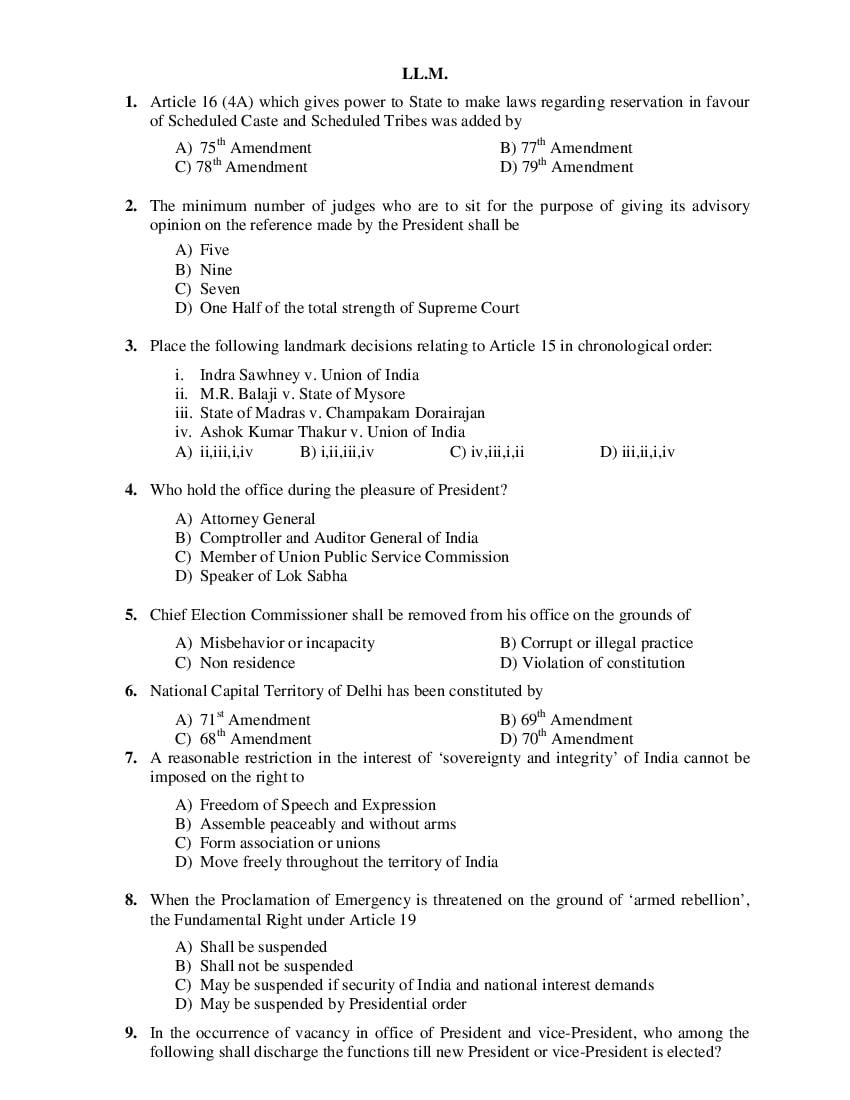
1. Article 16 (4A) which gives power to State to make laws regarding reservation in favour
of Scheduled Caste and Scheduled Tribes was added by
A) 75th Amendment B) 77th Amendment
C) 78th Amendment D) 79th Amendment
2. The minimum number of judges who are to sit for the purpose of giving its advisory
opinion on the reference made by the President shall be
A) Five
B) Nine
C) Seven
D) One Half of the total strength of Supreme Court
3. Place the following landmark decisions relating to Article 15 in chronological order:
i. Indra Sawhney v. Union of India
ii. M.R. Balaji v. State of Mysore
iii. State of Madras v. Champakam Dorairajan
iv. Ashok Kumar Thakur v. Union of India
A) ii,iii,i,iv B) i,ii,iii,iv C) iv,iii,i,ii D) iii,ii,i,iv
4. Who hold the office during the pleasure of President?
A) Attorney General
B) Comptroller and Auditor General of India
C) Member of Union Public Service Commission
D) Speaker of Lok Sabha
5. Chief Election Commissioner shall be removed from his office on the grounds of
A) Misbehavior or incapacity B) Corrupt or illegal practice
C) Non residence D) Violation of constitution
6. National Capital Territory of Delhi has been constituted by
A) 71st Amendment B) 69th Amendment
th
C) 68 Amendment D) 70th Amendment
7. A reasonable restriction in the interest of ‘sovereignty and integrity’ of India cannot be
imposed on the right to
A) Freedom of Speech and Expression
B) Assemble peaceably and without arms
C) Form association or unions
D) Move freely throughout the territory of India
8. When the Proclamation of Emergency is threatened on the ground of ‘armed rebellion’,
the Fundamental Right under Article 19
A) Shall be suspended
B) Shall not be suspended
C) May be suspended if security of India and national interest demands
D) May be suspended by Presidential order
9. In the occurrence of vacancy in office of President and vice-President, who among the
following shall discharge the functions till new President or vice-President is elected?
Page 2
B) Chairman of UPSC
C) Speaker of Lok Sabha
D) Chief Justice of India
10. Match the following
i. ADM Jabalpur v. Shukla (a) Searchlight Case
ii. R.K. Garg v. Union of India (b) Habeas Corpus Case
iii. M.S.M Sharma v. S.K. Sinha (c) Bank Nationalisation Case
iv. R.C. Cooper v. Union of India (d) Bearer Bonds Case
A) i-b, ii-a, iii-d, iv-c B) i-c, ii-a, iii-d, iv-b
C) i-b, ii-d, iii-a, iv-c D) i-c, ii-d, iii-a, iv-b
11. The words “Nothing in Article 13 shall apply to any amendment of this Constitution
made under Article 368” was inserted by
A) 42nd Amendment B) 44th Amendment
C) 24th Amendment D) 22nd Amendment
12. The Constitution (One Hundredth Amendment) Act 2015 was enacted to give effect for:
A) The transfer of certain territories by India to Bangladesh and transfer of certain
territories from Bangladesh to India.
B) The acquiring of territories by India from Bangladesh.
C) National Judicial Appointments Commission.
D) Transfer of certain territories by India to Bangladesh.
13. The Judge of High Court may be transferred from one High Court to another by
A) President
B) Judge of Supreme Court
C) President in consultation with Chief Justice of India
D) President in consultation with Chief Justice of respective High Courts
14. ‘Anti Defection Law’ was added by
A) 51st Amendment B) 52nd Amendment
C) 53rd Amendment D) 54th Amendment
15. Which of the following judgment is responsible for Parliament to pass 24th Amendment
Act 1971?
A) Sajjan Singh v. State of Rajasthan B) Golak Nath v. State of Punjab
C) Kesavananda Bharti v. State of Kerala D) Ramesh Thapar v. State of Madras
16. Seats in Gram Panchayat are filled by
A) Indirect election B) Direct election
C) State Legislature D) Parliament
17. Match the following
i. Provision regarding trade, commerce and intercourse (a) Germany
ii. Method of election of President (b) Ireland
iii. Removal of Supreme Court and High Court Judge (c) Australia
Page 3
A) i-c, ii-b, iii-d, iv-a B) i-c, ii-d, iii-b, iv-a
C) i-b, ii-d, iii-a, iv-c D) i-d, ii-b, iii-c, iv-a
18. Member of Joint Public Service Commission shall hold office for a term of
A) 6 years
B) 6 years or 65 years of his age, whichever is earlier
C) 6 years or 62 years of his age, whichever is earlier
D) During the pleasure of President
19. “Directive Principles of State Policy is the conscience of the Constitution which embody
the social philosophy of the Constitution” was said by
A) Granville Austin
B) K.C. Wheare
C) A.V. Dicey
D) B.R. Ambedkar
20. The Comptroller and Auditor General of India is ____________ either under
Government of India or Government of State after he ceased to hold office.
A) Eligible for further office
B) Ineligible for further office
C) Eligible for further office only after the recommendation made by the President
D) None of the above
21. Quorum to constitute the meeting of House of State Legislature shall be
A) 1/10th of total number of members
B) 10 members
C) 10 members or 1/10th of total number of members, whichever is greater
D) 10 members or 1/10th of total number of members, whichever is smaller
22. Which of the following writ is an exception to the Rule of Res Judicata?
A) Habeas Corpus B) Certiorari
C) Mandamus D) Quo Warranto
23. Find the correct statement
A) Member of Public Service Commission can be removed by order of President on
reference being made to it by Supreme Court
B) Member of Public Service Commission can be removed by order of President on
reference being made to it by Chief Justice of India
C) Member of Public Service Commission can be removed by order of Supreme
Court on reference being made to it by President
D) Member of Public Service Commission can be removed by order of Chief Justice
of India on reference being made to it by President
24. The word ‘internal disturbance’ was substituted by ‘armed rebellion’ under Article 352 by
A) 42nd Amendment B) 44th Amendment
C) 38th Amendment D) 64th Amendment
25. Match the following provisions with respect Legislative Relation between Centre and State
Page 4
operation
ii. Power of Parliament to legislate in national interest b. Article 251
iii. Inconsistency between laws made under Article 249 and 250 c. Article 250
iv. Inconsistency between laws made Parliament and State Legislature d. Article 249
on Concurrent List
A) i-d, ii-c, iii-b, iv-a B) i-a, ii-b, iii-c, iv-d
C) i-c, ii-d, iii-b, iv-a D) i-d, ii-c, iii-a, iv-b
26. The Air (Prevention and Control of Pollution) Act 1981 and The Environment
(Protection) Act 1986 was passed by Parliament under:
A) Article 252 of Constitution of India B) Article 253 of Constitution of India
C) Article 250 of Constitution of India D) Article 251 of Constitution of India
27. Which of the following Judge is famously known as “Green Judge”?
A) Justice B.N. Kirpal B) Justice P.N. Bhagwati
C) Justice V.R. Krishna Iyer D) Justice Kuldip Singh
28. When did National Green Tribunal Act came into force?
A) 18 October 2010 B) 26 September 2010
C) 3 June 2010 D) 12 August 2010
29. Polluter Pays Principle has been incorporated in
A) Principle 16 of Rio Declaration B) Principle 3 of Rio Declaration
C) Principle 15 of Stockholm Declaration D) Principle 27 of Earth Summit
30. In which case, it was held that there is no reason to compel non smoker to be helpless
victim of air pollution?
A) M.C. Mehta v. Union of India B) K.M. Chinappa v. Union of India
C) Murli Deora v. Union of India D) Sheela Barse v. Union of India
31. In which case, Supreme Court held that the State as trustee of all natural resources is
under legal duty to protect natural resources thereby applying the ‘Public Trust
Doctrine’?
A) M.C. Mehta v. Kamal Nath & others
B) M.C. Mehta v. Union of India (Ganga water pollution case)
C) M.C. Mehta v. Union of India (Replacing diesel vehicles by CNG vehicles)
D) Rural Litigation & Entitlement Kendra v. State of U.P.
32. Match the following as per Environment (Protection) Act, 1986
a) Environmental pollutant i) Section 22
b) Environment pollution ii) Section 2(b)
c) Cognizance of offence iii) Section 19
Page 5
A) a-ii, b-iv, c-i, d-iii B) a-iv, b-ii, c-iii, d-i
C) a-iv, b-ii, c-i, d-iii D) a-ii, b-iv, c-iii, d-i
33. When is Human Rights Day observed every year
A) 10th October B) 11th October
C) 10th December D) 11th December
34. Who is the present Chairperson of National Human Rights Commission?
A) Justice K.G. Balakrishnan B) Justice T.S. Thakur
C) Justice A.S. Anand D) Justice H.L. Dattu
35. Find the correct statement with respect to definition of ‘Human Rights’ as per Section
2(1) (d) of the Protection of Human Rights Act, 1993.
A) Human Rights means the right relating to life, liberty, equality, dignity, fraternity
and opportunity of the individual guaranteed by the Constitution or embodied in
the International Covenants and enforceable by courts in India
B) Human Rights means the right relating to life, liberty, equality and dignity of the
individual guaranteed by the Constitution or embodied in the International
Covenants and enforceable by courts in India
C) Human Rights mean the right relating to life, liberty, equality and dignity of the
individual guaranteed by the Constitution
D) Human Rights means the right relating to life, liberty, equality, dignity, fraternity
and opportunity of the individual embodied in the International Covenants and
enforceable by courts in India
36. Match the following provisions of Constitution of India with Universal Declaration of
Human Rights
i. Freedom of peaceful assembly and a) Article 17 of Universal Declaration of
association under Article 19 of Human Rights
Constitution
ii. Freedom of Religion under Article 25 of b) Article 26 of Universal Declaration of
Constitution Human Rights
iii. Right to Education under Article 21A of c) Article 18 of Universal Declaration of
Constitution Human Rights
iv. Right to Property under Article 300A of d) Article 20 of Universal Declaration of
Constitution Human Rights
A) i-d, ii-c, iii-b, iv-a B) i-c, ii-b, iii-a, iv-d
C) i-b, ii-a, iii-d, iv-c D) i-a, ii-b, iii-c, iv-d
37. Which of the following is not covered under the “Third Generation Human Rights”?
A) Right to intergenerational equity and sustainability
B) Civil, political, economic, social and cultural rights
Page 6
D) Right to healthy environment
38. Which one of the following principles was laid down in A.K. Kraipak v. Union of India
A) Post decisional hearing would be enough for observing the principles of natural
justice.
B) Rule of law is embedded under Article 14 of Constitution of India
C) All tribunals may review their decisions.
D) Principles of Natural Justice are applicable to administrative proceedings
39. “Administrative law is the law concerning the powers and procedures of administrative
agencies, including especially the law governing judicial review of administrative
actions”. This definition was given by:
A) K.C. Davis B) Ivor Jennings C) A.V. Dicey D) Garner
40. Against whom writ of Mandamus cannot be issued?
A) Tribunals B) Governor C) Courts D) Both A and B
41. If principles of natural justice are violated while deciding an administrative action, its
effect will be ______.
A) Voidable B) Null and void
C) Illegality D) Mere irregularity
42. Find the correct statement:
A) Administrative law is a part of private law
B) Administrative law is a part of public law
C) Administrative law controls Constitutional law
D) None of the above
43. Which is incorrect statement with respect to Lokpal and Lokayukta Act 2013?
A) It extends to whole of India except Jammu and Kashmir
B) It shall apply to public servants in and outside India
C) It shall have all the powers of Civil Court under Code of Civil Procedure, 1908
D) Whosoever makes false and vexatious complaint shall be punished for a term
which may extend to 1 year and with fine which may extend to Rs.1 lakh
44. Rule of Law as proposed by Dicey is _______
A) Principle of Administrative law
B) Consists of 3 main principles i.e. supremacy of law, equality before law and
constitution is result of ordinary law of land
C) Derived from phrase “la principe de legality”
D) All of the above
45. Communication of acceptance is complete as against the proposer
A) When acceptance is communicated to the proposer
B) When it comes to the knowledge of proposer
C) When the communication is made by the acceptor that he has accepted
D) When it is put in the course of transmission to proposer so as to be out of power
of acceptor
Page 7
when the contract is formed by
A) Coercion B) Undue influence
C) Fraud D) Misrepresentation
47. In Contract for sale of immovable property the presumption is “the time is
A) The essence of the contract
B) Not the essence of the contract
C) The essence of the contract but failure does not make the contract voidable
D) Not the essence of the contract but makes the contract voidable at the instance of
the other party
48. A gratuitous bailment is terminated
A) On the death of bailee
B) On the death of bailor
C) On the insanity of bailee or bailor
D) Either A or B
49. Which of the following statement is correct with respect to Bailment and Pledge
A) In bailment and pledge, the bailor and pawnor has the right to sell the goods
B) Bailment is defined under Section 149 of Contract Act whereas Pledge is defined
under Section 170 of Contract Act
C) In bailment and pledge, there is change of possession
D) The party who delivers the goods is known as bailee/pawnee and to whom the
goods are delivered is known as bailor/pawnor
50. Which of the following is not the duty of ‘Works Committee’ under Section 3 of the
Industrial Dispute Act?
A) To promote measures for securing and preserving amity and good relations between
employer and workman.
B) To form groups among workman and strengthen relations between employer and
workman.
C) To comment upon matters of their common interest on concern.
D) To endeavour to resolve any material difference of opinion.
51. Assertion: Strike is recognized as a weapon in the hands of workman to settle their
differences with management.
Reason: Illegal strike is prima facie unjustified and hence irrelevant.
A) Both A and R are true B) Both A and R are false
C) A is true and R is false D) A is false and R is true
52. Find the incorrect statement:
A) Doctrine of Ultra Vires protects the outsider for the acts of the company not
mentioned in the object clause
B) Doctrine of Constructive Notice implies that person’s dealing with company have
knowledge about Articles of Association and Memorandum of Association of
company
C) Doctrine of Indoor Management is an exception to Doctrine of Constructive
Notice
Page 8
of corporation in order to determine the real person behind the mask of company
53. Section 135 of the Companies Act 2013 provides for Corporate Social Responsibility:
A) Company with net worth of Rs. 5 crores or more.
B) Company with net profit of Rs. 500 crores or more
C) Company with turnover of Rs. 1000 crores or more
D) All of the above
54. “Tort means a civil wrong for which remedy is a common law action for unliquidated
damages and which is not exclusively the breach of contract or the breach of trust or
other merely equitable obligation”. This definition is given by
A) Salmond B) Winfield
C) Fraser D) Section 2(m) of Limitation Act 1963
55. Gloucester Grammar School case explain:
A) Injuria sine demno B) Damno sine injuria
C) Respondents superior D) Remoteness of damages
56. Which one the following is not an exception to the Rule of Strict Liability?
A) Statutory Authority B) Consent of Plaintiff
C) Act of 3rd party D) Necessity
57. Find the incorrect statement
A) Libel is in visible form whereas slander is in transient form
B) Libel is not actionable perse whereas slander is actionable in itself
C) Libel and slander is not merely a tort but also a criminal offence
D) Justification of truth can be pleaded as a defence in case of libel as well as slander
58. Which one of the following is not an essential ingredient of “Malicious Prosecution”?
A) Prosecution in criminal court
B) Commencement of prosecution without reasonable cause
C) Conclusion of proceedings against plaintiff
D) Conclusion of proceedings in favour of plaintiff
59. Which one of the following sources of International Law is not mentioned under Article
38 of the Statute of International Court of Justice?
A) International Customs
B) General Principles of law recognized by civilized state
C) Decisions of judicial/arbitral tribunals
D) Decisions of organs of international institutions
60. The Secretary General of United Nations is appointed by ___________
A) General Assembly
B) Security Council
C) General Assembly on the recommendation of Security Council
D) Secretariat
61. Which one of the following is correctly matched?
A) Chorzaw Factory Case – Res Judiciata
B) Paquete Habana Case – Justice, Equity and Good Conscience
Page 9
D) Barcelona Traction Case – International Customs
62. The principle of Rebus sic stantibus means:
A) A state cannot use force B) There is not a crime without law
C) Fundamental change of circumstances D) A treaty must be adhered to faithfully
63. Who is the father of International Law?
A) Hugo Grotious B) Oppenheim
C) Schwarzenberger D) Holland
64. Previous Conviction of a person is relevant under _______
A) Explanation I of Section 14 of Indian Evidence Act 1872
B) Explanation II of Section 14 of Indian Evidence Act 1872
C) Explanation I of Section 8 of Indian Evidence Act 1872
D) Explanation II of Section 8 of Indian Evidence Act 1872
65. Cross Examination of Witness _________
A) Must relate to relevant facts but need not to be confined to the facts which witness
testified in chief examination.
B) Must relate to relevant facts and needs to be confined to the facts which witness
testified in chief examination
C) Must not relate to relevant facts and need not to be confined to the facts which
witness testified in chief examination
D) Must not relate to relevant facts but needs to be confined to the facts which
witness testified in chief examination
66. Match the following:
i. Oral Evidence a. Electronic Record
ii. Documentary Evidence b. Must be direct
iii. Primary Evidence c. Photocopy of document
iv. Secondary Evidence d. evidence of the person who had seen/heard
A) i-c, ii-d, iii-a, iv-b B) i-d, ii-c, iii-b, iv-a
C) i-a, ii-b, iii-c, iv-d D) i-b, ii-a, iii-d, iv-c
67. Match the following case laws with the provisions of Hindu Marriage Act, 1955
i. Section 9 a. Seema v. Ashwani Kumar
ii. Section 13(1)(ia) b. Saroj Rani v. Sudershan Kuamr
iii. Section 8 c. Sureshta Devi v. Om Prakash
iv. Section 13B d. Dastane v. Dastane
Page 10
C) i-b, ii-d, iii-a, iv-c D) i-a, ii-d, iii-b, iv-c
68. A, a Hindu has two wives, W1 and W2 and one Son, S by wife W1 and four Sons, S1,
S2, S3 and S4 by wife W2. On a partition of coparcenary property W1 and W2 will get:
A) No share, as neither of them is a 6 parcenary
B) 1/4th share each
C) 1/5th share each
D) 1/8th share each
69. Marriage of Suni male with Jewish female is ____________
A) Void B) Voidable C) Valid D) Irregular
70. Conversion of a non Muslim wife to Islam:
A) Shall not ipso facto dissolve his marriage
B) Shall dissolve his marriage with the permission of the Qazi
C) Shall dissolve his marriage if the conversion to Islam is with the permission of the
Court
D) Shall not dissolve his marriage
71. In case of ‘muta marriages’, if the marriage is not consummated then the wife is to
undergo ‘iddat’ for _________ months.
A) 4 B) 3 C) 2 D) None of these
72. Dissolution of Muslim marriage Act, 1939 is based on the principle of which Muslim
School:
A) Hanifi School B) Shafi School C) Maliki School D) Zaidi School
73. Under Section 438 of Criminal Procedure Code, bail can be granted for ____________
offences by __________ Court.
A) Bailable or non bailable offences ; Sessions Court
B) Non bailable offences ; High Court or Sessions Court
C) Bailable offences ; High Court or Sessions Court
D) Bailable or non bailable ; High Court
74. In prosecution for offences against marriage under Section 198 of Cr.P.C, the court shall
take the cognizance of an offence ________.
A) Suo moto
B) Upon police report
C) Upon complaint made by aggrieved person
D) Any of the above
75. Find the incorrect statement:
A) The sentence of death passed by Session Court shall not be executed unless
confirmed by the High Court
B) The High Court has the power to either confirm the sentence or annul the
conviction or acquit the accused
C) The court passing the sentence shall commit the convicted person to jail custody
under warrant
Page 11
such court consists of two or more judges, confirmation is to be signed by at least
one of such judges
76. According to Bentham, censorial jurisdiction means _________
A) What the law is? B) What the statutes be?
C) What the law ought to be? D) What the law propounds?
77. Who of the following termed jurisprudence as observation of things and divine, the
knowledge of just and unjust?
A) Russians B) Romans C) Britishers D) Ulpian
78. Which one of the following writer says that Hindu Law has the oldest pedigree of any
known system of jurisprudence?
A) Austin B) Mayne C) G.C. Lee D) A.P.S. Ayyar
79. Salmond is opposed to the concept of ‘general jurisprudence’ of Austin because for him,
jurisprudence is a
A) Law of civil society B) Science of civil law
C) Science of law D) Law of civil behavior
80. Jeremy Bentham dismissed law of nature as ‘nothing but a phrase’ and Blackstonian
natural rights as non sense ‘non sense upon stilts’ and eulogized the doctrine of
A) Pain B) Pleasure C) Utility D) Abundance
81. The four elements of positive law as enshrined by Austin are ____________
A) Command, sanction, law and sovereign
B) Command, sanction, duty and ethics
C) Command, sanction, duty and sovereignty
D) Command, duty, ethics and morality
82. Holmes considers law to protect and promote the collective group interests vis-à-vis
A) Interest of the society B) Interest of the community
C) Individual interest D) Interest of the state
83. Cicero was a ________ jurist:
A) Greek B) Roman C) Chinese D) English
84. The main supporters of Expiatory Theory are
A) Plato and Locke B) Bodin and Hegel
C) Hegel and Kohler D) Starke and Hobbes
85. A proprietary right may be of both sort right in rem as well as right in personam, if they
are of
A) Uneconomic value B) Social value
C) Economic value D) Legal value
Page 12
crocodiles, with the belief that by doing so the child will be free from evil spirits. Which
offence Seema has commited?
A) Murder
B) Culpable Homicide not amounting to Murder
C) Attempt to Murder
D) Attempt to Culpable Homicide
87. If the offence is punishable with fine only, then in default of payment of fine, the Court
shall impose __________ imprisonment.
A) Simple B) Rigorous
C) Simple or rigorous D) Partly simple or partly rigorous
88. The doctrine of ‘volenti non fit injuria’ is not covered under _______ of Indian Penal
Code.
A) Section 88 B) Section 89 C) Section 90 D) Section 91
89. Punishment for a being member of unlawful assembly is _________
A) 2 years or fine or both B) 1 year or fine or both
C) 6 months or fine or both D) 2 months or fine or both
90. Match the following:-
i. Wrongful loss or gain a. Section 22
ii. Dishonestly b. Section 23
iii. Fraudulently c. Section 24
iv. Movable property d. Section 25
A) i-b, ii-c, iii-d, iv-a B) i-c, ii-d, iii-a, iv-b
C) i-d, ii-a, iii-b, iv-c D) i-a, ii-b, iii-c, iv-d
91. ‘A’ removes floppy containing important information from ‘B’s pocket and takes it in
his possession. ‘B’ objects to it. ‘A’ pulls out a knife from his pocket and says that I will
kill you if you move a step further. Which offence ‘A’ has commited?
A) Extortion
B) Robbery based on Theft
C) Robbery based on Extortion
D) Voluntarily causing hurt in committing Robbery
92. Which of the following property will not be covered under Stolen Property?
A) Property transferred by theft/extortion
B) Property transferred by criminal misappropriation/criminal breach of trust
C) Property transferred by cheating/mischief
D) All of the above
93. Minimum punishment prescribed under Indian Penal Code 1860 is _____________
A) 1 month or fine or both B) 24 hours or Rs.500 or both
Page 13
94. Find the correct statement:
A) Under Section 107(2) and 120B, agreement between 2 or more persons is enough to
make them liable for conspiracy
B) Under Section 107(2) and 120B, agreement between 2 or more persons is not
enough but some act or illegal omission is necessary
C) Under Section 107(2), mere agreement between 2 or more persons is enough to
make persons liable for conspiracy; whereas under Section 120B some act or
illegal omission must take place along with agreement
D) Under Section 107(2), mere agreement between 2 or more persons is not enough
to make persons liable for conspiracy but some act or illegal omission must take
place along with agreement; whereas under Section 120B mere agreement is
enough to make the persons liable
95. In which recruitment, in a system for higher position is open to all the qualified
candidates who may wish to apply is known as?
A) Direct Recruitment B) Recruitment by promotion
C) Ordinary Recruitment D) Passive Recruitment
96. Position classification’ is the classification of ________
A) Salaries B) Duties
C) Departments D) Personal status of incumbents
97. Promotion in Civil Services indicates _____
A) Changes in the situation which indicates difficult work and more important
responsibility
B) Change in the place of work
C) Transfer of work from field to headquarters
D) Always an increase in pay
98. The Union Public Service Commission of India has been established under ________
A) Article 315 of Indian Constitution B) Article 320 of Indian Constitution
C) Article 325 of Indian Constitution D) Article 335 of Indian Constitution
99. Reservation for Scheduled Caste and Scheduled Tribe in the Services has been provided
in Indian Constitution under:
A) Article 315 B) Article 335
C) Article 365 D) Article 375
100. Non-promotion of a Government servant whether in a substantive or officiating
capacity, after consideration of his case, to a post for promotion to which he is eligible,
is-
A) Minor penalty B) Major penalty
C) Reprimand D) Not a penalty
x-x-x
Document Details
| Board / Org | Panjab University |
| Exam | PU CET PG |
| Type | Question Paper |
| Pages | 13 |
| Updated | 22 Jul 2026 |