PU CET PG 2017 Question Paper Master in Public Health
Finished viewing? Save it for later —
Download PU CET PG 2017 Question Paper Master in Public Health (PDF · 7 pages)About PU CET PG 2017 Question Paper Master in Public Health
PU CET PG 2017 Question Paper Master in Public Health is available here for free download. Published by Punjab University for PU CET PG, this question paper can be viewed online or downloaded as a PDF (7 pages). Candidates preparing for PU CET PG can use PU CET PG 2017 Question Paper Master in Public Health to understand the exam pattern, the type of questions asked, and the overall difficulty level.
Frequently Asked Questions
How can I download PU CET PG 2017 Question Paper Master in Public Health?
Open this page and click the Download button to save PU CET PG 2017 Question Paper Master in Public Health as a PDF. It is completely free on AglaSem Docs.
Is PU CET PG 2017 Question Paper Master in Public Health free to download?
Yes. PU CET PG 2017 Question Paper Master in Public Health can be viewed online and downloaded as a PDF free of cost on AglaSem Docs.
How many pages does PU CET PG 2017 Question Paper Master in Public Health have?
PU CET PG 2017 Question Paper Master in Public Health contains 7 pages, which you can read online or download together as a single PDF.
Where can I find more PU CET PG study material?
You can find more PU CET PG question papers, sample papers, syllabus, and answer keys on AglaSem Docs.
PU CET PG 2017 Question Paper Master in Public Health – Text
Read the full text of this question paper below — useful to quickly search, copy and reference the content online without downloading the PDF.
📄 View text version (7 pages)
Page 1
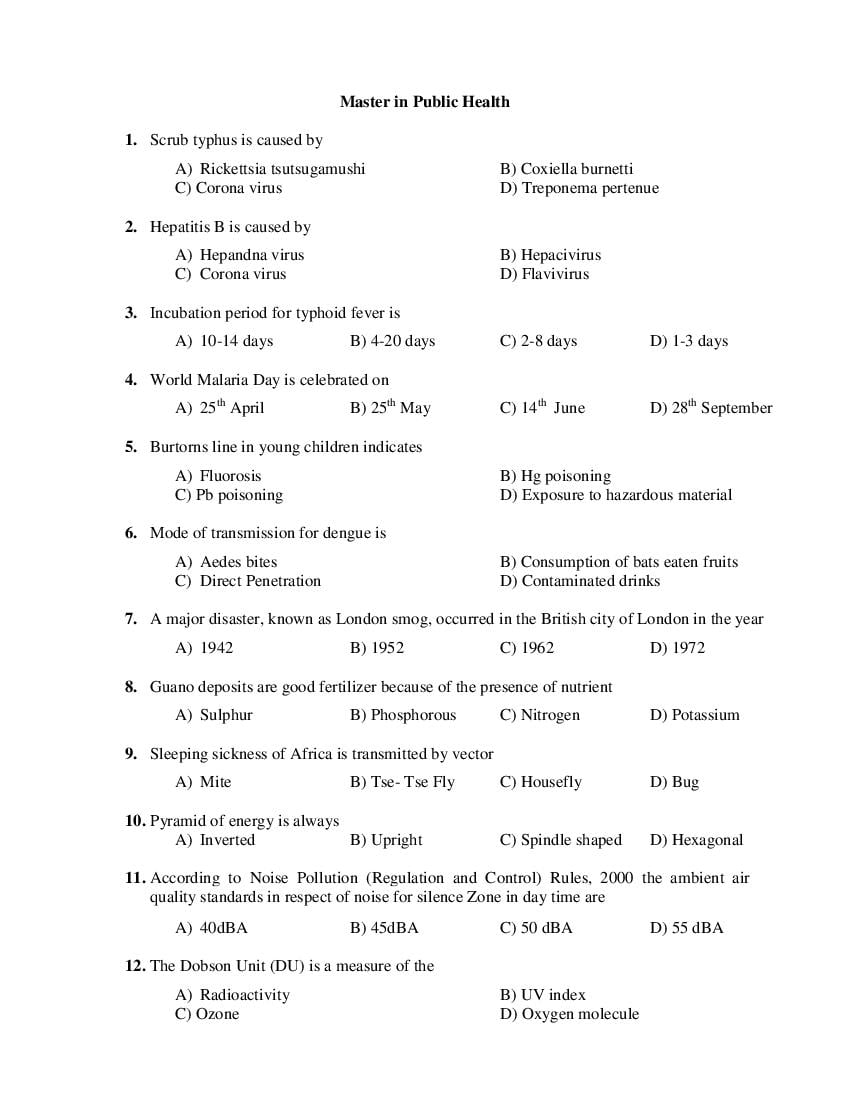
1. Scrub typhus is caused by
A) Rickettsia tsutsugamushi B) Coxiella burnetti
C) Corona virus D) Treponema pertenue
2. Hepatitis B is caused by
A) Hepandna virus B) Hepacivirus
C) Corona virus D) Flavivirus
3. Incubation period for typhoid fever is
A) 10-14 days B) 4-20 days C) 2-8 days D) 1-3 days
4. World Malaria Day is celebrated on
A) 25th April B) 25th May C) 14th June D) 28th September
5. Burtorns line in young children indicates
A) Fluorosis B) Hg poisoning
C) Pb poisoning D) Exposure to hazardous material
6. Mode of transmission for dengue is
A) Aedes bites B) Consumption of bats eaten fruits
C) Direct Penetration D) Contaminated drinks
7. A major disaster, known as London smog, occurred in the British city of London in the year
A) 1942 B) 1952 C) 1962 D) 1972
8. Guano deposits are good fertilizer because of the presence of nutrient
A) Sulphur B) Phosphorous C) Nitrogen D) Potassium
9. Sleeping sickness of Africa is transmitted by vector
A) Mite B) Tse- Tse Fly C) Housefly D) Bug
10. Pyramid of energy is always
A) Inverted B) Upright C) Spindle shaped D) Hexagonal
11. According to Noise Pollution (Regulation and Control) Rules, 2000 the ambient air
quality standards in respect of noise for silence Zone in day time are
A) 40dBA B) 45dBA C) 50 dBA D) 55 dBA
12. The Dobson Unit (DU) is a measure of the
A) Radioactivity B) UV index
C) Ozone D) Oxygen molecule
Page 2
A) Hippocrates B) Ram Nath Chopra C) John Snow D) Ian Donald
14. Who among the following introduced the concept of relationship of environment and
human health?
A) Avicenna B) Charaka C) Hippocrates D) Paracelsus
15. Which of the following dimensions is not included in WHO definition of health?
A) Physical well being B) Occupational well being
C) Mental well being D) Social well being
16. Who among following is known as Father of Modern toxicology
A) Hippocrates B) Ram Nath Chopra C) Matheiu Orfila D) Ian Donald
17. A good indicator of availability, utilization and effectiveness of health care services in a
country is
A) Maternal mortality rate
B) Hospital bed occupancy rate
C) Infant mortality rate
D) Disability adjusted life years (DALYs)
18. Standard of living (WHO) includes all except:
A) Income B) Sanitation and nutrition
C) Level of provision of health D) Human rights
19. Prevention of contact with microorganism is known as:
A) Asepsis B) Disinfection C) Sterilisation D) Sanitiser
20. Agent that reduces the number of bacterial contaminants to safe levels as per public
health requirement is known as:
A) Germicide B) Disinfection C) Sterilization D) Sanitiser
21. Primary prevention of dental caries includes?
A) Fluoridation B) Dental health education
C) Mass screening D) Dental fitting, teeth extraction
22. Malaria is transmitted by
A) Anopheles stephensi B) Plasmodium ovale
C) Culex D) Phlebotamus
23. National Institute of occupational health is located in
A) Chennai B) Ahmedabad C) Pune D) New Delhi
24. Arthropods are the vector for all except:
A) Scrub typhus B) Epidemic typhus
C) Q-fever D) Rocky mountain sported fever.
Page 3
A) 1st May B) 1st December C) 31st Octobers D) 29th May
26. A patient is called obese if BMI is:
A) 20-30 B) >25 C) >30 D) >40
27. Salivary amylase secreted into the oral cavity starts the digestion of
A) Proteins B) Starch C) Lipids D) Amino acids
28. Which of the following magazine honored for covering issues pertaining to science,
environment and development with the first Indian Sanitation Coalition-FICCI award for best
coverage on sanitation.
A) Down to Earth B) Current Science
C) Natural Life D) None of these
29. Which anti-diabetic drug from plant source, non-toxic, safe and prevent rise in
blood glucose level to normal?
A) Biguanides B) Meglitinides
C) Chalcone D) Sulfonylureas
30. International biological diversity day celebrated on:
A) 22 February B) 22 March C) 22 April D) 22 May
31. Seasonal variation of a disease can be assessed by
A) Comparing the prevalence of disease B) Comparing the incidence of disease
C) Calculating the survival rates D) Calculating the Mortality rates
32. A disease is called endemic when
A) Occurs in more than one geographical area
B) Occurs in more than one season
C) Is constantly present at low rates in a specified geographical area
D) Occurs in a frequency more than expected in a specified geographical area
33. Incidence of diarrhoea in a community can be calculated by
A) Case control study B) Cross sectional study
C) Double blind study D) Cohort study
34. Which is the best measure of estimating impact of health interventions in general
population?
A) Relative risk B) Attributable risk
C) Population attributable risk D) All of these
35. A clinical manifest disease of man or animal resulting from infection is called?
A) Infectious disease B) Contagious disease
C) Iatrogenic disease D) Nosocomial disease
36. ASHA is posted at the:
Page 4
C) Qualitative enquiry D) Primary health care
37. Primary health care involves all except:
A) Sanitation & water supply B) Sound referral centre
C) Supply of essential drugs D) Health education
38. Epidemiological significance of a ‘carriers’ is higher than ‘cases’ because
A) They infect more people B) They increase virulence of the agent
C) They are more infectious than cases D) They cannot be treated
39. The process which destroys all the microbial life including spores is known as
A) Disinfection B) Antisepsis C) Deodorization D) Sterilization
40. World Yoga day is celebrated on
A) 14 November B) 21 June C) 2 October D) 15 October
41. Swachh Bharat Mission or Clean India Mission a national campaign by the Government
of India, was officially launched on
A) 2 October 2014 B) 15 August 2015
C) 26 January 2015 D) 15 August 2014
42. Both B and T cells of immune system are produced in
A) Spleen B) Lymphoid nodes C) Bone marrow D) Thymus
43. Goiter is a cause of
A) Addisons disease B) Myasthenia gravis
C) Hashimoto-thyroiditis D) Good pastures synfrome
44. Trypanosoma gambiense produces in man
A) Kala-azar B) Sleeping sickness C) Oriental sore D) Malaria
45. First Census of India was held in year:
A) 1911 B) 1872 C) 1881 D) 1891
46. In India death has to be registered with in:
A) 3 days B) 7 days C) 14 days D) 21 days
47. The function of hemoglobin is?
A) To transport oxygen B) Destruction of bacteria
C) Prevention of anemia D) Utilization of energy
48. Who discovered the Polio vaccine?
A) Louis Pasteur B) Jonas Salk C) Konrad Zuse D) Eli Whitney
49. Insects responsible for transmitting diseases are called?
Page 5
50. The vitamin which is generally excreted by human in urine is ?
A) Vitamin – A B) Vitamin – D C) Vitamin – C D) Vitamin - E
51. The fruit after ripping becomes soft. It is due to?
A) Dissolution of tannin in sap B) Dissolution of middle lamella
C) Formation of ethylene gas D) Formation of auxin
52. Pollination is best defined as
A) Transfer of pollen from anther to stigma B) Germination of pollen grains
C) Growth of pollen tube in ovule D) Visiting flowers by insects
53. Vaccine can be stored at subcentre for:
A) 1 day B) 7 days C) 15 days D) 30 days
54. Stone leprosy is caused by
A) Ozone depletion B) Lead pollution
C) Acid rain D) London smog
55. Ozone hole is due to mainly two green house gas which are
A) CO2, CH4 B) N2O and CFCs C) N2O and CO D) CFC and CO2
56. For a region to be hotspot the minimum number of endemic species should be
A) 1500 B) 500 C) 1200 D) 2200
57. Which component of tobacco is carcinogenic
A) Nicotine B) Tar C) CO D) PAH
58. The indoor pollutant from the furniture is
A) Ozone B) Formaldehyde
C) Radon D) Carbon-dioxide
59. The main effect of DDT on birds is
A) Fewer feathers B) Reduced growth
C) Blindness D) Thinner eggshell
60. Which is the best index for burden of disease?
A) Case fatality rate B) Disability adjusted life years
C) Dependency ratio D) Morbidity data
61. Disease elimination means:
A) Cure of the disease
B) Preventing the transmission totally
C) Eradication of the vector
D) Complete termination of infective organism
Page 6
A) 100 B) 200 C) 500 D) 1000
63. The purple colour in Air quality index category indicates that condition are:
A) Unhealthy for sensitive group B) Unhealthy for everyone
C) Air quality is acceptable D) Health alert
64. In epidemic, 1st step is:
A) Verification of diagnosis B) Isolation
C) Immunization D) Notification
65. United Nations Conference on the Human Environment was held at
A) Brazil B) Stockhom C) Berlin D) Genewa
66. Health promotion logo represents
A) Circle with 3 wings and incorporates 5 key action in health promotion
B) Circle with 5 wings and incorporates 3 key action in health promotion
C) Circle with 3 wings and incorporates 3 key action in health promotion
D) Circle with 5 wings and incorporates 5 key action in health promotion
67. The basic approach in cohort studies is to work from
A) Cause to effect B) Effect to cause
C) Disease to cure D) Prevention to cure
68. Bhojpatra is obtained from the bark of
A) Dalbergia B) Betula C) Piper D) Cinchona
69. An enzyme requires
A) Optimum pH B) Neutral pH C) Acidic pH D) Alkaline pH
70. Ragi is richest source of
A) Calcium B) Iron
C) Iodine D) Vitamin B Complex
71. Harmful radiation emitted by sun is
A) Visible B) Infra- red C) Ultra violet D) Radio-waves
72. Swachh Yug Campaign initiated by Ministry of Drinking Water and Sanitation
A) Make banks of river Ganga clean
B) Make banks of river Ganga open defecation free
C) Make villages clean
D) Make villages open defecation free
73. Permit that allow the holder to emit one ton of carbon dioxide is known as
Page 7
C) Environment clearance D) Environment credit
74. The volume of air in a normal breath is called
A) Vital capacity B) Total lung capacity
C) Tidal volume D) Residual volume
75. Theme of International biological diversity day 2017 is
A) Biodiversity and Sustainable Tourism
B) Mainstreaming Biodiversity; Sustaining People and their Livelihoods
C) Island Biodiversity
D) Water and Biodiversity
x-x-x
Document Details
| Board / Org | Panjab University |
| Exam | PU CET PG |
| Type | Question Paper |
| Pages | 7 |
| Updated | 22 Jul 2026 |