UGC NET 2021 Question Paper Mass Communication and Journalism Shift 2
Finished viewing? Save it for later —
Download UGC NET 2021 Question Paper Mass Communication and Journalism Shift 2 (PDF · 96 pages)About UGC NET 2021 Question Paper Mass Communication and Journalism Shift 2
UGC NET 2021 Question Paper Mass Communication and Journalism Shift 2 is available here for free download. Published by NTA for UGC NET, this question paper can be viewed online or downloaded as a PDF (96 pages). Candidates preparing for UGC NET can use UGC NET 2021 Question Paper Mass Communication and Journalism Shift 2 to understand the exam pattern, the type of questions asked, and the overall difficulty level.
Frequently Asked Questions
How can I download UGC NET 2021 Question Paper Mass Communication and Journalism Shift 2?
Open this page and click the Download button to save UGC NET 2021 Question Paper Mass Communication and Journalism Shift 2 as a PDF. It is completely free on AglaSem Docs.
Is UGC NET 2021 Question Paper Mass Communication and Journalism Shift 2 free to download?
Yes. UGC NET 2021 Question Paper Mass Communication and Journalism Shift 2 can be viewed online and downloaded as a PDF free of cost on AglaSem Docs.
How many pages does UGC NET 2021 Question Paper Mass Communication and Journalism Shift 2 have?
UGC NET 2021 Question Paper Mass Communication and Journalism Shift 2 contains 96 pages, which you can read online or download together as a single PDF.
Where can I find more UGC NET study material?
You can find more UGC NET question papers, sample papers, syllabus, and answer keys on AglaSem Docs.
UGC NET 2021 Question Paper Mass Communication and Journalism Shift 2 – Text
Read the full text of this question paper below — useful to quickly search, copy and reference the content online without downloading the PDF.
📄 View text version (96 pages)
Page 1
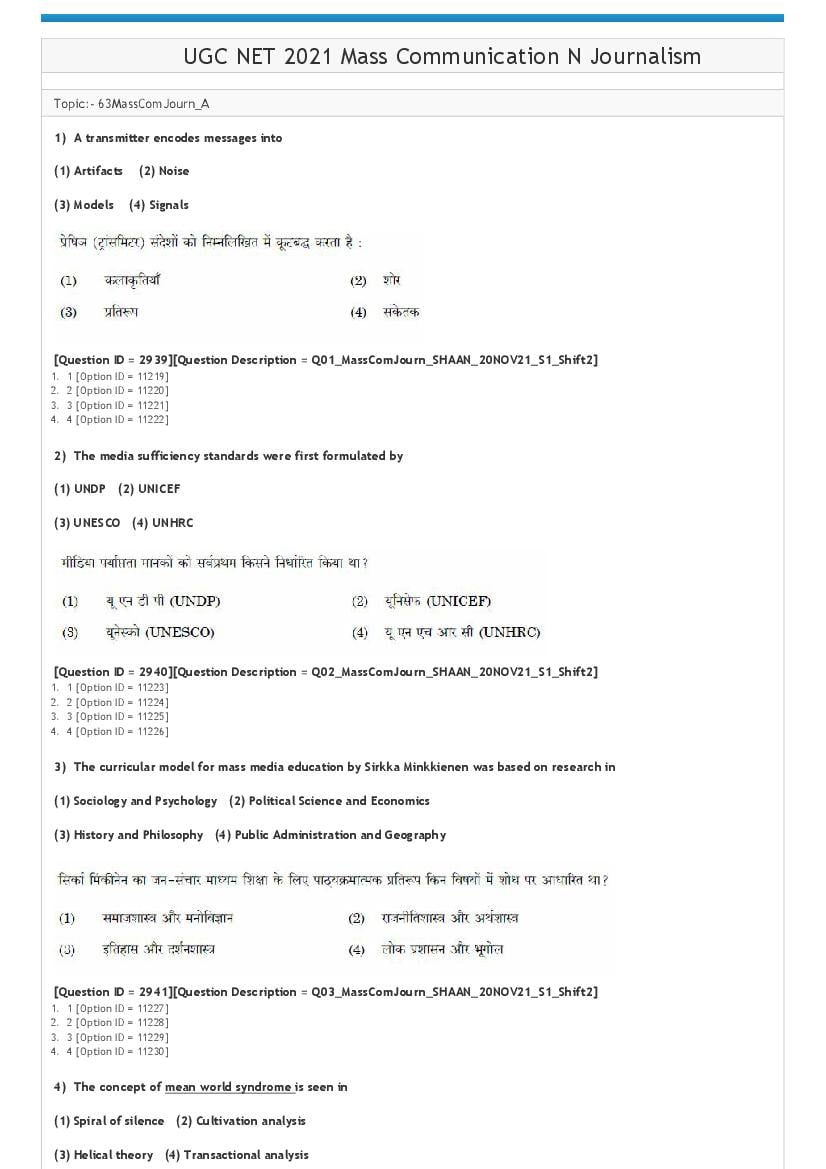
Topic:‐ 63MassComJourn_A
1) A transmitter encodes messages into
(1) Artifacts (2) Noise
(3) Models (4) Signals
[Question ID = 2939][Question Description = Q01_MassComJourn_SHAAN_20NOV21_S1_Shift2]
1. 1 [Option ID = 11219]
2. 2 [Option ID = 11220]
3. 3 [Option ID = 11221]
4. 4 [Option ID = 11222]
2) The media sufficiency standards were first formulated by
(1) UNDP (2) UNICEF
(3) UNESCO (4) UNHRC
[Question ID = 2940][Question Description = Q02_MassComJourn_SHAAN_20NOV21_S1_Shift2]
1. 1 [Option ID = 11223]
2. 2 [Option ID = 11224]
3. 3 [Option ID = 11225]
4. 4 [Option ID = 11226]
3) The curricular model for mass media education by Sirkka Minkkienen was based on research in
(1) Sociology and Psychology (2) Political Science and Economics
(3) History and Philosophy (4) Public Administration and Geography
[Question ID = 2941][Question Description = Q03_MassComJourn_SHAAN_20NOV21_S1_Shift2]
1. 1 [Option ID = 11227]
2. 2 [Option ID = 11228]
3. 3 [Option ID = 11229]
4. 4 [Option ID = 11230]
4) The concept of mean world syndrome is seen in
(1) Spiral of silence (2) Cultivation analysis
(3) Helical theory (4) Transactional analysis
Page 2
1. 1 [Option ID = 11231]
2. 2 [Option ID = 11232]
3. 3 [Option ID = 11233]
4. 4 [Option ID = 11234]
5) Paulo Friere described the top–down modernisation project as
(1) Existentialism (2) Assistentialism
(3) Universalism (4) Institutionalism
[Question ID = 2943][Question Description = Q05_MassComJourn_SHAAN_20NOV21_S1_Shift2]
1. 1 [Option ID = 11235]
2. 2 [Option ID = 11236]
3. 3 [Option ID = 11237]
4. 4 [Option ID = 11238]
6) In developmental communication, ‘being diagnostic’ will lead to
(1) Diversity of identities (2) Suppression of identities
(3) Explosion of identities (4) Fusion of identities
[Question ID = 2944][Question Description = Q06_MassComJourn_SHAAN_20NOV21_S1_Shift2]
1. 1 [Option ID = 11239]
2. 2 [Option ID = 11240]
3. 3 [Option ID = 11241]
4. 4 [Option ID = 11242]
7) When a third variable, remaining unseen causes an association of two variables, it is called :
(1) Absentee variable (2) Extraneous variable
(3) Spurious variable (4) Third order variable
[Question ID = 2945][Question Description = Q07_MassComJourn_SHAAN_20NOV21_S1_Shift2]
1. 1 [Option ID = 11243]
2. 2 [Option ID = 11244]
3. 3 [Option ID = 11245]
4. 4 [Option ID = 11246]
Page 3
(1) Modernisation (2) Ethnic superiority
(3) De–politicisation (4) Dominance of religion
[Question ID = 2946][Question Description = Q08_MassComJourn_SHAAN_20NOV21_S1_Shift2]
1. 1 [Option ID = 11247]
2. 2 [Option ID = 11248]
3. 3 [Option ID = 11249]
4. 4 [Option ID = 11250]
9) General Attributions to the sources like ‘Government official’ in news stories are referred to as:
(1) Off the record (2) Deep background
(3) Background (4) On the record
[Question ID = 2947][Question Description = Q09_MassComJourn_SHAAN_20NOV21_S1_Shift2]
1. 1 [Option ID = 11251]
2. 2 [Option ID = 11252]
3. 3 [Option ID = 11253]
4. 4 [Option ID = 11254]
10) Which among the following methods/models is used to make decisions related to ethical dilemmas in media?
(1) Fog index (2) Flesch method
(3) Freytag Pyramid (4) Potter box
[Question ID = 2948][Question Description = Q10_MassComJourn_SHAAN_20NOV21_S1_Shift2]
1. 1 [Option ID = 11255]
2. 2 [Option ID = 11256]
3. 3 [Option ID = 11257]
4. 4 [Option ID = 11258]
11) Which among the following Journalists is associated with the developmental news portal PARI (People’s Archive of Rural
India)?
(1) Kalpana Sharma (2) Gail Omvedt
(3) Ravish Kumar (4) P. Sainath
Page 4
1. 1 [Option ID = 11259]
2. 2 [Option ID = 11260]
3. 3 [Option ID = 11261]
4. 4 [Option ID = 11262]
12) ___________ is a paragraph that explains the point of the story when the lead is purposely vague.
(1) Circle Kicker (2) Nut graph
(3) Teaser Lead (4) Mystery lead
[Question ID = 2950][Question Description = Q12_MassComJourn_SHAAN_20NOV21_S1_Shift2]
1. 1 [Option ID = 11263]
2. 2 [Option ID = 11264]
3. 3 [Option ID = 11265]
4. 4 [Option ID = 11266]
13) The theory of cognitive dissonance as related to advertising is based on the premise that:
(1) People see what they expect to see (2) People see what they are offered to see
(3) People see what they are made to see (4) People see what they don’t get to see
[Question ID = 2951][Question Description = Q13_MassComJourn_SHAAN_20NOV21_S1_Shift2]
1. 1 [Option ID = 11267]
2. 2 [Option ID = 11268]
3. 3 [Option ID = 11269]
4. 4 [Option ID = 11270]
14) In outdoor advertising the term OTS (Opportunity To See) and OTR (Opportunity To Read) are referred to as:
(1) Wall painting (2) Posters
(3) Hoardings (4) Balloons
[Question ID = 2952][Question Description = Q14_MassComJourn_SHAAN_20NOV21_S1_Shift2]
1. 1 [Option ID = 11271]
2. 2 [Option ID = 11272]
3. 3 [Option ID = 11273]
4. 4 [Option ID = 11274]
15) The single sheet advertisement printed on one side is known as:
(1) Brochures (2) Leaflets
(3) Posters (4) Flyers
Page 5
1. 1 [Option ID = 11275]
2. 2 [Option ID = 11276]
3. 3 [Option ID = 11277]
4. 4 [Option ID = 11278]
16) A sceptical buyer is the one who
(1) makes impulsive purchase (2) has negative image about the seller
(3) carefully weighs the cost, pros and cons of the product being offered (4) is keen to return the product
[Question ID = 2954][Question Description = Q16_MassComJourn_SHAAN_20NOV21_S1_Shift2]
1. 1 [Option ID = 11279]
2. 2 [Option ID = 11280]
3. 3 [Option ID = 11281]
4. 4 [Option ID = 11282]
17) A commonly used and immensly valuable technique for analysing the external environment of an organization is
(1) SWOT Analysis (2) PEST Analysis
(3) MOST Analysis (4) PESTLE Analysis
[Question ID = 2955][Question Description = Q17_MassComJourn_SHAAN_20NOV21_S1_Shift2]
1. 1 [Option ID = 11283]
2. 2 [Option ID = 11284]
3. 3 [Option ID = 11285]
4. 4 [Option ID = 11286]
18) Who wrote the book about PR titled ‘Crystallizing public opinion’?
(1) Edward Bernays (2) Ivy Ledbetter Lee
(3) J.P. Morgan (4) George Creel
[Question ID = 2956][Question Description = Q18_MassComJourn_SHAAN_20NOV21_S1_Shift2]
1. 1 [Option ID = 11287]
2. 2 [Option ID = 11288]
3. 3 [Option ID = 11289]
4. 4 [Option ID = 11290]
Page 6
(1) The strengths and weakness of PR in an organization. (2) The negative image of an organization.
(3) The relationship between an organization and its key publics. (4) The internal relationship of employees in an
organization.
[Question ID = 2957][Question Description = Q19_MassComJourn_SHAAN_20NOV21_S1_Shift2]
1. 1 [Option ID = 11291]
2. 2 [Option ID = 11292]
3. 3 [Option ID = 11293]
4. 4 [Option ID = 11294]
20) When the media reflect stories on issues relevant to the company under PR coverage, it is often referred to as
(1) Third – party endorsement (2) First – party endorsement
(3) Second – party endorsement (4) Fourth – party endorsement
[Question ID = 2958][Question Description = Q20_MassComJourn_SHAAN_20NOV21_S1_Shift2]
1. 1 [Option ID = 11295]
2. 2 [Option ID = 11296]
3. 3 [Option ID = 11297]
4. 4 [Option ID = 11298]
21) The Sixteenth amendment to the Indian Constitution added a restriction on Article 19 in the form of
(1) Judicial review (2) Censorship of media contents
(3) Limiting entry of media persons into public buildings (4) Sovereignty and integrity of India
[Question ID = 2959][Question Description = Q21_MassComJourn_SHAAN_20NOV21_S1_Shift2]
1. 1 [Option ID = 11299]
2. 2 [Option ID = 11300]
3. 3 [Option ID = 11301]
4. 4 [Option ID = 11302]
22) In Virendra Vs. State of Punjab, Section (3)(1) of the Punjab Special Powers (Press) Act, 1956, was struck down on the
Page 7
(1) Procedural unreasonableness (2) Public interest
(3) Over – regulation (4) Political ill – will
[Question ID = 2960][Question Description = Q22_MassComJourn_SHAAN_20NOV21_S1_Shift2]
[Option ID = 11303]
[Option ID = 11304]
[Option ID = 11305]
[Option ID = 11306]
23) Section 292 of the Indian Penal Code prescribes punishment for
(1) Copyright infringement (2) Obscence publication
(3) Contempt of Court (4) Prejudicing national integration through media
[Question ID = 2961][Question Description = Q23_MassComJourn_SHAAN_20NOV21_S1_Shift2]
[Option ID = 11307]
[Option ID = 11308]
[Option ID = 11309]
[Option ID = 11310]
24) Copyright is considered as
(1) Public property (2) Industrial property
(3) Non‐substantial property (4) Non‐intellectual property
[Question ID = 2962][Question Description = Q24_MassComJourn_SHAAN_20NOV21_S1_Shift2]
Page 8
[Option ID = 11312]
[Option ID = 11313]
[Option ID = 11314]
25) In media management, the term ‘Performance’ means
(1) Economic performance only (2) Social responsibility only
(3) Both economic and social (4) Administrative flow only
[Question ID = 2963][Question Description = Q25_MassComJourn_SHAAN_20NOV21_S1_Shift2]
1. 1 [Option ID = 11315]
2. 2 [Option ID = 11316]
3. 3 [Option ID = 11317]
4. 4 [Option ID = 11318]
26) Lower level media management is also known as
(1) Staff management (2) Branch management
(3) Motivational management (4) Operative level management
[Question ID = 2964][Question Description = Q26_MassComJourn_SHAAN_20NOV21_S1_Shift2]
[Option ID = 11319]
[Option ID = 11320]
[Option ID = 11321]
[Option ID = 11322]
27) The main aim of professional sub‐culture in media management is to
(1) Unite individuals (2) Create divided groups
(3) Influence workers to be isolated (4) Produce dissimilarities in work culture
[Question ID = 2965][Question Description = Q27_MassComJourn_SHAAN_20NOV21_S1_Shift2]
[Option ID = 11323]
Page 9
[Option ID = 11325]
[Option ID = 11326]
28) Adobe Indesign is used in
(1) Radio documentaries (2) Television drama production
(3) Blogs on Internet (4) Newspaper
[Question ID = 2966][Question Description = Q28_MassComJourn_SHAAN_20NOV21_S1_Shift2]
[Option ID = 11327]
[Option ID = 11328]
[Option ID = 11329]
[Option ID = 11330]
29) Which among the following communicologists usefully distinguished between the paradigms of interaction, which was
called the ‘extractive’ and the ‘immersive’?
(1) Alan Turing (2) Peter Lunenfield
(3) Rosanne Allucquere (4) P. Hayward
[Question ID = 2967][Question Description = Q29_MassComJourn_SHAAN_20NOV21_S1_Shift2]
[Option ID = 11331]
[Option ID = 11332]
[Option ID = 11333]
[Option ID = 11334]
30) Photorealism in CGI and the hyperrealist imagery and narrative structures of Disney, Pixar and Dream works animated
features are all examples of what Jean – Louis Comdli calls
(1) reality effects (2) distancing effect
(3) anti ‐ reality (4) indexicality
Page 10
1. 1 [Option ID = 11335]
2. 2 [Option ID = 11336]
3. 3 [Option ID = 11337]
4. 4 [Option ID = 11338]
31) Cloud computing is a system delivering different types of services over
(1) The internet (2) The Non – commercial space
(3) Identified networks of telephone (4) Public corporation’s non‐cyber platforms
[Question ID = 2969][Question Description = Q31_MassComJourn_SHAAN_20NOV21_S1_Shift2]
[Option ID = 11339]
[Option ID = 11340]
[Option ID = 11341]
[Option ID = 11342]
32) Which one of the following leads in the percentage of population on social media, as per FICCI report 2020?
(1) People’s Republic of China (2) The United States
(3) The United Kingdom (4) India
[Question ID = 2970][Question Description = Q32_MassComJourn_SHAAN_20NOV21_S1_Shift2]
[Option ID = 11343]
[Option ID = 11344]
[Option ID = 11345]
Page 11
33) The Technique where brief fragments of shots are cut to exact rhythm against a musical beat or sound is
(1) cold cuts (2) flash cutting
(3) jump cutting (4) pop cutting
[Question ID = 2971][Question Description = Q33_MassComJourn_SHAAN_20NOV21_S1_Shift2]
[Option ID = 11347]
[Option ID = 11348]
[Option ID = 11349]
[Option ID = 11350]
34) Who authored the seminal work “The Photoplay” A Psychological study (1916)?
(1) Vachel Lindsay (2) Siegfried Kracauer
(3) Hugo Munsterberg (4) Rudolf Arnheim
[Question ID = 2972][Question Description = Q34_MassComJourn_SHAAN_20NOV21_S1_Shift2]
1. 1 [Option ID = 11351]
2. 2 [Option ID = 11352]
3. 3 [Option ID = 11353]
4. 4 [Option ID = 11354]
35) Which among the following film critics developed connection between mise – en – scene and realism on the one hand,
and montage and expressionism on the other?
(1) Andrei Bazin (2) Julia Kristeva
(3) Christian Metz (4) Susan Sontag
[Question ID = 2973][Question Description = Q35_MassComJourn_SHAAN_20NOV21_S1_Shift2]
[Option ID = 11355]
Page 12
[Option ID = 11357]
[Option ID = 11358]
36) The camera technique of directing the viewer to shift attention from one subject to another is called
(1) Manuel focus (2) Follow focus
(3) Deep focus (4) Rack focus
[Question ID = 2974][Question Description = Q36_MassComJourn_SHAAN_20NOV21_S1_Shift2]
1. 1 [Option ID = 11359]
2. 2 [Option ID = 11360]
3. 3 [Option ID = 11361]
4. 4 [Option ID = 11362]
37) Applied research aims at
(1) Constructing a theory
(2) Finding out a variable
(3) Solving a specific problem
(4) Testing a null hypothesis mathematically
[Question ID = 2975][Question Description = Q37_MassComJourn_SHAAN_20NOV21_S1_Shift2]
[Option ID = 11363]
[Option ID = 11364]
[Option ID = 11365]
[Option ID = 11366]
38) Longer period of exposure to an experimental stimulus minimises
(1) The simulatory effect (2) The sleeper effect
(3) The replicatory effect (4) The selectivity effect
[Question ID = 2976][Question Description = Q38_MassComJourn_SHAAN_20NOV21_S1_Shift2]
[Option ID = 11367]
[Option ID = 11368]
[Option ID = 11369]
Page 13
39) The area in which the null hypothesis is not accepted is known as
(1) The region of exclusion
(2) The region of seclusion
(3) The region of isolation
(4) The region of rejection
[Question ID = 2977][Question Description = Q39_MassComJourn_SHAAN_20NOV21_S1_Shift2]
[Option ID = 11371]
[Option ID = 11372]
[Option ID = 11373]
[Option ID = 11374]
40) Summative evaluation deals with
(1) Ability assessment (2) Process evaluation
(3) Implementation (4) Impact
[Question ID = 2978][Question Description = Q40_MassComJourn_SHAAN_20NOV21_S1_Shift2]
[Option ID = 11375]
[Option ID = 11376]
[Option ID = 11377]
[Option ID = 11378]
41) The Buddhist approach to communication emphasises:
(A) Aggressiveness
(B) Competitiveness
(C) Co‐operation
(D) Non‐violence
(E) Mindfulness
Choose the correct answer from the options given below :
(1) (A), (B), (C) only
(2) (B), (C), (D) only
Page 14
(4) (A), (D), (E) only
[Question ID = 2979][Question Description = Q41_MassComJourn_SHAAN_20NOV21_S1_Shift2]
[Option ID = 11379]
[Option ID = 11380]
[Option ID = 11381]
[Option ID = 11382]
42) The social responsibility theory of mass communication includes:
(A) Balanced opinion
(B) Imposing self ‐ regulation
(C) Strict government control
(D) Reflection of public opinion
(E) Suppression of dissent
Choose the correct answer from the options given below :
(1) (A), (B), (C) only
(2) (B), (C), (D) only
(3) (C), (D), (E) only
(4) (A), (B), (D) only
Page 15
[Option ID = 11383]
[Option ID = 11384]
[Option ID = 11385]
[Option ID = 11386]
43) The major recommendations of the first press commission were
(A) Abolition of State Trading Corporation
(B) Establishment of a Press Council
(C) Enactment of law for working Journalists
(D) Setting up of a body for newspaper registration
(E) Restricting the government advertisements to electronic media
Choose the correct answer from the options given below :
(1) (A), (B), (C) only
(2) (B), (C), (D) only
(3) (C), (D), (E) only
(4) (A), (C), (E) only
[Question ID = 2981][Question Description = Q43_MassComJourn_SHAAN_20NOV21_S1_Shift2]
[Option ID = 11387]
[Option ID = 11388]
[Option ID = 11389]
Page 16
44) According to Western Scholars of developmental communication, traditional societies are marked by
(A) Family focus
(B) Rural setting
(C) Customs and mores
(D) Participation
(E) Individuality
Choose the correct answer from the options given below :
(1) (A), (B), (C) only
(2) (B), (C), (D) only
(3) (C), (D), (E) only
(4) (A), (D), (E) only
[Question ID = 2982][Question Description = Q44_MassComJourn_SHAAN_20NOV21_S1_Shift2]
[Option ID = 11391]
[Option ID = 11392]
[Option ID = 11393]
[Option ID = 11394]
45) Which of the following criticisms were accepted by the advocates of dominant paradigm?
(A) Individuals as the locus of change
(B) Social regularity
(C) Ignoring culural specificity
(D) Rejection of empiricism
(E) Over – emphasis on the role of media
Choose the correct answer from the options given below :
(1) (A), (B), (C) only
(2) (B), (C), (D) only
(3) (C), (D), (E) only
Page 17
[Question ID = 2983][Question Description = Q45_MassComJourn_SHAAN_20NOV21_S1_Shift2]
[Option ID = 11395]
[Option ID = 11396]
[Option ID = 11397]
[Option ID = 11398]
46) The major guidelines for the coverage of crime news are
(A) Checking the source
(B) Cultivation of news source
(C) Exaggeration of fatalities
(D) Taking law and order agencies into confidence
(E) Conducting parallel investigation to police enquiry
Choose the correct answer from the options given below :
(1) (A), (B), (D) only (2) (B), (C), (D) only
(3) (C), (D), (E) only (4) (A), (C), (E) only
Page 18
1. 1 [Option ID = 11399]
2. 2 [Option ID = 11400]
3. 3 [Option ID = 11401]
4. 4 [Option ID = 11402]
47) What are the new trends in the designing of newspapers?
(A) Application of traditional divisions
(B) Use of different software exclusively for designing
(C) More and more colourful pictures
(D) Adoption of total design concept
(E) Preference to bold type for text composition
Choose the correct answer from the options given below :
(1) (A), (B), (C) only (2) (B), (C), (D) only
(3) (C), (D), (E) only (4) (A), (C), (E) only
[Question ID = 2985][Question Description = Q47_MassComJourn_SHAAN_20NOV21_S1_Shift2]
[Option ID = 11403]
[Option ID = 11404]
[Option ID = 11405]
[Option ID = 11406]
Page 19
(A) It should be brief
(B) It should be built on multiple ideas
(C) Use rhythm and rhyme
(D) It should explain the product
(E) Easy to remember
Choose the most appropriate answer from the options given below :
(1) (A), (C), (B) only (2) (E), (D), (B) only
(3) (C), (D), (B) only (4) (A), (C), (E) only
[Question ID = 2986][Question Description = Q48_MassComJourn_SHAAN_20NOV21_S1_Shift2]
1. 1 [Option ID = 11407]
2. 2 [Option ID = 11408]
3. 3 [Option ID = 11409]
4. 4 [Option ID = 11410]
49) Which are the basic functions of advertising in society?
(A) Marketing function
(B) Education function
(C) Cultural function
(D) Political function
(E) Social function
Choose the correct answer from the options given below :
(1) (A), (B), (C) only (2) (B), (C), (D) only
(3) (A), (B), (E) only (4) (D), (E), (C) only
Page 20
1. 1 [Option ID = 11411]
2. 2 [Option ID = 11412]
3. 3 [Option ID = 11413]
4. 4 [Option ID = 11414]
50) Which of the following are advantages for corporate public relations practitioners?
(A) Individualistic presence
(B) Unavailable for other departments
(C) Team membership
(D) Knowledge of the organisation
(E) Economical to the organisation
Choose the correct answer from the options given below :
(1) (A), (B), (C) only (2) (B), (C), (D) only
(3) (C), (D), (E) only (4) (A), (B), (E) only
Page 21
[Option ID = 11415]
[Option ID = 11416]
[Option ID = 11417]
[Option ID = 11418]
51) The success of public relations in any organisation depends upon
(A) Top – down communication system
(B) Commitment by management
(C) Centralised policy system
(D) Two – way communication system with different publics
(E) Keeping distance from manager
Choose the correct answer from the options given below :
(1) (A), (B), (C) only (2) (B), (C), (D) only
(3) (C), (D), (E) only (4) (A), (B), (E) only
[Question ID = 2989][Question Description = Q51_MassComJourn_SHAAN_20NOV21_S1_Shift2]
1. 1 [Option ID = 11419]
2. 2 [Option ID = 11420]
3. 3 [Option ID = 11421]
4. 4 [Option ID = 11422]
52) The key elements in a successful annual report are
(A) Corporate profile
(B) Financial highlights
(C) Value deducted statement
(D) Corporate goals
Page 22
Choose the correct answer from the options given below :
(1) (A), (B), (C) only (2) (B), (C), (D) only
(3) (A), (B), (D) only (4) (C), (D), (E) only
[Question ID = 2990][Question Description = Q52_MassComJourn_SHAAN_20NOV21_S1_Shift2]
1. 1 [Option ID = 11423]
2. 2 [Option ID = 11424]
3. 3 [Option ID = 11425]
4. 4 [Option ID = 11426]
53) Which of the following are considered privileged documents by courts in India?
(A) News copy prepared by media.
(B) Annual reports of private limited companies.
(C) State secrets.
(D) Correspondence between government and its officers regarding state security.
(E) Sources of information collected and listed by government employees.
Choose the correct answer from the options given below :
(1) (A), (B), (C) only (2) (B), (C), (D) only
(3) (C), (D), (E) only (4) (A), (D), (E) only
Page 23
1. 1 [Option ID = 11427]
2. 2 [Option ID = 11428]
3. 3 [Option ID = 11429]
4. 4 [Option ID = 11430]
54) Who directed the film ‘Sadgati’ based on the short story by Munshi Premchand?
(1) Shyam Benegal (2) Satyajit Ray
(3) Mani Kaul (4) Govind Nihalani
[Question ID = 2992][Question Description = Q54_MassComJourn_SHAAN_20NOV21_S1_Shift2]
1. 1 [Option ID = 11431]
2. 2 [Option ID = 11432]
3. 3 [Option ID = 11433]
4. 4 [Option ID = 11434]
55) Which of the following lead to the contempt of parliament?
(A) Abuse not related to the duties of the member of parliament.
(B) Personal attack of a member.
(C) Publication that affects the dignity of parliament.
(D) Publication reflecting upon the character and proceedings of parliament.
(E) Publication imputing contempt or ridicule of the house.
Choose the correct answer from the options given below :
(1) (A), (B), (C) only
(2) (B), (C), (D) only
(3) (C), (D), (E) only
(4) (A), (D), (E) only
(4) (A), (D), (E) only
Page 24
[Option ID = 11435]
[Option ID = 11436]
[Option ID = 11437]
[Option ID = 11438]
56) Which among the following factors differentiate media industries from most manufacturing concerns as per Lavine and
Wackman (1988)?
(A) Perishable commodity
(B) Work specialization
(C) Lower visibility
(D) Types of employees
(E) Type of organization structure
Choose the correct answer from the options given below :
(1) (A), (D), (E) only
(2) (A), (B), (E) only
(3) (C), (D), (E) only
(4) (B), (C), (E) only
[Question ID = 2994][Question Description = Q56_MassComJourn_SHAAN_20NOV21_S1_Shift2]
[Option ID = 11439]
[Option ID = 11440]
[Option ID = 11441]
[Option ID = 11442]
57) Tom Wolfe identified which of the following devices New Journalists borrowed from literary fiction?
(A) First person point of view
Page 25
(C) Telling the story using scenes
(D) Dialogues
(E) Third – person account
Choose the correct answer from the options given below :
(1) (A), (B), (E) only
(2) (B), (D), (E) only
(3) (A), (C), (B) only
(4) (A), (C), (D) only
[Question ID = 2995][Question Description = Q57_MassComJourn_SHAAN_20NOV21_S1_Shift2]
[Option ID = 11443]
[Option ID = 11444]
[Option ID = 11445]
[Option ID = 11446]
58) The main uses of Internet are
(A) Ignoring files
(B) Removing virus
(C) Interactive gaming
(D) Downloading files
(E) Increased personal health
Choose the correct answer from the options given below :
(1) (A) and (B) only
(2) (A), (B) and (C) only
(3) (C) and (D) only
(4) (C), (D) and (E) only
Page 26
[Option ID = 11447]
[Option ID = 11448]
[Option ID = 11449]
[Option ID = 11450]
59) “Eye track” studies of Poynter Institute and Stanford University, reveal which of the following online reader
characteristics?
(A) People will read a story online thoruoughly if they are interested
(B) Blurbs are the most important method to attract readers.
(C) Alternate story form such as timelines, fact boxes help readers.
(D) Readers give preference to the images more than the text.
(E) Presence of fact boxes intimidates reading
Choose the most appropriate answer from the options given below :
(1) (A), (B), (D) only
(2) (B), (C), (E) only
(3) (C), (D), (E) only
(4) (A), (B), (C) only
Page 27
[Option ID = 11451]
[Option ID = 11452]
[Option ID = 11453]
[Option ID = 11454]
60) Which among the following films were part of the French New Wave movement?
(A) Breathless
(B) Jules and Jim
(C) Grand Illusion
(D) Quo Vadis
(E) Hiroshima, mon amour
Choose the correct answer from the options given below :
(1) (A), (B), (D) only
(2) (A), (B), (E) only
(3) (B), (C), (E) only
(4) (B), (C), (D) only
[Question ID = 2998][Question Description = Q60_MassComJourn_SHAAN_20NOV21_S1_Shift2]
[Option ID = 11455]
[Option ID = 11456]
[Option ID = 11457]
[Option ID = 11458]
61) Which among the following are the best understood phases on ‘Bollywoodization’, according to Rajyadhyaksha?
(A) Cultural and economic patronage of NRI diasporic communities.
(B) Influence of Hollywood cinematic techniques on Indian Cinema.
Page 28
(D) Transformation of the domestic film industry shaped by the ambilion of people abroad.
(E) Endorsement of the anteur theory of the European Films.
Choose the most appropriate answer from the options given below :
(1) (A), (B), (D) only
(2) (B), (C), (E) only
(3) (A), (C), (D) only
(4) (C), (D), (E) only
[Question ID = 2999][Question Description = Q61_MassComJourn_SHAAN_20NOV21_S1_Shift2]
[Option ID = 11459]
[Option ID = 11460]
[Option ID = 11461]
[Option ID = 11462]
62) Which of the following are the functions of research hypotheses?
(A) Should produce negative correlation
(B) Should generate intervening variables
(C) Should provide direction for the study undertaken
(D) Should eliminate the trial and error method
(E) Must permit quantification of variables
Choose the correct answer from the options given below :
(1) (A), (B), (C) only
(2) (B), (C), (D) only
(3) (C), (D), (E) only
(4) (A), (D), (E) only
Page 29
[Option ID = 11463]
[Option ID = 11464]
[Option ID = 11465]
[Option ID = 11466]
63) Which of the following are the sources of artifacts?
(A) Literal replication
(B) History
(C) Instrumentation
(D) Random sampling
(E) Experimental mortality
Choose the correct answer from the options given below :
(1) (A), (B), (C) only
(2) (B), (C), (D) only
(3) (C), (D), (E) only
(4) (B), (C), (E) only
[Question ID = 3001][Question Description = Q63_MassComJourn_SHAAN_20NOV21_S1_Shift2]
Page 30
[Option ID = 11468]
[Option ID = 11469]
[Option ID = 11470]
64) Which of the following are the steps in content analysis?
(A) Formulation of research question
(B) Defining the identified population
(C) Selecting an appropriate sample
(D) Excluding the quantitative methods
(E) Avoid defining the categories for data analysis
Choose the correct answer from the options given below :
(1) (A), (B), (C) only
(2) (B), (C), (D) only
(3) (C), (D), (E) only
(4) (A), (B), (E) only
[Question ID = 3002][Question Description = Q64_MassComJourn_SHAAN_20NOV21_S1_Shift2]
[Option ID = 11471]
[Option ID = 11472]
[Option ID = 11473]
[Option ID = 11474]
65) Which of the following factors determine the relevance of the topic for communication research?
(A) Vastness of the topic
(B) Significance of the problem
(C) Need to generalise the findings
(D) Reputation of the supervisor
(E) Easiners of the subject
Choose the correct answer from the options given below :
Page 31
(2) (B), (C), (D) only
(3) (C), (D), (E) only
(4) (A), (D), (E) only
[Question ID = 3003][Question Description = Q65_MassComJourn_SHAAN_20NOV21_S1_Shift2]
[Option ID = 11475]
[Option ID = 11476]
[Option ID = 11477]
[Option ID = 11478]
66) Match List I with List II :
List I (Author) List II (Concept)
(A) Denis mcquail and Gureviteh (I) Political socialisation
(B) William Stephenson (II) Meaning theory
(C) Donald and Virginia Fry (III) Play and entertainment
(D) Patterson and mcclure (IV) Structural functionalism
Choose the correct answer from the options given below :
(1) (A) – (II), (B) – (III), (C) – (IV), (D) – (I)
(A) – (III), (B) – (IV), (C) – (I), (D) –
(2)
(II)
(3) (A) – (IV), (B) – (III), (C) – (II), (D) – (I)
(A) – (I), (B) – (II), (C) – (IV), (D) –
(4)
(III)
Page 32
[Option ID = 11479]
[Option ID = 11480]
[Option ID = 11481]
[Option ID = 11482]
67) Match List I with List II :
List I (Book) List II (Author(s))
(A) The People’s choice (I) Herbert Schiller
(B) Empire of communication (II) H.D. Lasswell
(C) The Mind Manager (III) H.A. Innis
(D) World Politics and personal
(IV) Paul Lazarsfeld
insecurity
Choose the correct answer from the options given below :
(A) – (I), (B) – (II), (C) – (III), (D) –
(1)
(IV)
(A) – (IV), (B) – (III), (C) – (I), (D) –
(2)
(II)
(A) – (II), (B) – (I), (C) – (IV), (D) –
(3)
(III)
(4) (A) – (III), (B) – (IV), (C) – (II), (D) – (I)
[Question ID = 3005][Question Description = Q67_MassComJourn_SHAAN_20NOV21_S1_Shift2]
Page 33
[Option ID = 11484]
[Option ID = 11485]
[Option ID = 11486]
68) Match List I with List II :
List I (Diffusion Research Tradition) List II (Innovation Studies)
(A) Anthropological (I) Technological innovations
(B) Early sociology (II) Technological ideas
(C) Marketing (III) Ham Radio
(D) Communication (IV) New products
Choose the correct answer from the options given below :
(A) – (I), (B) – (II), (C) – (III), (D) –
(1)
(IV)
(2) (A) – (II), (B) – (III), (C) – (IV), (D) – (I)
(A) – (III), (B) – (IV), (C) – (I), (D) –
(3)
(II)
(A) – (IV), (B) – (I), (C) – (II), (D) –
(4)
(III)
[Question ID = 3006][Question Description = Q68_MassComJourn_SHAAN_20NOV21_S1_Shift2]
[Option ID = 11487]
[Option ID = 11488]
[Option ID = 11489]
[Option ID = 11490]
69) Match List I with List II :
List I List II
(A) New Journalism (1960’s) (I) Bastian Obermayer
Page 34
(C) Yellow Journalism (III) Tom Wolfe
(D) Muckracking (IV) W.R. Hearst
Choose the correct answer from the options given below :
(A) – (I), (B) – (IV), (C) – (III), (D) –
(1)
(II)
(A) – (III), (B) – (I), (C) – (IV), (D) –
(2)
(II)
(A) – (IV), (B) – (I), (C) – (III), (D) –
(3)
(II)
(A) – (II), (B) – (I), (C) – (IV), (D) –
(4)
(III)
[Question ID = 3007][Question Description = Q69_MassComJourn_SHAAN_20NOV21_S1_Shift2]
[Option ID = 11491]
[Option ID = 11492]
[Option ID = 11493]
[Option ID = 11494]
70) Match List I with List II :
List I (Pragency) List II (Headquarters)
(A) Edelman (I) Paris
(B) MSL group (II) London
(C) Brunswick (III) New York
(D) Ogilvy (IV) Chicago
Choose the correct answer from the options given below :
(A) – (IV), (B) – (I), (C) – (II), (D) –
(1)
(III)
(A) – (III), (B) – (IV), (C) – (I), (D) –
(2)
(II)
(3) (A) – (II), (B) – (III), (C) – (IV), (D) – (I)
Page 35
(4)
(IV)
[Question ID = 3008][Question Description = Q70_MassComJourn_SHAAN_20NOV21_S1_Shift2]
[Option ID = 11495]
[Option ID = 11496]
[Option ID = 11497]
[Option ID = 11498]
71) Match List I with List II :
List I (Country) List II (Information Legislation)
(A) Canada (I) Right to Information Act, 2014
(B) Australia (II) Access to Information Act, 1983
(III) Freedom of Information Act,
(C) India
1982
(D) Bhutan (IV) Right to Information Act, 2005
Choose the correct answer from the options given below :
(1) (A) – (II), (B) – (III), (C) – (IV), (D) – (I)
(A) – (III), (B) – (IV), (C) – (I), (D) –
(2)
(II)
(A) – (IV), (B) – (I), (C) – (II), (D) –
(3)
(III)
(A) – (I), (B) – (II), (C) – (III), (D) –
(4)
(IV)
Page 36
[Option ID = 11499]
[Option ID = 11500]
[Option ID = 11501]
[Option ID = 11502]
72) Match List I with List II :
List I (Media outlet) List II (Ownership pattern)
(A) The Hindu (I) Cross – media ownership
(B) The Times of India (II) Trust
(C) CNN – TV 18 (III) Family ownership
(D) The Tribune (IV) Corporate ownership (external)
Choose the correct answer from the options given below :
(A) – (I), (B) – (III), (C) – (IV), (D) –
(1)
(II)
(2) (A) – (II), (B) – (III), (C) – (IV), (D) – (I)
(A) – (III), (B) – (I), (C) – (IV), (D) –
(3)
(II)
(A) – (III), (B) – (IV), (C) – (I), (D) –
(4)
(II)
Page 37
[Option ID = 11503]
[Option ID = 11504]
[Option ID = 11505]
[Option ID = 11506]
73) Match List I with List II :
List I (Animation Studio) List II (Content created)
(A) Maya Entertainment (I) Chhota Bheem
(B) Toonz Animation (II) Karma Chakra
(C) Green Gold Animation (III) Mondo Yan
(D) Studio Durga (IV) Aryan
Choose the correct answer from the options given below :
(A) – (I), (B) – (III), (C) – (II), (D) –
(1)
(IV)
(A) – (III), (B) – (II), (C) – (I), (D) –
(2)
(IV)
(A) – (IV), (B) – (II), (C) – (I), (D) –
(3)
(III)
(A) – (IV), (B) – (III), (C) – (I), (D) –
(4)
(II)
[Question ID = 3011][Question Description = Q73_MassComJourn_SHAAN_20NOV21_S1_Shift2]
[Option ID = 11507]
[Option ID = 11508]
[Option ID = 11509]
[Option ID = 11510]
74) Match List I with List II :
List I List II
Page 38
(B) Neo realism (II) Cleo from five to seven
(C) French New Wave (III) A. Taste of Honey
(D) British New Cinema (IV) Strike
Choose the correct answer from the options given below :
(A) – (I), (B) – (III), (C) – (II), (D) –
(1)
(IV)
(2) (A) – (III), (B) – (IV), (C) – (II), (D) – (I)
(A) – (IV), (B) – (I), (C) – (II), (D) –
(3)
(III)
(A) – (IV), (B) – (II), (C) – (I), (D) –
(4)
(III)
[Question ID = 3012][Question Description = Q74_MassComJourn_SHAAN_20NOV21_S1_Shift2]
[Option ID = 11511]
[Option ID = 11512]
[Option ID = 11513]
[Option ID = 11514]
75) Match List I with List II :
List I (Factors of research) List II (Description)
(I) Something is true because it is from a trusted
(A) Tenacity
source.
(II) Truth is found out by repeated objective
(B) Intuition
analysis.
(C) Authority (III) Something is true because it is self – evidence.
(D) Science (IV) Something is true because it has been true.
Choose the correct answer from the options given below :
(1) (A) – (II), (B) – (III), (C) – (IV), (D) – (I)
(A) – (IV), (B) – (III), (C) – (I), (D) –
(2)
(II)
Page 39
(3)
(IV)
(A) – (II), (B) – (IV), (C) – (I), (D) –
(4)
(III)
(1) (A) – (II), (B) – (III), (C) – (IV), (D) – (I) (2) (A) – (IV), (B) – (III), (C) – (I), (D) – (II)
(3) (A) – (III), (B) – (I), (C) – (II), (D) – (IV) (4) (A) – (II), (B) – (IV), (C) – (I), (D) – (III)
[Question ID = 3013][Question Description = Q75_MassComJourn_SHAAN_20NOV21_S1_Shift2]
[Option ID = 11515]
[Option ID = 11516]
[Option ID = 11517]
[Option ID = 11518]
76) Find out the correct chronological sequence of the following:
(A) Tracts
(B) Newsbooks
(C) Corantos
(D) Diurnals
(E) Newspaper
Choose the correct answer from the options given below :
(1) (A), (C), (D), (B), (E)
(2) (B), (C), (D), (E), (A)
(3) (C), (D), (E), (A), (B)
(4) (D), (E), (A), (B), (C)
Page 40
[Option ID = 11519]
[Option ID = 11520]
[Option ID = 11521]
[Option ID = 11522]
77) Identity the correct sequence of following social reformer – journalists in India, in terms of their publications:
(A) Mahatma Gandhi
(B) Bala Gangadhara Tilak
(C) Raja Ram Mohan Roy
(D) Ram Manohar Lohia
(E) Veereshalingam Panthulu
Choose the correct answer from the options given below :
(1) (A), (B), (E), (D), (C)
(2) (B), (D), (C), (A), (E)
(3) (C), (E), (B), (A), (D)
(4) (D), (A), (C), (E), (B)
[Question ID = 3015][Question Description = Q77_MassComJourn_SHAAN_20NOV21_S1_Shift2]
[Option ID = 11523]
Page 41
[Option ID = 11525]
[Option ID = 11526]
78) Identity the correct sequence of elements in a newspaper’s front newspage.
(A) Headlines
(B) Nameplate
(C) Ears
(D) Anchor story
(E) Skyline banner
Choose the correct answer from the options given below :
(1) (E), (B), (C), (A), (D)
(2) (A), (B), (D), (E), (C)
(3) (B), (C), (A), (D), (E)
(4) (C), (D), (E), (B), (A)
[Question ID = 3016][Question Description = Q78_MassComJourn_SHAAN_20NOV21_S1_Shift2]
[Option ID = 11527]
[Option ID = 11528]
[Option ID = 11529]
[Option ID = 11530]
79) James Webb Young in his model on how advertising works gave a five part logical sequence. Identity the correct
sequence from the options.
(A) Overcome inertia
(B) Add Value
(C) Remind
(D) Disseminate
(E) Familiarise
Choose the correct answer from the options given below :
(1) (B), (C), (A), (E), (D)
Page 42
(3) (C), (E), (A), (B), (D)
(4) (E), (C), (D), (A), (B)
[Question ID = 3017][Question Description = Q79_MassComJourn_SHAAN_20NOV21_S1_Shift2]
[Option ID = 11531]
[Option ID = 11532]
[Option ID = 11533]
[Option ID = 11534]
80) The sequencce of logical questions in planning for public relations campaigns is
(A) What do I want to achieve?
(B) How shall I say it?
(C) Who do I want to talk to?
(D) How do I know I have got it right ?
(E) What do I want to say ?
Choose the correct answer from the options given below :
(1) (C), (B), (D), (A), (E)
(2) (A), (C), (E), (B), (D)
(3) (A), (C), (D), (E), (B)
(4) (D), (C), (A), (E), (B)
Page 43
[Option ID = 11535]
[Option ID = 11536]
[Option ID = 11537]
[Option ID = 11538]
81) Select the correct sequence of the following statutes in India.
(A) The Official Secrets Act.
(B) The Indian Penal Code.
(C) The Working Journalist’s Act.
(D) The Press and Registration of Books Act.
(E) The Right to Information Act.
Choose the correct answer from the options given below :
(1) (A), (E), (B), (C), (D)
(2) (B), (D), (A), (C), (E)
(3) (C), (E), (B), (D), (A)
(4) (D), (A), (E), (C), (B)
[Question ID = 3019][Question Description = Q81_MassComJourn_SHAAN_20NOV21_S1_Shift2]
[Option ID = 11539]
[Option ID = 11540]
[Option ID = 11541]
Page 44
82) Choose the correct sequence of the following trends in American Journalism:
(A) Pass‐on readership
(B) Penny Press
(C) New/Yellow Journalism
(D) Jazz Journalism
(E) Corporate Journalism
Choose the correct answer from the options given below :
(1) (A), (B), (C), (D), (E)
(2) (B), (C), (D), (E), (A)
(3) (C), (D), (E), (A), (B)
(4) (D), (E), (A), (B), (C)
[Question ID = 3020][Question Description = Q82_MassComJourn_SHAAN_20NOV21_S1_Shift2]
[Option ID = 11543]
[Option ID = 11544]
[Option ID = 11545]
[Option ID = 11546]
83) The different stages of Internet development in sequence are:
(A) Data transfer system in packages.
(B) Appearance of MP3 format.
(C) Creation of first local network.
(D) Creation of search engine.
(E) Development of hypertext documents (WWW).
Choose the correct answer from the options given below :
(1) (A), (B), (C), (E), (D) (2) (B), (C), (D), (E), (A)
Page 45
[Question ID = 3021][Question Description = Q83_MassComJourn_SHAAN_20NOV21_S1_Shift2]
1. 1 [Option ID = 11547]
2. 2 [Option ID = 11548]
3. 3 [Option ID = 11549]
4. 4 [Option ID = 11550]
84) Which common order is to be followed in a news story according to Carole Rich?
(A) Lead
(B) Lead Quote
(C) Comments
(D) Nut graph
(E) Impact
Choose the correct answer from the options given below :
(1) (B), (A), (C), (D), (E)
(2) (A), (D), (B), (C), (E)
(3) (A), (D), (B), (E), (C)
(4) (A), (B), (D), (E), (C)
Page 46
[Option ID = 11551]
[Option ID = 11552]
[Option ID = 11553]
[Option ID = 11554]
85) The correct sequence of basic steps in focus group research is
(A) Prepare the study mechanics
(B) Determine the number of groups needed
(C) Select a sample
(D) Define the problem
(E) Execute the research plan
Choose the correct answer from the options given below :
(1) (D), (C), (B), (A), (E)
(2) (A), (B), (D), (E), (C)
(3) (B), (C), (A), (D), (E)
(4) (E), (D), (C), (B), (A)
[Question ID = 3023][Question Description = Q85_MassComJourn_SHAAN_20NOV21_S1_Shift2]
[Option ID = 11555]
[Option ID = 11556]
[Option ID = 11557]
[Option ID = 11558]
86) Given below are two statements: One is labelled as Assertion A and the other is labelled as Reason R.
Assertion (A) : The classical functions of media represent their universal acceptance among media
theorists.
Reasons (R) : The functional analysis theory of media has its dysfunctions listed by critics.
Page 47
(1) Both (A) and (R) are true and (R) is the correct explanation of A
(2) Both (A) and (R) are true but (R) is NOT the correct explanation of A
(3) (A) is true but (R) is false
(4) (A) is false but (R) is true
[Question ID = 3024][Question Description = Q86_MassComJourn_SHAAN_20NOV21_S1_Shift2]
[Option ID = 11559]
[Option ID = 11560]
[Option ID = 11561]
[Option ID = 11562]
87) Given below are two statements: One is labelled as Assertion A and the other is labelled as Reason R
Assertion (A) : Traditional developmental approaches of ‘understanding reality’ is a violation of the
very idea of communication.
Reason (R) : A criticism is that the notion of mass communication itself is oxymoron leading to
information oligarchy.
In the light of the above statements, Choose the most appropriate answer from the options given below:
(1) Both Statement (A) and Statement (R) are correct
(2) Both Statement (A) and Statement (R) are incorrect
(3) Statement (A) is correct but Statement (R) is incorrect
(4) Statement (A) is incorrect but Statement (R) is correct
Page 48
[Option ID = 11563]
[Option ID = 11564]
[Option ID = 11565]
[Option ID = 11566]
88) Given below are two statements: One is labelled as Assertion A and the other is labelled as Reason R.
Assertion (A) : The television news presentation is a disjointed narrative.
Reasons (R) : In the absence of alternative credible information, the media frames do matter for the
audience.
In the light of the above statements, Choose the correct answer from the options given below:
(1) Both (A) and (R) are true and (R) is the correct explanation of A
(2) Both (A) and (R) are true but (R) is NOT the correct explanation of A
(3) (A) is true but (R) is false
(4) (A) is false but (R) is true
[Question ID = 3026][Question Description = Q88_MassComJourn_SHAAN_20NOV21_S1_Shift2]
[Option ID = 11567]
[Option ID = 11568]
[Option ID = 11569]
[Option ID = 11570]
89) Given below are two statements: One is labelled as Assertion A and the other is labelled as Reason R.
Assertion (A) : The law of copyright is also applied to advertisements in media.
Page 49
contract otherwise.
In the light of the above statements, Choose the correct answer from the options given below:
(1) Both (A) and (R) are true and (R) is the correct explanation of A
(2) Both (A) and (R) are true but (R) is NOT the correct explanation of A
(3) (A) is true but (R) is false
(4) (A) is false but (R) is true
[Question ID = 3027][Question Description = Q89_MassComJourn_SHAAN_20NOV21_S1_Shift2]
[Option ID = 11571]
[Option ID = 11572]
[Option ID = 11573]
[Option ID = 11574]
90) Given below are two statements: One is labelled as Assertion A and the other is labelled as Reason R.
Assertion (A) : More media means more accessibility as well as increase in economic concentration in
media, besides knowledge gap between rich and poor.
Reasons (R) : The conventional mass media like newspapers, radio and television along with electronic
and digital options are responsible for expanded reach and options for the consumers.
In the light of the above statements, Choose the correct answer from the options given below:
(1) Both (A) and (R) are true and (R) is the correct explanation of A
(2) Both (A) and (R) are true but (R) is NOT the correct explanation of A
(3) (A) is true but (R) is false
(4) (A) is false but (R) is true
Page 50
[Option ID = 11575]
[Option ID = 11576]
[Option ID = 11577]
[Option ID = 11578]
Topic:‐ 63MassComJourn_B
1) Read the passage carefully and answer the question that follow:
Many of the theorists whose ideas we discuss believe that media play a central role in modern social orders or our daily
lives. Rather than presenting us with the types of empirical evidence favored by post positivists, they ask us to accept their
view of media influence using logic, argument, and our own powers of observation. Some describe compelling examples to
illustrate their arguments. Others offer empirical evidence for their belief in powerful media, but they use innovative
research methods, and so their work is challenged and questioned by post positivist researchers. During the 1970s and
1980s, supporters of the limited‐effects perspective were especially troubled by the rise of cultural theories. They were
quick to question the evidence offered by cultural theorists. They saw cultural theories as new variations of mass society
theory‐a theory they fell they had quite effectively debunked in the l950s and 1960s. Limited‐effects researches ‐
believed that cultural theories were too speculative and the empirical research generated from these theories was too
loosely structured.
Cultural studies and political economy theorists employ a broad range of research methods and theory‐generation strategies,
including some that are unsystematic and selective. As a result, critics believe that personal biases and interests inevitably
motivate culture researchers and affect the outcome of their work. But, argue cultural theory's defenders, this is
acceptable as long as researchers openly acknowledge those biases or interests.
The techniques used by many critical or cultural researchers are often qualitative method. That is, they highlight essential
differences (distinctive qualities) in phenomena. Epistemologically, the creation and advancement of knowledge tends to
be accomplished through discourse (debate and discussion) involving proponents of contrasting or opposing theoretical
positions. Theory is advanced through the formation of schools of thought in which there is consensus about the validity of a
specific body of theory. Often rival schools of theory emerge to challenge existing theories while developing and defending
their own. Proof of a theory’s power often rests in its ability to attract adherents and be defended against attacks from
opponents.
Not surprisingly, researchers who adopt a post positivist approach find cultural theories hard to accept. They are skeptical of
theories evaluated more through discourse than through empirical research. Post positivist media researchers place far less
stress on theory development or criticism. Their research methods are used to generate theory and to test theory rather
than as a means of making qualitative differentiations. They argue that if empirical research is conducted according to
prevailing standards, findings can be readily accepted throughout the research community. If other researchers doubt the
validity of specific findings, they can replicate (duplicate) the research and then report conflicting findings. But in truth,
these conflicting reports are quite rare and provoke considerable controversy when they are published. Though there is
verbal debate between those who espouse conflicting empirically based theories, these disagreements rarely appear in
print. When they do, both sides present empirical findings to support their positions. Arguments often center on
methodological disputes about the reliability and validity of research findings rather than the strength of the theoretical
propositions‐researchers disagree about whether appropriate methods were used, question the application of specific
methods, or argue that the data were improperly analyzed. Much less attention is given to the structure and consistency of
theoretical propositions. When theory is developed, it takes the form of middle‐range theory‐theory that summarizes sets of
empirical generalizations and doesn't make strong assertions or assumptions about the role of media.
Page 51
(1) Argue with non–positivists
(2) Reject the findings of cultural studies
(3) Present empirical findings
(4) Challenge the methodologies of non – positivists
Page 52
[Option ID = 11579]
[Option ID = 11580]
[Option ID = 11581]
[Option ID = 11582]
2) Read the passage carefully and answer the question that follow:
Many of the theorists whose ideas we discuss believe that media play a central role in modern social orders or our daily
lives. Rather than presenting us with the types of empirical evidence favored by post positivists, they ask us to accept their
view of media influence using logic, argument, and our own powers of observation. Some describe compelling examples to
illustrate their arguments. Others offer empirical evidence for their belief in powerful media, but they use innovative
research methods, and so their work is challenged and questioned by post positivist researchers. During the 1970s and
1980s, supporters of the limited‐effects perspective were especially troubled by the rise of cultural theories. They were
quick to question the evidence offered by cultural theorists. They saw cultural theories as new variations of mass society
theory‐a theory they fell they had quite effectively debunked in the l950s and 1960s. Limited‐effects researches ‐
believed that cultural theories were too speculative and the empirical research generated from these theories was too
loosely structured.
Cultural studies and political economy theorists employ a broad range of research methods and theory‐generation strategies,
including some that are unsystematic and selective. As a result, critics believe that personal biases and interests inevitably
motivate culture researchers and affect the outcome of their work. But, argue cultural theory's defenders, this is
acceptable as long as researchers openly acknowledge those biases or interests.
The techniques used by many critical or cultural researchers are often qualitative method. That is, they highlight essential
differences (distinctive qualities) in phenomena. Epistemologically, the creation and advancement of knowledge tends to
be accomplished through discourse (debate and discussion) involving proponents of contrasting or opposing theoretical
positions. Theory is advanced through the formation of schools of thought in which there is consensus about the validity of a
specific body of theory. Often rival schools of theory emerge to challenge existing theories while developing and defending
their own. Proof of a theory’s power often rests in its ability to attract adherents and be defended against attacks from
opponents.
Not surprisingly, researchers who adopt a post positivist approach find cultural theories hard to accept. They are skeptical of
theories evaluated more through discourse than through empirical research. Post positivist media researchers place far less
stress on theory development or criticism. Their research methods are used to generate theory and to test theory rather
than as a means of making qualitative differentiations. They argue that if empirical research is conducted according to
prevailing standards, findings can be readily accepted throughout the research community. If other researchers doubt the
validity of specific findings, they can replicate (duplicate) the research and then report conflicting findings. But in truth,
these conflicting reports are quite rare and provoke considerable controversy when they are published. Though there is
verbal debate between those who espouse conflicting empirically based theories, these disagreements rarely appear in
print. When they do, both sides present empirical findings to support their positions. Arguments often center on
methodological disputes about the reliability and validity of research findings rather than the strength of the theoretical
propositions‐researchers disagree about whether appropriate methods were used, question the application of specific
methods, or argue that the data were improperly analyzed. Much less attention is given to the structure and consistency of
theoretical propositions. When theory is developed, it takes the form of middle‐range theory‐theory that summarizes sets of
empirical generalizations and doesn't make strong assertions or assumptions about the role of media.
Page 53
(1) Non – effective
(2) Not evidence – based
(3) Argumentative
(4) Conjecture and loosely constructed
[Question ID = 3030][Question Description = Q92_MassComJourn_SHAAN_20NOV21_S1_Shift2]
[Option ID = 11583]
[Option ID = 11584]
[Option ID = 11585]
[Option ID = 11586]
Page 54
Many of the theorists whose ideas we discuss believe that media play a central role in modern social orders or our daily
lives. Rather than presenting us with the types of empirical evidence favored by post positivists, they ask us to accept their
view of media influence using logic, argument, and our own powers of observation. Some describe compelling examples to
illustrate their arguments. Others offer empirical evidence for their belief in powerful media, but they use innovative
research methods, and so their work is challenged and questioned by post positivist researchers. During the 1970s and
1980s, supporters of the limited‐effects perspective were especially troubled by the rise of cultural theories. They were
quick to question the evidence offered by cultural theorists. They saw cultural theories as new variations of mass society
theory‐a theory they fell they had quite effectively debunked in the l950s and 1960s. Limited‐effects researches ‐
believed that cultural theories were too speculative and the empirical research generated from these theories was too
loosely structured.
Cultural studies and political economy theorists employ a broad range of research methods and theory‐generation strategies,
including some that are unsystematic and selective. As a result, critics believe that personal biases and interests inevitably
motivate culture researchers and affect the outcome of their work. But, argue cultural theory's defenders, this is
acceptable as long as researchers openly acknowledge those biases or interests.
The techniques used by many critical or cultural researchers are often qualitative method. That is, they highlight essential
differences (distinctive qualities) in phenomena. Epistemologically, the creation and advancement of knowledge tends to
be accomplished through discourse (debate and discussion) involving proponents of contrasting or opposing theoretical
positions. Theory is advanced through the formation of schools of thought in which there is consensus about the validity of a
specific body of theory. Often rival schools of theory emerge to challenge existing theories while developing and defending
their own. Proof of a theory’s power often rests in its ability to attract adherents and be defended against attacks from
opponents.
Not surprisingly, researchers who adopt a post positivist approach find cultural theories hard to accept. They are skeptical of
theories evaluated more through discourse than through empirical research. Post positivist media researchers place far less
stress on theory development or criticism. Their research methods are used to generate theory and to test theory rather
than as a means of making qualitative differentiations. They argue that if empirical research is conducted according to
prevailing standards, findings can be readily accepted throughout the research community. If other researchers doubt the
validity of specific findings, they can replicate (duplicate) the research and then report conflicting findings. But in truth,
these conflicting reports are quite rare and provoke considerable controversy when they are published. Though there is
verbal debate between those who espouse conflicting empirically based theories, these disagreements rarely appear in
print. When they do, both sides present empirical findings to support their positions. Arguments often center on
methodological disputes about the reliability and validity of research findings rather than the strength of the theoretical
propositions‐researchers disagree about whether appropriate methods were used, question the application of specific
methods, or argue that the data were improperly analyzed. Much less attention is given to the structure and consistency of
theoretical propositions. When theory is developed, it takes the form of middle‐range theory‐theory that summarizes sets of
empirical generalizations and doesn't make strong assertions or assumptions about the role of media.
Page 55
(1) Advise them to declare their biasness
(2) Attack the post positivists
(3) Follow the methods of the post positivists
(4) Reject the criticism of the post positivists
[Question ID = 3031][Question Description = Q93_MassComJourn_SHAAN_20NOV21_S1_Shift2]
[Option ID = 11587]
[Option ID = 11588]
[Option ID = 11589]
[Option ID = 11590]
4) Read the passage carefully and answer the question that follow:
Many of the theorists whose ideas we discuss believe that media play a central role in modern social orders or our daily
lives. Rather than presenting us with the types of empirical evidence favored by post positivists, they ask us to accept their
view of media influence using logic, argument, and our own powers of observation. Some describe compelling examples to
illustrate their arguments. Others offer empirical evidence for their belief in powerful media, but they use innovative
research methods, and so their work is challenged and questioned by post positivist researchers. During the 1970s and
1980s, supporters of the limited‐effects perspective were especially troubled by the rise of cultural theories. They were
quick to question the evidence offered by cultural theorists. They saw cultural theories as new variations of mass society
theory‐a theory they fell they had quite effectively debunked in the l950s and 1960s. Limited‐effects researches ‐
believed that cultural theories were too speculative and the empirical research generated from these theories was too
loosely structured.
Page 56
including some that are unsystematic and selective. As a result, critics believe that personal biases and interests inevitably
motivate culture researchers and affect the outcome of their work. But, argue cultural theory's defenders, this is
acceptable as long as researchers openly acknowledge those biases or interests.
The techniques used by many critical or cultural researchers are often qualitative method. That is, they highlight essential
differences (distinctive qualities) in phenomena. Epistemologically, the creation and advancement of knowledge tends to
be accomplished through discourse (debate and discussion) involving proponents of contrasting or opposing theoretical
positions. Theory is advanced through the formation of schools of thought in which there is consensus about the validity of a
specific body of theory. Often rival schools of theory emerge to challenge existing theories while developing and defending
their own. Proof of a theory’s power often rests in its ability to attract adherents and be defended against attacks from
opponents.
Not surprisingly, researchers who adopt a post positivist approach find cultural theories hard to accept. They are skeptical of
theories evaluated more through discourse than through empirical research. Post positivist media researchers place far less
stress on theory development or criticism. Their research methods are used to generate theory and to test theory rather
than as a means of making qualitative differentiations. They argue that if empirical research is conducted according to
prevailing standards, findings can be readily accepted throughout the research community. If other researchers doubt the
validity of specific findings, they can replicate (duplicate) the research and then report conflicting findings. But in truth,
these conflicting reports are quite rare and provoke considerable controversy when they are published. Though there is
verbal debate between those who espouse conflicting empirically based theories, these disagreements rarely appear in
print. When they do, both sides present empirical findings to support their positions. Arguments often center on
methodological disputes about the reliability and validity of research findings rather than the strength of the theoretical
propositions‐researchers disagree about whether appropriate methods were used, question the application of specific
methods, or argue that the data were improperly analyzed. Much less attention is given to the structure and consistency of
theoretical propositions. When theory is developed, it takes the form of middle‐range theory‐theory that summarizes sets of
empirical generalizations and doesn't make strong assertions or assumptions about the role of media.
Page 57
(1) To negate cultural studies
(2) Build and evaluate theories
(3) Test the validity and reliability
(4) Force their views on other researchers
[Question ID = 3032][Question Description = Q94_MassComJourn_SHAAN_20NOV21_S1_Shift2]
[Option ID = 11591]
[Option ID = 11592]
[Option ID = 11593]
[Option ID = 11594]
5) Read the passage carefully and answer the question that follow:
Many of the theorists whose ideas we discuss believe that media play a central role in modern social orders or our daily
lives. Rather than presenting us with the types of empirical evidence favored by post positivists, they ask us to accept their
view of media influence using logic, argument, and our own powers of observation. Some describe compelling examples to
illustrate their arguments. Others offer empirical evidence for their belief in powerful media, but they use innovative
research methods, and so their work is challenged and questioned by post positivist researchers. During the 1970s and
1980s, supporters of the limited‐effects perspective were especially troubled by the rise of cultural theories. They were
quick to question the evidence offered by cultural theorists. They saw cultural theories as new variations of mass society
theory‐a theory they fell they had quite effectively debunked in the l950s and 1960s. Limited‐effects researches ‐
believed that cultural theories were too speculative and the empirical research generated from these theories was too
loosely structured.
Cultural studies and political economy theorists employ a broad range of research methods and theory‐generation strategies,
including some that are unsystematic and selective. As a result, critics believe that personal biases and interests inevitably
motivate culture researchers and affect the outcome of their work. But, argue cultural theory's defenders, this is
acceptable as long as researchers openly acknowledge those biases or interests.
The techniques used by many critical or cultural researchers are often qualitative method. That is, they highlight essential
differences (distinctive qualities) in phenomena. Epistemologically, the creation and advancement of knowledge tends to
be accomplished through discourse (debate and discussion) involving proponents of contrasting or opposing theoretical
positions. Theory is advanced through the formation of schools of thought in which there is consensus about the validity of a
specific body of theory. Often rival schools of theory emerge to challenge existing theories while developing and defending
their own. Proof of a theory’s power often rests in its ability to attract adherents and be defended against attacks from
Page 58
Not surprisingly, researchers who adopt a post positivist approach find cultural theories hard to accept. They are skeptical of
theories evaluated more through discourse than through empirical research. Post positivist media researchers place far less
stress on theory development or criticism. Their research methods are used to generate theory and to test theory rather
than as a means of making qualitative differentiations. They argue that if empirical research is conducted according to
prevailing standards, findings can be readily accepted throughout the research community. If other researchers doubt the
validity of specific findings, they can replicate (duplicate) the research and then report conflicting findings. But in truth,
these conflicting reports are quite rare and provoke considerable controversy when they are published. Though there is
verbal debate between those who espouse conflicting empirically based theories, these disagreements rarely appear in
print. When they do, both sides present empirical findings to support their positions. Arguments often center on
methodological disputes about the reliability and validity of research findings rather than the strength of the theoretical
propositions‐researchers disagree about whether appropriate methods were used, question the application of specific
methods, or argue that the data were improperly analyzed. Much less attention is given to the structure and consistency of
theoretical propositions. When theory is developed, it takes the form of middle‐range theory‐theory that summarizes sets of
empirical generalizations and doesn't make strong assertions or assumptions about the role of media.
How do the cultural theorists propound new theories and advance knowledge?
Page 59
(2) Attack the past theories
(3) Identify specific characteristics of an issue through arguments
(4) Write their opinion elaborately
[Question ID = 3033][Question Description = Q95_MassComJourn_SHAAN_20NOV21_S1_Shift2]
[Option ID = 11595]
[Option ID = 11596]
[Option ID = 11597]
[Option ID = 11598]
Topic:‐ 63MassComJourn_C
1) Read the passage carefully and answer the question that follow:
The consumer can respond to an advertisement as an isolated stimulus, and different communications vehicles enable the
manufacturer to focus communication in a tailor‐made way for each medium and even for each vehicle. However, the
consumer's response is also affected by a gestalt, the sum of many communications about the brand‐for example, by what
he or she knows of it, where it is sold, who uses it, and how it is promoted to the trade and the consumer. Most important,
there is an implicit communication about the brand in the advertising company it keeps, in the media and media vehicles in
which it appears; to a large extent, the medium is indeed the message. Yet dissonance of all types is only too common in
the real world.
An automobile advertisement tries to persuade us that the brand is now better built and more reliable than ever before; at
the same time, the advertisement offers a massive price rebate, as if to demonstrate that the manufacturer does not
believe its own quality claims. Another car advertisement, for an exceedingly traditional make of automobile with dated
styling, tries to persuade younger buyers that the car is now for them‐simply by saying that it is now for them. A highly
exclusive brand focused on the upper end of its market runs advertisements on prime‐time network television, shoulder to
shoulder with the most undiscriminating mass‐market brands. A highly sophisticated product concept is promoted in
advertisements of stupefying banality. These instances are in no way exceptional. We can see these and similarly
disheartening examples on television virtually every evening.
When consumers are asked to describe the personalities of well‐known banks and gasoline companies, these impressions turn
out to be uniformly negative. The implicit‐but of course unintended‐communications about these organizations (e.g.,
unfavorable mentions in the media) clearly influence consumers more than do the explicit, planned communications.
During the 1970s, a parable was circulated widely within the J. Walter Thompson agency and presented engagingly by
Jeremy Bullmore, then head of the agency's London office‐a parable that illustrates vividly the meaning of communications
gestalt.
Page 60
(1) Separate message for each consumer
(2) Send many isolated messages to all consumers
(3) Separate vehicle from media
(4) Provide subtle messages about brand, media and programmes
[Question ID = 3034][Question Description = Q96_MassComJourn_SHAAN_20NOV21_S1_Shift2]
[Option ID = 11599]
[Option ID = 11600]
[Option ID = 11601]
[Option ID = 11602]
2) Read the passage carefully and answer the question that follow:
Page 61
manufacturer to focus communication in a tailor‐made way for each medium and even for each vehicle. However, the
consumer's response is also affected by a gestalt, the sum of many communications about the brand‐for example, by what
he or she knows of it, where it is sold, who uses it, and how it is promoted to the trade and the consumer. Most important,
there is an implicit communication about the brand in the advertising company it keeps, in the media and media vehicles in
which it appears; to a large extent, the medium is indeed the message. Yet dissonance of all types is only too common in
the real world.
An automobile advertisement tries to persuade us that the brand is now better built and more reliable than ever before; at
the same time, the advertisement offers a massive price rebate, as if to demonstrate that the manufacturer does not
believe its own quality claims. Another car advertisement, for an exceedingly traditional make of automobile with dated
styling, tries to persuade younger buyers that the car is now for them‐simply by saying that it is now for them. A highly
exclusive brand focused on the upper end of its market runs advertisements on prime‐time network television, shoulder to
shoulder with the most undiscriminating mass‐market brands. A highly sophisticated product concept is promoted in
advertisements of stupefying banality. These instances are in no way exceptional. We can see these and similarly
disheartening examples on television virtually every evening.
When consumers are asked to describe the personalities of well‐known banks and gasoline companies, these impressions turn
out to be uniformly negative. The implicit‐but of course unintended‐communications about these organizations (e.g.,
unfavorable mentions in the media) clearly influence consumers more than do the explicit, planned communications.
During the 1970s, a parable was circulated widely within the J. Walter Thompson agency and presented engagingly by
Jeremy Bullmore, then head of the agency's London office‐a parable that illustrates vividly the meaning of communications
gestalt.
Page 62
(1) Wrong messages about prices
(2) Wrong messages about product
(3) Medium’s unsuitability
(4) Exposition to contrary messages in advertisements
[Question ID = 3035][Question Description = Q97_MassComJourn_SHAAN_20NOV21_S1_Shift2]
[Option ID = 11603]
[Option ID = 11604]
[Option ID = 11605]
[Option ID = 11606]
3) Read the passage carefully and answer the question that follow:
The consumer can respond to an advertisement as an isolated stimulus, and different communications vehicles enable the
manufacturer to focus communication in a tailor‐made way for each medium and even for each vehicle. However, the
consumer's response is also affected by a gestalt, the sum of many communications about the brand‐for example, by what
he or she knows of it, where it is sold, who uses it, and how it is promoted to the trade and the consumer. Most important,
there is an implicit communication about the brand in the advertising company it keeps, in the media and media vehicles in
which it appears; to a large extent, the medium is indeed the message. Yet dissonance of all types is only too common in
the real world.
An automobile advertisement tries to persuade us that the brand is now better built and more reliable than ever before; at
the same time, the advertisement offers a massive price rebate, as if to demonstrate that the manufacturer does not
believe its own quality claims. Another car advertisement, for an exceedingly traditional make of automobile with dated
styling, tries to persuade younger buyers that the car is now for them‐simply by saying that it is now for them. A highly
exclusive brand focused on the upper end of its market runs advertisements on prime‐time network television, shoulder to
shoulder with the most undiscriminating mass‐market brands. A highly sophisticated product concept is promoted in
advertisements of stupefying banality. These instances are in no way exceptional. We can see these and similarly
disheartening examples on television virtually every evening.
When consumers are asked to describe the personalities of well‐known banks and gasoline companies, these impressions turn
out to be uniformly negative. The implicit‐but of course unintended‐communications about these organizations (e.g.,
unfavorable mentions in the media) clearly influence consumers more than do the explicit, planned communications.
During the 1970s, a parable was circulated widely within the J. Walter Thompson agency and presented engagingly by
Jeremy Bullmore, then head of the agency's London office‐a parable that illustrates vividly the meaning of communications
gestalt.
Page 63
(1) The manufacturer did not believe what that advertisement said
(2) The automobile in strongly built
(3) The discount on the price is good
(4) The new vehicle is unique
[Question ID = 3036][Question Description = Q98_MassComJourn_SHAAN_20NOV21_S1_Shift2]
[Option ID = 11607]
[Option ID = 11608]
[Option ID = 11609]
[Option ID = 11610]
4) Read the passage carefully and answer the question that follow:
The consumer can respond to an advertisement as an isolated stimulus, and different communications vehicles enable the
manufacturer to focus communication in a tailor‐made way for each medium and even for each vehicle. However, the
consumer's response is also affected by a gestalt, the sum of many communications about the brand‐for example, by what
he or she knows of it, where it is sold, who uses it, and how it is promoted to the trade and the consumer. Most important,
Page 64
which it appears; to a large extent, the medium is indeed the message. Yet dissonance of all types is only too common in
the real world.
An automobile advertisement tries to persuade us that the brand is now better built and more reliable than ever before; at
the same time, the advertisement offers a massive price rebate, as if to demonstrate that the manufacturer does not
believe its own quality claims. Another car advertisement, for an exceedingly traditional make of automobile with dated
styling, tries to persuade younger buyers that the car is now for them‐simply by saying that it is now for them. A highly
exclusive brand focused on the upper end of its market runs advertisements on prime‐time network television, shoulder to
shoulder with the most undiscriminating mass‐market brands. A highly sophisticated product concept is promoted in
advertisements of stupefying banality. These instances are in no way exceptional. We can see these and similarly
disheartening examples on television virtually every evening.
When consumers are asked to describe the personalities of well‐known banks and gasoline companies, these impressions turn
out to be uniformly negative. The implicit‐but of course unintended‐communications about these organizations (e.g.,
unfavorable mentions in the media) clearly influence consumers more than do the explicit, planned communications.
During the 1970s, a parable was circulated widely within the J. Walter Thompson agency and presented engagingly by
Jeremy Bullmore, then head of the agency's London office‐a parable that illustrates vividly the meaning of communications
gestalt.
How do the media organizations devalue the advertisements they present?
(1) By charging for advertisements
Page 65
(3) By presenting negative news about the organisation sponsoring the advertisement
(4) By not having separate time slots
[Question ID = 3037][Question Description = Q99_MassComJourn_SHAAN_20NOV21_S1_Shift2]
[Option ID = 11611]
[Option ID = 11612]
[Option ID = 11613]
[Option ID = 11614]
5) Read the passage carefully and answer the question that follow:
The consumer can respond to an advertisement as an isolated stimulus, and different communications vehicles enable the
manufacturer to focus communication in a tailor‐made way for each medium and even for each vehicle. However, the
consumer's response is also affected by a gestalt, the sum of many communications about the brand‐for example, by what
he or she knows of it, where it is sold, who uses it, and how it is promoted to the trade and the consumer. Most important,
there is an implicit communication about the brand in the advertising company it keeps, in the media and media vehicles in
which it appears; to a large extent, the medium is indeed the message. Yet dissonance of all types is only too common in
the real world.
An automobile advertisement tries to persuade us that the brand is now better built and more reliable than ever before; at
the same time, the advertisement offers a massive price rebate, as if to demonstrate that the manufacturer does not
believe its own quality claims. Another car advertisement, for an exceedingly traditional make of automobile with dated
styling, tries to persuade younger buyers that the car is now for them‐simply by saying that it is now for them. A highly
exclusive brand focused on the upper end of its market runs advertisements on prime‐time network television, shoulder to
shoulder with the most undiscriminating mass‐market brands. A highly sophisticated product concept is promoted in
advertisements of stupefying banality. These instances are in no way exceptional. We can see these and similarly
disheartening examples on television virtually every evening.
When consumers are asked to describe the personalities of well‐known banks and gasoline companies, these impressions turn
out to be uniformly negative. The implicit‐but of course unintended‐communications about these organizations (e.g.,
unfavorable mentions in the media) clearly influence consumers more than do the explicit, planned communications.
During the 1970s, a parable was circulated widely within the J. Walter Thompson agency and presented engagingly by
Jeremy Bullmore, then head of the agency's London office‐a parable that illustrates vividly the meaning of communications
gestalt.
Page 66
(1) The qualities of an advertisement
(2) Impression made by all the advertisements and communication about a product
(3) Combination of components in a programme
(4) Time – frame when all ads are telecast in a programme.
[Question ID = 3038][Question Description = Q100_MassComJourn_SHAAN_20NOV21_S1_Shift2]
[Option ID = 11615]
[Option ID = 11616]
[Option ID = 11617]
[Option ID = 11618]
Topic:‐ GP_Set2_C
1) Read the passage carefully and answer the question that follow
India is one of the world’s largest repositories of music, dance, theatre, folk traditions, songs, performing arts, rites and
rituals, paintings and writings that are known, collectively as ‘‘Intangible Cultural Hertiage’’. India’s cultural heritage is a
source of inspiration to people everywhere. India’s century old cultural exchanges with South East Asia continue to inspire
people‐to‐people relationships. There is a visible impact of the Indian heritage on the scriptures and the way of life of the
people of the Mekong region. There is deep conviction about the Buddhist traits of humility, gentleness, justice and charity.
There are many similarities in languages of the region and Sanskrit. The Panchtantra and Jataka tales are narrated with
great enthusiasm and are part of folklore. The Ramayan culture is visible all across South East Asia.
The common culture binding India with South East Asian Countries apart from Buddhism is the great epic of Ramayana.
Angkor Wat has the great Ramayana Panel depicting the battle between Vanaras and the Asuras. SAARC remains an
important component of India’s cultural diplomacy representing multilateralism and people to people contacts. People to
people exchanges are being promoted amongst the BRICS countries with the BRICS Culture Ministers meetings laying down
Page 67
also being actively promoted in the fields of tourism, education, science, archeology, music, dance and yoga.
India’s soft power status varies with the regions. In South East Asia, Buddhism links India to the people of the region.
In the Indian Ocean countries, Project Mausam (the monsoon) linked the people to common traits. There are several new
links that have emerged – cricket ties with Australia and South Africa represented by Cricket connects exhibitions. The
theoretical framework for the formulation of India’s soft power status is best represented in the Government’s new ideas –
Digital India, Business Promtion, Yoga Diplomacy.
UNESCO has also focused on building Peace through Cultural Diplomacy. The influence of – Mahatma Gandhi. Nelson Mandela
and Martin Luther King Jr around the world, and the popularity of their ideas of harmonious co‐existence amongst various
layers of society is considerable.
India’s cultural diplomacy is centered around
(A) Ramayan
(B) Multilateral engagements
(C) Business Promotion
(D) People to people contacts
Choose the correct answer from the options given below :
(1) (A) and (D) only (2) (A), (C) and (D) only
(3) (B), (C) and (D) only (4) (B) and (D) only
Page 68
[Option ID = 13691]
[Option ID = 13692]
[Option ID = 13693]
[Option ID = 13694]
2) Read the passage carefully and answer the question that follow
India is one of the world’s largest repositories of music, dance, theatre, folk traditions, songs, performing arts, rites and
rituals, paintings and writings that are known, collectively as ‘‘Intangible Cultural Hertiage’’. India’s cultural heritage is a
source of inspiration to people everywhere. India’s century old cultural exchanges with South East Asia continue to inspire
people‐to‐people relationships. There is a visible impact of the Indian heritage on the scriptures and the way of life of the
people of the Mekong region. There is deep conviction about the Buddhist traits of humility, gentleness, justice and charity.
There are many similarities in languages of the region and Sanskrit. The Panchtantra and Jataka tales are narrated with
great enthusiasm and are part of folklore. The Ramayan culture is visible all across South East Asia.
The common culture binding India with South East Asian Countries apart from Buddhism is the great epic of Ramayana.
Angkor Wat has the great Ramayana Panel depicting the battle between Vanaras and the Asuras. SAARC remains an
important component of India’s cultural diplomacy representing multilateralism and people to people contacts. People to
people exchanges are being promoted amongst the BRICS countries with the BRICS Culture Ministers meetings laying down
the road map for collaboration. Cultural exchanges amongst the Member Nations of the Shanghai Cooperation Organisation is
also being actively promoted in the fields of tourism, education, science, archeology, music, dance and yoga.
India’s soft power status varies with the regions. In South East Asia, Buddhism links India to the people of the region.
In the Indian Ocean countries, Project Mausam (the monsoon) linkded the people to common traits. There are several new
links that have emerged – cricket ties with Australia and South Africa represented by Cricket connects exhibitions. The
theoretical framework for the formulation of India’s soft power status is best represented in the Government’s new ideas –
Digital India, Business Promtion, Yoga Diplomacy.
UNESCO has also focused on building Peace through Cultural Diplomacy. The influence of – Mahatma Gandhi. Nelson Mandela
and Martin Luther King Jr around the world, and the popularity of their ideas of harmonious co‐existence amongst various
layers of society is considerable.
Page 69
(A) Buddist tenets
(B) Yoga
(C) Cricket
(D) Ramayan
(E) Sanskrit
Choose the correct answer from the options given below :
(1) (A) only (2) (A), (B), (C) and (D) only
(3) (A) and (D) only (4) (A), (B), (D) and (E) only
Page 70
1. 1 [Option ID = 13695]
2. 2 [Option ID = 13696]
3. 3 [Option ID = 13697]
4. 4 [Option ID = 13698]
3) Read the passage carefully and answer the question that follow
India is one of the world’s largest repositories of music, dance, theatre, folk traditions, songs, performing arts, rites and
rituals, paintings and writings that are known, collectively as ‘‘Intangible Cultural Hertiage’’. India’s cultural heritage is a
source of inspiration to people everywhere. India’s century old cultural exchanges with South East Asia continue to inspire
people‐to‐people relationships. There is a visible impact of the Indian heritage on the scriptures and the way of life of the
people of the Mekong region. There is deep conviction about the Buddhist traits of humility, gentleness, justice and charity.
There are many similarities in languages of the region and Sanskrit. The Panchtantra and Jataka tales are narrated with
great enthusiasm and are part of folklore. The Ramayan culture is visible all across South East Asia.
The common culture binding India with South East Asian Countries apart from Buddhism is the great epic of Ramayana.
Angkor Wat has the great Ramayana Panel depicting the battle between Vanaras and the Asuras. SAARC remains an
important component of India’s cultural diplomacy representing multilateralism and people to people contacts. People to
people exchanges are being promoted amongst the BRICS countries with the BRICS Culture Ministers meetings laying down
the road map for collaboration. Cultural exchanges amongst the Member Nations of the Shanghai Cooperation Organisation is
also being actively promoted in the fields of tourism, education, science, archeology, music, dance and yoga.
India’s soft power status varies with the regions. In South East Asia, Buddhism links India to the people of the region.
In the Indian Ocean countries, Project Mausam (the monsoon) linkded the people to common traits. There are several new
links that have emerged – cricket ties with Australia and South Africa represented by Cricket connects exhibitions. The
theoretical framework for the formulation of India’s soft power status is best represented in the Government’s new ideas –
Digital India, Business Promtion, Yoga Diplomacy.
UNESCO has also focused on building Peace through Cultural Diplomacy. The influence of – Mahatma Gandhi. Nelson Mandela
and Martin Luther King Jr around the world, and the popularity of their ideas of harmonious co‐existence amongst various
layers of society is considerable.
Page 71
(1) Digital India (2) Skill India
(3) Business Promotion (4) Yoga Diplomacy
[Question ID = 3559][Question Description = Q48_GP_20NOV_S2_SHAAN_Shift2]
1. 1 [Option ID = 13699]
2. 2 [Option ID = 13700]
3. 3 [Option ID = 13701]
4. 4 [Option ID = 13702]
4) Read the passage carefully and answer the question that follow
India is one of the world’s largest repositories of music, dance, theatre, folk traditions, songs, performing arts, rites and
rituals, paintings and writings that are known, collectively as ‘‘Intangible Cultural Hertiage’’. India’s cultural heritage is a
source of inspiration to people everywhere. India’s century old cultural exchanges with South East Asia continue to inspire
people‐to‐people relationships. There is a visible impact of the Indian heritage on the scriptures and the way of life of the
people of the Mekong region. There is deep conviction about the Buddhist traits of humility, gentleness, justice and charity.
There are many similarities in languages of the region and Sanskrit. The Panchtantra and Jataka tales are narrated with
great enthusiasm and are part of folklore. The Ramayan culture is visible all across South East Asia.
The common culture binding India with South East Asian Countries apart from Buddhism is the great epic of Ramayana.
Angkor Wat has the great Ramayana Panel depicting the battle between Vanaras and the Asuras. SAARC remains an
important component of India’s cultural diplomacy representing multilateralism and people to people contacts. People to
people exchanges are being promoted amongst the BRICS countries with the BRICS Culture Ministers meetings laying down
the road map for collaboration. Cultural exchanges amongst the Member Nations of the Shanghai Cooperation Organisation is
also being actively promoted in the fields of tourism, education, science, archeology, music, dance and yoga.
India’s soft power status varies with the regions. In South East Asia, Buddhism links India to the people of the region.
In the Indian Ocean countries, Project Mausam (the monsoon) linkded the people to common traits. There are several new
links that have emerged – cricket ties with Australia and South Africa represented by Cricket connects exhibitions. The
theoretical framework for the formulation of India’s soft power status is best represented in the Government’s new ideas –
Digital India, Business Promtion, Yoga Diplomacy.
UNESCO has also focused on building Peace through Cultural Diplomacy. The influence of – Mahatma Gandhi. Nelson Mandela
and Martin Luther King Jr around the world, and the popularity of their ideas of harmonious co‐existence amongst various
layers of society is considerable.
Page 72
(A) Archeology
(B) Folklore
(C) Tourism
(D) Yoga
(E) Education
Choose the correct answer from the options given below :
(1) (A), (C), (D) and (E) only (2) (A), (B), (C) and (E) only
(3) (A), (B) and (E) only (4) (B), (C), (D) and (E) only
[Question ID = 3560][Question Description = Q49_GP_20NOV_S2_SHAAN_Shift2]
1. 1 [Option ID = 13703]
2. 2 [Option ID = 13704]
3. 3 [Option ID = 13705]
4. 4 [Option ID = 13706]
5) Read the passage carefully and answer the question that follow
India is one of the world’s largest repositories of music, dance, theatre, folk traditions, songs, performing arts, rites and
rituals, paintings and writings that are known, collectively as ‘‘Intangible Cultural Hertiage’’. India’s cultural heritage is a
source of inspiration to people everywhere. India’s century old cultural exchanges with South East Asia continue to inspire
people‐to‐people relationships. There is a visible impact of the Indian heritage on the scriptures and the way of life of the
people of the Mekong region. There is deep conviction about the Buddhist traits of humility, gentleness, justice and charity.
There are many similarities in languages of the region and Sanskrit. The Panchtantra and Jataka tales are narrated with
great enthusiasm and are part of folklore. The Ramayan culture is visible all across South East Asia.
The common culture binding India with South East Asian Countries apart from Buddhism is the great epic of Ramayana.
Angkor Wat has the great Ramayana Panel depicting the battle between Vanaras and the Asuras. SAARC remains an
important component of India’s cultural diplomacy representing multilateralism and people to people contacts. People to
people exchanges are being promoted amongst the BRICS countries with the BRICS Culture Ministers meetings laying down
the road map for collaboration. Cultural exchanges amongst the Member Nations of the Shanghai Cooperation Organisation is
also being actively promoted in the fields of tourism, education, science, archeology, music, dance and yoga.
Page 73
In the Indian Ocean countries, Project Mausam (the monsoon) linkded the people to common traits. There are several new
links that have emerged – cricket ties with Australia and South Africa represented by Cricket connects exhibitions. The
theoretical framework for the formulation of India’s soft power status is best represented in the Government’s new ideas –
Digital India, Business Promtion, Yoga Diplomacy.
UNESCO has also focused on building Peace through Cultural Diplomacy. The influence of – Mahatma Gandhi. Nelson Mandela
and Martin Luther King Jr around the world, and the popularity of their ideas of harmonious co‐existence amongst various
layers of society is considerable.
The passage highlights
(1) The emergence of India as a super power
(2) The role of culture for peace and harmonious relations with other countries
(3) India’s cultural hegemony
(4) India’s relations with BRICS countries
[Question ID = 3561][Question Description = Q50_GP_20NOV_S2_SHAAN_Shift2]
1. 1 [Option ID = 13707]
2. 2 [Option ID = 13708]
3. 3 [Option ID = 13709]
4. 4 [Option ID = 13710]
Page 74
1)
What is the ratio of the number of PCs sold of Company DELL during July to those sold during December of the same
company?
(1) 119 : 145 (2) 116 : 135
(3) 119 : 135 (4) 119 : 130
[Question ID = 3562][Question Description = Q01_GP_20NOV_S2_SHAAN_Shift2]
1. 1 [Option ID = 13711]
2. 2 [Option ID = 13712]
3. 3 [Option ID = 13713]
4. 4 [Option ID = 13714]
2)
Page 75
that month were sold without a discount?
(1) 882 (2) 1635
(3) 1638 (4) 885
[Question ID = 3563][Question Description = Q02_GP_20NOV_S2_SHAAN_Shift2]
1. 1 [Option ID = 13715]
2. 2 [Option ID = 13716]
3. 3 [Option ID = 13717]
4. 4 [Option ID = 13718]
3)
Page 76
earned on the PCs of that company during the same month?
(1) 6,49,900 (2) 6,45,900
(3) 6,49,400 (4) 6,49,500
[Question ID = 3564][Question Description = Q03_GP_20NOV_S2_SHAAN_Shift2]
1. 1 [Option ID = 13719]
2. 2 [Option ID = 13720]
3. 3 [Option ID = 13721]
4. 4 [Option ID = 13722]
4)
Page 77
HP during December?
(1) 110% (2) 140%
(3) 150% (4) 130%
[Question ID = 3565][Question Description = Q04_GP_20NOV_S2_SHAAN_Shift2]
1. 1 [Option ID = 13723]
2. 2 [Option ID = 13724]
3. 3 [Option ID = 13725]
4. 4 [Option ID = 13726]
5)
Page 78
(1) 10000 (2) 15000
(3) 10500 (4) 9500
[Question ID = 3566][Question Description = Q05_GP_20NOV_S2_SHAAN_Shift2]
[Option ID = 13727]
[Option ID = 13728]
[Option ID = 13729]
[Option ID = 13730]
Topic:‐ GP_Set2_B
1) In which level of teaching promotion of critical thinking is the hall mark?
(1) Memory level (2) Understanding level
(3) Reflective level (4) Autonomous development level
[Question ID = 3567][Question Description = Q06_GP_20NOV_S2_SHAAN_Shift2]
1. 1 [Option ID = 13731]
2. 2 [Option ID = 13732]
3. 3 [Option ID = 13733]
4. 4 [Option ID = 13734]
2) The key behaviour of an effective teacher is marked by which of the following features? (A) Structuring (B) Teacher
task orientation (C) Instructional Variety (D) Lesson clarity (E) Probing Choose the correct answer from the options given
below :
(1) (A), (B) and (C) only (2) (A), (C) and (D) only
Page 79
[Question ID = 3568][Question Description = Q07_GP_20NOV_S2_SHAAN_Shift2]
[Option ID = 13735]
[Option ID = 13736]
[Option ID = 13737]
[Option ID = 13738]
3) Match List I with List II gives their characteristic features.
List I List II
(Modes of Evaluation) (Characteristic Features)
(A) Formative Evaluation (I) Compares one student with another student
(B) Summative Evaluation (II) Compares the progress of a student against prespecified standards
(C) Criterion‐referenced Evaluation (III) Used primarily for motivational and monitoring purposes of learning
(D) Norm‐referenced Evaluation (IV) Used primarily for gradation of progress made
Choose the correct answer from the options given below :
(1) (A)‐(IV), (B)‐(III), (C)‐(I), (D)‐(II) (2) (A)‐(III), (B)‐(IV), (C)‐(II), (D)‐(I)
(3) (A)‐(II), (B)‐(I), (C)‐(III), (D)‐(IV) (4) (A)‐(I), (B)‐(II), (C)‐(IV), (D)‐(III)
Page 80
1. 1 [Option ID = 13739]
2. 2 [Option ID = 13740]
3. 3 [Option ID = 13741]
4. 4 [Option ID = 13742]
4) Given below are two statements :
Statement I : One of the basic principles of progressive view of teaching is that education should be life itself rather than a
preparation for living.
Statement II : According to reconstructionist view of education the new social order must be ‘genuinely democratic’.
In the light of the above statements, Choose the correct answer from the options given below :
(1) Both Statement I and Statement II are true. (2) Both Statement I and Statement II are false.
(3) Statement I is true but Statement II is false. (4) Statement I is false but Statement II is true.
[Question ID = 3570][Question Description = Q09_GP_20NOV_S2_SHAAN_Shift2]
1. 1 [Option ID = 13743]
2. 2 [Option ID = 13744]
3. 3 [Option ID = 13745]
4. 4 [Option ID = 13746]
5) Given below are two statements : One is labeled as Assertion A and the other is labeled as Reason R.
Assertion (A) : ‘Teaching’ involves critical and creative interchanges between teacher and learner and hence it is different
from ‘instruction’ and ‘training’.
Reason (R) : Both ‘instruction’ and ‘training’ are directed at lower order cognitive interchanges.
In the light of the above statements, Choose the most appropriate answer from the options given below :
(1) Both (A) and (R) are correct and (R) is the correct explanation of (A). (2) Both (A) and (R) are correct but (R) is NOT
the correct explanation of (A).
(3) (A) is correct but (R) is not correct. (4) (A) is not correct but (R) is correct.
[Question ID = 3571][Question Description = Q10_GP_20NOV_S2_SHAAN_Shift2]
Page 81
2. 2 [Option ID = 13748]
3. 3 [Option ID = 13749]
4. 4 [Option ID = 13750]
6) In which of the following researches, attempts are made to establish context‐free generalizations?
(1) Phenomenology (2) Grounded theory
(3) Symbolic interactionism (4) Experimental Studies
[Question ID = 3572][Question Description = Q11_GP_20NOV_S2_SHAAN_Shift2]
1. 1 [Option ID = 13751]
2. 2 [Option ID = 13752]
3. 3 [Option ID = 13753]
4. 4 [Option ID = 13754]
7) Identify the main features of ‘qualitative research’ from the following :
(A) It is concerned with understanding the phenomena from the participant’s perspective
(B) It assumes that there are social facts with a single objective reality
(C) Researcher becomes immersed in the situation, present or past
(D) Researcher is detached from the study to avoid bias
(E) There is greater flexibility in both the methods and research process
Choose the correct answer from the options given below :
(1) (A), (C) and (E) only (2) (A), (B) and (C) only
(3) (B), (C) and (D) only (4) (C), (D) and (E) only
[Question ID = 3573][Question Description = Q12_GP_20NOV_S2_SHAAN_Shift2]
1. 1 [Option ID = 13755]
2. 2 [Option ID = 13756]
3. 3 [Option ID = 13757]
4. 4 [Option ID = 13758]
8) Match List I with List II :
List I List II
Methods of research Features emphasized
(A) Experimental (I) Primary and secondary sources tapped with emphasis on internal criticism
(B) ExPost Facto (II) Status of facts and conditions are ascertained
(C) Descriptive (III) A variable is manipulated to see its effect on other variable
(D) Historical (IV) The differences are noted and factors causal or otherwise are determined
Choose the correct answer from the options given below :
(1) (A)‐(I), (B)‐(II), (C)‐(III), (D)‐(IV) (2) (A)‐(II), (B)‐(I), (C)‐(IV), (D)‐(III)
(3) (A)‐(III), (B)‐(IV), (C)‐(II), (D)‐(I) (4) (A)‐(IV), (B)‐(III), (C)‐(I), (D)‐(II)
Page 82
1. 1 [Option ID = 13759]
2. 2 [Option ID = 13760]
3. 3 [Option ID = 13761]
4. 4 [Option ID = 13762]
9) Given below are two statements :
Statement I : Data analysis in research being a technical job, ‘research ethics’ does not matter.
Statement II : ICT is helpful almost at all stages of research.
In the light of the above statements, Choose the correct answer from the options given below :
(1) Both Statement I and Statement II are true. (2) Both Statement I and Statement II are false.
(3) Statement I is true but Statement II is false. (4) Statement I is false but Statement II is true.
[Question ID = 3575][Question Description = Q14_GP_20NOV_S2_SHAAN_Shift2]
1. 1 [Option ID = 13763]
2. 2 [Option ID = 13764]
3. 3 [Option ID = 13765]
4. 4 [Option ID = 13766]
10) Given below are two statements : One is labeled as Assertion A and the other is labeled as Reason R.
Assertion (A) : When Null Hypothesis (H0) is rejected, researcher’s hypothesis (H1) is accepted.
Reason (R) : Null Hypothesis (H0) is a chance hypothesis and as such (H1) being true, the researcher’s hypothesis lies in the
domain of acceptability.
In the light of the above statements, Choose the most appropriate answer from the options given below :
(1) Both (A) and (R) are correct and (R) is the correct explanation of (A). (2) Both (A) and (R) are correct but (R) is NOT
Page 83
(3) (A) is correct but (R) is not correct. (4) (A) is not correct but (R) is correct.
[Question ID = 3576][Question Description = Q15_GP_20NOV_S2_SHAAN_Shift2]
1. 1 [Option ID = 13767]
2. 2 [Option ID = 13768]
3. 3 [Option ID = 13769]
4. 4 [Option ID = 13770]
11) Which of the following is an exclusive example of Non‐verbal cue that includes the pitch, rate, volume and use of
pauses?
(1) Linear Model of Communication (2) Interactional Model
(3) Non‐Verbal Cues (4) Para‐Language
[Question ID = 3577][Question Description = Q16_GP_20NOV_S2_SHAAN_Shift2]
1. 1 [Option ID = 13771]
2. 2 [Option ID = 13772]
3. 3 [Option ID = 13773]
4. 4 [Option ID = 13774]
12) Given below are two statements : One is labeled as Assertion A and the other is labeled as Reason R.
Assertion (A) : In the context of communication, the perceptual process creates, semantic‐noise also called word‐noise.
Reason (R) : The various meanings either cannotative or denotative are sources of semantic noise.
In the light of the above statements, Choose the most appropriate answer from the options given below :
(1) Both (A) and (R) are correct and (R) is the correct explanation of (A).
(2) Both (A) and (R) are correct but (R) is NOT the correct explanation of (A).
(3) (A) is correct but (R) is not correct.
(4) (A) is not correct but (R) is correct.
Page 84
[Option ID = 13775]
[Option ID = 13776]
[Option ID = 13777]
[Option ID = 13778]
13) Given below are two statements :
Statement I : Appropriate word choice is an essential of effective oral communication.
Statement II : Facial expression and postures fall under visual communication.
In the light of the above statements, Choose the correct answer from the options given below :
(1) Both Statement I and Statement II are true. (2) Both Statement I and Statement II are false.
(3) Statement I is true but Statement II is false. (4) Statement I is false but Statement II is true.
[Question ID = 3579][Question Description = Q18_GP_20NOV_S2_SHAAN_Shift2]
1. 1 [Option ID = 13779]
2. 2 [Option ID = 13780]
3. 3 [Option ID = 13781]
4. 4 [Option ID = 13782]
14) Identify the barriers to communication from the list given below :
(A) Time and distance
(B) By‐passed instructions
(C) Encoding of thoughts and ideas
(D) Decoding of thoughts and ideas
(E) Logical sequence
Choose the correct answer from the options given below :
(1) (A) and (B) only (2) (B) and (C) only
(3) (C) and (D) only (4) (D) and (E) only
Page 85
[Option ID = 13783]
[Option ID = 13784]
[Option ID = 13785]
[Option ID = 13786]
15) Match List I with List II :
List I List II
Types of Communication Main features
(A) Downward Communication (I) Grows primarily to meet organizational/member’s need for communication
(B) Upward Communication (II) It forms a useful link in decision making for task coordination
(C) Horizontal Communication (III) Provides management with feedback about current issues and problems
(D) Grapevine Communication (IV) It is the most common communication system in an organization
Choose the correct answer from the options given below :
(1) (A)‐(I), (B)‐(II), (C)‐(IV), (D)‐(III) (2) (A)‐(II), (B)‐(I), (C)‐(III), (D)‐(IV)
(3) (A)‐(III), (B)‐(IV), (C)‐(I), (D)‐(II) (4) (A)‐(IV), (B)‐(III), (C)‐(II), (D)‐(I)
[Question ID = 3581][Question Description = Q20_GP_20NOV_S2_SHAAN_Shift2]
1. 1 [Option ID = 13787]
2. 2 [Option ID = 13788]
3. 3 [Option ID = 13789]
4. 4 [Option ID = 13790]
16) If the cost price is 25% of selling price, then what is the profit percentage?
(1) 100 (2) 200
Page 86
[Question ID = 3582][Question Description = Q21_GP_20NOV_S2_SHAAN_Shift2]
1. 1 [Option ID = 13791]
2. 2 [Option ID = 13792]
3. 3 [Option ID = 13793]
4. 4 [Option ID = 13794]
17) A seller mixes 26 kg rice of a price of Rs. 20/kg, with 30 kg of different variety rice of a price of Rs. 36/kg. He sells
both the mixed rices at Rs. 30/kg. What will be the profit in percentage?
(1) 5% (2) 10%
(3) 15% (4) 20%
[Question ID = 3583][Question Description = Q22_GP_20NOV_S2_SHAAN_Shift2]
1. 1 [Option ID = 13795]
2. 2 [Option ID = 13796]
3. 3 [Option ID = 13797]
4. 4 [Option ID = 13798]
18) A milk man purchases milk at Rs. X per litre and sells it at Rs. 2X per litre. Still he mixes 2 litres of water with every 6
litre of pure milk. What is his profit percentage?
(1) 33.33 (2) 66.66
(3) 133.33 (4) 166.66
[Question ID = 3584][Question Description = Q23_GP_20NOV_S2_SHAAN_Shift2]
1. 1 [Option ID = 13799]
2. 2 [Option ID = 13800]
3. 3 [Option ID = 13801]
4. 4 [Option ID = 13802]
19) The average monthly income of P and Q is Rs. 5,050/‐. The average montly income of Q and R is Rs. 6,250/‐ and that
of P and R is Rs. 5,200. What will be the monthly income of P?
(1) Rs. 3,000/‐ (2) Rs. 3,500/‐
(3) Rs. 4,000/‐ (4) Rs. 4,500/‐
[Question ID = 3585][Question Description = Q24_GP_20NOV_S2_SHAAN_Shift2]
1. 1 [Option ID = 13803]
2. 2 [Option ID = 13804]
3. 3 [Option ID = 13805]
4. 4 [Option ID = 13806]
Page 87
first term?
(1) 15 (2) 20
(3) 25 (4) 30
[Question ID = 3586][Question Description = Q25_GP_20NOV_S2_SHAAN_Shift2]
1. 1 [Option ID = 13807]
2. 2 [Option ID = 13808]
3. 3 [Option ID = 13809]
4. 4 [Option ID = 13810]
21)
[Question ID = 3587][Question Description = Q26_GP_20NOV_S2_SHAAN_Shift2]
1. 1 [Option ID = 13811]
2. 2 [Option ID = 13812]
3. 3 [Option ID = 13813]
4. 4 [Option ID = 13814]
22)
Page 88
1. 1 [Option ID = 13815]
2. 2 [Option ID = 13816]
3. 3 [Option ID = 13817]
4. 4 [Option ID = 13818]
23)
Page 89
1. 1 [Option ID = 13819]
2. 2 [Option ID = 13820]
3. 3 [Option ID = 13821]
4. 4 [Option ID = 13822]
24) ‘‘All radically egalitarian societies are societies that do not preserve individual liberties’’.
Which of the following statements is true with reference to the above statement?
(1) ‘‘No radically egalitarian societies are societies that preserve individual liberties’’ is obverse of the given statement and
it is logically equivalent.
(2) ‘‘No radically egalitarian societies are societies that preserve individual liberties’’ is obverse of the given statement and
it is not logically equivalent.
(3) ‘‘Some radically egalitarian societies are societies that preserve individual liberties’’ is converse of the given statement
and it is logically equivalent.
(4) ‘‘Some radically egalitarian societies are not societies that preserve individual liberties’’ is converse of the given
statement and it is logically equivalent.
[Question ID = 3590][Question Description = Q29_GP_20NOV_S2_SHAAN_Shift2]
1. 1 [Option ID = 13823]
2. 2 [Option ID = 13824]
3. 3 [Option ID = 13825]
4. 4 [Option ID = 13826]
25) Two propositions are contradictories if :
(1) One is denial or negation of the other
(2) If they can both be true but cannot both be false
(3) If they have different subject and predicate term and differ from each other in both quality and quantity
(4) If they have the same subject and predicate terms but differ from each other only in quantity but not in quality
Page 90
1. 1 [Option ID = 13827]
2. 2 [Option ID = 13828]
3. 3 [Option ID = 13829]
4. 4 [Option ID = 13830]
26) What is the binary equivalent of the decimal number 67.625?
(1) 1000010.110 (2) 1000011.110
(3) 1000010.101 (4) 1000011.101
[Question ID = 3592][Question Description = Q31_GP_20NOV_S2_SHAAN_Shift2]
[Option ID = 13831]
[Option ID = 13832]
[Option ID = 13833]
[Option ID = 13834]
27) Identify the correct order of the following different types of computer components ranked from fastest to slowest in
terms of access time.
(A) RAM
(B) Optical Drive
(C) CPU Cache
(D) SSD
Choose the correct answer from the options given below :
(1) (B), (D), (A), (C) (2) (C), (D), (A), (B)
(3) (A), (B), (C), (D) (4) (C), (A), (D), (B)
[Question ID = 3593][Question Description = Q32_GP_20NOV_S2_SHAAN_Shift2]
1. 1 [Option ID = 13835]
2. 2 [Option ID = 13836]
3. 3 [Option ID = 13837]
4. 4 [Option ID = 13838]
28) Given below are two statements :
Statement I : The abbreviation ‘MOOC’ stands for ‘Massive Open Online Courses’.
Statement II : The abbreviation ‘SWAYAM’ stands for ‘Study Webs of Active‐Learning for Young Academic Minds’,
In the light of the above statements, Choose the correct answer from the options given below :
(1) Both Statement I and Statement II are true. (2) Both Statement I and Statement II are false.
Page 91
[Question ID = 3594][Question Description = Q33_GP_20NOV_S2_SHAAN_Shift2]
1. 1 [Option ID = 13839]
2. 2 [Option ID = 13840]
3. 3 [Option ID = 13841]
4. 4 [Option ID = 13842]
29) Which of the following statements are related to the role of ICT in citizen services?
(A) Access to public documents
(B) On‐line payments
(C) Better medical education across the country
Choose the correct answer from the options given below :
(1) (A), (B) and (C) (2) (A) and (C) only
(3) (B) and (C) only (4) (A) and (B) only
[Question ID = 3595][Question Description = Q34_GP_20NOV_S2_SHAAN_Shift2]
1. 1 [Option ID = 13843]
2. 2 [Option ID = 13844]
3. 3 [Option ID = 13845]
4. 4 [Option ID = 13846]
30) Match List I with List II :
List I List II
(Computer Terms) (Description)
(A) HTML (I) Semantic Web
Page 92
(C) Web 3.0 (III) Language used to create web pages
(D) VOIP (IV) Collaborative web
Choose the correct answer from the options given below :
(1) (A)‐(III), (B)‐(IV), (C)‐(I), (D)‐(II) (2) (A)‐(III), (B)‐(I), (C)‐(IV), (D)‐(II)
(3) (A)‐(II), (B)‐(IV), (C)‐(I), (D)‐(III) (4) (A)‐(IV), (B)‐(III), (C)‐(I), (D)‐(II)
[Question ID = 3596][Question Description = Q35_GP_20NOV_S2_SHAAN_Shift2]
1. 1 [Option ID = 13847]
2. 2 [Option ID = 13848]
3. 3 [Option ID = 13849]
4. 4 [Option ID = 13850]
31) Given below are two statements :
Statement I : Noise Pollution has an adverse impact on hearing ability as well as psychological well being of a person.
Statement II : Human perception of noise levels is linear.
In the light of the above statements, Choose the correct answer from the options given below :
(1) Both Statement I and Statement II are true. (2) Both Statement I and Statement II are false.
(3) Statement I is true but Statement II is false. (4) Statement I is false but Statement II is true.
[Question ID = 3597][Question Description = Q36_GP_20NOV_S2_SHAAN_Shift2]
1. 1 [Option ID = 13851]
2. 2 [Option ID = 13852]
3. 3 [Option ID = 13853]
4. 4 [Option ID = 13854]
Page 93
(1) China (2) India
(3) Australia (4) Saudi Arabia
[Question ID = 3598][Question Description = Q37_GP_20NOV_S2_SHAAN_Shift2]
1. 1 [Option ID = 13855]
2. 2 [Option ID = 13856]
3. 3 [Option ID = 13857]
4. 4 [Option ID = 13858]
33) Given below are two statements : One is labeled as Assertion A and the other is labeled as Reason R.
Assertion (A) : There has to be an integrated approach to achieve the targets of Sustainable Development Goals (SDGs).
Reason (R) : Many of the SDGs are interconnected.
In the light of the above statements, Choose the most appropriate answer from the options given below :
(1) Both (A) and (R) are correct and (R) is the correct explanation of (A).
(2) Both (A) and (R) are correct but (R) is NOT the correct explanation of (A).
(3) (A) is correct but (R) is not correct.
(4) (A) is not correct but (R) is correct.
[Question ID = 3599][Question Description = Q38_GP_20NOV_S2_SHAAN_Shift2]
[Option ID = 13859]
[Option ID = 13860]
[Option ID = 13861]
[Option ID = 13862]
34) Given below are two statements : One is labeled as Assertion A and the other is labeled as Reason R.
Assertion (A) : Mankind’s interaction with Earth has led to a highly complex and diverse ecosystem to an increasingly
degraded environment.
Reason (R) : Many of the changes taking place in Earth’s environment are irreversible.
In the light of the above statements, Choose the most appropriate answer from the options given below :
(1) Both (A) and (R) are true and (R) is the correct explanation of (A).
(2) Both (A) and (R) are true but (R) is NOT the correct explanation of (A).
(3) (A) is true but (R) is false.
(4) (A) is false but (R) is true.
Page 94
[Option ID = 13863]
[Option ID = 13864]
[Option ID = 13865]
[Option ID = 13866]
35) What percentage of India’s land is vulnerable to earthquakes?
(1) ~ 57% (2) ~ 42%
(3) ~ 37% (4) ~ 28%
[Question ID = 3601][Question Description = Q40_GP_20NOV_S2_SHAAN_Shift2]
1. 1 [Option ID = 13867]
2. 2 [Option ID = 13868]
3. 3 [Option ID = 13869]
4. 4 [Option ID = 13870]
36) Which of the following is most effectively promoted by Globalisation among the societies?
(1) Monocultural values (2) Multicultural values
(3) Regionalisation (4) Self centredness
[Question ID = 3602][Question Description = Q41_GP_20NOV_S2_SHAAN_Shift2]
1. 1 [Option ID = 13871]
2. 2 [Option ID = 13872]
3. 3 [Option ID = 13873]
4. 4 [Option ID = 13874]
37) CBCS stands for
(1) Choice Based Central Schemes (2) Choice Based Credit System
(3) Central Board of Credit Schemes (4) Credit Board of Central Sponsors
Page 95
1. 1 [Option ID = 13875]
2. 2 [Option ID = 13876]
3. 3 [Option ID = 13877]
4. 4 [Option ID = 13878]
38) COVID‐19 acronym stands for
(1) Corona Virus Disease 2019
(2) Corona Virus Disease strain 19
(3) Corona Virus Disaster 2019
(4) Corona Virus Disease 2020
[Question ID = 3604][Question Description = Q43_GP_20NOV_S2_SHAAN_Shift2]
[Option ID = 13879]
[Option ID = 13880]
[Option ID = 13881]
[Option ID = 13882]
39) NITI Aayog is
(1) National Institution for Transforming India (2) National Institute of Technology Integration
(3) National Institute of Technological Innovation (4) National Institute of Transformation and Innovation
[Question ID = 3605][Question Description = Q44_GP_20NOV_S2_SHAAN_Shift2]
1. 1 [Option ID = 13883]
2. 2 [Option ID = 13884]
3. 3 [Option ID = 13885]
4. 4 [Option ID = 13886]
40) Match List I with List II :
List I List II
(Days Celebrated) (When)
(A) Earth Day (I) 24 January
(B) UNO Day (II) 5th June
(C) Environment Day (III) 24th October
(D) International Day of Education (IV) 22nd April
Choose the correct answer from the options given below :
Page 96
(3) (A)‐(II), (B)‐(IV), (C)‐(I), (D)‐(III) (4) (A)‐(IV), (B)‐(III), (C)‐(II), (D)‐(I)
[Question ID = 3606][Question Description = Q45_GP_20NOV_S2_SHAAN_Shift2]
1. 1 [Option ID = 13887]
2. 2 [Option ID = 13888]
3. 3 [Option ID = 13889]
4. 4 [Option ID = 13890]
Document Details
| Board / Org | NTA |
| Exam | UGC NET |
| Type | Question Paper |
| Pages | 96 |
| Updated | 22 Jul 2026 |