UGC NET 2021 Question Paper Museology and Conservation
Finished viewing? Save it for later —
Download UGC NET 2021 Question Paper Museology and Conservation (PDF · 91 pages)About UGC NET 2021 Question Paper Museology and Conservation
UGC NET 2021 Question Paper Museology and Conservation is available here for free download. Published by NTA for UGC NET, this question paper can be viewed online or downloaded as a PDF (91 pages). Candidates preparing for UGC NET can use UGC NET 2021 Question Paper Museology and Conservation to understand the exam pattern, the type of questions asked, and the overall difficulty level.
Frequently Asked Questions
How can I download UGC NET 2021 Question Paper Museology and Conservation?
Open this page and click the Download button to save UGC NET 2021 Question Paper Museology and Conservation as a PDF. It is completely free on AglaSem Docs.
Is UGC NET 2021 Question Paper Museology and Conservation free to download?
Yes. UGC NET 2021 Question Paper Museology and Conservation can be viewed online and downloaded as a PDF free of cost on AglaSem Docs.
How many pages does UGC NET 2021 Question Paper Museology and Conservation have?
UGC NET 2021 Question Paper Museology and Conservation contains 91 pages, which you can read online or download together as a single PDF.
Where can I find more UGC NET study material?
You can find more UGC NET question papers, sample papers, syllabus, and answer keys on AglaSem Docs.
UGC NET 2021 Question Paper Museology and Conservation – Text
Read the full text of this question paper below — useful to quickly search, copy and reference the content online without downloading the PDF.
📄 View text version (91 pages)
Page 1
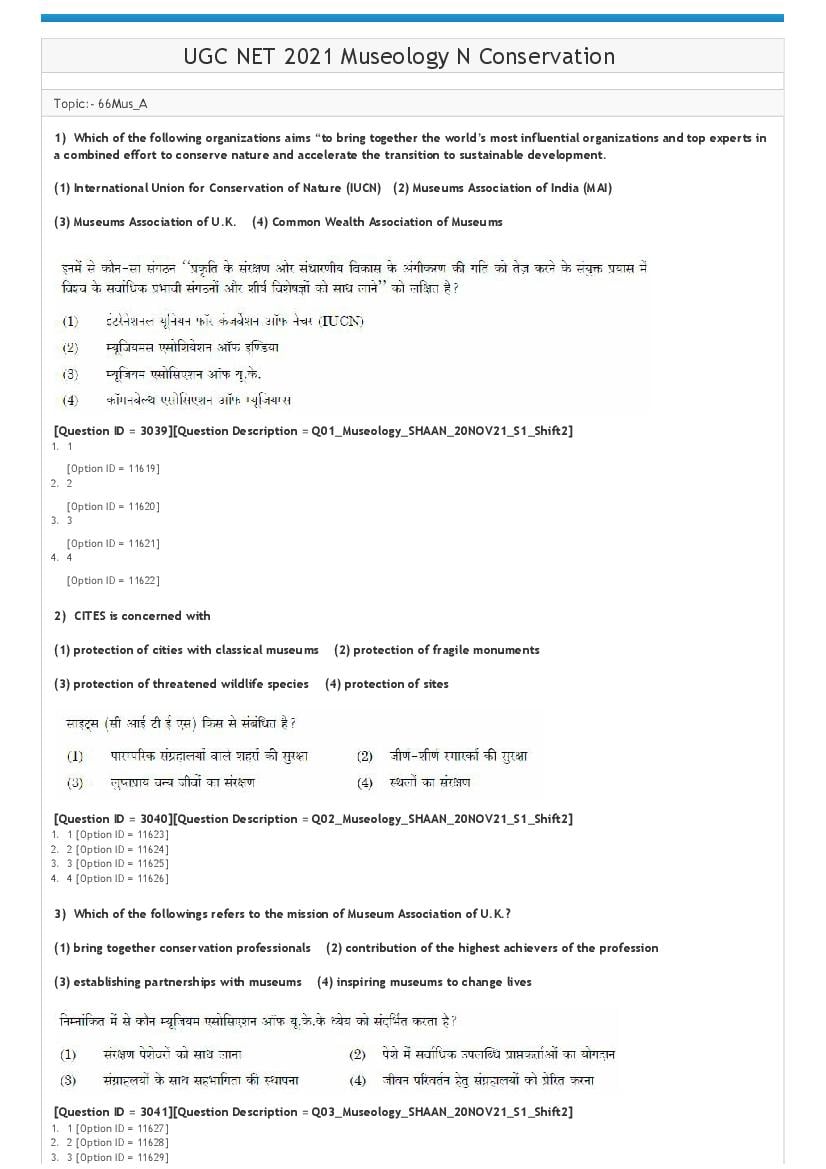
Topic:‐ 66Mus_A
1) Which of the following organizations aims “to bring together the world’s most influential organizations and top experts in
a combined effort to conserve nature and accelerate the transition to sustainable development.
(1) International Union for Conservation of Nature (IUCN) (2) Museums Association of India (MAI)
(3) Museums Association of U.K. (4) Common Wealth Association of Museums
[Question ID = 3039][Question Description = Q01_Museology_SHAAN_20NOV21_S1_Shift2]
1. 1
[Option ID = 11619]
2. 2
[Option ID = 11620]
3. 3
[Option ID = 11621]
4. 4
[Option ID = 11622]
2) CITES is concerned with
(1) protection of cities with classical museums (2) protection of fragile monuments
(3) protection of threatened wildlife species (4) protection of sites
[Question ID = 3040][Question Description = Q02_Museology_SHAAN_20NOV21_S1_Shift2]
1. 1 [Option ID = 11623]
2. 2 [Option ID = 11624]
3. 3 [Option ID = 11625]
4. 4 [Option ID = 11626]
3) Which of the followings refers to the mission of Museum Association of U.K.?
(1) bring together conservation professionals (2) contribution of the highest achievers of the profession
(3) establishing partnerships with museums (4) inspiring museums to change lives
[Question ID = 3041][Question Description = Q03_Museology_SHAAN_20NOV21_S1_Shift2]
1. 1 [Option ID = 11627]
2. 2 [Option ID = 11628]
3. 3 [Option ID = 11629]
Page 2
4) UNESCO stands for
(1) United Nations Establishment and Support Organization (2) United Nations, Ecological, Sports and Cultural Organization
(3) United Nations Educational, Scientific and Cultural Organization (4) United Nations Experts for Science and Culture
Office
[Question ID = 3042][Question Description = Q04_Museology_SHAAN_20NOV21_S1_Shift2]
1. 1 [Option ID = 11631]
2. 2 [Option ID = 11632]
3. 3 [Option ID = 11633]
4. 4 [Option ID = 11634]
5) The ICOM first meeting was held in May, 1947 at
(1) Czechoslovakia (2) London
(3) Paris (4) New York
[Question ID = 3043][Question Description = Q05_Museology_SHAAN_20NOV21_S1_Shift2]
1. 1 [Option ID = 11635]
2. 2 [Option ID = 11636]
3. 3 [Option ID = 11637]
4. 4 [Option ID = 11638]
6) XR‐D technique can be used for identification of
(1) Minerals (2) Oils and resins
(3) Organic pigments (4) Lignin content
[Question ID = 3044][Question Description = Q06_Museology_SHAAN_20NOV21_S1_Shift2]
1. 1 [Option ID = 11639]
2. 2 [Option ID = 11640]
3. 3 [Option ID = 11641]
4. 4 [Option ID = 11642]
7) Didarganj Yakshi is acquired by Bihar Museum by which mode
(1) Purchase (2) Long term loan
(3) Gift (4) Exchange
Page 3
1. 1 [Option ID = 11643]
2. 2 [Option ID = 11644]
3. 3 [Option ID = 11645]
4. 4 [Option ID = 11646]
8) Which of the following legal terms is related to collection?
(1) Wall‐to‐Wall (2) Unrestricted gift
(3) Liability (4) Floater
[Question ID = 3046][Question Description = Q08_Museology_SHAAN_20NOV21_S1_Shift2]
1. 1
[Option ID = 11647]
2. 2
[Option ID = 11648]
3. 3
[Option ID = 11649]
4. 4
[Option ID = 11650]
9) Which of the following statements is correct?
(1) a museum does not need an acquisition policy if it already has a collection (2) a museum must accept all gifts
(3) ethics are an important aspect of collecting (4) collection research should only be done by university museums
[Question ID = 3047][Question Description = Q09_Museology_SHAAN_20NOV21_S1_Shift2]
1. 1 [Option ID = 11651]
2. 2 [Option ID = 11652]
3. 3 [Option ID = 11653]
4. 4 [Option ID = 11654]
10) Which of the following is the general principle of marking accession number on the Object?
(1) use of unstable products (2) ignore the continuity of the documentation of old accession number
(3) integrity of the object is of least importance (4) ensure the continued existence of the accession number
Page 4
1. 1 [Option ID = 11655]
2. 2 [Option ID = 11656]
3. 3 [Option ID = 11657]
4. 4 [Option ID = 11658]
11) Which methodology will you follow while marking accession number on the object?
(1) write accession number with a coloured pen in a way to merge with colour of the object (2) write it in front of the
object clearly visible to the visitors
(3) write in a dimension which is proportional to the dimension of the object (4) write in a place where there is risk to be
erased
[Question ID = 3049][Question Description = Q11_Museology_SHAAN_20NOV21_S1_Shift2]
1. 1 [Option ID = 11659]
2. 2 [Option ID = 11660]
3. 3 [Option ID = 11661]
4. 4 [Option ID = 11662]
12) Documentation of museum objects in an excel sheet has the following advantage
(1) need electricity supply (2) require a knowledge of Excel
(3) require a great precision (4) immediate possibility of research
[Question ID = 3050][Question Description = Q12_Museology_SHAAN_20NOV21_S1_Shift2]
1. 1 [Option ID = 11663]
2. 2 [Option ID = 11664]
3. 3 [Option ID = 11665]
4. 4 [Option ID = 11666]
13) Which of the following is considered the most appropriate method of collecting authentic archaeological materials?
(1) gift (2) fieldwork
(3) purchase (4) exchange
[Question ID = 3051][Question Description = Q13_Museology_SHAAN_20NOV21_S1_Shift2]
Page 5
2. 2 [Option ID = 11668]
3. 3 [Option ID = 11669]
4. 4 [Option ID = 11670]
14) Cloze test conducted by a museum on a sample of exhibition text gives a score between 57 percent and 61 percent.
What does the score indicate?
(1) The text is roughly fully comprehensible (2) The text is highly comprehensible
(3) The text is highly difficult to comprehend (4) The text is very easy to understand
[Question ID = 3052][Question Description = Q14_Museology_SHAAN_20NOV21_S1_Shift2]
1. 1 [Option ID = 11671]
2. 2 [Option ID = 11672]
3. 3 [Option ID = 11673]
4. 4 [Option ID = 11674]
15) Which of the following types of exhibition labels tells about several closely related items displayed in a single case?
(1) introductory panels (2) group caption
(3) didactic panels (4) object captions
[Question ID = 3053][Question Description = Q15_Museology_SHAAN_20NOV21_S1_Shift2]
1. 1 [Option ID = 11675]
2. 2 [Option ID = 11676]
3. 3 [Option ID = 11677]
4. 4 [Option ID = 11678]
16) Which of the following provides and regulates a variety of stimuli to which the visitors will be exposed in a museum
exhibition?
(1) orientation (2) ambience
(3) master plan (4) pacing
[Question ID = 3054][Question Description = Q16_Museology_SHAAN_20NOV21_S1_Shift2]
1. 1 [Option ID = 11679]
2. 2 [Option ID = 11680]
3. 3 [Option ID = 11681]
4. 4 [Option ID = 11682]
17) A three‐dimensional miniature or life‐size scene in which figures, stuffed wildlife, or other objects are arranged in a
naturalistic setting against a curved painted background is called
Page 6
(3) Diorama (4) Tableau
[Question ID = 3055][Question Description = Q17_Museology_SHAAN_20NOV21_S1_Shift2]
1. 1 [Option ID = 11683]
2. 2 [Option ID = 11684]
3. 3 [Option ID = 11685]
4. 4 [Option ID = 11686]
18) Who gave the theory of Experiential Education?
(1) Jean Piaget (2) John Dewey
(3) Benjamin Bloom (4) Howard Gardner
[Question ID = 3056][Question Description = Q18_Museology_SHAAN_20NOV21_S1_Shift2]
1. 1 [Option ID = 11687]
2. 2 [Option ID = 11688]
3. 3 [Option ID = 11689]
4. 4 [Option ID = 11690]
19) Which of the following intelligences refer to ‘the ability to handle chains of reasoning and to recognize pattern and
order’?
(1) logical‐mathematical (2) spatial
(3) intrapersonal (4) musical
[Question ID = 3057][Question Description = Q19_Museology_SHAAN_20NOV21_S1_Shift2]
1. 1 [Option ID = 11691]
2. 2 [Option ID = 11692]
3. 3 [Option ID = 11693]
4. 4 [Option ID = 11694]
20) Which of the following intelligences refer to ‘the ability to use body skillfully and handle objects adroitly’?
(1) spatial (2) bodily‐kinesthetic
(3) naturalist (4) musical
Page 7
1. 1 [Option ID = 11695]
2. 2 [Option ID = 11696]
3. 3 [Option ID = 11697]
4. 4 [Option ID = 11698]
21) Which of the following theory takes a view that ‘knowledge exists outside the learner and learning is incremental
added bit by bit’?
(1) Didactic, Expository (2) Stimulus – Response
(3) Discovery (4) Constructivism
[Question ID = 3059][Question Description = Q21_Museology_SHAAN_20NOV21_S1_Shift2]
1. 1 [Option ID = 11699]
2. 2 [Option ID = 11700]
3. 3 [Option ID = 11701]
4. 4 [Option ID = 11702]
22) ‘Azurite’ is a corrosion product found on
(1) silver (2) iron
(3) copper (4) electrum
[Question ID = 3060][Question Description = Q22_Museology_SHAAN_20NOV21_S1_Shift2]
1. 1 [Option ID = 11703]
2. 2 [Option ID = 11704]
3. 3 [Option ID = 11705]
4. 4 [Option ID = 11706]
23) ‘Tidelines’ are often visble on the following type of object
(1) Paper manuscript (2) Bronze sculpture
(3) Leather puppet (4) Stone sculpture near sea shore
[Question ID = 3061][Question Description = Q23_Museology_SHAAN_20NOV21_S1_Shift2]
1. 1 [Option ID = 11707]
2. 2 [Option ID = 11708]
3. 3 [Option ID = 11709]
4. 4 [Option ID = 11710]
Page 8
(1) textile (2) metal
(3) mural (4) wood
[Question ID = 3062][Question Description = Q24_Museology_SHAAN_20NOV21_S1_Shift2]
1. 1 [Option ID = 11711]
2. 2 [Option ID = 11712]
3. 3 [Option ID = 11713]
4. 4 [Option ID = 11714]
25) ‘Lignin’ that imparts rigidity to wood is
(1) Phenolic component (2) Sulphonic component
(3) Ketonic component (4) Non‐ionic component
[Question ID = 3063][Question Description = Q25_Museology_SHAAN_20NOV21_S1_Shift2]
1. 1 [Option ID = 11715]
2. 2 [Option ID = 11716]
3. 3 [Option ID = 11717]
4. 4 [Option ID = 11718]
26) Maceration of incubated dry egg is done by using
(1) ethyl alcohol (2) pure glycerine
(3) pepsin (4) calcium hydroxide
[Question ID = 3064][Question Description = Q26_Museology_SHAAN_20NOV21_S1_Shift2]
1. 1 [Option ID = 11719]
2. 2 [Option ID = 11720]
3. 3 [Option ID = 11721]
4. 4 [Option ID = 11722]
27) Which of the following techniques used in conservation is invasive in nature
(1) UV examination (2) X‐Ray radiography
(3) X‐Ray fluroscence (4) X‐Ray diffractometry
Page 9
1. 1 [Option ID = 11723]
2. 2 [Option ID = 11724]
3. 3 [Option ID = 11725]
4. 4 [Option ID = 11726]
28) ‘ColorpHast’ indicator strips are used to measure
(1) R.H. (2) U.V
(3) A.H. (4) pH
[Question ID = 3066][Question Description = Q28_Museology_SHAAN_20NOV21_S1_Shift2]
1. 1 [Option ID = 11727]
2. 2 [Option ID = 11728]
3. 3 [Option ID = 11729]
4. 4 [Option ID = 11730]
29) Organisations ability to perform in ways that competitors cannot or will not match is called
(1) core competency (2) competitive advantage
(3) corporate culture (4) credence attributes
[Question ID = 3067][Question Description = Q29_Museology_SHAAN_20NOV21_S1_Shift2]
1. 1 [Option ID = 11731]
2. 2 [Option ID = 11732]
3. 3 [Option ID = 11733]
4. 4 [Option ID = 11734]
30) The book “Solubility and solvents for conservaton problems", ICCROM, Rome (1984) was authored by
(1) O.P. Agarwal (2) D.P. Agarwal
(3) Marissa L. Tabasso (4) G. Torraca
[Question ID = 3068][Question Description = Q30_Museology_SHAAN_20NOV21_S1_Shift2]
1. 1
[Option ID = 11735]
2. 2
[Option ID = 11736]
3. 3
[Option ID = 11737]
4. 4
[Option ID = 11738]
Page 10
(1) security (2) self‐respect
(3) acceptance (4) development and fulfillment
[Question ID = 3069][Question Description = Q31_Museology_SHAAN_20NOV21_S1_Shift2]
1. 1 [Option ID = 11739]
2. 2 [Option ID = 11740]
3. 3 [Option ID = 11741]
4. 4 [Option ID = 11742]
32) Which one of the following is a tangible reward given to an employee for motivation?
(1) Inviting the employee in a higher level meeting (2) Pat on the shoulder
(3) Appreciation during regular staff meeting (4) Cash reward
[Question ID = 3070][Question Description = Q32_Museology_SHAAN_20NOV21_S1_Shift2]
1. 1 [Option ID = 11743]
2. 2 [Option ID = 11744]
3. 3 [Option ID = 11745]
4. 4 [Option ID = 11746]
33) Which of the following is a single use plan?
(1) budget (2) policies
(3) procedures (4) rules
[Question ID = 3071][Question Description = Q33_Museology_SHAAN_20NOV21_S1_Shift2]
1. 1 [Option ID = 11747]
2. 2 [Option ID = 11748]
3. 3 [Option ID = 11749]
4. 4 [Option ID = 11750]
34) Considering the components of the total offerings of a museum, it can be viewed as a
(1) pure service (2) pure tangible good
(3) major service with accompanying minor goods and services (4) tangible good with accompanying services
Page 11
1. 1 [Option ID = 11751]
2. 2 [Option ID = 11752]
3. 3 [Option ID = 11753]
4. 4 [Option ID = 11754]
35) Which of the following is a popular measurement tool in which consumers rank their preference along a scale that
varies from “agree” to “disagree” with various gradations between the extremes?
(1) Likert scale (2) Attitude scale
(3) Behavior intention scale (4) Semantic differential scale
[Question ID = 3073][Question Description = Q35_Museology_SHAAN_20NOV21_S1_Shift2]
1. 1 [Option ID = 11755]
2. 2 [Option ID = 11756]
3. 3 [Option ID = 11757]
4. 4 [Option ID = 11758]
36) Which of the following marketing communication tools a museum is using, if it waives admission fee after reopening
during Unlock I?
(1) advertising (2) sales promotion
(3) public relations and publicity (4) personal selling
[Question ID = 3074][Question Description = Q36_Museology_SHAAN_20NOV21_S1_Shift2]
1. 1
[Option ID = 11759]
2. 2
[Option ID = 11760]
3. 3
[Option ID = 11761]
4. 4
[Option ID = 11762]
37) Maturity stage in the Product life cycle is marked by
(1) sales petrify at a low level (2) sales growth is apt to be slow
(3) rapid climb in sales (4) sales growth rate starts to decline or sales flattens
Page 12
1. 1 [Option ID = 11763]
2. 2 [Option ID = 11764]
3. 3 [Option ID = 11765]
4. 4 [Option ID = 11766]
38) Which of the following statements are true?
(A) Museums that maintain collections hold them in trust for the benefit of society and its development
(B) Museums operate in an illicit manner
(C) Museum preserve, interpret and promote the natural and cultural inheritance of humanity
(D) Museums provide opportunities for appreciation, understanding and promotion of the natural and cultural heritage
(E) Museums exist to generate profit
Choose the corect answer from the options given below :
(1) (A), (B), (E) Only (2) (A), (C), (D) Only
(3) (B), (D), (E) Only (4) (C), (D), (E) Only
[Question ID = 3076][Question Description = Q38_Museology_SHAAN_20NOV21_S1_Shift2]
1. 1 [Option ID = 11767]
2. 2 [Option ID = 11768]
3. 3 [Option ID = 11769]
4. 4 [Option ID = 11770]
39) Which of the following is included in mandate of ICCROM?
(A) collecting and disseminating information
(B) promoting awareness about day to day activities a museum
(C) providing advanced training to emerging and mid‐career professional
(D) promoting awareness of the value of preserving cultural heritage
Page 13
Choose the correct answer from the options given below :
(1) (A), (B), (D) Only (2) (B), (C), (D) Only
(3) (A), (C), (D) Only (4) (B), (D), (E) Only
[Question ID = 3077][Question Description = Q39_Museology_SHAAN_20NOV21_S1_Shift2]
1. 1 [Option ID = 11771]
2. 2 [Option ID = 11772]
3. 3 [Option ID = 11773]
4. 4 [Option ID = 11774]
40) Which of the following are the missions of the ICOM?
(A) Management of Museum professionals
(B) Combating the illicit traffic of cultural goods
(C) Promotion of culture and knowledge
(D) Protection of Museum related issues
Choose the correct answer from the options given below :
(1) (A), (C) only (2) (B), (D) only
(3) (C), (D) only (4) (B), (C) only
Page 14
1. 1 [Option ID = 11775]
2. 2 [Option ID = 11776]
3. 3 [Option ID = 11777]
4. 4 [Option ID = 11778]
41) A person who desires to obtain information under RTI Act shall
(A) Make a request
(B) Pay prescribed fee
(C) Specify the particulars of the information sought
(D) Give reason for requesting information
(E) Give complete personal details
Choose the correct answer from the options given below :
(1) (A), (B) and (C) only (2) (A), (B), (C) and (D) only
(3) (A), (B), (D), (E) only (4) (A), (C), (E) only
[Question ID = 3079][Question Description = Q41_Museology_SHAAN_20NOV21_S1_Shift2]
1. 1 [Option ID = 11779]
2. 2 [Option ID = 11780]
3. 3 [Option ID = 11781]
4. 4 [Option ID = 11782]
42) The Antiquities and Art Treasure Act, 1972 was enacted by the Parliament to
Page 15
(B) Regulate archaeological excavations
(C) Provide for the prevention of smuggling of and fraudulent dealings in antiquities
(D) Protection of sculptures, carvings and other like objects
(E) To provide for compulsory acquisition of antiquities and art treasures for preservation is public places
Choose the correct answer from the options given below :
(1) (A), (C), (D) and (E) only (2) (A) (B) and (C) only
(3) (B), (C), (D), and (E) only (4) (A), (C) and (E) only
[Question ID = 3080][Question Description = Q42_Museology_SHAAN_20NOV21_S1_Shift2]
1. 1 [Option ID = 11783]
2. 2 [Option ID = 11784]
3. 3 [Option ID = 11785]
4. 4 [Option ID = 11786]
43) Which of the following are covered under The Rights of Persons with Disability Act 2016?
(A) A National Museum
(B) A Regional Museum
(C) A municipal museum
(D) A District Museum
(E) A Private collection by individual
Choose the correct answer from the options given below :
(1) (A), (B) and (E) only (2) (A), (B) and (D) only
(3) (A), (B), (C) and (D) only (4) (A), (C) and (D) only
Page 16
1. 1 [Option ID = 11787]
2. 2 [Option ID = 11788]
3. 3 [Option ID = 11789]
4. 4 [Option ID = 11790]
44) What could be the appropriate reasons for the de‐accessioning of a museum object? (A) To make financial gains
(B) To refine the focus of the collection
(C) To repatriate the object
(D) To remove deteriorated and unsalvageable objects
Choose the correct answer from the options given below :
(1) (A), (B), (C) only (2) (B), (C), (D) only
(3) (A), (B), (D) only (4) (A), (B), (C), (D) only
[Question ID = 3082][Question Description = Q44_Museology_SHAAN_20NOV21_S1_Shift2]
1. 1
Page 17
2. 2
[Option ID = 11792]
3. 3
[Option ID = 11793]
4. 4
[Option ID = 11794]
45) Following are the examples of Intangible Cultural Heritage of India
(A) Satriya Dance
(B) Ramlila of Ram Nagar
(C) Dancing Girl from Mohenjodaro
(D) Jandila Guru Ke Thathere (Metal Smiths)
(E) Didarganj Yakshi
Choose the correct answer from the options given below :
(1) (C) and (E) only (2) (A), (B), (D) only
(3) (A), (B), (C), (E) only (4) (A), (B), (C), (D) only
[Question ID = 3083][Question Description = Q45_Museology_SHAAN_20NOV21_S1_Shift2]
1. 1 [Option ID = 11795]
2. 2 [Option ID = 11796]
3. 3 [Option ID = 11797]
4. 4 [Option ID = 11798]
46) In a Museum storage one should have
(A) Collection
(B) Non collection
(C) Furniture for collection
(D) Display cases from previous exhibitions
(E) Fire extinguisher
Choose the most appropriate answer from the options given below :
Page 18
(3) (A), (C), (E) only (4) (B), (D), (E) only
[Question ID = 3084][Question Description = Q46_Museology_SHAAN_20NOV21_S1_Shift2]
1. 1 [Option ID = 11799]
2. 2 [Option ID = 11800]
3. 3 [Option ID = 11801]
4. 4 [Option ID = 11802]
47) As per the ICCROM guidelines secondary card indices are
(A) Generally of a different color that have been used for main index
(B) Having the ‘information which is exactly the same as the one on the main card index
(C) Having information similar to accession register
(D) Not having the localization or location number
(E) Also used during the movement of the objects.
Choose the correct answer from the options given below :
(1) (A), (B), only (2) (A), (C), (D) only
(3) (B), (C), (E) only (4) (C), (D), (E) only
Page 19
1. 1 [Option ID = 11803]
2. 2 [Option ID = 11804]
3. 3 [Option ID = 11805]
4. 4 [Option ID = 11806]
48) Accession register can never be
(A) A group of single flying pages
(B) A well bound document
(C) In a ring binder
(D) Without page numbers
(E) A document that any one can consult
Choose the correct answer from the options given below :
(1) (A), (B), (D) only (2) (A), (C), (D), (E) only
(3) (B), (D), (E) only (4) (B), (C), (E) only
[Question ID = 3086][Question Description = Q48_Museology_SHAAN_20NOV21_S1_Shift2]
1. 1 [Option ID = 11807]
2. 2 [Option ID = 11808]
3. 3 [Option ID = 11809]
4. 4 [Option ID = 11810]
49) In a documentation system individual files have the following :
(A) Catalogue of exhibition in which this object had been presented
(B) Catalogue of auction offices having sold similar objects
(C) Catalogue of companies, whose chemicals were used in its conservation
Page 20
(E) Scientific articles concerning similar object
Choose the correct answer from the options given below :
(1) (B), (D), (E) only (2) (A), (C), (D) only
(3) (A), (B), (E) only (4) (C), (D), (E) only
[Question ID = 3087][Question Description = Q49_Museology_SHAAN_20NOV21_S1_Shift2]
1. 1 [Option ID = 11811]
2. 2 [Option ID = 11812]
3. 3 [Option ID = 11813]
4. 4 [Option ID = 11814]
50) According to ICCROM even if you have a computerised documentation system, you will have to do which elements of
the documentation by hand or manually
(A) Catalogue card
(B) Individual file
(C) Marking the number on the object
(D) Giving the localisation system or location number in the storage
Choose the most appropriate answer from the options given below :
(1) (A), (C) only (2) (B), (D) only
(3) (C), (D) only (4) (B), (C) only
Page 21
1. 1 [Option ID = 11815]
2. 2 [Option ID = 11816]
3. 3 [Option ID = 11817]
4. 4 [Option ID = 11818]
51) Which of the following affect legibility of the exihibition text?
(A) sentence structure
(B) viewing distance
(C) type size
(D) location of the text
Choose the most appropriate answer from the options given below :
(1) (A) and (C) only (2) (B) and (C) only
(3) (B), (C), and (D) only (4) (C) and (D) only
[Question ID = 3089][Question Description = Q51_Museology_SHAAN_20NOV21_S1_Shift2]
1. 1 [Option ID = 11819]
2. 2 [Option ID = 11820]
3. 3 [Option ID = 11821]
4. 4 [Option ID = 11822]
52) The benefits of computer‐controlled lighting system include
(A) controlled exposure to light
Page 22
(C) capital expenditure
(D) energy saving
Choose the most appropriate answer from the options given below :
(1) (A) and (D) only (2) (B) and (C) only
(3) (B), (C) and (D) only (4) (A), (B) and (D) only
[Question ID = 3090][Question Description = Q52_Museology_SHAAN_20NOV21_S1_Shift2]
1. 1 [Option ID = 11823]
2. 2 [Option ID = 11824]
3. 3 [Option ID = 11825]
4. 4 [Option ID = 11826]
53) Which of the following are common features of a museum exhibition and a trade show? (A) use of objects
(B) use of multi‐media
(C) include interactive experiences
(D) promotion of goods and services
Choose the most appropriate answer from the options given below :
(1) (B), (C) and (D) only (2) (B) and (C) only
(3) (A), (C) and (D) only (4) (A), (B) and (C) only
Page 23
1. 1 [Option ID = 11827]
2. 2 [Option ID = 11828]
3. 3 [Option ID = 11829]
4. 4 [Option ID = 11830]
54) Which of the following can be offered to people with visual impairment?
(A) Tactile drawings of objects
(B) Ramps
(C) Taped guides
(D) Maps showing seating
(E) Braille labels
Choose the correct answer from the options given below :
(1) (A), (B) and (C) only (2) (A), (C), (D) and E only
(3) (A), (C) and E only (4) (A), (D) and E only
[Question ID = 3092][Question Description = Q54_Museology_SHAAN_20NOV21_S1_Shift2]
1. 1 [Option ID = 11831]
2. 2 [Option ID = 11832]
3. 3 [Option ID = 11833]
4. 4 [Option ID = 11834]
55) Which of the following activities mainly involve cognitive and affective domain of learning?
Page 24
(B) Dancing
(C) Watching a historical drama
(D) Basket weaving
(E) Clay modelling
Choose the correct answer from the options given below :
(1) (B), (D) and (E) only (2) (A), (C) and (D) only
(3) (A) and (C) only (4) (B), (C) and (D) only
[Question ID = 3093][Question Description = Q55_Museology_SHAAN_20NOV21_S1_Shift2]
1. 1 [Option ID = 11835]
2. 2 [Option ID = 11836]
3. 3 [Option ID = 11837]
4. 4 [Option ID = 11838]
56) Following are the examples of remedial conservation
(A) Treatment of leaded bronzes using neutral BTA
(B) Use of silical gel in bronze object showcase
(C) Treatment of bronze disease using Benzotriazole
(D) Lining of a canvas painting
(E) Use of age‐less in showcases having bronzes
Choose the correct answer from the options given below :
(1) (A), (B), (C) only (2) (A), (D), (E) only
(3) (B) and (E) only (4) (A), (C), (D) only
Page 25
1. 1 [Option ID = 11839]
2. 2 [Option ID = 11840]
3. 3 [Option ID = 11841]
4. 4 [Option ID = 11842]
57) Which of the following are the ethics of conservation?
(A) Reversibility of the treatment
(B) Minimum intervention
(C) Giving extra shine to paintings and arifacts
(D) Compatability of the materials used for conservation
Choose the correct answer from the options given below :
(1) (A), (B), (C) only (2) (A), (B), (D) only
(3) (B), (C) and (D) only (4) (C) and (D) only
Page 26
1. 1
[Option ID = 11843]
2. 2
[Option ID = 11844]
3. 3
[Option ID = 11845]
4. 4
[Option ID = 11846]
58) Which of the following are characteristics of corporate funding?
(A) Matching of interest
(B) Give and take approach
(C) Lot of paperwork
(D) More types of gifts
Choose the correct answer from the options given below :
(1) (A) and (B) only (2) (B) and (C) only
(3) (B) and (D) only (4) (C) and (D) only
[Question ID = 3096][Question Description = Q58_Museology_SHAAN_20NOV21_S1_Shift2]
1. 1 [Option ID = 11847]
2. 2 [Option ID = 11848]
3. 3 [Option ID = 11849]
4. 4 [Option ID = 11850]
59) Which of the following Mineral pigments have been used in Indian miniature paintings?
(A) Lazwardi
(B) LAC
(C) Kharia
(D) Ramraj
(E) Peori
Page 27
(1) (A), (B) and (E) only (2) (A), (C) and (D) only
(3) (B), (D) and (E) only (4) (B), (C) and (D) only
[Question ID = 3097][Question Description = Q59_Museology_SHAAN_20NOV21_S1_Shift2]
1. 1 [Option ID = 11851]
2. 2 [Option ID = 11852]
3. 3 [Option ID = 11853]
4. 4 [Option ID = 11854]
60) Graphic depiction of Critical Path Analysis depicts
(A) Cash flow requirement
(B) Interdependence of the activities to be completed
(C) Time for activities to start and finish
(D) Logical sequence of the activities
Choose the correct answer from the options given below :
(1) (A), (B) and (C) only (2) (A), (B) and (D) only
(3) (B) and (D) only (4) (B), (C) and (D) only
Page 28
1. 1 [Option ID = 11855]
2. 2 [Option ID = 11856]
3. 3 [Option ID = 11857]
4. 4 [Option ID = 11858]
61) Following are processes involved in remedial treatment of oil painting
(A) Consolidation of flaked areas
(B) Removal of varnish
(C) Application of Citronella oil
(D) Filling of Lacunae
(E) Burnishing of the surface
Choose the correct answer from the options given below :
(1) (A), (B), (C) and (E) only (2) (A), (B) (C) and (D) only
(3) (A), (B), and (D) only (4) (A), (B), and (E) only
[Question ID = 3099][Question Description = Q61_Museology_SHAAN_20NOV21_S1_Shift2]
1. 1 [Option ID = 11859]
2. 2 [Option ID = 11860]
3. 3 [Option ID = 11861]
4. 4 [Option ID = 11862]
62) Use of following chemicals is considered as health and occupational hazard to the conservator
(A) Starch paste
(B) Phosgene
(C) Paradichlorobenzene
Page 29
(E) Benzene
Choose the correct answer from the options given below :
(1) (A) and (C) only (2) (B), (C), (D) and (E) only
(3) (A) and (E) only (4) (A), (B) and (C) only
[Question ID = 3100][Question Description = Q62_Museology_SHAAN_20NOV21_S1_Shift2]
1. 1 [Option ID = 11863]
2. 2 [Option ID = 11864]
3. 3 [Option ID = 11865]
4. 4 [Option ID = 11866]
63) SWOT methodology offers the prospects of
(A) building on strengths
(B) identifying cause and effects of strategic change
(C) eliminate or atleast mitigate weaknesses
(D) minimize the effect of external threats
Choose the most appropriate answer from the options given below :
(1) (A) and (C) only (2) (B), (C) and (D) only
(3) (A), (C) and (D) only (4) (A), (B) and (D) only
Page 30
1. 1 [Option ID = 11867]
2. 2 [Option ID = 11868]
3. 3 [Option ID = 11869]
4. 4 [Option ID = 11870]
64) Which of the following steps could be taken by a museum if it is facing the state of overfull demand?
(A) reduce promotion
(B) reduce pricing
(C) increase timings
(D) expand spatially
Choose the most appropriate answer from the options given below :
(1) (A), (C) and (D) only (2) (A) and (B) only
(3) (B), (C) and (D) only (4) (A), (B) and (D) only
[Question ID = 3102][Question Description = Q64_Museology_SHAAN_20NOV21_S1_Shift2]
1. 1 [Option ID = 11871]
2. 2 [Option ID = 11872]
3. 3 [Option ID = 11873]
4. 4 [Option ID = 11874]
65) Which of the following consumer groups come under behavioral segment?
(A) Rural
(B) Quality seekers
(C) Illiterate
Page 31
(E) Adults
Choose the correct answer from the options given below :
(1) (A), (B) and (E) only (2) (B) and (D) only
(3) (C), (D) and (E) only (4) (A) and (E) only
[Question ID = 3103][Question Description = Q65_Museology_SHAAN_20NOV21_S1_Shift2]
1. 1 [Option ID = 11875]
2. 2 [Option ID = 11876]
3. 3 [Option ID = 11877]
4. 4 [Option ID = 11878]
66) Match List I and List II
List I List II
(A) The Venice Charter (I) 2003
(B) The UNESCO convention for the
safeguarding of the intangible (II) 1972
heritage
(C) Right to Information Act (III) 1964
(D) The Wild Life Protection Act (IV) 2005
Choose the correct answer from the options given below:
(1) (A)‐(III), (B)‐(II), (C)‐(IV), (D)‐(I)
(2) (A)‐(III), (B)‐(IV), (C)‐(I), (D)‐(II)
(3) (A)‐(III), (B)‐(I), (C)‐(IV), (D)‐(II)
(4) (A)‐(IV), (B)‐(III), (C)‐(II), (D)‐(I)
Page 32
1. 1
[Option ID = 11879]
2. 2
[Option ID = 11880]
3. 3
[Option ID = 11881]
4. 4
[Option ID = 11882]
67) Match List I and List II
List I List II
(A) CIDOC (I) Musical instruments
(B) ICOM‐CC (II) Museology
(C) CIMCIM (III) Documentation
(D) ICOFOM (IV) Conservation
Choose the correct answer from the options given below:
(1) (A)‐(III), (B)‐(IV), (C)‐(II), (D)‐(I)
(2) (A)‐(II), (B)‐(IV), (C)‐(III), (D)‐(I),
(3) (A)‐(II), (B)‐(IV), (C)‐(I), (D)‐(III)
(4) (A)‐(III), (B)‐(IV), (C)‐(I), (D)‐(II)
[Question ID = 3105][Question Description = Q67_Museology_SHAAN_20NOV21_S1_Shift2]
1. 1
[Option ID = 11883]
2. 2
[Option ID = 11884]
3. 3
[Option ID = 11885]
4. 4
[Option ID = 11886]
68) Match List I and List II
List I List II
Storage Furniture % of floor area that they can occupy
Page 33
(B) Compacters (II) 35% – 45%
(C) Almirahs (III) 20%
(D) Drawing Cabinets (IV) 70% – 80%
Choose the correct answer from the options given below:
(1) (A)‐(IV), (B)‐(III), (C)‐(I), (D)‐(II)
(2) (A)‐(III), (B)‐(I), (C)‐(II), (D)‐(IV)
(3) (A)‐(III), (B)‐(IV), (C)‐(II), (D)‐(I)
(4) (A)‐(III), (B)‐(IV), (C)‐(I), (D)‐(II)
[Question ID = 3106][Question Description = Q68_Museology_SHAAN_20NOV21_S1_Shift2]
1. 1
[Option ID = 11887]
2. 2
[Option ID = 11888]
3. 3
[Option ID = 11889]
4. 4
[Option ID = 11890]
69) Match List I and List II
List I List II
(I) Aims to have an effect on
(A) Didactic exhibition
emotions of the visitors
(II) Aims to make visitors appreciate
(B) Emotive exhibition
beauty of the objects
(C) Evocative exhibition (III) Aim is to instruct and educate
(IV) Aims to arouse emotions in
visitors by creating an atmosphere and
(D) Aesthetic exhibition
possibly a theatrical style of
presentation
Choose the correct answer from the options given below:
(1) (A)‐(IV), (B)‐(II), (C)‐(III), (D)‐(I)
(2) (A)‐(III), (B)‐(I), (C)‐(IV), (D)‐(II)
(3) (A)‐(II), (B)‐(III), (C)‐(I), (D)‐(IV)
(4) (A)‐(I), (B)‐(IV), (C)‐(II), (D)‐(III)
Page 34
1. 1
[Option ID = 11891]
2. 2
[Option ID = 11892]
3. 3
[Option ID = 11893]
4. 4
[Option ID = 11894]
70) Match List I and List II
List I List II
(I) A procedure with which an
(A) Deposition object is given a place in the museum
collection
(II) Data describing the context,
(B) Data standard
content and structure of information
(III) A statement of what data should
(C) Meta data
be recorded
(IV) The transfer of the possession of
(D) Registration an object or collection, as a long term
loan to the museum
Choose the correct answer from the options given below:
(1) (A)‐(III), (B)‐(IV), (C)‐(II), (D)‐(I)
(2) (A)‐(II), (B)‐(I), (C)‐(IV), (D)‐(III)
(3) (A)‐(IV), (B)‐(III), (C)‐(II), (D)‐(I)
(4) (A)‐(II), (B)‐(I), (C)‐(III), (D)‐(IV)
Page 35
1. 1
[Option ID = 11895]
2. 2
[Option ID = 11896]
3. 3
[Option ID = 11897]
4. 4
[Option ID = 11898]
71) Match List I and List II
List I List II
(A) Dry Rot (I) Oil paintings
(B) Tarnishing (II) Wood
(C) Blooming (III) Paper
(D) Tidelines (IV) Silver
Choose the correct answer from the options given below:
(1) (A)‐(II), (B)‐(IV), (C)‐(I), (D)‐(II)
(2) (A)‐(II), (B)‐(I), (C)‐(IV), (D)‐(III)
(3) (A)‐(IV), (B)‐(III), (C)‐(II), (D)‐(I)
(4) (A)‐(II), (B)‐(III), (C)‐(IV), (D)‐(I)
[Question ID = 3109][Question Description = Q71_Museology_SHAAN_20NOV21_S1_Shift2]
1. 1
[Option ID = 11899]
2. 2
[Option ID = 11900]
3. 3
[Option ID = 11901]
4. 4
[Option ID = 11902]
Page 36
List I List II
Demand State Marketing task
(I) Reverse demand through
(A) No demand
creative remarketing of the product
(II) Maintain the current level of
(B) Declining demand
demand
(III) Find ways to connect the
(C) Overfull demand benefits of the product with potential
consumers’ needs and interests
(IV) Find ways to reduce demand
(D) Full demand
temporarily or permanently
Choose the correct answer from the options given below:
(1) (A)‐(II), (B)‐(I), (C)‐(IV), (D)‐(III)
(2) (A)‐(III), (B)‐(I), (C)‐(IV), (D)‐(II)
(3) (A)‐(I), (B)‐(II), (C)‐(IV), (D)‐(II)
(4) (A)‐(III), (B)‐(I), (C)‐(II), (D)‐(IV)
[Question ID = 3110][Question Description = Q72_Museology_SHAAN_20NOV21_S1_Shift2]
1. 1
[Option ID = 11903]
2. 2
[Option ID = 11904]
3. 3
[Option ID = 11905]
4. 4
[Option ID = 11906]
73) Match List I and List II
List I List II
(Chemicals used for Treatment) (Type of object)
(A) Zinc dust (I) Palm leaf
(B) Cironella oil (II) Glass
(C) HXtal‐NYL‐1 (III) Wood
(D) PEG (IV) Bronze
Page 37
(1) (A)‐(IV), (B)‐(I), (C)‐(II), (D)‐(III)
(2) (A)‐(III), (B)‐(II), (C)‐(I), (D)‐(IV)
(3) (A)‐(II), (B)‐(III), (C)‐(IV), (D)‐(I)
(4) (A)‐(I), (B)‐(IV), (C)‐(III), (D)‐(II)
[Question ID = 3111][Question Description = Q73_Museology_SHAAN_20NOV21_S1_Shift2]
1. 1
[Option ID = 11907]
2. 2
[Option ID = 11908]
3. 3
[Option ID = 11909]
4. 4
[Option ID = 11910]
74) Match List I and List II
List I List II
Type of policy Example
(A) Marketing policy (I) Policy on core corporate values
(B) Operational policy (II) Product, pricing policy
(C) Ethics policy (III) Internal audit policies
(D) Corporate governance and (IV) Production or service provision
compilance policies policy
Choose the correct answer from the options given below:
(1) (A)‐(II), (B)‐(IV), (C)‐(I), (D)‐(III)
(2) (A)‐(II), (B)‐(IV), (C)‐(III), (D)‐(I)
(3) (A)‐(IV), (B)‐(III), (C)‐(I), (D)‐(II)
(4) (A)‐(II), (B)‐(I), (C)‐(IV), (D)‐(III)
Page 38
1. 1
[Option ID = 11911]
2. 2
[Option ID = 11912]
3. 3
[Option ID = 11913]
4. 4
[Option ID = 11914]
75) Sequence of activities ideally involved during physical verification of objects in a Museum is as follows :
(A) Give location number inside the storage and furniture
(B) Verify each object with the help of Main Index card and its actual position
(C) Put the location number on the Main Index cards of each object
(D) Organize all the objects in case they are disorganized
Choose the correct answer from the options given below :
(1) (A), (C), (B), (D) (2) (D), (B), (C), (A)
(3) (D), (A), (C), (B) (4) (D), (C), (A), (B)
[Question ID = 3113][Question Description = Q75_Museology_SHAAN_20NOV21_S1_Shift2]
1. 1 [Option ID = 11915]
2. 2 [Option ID = 11916]
3. 3 [Option ID = 11917]
4. 4 [Option ID = 11918]
76) Put up the international conventions in chronological order
Page 39
property
(B) Convention for the protection of cultural property in the event of armed conflict (the Hague convention)
(C) Convention on International trade in Endangered species of wild Fauna and Flora
(D) Unidroit convention on stolen and illegally exported cultural property
Choose the correct answer from the options given below :
(1) (A), (B), (C), (D) (2) (B), (A), (C), (D)
(3) (B), (D), (A), (C) (4) (C), (D), (A), (B)
[Question ID = 3114][Question Description = Q76_Museology_SHAAN_20NOV21_S1_Shift2]
1. 1 [Option ID = 11919]
2. 2 [Option ID = 11920]
3. 3 [Option ID = 11921]
4. 4 [Option ID = 11922]
77) Arrange the following steps invovled in service consumption in order
(A) Evaluation of service performance
(B) Clarify needs and identify alternative service products
(C) Use the service
(D) Awareness of the need
(E) Evaluation of alternative service products
Choose the correct answer from the options given below :
(1) (B), (A), (D), (C), (E) (2) (D), (B), (C), (A), (E)
(3) (D), (B), (E), (A), (C) (4) (D), (B), (E), (C), (A)
Page 40
1. 1 [Option ID = 11923]
2. 2 [Option ID = 11924]
3. 3 [Option ID = 11925]
4. 4 [Option ID = 11926]
78) Arrange the steps given below for acquiring an object for museum
(A) Action taken to accept the object
(B) Enter in the entry register
(C) Enter the detail of the object in the accession register
(D) Give the Accession No. to the object
Choose the correct answer from the options given below :
(1) (A), (B), (D), (C) (2) (B), (D), (A), (C)
(3) (B), (A), (C), (D) (4) (C), (A), (B), (D)
[Question ID = 3116][Question Description = Q78_Museology_SHAAN_20NOV21_S1_Shift2]
1. 1 [Option ID = 11927]
2. 2 [Option ID = 11928]
3. 3 [Option ID = 11929]
4. 4 [Option ID = 11930]
79) Arrange the following steps involved in organisation of an exhibition
(A) Preparation of alternate design proposals
Page 41
(C) Conduct front end analysis
(D) Summative evaluation
(E) Keeping displays relevant and maintained
Choose the correct answer from the options given below :
(1) (C), (A), (B), (E), (D) (2) (B), (C), (A), (E), (D)
(3) (A), (B), (D), (C), (E) (4) (C), (B), (A), (E), (D)
[Question ID = 3117][Question Description = Q79_Museology_SHAAN_20NOV21_S1_Shift2]
1. 1 [Option ID = 11931]
2. 2 [Option ID = 11932]
3. 3 [Option ID = 11933]
4. 4 [Option ID = 11934]
80) Arrange in sequence the following steps involved in conservation treatment of paper using leaf‐castor equipment
(A) Drying of folio
(B) Testing of ink for bleeding
(C) Preparation of paper pulp
(D) Placement of folio on leaf castor
Choose the correct answer from the options given below :
(1) (A), (C), (B), (D) (2) (C), (D), (A), (B)
(3) (B), (C), (D), (A) (4) (D), (A), (B), (C)
Page 42
1. 1
[Option ID = 11935]
2. 2
[Option ID = 11936]
3. 3
[Option ID = 11937]
4. 4
[Option ID = 11938]
81) Arrange the following steps involed in organising a learning programme for School.
(A) formulate objectives
(B) conduct the learning activities
(C) evaluate the learning
(D) meeting with school teachers
(E) plan learning activities
Choose the correct answer from the options given below :
(1) (C), (E), (B), (A), (D) (2) (D), (A), (B), (C), (E)
(3) (D), (A), (E), (B), (C) (4) (D), (E), (B), (A), (C)
[Question ID = 3119][Question Description = Q81_Museology_SHAAN_20NOV21_S1_Shift2]
1. 1 [Option ID = 11939]
2. 2 [Option ID = 11940]
3. 3 [Option ID = 11941]
4. 4 [Option ID = 11942]
Page 43
(A) Manuscripts
(B) Metal
(C) Coated paper
(D) Textiles
(E) Stone
Choose the correct answer from the options given below :
(1) (A), (C), (E), (D), (B) (2) (D), (A), (C), (E), (B)
(3) (C), (A), (D), (B), (E) (4) (C), (D), (B), (A), (E)
[Question ID = 3120][Question Description = Q82_Museology_SHAAN_20NOV21_S1_Shift2]
1. 1 [Option ID = 11943]
2. 2 [Option ID = 11944]
3. 3 [Option ID = 11945]
4. 4 [Option ID = 11946]
83) Given below are two statements : One is labelled as Assertion A and the other is labelled as Reason R :
Assertion (A) : Display of Human Remains in museums is a matter of concern and has lead to restitution of these objects to
the native society by museums in some countries
Reasons (R) : Every human being requires to rest in dignity after death
In the light of the above statements, choose the correct answer from the options given below :
(1) Both (A) and (R) are true and (R) is the correct explanation of (A) (2) Both (A) and (R) are true but (R) is not the
correct explanation of (A)
(3) (A) is true but (R) is false (4) (A) is false but (R) is true
Page 44
1. 1 [Option ID = 11947]
2. 2 [Option ID = 11948]
3. 3 [Option ID = 11949]
4. 4 [Option ID = 11950]
84) Given below are two statements :
Statement I : In common law countries, the judicial remedies for the return / restitution of stolen cultural property are
based on the common law principle, the English ‘nemo dat rule, which provides that one who purchases property from a
thief, no matter how innocently, acquires no title in the property.
Statement II : Title remains with the thief.
In the light of the above statements, choose the most appropriate answer from the options given below :
(1) Both Statement I and Statement II are correct (2) Both Statement I and Statement II are incorrect
(3) Statement I is correct but Statement II is correct (4) Statement I is incorrect but Statement II is correct
[Question ID = 3122][Question Description = Q84_Museology_SHAAN_20NOV21_S1_Shift2]
1. 1 [Option ID = 11951]
2. 2 [Option ID = 11952]
3. 3 [Option ID = 11953]
4. 4 [Option ID = 11954]
85) Given below are two statements : One is labelled as Assertion A and the other is labelled as Reason R :
Assertion (A) : Services offered by for‐profit and non profit organizations do not differ in their underlying goals
Page 45
In the light of the above statements, choose the most appropriate answer from the options given below :
(1) Both (A) and (R) are correct and (R) is the correct explanation of (A) (2) Both (A) and (R) are correct but (R) is not the
correct explanation of (A)
(3) (A) is correct but (R) is not correct (4) (A) is not correct but (R) is correct
[Question ID = 3123][Question Description = Q85_Museology_SHAAN_20NOV21_S1_Shift2]
1. 1 [Option ID = 11955]
2. 2 [Option ID = 11956]
3. 3 [Option ID = 11957]
4. 4 [Option ID = 11958]
86) Given below are two statements : One is labelled as Assertion A and the other is labelled as Reason R :
Assertion (A) : Packing cases of artifacts are given cushioning material such as foam, etc
Reasons (R) : Objects observe severe jerks during their transportation in trucks, airplane and trolleys
In the light of the above statements, choose the correct answer from the options given below :
(1) Both (A) and (R) are true and (R) is the correct explanation of (A) (2) Both (A) and (R) are true but (R) is not the
correct explanation of (A)
(3) (A) is true but (R) is false (4) (A) is false but (R) is true
Page 46
1. 1 [Option ID = 11959]
2. 2 [Option ID = 11960]
3. 3 [Option ID = 11961]
4. 4 [Option ID = 11962]
87) Given below are two statements : One is labelled as Assertion A and the other is labelled as Reason R :
Assertion (A) : As soon as an object is collected for museum it should immediately be entered in the accession register
Reasons (R) : The details entered in the accession register are used for deciding whether the object fits within the scope of
the museum
In the light of the above statements, choose the most appropriate answer from the options given below :
(1) Both (A) and (R) are correct and (R) is the correct explanation of (A) (2) Both (A) and (R) are correct but (R) is not the
correct explanation of (A)
(3) (A) is correct but (R) is not correct (4) (A) is not correct but (R) is correct
[Question ID = 3125][Question Description = Q87_Museology_SHAAN_20NOV21_S1_Shift2]
1. 1 [Option ID = 11963]
2. 2 [Option ID = 11964]
3. 3 [Option ID = 11965]
4. 4 [Option ID = 11966]
88) Given below are two statements : One is labelled as Assertion A and the other is labelled as Reason R :
Assertion (A) : All museum exhibition by their very nature, invariably have some educational content
Reasons (R) : Visitors may learn from exhibitions organised solely for aesthetic or emotive purposes
In the light of the above statements, choose the most appropriate answer from the options given below :
(1) Both (A) and (R) are correct and (R) is the correct explanation of (A) (2) Both (A) and (R) are correct but (R) is not the
correct explanation of (A)
(3) (A) is correct but (R) is not correct (4) (A) is not correct but (R) is correct
Page 47
1. 1 [Option ID = 11967]
2. 2 [Option ID = 11968]
3. 3 [Option ID = 11969]
4. 4 [Option ID = 11970]
89) Given below are two statements :
Statement I : Carbon dating can only be done on organic samples.
Statement II : Carbon dating involves use of two isotopes of carbon, namely C14 and C13
In the light of the above statements, choose the most appropriate answer from the options given below :
(1) Both Statement I and Statement II are correct (2) Both Statement I and Statement II are incorrect
(3) Statement I is correct but Statement II is correct (4) Statement I is incorrect but Statement II is correct
[Question ID = 3127][Question Description = Q89_Museology_SHAAN_20NOV21_S1_Shift2]
1. 1 [Option ID = 11971]
2. 2 [Option ID = 11972]
3. 3 [Option ID = 11973]
4. 4 [Option ID = 11974]
90) Given below are two statements : One is labelled as Assertion A and the other is labelled as Reason R :
Page 48
Reasons (R) : ‘Burn Test’ can only differentiate between vegetable and animal fibres.
In the light of the above statements, choose the most appropriate answer from the options given below :
(1) Both (A) and (R) are true and (R) is the correct explanation of (A) (2) Both (A) and (R) are true but (R) is not the
correct explanation of (A)
(3) (A) is true but (R) is false (4) (A) is false but (R) is true
[Question ID = 3128][Question Description = Q90_Museology_SHAAN_20NOV21_S1_Shift2]
1. 1 [Option ID = 11975]
2. 2 [Option ID = 11976]
3. 3 [Option ID = 11977]
4. 4 [Option ID = 11978]
Topic:‐ 66Mus_B
1) It is because there is so much variety in the combinations of adhesion and cohesion of dirt, objects and cleaning solutions
that it is necessary for you to use widely varied techniques. A method has to be chosen so that you can attack the dirt
without attacking the object. Sometimes mechanical methods can be used, mechinical force being used to break the bond
between the dirt and the object. In a shipyard for example, a pneumatic hammer might be used to remove rust. This quite
obviously constitutes a brutal attack (though in this case, justifIed by the scale of the job): However, all the other, far more
gentle approaches to breaking the bonds between dirt and object, can also be looked upon as some kind of hammering, and
doing so brings out some common features of cleaning techniques and especially highlights the inevitability of damage
during cleaning, A dirty object is one on to which extra material has moved; cleaning is the business of re‐moving that extra
material. One class of cleaning techniques, those called mechanical, have in common the method of getting the dirt to
move. All involve arranging a collision between the dirt and some material object. As an analogy think of a sculptor who
uses a variety of tools to remove the superfluous stone (dirt) to reveal the desired form (object). Points and chisels of
increasing fineness are made to collide with the surface and it is hoped that, with each blow, nothing more than the
unwanted material will be struck off. When cleaning an object consider the following questions. Can you arrange only to hit
the dirt? Answer – no. Will hitting the object damage it? Answer – yes. Will the dirt part from the object cleanly? Answer –
maybe. Where will the dirt go to? Answer – back onto the object unless you collect it.
Chemical cleaning is not exempt from the hammering analogy. In Book I you learnt how chemical bonds are broken by
impacts from adjacent molecules. At ordinary temperatures the velocities of molecules are of the order of several
thousands of kilometres per hour. Any solvent or reactant you put on an object and its dirt causes chemical collisions with
both, and although the dirt may come off you can guarantee that some traces of the chemical you have used will have
worked their way into the object. Again, minute damage – but it is there. The useful thing about using chemical collisions is
that they can be chosen to be highly selective; you can arrange to do far greater damage to the dirt than to the object,
provided you know enough chemistry to make a wise choise of cleaning substance.
It should be obvious that gentleness does not so much prevent damage as render it invisible. Damage, to some degree.
occurs what‐ever method is used.
Page 49
(1) the object (2) both the dirt and the object
(3) the dirt but not the object (4) neither the dirt nor the object
[Question ID = 3129][Question Description = Q91_Museology_SHAAN_20NOV21_S1_Shift2]
1. 1
[Option ID = 11979]
2. 2
[Option ID = 11980]
3. 3
[Option ID = 11981]
4. 4
[Option ID = 11982]
2) It is because there is so much variety in the combinations of adhesion and cohesion of dirt, objects and cleaning solutions
that it is necessary for you to use widely varied techniques. A method has to be chosen so that you can attack the dirt
without attacking the object. Sometimes mechanical methods can be used, mechinical force being used to break the bond
between the dirt and the object. In a shipyard for example, a pneumatic hammer might be used to remove rust. This quite
Page 50
gentle approaches to breaking the bonds between dirt and object, can also be looked upon as some kind of hammering, and
doing so brings out some common features of cleaning techniques and especially highlights the inevitability of damage
during cleaning, A dirty object is one on to which extra material has moved; cleaning is the business of re‐moving that extra
material. One class of cleaning techniques, those called mechanical, have in common the method of getting the dirt to
move. All involve arranging a collision between the dirt and some material object. As an analogy think of a sculptor who
uses a variety of tools to remove the superfluous stone (dirt) to reveal the desired form (object). Points and chisels of
increasing fineness are made to collide with the surface and it is hoped that, with each blow, nothing more than the
unwanted material will be struck off. When cleaning an object consider the following questions. Can you arrange only to hit
the dirt? Answer – no. Will hitting the object damage it? Answer – yes. Will the dirt part from the object cleanly? Answer –
maybe. Where will the dirt go to? Answer – back onto the object unless you collect it.
Chemical cleaning is not exempt from the hammering analogy. In Book I you learnt how chemical bonds are broken by
impacts from adjacent molecules. At ordinary temperatures the velocities of molecules are of the order of several
thousands of kilometres per hour. Any solvent or reactant you put on an object and its dirt causes chemical collisions with
both, and although the dirt may come off you can guarantee that some traces of the chemical you have used will have
worked their way into the object. Again, minute damage – but it is there. The useful thing about using chemical collisions is
that they can be chosen to be highly selective; you can arrange to do far greater damage to the dirt than to the object,
provided you know enough chemistry to make a wise choise of cleaning substance.
It should be obvious that gentleness does not so much prevent damage as render it invisible. Damage, to some degree.
occurs what‐ever method is used.
Use of pneumatic hammer for removing rust from a ship is an example of
(1) Unethical cleaning (2) Mechanical cleaning
(3) Biological cleaning (4) Chemical cleaning
Page 51
1. 1
[Option ID = 11983]
2. 2
[Option ID = 11984]
3. 3
[Option ID = 11985]
4. 4
[Option ID = 11986]
3) It is because there is so much variety in the combinations of adhesion and cohesion of dirt, objects and cleaning solutions
that it is necessary for you to use widely varied techniques. A method has to be chosen so that you can attack the dirt
without attacking the object. Sometimes mechanical methods can be used, mechinical force being used to break the bond
between the dirt and the object. In a shipyard for example, a pneumatic hammer might be used to remove rust. This quite
obviously constitutes a brutal attack (though in this case, justifIed by the scale of the job): However, all the other, far more
gentle approaches to breaking the bonds between dirt and object, can also be looked upon as some kind of hammering, and
doing so brings out some common features of cleaning techniques and especially highlights the inevitability of damage
during cleaning, A dirty object is one on to which extra material has moved; cleaning is the business of re‐moving that extra
material. One class of cleaning techniques, those called mechanical, have in common the method of getting the dirt to
move. All involve arranging a collision between the dirt and some material object. As an analogy think of a sculptor who
uses a variety of tools to remove the superfluous stone (dirt) to reveal the desired form (object). Points and chisels of
increasing fineness are made to collide with the surface and it is hoped that, with each blow, nothing more than the
unwanted material will be struck off. When cleaning an object consider the following questions. Can you arrange only to hit
the dirt? Answer – no. Will hitting the object damage it? Answer – yes. Will the dirt part from the object cleanly? Answer –
maybe. Where will the dirt go to? Answer – back onto the object unless you collect it.
Chemical cleaning is not exempt from the hammering analogy. In Book I you learnt how chemical bonds are broken by
impacts from adjacent molecules. At ordinary temperatures the velocities of molecules are of the order of several
thousands of kilometres per hour. Any solvent or reactant you put on an object and its dirt causes chemical collisions with
both, and although the dirt may come off you can guarantee that some traces of the chemical you have used will have
worked their way into the object. Again, minute damage – but it is there. The useful thing about using chemical collisions is
that they can be chosen to be highly selective; you can arrange to do far greater damage to the dirt than to the object,
provided you know enough chemistry to make a wise choise of cleaning substance.
It should be obvious that gentleness does not so much prevent damage as render it invisible. Damage, to some degree.
occurs what‐ever method is used.
Page 52
(1) breaking the bond between the dirt and the object (2) dissolving the bond between the dirt and the object
(3) reorganizing the bond between the dirt and the object (4) combining the dirt with mechanical tool
[Question ID = 3131][Question Description = Q93_Museology_SHAAN_20NOV21_S1_Shift2]
1. 1
[Option ID = 11987]
2. 2
[Option ID = 11988]
3. 3
[Option ID = 11989]
4. 4
[Option ID = 11990]
4) It is because there is so much variety in the combinations of adhesion and cohesion of dirt, objects and cleaning solutions
that it is necessary for you to use widely varied techniques. A method has to be chosen so that you can attack the dirt
without attacking the object. Sometimes mechanical methods can be used, mechinical force being used to break the bond
between the dirt and the object. In a shipyard for example, a pneumatic hammer might be used to remove rust. This quite
obviously constitutes a brutal attack (though in this case, justifIed by the scale of the job): However, all the other, far more
gentle approaches to breaking the bonds between dirt and object, can also be looked upon as some kind of hammering, and
doing so brings out some common features of cleaning techniques and especially highlights the inevitability of damage
during cleaning, A dirty object is one on to which extra material has moved; cleaning is the business of re‐moving that extra
material. One class of cleaning techniques, those called mechanical, have in common the method of getting the dirt to
move. All involve arranging a collision between the dirt and some material object. As an analogy think of a sculptor who
uses a variety of tools to remove the superfluous stone (dirt) to reveal the desired form (object). Points and chisels of
increasing fineness are made to collide with the surface and it is hoped that, with each blow, nothing more than the
unwanted material will be struck off. When cleaning an object consider the following questions. Can you arrange only to hit
the dirt? Answer – no. Will hitting the object damage it? Answer – yes. Will the dirt part from the object cleanly? Answer –
maybe. Where will the dirt go to? Answer – back onto the object unless you collect it.
Chemical cleaning is not exempt from the hammering analogy. In Book I you learnt how chemical bonds are broken by
impacts from adjacent molecules. At ordinary temperatures the velocities of molecules are of the order of several
thousands of kilometres per hour. Any solvent or reactant you put on an object and its dirt causes chemical collisions with
both, and although the dirt may come off you can guarantee that some traces of the chemical you have used will have
worked their way into the object. Again, minute damage – but it is there. The useful thing about using chemical collisions is
that they can be chosen to be highly selective; you can arrange to do far greater damage to the dirt than to the object,
provided you know enough chemistry to make a wise choise of cleaning substance.
It should be obvious that gentleness does not so much prevent damage as render it invisible. Damage, to some degree.
Page 53
One of the advantages of chemical cleaning of an artifact is
(1) it can be done easily by anyone (2) it can be used for all types of dirt and accretions
(3) time involved in cleaning is very less (4) the method can be made highly selective
[Question ID = 3132][Question Description = Q94_Museology_SHAAN_20NOV21_S1_Shift2]
1. 1
[Option ID = 11991]
2. 2
[Option ID = 11992]
3. 3
[Option ID = 11993]
Page 54
[Option ID = 11994]
5) It is because there is so much variety in the combinations of adhesion and cohesion of dirt, objects and cleaning solutions
that it is necessary for you to use widely varied techniques. A method has to be chosen so that you can attack the dirt
without attacking the object. Sometimes mechanical methods can be used, mechinical force being used to break the bond
between the dirt and the object. In a shipyard for example, a pneumatic hammer might be used to remove rust. This quite
obviously constitutes a brutal attack (though in this case, justifIed by the scale of the job): However, all the other, far more
gentle approaches to breaking the bonds between dirt and object, can also be looked upon as some kind of hammering, and
doing so brings out some common features of cleaning techniques and especially highlights the inevitability of damage
during cleaning, A dirty object is one on to which extra material has moved; cleaning is the business of re‐moving that extra
material. One class of cleaning techniques, those called mechanical, have in common the method of getting the dirt to
move. All involve arranging a collision between the dirt and some material object. As an analogy think of a sculptor who
uses a variety of tools to remove the superfluous stone (dirt) to reveal the desired form (object). Points and chisels of
increasing fineness are made to collide with the surface and it is hoped that, with each blow, nothing more than the
unwanted material will be struck off. When cleaning an object consider the following questions. Can you arrange only to hit
the dirt? Answer – no. Will hitting the object damage it? Answer – yes. Will the dirt part from the object cleanly? Answer –
maybe. Where will the dirt go to? Answer – back onto the object unless you collect it.
Chemical cleaning is not exempt from the hammering analogy. In Book I you learnt how chemical bonds are broken by
impacts from adjacent molecules. At ordinary temperatures the velocities of molecules are of the order of several
thousands of kilometres per hour. Any solvent or reactant you put on an object and its dirt causes chemical collisions with
both, and although the dirt may come off you can guarantee that some traces of the chemical you have used will have
worked their way into the object. Again, minute damage – but it is there. The useful thing about using chemical collisions is
that they can be chosen to be highly selective; you can arrange to do far greater damage to the dirt than to the object,
provided you know enough chemistry to make a wise choise of cleaning substance.
It should be obvious that gentleness does not so much prevent damage as render it invisible. Damage, to some degree.
occurs what‐ever method is used.
Page 55
(1) Mechanical cleaning results in no damage to the object (2) Chemical cleaning damages the object
(3) Both Mechanical and chemical cleaning are safe for the objects (4) Some damage is inevitable during cleaning
[Question ID = 3133][Question Description = Q95_Museology_SHAAN_20NOV21_S1_Shift2]
1. 1
[Option ID = 11995]
2. 2
[Option ID = 11996]
3. 3
[Option ID = 11997]
4. 4
[Option ID = 11998]
Topic:‐ 66Mus_C
1) The term museography first appeared in the 18th century (Neikel, 1727) and is older than the word museology. It has
three specific meanings:
Currently museography is essentially defined as the practical or applied aspect of museology, that is to say the techniques
which have been developed to fulfill museal operations, in particular with regard to the planning and fitting out of the
museum premises, conservation, restoration, security and exhibition.
In contrast to museology, the word museography has long been used to identify the practical activities associated with
museums; The term is regularly used in the French‐speaking world, but rarely in the English‐speaking one, where museum
practice is preferred. Many museologists from Central and Eastern Europe have used the term applied museolpgy, that is to
say, the practical application of techniques resulting from the study of museology, a science undergoing development.
In French the use of the term museography identifies the art (or the techniques) of exhibitions. For some years the term
expography (exhibit design) has been proposed for the techniques involved in exhibitions, whether they are in a museum or
in a non‐museal space. Generally speaking, what we call the ‘museographical programme’ covers definition of the contents
of the exhibition and its requirements, as well as the functional links between the exhibition spaces and the other museum
areas. This definition does not mean that museography (museum practice) is defined only by that part of the museum which
is seen by the visitor.
Museographers (museum designers or exhibit designers), like other museum professionals, take into account the scientific
programme and collection management and aim to display the objects selected by the curator in a suitable manner. They
must know methods of conservation and how to inventorize museum objects. They create the scenario for the contents and
propose a form of language which includes additional media to aid understanding. They are concerned with the needs of
the public and employ the communication methods most suitable for putting across the message of the exhibition. Their
role, often as the head of a project, is to coordinate all the scientific and technical specialists working within a museum:
organising them, sometimes clashing with them and arbitrating.
Page 56
aspect of museology
(1) Museum science (2) Museal operations
(3) Scenography (4) Museography
[Question ID = 3134][Question Description = Q96_Museology_SHAAN_20NOV21_S1_Shift2]
1. 1 [Option ID = 11999]
2. 2 [Option ID = 12000]
3. 3 [Option ID = 12001]
4. 4 [Option ID = 12002]
2) The term museography first appeared in the 18th century (Neikel, 1727) and is older than the word museology. It has
three specific meanings:
Currently museography is essentially defined as the practical or applied aspect of museology, that is to say the techniques
which have been developed to fulfill museal operations, in particular with regard to the planning and fitting out of the
museum premises, conservation, restoration, security and exhibition.
In contrast to museology, the word museography has long been used to identify the practical activities associated with
museums; The term is regularly used in the French‐speaking world, but rarely in the English‐speaking one, where museum
practice is preferred. Many museologists from Central and Eastern Europe have used the term applied museolpgy, that is to
say, the practical application of techniques resulting from the study of museology, a science undergoing development.
In French the use of the term museography identifies the art (or the techniques) of exhibitions. For some years the term
expography (exhibit design) has been proposed for the techniques involved in exhibitions, whether they are in a museum or
in a non‐museal space. Generally speaking, what we call the ‘museographical programme’ covers definition of the contents
of the exhibition and its requirements, as well as the functional links between the exhibition spaces and the other museum
areas. This definition does not mean that museography (museum practice) is defined only by that part of the museum which
is seen by the visitor.
Museographers (museum designers or exhibit designers), like other museum professionals, take into account the scientific
programme and collection management and aim to display the objects selected by the curator in a suitable manner. They
must know methods of conservation and how to inventorize museum objects. They create the scenario for the contents and
Page 57
the public and employ the communication methods most suitable for putting across the message of the exhibition. Their
role, often as the head of a project, is to coordinate all the scientific and technical specialists working within a museum:
organising them, sometimes clashing with them and arbitrating.
Expography is the term which generally means
(1) Conservation of museum exhibits (2) Designing of Exhibition in a museum or non‐museal space
(3) Exposing the corrupt practices in museums (4) Exposing the archaeological layers of exhibits
[Question ID = 3135][Question Description = Q97_Museology_SHAAN_20NOV21_S1_Shift2]
1. 1 [Option ID = 12003]
2. 2 [Option ID = 12004]
3. 3 [Option ID = 12005]
4. 4 [Option ID = 12006]
3) The term museography first appeared in the 18th century (Neikel, 1727) and is older than the word museology. It has
three specific meanings:
Page 58
which have been developed to fulfill museal operations, in particular with regard to the planning and fitting out of the
museum premises, conservation, restoration, security and exhibition.
In contrast to museology, the word museography has long been used to identify the practical activities associated with
museums; The term is regularly used in the French‐speaking world, but rarely in the English‐speaking one, where museum
practice is preferred. Many museologists from Central and Eastern Europe have used the term applied museolpgy, that is to
say, the practical application of techniques resulting from the study of museology, a science undergoing development.
In French the use of the term museography identifies the art (or the techniques) of exhibitions. For some years the term
expography (exhibit design) has been proposed for the techniques involved in exhibitions, whether they are in a museum or
in a non‐museal space. Generally speaking, what we call the ‘museographical programme’ covers definition of the contents
of the exhibition and its requirements, as well as the functional links between the exhibition spaces and the other museum
areas. This definition does not mean that museography (museum practice) is defined only by that part of the museum which
is seen by the visitor.
Museographers (museum designers or exhibit designers), like other museum professionals, take into account the scientific
programme and collection management and aim to display the objects selected by the curator in a suitable manner. They
must know methods of conservation and how to inventorize museum objects. They create the scenario for the contents and
propose a form of language which includes additional media to aid understanding. They are concerned with the needs of
the public and employ the communication methods most suitable for putting across the message of the exhibition. Their
role, often as the head of a project, is to coordinate all the scientific and technical specialists working within a museum:
organising them, sometimes clashing with them and arbitrating.
Who makes the selection of objects that are to be displayed?
(1) Conservator (2) Curator
(3) Museographer (4) Exographer
Page 59
1. 1 [Option ID = 12007]
2. 2 [Option ID = 12008]
3. 3 [Option ID = 12009]
4. 4 [Option ID = 12010]
4) The term museography first appeared in the 18th century (Neikel, 1727) and is older than the word museology. It has
three specific meanings:
Currently museography is essentially defined as the practical or applied aspect of museology, that is to say the techniques
which have been developed to fulfill museal operations, in particular with regard to the planning and fitting out of the
museum premises, conservation, restoration, security and exhibition.
In contrast to museology, the word museography has long been used to identify the practical activities associated with
museums; The term is regularly used in the French‐speaking world, but rarely in the English‐speaking one, where museum
practice is preferred. Many museologists from Central and Eastern Europe have used the term applied museolpgy, that is to
say, the practical application of techniques resulting from the study of museology, a science undergoing development.
In French the use of the term museography identifies the art (or the techniques) of exhibitions. For some years the term
expography (exhibit design) has been proposed for the techniques involved in exhibitions, whether they are in a museum or
in a non‐museal space. Generally speaking, what we call the ‘museographical programme’ covers definition of the contents
of the exhibition and its requirements, as well as the functional links between the exhibition spaces and the other museum
areas. This definition does not mean that museography (museum practice) is defined only by that part of the museum which
is seen by the visitor.
Museographers (museum designers or exhibit designers), like other museum professionals, take into account the scientific
programme and collection management and aim to display the objects selected by the curator in a suitable manner. They
must know methods of conservation and how to inventorize museum objects. They create the scenario for the contents and
propose a form of language which includes additional media to aid understanding. They are concerned with the needs of
the public and employ the communication methods most suitable for putting across the message of the exhibition. Their
role, often as the head of a project, is to coordinate all the scientific and technical specialists working within a museum:
organising them, sometimes clashing with them and arbitrating.
Page 60
(1) only that part of the museum which is seen by the visitor (2) besides exhibit design, it also takes into account the
Scientific programme and collection management and aim to display the objects selected by the curator in a suitable
manner
(3) not concerned with the needs of the public (4) not employ any Communication method most suitable for putting
across the message of the exhibition
[Question ID = 3137][Question Description = Q99_Museology_SHAAN_20NOV21_S1_Shift2]
1. 1
[Option ID = 12011]
2. 2
[Option ID = 12012]
3. 3
[Option ID = 12013]
4. 4
[Option ID = 12014]
5) The term museography first appeared in the 18th century (Neikel, 1727) and is older than the word museology. It has
three specific meanings:
Currently museography is essentially defined as the practical or applied aspect of museology, that is to say the techniques
which have been developed to fulfill museal operations, in particular with regard to the planning and fitting out of the
museum premises, conservation, restoration, security and exhibition.
In contrast to museology, the word museography has long been used to identify the practical activities associated with
museums; The term is regularly used in the French‐speaking world, but rarely in the English‐speaking one, where museum
practice is preferred. Many museologists from Central and Eastern Europe have used the term applied museolpgy, that is to
say, the practical application of techniques resulting from the study of museology, a science undergoing development.
In French the use of the term museography identifies the art (or the techniques) of exhibitions. For some years the term
expography (exhibit design) has been proposed for the techniques involved in exhibitions, whether they are in a museum or
in a non‐museal space. Generally speaking, what we call the ‘museographical programme’ covers definition of the contents
of the exhibition and its requirements, as well as the functional links between the exhibition spaces and the other museum
areas. This definition does not mean that museography (museum practice) is defined only by that part of the museum which
is seen by the visitor.
Museographers (museum designers or exhibit designers), like other museum professionals, take into account the scientific
programme and collection management and aim to display the objects selected by the curator in a suitable manner. They
must know methods of conservation and how to inventorize museum objects. They create the scenario for the contents and
propose a form of language which includes additional media to aid understanding. They are concerned with the needs of
the public and employ the communication methods most suitable for putting across the message of the exhibition. Their
role, often as the head of a project, is to coordinate all the scientific and technical specialists working within a museum:
organising them, sometimes clashing with them and arbitrating.
Page 61
(1) Museographer’s role is often as the head of project to consider all types of technical and scientific aspects in
consultation with experts which may include arguments, disagreements, assisting them in arriving at the best solution (2)
Museographer’s role is often to agree with the conservators, Engineers, Scientific staff while designing the museum
(3) Museographer’s role is only restricted to design of the exhibition in a museum or non museal space (4) Museographer’s
role is to always clash and arbitrate with subject specialists in a museum
[Question ID = 3138][Question Description = Q100_Museology_SHAAN_20NOV21_S1_Shift2]
1. 1 [Option ID = 12015]
2. 2 [Option ID = 12016]
3. 3 [Option ID = 12017]
4. 4 [Option ID = 12018]
Topic:‐ GP_Set2_C
1) Read the passage carefully and answer the question that follow
India is one of the world’s largest repositories of music, dance, theatre, folk traditions, songs, performing arts, rites and
Page 62
source of inspiration to people everywhere. India’s century old cultural exchanges with South East Asia continue to inspire
people‐to‐people relationships. There is a visible impact of the Indian heritage on the scriptures and the way of life of the
people of the Mekong region. There is deep conviction about the Buddhist traits of humility, gentleness, justice and charity.
There are many similarities in languages of the region and Sanskrit. The Panchtantra and Jataka tales are narrated with
great enthusiasm and are part of folklore. The Ramayan culture is visible all across South East Asia.
The common culture binding India with South East Asian Countries apart from Buddhism is the great epic of Ramayana.
Angkor Wat has the great Ramayana Panel depicting the battle between Vanaras and the Asuras. SAARC remains an
important component of India’s cultural diplomacy representing multilateralism and people to people contacts. People to
people exchanges are being promoted amongst the BRICS countries with the BRICS Culture Ministers meetings laying down
the road map for collaboration. Cultural exchanges amongst the Member Nations of the Shanghai Cooperation Organisation is
also being actively promoted in the fields of tourism, education, science, archeology, music, dance and yoga.
India’s soft power status varies with the regions. In South East Asia, Buddhism links India to the people of the region.
In the Indian Ocean countries, Project Mausam (the monsoon) linked the people to common traits. There are several new
links that have emerged – cricket ties with Australia and South Africa represented by Cricket connects exhibitions. The
theoretical framework for the formulation of India’s soft power status is best represented in the Government’s new ideas –
Digital India, Business Promtion, Yoga Diplomacy.
UNESCO has also focused on building Peace through Cultural Diplomacy. The influence of – Mahatma Gandhi. Nelson Mandela
and Martin Luther King Jr around the world, and the popularity of their ideas of harmonious co‐existence amongst various
layers of society is considerable.
India’s cultural diplomacy is centered around
(A) Ramayan
(B) Multilateral engagements
(C) Business Promotion
Page 63
Choose the correct answer from the options given below :
(1) (A) and (D) only (2) (A), (C) and (D) only
(3) (B), (C) and (D) only (4) (B) and (D) only
[Question ID = 3557][Question Description = Q46_GP_20NOV_S2_SHAAN_Shift2]
1. 1
[Option ID = 13691]
2. 2
[Option ID = 13692]
3. 3
[Option ID = 13693]
4. 4
[Option ID = 13694]
2) Read the passage carefully and answer the question that follow
India is one of the world’s largest repositories of music, dance, theatre, folk traditions, songs, performing arts, rites and
rituals, paintings and writings that are known, collectively as ‘‘Intangible Cultural Hertiage’’. India’s cultural heritage is a
source of inspiration to people everywhere. India’s century old cultural exchanges with South East Asia continue to inspire
people‐to‐people relationships. There is a visible impact of the Indian heritage on the scriptures and the way of life of the
people of the Mekong region. There is deep conviction about the Buddhist traits of humility, gentleness, justice and charity.
There are many similarities in languages of the region and Sanskrit. The Panchtantra and Jataka tales are narrated with
great enthusiasm and are part of folklore. The Ramayan culture is visible all across South East Asia.
The common culture binding India with South East Asian Countries apart from Buddhism is the great epic of Ramayana.
Angkor Wat has the great Ramayana Panel depicting the battle between Vanaras and the Asuras. SAARC remains an
important component of India’s cultural diplomacy representing multilateralism and people to people contacts. People to
people exchanges are being promoted amongst the BRICS countries with the BRICS Culture Ministers meetings laying down
the road map for collaboration. Cultural exchanges amongst the Member Nations of the Shanghai Cooperation Organisation is
also being actively promoted in the fields of tourism, education, science, archeology, music, dance and yoga.
Page 64
In the Indian Ocean countries, Project Mausam (the monsoon) linkded the people to common traits. There are several new
links that have emerged – cricket ties with Australia and South Africa represented by Cricket connects exhibitions. The
theoretical framework for the formulation of India’s soft power status is best represented in the Government’s new ideas –
Digital India, Business Promtion, Yoga Diplomacy.
UNESCO has also focused on building Peace through Cultural Diplomacy. The influence of – Mahatma Gandhi. Nelson Mandela
and Martin Luther King Jr around the world, and the popularity of their ideas of harmonious co‐existence amongst various
layers of society is considerable.
The common thread binding India and South East Asian Countries is/are
(A) Buddist tenets
(B) Yoga
(C) Cricket
(D) Ramayan
(E) Sanskrit
Choose the correct answer from the options given below :
(1) (A) only (2) (A), (B), (C) and (D) only
(3) (A) and (D) only (4) (A), (B), (D) and (E) only
Page 65
1. 1 [Option ID = 13695]
2. 2 [Option ID = 13696]
3. 3 [Option ID = 13697]
4. 4 [Option ID = 13698]
3) Read the passage carefully and answer the question that follow
India is one of the world’s largest repositories of music, dance, theatre, folk traditions, songs, performing arts, rites and
rituals, paintings and writings that are known, collectively as ‘‘Intangible Cultural Hertiage’’. India’s cultural heritage is a
source of inspiration to people everywhere. India’s century old cultural exchanges with South East Asia continue to inspire
people‐to‐people relationships. There is a visible impact of the Indian heritage on the scriptures and the way of life of the
people of the Mekong region. There is deep conviction about the Buddhist traits of humility, gentleness, justice and charity.
There are many similarities in languages of the region and Sanskrit. The Panchtantra and Jataka tales are narrated with
great enthusiasm and are part of folklore. The Ramayan culture is visible all across South East Asia.
The common culture binding India with South East Asian Countries apart from Buddhism is the great epic of Ramayana.
Angkor Wat has the great Ramayana Panel depicting the battle between Vanaras and the Asuras. SAARC remains an
important component of India’s cultural diplomacy representing multilateralism and people to people contacts. People to
people exchanges are being promoted amongst the BRICS countries with the BRICS Culture Ministers meetings laying down
the road map for collaboration. Cultural exchanges amongst the Member Nations of the Shanghai Cooperation Organisation is
also being actively promoted in the fields of tourism, education, science, archeology, music, dance and yoga.
India’s soft power status varies with the regions. In South East Asia, Buddhism links India to the people of the region.
In the Indian Ocean countries, Project Mausam (the monsoon) linkded the people to common traits. There are several new
links that have emerged – cricket ties with Australia and South Africa represented by Cricket connects exhibitions. The
theoretical framework for the formulation of India’s soft power status is best represented in the Government’s new ideas –
Digital India, Business Promtion, Yoga Diplomacy.
UNESCO has also focused on building Peace through Cultural Diplomacy. The influence of – Mahatma Gandhi. Nelson Mandela
and Martin Luther King Jr around the world, and the popularity of their ideas of harmonious co‐existence amongst various
layers of society is considerable.
Page 66
(1) Digital India (2) Skill India
(3) Business Promotion (4) Yoga Diplomacy
[Question ID = 3559][Question Description = Q48_GP_20NOV_S2_SHAAN_Shift2]
1. 1 [Option ID = 13699]
2. 2 [Option ID = 13700]
3. 3 [Option ID = 13701]
4. 4 [Option ID = 13702]
4) Read the passage carefully and answer the question that follow
India is one of the world’s largest repositories of music, dance, theatre, folk traditions, songs, performing arts, rites and
rituals, paintings and writings that are known, collectively as ‘‘Intangible Cultural Hertiage’’. India’s cultural heritage is a
source of inspiration to people everywhere. India’s century old cultural exchanges with South East Asia continue to inspire
people‐to‐people relationships. There is a visible impact of the Indian heritage on the scriptures and the way of life of the
people of the Mekong region. There is deep conviction about the Buddhist traits of humility, gentleness, justice and charity.
There are many similarities in languages of the region and Sanskrit. The Panchtantra and Jataka tales are narrated with
great enthusiasm and are part of folklore. The Ramayan culture is visible all across South East Asia.
The common culture binding India with South East Asian Countries apart from Buddhism is the great epic of Ramayana.
Angkor Wat has the great Ramayana Panel depicting the battle between Vanaras and the Asuras. SAARC remains an
important component of India’s cultural diplomacy representing multilateralism and people to people contacts. People to
people exchanges are being promoted amongst the BRICS countries with the BRICS Culture Ministers meetings laying down
the road map for collaboration. Cultural exchanges amongst the Member Nations of the Shanghai Cooperation Organisation is
also being actively promoted in the fields of tourism, education, science, archeology, music, dance and yoga.
India’s soft power status varies with the regions. In South East Asia, Buddhism links India to the people of the region.
In the Indian Ocean countries, Project Mausam (the monsoon) linkded the people to common traits. There are several new
links that have emerged – cricket ties with Australia and South Africa represented by Cricket connects exhibitions. The
theoretical framework for the formulation of India’s soft power status is best represented in the Government’s new ideas –
Digital India, Business Promtion, Yoga Diplomacy.
UNESCO has also focused on building Peace through Cultural Diplomacy. The influence of – Mahatma Gandhi. Nelson Mandela
and Martin Luther King Jr around the world, and the popularity of their ideas of harmonious co‐existence amongst various
layers of society is considerable.
Page 67
(A) Archeology
(B) Folklore
(C) Tourism
(D) Yoga
(E) Education
Choose the correct answer from the options given below :
(1) (A), (C), (D) and (E) only (2) (A), (B), (C) and (E) only
(3) (A), (B) and (E) only (4) (B), (C), (D) and (E) only
[Question ID = 3560][Question Description = Q49_GP_20NOV_S2_SHAAN_Shift2]
1. 1 [Option ID = 13703]
2. 2 [Option ID = 13704]
3. 3 [Option ID = 13705]
4. 4 [Option ID = 13706]
5) Read the passage carefully and answer the question that follow
India is one of the world’s largest repositories of music, dance, theatre, folk traditions, songs, performing arts, rites and
rituals, paintings and writings that are known, collectively as ‘‘Intangible Cultural Hertiage’’. India’s cultural heritage is a
source of inspiration to people everywhere. India’s century old cultural exchanges with South East Asia continue to inspire
people‐to‐people relationships. There is a visible impact of the Indian heritage on the scriptures and the way of life of the
Page 68
There are many similarities in languages of the region and Sanskrit. The Panchtantra and Jataka tales are narrated with
great enthusiasm and are part of folklore. The Ramayan culture is visible all across South East Asia.
The common culture binding India with South East Asian Countries apart from Buddhism is the great epic of Ramayana.
Angkor Wat has the great Ramayana Panel depicting the battle between Vanaras and the Asuras. SAARC remains an
important component of India’s cultural diplomacy representing multilateralism and people to people contacts. People to
people exchanges are being promoted amongst the BRICS countries with the BRICS Culture Ministers meetings laying down
the road map for collaboration. Cultural exchanges amongst the Member Nations of the Shanghai Cooperation Organisation is
also being actively promoted in the fields of tourism, education, science, archeology, music, dance and yoga.
India’s soft power status varies with the regions. In South East Asia, Buddhism links India to the people of the region.
In the Indian Ocean countries, Project Mausam (the monsoon) linkded the people to common traits. There are several new
links that have emerged – cricket ties with Australia and South Africa represented by Cricket connects exhibitions. The
theoretical framework for the formulation of India’s soft power status is best represented in the Government’s new ideas –
Digital India, Business Promtion, Yoga Diplomacy.
UNESCO has also focused on building Peace through Cultural Diplomacy. The influence of – Mahatma Gandhi. Nelson Mandela
and Martin Luther King Jr around the world, and the popularity of their ideas of harmonious co‐existence amongst various
layers of society is considerable.
The passage highlights
(1) The emergence of India as a super power
(2) The role of culture for peace and harmonious relations with other countries
(3) India’s cultural hegemony
(4) India’s relations with BRICS countries
Page 69
1. 1 [Option ID = 13707]
2. 2 [Option ID = 13708]
3. 3 [Option ID = 13709]
4. 4 [Option ID = 13710]
Topic:‐ GP_Set2_A
1)
What is the ratio of the number of PCs sold of Company DELL during July to those sold during December of the same
company?
(1) 119 : 145 (2) 116 : 135
(3) 119 : 135 (4) 119 : 130
Page 70
1. 1 [Option ID = 13711]
2. 2 [Option ID = 13712]
3. 3 [Option ID = 13713]
4. 4 [Option ID = 13714]
2)
If 35% of the PCs sold by Company HP during November were sold at a discount, then how many PCs of Company HP during
that month were sold without a discount?
(1) 882 (2) 1635
(3) 1638 (4) 885
[Question ID = 3563][Question Description = Q02_GP_20NOV_S2_SHAAN_Shift2]
1. 1 [Option ID = 13715]
2. 2 [Option ID = 13716]
3. 3 [Option ID = 13717]
4. 4 [Option ID = 13718]
Page 71
If the dealer earned a profit of Rs. 433 on each PC sold of Company DELL during October, then what was his total profit
earned on the PCs of that company during the same month?
(1) 6,49,900 (2) 6,45,900
(3) 6,49,400 (4) 6,49,500
[Question ID = 3564][Question Description = Q03_GP_20NOV_S2_SHAAN_Shift2]
1. 1 [Option ID = 13719]
2. 2 [Option ID = 13720]
3. 3 [Option ID = 13721]
4. 4 [Option ID = 13722]
4)
Page 72
HP during December?
(1) 110% (2) 140%
(3) 150% (4) 130%
[Question ID = 3565][Question Description = Q04_GP_20NOV_S2_SHAAN_Shift2]
1. 1 [Option ID = 13723]
2. 2 [Option ID = 13724]
3. 3 [Option ID = 13725]
4. 4 [Option ID = 13726]
5)
Page 73
(1) 10000 (2) 15000
(3) 10500 (4) 9500
[Question ID = 3566][Question Description = Q05_GP_20NOV_S2_SHAAN_Shift2]
1. 1
[Option ID = 13727]
2. 2
[Option ID = 13728]
3. 3
[Option ID = 13729]
4. 4
[Option ID = 13730]
Topic:‐ GP_Set2_B
1) In which level of teaching promotion of critical thinking is the hall mark?
(1) Memory level (2) Understanding level
(3) Reflective level (4) Autonomous development level
Page 74
1. 1 [Option ID = 13731]
2. 2 [Option ID = 13732]
3. 3 [Option ID = 13733]
4. 4 [Option ID = 13734]
2) The key behaviour of an effective teacher is marked by which of the following features? (A) Structuring (B) Teacher
task orientation (C) Instructional Variety (D) Lesson clarity (E) Probing Choose the correct answer from the options given
below :
(1) (A), (B) and (C) only (2) (A), (C) and (D) only
(3) (B), (C) and (D) only (4) (C), (D) and (E) only
[Question ID = 3568][Question Description = Q07_GP_20NOV_S2_SHAAN_Shift2]
1. 1
[Option ID = 13735]
2. 2
[Option ID = 13736]
3. 3
[Option ID = 13737]
4. 4
[Option ID = 13738]
3) Match List I with List II gives their characteristic features.
List I List II
(Modes of Evaluation) (Characteristic Features)
(A) Formative Evaluation (I) Compares one student with another student
(B) Summative Evaluation (II) Compares the progress of a student against prespecified standards
(C) Criterion‐referenced Evaluation (III) Used primarily for motivational and monitoring purposes of learning
(D) Norm‐referenced Evaluation (IV) Used primarily for gradation of progress made
Choose the correct answer from the options given below :
(1) (A)‐(IV), (B)‐(III), (C)‐(I), (D)‐(II) (2) (A)‐(III), (B)‐(IV), (C)‐(II), (D)‐(I)
(3) (A)‐(II), (B)‐(I), (C)‐(III), (D)‐(IV) (4) (A)‐(I), (B)‐(II), (C)‐(IV), (D)‐(III)
Page 75
1. 1 [Option ID = 13739]
2. 2 [Option ID = 13740]
3. 3 [Option ID = 13741]
4. 4 [Option ID = 13742]
4) Given below are two statements :
Statement I : One of the basic principles of progressive view of teaching is that education should be life itself rather than a
preparation for living.
Statement II : According to reconstructionist view of education the new social order must be ‘genuinely democratic’.
In the light of the above statements, Choose the correct answer from the options given below :
(1) Both Statement I and Statement II are true. (2) Both Statement I and Statement II are false.
(3) Statement I is true but Statement II is false. (4) Statement I is false but Statement II is true.
[Question ID = 3570][Question Description = Q09_GP_20NOV_S2_SHAAN_Shift2]
1. 1 [Option ID = 13743]
2. 2 [Option ID = 13744]
3. 3 [Option ID = 13745]
4. 4 [Option ID = 13746]
5) Given below are two statements : One is labeled as Assertion A and the other is labeled as Reason R.
Assertion (A) : ‘Teaching’ involves critical and creative interchanges between teacher and learner and hence it is different
from ‘instruction’ and ‘training’.
Reason (R) : Both ‘instruction’ and ‘training’ are directed at lower order cognitive interchanges.
In the light of the above statements, Choose the most appropriate answer from the options given below :
(1) Both (A) and (R) are correct and (R) is the correct explanation of (A). (2) Both (A) and (R) are correct but (R) is NOT
the correct explanation of (A).
(3) (A) is correct but (R) is not correct. (4) (A) is not correct but (R) is correct.
Page 76
1. 1 [Option ID = 13747]
2. 2 [Option ID = 13748]
3. 3 [Option ID = 13749]
4. 4 [Option ID = 13750]
6) In which of the following researches, attempts are made to establish context‐free generalizations?
(1) Phenomenology (2) Grounded theory
(3) Symbolic interactionism (4) Experimental Studies
[Question ID = 3572][Question Description = Q11_GP_20NOV_S2_SHAAN_Shift2]
1. 1 [Option ID = 13751]
2. 2 [Option ID = 13752]
3. 3 [Option ID = 13753]
4. 4 [Option ID = 13754]
7) Identify the main features of ‘qualitative research’ from the following :
(A) It is concerned with understanding the phenomena from the participant’s perspective
(B) It assumes that there are social facts with a single objective reality
(C) Researcher becomes immersed in the situation, present or past
(D) Researcher is detached from the study to avoid bias
(E) There is greater flexibility in both the methods and research process
Choose the correct answer from the options given below :
(1) (A), (C) and (E) only (2) (A), (B) and (C) only
(3) (B), (C) and (D) only (4) (C), (D) and (E) only
[Question ID = 3573][Question Description = Q12_GP_20NOV_S2_SHAAN_Shift2]
1. 1 [Option ID = 13755]
2. 2 [Option ID = 13756]
3. 3 [Option ID = 13757]
4. 4 [Option ID = 13758]
Page 77
List I List II
Methods of research Features emphasized
(A) Experimental (I) Primary and secondary sources tapped with emphasis on internal criticism
(B) ExPost Facto (II) Status of facts and conditions are ascertained
(C) Descriptive (III) A variable is manipulated to see its effect on other variable
(D) Historical (IV) The differences are noted and factors causal or otherwise are determined
Choose the correct answer from the options given below :
(1) (A)‐(I), (B)‐(II), (C)‐(III), (D)‐(IV) (2) (A)‐(II), (B)‐(I), (C)‐(IV), (D)‐(III)
(3) (A)‐(III), (B)‐(IV), (C)‐(II), (D)‐(I) (4) (A)‐(IV), (B)‐(III), (C)‐(I), (D)‐(II)
[Question ID = 3574][Question Description = Q13_GP_20NOV_S2_SHAAN_Shift2]
1. 1 [Option ID = 13759]
2. 2 [Option ID = 13760]
3. 3 [Option ID = 13761]
4. 4 [Option ID = 13762]
9) Given below are two statements :
Statement I : Data analysis in research being a technical job, ‘research ethics’ does not matter.
Statement II : ICT is helpful almost at all stages of research.
In the light of the above statements, Choose the correct answer from the options given below :
(1) Both Statement I and Statement II are true. (2) Both Statement I and Statement II are false.
(3) Statement I is true but Statement II is false. (4) Statement I is false but Statement II is true.
Page 78
1. 1 [Option ID = 13763]
2. 2 [Option ID = 13764]
3. 3 [Option ID = 13765]
4. 4 [Option ID = 13766]
10) Given below are two statements : One is labeled as Assertion A and the other is labeled as Reason R.
Assertion (A) : When Null Hypothesis (H0) is rejected, researcher’s hypothesis (H1) is accepted.
Reason (R) : Null Hypothesis (H0) is a chance hypothesis and as such (H1) being true, the researcher’s hypothesis lies in the
domain of acceptability.
In the light of the above statements, Choose the most appropriate answer from the options given below :
(1) Both (A) and (R) are correct and (R) is the correct explanation of (A). (2) Both (A) and (R) are correct but (R) is NOT
the correct explanation of (A).
(3) (A) is correct but (R) is not correct. (4) (A) is not correct but (R) is correct.
[Question ID = 3576][Question Description = Q15_GP_20NOV_S2_SHAAN_Shift2]
1. 1 [Option ID = 13767]
2. 2 [Option ID = 13768]
3. 3 [Option ID = 13769]
4. 4 [Option ID = 13770]
11) Which of the following is an exclusive example of Non‐verbal cue that includes the pitch, rate, volume and use of
pauses?
(1) Linear Model of Communication (2) Interactional Model
(3) Non‐Verbal Cues (4) Para‐Language
[Question ID = 3577][Question Description = Q16_GP_20NOV_S2_SHAAN_Shift2]
1. 1 [Option ID = 13771]
2. 2 [Option ID = 13772]
3. 3 [Option ID = 13773]
4. 4 [Option ID = 13774]
12) Given below are two statements : One is labeled as Assertion A and the other is labeled as Reason R.
Assertion (A) : In the context of communication, the perceptual process creates, semantic‐noise also called word‐noise.
Reason (R) : The various meanings either cannotative or denotative are sources of semantic noise.
In the light of the above statements, Choose the most appropriate answer from the options given below :
(1) Both (A) and (R) are correct and (R) is the correct explanation of (A).
(2) Both (A) and (R) are correct but (R) is NOT the correct explanation of (A).
(3) (A) is correct but (R) is not correct.
Page 79
[Question ID = 3578][Question Description = Q17_GP_20NOV_S2_SHAAN_Shift2]
1. 1
[Option ID = 13775]
2. 2
[Option ID = 13776]
3. 3
[Option ID = 13777]
4. 4
[Option ID = 13778]
13) Given below are two statements :
Statement I : Appropriate word choice is an essential of effective oral communication.
Statement II : Facial expression and postures fall under visual communication.
In the light of the above statements, Choose the correct answer from the options given below :
(1) Both Statement I and Statement II are true. (2) Both Statement I and Statement II are false.
(3) Statement I is true but Statement II is false. (4) Statement I is false but Statement II is true.
[Question ID = 3579][Question Description = Q18_GP_20NOV_S2_SHAAN_Shift2]
1. 1 [Option ID = 13779]
2. 2 [Option ID = 13780]
3. 3 [Option ID = 13781]
4. 4 [Option ID = 13782]
14) Identify the barriers to communication from the list given below :
(A) Time and distance
(B) By‐passed instructions
(C) Encoding of thoughts and ideas
(D) Decoding of thoughts and ideas
Page 80
Choose the correct answer from the options given below :
(1) (A) and (B) only (2) (B) and (C) only
(3) (C) and (D) only (4) (D) and (E) only
[Question ID = 3580][Question Description = Q19_GP_20NOV_S2_SHAAN_Shift2]
1. 1
[Option ID = 13783]
2. 2
[Option ID = 13784]
3. 3
[Option ID = 13785]
4. 4
[Option ID = 13786]
15) Match List I with List II :
List I List II
Types of Communication Main features
(A) Downward Communication (I) Grows primarily to meet organizational/member’s need for communication
(B) Upward Communication (II) It forms a useful link in decision making for task coordination
(C) Horizontal Communication (III) Provides management with feedback about current issues and problems
(D) Grapevine Communication (IV) It is the most common communication system in an organization
Choose the correct answer from the options given below :
(1) (A)‐(I), (B)‐(II), (C)‐(IV), (D)‐(III) (2) (A)‐(II), (B)‐(I), (C)‐(III), (D)‐(IV)
(3) (A)‐(III), (B)‐(IV), (C)‐(I), (D)‐(II) (4) (A)‐(IV), (B)‐(III), (C)‐(II), (D)‐(I)
Page 81
1. 1 [Option ID = 13787]
2. 2 [Option ID = 13788]
3. 3 [Option ID = 13789]
4. 4 [Option ID = 13790]
16) If the cost price is 25% of selling price, then what is the profit percentage?
(1) 100 (2) 200
(3) 300 (4) 400
[Question ID = 3582][Question Description = Q21_GP_20NOV_S2_SHAAN_Shift2]
1. 1 [Option ID = 13791]
2. 2 [Option ID = 13792]
3. 3 [Option ID = 13793]
4. 4 [Option ID = 13794]
17) A seller mixes 26 kg rice of a price of Rs. 20/kg, with 30 kg of different variety rice of a price of Rs. 36/kg. He sells
both the mixed rices at Rs. 30/kg. What will be the profit in percentage?
(1) 5% (2) 10%
(3) 15% (4) 20%
[Question ID = 3583][Question Description = Q22_GP_20NOV_S2_SHAAN_Shift2]
1. 1 [Option ID = 13795]
2. 2 [Option ID = 13796]
3. 3 [Option ID = 13797]
4. 4 [Option ID = 13798]
18) A milk man purchases milk at Rs. X per litre and sells it at Rs. 2X per litre. Still he mixes 2 litres of water with every 6
litre of pure milk. What is his profit percentage?
(1) 33.33 (2) 66.66
(3) 133.33 (4) 166.66
[Question ID = 3584][Question Description = Q23_GP_20NOV_S2_SHAAN_Shift2]
1. 1 [Option ID = 13799]
2. 2 [Option ID = 13800]
3. 3 [Option ID = 13801]
4. 4 [Option ID = 13802]
19) The average monthly income of P and Q is Rs. 5,050/‐. The average montly income of Q and R is Rs. 6,250/‐ and that
of P and R is Rs. 5,200. What will be the monthly income of P?
(1) Rs. 3,000/‐ (2) Rs. 3,500/‐
(3) Rs. 4,000/‐ (4) Rs. 4,500/‐
Page 82
1. 1 [Option ID = 13803]
2. 2 [Option ID = 13804]
3. 3 [Option ID = 13805]
4. 4 [Option ID = 13806]
20) The average of 4 terms is 20, and the first term is 1/3rd of sum of the remaining 3 terms. What will be the value of
first term?
(1) 15 (2) 20
(3) 25 (4) 30
[Question ID = 3586][Question Description = Q25_GP_20NOV_S2_SHAAN_Shift2]
1. 1 [Option ID = 13807]
2. 2 [Option ID = 13808]
3. 3 [Option ID = 13809]
4. 4 [Option ID = 13810]
21)
Page 83
1. 1 [Option ID = 13811]
2. 2 [Option ID = 13812]
3. 3 [Option ID = 13813]
4. 4 [Option ID = 13814]
22)
[Question ID = 3588][Question Description = Q27_GP_20NOV_S2_SHAAN_Shift2]
1. 1 [Option ID = 13815]
2. 2 [Option ID = 13816]
3. 3 [Option ID = 13817]
4. 4 [Option ID = 13818]
23)
Page 84
1. 1 [Option ID = 13819]
2. 2 [Option ID = 13820]
3. 3 [Option ID = 13821]
4. 4 [Option ID = 13822]
24) ‘‘All radically egalitarian societies are societies that do not preserve individual liberties’’.
Which of the following statements is true with reference to the above statement?
(1) ‘‘No radically egalitarian societies are societies that preserve individual liberties’’ is obverse of the given statement and
it is logically equivalent.
(2) ‘‘No radically egalitarian societies are societies that preserve individual liberties’’ is obverse of the given statement and
it is not logically equivalent.
(3) ‘‘Some radically egalitarian societies are societies that preserve individual liberties’’ is converse of the given statement
and it is logically equivalent.
(4) ‘‘Some radically egalitarian societies are not societies that preserve individual liberties’’ is converse of the given
statement and it is logically equivalent.
[Question ID = 3590][Question Description = Q29_GP_20NOV_S2_SHAAN_Shift2]
1. 1 [Option ID = 13823]
2. 2 [Option ID = 13824]
3. 3 [Option ID = 13825]
4. 4 [Option ID = 13826]
Page 85
(1) One is denial or negation of the other
(2) If they can both be true but cannot both be false
(3) If they have different subject and predicate term and differ from each other in both quality and quantity
(4) If they have the same subject and predicate terms but differ from each other only in quantity but not in quality
[Question ID = 3591][Question Description = Q30_GP_20NOV_S2_SHAAN_Shift2]
1. 1 [Option ID = 13827]
2. 2 [Option ID = 13828]
3. 3 [Option ID = 13829]
4. 4 [Option ID = 13830]
26) What is the binary equivalent of the decimal number 67.625?
(1) 1000010.110 (2) 1000011.110
(3) 1000010.101 (4) 1000011.101
[Question ID = 3592][Question Description = Q31_GP_20NOV_S2_SHAAN_Shift2]
1. 1
[Option ID = 13831]
2. 2
[Option ID = 13832]
3. 3
[Option ID = 13833]
4. 4
[Option ID = 13834]
27) Identify the correct order of the following different types of computer components ranked from fastest to slowest in
terms of access time.
(A) RAM
(B) Optical Drive
(C) CPU Cache
(D) SSD
Choose the correct answer from the options given below :
(1) (B), (D), (A), (C) (2) (C), (D), (A), (B)
(3) (A), (B), (C), (D) (4) (C), (A), (D), (B)
Page 86
1. 1 [Option ID = 13835]
2. 2 [Option ID = 13836]
3. 3 [Option ID = 13837]
4. 4 [Option ID = 13838]
28) Given below are two statements :
Statement I : The abbreviation ‘MOOC’ stands for ‘Massive Open Online Courses’.
Statement II : The abbreviation ‘SWAYAM’ stands for ‘Study Webs of Active‐Learning for Young Academic Minds’,
In the light of the above statements, Choose the correct answer from the options given below :
(1) Both Statement I and Statement II are true. (2) Both Statement I and Statement II are false.
(3) Statement I is true but Statement II is false. (4) Statement I is false but Statement II is true.
[Question ID = 3594][Question Description = Q33_GP_20NOV_S2_SHAAN_Shift2]
1. 1 [Option ID = 13839]
2. 2 [Option ID = 13840]
3. 3 [Option ID = 13841]
4. 4 [Option ID = 13842]
29) Which of the following statements are related to the role of ICT in citizen services?
(A) Access to public documents
(B) On‐line payments
(C) Better medical education across the country
Choose the correct answer from the options given below :
(1) (A), (B) and (C) (2) (A) and (C) only
(3) (B) and (C) only (4) (A) and (B) only
Page 87
1. 1 [Option ID = 13843]
2. 2 [Option ID = 13844]
3. 3 [Option ID = 13845]
4. 4 [Option ID = 13846]
30) Match List I with List II :
List I List II
(Computer Terms) (Description)
(A) HTML (I) Semantic Web
(B) Web 2.0 (II) Use of Internet to make phone calls
(C) Web 3.0 (III) Language used to create web pages
(D) VOIP (IV) Collaborative web
Choose the correct answer from the options given below :
(1) (A)‐(III), (B)‐(IV), (C)‐(I), (D)‐(II) (2) (A)‐(III), (B)‐(I), (C)‐(IV), (D)‐(II)
(3) (A)‐(II), (B)‐(IV), (C)‐(I), (D)‐(III) (4) (A)‐(IV), (B)‐(III), (C)‐(I), (D)‐(II)
[Question ID = 3596][Question Description = Q35_GP_20NOV_S2_SHAAN_Shift2]
1. 1 [Option ID = 13847]
2. 2 [Option ID = 13848]
3. 3 [Option ID = 13849]
4. 4 [Option ID = 13850]
31) Given below are two statements :
Statement I : Noise Pollution has an adverse impact on hearing ability as well as psychological well being of a person.
Statement II : Human perception of noise levels is linear.
In the light of the above statements, Choose the correct answer from the options given below :
(1) Both Statement I and Statement II are true. (2) Both Statement I and Statement II are false.
(3) Statement I is true but Statement II is false. (4) Statement I is false but Statement II is true.
Page 88
1. 1 [Option ID = 13851]
2. 2 [Option ID = 13852]
3. 3 [Option ID = 13853]
4. 4 [Option ID = 13854]
32) Which country is in the process of setting up the largest integrated solar‐wind energy park of 30 GW capacity?
(1) China (2) India
(3) Australia (4) Saudi Arabia
[Question ID = 3598][Question Description = Q37_GP_20NOV_S2_SHAAN_Shift2]
1. 1 [Option ID = 13855]
2. 2 [Option ID = 13856]
3. 3 [Option ID = 13857]
4. 4 [Option ID = 13858]
33) Given below are two statements : One is labeled as Assertion A and the other is labeled as Reason R.
Assertion (A) : There has to be an integrated approach to achieve the targets of Sustainable Development Goals (SDGs).
Reason (R) : Many of the SDGs are interconnected.
In the light of the above statements, Choose the most appropriate answer from the options given below :
(1) Both (A) and (R) are correct and (R) is the correct explanation of (A).
(2) Both (A) and (R) are correct but (R) is NOT the correct explanation of (A).
(3) (A) is correct but (R) is not correct.
(4) (A) is not correct but (R) is correct.
[Question ID = 3599][Question Description = Q38_GP_20NOV_S2_SHAAN_Shift2]
1. 1
[Option ID = 13859]
2. 2
[Option ID = 13860]
3. 3
[Option ID = 13861]
4. 4
[Option ID = 13862]
34) Given below are two statements : One is labeled as Assertion A and the other is labeled as Reason R.
Assertion (A) : Mankind’s interaction with Earth has led to a highly complex and diverse ecosystem to an increasingly
degraded environment.
Reason (R) : Many of the changes taking place in Earth’s environment are irreversible.
In the light of the above statements, Choose the most appropriate answer from the options given below :
Page 89
(2) Both (A) and (R) are true but (R) is NOT the correct explanation of (A).
(3) (A) is true but (R) is false.
(4) (A) is false but (R) is true.
[Question ID = 3600][Question Description = Q39_GP_20NOV_S2_SHAAN_Shift2]
1. 1
[Option ID = 13863]
2. 2
[Option ID = 13864]
3. 3
[Option ID = 13865]
4. 4
[Option ID = 13866]
35) What percentage of India’s land is vulnerable to earthquakes?
(1) ~ 57% (2) ~ 42%
(3) ~ 37% (4) ~ 28%
[Question ID = 3601][Question Description = Q40_GP_20NOV_S2_SHAAN_Shift2]
1. 1 [Option ID = 13867]
2. 2 [Option ID = 13868]
3. 3 [Option ID = 13869]
4. 4 [Option ID = 13870]
36) Which of the following is most effectively promoted by Globalisation among the societies?
(1) Monocultural values (2) Multicultural values
(3) Regionalisation (4) Self centredness
[Question ID = 3602][Question Description = Q41_GP_20NOV_S2_SHAAN_Shift2]
1. 1 [Option ID = 13871]
Page 90
3. 3 [Option ID = 13873]
4. 4 [Option ID = 13874]
37) CBCS stands for
(1) Choice Based Central Schemes (2) Choice Based Credit System
(3) Central Board of Credit Schemes (4) Credit Board of Central Sponsors
[Question ID = 3603][Question Description = Q42_GP_20NOV_S2_SHAAN_Shift2]
1. 1 [Option ID = 13875]
2. 2 [Option ID = 13876]
3. 3 [Option ID = 13877]
4. 4 [Option ID = 13878]
38) COVID‐19 acronym stands for
(1) Corona Virus Disease 2019
(2) Corona Virus Disease strain 19
(3) Corona Virus Disaster 2019
(4) Corona Virus Disease 2020
[Question ID = 3604][Question Description = Q43_GP_20NOV_S2_SHAAN_Shift2]
1. 1
[Option ID = 13879]
2. 2
[Option ID = 13880]
3. 3
[Option ID = 13881]
4. 4
[Option ID = 13882]
39) NITI Aayog is
(1) National Institution for Transforming India (2) National Institute of Technology Integration
(3) National Institute of Technological Innovation (4) National Institute of Transformation and Innovation
[Question ID = 3605][Question Description = Q44_GP_20NOV_S2_SHAAN_Shift2]
1. 1 [Option ID = 13883]
2. 2 [Option ID = 13884]
3. 3 [Option ID = 13885]
4. 4 [Option ID = 13886]
Page 91
List I List II
(Days Celebrated) (When)
(A) Earth Day (I) 24 January
(B) UNO Day (II) 5th June
(C) Environment Day (III) 24th October
(D) International Day of Education (IV) 22nd April
Choose the correct answer from the options given below :
(1) (A)‐(I), (B)‐(III), (C)‐(II), (D)‐(IV) (2) (A)‐(IV), (B)‐(III), (C)‐(I), (D)‐(II)
(3) (A)‐(II), (B)‐(IV), (C)‐(I), (D)‐(III) (4) (A)‐(IV), (B)‐(III), (C)‐(II), (D)‐(I)
[Question ID = 3606][Question Description = Q45_GP_20NOV_S2_SHAAN_Shift2]
1. 1 [Option ID = 13887]
2. 2 [Option ID = 13888]
3. 3 [Option ID = 13889]
4. 4 [Option ID = 13890]
Document Details
| Board / Org | NTA |
| Exam | UGC NET |
| Type | Question Paper |
| Pages | 91 |
| Updated | 22 Jul 2026 |