ISC Class 12 Specimen Paper Physics
Finished viewing? Save it for later —
Download ISC Class 12 Specimen Paper Physics (PDF · 24 pages)About ISC Class 12 Specimen Paper Physics
ISC Class 12 Specimen Paper Physics is available here for free download. Published by CISCE for Class 12, this sample paper can be viewed online or downloaded as a PDF (24 pages). Candidates preparing for Class 12 can use ISC Class 12 Specimen Paper Physics to understand the exam pattern, the type of questions asked, and the overall difficulty level.
Frequently Asked Questions
How can I download ISC Class 12 Specimen Paper Physics?
Open this page and click the Download button to save ISC Class 12 Specimen Paper Physics as a PDF. It is completely free on AglaSem Docs.
Is ISC Class 12 Specimen Paper Physics free to download?
Yes. ISC Class 12 Specimen Paper Physics can be viewed online and downloaded as a PDF free of cost on AglaSem Docs.
How many pages does ISC Class 12 Specimen Paper Physics have?
ISC Class 12 Specimen Paper Physics contains 24 pages, which you can read online or download together as a single PDF.
Where can I find more Class 12 study material?
You can find more Class 12 question papers, sample papers, syllabus, and answer keys on AglaSem Docs.
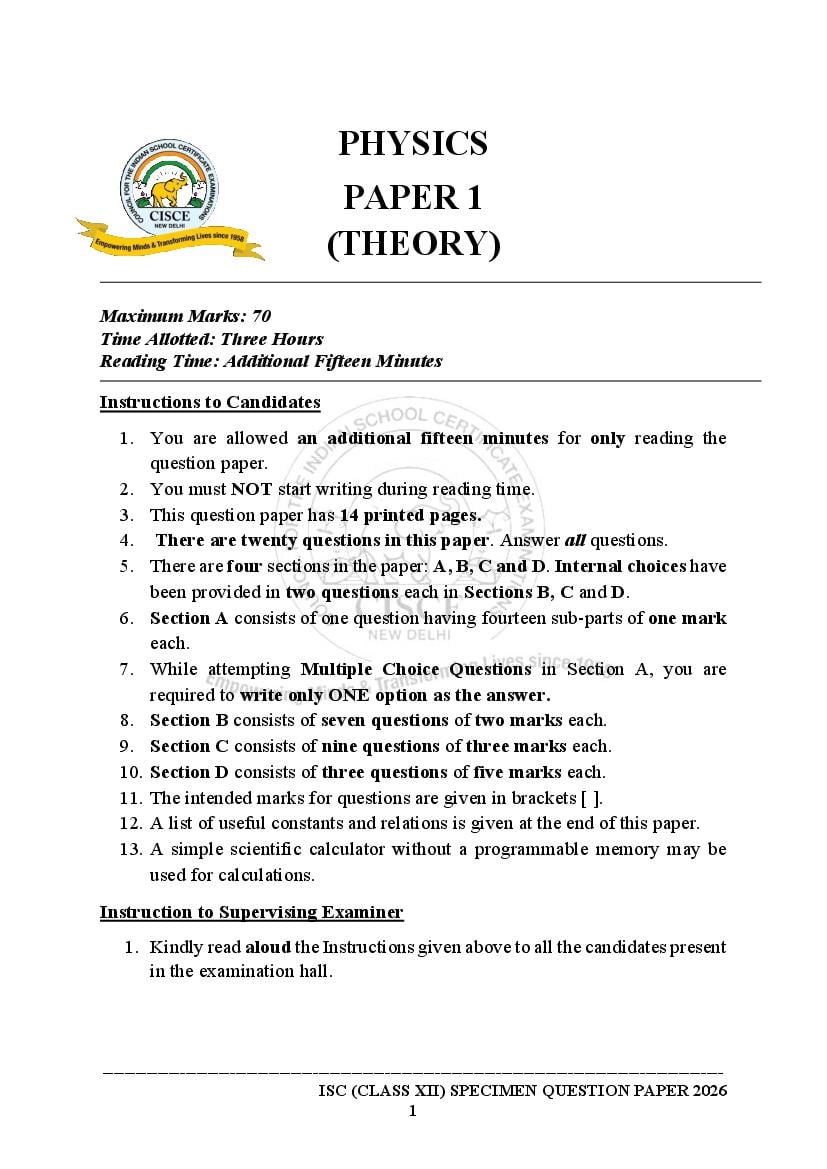
ISC Class 12 Specimen Paper Physics – Text
Read the full text of this sample paper below — useful to quickly search, copy and reference the content online without downloading the PDF.
📄 View text version (24 pages)
Page 1
PAPER 1
(THEORY)
Maximum Marks: 70
Time Allotted: Three Hours
Reading Time: Additional Fifteen Minutes
Instructions to Candidates
1. You are allowed an additional fifteen minutes for only reading the
question paper.
2. You must NOT start writing during reading time.
3. This question paper has 14 printed pages.
4. There are twenty questions in this paper. Answer all questions.
5. There are four sections in the paper: A, B, C and D. Internal choices have
been provided in two questions each in Sections B, C and D.
6. Section A consists of one question having fourteen sub-parts of one mark
each.
7. While attempting Multiple Choice Questions in Section A, you are
required to write only ONE option as the answer.
8. Section B consists of seven questions of two marks each.
9. Section C consists of nine questions of three marks each.
10. Section D consists of three questions of five marks each.
11. The intended marks for questions are given in brackets [ ].
12. A list of useful constants and relations is given at the end of this paper.
13. A simple scientific calculator without a programmable memory may be
used for calculations.
Instruction to Supervising Examiner
1. Kindly read aloud the Instructions given above to all the candidates present
in the examination hall.
1
Page 2
Board Examination Question Paper and should be used as a practice tool. The questions for
the Board Examination can be set from any part of the syllabus, though the format of the
Board Examination Question Paper will remain the same as that of the Specimen Question
Paper. The weightage allocated to various topics, as given in the syllabus, will be strictly
adhered to.
SECTION A– 14 MARKS
Question 1
(A) In questions (i) to (vii) below, choose the correct alternative (a), (b), (c) or (d)
for each of the questions given below:
(i) Two point charges +50nc and -50nc separated a distance of 1mm are kept well [1]
inside a large sphere of radium 1m. Electric flux emanating from the sphere
is: (Analysis)
(a) 50 × 10 −12
Vm
(b) 50 × 10−9 Vm
(c) 50 × 10−6 Vm
(d) Zero
(ii) Three straight, parallel wires are coplanar and perpendicular to the plane of the [1]
page. The currents I1 and I3 are directed out of the page. If wire 3 experiences
no force due to the currents I1 and I2, then the current in the wire 2 is:
Figure 1 (Analysis)
(a) I2 = 2I1 and directed into the page
(b) I2 = 0.5I1 and directed into the page
(c) I2 = 2I1 and directed out of the page
(d) I2 = 0.5I1 and directed out of the page
(iii) The variation of magnetic susceptibility (x) with absolute temperature (T) for [1]
a diamagnetic substance is: (Recall)
(a) x
2
Page 3
x
(c) x
(d) x
T
(iv) The wavelength e of an electron and p of a photon of same energy E are [1]
related by: (Understanding)
(a) p e
(b) 1
p
e
(c) 2
p e
(d) p e
(v) In which of the following figures, is the p-n diode forward biased? (Recall) [1]
(P) +10 V
R
+5 V
(Q) R
10 V
(R) −12 V
R
−5 V
3
Page 4
R
+5 V
(a) Only (P), (Q) and (S)
(b) Only (R)
(c) Only (P) and (R)
(d) Only (Q) and (S)
(vi) When a beam of white light is incident on a prism, the prism: [1]
(Understanding)
(a) only disperses the incident light.
(b) only deviates the incident light.
(c) deviates as well as disperses incident light.
(d) neither deviates nor disperses incident light.
(vii) Given below are two statements marked, Assertion and Reason. Read the two [1]
statements and choose the correct option.
Assertion: The focal length of the convex mirror will increase, if the mirror
is placed in water.
Reason: The focal length of a convex mirror of radius R is equal to R/2.
(Analysis)
(a) Both Assertion and Reason are true and Reason is the correct
explanation for Assertion.
(b) Both Assertion and Reason are true but Reason is not the correct
explanation for Assertion.
(c) Assertion is true and Reason is false.
(d) Assertion is false and Reason is true.
(B) Answer the following questions briefly:
(i) Current I flowing through a metallic wire is gradually increased. [1]
Show graphically how heating power (P) developed in it varies with the
current (I). (Application)
(ii) State one method to minimise flux loss in a transformer. (Recall) [1]
(iii) Why are giant telescopes of reflecting type? Give any one scientific reason. [1]
(Recall)
(iv) Give any one example where a ray of light travelling from one optical medium [1]
to another travels undeviated. (Understanding)
4
Page 5
through a potential difference V. When V is varied, de-Broglie wavelength ()ג
of the particles varies as shown in graphs below. Which graph is for heavier
particles and why? (Analysis)
(vi) What happens when an electron collides with a positron? (Recall) [1]
(vii) What is the direction of flow of electrons in a solar cell? (Recall) [1]
SECTION B – 14 MARKS
Question 2 [2]
(i) Find the capacitance of the following combinations between terminals A and
B. Area of each plate is A and separation between nearest two plates is ‘d’.
(Analysis)
(a)
Figure 2
(b)
Figure 3
OR
(ii) The current (I)-voltage (V) graphs for a conductor are given at two different
temperatures T1 and T2. (Analysis)
(a) At which temperature T1 or T2 is the resistance higher?
(b) Which temperature T1 or T2 is higher?
5
Page 6
Arrangement of an oxygen ion and two hydrogen ions in a water molecule is shown
in Figure 4 below.
Calculate electric dipole moment of water molecule. Express your answer in terms of
e (charge on hydrogen ion), l and θ. H+ (Application)
l
-
θ
-
l
H+
Figure 4
Question 4 [2]
(i) Two cells of same emf E, but different internal resistance r1 and r2 are connected
to an external resistance R as shown in Figure 5 given below. The voltmeter V
reads zero. Obtain an expression for R in terms of r1 and r2. (Assume that the
voltmeter V is of infinite resistance). (Application)
V
E E
r1 r2
R
Figure 5
OR
(ii) Ramesh performed an experiment to determine an unknown resistance R using
the circuit shown in Figure 6 below. X is a resistance box and PQ is a 100cm
potentiometer wire. He closed the key and inserted X = 1Ω, 2Ω ….. and
recorded the null point (l) corresponding to different values of X.
Figure 6 (Application)
6
Page 7
(b) Write down a relation required to calculate the resistance R in terms of X
and (l).
Question 5 [2]
Two moving coil galvanometers G1 and G2 are identical except that they have 50 turns
and 20 turns and resistance of 10Ω and 1Ω respectively. Perform necessary
calculations to check which one has greater voltage sensitivity.
(Application)
Question 6 [2]
Two similar convex lenses are made up of two different materials as shown in
Figures 7 and 8 below. Find the number of images formed in the following set ups:
(Application)
(i)
Figure 7
(ii)
Figure 8
Question 7 [2]
Name the electromagnetic wave used in: (Recall)
(a) radars
(b) crystallography
Question 8 [2]
In the photoelectric effect, the maximum kinetic energy of the emitted photoelectron
is ‘a’ and the work function of the metal is W0. If the frequency of incident radiation
is made ‘K’ times, then calculate the change in maximum KE of the ejected electron.
(Application)
7
Page 8
Question 9 [3]
Obtain an expression for electric potential (V) at a point near a point charge ‘Q’.
(Recall)
Question 10 [3]
(i) Five identical charges Q = 2𝜇𝐶 are placed equidistant on a semicircle as shown
in Figure 9. Another point charge q = 1𝜇𝐶 is kept at the center of the circle of
radius 2cm. Calculate the electrostatic force experienced by the charge q.
(Application)
Q
Q
Q
q
Q
Q
Figure 9
OR
(ii) Using Kirchoff’s laws of electrical networks, calculate the current I3.
(Application)
A I1 B I3
C
I1 I2
I3
2Ω 6Ω
8Ω
33V, 24V,
1Ω 2Ω
I3
F D
E
Figure 10
8
Page 9
Using Ampere circuital law, obtain an expression for magnetic field ‘B’ at a point at
a perpendicular distance ‘r’ from a long current carrying conductor. (Recall)
Question 12 [3]
(i) A student records the following data for the magnitudes (B) of the magnetic
field at axial points at different distances x (See Figure 11 given below) from
the centre O of a circular coil of radius a carrying a current I.
Verify (for any two) that these observations are in good agreement with the
expected theoretical values of B. (Application)
X x=0 x=a x = 2a x = 3a
B B0 B0 B0 B0
2√2 5√5 10√10
Figure 11
OR
(ii) An electron moving along positive X axis with a velocity of 8 ×10⁷ ms-1 enters
a region having uniform magnetic field B = 1·3 × 10-3 T along positive Y axis.
(Application)
(a) Explain why the electron describes a circular path.
(b) Calculate the radius of the circular path described by the electron.
9
Page 10
Study the diagram shown in Figure 12 given below.
Figure 12
Identify the following in Figure 12. (Understanding)
(i) A primary wavefront
(ii) A secondary wavefront
(iii) A wave normal
Question 14 [3]
In Young’s double slit experiment, show that fringe width 𝜔 (fringe separation) is
given by
λD
𝜔= d
where the terms have their usual meaning. (Recall)
Question 15 [3]
With reference to the lens maker’s formula, answer the following questions:
(Understanding)
Figure 13
10
Page 11
(a) refraction at first spherical surface.
(b) refraction at second spherical surface.
(ii) Combine these two expressions / equations to obtain an expression for focal
length of the lens.
Question 16 [3]
(i) A student studies details of a microorganism with the help of an instrument.
Name the instrument used by him. (Recall)
(ii) Draw a labelled ray diagram of an image formed by this instrument, assuming
(Recall)
(a) a small upright object.
(b) image lies at least distance of distinct vision.
Question 17 [3]
In a hydrogen atom, an electron jumps from the first excited state to the ground state,
and a photon is emitted. This photon is incident on a metal surface having a work
function of 2eV. Calculate the stopping potential of the electron emitted from the
metal surface. (Analysis)
SECTION D – 15 MARKS
Question 18 [5]
(i) (a) Define the co-efficient of self-inductance. (Recall)
200
(b) (1) Consider an A.C. source of frequency(
л
) Hz applied across a
coil. For each value of V- I in the tabulation, evaluate Inductive
reactance and Self – Inductance of the coil. (Analysis)
S.No. V(volt) I(A) Inductive Self - Inductance
Reactance
1 3.0 0.5
2 6.0 1.0
3 9.0 1.5
(2) If a D.C. source be connected to the same coil, what would be the
value of inductive reactance? (Analysis)
OR
11
Page 12
of A.C. with frequency in a series LCR circuit and obtained the graphs as
shown below. They all used an AC source of the same emf and inductance of
the same value.
f f0 f
Figure 14
(a) Who used minimum resistance? (Analysis)
(b) In which case will the quality Q factor be maximum? (Analysis)
(c) What did the students conclude about the nature of impedance at
resonant frequency (f0)? (Analysis)
(d) An ideal capacitor is connected across 220V, 50Hz, and 220V, 100Hz
supplies. Find the ratio of current flowing through it in the two cases.
(Application)
Question 19 [5]
(i) (a) Study the graph shown below and answer the questions that follow.
(Recall)
Indicate which region corresponds to:
(1) Nuclei prone to fission
(2) Nuclei prone to fusion
(3) Most stable nuclei
12
Page 13
+2e, mass = 4mp) approaches a gold nucleus (Z = 79), it is continuously
repelled, so it loses its kinetic energy(K) and its potential energy
increases. Finally, -particle comes to rest momentarily when whole of
the kinetic energy is change into the potential energy of the charge at
that distance from the nucleus. Let this distance be ro after which -
particle returns back again due to electrostatic repulsion.
Using the above information, derive an expression for ro. (Application)
OR
(ii) (a) In an atom X, electrons absorb the energy from an external source.
This energy “excites” the electrons from a lower-energy level to a
higher-energy level around the nucleus of the atom. When electrons
return to the ground state, they emit photons.
Figure 15 below is the energy level diagram of atom X with three
energy levels, E1 = 0·00eV, E2 = 1·78eV and E3 = 2·95eV. The ground
state is considered 0 eV for reference.
E3 2∙95 eV
E2 1∙78 eV
E1 0 eV
Figure 15
What wavelength of radiation is needed to excite the atom to energy
level E2 from E1? (Application)
(b) According to Bohr’s theory of hydrogen atom, calculate (Application)
(1) angular momentum of the electron in second Bohr orbit.
(2) radius of the third Bohr orbit.
Question 20 [5]
(i) A band gap is the distance between the valence band of electrons and the
conduction band. Essentially, the band gap represents the minimum energy that
is required to excite an electron up to a state in the conduction band where it
can participate in conduction. The lower energy level is the valence band, and
thus if a gap exists between this level and the higher energy conduction band,
energy must be input for electrons to become free.
An LED is made of a p-type semiconductor material (which has a higher
concentration of "holes" or positive charge carriers) and an n-type
semiconductor material (which has a higher concentration of electrons or
negative charge carriers). This recombination process releases energy in the
form of light and heat. The specific wavelength (and therefore the colour) of
the emitted light depends on the energy band gap of the semiconductor material
used.
I-V characteristic of LED bulb is given below.
13
Page 14
Identify the wavelength that has: (Application)
(a) The maximum energy gap
(b) The minimum energy gap
(ii) E is the energy of the incident photon and Eg is energy gap, which is produced
across the depletion layer. What will happen in the following cases:
(Understanding)
(a) E > Eg
(b) E = Eg
(c) E < Eg
USEFUL CONSTANTS AND RELATIONS
1. Planck's constant h = 6·6 × 10-34 Js
2. Speed of light in vacuum c = 3 × 10⁸ ms-1
Charge of a proton = Charge of e
3. = + 1·6 × 10-19 C
an electron
4. Mass of an electron m = 9·1 × 10-31 Kg
5. Bohr radius ao = 5·3 × 10-11 m
Ionisation energy of hydrogen
6. E = 13·6 eV
atom
7. One electron volt 1 eV = 1·6 × 10-19 J
14
Page 15
PAPER 1
(THEORY)
ANSWER KEY
(Equivalent answers are acceptable.)
SECTION A– 14 MARKS
Question 1
(A) In answering Multiple Choice Questions, candidates have to write either
the correct option number or the statement against it. Please note that
only ONE correct answer should be written.
(i) (d) or Zero [1]
(ii) (c) or I2 = 2I1 and directed out of the page [1]
(iii) (a) or [1]
x
2
(iv) (c) or p e [1]
(v) (b) or Only (R) [1]
(vi) (c) or deviates as well as disperses incident light. [1]
(vii) (d) or Assertion is false and Reason is true. [1]
(B) Answer the following questions briefly:
(i) [1]
(ii) By winding the primary and secondary coils close together, ideally one over [1]
the other (interleaving), and by using a core with a high permeability.
ISC (CLASS XII) SPECIMEN ANSWER KEY 2026
1
Page 16
aberration. / Images formed by a reflecting telescope are free from the defect
of spherical aberration. / Images formed by a reflecting telescope are brighter.
(iv) When a ray of light is incident normally on the surface of separation [1]
medium 1
medium 2
OR
When refractive index of medium 1is equal to refractive index of medium 2.
OR
𝜇1 = 𝜇2
(v) MB >MA as slope of line B >slope of line A. S =
ℎ
[1]
√2𝑚𝑒𝑉
OR
Graph B refers to heavier particles.
(vi) They annihilate each other producing gamma ray photons. [1]
(vii) Electrons move towards the n-type material, and holes move towards the [1]
p-type material, creating a flow of current when a circuit is connected.
SECTION B – 14 MARKS
Question 2 [2]
(i) (a) When A and B are connected to the positive and negative plates of the
battery respectively, the charges will appear on them as:
It is clear from the figure that two capacitors form which are in parallel.
Thus,
20A
CAB = 2C = d
ISC (CLASS XII) SPECIMEN ANSWER KEY 2026
2
Page 17
30A
There are three capacitors in parallel. Thus, CAB = 3C = d
OR
(ii) (a) For the I-V graph, the slope of the I-V graph gives the conductance
𝑉 1
R = 𝐼 = tanθ
Since θ1 > θ2
tanθ1 > tanθ2
So Resistance at T1 < Resistance at T2.
(b) Since the resistance of a conductor rises with temperature and ‘R’ at T2
is higher than ‘R’ at T1, so T2 > T1.
Question 3 [2]
P1 = P2 = e × l
P = 2p cos α = 2 e × l cos (θ/2)
Question 4 [2]
(i) The total emf in the circuit is, 𝐸+𝐸=2𝐸
The total resistance in the circuit is, 𝑅+𝑟1+𝑟2
2𝐸
The current in the circuit is given by: 𝐼 = 𝑅+𝑟 +𝑟
1 2
Given V = E - I𝑟1 = 0
∴ I𝑟1 = E
2𝐸
∴ × 𝑟1 = 𝐸
𝑅 + 𝑟1 + 𝑟2
R = 𝑟1 − 𝑟2
OR
(ii) (a) Wheatstone Bridge Principle
(b) R=
𝑋(100−𝑙)
𝑙
ISC (CLASS XII) SPECIMEN ANSWER KEY 2026
3
Page 18
𝐵𝐴𝑁
Voltage sensitivity 𝛽 = 𝐶𝑅
𝐵. 𝐴. 50 𝐵𝐴
𝛽 (𝐺1 ) = =5
𝐶. 10 𝑐
𝐵. 𝐴. 20 𝐵𝐴
𝛽 (𝐺2 ) = = 20
𝐶. 1 𝑐
𝐺2 has greater voltage sensitivity.
Question 6 [2]
(i) Two images
(ii) One image
Question 7 [2]
(i) Microwaves
(ii) X rays
Question 8 [2]
a1 =hv – Wo
a2 = h (kv) –Wo
a2 – a1 = (khv –Wo) – (hv –Wo)
= khv – hv
= (k–1) hv
ISC (CLASS XII) SPECIMEN ANSWER KEY 2026
4
Page 19
Question 9 [3]
dx
B A
O P
r
Q +1
x
1 𝑄×1 1 𝑄
F = 4𝜋∈ . 𝑥 2 = ( 4𝜋∈ ) 𝑥 2
0 0
dW = -Fdx
1 𝑄
= - ( 4𝜋∈ ) 𝑥 2 dx
0
𝑟 𝑟 1 𝑄
V = W = ∫ထ 𝑑𝑊 = ∫ထ − ( 4𝜋∈ ) 𝑥 2 𝑑𝑥
0
1 𝑄
V = ( 4𝜋∈ ) 𝑟
0
This is the desired expression.
Question 10 [3]
(i) Force acting on q due to Q1 and Q5 are opposite direction, so cancel to each
other.
𝑞𝑄3
Force acting on q due to Q3 is F3 = 4𝜋𝜀 𝑅2
𝑜
Force acting on q due to Q2 and Q4
Resolving in two-component method:
(1) Vertical Component:
Q2 Sin θ and Q4 Sinθ are equal and opposite directions, so they cancel to each
other.
(2) Horizontal Component:
Q2 Sin θ and Q4 cos θ are equal and same direction, so they can get added.
F24 = F2q + F4q = F2 cos 45° + F4 cos 45°
𝑞𝑄2 𝑞𝑄4
F24 = 4𝜋𝜀 𝑅2 cos 45° + 4𝜋𝜀 𝑅2 cos 45°
𝑜 𝑜
Resultant net force F
ISC (CLASS XII) SPECIMEN ANSWER KEY 2026
5
Page 20
(ii) I3 = I3 + I2
Applying KVL to the loop ABCDEFA,
2I1 + 8 (I1 + I2 ) + 1I1 = 33
11I1 + 8I2 = 33
Applying KVL to the loop BCDEB,
6I2 + 8 (I1 + I2 ) + 2I2 = 26
8I1 + 9I2 = 24
On solving, we get
I1 = 3A, I2 = 0
∴ I3 = 3A
Question 11 [3]
I
r
dl
I
By Ampere Circuital law,
⃗⃗⃗ = 𝜇0 𝐼
⃗⃗⃗ 𝑑𝑙
∮ 𝐵.
∮ 𝐵𝑑𝑙 cos 𝜃 ° = 𝜇0 𝐼
∮ B𝑑𝑙 = 𝜇0 𝐼
B ∮ 𝑑𝑙 = 𝜇0 𝐼
B.2𝜋𝑟 = 𝜇0 𝐼
𝜇0 𝐼
𝐵 = 2𝜋𝑟
Question 12 [3]
(i) The expression for B at an axial point of a circular coil carrying current is,
0 2NI(a2)
B= , for N turns
4 r3
0 2I(a2)
B= , for N= 1 turn
4 r3
0 I
At the center, x = 0: = 2 a
ISC (CLASS XII) SPECIMEN ANSWER KEY 2026
6
Page 21
At x = a: = 2√2
B0
At x = 2a : = 5√5
B0
At x = 3a : = 10√10
OR
(ii) (a) Because force exerted by the magnetic field is always perpendicular to
its velocity. So, it provides the necessary centripetal force to the
electron.
(b) 𝑒 𝑣
=
𝑚 𝐵𝑟
1·6 × 10−19 8 × 10 × 7
=
9·1 × 10−31 1·3 × 10−3 × 𝑟
So, r = 0·35m
Question 13 [3]
(i) ABCD
(ii) A’B’C’D’
(iii) SDD’ or SCC’ or SBB’ or SAA’
Question 14 [3]
P
A ym
𝜃
d M
𝜃
O
B N
D
Because 𝜃 is small,
tan 𝜃 ≈ 𝑠𝑖𝑛 𝜃
𝑦𝑚 𝐵𝑁 𝑚λ
= =
𝐷 𝐴𝐵 𝑑
𝑚λ
𝑦𝑚 = 𝑑
𝜔 = 𝑦𝑚 − 𝑦𝑚−1
𝑚λD λD
= 𝑑 − (𝑚 − 1) 𝑑
λD
𝜔= (Proved)
𝑑
ISC (CLASS XII) SPECIMEN ANSWER KEY 2026
7
Page 22
(i) (a) 𝜇1 𝜇2 𝜇2 − 𝜇1
+ ′=
𝑢 𝜗 𝑅1
1 𝜇2 𝜇2 − 1
+ ′=
𝜇 𝜗 𝑅1
(b) 𝜇2 𝜇2 𝜇2 − 1
′
+ =
−𝜗 𝜗 𝑅2
(ii) Adding
1 1 1 1
+ 𝜗 = (𝜇2 − 1) (𝑅 + 𝑅 )
𝑢 1 2
When u = ထ, 𝜗 = 𝑓
1 1 1 1
+ 𝑓 = (𝜇2 − 1) (𝑅 + 𝑅 )
ထ 1 2
1 1 1
∴ = (𝜇2 − 1) (𝑅 + 𝑅 )
𝑓 1 2
Question 16 [3]
(i) Compound microscope
(ii)
Question 17 [3]
E = -3.4 –(-13.6) = 10.2ev
eVo = E – Wo
= 10.2 – 2
Or, V = 8.2V
ISC (CLASS XII) SPECIMEN ANSWER KEY 2026
8
Page 23
Question 18 [5]
(i) (a) It is defined as magnetic flux linked with the solenoid when unit
current flows through it.
Or
It is defined as a ratio of magnetic flux linked with the solenoid to the
current flowing through it.
(b) (1)
S.No. V(volt) I(A) Inductive Self -
Reactance Inductance
1 3∙0 0∙5 6∙0 Ω 0∙015H
2 6∙0 1∙0 6∙0 Ω 0∙015H
3 9∙0 1∙5 6∙0 Ω 0∙015H
(2) Zero
OR
(ii) (a) Resistance used by X is the least and resistance used by Z is the
maximum.
(b) Q will be maximum for X.
(c) At resonance impedance is equal to ohmic resistance.
(d) In a capacitor the current is dependent directly on frequency
I1 1
I2 = 2
Question 19 [5]
(i) (a) (1) Region C
(2) Region A
(3) Region B
(b) At the distance of closest approach 𝑟0 this energy has changed into
potential energy U of the -particle.
1 (𝑍𝑒∙2𝑒)
U = 4𝜋𝜖 ×
0 𝑟0
where Z = 79 is the atomic number of gold nucleus
Thus we have,
1 2(79)𝑒 2
K = 4𝜋𝜖 ×
0 𝑟0
1 158𝑒 2
𝑟0 = 4𝜋𝜖 ×
0 𝐾
OR
ISC (CLASS XII) SPECIMEN ANSWER KEY 2026
9
Page 24
ℎ𝑐
= 𝐸2 − 𝐸1
λ
6∙6 × 10−34 ×3 × 108
= = (1∙ 78 − 0) × 1 ∙ 6 × 10⁻¹⁹
λ
6 ∙ 6 × 3 × 10−26
λ=
1 ∙ 78 × 1 ∙ 6 × 10⁻¹⁹
λ = 6 ∙ 952 × 10−7 𝑚
(b) (1) 2ℎ
𝑙2 = 2h =
2𝜋
6 ∙ 6 × 10−34
=
3 ∙ 14
= 2 ∙ 1 × 10⁻³⁴ 𝐽𝑠
(2) 𝑟𝑛 = 𝑛2 𝑎0
𝑟3 = 32 × 5 ∙ 3 × 10−11
= 47 ∙ 7 × 10⁻¹¹ 𝑚
Question 20 [5]
(i) (a) 3
(b) 1
(ii) (a) Emission of photon with energy
(b) Emission of photon with no energy
(c) No emission of photon
ISC (CLASS XII) SPECIMEN ANSWER KEY 2026
10
Document Details
| Board / Org | CISCE |
| Exam | Class 12 |
| Type | Sample Paper |
| Pages | 24 |
| Updated | 24 Sep 2026 |