GATE 2022 Question Paper XL Life Sciences
Finished viewing? Save it for later —
Download GATE 2022 Question Paper XL Life Sciences (PDF · 71 pages)About GATE 2022 Question Paper XL Life Sciences
GATE 2022 Question Paper XL Life Sciences is available here for free download. Published by IIT for Graduate Aptitude Test in Engineering, this question paper can be viewed online or downloaded as a PDF (71 pages). Candidates preparing for Graduate Aptitude Test in Engineering can use GATE 2022 Question Paper XL Life Sciences to understand the exam pattern, the type of questions asked, and the overall difficulty level.
Frequently Asked Questions
How can I download GATE 2022 Question Paper XL Life Sciences?
Open this page and click the Download button to save GATE 2022 Question Paper XL Life Sciences as a PDF. It is completely free on AglaSem Docs.
Is GATE 2022 Question Paper XL Life Sciences free to download?
Yes. GATE 2022 Question Paper XL Life Sciences can be viewed online and downloaded as a PDF free of cost on AglaSem Docs.
How many pages does GATE 2022 Question Paper XL Life Sciences have?
GATE 2022 Question Paper XL Life Sciences contains 71 pages, which you can read online or download together as a single PDF.
Where can I find more Graduate Aptitude Test in Engineering study material?
You can find more Graduate Aptitude Test in Engineering question papers, sample papers, syllabus, and answer keys on AglaSem Docs.
GATE 2022 Question Paper XL Life Sciences – Text
Read the full text of this question paper below — useful to quickly search, copy and reference the content online without downloading the PDF.
📄 View text version (71 pages)
Page 1
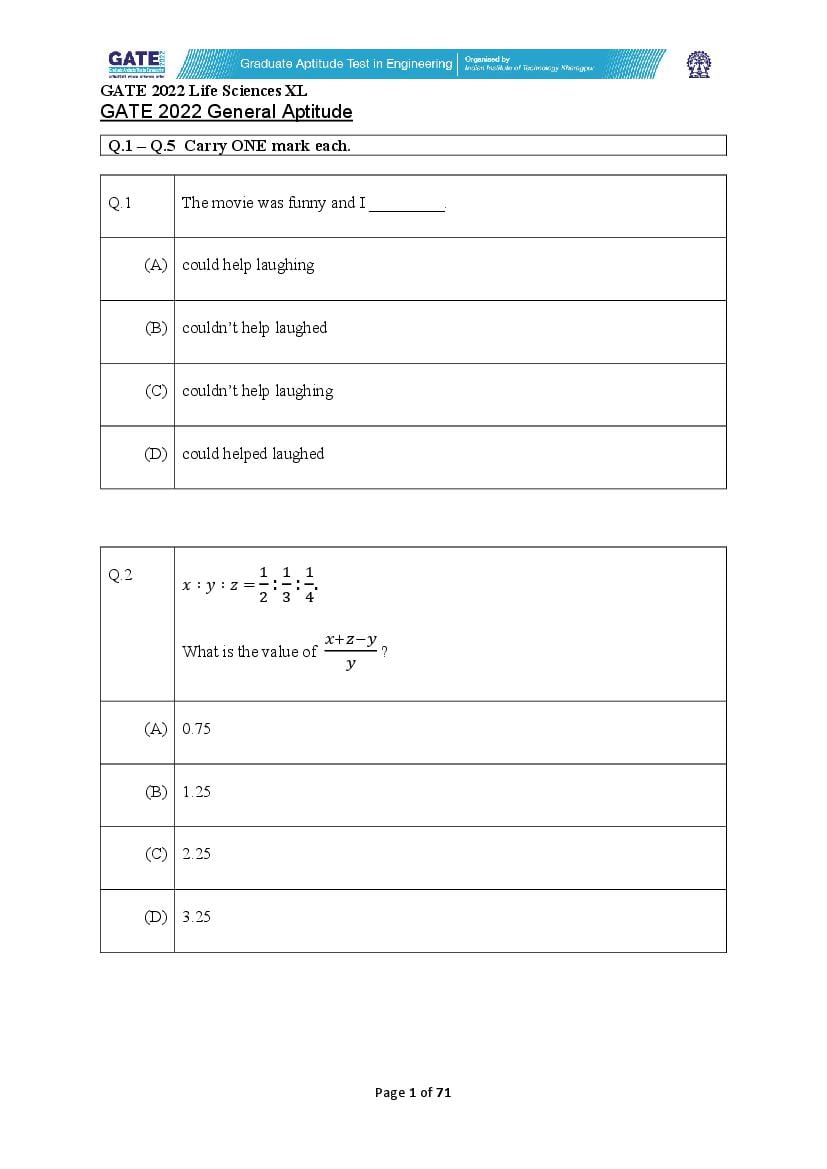
Q.1 – Q.5 Carry ONE mark each.
Q.1 The movie was funny and I _________.
(A) could help laughing
(B) couldn’t help laughed
(C) couldn’t help laughing
(D) could helped laughed
Q.2
𝑥∶𝑦∶𝑧= : : .
What is the value of ?
(A) 0.75
(B) 1.25
(C) 2.25
(D) 3.25
Page 1 of 71
Page 2
Both the numerator and the denominator of are increased by a positive
integer, 𝑥, and those of are decreased by the same integer. This operation
results in the same value for both the fractions.
What is the value of 𝑥?
(A) 1
(B) 2
(C) 3
(D) 4
Page 2 of 71
Page 3
following outcome.
150 students are interested in Mathematics.
200 students are interested in Physics.
175 students are interested in Chemistry.
50 students are interested in Mathematics and Physics.
60 students are interested in Physics and Chemistry.
40 students are interested in Mathematics and Chemistry.
30 students are interested in Mathematics, Physics and Chemistry.
Remaining students are interested in Humanities.
Based on the above information, the number of students interested in
Humanities is
(A) 10
(B) 30
(C) 40
(D) 45
Page 3 of 71
Page 4
For the picture shown above, which one of the following is the correct picture
representing reflection with respect to the mirror shown as the dotted line?
(A)
(B)
(C)
(D)
Page 4 of 71
Page 5
Q.6 In the last few years, several new shopping malls were opened in the city. The
total number of visitors in the malls is impressive. However, the total revenue
generated through sales in the shops in these malls is generally low.
Which one of the following is the CORRECT logical inference based on the
information in the above passage?
(A) Fewer people are visiting the malls but spending more
(B) More people are visiting the malls but not spending enough
(C) More people are visiting the malls and spending more
(D) Fewer people are visiting the malls and not spending enough
Page 5 of 71
Page 6
six months is in the ratio 3: 4: 5. After six months, they had to increase their
monthly investments by 10%, 15% and 20%, respectively, of their initial
monthly investment. The new investment ratio was kept constant for the next
six months.
What is the ratio of their shares in the total profit (in the same order) at the end
of the year such that the share is proportional to their individual total investment
over the year?
(A) 22 : 23 : 24
(B) 22 : 33 : 50
(C) 33 : 46 : 60
(D) 63 : 86 : 110
Page 6 of 71
Page 7
Line L1: 2𝑥 − 3𝑦 = 5
Line L2: 3𝑥 + 2𝑦 = 8
Line L3: 4𝑥 − 6𝑦 = 5
Line L4: 6𝑥 − 9𝑦 = 6
Which one among the following is the correct statement?
(A) L1 is parallel to L2 and L1 is perpendicular to L3
(B) L2 is parallel to L4 and L2 is perpendicular to L1
(C) L3 is perpendicular to L4 and L3 is parallel to L2
(D) L4 is perpendicular to L2 and L4 is parallel to L3
Page 7 of 71
Page 8
statements.
Statement 1: Some soaps are clean.
Statement 2: All clean objects are wet.
Conclusion I: Some clean objects are soaps.
Conclusion II: No clean object is a soap.
Conclusion III: Some wet objects are soaps.
Conclusion IV: All wet objects are soaps.
Which one of the following options can be logically inferred?
(A) Only conclusion I is correct
(B) Either conclusion I or conclusion II is correct
(C) Either conclusion III or conclusion IV is correct
(D) Only conclusion I and conclusion III are correct
Page 8 of 71
Page 9
movement. The initial position of the ant is at point P facing east.
The ant first turns 72o anticlockwise at P, and then does the following two
steps in sequence exactly FIVE times before halting.
1. moves forward for 10 cm.
2. turns 144o clockwise.
The pattern made by the trace left behind by the ant is
(A)
(B)
(C)
(D)
Page 9 of 71
Page 10
Q.11 Consider a second order reaction,
The concentration of A is represented as [A].
Which of the following is the CORRECT plot for determining the rate constant for
the above reaction?
(A)
(B)
(C)
(D)
Page 10 of 71
Page 11
(A) Al
(B) Si
(C) P
(D) S
Q.13 Which among the following metal ions has the highest enthalpy of hydration?
(Assume the given metal ions have the same counter ion.)
Given: Atomic numbers of Ti, V, Cr and Mn are 22, 23, 24 and 25, respectively.
(A) Ti2+
(B) V2+
(C) Cr2+
(D) Mn2+
Page 11 of 71
Page 12
(A) PH3
(B) PF3
(C) NF3
(D) NH3
Q.15 Which of the following is the CORRECT statement about hexoses?
(A) D-mannose is C- 4 epimer of D-glucose
(B) D-galactose is C- 2 epimer of D-glucose
(C) D-glucose and L-glucose are diastereomers
(D) D-glucose and D-galactose are diastereomers
Page 12 of 71
Page 13
(A) adenine, cytosine, guanine and thymine
(B) adenine, guanine, thymine and uracil
(C) adenine, cytosine, thymine and uracil
(D) cytosine, guanine, thymine and uracil
Q.17 The CORRECT order of basicity for the following compounds is
(A) I > II > III
(B) II > III > I
(C) II > I > III
(D) III > I > II
Page 13 of 71
Page 14
x × 10 – 4 S m2 mol–1 at 25 oC.
The value of x is (round off to the nearest integer)
Given:
Electrolyte Limiting molar conductance
at 25 oC in 10 – 4 S m2 mol– 1
HBr 427.95
KBr 151.64
CH2BrCOOK 112.72
(A) 164
(B) 195
(C) 389
(D) 467
Q.19 A sample of benzene, contaminated with a non-volatile and non-ionic solute, boils
at 0.31°C higher than that of pure benzene. The molality of the solute in the
contaminated solution is ______ (round off to two decimal places).
Given: Gas constant = 8.314 J K1 mol1
Molecular weight of benzene is 78.11 g mol1
Normal boiling point of benzene is 80.1°C
Enthalpy of vaporization of benzene is 30.76 kJ mol1
Page 14 of 71
Page 15
Q.20 Among the following statements about cobalt complexes, which is/are CORRECT?
Given: Atomic number of Co is 27
(A) [Co(NH3)4]2+ exhibits square planar geometry
(B) [Co(en)3]3+ does not show optical isomerism (en = ethylenediamine)
(C) [Co(H2O)6]3+ is paramagnetic in nature
(D) [Co(NH3)5Cl)]2+ shows ligand-to-metal charge transfer
Page 15 of 71
Page 16
The CORRECT statement(s) related to mono-chlorination at carbon-2 position
is/are
(A) The reaction proceeds through alkyl radical intermediate
(B) Complete inversion of configuration at carbon-2 takes place
(C) Complete retention of configuration at carbon-2 takes place
(D) A mixture of enantiomers is formed
Page 16 of 71
Page 17
where E is enzyme, S is substrate, ES is enzyme-substrate complex and P is
product.
The CORRECT statement(s) for the above reaction is/are
(A) Maximum possible rate of product formation is dependent on k2 and initial
concentration of enzyme.
(B) For a low substrate concentration, the rate of product formation is first order with
respect to enzyme and also first order with respect to the substrate.
(C) The rate of product formation is independent of the concentration of enzyme-
substrate complex.
(D) For a very high substrate concentration, initial rate of product formation is zero
order with respect to the substrate.
Page 17 of 71
Page 18
The CORRECT pathway(s) involved in the reaction is/are
(A) E2 followed by isomerization
(B) E1 followed by isomerization
(C) SN1 followed by isomerization
(D) Isomerization through carbocation
Q.24 An aqueous solution of aspirin (HA) is prepared at pH 7.4. The ratio of
concentration of A and HA at equilibrium is ______ (round off to the nearest
integer).
Given: Ka of aspirin is 3.98 × 10 – 4
Q.25 The total number of 3-centre-2-electron bonds in B4H10 is ______ (in integer).
Page 18 of 71
Page 19
is ______ (round off to one decimal place).
Given: Gas constant = 8.314 J K–1 mol–1
ΔfGo of 1-butene = +71.39 kJ mol–1
ΔfGo of trans-2-butene = + 63.06 kJ mol–1
Q.27 A 16 mW monochromatic light emits 4×10 16 photons in 1 second. When this light
incidents on a metal strip, photoelectrons are emitted. The wavelength of the emitted
photoelectrons (in Å) is ______ (round off to one decimal place).
Given: Work function of the metal = 2.0 eV
Charge of an electron = 1.6 × 10⁻¹⁹ C
Mass of an electron = 9.1 × 1031 kg
Planck’s constant = 6.626 × 10⁻³⁴ J s
Page 19 of 71
Page 20
Q.28 Which of the immune cells listed below are agranular?
P. Eosinophils
Q. Mast cells
R. Monocytes
S. T-cells
(A) P and Q only
(B) Q and R only
(C) R and S only
(D) S and P only
Q.29 Which one of the following enzymes is located in the outer mitochondrial
membrane?
(A) Citrate synthase
(B) Fumarase
(C) Monoamine oxidase
(D) Succinate dehydrogenase
Page 20 of 71
Page 21
NOT correct?
(A) It catalyzes nick translation.
(B) Its absence is lethal to E. coli.
(C) It synthesizes a complementary DNA strand using a single-stranded template.
(D) It possesses 3′ → 5′ exonuclease activity.
Q.31 Which one of the following compounds is NOT a translation inhibitor?
(A) Chloramphenicol
(B) Cycloheximide
(C) Puromycin
(D) Rifampicin
Q.32 A dye was allowed to undergo migration on a chromatographic paper using a
solvent. The dye, and the solvent-front migrated 5 and 20 𝑐𝑚, respectively, from
the point of origin. The retention factor (rounded off to two places of decimals) for
the dye is _____.
Q.33 The 𝑝𝐾 values of the carboxylic and amino groups of an amino acid with a
non-ionizable side chain are 2.17 and 9.13, respectively. The isoelectric point
(rounded off to two places of decimals) of this amino acid is _____.
Page 21 of 71
Page 22
molecule of CO2 in Calvin cycle is _____.
Q.35 The absorbance of a 5 × 10 𝑀 solution of tyrosine at 280 𝑛𝑚 wavelength is
0.75. The path length of the cuvette is 1 𝑐𝑚. The molar absorption coefficient at
the given wavelength in 𝑀 𝑐𝑚 , correct to the nearest integer, is _____.
Page 22 of 71
Page 23
Q.36 Filamentous photosynthetic algae were placed on a microscopic slide and
illuminated with light of different colors as illustrated.
Slide
Algae
Blue Green Yellow Red
The bacteria that are known to migrate towards the region of high 𝑂 were also
added uniformly on the slide. Which one of the following options illustrates the
distribution of bacteria along the length of the microscopic slide after
illumination?
(A)
(B)
(C)
(D)
Page 23 of 71
Page 24
translation system, which can generate proteins in all possible reading frames.
𝑅𝑁𝐴 : 5 − (𝐴𝐺) − 3
𝑅𝑁𝐴 : 5 − (𝐴𝐴𝐺) − 3
The 𝑅𝑁𝐴 translated product contained Arg and Glu.
The 𝑅𝑁𝐴 translated product contained Arg, Glu, and Lys.
Which one of the following codons directs the incorporation of Arg?
(A) AAG
(B) AGA
(C) GAA
(D) GAG
Q.38 Which of the following statements about endogenous synthesis of insulin are
correct?
P. Insulin is synthesized as preproinsulin.
Q. Preproinsulin is converted to proinsulin.
R. Single-site cleavage of proinsulin eliminates C chain.
S. Mature insulin consists of disulphide-linked A and B chains.
(A) P, Q, and R
(B) P, Q, and S
(C) P, R, and S
(D) Q, R, and S
Page 24 of 71
Page 25
(A) Aromatase
(B) 3β-hydroxysteroid dehydrogenase
(C) 5α-reductase
(D) 17β-hydroxysteroid dehydrogenase
Q.40 Purification of 6×His-tagged protein using Ni-NTA column is an example
of ________
(A) affinity chromatography
(B) hydrophobic-interaction chromatography
(C) ion-exchange chromatography
(D) size-exclusion chromatography
Q.41 Which of the following carbohydrates has/have a 𝛽1 → 4 glycosidic linkage?
(A) Cellulose
(B) Chitin
(C) Lactose
(D) Maltose
Page 25 of 71
Page 26
(A) It is secreted into colostrum.
(B) It is transported across the cell by transcytosis.
(C) Its secretion is facilitated by poly-Ig receptor.
(D) It primarily exists as a dimer in serum.
Q.43 The standard free energy changes for conversion of phosphoenol pyruvate (𝑃𝐸𝑃)
to pyruvate, and 𝐴𝑇𝑃 synthesis are shown below.
𝑃𝐸𝑃 + 𝐻 𝑂 ⇌ 𝑝𝑦𝑟𝑢𝑣𝑎𝑡𝑒 + 𝑃 ∆𝐺 = −61.9 𝑘𝐽 ∙ 𝑚𝑜𝑙
𝐴𝐷𝑃 + 𝑃 ⇌ 𝐴𝑇𝑃 + 𝐻 𝑂 ∆𝐺 = 30.5 𝑘𝐽 ∙ 𝑚𝑜𝑙
The starting concentrations of 𝑃𝐸𝑃, 𝐴𝐷𝑃, 𝑝𝑦𝑟𝑢𝑣𝑎𝑡𝑒, and 𝐴𝑇𝑃 are 25, 25, 50,
and 50 𝑚𝑀, respectively. The value of universal gas constant (R) is
8.315 𝐽 ∙ 𝑚𝑜𝑙 𝐾 . The actual free energy change in 𝑘𝐽 ∙ 𝑚𝑜𝑙 for the reaction
𝑃𝐸𝑃 + 𝐴𝐷𝑃 → 𝑝𝑦𝑟𝑢𝑣𝑎𝑡𝑒 + 𝐴𝑇𝑃
carried out at 37 ℃ will be _____ (rounded off to one place of decimal).
Q.44 The dissociation constant for a receptor-ligand pair is 0.25 × 10 𝑀. The ligand
was added to a solution of the receptor such that the receptor was 50% saturated
at equilibrium. Assume that the receptor has one ligand binding site. The
concentration of the free ligand at equilibrium in 𝑛𝑀, correct to the nearest
integer, should be _____.
Page 26 of 71
Page 27
substrate concentration of 0.5 × 10 𝑀. This enzyme follows Michaelis-Menten
kinetics. In the presence of a competitive inhibitor, the half-maximal velocity was
found at a substrate concentration of 1.5 × 10 𝑀. Given that the enzyme-
inhibitor pair has a dissociation constant of 2 × 10 𝑀, the concentration of the
competitive inhibitor in µ𝑀, rounded off to one place of decimal, was_____.
Q.46 A forty-times diluted sample of ssRNA gave an 𝐴 of 0.01. The concentration
of the ssRNA before the dilution in µ𝑔/𝑚𝐿 was _____ (correct to the nearest
integer).
Page 27 of 71
Page 28
Q.47 In Angiosperms, normally ‘Exarch Xylem’ occurs in
(A) dicot stem
(B) monocot stem
(C) dicot root
(D) dicot leaf
Q.48 ‘Quiescent Center’ is present in
(A) leaf meristem
(B) root apical meristem
(C) shoot apical meristem
(D) floral meristem
Page 28 of 71
Page 29
Agrobacterium tumefaciens, match Group-I (vir gene) and Group-II (coded
protein) in CORRECT combination.
Group-I Group-II
P. vir A I. Single strand T-DNA binding protein
Q. vir B II. Topoisomerase
R. vir E III. Membrane protein, channel for T-DNA
S. vir D IV. Sensor protein, constitutive expression
(A) P-IV, Q-III, R-II, S-I
(B) P-IV, Q-III, R-I, S-II
(C) P-IV, Q-II, R-I, S-III
(D) P-I, Q-III, R-II, S-IV
Q.50 Anomalous secondary growth is observed in
(A) Triticum
(B) Oryza
(C) Zea
(D) Dracaena
Page 29 of 71
Page 30
(A) Angular leaf spot of cotton
(B) Citrus canker
(C) Apple scab
(D) Leaf curl of papaya
Q.52 Phylogenetic system of classification is/are proposed by
(A) Carolus Linnaeus
(B) John Hutchinson
(C) Engler and Prantl
(D) Bentham and Hooker
Page 30 of 71
Page 31
(A) Open ocean
(B) Chaparral
(C) Deep sea
(D) Estuaries
Q.54 In NADP+-malic enzyme type C4 photosynthesis cycle, n molecule(s) of ATP is/are
required for the assimilation of one molecule of CO2. The value of n is ________
(in integer).
Page 31 of 71
Page 32
Q.55 An Arabidopsis thaliana mutant plant developed defective flowers with altered
floral organ identity and patterning. In this mutant, the four floral whorls contain
Sepal-Sepal-Carpel-Carpel, from the periphery to the center of the flower.
Based on the typical ABC model of floral organ patterning, which among the
following are mutated in this plant?
(A) Class A gene(s)
(B) Class B gene(s)
(C) Class C gene(s)
(D) Double mutant for Class A and Class C genes
Page 32 of 71
Page 33
in Group-II in CORRECT order.
Group-I Group-II
P. Myrcene I. Sesquiterpene
Q. β-Farnesene II. Cyanogenic glycoside
R. Amygdalin III. Flavone
S. Nicotine IV. Alkaloid
T. Luteolin V. Monoterpene
(A) P-I, Q-V, R-II, S-IV, T-III
(B) P-V, Q-II, R-IV, S-I, T-III
(C) P-II, Q-III, R-IV, S-V, T-I
(D) P-V, Q-I, R-II, S-IV, T-III
Page 33 of 71
Page 34
Group-III (subcellular localization of the enzyme and the associated metabolic
process) in CORRECT combination.
Group-I Group-II Group-III
P. PEP I. 2 Glycolate + 2 O2 = a. Cytosol –
Carboxylase 2 Glyoxylate + 2 H2O2 C4 cycle
II. Pyruvate + NAD+ + CoA = b. Peroxisome –
Q. Rubisco
Acetyl-CoA + CO2 + NADH C2 cycle
c. Mitochondria
R. Glycolate III. Phosphoenolpyruvate +
– aerobic
oxidase HCO3– = Oxaloacetate + Pi
respiration
IV. 3 (Ribulose 1,5-bisphosphate)
S. Pyruvate d. Chloroplast –
+ 3 CO2 + 3 H2O =
dehydrogenase C3 cycle
6 (3-phosphoglycerate) + 6 H+
(A) P-III-a, Q-IV-d, R-I-b, S-II-c
(B) P-II-a, Q-III-d, R-I-b, S-IV-c
(C) P-IV-a, Q-II-b, R-I-d, S-III-c
(D) P-IV-a, Q-II-d, R-I-b, S-III-c
Page 34 of 71
Page 35
combination.
Group-I Group-II
P. Kanamycin I. pmi
Q. Hygromycin II. bar
R. Phosphinothricin III. nptII
S. Mannose IV. ptxD
V. dhfr
VI. hpt
(A) P-III, Q-VI, R-II, S-I
(B) P-IV, Q-III, R-II, S-I
(C) P-I, Q-VI, R-III, S-II
(D) P-II, Q-I, R-V, S-VI
Page 35 of 71
Page 36
plant) in CORRECT combination.
Group-I Group-II Group-III
P. Reserpine I. Stilbenes a. Manihot esculanta
Q. Resveratrol II. Cyanogenic glycoside b. Crocus sativus
R. Picrocrocin III. Alkaloid c. Vitis vinifera
S. Linamarin IV. Monoterpene glycoside d. Rauwolfia serpentina
(A) P-I-d, Q-II-c, R-IV-a, S-III-b
(B) P-III-d, Q-IV-b, R-I-c, S-II-a
(C) P-II-a, Q-III-b, R-I-d, S-IV-c
(D) P-III-d, Q-I-c, R-IV-b, S-II-a
Page 36 of 71
Page 37
(affected plant) in CORRECT combination.
Group-I Group-II Group-III
P. Karnal Bunt I. Phytophthora infestans a. Rice
Q. Ergot II. Blumeria graminis b. Potato
R. Late blight III. Neovossia indica c. Rye
S. Powdery mildew IV. Puccinia recondita d. Wheat
V. Claviceps purpurea e. Barley
VI. Alternaria solani f. Brinjal
(A) P-II-a, Q-V-b, R-III-d, S-I-e
(B) P-III-d, Q-V-c, R-II-e, S-IV-f
(C) P-III-d, Q-V-c, R-I-b, S-II-e
(D) P-V-c, Q-I-d, R-VI-b, S-II-e
Page 37 of 71
Page 38
between two species.
Group-I Group-II
P. Neutralism I. neither can survive under natural condition without
the other
Q. Allelopathy II. direct inhibition of one species by the other species
using toxic compound
R. Amensalism III. neither is affected by the association with the other
S. Mutualism IV. one is inhibited and the other is not affected
(A) P-I, Q-II, R-III, S-IV
(B) P-III, Q-II, R-IV, S-I
(C) P-IV, Q-III, R-II, S-I
(D) P-III, Q-IV, R-II, S-I
Page 38 of 71
Page 39
(A) Surface fibre – Cotton – Gossypium hirsutum
(B) Bast fibre – Flax – Corchorus capsularis
(C) Drying oil – Safflower oil – Helianthus annuus
(D) Non-drying oil – Castor oil – Ricinus communis
Q.63 Which of the following is/are phanerogamic parasite(s)?
(A) Cuscuta reflexa
(B) Orobanche cernua
(C) Ocimum sanctum
(D) Santalum album
Q.64 When a true breeding tall plant containing red flowers was crossed with the true
breeding dwarf plant containing white flowers, all F1 plants were tall with red
flowers. When the F1 plant was self-pollinated, considering independent assortment
of plant height and flower colour traits, the calculated percentage probability of
dwarf plants bearing red flowers in the F2 generation is ________ percent (round
off to 2 decimal places).
Page 39 of 71
Page 40
of the mature mRNA for ADSH22 is 2150 nucleotides (nts). This mRNA has a 270
nts long 5′ UTR and 200 nts long 3′ UTR. Taking average molecular weight of an
amino acid as 115 Dalton (Da), the calculated molecular weight of ADSH22 protein
is ________ kDa (round off to 1 decimal place).
Page 40 of 71
Page 41
Q.66 The terminal acceptor of electron during anaerobic respiration in Methanococcus
is ______________.
(A) Nitrate ion
(B) Sulfate ion
(C) Carbon dioxide
(D) Oxygen
Q.67 Which one of the following mutagens convert DNA’s adenine to hypoxanthine?
(A) Ultraviolet light
(B) Mitomycin C
(C) Methyl methanesulfonate
(D) Nitrous acid
Page 41 of 71
Page 42
healthy human blood?
(A) Neutrophils
(B) Eosinophils
(C) Basophiles
(D) Monocytes
Q.69 The site of photosynthesis in cyanobacteria is ____________.
(A) Chloroplast
(B) Chromatophores
(C) Thylakoids
(D) Chlorosomes
Page 42 of 71
Page 43
(A) inhibition of nucleic acid synthesis
(B) damage to the cytoplasmic membrane
(C) inhibition of cell wall synthesis
(D) regulation of DNA supercoiling
Q.71 Phenolics act as disinfectant by ____________.
(A) rupturing plasma membrane followed by leakage of cellular contents
(B) bond formation between adjacent pyrimidine bases
(C) forming adduct with amino acid and unsaturated fatty acids
(D) alkylation of proteins
Page 43 of 71
Page 44
microorganisms?
(A) Nucleic acid hybridization
(B) Southern blotting
(C) 16s rRNA sequencing
(D) Percentage G-C content
Q.73 Which of the following are present in Gram-negative bacteria?
(A) Lipopolysaccharide
(B) Teichoic acid
(C) Periplasm
(D) Endotoxin
Page 44 of 71
Page 45
Q.74 Nonsense suppressor mutation is found in _________________.
(A) rRNA
(B) tRNA
(C) start codon of mRNA
(D) stop codon of mRNA
Q.75 Choose the correct match for structural components of bacteria to their function.
Structural component Function
(P) Flagella (i) prevent cell lysis
(Q) Cell wall (ii) chemotaxis
(R) Metachromatic granules (iii) storage for ATP
(S) Magnetosomes (iv) cell orientation
(A) (P)-(ii), (Q)-(iii), (R)-(i), (S)-(iv)
(B) (P)-(ii), (Q)-(i), (R)-(iii), (S)-(iv)
(C) (P)-(ii), (Q)-(i), (R)-(iv), (S)-(iii)
(D) (P)-(i), (Q)-(iv), (R)-(iii), (S)-(ii)
Page 45 of 71
Page 46
Pathogen Disease
(P) Streptococcus pyogenes (i) Scarlet fever
(Q) Brucella species (ii) Pott’s disease
(R) Mycobacterium tuberculosis (iii) Traveler’s diarrhea
(S) Escherichia coli (iv) Undulant fever
(A) (P)-(ii), (Q)-(iii), (R)-(i), (S)-(iv)
(B) (P)-(ii), (Q)-(i), (R)-(iii), (S)-(iv)
(C) (P)-(i), (Q)-(iv), (R)-(ii), (S)-(iii)
(D) (P)-(i), (Q)-(iv), (R)-(iii), (S)-(ii)
Page 46 of 71
Page 47
Bacteria
(P) Streptomyces species
(Q) Rhodopseudomonas acidophila
(R) Bacillus subtilis
(S) Nocardia species
Mode of cell division
(A) (P)-(ii), (Q)-(iii), (R)-(i), (S)-(iv)
(B) (P)-(ii), (Q)-(i), (R)-(iii), (S)-(iv)
(C) (P)-(iv), (Q)-(ii), (R)-(i), (S)-(iii)
(D) (P)-(i), (Q)-(iv), (R)-(iii), (S)-(ii)
Page 47 of 71
Page 48
of denitrification is ____
(A) 2NO3- 2NO2- N2O 2NO N2
(B) 2NO3- 2NO2- 2NO N2O N2
(C) 2NO3- 2NO 2NO2- N2O N2
(D) 2NO3- N2O 2NO 2NO2- N2
Q.79 Which of the following diseases are caused by family of DNA viruses?
(A) Hepatitis B
(B) Smallpox
(C) Influenza
(D) Rabies
Page 48 of 71
Page 49
plaque?
(A) Gonococcus
(B) Streptococcus mutans
(C) Streptococcus sobrinus
(D) Fusobacterium species
Q.81 Which of the following statements are TRUE for archaea?
(A) Cell wall in archaea contains muramic acid and D-amino acid
(B) N-Formylmethionine is the first amino acid to initiate new polypeptide chain
synthesis in archaea
(C) Methionine is the first amino acid used during protein synthesis in archaea
(D) Membrane of archaea contains phytanyl rather than fatty acids
Page 49 of 71
Page 50
EcoRI, considering complete digestion, how many DNA fragments will be
released?
Q.83 Escherichia coli growing under favorable conditions doubles in every 20 minutes.
If the initial number of Escherichia coli cells is 100, what will be the logarithmic
number of cells at 17th generation? (Answer up to 1 decimal place)
Q.84 What will be value of the Numerical Aperture (NA), if half aperture angle is 58°
and oil immersed objective is used for the process of light microscopy? (Answer
up to 1 decimal place)
Consider Sin 58° = 0.85 and refractive index of immersion oil used is = 1.50.
Page 50 of 71
Page 51
Q.85 Which one of the following organic compounds is composed of only (i) a nitrogen
containing base, (ii) a single five-carbon sugar, and (iii) a triphosphate?
(A) Nucleoside
(B) Nucleotide
(C) Base
(D) Nucleic acid
Q.86 Which one of the following animals develops adaptive predator avoidance
morphology because of the presence of high predator number in its habitat?
(A) Daphnia sp.
(B) Scaphiopus sp.
(C) Wolbachia sp.
(D) Rhodnius sp.
Page 51 of 71
Page 52
(A) Gap genes
(B) Segment polarity genes
(C) Pair rule genes
(D) Maternal effect genes
Q.88 The action of which class of enzyme inhibitors can be reversed by adding an excess
of substrate?
(A) Uncompetitive inhibitors
(B) Competitive inhibitors
(C) Non-specific inhibitors
(D) Allosteric inhibitors
Page 52 of 71
Page 53
plants. One of the experiments involved crossing plants with two contrasting
characters, tall (dominant) and dwarf (recessive), which yielded all tall plants in the
first generation. When the same genetic cross was independently repeated by a
researcher, only short plants were obtained. Which one of the following can
possibly explain the altered outcome?
(A) Tall plants were heterozygous
(B) An enhancer for the tall allele is present in the dwarf plant
(C) A suppressor for the tall allele is present in the dwarf plant
(D) Dwarf plants are homozygous
Q.90 – Q.92 Multiple Select Question (MSQ) carry ONE mark each (no negative marks)
Q.90 Which of the following is/are responsible for reversible receptorligand
interaction?
(A) Ionic interactions
(B) Hydrogen bonding
(C) Peptide bonding
(D) Hydrophobic interactions
Page 53 of 71
Page 54
antigen?
(A) B-cells
(B) Macrophages
(C) Red blood cells
(D) Platelets
Q.92 Animals can be classified as ‘specialists’ or ‘generalists’ with respect to diet and
habitat selection. Which of the following organism/s belong/s to the specialist
category?
(A) Raccoon
(B) Panda
(C) Polar Bear
(D) Koala Bear
Page 54 of 71
Page 55
wrong answer: - 2/3)
Q.93 Match the drug/chemicals listed in Column I with the developmental/physiological
defects listed in Column II.
Column I Column II
P. Veratrum alkaloids (i) Obesity
Q. Thalidomide (ii) Minamata syndrome
R. Methylmercury (iii) Cyclopia
S. Diethylstilbesterol (iv) Phocomelia
(A) P-(iii); Q-(iv); R-(ii); S-(i)
(B) P-(i); Q-(iv), R-(iii), S-(ii)
(C) P-(ii), Q-(iv), R-(iii), S-(i)
(D) P-(ii), Q-(iii), R-(iv), S-(i)
Page 55 of 71
Page 56
the host listed in Column II
Column I Column II
P. Ascaris lumbricoides (i) Subcutaneous tissue in human
Q. Dracunculus medinensis (ii) Lymphatic vessels and lymph nodes
R. Enterobius vermicularis (iii) Small intestine
S. Wuchereria bancrofti (iv) Caecum or vermiform appendix
(A) P-(iii), Q-(iv), R-(ii), S-(i)
(B) P-(i), Q-(iv), R-(iii), S-(ii)
(C) P-(ii), Q-(iii), R-(iv), S-(i)
(D) P-(iii), Q-(i), R-(iv), S-(ii)
Page 56 of 71
Page 57
primary functional roles listed in Column III.
Column I Column II Column III
P. Microglial cells (i) Lung a. Visual transduction
Q. Leydig cells (ii) Eyes b. Hormone secretion
R. ON cells (iii) Brain c. Phagocytosis
S. Pneumocytes (iv) Testis d. Gaseous exchange
(A) P-(iii)-b, Q-(iv)-c, R-(ii)-a, S-(i)-d
(B) P-(ii)-c, Q-(iv)-d, R-(i)-a, S-(iii)-b
(C) P-(i)-a, Q-(iv)-b, R-(ii)-c, S-(iii)-d
(D) P-(iii)-c, Q-(iv)-b, R-(ii)-a, S-(i)-d
Page 57 of 71
Page 58
Column II.
Column I Column II
P. Dominance hierarchies (i) Giving up one’s own reproductive potential to
benefit another individual
Q. Territory (ii) Selection acting on related animals which affects
fitness of an individual
R. Altruism (iii) Exclusion of competing individuals using
agonistic behavior
S. Kin selection (iv) Preferential access to the food and mates in a
group
(A) P-(ii), Q-(iv), R-(i), S-(iii)
(B) P-(iv), Q-(iii), R-(i), S-(ii)
(C) P-(iii), Q-(iv), R-(i), S-(ii)
(D) P-(i), Q-(iv), R-(iii), S-(ii)
Page 58 of 71
Page 59
Column II and the primary target tissues listed in Column III
Column I Column II Column III
P. Epinephrine (i) Hypothalamus a. Pituitary
Q. Prolactin (ii) Thyroid b. Heart
R. Calcitonin (iii) Pituitary c. Bone
S. Thyrotropin releasing (iv) Chromaffin tissue d. Pigeon’s crop
hormone
(A) P-(iii)-b, Q-(iv)-c, R-(ii)-a, S-(i)-d
(B) P-(iv)-c, Q-(iii)-b, R-(ii)-a, S-(i)-d
(C) P-(iv)-b, Q-(iii)-d, R-(ii)-c, S-(i)-a
(D) P-(iii)-b, Q-(iv)-c, R-(ii)-d, S-(i)-a
Page 59 of 71
Page 60
marks)
Q.98 2-Deoxyglucose (2-DG) inhibits the proliferation of cells and hence finds use as an
anti-cancer agent. It is also used in COVID therapy, where it blocks
hyperproliferation of virus-infected cells. Mechanistically, 2-DG blocks glycolysis
by inhibiting the activities of which of the following enzyme/s?
(A) Hexokinase
(B) Glucose 6-phosphate isomerase
(C) Glucose-6 phosphate dehydrogenase
(D) Phosphofructokinase
Q.99 According to Abbe’s equation on microscopy, the ability to resolve two entities
inside a cell by light microscopy depends on which of the following factor/s?
(A) Magnification of the objective lens
(B) Intensity of incident light
(C) Wavelength
(D) Numerical aperture of the objective lens
Page 60 of 71
Page 61
in Column II and their definitions listed in Column III.
Column I Column II Column III
P. Torpor (i) Australian a. Prolonged period of inactivity without
burrowing frogs reducing body temperature
Q. Hibernation (ii) Polar Bears b. Inactivity period which accompanies
extended periods of dryness
R. Winter sleep (iii) Ground c. Decreased metabolism with lowered
Squirrels body temperature occurring in daily
activity cycles
S. Aestivation (iv) Hummingbirds d. Decreased metabolism and lower body
temperature for weeks or months
(A) P-(ii)-c, Q-(iv)-b, R-(i)-a, S-(iii)-d
(B) P-(iv)-c, Q-(iii)-d, R-(ii)-a, S-(i)-b
(C) P-(iv)-c, Q-(ii)-b, R-(i)-a, S-(iii)-d
(D) P-(iv)-b, Q-(i)-c, R-(ii)-d, S-(iii)-a
Page 61 of 71
Page 62
(no negative marks).
Q.101 If the vital capacity (VC) of an individual is 4900 ml, the tidal volume (TV) is
500 ml, and the inspiratory reserve volume (IRV) is 3300 ml, the expiratory reserve
volume (ERV) of the individual is ________ml. (in integer).
Q.102 A typical food chain involves producers, herbivores, primary carnivores and
secondary carnivores. Based on Lindeman’s law of trophic efficiency, if producers
have 40 kJ of energy, the energy that will be stored in secondary carnivores
is _____ kJ. (round off to two decimal places)
Q.103 The average body length of Drosophila nasuta collected from Andaman and
Nicobar Islands is 2 mm. From this population, a few males and females having a
body length of 3 mm were selected and interbred. The average body length of the
resultant progeny was 2.5 mm. The heritability (h2) of the body length in this
population is ______. (round off to one decimal place)
Page 62 of 71
Page 63
Q.104 Which among the given options truly depict the lines 1 and 2 in the figure below
with respect to the effect of heat processing on food?
(A) 1-Safety, 2-Quality
(B) 1-Yield, 2-Safety
(C) 1-Yield, 2-Quality
(D) 1-Quality, 2-Safety
Q.105 Homogenization of milk leads to disintegration of fat globules by
(A) Turbulence and pasteurization
(B) Pasteurization and cavitation
(C) Pasteurization and pressurization
(D) Turbulence and cavitation
Page 63 of 71
Page 64
food under aerobic condition is
(A) 0.98
(B) 0.91
(C) 0.89
(D) 0.86
Q.107 Cultures used in industrial production of yogurt are
(A) Lactococcus lactis subsp. lactis
(B) Streptococcus thermophilus
(C) Leuconostoc mesenteroides subsp. cremoris
(D) Lactobacillus delbrueckii subsp. bulgaricus
Page 64 of 71
Page 65
of spray drying depends on
(A) Temperature of the incoming air
(B) Shape of the cyclone separator
(C) Diameter of the whey droplet
(D) Heat transfer coefficient of hot air
Q.109 The parboiling of paddy results into
(A) Increase in the milling losses
(B) Increase in the nutritional value of rice
(C) Increase in the head rice recovery
(D) Increase in the broken rice percentage
Q.110 One hundred kg paddy is dried from 18% wet basis to 13% wet basis moisture
content. The amount of water removed (in kg) from the paddy is _______ (round
off to one decimal place).
Q.111 In a canning industry, the total process time (F0) was calculated as 3 min. If each
can contains 20 spores having decimal reduction time of 1.6 min, the probability of
spoilage would be ______ in 100 cans (round off to the nearest integer).
Page 65 of 71
Page 66
Q.112 Match the edible oil refining stages given in Column I with their respective
functions in Column II
Column I Column II
P. Degumming 1. Separation of waxes
Q. Neutralization 2. Removal of pigments
R. Bleaching 3. Removal of phosphatides
S. Winterization 4. Removal of free fatty acids
(A) P-3, Q-2, R-1, S-4
(B) P-2, Q-1, R-3, S-4
(C) P-3, Q-4, R-2, S-1
(D) P-3, Q-1, R-2, S-4
Page 66 of 71
Page 67
operating principle or description in Column II.
Column I Column II
P. Aseptic packaging 1. Control of the concentration of O2
and CO2 inside the package
Q. Active packaging 2. Create a skin tight package wall
R. Modified atmosphere packaging 3. Independent sterilization of food
and packaging material and
packaging under sterile
environment
S. Vacuum packaging 4. Makes non-passive contribution to
product development
(A) P-3, Q-4, R-1, S-2
(B) P-3, Q-2, R-1, S-4
(C) P-1, Q-4, R-3, S-2
(D) P-3, Q-1, R-4, S-2
Page 67 of 71
Page 68
(A) 3-Hydroxy-2-methylpyran-4-one
(B) 2H-4-Hydroxy-5-methylfuran-3-one
(C) 3-Hydroxy-2-acetylfuran
(D) p-Amino benzoicacid
Q.115 Match the size reduction equipment in Column I with the method of operation in
Column II.
Column I Column II
P. Hammer mill 1. Compression
Q. Burr mill 2. Impact
R. Crushing rolls 3. Cutting
S. Rotary knife 4. Attrition
(A) P-2, Q-4, R-1, S-3
(B) P-3, Q-1, R-2, S-4
(C) P-4, Q-1, R-2, S-3
(D) P-3, Q-4, R-2, S-1
Page 68 of 71
Page 69
(A) Monochlorodifluoromethane
(B) Dichlorodifluoromethane
(C) Liquid nitrogen
(D) Freon
Q.117 Which among the following are -6 poly unsaturated essential fatty acids?
(A) 18:2 Linoleic acid
(B) 18:3 -Linolenic acid
(C) 18:3 -Linolenic acid
(D) 20:4 Arachidonic acid
Q.118 Which among the following statements are true with respect to protein
denaturation?
(A) There may be an increase in -helix and -sheet structure
(B) It is an irreversible process
(C) When fully denatured, globular proteins resemble a random coil
(D) The peptide bonds are broken
Page 69 of 71
Page 70
(A) Mist polisher–Rice
(B) Break roll–Wheat
(C) Rubber roll–Pigeon pea
(D) Beall degermer–Maize
Q.120 Which among the following expression(s) is/are correct?
(A) Reynolds number =
× ×
(B) Nusselt number =
×
(C) Schmidt number =
(D) Biot number =
×
Page 70 of 71
Page 71
60 C and leaves at 57 C. The total heat loss over the tube length is 381.15 W. The
specific heat capacity, density, and viscosity of milk are 3.85 kJ kg-1 K-1,
1020 kg m-3, and 1.20 cP, respectively. The Reynolds number for the flow is ______
(round off to the nearest integer).
Given: π = 3.14
Q.122 The dry bulb temperature and relative humidity of air inside a storage chamber are
37 C and 50%, respectively. The saturation pressure of water vapour at 37 C and
barometric pressure are 6.28 kPa and 101.32 kPa, respectively. The humidity ratio
of air inside the chamber is ______ kg water (kg dry air)-1 (round off to three
decimal places).
Given: Molecular weight of water vapour and dry air are 18.02 g mol-1 and
28.97 g mol-1, respectively.
Page 71 of 71
Document Details
| Board / Org | IIT |
| Exam | Graduate Aptitude Test in Engineering |
| Type | Question Paper |
| Pages | 71 |
| Language | english |
| Updated | 22 Jul 2026 |