ISC Class 12 Specimen Paper 2026 Sociology
Finished viewing? Save it for later —
Download ISC Class 12 Specimen Paper 2026 Sociology (PDF · 17 pages)About ISC Class 12 Specimen Paper 2026 Sociology
ISC Class 12 Specimen Paper 2026 Sociology is available here for free download. Published by CISCE for Class 12, this sample paper can be viewed online or downloaded as a PDF (17 pages). Candidates preparing for Class 12 can use ISC Class 12 Specimen Paper 2026 Sociology to understand the exam pattern, the type of questions asked, and the overall difficulty level.
Frequently Asked Questions
How can I download ISC Class 12 Specimen Paper 2026 Sociology?
Open this page and click the Download button to save ISC Class 12 Specimen Paper 2026 Sociology as a PDF. It is completely free on AglaSem Docs.
Is ISC Class 12 Specimen Paper 2026 Sociology free to download?
Yes. ISC Class 12 Specimen Paper 2026 Sociology can be viewed online and downloaded as a PDF free of cost on AglaSem Docs.
How many pages does ISC Class 12 Specimen Paper 2026 Sociology have?
ISC Class 12 Specimen Paper 2026 Sociology contains 17 pages, which you can read online or download together as a single PDF.
Where can I find more Class 12 study material?
You can find more Class 12 question papers, sample papers, syllabus, and answer keys on AglaSem Docs.
ISC Class 12 Specimen Paper 2026 Sociology – Text
Read the full text of this sample paper below — useful to quickly search, copy and reference the content online without downloading the PDF.
📄 View text version (17 pages)
Page 1
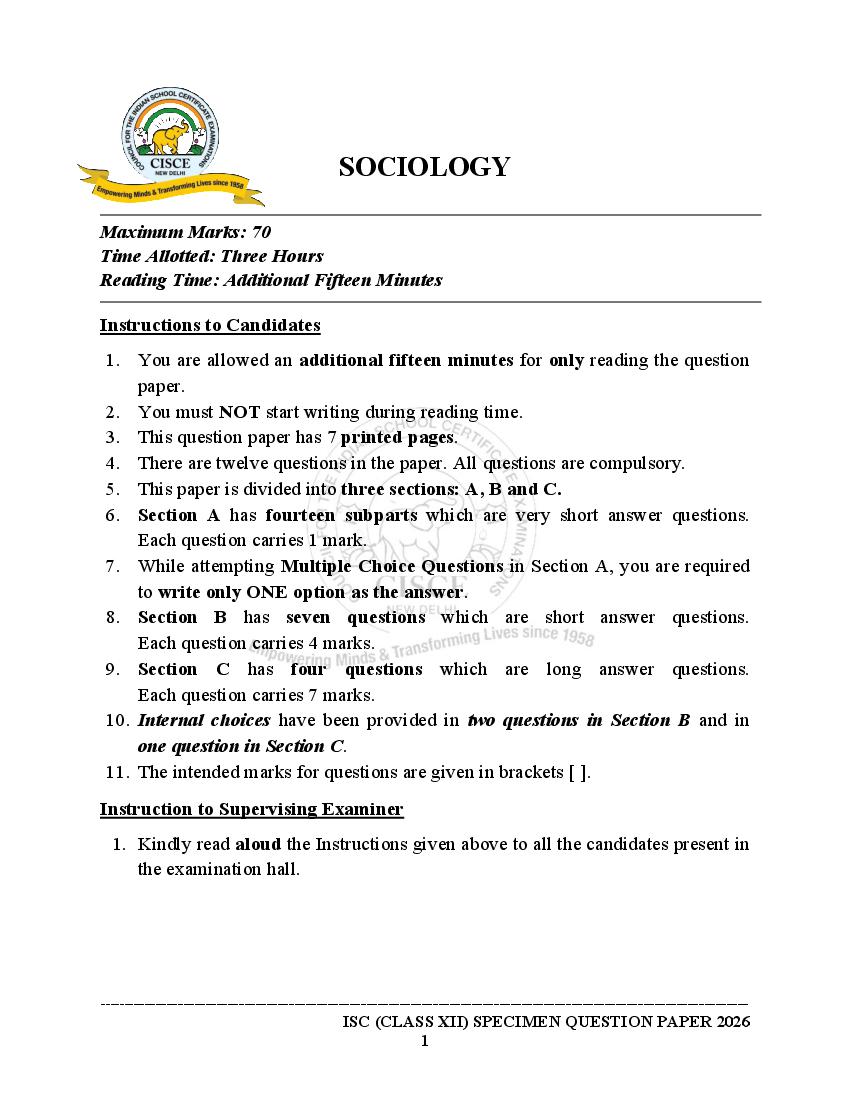
Maximum Marks: 70
Time Allotted: Three Hours
Reading Time: Additional Fifteen Minutes
Instructions to Candidates
1. You are allowed an additional fifteen minutes for only reading the question
paper.
2. You must NOT start writing during reading time.
3. This question paper has 7 printed pages.
4. There are twelve questions in the paper. All questions are compulsory.
5. This paper is divided into three sections: A, B and C.
6. Section A has fourteen subparts which are very short answer questions.
Each question carries 1 mark.
7. While attempting Multiple Choice Questions in Section A, you are required
to write only ONE option as the answer.
8. Section B has seven questions which are short answer questions.
Each question carries 4 marks.
9. Section C has four questions which are long answer questions.
Each question carries 7 marks.
10. Internal choices have been provided in two questions in Section B and in
one question in Section C.
11. The intended marks for questions are given in brackets [ ].
Instruction to Supervising Examiner
1. Kindly read aloud the Instructions given above to all the candidates present in
the examination hall.
----------------------------------------------------------------------------------------------------------------------
ISC (CLASS XII) SPECIMEN QUESTION PAPER 2026
1
Page 2
Board Examination Question Paper and should be used as a practice tool. The questions for the
Board Examination can be set from any part of the syllabus, though the format of the Board
Examination Question Paper will remain the same as that of the Specimen Question Paper.
SECTION A – 14 MARKS
Question 1
(i) In some African communities, parents and grandparents are often addressed using [1]
the name of the child / grandchild. For example, among the Yoruba of West Africa
a woman could be referred to as “Iya Femi” (mother of Femi) and a man as “Baba
Femi” (father of Femi). (Understanding)
The kinship usage described above is:
(a) Couvade
(b) Teknonymy
(c) Avunculate
(d) Amitate
(ii) The Rabaris are an indigenous tribe of nomadic cattle and camel herders and [1]
shepherds that live throughout northwest India. Moving mainly through the regions
of Rajasthan and Gujarat, they go back to their village once a year and make their
living by selling milk.
(Source(edited): https://www.atlasofhumanity.com/rabari)
Which type of economic activity does the Rabari tribe engage in for a living?
(Understanding)
(a) Shifting axe cultivation
(b) Food gathering
(c) Pastoralism
(d) Handicrafts
(iii) Given below are two statements marked as Assertion and Reason. Read the [1]
statements carefully and choose the correct option. (Analysis)
Assertion: Avoidance has been prevalent in all forms of societies especially
primitive communities.
Reason: As a social mechanism, avoidance prevents conflict especially in
communities that are not governed by any written laws, by imposing strict
behavioural norms on kin members.
---------------------------------------------------------------------------------------------------------------------
ISC (CLASS XII) SPECIMEN QUESTION PAPER 2026
2
Page 3
Assertion.
(b) Both Assertion and Reason are true but Reason is not the correct explanation
for Assertion.
(c) Assertion is true and Reason is false.
(d) Both Assertion and Reason are false.
(iv) Given below are two statements marked as Assertion and Reason. Read the [1]
statements carefully and choose the correct option. (Analysis)
Assertion: At times, tribal communities in India desire to carve a separate political
identity within the nation state.
Reason: These communities often face discrimination and exclusion from the
mainstream society.
(a) Both Assertion and Reason are true and Reason is the correct explanation for
Assertion.
(b) Both Assertion and Reason are true but Reason is not the correct explanation
for Assertion.
(c) Assertion is true and Reason is false.
(d) Both Assertion and Reason are false.
(v) Mahi lives in a communal residence with other young members of her tribe. [1]
Her village also has similar communal residences for widows and widowers. All the
members residing there learn about their tribal practices and are inducted into the
tribal way of life. This communal residence imparts a knowledge of tribal values
and culture to the youth. (Analysis)
Choose the correct statements that describe the residence that Mahi inhabits.
(P) Mahi lives in a joint family.
(Q) She lives in a dormitory.
(R) She inhabits Avunculocal residence.
(S) It acts as a centre for socialisation and education of the youth.
(a) Only (P) and (Q)
(b) Only (Q) and (R)
(c) Only (R) and (S)
(d) Only (Q) and (S)
---------------------------------------------------------------------------------------------------------------------
ISC (CLASS XII) SPECIMEN QUESTION PAPER 2026
3
Page 4
(Application)
(a) Members of a low caste group imitated the lifestyle of the upper caste as they
wanted to rise in the social hierarchy.
(b) A group of Indians discarded the use of Indian clothes in favour of formal
English attire as they considered it a mark of social mobility.
(c) In remote areas of Karnataka, the lifestyle of Brahmins was imitated by
members of other castes to gain upward social mobility.
(d) A large part of the urban population prefers eating meals at Mc Donald’s to
traditional food items at Indian restaurants.
(vii) In a debate competition at her school, Neha argues that the bond between siblings is [1]
inherently stronger than the bond between spouses.
Which one of the following BEST explains Neha’s argument? (Evaluate)
(a) Conjugal families are characterised by permanence.
(b) Consanguineal families are characterised by long lasting relationships.
(c) Blood relatives form the core of Conjugal families.
(d) Consanguineal families are large in size.
(viii) Analyse the relationship between the first pair and complete the analogy. (Analysis) [1]
(a) Free goods: Gifts of Nature :: __________: Command a price
(b) Consanguineous kinship: Blood ties :: Affinal kinship: __________
(ix) ‘In a recent wedding in rural Maharashtra, the families consulted local elders and [1]
genealogical records before finalising the match. The bride and groom's lineage
were traced back seven generations on the father's side and five on the mother's side
to ensure that no common ancestor was shared within those limits.’
Source: https://www.tribuneindia.com/
With reference to the above case, identify the rule of marriage being followed.
(Understanding)
(x) Some cultures observe strict dietary restrictions and prohibit the killing and eating [1]
of certain animals.
Which concept of religion propels people to follow this behaviour?
(Understanding)
th
(xi) Slavery in the 17 century in USA was a system of hierarchy based on race and [1]
ethnicity that did not allow social mobility and social relationships in society.
Which hierarchical arrangement of individuals and groups with distinct social
layers prevented social mobility and social relationships? (Understanding)
---------------------------------------------------------------------------------------------------------------------
ISC (CLASS XII) SPECIMEN QUESTION PAPER 2026
4
Page 5
(xiii) Briefly explain the term sharecropper with reference to the agrarian economic
structure. (Recall)
(xiv) State any one feature of Polygyny. (Recall)
SECTION B – 28 MARKS
Question 2 [4]
Pooja cut all ties from members of her extended family for two decades due to a feud. When
her maternal grandmother passed away, her maternal aunts Rati and Ratna along with their
sons Surya and Vikram reconnected with her. At first, Pooja was reluctant to renew ties
with them. But she decided to revive her relationship with her family members after being
encouraged by her husband, Vinod.
Briefly discuss the term degree of kinship. What are the different degrees of kinship evident
in the above case? (Understanding)
Question 3 [4]
The graph given below depicts the results of the study done to assess the implementation of
Right to Education (2009) in Government, Aided and Private Unaided schools in four states
in India. Study the graph and answer the question that follows:
Proportion of Children Receiving free Education in
Government, Aided and Private Unaided Schools
96.7 93.1 92.3
100 87.5
80
60 State 1 State 2 State 3 State 4
40
16.3 11.8
20 9.8 7.2 1.7
2.9 1.5 0.7
0
Primary Upper Primary Primary Upper Primary
Government Aided Private Unaided
(Source: itforchange.net)
Analyse the effectiveness of Right to Education in addressing the disparity in education.
(Analysis)
---------------------------------------------------------------------------------------------------------------------
ISC (CLASS XII) SPECIMEN QUESTION PAPER 2026
5
Page 6
How do social control measures reinforce morality in society? (Evaluate)
Question 5 [4]
The Jajmani system should be revived to bring back stability in rural livelihoods.
Do you agree with the statement? Justify your answer by giving four reasons.
(Evaluate)
Question 6 [4]
Discuss any four features of Tribes. (Recall)
Question 7 [4]
(i) Explore any four positive impacts of religion on human society. (Understanding)
OR
(ii) With reference to Durkheim’s theory of religion, discuss how religion establishes
harmony and stability in society. (Understanding)
Question 8 [4]
(i) Comment on the relevance of MacIver’s idea of family as a social unit by referring
to any four features of his theory. (Evaluate)
OR
(ii) With the help of four arguments, comment on the relevance of Marriage as a social
institution in present times. (Evaluate)
SECTION C – 28 MARKS
Question 9 [7]
(i) Discuss any seven features of Monogamy. (Understanding)
OR
(ii) Discuss any seven features of Exogamy. (Understanding)
---------------------------------------------------------------------------------------------------------------------
ISC (CLASS XII) SPECIMEN QUESTION PAPER 2026
6
Page 7
Explain the correlation between Urbanisation and the transformation in the family structure
in India. (Understanding)
Question 11
(i) List four castes in India according to the order of hierarchy. (Recall) [2]
(ii) Discuss the Divine Origin Theory of Caste. (Understanding) [5]
Question 12
Read the passage given below and answer the questions that follow.
Samay, from Ramthali village in Chittorgarh, had to engage in daily labour at a construction
site with his father. He dropped out of school as he was required to support his family
financially. A local NGO approached Samay and his family and attempted to re-enrol him
in school. However, it proved to be a futile attempt as Samay did not join the school and
continued working with his father.
The NGO then contacted the members of the local children’s council for intervention. The
child leaders of this council met Samay and his parents. They visited them daily and shared
inspiring real-life stories of their school experiences with Samay. They also convinced his
parents about the illegality of child labour which prompted them to re-enrol Samay in a
government school.
(i) Identify and briefly explain the children’s council referred to above. (Understanding) [2]
(ii) Assess the role of political organisations like the children’s council in bringing about [5]
social change. (Analysis)
---------------------------------------------------------------------------------------------------------------------
ISC (CLASS XII) SPECIMEN QUESTION PAPER 2026
7
Page 8
ANSWER KEY
SECTION A – 14 MARKS
Question 1
In answering Multiple Choice Questions, candidates have to write either the
correct option number or the explanation against it. Please note that only
ONE correct answer should be written.
(i) (b) or Teknonymy [1]
(ii) (c) or Pastoralism [1]
(iii) (a) or Both Assertion and Reason are true and Reason is the correct [1]
explanation for Assertion.
(iv) (a) or Both Assertion and Reason are true and Reason is the correct [1]
explanation for Assertion.
(v) (d) or Only Q and S [1]
(vi) (b) or A group of Indians discarded the use of Indian clothes in favour of [1]
formal English attire as they considered it a mark of social mobility.
(vii) (b) or Consanguineal families are characterised by long lasting relationships. [1]
(viii) (a) Economic goods [1]
(b) Marital ties
(ix) Sapinda Exogamy [1]
(x) Taboo [1]
(xi) Social Stratification [1]
(xii) Classificatory kinship terms: [1]
• are used in primitive societies.
• classify many kin members under the same term.
• indicate sociological relations.
• indicate marriage patterns.
(Any one of the above or any other relevant point to be accepted)
(xiii) A sharecropper is a farmer who cultivates land owned by others and gives [1]
them a share of the crop that is produced.
(xiv) • Marriage between one man and many women at the same time. [1]
• Too many women of marriageable age with few men remaining
within the community
• Generally prevalent in male dominated communities.
(Any one of the above or any other relevant point to be accepted)
1
Page 9
The answers given in Section B and Section C are suggestive and not exhaustive. Any other
correct answer to the questions will be accepted.
Question 2 [4]
Degree of kinship explains closeness of ego to kin members through blood and marital
ties.
Pooja’s Primary kin: Husband Vinod
Pooja’s Secondary kin: Maternal grandma and maternal aunts Rati and Ratna.
Pooja’s Tertiary kin: Cousins Surya and Vikram
Hence, three major kinship bonds exist, that are, Primary, Secondary and Tertiary.
(Candidates have to correctly identify the examples from the source. It should then
be followed by a brief explanation of each degree of kinship.)
Question 3 [4]
The RTE Act (2009) mandates that all children aged between 6–14 must receive free
and compulsory education, ensuring that economic barriers do not prevent children
from attending school.
• The graph shows that government schools have admitted a large number of
children as per the Act. It shows a successful implementation of the Act
uniformly in all the states depicted in the graph.
• However, the same cannot be inferred about Aided and Private schools. The
reasons for this disparity could be multiple.
• A successful implementation of this Act requires trained and sensitive
teachers who can induct these children smoothly into the mainstream and
ensure learning.
• The class and culture divide between rich and poor is so wide that at times
children from underprivileged sections either do not seek admissions in
private / aided schools or they are not admitted by the schools.
• At times, the lack of inclusive and supportive learning environment in private
schools results in low admission rate.
• Also, the lack of awareness among parents about RTE limits them to enrolling
their children to government schools.
(Candidates are required to discuss any four of the above points or any other
relevant point with respect to the efficiency of the RTE.)
Question 4 [4]
Social control is exercised by many formal and informal modes. It is exercised to
reinforce a morally acceptable behaviour and establish order in society. Concepts such
as justice, honesty, fairness, incorruptibility, freedom and mercy are purely moral
concepts. These are reinforced through the aid of many measures. In a social set up,
the existence of formal institutions such as law and government keeps the deviant
behaviour in check.
2
Page 10
beliefs reiterate the same and ensure conformity. People obey the formal rules and
follow the informal practices so that they are not alienated by society.
When social control is exercised through these measures, it influences individual
behaviour and the order in the society. For instance, every society whether primitive
or modern, has its own concept of morality depending on its social ethos. Certain
societies may use an animal or a bird as a religious symbol and revere it while some
may consider it outmoded and use it for economic purposes. Their laws and informal
social pressure would infuse the same through socialisation, cultural practices such as
festivals, ceremonies etc.
However, some fundamental moral values such as compassion, humanity, love and
care are universal and these are internalised by individuals through the measure of
socialisation.
(Candidates have to give valid arguments to bring out the impact of social control
measures in ensuring morality in society. Any other relevant point will be accepted.)
Question 5 [4]
Yes, the Jajmani system should be revived in the rural setup for the following reasons.
• The Jajmani system ensured occupation to every caste had which reduced
unemployment in villages. It established stability and provided economic
security to everyone.
• It fostered cooperation and social bonding between landowning and service-
providing castes, that were, Jajman and Prajan. It made both interdependent.
• Village became a self-sufficient economic unit, not dependent on external
markets for economic survival.
• Occupations like pottery, weaving, and blacksmithing were preserved and
passed down through generations. The indigenous skills were continued and
valued.
• Essential services were always available within the village, ensuring the
smooth functioning of the rural community.
No, the Jajmani system should not be revived for the following reasons.
• The Jajmani system led to social disparities. It widened the gulf between
‘haves’ and ‘have nots’, the upper castes and the lower castes. In the
• It discouraged social mobility and social change by rigidly fixing members of
a caste to a specific occupation.
• It led to a stagnant and closed society as the ways of living and earning became
outmoded and failed to keep pace with the rise of modernisation.
• It became an instrument of exploitation and abuse as the system emanated
from caste system which was essentially hierarchical and unequal.
(Candidates are required to give any four of the above reasons or any other relevant
point. They may choose to agree or disagree with the statement. The agreement or
disagreement has to be backed by strong reasons.)
3
Page 11
Features of tribes are as follows:
• Tribes have a definite territory which does not blend with the other
communities.
• Kinship bonds are strong, and members of a tribe remain united at all times.
• Tribes are mostly divided into clans.
• Tribal endogamy is strictly followed.
• All members of a tribe speak a common language / dialect.
• Property is mostly jointly owned.
• Tribes have their own panchayat though politically they are under the Indian
government.
• They have their own set of religious beliefs and moral codes which are distinct
from that of the rest of the population.
• There is an absence of formal schools, and the dormitory is the training
institution for tribal children.
(Candidates have to explain any four of the above features of tribes. Any other
relevant feature is acceptable.)
Question 7 [4]
(i) Functions / Positive impact of Religion:
• Religion conserves the value of life by making humans view it as
meaningful.
• It explains individual suffering and provides a rationale for those
experiences, thereby, satisfying the anxiety.
• It acts as the source of strength and inspires human beings to navigate
through the most difficult situations in life.
• It acts as an agent of social control, disciplines human instinct, therefore,
establishing order.
• Priestly functions are performed by religious leaders, leading to stability
in society.
• Religion promotes welfare by teaching human beings to be kind and
compassionate to others.
• It provides recreation.
• Religion enhances self-importance as it enables humans to view
themselves as the superior and favoured creation of God.
(Candidates have to explore four positive effects of religion on human
society. Any other relevant positive effect of religion, apart from the ones
given above, will be accepted.)
OR
(ii) Durkheim’s Theory of Religion:
• Durkheim offered the concepts of ‘sacred’ and ‘profane’. These
concepts are exclusive of each other. According to him, every society
makes a distinction between these two concepts. All positive beliefs are
attributed to God and are considered sacred. These beliefs create fear in
the minds of people.
4
Page 12
everyday lives. It consists of magic and pseudo-science. Magic can also
be anti-social. For e.g., Mahalis worship Surji Devi as a joint
performance, but each family has its own deity Orak Bonga.
• His theory focuses on the importance of the collective conscience that
can be raised by the sacred. Through celebrations of festivals and
rituals, communal ties are strengthened, and solidarity is maintained.
• The theory also stresses on the functionalist aspect of religion through
religious beliefs and rites.
• Durkheim’s ideas are highly relevant as they help us understand the way
religion exists and functions in contemporary societies. All modern
societies use the two concepts of sacred and profane to reinforce social
order and unity.
(Candidates are required to discuss Durkheim’s theory of religion in the
context of establishing harmony and stability in society. The discussion
should not be generic but linked to the idea of harmony and stability.)
Question 8 [4]
(i) MacIver’s idea of Family
• Universality: Family is the most basic universal social unit. All
cultures all over the world have this institution. There is no substitute
for family. The world has seen many changes in civilisations, but the
institution of family has remained constant. MacIver’s idea is valid as
family has continued to exist despite the transitions in the fabric of
society.
• Emotional basis: A family integrates all the members emotionally.
Affection, mutual cooperation and blood ties keep the family together.
This bond ensures proper cultural transmission. This proposition of
MacIver can be challenged as it is not the emotional connect only
that keeps the members together but also the economic need. In
urban setup, families stay together as it is financially reasonable.
• Educative role: Early education begins with the family. It helps
develop an individual’s personality and makes him / her internalise
social behaviour. The family guides and nurtures the individuals in their
first lessons of love, respect, cooperation, normative behaviour and
social customs. This idea stays relevant as family is the primary unit
that educates an individual. Before a child begins formal schooling,
she is schooled in acceptable behaviour by the family.
• Limited size: Since the size of the modern family is limited,
communication is better and keeps the family closely knit.
• Nuclear position: The family is the nucleus around which an
individual’s life revolves. It is an individual’s most important primary
group. In the contemporary urban society, this argument can also
be contested as people have increasingly become individualistic.
5
Page 13
There are defined roles for all members with expectations from each
one. This proposition holds true in present times also as each
member of the family, be it nuclear or joint, is assigned a role to
fulfil which justifies their existence in the family set up.
• Social regulation: A family acts as a social agent and trains the
members in socially acceptable behaviour. The social regulations and
restrictions set by the family enable members to behave in a socially
useful manner. A highly relevant claim which establishes the
authority of family as it keeps the boisterous behaviour of
individuals in check. The decisions and actions of many individuals
are motivated by their family response.
• Persistence and change: The form and structure of the family has been
changing with time. It has changed with evolving times. As a unit,
however it has continued to exist. This feature holds true as family
has existed despite changes in its form and structure.
(Candidates have to discuss any four of the above features of MacIver’s
theory and examine their relevance in present times. Headings are not
mandatory.)
OR
(ii) Relevance of Marriage:
• Social Sanction: Marriage regularises and socially sanctions the
satisfaction of sex relations. This is not entirely true and relevant in
modern times. Though marriage continues to be viewed as a sacred
institution, it is certainly not the only medium for satisfaction of
physical needs as law permits a consensual relationship between
adults.
• Reinforces Taboo: It also instils an awareness of incest as taboo
specifying who can be marital partners. This claim is correct and
relevant as the choice of a marital partner in many societies is
defined by what is permitted and not considered ‘incest’.
• Continuity of Human beings: Marriage helps in survival and
continuity of human race. As a social institution, the procreative
aspect of marriage has kept it relevant. It multiplies human race
and prevents the human society from becoming extinct.
• Economic organisation: It helps in the economic organisation and
division of labour between marital members. This feature of marriage
has been radicalised as the conventional set up relegated women to
domestic sphere while men occupied the public sphere. What we
witness is a redivision of labour with women participating equally in
the outdoor economic activities.
• Property Inheritance: It justifies property inheritance. Historically,
women had limited or no rights in their father’s or husband’s
property. They were not considered rightful heirs. This feature of
marriage restricted women from claiming rights over property and
has been challenged in the present times with women sharing claim
in property.
6
Page 14
legitimate institution required for enjoying parenthood. It leads to the
formation of family.
(Candidates have to examine the relevance of marriage with the help of four
arguments. They may give any other argument analysing its relevance
besides the ones given above. Headings are not mandatory.)
SECTION C – 28 MARKS
Question 9 [7]
(i) Monogamy as a marriage form
• It is a form of marriage between one man and one woman.
• It is the most common form of marriage across the world.
• It is practised by every modern society except Islam.
• It ensures stability, peace, loyalty and the highest form of love between
spouses as only two individuals are involved.
• It is economically better suited.
• It promotes better understanding between partners.
• It helps in the process of socialisation.
• Monogamy takes care of dependent parents and family members.
• It ascribes a higher status to women.
(Candidates are required to discuss Monogamy as a marriage form with the
help of any seven arguments given above or any other relevant argument.)
OR
(ii) Exogamy is the practice of marrying outside one’s clan, village or group-
descent group or lineage.
Features:
• There are four kinds of exogamy among the Hindus. They are Gotra,
Pravara, Sapinda and village.
• The fear of racial degeneration leads to exogamy.
• The desire to widen the area of co-operative cultural contact is another
reason.
• The need for genetic diversity also led to exogamy.
• Norms related to incest are also responsible for exogamy.
• In hunting and food gathering communities, women were a burden, and
this would have led to female infanticide and female scarcity.
This might have forced men to marry girls from outside.
• Man’s desire to marry someone belonging to a different social group
led to marital alliances with members from other groups.
• Exogamy led to culture conflict and cultural degeneration.
(Candidates have to discuss any seven features of exogamy. They may write
any other correct feature of exogamy apart from the ones given above.)
7
Page 15
Urbanisation and transformation of family structure in India
• Urbanisation has impacted the structure of family in India. It has radically
transformed the entire lay out family and given rise to the culture of nuclear
family.
• Nuclear family is a small family group consisting of husband, wife and
children. It is widely prevalent in urban areas.
• Since there is a dearth of space and housing facilities in urban areas, this family
form is most preferred. The nuclear family culture has emerged predominantly
due to this reason.
• As nuclear family does away with the traditional patriarchal structure and
divides the authority equally between both the partners, it has acquired
popularity in urban societies.
• In the urban set up, women have become active partners indulging in economic
activities which has significantly transformed the division of labour. Gender
roles have been reversed with men staying and working from home and
looking after children.
• It prioritises the ideas of love and understanding in marriage, hence, is
preferred by the present generation in urban societies.
• It gives space and promotes individualism.
• Traditional gender roles are reshaped with the participation of women in
workforce. It makes women independent and assertive and so is increasingly
becoming common in urban setup.
• It promotes family planning and has led to a decline in birth rate.
(Candidates have to draw a correlation between the Nuclear family and the urban
set up.)
Question 11
(i) Following are the four castes in the order of hierarchy. [2]
1. Brahmin
2. Kshatriya
3. Vaishya
4. Shudra
(Candidates must mention the four castes in the correct order of hierarchy.
These should not be listed randomly but in the strict order of hierarchy.)
(ii) Theory of Caste Origin [5]
This theory has been outlined in the Purushasukta of the Rig Veda. It states that
the four castes originated from the different body parts of Brahma – the Divine
Supreme being. The place of origin for each varna indicates its function in the
society.
• Brahmins – mouth- related to speech and thus the bearers of knowledge.
• Kshatriyas – arms – related to strength and bravery and thus the warrior
caste.
8
Page 16
economic wellbeing of society.
• Shudras – from the feet of the creator and thus their duty is to serve
everyone as the feet serve the other parts of the body.
This theory has been supported by Manu and the Bhagvad Gita.
Demerits:
• It is unscientific.
• In reality, Jati and not varna is the actual basis of caste. This theory
considers varna to be the actual basis.
• This arrangement blocks an individual’s progress by restricting him / her
to her caste-based occupations.
• A fourfold division of caste is an oversimplification. There are many
subcastes that exist in the society but have not been included in the fold
of the theory. For example, the Dalits.
(Candidates have to discuss all aspects of the theory.)
Question 12
(i) Bal Panchayat. [2]
It is the organisation for political empowerment and training for the rural youth
in India involving them in the decision-making process regarding issues that
affect their lives. It comprises children between the ages of 10 to 18 years.
(ii) The purpose of the Bal Panchayat is to nurture leadership skills on a democratic [5]
platform, so that children have a voice and are engaged in community
development, which in turn can foster social change.
Role of the Bal Panchayat in creating social change:
• The given caselet shows the power of Bal Panchayat in changing
perspectives and altering decisions. It is an inclusive, child-friendly form
of governance which treats children as active agents of change and not
always as vulnerable category to be protected.
• It is a democratic platform for participation that allows children to voice
the issues that concern them.
• It also addresses issues concerning the youth which could be pertaining to
prospects of employment, opportunities to study and other serious issues.
• It is a potent platform for developing leadership skills as it exposes
children to challenges and encourages them to grow.
• It also fosters community engagement and children become the medium
to connect the community to larger issues.
• It assists the village panchayat and furthers their issues.
• It mobilises the masses and creates awareness related to the environment,
cleanliness and sustainability. Since these issues are voiced by children,
these acquire special significance.
9
Page 17
to children. The above caselet is evidence to the same. Intervention by
members of Bal Panchayat raises awareness on child labour and the
damage that child labour causes to future prospects of children.
• States across India have been successful in eliminating child labour, child
marriage and human trafficking with the support of Bal Panchayats.
• The UNICEF too has been extremely appreciative and supportive of Bal
Panchayats.
(Candidates have to examine the role of Bal Panchayat in bringing about
social change. Any other relevant argument apart from the ones given above
will be accepted.)
10
Document Details
| Board / Org | CISCE |
| Exam | Class 12 |
| Type | Sample Paper |
| Pages | 17 |
| Updated | 24 Sep 2026 |