TG ICET 2026 Syllabus
Finished viewing? Save it for later —
Download TG ICET 2026 Syllabus (PDF · 3 pages)About TG ICET 2026 Syllabus
TG ICET 2026 Syllabus is available here for free download. Published by TGCHE for Telangana Integrated Common Entrance Test, this syllabus can be viewed online or downloaded as a PDF (3 pages). Candidates preparing for Telangana Integrated Common Entrance Test can use TG ICET 2026 Syllabus to understand the exam pattern, the type of questions asked, and the overall difficulty level.
Frequently Asked Questions
How can I download TG ICET 2026 Syllabus?
Open this page and click the Download button to save TG ICET 2026 Syllabus as a PDF. It is completely free on AglaSem Docs.
Is TG ICET 2026 Syllabus free to download?
Yes. TG ICET 2026 Syllabus can be viewed online and downloaded as a PDF free of cost on AglaSem Docs.
How many pages does TG ICET 2026 Syllabus have?
TG ICET 2026 Syllabus contains 3 pages, which you can read online or download together as a single PDF.
Where can I find more Telangana Integrated Common Entrance Test study material?
You can find more Telangana Integrated Common Entrance Test question papers, sample papers, syllabus, and answer keys on AglaSem Docs.
TG ICET 2026 Syllabus – Text
Read the full text of this syllabus below — useful to quickly search, copy and reference the content online without downloading the PDF.
📄 View text version (3 pages)
Page 1
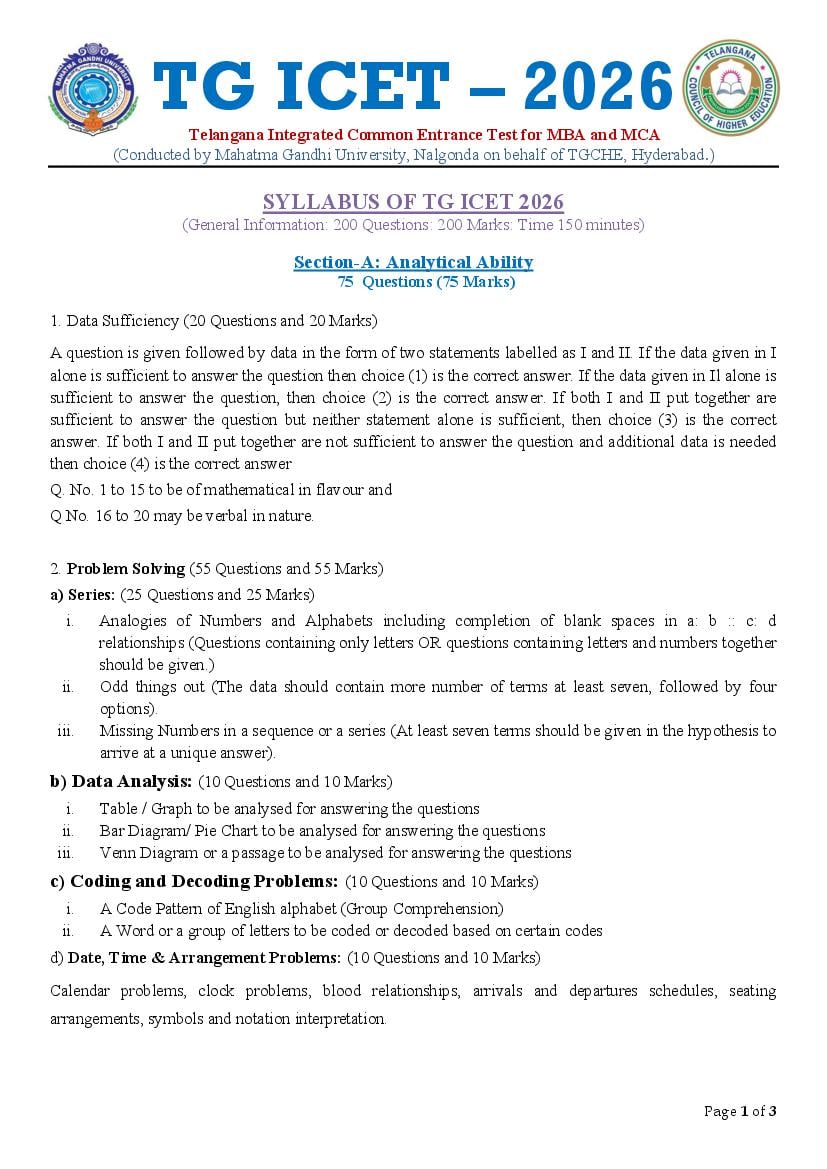
(General Information: 200 Questions: 200 Marks: Time 150 minutes)
Section-A: Analytical Ability
1. Data Sufficiency (20 Questions and 20 Marks)
A question is given followed by data in the form of two statements labelled as I and II. If the data given in I
alone is sufficient to answer the question then choice (1) is the correct answer. If the data given in Il alone is
sufficient to answer the question, then choice (2) is the correct answer. If both I and II put together are
sufficient to answer the question but neither statement alone is sufficient, then choice (3) is the correct
answer. If both I and II put together are not sufficient to answer the question and additional data is needed
then choice (4) is the correct answer
Q. No. 1 to 15 to be of mathematical in flavour and
Q No. 16 to 20 may be verbal in nature.
2. Problem Solving (55 Questions and 55 Marks)
a) Series: (25 Questions and 25 Marks)
i. Analogies of Numbers and Alphabets including completion of blank spaces in a: b :: c: d
relationships (Questions containing only letters OR questions containing letters and numbers together
should be given.)
ii. Odd things out (The data should contain more number of terms at least seven, followed by four
options).
iii. Missing Numbers in a sequence or a series (At least seven terms should be given in the hypothesis to
arrive at a unique answer).
b) Data Analysis: (10 Questions and 10 Marks)
i. Table / Graph to be analysed for answering the questions
ii. Bar Diagram/ Pie Chart to be analysed for answering the questions
iii. Venn Diagram or a passage to be analysed for answering the questions
c) Coding and Decoding Problems: (10 Questions and 10 Marks)
i. A Code Pattern of English alphabet (Group Comprehension)
ii. A Word or a group of letters to be coded or decoded based on certain codes
d) Date, Time & Arrangement Problems: (10 Questions and 10 Marks)
Calendar problems, clock problems, blood relationships, arrivals and departures schedules, seating
arrangements, symbols and notation interpretation.
Page 1 of 3
Page 2
I. Arithmetical Ability (35 Questions and 35 Marks)
Laws of indices, ratio and proportion, surds, numbers and divisibility, L.C.M. and G.C.D. Rational
numbers, Ordering, Percentages; Profit and loss; Partnership, Pipes and cisterns, time and distance, time
and work problems, areas, volumes, mensuration and modular arithmetic.
II. Algebraical and Geometrical Ability (30 Questions and 30 Marks)
Sets, Polynomials, Remainder Theorem & Consequences, Linear Equations in two Variables Algebraic
expressions, Arithmetic and Geometric progressions, Trigonometric ratios of angles (0°, 30°, 45°, 60°,
90°, 180°), Trigonometric identities, Heights and Distances, Plane geometry of Lines and Triangles,
Plane geometry of Quadrilaterals, Plane geometry of Circles, Coordinate geometry - Distance between
two points, Coordinate geometry - Section formula, Slope of a line, Lines y=mx, Lines y=mx+c and
Lines 𝑦 − 𝑦1 = 𝑚(𝑥 − 𝑥1 ).
III. Statistical Ability: (10 Questions and 10 Marks)
Mean, Median, Mode and simple problems on Probability.
Page 2 of 3
Page 3
50 Questions (50 Marks)
Candidates will be assessed on the ability to:
1. Identify the vocabulary used in the day-to-day communication.
2. Understand the functional use of grammar in day-to-day communication as well as in the business
contexts.
3. Identify the basic terminology and concepts in computer and business contexts (letters, reports,
memoranda, agenda, minutes etc.).
4. Understand written text and drawing inferences.
Part 1: Meanings (sentences with dashes)
Part 2: Synonyms and Antonyms
Part 3: Verb (Tense & Voice)
Part 4: Phrasal Verbs & Idioms
Part 5: Articles & Prepositions
Part 6: Computer Terminology
Part 7: Business Terminology
Part 8: Comprehension (three) passages (Each passage carries five questions)
Place: Nalgonda Sd/-
Date: 06th February, 2026 CONVENER, TG ICET-2026
Page 3 of 3
Document Details
| Board / Org | TGCHE |
| Exam | Telangana Integrated Common Entrance Test |
| Type | Syllabus |
| Pages | 3 |
| Language | english |
| Updated | 22 Jul 2026 |