PU CET PG 2017 Question Paper M.E. Biotechnology
Finished viewing? Save it for later —
Download PU CET PG 2017 Question Paper M.E. Biotechnology (PDF · 7 pages)About PU CET PG 2017 Question Paper M.E. Biotechnology
PU CET PG 2017 Question Paper M.E. Biotechnology is available here for free download. Published by Punjab University for PU CET PG, this question paper can be viewed online or downloaded as a PDF (7 pages). Candidates preparing for PU CET PG can use PU CET PG 2017 Question Paper M.E. Biotechnology to understand the exam pattern, the type of questions asked, and the overall difficulty level.
Frequently Asked Questions
How can I download PU CET PG 2017 Question Paper M.E. Biotechnology?
Open this page and click the Download button to save PU CET PG 2017 Question Paper M.E. Biotechnology as a PDF. It is completely free on AglaSem Docs.
Is PU CET PG 2017 Question Paper M.E. Biotechnology free to download?
Yes. PU CET PG 2017 Question Paper M.E. Biotechnology can be viewed online and downloaded as a PDF free of cost on AglaSem Docs.
How many pages does PU CET PG 2017 Question Paper M.E. Biotechnology have?
PU CET PG 2017 Question Paper M.E. Biotechnology contains 7 pages, which you can read online or download together as a single PDF.
Where can I find more PU CET PG study material?
You can find more PU CET PG question papers, sample papers, syllabus, and answer keys on AglaSem Docs.
PU CET PG 2017 Question Paper M.E. Biotechnology – Text
Read the full text of this question paper below — useful to quickly search, copy and reference the content online without downloading the PDF.
📄 View text version (7 pages)
Page 1
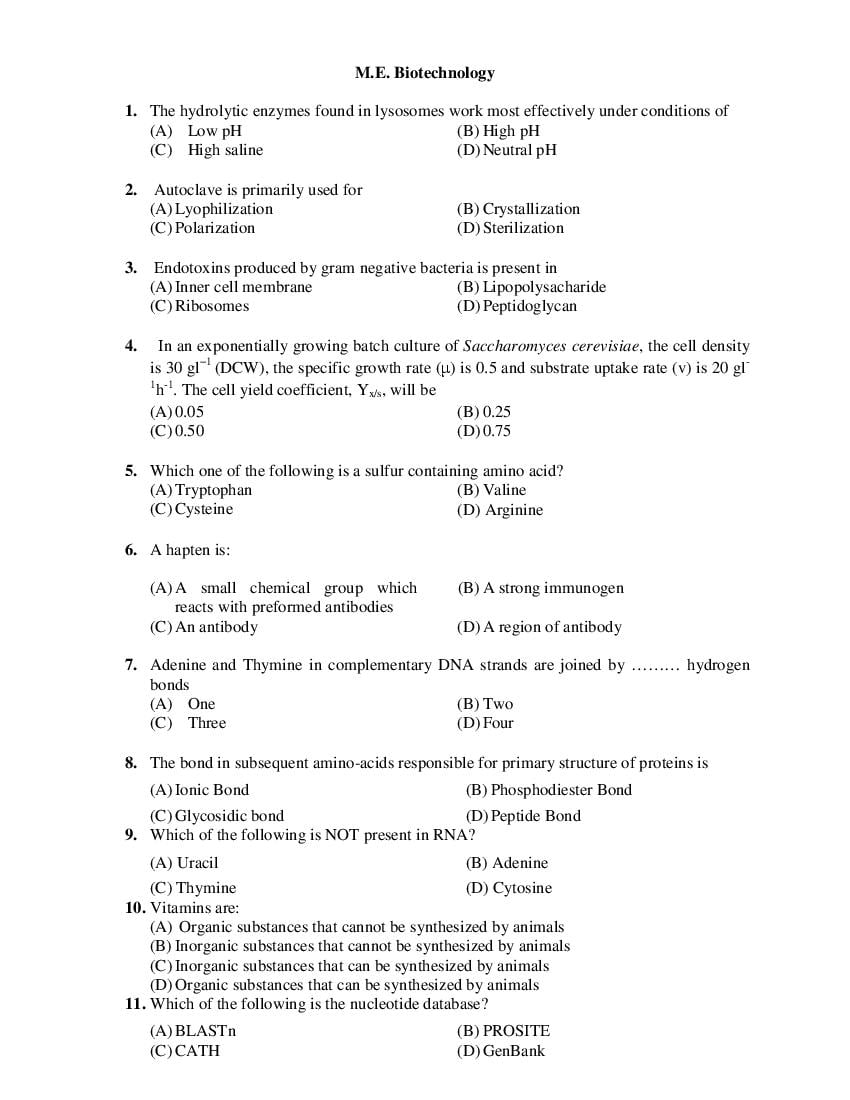
1. The hydrolytic enzymes found in lysosomes work most effectively under conditions of
(A) Low pH (B) High pH
(C) High saline (D) Neutral pH
2. Autoclave is primarily used for
(A) Lyophilization (B) Crystallization
(C) Polarization (D) Sterilization
3. Endotoxins produced by gram negative bacteria is present in
(A) Inner cell membrane (B) Lipopolysacharide
(C) Ribosomes (D) Peptidoglycan
4. In an exponentially growing batch culture of Saccharomyces cerevisiae, the cell density
is 30 gl−1 (DCW), the specific growth rate (µ) is 0.5 and substrate uptake rate (v) is 20 gl-
1 -1
h . The cell yield coefficient, Yx/s, will be
(A) 0.05 (B) 0.25
(C) 0.50 (D) 0.75
5. Which one of the following is a sulfur containing amino acid?
(A) Tryptophan (B) Valine
(C) Cysteine (D) Arginine
6. A hapten is:
(A) A small chemical group which (B) A strong immunogen
reacts with preformed antibodies
(C) An antibody (D) A region of antibody
7. Adenine and Thymine in complementary DNA strands are joined by ……… hydrogen
bonds
(A) One (B) Two
(C) Three (D) Four
8. The bond in subsequent amino-acids responsible for primary structure of proteins is
(A) Ionic Bond (B) Phosphodiester Bond
(C) Glycosidic bond (D) Peptide Bond
9. Which of the following is NOT present in RNA?
(A) Uracil (B) Adenine
(C) Thymine (D) Cytosine
10. Vitamins are:
(A) Organic substances that cannot be synthesized by animals
(B) Inorganic substances that cannot be synthesized by animals
(C) Inorganic substances that can be synthesized by animals
(D) Organic substances that can be synthesized by animals
11. Which of the following is the nucleotide database?
(A) BLASTn (B) PROSITE
(C) CATH (D) GenBank
Page 2
(A) Escherichia coli (B) Tobacco Mosaic Virus
(C) Saccharomyces cerevisiae (D) Aspergillus niger
13. Penicillium chrysogenum is industrially used to produce the antibiotic penicillin. In a
batch culture of Penicillium chrysogenum, the maximum penicillin synthesis occurs
during the
(A) Lag phase (B) Exponenetial phase
(C) Stationary phase (D) Death phase
14. During bacterial conjugation the genetic material is transferred from the donor bacteria to
the recipient through
(A) Cell wall (B) Pili
(C) Medium (D) Capsule
15. According to Oparin’s Theory, atmosphere of earth just before the origin of life consisted of
(A) Water vapors, reducing environment (CH4, NH3, H2) without oxygen
(B) Water vapors, reducing environment (CH4, NH3, H2) with oxygen
(C) Reducing environment (CH4, NH3, H2) without oxygen and water vapours
(D) Reducing environment (CH4, NH3, H2) with oxygen and without water vapours
16. The bacterial cells having F plasmid integrated in their chromosome are termed as
(A) P+ (B) F–
(C) Hfr (D) Hbr
17. Which of the following organelle is called “suicide bags” of cells?
(A) Nucleolus (B) Ribosome
(C) Chloroplast (D) Lysosome
18. α−D-Glucose and β−D-glucose are……………of each other
(A) Epimers (B) Anomers
(C) Multirotation pair (D) Ketoenol pair
19. The unit of chromosome map is
(A) Millimendel (B) Decibarr
(C) Centimorgan (D) Femtostern
20. The process for the synthesis of RNA from a DNA template is known as
(A) Replication (B) Translation
(C) Transcription (D) Mutation
21. An organism which has two identical alleles of a gene is called
(A) Dominant (B) Hybrid
(C) Heterozygous (D) Homozygous
22. Which of the following is the SI unit of Absorbance (A) of light by a solution?
(A) Absorbance (A) is a unitless quantity.
(B) Candela
(C) Candela/ m2 (Candela per square meter)
(D) Candela/s (Candela per second)
Page 3
interactions?
(A) Southern hybridization analysis (B) Polymerase chain reaction
(C) Fluorescence in situ hybridization (D) Yeast two-hybrid system
24. At a pH below its isoelectric point, an amino acid exists as
(A) Anion (B) Cation
(C) Undissociated molecule (D) Zwitterion
25. Which of the following is the immediate source of energy for active transport?
(A) Carbohydrates (B) Lipids
(C) ATP (D) NADP
26. Which of the following is NOT a method to introduce genetic variation into bacteria?
(A) DNA amplification (B) Transduction
(C) Transformation (D) Directed Mutagenesis
27. Match the vitamins in Group I with the processes/reactions in Group II.
Group I Group II
P. Pantothenic acid 1. Electron transport
Q. Riboflavin (Vitamin 2) 2. Transfer of 1-C units
R. Vitamin B6 3. Decarboxylation
S. Folic acid 4. Fatty acid metabolism
5. Hydrolysis
(A) P-5, Q-2, R- 4, S-1 (B) P- 4, Q-1, R-3, S-2
(C) P- 4, Q- 2, R-1, S-5 (D) P- 2, Q- 1, R-3, S-5
28. Which of the following represents a dihybrid?
(A) WsSs (B) WsSS
(C) WWSs (D) wwSs
29. Which technique is most frequently employed for repeated use of enzymes in
bioprocesses?
(A) Polymerization (B) Isomerization
(C) Ligation (D) Immobilization
30. Match the entries in Group I with the most suitable methods of sterilization in Group II.
Group I Group II
P. Serum 1. Autoclave
Q. Luria broth 2. Membrane filtration
R. Biological safety cabinets 3. UV irradiation
4. Gamma irradiation
(A) P-4, Q-2, R-3 (B) P-1, Q-4, R-2
(C) P-2, Q- 1, R-3 (D) P-1, Q- 1, R-4
31. Which of the following processes is involved during the identification of blood groups?
(A) Precipitation (B) Immunization
(C) Opsonization (D) Agglutination
Page 4
(A) Metaphase I of meiosis (B) Metaphase II of meiosis
(C) Metaphase of mitosis (D) Telophase of mitosis
33. Which one of the following is a known protoplast fusion inducing agent?
(A) Nucleotides (B) ATP
(C) Polyethylene glycol (D) Colchicine
34. Given is the sequence of one strand of DNA - 5’ TCGATC 3’.Which of the following is
the sequence of the complementary strand?
(A) AGCTAG (B) TCGATC
(C) CTAGCT (D) ACTAGC
35. A solute binds with an adsorbent with a dissociation constant KD. The retention time of
the solute in a chromatography column containing this adsorbent
(A) Influences KD
(B) Increases with increasing KD
(C) Decreases with increasing KD
(D) Is independent of KD
36. Heat inactivation of serum is carried out to inactivate
(A) Prions (B) Pathogenic bacteria
(C) Mycoplasma (D) Complement
37. Nude mice are a type of laboratory animal with a genetic mutation that results in an
inhibited immune system due to a greatly reduced number of T cells. Nude mice refers to
(A) Mice without thymus (B) Mice without skin
(C) Knockout mice (D) Transient mice
38. Which of the following protects cells by preventing crystallization of water during
cryopreservation of mammalian cells?
(A) Dimethyl Sulfoxide (B) Polyvinyl Alcohol
(C) Ethanol (D) Ethylene oxide
39. Which of the following organelle is found only in plants but not in animals?
(A) Nucleus (B) Plastids
(C) Mitochondria (D) Ribosomes
40. The catalytic efficiency for an enzyme is defined as
(A) Kcat (B) Vmax/Kcat
(C) Kcat/ Km (D) Kcat/ Vmax
41. Endogenous antigens are presented on to the cell surface along with
(A) MHC-I (B) MHC-II
(C) Fc receptor (D) Folic acid receptor
42. In steady state fermentation, the washout stage occurs if
(A) Dilution rate is less than the maximum specific growth rate
(B) Dilution rate is higher than the maximum specific growth rate
(C) Cell concentration becomes maximum
(D) Substrate concentration becomes minimum
Page 5
compound showed migration of 20 cm and 15 cm, respectively. What would be the Rf
value for the compound?
(A) 0.25 (B) 0.33
(C) 0.75 (D) 1.33
44. Prior exposure to pathogens is known to increase resistance to future pathogen attacks.
This phenomenon is known as
(A) Systemic acquired resistance (B) Hypersensitive response
(C) Innate immunity (D) Antibody mediated response
45. Match the entries in the Group I with the elution conditions in Group II.
Group I Group II
P. Ion-exchange chromatography 1. Isocratic solvent
Q. Hydrophobic column chromatography 2. Ampholytes
R. Gel filtration chromatography 3. Increasing gradient of salt
S. Chromatofocusing 4. Decreasing gradient of polarity
(A) P-4, Q-1, R-2, S-3 (B) P-4, Q-3, R-1, S-2
(C) P-3, Q-4, R-2, S-1 (D) P-3, Q-4, R-1, S-2
46. During sterilization of a fermentation medium in a given bioreactor, heating = 12.56,
cooling = 7.48 and the total value of required for whole sterilization process is 52,
where is the design criteria. What is the value of holding?
(A) 31.96 (B) 72.04
(C) 46.92 (D) 57.08
47. Cell lysis needs to be carried out as a downstream process if the product of interest is
(A) Extracellular (B) Intracellular
(C) Toxic (D) Heat labile
48. Which of the following features is NOT required in a prokaryotic expression vector?
(A) Origin of replication (B) Selection Marker
(C) Ribosome binding site (D) CMV promoter
49. Which of the following is a sequence alignment tool?
(A) BLAST (B) PRINT
(C) NCBI (D) EMBL
50. For an enzymatic reaction, Km is the defined as the substrate concentration at which
(A) The reaction rate is double of the maximum
(B) The reaction rate is one half of the maximum
(C) The enzyme is completely saturated with substrate
(D) The enzymatic reaction stops
51. The helix content of a protein can be determined using
(A) A high resolution electron microscope
(B) A fluorescence spectrometer
(C) A circular dichroism spectrometer
(D) A UV-Visible spectrophotometer
Page 6
(A) GenBank (B) PIR
(C) DDBJ (D) FASTA
53. When a cell is about to divide, before cell division, the amount of DNA in cell becomes
(A) One fourth (B) Half
(C) Less than Half (D) Double
54. The use of living organisms to degrade the pollutants present in environment is called
(A) Clarification (B) Centrifugation
(C) Bioremediation (D) Amplification
55. The process of introducing DNA into cells by exposing them to high voltage electric
pulse is known as
(A) Electrofission (B) Electrofusion
(C) Electrosonication (D) Electroporation
56. The effect of a reversible competitive inhibitor on an enzyme can be nullified by
(A) Increasing the concentration of (B) Increasing the concentration of product
reactant
(C) Increasing the temperature of (D) Increasing the salt concentration
reaction
57. The specific activity of an enzyme in a crude extract of S. Cerevisiae is 10 units/mg of
protein. The extract is passed through an ion-exchange column. After this purification
step, the specific activity of the enzyme changes to 68 units/mg of protein. The fold
purification for this step is:
(A) 0.14 (B) 6.8
(C) 680 (D) 58
58. An apoenzyme is
(A) Vitamin (B) Amino Acid
(C) Carbohydrate (D) Inactive Protein
59. Protoplasts are the cells which are lacking in
(A) Cell wall (B) Cell Membrane
(C) Cytoplasm (D) Periplasm
60. Primary mediator in anaphylaxis reactions is
(A) Histamine (B) Seratonin
(C) Heparin (D) Aspargine
61. Proteomics is the study of
(A) Regulatory proteins of an organism (B) Structural proteins of an organism
(C) Catalytic proteins of an organism (D) All proteins of organism
62. Which one of the following is an RNA dependent DNA synthetase (an enzyme that
synthesizes DNA using RNA as a template)?
(A) DNA Polymerase I (B) DNA Polymerase II
(C) Reverse Transcriptase (D) Deoxy ribonuclease
Page 7
chemostat with the given parameters µ max = 1 h-1; Yx/s= 0.55 gg-1; Ks = 0.2 gL-1; S0 = 10
gL-1
(A) 0.98 h-1 (B) 1.98 h-1
(C) 0.49 h-1 (D) 1.49 h-1
64. Association of nitrogen fixing bacteria with the leguminous roots is an example of
(A) Parasitism (B) Neutralism
(C) Mutualism (D) Communalism
65. IPR stands for
(A) Indian Patent Rights (B) International Patent Rights
(C) International Property Rights (D) Intellectual Property rights
66. Which statement is true of both prokaryotic and eukaryotic cells?
(A) Prokaryotic cells are generally much larger than eukaryotic cells
(B) Eukaryotic cells have ribosomes but prokaryotic cells do not
(C) Both have DNA as their primary genetic material
(D) Eukaryotic cells have plasma membrane and prokaryotic cells do not
67. Which of the following biomolecules is likely to have buffering action?
(A) Carbohydrates (B) Proteins
(C) DNA (D) Lipids
68. Resolving power of a microscope is determined by
(A) Wavelength of light source
(B) Intensity of light source
(C) Power of light source
(D) Does not depend on any feature of light source
69. The soil bacteria most commonly used for transformation in plants is
(A) Rhizobacterium (B) Escherichia coli
(C) Agrobacterium tumifaciens (D) Mycorrhizae
70. During fermentation, the top portion inside the reactor is left free without broth. This
portion is called
(A) Shaft (B) Head space
(C) Impeller (D) Sparger
71. The sugar moiety present in DNA is
(A) Deoxyribose (B) Ribose
(C) Fructose (D) Ribulose
72. The micro-organism most commonly used for industrial production of amylase enzyme is
(A) Saccharomyces cerevisiae (B) Aspergillus niger
(C) Bacillus subtilis (D) Penicillium chrysogenum
73. Analysis of protein antigen is carried out by which of the following techniques
(A) Southern blot (B) Northern blot
(C) Eastern blot (D) Western blot
74. Batch fermentation is an example of
(A) Closed system (B) Open system
(C) Fed-batch system (D) Equilibrium system
75. The enzyme usually used in Polymerase Chain Reaction is
(A) RNA polymerase (B) Taq polymerase
(C) Ribonuclease (D) Endonuclease
x-x-x
Document Details
| Board / Org | Panjab University |
| Exam | PU CET PG |
| Type | Question Paper |
| Pages | 7 |
| Updated | 22 Jul 2026 |