PU CET PG 2017 Question Paper Disaster Management
Finished viewing? Save it for later —
Download PU CET PG 2017 Question Paper Disaster Management (PDF · 9 pages)About PU CET PG 2017 Question Paper Disaster Management
PU CET PG 2017 Question Paper Disaster Management is available here for free download. Published by Panjab University for PU CET PG, this question paper can be viewed online or downloaded as a PDF (9 pages). Candidates preparing for PU CET PG can use PU CET PG 2017 Question Paper Disaster Management to understand the exam pattern, the type of questions asked, and the overall difficulty level.
Frequently Asked Questions
How can I download PU CET PG 2017 Question Paper Disaster Management?
Open this page and click the Download button to save PU CET PG 2017 Question Paper Disaster Management as a PDF. It is completely free on AglaSem Docs.
Is PU CET PG 2017 Question Paper Disaster Management free to download?
Yes. PU CET PG 2017 Question Paper Disaster Management can be viewed online and downloaded as a PDF free of cost on AglaSem Docs.
How many pages does PU CET PG 2017 Question Paper Disaster Management have?
PU CET PG 2017 Question Paper Disaster Management contains 9 pages, which you can read online or download together as a single PDF.
Where can I find more PU CET PG study material?
You can find more PU CET PG question papers, sample papers, syllabus, and answer keys on AglaSem Docs.
PU CET PG 2017 Question Paper Disaster Management – Text
Read the full text of this question paper below — useful to quickly search, copy and reference the content online without downloading the PDF.
📄 View text version (9 pages)
Page 1
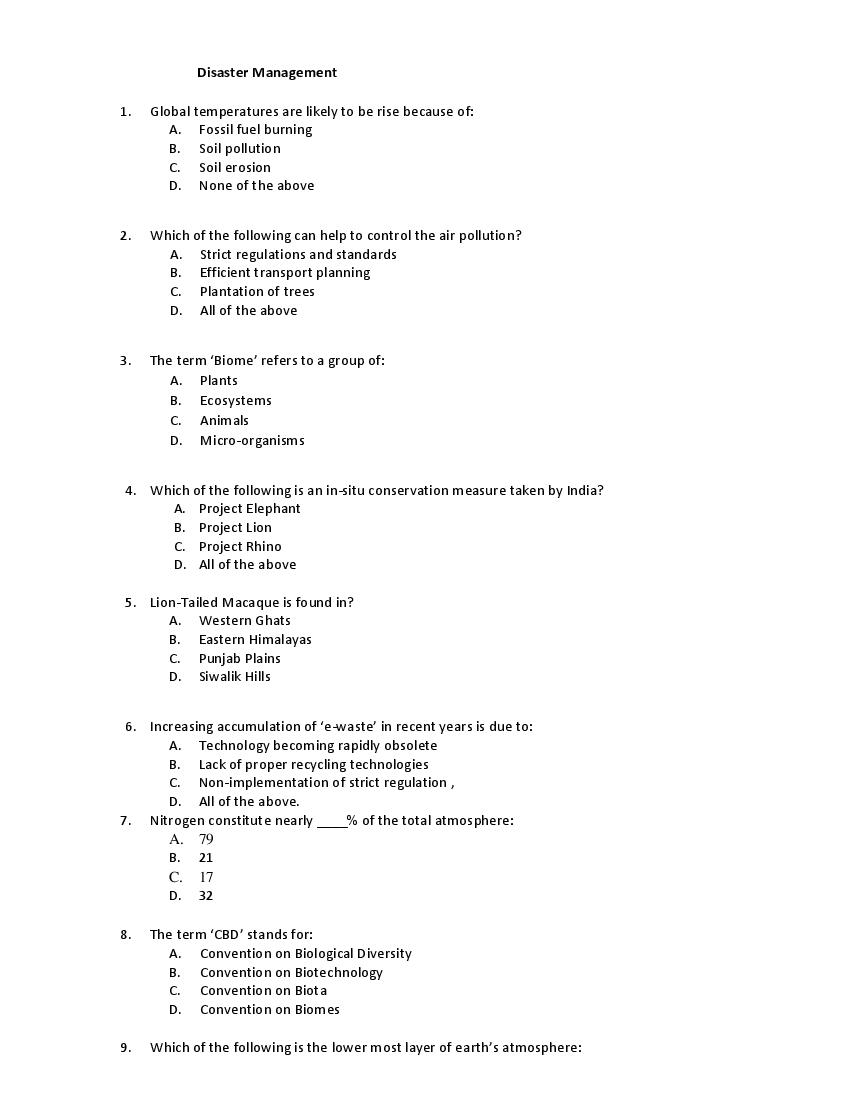
1. Global temperatures are likely to be rise because of:
A. Fossil fuel burning
B. Soil pollution
C. Soil erosion
D. None of the above
2. Which of the following can help to control the air pollution?
A. Strict regulations and standards
B. Efficient transport planning
C. Plantation of trees
D. All of the above
3. The term ‘Biome’ refers to a group of:
A. Plants
B. Ecosystems
C. Animals
D. Micro-organisms
4. Which of the following is an in-situ conservation measure taken by India?
A. Project Elephant
B. Project Lion
C. Project Rhino
D. All of the above
5. Lion-Tailed Macaque is found in?
A. Western Ghats
B. Eastern Himalayas
C. Punjab Plains
D. Siwalik Hills
6. Increasing accumulation of ‘e-waste’ in recent years is due to:
A. Technology becoming rapidly obsolete
B. Lack of proper recycling technologies
C. Non-implementation of strict regulation ,
D. All of the above.
7. Nitrogen constitute nearly ____% of the total atmosphere:
A. 79
B. 21
C. 17
D. 32
8. The term ‘CBD’ stands for:
A. Convention on Biological Diversity
B. Convention on Biotechnology
C. Convention on Biota
D. Convention on Biomes
9. Which of the following is the lower most layer of earth’s atmosphere:
Page 2
B. Magnetosphere
C. Biosphere
D. Hydrosphere
10. The famous ‘Harike wetland’ is facing the problem of which weed?
A. Congress Grass
B. Water Hyacinth
C. Lantana
D. Ageratum
11. What ‘Indian cheetah’ and ‘Dodo bird’ represents:
A. Threatened species
B. Extinct species
C. Rare species
D. Vulnerable species
12. Montreal Protocol represents a treaty on which of the following:
A. Treaty on Sustainable development
B. Ozone treaty
C. Stockholm Declaration
D. Climate Convention
13. The land destroyed because of mining activity is known as:
A. Marshy land
B. Derelict land
C. Saline land
D. Productive land
14. pH value of safe and potable water ranges from:
A. 9.0-11.0
B. 6.5-8.0
C. 3.5-5.0
D. 11.0-12.0
15. In social forestry which trees are usually grown for commercial purpose?
A. Apple and Jamun
B. Sal and Mango
C. Poplar and Safeda
D. Mango and Jamun
16. Which of the following element is found in Tobacco:
A. Methane
B. Nicotine
C. Ethene
D. Caffeine
17. Which one of the following is not a pollutant of air?
A. SO2
B. NO2
C. Surface run-off
D. Noise
18. Chilka Lake is situated in which state of India:
A. Himachal Pradesh
Page 3
C. Orissa
D. Rajasthan
19. Which of the following is not a water borne disease?
A. Cholera
B. Osteoporosis
C. Typhoid
D. Gastroenteritis
20. The discovery of ‘Greenhouse effect’ was made by
A. R K Pachauri
B. Joseph Fourier
C. John Tyndall
D. Charles Darwin
21. Chlorofluorocarbon (CFC’s) is mainly produced by:
A. Burning of plants and wood
B. Open dumping of garbage
C. Refrigeration system
D. Burning of agricultural waste
22. What does the term ‘Savanna’ represents?
A. A variety of wheat
B. A type of Grasslands
C. Name of an animal species
D. None of the above
23. In India, the ‘Forest Research Institute’ (FRI) is situated in which city?
A. Bhopal
B. Varanasi
C. Dehradun
D. Hyderabad
24. The largest desert of the world is?
A. Sahara Desert
B. Taklamakan Desert
C. Atacama Desert
D. Mojave Desert
25. Ozone hole was seen for the first time over Antarctica in:
A. 1931
B. 1951
C. 1994
D. 1985
26. In which state of India, the Harike wetland is located?
A. Tamilnadu
B. West Bengal
Page 4
D. Maharashtra
27. Which of the following desert is located in western parts of India?
A. Sahara Desert
B. Atacama Desert
C. Kala Hari Desert
D. Thar Desert
28. When is the ‘World Environment day’ celebrated:
A. 25th December
B. 2nd October
C. 15th August
D. 5th June
29. Which gas protects living organisms from harmful UV radiation?
A. Methane
B. Ozone
C. Carbon dioxide
D. Nitrogen
30. Which of the following resources is renewable resource of energy?
A. Wind
B. Crude Oil
C. Petroleum
D. Coal
31. ‘Kyoto Protocol’ is associated with controlling which of the following problem:
A. Global Warming
B. Depletion of Ozone
C. Extinction of Plant Species
D. Soil Pollution
32. What is the main disadvantage of most of the renewable energy sources
A. These are highly polluting
B. They have high waste disposal cost
C. Their supply is unreliable
D. These have high running cost
33. Geothermal energy refers to a form of energy from:
A. Crude Oil
B. Petroleum
C. Coal
D. Natural heat produced in the earth
34. The ‘Output Device’ of a computer system is:
A. Printer
B. Keyboard
C. Monitor
D. Mouse
35. The term GPS stand for:
A. General Policy System
B. Global Political System
C. Global Positioning System
D. General Police System
Page 5
A. Beas
B. Narmada
C. Satluj
D. Ravi
37. Chandigarh is also known as
A. Pink City
B. The City of Lakes
C. The City of Gardens
D. The City Beautiful
38. As per the norms, the minimum forest cover required to sustain ecological balance is:
A. 53% of the total land area
B. 43% of the total land area
C. 33% of the total land area
D. 23% of the total land area
39. Which of the following Indian state has dense coniferous forests?
A. Tamilnadu
B. Telangana
C. Rajasthan
D. Himachal Pradesh
40. The term ‘Biosphere’ refers to:
A. The solid shell of inorganic materials on the Earth surface
B. Thin cover of organic matter comprising of all living things on earth
C. The sphere which occupies the maximum volume of all of the spheres
D. All of the above
41. An infamous place ‘Bermuda Triangle’ is located in the northeast direction of which American
state:
A. North Dakota
B. Alaska
C. Florida
D. Illinois
42. The term ‘First Aid’ aims:
A. To preserve life
B. To prevent the victims condition from worsening
C. To promote recovery
D. All the above
43. Bhopal Gas Tragedy was occurred in?
A. 2004
B. 1994
C. 1944
D. 1984
44. Which of the following is the prime source of energy on planet Earth?
A. Sun
B. Wood
C. Coal
D. Petroleum
Page 6
A. Wind energy
B. Coal and petroleum
C. Solar Energy
D. Tidal energy
46. Which of the following is not a ‘greenhouse gas’?
A. Methane
B. Carbon-dioxide
C. Oxygen
D. Sulfur-dioxide
47. The green colour of plants is due to the presence of:
A. Methane
B. Iron
C. Chlorophyll
D. Oxygen
48. The ‘Sorrow of China’ is a name given to:
A. Hwang Ho River
B. Mekong River
C. Yangtze Kiang River
D. Si Kiang River
49. The islands of Andaman and Nicobar are an extension of:
A. Alps Mountain range
B. Arakan Yoma mountain range
C. Himalayan mountain ranges
D. Sahyadri Mountain range
50. The famous artificial archipelago ‘Palm Islands’ are located in:
A. Italy
B. New Zealand
C. Maldives
D. Dubai
51. ‘Cartography’ is a part of:
A. Cosmology
B. Literacy
C. Graphicacy
D. None of these
52. San Andreas fault is located in:
A. USA
B. England
C. India
D. Russia
53. Which of the following rivers is believed to older than the Himalayas:
A. River Chenab
B. River Indus
C. River Gomati
D. River Tungabhadra
Page 7
A. Production of Atomic Power
B. Development of Fisheries
C. Control of floods
D. Drinking water supply
55. The term ‘Pedology’ refers to the study of:
A. Soil
B. Glaciers
C. Air Pollution
D. Animal Behaviour
56. ‘Kaziranga’ National Park is famous for:
A. Indian Gaur
B. One-horned Rhino
C. Musk Deer
D. Black buck
57. In the year 1973, the ‘Chipko Movement’ in India was initiated by:
A. Mrs. Indira Gandhi
B. Shri Narendra Modi
C. Shri Sunder Lal Bahuguna
D. Shri Jawaharlal Nehru
58. In the light of accelerating global warming it is expected that:
A. Sea level will decline
B. Sea level will remain at constant level
C. Sea level will rise
D. None of the above
59. The concept of growing more trees in ‘City/Urban areas’ is called as:
A. Urban forestry
B. Agro forestry
C. Commercial Plantation
D. Social forestry
60. The ‘Valley of Flowers’ is located in which Indian state?
A. Haryana
B. Uttarakhand
C. Gujarat
D. Maharashtra
61. The process of ‘Data Collection’ involves:
A. Editing of data
B. Analysis of data
C. Data Coding
D. Interview
62. In a computer system the Input Device is:
A. Keyboard
Page 8
C. Head-phone
D. Monitor
63. Smog is:
A. is colorless
B. A natural phenomenon
C. a combination of smoke and fog
D. all of the above
64. Any survey that specifically deals with the landed property is known as:
A. Cadastral Survey
B. Geographical Survey
C. Geodetic Survey
D. Field Survey
65. Which civilization is the oldest known civilization of the world?
A. Mayan Civilization
B. Indus Valley Civilization
C. Inca Civilization
D. Sumerian Civilization
66. The book ‘Origin of the Species’ was written by:
A. Charles Darwin
B. A.P.J. Kalam
C. A.R. Wallace
D. J.K. Rowling
67. Which one of the following is not an aquatic ecosystem?
A. Lake
B. Shallow Ocean
C. Estuary
D. Grassland
68. The majority of flood in India, occur in:
A. January-February
B. June-September
C. April-June
D. December-January
69. Tehri Dam is located in the state of:
A. Himachal Pradesh
B. Punjab
C. Sikkim
D. Uttarakhand
70. The ‘Great Barrier Reef’ is located at the:
A. East Australian Coast
B. Bay of Bengal
C. Arabian Sea
D. Gulf of Cambay
Page 9
A. Glass material
B. Wood and plants
C. Paper
D. Iron
72. Species which have a key impact on an ecosystem are known as the:
A. Pioneer species
B. Frontier species
C. Crown species
D. Keystone species
73. The National Disaster Management Authority of India is chaired by?
A. The Home Minister of India
B. The Prime Minister of India
C. Vice President of India
D. Human Resource Development (HRD) Minister
74. The term ‘Cyclone’ is derived from?
A. Greek Word
B. German Word
C. Tibetan Word
D. Chinese Word
75. The full form of NDMA is:
A. National Disaster Management Authority
B. Natural Disaster Management Authority
C. Natural Disaster Management Act
D. National Disaster Management Area
Document Details
| Board / Org | Panjab University |
| Exam | PU CET PG |
| Type | Question Paper |
| Pages | 9 |
| Updated | 22 Jul 2026 |