Karnataka PGCET 2015 Question Paper Textile Technology
Finished viewing? Save it for later —
Download Karnataka PGCET 2015 Question Paper Textile Technology (PDF · 12 pages)About Karnataka PGCET 2015 Question Paper Textile Technology
Karnataka PGCET 2015 Question Paper Textile Technology is available here for free download. Published by KEA for Karnataka PGCET, this question paper can be viewed online or downloaded as a PDF (12 pages). Candidates preparing for Karnataka PGCET can use Karnataka PGCET 2015 Question Paper Textile Technology to understand the exam pattern, the type of questions asked, and the overall difficulty level.
Frequently Asked Questions
How can I download Karnataka PGCET 2015 Question Paper Textile Technology?
Open this page and click the Download button to save Karnataka PGCET 2015 Question Paper Textile Technology as a PDF. It is completely free on AglaSem Docs.
Is Karnataka PGCET 2015 Question Paper Textile Technology free to download?
Yes. Karnataka PGCET 2015 Question Paper Textile Technology can be viewed online and downloaded as a PDF free of cost on AglaSem Docs.
How many pages does Karnataka PGCET 2015 Question Paper Textile Technology have?
Karnataka PGCET 2015 Question Paper Textile Technology contains 12 pages, which you can read online or download together as a single PDF.
Where can I find more Karnataka PGCET study material?
You can find more Karnataka PGCET question papers, sample papers, syllabus, and answer keys on AglaSem Docs.
Karnataka PGCET 2015 Question Paper Textile Technology – Text
Read the full text of this question paper below — useful to quickly search, copy and reference the content online without downloading the PDF.
📄 View text version (10 pages)
Page 1
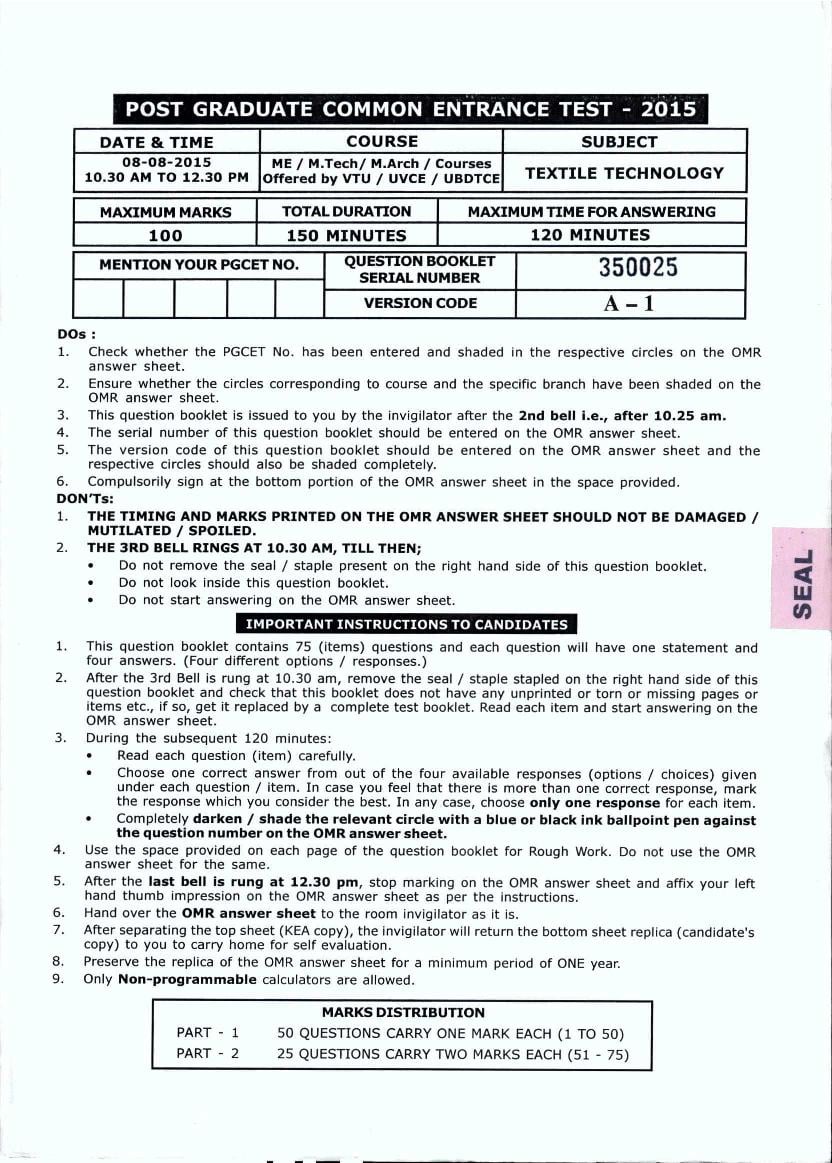
DATE & TIME COURSE SUBJECT
08-08-2015 ME / M.Tech/ M.Arch / Courses
10.30 AM TO 12.30 PM Offered by VTU / UVCE / UBDTCE TEXTILE TECHNOLOGY
MAXIMUM MARKS TOTAL DURATION MAXIMUM TIME FOR ANSWERING
100 150 MINUTES 120 MINUTES
QUESTION BOOKLET
MENTION YOUR PGCET NO.
SERIAL NUMBER
350025
VERSION CODE A -1
DOs :
1. Check whether the PGCET No. has been entered and shaded in the respective circles on the OMR
answer sheet.
2. Ensure whether the circles corresponding to course and the specific branch have been shaded on the
OMR answer sheet.
3. This question booklet is issued to you by the invigilator after the 2nd bell i.e., after 10.25 am.
4. The serial number of this question booklet should be entered on the OMR answer sheet.
5. The version code of this question booklet should be entered on the OMR answer sheet and the
respective circles should also be shaded completely.
6. Compulsorily sign at the bottom portion of the OMR answer sheet in the space provided.
DON'Ts:
1. THE TIMING AND MARKS PRINTED ON THE OMR ANSWER SHEET SHOULD NOT BE DAMAGED /
MUTILATED / SPOILED.
2. THE 3RD BELL RINGS AT 10.30 AM, TILL THEN;
• Do not remove the seal / staple present on the right hand side of this question booklet.
• Do not look inside this question booklet.
• Do not start answering on the OMR answer sheet.
IMPORTANT INSTRUCTIONS TO CANDIDATES
1. This question booklet contains 75 (items) questions and each question will have one statement and
four answers. (Four different options / responses.)
2. After the 3rd Bell is rung at 10.30 am, remove the seal / staple stapled on the right hand side of this
question booklet and check that this booklet does not have any unprinted or torn or missing pages or
items etc., if so, get it replaced by a complete test booklet. Read each item and start answering on the
OMR answer sheet.
3. During the subsequent 120 minutes:
• Read each question (item) carefully.
• Choose one correct answer from out of the four available responses (options / choices) given
under each question / item. In case you feel that there is more than one correct response, mark
the response which you consider the best. In any case, choose only one response for each item.
• Completely darken / shade the relevant circle with a blue or black ink ballpoint pen against
the question number on the OMR answer sheet.
4. Use the space provided on each page of the question booklet for Rough Work. Do not use the OMR
answer sheet for the same.
5. After the last bell is rung at 12.30 pm, stop marking on the OMR answer sheet and affix your left
hand thumb impression on the OMR answer sheet as per the instructions.
6. Hand over the OMR answer sheet to the room invigilator as it is.
7. After separating the top sheet (KEA copy), the invigilator will return the bottom sheet replica (candidate's
copy) to you to carry home for self evaluation.
8. Preserve the replica of the OMR answer sheet for a minimum period of ONE year.
9. Only Non-programmable calculators are allowed.
MARKS DISTRIBUTION
PART - 1 50 QUESTIONS CARRY ONE MARK EACH (1 TO 50)
PART - 2 25 QUESTIONS CARRY TWO MARKS EACH (51 - 75)
Page 2
Page 3
PART - 1
(50 X 1 = 50)
(Each question carries one mark)
1. Minimum FQI value required for a textile 6. Normally the following hooks are high in card
fibre is sliver
a. 40 h 10 a. Leading hooks
c. 20 b. Trailing hooks
d. 5
c. Hooks on both side
2. Trash to lint ratio in Blow - room is normally d No hooks
a. 80:20 b. 70:30
c. 50:50 d. 40:60
7. Draw frame is exclusively used to enhance
a. Uniformity of sliver
3. The number of beating points used for blends
is h Strength of sliver
a. 5 b. 6 c. To reduce the size of sliver
c. 8 d 2.5
d. To increase the size of sliver
4. Hopper feeder is normally kept behind
scutcher since it
8. Polar drafting in draw frame is
a. Cleans well
b. Opening is better a. 4/4 b. 4/3
c. Regulates the feed c. 3/5 d 2/2
d. Better beating point
9. Comber to be fed with
5. The percentage plate is part of
a. Leading hooks
a. Doffer
b. Trailing hooks
b. Flat
c. No hooks
c. Licker-in
d. Front plate d Hooks on both side
A-1 3 TX
Page 4
extraction from
a. Directly proportional a. 7,000 - 9,000 rpm
b. Indirectly b. 15,000 - 16,000 rpm
c. No relation c. 2,000 - 3, 000 rpm
d Equal to d. 1,000 - 1,500 rpm
11. Always traveler lag takes place since 16. End of condensation is a process of where
yarn will be
a. Twist to be inserted
a. Increasing the fibre flux and reducing
b. Winding to take place the fibre velocity
c. Strength to be imparted b. Increasing the fibre velocity and
reducing the fibre flux
d. Uniformity increases
c. Increasing the fibre flux and
increasing the fibre velocity
12. Bobbin leading mechanism in speed frame
d. Reducing the fibre flux and reducing
is preferred in
the fibre velocity
a. Jute Industry
b. Silk Industry 17. The number of doubling that takes place in
c. Man - Made open end spinning
d. Cotton Industry a. 10 - 15 h 20 - 25
c. 100 - 200 d. 25 - 50
13. Doubling of yarn increases
a. Strength and uniformity 18. Normally the ratio between fibre length to
rotor is
b. Abrasion and tearing
a. 1:2 b. 1:1.1
c. Bursting strength
c. 1:1 d. 1:0.5
d. Hand value
19. The slub catcher setting (Mechanical type)
14. Wet doubling is normally employed for the setting is normally
a. Sewing thread a. Equal to yarn dia
b. Fancy yarns b. Half the yarn dia
c. Twist less yarns c. 4 times the yarn dia
d. None of the above d 2.5 times the yarn dia
A-1 4 TX
Page 5
a. Viscometer a. Core fibres
b. Refractometer b. Long fibres
c. Tachometer c. Entangled fibres
d. None of the above d. Protruding fibres
21. The sizing is a process which enhances 26. Singeing, when carried out at yarn stage
a. Tensile strength a. Makes the yarn finer
b. Abrasion resistance b. Makes it coarser
c. Tearing strength c. The count is not affected
d. Bursting strength d. None of the above
22. The beating - up normally takes place at 27. Scouring is a process in which
a. Front centre a. Natural impurities are removed
h Back centre b. Brightens the fabric
c. Top centre c. Strengthen the fabric
d. Bottom centre d. Improves hand of the fabric
23. Knitting is a process of 28. Silk is normally dyed with
a. Interlacing of yarns a. Direct dye
b. Intermeshing of yarns b. Acid dye
c. c. Basic dye
Knotting the yarns
d. Vat dye
cL Combining the yarns
29. The fastness property is very good, when
24. Normally course density will be
cotton fabric is dyed with
a. Higher than wale density a. Direct dye
b. Equal to wale density h Vat dye
c. Less than wale density c. Basic dye
d. No relations d. Sulphur dye
A-1 5 TX
Page 6
a. 30 Tex b. 20 Tex a. Twisting
c. 10 Tex d. 5 Tex b. Reeling
c. Degumming
31. Fabric hand value is measured by d Doubling
a. KAWA BATA
b. FAST 36. The strongest weave is
c. HVI a. Plain b. Twill
d. Spectrometer c. Satin d. Sateen
32. As the drape coefficient increases fabric is 37. Pique fabrics means
a. Stiffer a. Curtain fabrics
b. Supple b. Shirting
c. Smoother c. Toilet fabrics
d. Low resistance to bending
d. Fancy fabrics
33. Bursting strength is very important
parameter for 38. Towelling fabrics are normally
a. Woven fabric a. Plain weave
b. Knitted fabric b. Huck - a - back
c. Braided fabric c. Twill weave
d. None of the above d. Satin weave
34. Silk contains 39. The number of floats is high in
a. Sulphuric acid a. Plain weave
b. Acetic acid b. Twill weave
c. Amino acid c. Sateen weave
d. Hydrochloric acid d. Pile fabric
A-1 6 TX
Page 7
a. Sewing Garment a. Cutting b. Finishing
c. Dyeing d. Sewing
b. Dyeing Garment
c. Marketing Garment
46. Shear stress means
d. Finishing Garment
a. Vertical load
b. Tangential load to the surface
41. Normally in garment industry, grey fabrics c. Multidirectional load
are inspected by
d. None of the above
a. Visual inspection
b. 4 - point system 47. Spun silk means
c. Physical testing a. Silk filament are spun in short staple
spinning
d. None of the above
b. Silk filament are spun in long staple
spinning
42. Care labeling is a c. Silk filament are twisted together
a. Process of selling the garment d. Waste silk are spun in short staple
spinning
b. Cutting procedure
c. Stitching instruction 48. The normal degumming loss percentage will
d. Maintenance of garment during be
washing a. 0 - 10% b. 10 - 15%
c. 20 - 25% d. 5 - 15%
43. Good quality silk will have
a. More Renditta 49. Pattern making means
a. Paper cutting before garment making
b. Less Renditta
b. Device to stitch
c. Equal to reelability
c. Method of dyeing garment
d. None of the above
d. Quality control study
44. The maximum THV value of a fabric 50. Silk is a
a. 1 h 100 a. Mono filament b. Bi - filament
c. 5 d. 0 c. Multi filament d. Fibre
i•
A-1 7 TX
Page 8
(Each question carries two marks)
(25 X 2 = 50)
51. Ginning is a process of 55. Normally the beater to fan - speed in blow
room is in the ratio
a. Removing short fibres
a. 1:2 b. 1:3
b. Removing long fibres
c. 1:1.2 d. 1:4
c. Separating seed and fibre
d. Mixing the fibres
•
56. Mote knife is a part of
52. Jute is a a. Licker in zone
a. Bast fibre b. Doffer zone
b. Mineral fibre
c. Flat zone
c. Man - made fibre
d. Carding zone
Organic fibre
57. At the time of carding, only
53. Air texturing of yarn result in
a. 40 flats will be working
a. Stretch yarn
b. Modified stretch yarn b. No flats will be working
c. Bulk yarn c. 100 flats will be working
d. Crimped yarn d. Only 10 flats will be working
54. The grid bar setting is very important to 58. The noil percentage in double combing is
control
a. Loss of trash a. 0 - 5%
b. Loss of lint b. 5 - 10%
c. Loss of sand particles c. 10- 15%
d None of the above d. 20 - 25%
A-1 8 TX
Page 9
span yarns because
a. Strength
a. Long fibres are used
b. Uniformity
b. Method of twisting
c. Non uniformity
d. Drafting c. More no. of doubling
d. Break in twisting and winding
60. The twist given in speed frame is to
a. Strengthen the roving
64. Polyester is normally dyed with
b. Withstand stress and strain during
spinning a. Acid dyes
c. Withstand stress and strain during b. Reactive dyes
winding
c. Disperse dyes
d. Prepare roving uniformity
d. Vat dyes
61. Normally actual twist is always
a. Greater than practical twis 65. Higher micronaire value means
b. Less than practical twist a. Fibres are finer
c. Equal to practical twist
b. Fibres are coarser
d. None of the above
c. Fibres are matured
d. Fibres are stronger
62. As the diameter of rotor increases the
a. Wrapper fibres will be less
66. 30 Tex yarn is equivalent to
b. Wrapper fibres will be more
c. Does not affect the wrapper fibres a. 30's Ne b. 10's Ne
d. None of the above c. 5's Ne d. 20's Ne
A-1 9 TX
Page 10
a. Abrasion resistance a. Shirting
b. Suits
b. Tearing resistance
c. Towelling
c. Tensile strength
d. Blouse
d. Bursting strength
72. Fabrofeel is an instrument used to measure
68. The maximum cover factor of square plain a. Tensile and tearing strength of fabric
fabric is
b. Drape coefficient of fabric
a. 10 h 2
c. Hand value of fabric
c. 12 d. 16.2 d. Bursting strength of fabric
69. The temperature normally preferred during 73. The U% of normal ring spun yarn ranges from
reeling of silk is
a. 0 - 5% b. 5 - 8%
a. 65°C c. 20 - 25% d. 10 - 12%
h 25° c
74. The expected loop shape factor of cotton
knitted fabric is
c. 10° C
a. 10 - 20 b. 5-6
d. Steam temp
c. 1 - 1.3 d. 0-1
70. Spun silk industry make use of 75. Sewing threads are normally manufactured
a. Short staple spinning bY
a. Dry doubling
b. Long staple spinning
b. Wet doubling
c. Friction spinning
c. Fancy doubling
d. Air jet spinning d. Open - End spinning
A-1 10 TX
Document Details
| Board / Org | KEA |
| Exam | Karnataka PGCET |
| Type | Question Paper |
| Pages | 12 |
| Updated | 22 Jul 2026 |