CUSAT CAT 2022 Question Paper Biotechnology
Finished viewing? Save it for later —
Download CUSAT CAT 2022 Question Paper Biotechnology (PDF · 29 pages)About CUSAT CAT 2022 Question Paper Biotechnology
CUSAT CAT 2022 Question Paper Biotechnology is available here for free download. Published by Cochin University for CUSAT Common Admission Test, this question paper can be viewed online or downloaded as a PDF (29 pages). Candidates preparing for CUSAT Common Admission Test can use CUSAT CAT 2022 Question Paper Biotechnology to understand the exam pattern, the type of questions asked, and the overall difficulty level.
Frequently Asked Questions
How can I download CUSAT CAT 2022 Question Paper Biotechnology?
Open this page and click the Download button to save CUSAT CAT 2022 Question Paper Biotechnology as a PDF. It is completely free on AglaSem Docs.
Is CUSAT CAT 2022 Question Paper Biotechnology free to download?
Yes. CUSAT CAT 2022 Question Paper Biotechnology can be viewed online and downloaded as a PDF free of cost on AglaSem Docs.
How many pages does CUSAT CAT 2022 Question Paper Biotechnology have?
CUSAT CAT 2022 Question Paper Biotechnology contains 29 pages, which you can read online or download together as a single PDF.
Where can I find more CUSAT Common Admission Test study material?
You can find more CUSAT Common Admission Test question papers, sample papers, syllabus, and answer keys on AglaSem Docs.
CUSAT CAT 2022 Question Paper Biotechnology – Text
Read the full text of this question paper below — useful to quickly search, copy and reference the content online without downloading the PDF.
📄 View text version (29 pages)
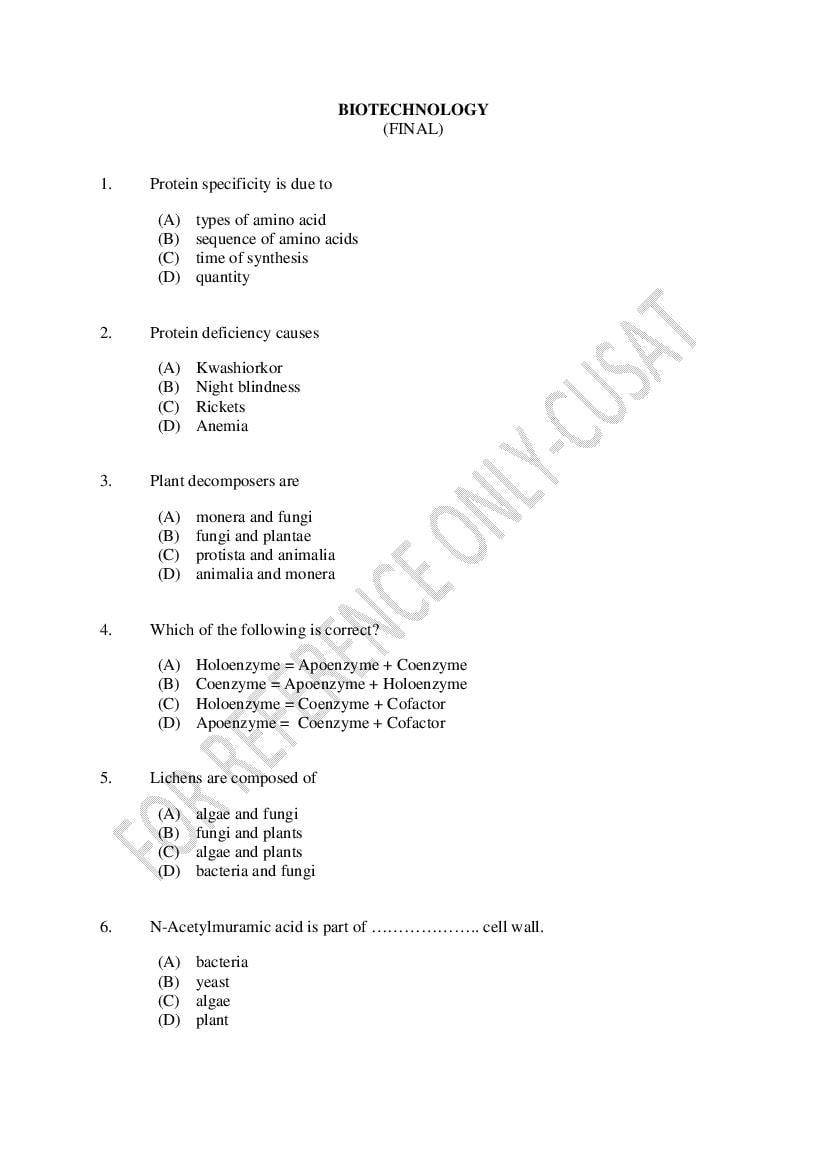
Page 1
(FINAL)
1. Protein specificity is due to
(A) types of amino acid
(B) sequence of amino acids
(C) time of synthesis
(D) quantity
2. Protein deficiency causes
(A) Kwashiorkor
(B) Night blindness
(C) Rickets
(D) Anemia
3. Plant decomposers are
(A) monera and fungi
(B) fungi and plantae
(C) protista and animalia
(D) animalia and monera
4. Which of the following is correct?
(A) Holoenzyme = Apoenzyme + Coenzyme
(B) Coenzyme = Apoenzyme + Holoenzyme
(C) Holoenzyme = Coenzyme + Cofactor
(D) Apoenzyme = Coenzyme + Cofactor
5. Lichens are composed of
(A) algae and fungi
(B) fungi and plants
(C) algae and plants
(D) bacteria and fungi
6. N-Acetylmuramic acid is part of ……………….. cell wall.
(A) bacteria
(B) yeast
(C) algae
(D) plant
Page 2
(A) crystal violet
(B) safranin
(C) carbol fuchsin
(D) Both (B) and (C)
8. The components of microbiological media are sterilized by
(A) steam sterilization
(B) red hot sterilization
(C) flaming
(D) incineration
9. Which of the following are sulfur containing amino acids?
(A) Cysteine and methionine
(B) Methionine and threonine
(C) Cysteine and threonine
(D) Cysteine and serine
10. The antibiotic ‘penicillin’ is produced by
(A) fungi
(B) bacteria
(C) algae
(D) ferns
11. Macroalgae are otherwise called as
(A) plants
(B) seaweeds
(C) microbes
(D) spores
12. The technique of chromatography works on the principle of
(A) adsorption
(B) absorption
(C) retention
(D) conjugation
Page 3
(A) zymogen
(B) molecular chaperon
(C) chitosan
(D) enzymes
14. Which of the following is NOT a part of ‘central dogma’ in
molecular biology?
(A) Transcription
(B) Translation
(C) Transduction
(D) Transversion
15. The virus affecting bacteria is
(A) bacteriophage
(B) cosavirus
(C) echovirus
(D) salmovirus
16. Which of the following is Kornberg enzyme?
(A) DNA polymerase
(B) RNA polymerase
(C) Ligase
(D) Endonuclease
17. BRCA genes are associated with
(A) Breast cancer
(B) Colorectal cancer
(C) Blood cancer
(D) Skin cancer
18. Which among the following is to be restricted for celiac disease?
(A) Gluten rich food
(B) Oil rich food
(C) Tannin rich food
(D) Glucose rich food
Page 4
(A) Hane’s plot
(B) Ramachandran plot
(C) Moody’s plot
(D) Fick’s plot
20. DNA gyrase is involved in
(A) DNA cleavage
(B) joining of the fragmented DNA
(C) supercoiling of chromosomal DNA
(D) DNA fragmentation
21. Which of the following microorganisms is commonly associated with
wound infections?
(A) Staphylococcus aureus
(B) Chlorella vulgaris
(C) Clostridium botulinum
(D) Shewanella putrefaciens
22. Chemically synthesized DNA sequences for the two chains are separately inserted
into the plasmid pBR 322 by the side of
(A) β-Galactosidase
(B) galactokinase
(C) acid phosphatase
(D) glucokinase
23. Which of the following techniques would be most useful to identify and quantify the
presence of a known impurity in a drug substance?
(A) NMR
(B) GC
(C) IR
(D) HPLC
24. The polymerization of the gel used in PAGE occurs between polyacrylamide and
(A) N,N-acrylamide
(B) Bisacrylamide
(C) N-methyleneacrylamide
(D) N,N-methylene bisacrylamide
Page 5
(A) Mast cells and IgE
(B) K cells and IgG
(C) Deposition of antigen antibody complexes
(D) T Helper Cells
26. In mammals, somatic cell division is operated by
(A) mitosis
(B) meiosis
(C) replication
(D) doubling
27. Microbial growth kinetics is analyzed using
(A) Michaelis-Menten Kinetics
(B) Monod Kinetics
(C) Leudkingpiret model
(D) LB Plot
28. In gel electrophoresis, the separated DNA fragments can be
visualized with the help of
(A) acetocarmine in bright blue light
(B) ethidium bromide in UV radiation
(C) acetocarmine in UV radiation
(D) ethidium bromide in IR radiation
29. Match the following.
(a) Thermus aquatics (i) Triglycerides
(b) Chlorella pyrenoidosa (ii) Transgenic Plants
(c) Agrobacterium tumefaciens (iii) PCR enzyme
(d) Gracilaria corticata (iv) Polysaccharides
(A) (a)-(i), (b)-(iii), (c)-(ii), (d)-(iv)
(B) (a)-(iii), (b)-(i), (c)-(ii), (d)-(iv)
(C) (a)-(iv), (b)-(iii), (c)-(ii), (d)-(i)
(D) (a)-(iv), (b)-(i), (c)-(iii), (d)-(ii)
Page 6
(A) nitrification
(B) dentrification
(C) nitrogen fixation
(D) ammonification
31. The buffer system of the blood is maintained by
(A) hemoglobin
(B) amino acids
(C) phosphate ions
(D) bicarbonate
32. Which of the following reactions is the best representative of photosynthesis?
(A) CH2O + O2 → CO2 + H2O
(B) 2C + 3H2 → C2H6?
(C) H2 + ½ O2 → H2O
(D) CO2 + H2O → CH2O + O2
33. In a typical biosensor, the following biochemical reaction occurs in the presence of
glucose oxidase. Identify the appropriate biosensor type.
Glucose + O2 → Glucuronic acid + H2O2
(A) Optical biosensor
(B) Amperometric biosensor
(C) Calorimetric biosensor
(D) Potentiometric biosensor
34. Which of the following is NOT a greenhouse gas?
(A) N2
(B) CO2
(C) N2O
(D) CH4
Page 7
(A) P53
23
(B) P
(C) P63
(D) P43
36. Collectively, the suspended, single-celled, photosynthesizing microorganisms in the
world ocean are called
(A) zooplankton
(B) virioplankton
(C) phytoplankton
(D) jellyplankton
37. Embryonic stem cells are derived from
(A) blastocyst
(B) fibrocyst
(C) mesoderm
(D) ectoderm
th
38. In sickle cell anaemia, the glutamic acid in the 6 position in the β chain of
haemoglobin is replaced by
(A) Leucine
(B) Histamine
(C) Valine
(D) Proline
39. Which of the following is NOT an example for Exergonic Reactions?
(A) Photosynthesis
(B) Glycolysis
(C) Photolysis
(D) Cellular respiration
40. Which of the following cells produce IgM antibodies?
(A) Mast cell
(B) Virgin B cells
(C) Macrophages
(D) Developing B cells
Page 8
the free energy change (∆G) will be
(A) ∆G < 0
(B) ∆G > 0
(C) ∆G = 0
(D) remains constant
42. Clear areas in a plate with bacterial colonies, caused by phage particles, are called
(A) Phage’s
(B) Plaques
(C) Plasmids
(D) Bacteriophages
43. ……………….. is the process by which cells interact and attach to neighboring cells
through specialized molecules of the cell surface.
(A) Cell migration
(B) Cell division
(C) Cell development
(D) Cell adhesion
44. Giant chromosomes are found in
(A) Drosophila
(B) Human
(C) Grasshopper
(D) Mouse
45. Match the following cell adhesion molecules (CAM) with their ligand reorganization.
(a) Selectins (i) N-CAM
(b) Integrins (ii) Fibronectin
(c) Ig superfamily (iii) Ca2+ binding sites
(d) Cadherins (iv) Lectin domain
(A) (a)-(i), (b)-(iii), (c)-(iv), (d)-(ii)
(B) (a)-(ii), (b)-(iv), (c)-(iii), (d)-(i)
(C) (a)-(iv), (b)-(ii), (c)-(i), (d)-(iii)
(D) (a)-(iii), (b)-(ii), (c)-(iv), (d)-(i)
Page 9
(A) Lungs
(B) Kidney
(C) Spleen
(D) Liver
47. The stability of biological macromolecules and of biomolecular associations is
quantified by the standard free energy ∆G°. Which of the following analyses is used
to determine the thermodynamic parameters of protein stability?
(A) Van’t Hoff analysis
(B) Thermal analysis
(C) Kinetic analysis
(D) LCA analysis
48. Which of following cells doesn’t secrete IFN-γ ?
(A) TH1 Cells
(B) TH2 Cells
(C) NK Cells
(D) CD8 – T cells
49. Which of the following is NOT a function of hormones?
(A) Metabolism
(B) Growth of body
(C) Transmission of nerve impulse
(D) Parturition
50. What is the value of equilibrium constant at 298 K for the
chemical reaction given below?
N2O4 (g) → 2 NO2 (g)
Given that standard free energies of formation at 298 K are
97,540 J/mol and 51,310 J/mol for N2O4 and NO2 respectively.
(A) K = 0.507
(B) K = 0.128
(C) K = 0.075
(D) K = 0.002
Page 10
(A) Serine
(B) Choline
(C) Lysolecithin
(D) Glycerol
52. Which of the following equations is used for the prediction of effect of
temperature on equilibrium constant?
(A) Langmuir equation
(B) Freudlich equation
(C) Van’t Hoff equation
(D) Tooth’s equation
53. Changes of gene frequency brought about purely by chance in
a small population is called
(A) Genetic drift
(B) recombination
(C) metamerism
(D) mutation
54. What is the membrane potential of the neuron if the
+
external K concentration is 24 mM?
(A) −56 mV
(B) +56 MV
(C) −76 mV
(D) +76 mV
55. In mitochondrial oxidative phosphorylation, the role of
which among the following as a Po4 acceptor is important?
(A) ATP
(B) CAMP
(C) ADP
(D) AMP
Page 11
56. The wall shear stress of 0.981 N/m and average shear rate in circular pipe of 981 s
is obtained for the fluid flow. Calculate the viscosity of the fluid.
(A) 1 × 10⁻³ N.s/m2
(B) 1 × 10⁻³ N/m2
–3 2
(C) 2 × 10 N/m
(D) 2 × 10⁻³ N.s/m2
57. Interferons inhibit the synthesis of
(A) Viral RNA and proteins
(B) Viral DNA and proteins
(C) Viral proteins
(D) Antiviral activity
3
58. A strain of Azotobacter vinelandii is cultured in a 15 m stirred fermenter for
–1
alginate production. Under current operating conditions kLa is 0.17 s . Oxygen
–3 –3
solubility in the broth is approximately 8 × 10 kg m . The specific rate of
–1 –1
oxygen uptake is 12.5 mmol g h . Determine the cell concentration.
(A) 12 g L–1
(B) 16 g L–1
(C) 20 g L–1
(D) 18 g L–1
59. In an enzyme catalyzed reaction pathway by a series of enzymes, the inhibition of the
first step by the final product is
(A) feedback regulation
(B) enzyme degradation
(C) control of enzyme synthesis
(D) activation of latent enzymes
60. A hot fluid enters a double pipe heat exchanger at a temperature of 423 K and to be
cooled to 363 K by a cold fluid entering at 308 K and heated to 338 K. Which of the
following arrangements is recommendable for the high rate of heat transfer?
(A) Parallel flow
(B) Co-current flow
(C) Counter current flow
(D) Cross flow
Page 12
acid to water and carbon dioxide
(A) Mitochondrion
(B) Chloroplast
(C) Lysosome
(D) Ribosome
62. The wall surfaces are maintained at 373 K and 303 K respectively. The thermal
conductivity of the red brick is 0.70 W/m.K. What is the rate of heat loss Q through a
wall of red brick 5 m in length and 4 m in height and 250 mm in thickness?
(A) 3920 W
(B) 4020 W
(C) 8018 W
(D) 2600 W
63. The introduction of microorganisms in contaminated soil to
facilitate biodegradation is known as
(A) Biostimulation
(B) Bio augmentation
(C) Bioseparation
(D) Venting
64. Fick’s law is applicable for
(A) heat transfer
(B) mass transfer
(C) momentum transfer
(D) fluid transfer
65. Normal concentration of cholesterol in our body is
(A) 80-120 mg/100 ml blood
(B) 100-150 mg/100 ml blood
(C) 140-250 mg/100 ml blood
(D) 50-100 mg/100 ml blood
66. The transfer of heat from one point to another point within the fluid by
mixing of hot and cold portions of the fluid is called
(A) conduction
(B) convection
(C) eddy current
(D) sorption
Page 13
(A) small tubules in kidney
(B) ductless glands in pancreas
(C) present in pineal gland
(D) None of the above
68. The diffusivity coefficient of oxygen into fermentation broth was noted to
–10 2
be 7.5 × 10 m /s. The thickness of the stagnant film was calculated to
5.2 microns. Calculate the mass transfer coefficient using film theory.
(A) 1.442 × 10⁻⁴ m/s
(B) 3.550 × 10⁻⁴ m/s
(C) 4.998 × 10⁻⁴ m/s
(D) 1.205 × 10⁻⁴ m/s
69. The shell of a diatom is made up of
(A) calcium carbonate
(B) silica
(C) magnesium carbonate
(D) lime
70. Which of the following combinations of hormones will promote differentiation of
shoot as well as root in plant tissue culture?
(A) Gibberellin and abscisic acid
(B) Auxin and cytokinin
(C) Auxin and abscisic acid
(D) IAA and gibberellins
71. The basic protein associated with DNA is
(A) Histones
(B) Albumin
(C) Globulin
(D) Non-histone
Page 14
(A) DNA
(B) RNA
(C) proteins
(D) C-DNA
73. Amoeabiasis in humans is caused by
(A) Plasmodium vivax
(B) Paramecium auvelia
(C) Entamoeba histolytica
(D) Entamoeba gingivalis
74. It is desired to culture a microorganism for the production of a commercially
important product, feeding the substrate intermittently to overcome catabolite
repression. Which of the following bioreactors could be appropriate for this process?
(A) Batch reactor
(B) Fed-batch reactor
(C) Continuous reactor
(D) Packed bed reactor
75. Asexual reproductions in fungi is associated with
(A) Ascospores
(B) Conidia
(C) Basidiospores
(D) Zygospores
76. The Theory of Natural selection was proposed by
(A) Darwin
(B) Lamarck
(C) Wagner
(D) Mendel
77. The biologically derived compounds that lower the surface tension or interfacial
tension between two liquids is
(A) biosurfactant
(B) emulsion
(C) biosorbent
(D) bioadsorbent
Page 15
(A) Leptotene
(B) Zygotene
(C) Pachytene
(D) Diakinesis
79. A nucleoside differs from nucleotide in not having
(A) sugar
(B) glucose
(C) nitrogenous base
(D) phosphate group
80. Which of the following is an ore mineral of uranium?
(A) Zircon
(B) Pitchblende
(C) Magnetite
(D) Apatite
81. Which of the following is used for the culture of spleen cells?
(A) Luria bertani medium
(B) Dulbecco's modified eagle medium
(C) Malt extract broth
(D) Nutrient broth
82. Hydrolysis of starch yields
(A) d-Glucose
(B) Fructose
(C) Sucrose
(D) Glucose and Fructose
83. Coliform in drinking water samples are tested using
(A) MPN Test
(B) ASP test
(C) Benedict’s test
(D) Biuret test
Page 16
(A) Nylon
(B) Protein
(C) Bakelite
(D) Terylene
85. The programmed cell death is
(A) Apoptosis
(B) Necrosis
(C) Endocytosis
(D) Cytolysis
86. A very common flocculant used for water treatment to
settle down impurities rapidly is
(A) Alum
(B) Charcoal
(C) Bentonite
(D) Diatomaceous earth
87. Match the following.
(a) Phagocytosis (i) Golgi Apparatus
(b) Pinocytosis (ii) Uptake of liquid material
(c) Exocytosis (iii) Receptor mediated endocytosis
(d) Clathrin (iv) Uptake of solid material
(A) (a)-(i), (b)-(ii), (c)-(iii), (d)-(iv)
(B) (a)-(iii), (b)-(iv), (c)-(ii), (d)-(i)
(C) (a)-(iv), (b)-(ii), (c)-(i), (d)-(iii)
(D) (a)-(iii), (b)-(ii), (c)-(iv), (d)-(i)
88. The binding of dyes like Coomassie Blue R250 to protein for the
detection of proteins relies on
(A) hydrophobic interaction
(B) adsorption only
(C) Both (A) and (B)
(D) None of the above
Page 17
(A) energy-dispersive X-ray spectroscopy
(B) scanning electron microscopy
(C) transmission electron microscopy
(D) fourier-transform infrared spectroscopy
90. Saponification means
(A) hydrolysis of starch
(B) the other name of deconjugation
(C) conversion of fatty acids to soaps and alcohols
(D) formation of soaps and alcohols by the action of heat and aqueous alkali
91. Which of the following explants is suitable for virus elimination by
micropropagation?
(A) Leaf
(B) Shoot
(C) Flower
(D) Meristem
92. Lipases catalyze fats to
(A) fatty acids and glycerol
(B) glycerol
(C) fatty acids only
(D) None of the above
93. ……………….. has the strongest fluorescence quantum yield of the amino acids
found in proteins.
(A) Trp
(B) Asp
(C) His
(D) Pro
94. The major gaseous product released by burning of fossil fuels is
(A) Carbon dioxide
(B) Sulphur dioxide
(C) Both but highest being carbon dioxide
(D) None of the above
Page 18
(A) Adrenaline
(B) Glutamate
(C) Histamine
(D) Histidine
96. C60 (Buck minister fullerene or bucky ball) is an allotrope of
(A) sulphur
(B) carbon
(C) phosphorous
(D) selenium
97. Which one the following reaction mechanisms drives the conversion of low energy
3-phosphoglyceraldehyde to high energy 1,3-bisphosphoglycerate?
(A) Oxidation without anhydride bond formation
(B) Oxidation coupled with anhydride bond formation
(C) Substrate level phosphorylation
(D) Formation of carboxylate
98. An amide with two –NH2 groups and joined by a carbonyl functional group with
importance as fertilizer is
(A) urea
(B) superphosphate
(C) dioxin
(D) None of the above
99. Which of the following is a cis-regulatory element?
(A) TATA Box
(B) CAAT box
(C) CATA box
(D) NATA box
100. α and β glucose differs with respect to the position of OH group at
(A) carbon number 1
(B) carbon number 3
(C) carbon α and β to aldehyde group
(D) all the carbons
Page 19
(A) Microsatellite
(B) Transposon
(C) Phagemids
(D) Exon
102. Adsorption differs from absorption in
(A) being a purely surface phenomenon
(B) interfacial mixing
(C) slow kinetics
(D) None of the above
103. Which of the following precursors is widely used for penicillin production?
(A) Zeatin
(B) Auxin
(C) Benzoic acid
(D) Phenyl acetic acid
104. Which among the following is an example of photocatalyst?
(A) Chlorophyll
(B) Magnesium chloride
(C) Indigo
(D) None of the above
105. Match the following blotting techniques.
(a) Southern blotting (i) Lipids
(b) Western blotting (ii) RNA
(c) Northern blotting (iii) DNA
(d) Eastern blotting (iv) Proteins
(A) (a)-(i), (b)-(ii), (c)-(iv), (d)-(iii)
(B) (a)-(iii), (b)-(iv), (c)-(ii), (d)-(i)
(C) (a)-(iv), (b)-(iii), (c)-(i), (d)-(ii)
(D) (a)-(ii), (b)-(iii), (c)-(iv), (d)-(i)
106. Milk of magnesia used commonly as an oral antacid is primarily composed of
(A) magnesium hydroxide
(B) magnesium oxide and milk
(C) calcium hydroxide magnesium oxide
(D) None of the above
Page 20
(A) Spread plating
(B) Replica plating
(C) Streaking
(D) Pouring
108. Aspirin belongs to the class of compounds
(A) Salicylates
(B) Pthalates
(C) Oxalates
(D) terpenoids
109. Which of the following is NOT a type of reverse mutation?
(A) Back mutation
(B) Intergenic suppressor mutation
(C) Intragenic suppressor mutation
(D) Missense mutation
110. Cholesterol, an important constituent of cell membranes of animals, is basically a
(A) sterol
(B) sphingolipid
(C) teichoic acid
(D) β glucan
111. Leaching refers to
(A) liquid-liquid extraction
(B) solid-liquid extraction
(C) gas-liquid extraction
(D) gas-solid extraction
112. Tannin is an example of
(A) polyphenol
(B) hydroxy acids
(C) nucleic acids
(D) carboxylic acids
Page 21
(A) Pyruvic acid
(B) Hyaluronic acid
(C) Steric acid
(D) Malonic acid
114. In fireflies, which among the following enzymes plays an important role in
generating light?
(A) Luciferase
(B) Phosphatase
(C) ATPase
(D) DNA polymerase
115. Which of the following is a nucleotide sequence database?
(A) Swiss Prot
(B) EMBL
(C) TrEMBL
(D) PROSITE
116. Common examples of photosensitive chemicals are
(A) halides of silver
(B) oxides of silver
(C) salts of silver
(D) None of the above
117. Which of the following statements is correct in considering the effect of activation on
spore and nutrient destruction during the sterilization of the medium?
(A) It is advantageous to employ high temperature for short period of time
(B) It is advantageous to employ low temperature for long period of time
(C) It is advantageous to employ high temperature for long period of time
(D) It is advantageous to employ low temperature for short period of time
118. Identify the salt which contains two different cations.
(A) Mohr’s salt
(B) Epsom salt
(C) Glaubers salt
(D) Blue vitriol
Page 22
used to control vortex in a fermentor?
(A) Agitator
(B) Baffles
(C) Vent
(D) Shaft
120. The gas widely used for fruit ripening and commonly called as ripening gas is
(A) ethylene
(B) carbon dioxide
(C) chlorine
(D) ozone
121. Nitrogenase enzyme catalyses the nitrogen fixation in root nodules of leguminous
plants. What are the possible products formed?
(A) Ammonia alone
(B) Nitrate alone
(C) Ammonia and oxygen
(D) Ammonia and hydrogen
122. Which of the following gas mixtures is used in
Gas cutting or oxy-fuel cutting of metals?
(A) Acetylene + Oxygen
(B) Oxygen + Hydrogen
(C) Oxygen alone
(D) Nitrogen + Oxygen
123. Which of the following is a heavy metal removal technique based on
surface phenomena?
(A) Absorption
(B) Bioacculmulation
(C) Biodegradation
(D) Adsorption
124. Radiocarbon dating or carbon dating is usually applied to determine the age of
(A) organic materials
(B) inorganic materials
(C) Both (A) and (B)
(D) None of the above
Page 23
(A) viscosity
(B) size of the colloidal particles
(C) stability of the colloidal particles
(D) solubility
126. Parabolic mirror is used in a reflecting telescope to get rid of
which of the following aberrations?
(A) Coma
(B) Spherical aberration
(C) Astigmatism
(D) Chromatic aberration
127. Match the following.
(a) Monascus purpureus (i) Biosurfactant
(b) Trichoderma polysporum (ii) Clot buster
(c) Streptococcus Sp. (iii) Statin
(d) Pseudomonas sp. (iv) Cyclosporin A
(A) (a)-(i), (b)-(ii), (c)-(iv), (d)-(iii)
(B) (a)-(iii), (b)-(iv), (c)-(i), (d)-(ii)
(C) (a)-(ii), (b)-(iv), (c)-(i), (d)-(iii)
(D) (a)-(iii), (b)-(iv), (c)-(ii), (d)-(i)
128. Different types of solar radiation cause different types of effects.
Which of the following is correct?
(A) Infrared causes more heating effects
(B) Infrared causes more chemical effects
(C) Ultraviolet causes more heating effects
(D) Infrared causes more visible effects
129. Match the following.
(a) Ulva lactuca (i) Microalgae
(b) Sargassum swartzii (ii) Green algae
(c) Chlorella vulgaris (iii) Brown algae
(d) Chondrus crispus (iv) Red algae
(A) (a)-(i), (b)-(ii), (c)-(iv), (d)-(iii)
(B) (a)-(iii), (b)-(iv), (c)-(i), (d)-(ii)
(C) (a)-(ii), (b)-(iii), (c)-(i), (d)-(iv)
(D) (a)-(iii), (b)-(iv), (c)-(ii), (d)-(i)
Page 24
(A) Raman Effect
(B) Rayleigh scattering
(C) Reflection from the ocean
(D) Bohr’s theory
131. Match the following.
(a) ELISA (i) Protein Separation
(b) Edman degradation (ii) Nucleic acid separation
(c) AGE (iii) Immunoglobulin Analysis
(d) SDS-PAGE (iv) Protein Sequencing
(A) (a)-(i), (b)-(ii), (c)-(iv), (d)-(iii)
(B) (a)-(iii), (b)-(iv), (c)-(i), (d)-(ii)
(C) (a)-(ii), (b)-(iii), (c)-(i), (d)-(iv)
(D) (a)-(iii), (b)-(iv), (c)-(ii), (d)-(i)
132. The dimension of torque is
(A) ML2 T−2
(B) ML2 T2
(C) M 2LT−2
(D) MLT
133. In trypan blue exclusion assay for cell counting
(A) viable cells are coloured
(B) dead cells are coloured
(C) viable cells are non-coloured
(D) dead cells are non-coloured
134. Super conductors are derived from
(A) P-block elements
(B) Actinides
(C) Lanthanides
(D) Transition elements
Page 25
(a) β-lactam (i) Affects cell membrane
(b) Aminoglycosides (ii) Inhibits cell wall synthesis
(c) Polyene macrolides (iii) Inhibits DNA synthesis
(d) Quinolones (iv) Inhibits protein synthesis
(A) (a)-(i), (b)-(ii), (c)-(iv), (d)-(iii)
(B) (a)-(iii), (b)-(iv), (c)-(i), (d)-(ii)
(C) (a)-(ii), (b)-(iv), (c)-(i), (d)-(iii)
(D) (a)-(iii), (b)-(iv), (c)-(ii), (d)-(i)
136. Copper is usually preferred as a conductor of electricity because, it
(A) has highest number of mobile electrons
(B) gets heated slowly
(C) does not melt due to heating effect
(D) is cheaper than other metals or conductors
137. In cell cycle, the Cdk inhibitor binds to Cdk-cyclin complexes and blocks their
activity resulting in pausing of the cell division at
(A) G1 phase
(B) G2 phase
(C) M phase
(D) S phase
138. If a solution transmits all visible wave lengths of light and absorbs none, it will appear
(A) white
(B) black
(C) red
(D) not possible to say
Page 26
sequence and select the correct option
(i) Synthesis of gene (DNA) for insulin artificially
(ii) Culturing recombinant E.coli in bioreactors
(iii) Purification of insulin
(iv) Insertion of human insulin gene into plasmid
(v) Introduction of recombinant plasmid into E.coli
(vi) Extraction of recombinant gene product from E.coli
(A) (ii), (i), (iv), (iii), (v), (vi)
(B) (i), (iii), (v), (vi), (ii), (iv)
(C) (i), (iv), (v), (ii), (vi), (iii)
(D) (i), (ii), (iii), (iv), (v), (vi)
140. Sedimentation rate for liquids is typically measured in
(A) Svedberg units
(B) nm
(C) g/sec
(D) there are no units as such
141. Sodium-potassium pump is ……………….. type of cell membrane transporter.
(A) uniport
(B) symport
(C) antiport
(D) triport
142. Cry toxins for the production of biological insecticides and insect-resistant genetically
modified crops are obtained from
(A) Azadirachta indica
(B) Thespesia populnea
(C) Bacillus thuringiensis
(D) Berberis aristata
143. Which of the following is the correct order of steps involved in
Lyophilisation process?
(A) Sublimation, Freezing, Desorption
(B) Desorption, Sublimation, Freezing
(C) Freezing, Sublimation, Desorption
(D) Sublimation, Desorption, Freezing
Page 27
(a) Codeine (i) Catharanthus roseus
(b) Taxol (ii) Papaver somniferum
(c) Emetine (iii) Taxus brevifolia
(d) Vinblastine (iv) Cephaelis ipecacuanha
(A) (a)-(i), (b)-(ii), (c)-(iv), (d)-(iii)
(B) (a)-(ii), (b)-(iii), (c)-(iv), (d)-(i)
(C) (a)-(ii), (b)-(iv), (c)-(i), (d)-(iii)
(D) (a)-(iii), (b)-(iv), (c)-(ii), (d)-(i)
145. Match the following analytical techniques with their applications.
(a) BET Analysis (i) Metal concentration
(b) Thermogravimetric analysis (ii) Phase transition
(c) Differential scanning calorimetry (iii) Surface area/pore volume
(d) Atomic absorption spectroscopy (iv) Thermal stability
(A) (a)-(i), (b)-(ii), (c)-(iv), (d)-(iii)
(B) (a)-(iii), (b)-(iv), (c)-(ii), (d)-(i)
(C) (a)-(ii), (b)-(iv), (c)-(i), (d)-(iii)
(D) (a)-(iv), (b)-(iii), (c)-(ii), (d)-(i)
146. Match the following plant growth regulators and their roles.
(a) Abscisic acid (i) Shoot formation
(b) Ethylene (ii) Secretion of cell wall dissolving enzymes
(c) Auxin (iii) Seed germination
(d) Cytokinin (iv) Root formation
(A) (a)-(i), (b)-(ii), (c)-(iv), (d)-(iii)
(B) (a)-(iii), (b)-(iv), (c)-(ii), (d)-(i)
(C) (a)-(ii), (b)-(iv), (c)-(i), (d)-(iii)
(D) (a)-(iii), (b)-(ii), (c)-(iv), (d)-(i)
147. Microbes that colonize living, internal tissues of plants without causing any
immediate, overt negative effects are called
(A) pathogens
(B) endophytes
(C) metabolites
(D) epiphytes
Page 28
permeabilize without destroying cell membranes/biomembranes.
(A) Surfactants
(B) Saponin
(C) Sodium dodecyl sulphate
(D) Sodium lauryl sulfate
149. The technique that allows manipulation of the cellular genome by a process called
protoplast fusion.
(A) Nuclear hybridization
(B) Somatic hybridization
(C) Conjugation
(D) Cloning
150. During dispersion of white light through a prism, the incident light separates
(A) into various colours at various wavelengths and frequencies
(B) at a fixed wavelength
(C) with variable frequency only
(D) with selective change of frequency and wavelength
Page 29
Subject Name: 601 BIOTECHNOLOGY
SI No. Key SI No. Key SI No. Key SI No. Key SI No. Key
1 B 31 D 61 A 91 D 121 D
2 A 32 D 62 A 92 A 122 A
3 A 33 B 63 B 93 A 123 D
4 A 34 A 64 B 94 A 124 A
5 A 35 A 65 C 95 D 125 C
6 A 36 C 66 B 96 B 126 B
7 D 37 A 67 B 97 B 127 D
8 A 38 C 68 A 98 A 128 A
9 A 39 A 69 B 99 A 129 C
10 A 40 B 70 B 100 A 130 B
11 B 41 A 71 A 101 B 131 D
12 A 42 B 72 A 102 A 132 A
13 B 43 D 73 C 103 D 133 B
14 C 44 A 74 B 104 A 134 D
15 A 45 C 75 D 105 B 135 C
16 A 46 C 76 A 106 A 136 A
17 A 47 A 77 A 107 B 137 A
18 A 48 B 78 C 108 A 138 A
19 B 49 C 79 D 109 D 139 C
20 C 50 B 80 B 110 A 140 A
21 A 51 B 81 B 111 B 141 C
22 A 52 C 82 A 112 A 142 C
23 D 53 A 83 A 113 B 143 C
24 B 54 A 84 B 114 A 144 B
25 C 55 C 85 A 115 B 145 B
26 B 56 A 86 A 116 A 146 D
27 B 57 A 87 C 117 A 147 B
28 B 58 A 88 A 118 A 148 B
29 B 59 A 89 D 119 B 149 B
30 B 60 C 90 C 120 A 150 A
Document Details
| Board / Org | Cochin University |
| Exam | CUSAT Common Admission Test |
| Type | Question Paper |
| Pages | 29 |
| Updated | 22 Jul 2026 |