PU CET PG 2017 Question Paper MSc_2Yr__Human Genomics_
Finished viewing? Save it for later —
Download PU CET PG 2017 Question Paper MSc_2Yr__Human Genomics_ (PDF · 9 pages)About PU CET PG 2017 Question Paper MSc_2Yr__Human Genomics_
PU CET PG 2017 Question Paper MSc_2Yr__Human Genomics_ is available here for free download. Published by Panjab University for PU CET PG, this question paper can be viewed online or downloaded as a PDF (9 pages). Candidates preparing for PU CET PG can use PU CET PG 2017 Question Paper MSc_2Yr__Human Genomics_ to understand the exam pattern, the type of questions asked, and the overall difficulty level.
Frequently Asked Questions
How can I download PU CET PG 2017 Question Paper MSc_2Yr__Human Genomics_?
Open this page and click the Download button to save PU CET PG 2017 Question Paper MSc_2Yr__Human Genomics_ as a PDF. It is completely free on AglaSem Docs.
Is PU CET PG 2017 Question Paper MSc_2Yr__Human Genomics_ free to download?
Yes. PU CET PG 2017 Question Paper MSc_2Yr__Human Genomics_ can be viewed online and downloaded as a PDF free of cost on AglaSem Docs.
How many pages does PU CET PG 2017 Question Paper MSc_2Yr__Human Genomics_ have?
PU CET PG 2017 Question Paper MSc_2Yr__Human Genomics_ contains 9 pages, which you can read online or download together as a single PDF.
Where can I find more PU CET PG study material?
You can find more PU CET PG question papers, sample papers, syllabus, and answer keys on AglaSem Docs.
PU CET PG 2017 Question Paper MSc_2Yr__Human Genomics_ – Text
Read the full text of this question paper below — useful to quickly search, copy and reference the content online without downloading the PDF.
📄 View text version (9 pages)
Page 1
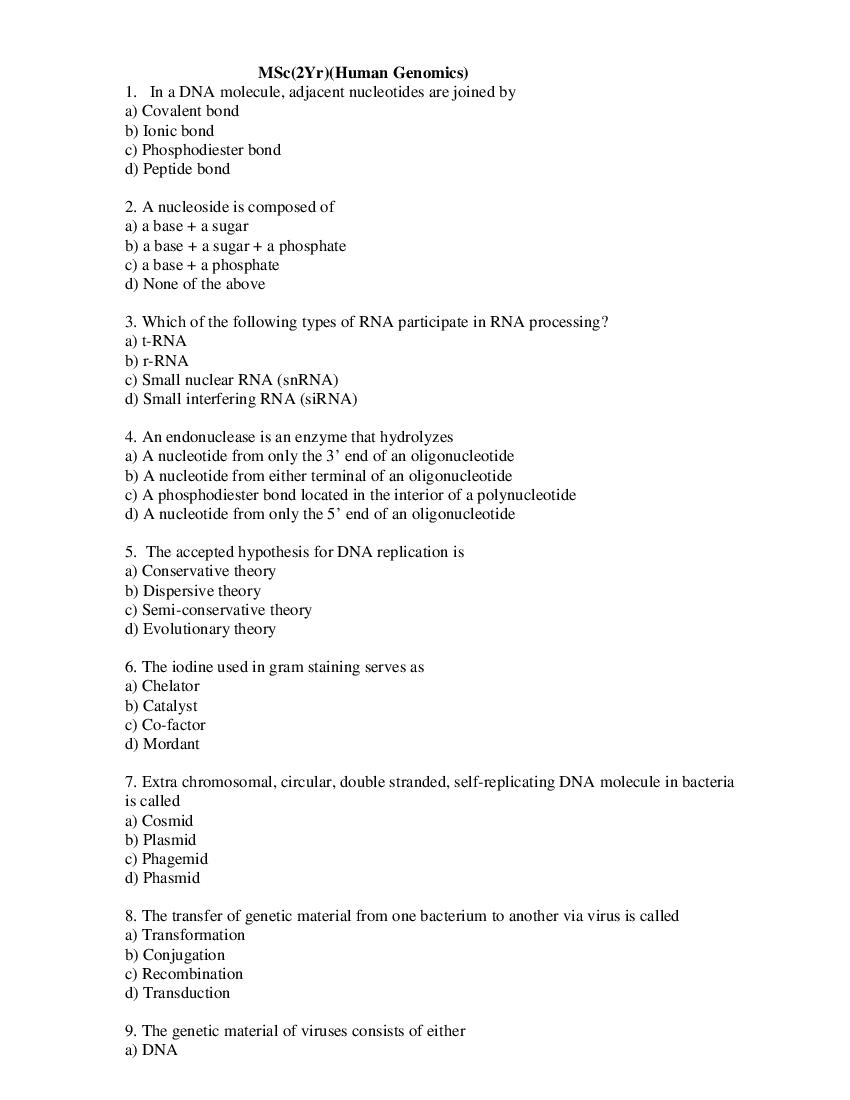
1. In a DNA molecule, adjacent nucleotides are joined by
a) Covalent bond
b) Ionic bond
c) Phosphodiester bond
d) Peptide bond
2. A nucleoside is composed of
a) a base + a sugar
b) a base + a sugar + a phosphate
c) a base + a phosphate
d) None of the above
3. Which of the following types of RNA participate in RNA processing?
a) t-RNA
b) r-RNA
c) Small nuclear RNA (snRNA)
d) Small interfering RNA (siRNA)
4. An endonuclease is an enzyme that hydrolyzes
a) A nucleotide from only the 3’ end of an oligonucleotide
b) A nucleotide from either terminal of an oligonucleotide
c) A phosphodiester bond located in the interior of a polynucleotide
d) A nucleotide from only the 5’ end of an oligonucleotide
5. The accepted hypothesis for DNA replication is
a) Conservative theory
b) Dispersive theory
c) Semi-conservative theory
d) Evolutionary theory
6. The iodine used in gram staining serves as
a) Chelator
b) Catalyst
c) Co-factor
d) Mordant
7. Extra chromosomal, circular, double stranded, self-replicating DNA molecule in bacteria
is called
a) Cosmid
b) Plasmid
c) Phagemid
d) Phasmid
8. The transfer of genetic material from one bacterium to another via virus is called
a) Transformation
b) Conjugation
c) Recombination
d) Transduction
9. The genetic material of viruses consists of either
a) DNA
Page 2
c) DNA or RNA
d) ssDNA or ssRNA
10. Conversion of NO2- to NO3- is carried out by
a) Nitrosomonas
b) Nitrososcoccus
c) Nitrobacter
d) Clostridium
11. X-chromosome inactivation
a) Normally takes place in males but not females
b) Is the cause of Y chromosome being genetically inactive
c) Takes place in humans so that the same X chromosome is inactive in all the cells of a
female
d) Results in genetically turning off one of the two X chromosomes in female mammals
12. Which of the following conditions is caused by trinucleotide (triplet) repeat expansion?
a) Cystic fibrosis
b) Duchenne muscular dystrophy
c) Huntington disease
d) Osteogenesis imperfect
13. Griffith’s transformation experiment was carried out using
a) Escherichia coli
b) Bacillus sublitis
c) Diplococcus pneumonia
d) Salmonella typhimurium
14. A heritable feature is a ______ and may have two or more variants called______.
a) Trait/Characteristics
b) Character/Traits
c) Character/Factors
d) Trait/Factors
15. Which of the following is correct with regard to aneuploidy?
a) Inversion
b) 2n + 1
c) All aneuploid individuals die before birth
d) 4n
16. Proteins that assist the binding of RNA polymerase to the promoter region on DNA
strand are called
a) Transcription factors
b) SSB proteins
c) Sigma factor
d) All of the above
17. Which of the following descriptions of chromosomes is not correctly matched?
a) Metacentric — chromosome arms are almost equal in size
b) Submetacentric — chromosome arms are slightly different in size
c) Acrocentric — chromosome arms are identical in size
d) Telocentric — there is only one chromosome arm
Page 3
a) Induced mutations
b) Fused mutations
c) Spontaneous mutations
d) potent mutations
19. The enzyme which builds mRNA strand complimentary to the DNA transcription unit is
called
a) DNA polymerase
b) RNA polymerase
c) Helicase
d) DNA ligase
20. Proto-oncogene in normal cells
a) Code for proteins involved in the stimulus of cell division
b) Suppresses progression through the cell cycle in response to DNA damage
c) Initiates apoptosis
d) Initiates cell death
21. During cell division there are three types of check points one of them (M checkpoint) to
ensure
a) Chromosomes are attached to the spindle
b) Complete DNA replication
c) DNA not damage or broken
d) RNA is not damaged
22. Those cancers that derived from ectoderm or endoderm of epithelial cell are called
a) Carcinoma
b) Sarcoma
c) Leukaemia
d) Myeloid
23. The association of endotoxin in gram-negative bacteria is a result of the presence of
a) Peptidoglycan
b) Lipopolysaccharides
c) Polypeptide
d) Steroids
24. Which of the following describes prokaryotic cell membrane?
a) Selectively permeable
b) Regulates passage of materials into and out of the cell
c) Contains proteins and phospholipids
d) Contains metabolic enzymes
25. Chloroplasts are organelle that actively carries out photosynthesis. Which of the
following is NOT a characteristic of them?
a) Are found in plant and algal cells
b) Contain the pigment chlorophyll
c) Are membrane enclosed
d) Are found in photosynthetic prokaryotic cells
Page 4
a) Amino acid
b) Peptide
c) Imino acid
d) Peptoid
27. The basic repeating units of a DNA molecule is
a) Nucleoside
b) Nucleotide
c) Histones
d) Amino acids
28. The length of DNA having 23 base pairs is
a) 78 Å
b) 78.4 Å
c) 78.2 Å
d) 74.8 Å
29. RNA molecules differ from DNA molecules in all but which one of the following
respects?
a) Kind of pyramidines
b) Kind of purines
c) Type of sugar
d) Number of strands per molecule
30. Solution with pH = 5 is __________ than a solution with pH = 7.
a) 2 times more basic
b) 10 times more basic
c) 10 times more acidic
d) 100 times more acidic
31. Stereo chemical configuration of all α-amino acids derived from proteins is
a) L
b) D
c) L and D
d) R and S
32. DNA replication takes place in which direction?
a) 3' to 5'
b) 5 'to 3'
c) Randomly
d) Vary from organism to organism
33. Molecules in which the atoms are held together by __________ bonds have the strongest
chemical linkages.
a) Non-covalent
b) Covalent
c) Ionic
d) Hydrogen
34. Rh factor of the blood was discovered by scientist
a) Louis Pasteur
Page 5
c) Janskey
d) Moss
35. Enhancement of virulence is known as
a) Exaltation
b) Attenuation
c) Both a and b
d) Stimulation
36. The ability of the immune system to recognize self antigens versus non-self antigen is an
example of
a) Specific immunity
b) Tolerance
c) Cell mediated immunity
d) Antigenic immunity
37. Cell mediated immunity is carried out by….. while humoral immunity is mainly carried
out by………………..
a) B cells/T cells
b) Epitopes/Antigens
c) T cells/B cells
d) Antibodies/Antigens
38. Monoclonal antibodies recognize a single
a) Antigen
b) Bacterium
c) Epitope
d) B cell
39. B Cells are activated by
a) Complement
b) Antibody
c) Interferon
d) Antigen
40. The specificity of an antibody is due to
a) Its valence
b) Heavy chains
c) Fc portion of the molecule
d) Variable portion of the heavy and light chain
41. C3b
a) Is chemotactic
b) Is an anaphylatoxin
c) Opsonizes bacteria
d) Directly injures bacteria
42. B cell are distinguished from T cells by the presence of
a) CD4
b) Surface Ig
c) CD8
Page 6
43. B cell don’t express
a) CD2
b) MHC-Ⅰmolecule
c) MHC-Ⅱmolecule
d) CR2
44. Molecules directly involved in NK cell mediated killing include
a) Muramyl dipeptide
b) Granzyme
c) Complement
d) IFN-gamma
45. Dendritic cells are characterized by
a) The presence of TCR
b) Expression of CD3
c) Expression of IgM molecules
d) Their ability to release histamine
46. Cytokines always act
a) By binding to specific receptors
b) In an autocrine fashion
c) At long range
d) Antagonistically with other cytokines.
47. The source of illumination in Fluorescent microscope is
a) Electron beam
b) Light rays
c) UV rays
d) Infrared rays
48. DNA Finger printing requires only a minute quantity of DNA sample such as WBC of
blood stain because
a) Large quantity of DNA is available in WBC
b) DNA contains nitrogen bases
c) DNA can be amplified through PCR
d) DNA determines the heredity
49. ELISA is used to detect HIV but the confirmation of HIV infection is done through
a) Southern blotting
b) Western blotting
c) Eastern blotting
d) DNA finger printing
50. Which one of the following enzymes is obtained from Thermophilus aquaticus bacterium
which is heat stable and used in PCR at high temperature
a) DNA polymerase III
b) Endonuclease
c) Taq polymerase
d) DNA gyrase
Page 7
inhibits the action of enzyme. This is
a) Allosteric inhibition
b) Feed back inhibition
c) Competitive inhibition
d) Non competitive inhibition
52. The most accepted theory of origin of life is
a) Special creation theory
b) Theory of abiogenesis
c) Oparin- Haldane theory
d) Theory of spontaneous generation
53. In Man, IA allele produces A antigen and IB allele produce B antigen. i allele is incapable
of producing any antigen. In which of the following person, the genotype is homozygous for
the alleles
a) A group
b) B group
c) O group
d) AB group
54. Most common example of fermented cereal product is
a) Pickles
b) Bread
c) Yogurt
d) Cheese
55. Model which states that specific shapes are possessed by substrate and enzyme is known
as
a) Deduction model
b) Induction model
c) Lock and key model
d) Arrow and shield model
56. If proteins are separated according to their molecular mass then the type of electrophoresis
is
a)SDS page
b)Free flow electrophoresis
c)Electro focusing
d)Affinity electrophoresis
57. Agarose is composed of long unbranched chains of uncharged
a)Proteins
b)Vitamins
c)Carbohydrates
d)RNA
58. If you performed a laboratory analysis of DNA, you would find that the amount of
adenine is ____________ the amount of thymine.
a) Much greater than
b) Much less than
c) About the same as
d) Shows no relationship to
Page 8
a) A mutation in a gene that slows the cell cycle
b) Faulty DNA repair
c) Loss of control over telomere length
d) Balanced diet
60. The triplet code of CAT in DNA is represented as ______ in mRNA and ______ in tRNA.
a) GAA, CAT
b) CAT, CAT
c) GUA, CAU
d) GTA, CAU
61. Monohybrid test cross ratio is
a) 3:1
b) 2:1
c) 1:1
d) 9:3:3:1
62. ABO blood group system is due to
(a) Multifactor inheritance
(b) Incomplete dominance
(c) Multiple allelism
(d) Epistasis
63. Direct DNA uptake by protoplasts can be stimulated by
a) Polyethylene glycol (PEG)
b) Decanal
c) Luciferin
d) Amino acids
64. Which technique is used to introduce genes into dicots?
a) Electroporation
b) Particle acceleration
c) Microinjection
d) Ti plasmid infection
65. Agrobacterium tumefaciens is a
a) gram (+) bacteria
b) gram (-) bacteria
c) A fungi
d) A yeast
66. In the Hardy–Weinberg equation, the heterozygous individuals in a population are
represented by
a) p2
b) 2pq
c) q2
d) p
67. At certain pH environments isoelectric point affects the
a) Solubility of molecule
b) Solubility of solvent
Page 9
d) Density of molecule
68. pH at which amino acids does not migrate in an electric field
a) Isoelectric
b) Electric point
c) Field point
d) All of the above
69. Histones are rich in
a) Lysine
b) Arginine
c) Histidine
d) Lysine and Arginine
70. Which of the following amino acid is sweet in taste?
a) Glycine
b) Alanine
c) Glutamic acid
d) None of these
71. Margaret Dayhoff developed the first protein sequence database called
a) SWISS PROT
b) PDB
c) Atlas of protein sequence and structure
d) Protein sequence databank
72. Each record in a database is called
a) Entry
b) File
c) Record
d) Ticket
73. Which of the following is a protein sequence database
a) DDBJ
b) EMBL
c) GenBank
d) PIR
74. An example of Homology & similarity tool
a) PROSPECT
b) EMBOSS
c) RASMOL
d) BLAST
75. Human genome contains about
a) 2 billion base pairs
b) 3 billion base pairs
c) 4 billion base pairs
d) 5 billion base pairs
Document Details
| Board / Org | Panjab University |
| Exam | PU CET PG |
| Type | Question Paper |
| Pages | 9 |
| Updated | 22 Jul 2026 |