Finished viewing? Save it for later —
Download CBSE Class 11 KTPI Syllabus 2021-22 (PDF · 4 pages)About CBSE Class 11 KTPI Syllabus 2021-22
CBSE Class 11 KTPI Syllabus 2021-22 is available here for free download. Published by CBSE for Class 11, this syllabus can be viewed online or downloaded as a PDF (4 pages). Candidates preparing for Class 11 can use CBSE Class 11 KTPI Syllabus 2021-22 to understand the exam pattern, the type of questions asked, and the overall difficulty level.
Frequently Asked Questions
How can I download CBSE Class 11 KTPI Syllabus 2021-22?
Open this page and click the Download button to save CBSE Class 11 KTPI Syllabus 2021-22 as a PDF. It is completely free on AglaSem Docs.
Is CBSE Class 11 KTPI Syllabus 2021-22 free to download?
Yes. CBSE Class 11 KTPI Syllabus 2021-22 can be viewed online and downloaded as a PDF free of cost on AglaSem Docs.
How many pages does CBSE Class 11 KTPI Syllabus 2021-22 have?
CBSE Class 11 KTPI Syllabus 2021-22 contains 4 pages, which you can read online or download together as a single PDF.
Where can I find more Class 11 study material?
You can find more Class 11 question papers, sample papers, syllabus, and answer keys on AglaSem Docs.
CBSE Class 11 KTPI Syllabus 2021-22 – Text
Read the full text of this syllabus below — useful to quickly search, copy and reference the content online without downloading the PDF.
📄 View text version (4 pages)
Page 1
(Code No. 073)
2021-22
Rationale
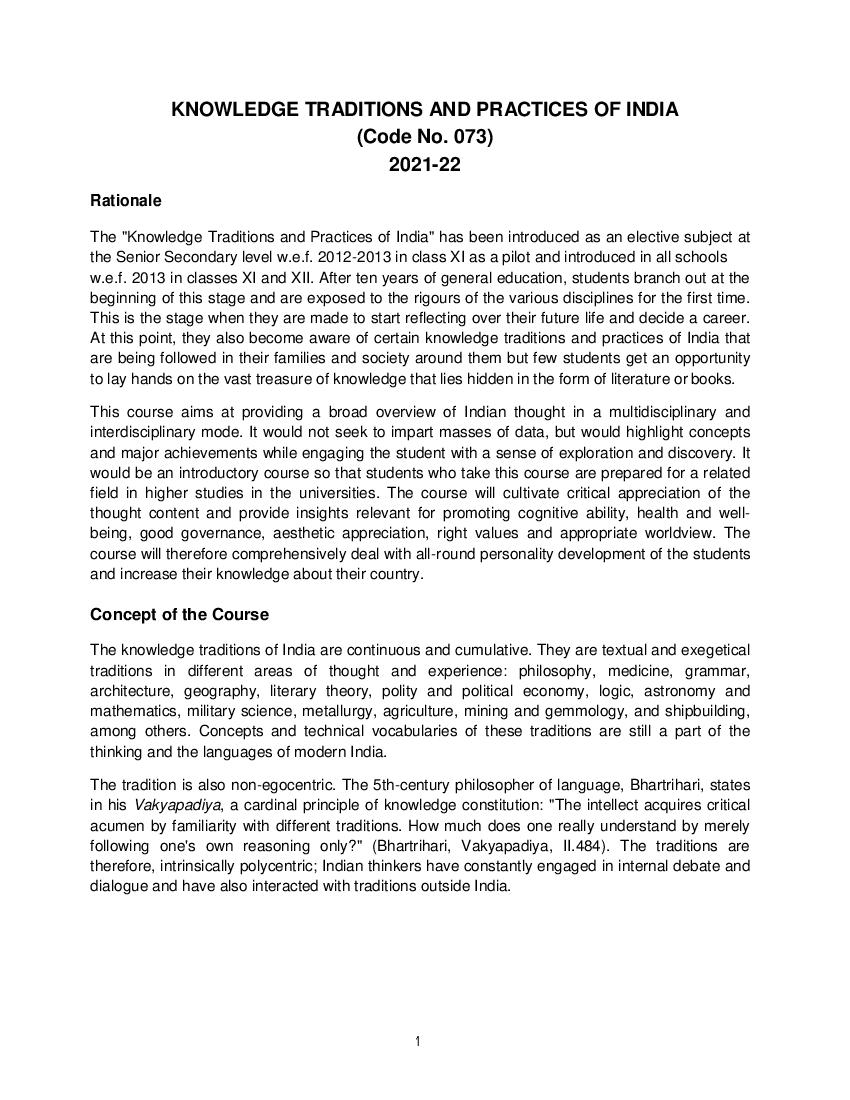
The "Knowledge Traditions and Practices of India" has been introduced as an elective subject at
the Senior Secondary level w.e.f. 2012-2013 in class XI as a pilot and introduced in all schools
w.e.f. 2013 in classes XI and XII. After ten years of general education, students branch out at the
beginning of this stage and are exposed to the rigours of the various disciplines for the first time.
This is the stage when they are made to start reflecting over their future life and decide a career.
At this point, they also become aware of certain knowledge traditions and practices of India that
are being followed in their families and society around them but few students get an opportunity
to lay hands on the vast treasure of knowledge that lies hidden in the form of literature or books.
This course aims at providing a broad overview of Indian thought in a multidisciplinary and
interdisciplinary mode. It would not seek to impart masses of data, but would highlight concepts
and major achievements while engaging the student with a sense of exploration and discovery. It
would be an introductory course so that students who take this course are prepared for a related
field in higher studies in the universities. The course will cultivate critical appreciation of the
thought content and provide insights relevant for promoting cognitive ability, health and well-
being, good governance, aesthetic appreciation, right values and appropriate worldview. The
course will therefore comprehensively deal with all-round personality development of the students
and increase their knowledge about their country.
Concept of the Course
The knowledge traditions of India are continuous and cumulative. They are textual and exegetical
traditions in different areas of thought and experience: philosophy, medicine, grammar,
architecture, geography, literary theory, polity and political economy, logic, astronomy and
mathematics, military science, metallurgy, agriculture, mining and gemmology, and shipbuilding,
among others. Concepts and technical vocabularies of these traditions are still a part of the
thinking and the languages of modern India.
The tradition is also non-egocentric. The 5th-century philosopher of language, Bhartrihari, states
in his Vakyapadiya, a cardinal principle of knowledge constitution: "The intellect acquires critical
acumen by familiarity with different traditions. How much does one really understand by merely
following one's own reasoning only?" (Bhartrihari, Vakyapadiya, II.484). The traditions are
therefore, intrinsically polycentric; Indian thinkers have constantly engaged in internal debate and
dialogue and have also interacted with traditions outside India.
1
Page 2
Students will be able to:
get familiar with Indian thought in different disciplines.
get familiar with major Indian thinkers in different disciplines.
get familiar with the primary texts of Indian thought through an organized study of short
extracts in translation of those texts.
develop a better appreciation and understanding of not only the Knowledge Traditions and
Practices of India but also of many contemporary questions and issues that they handle in
their course work in related disciplines.
enhance self-awareness and self-esteem.
Specific aims:
Students will be able to:
get familiar with the nature of Indian texts.
read primary texts from various sources and will be able to collect information and develop
their critical abilities.
relate the knowledge to present context.
develop positive attitude towards Indian thoughts and traditions.
compare and contrast views given in the units and develop interest in the authentic texts.
internalise the given knowledge and pursue it further in their courses of studies by gathering
more information about thinkers and texts.
interpret and analyse texts of different kinds and express it in their own language.
understand the contribution of Indian mind in various fields.
relate ideas of various disciplines with western thought they are otherwise introduced to in
their course work.
develop a wider understanding of how all knowledge is ultimately interrelated.
read and know the history of Indian literatures.
pursue further study in related fields.
paraphrase the ideas of primary text in English or Hindi.
2
Page 3
Examination Specifications
Class – XI (2021-22)
One Paper 70+30 = 100Marks
Section-wise W
eightage e of the Paper Time: 3Hours
Sr Section Areas of Assessment No of Marks
no Periods
A Reading Skills 60 20
Two passages from the text book
B Analytical Skills 60 25
Two passages for comparing/contrasting relating to
the present time.
One out of three long answer type questions
C Thinking Skills 60 25
Five out of six short answer questions
Ten objective type questions based on
Multiple Choice Answers
D Research based Project/Portfolio Assessment 40 20+10=30
+viva voice
SECTION – A
READING SKILLS - 20 MARKS
Q.1 Two passages from the modules with a variety of questions on different levels of
comprehension, i.e., to test literal, interpretative and inferential skills. The total range of two
passages would be about 700 to800 words. 20marks
SECTION – B ANALYTICAL SKILLS - 25 MARKS
Q.2 Two passages extracted from different modules for comparing and contrasting and relating the ideas
contained - to the present time. The length of both the passages together should be about 600 words.
10marks
Q.3 One out of two long answer type questions based on the knowledge of the content to test the
insights gained and whether the knowledge has been internalised.15marks
3
Page 4
THINKING SKILLS - 25 MARKS
Q.4 Five out of six short answer type questions based on the survey sections in the modules.
(W
ord limit30-40words) 5 x 3 = 15marks
Q.5 Ten objective type MCQs to test global and local understanding of the text. 10marks
SECTION – D
RESEARCH BASED PROJECT/ PORTFOLIO ASSESSMENT + VIVA VOICE20 +10 = 30 marks
The textbook has inbuilt suggestions and activities for the students to prepare a portfolio or
undertake work on a research based project. The purpose is to make students exhibit their efforts
and achievements in one or more areas. It is expected that schools organise visits to the
traditional seats of learning, historical places, cultural hubs and authentic areas. The project will
be assessed through a viva voce also which carries 10 marks out of30.
Students will be expected to compile and collect material for the project/portfolio which would be
assessed on the following points:
Presentation: efforts put in, meaningful material with aesthetic sense.
Variety of content: a wide variety of content in the form of audio visual media, extracts from
journals, art work, conference updates, photographs, writing samples, maps, charts, extracts
of interview and reading logs etc.
Organisation of material collected has been presented with cogency and coherence.
Clarity of understanding and good judgement to test internalization of knowledge.
Viva voice
Prescribed Books:
A textbook on Knowledge Traditions and Practices of India Part - I published by CBSE 2012-13.
4
Document Details
| Board / Org | CBSE |
| Exam | Class 11 |
| Type | Syllabus |
| Pages | 4 |
| Updated | 15 Jul 2026 |