PU CET PG 2017 Question Paper BIOCHEMISTRY
Finished viewing? Save it for later —
Download PU CET PG 2017 Question Paper BIOCHEMISTRY (PDF · 9 pages)About PU CET PG 2017 Question Paper BIOCHEMISTRY
PU CET PG 2017 Question Paper BIOCHEMISTRY is available here for free download. Published by Panjab University for PU CET PG, this question paper can be viewed online or downloaded as a PDF (9 pages). Candidates preparing for PU CET PG can use PU CET PG 2017 Question Paper BIOCHEMISTRY to understand the exam pattern, the type of questions asked, and the overall difficulty level.
Frequently Asked Questions
How can I download PU CET PG 2017 Question Paper BIOCHEMISTRY?
Open this page and click the Download button to save PU CET PG 2017 Question Paper BIOCHEMISTRY as a PDF. It is completely free on AglaSem Docs.
Is PU CET PG 2017 Question Paper BIOCHEMISTRY free to download?
Yes. PU CET PG 2017 Question Paper BIOCHEMISTRY can be viewed online and downloaded as a PDF free of cost on AglaSem Docs.
How many pages does PU CET PG 2017 Question Paper BIOCHEMISTRY have?
PU CET PG 2017 Question Paper BIOCHEMISTRY contains 9 pages, which you can read online or download together as a single PDF.
Where can I find more PU CET PG study material?
You can find more PU CET PG question papers, sample papers, syllabus, and answer keys on AglaSem Docs.
PU CET PG 2017 Question Paper BIOCHEMISTRY – Text
Read the full text of this question paper below — useful to quickly search, copy and reference the content online without downloading the PDF.
📄 View text version (9 pages)
Page 1
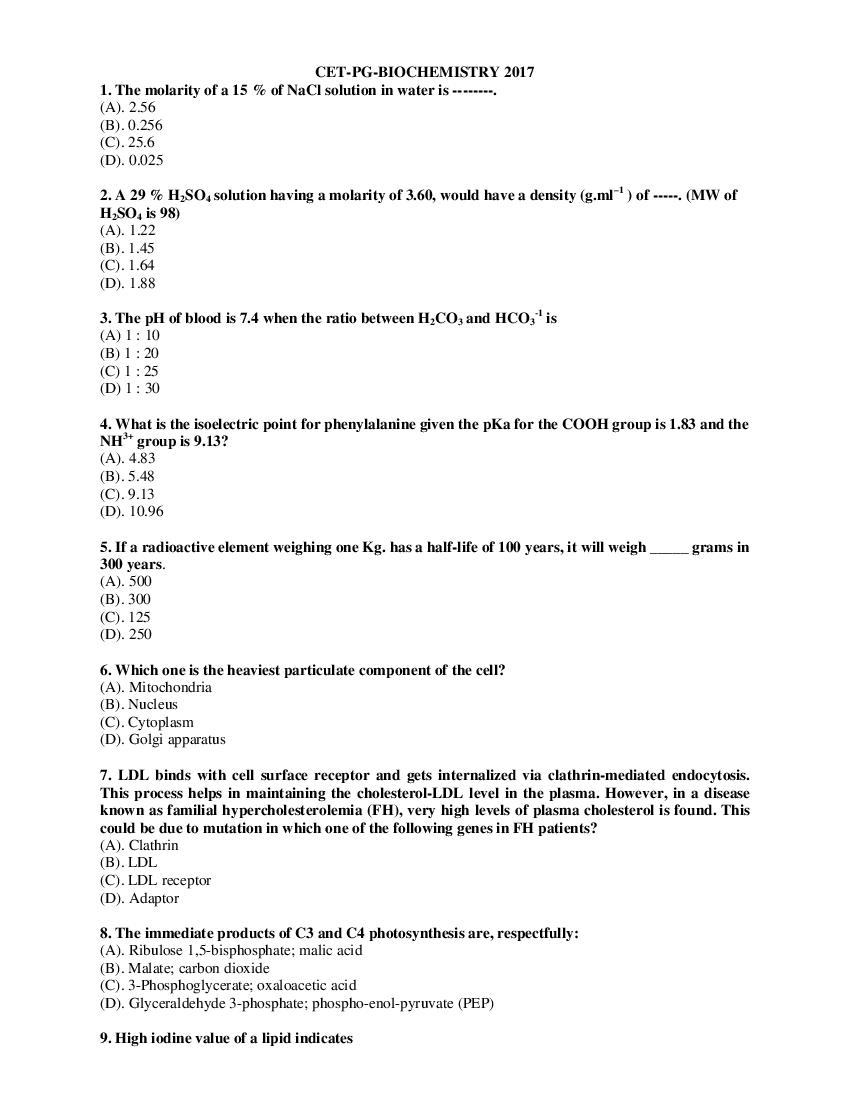
1. The molarity of a 15 % of NaCl solution in water is --------.
(A). 2.56
(B). 0.256
(C). 25.6
(D). 0.025
2. A 29 % H2SO4 solution having a molarity of 3.60, would have a density (g.ml–1 ) of -----. (MW of
H2SO4 is 98)
(A). 1.22
(B). 1.45
(C). 1.64
(D). 1.88
3. The pH of blood is 7.4 when the ratio between H2CO3 and HCO3-1 is
(A) 1 : 10
(B) 1 : 20
(C) 1 : 25
(D) 1 : 30
4. What is the isoelectric point for phenylalanine given the pKa for the COOH group is 1.83 and the
NH3+ group is 9.13?
(A). 4.83
(B). 5.48
(C). 9.13
(D). 10.96
5. If a radioactive element weighing one Kg. has a half-life of 100 years, it will weigh _____ grams in
300 years.
(A). 500
(B). 300
(C). 125
(D). 250
6. Which one is the heaviest particulate component of the cell?
(A). Mitochondria
(B). Nucleus
(C). Cytoplasm
(D). Golgi apparatus
7. LDL binds with cell surface receptor and gets internalized via clathrin-mediated endocytosis.
This process helps in maintaining the cholesterol-LDL level in the plasma. However, in a disease
known as familial hypercholesterolemia (FH), very high levels of plasma cholesterol is found. This
could be due to mutation in which one of the following genes in FH patients?
(A). Clathrin
(B). LDL
(C). LDL receptor
(D). Adaptor
8. The immediate products of C3 and C4 photosynthesis are, respectfully:
(A). Ribulose 1,5-bisphosphate; malic acid
(B). Malate; carbon dioxide
(C). 3-Phosphoglycerate; oxaloacetic acid
(D). Glyceraldehyde 3-phosphate; phospho-enol-pyruvate (PEP)
9. High iodine value of a lipid indicates
Page 2
(B). Carboxyl groups
(C). Hydroxyl groups
(D). Unsaturation
10. Which of the following phospholipids is localized to a greater extent in the outer leaflet of the
membrane lipid bilayer?
(A). Phosphatidyl Choline
(B). Phosphatidyl Ethanolamine
(C). Phosphatidyl Inositol phosphoglycerides
(D). Phosphatidyl Serine
11. A drug which prevents uric acid synthesis by inhibiting the enzyme xanthine oxidase is
(A). Aspirin
(B). Allopurinol
(C). Colchicine
(D). Probenecid
12. On exposure to light rhodopsin forms
(A). All trans-retinal
(B). Cis-retinal
(C). Retinol
(D). Retinoic acid
13. The most potent Vitamin D metabolite is
(A). 25-Hydroxycholecalciferol
(B). 1,25-Dihydroxycholecalciferol
(C). 24, 25-Dihydroxycholecalciferol
(D). 7-Dehydrocholesterol
14.The number of isomers of glucose is
(A). 2
(B). 4
(C). 8
(D). 16
15. A disaccharide linked by α-1-4 Glycosidic linkages is
(A). Lactose
(B). Sucrose
(C). Cellulose
(D). Maltose
16. Barfoed’s solution is not reduced by
(A). Glucose
(B). Mannose
(C). Sucrose
(D). Ribose
17. Fluoride inhibits ______ and arrests glycolysis.
(A). Glyceraldehyde-3-phosphate dehydrogenase
(B). Aconitase
(C) .Enolose
(D). Succinate dehydrogenase
18. An uncoupler of oxidative phosphorylation such as dinitrophenol
(A). Inhibits electron transport and ATP synthesis
Page 3
(C). Inhibits electron transport without impairment of ATP synthesis
(D). Specially inhibits cytochrome b
19. Energy required to produce 3 ATP from 3 ADP and 3 Pi is
(A). –21,900 cal
(B). 29,900 cal
(C). 31,900 cal
(D). 39,900 cal
20. Substrate level phosphorylation in TCA cycle is in step:
(A). Isocitrate dehydrogenase
(B). Malate dehydrogenase
(C). Aconitase
(D). Succinate thiokinase
21. Assuming that the sequence of CDRs of an antibody are heavily enriched with Tyrosine and
Serine, what is likely to be the driving force stabilizing its interaction with the antigen?
(A). Hydrophobic interaction
(B). Hydrogen bonding
(C). Van-der Waals interaction
(D). Covalent interactions
22. Which one of the following side chains of an amino acid is responsible for fluorescence in
proteins?
(A). Indole ring
(B). Guanidino group
(C). Phenolic group
(D). Imidazole group
23. A pigment isolated from marine red algae that finds application in flow cytometry is
(A). Xanthophyll
(B). Phycoerythrin
(C). Chlorophyll
(D). Fluorescamine
24. If a neuron is tyrosine hydroxylase positive, it could be either:
(A). Noradrenergic or Histaminergic
(B). Dopaminergic or Serotonergic
(C). Noradrenergic or Dopaminergic
(D). Serotonergic or Noradrenergic
25. Which one of the following reactions is performed by Cytochrome-P450 to detoxify the
xenobiotics?
(A). Hydroxylation
(B). Ligation
(C). Hydrolysis
(D). Group transfer
26. In Electrophoresis if the buffer pH is above the isoelectric point of the protein, the protein will
(A). Migrate towards the anode
(B). Migrate towards the cathode
(C). Not migrate at all
(D). Migrate partly to anode and partly to cathode
27. Which one of the following can covert glucose to vitamin C?
(A). Humans
(B). Monkeys
Page 4
(D). Albino rats
28. Omega 3 fats are good for health and play an important role in prevention of heart disease. If
you have to formulate a food product rich in omega 3 fats which one of the following options would
you choose?
(A). Rice bran oil because it contains C 18:2 ∆9c, 12c
(B). Flax seed oil because it contains C 18:3 ∆9c, 12c, 15c
(C). Olive oil because it contains C 18:1 ∆9c
(D). Black- currant seed oil because it contains C 18:3 ∆ 6c, 9c, 12c
29. Inosine in the tRNA anticodon will base pair with all except which one of the following bases in
the codon of mRNA?
(A). Adenine
(B). Uracil
(C). Cytosine
(D). Guanine
30. The integration of T-DNA in the plant nuclear genome is most likely due to
(A). homologous recombination
(B). non-homologous recombination
(C). non-homologous end joining
(D). single-stranded recombination during transcription
31. Statins are very effective against hypercholesterolemia, a major cause of atherosclerosis. These
drugs reduce plasma cholesterol levels by
(A). Preventing absorption of cholesterol from the intestine.
(B). Increasing the excretion of cholesterol from the body via conversion to bile acids.
(C). Inhibiting the conversion of 3-hydroxy-3-methylglutaryl-CoA to mevalonate in the pathway for
cholesterol biosynthesis.
(D). Increasing the rate of degradation of 3-hydroxy-3-methylglutaryl CoA reductase.
32. The cell-free extract prepared from E. coli cells over-expressing enzyme β- glucosidase showed
the activity of 1.5 units per ml (protein concentration 2 mg per ml). The Ni-NTA purified
preparation showed the activity of 75 units per ml (protein concentration 100 µg per ml). Calculate
the fold purification of the enzyme achieved?
(A). 0.001
(B). 0.02
(C). 50
(D). 1000
33. DNA molecules labelled with 15N and 14N can be separated by
(A). Pulse field gel electrophoresis
(B). Density gradient ultracentrifugation
(C).Capillary electrophoresis
(D).Differential centrifugation
34. A 25-year old man undertakes a prolonged fast for religious reasons. Which one of the following
metabolites will be elevated in his blood plasma after 24 hours?
(A). Lactic acid
(B). Glycogen
(C). Ketone bodies
(D). Non-esterified fatty acids
35. Succinate dehydrogenase converts succinate to fumarate. Which one of the following is TRUE
when the competitive inhibitor malonate is added in the reaction mixture?
(A). Both Km and Vmax increase.
(B). Both Km and Vmax decrease.
Page 5
(D). Km increases and Vmax decreases.
36. Digestion of a 5Kb linear DNA fragment with EcoRI generates two fragments of 2 Kb and 3 Kb,
while digestion of the same molecule with HindIII yields three fragments of 0.7 Kb, 3.5 Kb and 0.8
Kb. When the same DNA is digested with both the enzymes, it yields fragments of 0.7 Kb, 1.3 Kb,
2.2 Kb and 0.8 Kb. The right sequence of restriction sites in the DNA fragment is
(A). One EcoRI site in between two HindIII sites
(B). One HindIII site in between two EcoRI sites
(C). Two HindIII sites followed by only one EcoRI site
(D). One EcoRI site followed by two HindIII sites.
37. Which metabolite of TCA cycle is used in detoxification of ammonia in brain?
(A). Alpha ketogluterate
(B). Ornithine
(C). Oxaloacetate
(D). Glycine
38. A ketogenic amino acid is
(A). Valine
(B). Cysteine
(C). Leucine
(D). Threonine
39. Which of the following statements about the enzymes, glucokinase and/or hexokinase is correct?
(A). Glucokinase has a high affinity for glucose.
(B). Hexokinase has a high affinity for glucose.
(C). Hexokinase has a higher Km for glucose than has glucokinase.
(D) Glucokinase has a lower Km for glucose than has hexokinase
40. Biuret reaction is specific for
(A). –CONH-linkages
(B). –CSNH2 group
(C). –(NH)NH2 group
(D). -CH2SSCH2-group
41. Globular proteins have completely folded, coiled polypeptide chain and the axial
ratio (ratio of length to breadth) is
(A). Less than 10 and generally not greater than 3–4
(B). Generally 10
(C). Greater than 10 and generally 20
(D). Greater than 10
42. Which of the following statements about transamination reactions is correct?
(A). Transamination reactions involve ATP hydrolysis.
(B). Transamination reactions are irreversible.
(C). Transamination reactions require NAD+ or NADP+.
(D). Transamination reactions require pyridoxal-5'-phophate.
43. Each turn of α-helix contains the amino acid residues (number):
(A). 3.6
(B). 3.0
(C). 4.2
(D). 4.5
44. The enzymes of urea synthesis are found in
Page 6
(B). Cytosol only
(C). Both mitochondria and cytosol
(D). Nucleus
45. Sanger’s reagent contains
(A). Phenylisothiocyanate
(B). Dansyl chloride
(C). 1-Fluoro-2, 4-dinitrobenzene
(D). Ninhydrin
46. The deadly 'death cap' mushroom, Amanita palloides, produces a toxin called α-amanitin.
Which cellular process is inhibited by this toxin?
(A). DNA synthesis
(B). Cell division
(C). RNA synthesis
(D). RNA splicing
47. In bacterial promoters, which of the following describes the 'Pribnow box'?
(A). The 5' untranslated region
(B). The -10 box
(C). The -35 box
(D). The termination sequence
48. Maple syrup urine diseases is an inborn error of metabolism of
(A). Sulphur-containing amino acids
(B). Aromatic amino acids
(C). Branched chain amino acids
(D). Dicarboxylic amino acids
49. The half-life of IgG is
(A). 2–3 days
(B). 5–6 days
(C). 8–10 days
(D). 20–25 days
50. The components of complement system are activated by
(A). Microsomal hydroxylation
(B). Phosphorylation
(C). Glycosylation
(D). Proteloysis
51. What is the normal immunological role of the CD8+ve T-cell
(A). Helps B-lymphocytes to develop into plasma cells.
(B). Kills virus infected cells.
(C) Secretes antibodies.
(D) Rejects transplanted tissue.
52. A cation exchange resin linked to cellulose backbone is
(A). CM-cellulose
(B). DEAE cellulose
(C). Starch
(D). Biogel
53. CD 4 is a transmembrane glycoprotein present in
(A). Helper T cells
Page 7
(C). Memory T cells
(D). Cytotoxic T cells
54. Calcitonin is synthesised in
(A). Parathyroid glands
(B). Thyroid gland
(C). Pars intermedia of pituitary
(D). Adrenal cortex
55. Insulin is made up of
(A). A single polypeptide chain having 51 amino acid residues
(B). A single polypeptide chain having 84 amino acid residues
(C). A-chain having 21 and B-chain having 30 amino acid residues
(D). A-chain having 30 and B-chain having 21 amino acid residues
56. Normal range of serum urea is
(A). 0.6–1.5 mg/dl
(B). 9–11 mg/dl
(C). 20–45 mg/dl
(D). 60–100 mg/dl
57. Collagen is very rich in
(A). Glycine
(B). Serine
(C). Aspartic acid
(D). Glutamic acid
58. Cephalin consists of
(A). Glycerol, fatty acids, phosphoric acid and choline
(B). Glycerol, fatty acids, phosphoric acid and ethanolamine
(C). Glycerol, fatty acids, phosphoric acid and inositol
(D). Glycerol, fatty acids, phosphoric acid and serine
59. Arachidonic acid contains the number of double bonds:
(A). 2
(B). 3
(C). 4
(D). 5
60. Fatty acids with odd number of carbon atoms yield acetyl-CoA and a molecule of
(A). Succinyl-CoA
(B). Propionyl-CoA
(C). Malonyl-CoA
(D). Acetoacetyl-CoA
61. Dideoxynucleoside triphosphates (ddNTPs) are used in sequencing DNA because:
(A). ddNTPs are fluorescent.
(B). ddNTPs are incorporated very efficiently into DNA by DNA polymerase.
(C). ddNTPs cannot be incorporated into DNA by DNA polymerase.
(D) ddNTPs prevent further DNA synthesis once they are incorporated into the DNA sequence.
62. A mitochondrial marker enzyme is
(A). Aldolase
(B). Amylase
Page 8
(D). Pyruvate dehydrogenase
63. Heme is synthesized from:
(A). Succinyl-CoA and glycine
(B). Active acetate and glycine
(C). Active succinate and alanine
(D). Active acetate and alanine
64. Ramachandran plot:
(A). Gives the frequency of occurrence of amino acids in -sheet structure.
(B). Represents the sterically allowed conformations of a polypeptide back bone
(C). Predicts α-helical structure from the given amino acid sequences
(D). Shows the X-ray diffraction pattern of a position.
65. At which cell cycle checkpoint is the cell cycle halted if the cell's DNA is damaged?
(A). G1 - S
(B). S - G2
(C). G2 - M
(D). G0 - G1
66. The tyrosine residues per molecule of thyroglobulin is
(A). 85
(B). 95
(C). 115
(D). 135
67. In cholera, there is uncontrolled secretion of sodium ions and water into the intestinal lumen
because of the action of cholera toxin on a G protein coupled receptor system. How does the toxin
act?
(A). Cholera toxin activates a Gi (inhibitory) protein.
(B). Cholera toxin inhibits phosphodiesterase so that the signal is not switched off.
(C). Cholera toxin inhibits the binding of vasoactive intestinal polypeptide to the receptor.
(D). Cholera toxin inhibits the GTPase activity of the G protein alpha subunit.
68. Which of the following antibiotic resembles the 3’end of charged t-RNA molecule?
(A). Streptomycin
(C). Tetracyclin
(D). Kanamycin
(D). Puromycin
69. The catabolite repression is mediated by a catabolite gene activator protein (CAP) in
conjunction with
(A). AMP
(B). GMP
(C). cAMP
(D). cGMP
70. DNA fragments upto 45 kilobases in size can be cloned in
(A). Bacterial plasmids
(B). Lambda phage
(C). Cosmids
(D). Yeast artificial chromosomes
71. Chloride shift is
(A). H ions leaving the RBC in exchange of Cl-
(B). Cl– leaving the RBC in exchange of bicarbonate
Page 9
(D). Carbonic acid to the plasma
72. Aspartate transcarbamoylase is inhibited by
(A). CTP
(B). PRPP
(C). ATP
(D). TMP
73.Which reaction in photosynthesis is carried out by 'Rubisco' or ribulose 1- 5 bisphosphate
carboxylase?
(A). Conversion of 3 phosphoglycerate into glyceraldehyde 3 phosphate.
(B). Utilisation of CO2 to produce 3 phosphoglycerate.
(C). Conversion of glyceraldehyde 3 phosphate into ribulose 5 phosphate.
(D). Carboxylation of phosphoenol pyruvate to oxaloacetate.
74. Which of the following signalling molecules binds to a receptor situated in the cytosol, rather
than the outer membrane of the cell?
(A). Progesterone
(B). Adrenaline (Epinephrine)
(C). Epidermal growth factor
(D). Interferon
75. What is largely responsible for the negative resting membrane potential (around -70 mV) in a
neuron?
(A). Axonal insulation by Schwann cells.
(B). Voltage-gated sodium channels opening.
(C). The action potential.
(D). Potassium leak currents
Document Details
| Board / Org | Panjab University |
| Exam | PU CET PG |
| Type | Question Paper |
| Pages | 9 |
| Updated | 22 Jul 2026 |