PU CET PG 2017 Question Paper MSc_2Yr__NuclearMedicine_
Finished viewing? Save it for later —
Download PU CET PG 2017 Question Paper MSc_2Yr__NuclearMedicine_ (PDF · 9 pages)About PU CET PG 2017 Question Paper MSc_2Yr__NuclearMedicine_
PU CET PG 2017 Question Paper MSc_2Yr__NuclearMedicine_ is available here for free download. Published by Punjab University for PU CET PG, this question paper can be viewed online or downloaded as a PDF (9 pages). Candidates preparing for PU CET PG can use PU CET PG 2017 Question Paper MSc_2Yr__NuclearMedicine_ to understand the exam pattern, the type of questions asked, and the overall difficulty level.
Frequently Asked Questions
How can I download PU CET PG 2017 Question Paper MSc_2Yr__NuclearMedicine_?
Open this page and click the Download button to save PU CET PG 2017 Question Paper MSc_2Yr__NuclearMedicine_ as a PDF. It is completely free on AglaSem Docs.
Is PU CET PG 2017 Question Paper MSc_2Yr__NuclearMedicine_ free to download?
Yes. PU CET PG 2017 Question Paper MSc_2Yr__NuclearMedicine_ can be viewed online and downloaded as a PDF free of cost on AglaSem Docs.
How many pages does PU CET PG 2017 Question Paper MSc_2Yr__NuclearMedicine_ have?
PU CET PG 2017 Question Paper MSc_2Yr__NuclearMedicine_ contains 9 pages, which you can read online or download together as a single PDF.
Where can I find more PU CET PG study material?
You can find more PU CET PG question papers, sample papers, syllabus, and answer keys on AglaSem Docs.
PU CET PG 2017 Question Paper MSc_2Yr__NuclearMedicine_ – Text
Read the full text of this question paper below — useful to quickly search, copy and reference the content online without downloading the PDF.
📄 View text version (9 pages)
Page 1
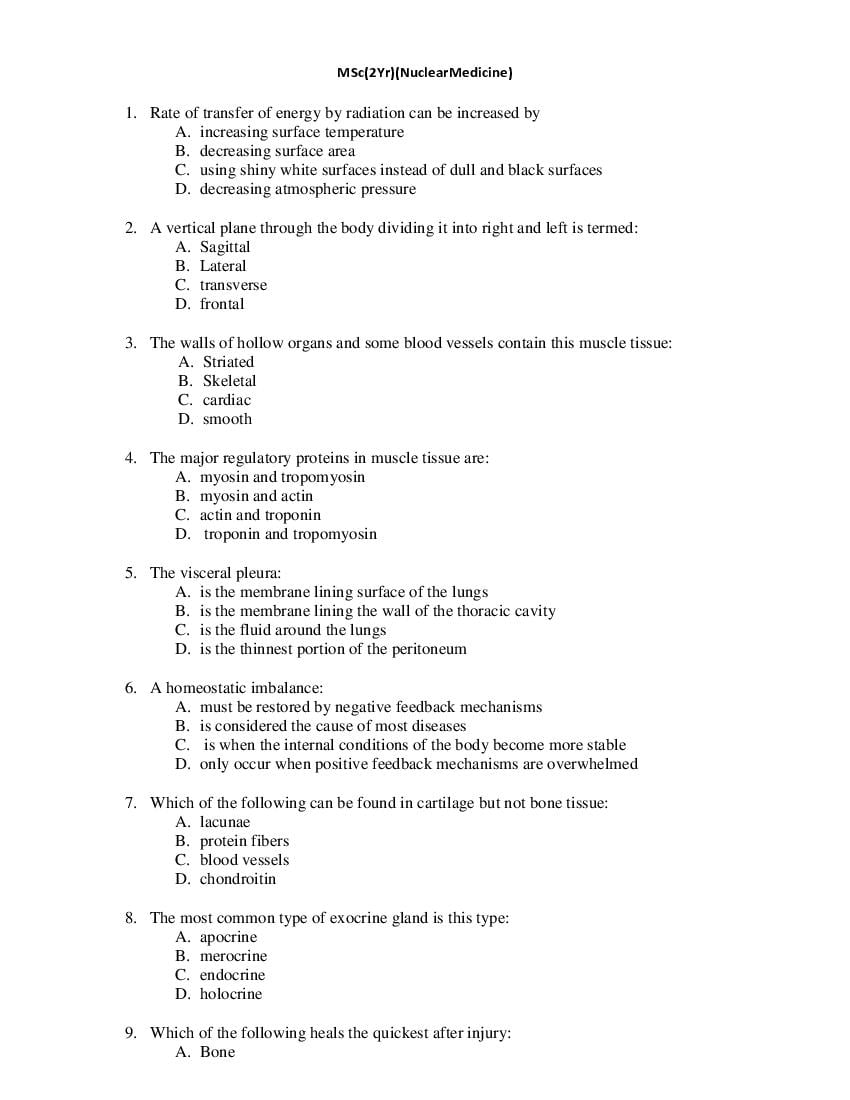
1. Rate of transfer of energy by radiation can be increased by
A. increasing surface temperature
B. decreasing surface area
C. using shiny white surfaces instead of dull and black surfaces
D. decreasing atmospheric pressure
2. A vertical plane through the body dividing it into right and left is termed:
A. Sagittal
B. Lateral
C. transverse
D. frontal
3. The walls of hollow organs and some blood vessels contain this muscle tissue:
A. Striated
B. Skeletal
C. cardiac
D. smooth
4. The major regulatory proteins in muscle tissue are:
A. myosin and tropomyosin
B. myosin and actin
C. actin and troponin
D. troponin and tropomyosin
5. The visceral pleura:
A. is the membrane lining surface of the lungs
B. is the membrane lining the wall of the thoracic cavity
C. is the fluid around the lungs
D. is the thinnest portion of the peritoneum
6. A homeostatic imbalance:
A. must be restored by negative feedback mechanisms
B. is considered the cause of most diseases
C. is when the internal conditions of the body become more stable
D. only occur when positive feedback mechanisms are overwhelmed
7. Which of the following can be found in cartilage but not bone tissue:
A. lacunae
B. protein fibers
C. blood vessels
D. chondroitin
8. The most common type of exocrine gland is this type:
A. apocrine
B. merocrine
C. endocrine
D. holocrine
9. Which of the following heals the quickest after injury:
A. Bone
Page 2
C. cartilage
D. muscle
10. Which of the following suffixes implies "growth" or "formation":
A. –blast
B. –lemma
C. -stasis
D. –cyte
11. IF the concentration of glucose in the water outside of a cell is higher than the concentration
inside:
A. Water will tend to enter the cell by osmosis
B. Water will tend to leave the cell by osmosis
C. Glucose will tend to enter the cell by osmosis
D. Glucose will tend to leave the cell by osmosis
12. Times a proton is heavier than an electron is
A. 1827
B. 1876
C. 1836
D. 1789
13. In fission, mass of products is
A. less than original nucleus
B. more than original nucleus
C. equal to original nucleus
D. both B and C
14. Cosmic radiation consists of
A. protons and electrons
B. alpha particles
C. larger nuclei
D. all of above
15. Greatest ionization power is possessed by
A. beta particles
B. gamma particles
C. neutrons
D. alpha particles
16. Half-life of Carbon-14 is
A. 23 years
B. 1000 years
C. 1200 years
D. 5730 years
17. Antibiotics are
A. carbohydrate in nature
B. protein in nature
C. fats
Page 3
18. A chromosome aberration leads to change in the order of genes in a genetic map but does
not alter its linkage group. This is due to
A. Translocation
B. Recombination
C. Transposition
D. Inversion
19. Most common type of phospholipids in the cell membrane of nerve cells is
A. Phosphatidylcholine
B. Phosphatidylinositol
C. Phosphatidylserine
D. Sphingomylein
20. Which of the cyclins have essential functions in S phase of the cell cycle?
A. A type
B. B type
C. D type
D. Both B and D type
21. What is the resting membrane potential of a neuron?
A. -70 mV
B. -65mV
C. -80 mV
D. -55mV
22. Which one of the following functions is not served by the plasma proteins?
A. Blood clotting
B. Oxygen transport
C. Hormone binding and transport
D. Buffering capacity of blood
23. The S wave form of normal human ECG originates due to:
A. Septal and left ventricular depolarization
B. Late depolarization of the ventricular walls moving back towards the AV junction
C. Left to right septal depolarization
D. Repolarization of atrium
24. The number of layers in Retina are
A. 6
B. 12
C. 8
D. 10
25. The physiological process through which new Blood vessel form from pre-existing
vessels is known as
A. Metastasis
B. Angiogenesis
C. Diapedesis
Page 4
26. The most radiosensitive phase of a cell cycle is
A. S phase
B. M phase
C. G1 phase
D. Gº Phase
27. Which of the following is not a chemical radiosensitizer?
A. Nucleotide analogues
B. Electronic affinic compounds
C. Nitroimidazoles
D. Aminothiols
28. Photographic film badge monitoring devices are unable to detect:
A. Neutrons
B. Beta particle
C. Gamma rays
D. x-rays
29. The neutrino hypothesis was put forward by
A. Einstein
B. Rutherford
C. Pauli
D. Fermi
30. 1 Fermi is equal to
A. 10-13 m
B. 10-14 m
C. 10-15 m
D. 10-16 m
31. Which is not a beta emitter?
A. 32P
B. 131I
C. 99mTc
D. 89Sr
32. Which spectroscopy is used to detect -SH group and disulphide linkages in proteins
A. CD spectroscopy
B. Fluorescence spectroscopy
C. NMR spectroscopy
D. FTIR spectroscopy
33. Which of the following can be detected in a magnetic field
A. Gamma rays
B. Beta rays
C. Radio waves
D. Ultra-violet rays
34. Bremsstahlung radiation are called
A. X-rays with fixed energy
B. Gamma rays with fixed emergy
C. X-rays with variable energy
D. Gamma rays with variable energy
35. Which one of the following is not the process of energy transfer from neutrons?
Page 5
B. Spallation
C. Compton scattering
D. Inelastic scatter
36. To get high resolving power and low noise background, semiconductor detector should
be kept at
A. low temperature
B. high temperature
C. any temperature
D. variable temperature
37. 1 Roentgen is equal to
A. 2 x 10¹² ionisations/gm of tissue
B. 2 x 10¹¹ ionisations/gm of tissue
C. 2 x 10¹⁰ ionisations/gm of tissue
D. 2 x 10⁸ ionisations/gm of tissue
38. Energy liberated when one atom of U-235 undergoes fission reaction is
A. 200MeV
B. 100Mev
C. 40Mev
D. 20Mev
39. During fission process a large amount of
A. heat energy is released
B. nuclear energy is released
C. chemical energy is released
D. light energy is released
40. Half life of any radioactive material is 50 days. How many half life it will take to become
12.5% of the original amount?
A. 1
B. 2
C. 3
D. 4
41. According to the Beer-Lambert Law, on which of the following does absorbance not
depend?
A. Distance that the light has travelled through the sample.
B. Extinction coefficient of the sample.
C. Solution concentration.
D. Colour of the solution.
42. The wavelength of an absorption is 495 nm. In what part of the electromagnetic spectrum
does this lie?
A. Radiowave
B. Ultraviolet-visible.
C. Microwave.
D. Infrared.
43. Enriched uranium means
A. Uranium that is very pure
Page 6
occurring uranium
C. Uranium in which the concentration of U-235 is more than in the natural
occurring uranium
D. Uranium in which the concentration of U-236 is more than in the natural
occurring uranium
44. The material used for absorbing excess neutrons in a nuclear reactor is
A. Cadmium
B. Neodymium
C. Vanadium
D. Indium
45. Energy of thermal neutrons is
A. 0.50 ev
B. 0.05 ev
C. 0.25 ev
D. 0.025 ev
46. The isoelectric point of a protein is
A. pH where its net charge is zero
B. pH where its net charge is +1
C. pH where the net charge is -1
D. pH where its net charge is +2
47. Anaerobic respiration in animals produces
A. CO2
B. Lactic acid and H2O
C. Glucose and oxygen
D. C2H2O5 and CO2
48. The volume of air breathed in and out during normal breathing is called
A. Vital capacity
B. Tidal volume
C. Inspiratory reserve volume
D. Residual volume
49. The matrix of blood is known as
A. Plasma
B. Serum
C. Platelets
D. Pleura
50. Goitre is caused by
A. Excessive secretion of thyroxine
B. Deficiency of iodine
C. Defective growth hormone
D. Excessive secretion of tri iodo thyronine
51. The protective covering of brain is called
A. Meninges
B. Peritoneum
C. Pleura
D. Pericardium
52. What is the fate of glucose in mitochondrial matrix after glycolysis?
Page 7
B. Oxidative decarboxylation
C. Reduction
D. Oxidation
53. When the Half Life increases:
A. the Decay Constant increases
B. the Decay Constant decreases
C. the Decay Constant remains unchanged
D. the Decay Constant first increases and then decreases
54. A linear relationship is obtained between the number of radioactive nuclei and time when
it is plotted:
A. on a log-log graph
B. on a linear-linear graph
C. on a log-linear graph
D. on a square-linear graph
55. The number of nuclei which decay between t and t+dt is proportional to:
A. the number of nuclei only
B. the time interval only
C. the quotient of the number of nuclei and the time interval
D. the product of the number of nuclei and the time interval
56. The Radioactive Decay Law is expressed by:
A. an exponential function
B. a logarithmic function
C. a sinusoidal function
D. a linear function
57. Which of the following is measured in millimetres?
A. Energy resolution
B. Spatial resolution
C. Field uniformity
D. Temporal resolution
58. The Z component of the signal in PMT tube will
A. Be processed by pulse height analyser
B. Be recorded on CRT
C. Not be processed by pulse height analyser
D. Be removed by PMT
59. Which photon processes are dominant in the context of diagnostic radiology?
A. Compton scattering and photoelectric effect
B. Photoelectric effect and pair production
C. Compton scattering and pair production
D. Compton scattering and Rayleigh scattering
60. Vibration property of molecules is checked by
A. Infra red Spectroscopy
B. HPLC
C. Electron Microscopy
Page 8
61. Proton NMR is useful for investigating the structure of organic compounds because
A. organic compounds contain carbon atoms
B. organic compounds are mostly covalent
C. hydrogen atoms are found in nearly all organic compounds
D. organic compounds have low boiling points
62. You want to know if a culture of cells is in the process of DNA synthesis. You
incubate your cells in thepresence of radioactive thymidine to see if it is being
incorporated into the DNA. What is the best technique to detect the labeled
deoxynucleotide in nuclear DNA?
A. Autoradiography
B. polyacrylamide gel electrophoresis
C. agarose gel electrophoresis
D. two-dimensional gel electrophoresis
63. Radius of nucleus ranges from
A. 10-15 m
B. 10-15m to 10-14m
C. 10-10m
D. 10-10m to 10-6m
64. In a nuclear process, quantity conserved is
A. mass-energy
B. momentum
C. mass only
D. energy only
65. In β+ decay, nucleon number is
A. Conserved
B. not conserved
C. unstable
D. stable
66. Phenomena of radioactivity was discovered by Henri Becquerel in
A. 1893
B. 1894
C. 1895
D. 1896
67. Heavy nuclei have
A. more protons than neutrons
B. more electrons than neutrons
C. more neutrons than electrons
D. more neutrons than protons
68. Strong nuclear force acts over distance
A. 10-13 m
B. 10-14 m
C. 10-15 m
D. 10-16 m
Page 9
A. 50 times mass of electron
B. 100 times mass of electron
C. 500 times mass of electron
D. 1000 times mass of electron
70. A measure of radiation that takes into account the possible biological damage produced
by different types of radiation is called a
A. Rem
B. Rad
C. Roentgen
D. Curie
71. The radioactive isotope Z has a half-life of 12 hours. After 2 days, the fraction of the
original amount remaining is
A. 1/2
B. 1/4
C. 1/8
D. 1/16
72. The rate of radioactive decay is increased by
A. increased heat
B. increased pressure
C. the use of a nuclear catalyst
D. none of the above
73. The mass of a given nucleus is always ______the sum of the masses of the individual
particles of which it is made.
A. Less than
B. More than
C. the Same as
D. sometimes less, sometimes more, but never the same as
74. A Geiger counter is able to provide an indirect measure of radioactivity because radiation
has a property of
A. Ionization
B. making matter glow in the dark
C. fogging photographic film
D. attracting electrons.
75. The normal life span of red blood cells is _______days, following which it is removed
from the circulation by __________.
a. 60 days, spleen
b. 120 days, spleen
c. 60 days, bone marrow
d. 120 days, bone marrow
Document Details
| Board / Org | Panjab University |
| Exam | PU CET PG |
| Type | Question Paper |
| Pages | 9 |
| Updated | 22 Jul 2026 |