NCERT Book Class 10 Science Chapter 12 Magnetic Effects of Electric Current
Finished viewing? Save it for later —
Download NCERT Book Class 10 Science Chapter 12 Magnetic Effects of Electric Current (PDF · 13 pages)About NCERT Book Class 10 Science Chapter 12 Magnetic Effects of Electric Current
NCERT Book Class 10 Science Chapter 12 Magnetic Effects of Electric Current is available here for free download. Published by NCERT for Class 10, this books can be viewed online or downloaded as a PDF (13 pages). Candidates preparing for Class 10 can use NCERT Book Class 10 Science Chapter 12 Magnetic Effects of Electric Current to understand the exam pattern, the type of questions asked, and the overall difficulty level.
Frequently Asked Questions
How can I download NCERT Book Class 10 Science Chapter 12 Magnetic Effects of Electric Current?
Open this page and click the Download button to save NCERT Book Class 10 Science Chapter 12 Magnetic Effects of Electric Current as a PDF. It is completely free on AglaSem Docs.
Is NCERT Book Class 10 Science Chapter 12 Magnetic Effects of Electric Current free to download?
Yes. NCERT Book Class 10 Science Chapter 12 Magnetic Effects of Electric Current can be viewed online and downloaded as a PDF free of cost on AglaSem Docs.
How many pages does NCERT Book Class 10 Science Chapter 12 Magnetic Effects of Electric Current have?
NCERT Book Class 10 Science Chapter 12 Magnetic Effects of Electric Current contains 13 pages, which you can read online or download together as a single PDF.
Where can I find more Class 10 study material?
You can find more Class 10 question papers, sample papers, syllabus, and answer keys on AglaSem Docs.
NCERT Book Class 10 Science Chapter 12 Magnetic Effects of Electric Current – Text
Read the full text of this books below — useful to quickly search, copy and reference the content online without downloading the PDF.
📄 View text version (1 page)
Page 1
Magnetic Effects of
Electric Current
I n the previous Chapter on ‘Electricity’ we learnt about the heating
effects of electric current. What could be the other effects of electric
current? We know that an electric current-carrying wire behaves like a
magnet. Let us perform the following Activity to reinforce it.
Resistor
Activity 12.1
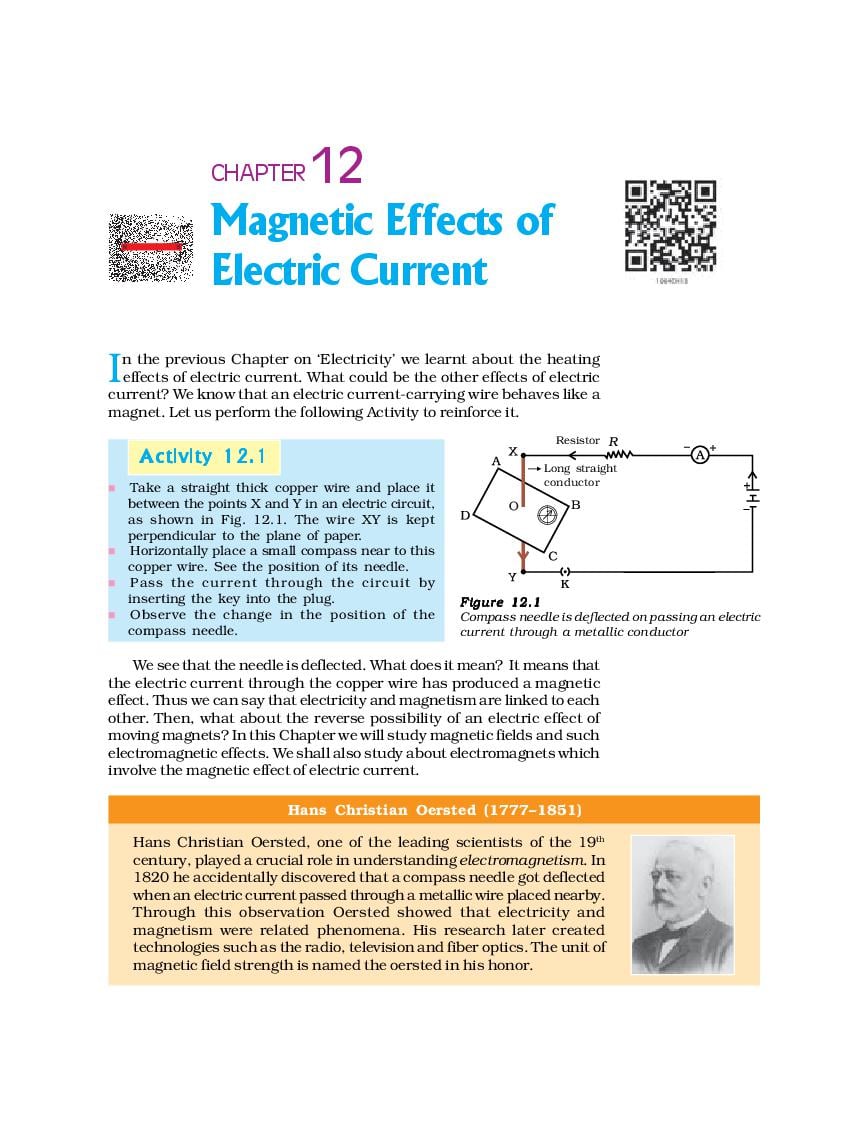
Long straight
conductor
n Take a straight thick copper wire and place it
between the points X and Y in an electric circuit,
as shown in Fig. 12.1. The wire XY is kept
perpendicular to the plane of paper.
n Horizontally place a small compass near to this
copper wire. See the position of its needle.
n Pass the current through the circuit by
inserting the key into the plug. Figure 12.1
n Observe the change in the position of the Compass needle is deflected on passing an electric
compass needle. current through a metallic conductor
We see that the needle is deflected. What does it mean? It means that
the electric current through the copper wire has produced a magnetic
effect. Thus we can say that electricity and magnetism are linked to each
other. Then, what about the reverse possibility of an electric effect of
moving magnets? In this Chapter we will study magnetic fields and such
electromagnetic effects. We shall also study about electromagnets which
involve the magnetic effect of electric current.
Hans Christian Oersted (1777–1851)
Hans Christian Oersted, one of the leading scientists of the 19th
century, played a crucial role in understanding electromagnetism. In
1820 he accidentally discovered that a compass needle got deflected
when an electric current passed through a metallic wire placed nearby.
Through this observation Oersted showed that electricity and
magnetism were related phenomena. His research later created
technologies such as the radio, television and fiber optics. The unit of
magnetic field strength is named the oersted in his honor.
Showing the first page only. Download the PDF above for the complete document.
Document Details
| Board / Org | NCERT |
| Exam | Class 10 |
| Type | Books |
| Pages | 13 |
| Language | english |
| Updated | 29 Aug 2026 |