MBOSE Class 12 Question Paper 2022 for Anthropology
Finished viewing? Save it for later —
Download MBOSE Class 12 Question Paper 2022 for Anthropology (PDF · 8 pages)About MBOSE Class 12 Question Paper 2022 for Anthropology
MBOSE Class 12 Question Paper 2022 for Anthropology is available here for free download. Published by Meghalaya Board for Class 12, this question paper can be viewed online or downloaded as a PDF (8 pages). Candidates preparing for Class 12 can use MBOSE Class 12 Question Paper 2022 for Anthropology to understand the exam pattern, the type of questions asked, and the overall difficulty level.
Frequently Asked Questions
How can I download MBOSE Class 12 Question Paper 2022 for Anthropology?
Open this page and click the Download button to save MBOSE Class 12 Question Paper 2022 for Anthropology as a PDF. It is completely free on AglaSem Docs.
Is MBOSE Class 12 Question Paper 2022 for Anthropology free to download?
Yes. MBOSE Class 12 Question Paper 2022 for Anthropology can be viewed online and downloaded as a PDF free of cost on AglaSem Docs.
How many pages does MBOSE Class 12 Question Paper 2022 for Anthropology have?
MBOSE Class 12 Question Paper 2022 for Anthropology contains 8 pages, which you can read online or download together as a single PDF.
Where can I find more Class 12 study material?
You can find more Class 12 question papers, sample papers, syllabus, and answer keys on AglaSem Docs.
MBOSE Class 12 Question Paper 2022 for Anthropology – Text
Read the full text of this question paper below — useful to quickly search, copy and reference the content online without downloading the PDF.
📄 View text version (8 pages)
Page 1
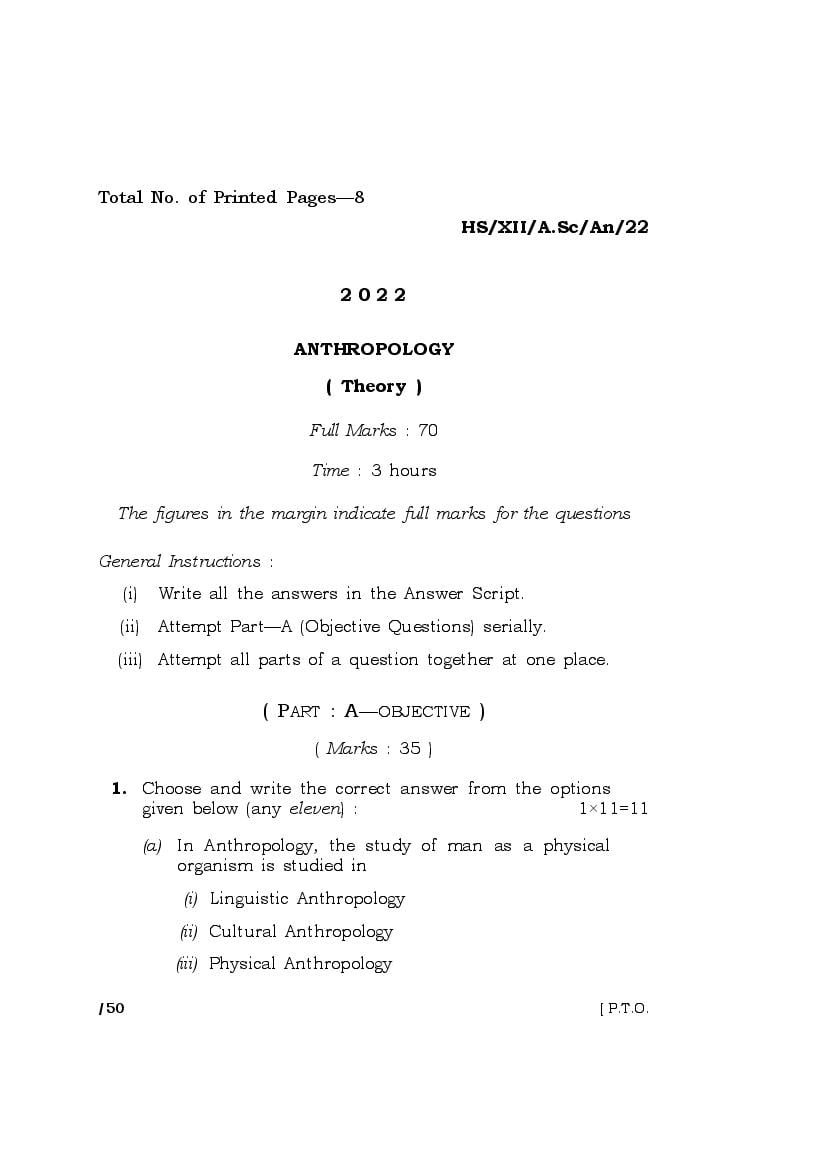
HS/XII/A.Sc/An/22
2022
ANTHROPOLOGY
( Theory )
Full Marks : 70
Time : 3 hours
The figures in the margin indicate full marks for the questions
General Instructions :
(i) Write all the answers in the Answer Script.
(ii) Attempt Part—A (Objective Questions) serially.
(iii) Attempt all parts of a question together at one place.
( PART : A—OBJECTIVE )
( Marks : 35 )
1. Choose and write the correct answer from the options
given below (any eleven) : 1×11=11
(a) In Anthropology, the study of man as a physical
organism is studied in
(i) Linguistic Anthropology
(ii) Cultural Anthropology
(iii) Physical Anthropology
/50 [ P.T.O.
Page 2
(b) The first fossil of Australopithecine group was
discovered by _____ in the year 1924.
(i) Eugene Dubois
(ii) Raymond Dart
(iii) Thomas Huxley
(c) _____ is the mixing of different populations leading to
the formation of new races.
(i) Mutation
(ii) Isolation
(iii) Hybridization
(d) The glacial period of Europe is arranged as
(i) Gunz–Mindel–Riss–Wurm
(ii) Mindel–Riss–Gunz–Wurm
(iii) Gunz–Riss–Wurm–Mindel
(e) The major biological and cultural evolution of man
took place during the _____ epoch.
(i) Pliocene
(ii) Pleistocene
(iii) Holocene
HS/XII/A.Sc/An/22/50 [ Contd.
Page 3
(f) The earliest type of tool made by man was
(i) chopping tool
(ii) flake tool
(iii) polished tool
(g) The longest and the strongest bone in the human
body is known as
(i) humerus
(ii) femur
(iii) tibia
(h) Microliths are the characteristic tools of the _____
age.
(i) Palaeolithic
(ii) Mesolithic
(iii) Neolithic
(i) Levalloisian refers to the
(i) flake tool tradition
(ii) blade tool tradition
(iii) hand axe tradition
(j) The process of growing old is scientifically studied in
(i) Anthropology
(ii) Osteology
(iii) Gerontology
HS/XII/A.Sc/An/22/50 [ P.T.O.
Page 4
(k) Exposure to sunlight helps to produce
(i) vitamin A
(ii) vitamin C
(iii) vitamin D
(l) The Indo-Aryan was classified by
(i) B. S. Guha
(ii) H. H. Risley
(iii) S. S. Sarkar
(m) Historically, the Indian women are confined to
(i) private domain
(ii) public domain
(iii) both private and public domain
(n) The Scheduled Tribes are comprised of _____ of the
total Indian population according to 2011 Census.
(i) 8·6%
(ii) 16·6%
(iii) 52%
(o) The untouchables who constitute the lowest segment
of Hindu social hierarchy have been grouped as the
(i) Scheduled Tribe
(ii) Scheduled Caste
(iii) OBC
HS/XII/A.Sc/An/22/50 [ Contd.
Page 5
2. Write True or False against each statement (any ten) :
1×10=10
(a) The study of ‘race’ is linked with Physical
Anthropology.
(b) In the course of Hominid evolution, mainly four
stages are recognized.
(c) Broad nose is advantageous to the people living in the
cold region.
(d) Oath is a promise in the name of God for not to tell
a lie.
(e) When the lower caste seeks upward mobility, it is
termed as ‘Sanskritization’.
(f) One of the intrinsic factors of growth is diet.
(g) Skin colour is one of the important characters used
for racial determination.
(h) The use of bone tools is evident from the lower
Palaeolithic stage.
(i) Anvil stone technique was used for producing some
massive tools.
(j) The uplifting of the earth due to melting of the ice
mass is known as Eustatic movement.
(k) The facial prognathism is prominent in the Negroid
people.
(l) Invention of pottery took place in the Mesolithic
period.
HS/XII/A.Sc/An/22/50 [ P.T.O.
Page 6
(m) The status of women is same in all societies in India.
(n) Home art is also known as ‘art mobilier’.
(o) The Indian Constitution has not made important
provisions for the welfare of the tribal people.
3. Answer in brief any seven of the following : 2×7=14
(a) Name the major races of the world.
(b) What is hypoxia?
(c) List in order the stages of Hominid evolution.
(d) Define ‘race’.
(e) What is modernization?
(f) Name any stone tool and the tool-making technique
used in the Neolithic period.
(g) What is mutation?
(h) What are positive sanctions?
(i) Differentiate between sex and gender.
(j) Mention the stages of post-natal growth in human.
(k) Define ‘customary laws’.
HS/XII/A.Sc/An/22/50 [ Contd.
Page 7
(l) Write the full form of OBC.
(m) What is visual acquity?
(n) What is culture contact?
(o) Mention two important features of the Neolithic
culture.
( PART : B—DESCRIPTIVE )
( Marks : 35 )
Answer Question No. 4 and any two from the rest
4. Write short notes on any three of the following : 5×3=15
(a) Pre-natal stage
(b) Mongoloid race
(c) Main characteristics of Caste
(d) Justice and punishment in tribal societies
(e) Prehistoric arts
(f) Socialization
5. Define adaptation. Describe the morphological adapta-
tions in humans. 2+8=10
6. What is growth? Bring out the environmental factors
affecting human growth. 2+8=10
7. Write an essay on the traditional political structure in
tribal societies. 10
HS/XII/A.Sc/An/22/50 [ P.T.O.
Page 8
8. Define prehistory. Describe any two tools of the lower
Palaeolithic period. 2+8=10
9. What is glaciation? Describe any two evidences of
glaciation. 2+8=10
10. Highlight the classification of Indian population
according to H. H. Risley or B. S. Guha. 10
11. Define tribe. Elucidate the major problems of tribes in
India. 2+8=10
12. What is evolution? Explain the bio-cultural mechanism
behind human evolution. 2+8=10
13. Write on the main features of the Mesolithic period. 10
HS/XII/A.Sc/An/22/50 22K—240
Document Details
| Board / Org | Meghalaya Board |
| Exam | Class 12 |
| Type | Question Paper |
| Pages | 8 |
| Updated | 22 Jul 2026 |