PU CET PG 2017 Question Paper MSc_HS 2Yr__Botany_
Finished viewing? Save it for later —
Download PU CET PG 2017 Question Paper MSc_HS 2Yr__Botany_ (PDF · 8 pages)About PU CET PG 2017 Question Paper MSc_HS 2Yr__Botany_
PU CET PG 2017 Question Paper MSc_HS 2Yr__Botany_ is available here for free download. Published by Punjab University for PU CET PG, this question paper can be viewed online or downloaded as a PDF (8 pages). Candidates preparing for PU CET PG can use PU CET PG 2017 Question Paper MSc_HS 2Yr__Botany_ to understand the exam pattern, the type of questions asked, and the overall difficulty level.
Frequently Asked Questions
How can I download PU CET PG 2017 Question Paper MSc_HS 2Yr__Botany_?
Open this page and click the Download button to save PU CET PG 2017 Question Paper MSc_HS 2Yr__Botany_ as a PDF. It is completely free on AglaSem Docs.
Is PU CET PG 2017 Question Paper MSc_HS 2Yr__Botany_ free to download?
Yes. PU CET PG 2017 Question Paper MSc_HS 2Yr__Botany_ can be viewed online and downloaded as a PDF free of cost on AglaSem Docs.
How many pages does PU CET PG 2017 Question Paper MSc_HS 2Yr__Botany_ have?
PU CET PG 2017 Question Paper MSc_HS 2Yr__Botany_ contains 8 pages, which you can read online or download together as a single PDF.
Where can I find more PU CET PG study material?
You can find more PU CET PG question papers, sample papers, syllabus, and answer keys on AglaSem Docs.
PU CET PG 2017 Question Paper MSc_HS 2Yr__Botany_ – Text
Read the full text of this question paper below — useful to quickly search, copy and reference the content online without downloading the PDF.
📄 View text version (8 pages)
Page 1
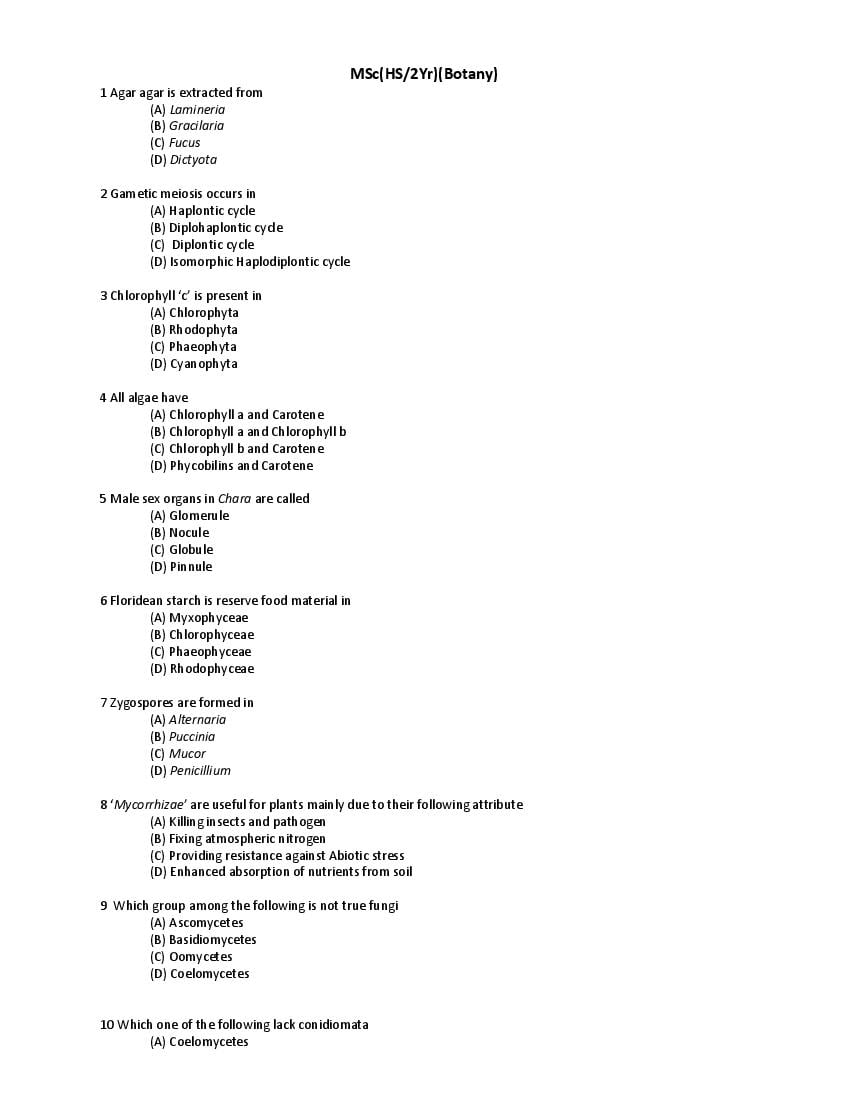
1 Agar agar is extracted from
(A) Lamineria
(B) Gracilaria
(C) Fucus
(D) Dictyota
2 Gametic meiosis occurs in
(A) Haplontic cycle
(B) Diplohaplontic cycle
(C) Diplontic cycle
(D) Isomorphic Haplodiplontic cycle
3 Chlorophyll ‘c’ is present in
(A) Chlorophyta
(B) Rhodophyta
(C) Phaeophyta
(D) Cyanophyta
4 All algae have
(A) Chlorophyll a and Carotene
(B) Chlorophyll a and Chlorophyll b
(C) Chlorophyll b and Carotene
(D) Phycobilins and Carotene
5 Male sex organs in Chara are called
(A) Glomerule
(B) Nocule
(C) Globule
(D) Pinnule
6 Floridean starch is reserve food material in
(A) Myxophyceae
(B) Chlorophyceae
(C) Phaeophyceae
(D) Rhodophyceae
7 Zygospores are formed in
(A) Alternaria
(B) Puccinia
(C) Mucor
(D) Penicillium
8 ‘Mycorrhizae’ are useful for plants mainly due to their following attribute
(A) Killing insects and pathogen
(B) Fixing atmospheric nitrogen
(C) Providing resistance against Abiotic stress
(D) Enhanced absorption of nutrients from soil
9 Which group among the following is not true fungi
(A) Ascomycetes
(B) Basidiomycetes
(C) Oomycetes
(D) Coelomycetes
10 Which one of the following lack conidiomata
(A) Coelomycetes
Page 2
(C) Hypomycetes
(D) Saprolegniales
11 The unilocular fruiting body in which conidiophore and conidia are formed is called as
(A) Pycnidia
(B) Acervulus
(C) Synnemeta
(D) Sporodochia
12 Elaterophpre is present in capsule of
(A) Marchantia
(B) Pellia
(C) Porella
(D) Sphagnum
13 Protonema of moss is
(A) Haploid
(B) Diploid
(C) Triploid
(D) Sporophytic
14 Pseudoeleters are present in
(A) Marchantia
(B) Anthoceros
(C) Pellia
(D) Porella
15 Pseudopodium is present in sporophyte of
(A) Porella
(B) Pogonatum
(C) Polytrichum
(D) Sphagnum
16 Foot and seta are absent in the sporophyte of
(A) Riccia
(B) Marchantia
(C) Pellia
(D) Porella
17 The major constituent of Peat is
(A) Marchantia
(B) Pogonatum
(C) Polytrichum
(D) Sphagnum
18 The protostele in which xylem core is Smooth and
rounded is
(A) Haplostele
(B) Actinostlele
(C) Plectostele
(D) Siphonostele
19 The inner most layer of sporangium of Selaginella is
(A) Elators
(B) synangium
(C) Tapetum
(D) Jacket
Page 3
(A) Haplostele
(B) Actinostlele
(C) Plectostele
(D) Siphonostele
21 Spore dissemination in many ferns is affected by
(A) Inducium
(B) Sorus
(C) Annulus
(D) Tepetum
22 The endosperm of gymnosperms is
(A) Haploid
(B) Diploid
(C) Triploid
(D) Polyploid
23 Most of the gymnosperms have
(A) Both antheridia and archegonia
(B) Neither antheridia nor archegonia
(C) Archegonia but no antheridia
(D) Only antheridia
24 Corolloid roots in Cycas are
(A) Dichotomously branched and negatively geotropic
(B) Dichotomously branched and positively geotropic
(C) Extensively branched and negatively phototrophic
(D) Dichotomously branched with horizontal growth
25 Male gametes of angiosperms are produced by
(A) Vegetative cell
(B) Tube cell
(C) Generative cell
(D) Pollen tube
26 Female gametophyte (megagametophyte) of angiosperms is represented by
(A) ovule
(B) embryo sac
(C) megaspore mother sac
(D) megasporophyll
27 The plant part of angiosperms, which consists of two generations one within the other is
(A) Germinated pollen grains
(B) Seed
(C) Embryo
(D) Unfertilized ovule
28 In angiosperms, triple fusion produces
(A) Primary endospermic nucleus
(B) Secondary nucleus
(C) Zygotic nucleus
(D) Polar nucleus
29 When the body of the ovule is transversely placed and is at right angle to the stalk/funicle of the ovule, it is
called
(A) Anatropous
(B) Circinotropous
(C) Orthotropous
Page 4
30 An inflorescence bearing sessile, bisexual flowers in acropetal succession is called as
(A) Spike
(B) Spadix
(C) Corymb
(D) Raceme
31 Cork cambium and vascular cambium are
(A) Parts of secondary xylem and phloem
(B) Parts of pericycle
(C) Lateral meristem
(D) Apical meristem.
32 A bicollateral vascular bundle is characterised by
(A) Phloem being sandwitched between xylem
(B) Xylem being sandwitched between phloem
(C) Longitudinal splitting of vascular bundle
(D) Transverse splitting of vascular bundle
33 Heartwood differs from sapwood in
(A) Absence of vessels and parenchyma
(B) Presence of rays and fibres
(C) Having dead and non-conducting elements
(D) Being susceptible to pests and pathogens
34 Interfascicular cambium is a
(A) Type of Protoderm
(B) Primordial meristem
(C) Primary meristematic tissue
(D) Secondary meristematic tissue
35 Pith and cortex do not differentiate in
(A) Monocot stem
(B) Dicot stem
(C) Monocot root
(D) Dicot root.
36 Collateral bundles occur in
(A) Dicot as well as monocot stem
(B) Leaves only
(C) Monocot stem only
(D) Dicot stem only
37 A pair of genes representing alternative forms of the same character and located on two homologous
chromosomes is called as
(A) Alleles or allelomorphic pairs
(B) Non allelic alleles
(C) Homozygous genes
(D) Heterozygous genes
38 If an organism produces 32 types of gametes, its genotype should be heterozygous for
(A) 4 genes
(B) 5 genes
(C) 8 genes
(D) 16 genes
Page 5
trait and a ratio of 9:7 in F2 generation are called as
(A) Supplementary genes
(B) Complementary genes
(C) Hypostatic genes
(D) Epistatic genes
40 A gene which can occur in more than two alternative forms present on the same locus is called as
(A) Polygene
(B) Pleiotropic gene
(C) Multiple allele
(D) Lethal gene
41 When two genes are located very close to each other on the same chromosome
(A) Frequency of crossing over increases
(B) Hardly any crossing over takes place
(C) Linkage is zero
(D) Only double cross over can occur
42 Crossing over during meiosis occurs at which of the following stages?
(A) Dikinesis
(B) leptotene
(C) zygotene
(D) pachytene
43 What will you call this set up 2n-2+2
(A) Nullisomy
(B) Nullisomy tetrasomy
(C) Double nulisomy
(D) Double tetrasomy
44 A polyploid species having multiple and identical sets of chromosomes is called as
(a) Allopolyploid
(b) Amphipolyploid
(c) Aneuploidy
(d) Autopolyploid
45 Point mutations occur during
(A) DNA replication
(B) DNA repairing
(C) Cell division
(D) Transcription
46 The type of interaction between two non-allelic genes in which one masks, inhibits or supresses the expression
of other is called
(A) Epistasis
(B) Co-dominance
(C) Expressivity
(D) Dominance
47 A bivalent of meiosis-1 consist of
(A) Four chromatids and four centromeres
(B) Two chromatids and for two centromeres
(C) Two chromatids and one centromere
(D) Four chromatids and two centromeres
Page 6
(A) AUG
(B) GUC
(C) CUC
(D) AAA
49 Which one is a termination codon
(A) AGG
(B) UUA
(C) UAA
(D) AUG
50 Replacement of a purine by a pyramidine during DNA replication is called as
(A) Transition
(B) Transversion
(C) Translocation
(D) Translation
51 Which one of the following is essential fatty acid
(A) Acetic acid
(B) Oleic acid
(C) Linoleic acid
(D) Palmitic acid
52 The variations among the plants with gametic chromosome number is popularly described as
(A) Somaclonal variations
(B) Gametoclonal variations
(C) Inter specific variations
(D) Intraspecific variations
53 Which one of the following acts as energy source in nutrient medium
(A) Agar
(B) Chelators
(C) Sucrose
(D) Plant growth regulators
54 Which one of the following is not an application of plant tissue culture
(A) Conservation of germplasm
(B) Plant breeding
(C) Genetic engineering
(D) Biochemical analysis
55 Which of the followimg chemicals is not used for surface sterilization of explants
(A) HgCl2
(B) CaCl2
(C) NaClO
(D) Ethanol
56 Which one of the following is naturally occurring auxin
(A) NAA
(B) IAA
(C) 2,4-D
(D) Picloram
57 Heaviest wood is obtained from
(A) Krugiodendron ferreum
(B) Quercus rubra
Page 7
(D) Tectona grandis
58 Quinine is obtained from
(A) Raulfia serpentina
(B) Cincona calisaya
(C) Clavicep perpuria
(D) Digitalis perpuria
59 Drying oil is obtained from
(A) Arechis hypogia
(B) Ricinus communis
(C) Linum usitaticimum
(D) Cocos nucifera
60 Cinamom is obtained from bark of which plant?
(A) Elettaria cardamomum
(B) Cuminum cyminum
(C) Cinamomum camphora
(D) Cinamomum vernum
61 Jute fibre is obtained from
(A) Corchous capsularis
(B) Crotolaria junctia
(C) Cannabis sativa
(D) Ceiba pentandra
62 Increasing skin cancer and high mutation rate are due to
(A) Ozone depletion
(B) CO pollution
(C) CO2 pollution
(D) Acid rain
63 In an ecosystem the population of
(A) Secondary consumers is largest
(B) Primary consumers is least dependent upon primary producers
(C) Primary consumers outnumber primary producers
(D) Primary producers is greater than number of primary consumers
64 Energy pyramid is always
(A) Upright
(B) Inverted
(C) Parallel
(D) Inclined
65 ‘Smog’ is
(A) Dust storm
(B) Smoke and fog
(C) Smoke
(D) Moistened air gases
66 Energy flow in an ecosystem through a path is
(A) Producer ˃ Carnivores ˃ Herbivores ˃ Decomposers
(B) Producer ˃ Herbivores ˃ Carnivores ˃ Decomposers
(C) Herbivores ˃ Producer ˃ Carnivores ˃ Decomposers
(D) Herbivores ˃ Carnivores ˃ Producer ˃ Decomposers
67 Chlorophyll is present
Page 8
(B) In the stroma of chloroplast
(C) In the grana of chloroplast
(D) Dispersed through the chloroplast
68 In case of C4 pathway, CO2 combines with
(A PGA
(B) RuBP
(C) PEP
(D) RMP
69 Which one of the following is not a micronutrient?
(A) Magnesium
(B) Molybdenum
(C) Boron
(D) Zinc
70 Which is the first stable compound produced in calvin cycle?
(A) OAA
(B) PGA
(C) PEP
(D) RuBP
71 Deficiency of which mineral causes shortning of internodes and reduction in cambium activity?
(A) K
(B) Fe
(C) Cu
(D) B
72 The number of photons required to release one mole of O2
in photosynthesis is called as
(A) Quantum yield
(B) Quantum requirement
(C) Red drop
(D) Emerson’s effect
73 Bacteria prepare food by oxidation of
(A) N2
(B) NO2
(C) O2
(D) Glycogen
74 A fully formed infectious viral particles called as
(A) Viroid
(B) Virusoid
(C) Virion
(D) Capsid
75 Which of the following statements is false with respect to Mycoplasma
(A) They are the smallest prokaryotic organisms that can grow in cell free culture media
(B) They are obligate intracellular organisms
(C) They lack a cell wall
(D) They are resistant to Beta-lactam drug
______________________________________
Document Details
| Board / Org | Panjab University |
| Exam | PU CET PG |
| Type | Question Paper |
| Pages | 8 |
| Updated | 22 Jul 2026 |