CUSAT CAT 2022 Question Paper Botany
Finished viewing? Save it for later —
Download CUSAT CAT 2022 Question Paper Botany (PDF · 26 pages)About CUSAT CAT 2022 Question Paper Botany
CUSAT CAT 2022 Question Paper Botany is available here for free download. Published by Cochin University for CUSAT Common Admission Test, this question paper can be viewed online or downloaded as a PDF (26 pages). Candidates preparing for CUSAT Common Admission Test can use CUSAT CAT 2022 Question Paper Botany to understand the exam pattern, the type of questions asked, and the overall difficulty level.
Frequently Asked Questions
How can I download CUSAT CAT 2022 Question Paper Botany?
Open this page and click the Download button to save CUSAT CAT 2022 Question Paper Botany as a PDF. It is completely free on AglaSem Docs.
Is CUSAT CAT 2022 Question Paper Botany free to download?
Yes. CUSAT CAT 2022 Question Paper Botany can be viewed online and downloaded as a PDF free of cost on AglaSem Docs.
How many pages does CUSAT CAT 2022 Question Paper Botany have?
CUSAT CAT 2022 Question Paper Botany contains 26 pages, which you can read online or download together as a single PDF.
Where can I find more CUSAT Common Admission Test study material?
You can find more CUSAT Common Admission Test question papers, sample papers, syllabus, and answer keys on AglaSem Docs.
CUSAT CAT 2022 Question Paper Botany – Text
Read the full text of this question paper below — useful to quickly search, copy and reference the content online without downloading the PDF.
📄 View text version (26 pages)
Page 1
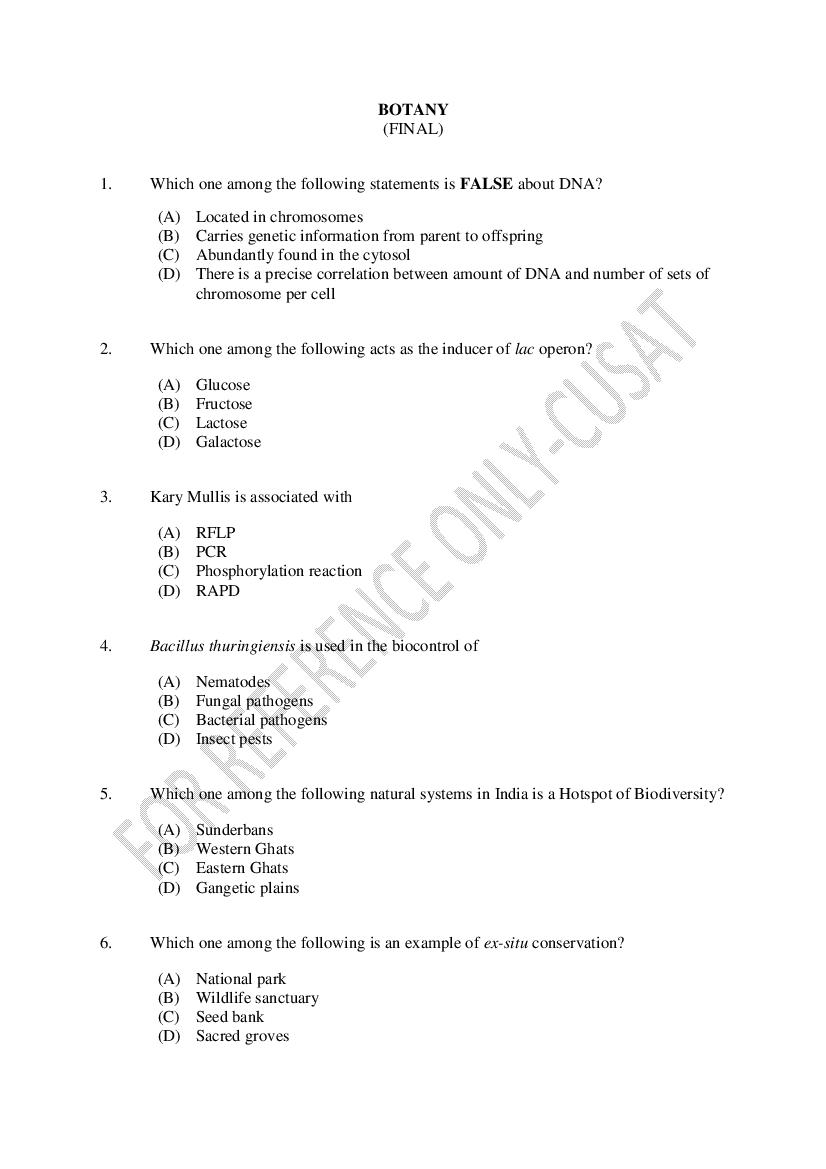
(FINAL)
1. Which one among the following statements is FALSE about DNA?
(A) Located in chromosomes
(B) Carries genetic information from parent to offspring
(C) Abundantly found in the cytosol
(D) There is a precise correlation between amount of DNA and number of sets of
chromosome per cell
2. Which one among the following acts as the inducer of lac operon?
(A) Glucose
(B) Fructose
(C) Lactose
(D) Galactose
3. Kary Mullis is associated with
(A) RFLP
(B) PCR
(C) Phosphorylation reaction
(D) RAPD
4. Bacillus thuringiensis is used in the biocontrol of
(A) Nematodes
(B) Fungal pathogens
(C) Bacterial pathogens
(D) Insect pests
5. Which one among the following natural systems in India is a Hotspot of Biodiversity?
(A) Sunderbans
(B) Western Ghats
(C) Eastern Ghats
(D) Gangetic plains
6. Which one among the following is an example of ex-situ conservation?
(A) National park
(B) Wildlife sanctuary
(C) Seed bank
(D) Sacred groves
Page 2
(A) Reduction in the availability of natural food resources
(B) Increase in the forest area
(C) Adequate rainfall
(D) Curiosity of wildlife animals that leads for the invasion to outside
the forest area
8. The Jim Corbett National Park is famous for notable man-eaters
(A) Leopard
(B) Tiger
(C) Bear
(D) Lion
9. The first transgenic virus-resistant plant was
(A) Rice
(B) Cotton
(C) Tobacco
(D) Tomato
10. Enzyme targeted in gene silencing for delaying fruit ripening in tomato is
(A) Polygalacturonase (PG)
(B) Glyphosate
(C) ADA
(D) P53
11. Polyploidy is induced through
(A) Irradiation
(B) Mutagenic chemicals
(C) Ethylene
(D) Colchicine
12. Heterosis is the
(A) Appearance of spontaneous mutation
(B) Induction of mutation
(C) Mixture of two or more traits
(D) Superiority of hybrids over their parents
Page 3
(A) Grafting
(B) Conjugation
(C) Protoplast fusion
(D) Recombinant DNA technology
14. A virologist wants to study the viral effects on plants. Which one among the
following plant parts should be excluded?
(A) Pith
(B) Shoot apex
(C) Phloem
(D) Cortex
15. The genotypic ratio of a monohybrid cross is
(A) 1:2:1
(B) 3:1
(C) 2:1:1
(D) 9:3:3:1
16. An exception to Gregor Johann Mendel’s laws is
(A) Independent assortment
(B) Linked genes
(C) Dominance
(D) Incomplete dominance
17. Which term of genetics represents the potential ability of a plant cell to
grow into a complete plant?
(A) Pluripotency
(B) Totipotency
(C) Cloning
(D) Variation
18. Experimental plant for Gregor Johann Mendel’s genetic study is
(A) Onion
(B) Carrot
(C) Garden pea
(D) Lily
Page 4
(A) Bar chart
(B) Pie chart
(C) Histogram
(D) Frequency polygon
20. Which of the following is the protein database?
(A) Genebank
(B) Swiss-Prot
(C) DDBJ
(D) PDB
21. The natural place of an organism or community is termed as
(A) Niche
(B) Biome
(C) Habitat
(D) Habit
22. Agar agar is obtained from
(A) Gracillaria
(B) Gelidium
(C) Gigartina
(D) Chara
23. The alga that is exploited as a rich source of protein is
(A) Spirogyra
(B) Spirulina
(C) Chlamydomonas
(D) Scytonema
24. Brown algae is characterized by the presence of
(A) Phycocyanin
(B) Phycoerythrin
(C) Fucoxanthin
(D) Haematochrome
Page 5
(A) Ulothrix
(B) Anabaena
(C) Ulva
(D) Hydrodictyon
26. Pyrenoids in green algal cells are related to
(A) Enzyme secretion
(B) Protein storage
(C) Starch formation
(D) General metabolism
27. The non-motile greatly thickened asexual spores are called
(A) Hypnospores
(B) Aplanospores
(C) Macrozoospores
(D) Microzoospores
28. Fungal spores produced asexually at the tips of hyphae are called
(A) Sporangiophores
(B) Conidia
(C) Anthospores
(D) Meiospores
29. All fungi can be called as
(A) Autotrophs
(B) Saprophytes
(C) Parasites
(D) Heterotrophs
30. Destruction of 50% maize plants in USA in 1970 was due to infection by
(A) Hemileia vastratrix
(B) Helminthosporium oryzae
(C) Claviceps purpurea
(D) Ustilago maydis
Page 6
(A) Basidiomycetes
(B) Ascomycetes
(C) Phycomycetes
(D) Deuteromycetes
32. When fungi feed on dead organic matter, they are known as
(A) Dimorphic
(B) Parasites
(C) Saprophytes
(D) Photoautotrophs
33. Wart disease caused by Synchytrium endobioticum occurs in
(A) Cabbage
(B) Garden pea
(C) Groundnut
(D) Potato
34. Which one among the following secretes toxins under
storage conditions of crop plants?
(A) Aspergillus
(B) Pencillium
(C) Fusarium
(D) Colletotrichum
35. To which one among the following groups you would place a plant that produces
spores and embryos, but lacks seeds and vascular tissue?
(A) Fungi
(B) Bryophytes
(C) Pteridophytes
(D) Gymnosperms
36. Elaters are present in the sporogonium of
(A) Marchantia
(B) Riccia
(C) Selaginella
(D) Sphagnum
Page 7
(A) Eastern Himalayas
(B) Western Himalayas
(C) Western Ghats
(D) Eastern Ghats
38. Dichotomous branching is found in
(A) Fern
(B) Funaria
(C) Liverworts
(D) Marchantia
39. Who among the following scientists was a paleobotanist?
(A) P. Maheshwari
(B) S.R. Kashyap
(C) V. Puri
(D) Birbal Sahni
40. Heterospory refers to the production of
(A) Sexual and asexual spores
(B) Large and small spores
(C) Haploid and diploid spores
(D) Diploid and tetraploid spores
41. According to available fossil records, which one among the following was the first
land vascular plant?
(A) Psilophytales
(B) Lycopods
(C) Horse-tail
(D) Cycas
42. A stele without a central pith is called
(A) Solenostele
(B) Protostele
(C) Dictyostele
(D) Siphonostele
Page 8
(A) Animals
(B) Wind
(C) Water
(D) Insects
44. Red wood tree is
(A) Cedrus
(B) Pinus
(C) Sequoia
(D) Dalbergia
45. Fruitless flowering plants are called
(A) Sterile plants
(B) Angiosperms
(C) Primitive plants
(D) Gymnosperms
46. Which one among the following is a living fossil?
(A) Pinus
(B) Ginkgo
(C) Thuja
(D) Deodar
47. Canada balsam is an oleoresin obtained from
(A) Abies balsamea
(B) Impatiens balsamia
(C) Pinus sylvestris
(D) Helianthus annus
48. Senescence is induced by
(A) IAA
(B) Cytokinin
(C) GA3
(D) ABA
Page 9
(A) Stem
(B) Root
(C) Leaf
(D) Sex organ
50. Common characteristic of Bryophytes and Pteridophytes is
(A) Vascularization
(B) Terrestrial habit
(C) Fertilization in water
(D) Independent sporophyte
51. Tap roots are commonly found in
(A) Gymnosperms
(B) Angiosperms
(C) Monocots
(D) Dicots
52. Haustoria are found in
(A) Symbionts
(B) Parasites
(C) Saprophytes
(D) Legume nodules
53. The presence of vessels and companion cells are characteristic features of
(A) Angiosperm
(B) Gymnosperm
(C) Pteridophyta
(D) Echinodermata
54. Which one among the following is the tallest tree of the world?
(A) Eucalyptus regnans
(B) Sequoia sempervirens
(C) Pinus longifolia
(D) Pinus wallichiana
Page 10
(A) Kingdom
(B) Division
(C) Species
(D) Order
56. Which one of the following is associated with bacterial cell?
(A) Ribosomes
(B) Nucleus
(C) Chloroplasts
(D) Lysosomes
57. Lateral roots originate from
(A) Cortex
(B) Endodermal cells
(C) Pericycle
(D) Cork cambium
58. The fiber cells of plants are a type of
(A) Parenchyma
(B) Meristematic cell
(C) Sclerenchyma
(D) Collenchyma
59. The age of trees can be determined by
(A) Measuring its diameter in cubic feet
(B) Counting the number of annual rings
(C) Counting the number of leaves
(D) Finding out the number of branches
60. Wound healing in plants is initiated by
(A) Apical meristem
(B) Lateral meristem
(C) Secondary meristem
(D) Intercalary meristem
Page 11
(A) Seed germination
(B) Bud formation
(C) Root primordia formation
(D) Pollen grain formation
62. Which one among the following statements is true for the pollen tube?
(A) It shows only tip growth
(B) It is composed of three non-cellular zones
(C) It shows chemostatic movements
(D) It shows radial cytoplasmic streaming
63. Which one among the following fruits is produced by parthenocarpy?
(A) Brinjal
(B) Apple
(C) Banana
(D) Jackfruit
64. The fusion of female reproductive nucleus with the male reproductive nucleus is
(A) Adoption
(B) Excretion
(C) Fertilization
(D) Regeneration
65. The two nuclei at the end of the pollen tube are called
(A) Tube nucleus and generative nucleus
(B) Sperm and ovum
(C) Generative nucleus and stigma
(D) Tube nucleus and sperm
66. Loss of water through the stomata of leaves is known as
(A) Guttation
(B) Exudation
(C) Transpiration
(D) Evaporation
Page 12
(A) Wheat
(B) Mustard
(C) Potato
(D) Sugarcane
68. Water-soluble photosynthetic pigment is
(A) Chlorophyll a
(B) Xanthophyll
(C) Anthocyanin
(D) Chlorophyll b
69. The cell wall of Spirogyra consists of
(A) Cellulose
(B) Chitin
(C) Lignin
(D) Suberin
70. Which one among the following is an insectivorous plant?
(A) Tridax procumbens
(B) Utricularia gibba
(C) Calotropis gigantean
(D) Pongamia pinnata
71. The ploidy level of prothallus, the gametophyte stage in fern, is
(A) Haploid
(B) Diploid
(C) Triploid
(D) Tetraploid
72. The presence of carinal canal is a specialized feature in
(A) Lycopodium
(B) Selaginella
(C) Isoetes
(D) Equisetum
Page 13
without meiosis is called
(A) Apospory
(B) Apogamy
(C) Polyembryony
(D) Apomixis
74. Gymnosperms differ from angiosperms in the
(A) Presence of naked seeds and lack of vessels
(B) Presence of seeds and vessels
(C) Having abortive seeds
(D) Having tracheids
75. Xylem of gymnosperms lacks
(A) Tracheids
(B) Xylem fibres
(C) Xylem parenchyma
(D) Vessels
76. In gymnosperms, the endosperm is formed
(A) at the time of fertilization
(B) before fertilization
(C) after fertilization
(D) along with the development of embryo
77. Sago palm is
(A) Cycas
(B) Pinus
(C) Gnetum
(D) Cocos
78. Transfer of male gametes in bryophytes and pteridophytes occurs through
(A) Wind
(B) Water
(C) Birds
(D) Insects
Page 14
(A) Monoecious plant
(B) Dioecious plant
(C) Hermaphrodite plant
(D) Sterile plant
80. The first land plants were formed in the era of
(A) Precambrian
(B) Paleozoic
(C) Mesozoic
(D) Pre-paleozoic
81. CAM pathway was first discovered in
(A) Xerophytes
(B) Mesophytes
(C) Succulents
(D) Hydrophytes
82. Streptomycin is active against
(A) Gram positive bacteria
(B) Gram negative bacteria
(C) Viruses
(D) Fungi
83. One among the following traits is INCORRECT about monocotyledonous plants
(A) Single cotyledon
(B) Parallel venation
(C) Fibrous root
(D) Flowers are pentamerous
84. Nitrogenous base together with a deoxyribose sugar moiety and
phosphate group forms
(A) Nucleoside
(B) Protein
(C) Amino acid
(D) Nucleotide
Page 15
(A) Synecology
(B) Autoecology
(C) Habitat ecology
(D) Population ecology
86. The callus is
(A) Undifferentiated mass of cells
(B) Differentiated mass of cells
(C) Redifferentiated mass of cells
(D) Exclusively dead cells
87. Auxins are
(A) Phytohormones
(B) Steroids
(C) Porphyrins
(D) Sugar molecules
88. Gibberellins were first extracted from
(A) Bacteria
(B) Virus
(C) Fungi
(D) Algae
89. Phytohormone responsible for signaling abiotic stress is
(A) Cytokinin
(B) GA3
(C) IAA
(D) ABA
90. The root hairs originate from
(A) Rhizodermis
(B) Trichomes
(C) Accessory cells
(D) Trichoblasts
Page 16
(A) Sieve cells
(B) Vessel wall
(C) Companion cells
(D) Sieve tube wall
92. Annual rings are distinct in plants growing in
(A) Temperate regions
(B) Tropical regions
(C) Grasslands
(D) Arctic region
93. Pollen grains are shed at 2-celled stage in angiosperms and contain
(A) Tube cell + Vegetative cell
(B) Tube cell + Generative cell
(C) Tube cell + Male gamete
(D) Two sclerenchyma cells
94. The location of microspore mother cells is
(A) Anther
(B) Filament
(C) Style
(D) Stigma
95. The ovule of the plants is also called as
(A) Megasporangium
(B) Microsporangium
(C) Embryo Sac
(D) Endosperm
96. Which one among the following is an example of tetrasporic embryo sac?
(A) Polygonum type
(B) Allium type
(C) Endymion type
(D) Peperomia type
Page 17
(A) Allium
(B) Citrus
(C) Poa
(D) Brassica
98. Floral condition with the absence of distinct sepals and petals is known as
(A) Perianth
(B) Corolla
(C) Androecium
(D) Gynoecium
99. Typical example for green alga is
(A) Laminaria
(B) Sargassum
(C) Chlamydomonas
(D) Fucus
100. Tissue that helps for flexibility in plants is
(A) Parenchyma
(B) Collenchyma
(C) Sclerenchyma
(D) Callus
101. Which one among the following tuber crops is an example for
modified adventitious root?
(A) Sweet potato
(B) Onion
(C) Garlic
(D) Carrot
102. Which one among the following is a unisexual plant?
(A) Mustard
(B) Papaya
(C) Sunflower
(D) Hibiscus
Page 18
(A) Ustilago kolleri
(B) Ustilago hordei
(C) Ustilago tritici
(D) Ustilago avenae
104. Red rot disease of sugarcane is caused by
(A) Phytophthora infestans
(B) Alternaria solani
(C) Colletotrichum falcatum
(D) Cercospora personata
105. Plants that can tolerate high concentration of salt in the soil are termed as
(A) Epiphytes
(B) Halophytes
(C) Xerophytes
(D) Hydrophytes
106. Cuscuta is an example for
(A) Autotroph
(B) Parasite
(C) Saprotroph
(D) Host
107. Crown gall disease is caused by
(A) Agrobacterium tumefaciens
(B) Escherichia coli
(C) Streptomyces aureus
(D) Pectobacterium carotovorum
108. Clove is an aromatic
(A) Fruit
(B) Flower bud
(C) Stem
(D) Root
Page 19
(A) Vulgaxanthin
(B) Carotenes
(C) Betalins
(D) Phycoxanthin
110. The translocation of food materials in plants takes place through
(A) Parenchyma
(B) Collenchyma
(C) Xylem
(D) Phloem
111. Which one among the following plants treats malaria
caused by Plasmodium falciparum?
(A) Cedrus
(B) Azadirachta
(C) Cinchona
(D) Eucalyptus
112. ‘Yellow spot’ disease on citrus leaves is due to the deficiency of
(A) Br
(B) Mg
(C) Zn
(D) Fe
113. Biodegradable wastes can be converted into useful substances by
(A) Bacteria
(B) Viruses
(C) Nuclear proteins
(D) Radioactive substances
114. Plant secondary metabolite used in leather industry is
(A) Resin
(B) Latex
(C) Tannin
(D) Mucilage
Page 20
(A) Leaf
(B) Stem
(C) Root
(D) Leaflet
116. Curcumin is isolated from a member belonging to one among the following
families of plants
(A) Liliaceae
(B) Zingiberaceae
(C) Asteraceae
(D) Chenopodiaceae
117. Which one among the following is a group of non-green heterotrophic organism?
(A) Fungi
(B) Algae
(C) Ferns
(D) Mosses
118. Cell wall of higher plant is composed of
(A) Cellulose, hemicellulose and pectin
(B) Cellulose, hemicellulose and chitin
(C) Cellulose and chitin
(D) Cellulose only
119. ‘Cell theory’ was proposed by
(A) Beadle and Tatum
(B) Schleiden and Schwann
(C) Robert Hooke
(D) Leeuwenhoeck
120. Which one among the following is the longest phase in cell cycle?
(A) Prophase
(B) Metaphase
(C) Telophase
(D) Anaphase
Page 21
(A) Respiration
(B) Photosynthesis
(C) Protein synthesis
(D) Fat synthesis
122. The crossing of F1 offspring with homozygous recessive parent is called
(A) Back cross
(B) Test cross
(C) F1 cross
(D) F2 cross
123. Cocoa used for flavor of chocolates is obtained from
(A) Artocarpus
(B) Terminalia
(C) Theobroma
(D) Ficus
124. ‘Greenhouse effect’ relates to
(A) Increased growth of green algae
(B) Global warming
(C) Cultivation of vegetables in house
(D) Development of terrace gardens
125. The rate of transpiration in plants is measured by
(A) Porometer
(B) Osmometer
(C) Microscope
(D) Potometer
126. The result of point mutation is
(A) Deletion
(B) Insertion
(C) Duplication
(D) Change in single base pair
Page 22
(A) Ligase
(B) Phosphatase
(C) Ribonuclease
(D) Restriction enzymes
128. Enzyme that unwinds the DNA double helix at the replication fork is
(A) Helicase
(B) Primase
(C) Ligase
(D) Oxygenase
129. ‘Jumping genes’ are known as
(A) Transposons
(B) Transversion
(C) Transduction
(D) Transformation
130. At which stage does colchicine hamper cell division?
(A) Anaphase
(B) Telophase
(C) Interphase
(D) Metaphase
131. Nuclear condition having more than the diploid set of chromosomes is termed as
(A) Haploidy
(B) Diploidy
(C) Polyploidy
(D) Trisomy
132. Virus which infects bacteria is called
(A) Lysophage
(B) Bacteriophage
(C) Virophage
(D) TMV
Page 23
(A) Nucleid
(B) Capsid
(C) Capsomere
(D) Outer envelope
134. Which one among the following is haploid?
(A) Pollen grains
(B) Endosperm
(C) Anther wall
(D) Petals
135. Puccinia is also known as
(A) Golden fungi
(B) Rust fungi
(C) Rock fungi
(D) Blue fungi
136. Economically important Saccharomyces produces
(A) Waste water
(B) Inhibitor of fermentation
(C) Ethanol
(D) Sewage
137. Lichens are symbiotic association of
(A) Blue-green algae and basidomycetes
(B) Red algae and ascomycetes
(C) Brown algae and phycomycetes
(D) Blue-green algae and ascomycetes
138. The element located at the centre of the porphyrin ring in chlorophyll molecule is
(A) Calcium
(B) Magnesium
(C) Potassium
(D) Manganese
Page 24
(A) Raceme
(B) Corymb
(C) Catkin
(D) Umbel
140. A True fruit is one that is
(A) developed solely from the ovary after fertilization
(B) developed from whole gynoecium
(C) developed from ovule
(D) developed from thalamus
141. Laminarin and mannitol are the stored food materials of
(A) Green algae
(B) Red algae
(C) Brown algae
(D) Bluegreen algae
142. Fermentation occurs in the
(A) Presence of oxygen
(B) Absence of oxygen
(C) Presence of nitrogen
(D) Presence of ethylene
143. ‘Velamen tissues’ in epiphytes are found
(A) Below the epidermis
(B) Below the endodermis
(C) Outside the cortex
(D) Outside the exodermis
144. Bulliform cells are found in the leaves of
(A) Grass
(B) Mango
(C) Banyan
(D) Legumes
Page 25
(A) Eubacteria
(B) Dinoflagellates
(C) Archaebacteria
(D) Fungi
146. Smallest plant in the world is
(A) Sequoia
(B) Wolffia
(C) Rafflesia
(D) Salix
147. An example for C4 plants is
(A) Rice
(B) Sugarcane
(C) Spinach
(D) Wheat
148. Water soluble vitamin is
(A) Vitamin A
(B) Vitamin C
(C) Vitamin E
(D) Vitamin D
149. Technical process in which water is removed from a product after it is frozen and
placed under vacuum is termed as
(A) Polymerization
(B) Sublimation
(C) Lyophilization
(D) Synthesis
150. Soil, moisture and light are known as
(A) Physical factors
(B) Chemical factors
(C) Biological factors
(D) Extra-terrestrial factors
Page 26
Subject Name: 602 BOTANY
SI No. Key SI No. Key SI No. Key SI No. Key SI No. Key
1 C 31 B 61 D 91 B 121 C
2 A 32 C 62 A 92 A 122 B
3 B 33 D 63 C 93 B 123 C
4 D 34 A 64 C 94 A 124 B
5 B 35 B 65 A 95 A 125 D
6 C 36 A 66 C 96 D 126 D
7 A 37 B 67 D 97 B 127 D
8 A 38 C 68 C 98 A 128 A
9 C 39 D 69 A 99 B 129 A
10 A 40 B 70 B 100 B 130 D
11 D 41 A 71 A 101 A 131 C
12 D 42 B 72 D 102 B 132 B
13 C 43 B 73 A 103 C 133 B
14 B 44 C 74 A 104 C 134 A
15 A 45 D 75 D 105 B 135 B
16 B 46 B 76 B 106 B 136 C
17 B 47 A 77 A 107 A 137 D
18 C 48 D 78 B 108 B 138 B
19 B 49 C 79 B 109 B 139 D
20 D 50 C 80 B 110 D 140 A
21 C 51 D 81 C 111 C 141 C
22 D 52 B 82 B 112 B 142 B
23 B 53 A 83 D 113 A 143 D
24 C 54 A 84 D 114 C 144 A
25 B 55 C 85 B 115 B 145 C
26 C 56 A 86 A 116 B 146 B
27 A 57 C 87 A 117 A 147 B
28 B 58 C 88 A 118 A 148 B
29 D 59 B 89 A 119 B 149 C
30 D 60 C 90 A 120 A 150 D
Document Details
| Board / Org | Cochin University |
| Exam | CUSAT Common Admission Test |
| Type | Question Paper |
| Pages | 26 |
| Updated | 09 Jun 2026 |