CUSAT CAT 2022 Question Paper Chemistry
Finished viewing? Save it for later —
Download CUSAT CAT 2022 Question Paper Chemistry (PDF · 35 pages)About CUSAT CAT 2022 Question Paper Chemistry
CUSAT CAT 2022 Question Paper Chemistry is available here for free download. Published by Cochin University for CUSAT Common Admission Test, this question paper can be viewed online or downloaded as a PDF (35 pages). Candidates preparing for CUSAT Common Admission Test can use CUSAT CAT 2022 Question Paper Chemistry to understand the exam pattern, the type of questions asked, and the overall difficulty level.
Frequently Asked Questions
How can I download CUSAT CAT 2022 Question Paper Chemistry?
Open this page and click the Download button to save CUSAT CAT 2022 Question Paper Chemistry as a PDF. It is completely free on AglaSem Docs.
Is CUSAT CAT 2022 Question Paper Chemistry free to download?
Yes. CUSAT CAT 2022 Question Paper Chemistry can be viewed online and downloaded as a PDF free of cost on AglaSem Docs.
How many pages does CUSAT CAT 2022 Question Paper Chemistry have?
CUSAT CAT 2022 Question Paper Chemistry contains 35 pages, which you can read online or download together as a single PDF.
Where can I find more CUSAT Common Admission Test study material?
You can find more CUSAT Common Admission Test question papers, sample papers, syllabus, and answer keys on AglaSem Docs.
CUSAT CAT 2022 Question Paper Chemistry – Text
Read the full text of this question paper below — useful to quickly search, copy and reference the content online without downloading the PDF.
📄 View text version (35 pages)
Page 1
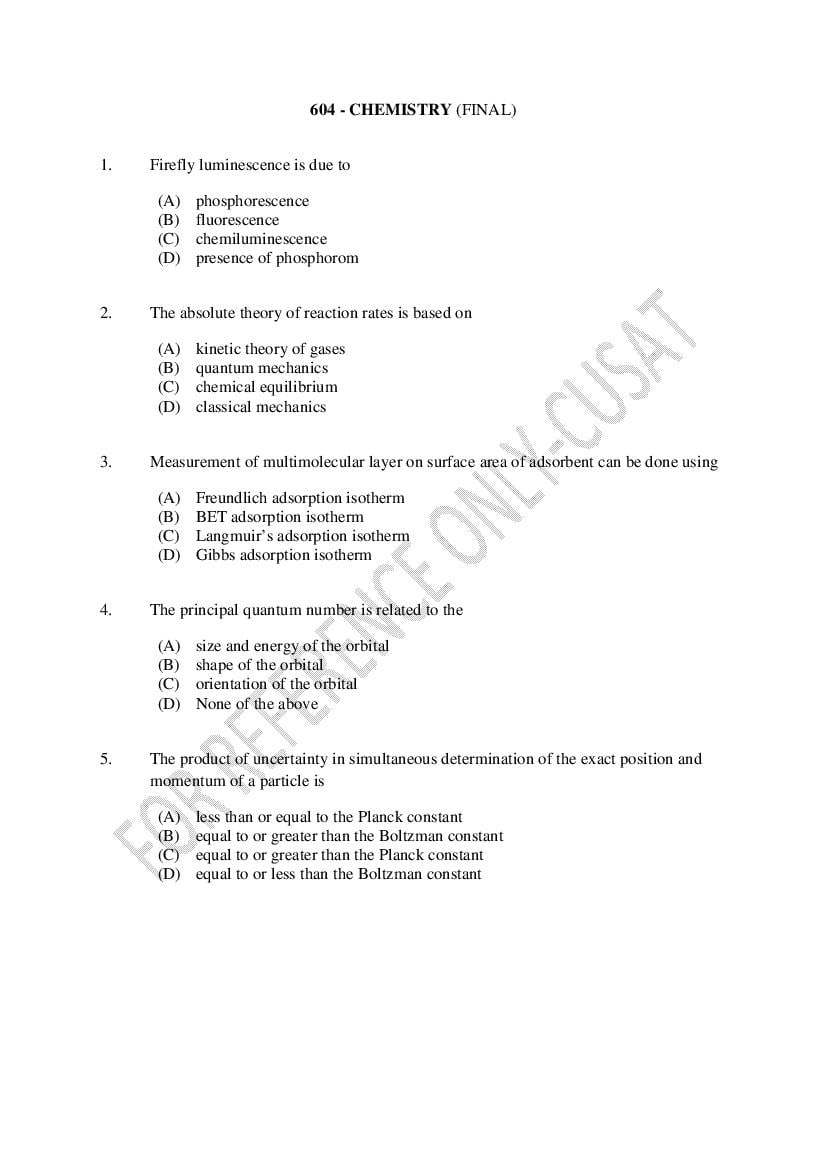
1. Firefly luminescence is due to
(A) phosphorescence
(B) fluorescence
(C) chemiluminescence
(D) presence of phosphorom
2. The absolute theory of reaction rates is based on
(A) kinetic theory of gases
(B) quantum mechanics
(C) chemical equilibrium
(D) classical mechanics
3. Measurement of multimolecular layer on surface area of adsorbent can be done using
(A) Freundlich adsorption isotherm
(B) BET adsorption isotherm
(C) Langmuir’s adsorption isotherm
(D) Gibbs adsorption isotherm
4. The principal quantum number is related to the
(A) size and energy of the orbital
(B) shape of the orbital
(C) orientation of the orbital
(D) None of the above
5. The product of uncertainty in simultaneous determination of the exact position and
momentum of a particle is
(A) less than or equal to the Planck constant
(B) equal to or greater than the Boltzman constant
(C) equal to or greater than the Planck constant
(D) equal to or less than the Boltzman constant
Page 2
(A) It minimizes liquid junction potential
(B) It eliminates liquid junction potential
(C) It can be determined experimentally
(D) It depends on the ionic mobility of cation and anion
–1 –5 –1
7. The conductivity of 0.001028 mol L acetic acid is 4.95 × 10 S cm . Calculate its
2 –1
dissociation constant if ⋀° for acetic acid is 390.5 S cm mol .
(A) 2.78 × 10⁻⁵ mol L–1
(B) 1.78 × 10⁻⁵ mol L–1
(C) 3.78 × 10⁻⁷ mol L–1
(D) 1.78 × 10⁻³ mol L–1
8. For an aqueous solution at 25°C Debye-Huckel limiting law is given by
(A) log γ ± = 0.509 Z + Z − µ
(B) log γ ± = 0.509 Z + Z − µ
(C) log γ ± = −0.509 Z + Z − µ
(D) log γ ± = −0.509 Z + Z − µ 2
9. Find the pH of a buffer solution containing 0.20 mole per litre CH3COONa and
0.02 mole per litre CH3COOH, pKa of acetic acid is 4.76.
(A) 5.76
(B) 4.76
(C) 7.0036
(D) 9.0056
10. A crystal has lattice parameter a ≠ b ≠ c and ≠ ≠ ≠ 90°, the crystal system is
(A) triclinic
(B) orthorhombic
(C) cubic
(D) tetragonal
Page 3
(A) NaCl
(B) AgCl
(C) AgBr
(D) FeS
12. The magnetic moments of the domains in the substance are aligned in parallel and
anti-parallel directions in unequal numbers is called
(A) ferromagnetism
(B) antiferromagnetism
(C) diamagnetism
(D) ferrimagnetism
13. Crystal A diffracts from (1 1 1) and (2 0 0) planes but not from (1 1 0) plane, while
crystal B diffracts from (1 1 0) and (2 0 0) planes but not from (1 1 1) plane. From the
above we may conclude that
(A) A has FCC lattice, while B has BCC lattice
(B) A has BCC lattice, while B has FCC lattice
(C) A and B both has FCC lattice
(D) A and B both has BCC lattice
14. Calculate the Miller indices of crystal plane which cut
through the crystal axes at (2a, 3b, c).
(A) (1 1 1)
(B) (1 0 0)
(C) (3 2 6)
(D) (2 0 0)
15. Point group of water molecule is
(A) C2h
(B) C3V
(C) C2V
(D) D2h
Page 4
of rate of reaction by a catalyst?
(A) Increase in activation energy
(B) Decrease in Arrhenius factor
(C) Increase of free energy
(D) Lowering of activation energy
17. Zeolites are made up of
(A) Zinc and Aluminum
(B) Zirconium and Ammonium
(C) Silicon and Aluminium
(D) Zinc and Ammonium
18. For a reaction the plot of [A] against time is linear with negative slope.
The order of the reaction is
(A) Zero
(B) First
(C) Second
(D) Third
19. Half-life for a second order reaction is
[ A]0
(A)
2k
0.693
(B)
k
1
(C)
k[ A]0
k
(D)
0.693
Page 5
half-life of this reaction is 400 second, when the initial pressure is 250 torr.
What will be the rate constant and half-life respectively, if the initial pressure
of acetaldehyde is 200 torr at the same temperature?
5
(A) 10 , 500
(B) 10−5, 400
(C) 10−5, 500
(D) 10−4, 400
21. A certain reaction proceeds in a sequence of three elementary steps, with the rate
1
k 2
constants k1, k2 and k4. If the rate constant is expressed as, kobs = k2 1 . The
k
4
activation energy of the reaction is
1 E1
(A) + E2
2 E4
E1 + E4
(B)
2
E1 − E4
(C)
2
1
(D) E2 + ( E − E4 )
2 1
22. The total number of atoms per unit cell in bcc is
(A) 1
(B) 2
(C) 3
(D) 4
+ −
23. Arrange O2, O2 , and O2 in the increasing order of stability.
(A) O2+ < O2 < O2−
(B) O2+ < O2− < O2
(C) O2 < O2+ < O2−
(D) O2− < O2 < O2+
Page 6
(A) 0
(B) 1
(C) 2
(D) 3
25. The ground state energy of a particle confined to one dimensional box of length a is
(A) 0
h2
(B)
8ma 2
(C) BJ ( J + 1)
1
(D) hν
2
26. Which of the radiations is employed in NMR spectroscopy?
(A) Radio frequency
(B) Microwave
(C) X-rays
(D) Gamma rays
27. In Raman spectroscopy ……………….. radiation is analysed.
(A) scattered
(B) transmitted
(C) reflected
(D) emitted
28. Cathodic process during corrosion of iron in alkaline medium is
(A) hydrogen ion reduction
(B) O2 reduction
(C) oxidation of Fe
(D) reduction of Fe3+
Page 7
29. In the titration of Fe against dichromate in acid medium using diphenylamine
indicator orthophosphic acid is added to
(A) maintain constant pH
(B) adjust the redox potential near the indicator potential
(C) catalyse the reaction
(D) act as promoter
30. Which of the following point groups does NOT have inversion center?
(A) Td
(B) C2h
(C) D3d
(D) D4h
31. EPR spectrum of CH3 (radical) is split into ……………….. lines.
(A) 2
(B) 3
(C) 4
(D) 7
32. ……………….. is an example of shape selective catalyst.
(A) ZSM-5
(B) Alumina
(C) Silica
(D) Carbon nanotube
33. Schrodinger wave equation for He atom does not have exact solution because of
(A) inert nature
(B) e-e repulsion
(C) completely filled valence orbital
(D) two protons in the nucleus
+
34. The geometry around ClF4 is
(A) square planar
(B) square pyramidal
(C) see-saw
(D) pyramidal
Page 8
35. On the basis of LCAO-MO theory, the magnetic charecterestics of N2 and N2 are
(A) both diamagnetic
(B) both paramagnetic
(C) N2 diamagnetic and N2+ paramagnetic
(D) N2 paramagnetic and N2+ diamagnetic
36. The correct classification of B5H9, B5H11 and B5H7 respectively is
(A) closo, arachno, nido
(B) nido, closo, arachno
(C) arachno, nido, closo
(D) nido, arachno, closo
37. A well known naturally occurring organometallic compound is
(A) vitamin B12 coenzyme
(B) chlorophyll
(C) cytochrome P-450
(D) myoglobin
38. The number of metal-metal bonds present in Ir4(CO)12 are
(A) 4
(B) 6
(C) 5
(D) 8
39. The complexes [Co(NH3)4(H2O)Cl]Br2 and [Co(NH3)4Br2]Cl.H2O are examples of
(A) ionization isomerism
(B) linkage isomerism
(C) geometrical isomerism
(D) optical isomerism
40. The complex with spin-only magnetic moment of ≈ 4.9 BM is
(A) Fe(H2O)6]2+
(B) [Fe(CN)6]3−
(C) [Fe(CN)6]4−
(D) Fe(H2O)6]3+
Page 9
(A) one
(B) two
(C) three
(D) four
42. The order of acidity of boron trihalide is
(A) BF3 ˃ BCl3 ˃ BBr3
(B) BBr3 ˃ BCl3 ˃ BF3
(C) BF3 ˃ BBr3 ˃ BCl3
(D) BBr3 ˃ BF3 ˃ BCl3
43. The first ionization potential of Mg, Al, P, and S follows the order
(A) Mg < Al < P < S
(B) Al < Mg < P < S
(C) Al < Mg < S < P
(D) Mg < Al < S < P
44. On hydrolysis, aluminium carbide produces
(A) CH4
(B) C2H6
(C) C2H4
(D) C2H2
45. In atomic absorption spectroscopy, the atomization process utilizes
(A) flame
(B) electric field
(C) magnetic field
(D) electron beam
46. The highest occupied molecular orbital of HF is
(A) bonding
(B) anti-bonding
(C) ionic
(D) non-bonding
Page 10
(A) dXY
2 2
(B) d X − Y
(C) dZ2
(D) dYZ
48. The CORRECT order of melting points of group 15 trifluorides is
(A) PF3 < AsF3 < SbF3 < BiF3
(B) BiF3 < SbF3 < PF3 < AsF3
(C) PF3 < SbF3 < AsF3 < BiF3
(D) BiF3 < AsF3 < SbF3 < PF3
49. With respect to periodic properties, the CORRECT statement is
(A) Electron affinity order is F > O > Cl
(B) First ionisation energy order is Al > Mg > K
(C) Atomic radius order is N > P >As
(D) Ionic radius order is K+ > Ca2+ > Mg2+
50. The CORRECT order of ∆o (the octahedral crystal field splitting of d orbitals) values
for the following anionic metal complexes is
(A) [Ir(CN)6]3− < [Rh(CN)6]3− < [RhI6]3− < [CoI6]3−
(B) [CoI6]3− < [RhI6]3− < [Rh(CN)6]3− < [Ir(CN)6]3−
(C) [CoI6]3− < [Rh(CN)6]3− < [RhI6]3− < [Ir(CN)6]3−
(D) [Ir(CN)6]3− < [CoI6]3− < [Rh(CN)6]3− < [RhI6]3−
14 14
51. The decay modes of C and O are
(A) β decay
(B) positron emission
(C) β decay and positron emission, respectively
(D) positron emission and β decay, respectively
Page 11
hemocyanin and vitamin B12, respectively, is
(A) iron, iron and zinc
(B) molybdenum, iron and copper
(C) iron, copper and cobalt
(D) molybdenum, copper and cobalt
53. Among the following compounds, the one having the lowest boiling point is
(A) SnCl4
(B) GeCl4
(C) SiCl4
(D) CCl4
54. Number of vertices in an icosahedral closo-borane is
(A) 10
(B) 8
(C) 24
(D) 12
55. Among the following complex ion that would show strong Jahn-Teller distortion is
(A) [Cr(H2O)6]2+
(B) [Co(H2O)6]2+
(C) [Ti(H2O)6]3+
(D) [Fe(H2O)6]2+
2+ 2+ 2+
56. The enthalpies of hydration of Ca , Mn and Zn
(A) Mn2+ > Ca2+ > Zn2+
(B) Zn2+ > Ca2+ > Mn2+
(C) Mn2+ > Zn2+ > Ca2+
(D) Zn2+ > Mn2+ > Ca2+
Page 12
(A) 2
(B) 6
(C) 5
(D) 3
+
58. The bond order in Be2 , molecule can be expected to be
(A) 0
(B) 1
(C) 2
(D) 3
59. Which one of the following is a monobasic acid?
(A) H4P2O7
(B) H3PO4
(C) H3PO3
(D) H3PO2
60. Which one of the following has the largest energy band gap?
(A) Germanium
(B) Silicon
(C) Tellurium
(D) Diamond
−
61. The number of possible isomers for the octahedral complex in [Co(en)Cl2Br2] is
(A) 2
(B) 4
(C) 6
(D) 8
62. The complex which obeys the 18-electron rule
(A) Fe(CO)4
(B) Ni(CO)3(PPh3)
(C) Cr(CO)5
(D) Cr(C5H5)2
Page 13
63. As a ligand Cl is
(A) only a sigma donor
(B) only a pi donor
(C) both a sigma donor and a pi donor
(D) a sigma donor and a sigma acceptor
64. Which of the following molecule have non zero dipole moment?
(A) NF3
(B) BF3
(C) CO2
(D) BeF2
65. An example of a molecule with three-center two-electron band is
(A) XeF2
(B) B2H6
(C) ICl2
(D) BF4
66. Which is the strongest acid?
(A) HClO4
(B) HClO3
(C) HClO2
(D) HClO
67. 1,2-Dimethylcyclopropane (1) exhibits
H3C CH3
1
(A) optical isomerism only
(B) geometrical isomerism only
(C) neither optical nor geometrical isomerism
(D) both optical and geometrical isomerism
Page 14
H
H CH 3
H
C H3 H
(A) (E)-hex-4-en-1-yne
(B) (E)-hex-2-en-5-yne
(C) (Z)-hex-4-en-1-yne
(D) (Z)-hex-2-en-5-yne
69. The following conformational energy diagram is most likely for
(A) propane
(B) ethane
(C) cyclohexane
(D) n-butane
70. The following bond cleavage represented by a double headed arrow indicates
(A) homolytic cleavage with X leaving as a radical
(B) heterolytic cleavage with X leaving without the electron pair
(C) heterolytic cleavage with departure of X with a pair of electrons
(D) homolytic cleavage with X leaving as a radical anion
Page 15
the following Lewis structure with charges, if any, positioned appropriately. Formal
charges on nitrogen and oxygen in (X) are
(X)
(A) +1 on oxygen and zero on nitrogen
(B) +1 on oxygen and -1 on nitrogen
(C) since the compound is nonpolar, zero on both nitrogen and oxygen
(D) +1 on nitrogen and -1 on oxygen
72. Pick the correct statement on the geometry of reactive intermediates such as
carbocations, carbanions and carbon centered radicals
(A) all carbocations and carbon centered radicals are planar
(B) all carbanions and carbon centered radicals are planar
(C) all carbanions and carbon centered radicals are pyramidal
(D) all carbocations, resonance stabilized carbanions and resonance stabilized
carbon centered radicals are planar
73. Which among the following is NOT a typical reaction of carbocations having at least
one β-hydrogen?
(A) Elimination of a proton to give an olefin
(B) Addition to a double bond to give another carbocation
(C) Rearrangement to give another carbocation intermediate
(D) Insertion to double bonds to give cyclopropanes
74. Reaction of propane with bromine in the presence of light gives a mixture of
2-bromopropane (97%) and 1-bromopropane (3%). Based on this result,
estimate the relative reactivity of methylene (CH2) and methyl (CH3)
hydrogen towards free radical substitution by Br.
(A) 97:3
(B) 97:1
(C) 97:6
(D) 97:9
Page 16
according to Baeyer’s strain theory, which among the following cycloalkanes should
exhibit the lowest heat of combustion per CH2?
(A) Cyclopropane
(B) Cyclobutane
(C) Cyclopentane
(D) Cyclohexane
76. Which among the following compound/compounds has/have Z-configuration?
I II III IV
(A) I only
(B) I and IV
(C) II and III
(D) None of the above
77. Pick the statement that is NOT true for the eight D-aldohexoses (D-allose, D-altrose,
D-glucose, D-mannose, D-gulose, D-iodose, D-galactose and D-talose).
(A) All of them give a 5:1 mixture of formic acid and formaldehyde on oxidation
with periodic acid
(B) C-5 carbon in all the eight of them has R-configuration
(C) In solution, all of them exist as an equilibrium mixture of α and β-anomers
(D) On reaction with phenylhydrazine, the eight aldohexoses give eight isomeric
osazones
Page 17
(A)
(B)
(C)
(D)
79. Major Saytzeff’s E2 elimination product of (S)-2-bromobutane (X) is
(A)
(B)
(C)
(D) a 1:1 mixture of E and Z-isomers of but-2-ene
80. Suggest suitable reagents to bring about the following transformation.
(A) Alkaline KMnO4
(B) O3 followed by dimethyl sulfide
(C) Dilute sulfuric acid in the presence of mercuric sulfate
(D) Periodic acid
Page 18
the presence of mercuric sulfate. Hydration products of all terminal alkynes sharing
the molecular formula CnH2n – 2 will
(A) reduce Fehling solution
(B) restore the color of Schiff’s reagent
(C) undergo ozonolysis to give formaldehyde as one of the major products
(D) give an yellow precipitate on treatment with iodine in the presence of base
82. Pick the correct statement.
(A) Nature of leaving group is equally important in controlling both SN1
SN and SN2
reaction rates
(B) Nature of nucleophile is equally important in controlling both SN1 and SN2
reaction rates
(C) Nature of leaving group is more important in controlling SN2 reaction rates
while nature of nucleophile is more important in controlling SN1 reaction rates
(D) Good leaving groups accelerate SN2 reaction rates while SN1 reaction rates
are not affected by the nature of the leaving group
83. Which among the following compounds has the lowest pK
p a?
(A)
(B)
(C)
(D)
Page 19
(A)
(B)
(C)
(D)
85. In aromatic electrophilic substitution reactions proceeding via the arenium ion
intermediates (assuming kinetic control)
(A) all +I and +M groups are ortho-para orienting and activating
(B) all +I and +M are ortho-para orienting and deactivating
(C) all +I groups are ortho-para orienting and activating while +M groups, though
ortho-para orienting can be either activating or deactivating groups
(D) all +M groups are ortho-para orienting and activating while some + I groups,
though ortho-para orienting can be either activating or deactivating groups
86. A colorless liquid, boiling at 80 °C tested negative for halogens, nitrogen and sulphur.
It gave a yellow precipitate with Borche’s reagent, but a negative test with Tollen’s
reagent. It also gave a positive iodoform test. The compound was refluxed with a 1:1
mixture of concentrated nitric acid and sulfuric acid and the reaction mixture on
pouring into ice cold water remained colorless. The compound, most probably is
(A) an aliphatic methylketone
(B) an aromatic methyl ketone
(C) a cyclic ketone
(D) an ester
Page 20
nitrogen and sulfur. It gave a negative test with both aqueous and alcoholic silver
nitrate solutions and gave a single mononitration product. Which among the
following is the most likely structure for this compound?
(A)
(B)
(C)
(D)
88. Borche’s reagent is prepared by
(A) dissolving boric acid in dilute sulfuric acid
(B) dissolving disodium hydrogen phosphate in a 1:1 mixture of water and ethanol
(C) dissolving 2,4-dintropehenylhydrazine in methanol containing a small amount
of concentrated sulfuric acid
(D) dissolving silver nitrate in 95% ethanol
89. Which among the following saccharides will give a bright red
precipitate with Fehling solution?
(A) All monosaccharaides
(B) All disaccharides
(C) All mono and polysaccharides
(D) Polysaccharides only
90. Which among the following is NOT a suitable method for the preparation of
benzylamine (C6H5CH2NH2)?
(A) Reaction of ammonium formate with benzaldehyde at temperature
above 100 °C
(B) Hoffmann bromamide reaction of benzamide
(C) Gabriel phthalimide synthesis starting from benzyl chloride
(D) Reduction of benzonitrile using lithium aluminum hydride
Page 21
chloroform in the presence of sodium hydroxide is
(A)
(B)
(C)
(D)
92. Reaction of benzene diazonium chloride with β-naphthol to give the corresponding
azo dye is an example for
(A) aromatic nucleophilic substitution proceeding through bimolecular
displacement mechanism
(B) SN1 substitution on an aromatic ring
(C) aromatic nucleophilic substitution proceeding through benzyne intermediate
(D) aromatic electrophilic substitution reaction
93. In qualitative analysis, Schotten-Baumann
Schotten Baumann reaction is employed for preparing
crystalline derivatives for
(A) aromatic tertiary amines
(B) polycyclic aromatic hydrocarbons
(C) primary and secondary aromatic amines
(D) tertiary alcohols and phenols
94. Arndt-Eisert
Eisert homologation reaction is particularly useful for the synthesis of
(A) 1,2-dicarboxylic
lic acids from carboxylic acids
(B) β-aminoacids
aminoacids from α-aminoacids
(C) mixed anhydrides from a binary mixture of carboxylic acids
(D) 1,3-dicarbonyl compounds from carbonyl compounds
Page 22
the preparation of thiophene?
(A) Paal-Knorr synthesis
(B) Hantzsch synthesis
(C) Skraup synthesis
(D) Friedländer synthesis
96. [3,3] Sigmatropic shift is NOT involved in
(A) Claisen rearrangement
(B) Fries rearrangement
(C) Fischer indole synthesis
(D) Cope rearrangement
97. Pick the statement that is correct for the following molecule.
(A) It gives a brown precipitate on boiling with Benedict’s reagent
(B) It is hydrolysed with dilute HCl to give a 1:1 mixture of glucose and sucrose
(C) It is a reagent for the spot test for group III cations
(D) It is an artificial sweetener
98. Which among the following is an ω-3 fatty acid?
(A)
(B)
(C)
(D)
Page 23
−1
at δ 10.24 and 9.31 ppm. In its IR spectrum, a strong peak is observed at 1730 cm
and it restored the color of Schiff’s reagent. Which among the following structures
agrees best with these data?
(A)
(B)
(C)
(D)
100. Predict the major product formed in the following reaction.
(A)
(B)
(C)
(D)
Page 24
substitution due to
1 2
(A) inductive effects
(B) π-conjugation
(C) hyperconjugation
(D) steric factors
102. Pick the correct statement.
(A) Both carbocations and carbanions are electrophilic in nature
(B) Both carbocations and carbanions are nucleophilc in nature
(C) Carbocations are electrophilic while carbanions are nucleophilic in nature
(D) Carbocations are nucleophilic while carbanions are electrophilic in nature
103. Selective halogenation of isopentane (2-methylbutane, C5H12) at the 2-positin is most
effective (that is, high yield with minimal side products) with
(A) fluorine
(B) chlorine
(C) bromine
(D) iodine
104. Hydrocarbons are chlorinated using chlorine gas in the presence of light. From
experimentation, it has been determined that the relative rates of chlorination to
primary (CH3), secondary (CH2), and tertiary (CH) positions in hydrocarbons are
1, 3.8, and 5 respectively. Based on this, predict the major monochlorination
product generated from 2-ethypentane (X) in the following reaction.
X I II III
(A) I
(B) II
(C) III
(D) All the three products are formed in approximately equal (±2%) amounts
Page 25
with Br2.
(I) (II) (III) (IV)
(A) both (I) and (II) will give meso-2,3-dibromobutane (III)
(B) both (I) and (II) will give the d,l-pair of 2,3-dibromobutane (IV)
(C) (I) will give meso-2,3-dibromobutane (III) while (II) will give the d,l-pair (IV)
(D) (II) will give meso-2,3-dibromobutane (III) while (I) will give the d,l-pair (IV)
106. Pick the statement that is true for SN1 substitution reactions on a chiral carbon.
(A) proceeds with retention of configuration
(B) proceeds with racemization
(C) proceeds with inversion of configuration
(D) stereochemical outcome depends on the amount of nucleophile used in the
reaction
107. Which among the following reactions is NOT suitable for the preparation of a
primary alcohol?
(A) Reaction of isopropylmagnesium bromide with oxirane
(B) Reaction of propylmagnesium bromide with 2,2-dimethyloxirane
(C) Reaction of isopropylmagnesium bromide with formaldehyde
(D) Reaction of propylmagnesium bromide with formaldehyde
108. Which among the following compounds can be converted to benzene in one step?
(A) Nitrobenzene
(B) Toluene
(C) Benzaldehyde
(D) Phenol
109. Which among the following is NOT a pericyclic reaction?
(A) Dieckmann cyclizatoin
(B) Elctrocyclic ring closure
(C) Sigmatropic rearrangements
(D) Cycloaddition
Page 26
complex with 2,4,6-trinitrophenol?
(A)
(B)
(C)
(D)
111. An unknown compound burned with a sooty flame. When reacted with NaNO2 and
concentrated H2SO4 it gave a deep blue color which changed to red on dilution with
water. The original blue color was regenerated by treatment with potassium hydroxide
solution. The unknown compound most probably is
(A) an aromatic primary amine
(B) a phenol
(C) an aromatic nitro compound
(D) an aliphatic dicarboxylic acid
112. Reaction of diazomethane with acetic acid will give
(A) methyl acetate
(B) methyl diazoacetate
(C) propionic acid
(D) ethanol
113. Ethyl acetoacetate is prepared by
(A) condensation of acetaldehyde with ethyl acetate
(B) acylation of ethyl acetate using acetyl chloride in the presence of anhydrous
aluminum chloride
(C) reaction of ethyl acetate with sodium ethoxide in ethanol
(D) treatment of diethyl malonate with methyl magnesium bromide under
controlled conditions
Page 27
organic polymer are
(A) β(1→4)linked glucose units
(B) α(1→4) linked glucose units
(C) aminoacids linked through peptide linkages
(D) nucleosides connected through phosphate linkages
115. Which among the following is a triphenylmethane dye?
(A) methyl orange
(B) fluorescein
(C) rosaniline
(D) alizarin
116. N,N '-Dicyclohexylcarbodiimide (DCC) finds application in peptide chemistry
as a reagent for
(A) N-terminal analysis
(B) C-terminal analysis
(C) C-activation in peptide synthesis
(D) N-protection in peptide synthesis
117. The process by which mRNA directs protein synthesis with
the assistance of tRNA is called
(A) translation
(B) transcription
(C) reverse transcription
(D) replication
118. The number of IR active vibrational normal modes of CO2 is
(A) 2
(B) 3
(C) 4
(D) 6
Page 28
NO, O2, B2, and C2 in their ground state is
(A) NO, B2, and C2 are paramagnetic
(B) B2, O2 and NO are paramagnetic
(C) O2, C2 and NO are paramagnetic
(D) O2, B2 and C2 are paramagnetic
120. In the structure of P4O10, the number of P-O-P bond(s) is
(A) 4
(B) 6
(C) 7
(D) 8
121. The number of S-S bond in H2S5O6 is
(A) 2
(B) 5
(C) 4
(D) 3
122. The complex with inverse spinel structure is
(A) Co3O4
(B) MgAlO4
(C) Fe3O4
(D) Mn3O4
2+
123. The ground state term of [Ni(H2O)6] is
3
(A) T1g
3
(B) A2g
3
(C) T2g
4
(D) T1g
Page 29
(A) HC(CH2CH2NH2)3
(B) CH3NHCH2CH2CH3
(C) N(CH2CH2NH2)3
(D) H2NCH2CH2CH2NH2
125. An examples of nido-borane from the following is
(A) B4H10
(B) B6H10
(C) B6H12
(D) B8H14
2−
126. The geometries of Ni(CO)4 and [NiCl4] respectively are
(A) tetrahedral and square planer
(B) square planer and tetrahedral
(C) tetrahedral and tetrahedral
(D) square planer and square planer
127. The heteronuclear diatomic molecule that is isoelectronic to HCN is
(A) NO
(B) CO
(C) BO
(D) SO
128. Which one of the following free ions has the lowest magnetic moment?
(A) Ce3+
(B) Nd3+
(C) Sm3+
(D) Gd3+
Page 30
129. The crystal field stabilization energy and the spin only magnetic moment of [CoF6]
are respectively
(A) 0.4∆o and 4.9 BM
(B) 0.8∆o and 3.8 BM
(C) 1.8∆o and 1.7 BM
(D) 2.4∆o and 0 BM
130. Which of the following has maximum number of lone pairs associated with Xe?
(A) XeF2
(B) XeO3
(C) XeF4
(D) XeF6
131. An element with atomic number 88 belongs to
(A) Group 12
(B) Group 2
(C) Group 8
(D) Group 10
132. The number of precipitable halide ions in [Pt(NH3)Cl2Br]Cl is
(A) 2
(B) 3
(C) 4
(D) 1
133. Which of the following is amphoteric oxide?
(A) CO
(B) N2O
(C) Al2O3
(D) P4O10
Page 31
(A) PH3
(B) H2S
(C) HI
(D) KH
d
135. Which of the following is an Eigen function of ?
dx
(A) sin kx
(B) cos kx
(C) eikx
(D) log x
136. Which of the following molecules is microwave active?
(A) CO2
(B) CH4
(C) C6H6
(D) COS
137. The absorbance of a solution is 1.0. What percent of radiation is
absorbed by the sample?
(A) 100%
(B) 90%
(C) 50%
(D) 10%
138. Which of the following nuclei are NMR INACTIVE?
(A) 2
H
(B) 17
O
(C) 23
Na
(D) 12 C
Page 32
(A) σ
(B) E
(C) C32
(D) i
140. Cv for CO2 using equipartition principle is
13
(A) R
2
7
(B) R
2
5
(C) R
2
3
(D) R
2
141. Arrange translational, rotational, vibrational and electronic partition functions in the
increasing order of magnitudes.
(A) qTra < qRot < qVib < qEl
(B) qTra > qRot > qVib > qEl
(C) qTra > qVib > qRot > qEl
(D) qTra > qEl > qVib > qRot
142. Which of the following statements is NOT true for Boltzman exponential law?
(A) Maximum population of molecules is always in the ground state
(B) As temperature increases population in the higher energy levels increases
(C) As energy increases population increases
(D) Intensity of spectral lines can be understood
143. Which among the following has maximum magnitude?
(A) RMS velocity
(B) Mean velocity
(C) Most probable velocity
(D) Average value of the component of velocity in one direction
Page 33
(A) Viscosity of liquids and gases decreases with temperature
(B) Viscosity of gases and liquids increases with temperature
(C) Viscosity of gases increases with temperature
(D) Viscosity of liquids increases with temperature
145. When 800 mA of current is passed through an aqueous solution of
CuSO4 for 20 minutes
(A) 31.5 mg of Cu is deposited at cathode
(B) 63.5 mg of Cu is deposited at cathode
(C) 800 mg of Cu is deposited at cathode
(D) 400 mg of Cu is deposited at cathode
146. The efficiency of an ideal Carnot engine is
(A) 100%
(B) less than 100%
(C) greater than 100%
(D) 50%
147. Chemical potential is defined as
∂A
(A)
∂ni P,T ,nj
∂G
(B)
∂ni V ,T ,nj
∂A
(C)
∂ni V ,T ,nj
∂u
(D)
∂ni P,T ,nj
148. A surface catalysed unimolecular gas phase reaction follows
(A) first order kinetics at all pressure
(B) zero order kinetics at all pressure
(C) first order kinetics at low pressure and zero order kinetics at higher pressure
(D) zero order kinetics at low pressure and first order kinetics at high pressure
Page 34
(A) Electrophoresis
(B) Electro osmosis
(C) Streaming potential
(D) Donnan membrane equilibrium
150. Which of the following is related to over voltage?
(A) Nernst equation
(B) Tafel equation
(C) Debye-Huckel onsager equation
(D) Faradays laws
Page 35
Subject Name: 604 CHEMISTRY
SI No. Key SI No. Key SI No. Key SI No. Key SI No. Key
1 C 31 C 61 B 91 C 121 C
2 B 32 A 62 B 92 D 122 C
3 B 33 B 63 C 93 C 123 B
4 A 34 C 64 A 94 B 124 B
5 C 35 C 65 B 95 A 125 B
6 B 36 D 66 A 96 B 126 C
7 B 37 A 67 D 97 D 127 B
8 C 38 B 68 A 98 C 128 C
9 A 39 A 69 D 99 C 129 B
10 A 40 A 70 C 100 D 130 A
11 C 41 B 71 D 101 C 131 B
12 D 42 B 72 D 102 C 132 D
13 A 43 C 73 D 103 C 133 C
14 C 44 A 74 B 104 B 134 D
15 C 45 A 75 C 105 C 135 C
16 D 46 A 76 A 106 B 136 D
17 C 47 B 77 D 107 B 137 B
18 A 48 A 78 D 108 D 138 D
19 C 49 D 79 C 109 A 139 A
20 C 50 B 80 B 110 A 140 A
21 D 51 C 81 D 111 B 141 B
22 B 52 C 82 A 112 A 142 C
23 D 53 C 83 B 113 C 143 A
24 A 54 D 84 A 114 A 144 C
25 B 55 A 85 C 115 C 145 A
26 A 56 D 86 A 116 C 146 B
27 A 57 B 87 B 117 A 147 C
28 B 58 A 88 C 118 B 148 C
29 B 59 D 89 A 119 B 149 D
30 A 60 D 90 B 120 B 150 B
Document Details
| Board / Org | Cochin University |
| Exam | CUSAT Common Admission Test |
| Type | Question Paper |
| Pages | 35 |
| Updated | 09 Jun 2026 |