CUSAT CAT 2022 Question Paper Fisheries
Finished viewing? Save it for later —
Download CUSAT CAT 2022 Question Paper Fisheries (PDF · 27 pages)About CUSAT CAT 2022 Question Paper Fisheries
CUSAT CAT 2022 Question Paper Fisheries is available here for free download. Published by Cochin University for CUSAT Common Admission Test, this question paper can be viewed online or downloaded as a PDF (27 pages). Candidates preparing for CUSAT Common Admission Test can use CUSAT CAT 2022 Question Paper Fisheries to understand the exam pattern, the type of questions asked, and the overall difficulty level.
Frequently Asked Questions
How can I download CUSAT CAT 2022 Question Paper Fisheries?
Open this page and click the Download button to save CUSAT CAT 2022 Question Paper Fisheries as a PDF. It is completely free on AglaSem Docs.
Is CUSAT CAT 2022 Question Paper Fisheries free to download?
Yes. CUSAT CAT 2022 Question Paper Fisheries can be viewed online and downloaded as a PDF free of cost on AglaSem Docs.
How many pages does CUSAT CAT 2022 Question Paper Fisheries have?
CUSAT CAT 2022 Question Paper Fisheries contains 27 pages, which you can read online or download together as a single PDF.
Where can I find more CUSAT Common Admission Test study material?
You can find more CUSAT Common Admission Test question papers, sample papers, syllabus, and answer keys on AglaSem Docs.
CUSAT CAT 2022 Question Paper Fisheries – Text
Read the full text of this question paper below — useful to quickly search, copy and reference the content online without downloading the PDF.
📄 View text version (27 pages)
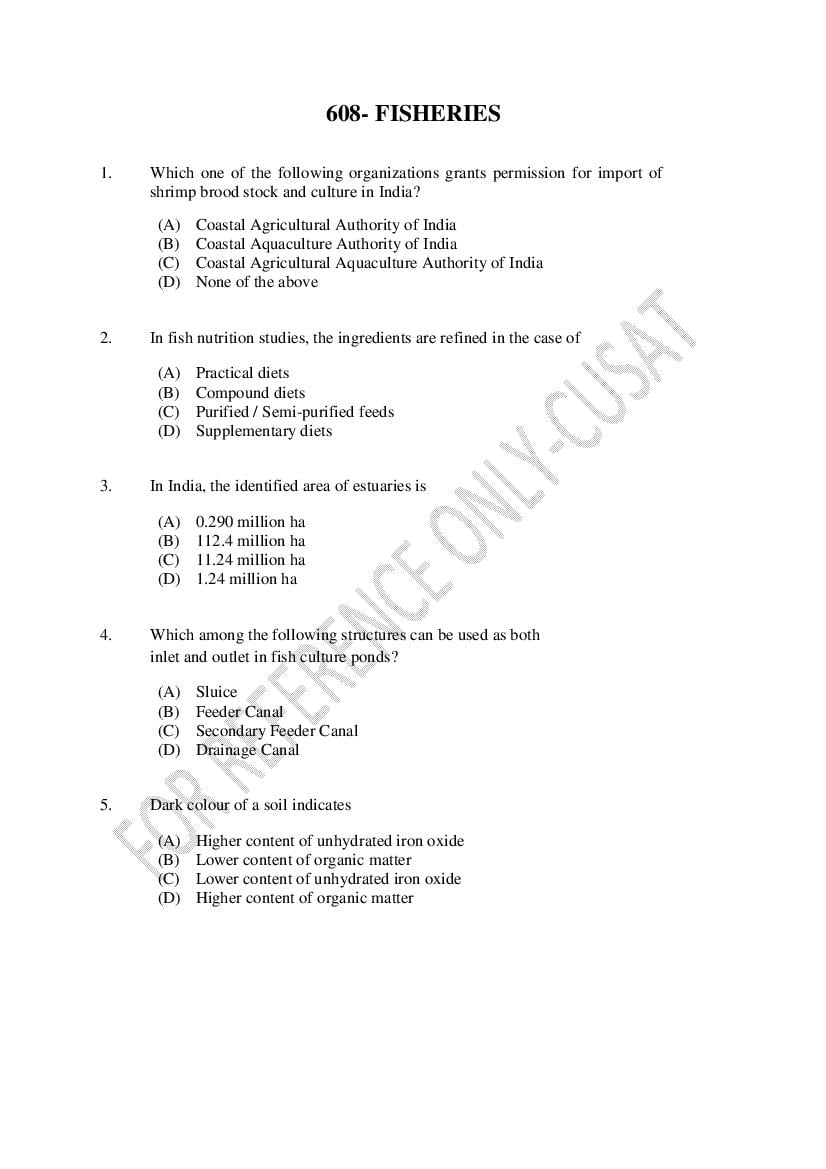
Page 1
1. Which one of the following organizations grants permission for import of
shrimp brood stock and culture in India?
(A) Coastal Agricultural Authority of India
(B) Coastal Aquaculture Authority of India
(C) Coastal Agricultural Aquaculture Authority of India
(D) None of the above
2. In fish nutrition studies, the ingredients are refined in the case of
(A) Practical diets
(B) Compound diets
(C) Purified / Semi-purified feeds
(D) Supplementary diets
3. In India, the identified area of estuaries is
(A) 0.290 million ha
(B) 112.4 million ha
(C) 11.24 million ha
(D) 1.24 million ha
4. Which among the following structures can be used as both
inlet and outlet in fish culture ponds?
(A) Sluice
(B) Feeder Canal
(C) Secondary Feeder Canal
(D) Drainage Canal
5. Dark colour of a soil indicates
(A) Higher content of unhydrated iron oxide
(B) Lower content of organic matter
(C) Lower content of unhydrated iron oxide
(D) Higher content of organic matter
Page 2
(A) Sluice
(B) Drainage Canal
(C) Feeder Canal
(D) Monk
7. In soil analysis, the qualitative tests used are
(A) Soil Triangle and Square Test
(B) Water Retention and Insitu Test
(C) Water Absorption and Institution Test
(D) None of the above
8. Compass is used for
(A) Drawing contour map boundary
(B) Drawing elevation map boundary
(C) Drawing location map boundary
(D) Drawing fish pond measurements
9. Normally, herbivorous finfishes are not fed continuously as they have
(A) Shorter Mouth
(B) Shorter Intestine
(C) Long Intestine
(D) Narrow Mouth
10. In freshwater studies, the secchi disc is made of
(A) Black and Yellow colour
(B) Black and White colour
(C) White colour alone
(D) Black and Orange colour
11. Altricial larvae seem to be incapable of processing
(A) Microalgae
(B) Formulated feeds
(C) Copepods
(D) Artemia nauplii
Page 3
(A) Phytoplankton
(B) Zooplankton
(C) Artificial food
(D) Benthic detritus
13. Blood worm is an example of
(A) Aquatic live feed
(B) Artificial feed
(C) Moist feed
(D) Non aquatic live feed
14. In Scampi, androgenic gland removal from immature males results in
(A) Neo Males
(B) Neo Females
(C) Neo Offspring
(D) None of the above
15. Primary Production is defined as synthesis of ……………… by photosynthesis.
(A) organic carbon
(B) organic nitrogen
(C) organic potassium
(D) organic phosphorus
16. Movement of cool nutrient rich benthic seawater towards sea surface is known as
(A) Turbulence
(B) Bottom current
(C) Upwelling
(D) Sea water sinking
17. The example for an autotroph is
(A) Phytoplankton
(B) Holoplankton
(C) Water Fleas
(D) Zooplankton
Page 4
(A) Carbon dioxide
(B) Sulphur dioxide
(C) Oxygen
(D) Ammonia
19. Best natural nursery location for brackish water fish and shrimp is
(A) Open sea
(B) Coastal waters
(C) Mangrove swamp
(D) Rivers
20. CIBA has introduced a three tier modular system for the culture of
(A) White Shrimp
(B) Lobster
(C) Mud Crab
(D) Pearl Spot Fish
21. Bio-encapsulation is the process involved in improving nutritional status of
(A) Compound feeds
(B) Formulated feeds
(C) Formulated Chorion feeds
(D) Live feeds
22. Which fish larvae swims against slow current?
(A) Carps
(B) Milk fish
(C) Gold fish
(D) Mullet fish
23. First successful brood stock development, induced breeding and larval production of
Silver Pompano was made during 2011 by
(A) CMFRI
(B) CIFE
(C) CIFRI
(D) RGCA
Page 5
(A) 0.56 million sq. km
(B) 0.76 million sq. km
(C) 0.60 million sq. km
(D) 2.02 million sq. km
25. Ice-Ice is a common disease encountered in
(A) Corals
(B) Seaweeds
(C) Echinoderms
(D) Seahorses
26. Generic name of sole-fish which is abundantly captured from Arabian sea is
(A) Solia
(B) Cynoglossus
(C) Pseudorhombus
(D) Psettodus
27. Cyclops is one of the most common genera of
(A) Freshwater copepods
(B) Brackishwater copepods
(C) Backwater copepods
(D) Estuary water copepods
28. ‘The Indian major Carps’ comprises / includes
(A) Catla + Rohu + Grass Carp
(B) Catla + Rohu + Mrigal
(C) Catla + Rohu + Common Carp
(D) Catla + Rohu + Silver Carp
29. Antarctic krill is a
(A) Deep water prawn
(B) Pelagic crab
(C) Euphasiid
(D) Rock lobster
Page 6
(A) Floats and sinkers
(B) Otter board
(C) Jibs
(D) Beams
31. Permanent plankton are termed as
(A) Meroplankton
(B) Holoplankton
(C) Pleuston
(D) Neuston
32. Fish are rearedo successively in 3 different ponds connected to one another and with
progressively increasing areas in a ratio of 1 : 2 : 4 or 1 : 3 : 9 is called as
(A) Progression culture system
(B) Modular culture system
(C) Straight culture system
(D) Progression and Straight culture system
33. An example for aquatic live feed is
(A) Rotifer
(B) Artemia
(C) Spirulina
(D) All the above
34. In the history of aquaculture, Concentration Theory means
(A) Concentration of shellfishes that grow and reproduce during wet season
(B) Concentration of fish that grow and reproduce during wet season
(C) Concentration of molluscans that grow and reproduce during wet season
(D) Concentration of silver pompano that grow and reproduce during wet season
35. Marine Cage Culture is a new entrant to
(A) Indonesia mariculture sector
(B) Indian mariculture sector
(C) Thailand mariculture sector
(D) Japan mariculture sector
Page 7
(A) Smallest inland fisheries resource in India
(B) Largest inland fisheries resource in India
(C) Smallest marine fisheries resource in India
(D) None of the above
37. Bhery Fields are the Traditional practice of fish farming with rice in
(A) West Bengal
(B) Kerala
(C) Gujarat
(D) Odhisha
38. 1.5 × 1.5 cm is the right mesh size to keep smaller fish and
also to let freshwater flow through in
(A) Hapa
(B) FRP tank
(C) Pen
(D) Cage
39. The scientific name of brown mussel is
(A) Trichogaster trichopterus
(B) Perna indica
(C) Betta splendens
(D) Perna viridis
40. The example for euryhalilne rotifer is
(A) Brachionus rubens
(B) Brachionus calyciflorus
(C) Brachionus plicatilis
(D) Brachionus brachionus
41. Veliger larval form is commonly noticed in
(A) Molluscs forms
(B) Finfishes forms
(C) Crustaceans
(D) Penaeus indicus
Page 8
be in proper balance with respect to
(A) Proteins
(B) Carbohydrates
(C) Vitamins and Minerals
(D) All the Above
43. Which of the following states in India has the longest coastline?
(A) Gujarat
(B) Karnataka
(C) Tamil Nadu
(D) Mizoram
44. The scientific name of giant freshwater prawn is
(A) Macrobrachium rosenbergii
(B) Macrobrachium idea
(C) Macrobrachium malcomsonii
(D) Panulirus homarus
45. The scientific name of White Legged Shrimp is
(A) Penaeus semisulcatus
(B) Penaeus indicus
(C) Penaeus merguensis
(D) Penaeus vannamei
46. The exotic carps in India comprises / includes
(A) Silver Carp + Grass Carp + Common Carp
(B) Silver Carp + Grass Carp + Catla
(C) Silver Carp + Grass Carp + Mrigal
(D) Silver Carp + Grass Carp + Rohu
47. Exclusive Economic Zone of Indian waters is
(A) 2.02 million sq. km
(B) 3.02 million sq. km
(C) 4.02 million sq. km
(D) 20.02 million sq. km
Page 9
(A) Copepode
(B) Rotifer
(C) Cladoceran
(D) Mollusc
49. Phycology is the scientific study of
(A) Algin
(B) Agar
(C) Algae
(D) None of the above
50. Embankment ponds are constructed
(A) Below the ground level
(B) Above the ground level
(C) Below and Above the ground level
(D) None of the above
51. Which among the following is a diatom?
(A) Brachionus
(B) Chlorella
(C) Skeletonema
(D) Isochrysis
52. Farming and husbandry of marine aquatic plants and animals in pollution free natural
brackishwater / marine environment or salt water is known as
(A) Mariculture
(B) Inland Aquaculture
(C) Pen culture
(D) Off Shore Farming
53. The scientific name of silver pomfret fish is
(A) Trachinotus blochii
(B) Rastraliger kanagurta
(C) Pampus argenteus
(D) Penaeus indicus
Page 10
(A) Geosmin algae
(B) Lumut algae
(C) Lab lab algae
(D) None of the above
55. Which among the following is a phytoflagellate?
(A) Brachionus
(B) Chlorella
(C) Skeletonema
(D) Isochrysis
56. Hydration, Decapsulation and Hatching are mandatory steps required for
(A) Artemia hatching
(B) Blood worm hatching
(C) White worm hatching
(D) None of the above
57. The scientific name of ‘three spotted crab’ is
(A) Lates calcarifer
(B) Etroplus suratensis
(C) Mugil cephalus
(D) Portunus sanguinolentus
58. Heteropneustes fossilis is a
(A) Ray fish
(B) Cat fish
(C) Agnatha
(D) Milk fish
59. Percentage content of edible tissue is more in
(A) Fish
(B) Chicken
(C) Pig
(D) Duck
Page 11
(A) Fish feed preparation
(B) Pond preparation
(C) Fish pond site selection
(D) None of the above
61. Natural collections of algae kept in culture vessels in laboratory is called as
(A) Maintenance culture
(B) Enrichment culture
(C) Unialgal culture
(D) Axenic culture
62. Polynemid fish are commonly known as
(A) Thread fins
(B) Dhol
(C) Bombay ducks
(D) Cat fish
63. Export sized lobsters are
(A) > 100 g
(B) 51-100 g
(C) < 25 g
(D) 26-50 g
64. The National fish of India is
(A) Indian Silver Pomfret
(B) Indian tiger shrimp
(C) Indian Silver pompano
(D) Indian Mackerel
65. The scientific name of Asian Cat fish is
(A) Labeo rohita
(B) Clarias batrachus
(C) Labeo fimbriatus
(D) Pangassius
Page 12
(A) Clarias batrachus
(B) Trachinotus blochii
(C) Epinephelus malabaricus
(D) Portunus pelagicus
67. ‘Marlin’ is a
(A) Saw fish
(B) Sail fish
(C) Sea horse
(D) Sea bream
68. The scientific name of Grass Carp is
(A) Ctenopharyngodon idella
(B) Catalacatla
(C) Cyprinus carpio
(D) Hypopthalmichys milotrix
69. In India, fishery resources are overexploited in
(A) Off shore waters
(B) Inshore waters
(C) Estuaries
(D) Back waters
70. The major operational cost involved in aquaculture systems relates to
(A) Fish Seeds
(B) Fertilizers
(C) Fish Feeds
(D) Wages
71. No energy cost is generally involved in
(A) Closed Mariculture
(B) Coastal Aquaculture
(C) Open Mariculture
(D) Integrated Mangrove Aquaculture
Page 13
two major groups. They are
(A) Agnatha and Gnathostomata
(B) Finfish and shell fish
(C) Chondtricthys and Osteoicthys
(D) Pelagic fish and deep sea fish
73. Latimeria chalumnae is
(A) Holocephali
(B) Coelacanth
(C) Dipnoi
(D) Mud skipper
74. Which one of the following fishes has an accessory respiratory organ?
(A) Rhincodon typus
(B) Dasyatis sp.
(C) Sardinella fimbriata
(D) Anabas testudens
75. Marine plankton which act as forerunners of annual regular fishery are known as
(A) Zooplankton
(B) Phytoplankton
(C) Indicator species
(D) Picoplankton
76. The fish that form a major composition in the fishery around Minicoy seas is
(A) Tuna
(B) Sardines
(C) Sharks
(D) Mackerel
77. Which among the following is a rich source of vitamin A?
(A) Fish muscle
(B) Cod liver oil
(C) Shark skin
(D) Air bladder of fish
Page 14
(A) Scampi
(B) Lobster
(C) King crab
(D) None of the above
79. Hard substratum is essential for settlement of
(A) Asteroid larvae
(B) Bivalve mollusc spats
(C) Lobster seed
(D) Shrimp seed
80. One of the following bivalve molluscs is listed under CITES
(A) Green mussel
(B) Edible oyster
(C) Giant clam
(D) Pearl oyster
81. Major nitrogenous metabolite in the excretion of fish is
(A) Urea
(B) Ammonia
(C) Uric acid
(D) Sodium
82. Monosex culture is commonly practiced for culturing
(A) Tilapia
(B) Catla
(C) Clarias
(D) Channa
83. The common name of Lates calcarifer is
(A) Sea bass
(B) Milk fish
(C) Ribbon fish
(D) None of the above
Page 15
(A) Lizard fish
(B) Lung fish
(C) Cuttle fish
(D) Eels
85. Control of undesirable biota by means of other biota is known as
(A) Biotic control
(B) Pathogenic control
(C) Serological control
(D) Biological control
86. Organisms having both male and female reproductive organs are
(A) Bisexual animals
(B) Diploid animals
(C) Hermaphrodite animals
(D) Androgenic animals
87. Smoked Tuna prepared at Minicoy is called as
(A) Fish pickle
(B) Masmin
(C) Fish soup powder
(D) Surumi
88. In the marine environment, the time interval between two successive highwaters is
(A) High water period
(B) High tide period
(C) Low tide period
(D) Tidal period
89. Process of directing a fishing vessel/boat from one place to another
in a safe way is called as
(A) Seamanship
(B) Position fixing
(C) Fishing
(D) Navigation
Page 16
(A) Padina
(B) Sargassum
(C) Ulva
(D) Gracillaria
91. Lowering of temperature to preserve fish at 0° C is known as
(A) Chilling
(B) Super chilling
(C) Freezing
(D) All the above
92. What level the primary producers occupy in the food chain?
(A) Top level
(B) Third trophic level
(C) Second trophic level
(D) First trophic level
93. In freshwater fish-culture, Carp Pituitary Extract is used for
(A) Rapid growth of fingerlings
(B) High conversion efficiency of adults
(C) Induced breeding
(D) Efficient feeding
94. Which component incorporated in fishfeeds can provide disease resistance
in a short time basis?
(A) Binders
(B) Immunostimulants
(C) Minerals
(D) None of the above
95. The effective method to prevent Epizootic Ulcerative Syndrome (EUS) is sundrying
the aquaculture ponds and applying
(A) Potassium permanganate
(B) Chlorine
(C) Organic fertilisation
(D) Liming
Page 17
(A) Acetic acid
(B) Alcohol
(C) Liquid nitrogen
(D) Acetylene
97. Which is used as a binder for artificial feed preparation?
(A) Fish meal
(B) Mineral mix
(C) Wheat flour
(D) Tapioca flour
98. The cyst of which of the following species can be hatched and fed to newly hatched
ornamental fish?
(A) Tubifex
(B) Daphnia
(C) Moina
(D) Artemia
99. Fishes with wide range of salinity tolerance are called
(A) Euryhaline
(B) Eurybathic
(C) Stenohaline
(D) None of the above
100. The microalgal species used for shrimp larval rearing is
(A) Ceratium sp.
(B) Isochrysis sp.
(C) Peridinium sp.
(D) Trichodesmium sp.
101. The main process contributing to the enrichment of sea for rich fishery is
(A) Eutrophication
(B) Spring tide
(C) Upwelling
(D) Decomposition
Page 18
(A) Total Aquatic Catch
(B) Total Allowable Catch
(C) Temperature Assessed Catch
(D) Total Auto Catch
103. Fish eggs and larvae constitute part of
(A) Meroplankton
(B) Holoplankton
(C) Pleuston
(D) Nanoplankton
104. Basic requirement in designing a fishing boat is
(A) Sea worthiness
(B) Sea kindliness
(C) Displacement
(D) All the above
105. The major fish by-product which is used largely in poultry and aquaculture sectors is
(A) Fish meal
(B) Chitin
(C) Shark fins
(D) Bech-de-Mer
106. The bio-nomenclature system was set by
(A) Cuvier
(B) Valenciennes
(C) Hamilton
(D) Linnaeus
107. Eels belong to the order
(A) Anguilliformes
(B) Perciformes
(C) Agnathostoma
(D) Pleuronectiformes
Page 19
(A) Sharks
(B) Sardines
(C) Bombay duck
(D) All the above
109. Ovaries in fish are
(A) Single lobed
(B) Bi-lobed
(C) Tri-lobed
(D) Highly branched
110. Morphometric characters in fishes are
(A) Measurable characters
(B) Countable characters
(C) Non-measurable characters
(D) None of the above
111. Lateral lines in fishes are
(A) Feeding organs
(B) Sense organs
(C) Reproductive organs
(D) Respiratory organs
112. Guppies are
(A) Oviparous
(B) Ovo-viviparous
(C) Mouth breeders
(D) Nest builders
113. Marine fish migrating within ocean limits for breeding and feeding are called
(A) Potamodromous
(B) Catadromous
(C) Anadromous
(D) Oceanodromous
Page 20
(A) Village ponds
(B) Cages
(C) Coastal paddy fields
(D) Pens
115. “Mud Bank Fishery” is observed in Kerala during
(A) South-West monsoon
(B) North-East monsoon
(C) Upwelling
(D) None of the above
116. Mrigal is a
(A) Surface feeder
(B) Column feeder
(C) Grass feeder
(D) Bottom feeder
117. The oil cake used for pest control in fish culture ponds is
(A) Groundnut oil cake
(B) Soya oil cake
(C) Mahua oil cake
(D) Gingelly oil cake
118. In India, who was the first to be successful in induced breeding of carps using
pituitary extract?
(A) Bal and Rao
(B) Chaudhuri and Alikunhi
(C) Alikunhi
(D) Chudhuri and Bal
119. The greatest fish species diversity in the world is present in the
(A) Pacific region
(B) Atlantic region
(C) South Asian region
(D) Northern hemisphere
Page 21
sea foods for overseas market?
(A) Respective state governments
(B) Department of biotechnology
(C) Agricultural universities
(D) Marine Products Export Development Authority
121. The salinity of standard seawater is
(A) 15O/OO
(B) 35O/OO
(C) 66O/OO
(D) 100O/OO
122. A net erected in the sea or a fresh water body to form an enclosure for fish farming is
(A) Hang net
(B) Gill net
(C) Drift net
(D) Barrier net
123. The two year old larva of Anguilla sp. which develops sexual differentiation is
known as
(A) Glass eel
(B) Leptocephalus
(C) Juvanile eel
(D) Elver
124. The most successful methodology adopted at present for
induced spawning of penaeid prawns is
(A) Eye stalk ablation
(B) Injecting hormones
(C) Sudden change of temperature
(D) Increase of Male-Female ratio
125. Unwanted marine organisms that settle and grow upon ship hulls, harbour structures,
net cages etc. and cause damage to structures are known as
(A) Fouling organisms
(B) Swarming organisms
(C) Suspension feeding organisms
(D) Composite organisms
Page 22
(e.g. Sea) where the the temperature gradient decreases abruptly with
increasing depth is known as
(A) Thermal stratified layer
(B) Thermal gradient
(C) Thermocline
(D) Benthic layer
127. A thermally oriented ecological barrier that has significant consequences on
biological productivity in the sea is known as
(A) Cold deep water body
(B) Hot sea surface body
(C) Continental slope
(D) Thermocline
128. The only coastal lake in India that comprises of freshwater, brackish water and high
saline water is
(A) Pulicat lake
(B) Chilka lake
(C) Vembanad lake
(D) Ashtamudi lake
129. In aquaculture, the stripping of brood stock organisms and mixing together of both
eggs and sperms is known as
(A) Artificial insemination
(B) Artificial propagation
(C) Artificial fertilisation
(D) Induced fertilisation
130. The potential reproductive capacity of an organism (e.g. fish) expressed in the number
of eggs produced during each reproductive cycle is known as
(A) Gonadial capacity
(B) Fecundity
(C) Fertilising capacity
(D) Gonadial efficiency
Page 23
freshwater body is generally
(A) The high tide level
(B) The low tide level
(C) The mean tidal level
(D) The area of mixing
132. The organ, which contains gas, present in the roof of the abdominal cavity in bony
fish is known as
(A) Gas bladder
(B) Fish balancer
(C) Accessory respiratory organ
(D) Swim bladder
133. The division of a water body into layers of different
temperature and density is known as
(A) Aqueous stratification
(B) Density stratification
(C) Thermal stratification
(D) Thermocline
134. Fenced, netted structure fixed to the bottom substrate and allowing free water
exchange for healthy aqua farming is known as
(A) Aqua enclosure
(B) Stake net
(C) Pen
(D) Artificial reef
135. The marine zone relatively shallow, which extends from the coast to the outside edge
of continental shelf is known as
(A) Neritic zone
(B) Intertidal zone
(C) Ten fathom zone
(D) Shallow water zone
Page 24
shell layer that makes up the outer coating of pearls is known as
(A) Pearl oyster
(B) Narcotic stain
(C) Nacre
(D) Pearl
137. Cultivation or culture of a single crop or species by excluding
other species is known as
(A) Exclusive culture
(B) Special culture
(C) Choice culture
(D) Monoculture
138. A tidal salt marsh community of trees and shrubs of genera
Rhizophora and Avecinea is known as
(A) Marsh plantations
(B) Intertidal plants
(C) Mangrove
(D) Swamp
139. A network of interconnected food chains of a community is known as
(A) Multiple food chain
(B) Combined food chain
(C) Net work food chain
(D) Food web
140. Natural or artificial nutrient enrichment in a body of water
resulting in plankton blooms is
(A) Eutrophication
(B) Upwelling
(C) Oxygenation
(D) Nitrification
141. A form of biopsy performed with a catheter to obtain a sample of ovarian tissue is
(A) Cannulation
(B) Catheration
(C) Congregation
(D) None of the above
Page 25
benefit or harm to the host
(A) Epibiont
(B) Endobiont
(C) Parasitic
(D) Symbiotic
143. An active fishing gear used for the collection of bottom fauna,
particularly clams and oysters is
(A) Bottom trawler
(B) Dredge
(C) Tow net
(D) Shore seine
144. A systematic gathering of information on fish availability and abundance using
underwater sound is known as
(A) Echo-sounding survey
(B) Deep water survey
(C) Acoustic survey
(D) Thermocline survey
145. An establishment where rearing of broodstock fishes, breeding and larval rearing for
production of fish fry are carried out is known as
(A) Breeding grounds
(B) Culture ponds
(C) Hatchery
(D) Nursery
146. A particular marine area with level of legal restrictions to protect living, non-living,
cultural and / or historic resources is known as
(A) Marine Archaeological Area
(B) Marine Cultural Area
(C) Environment Protected Area
(D) Marine Protected Area
147. Ocean depth extending from 200 to 1000 metres below sea surface
(A) Bathy pelagic
(B) Oceanic
(C) Mesopelagic
(D) Abyssal
Page 26
chemical composition, tectonic movements etc. is known as
(A) Marine biology
(B) Marine geology
(C) Ocean science
(D) Oceanography
149. Calcareous deposits or bones found in chambers at
the base of the skull in fish are known as
(A) Otoliths
(B) Osteopores
(C) Ear ossicles
(D) Balancing organs
150. Technology used in commercial fishing to allow environmental and fishery regulatory
organisations to track the location of fishing vessels
(A) Vessel Tracking System
(B) Vessel Monitoring System
(C) Vessel Guiding System
(D) Vessel Grouping System
Page 27
Subject Name: 608 FISHERIES
SI No. Key SI No. Key SI No. Key SI No. Key SI No. Key
1 B 31 B 61 A 91 A 121 B
2 C 32 B 62 A 92 D 122 D
3 A 33 D 63 A 93 C 123 D
4 A 34 B 64 D 94 B 124 A
5 D 35 B 65 B 95 D 125 A
6 D 36 B 66 B 96 C 126 C
7 B 37 A 67 B 97 D 127 D
8 C 38 D 68 A 98 D 128 B
9 C 39 B 69 B 99 A 129 C
10 B 40 C 70 C 100 B 130 B
11 B 41 A 71 D 101 C 131 C
12 B 42 D 72 B 102 B 132 D
13 A 43 A 73 B 103 A 133 C
14 B 44 A 74 D 104 D 134 C
15 A 45 D 75 C 105 A 135 A
16 C 46 A 76 A 106 D 136 C
17 A 47 A 77 B 107 A 137 D
18 C 48 C 78 A 108 C 138 C
19 C 49 C 79 B 109 B 139 D
20 C 50 B 80 C 110 A 140 A
21 D 51 C 81 B 111 B 141 A
22 D 52 A 82 A 112 B 142 A
23 A 53 C 83 A 113 D 143 B
24 A 54 B 84 A 114 C 144 C
25 B 55 D 85 D 115 A 145 C
26 B 56 A 86 C 116 D 146 D
27 A 57 D 87 B 117 C 147 C
28 B 58 B 88 D 118 B 148 D
29 C 59 A 89 D 119 C 149 A
30 A 60 C 90 D 120 D 150 B
Document Details
| Board / Org | Cochin University |
| Exam | CUSAT Common Admission Test |
| Type | Question Paper |
| Pages | 27 |
| Updated | 09 Jun 2026 |