CUSAT CAT 2022 Question Paper Engineering Science
Finished viewing? Save it for later —
Download CUSAT CAT 2022 Question Paper Engineering Science (PDF · 27 pages)About CUSAT CAT 2022 Question Paper Engineering Science
CUSAT CAT 2022 Question Paper Engineering Science is available here for free download. Published by Cochin University for CUSAT Common Admission Test, this question paper can be viewed online or downloaded as a PDF (27 pages). Candidates preparing for CUSAT Common Admission Test can use CUSAT CAT 2022 Question Paper Engineering Science to understand the exam pattern, the type of questions asked, and the overall difficulty level.
Frequently Asked Questions
How can I download CUSAT CAT 2022 Question Paper Engineering Science?
Open this page and click the Download button to save CUSAT CAT 2022 Question Paper Engineering Science as a PDF. It is completely free on AglaSem Docs.
Is CUSAT CAT 2022 Question Paper Engineering Science free to download?
Yes. CUSAT CAT 2022 Question Paper Engineering Science can be viewed online and downloaded as a PDF free of cost on AglaSem Docs.
How many pages does CUSAT CAT 2022 Question Paper Engineering Science have?
CUSAT CAT 2022 Question Paper Engineering Science contains 27 pages, which you can read online or download together as a single PDF.
Where can I find more CUSAT Common Admission Test study material?
You can find more CUSAT Common Admission Test question papers, sample papers, syllabus, and answer keys on AglaSem Docs.
CUSAT CAT 2022 Question Paper Engineering Science – Text
Read the full text of this question paper below — useful to quickly search, copy and reference the content online without downloading the PDF.
📄 View text version (27 pages)
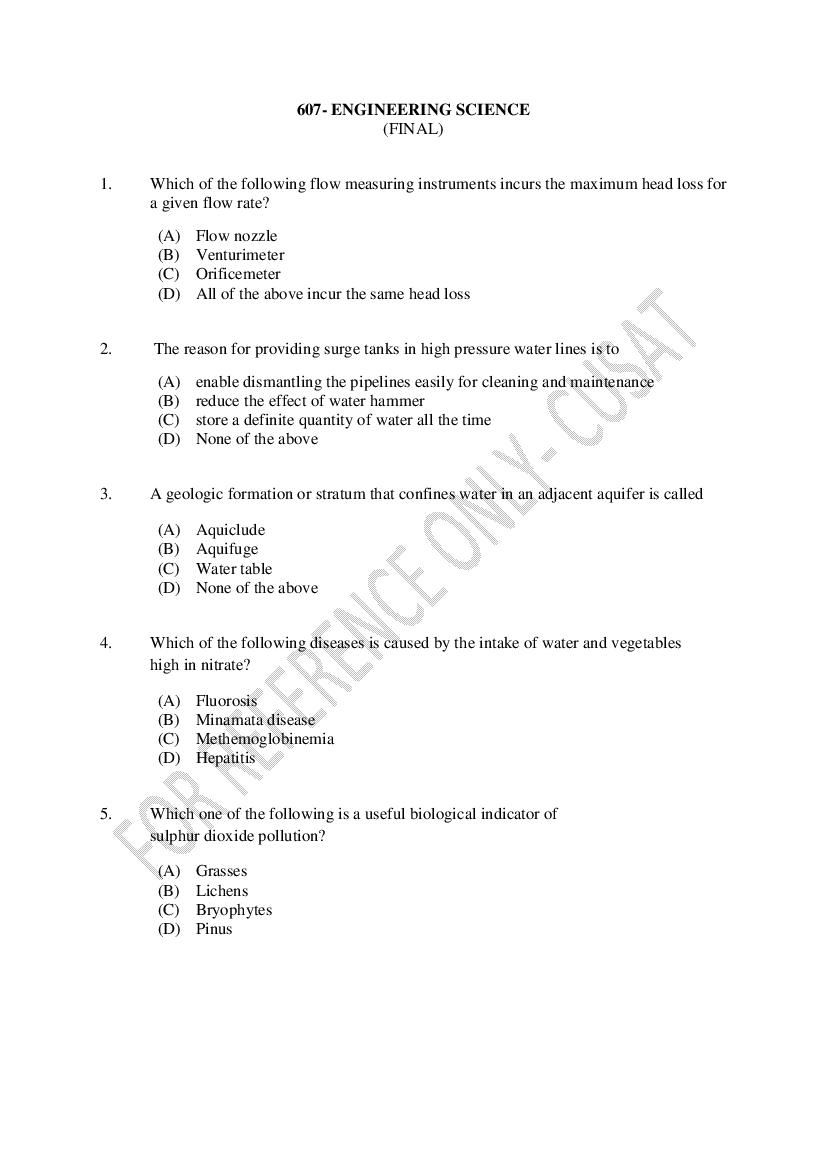
Page 1
(FINAL)
1. Which of the following flow measuring instruments incurs the maximum head loss for
a given flow rate?
(A) Flow nozzle
(B) Venturimeter
(C) Orificemeter
(D) All of the above incur the same head loss
2. The reason for providing surge tanks in high pressure water lines is to
(A) enable dismantling the pipelines easily for cleaning and maintenance
(B) reduce the effect of water hammer
(C) store a definite quantity of water all the time
(D) None of the above
3. A geologic formation or stratum that confines water in an adjacent aquifer is called
(A) Aquiclude
(B) Aquifuge
(C) Water table
(D) None of the above
4. Which of the following diseases is caused by the intake of water and vegetables
high in nitrate?
(A) Fluorosis
(B) Minamata disease
(C) Methemoglobinemia
(D) Hepatitis
5. Which one of the following is a useful biological indicator of
sulphur dioxide pollution?
(A) Grasses
(B) Lichens
(C) Bryophytes
(D) Pinus
Page 2
(A) Excessive negative pressure
(B) Excessive turbidity
(C) Excessive water pressure
(D) Excessive water flow
7. Which of the following does not influence the efficiency of a sedimentation tank?
(A) Detention period
(B) Length of tank
(C) Depth of tank
(D) Velocity of water
8. Which of the following is a secondary pollutant?
(A) Sulphur dioxide
(B) Carbon monoxide
(C) Suspended particulate matter
(D) Ozone
9. The method used to measure the colour of a water sample
(A) Gravimetric analysis
(B) Chromatography
(C) Tintometer method
(D) Nephelometry
+
10. What is the concentration of H ions in moles/L in water if the pOH value is 5?
(A) 10−9
(B) 10−5
(C) 10−6
(D) 10−8
11. Which of the following water borne diseases is caused by virus infection?
(A) Typhoid fever
(B) Hepatitis A
(C) Cholera
(D) Dysentery
Page 3
cylinder simultaneously?
(A) Hydraulic ram
(B) Hydraulic press
(C) Hydraulic turbine
(D) Hydraulic pump
13. Pick the chemical process in which the combustible portion of the waste is
combined with oxygen forming carbon dioxide and water, which are released
into the atmosphere.
(A) Incineration
(B) Pyrolysis
(C) Composting
(D) Stabilisation
14. An area of land that feeds all the water running under it and draining off of it into a
body of water is known as
(A) Water cycle
(B) Catchment area
(C) Water shed
(D) Water reservoir
15. Which of the following greenhouse gases has the highest global warming potential on
a 100-year scale?
(A) Nitrous oxide
(B) Carbon tetra fluoride
(C) Methane
(D) Water vapour
16. A disease that affects a large number of people within a community, population, or
region is known as
(A) Pandemic
(B) Endemic
(C) Epidemic
(D) Outbreak
Page 4
(A) Carcinogen
(B) Mutagen
(C) Teratogen
(D) Antibody
18. Rapid growth of bacteria is observed in the ……………… phase of the growth curve.
(A) Lag phase
(B) Stationary phase
(C) Endogenous phase
(D) Log phase
19. Removal of sand, and gravel in the primary treatment of waste water is known as
(A) Coagulation
(B) Screening
(C) Grit removal
(D) Adsorption
20. Which of the following techniques can be used for the effective removal of emulsified
oil from water?
(A) Gravity separation
(B) Screening
(C) Filtration
(D) Dissolved air floatation
21. Which of the following is a global treaty that aims to protect human health and the
environment from the effects of persistent organic pollutants?
(A) Montreal protocol
(B) Stockholm convention
(C) Basel convention
(D) Rotterdam Convention
22. ……………… is a dimensionless parameter measuring the ratio of "the inertia force
on an element of fluid to the weight of the fluid element"
(A) Froude number
(B) Reynolds number
(C) Nusselt number
(D) Prandtl number
Page 5
trophic levels. This phenomenon is known as
(A) Biomagnification
(B) Eutrophication
(C) Biodegradation
(D) Bioremediation
24. ……………… is considered as a common indicator organism of sewage pollution in
a water body.
(A) Lemna paucicostata
(B) Eicchornia Crassipes
(C) Escherichia coli
(D) Entamoeba histolytica
25. Which of the following weirs has less head loss?
(A) Ogee shaped
(B) Broad crested
(C) Sharp crested
(D) Narrow crested
26. Select the two air pollution control devices that are usually used to remove very fine
particles from the flue gas
(A) Cyclone and Venturi Scrubber
(B) Cyclone and Packed Scrubber
(C) Electrostatic Precipitator and Bag Filter
(D) Settling Chamber and Tray Scrubber
27. The normal depth in a wide rectangular channel is increased by 10%. The percentage
increase in the discharge in the channel is
(A) 20.1
(B) 15.4
(C) 10.5
(D) 17.2
28. The presence of hardness in excess of permissible limit causes
(A) Cardio vascular problems
(B) Skin discoloration
(C) Calcium deficiency
(D) Increased laundry expenses
Page 6
29. The 5-day BOD of a wastewater sample is obtained as 190 mg/l (with k = 0.01 h ).
The ultimate oxygen demand (mg/l) of the sample will be
(A) 380
(B) 475
(C) 271
(D) 190
30. Standard 5-day BOD of a waste water sample is nearly ……………… percent of the
ultimate BOD.
(A) 78
(B) 68
(C) 58
(D) 48
31. Excessive fluoride in drinking water can lead to
(A) Alzheimer's disease
(B) Skin cancer
(C) Methemoglobinemia
(D) Mottling of teeth and embrittlement of bones
32. The lift force acting on an immersed body in a flowing fluid is
(A) always in the opposite direction to gravity
(B) due to Wake phenomenon
(C) the dynamic fluid-force component normal to approach velocity
(D) due to buoyant force
33. Muskingum method for routing of flood
(A) is used for routing floods through reservoirs
(B) uses a conservation of mass approach to route an inflow hydrograph
(C) is a hydrologic method of routing floods through streams
(D) uses only energy equation
34. The temporary hardness of water, is caused by
(A) carbonates of calcium and magnesium
(B) bicarbonates of sodium and potassium
(C) bicarbonates of calcium and magnesium
(D) dissolved carbon dioxide
Page 7
(A) m2/s
2
(B) Ns/m
(C) Pa s/m2
(D) kg s2/m2
36. Chemical oxygen Demand (COD) of a sample is always greater than Biochemical
Oxygen Demand (BOD) since it represents
(A) biodegradable and non-biodegradable organic matter
(B) non-biodegradable organic matter only
(C) biodegradable organic matter only
(D) inorganic matter
37. An outlet irrigates an area of 20 ha. The discharge (l/s) required at this outlet to meet
the evapotranspiration requirement of 20 mm occurring uniformly in 20 days
neglecting other field losses is
(A) 2.52
(B) 2.31
(C) 2.01
(D) 1.52
38. According to Darcy's law for flow through porous media,
the flow rate is proportional to
(A) Pressure gradient
(B) Effective stress
(C) Cohesion
(D) Stability number
39. Which of the following does not affect the disinfection efficiency of
chlorine in water treatment?
(A) Contact time
(B) pH
(C) Temperature
(D) Viscosity
Page 8
amount sufficient to
(A) react with any ammonia and readily oxidisable organic matter
(B) kill Giardia cysts
(C) react with inorganic matter
(D) reduce bacterial growth in filters
41. The substances having physical properties that are equal in all directions are known as
(A) Homogeneous
(B) Isotropic
(C) Orthotropic
(D) Visco-elastic
42. A soil sample has a void ratio of 0.5. Its porosity will be approximately
(A) 50%
(B) 66%
(C) 33%
(D) 100%
43. The pressure at a point in a fluid in motion is the same in all directions. This fluid is
(A) A Newtonian fluid
(B) A Non-Newtonian fluid
(C) A Real fluid
(D) An Ideal fluid
44. How will you increase the efficiency of a sedimentation tank, for a given discharge?
(A) By increasing the depth of the tank
(B) By increasing the surface area of the tank
(C) By decreasing the surface area of the tank
(D) By decreasing the depth of the tank
45. The compound used to control the growth of algae in reservoirs is
(A) Copper sulphate
(B) Bleaching powder
(C) Lime solution
(D) Alum solution
Page 9
(A) Anoxic bacteria
(B) Anaerobic bacteria
(C) Aerobic bacteria
(D) Facultative bacteria
47. The most commonly used non-empirical formula for determining the velocity of flow
of underground water is
(A) Lacy’s formula
(B) Slichter's formula
(C) Hazen's formula
(D) Darcy’s formula
48. Which of the following contributes to the turbidity of water?
(A) Suspended clay
(B) Suspended silt
(C) Finely divided organic material
(D) All the above
49. Which of the following statements is true for disinfection of water with ozone?
(A) It is more effective than chlorine in destroying viruses and bacteria
(B) It removes the color, taste and odour from water
(C) It adds taste to the water
(D) It vanishes before water reaches the consumers
2
50. The normal range of overflow rate for plain sedimentation tanks in litres/hr/m is
(A) 100 to 250
(B) 250 to 500
(C) 500 to 750
(D) 750 to 1000
51. The maximum pressure to which cast iron pipes may be subjected to, is
(A) 10 kg/cm2
(B) 7 kg/cm2
(C) 5 kg/cm2
(D) 3 kg/cm2
Page 10
(A) Nil
(B) 5 mg/l
(C) 10 mg/l
(D) 15 mg/l
53. Which of the following can be used to detect low turbidity of water?
(A) Turbidity tube
(B) Jackson turbidity meter
(C) Baylis turbidimeter
(D) Hellige turbidimeter
54. The maximum permissible concentration of nitrates (measured as nitrogen) in
drinking water is
(A) Nil
(B) 10 mg/l
(C) 50 mg/l
(D) 100 mg/l
55. What does a Ringelmann chart measure?
(A) Combustibles present in automobile exhaust
(B) Flue gas temperature
(C) Exhaust gas density
(D) Smoke density from a chimney
56. Prolonged exposure to high concentration of carbon monoxide (> 5000 ppm)
can be fatal. Why?
(A) Due to clotting of blood
(B) Due to jamming of respiratory tract
(C) It forms carboxyhemoglobin by combining with haemoglobin of blood,
thereby making it incapable of absorbing oxygen
(D) It forms CO2 by combining with oxygen present in the blood
57. Zeolite process is used in water treatment to remove
(A) Hardness
(B) Alkalinity
(C) Acidity
(D) Iron and zinc
Page 11
(A) Iron oxide
(B) Limestone powder
(C) Silica gel
(D) Activated carbon
59. Among the following, which gas has the widest explosion limit range?
(A) Acetylene
(B) Hydrogen
(C) Carbon monoxide
(D) Ammonia
60. Soluble silica present in boiler feed water can be removed by
(A) Coagulation
(B) Filtration
(C) Ion exchange
(D) Absorption
61. Which of the following is a measure of the resistance of water to
the passage of light through it?
(A) Dissolved gases
(B) Color
(C) Hardness
(D) Turbidity
62. Which of the following can be used to reduce the high noise levels produced during
operation of fans and compressors?
(A) Acoustic adsorbent
(B) Mufflers
(C) Lagging of noisy duct
(D) Acoustic barriers
63. Identify the equipment that is not a source of ozone emission.
(A) Dermatological photo-therapy equipments
(B) Xerox machines
(C) Refrigerators
(D) High voltage electrical equipments
Page 12
treated drinking water
(A) 0.2 mg/l
(B) 0.001 mg/l
(C) 2 mg/l
(D) 10 mg/l
65. Which of the following is a masonry structure built below ground level where
anaerobic biochemical reaction takes place?
(A) Cesspool
(B) Septic tank
(C) Skimming mill
(D) Lagoon
66. The most active zone of atmosphere in which weathering events like rain, storm and
lightning occurs is
(A) Thermosphere
(B) Ionosphere
(C) Stratosphere
(D) Troposphere
67. Which of the following removes oil and fatty substances in sewage treatment?
(A) Aeration tank
(B) Equalisation tank
(C) Skimming tank
(D) Rapid sand filter
68. The most efficient particulate removal equipment for the removal of submicronic dust
particles from blast furnace gas is
(A) Packed scrubber
(B) Electrostatic precipitator
(C) Gravity settling chamber
(D) Hydro cyclone
69. Black smoke is coming out of the chimney of a furnace. It is an indication of
(A) the presence of large quantity of excess combustion air in the furnace
(B) the presence of low amount of excess combustion air in the furnace
(C) the use of furnace oil as fuel
(D) the use of pulverized coal as fuel
Page 13
(A) CO
(B) CO2
(C) H2
(D) CH4
71. Which of the following is not responsible for the emission of considerable amount of
SO2 into the atmosphere?
(A) Thermal power plant
(B) Nitric acid plant
(C) Petroleum refinery
(D) Sulphuric acid plant
72. Which of the following processes take place in an Imhoff tank used for
sewage treatment?
(A) Digestion
(B) Filtration
(C) Sedimentation
(D) Both digestion and sedimentation
73. Which of the following is provided in the primary treatment of sewage to remove grit
and fine sand particles?
(A) Detritus tank
(B) Skimming tank
(C) Mixing tank
(D) Aeration tank
74. The temperature rise of an aquatic system can lead to the reduction of
(A) Biochemical oxygen demand of water
(B) Dissolved oxygen content of water
(C) Vapor pressure of water
(D) All (A), (B) and (C) above
Page 14
and colloidal matter from polluted water is
(A) Sedimentation
(B) Filtration
(C) Mechanical flocculation
(D) Chemical coagulation
76. The least efficient dust collection equipment for the removal of
sub-micron particles from air is
(A) Bag filter
(B) Cyclone separator
(C) Gravity type dust catcher
(D) Hollow wet scrubber
77. The major reason for hydrodynamic noise is
(A) Pipe vibrations
(B) Boundary layer separation
(C) Cavitation
(D) Fluctuation in liquid flow
78. Disinfection of water by irradiating it with ultraviolet light of suitable wavelength is
commonly used in
(A) Food industry
(B) Municipal sewage treatment
(C) Petroleum refinery
(D) Iron and steel plant
79. Which of the following processes facilitates replenishment of dissolved oxygen in a
stream polluted with industrial waste?
(A) Natural aeration of water stream
(B) Photosynthetic action of algae
(C) Decay of vegetable matter
(D) Both (A) and (B) above
80. Which of the following is the most detrimental for water used in high pressure boiler?
(A) Turbidity
(B) Silica
(C) Phenol
(D) Dissolved oxygen
Page 15
(A) Diffusion of dust particles
(B) Effect of gravitational force on dust particles
(C) Effect of centrifugal force on dust particles
(D) Effect of electrostatic force on dust particles
82. The inhalation of ……………… dust for a long time can lead to the
disease known as ‘siderosis’.
(A) Coal
(B) Iron
(C) Silica
(D) Cotton
83. Which of the following eye irritating compounds is formed in atmosphere by the
direct reaction of unsaturated hydrocarbons with either NO or NO2?
(A) Peroxyacetyl nitrate (PAN)
(B) Benzaldehyde
(C) Benzopyrene
(D) Polyacrylonitrile
84. The most commonly used pump for pumping raw sewage is
(A) Electromagnetic pump
(B) Centrifugal pump
(C) Reciprocating pump
(D) Gear pump
85. The valve that facilitates close control flow of fluids is
(A) Gate valve
(B) Check valve
(C) Butterfly valve
(D) Globe valve
86. Prandtl mixing length is
(A) applicable to laminar flow problems
(B) a universal constant
(C) zero at the pipe wall
(D) None of the above
Page 16
product of velocity head and density.
(A) Average drag per unit projected area
(B) Shear force
(C) Shear stress
(D) None of the above
88. Which of the following equations represents fluid flow through a packed bed?
(A) Fanning's
(B) Ergun's
(C) Hagen-Poiseuille’s
(D) Stoke’s
89. The ratio of inertial forces to viscous forces for a fluid
is called the ……………… number.
(A) Froude
(B) Euler
(C) Reynold
(D) Mach
90. In laminar flow through a round tube, the discharge varies
(A) Linearly as the viscosity
(B) Inversely as the pressure drop
(C) Inversely as the viscosity
(D) As the square of the radius
91. Which of the following can be used to create a flow of gas, where no significant
compression is required?
(A) Reciprocating compressor
(B) Blower
(C) Axial flow compressor
(D) Centrifugal compressor
92. For a fluid rotating at constant angular velocity about vertical axis as a rigid body,
the pressure intensity varies as the
(A) Square of the radial distance
(B) Radial distance linearly
(C) Inverse of the radial distance
(D) Elevation along vertical direction
Page 17
flow of gas at low velocity?
(A) Pitot tube
(B) Rotameter
(C) Segmental orificemeter
(D) Hot wire anemometer
94. Which of the following parameters is measured by a piezometer provided in the pipe?
(A) Friction factor
(B) Dynamic pressure
(C) Static pressure
(D) None of the above
95. The reason for providing foot valves in the suction line of a centrifugal pump is
(A) to avoid priming, every time we start the pump
(B) to remove the contaminant present in the liquid
(C) to minimize the fluctuation in discharge
(D) to control the liquid discharge
96. The boundary layer in fluid flow is caused by
(A) Surface tension
(B) Fluid viscosity
(C) Fluid density
(D) Gravity forces
97. Metacentric height of a floating body is defined as the distance
between metacentre and
(A) Water surface
(B) Centre of buoyancy
(C) Centre of gravity
(D) None of the above
98. The scale up of an agitator design requires
(A) Geometrical similarity only
(B) Dynamic similarity only
(C) Both geometrical and dynamic similarity
(D) All geometrical, dynamic and kinematic similarity
Page 18
through a flow nozzle is that
(A) The flow nozzle has a shorter length
(B) Throat diameter is more in the case of flow nozzle
(C) Sudden expansion of flow occurs in the downstream in the case of flow nozzle
(D) Distance between the throat and the inlet is more in a flow nozzle
100. The flow rate of high velocity flue gas discharged through a stack to the atmosphere
can be most conveniently measured by a
(A) Pitot tube
(B) Manometer
(C) Rotameter
(D) Orificemeter
101. If A is the cross-sectional area of the flow through a non-circular duct and P is the
wetted perimeter of the cross-section, the hydraulic diameter of the duct will be
(A) 2A/P
(B) 4A/P
(C) 3A/P
(D) 8A/P
102. Which of the following laws is applicable to velocity distribution in the turbulent
boundary layer?
(A) Parabolic law
(B) Linear law
(C) Logarithmic law
(D) Newton’s law
103. The schedule number of a pipe is related to
(A) Size
(B) Roughness
(C) Material density
(D) Wall thickness
104. The margin of pressure over vapor pressure, at the pump suction nozzle is known as
(A) Static submergence
(B) Net positive suction head
(C) Cavitation sensitivity
(D) Priming efficiency
Page 19
(A) Axial flow type
(B) Radial flow type
(C) Mixed flow type
(D) None of the above
106. The type of roof that is most commonly used for cylindrical storage tanks is
(A) Dome
(B) Flat
(C) Conical
(D) Umbrella
107. A light rope is loaded with many equal weights at equal horizontal intervals.
The points of suspension on the rope lie on a
(A) Catenary
(B) Parabola
(C) Cycloid
(D) Ellipse
108. A force P of 50 N and another force Q of an unknown magnitude act at 90 degrees to
each other. They are balanced by a force of 130 N. What is the magnitude of Q?
(A) 60 N
(B) 80 N
(C) 100 N
(D) 120 N
109. The equation of motion of a particle starting from rest along a straight line is
x = t 3 − 3l 2 + 5. The ratio of the velocities after 5 sec and 3 sec will be
(A) 5
(B) 2
(C) 3
(D) 4
110. Which of the following is a graphical method used to determine the deflection of a
framed structure under the load?
(A) Williot-Mohr diagram
(B) Venn diagram
(C) Nyquist diagram
(D) Bending moment diagram
Page 20
The forces must be coplanar and
(A) Concurrent parallel
(B) Parallel
(C) Concurrent
(D) None of the above
112. The moment of inertia of a hollow circular section whose external diameter is 8 cm
and internal diameter is 6 cm, about centroidal axis is
4
(A) 437.5 cm
(B) 337.45 cm4
(C) 237.5 cm4
4
(D) 137.45 cm
113. Facultative bacteria are able to work in
(A) Presence of oxygen only
(B) Absence of oxygen only
(C) Presence as well as in absence of oxygen
(D) Presence of water
114. Air binding phenomena in rapid sand filters occur due to
(A) Excessive negative head
(B) Mud ball formation
(C) Higher turbidity in the effluent
(D) Low temperature
115. The rate of BOD exerted at any time is
(A) Directly proportional to BOD satisfied
(B) Directly proportional to BOD remaining
(C) Inversely proportional to BOD satisfied
(D) Inversely proportional to BOD remaining
116. A sewer that receives the discharge of a number of house sewers is called
(A) House sewer
(B) Intercepting sewer
(C) Lateral sewer
(D) Sub-main sewer
Page 21
(A) 0.1 mg/liter
(B) 1.5 mg/liter
(C) 5 mg/liter
(D) 10 mg/liter
118. The treatment of water with bleaching powder is known as
(A) Pre-chlorination
(B) Super chlorination
(C) De-chlorination
(D) Hypo-chlorination
119. A pipe which is installed in the house drainage to preserve
the water seal of traps is called
(A) Vent pipe
(B) Anti-siphonage pipe
(C) Waste pipe
(D) Soil pipe
120. Which of the following global treaties deals with the trans boundary movement of
hazardous wastes?
(A) Kyoto protocol
(B) Stockholm convention
(C) Basel convention
(D) Ramsar convention
121. The best method for the determination of average annual precipitation in
a catchment basin is
(A) Isohyetal method
(B) Thiessen's mean method
(C) Arithmetical method
(D) None of the above
122. A hydroelectric scheme operating under a head of 80 m will be classified as
(A) Low head scheme
(B) Medium head scheme
(C) High head scheme
(D) None of the above
Page 22
surrounding air, is called
(A) Cyclonic precipitation
(B) Convective precipitation
(C) Orographic precipitation
(D) Radiative precipitation
124. Isopiestic lines are the contours
(A) Drawn to represent water table
(B) Drawn to represent piezometric heads
(C) Drawn to piezometric surface
(D) None of the above
125. The surface run-off is the quantity of water
(A) Absorbed by soil
(B) Intercepted by buildings and vegetative cover
(C) Required to fill surface depressions
(D) That reaches the stream channels
126. Remote sensing techniques make use of the properties of ………………… emitted,
reflected or diffracted by the sensed objects.
(A) Electric waves
(B) Sound waves
(C) Electromagnetic waves
(D) Wind waves
127. The ratio of limiting friction and normal reaction is known as
(A) Coefficient of friction
(B) Angle of friction
(C) Angle of repose
(D) Sliding friction
128. The moment diagram for a cantilever which is subjected to a uniformly distributed
load will be a
(A) Triangle
(B) Parabola
(C) Rectangle
(D) Cubic parabola
Page 23
(A) 1/25
(B) 1/20
(C) 1/15
(D) 1/10
130. Which of the following is NOT the unit of pressure?
(A) kg/cm
(B) atm
2
(C) kg/cm
(D) Newton
131. A diagram which shows the variations of the axial load for all sections of the span of
a beam, is called
(A) Bending moment diagram
(B) Shear force diagram
(C) Thrust diagram
(D) Stress diagram
132. The main function of a diversion head works of a canal from a river, is
(A) to remove silt
(B) to control floods
(C) to store water
(D) to raise water level
133. The difference in level between the top of a bank and supply level in a canal, is called
(A) Berm
(B) Free board
(C) Height of bank
(D) None of the above
134. The best method of irrigation for standing crops in undulating sandy soil is
(A) Sprinkler irrigation
(B) Free flooding
(C) Check method
(D) Furrow method
Page 24
(A) Non-regime section
(B) Inadequate slope
(C) Defective head regulator
(D) All the above
136. Plasticity index is defined as the range of water content between
(A) Semi-solid limit and liquid limit
(B) Plastic limit and semi solid limit
(C) Liquid and plastic limit
(D) Liquid limit and solid limit
137. Rankine's theory of earth pressure assumes that the back of the wall is
(A) Plane and smooth
(B) Plane and rough
(C) Vertical and smooth
(D) Vertical and rough
138. The maximum pressure which a soil can carry without shear failure is called
(A) Safe bearing capacity
(B) Net safe bearing capacity
(C) Net ultimate bearing capacity
(D) Ultimate bearing capacity
139. The clay soil mainly consists of
(A) Kaolinite
(B) Montmorillonite
(C) Vermiculite
(D) All the above
140. An exhausted anion-exchange resin can be regenerated by treating it with
(A) Concentrated HCl solution
(B) Concentrated NaOH solution
(C) Dilute brine solution
(D) Concentrated brine solution
Page 25
(A) Sea water
(B) Industrial waste water
(C) Domestic sewage
(D) River water
142. Animals that consume both plants and animal matter are called
(A) Carnivores
(B) Omni-carnivores
(C) Necromorphs
(D) Omnivores
143. Kyoto protocol is related to
(A) Population
(B) Resources
(C) Global warming
(D) Pollution
144. Decomposers which specifically act on the fecal matter of other organisms are called
(A) Heterophagic
(B) Coprophagic
(C) Paraphagic
(D) Allophagic
145. The ratio between energy flows at different points along the food chain is called
(A) Ecological efficiency
(B) Ecological capacity
(C) Ecological potential
(D) Ecological assimilation
146. Soap and detergents are the source of organic pollutants like
(A) Glycerol
(B) Polyphosphates
(C) Sulphonated hydrocarbons
(D) All of the above
Page 26
(A) Homeostasis
(B) Exotherms
(C) Homeobox
(D) Endotherms
148. Upper layer in a single body of water is known as
(A) Hypolimnion
(B) Epilimnion
(C) Thermocline
(D) Hydroline
149. In pond ecosystem, the pyramid of biomass is
(A) Upright
(B) Spindle-shaped
(C) Inverted
(D) Irregular
150. Trophic levels are formed by
(A) Plants only
(B) Animals only
(C) Organisms linked in food chains
(D) All of the above
Page 27
Subject Name: 607 ENGINEERING SCIENCE
SI No. Key SI No. Key SI No. Key SI No. Key SI No. Key
1 C 31 D 61 D 91 B 121 A
2 B 32 A 62 B 92 A 122 C
3 A 33 B 63 C 93 D 123 B
4 C 34 C 64 A 94 C 124 C
5 B 35 B 65 B 95 A 125 D
6 A 36 A 66 D 96 B 126 C
7 D 37 B 67 C 97 C 127 A
8 D 38 A 68 B 98 D 128 B
9 C 39 D 69 B 99 C 129 D
10 A 40 A 70 D 100 A 130 A
11 B 41 B 71 B 101 B 131 C
12 A 42 C 72 D 102 C 132 D
13 A 43 D 73 A 103 D 133 B
14 C 44 B 74 B 104 B 134 A
15 B 45 A 75 D 105 A 135 D
16 B 46 C 76 C 106 C 136 C
17 C 47 D 77 C 107 B 137 C
18 D 48 D 78 A 108 D 138 A
19 C 49 A 79 D 109 B 139 D
20 D 50 C 80 B 110 A 140 B
21 B 51 B 81 C 111 C 141 A
22 A 52 A 82 B 112 D 142 D
23 A 53 C 83 A 113 C 143 C
24 C 54 B 84 B 114 A 144 B
25 B 55 D 85 D 115 B 145 A
26 C 56 C 86 C 116 C 146 D
27 D 57 A 87 A 117 B 147 A
28 D 58 B 88 B 118 D 148 B
29 C 59 A 89 C 119 B 149 C
30 B 60 C 90 C 120 C 150 C
Document Details
| Board / Org | Cochin University |
| Exam | CUSAT Common Admission Test |
| Type | Question Paper |
| Pages | 27 |
| Updated | 22 Jul 2026 |