NCERT Solutions for Class 12 Psychology Chapter 1 Variations in Psychological Attributes
Finished viewing? Save it for later —
Download NCERT Solutions for Class 12 Psychology Chapter 1 Variations in Psychological Attributes (PDF · 7 pages)About NCERT Solutions for Class 12 Psychology Chapter 1 Variations in Psychological Attributes
NCERT Solutions for Class 12 Psychology Chapter 1 Variations in Psychological Attributes is available here for free download. Published by NCERT for Class 12, this solution can be viewed online or downloaded as a PDF (7 pages). Candidates preparing for Class 12 can use NCERT Solutions for Class 12 Psychology Chapter 1 Variations in Psychological Attributes to understand the exam pattern, the type of questions asked, and the overall difficulty level.
Frequently Asked Questions
How can I download NCERT Solutions for Class 12 Psychology Chapter 1 Variations in Psychological Attributes?
Open this page and click the Download button to save NCERT Solutions for Class 12 Psychology Chapter 1 Variations in Psychological Attributes as a PDF. It is completely free on AglaSem Docs.
Is NCERT Solutions for Class 12 Psychology Chapter 1 Variations in Psychological Attributes free to download?
Yes. NCERT Solutions for Class 12 Psychology Chapter 1 Variations in Psychological Attributes can be viewed online and downloaded as a PDF free of cost on AglaSem Docs.
How many pages does NCERT Solutions for Class 12 Psychology Chapter 1 Variations in Psychological Attributes have?
NCERT Solutions for Class 12 Psychology Chapter 1 Variations in Psychological Attributes contains 7 pages, which you can read online or download together as a single PDF.
Where can I find more Class 12 study material?
You can find more Class 12 question papers, sample papers, syllabus, and answer keys on AglaSem Docs.
NCERT Solutions for Class 12 Psychology Chapter 1 Variations in Psychological Attributes – Text
Read the full text of this solution below — useful to quickly search, copy and reference the content online without downloading the PDF.
📄 View text version (7 pages)
Page 1
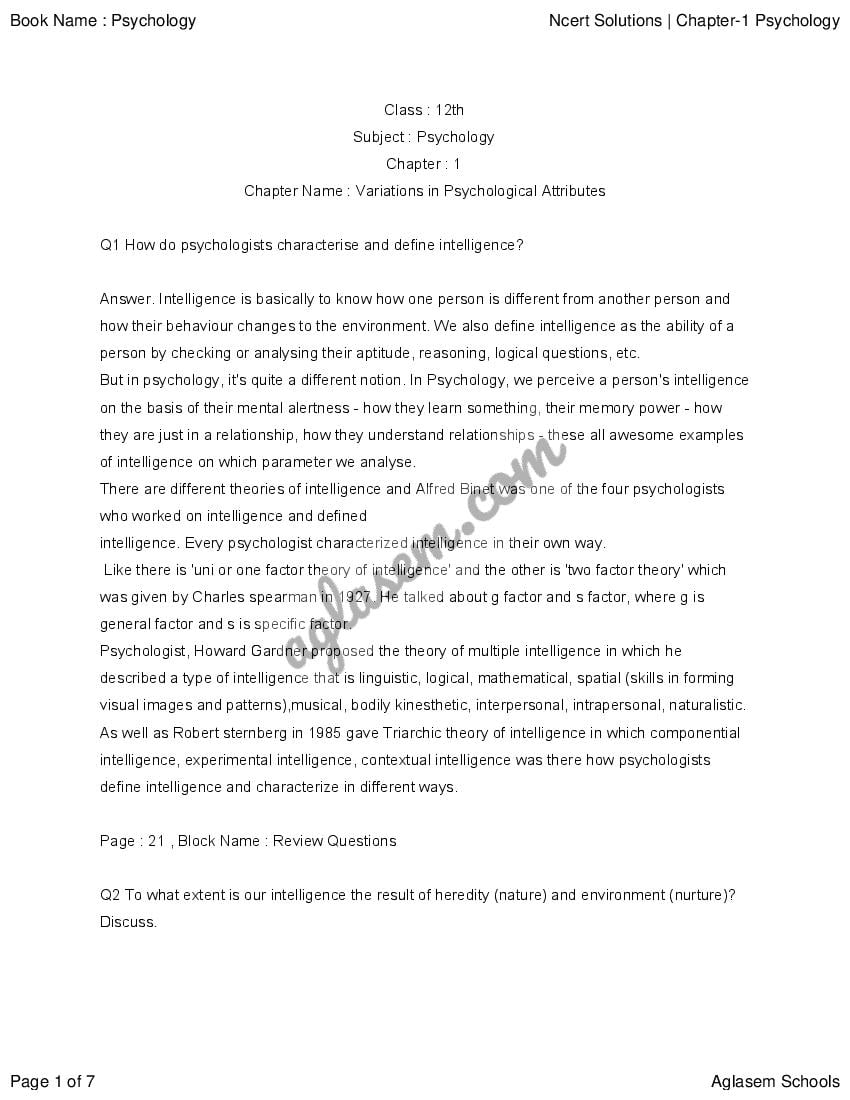
Class : 12th
Subject : Psychology
Chapter : 1
Chapter Name : Variations in Psychological Attributes
Q1 How do psychologists characterise and define intelligence?
Answer. Intelligence is basically to know how one person is different from another person and
how their behaviour changes to the environment. We also define intelligence as the ability of a
person by checking or analysing their aptitude, reasoning, logical questions, etc.
But in psychology, it's quite a different notion. In Psychology, we perceive a person's intelligence
on the basis of their mental alertness - how they learn something, their memory power - how
they are just in a relationship, how they understand relationships - these all awesome examples
of intelligence on which parameter we analyse.
There are different theories of intelligence and Alfred Binet was one of the four psychologists
who worked on intelligence and defined
intelligence. Every psychologist characterized intelligence in their own way.
Like there is 'uni or one factor theory of intelligence' and the other is 'two factor theory' which
was given by Charles spearman in 1927. He talked about g factor and s factor, where g is
general factor and s is specific factor.
Psychologist, Howard Gardner proposed the theory of multiple intelligence in which he
described a type of intelligence that is linguistic, logical, mathematical, spatial (skills in forming
visual images and patterns),musical, bodily kinesthetic, interpersonal, intrapersonal, naturalistic.
As well as Robert sternberg in 1985 gave Triarchic theory of intelligence in which componential
intelligence, experimental intelligence, contextual intelligence was there how psychologists
define intelligence and characterize in different ways.
Q2 To what extent is our intelligence the result of heredity (nature) and environment (nurture)?
Discuss.
Page 1 of 7 Aglasem Schools
Page 2
Answer. Intelligence is the result of heredity and environment both . As we see most of the
things we have in our daily routine because of our genes. Heredity plays an important role in our
intelligence because our sitting posture, walking style, and eating habits are similar to our
parents. For example if you are eating in a good manner or something that is different from
normal behaviour is somehow we have because our genes that are intelligent are the result of
heredity (nature).
Environment gives a lot of information on knowledge that we had not known before. When we
are surviving all living in an environment we come to know learn different things full stop for
example child goes to playground he plays with children that time you only loans that game just
because his friends told him how to play that practicing make him better in that game for
sometimes their friends tell him how to play better that time environment plays role in his
intelligence that how the child receive or memorize or understand that trick which was told him
by his friends.
Q3 Explain briefly the multiple intelligence identified by Gardner.
Answer. Howard Gardner proposed the theory of multiple intelligence. He defines intelligence
that covers various areas. According to him, all these areas for different types of intelligence are
independent of each other. It means, if one type of intelligence is high that doesn't mean it
affects the other type of intelligence that makes them low or high.
He gave intelligence 8 types. These are:
1. Linguistic
Skills involved in the production and use of language. It means having a person speak
so uses language and his ability to express thinking and understand others.
2. Logical mathematical
Skills in scientific thinking and problem solving. It means how a person is able to solve
mathematical problems.
3. Spatial
Skills informing visual images and patterns. It means how a person is able to form
images in the mind after listening to a word for example pilots, sailors,etc.
4. Musical
Page 2 of 7 Aglasem Schools
Page 3
Sensitivity to musical rhythms and patterns.
It means how a person is able to produce musical patterns.
5. Bodily-Kinaesthetic
Using whole or portions of the body flexibly and creatively. It means how a person is able
to use their whole body like sports, gymnasium,etc.
6. Interpersonal
Sensitivity to subtle aspects of others Behaviour. It means the skill of understanding the
feelings for the person so that will make their born into a comfortable relationship.
7. Intrapersonal
Awareness of one's own feelings, desires. It means how a person uses knowledge
effectively that relates to others.
8. Naturalistic
Sensitivity to the features of the natural world. This involves the knowledge and awareness of
the bond with the natural environment.
Page : 21, Block Name : Review Questions
Q4 How does the Triachic theory help us to understand intelligence?
Answer. Robert Sternberg in 1985 proposed triarchic theory of intelligence. Sternberg's views
on intelligence as "the ability to adapt to shape and select environment to accomplish one's
goals and those one's society and culture".
Three basic types of intelligence; componential, experimental and contextual.
1. Componential intelligence : it is also called analytical intelligence. This type of
intelligence checks the ability to solve problems.
2. Experimental intelligence: it is also called creative intelligence. This intelligence is using
past experiences to solve problems.
3. Contextual intelligence: it is also called practical intelligence. It includes the capability to
deal with environmental needs in daily routine. It may be called street smartness or
business sense.
Sternberg's theory of intelligence represents the information process approach to understand
intelligence.
Page 3 of 7 Aglasem Schools
Page 4
Q5 "Any intellectual activity involves the independent functioning of these neurological
systems". Explain with reference to the PASS model.
Answer. This model has been developed by J.P. Das, Jack Naglieri, and Kirby(1994). PASS
model includes :
Here, P refers to Planning ; It is one of the important features of intelligence. Information is
given and processed, then planning is initiated. It relieves us to think of possible trials of action
so that we can apply them to reach our goal and then analyse their result.
For example: When your family decides to visit for a trip. You start packing your bags before
one day. That means, you start planning what type of clothes you want there , what eatables
you want to have with you, what kind of footwear you want to carry with yourself .This is how we
plan when we get the information of a trip.
A refers to attention. It helps to attend to a particular subject of stimuli. It includes when we give
attention to a particular situation so that we are unable to process information.
For example: if mother told us to pack a bag for the trip immediately we start thinking about
clothes, where is our bag which we want to carry , where were footwears kept.
S refers to Simultaneous and successive processing : when we collect the information inter
knowledge system either simultaneously or successively. Information is collected in strike to that
part which makes our mind that we are already known by it.
Example: If mother asks you to pack your bag but she explained to you that don't leave
necessary things here. Then you start thinking one by one what you want there and what you
have, i.e., processing items in your mind what you need.
Q6 Are there cultural differences in the conceptualization of intelligence?
Answer. There are so many tests for intelligence to assess people's ability. There are so many
cultures but intelligent tests work the same as one culture to another. Only the basic difference,
what the result comes after applying for the test will be different because every culture has
Page 4 of 7 Aglasem Schools
Page 5
different norms, different habits, different lifestyles,etc. which differences in the results . As we
grew up in different cultures. Within different cultures from one another that will vary in the
result of intelligence test.
Q7 What is IQ? How do psychologists classify people on the basis of their IQ scores?
Answer. IQ means Intelligence Quotient . In 1905, Alfred Binet and Theodore Simon made the
successful attempt to formally measure intelligence.
IQ = (MA÷CA)×100
IQ -intelligence quotient
MA- mental age
CA - chronological age
Normally, IQ is distributed in the population in a way that the scores of mostly people have fallen
in the middle range. Only a few people do not come under a high or low range of IQ.
● Individual variety in their intellectual abilityIf the calculation of IQ person scored 90-109
comes under average level.
● If a person scores less than 90 that will come under below average.
● If a person scores more than 90 that will come under above average.
Q8 How can you differentiate between verbal and performance tests of intelligence?
Answer.
● Verbal test intelligence wants the subject to give verbal responses whether oral or
written form.
● Non verbal tests that are also called performance tests do not want the subject to give
verbal responses as it is based on performance.
● Verbal tests can be administered only on literate people.
● Nonverbal can be done by anyone.
● In verbal tests written languages are necessary for answering the test.
Page 5 of 7 Aglasem Schools
Page 6
● Written language is not necessary in nonverbal tests.
Q9 All persons do not have the same intellectual capacity. How do individuals vary in their
intellectual ability ? Explain.
Answer. Individuals vary in their intellectual ability because they brought up in different
environments. Environment in which they are living is also different . As well as in what type of
culture they are also different. These are such factors which may lead to different intellectual
ability of people.
Intelligent quotient is a test which helps in measuring people's intelligence. On the basis of
scores of intelligent tests , individuals vary in their intellectual ability.
Q10 Which of the two IQ and EQ, do you think would be more related to success in life and
why?
Answer. There is a direct connection between our IQ and our ability to succeed in life. They
both are directly proportional to each other.
As we see in our school we are ranked by our CGPA. Students are also given tests that rank
them against other students. Nowadays, this has become the rule, in schools without their
student's rank compared to others they don't give them ranks or positions. Here, IQ is on
demand but there are studies that show IQ accounts for only a little percent of success.
But when we talked about EQ, it is the most important factor of success .
● Our emotional state helps us to survive in the environment .
● We can never go beyond without our emotions to stabilize ourselves.
● If we are not able to control our emotions then what kind of IQ will be helpful.
● To reduce stress and pressure, first we have to mark up to level our EQ , only after that
our IQ will help us to achieve something we want.
Here, we conclude EQ is a more important factor in how creativity is related to intelligence and
how creativity is related to how IQ is.
Page 6 of 7 Aglasem Schools
Page 7
Q11 How is 'aptitude' different from 'interest' and 'intelligence' ? How is aptitude measured?
Answer. Aptitude refers to special abilities in a particular field activity.
Interest is the feeling that forces us to do spontaneously that desired activity.
Intelligence stability of an individual is to think clearly and function effectively in the environment.
● Interest is when we make something first priority for particular activity but aptitude is the
ability to do that activity.
● Intelligence is what we are able to do in the air of what we are capable of doing but
aptitude is when a person is skilled in a particular type of area.
Q12 How is creativity related to intelligence?
Answer. Creativity is what we do something different from others but better.
Example: There is a girl named Alice who works at home and she is also intelligent in the
academic area also.
There is a girl named Rihanna who helps her mother at home . She is average in academics but
she is a very good volleyball player and also participated in a very high level of competition.
That means, the prior one is intelligent, i.e., Alice.
But in the case of Rihanna she is doing well with her mother also in academics but her
intelligence helpers to make a creative as are she interested in volleyball . So this is how
creativity relates to intelligence.
Page 7 of 7 Aglasem Schools
Document Details
| Board / Org | NCERT |
| Exam | Class 12 |
| Type | Solution |
| Pages | 7 |
| Updated | 01 May 2026 |