CUSAT CAT 2022 Question Paper Geology
Finished viewing? Save it for later —
Download CUSAT CAT 2022 Question Paper Geology (PDF · 27 pages)About CUSAT CAT 2022 Question Paper Geology
CUSAT CAT 2022 Question Paper Geology is available here for free download. Published by Cochin University for CUSAT CAT, this question paper can be viewed online or downloaded as a PDF (27 pages). Candidates preparing for CUSAT CAT can use CUSAT CAT 2022 Question Paper Geology to understand the exam pattern, the type of questions asked, and the overall difficulty level.
Frequently Asked Questions
How can I download CUSAT CAT 2022 Question Paper Geology?
Open this page and click the Download button to save CUSAT CAT 2022 Question Paper Geology as a PDF. It is completely free on AglaSem Docs.
Is CUSAT CAT 2022 Question Paper Geology free to download?
Yes. CUSAT CAT 2022 Question Paper Geology can be viewed online and downloaded as a PDF free of cost on AglaSem Docs.
How many pages does CUSAT CAT 2022 Question Paper Geology have?
CUSAT CAT 2022 Question Paper Geology contains 27 pages, which you can read online or download together as a single PDF.
Where can I find more CUSAT CAT study material?
You can find more CUSAT CAT question papers, sample papers, syllabus, and answer keys on AglaSem Docs.
CUSAT CAT 2022 Question Paper Geology – Text
Read the full text of this question paper below — useful to quickly search, copy and reference the content online without downloading the PDF.
📄 View text version (27 pages)
Page 1
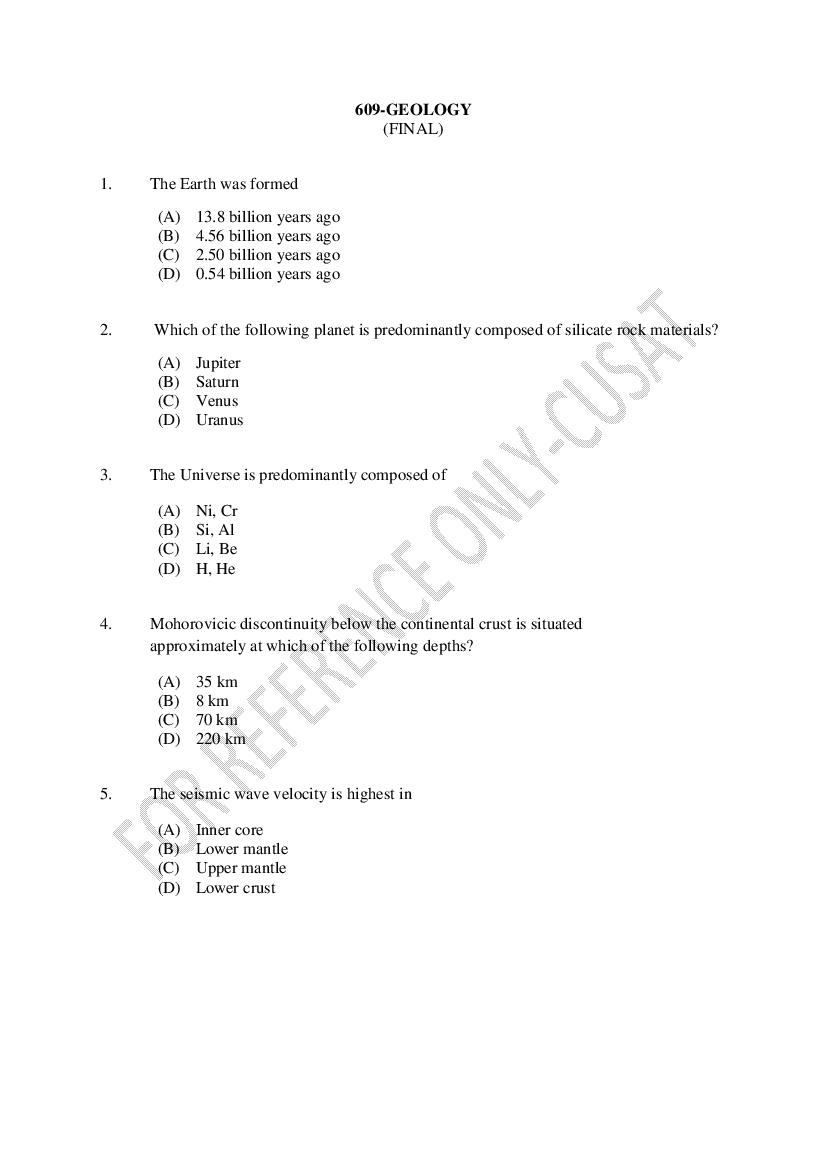
(FINAL)
1. The Earth was formed
(A) 13.8 billion years ago
(B) 4.56 billion years ago
(C) 2.50 billion years ago
(D) 0.54 billion years ago
2. Which of the following planet is predominantly composed of silicate rock materials?
(A) Jupiter
(B) Saturn
(C) Venus
(D) Uranus
3. The Universe is predominantly composed of
(A) Ni, Cr
(B) Si, Al
(C) Li, Be
(D) H, He
4. Mohorovicic discontinuity below the continental crust is situated
approximately at which of the following depths?
(A) 35 km
(B) 8 km
(C) 70 km
(D) 220 km
5. The seismic wave velocity is highest in
(A) Inner core
(B) Lower mantle
(C) Upper mantle
(D) Lower crust
Page 2
(A) Silicon
(B) Iron
(C) Magnesium
(D) Oxygen
7. The average density of the earth is
3
(A) 3.20 g/cm
3
(B) 2.50 g/cm
3
(C) 5.52 g/cm
3
(D) 4.00 g/cm
8. Which of the following layer/discontinuity is responsible for
tectonic movement of lithospheric plate?
(A) Moho
(B) LVZ
(C) D”
(D) Conrad
9. Which of the following tectonic domain show highest heat flow?
(A) Subduction zone
(B) Stable craton
(C) Mid oceanic ridge
(D) Collisional orogen
10. A radioactive isotope A decays to radioactive isotope B with half life of 10 thousand
years. If initially 1000 atoms of A were present, how many atoms of A and B will be
respectively present after 30 thousand years?
(A) 500, 500
(B) 250, 750
(C) 750, 250
(D) 125, 875
11. The tilt of the earth’s rotation axis with reference to perpendicular of orbital plane is
(A) 17.5°
(B) 23.5°
(C) 27.5°
(D) 32.5°
Page 3
(A) Continental transform fault
(B) Oceanic transform fault
(C) Transcurrent fault
(D) Normal fault
13. Which of the following Earth’s feature is NOT related to plate tectonics?
(A) Spreading centre
(B) Hotspot
(C) Island arc
(D) Collisional mountain belt
14. The supercontinent Pangea came into existence during ……………….. period.
(A) Cambrian
(B) Silurian
(C) Carboniferous
(D) Triassic
15. Find the hardest mineral from the following.
(A) Plagioclase
(B) Microcline
(C) Quartz
(D) Corrundum
16. The mineral ……………….. do not show double refraction.
(A) Quartz
(B) Fluorite
(C) Calcite
(D) Apatite
17. Which of the mineral will NOT yield streak in a streak plate?
(A) Hematite
(B) Calcite
(C) Galena
(D) Topaz
Page 4
(A) Stishovite
(B) Coesite
(C) Cristobalite
(D) Tridymite
19. Which of the following mineral pair is NOT a polymorph?
(A) Pyrite ‒ Marcasite
(B) Andalusite ‒ Kyanite
(C) Albite ‒ Anorthite
(D) Calcite ‒ Aragonite
20. Which of the following minerals belongs to tektosilicates?
(A) Hornblende
(B) Albite
(C) Biotite
(D) Pyroxene
21. Identify the phosphate mineral from this group.
(A) Fluorite
(B) Apatite
(C) Magnetite
(D) Calcite
22. If a symmetry element is present at a lattice point in a crystal, then
(A) the same element would be present at each lattice point
(B) it need not be present in its unit-cell
(C) it would be absent from some of the lattice points
(D) its external manifestation would depend on the physical property of the crystal
23. Which of the following symmetry point groups belongs to the orthorhombic system?
(A) 222
(B) 322
(C) 432
(D) 622
Page 5
(A) 1-fold axis of rotation
(B) 2-fold axis of rotation
(C) 3-fold axis of rotation
(D) 4-fold axis of rotation
25. What point group would result if a center of symmetry is added to point group 2 mm?
(A) 2mm
(B) 2/m 22
(C) 2/m2/m2/m
(D) m22
26. The symbol for the zone axis containing the faces (010), (110) and (1 10) is
(A) [100]
(B) [010]
(C) [001]
(D) [1 10]
27. What is the Weiss symbol for a face whose Miller index is (341)?
(A) 4a : 3b : 12c
(B) 3a : 4b : 1c
(C) 1a : 4b : 3c
(D) 4a : 3b : 1c
28. In crystal class 2/m if 2-fold axis is along the b-axis, then the face (011) would belong
to which of the following forms?
(A) {011} dome
(B) {011} sphenoid
(C) {011} prism
(D) {011} pyramid
29. Angle between two sets of 2-fold axes in point group 622 is
(A) 30°
(B) 60°
(C) 90°
(D) 120°
Page 6
(A) Isometric
(B) Tetragonal
(C) Orthorhombic
(D) Monoclinic
31. Which of the following crystal defects may lead to development of
slip planes under stress?
(A) Schottky defect
(B) Frenkel defect
(C) Impurity defect
(D) Edge dislocation
32. For which of the following crystallographic systems, face (001) is not necessarily
perpendicular to the C-axis?
(A) Cubic
(B) Hexagonal
(C) Tetragonal
(D) Triclinic
33. A primitive unit cell contains
(A) One lattice point
(B) 2 lattice points
(C) 3 lattice points
(D) 4 lattice points
34. The low-pressure polymorph of the alumino-silicate is
(A) Sillimanite
(B) Kyanite
(C) Epidote
(D) Andalusite
35. Which of the following is a sodic amphibole?
(A) Cummingtonite
(B) Tremolite
(C) Pargasite
(D) Glaucophane
Page 7
(A) Malanjkhand, Madhya Pradesh
(B) Zawar, Rajasthan
(C) Sukinda, Orissa
(D) Ukhrul, Manipur
37. Which of the following process is responsible for formation of
porphyry type copper ore deposits?
(A) Sedimentary
(B) Magmatic
(C) Magmatic hydrothermal
(D) Supergene enrichment
38. Largest copper ore deposit of India is situated at
(A) Malanjkhand, Madhya Pradesh
(B) Khetri, Rajasthan
(C) Surda, Jharkand
(D) Mosabani, Jharkhand
39. Find the odd one amongst the following copper ore minerals.
(A) Chalcopyrite
(B) Cuprite
(C) Chalcocite
(D) Bornite
40. Which of the following represent chemical composition of pyrrhotite?
(A) FeS2
(B) FeS
(C) Fe1 – XS
(D) Fe1 + XS
41. Which one of the following is the most abundant metal in the Earth’s crust?
(A) Chromium
(B) Manganese
(C) Titanium
(D) Iron
Page 8
(A) Copper
(B) Gold
(C) Iron
(D) Zinc
43. Which of the following metals do NOT form sulphide mineral?
(A) Copper
(B) Uranium
(C) Molybdenum
(D) Nickel
44. Which of the following is example of syngenetic ore deposit?
(A) Banded iron ore deposit
(B) VMS type Pb-Zn deposit
(C) SEDEX type Pb-Zn deposit
(D) Lode gold deposit
45. Bauxite is an example of
(A) Magmatic ore deposit
(B) Residual ore deposit
(C) Placer deposit
(D) Hydrothermal ore deposit
46. The fauna which comprises exclusively of active swimmers is described as
(A) Plankton
(B) Nekton
(C) Benthic
(D) Pelagic
47. Echinoid fauna was evolved during
(A) Cambrian
(B) Ordovician
(C) Silurian
(D) Devonian
Page 9
(A) Marine
(B) Estuarine
(C) Lacustrine
(D) Terrestrial
49. Lamellibranchs with two unequal adductors are called
(A) Isomyaria
(B) Aniosomyria
(C) Monomyria
(D) Dimyaria
50. The criteria for becoming index fossil is that the organism lived for a
(A) brief time over a wide area
(B) brief time over a small area
(C) long time over a small area
(D) long time over a wide area
51. Which of the following Era is termed as ‘The Age of the Reptiles’?
(A) Mesozoic
(B) Cenozoic
(C) Paleozoic
(D) Tertiary
52. Trace fossils are also known as ……………….. fossils.
(A) Reworked
(B) Ichno
(C) Chemical
(D) Pseudo
53. Two valves of Brachiopoda are jointed at
(A) Posterior
(B) Didductor
(C) Hinge line
(D) Commissure line
Page 10
(A) Bilateral
(B) Radial
(C) Biradial
(D) No symmetry
55. What is the time of extinction of Ammonoids?
(A) Lower Carboniferous
(B) Upper Jurassic
(C) Upper Cretaceous
(D) Middle Permian
56. The thorax and the pygidium of a Trilobite is differentiated according to their
(A) shape and size
(B) the nature of furrows
(C) movable and immovable character
(D) None of the above
57. Belemnites belongs to
(A) Bivalvia
(B) Gastropoda
(C) Brachiopoda
(D) Cephalopoda
58. Which of the following Mollusca exclusively live under marine conditions?
(A) Bivalvia
(B) Cephalopoda
(C) Gastropoda
(D) Slugs
59. Modern day squids belong to following class
(A) Cephalopoda
(B) Bivalvia
(C) Gastropoda
(D) Scaphopoda
Page 11
(A) periproct
(B) peristome
(C) apical disc
(D) corona
61. Nautilus is an example of
(A) Living fossil
(B) Index fossil
(C) Ichnofossil
(D) Body fossil
62. Stromatolites are ……………….. types of fossils
(A) Body fossils
(B) Trace fossils
(C) Living fossils
(D) Mold fossils
63. Taphonomy is a branch of palaeontology that deals with
(A) reconstruction of paleo-environments by means of fossils
(B) study of types of fossils
(C) study of fossil pollens and spores
(D) study of the conditions of preservation of fossils
64. The process through which hard parts of organisms either change to more stable
minerals or small crystals turn into larger crystals, is termed as
(A) Recrystallization
(B) Replacement
(C) Permineralization
(D) Carbonization
65. Hinge structure of the Bivalvia in which cardinal and lateral teeth are present is
(A) taxodont
(B) heterodont
(C) desmodont
(D) schizodont
Page 12
(A) supergroup
(B) group
(C) formation
(D) member
67. The oldest rock from India is recorded in
(A) Dharwar craton
(B) Bastar craton
(C) Singhbhum craton
(D) Aravalli craton
68. The Eparchean unconformity denote boundary between
(A) Hadean and Archean
(B) Archean and Proterozoic
(C) Proterozoic and Cambrian
(D) Permian and Triassic
69. The Deccan basalt was erupted ~65 million years ago,
the time represent boundary between
(A) Precambrian and Cambrian
(B) Permian and Triassic
(C) Triassic and Jurrasic
(D) Cretaceous and Paleogene
70. Which of the following stratigraphic boundary represent most
profound changes in life forms?
(A) Archean-Proterozoic
(B) Mesoproterozoic-Neoproterozoic
(C) Neoproterozoic-Cambrian
(D) Paleozoic-Mesozoic
71. Vempalle Dolomite Formation belong to
(A) Aravalli supergroup
(B) Cudappah supergroup
(C) Vindhyan supergroup
(D) Chattisgarh supergroup
Page 13
(A) Cambrian
(B) Orovician
(C) Silurian
(D) Devonian
73. Majority of world’s petroleum resources are restricted to
the following geological time period
(A) Mesozoic
(B) Permo-Carboniferous
(C) Cambro-Ordovician
(D) Neoproterozoic
74. The majority of economic coal bearing strata in India is found in
(A) Vindhyan basin
(B) Cuddapah basin
(C) Gondwana basin
(D) Siwalik basin
75. Which of the following lithostratigraphic unit record evidences of glaciation?
(A) Talchir boulder beds
(B) Karharbari conglomerate
(C) Barakar sandstone
(D) Raniganj sandstone
76. Intersection of an inclined plane with an imaginary horizontal surface is known as
(A) pitch
(B) strike
(C) dip
(D) plunge
77. The true dip direction of an inclined plane is always
(A) parallel to the strike
(B) perpendicular to the strike
(C) at 45° to the strike
(D) oblique to the strike
Page 14
(A) inclined horizontal fold
(B) upright plunging fold
(C) upright horizontal fold
(D) recumbent fold
79. Surface joining adjoining inflection lines of a fold is called
(A) median surface
(B) enveloping surface
(C) axial surface
(D) form surface
80. The relative displacement between two adjacent points on either side of
the fault plane is known as
(A) offset
(B) off lap
(C) net slip
(D) throw
81. Pitch of a linear structure represents the angle measured between
(A) the linear structure and the strike line of the bed
(B) the linear structure and dip direction of the bed
(C) the linear structure and its horizontal projection
(D) the linear structure and true geographic north
82. The axial plane of a recumbent fold is
(A) horizontal
(B) vertical
(C) inclined
(D) curved
83. The distance between median surface and adjacent enveloping surface is
a measure of fold
(A) wavelength
(B) amplitude
(C) arc length
(D) axial thickness
Page 15
(A) final length to change in length
(B) change in length to final length
(C) final length to initial length
(D) change in length to initial length
85. An oblique slip fault where hanging wall moves down and to the left
with respect to footwall is known as
(A) left reverse
(B) right reverse
(C) left normal
(D) right normal fault
86. Hanging wall of a fault always lies on the ……………….. of the fault plane.
(A) up-dip direction
(B) down-dip direction
(C) along the strike direction
(D) 30° anticlockwise from the strike direction
87. Which of the following faults generally do NOT cause change in topography?
(A) Normal fault
(B) Reverse fault
(C) Oblique slip fault
(D) Strike slip fault
88. Normal faults are characteristic feature of
(A) convergent plate margin
(B) divergent plate margin
(C) passive plate margin
(D) transform plate margin
89. Horst and graben is characteristic feature of
(A) thrust fault
(B) strike slip fault
(C) intersecting normal faults
(D) conjugate normal faults
Page 16
(A) normal limb of an overturned fold
(B) overturned limb of an overturned fold
(C) short limb of an asymmetric fold
(D) long limb of an asymmetric fold
91. Pyroclastic rocks form by
(A) a lava cooling on the surface of the Earth
(B) violent, explosive volcanic eruption
(C) a magma cooling slowly in the subsurface
(D) two phases of cooling, one fast and one slow
92. Which of following minerals crystallize first during cooling and
solidification of basaltic magma?
(A) Andesine
(B) Olivine
(C) Quartz
(D) Pyroxene
93. The volcanic equivalent of granite is
(A) Andesite
(B) Dacite
(C) Rhyolite
(D) Basalt
94. The rate of cooling of a magma or lava is reflected by the ……………….. of the rock.
(A) mineralogy
(B) texture
(C) colour
(D) density
95. The difference between Pahoehoe and aa lava flow is that
(A) Pahoehoe flow would have a smooth surface but aa flow
would have rough and clinkery surface
(B) Aa flow would have smooth surface but pahoehoe flow
would have rough surface
(C) Aa flow would have ropy structures
(D) Pahoehoe flow would be completely devoid of vesicles
Page 17
(A) Olivine + Plagioclase + Hornblende
(B) Biotite + Plagioclase + Quartz
(C) Olivine + Orthopyroxene + Clinopyroxene + an Aluminous phase
(D) Olivine + Spinel + Plagioclase + a Calcic phase
97. Temperature inside the Earth
(A) increases constantly with approximately 25°c / km rate
(B) increases slowly within crust but rapidly in mantle as depth increases
(C) increases rapidly within crust but follows an adiabatic gradient in
mantle as depth increases
(D) increases rapidly in crust but decreases in mantle as depth increases
98. In a thin section of extrusive igneous rock, well developed plagioclase
crystals are surrounded by smaller grains of pyroxene and plagioclase,
the resultant texture is called
(A) Poikilitic
(B) Porphyritic
(C) Hyaloporphyritic
(D) Xenoblastic
99. The plutonic equivalent of trachyte is
(A) Granite
(B) Gabbro
(C) Diorite
(D) Syenite
100. Why do magmas rise toward Earth's surface?
(A) Magmas are more viscous than solid rocks in the crust and upper mantle
(B) Most magmas are richer in silica than most crustal and upper mantle rocks
(C) Magmas, being melts and having gases, are less dense than the adjacent
solid rock
(D) Magmas are denser than the surrounding rocks
101. Steep sided volcanoes composed of both lavas and fragmental materials are termed as
(A) Composite
(B) Dome
(C) Maar
(D) Shield
Page 18
(A) Rhyolitic
(B) Basaltic
(C) Andesitic
(D) Komatiitic
103. A thin section of dolerite dyke rock show that plagioclase laths are partly enclosed in
pyroxene crystals, the texture is termed as
(A) Ophitic
(B) Sub-ophitic
(C) Porphyritic
(D) Graphic
104. A coarse grained plutonic rock is composed of 45% quartz, 35% alkali feldspar and
20% plagioclase. The rock can be classified as
(A) Tonalite
(B) Granodiorite
(C) Granite
(D) Alkali feldspar granite
105. The following is the example of silica under-saturated rock
(A) Biotite granite
(B) Nepheline syenite
(C) Monzodiorite
(D) Tonalite
106. Different mineral assemblages of rocks metamorphosed under
the same physical conditions (P & T) represent
(A) different metamorphic grade
(B) different bulk composition
(C) different zones of metamorphism
(D) different types of metamorphism
107. In regional metamorphism, the source of increased temperature and pressure is
(A) a local intrusive heat source
(B) impact metamorphism
(C) increase in temperature with increasing depth of burial
(D) due to increased rate of radioactive decay
Page 19
You are walking in the direction of
(A) increasing metamorphic grade
(B) decreasing metamorphic grade
(C) increasing degree of contact metamorphism
(D) decreasing degree of contact metamorphism
109. The protolith of marble is
(A) Granite
(B) Limestone
(C) Sandstone
(D) Shale
110. A rock that has undergone cataclastic metamorphism would most likely display
(A) preserved sedimentary layering
(B) pulverized rock fragments
(C) new minerals
(D) large olivine crystals
111. What is the most prominent textural feature of regional metamorphic rocks?
(A) Lineation
(B) Bedding
(C) Cataclasis
(D) Foliation
112. Slaty cleavage results regional metamorphism of a pelitic sedimentary rock by
(A) formation of fine grained micaceous minerals along a preferred orientation
(B) formation of pressure solution of quartz
(C) replacement of quartz by mica along the crenulations
(D) precipitation of quartz in pressure shadow range
113. Which of the following index mineral forms at the highest metamorphic grade?
(A) Chlorite
(B) Biotite
(C) Sillmanite
(D) Garnet
Page 20
(A) Green schist
(B) Blue schist
(C) Gneiss
(D) Granofels
115. Which of the following rocks can be considered gradational between
an igneous rock and a metamorphic rock?
(A) Gneiss
(B) Quartzite
(C) Migmatite
(D) Eclogite
116. Which of the following show highest degree of sorting?
(A) River sand
(B) Beach sand
(C) Aeolian sand
(D) Colluvial sand
117. Which of the following clastic rock show highest degree of textural and
mineralogical maturity?
(A) Arkose
(B) Greywacke
(C) Quartz wacke
(D) Quartz arenite
118. Which of the following sedimentary structure can NOT be used for finding
paleocurrent direction?
(A) Trough cross bed
(B) Current ripple
(C) Flute marks
(D) Graded bedding
119. In a geological succession a lagoonal mudstone is overlain by well sorted beach
sandstone, this may be the result of
(A) transgression
(B) regression
(C) aggradation
(D) offlap
Page 21
identifying top and bottom of asequence?
(A) Planar cross bedding
(B) Trough cross bedding
(C) Plane lamination
(D) Current ripples
121. A clastic sedimentary rock contain 60% quartz, 35% feldspar,
5% rock fragment, the rock is
(A) Quartz arenite
(B) Sub arkose
(C) Arkose
(D) Greywacke
122. Which of the following bedform represent highest stream power?
(A) Ripple
(B) Dune
(C) Plane bed
(D) Antidune
123. Spherical carbonate particles having concentric or radial internal structure, are called
(A) Intraclasts
(B) Fossils
(C) Oolites
(D) Pellets
124. Presence of Herringbone cross beds in sedimentary rocks indicate deposition under
(A) fluvial condition
(B) shallow marine tidal condition
(C) deep marine turbidity current
(D) shallow marine geostrophic current
125. Which one of the following is NOT a depositional feature?
(A) Ripple
(B) Dune
(C) Flute marks
(D) Cross bedding
Page 22
(A) stream piracy
(B) avulsion
(C) meander migration
(D) cutoff
127. Which of the following requires minimum velocity for entrainment in stream flow?
(A) Clay
(B) Silt
(C) Fine sand
(D) Gravel
128. Potholes are related to
(A) wave action
(B) glacial erosion
(C) fluvial erosion
(D) wind erosion
129. Which of the following is NOT an endogenic geomorphic process?
(A) Isostacy
(B) Exfoliation
(C) Orogenesis
(D) Epeirogenesis
130. Which of the following is related to glaciers?
(A) Thalweg
(B) Gorge
(C) Esker
(D) Pediment
131. Which of the following is NOT related to karst?
(A) Clint and gryke
(B) Zeugen
(C) Sink hole
(D) Polje
Page 23
resistant and non-resistant strata is
(A) Dendritic
(B) Radial
(C) Trellis
(D) Deranged
133. Meandering streams deposit sand on the inside of a meander.
These deposits are termed as
(A) mid-channel bars
(B) point bars
(C) fluvial bars
(D) barrier bars
134. The total length of stream channels divided by the basin area is
(A) stream frequency
(B) drainage density
(C) bifurcation ratio
(D) relief
135. The sediment transport on hill slopes done by overland flow is termed as
(A) mass wasting
(B) slope wash
(C) sapping
(D) soil creep
136. Benioff zone is a dipping planar zone of earthquakes that coincides with
(A) subducting plate
(B) mid ocean ridges
(C) transform faults
(D) collisional mountains
137. The transfer of heat by the physical movement of material is called
(A) conduction
(B) convection
(C) radiation
(D) scattering
Page 24
(A) Ferromagnetic
(B) Para magnetic
(C) Diamagnetic
(D) Ferrimagnetic
139. The principle of continents being in buoyant equilibrium is known as
(A) isostasy
(B) the principle of buoyant equilibrium
(C) elastic rebound theory
(D) None of the above
140. The value of Gravity becomes zero at
(A) the surface of the earth
(B) the centre of the earth
(C) the equator
(D) the poles
141. Natural earthquakes are generated due to
(A) plastic flow of rocks and release of plastic strain energy
(B) folding of rock layers
(C) sudden release of elastic strain energy during fracture propagation
(D) sudden release of viscous strain accumulated in rocks
142. Longitudinal waves cannot pass through
(A) air
(B) vacuum
(C) liquid
(D) solid
143. Geostationary satellites revolve around
(A) fixed height
(B) any height
(C) height depends on accuracy
(D) height depends on wavelength
Page 25
(A) camera
(B) scanner
(C) sensor
(D) None of the above
145. Among the following, which is an Indian satellite?
(A) Landsat
(B) SPOT
(C) IKONOS
(D) Cartosat
146. For getting stereovision, the forward overlap between successive photographs must be
(A) 30%
(B) more than 60%
(C) 30-60%
(D) no overlap
147. Porous and permeable formation that easily store and transmits water is called
(A) aquifer
(B) aquitard
(C) aquiclude
(D) aquifuge
148. During the drilling of a borehole, water is first encountered at 10 feet depth. Soon
after, water level stabilizes at 5 feet depth. Which of the following is true?
(A) Aquifer is unconfined
(B) Aquifer is anisotropic
(C) Aquifer is heterogeneous
(D) Aquifer is artesian
149. In a coastal aquifer, water table lies 5 m above the sea level. What would be the depth
of freshwater-saline water interface from the sea level?
(A) 100 m
(B) 150 m
(C) 200 m
(D) 250 m
Page 26
(A) isobar
(B) isotherm
(C) isohyet
(D) isochron
Page 27
Subject Name: 609 GEOLOGY
SI No. Key SI No. Key SI No. Key SI No. Key SI No. Key
1 B 31 D 61 A 91 B 121 C
2 C 32 D 62 B 92 B 122 D
3 D 33 A 63 D 93 C 123 C
4 A 34 D 64 A 94 B 124 B
5 B 35 D 65 B 95 A 125 C
6 D 36 C 66 D 96 C 126 B
7 C 37 C 67 C 97 C 127 B
8 B 38 A 68 B 98 B 128 C
9 C 39 B 69 D 99 D 129 B
10 D 40 C 70 C 100 C 130 C
11 B 41 D 71 B 101 A 131 B
12 A 42 B 72 D 102 D 132 C
13 B 43 B 73 A 103 B 133 B
14 C 44 A 74 C 104 C 134 B
15 D 45 B 75 A 105 B 135 B
16 B 46 B 76 B 106 B 136 A
17 D 47 B 77 B 107 C 137 B
18 A 48 A 78 C 108 A 138 C
19 C 49 B 79 A 109 B 139 A
20 B 50 A 80 C 110 B 140 B
21 B 51 A 81 A 111 D 141 C
22 A 52 B 82 A 112 A 142 B
23 A 53 C 83 B 113 C 143 A
24 C 54 D 84 D 114 B 144 C
25 C 55 C 85 C 115 C 145 D
26 C 56 C 86 B 116 C 146 B
27 A 57 D 87 D 117 D 147 A
28 C 58 B 88 B 118 D 148 D
29 A 59 A 89 D 119 A 149 C
30 C 60 B 90 B 120 B 150 C
Document Details
| Board / Org | Cochin University |
| Exam | CUSAT CAT |
| Type | Question Paper |
| Pages | 27 |
| Updated | 09 Jun 2026 |