UGC NET 2021 Question Paper Linguistics Shift 1
Finished viewing? Save it for later —
Download UGC NET 2021 Question Paper Linguistics Shift 1 (PDF · 64 pages)About UGC NET 2021 Question Paper Linguistics Shift 1
UGC NET 2021 Question Paper Linguistics Shift 1 is available here for free download. Published by NTA for UGC NET, this question paper can be viewed online or downloaded as a PDF (64 pages). Candidates preparing for UGC NET can use UGC NET 2021 Question Paper Linguistics Shift 1 to understand the exam pattern, the type of questions asked, and the overall difficulty level.
Frequently Asked Questions
How can I download UGC NET 2021 Question Paper Linguistics Shift 1?
Open this page and click the Download button to save UGC NET 2021 Question Paper Linguistics Shift 1 as a PDF. It is completely free on AglaSem Docs.
Is UGC NET 2021 Question Paper Linguistics Shift 1 free to download?
Yes. UGC NET 2021 Question Paper Linguistics Shift 1 can be viewed online and downloaded as a PDF free of cost on AglaSem Docs.
How many pages does UGC NET 2021 Question Paper Linguistics Shift 1 have?
UGC NET 2021 Question Paper Linguistics Shift 1 contains 64 pages, which you can read online or download together as a single PDF.
Where can I find more UGC NET study material?
You can find more UGC NET question papers, sample papers, syllabus, and answer keys on AglaSem Docs.
UGC NET 2021 Question Paper Linguistics Shift 1 – Text
Read the full text of this question paper below — useful to quickly search, copy and reference the content online without downloading the PDF.
📄 View text version (64 pages)
Page 1
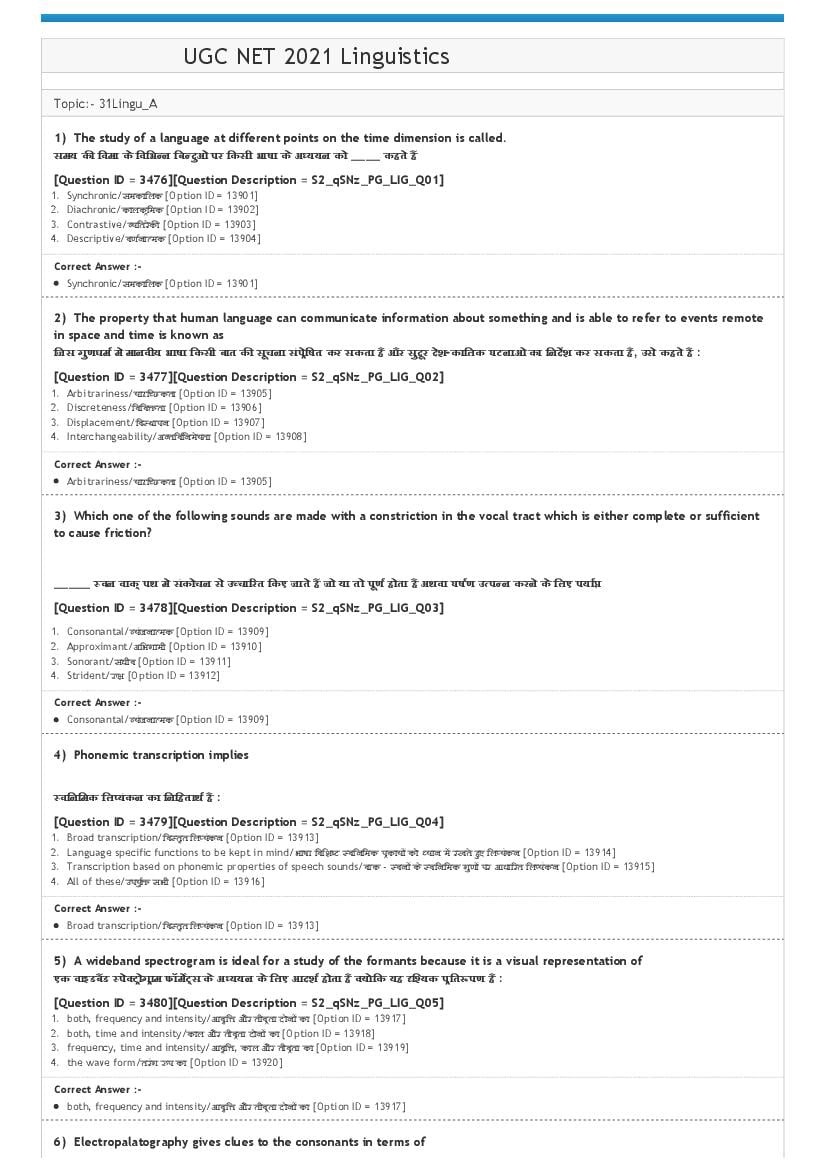
Topic:‐ 31Lingu_A
1) The study of a language at different points on the time dimension is called.
समय क िवमा के िविभ न िब दुओं पर िकसी भाषा के अ ययन को ____ कहते ह
[Question ID = 3476][Question Description = S2_qSNz_PG_LIG_Q01]
1. Synchronic/समकािलक [Option ID = 13901]
2. Diachronic/कालकिमक [Option ID = 13902]
3. Contrastive/ यितरेक [Option ID = 13903]
4. Descriptive/वणना मक [Option ID = 13904]
Synchronic/समकािलक [Option ID = 13901]
2) The property that human language can communicate information about something and is able to refer to events remote
in space and time is known as
िजस गुणधम म मानवीय भाषा िकसी बात क सूचना संपेिषत कर सकता है और सुदरू देश‐कािलक घटनाओं का िनदश कर सकता है, उसे कहते है :
[Question ID = 3477][Question Description = S2_qSNz_PG_LIG_Q02]
1. Arbitrariness/या ि छकता [Option ID = 13905]
2. Discreteness/िविव ता [Option ID = 13906]
3. Displacement/िव थापन [Option ID = 13907]
4. Interchangeability/अ तिविनमेयता [Option ID = 13908]
Arbitrariness/या ि छकता [Option ID = 13905]
3) Which one of the following sounds are made with a constriction in the vocal tract which is either complete or sufficient
to cause friction?
_____ वन वाक् पथ म संकोचन से उ चा रत िकए जाते ह जो या तो पूण होता है अथवा घष ण उ प न करने के िलए पया
[Question ID = 3478][Question Description = S2_qSNz_PG_LIG_Q03]
1. Consonantal/ यंजना मक [Option ID = 13909]
2. Approximant/अिभगामी [Option ID = 13910]
3. Sonorant/सघीव [Option ID = 13911]
4. Strident/ [Option ID = 13912]
Consonantal/ यंजना मक [Option ID = 13909]
4) Phonemic transcription implies
विनिमक िल यंकन का िनिहताथ है :
[Question ID = 3479][Question Description = S2_qSNz_PG_LIG_Q04]
1. Broad transcription/िव तृत िल यंकन [Option ID = 13913]
2. Language specific functions to be kept in mind/भाषा िविश विनिमक पकाय को यान म रखते हए िल यंकन [Option ID = 13914]
3. Transcription based on phonemic properties of speech sounds/वाक ‐ वन के विनिमक गुण पर आधा रत िल यंकन [Option ID = 13915]
4. All of these/उपयु सभी [Option ID = 13916]
Broad transcription/िव तृत िल यंकन [Option ID = 13913]
5) A wideband spectrogram is ideal for a study of the formants because it is a visual representation of
एक वाइडबड पे टोगाम फॉम स के अ ययन के िलए आदश होता है य िक यह ि यक पित पण है :
[Question ID = 3480][Question Description = S2_qSNz_PG_LIG_Q05]
1. both, frequency and intensity/आवृि और तीवता दोन का [Option ID = 13917]
2. both, time and intensity/काल और तीवता दोन का [Option ID = 13918]
3. frequency, time and intensity/आवृि , काल और तीवता का [Option ID = 13919]
4. the wave form/तरंग प का [Option ID = 13920]
both, frequency and intensity/आवृि और तीवता दोन का [Option ID = 13917]
6) Electropalatography gives clues to the consonants in terms of
Page 2
े देता है :
[Question ID = 3481][Question Description = S2_qSNz_PG_LIG_Q06]
1. place of articulation/उ चारण थल [Option ID = 13921]
2. manner of articulation/उ चारण क िविध [Option ID = 13922]
3. voice and aspiration features/घोष और महापाण अिभल ण [Option ID = 13923]
4. fricative and affrication features/घष और अनुघषण अिभल ण [Option ID = 13924]
place of articulation/उ चारण थल [Option ID = 13921]
7) Examples like 'smog', 'motel' and 'brunch' are the cases of the word ‐ formation strategy called
' मॉग', 'मॉटेल' और 'बच
ं ' जैसे उदाहरण िन निलिखत म से िकस श दिनमाण कायनीित के मामले ह :
[Question ID = 3482][Question Description = S2_qSNz_PG_LIG_Q07]
1. Suppletion/सवादेश [Option ID = 13925]
2. Backformation/सा य मूलक यु पि [Option ID = 13926]
3. Blending/िमशण [Option ID = 13927]
4. Clipping/कतरन [Option ID = 13928]
Suppletion/सवादेश [Option ID = 13925]
8) A morpheme which is realized by more than one morph in some phonological environment is called :
कुछ िपम जो कुछ विनिमक प रवेश म एक से अिधक प ारा उ चा रत होते ह, या कहे जाते ह :
[Question ID = 3483][Question Description = S2_qSNz_PG_LIG_Q08]
1. Suppletive/सवादेशा मक
[Option ID = 13929]
2. Portmanteau/संपृ
[Option ID = 13930]
3. Allophone/उप वन
[Option ID = 13931]
4. Allomorph/उप प
[Option ID = 13932]
Suppletive/सवादेशा मक
[Option ID = 13929]
9) The morpheme '‐ s' in a sentence 'She eats an apple' ,which is an example of third person, singular and present simple
tense marker in English, is known as
अंगेजी म 'शी इ स (eats) एन ए पल' वा य म िपम ‐ S जो थड पसन, एकवचन और सामा य वतमान काल िच का उदाहरण है, या कहा जाता है ‐
[Question ID = 3484][Question Description = S2_qSNz_PG_LIG_Q09]
1. Grammaticalized morpheme/ याकरणीकृत िपम
[Option ID = 13933]
2. Cliticized morpheme/युि क िपम
[Option ID = 13934]
3. Portmanteau morpheme/संपृ
[Option ID = 13935]
4. Subtractive morpheme/ यवकलक िपम
[Option ID = 13936]
Grammaticalized morpheme/ याकरणीकृत िपम
[Option ID = 13933]
10) In English, we use the shortened forms 'they'll' and 'he's' for 'they will' & 'he has (is)'. These are examples of
अंगेजी म हम 'they will' और 'he has (is)' के िलए संि प 'they'll' और 'he's' का पयोग करते ह, यह िन निलिखत म से िकसका उदाहरण है :
[Question ID = 3485][Question Description = S2_qSNz_PG_LIG_Q10]
Page 3
2. proclitic/प ाशयी [Option ID = 13938]
3. syncretic/समि जत [Option ID = 13939]
4. special clitic/िवशेष आशयी [Option ID = 13940]
enclitic/पूवाशमी [Option ID = 13937]
11) In the sentence 'I saw the girl who was a teacher', 'who was a teacher' is a/an
वा य 'आई सॉ द गल ह वाज़ ए टीचर' म 'ह वाज़ ए टीचर' है :
[Question ID = 3486][Question Description = S2_qSNz_PG_LIG_Q11]
1. S/एस
[Option ID = 13941]
2. NP/एन पी
[Option ID = 13942]
3. VP/वी पी
[Option ID = 13943]
4. Adjectie P/िवशेषण पी
[Option ID = 13944]
S/एस
[Option ID = 13941]
12) In the sentence, ' I felt that the fruit was not fresh', 'that' is a
वा य 'आई फे ट दैट द फ ू ट वाज नॉट फ े श', म है :
[Question ID = 3487][Question Description = S2_qSNz_PG_LIG_Q12]
1. Noun/सं ा [Option ID = 13945]
2. Co‐ordinating Conjunction/समानािधकरण समु चयबोधक [Option ID = 13946]
3. Complementizer/पूरणकारी [Option ID = 13947]
4. Adverb/िकया िवशेषण [Option ID = 13948]
Noun/सं ा [Option ID = 13945]
13) From the perspective of grammatical analysis, as part of a two‐way classification of syntactic constructions using
distributional criteria, which of the following is exocentric?
वा या मक रचना के ि भागी वग करण के प म याकरिणक ि कोण से िन निलिखत म से कौन अंतःकिदत है ?
[Question ID = 3488][Question Description = S2_qSNz_PG_LIG_Q13]
1. a tall boy/अ टॉल बॉय
[Option ID = 13949]
2. on the table/ऑन द टेबल
[Option ID = 13950]
3. the cake with cream/द केक िवद कीम
[Option ID = 13951]
4. will be going/िवल बी गोइंग
[Option ID = 13952]
a tall boy/अ टॉल बॉय
[Option ID = 13949]
14) Which of the following is not true for covert movement in Government and Binding framework?
जी बी (GB) मॉडल म ढांचे म अपकट संचलन के िलए िन निलिखत म से कौन सही नह है ?
[Question ID = 3489][Question Description = S2_qSNz_PG_LIG_Q14]
Page 4
2. It is a semantic movement/यह एक अथिव ानी संचलन है [Option ID = 13954]
3. Its output has a phonetic reflex/इसक प रणित म एक विनक पितवत होता है [Option ID = 13955]
4. Examples include 'wh‐', 'in situ', expletive replacement, and anaphor raising/इसके उदाहरण म 'ड यू एच' 'इन सीटू ' अनुपूरक पित थापन और अ वादेश उ थापन शािमल है
[Option ID = 13956]
It takes place from S‐ structure to LF/यह S ‐ संरचना से LF संरचना क ओर घिटत होता है [Option ID = 13953]
15) The modern study of speech acts begins with Austin's (1962) engaging monograph "How to do things with words", the
published version of his William James Lectures, delivered at Harvard in the year
वाक् यापार का आधुिनक अ ययन हारवड म िदए गए िविलयम जे स या यान के ऑि टन (1962) के पकािशत पांतर रोचक िविनबंध (मोनोगाफ) ''हाउ टू डु
िथं स िवद व स'' के साथ िकस वष पारंभ हआ
[Question ID = 3490][Question Description = S2_qSNz_PG_LIG_Q15]
1. 1955
[Option ID = 13957]
2. 1957
[Option ID = 13958]
3. 1954
[Option ID = 13959]
4. 1952
[Option ID = 13960]
1955
[Option ID = 13957]
16) Implicature is a component of speaker meaning that constitutes an aspect of what is meant in a speaker's
utterance without being part of
िनिहताथ व ा के अिभपाय का वह घटक है जो िन निलिखत का िह सा हए िबना व ा के कथन का पहलू है :
[Question ID = 3491][Question Description = S2_qSNz_PG_LIG_Q16]
1. What is said/जो कहा जाता है
[Option ID = 13961]
2. What is understood/जो समझा जाता है
[Option ID = 13962]
3. What is asked for/जो माँगा जाता है
[Option ID = 13963]
4. What is not being asked/जो पूँछा नह जा रहा है
[Option ID = 13964]
What is said/जो कहा जाता है
[Option ID = 13961]
17) The term Discourse Marker (D.M.) is generally used to refer to a syntactically heterogenous class of expressions which
are distinguished by their
िड कोस माकर (डी. एम) पद का पयोग सामा यतः वा य िव यासा मक प से िवषमांगी अिभ यि य के उ लेख के िलए िकया जाता है जो िन निलिखत म से
िकसके ारा पहचाने जाते ह :
[Question ID = 3492][Question Description = S2_qSNz_PG_LIG_Q17]
1. Function in discourse/पोि म पकाय [Option ID = 13965]
2. Meaning in discourse/पोि म अथ [Option ID = 13966]
3. Category in discourse/पोि म शण
े ी [Option ID = 13967]
4. Purpose in discourse/पोि म पयोजन [Option ID = 13968]
Function in discourse/पोि म पकाय [Option ID = 13965]
18) A term or expression that expresses negative feelings or attitude towards the referent, such as 'rag' for newspaper is
known as
Page 5
[Question ID = 3493][Question Description = S2_qSNz_PG_LIG_Q18]
1. Euphemism/िश ोि [Option ID = 13969]
2. Dysphemism/दुवािचता (िड फेिम म) [Option ID = 13970]
3. Equipollent antonyms/समतुिलत िवपरीताथक [Option ID = 13971]
4. Equipollent opposition/समतुिलत िवरोध [Option ID = 13972]
Euphemism/िश ोि [Option ID = 13969]
19) A ___________ change is one which does affect the inventory of phonemes by adding to or deleting from the number
of phonemes of the language or one in which one phoneme changes into another phoneme
______ प रवतन म भाषा के विनम को सं या म जोड़ या घटाव के ारा विनम सूची पभािवत होती है, अथवा इसम एक विनम दूसरे विनम म प रवितत हो
जाता है
[Question ID = 3494][Question Description = S2_qSNz_PG_LIG_Q19]
1. allophonie/अ विनक [Option ID = 13973]
2. non‐phonemie/गैर ‐ विनिमक [Option ID = 13974]
3. phonemic/ विनिमक [Option ID = 13975]
4. shift/प रवृि [Option ID = 13976]
allophonie/अ विनक [Option ID = 13973]
20) The English word 'female', which was earlier 'femelle', acquired its present form under the influence of 'male' and it is
an example of
अंगेजी के श द 'female', जो पहले 'femelle' था, ने 'male' श द के पभाव म अपना वतमान व प गहण िकया और या ________ का उदाहरण है :
[Question ID = 3495][Question Description = S2_qSNz_PG_LIG_Q20]
1. split/िवखंडन [Option ID = 13977]
2. conditioned change/सोपािधक प रवतन [Option ID = 13978]
3. unconditioned change/िन पािधक प रवतन [Option ID = 13979]
4. analogical change/सा यमूलक प रवतन [Option ID = 13980]
split/िवखंडन [Option ID = 13977]
21) Who proposed the 'wave model' which was an indirect challenge to the Neogrammarian view of sound change?
______ ारा प तािवत 'वेव मॉडल' वन प रवतन के नववैयाकरिणक ि कोण को अप य चुनौती थी :
[Question ID = 3496][Question Description = S2_qSNz_PG_LIG_Q21]
1. Johannes Schmidt/जोहांस ि मट [Option ID = 13981]
2. Karl Brugmann/काल बुगमैन [Option ID = 13982]
3. Hermann Osthoff/हमन ओ टॉफ [Option ID = 13983]
4. Jakob Grimm/जैकब िगम [Option ID = 13984]
Johannes Schmidt/जोहांस ि मट [Option ID = 13981]
22) The area which preserves linguistic features of an earlier stage of development is called a
वह ेत जो िवकास क पूवाव था के भािषक अिभल ण का प रर ण करता है ______ ेत कहलाता है :
[Question ID = 3497][Question Description = S2_qSNz_PG_LIG_Q22]
1. focal area/कदीय त े [Option ID = 13985]
2. relic area/अवशेष त े [Option ID = 13986]
3. transition area/संकमण त े [Option ID = 13987]
4. linguistic area/भाषािव ानी ते [Option ID = 13988]
focal area/कदीय त
े [Option ID = 13985]
23) Which of the following is NOT true for language determination?
भाषा िनधारण के िलए िन निलिखत म से कौन ‐सा कथन स य नह है ?
[Question ID = 3498][Question Description = S2_qSNz_PG_LIG_Q23]
Page 6
2. It describes that aspect of language planning which is concerned with the allocation of languages or language varieties to specific functions in a
given society/यह इस बात का वणन करता है िक भाषा योजना का प , िजसका संबधं िकसी समाज म भाषा आबंटन अथवा भाषा के पकार से होता है, उसका िविश काय होता है [Option ID
= 13990]
3. It is concerned with matters such as the choice of an official language, medium of instruction, regulation of language use in courts, etc./यह िविभ न
बात जैसे िक राजभाषा, िश ा का मा यम, यायालय आिद म भाषा पयोग के अिधिनयम आिद के चयन से संबिं धत है [Option ID = 13991]
4. Heinz Kloss referred to this aspect of language planning as status planning./हाईंज़ लॉस ने तर योजना के प म भाषा योजना के इस प को नह माना [Option ID =
13992]
It was introduced by Sapir/इसे सपीर ारा पेश िकया गया [Option ID = 13989]
24) A language is considered endangered if
िकसी भाषा को उस समय संकटाप न माना जाता है जब
[Question ID = 3499][Question Description = S2_qSNz_PG_LIG_Q24]
1. there is no risk that it will no longer be spoken/इसम कोई जोिखम नह होता िक उसे भिव य म बोला नह जाएगा
[Option ID = 13993]
2. there is no generational decline in the percentage of children who learn to speak it./भाषा सीखने वाले ब च क सं या म पीढ़ीगत हास नह होगा
[Option ID = 13994]
3. the number of speakers is very small and there is no decline in the proportion of children learning it./बोलने वाल क सं या बहत कम है तथा इसे सीखने वाले
ब च क सं या म सानुपाितक हास नह हआ है
[Option ID = 13995]
4. there is a renewed interest in ethnic identity among the speakers of the language./भाषा के बोलने वाल म जातीय पहचान म नई अिभ िच बनी हई है
[Option ID = 13996]
there is no risk that it will no longer be spoken/इसम कोई जोिखम नह होता िक उसे भिव य म बोला नह जाएगा
[Option ID = 13993]
25) Lesley Milroy's work in Belfast (1987) showed that
बेलफा ट (1987) म ले ली िमलरॉय का काय यह दशाता है िक
[Question ID = 3500][Question Description = S2_qSNz_PG_LIG_Q25]
1. Speakers who were closely integrated into local community networks maintained linguistic forms characteristic of the local dialect more frequently
than other speakers./वे व ा जो थानीय समुदाय नेटवक म पूव पेण जुड़े होते ह, वे थानीय बोली के भािषक प के गुण को दूसरे व ाओं क तुलना म पायः अिधक कायम रखते ह
[Option ID = 13997]
2. Speakers who were not closely integrated into local community networks maintained linguistic forms characteristic of the local dialect more
frequently than other speakers./वे व ा जो थानीय समुदाय नेटवक म पूण पेण नह जुड़े होते ह, वे थानीय बोली के भािवक प के गुण को दूसरे व ाओं क तुलना म पायः अिधक
कायम रखते ह
[Option ID = 13998]
3. Speakers who were closely integrated into local community networks did not maintain linguistic forms characteristic of the local dialect more
frequently than other speakers./वे व ा जो थानीय समुदाय नेटवक म पूव पेण जुड़े होते ह वे थानीय बोली के भािषक प के गुण को दूसरे क तुलना म पायः अिधक कायम नह रखते
ह
[Option ID = 13999]
4. Speakers who were not closely integrated into local community networks did not maintain linguistic forms characteristic of the local dialect more
frequently than other speakers./वे व ा जो थानीय समुदाय नेटवक म पूण पेण थानीय बोली के भािषक प के गुण को दूसरे म पायः अिधक कायम नह रखते ह
[Option ID = 14000]
Speakers who were closely integrated into local community networks maintained linguistic forms characteristic of the local dialect more frequently
than other speakers./वे व ा जो थानीय समुदाय नेटवक म पूव पेण जुड़े होते ह, वे थानीय बोली के भािषक प के गुण को दूसरे व ाओं क तुलना म पायः अिधक कायम रखते ह
[Option ID = 13997]
26) A linguistic feature regarded as distinctive of a particular group is called
ऐसा भािषक गुण िजसे िकसी िनि त समूह का िविश अिभल ण माना जाता है उसे या कहा जाता है ?
[Question ID = 3501][Question Description = S2_qSNz_PG_LIG_Q26]
1. Shibboleth/िशबोलेथ [Option ID = 14001]
2. Social network/सोशल नेटवक [Option ID = 14002]
3. Ego‐network/ईगो ‐ नेटवक [Option ID = 14003]
4. Tenor/टेनॉर [Option ID = 14004]
Page 7
27) Kashmiri is unique in subcontinental NIA in possessing an almost complete set of
उपमहा ीपीय NIA म क मीरी क अन य िवशेषता है िक इसम का लगभग संपूण समु चय होता है ‐
[Question ID = 3502][Question Description = S2_qSNz_PG_LIG_Q27]
1. Palatalized consonants/ताल यरंिजत यंजन का [Option ID = 14005]
2. Aspirated consonants/महापाण यंजन का [Option ID = 14006]
3. Retroflex consonants/पितवेि त यंजन का [Option ID = 14007]
4. Glottalized consonants/ ासरंिजत यंजन का [Option ID = 14008]
Palatalized consonants/ताल यरंिजत यंजन का [Option ID = 14005]
28) Indo Aryan languages are
इंडो ‐ आयन भाषाओं म
[Question ID = 3503][Question Description = S2_qSNz_PG_LIG_Q28]
1. rich in native fricatives/देशीय घिषय क पचुरता होती है [Option ID = 14009]
2. rich in glottalized consonants/ ासरंिजत यंजन क पचुरता होती है [Option ID = 14010]
3. poor in native fricatives/देशीय घिषय क कमी होती है [Option ID = 14011]
4. poor in aspirated consonants/महापाण ‐ यंजन क कमी होती है [Option ID = 14012]
rich in native fricatives/देशीय घिषय क पचुरता होती है [Option ID = 14009]
29) In language typology, the classification of languages into types is based on
भाषा पा पिव ान म भाषाओं का प प म वग करण िन निलिखत म से िकस पर आधा रत होता है ?
[Question ID = 3504][Question Description = S2_qSNz_PG_LIG_Q29]
1. written records of languages/भाषाओं के िलिखत रकॉड [Option ID = 14013]
2. general structural features of languages/भाषाओं के सामा य संरचना मक अिभल ण [Option ID = 14014]
3. areal proximity of languages/भाषाओं क त े ीय िनकटता [Option ID = 14015]
4. phonetic similarities of languages alone/केवल भाषाओं क विनक समानताएँ [Option ID = 14016]
written records of languages/भाषाओं के िलिखत रकॉड [Option ID = 14013]
30) A line drawn on a map to mark the boundary of an area in which a particular linguistic feature is used is known as
िजस ेत म िकसी िवशेष भािषक अिभल ण का पयोग होता है, मानिचत पर उसक सीमा दशाने के िलए ख ची गई रेखा को कहते ह :
[Question ID = 3505][Question Description = S2_qSNz_PG_LIG_Q30]
1. an isomorph/सम प सीमारेखा [Option ID = 14017]
2. an isophone/सम वन सीमारेखा [Option ID = 14018]
3. an isosyntagm/समवा य सीमारेखा [Option ID = 14019]
4. an isogloss/समभाषांश सीमारेखा [Option ID = 14020]
an isomorph/सम प सीमारेखा [Option ID = 14017]
31) Motor speech disorder that compromises the sequential, articulatory movements that are required to produce speech
and are believed to result from a breakdown in motor speech programming is called :
शारी रक वाग दोष िजसम वाक् उ चारण के िलए अपेि त कमगत, उ चारणगत संचलन म परेशानी होती है, जो मोटर पीच पोगािमंग म गड़बड़ी के कारण होता है,
या कहा जाता है :
[Question ID = 3506][Question Description = S2_qSNz_PG_LIG_Q31]
1. Expressive aphasia/अिभ यि भाषाघात [Option ID = 14021]
2. Dysarthria/िडसािथया [Option ID = 14022]
3. Apraxia of speech/वाक् चे ा ‐ अ मता [Option ID = 14023]
4. Asperger's syndrome/ए पजर िसंडोम [Option ID = 14024]
Expressive aphasia/अिभ यि भाषाघात [Option ID = 14021]
32) The concepts of BICS and CALP were proposed by
Page 8
[Question ID = 3507][Question Description = S2_qSNz_PG_LIG_Q32]
1. Jim Cummins/िजम किमंस [Option ID = 14025]
2. Noam Chomsky/नोम चॉ क [Option ID = 14026]
3. B.F. Skinner/बी. एफ. ि कनर [Option ID = 14027]
4. Dell Hymes/डेल हाइ स [Option ID = 14028]
Jim Cummins/िजम किमंस [Option ID = 14025]
33) Patient‐centred approaches to language assessment aim to
भाषा मू यांकन के पित रोगी किदत ि कोण का उ े य है :
[Question ID = 3508][Question Description = S2_qSNz_PG_LIG_Q33]
1. describe the patient's language deficit & ability to communicate in an everyday situation/दैनंिदन प रि थित म रोगी क भाषा क कमी और स पष
े ण क यो यता का
वणन करना [Option ID = 14029]
2. determine to what extent the patient's language conforms to normalcy conditions/यह िनधा रत करना िक िकस हद तक रोगी क भाषा सामा यतः प रि थितय के अनुकल ू
है [Option ID = 14030]
3. determine to what extent the patient's performance is influenced by age, sex, culture and other such factors./यह िनधा रत करना िक रोगी का काय िन पादन
िकस हद तक आयु, िलंग, सं कृित और अ य ऐसे कारक ारा पभािवत होता है [Option ID = 14031]
4. All of the above/उपयु सभी [Option ID = 14032]
describe the patient's language deficit & ability to communicate in an everyday situation/दैनंिदन प रि थित म रोगी क भाषा क कमी और स पष
े ण क यो यता का
वणन करना [Option ID = 14029]
34) A dictionary whose macrostructure is characterized by the letter arrangement lemmata within the word list is
ऐसा श दकोष िजसक वृहत् संरचना क िवशेषता श दसूची के भीतर लेमाटा क अ र यव था है :
[Question ID = 3509][Question Description = S2_qSNz_PG_LIG_Q34]
1. Analogical dictionary/सा य मूलक श दकोष [Option ID = 14033]
2. Etymological dictionary/ यु पि मूलक श दकोष [Option ID = 14034]
3. Alphabetical dictionary/वणकमानुसार श दकोष [Option ID = 14035]
4. Ideographic dictionary/भावलेखीय श दकोष [Option ID = 14036]
Analogical dictionary/सा य मूलक श दकोष [Option ID = 14033]
35) A search procedure through which required lexicographic data can be found in a dictionary is known as
अ वेषण पिकया िजसके मा यम से अपेि त श दकोषीय डाटा श दकोष म पाए जा सकते ह :
[Question ID = 3510][Question Description = S2_qSNz_PG_LIG_Q35]
1. Dictionary Algorithm/श दकोष कलनिविध (अलगो र ) [Option ID = 14037]
2. Designatum/अिभधेय [Option ID = 14038]
3. Denotation/वा याथ [Option ID = 14039]
4. Definiedum/प रभा य [Option ID = 14040]
Dictionary Algorithm/श दकोष कलनिविध (अलगो र ) [Option ID = 14037]
36) Choose the most appropriate answer on the basis of the statements given below
A. Valmiki's Ramayana was composed in pre‐historic times.
B. A grammar written on this text is called a traditional grammar.
C. A grammar written on this text is called a synchronic grammar.
D. A grammar written on this text is called a diachronic grammar.
Choose the most appropriate answer from the options given below:
िन निलिखत कथन के आधार पर सवािधक उपयु उ र का चयन कर :
A. वा मीिक के ''रामायण'' क रचना पागैितहािसक काल म हई थी
B. इस पाठ पर िलिखत याकरण को परंपरागत याकरण कहते ह
C. इस पाठ पर िलिखत याकरण को समकािलक याकरण कहते ह
D. इस पाठ पर िलिखत याकरण को कालकिमक याकरण कहते ह
नीचे िदए गए िवक प म से सही उ र का चयन क िजए :
Page 9
1. A and B only/केवल A और B [Option ID = 14041]
2. A and C only/केवल A और C [Option ID = 14042]
3. A and D only/केवल A और D [Option ID = 14043]
4. A, B and D only/केवल A, B और D [Option ID = 14044]
A and B only/केवल A और B [Option ID = 14041]
37) Which of the following statements are true?
A. A natural class is a group of sounds described by a small number of distinctive features
B. A natural class is a group of sounds described by a large number of distinctive features.
C. Any individual member of a distinctive class would require fewer features in its description than the class itself.
D. Any individual member of a distinctive class would require more features in its description than the class itself.
Choose the correct answer from the options given below
िन निलिखत म से कौन से कथन सही ह ?
A. एक पकृत वग वन का एक समूह होता है जो एक छोटी सं या म िविश गुण से प रभािषत होता है
B. एक पकृत वग वन का एक समूह होता है जो एक बड़ी सं या म िविश गुण से प रभािषत होता है
C. एक यावतक वग के िकसी सद य िवशेष के िववरण के िलए इसके वग क तुलना म कम अिभल ण अपेि त ह गे
D. एक यावतक वग के िकसी सद य िवशेष के िववरण के िलए इसके वग क तुलना म अिभल ण अपेि त ह गे
नीचे िदए गए िवक प म से सही उ र का चयन क िजए :
[Question ID = 3512][Question Description = S2_qSNz_PG_LIG_Q37]
1. A and C only [Option ID = 14045]
2. B and C only [Option ID = 14046]
3. A and D only [Option ID = 14047]
4. B and D only [Option ID = 14048]
A and C only [Option ID = 14045]
38) The basic difference between a zero morph and an empty morph is that:
A. Both zero and empty morphs have forms and meaning
B. Empty morph has form but no meaning
C. Zero morph has no form but has meaning
D. Both empty and zero morphs have no form and no meaning
Choose the most appropriate answer from the options given below:
शू य प और र प के बीच मूल अंतर यह है िक :
A. शू य और र प दोन के आकार और अथ होते ह
B. र प के प होते ह, लेिकन इसका अथ नह होता ह
C. शू य प का आकार नह होता है; लेिकन अथ होता है
D. र और शू य प दोन के न आकार होते ह और न अथ
नीचे िदए गए िवक प म से सही उ र का चयन क िजए :
[Question ID = 3513][Question Description = S2_qSNz_PG_LIG_Q38]
1. A and C only/केवल A और C [Option ID = 14049]
2. A and B only/केवल A और B [Option ID = 14050]
3. B and C only/केवल B और C [Option ID = 14051]
4. B, C and D only/केवल B, C और D [Option ID = 14052]
A and C only/केवल A और C [Option ID = 14049]
39) Which of the following are true about the word‐formation processes?
A. Abbreviated words such as www, URL and http are called abbreviations as they cannot be pronounced as words
B. Abbreviated words such as UNESCO, NATO, AIIMS and ISRO are called acronyms as they can be pronounced as words.
Page 10
pronounced as words
D. Shortened words such as 'brunch' for breakfast and lunch and 'motel' for motor and hotel are called 'Blend words'
Choose the most appropriate answer from the options given below:
िन निलिखत म से श दिनमाण प िक याओं के संबंध म या सही है ?
A. www, URL और http जैसे संि श द, श द सं ेप कहे जाते ह योिक उनका उ चारण श द क तरह नह हो सकता है
B. यूने को, नाटो, ए स और इसरो जैसे संि श द प रवण कहे जाते ह य िक उनका उ चारण श द क तरह होता है
C. Advertisement के िलए 'ad' और Professor के िलए 'Prof' जैसे लघुकत
ृ श द को भी प रवण कहा जाता है य िक उनका भी उ चारण श द क तरह
िकया जा सकता है
D. 'Breakfast' और 'Lunch' के िलए लघुकत
ृ श द 'brunch' और motor और hotel के िलए Motel का िमश ( ल स) कहते ह
नीचे िदए गए िवक प म से सही उ र का चयन क िजए :
[Question ID = 3514][Question Description = S2_qSNz_PG_LIG_Q39]
1. A and C only/केवल A और C [Option ID = 14053]
2. B, C and D only/केवल B, C और D [Option ID = 14054]
3. A, B, C and D only/A, B, C और D [Option ID = 14055]
4. A, B and D only/केवल A, B और D [Option ID = 14056]
A and C only/केवल A और C [Option ID = 14053]
40) Which of the following are true about compound words in English?
A. Compounds such as 'blue tooth' and 'deadline' are called exocentric compounds as none of them has a head‐word.
B. Compounds such as 'boy‐friend' and 'North‐East' are called copulative compounds as both words act as head‐ words.
C. Words such as 'bedroom', 'classroom' and 'bathroom' are called left‐headed endocentric compounds as the left‐hand word
acts as the head‐word.
D. Words such as 'notary‐public' and 'attorney‐general' are called right‐ headed endocentric compounds as the right‐hand
word acts as the head‐ word.
E. Words such as cranberry, blueberry and strawberry are called neo‐classical compounds as it is hard to decide the head‐
word in these examples.
Choose the correct answer from the options given below:
अंगेजी म संयु श द के बारे म िन निलिखत म से कौन से कथन सही ह ?
A. ' लूटूथ' और 'डेडलाइन' जैसे संयु श द अ तः केि दक सम त श द कहे जाते ह य िक इनम से कोई हेड ‐ वड नह ह
B. ' वॉय फ ड' और 'नाथ ‐ ई ट' जैसे सम त श द कहे जाते ह य िक दोन श द हेड ‐ वड के प म काय करते ह
C. बेड म, लास म और बाथ म जैसे श द ले ट हडेड अंतः किदक समास कहे जाते ह य िक ले ट ह ड श द हेड वड के प म काय करते ह
D. नोटरी पि लक कर अटॉन जेनरल जैसे श द राइट हेडड
े अ तः केि दक सम त श द कह जाते ह य िक राइट ह ड श द हेड वड क तरह काय करते ह
E. कैनबेरी, लूबेरी और टाबेरी जैसे श द नव लािसक सम त पद कहे जाते ह य िक इन उदाहरण म हेड वड का िनणय करना किठन है
नीचे िदए गए िवक प म से सही उ र का चयन क िजए :
[Question ID = 3515][Question Description = S2_qSNz_PG_LIG_Q40]
1. B, C and E only/केवल B, C और E [Option ID = 14057]
2. B, D and E only/केवल B, D और E [Option ID = 14058]
3. A, B and E only/केवल A, B और E [Option ID = 14059]
4. A, C and B only/केवल A, B और C [Option ID = 14060]
B, C and E only/केवल B, C और E [Option ID = 14057]
41) Regarding Control theory, which of the following are true
A. Control determines the potential for reference of the abstract pronominal elements PRO and pro
B. a PRO which is the subject of an embedded infinitive clause is said to be under the control of the main clause subject
after a verb like 'persuade'
C. a PRO which is the subject of an embedded infinitive clause is said to be under the control of the object of the verb, in
cases of a verb like 'promise'.
D. Certain uses of PRO are uncontrolled
Page 11
Choose the correct answer from the options given below:
कंटोल िस ांत के संबंध म िन निलिखत म से कौनसे कथन सही ह ?
A. कंटोल अमूत सावनािमक त व PRO और pro के संकेताथ के िलए मता अवधारणा करता है :
B. कोई PRO जो िकसी आ ाियत तुमथ उपवा य का कता है उसे 'पर यूड' जै स ी एक िकया के बाद मु य उपवा य क ा के िनयंतणाधीन कहा जाता है
C. कोई PRO जो िकसी आ ाियत तुमथ उपवा य का कता है, उसे 'पॉिमस' जै स ी एक िकया के बाद िकया के कम के िनयंतणाधीन कहा जाता है
D. PRO के कितपय पयोग अनकंटो ड होते ह
E. अनकंटो ड प रि थितय म PRO का या ि छक संकेताथ होता है और यह पूवपदीय NP से संदभ गहण नह करता है
नीचे िदए गए िवक प म से सही उ र का चयन क िजए :
[Question ID = 3516][Question Description = S2_qSNz_PG_LIG_Q41]
1. A, B and C only/केवल A, B और C [Option ID = 14061]
2. A, D and E only/केवल A, D और E [Option ID = 14062]
3. C, D and E only/केवल C, D और E [Option ID = 14063]
4. D and E only/केवल D और E [Option ID = 14064]
A, B and C only/केवल A, B और C [Option ID = 14061]
42) Which of the following are true in the sentence 'The boy will buy a car after the holidays'?
A. 'after the holidays' is a complement.
B. 'A car' is a complement.
C. 'buy' governs 'a car'.
D. 'Infl ' governs ' the boy '.
E. 'a car' m‐commands 'the boy'.
Choose the correct answer from the options given below:
'द बॉय िवल बाइ अ कार आ टर द होलीडेज' वा य के मामले म िन निलिखत म से कौन सही ह ?
A. 'आ टर द होलीडेज' एक पूरक है
B. 'अ कार' एक पूरक है
C. 'बाइ', 'अ कार' को िनयंितत करता है
D. 'Infl', 'द वॉय' को िनयंितत करता है
E. 'अ कार', 'द वॉय' को m ‐ कमांड करता है
नीचे िदए गए िवक प म से सही उ र का चयन क िजए :
[Question ID = 3517][Question Description = S2_qSNz_PG_LIG_Q42]
1. B, C and D only/केवल B, C और D [Option ID = 14065]
2. A, D and E only/केवल A, D और E [Option ID = 14066]
3. A, B, C and D only/केवल A, B, C और D [Option ID = 14067]
4. A, B and D only/केवल A, B और D [Option ID = 14068]
B, C and D only/केवल B, C और D [Option ID = 14065]
43) Within the Minimalist Program which of the following are true?
A. The computational system is a mechanism that arranges lexical items in such a manner so as to form a syntactic object.
B. These lexical items must converge or be interpreted at PF and LF.
C. To build a syntactic structure, the computational system accesses lexical items in the numeration.
D. Then it obligatorily selects two or three lexical items at a time and applies operation 'merge' to them.
E. During the derivations constituents must be checked for convergence or well‐formedness.
Choose the correct answer from the options given below:
अ पतमता कायकम (िमिनमिल ट कायकम) के अंदर िन निलिखत म से कौन से कथन सही ह?
A. अिभकलना मक ‐ पणाली एक ऐसा तंत है जो कोशगत मद को इस पकार यवि थत करता है िक एक वा या मक कम क रचना होती है
Page 12
C. वा या मक रचना िनमाण के िलए अिभकलना मक पणाली सं या मक प से कोशगत मद तक पहच
ं ता है
D. उसके बाद यह अिनवाय प से एक साथ दो या तीन कोशगत मद का चयन कर उनका िवलय करता है
E. श द ‐ साधन के दौरान अिभसरण अथवा सुयोजन के िलए आव यक प से जांच क जानी चािहए
नीचे िदए गए िवक प म से सही उ र का चयन क िजए :
[Question ID = 3518][Question Description = S2_qSNz_PG_LIG_Q43]
1. A and B only/केवल A और B [Option ID = 14069]
2. A, B and C only/केवल A, B और C [Option ID = 14070]
3. A, B, C and D only/केवल A, B, C और D [Option ID = 14071]
4. A, B, C and E only/केवल A, B, C और E [Option ID = 14072]
A and B only/केवल A और B [Option ID = 14069]
44) Which is TRUE for sign?
A. Signs can generally be classified as iconic or arbitrary.
B. Iconic signs are those, whose forms mirror their meanings in some respect.
C. No natural analogical correspondences between their forms and their meanings are called arbitrary.
D. The concept of sign does not appear in linguistics.
Choose the most appropriate answer from the options given below:
'िच ' (साइन) के िलए या सही है ?
A. िच (साइन) को सामा यतया अनुसक
ं त
े क तक या या ि छक िच क के प म वग कृत िकया जा सकता है
B. अनुसक
ं त
े क िच वे ह िजनके प कुछ संदभ म अपने अथ को पितिबि बत करते ह
C. श द और उनके अथ के बीच कोई वाभािवक समनु पता न होने के कारण या ि छक िच कहे जाते ह
D. िच (साइन) क अवधारणा भाषािव ान म नह है
नीचे िदए गए िवक प म से सही उ र का चयन क िजए :
[Question ID = 3519][Question Description = S2_qSNz_PG_LIG_Q44]
1. A and D only/केवल A और D [Option ID = 14073]
2. B and D only/केवल B और D [Option ID = 14074]
3. A, B and C only/केवल A, B और C [Option ID = 14075]
4. A, B, C and D only/A, B, C और D [Option ID = 14076]
A and D only/केवल A और D [Option ID = 14073]
45) Which is TRUE for polarity?
A. The determination of logical polarity depends on the fact that one negative cancels another.
B. In privative polarity one term is associated with the presence of something salient, and the other with its absence.
C. One term is evaluatively positive, or commendatory and the other is negative.
D. There is no relation between polarity and partiality.
Choose the most appropriate answer from the options given below:
धुवीयता के िलए या सही है :
A. तािकक धुवीयता इस त य पर िनभर करता है िक एक नकारा मक दूसरे को िनर त कर देता है
B. अभावसूचक धुवीयता (पाइवेिटव पोलरेटी) म एक पद दूसरे मह वपूण श द क िव मानता और दूसरा पद उसके अभाव से संबंिधत है
C. एक पद मू यांकना मक प से सकारा मक है, या पशंसा मक है और दूसरे नकारा मक है
D. धुवीयता और प पातपूणता के बीच कोई संबंध नह है
नीचे िदए गए िवक प म से सही उ र का चयन क िजए :
[Question ID = 3520][Question Description = S2_qSNz_PG_LIG_Q45]
1. A and D only/केवल A और D [Option ID = 14077]
2. B and D only/केवल B और D [Option ID = 14078]
3. A, B and C only/केवल A, B और C [Option ID = 14079]
4. A, B, C and D only/A, B, C और D [Option ID = 14080]
Page 13
46) Which is TRUE for meaning?
A. In PLEONASM, the examples give a feeling of redundancy.
B. In DISSONANCE, there is a sense of its matched meaning.
C. A sense of punning is an unmistakable system of ZEUGMA.
D. Many polysemous senses are not related metaphorically.
Choose the most appropriate answer from the options given below:
िन निलिखत म से या अथ के िलए सही है :
A. श दािध य म उदाहरण अिजं य का भाव देते ह
B. िवसंवािदता म मेिलत अथ का भाव है
C. ष
े का भाव यू मा क सु प प ित है
D. अनेक बह ‐ अथक भाव तुलना मक प से संबंिधत नह है
नीचे िदए गए िवक प म से सही उ र का चयन क िजए :
[Question ID = 3521][Question Description = S2_qSNz_PG_LIG_Q46]
1. A and D only/केवल A और D [Option ID = 14081]
2. B and D only/केवल B और D [Option ID = 14082]
3. A, B and C only/केवल A, B और C [Option ID = 14083]
4. A, B, C and D only/A, B, C और D [Option ID = 14084]
A and D only/केवल A और D [Option ID = 14081]
47) Regarding 'relative chronology' which of the following is/are correct?
A. 'Predictability' is the most useful factor in determining relative chronology.
B. 'Derivation' is the most reliable factor in determining relative chronology.
C. 'Internal reconstruction' is the most important factor in determining relative chronology.
D. 'Phonological changes' are the most useful features in determining relative chronology.
Choose the most appropriate answer from the options given below:
'सापेि क कालानुकमण' के संबंध म िन निलिखत म से कौन सही है/ ह ?
A. सापेि क कालानुकमण के अवधारण म 'पूवानुमेयता' सवािधक उपयोगी
B. सापेि क कालानुकमण के अवधारण म ' यु पि ' सवािधक िव सनीय
C. सापेि क कलानुकमण के अवधारण म 'अ या तर पुनरचना' सवािधक मह वपूण कारक है
D. सापेि क कालानुकमण के अवधारण म ' विनिमक प रवतन' सवािधक मह वपूण कारक है
नीचे िदए गए िवक प म से सही उ र का चयन क िजए :
[Question ID = 3522][Question Description = S2_qSNz_PG_LIG_Q47]
1. A only/केवल A
[Option ID = 14085]
2. A and B only/केवल A और B
[Option ID = 14086]
3. A, B and C only/केवल A, B और C
[Option ID = 14087]
4. A, B, C and D/A, B, C और D
[Option ID = 14088]
A only/केवल A
[Option ID = 14085]
Page 14
A. Coalescence
B. Assimilation
C. Coalescence and Epenthesis
D. Lexical diffusion
Choose the most appropriate answer from the options given below:
लैिटन श द 'Octo', िजसका अथ 'eight' है, इटैिलयन म 'otto' बन जाता है, यह िकस पकार का वन प रवतन है ?
A. संिध
B. समीभवन
C. संिध और अिपिनिहित
D. कोशगत िवसरण
नीचे िदए गए िवक प म से सही उ र का चयन क िजए :
[Question ID = 3523][Question Description = S2_qSNz_PG_LIG_Q48]
1. A only/केवल A [Option ID = 14089]
2. B only/केवल B [Option ID = 14090]
3. C only/केवल C [Option ID = 14091]
4. D only/केवल D [Option ID = 14092]
A only/केवल A [Option ID = 14089]
49) If in a language, the word for 'wrist' is one that is literally translated as 'hand‐neck', which category or categories should
it belong to?
A. Assimilated loan
B. Tadbhava
C. Loan translation
D. Loan blend
Choose the most appropriate answer from the options given below:
यिद िकसी भाषा म 'wrist' श द के िलए जो श द है उसका शाि दक अनुवाद 'hand neck' के प म िकया जाता है तो यह िकस / िकन शेणी / शेिणय से
संबंिधत होगा ?
A. समीभूत आगत
B. त व
C. आगत अनुवाद
D. आगत िमश श द
नीचे िदए गए िवक प म से सही उ र का चयन क िजए :
[Question ID = 3524][Question Description = S2_qSNz_PG_LIG_Q49]
1. A only/केवल A [Option ID = 14093]
2. A and B only/केवल A और B [Option ID = 14094]
3. C only/केवल C [Option ID = 14095]
4. C and D only/केवल C और D [Option ID = 14096]
A only/केवल A [Option ID = 14093]
50) Which of the following are true in the case of Restricted Code and Elaborated Code?
A. It is based on the premise that different classes within a society are marked by different types of social relations, and
corresponding to the class divisions of society is the linguistic dichotomy of an elaborated (middle class) code and a
restricted (lower class) code.
B. Elaborated code was said to be used in relatively formal, educated situations; not to be reliant for its meaningfulness on
extra linguistic content, and to permit speakers to be individually creative in their expression, and to use a range of
linguistic alternatives.
C. Elaborated code was said to be characterized linguistically by being highly predictable with a relatively high proportion of
such features as pronouns, tag questions, and use of gestures and intonation to convey meaning.
D. Restricted code was thought to be used in relatively informal situations, stressing the speaker's membership of a group,
Page 15
E. Restricted code was said to be characterized linguistically by a relatively high proportion of such features as subordinate
clauses, adjectives, the pronoun 'I' and passives.
Choose the most appropriate answer from the options given below:
प रसीिमत और यापक संिहता के संबंध म िन न म से कौन सही ह ?
A. यह इस अवधारणा पर आधा रत है िक समाज के भीतर के िविभ न वग के िभ न िभ न पकार के सामािजक संबंध होते ह और यापक संिहता (म यवग) और
प रसीिमत संिहता (िन न वग) का भािषक ि भाजन समाज के वग य िवभाजन के अनु प होता है
B. यापक संिहता को सापे तया औपचा रक, िशि त प रि थितय म पयोग िकया जाने वाला कहा जाता था; यह इसक साथकता या पराभािषक मू य के
पासंिगक नह था; इसम व ा अपनी अिभ यि म यि गत प से रचना मक हो सकते थे और अनेक भािषक िवक प का पयोग कर सकते थे
C. यापक संिहता को भािषक प से अ यंत अनुनेत कहा जाता जाता था िजसम अथ संपेषण के िलए सवनाम प बंध, अंगिव ेप का पयोग और आकतान जैसे
अिभल ण का सापे तः उ च अनुपात होता है
D. प रसीिमत संिहता को भािषक प से सापे तः आिशत उपवा य , िवशेषण , सवनाम 'मै' और कम जैसे अिभल ण के उ च अनुपात वाला कहा जाता था
नीचे िदए गए िवक प म से सही उ र का चयन क िजए :
[Question ID = 3525][Question Description = S2_qSNz_PG_LIG_Q50]
1. A and E only/केवल A और E [Option ID = 14097]
2. A, B and D only/केवल A, B और D [Option ID = 14098]
3. B, D and E only/केवल B, D और E [Option ID = 14099]
4. C and E only/केवल C और E [Option ID = 14100]
A and E only/केवल A और E [Option ID = 14097]
51) Which of the following are aspects of Corpus planning?
A. Development of a writing system
B. Promotion of an official language
C. Relativization of heritage language
D. Creation of new words
E. Promotion as a national language
Choose the most appropriate answer from the options given below:
िन निलिखत म से कौन से काियक िनयोजन के प ह?
A. लेखन पणाली का िवकास
B. राजभाषा के प म िवकास
C. धरोहर भाषा का पुनः थानीयकरण
D. नए श द का सृजन
E. रा भाषा के प म िवकास
नीचे िदए गए िवक प म से सही उ र का चयन क िजए :
[Question ID = 3526][Question Description = S2_qSNz_PG_LIG_Q51]
1. A, B, C and D only/केवल A , B, C और D [Option ID = 14101]
2. B, C and D only/केवल B, C और D [Option ID = 14102]
3. B and D only/केवल B और D [Option ID = 14103]
4. A and D only/केवल A और D [Option ID = 14104]
A, B, C and D only/केवल A , B, C और D [Option ID = 14101]
52) Which of the following are true for ELAN?
A. This software allows the researcher to time‐align transcription and recording.
B. It is well suited to sociolinguistic work.
C. The researcher can make numerous dependent and independent annotations on any word or utterances.
D. Different speakers can only be transcribed on the same tier, and apart from one tier no new coding tiers can be added.
E. ELAN does not allow work from video.
Choose the correct answer from the options given below:
Page 16
A. यह सॉ टवेयर अनुसंधानकता को समय सापे िल यंकन और रकॉिडग क अनुमित देता है
B. यह समाज भाषा वै ािनक काय के िलए उपयु है
C. शोधकता िकसी श द, वाक् आिद के बारे म असं य वत त और अ वतंत या या करता है
D. एक ही तर पर िविभ न व ाओं को ही केवल िल यंकन िकया जा सकता है, एक तर को छोड़कर कोई तथा कोिडंग तर नह जोड़ा जा सकता है
E. ELAN वीिडयो ारा काय क अनुमित नह देता
नीचे िदए गए िवक प म से सही उ र का चयन क िजए :
[Question ID = 3527][Question Description = S2_qSNz_PG_LIG_Q52]
1. A, B and C only/केवल A, B और C [Option ID = 14105]
2. B, C and E only/केवल B, C और E [Option ID = 14106]
3. A, D and E only/केवल A, D और E [Option ID = 14107]
4. C, D and E only/केवल C, D और E [Option ID = 14108]
A, B and C only/केवल A, B और C [Option ID = 14105]
53) Which of the following is TRUE?
A. In Punjabi, the transformation of aspiration into tone devoices as well as deaspirates preceding stops.
B. In Punjabi, the transformation of aspiration into tone devoices as well as deaspirates following stops.
C. Loss of aspiration in the Dardic group of languages results in aspirated voiced stops.
D. Loss of aspiration in the Dardic group of languages results in aspirated voiceless stops.
E. Loss of aspiration in the Dardic group of languages results in aspirated voiced nasals.
Choose the correct answer from the options given below:
िन निलिखत म से कौन सा कथन सही है ?
A. पंजाबी म महापाण व के तान म पांत रत होने से पूववत पश का अघोषीकरण और उनके महापाण व का लोप होता है
B. पंजाबी म महापाण व के तान म पांत रत होने से अनुवत पश का अघोषीकरण और उनके महापाण व का लोप होता है
C. दािदक समूह क भाषाओं म महापाण व के लोप होने से महापाण सघोष पश उ प न होते ह
D. दािदक समूह क भाषाओं म महापाण व के लोप होने से महापाण अघोष पश उ प न होते ह
E. दािदक समूह क भाषाओं म महापाण व के लोप होने से महापाण सघोष अनुनािसक उ प न होते ह
नीचे िदए गए िवक प म से सही उ र का चयन क िजए :
[Question ID = 3528][Question Description = S2_qSNz_PG_LIG_Q53]
1. A only/केवल A [Option ID = 14109]
2. A and B only/केवल A और B [Option ID = 14110]
3. A, C and E only/केवल A, C और E [Option ID = 14111]
4. A, B, C and D only/केवल A, B, C और D [Option ID = 14112]
A only/केवल A [Option ID = 14109]
54) Which of the following is/are true about causativization?
A. The process of causativization increases the valence of the verb.
B. Causativization takes place either periphrastically or morphologically, or in both ways.
C. Both direct and indirect causation are found in all the languages.
D. It has been claimed typologically that the causative verb never places the causee in the nominative case.
Choose the most appropriate answer from the options given below:
पेरणाथक करण के िवषय म िन निलिखत म से कौन ‐ से कथन स य ह ?
A. पेरणाथक करण क पिकया िकया क संयोजन ‐ मता म वृि करती है
B. पेरणाथक करण िव त रत प म या पपिकया मक प म या दोन प म होता है
C. सभी भाषाओं म प य और अप य पेरण दोन पाए जाते ह
D. प पवै ािनक प से दावा िकया गया है िक पेरणाथक िकया कभी भी 'पे रत' को कता कारक म नह रखता है
नीचे िदए गए िवक प म से सही उ र का चयन क िजए :
Page 17
1. A and C only/केवल A और C [Option ID = 14113]
2. A, B and D only/केवल A, B और D [Option ID = 14114]
3. A and D only/केवल A और D [Option ID = 14115]
4. C and D only/केवल C और D [Option ID = 14116]
A and C only/केवल A और C [Option ID = 14113]
55) 'Communicative Language Teaching'
A. emphasizes using techniques that engage learners in the pragmatic, authentic, functional use of language for meaningful
purposes
B. is another name for direct methods.
C. uses mostly audiolingual devices.
D. emphasizes through concrete learning antiques in the form of "tasks", what learners are able to do with the language;
later also known as task based language teaching.
E. used for teaching native language to infants.
Choose the correct answer from the options given below:
संपेषणपरक भाषा िश ण ‐
A. उन तकनीक के पयोग करने पर बल देता है जो िश ािथय को साथक उ े य के िलए भाषा के यावहा रक, पामािणक और पकाया मक पयोग म लगाती ह
B. प य पणाली का दूसरा नाम है
C. म अिधकतर श य िज ीय उपकरण (audiolingual devices) का पयोग होता है
D. ''काय (tasks)'' के प म मूत अिधगम प रणाम के ज रए इस बात पर बल देता है िक भाषा क सहायता से िश ाथ या करने म स म ह; बाद म इसे काय
(task) ‐ आधा रत भाषा िश ण भी कहा जाने लगा
E. का पयोग िशशु ओ ं को देशीय भाषा का िश ण पदान करने के िलए िकया जाता है
नीचे िदए गए िवक प म से सही उ र का चयन क िजए :
[Question ID = 3530][Question Description = S2_qSNz_PG_LIG_Q55]
1. A, B and C only/केवल A, B और C
[Option ID = 14117]
2. A and D only/केवल A और D
[Option ID = 14118]
3. A and C only/केवल A और C
[Option ID = 14119]
4. A, B and D only/केवल A, B और D
[Option ID = 14120]
A, B and C only/केवल A, B और C
[Option ID = 14117]
56) Which of the following characterize ASD or Autism Spectrum Disorder?
A. Marked impairments in social communication and social interaction.
B. Severe grammatical‐structural impairments.
C. Deficits in pragmatics and discourse skills which are also linked with ToM (Theory of Mind) impairments.
D. Auditory perception impairment
E. Difficulties in motor production of speech.
Choose the correct answer from the options given below:
िन निलिखत म से या ‐ या ए एस डी ‐ ऑिट म पे टम िडजॉडर के ल ण ह :
A. सामािजक संपेषण और सामािजक अंतःिकया म मह वपूण गड़बिड़यां
B. याकरिणक ‐ संरचनागत भारी गड़बिड़यां
Page 18
े पयोग िव ान म हास और पोि कौशल जो ToM ( योरी ऑफ माईं ड) से भी जुड़े ह, संबंधी गड़बिड़यां
D. श य अवबोध गड़बिड़यां
E. वाक् उ चारण म किठनाइयां
नीचे िदए गए िवक प म से सही उ र का चयन क िजए :
[Question ID = 3531][Question Description = S2_qSNz_PG_LIG_Q56]
1. C and D only/केवल C और D [Option ID = 14121]
2. A, B and C only/केवल A, B और C [Option ID = 14122]
3. A and C only/केवल A और C [Option ID = 14123]
4. A, B, D and E only/केवल A, B, D और E [Option ID = 14124]
C and D only/केवल C और D [Option ID = 14121]
57) Which of the following are true?
A. Compilers and interpreters are language translators which read and analyze source code.
B. A compiler produces a program equivalent to the source program in a target language, usually object or assembly code
but also sometimes C.
C. An interpreter directly executes the source program.
D. Languages with significant static properties like FORTRAN, Ada, C+ + are almost always interpreted
Choose the most appropriate answer from the options given below:
िन निलिखत म से कौन ‐से कथन स य ह ?
A. क पाइलर और इंटरपेटर भाषा अनुवादक होते ह जो सोत कूट को पढ़कर उसका िव ष
े ण करते ह
B. क पाइलर ल य भाषा म सोत पोगाम के समतु य पोगाम जिनत करता है, जो पायः ऑ जे ट या असबली कूट होता है पर कभी ‐ कभार C भी
C. इंटरपेटर सोत पोगाम का प य प से िन पादन करता है
D. फोटरेन, एडीए और C++ जै स ी मह वपूण गुणधम वाली भाषाओं क लगभग हमेशा या या क जाती है
नीचे िदए गए िवक प म से सही उ र का चयन क िजए :
[Question ID = 3532][Question Description = S2_qSNz_PG_LIG_Q57]
1. A, B and D only/केवल A, B और D [Option ID = 14125]
2. A, B and C only/केवल A, B और C [Option ID = 14126]
3. B and D only/केवल B और D [Option ID = 14127]
4. B, C and D only/केवल B, C और D [Option ID = 14128]
A, B and D only/केवल A, B और D [Option ID = 14125]
58) Match List I with List II
List I List II
A. LogographicI. IPA
B. Syllabic II. Chinese
C. Alphabetic III. Latin
D. Linguistic IV. Japanese
Choose the correct answer from the options given below:
सूची ‐I को सूची ‐II से सुमेिलत क िजए :
सूची ‐I सूची ‐II
A. श द ‐ िच संबंधी I. आइ पी ए
B. आ रक II. चीनी
C. आनुविणक III. लैिटन
D. भािषक IV. जापानी
नीचे िदए गए िवक प म से सही उ र चुिनए :
[Question ID = 3533][Question Description = S2_qSNz_PG_LIG_Q58]
1. A ‐ I , B ‐ II , C ‐ III , D ‐ IV [Option ID = 14129]
2. A ‐ IV , B ‐ III , C ‐ II , D ‐ I [Option ID = 14130]
3. A ‐ III , B ‐ II , C ‐ I , D ‐ IV [Option ID = 14131]
4. A ‐ II , B ‐ IV , C ‐ III, D ‐ I [Option ID = 14132]
A ‐ I , B ‐ II , C ‐ III , D ‐ IV [Option ID = 14129]
Page 19
List I List II
A. Roman Jakobson and Morris Halle (1956)I. Sound Patterns in Language
B. Noam Chomsky and Morris Halle (1968) II. Fundamentals of Language
C. Edward Sapir (1925) III. Patterns of Sounds
D. Ian Maddieson (1984) IV. The Sound Pattern of English
Choose the correct answer from the options given below:
सूची ‐I को सूची ‐II से सुमेिलत क िजए :
सूची ‐I सूची ‐II
A. रोमन जैकबसन और मौ रस हाले (1956) I. साउंड पैटनज़ इन ल वेज
B. नोम चो क और मौ रस हाले (1969) II. फंडामट स ऑफ ल वेज
C. एडवड सपीर (1925) III. पैटनज़ ऑफ़ साउं ज़
D. इयान मैिडसन IV. साउंड पैटन ऑफ़ इंि लश
नीचे िदए गए िवक प म से सही उ र चुिनए :
[Question ID = 3534][Question Description = S2_qSNz_PG_LIG_Q59]
1. A ‐ II , B ‐ I , C ‐ IV , D ‐ III [Option ID = 14133]
2. A ‐ II , B ‐ IV , C ‐ I , D ‐ III [Option ID = 14134]
3. A ‐ I , B ‐ II , C ‐ IV , D ‐ III [Option ID = 14135]
4. A ‐ II , B ‐ III , C ‐ IV , D ‐ I [Option ID = 14136]
A ‐ II , B ‐ I , C ‐ IV , D ‐ III [Option ID = 14133]
60) Match List I with List II
List I List II
A. Homophonous
I. A form that can be attached at the end of a
morpheme
word
B. Exocentric II. determines the grammatical category and
compound the meaning of a compound
C. Head of a compound III. a compound word with no head
IV. a morpheme that has the same phonetic
D. Enclitic
shape but different semantic functions
Choose the correct answer from the options given below:
सूची ‐I को सूची ‐II से सुमेिलत क िजए :
सूची ‐I सूची ‐II
A. सम वन िपम I. प िजसे श द के अंत म जोड़ा जा सकता है
B. अ तः केि दक
II. समास क याकरिणक शेणी और अथ िनधा रत करता है
समास
C. समास का पधान III. िबना पधान श द के सम त श द
IV. िपम िजसका विनक आकार समान है लेिकन िभ न अथ
D. पूवाशयी
संबंधी पकाय है
नीचे िदए गए िवक प म से सही उ र चुिनए :
[Question ID = 3535][Question Description = S2_qSNz_PG_LIG_Q60]
1. A ‐ II , B ‐ III , C ‐ I , D ‐ IV
[Option ID = 14137]
2. A ‐ I , B ‐ II , C ‐ IV , D ‐ III
[Option ID = 14138]
3. A ‐ IV , B ‐ III , C ‐ II, D ‐ I
[Option ID = 14139]
4. A ‐ III , B ‐ II , C ‐ IV, D ‐ I
[Option ID = 14140]
Page 20
[Option ID = 14137]
61) Match List I with List II
List I List II
A. Weak feature I. Checking can wait until spell‐out.
B. Burzios'
II. Only verbs that can express agency, volition or
generalization
cause and can assign accusative case
C. Explanatory III. Stage which connects syntax and the
adequacy conceptual‐ intentional systems
IV. Accurate construction of a language acquisition
D. Logical form
model
Choose the correct answer from the options given below:
सूची ‐I को सूची ‐II से सुमेिलत क िजए :
सूची ‐I सूची ‐II
A. अपमुख गुण I. पेल आउट तक चेिकंग को थािगत रखा जा सकता है
B. बिजय का II. केवल वैसी िकयाय जो एजसी, वे छा अथवा कारण को य करती
सामा यीकरण ह कम कारक को िनयत कर सकती ह
C. िववेचना मक III. वह अव था जो वा यिव यास और संक पना मक ‐ संपृ ाथ
पया ता पणाली को जोड़ती है
D. तकस मत
IV. िकसी भाषा अिधगहण मॉडल क सटीक संरचना
प
नीचे िदए गए िवक प म से सही उ र चुिनए :
[Question ID = 3536][Question Description = S2_qSNz_PG_LIG_Q61]
1. A ‐ III , B ‐ IV , C ‐ I , D ‐ II
[Option ID = 14141]
2. A ‐ II , B ‐ I , C ‐ III , D ‐ IV
[Option ID = 14142]
3. A ‐ I , B ‐ II , C ‐ IV , D ‐ III
[Option ID = 14143]
4. A ‐ IV , B ‐ III , C ‐ II , D ‐ I
[Option ID = 14144]
A ‐ III , B ‐ IV , C ‐ I , D ‐ II
[Option ID = 14141]
62) Match List I with List II
List I List II
A. Give me that book I. Exophoric gestural
B. I like this city II. Discourse Deictic
C. You are wrong. That is exactly what she said.III. Exophoric Symbolic
D. I hurt this finger. IV. Exophoric
Choose the correct answer from the options given below:
सूची ‐I को सूची ‐II से सुमेिलत क िजए :
सूची ‐I सूची ‐II
A. िगव मी दैट बुक I. बिहमुखी अंगिव ेपी
B. आई लाइक िदस िसटी II. पोि िनदशी
C. यू आर र ग, दैट इज ए जै टली हाट शी सेड III. बिहमुखी संकत
े ा मक
D. आई हट िहज िफंगर IV. बिहमुखी
नीचे िदए गए िवक प म से सही उ र चुिनए :
[Question ID = 3537][Question Description = S2_qSNz_PG_LIG_Q62]
Page 21
2. A ‐ IV , B ‐ III , C ‐ II , D ‐ I [Option ID = 14146]
3. A ‐ II , B ‐ III , C ‐ I , D ‐ IV [Option ID = 14147]
4. A ‐ III , B ‐ II , C ‐ I , D ‐ IV [Option ID = 14148]
A ‐ I , B ‐ II , C ‐ III , D ‐ IV [Option ID = 14145]
63) Match List I with List II
List I List II
I. Morris
A. Social motivation of a sound change
Swadesh
B. Translation of the morphemic constituents of a II. Grassmann's
word or phrase item‐wise Law
into equivalent morphemes in another language
C. Regular dissimilation in Greek and Sanskrit
III. William
wherein two roots with two aspirated stops and
Labov
where the first dissimilates to an unaspirated stop
D. Lexicostatistics IV. Calque
Choose the correct answer from the options given below:
सूची ‐I को सूची ‐II से सुमेिलत क िजए :
सूची ‐I सूची ‐II
I. मॉ रस
A. िकसी वन प रवतन का सामािजक अिभपेरण
वदेश
B. िकसी श द अथवा वा यांश के िपिमक घटक का िकसी अ य भाषा के II. गॉसमैन
समतु य िपम म मदवार अनुवाद का िनयम
C. गीक और सं कृत म िनयिमत िवषयी भवन िजसम दो महापाण पश वाले III. िविलयम
दो धातु ओ ं म से पथम का अ पपािणत पश म िवषयीभवन होता है लाबोव
D. श द सांि यक IV. का क
नीचे िदए गए िवक प म से सही उ र चुिनए :
[Question ID = 3538][Question Description = S2_qSNz_PG_LIG_Q63]
1. A ‐ II , B ‐ I, C ‐ IV, D ‐ III
[Option ID = 14149]
2. A ‐ I , B ‐ IV , C ‐ III , D ‐ II
[Option ID = 14150]
3. A ‐ III , B ‐ IV , C ‐ II, D ‐ I
[Option ID = 14151]
4. A ‐ IV , B ‐ II , C ‐ III , D ‐ I
[Option ID = 14152]
A ‐ II , B ‐ I, C ‐ IV, D ‐ III
[Option ID = 14149]
64) Match List I with List II
List I List II
A. Jean Aitchison I. Language Change: Progress or Decay?
B. J.C. Chambers and P.
II. Dialectology
Trudgill
III. Language Shift: Social Determinants of
C. Susan Gal
Language Change in Bilingual Austria
D. Janet Holmes IV. Women, Men and Politeness
Choose the correct answer from the options given below:
Page 22
सूची ‐I सूची ‐II
A. जीन एिचसन I. भाषा प रवतन : पिकया या य?
B. जे. सी. चै बस और पी.
II. बोलीिव ान
टड
ु िगल
III. भाषा िवचलन : ि भाषी आि टया म भाषा प रवतन के
C. सुजान गैल
सामािजक िनधारक
D. जैनेट हो मस IV. मिहलाएं, पु ष और नमता
नीचे िदए गए िवक प म से सही उ र चुिनए :
[Question ID = 3539][Question Description = S2_qSNz_PG_LIG_Q64]
1. A ‐ I , B ‐ II , C ‐ III , D ‐ IV
[Option ID = 14153]
2. A ‐ II , B ‐ I, C ‐ IV, D ‐ III
[Option ID = 14154]
3. A ‐ III , B ‐ II , C ‐ IV, D ‐ I
[Option ID = 14155]
4. A ‐ IV , B ‐ III , C ‐ I , D ‐ II
[Option ID = 14156]
A ‐ I , B ‐ II , C ‐ III , D ‐ IV
[Option ID = 14153]
65) Match List I with List II
List I List II
A. Isolating I. Swahili
B. Agglutinating II. Latin
C. In fleeting III. Eskimo
D. IncorporatingIV. Vietnamese
Choose the correct answer from the options given below:
सूची ‐I को सूची ‐II से सुमेिलत क िजए :
सूची ‐I सूची ‐II
A. िवयोजन I. वािहली
B. योजन II. लैिटन
C. िवभि III. एि कमो
D. समावेशन IV. िवयतनामी
नीचे िदए गए िवक प म से सही उ र चुिनए :
[Question ID = 3540][Question Description = S2_qSNz_PG_LIG_Q65]
1. A ‐ I , B ‐ II , C ‐ IV , D ‐ III [Option ID = 14157]
2. A ‐ III , B ‐ II , C ‐ I , D ‐ IV [Option ID = 14158]
3. A ‐ II , B ‐ III , C ‐ IV , D ‐ I [Option ID = 14159]
4. A ‐ IV , B ‐ I , C ‐ II , D ‐ III [Option ID = 14160]
A ‐ I , B ‐ II , C ‐ IV , D ‐ III [Option ID = 14157]
66) Match List I with List II
List I List II
A. Broca's aphasia I. Difficulties in motor production of speech
B. Wernicke's
II. Loss of comprehension ability
aphasia
C. Anomic III. Loss of language as a symbolic system and
aphasia difficulties in grammar
Page 23
D. Dysarthria
objects, people, places, etc.
Choose the correct answer from the options given below:
सूची ‐I को सूची ‐II से सुमेिलत क िजए :
सूची ‐I सूची ‐II
A. बोका
I. पेशीय वाक् उ चारण म किठनाइय
अफेिजया
B. विनके
II. अवबोध मता म कमी
अफेिजया
C. नामन III. पतीका मक तंत के प म भािषक मता का हास और याकरण म
भाषाघात किठनाइयां
D. िडसािथया IV. व तु, लोग थान आिद के समुिचत नाम ढूंढने म किठनाई
नीचे िदए गए िवक प म से सही उ र चुिनए :
[Question ID = 3541][Question Description = S2_qSNz_PG_LIG_Q66]
1. A ‐ III , B ‐ IV, C ‐ II , D ‐ I
[Option ID = 14161]
2. A ‐ III , B ‐ II , C ‐ IV , D ‐ I
[Option ID = 14162]
3. A ‐ II , B ‐ III , C ‐ I , D ‐ IV
[Option ID = 14163]
4. A ‐ I , B ‐ II , C ‐ III , D ‐ IV
[Option ID = 14164]
A ‐ III , B ‐ IV, C ‐ II , D ‐ I
[Option ID = 14161]
67) Match List I with List II
List I List II
A. Cummings, L. (2014) I. Neurolinguistics and Linguistic
Aphasiology: an Introduction.
II. Cambridge Handbook of
B. Murdoch, B. E. (2010)
Communication Disorders.
C. Caplan, D. (1987) III. Introduction to Language Pathology.
D. Crystal, D. and Varley, R. IV. Acquired Speech & Language
(1998) Disorders: A Neuroanatomical and
Functional Neurological Approach.
Choose the correct answer from the options given below:
सूची ‐I को सूची ‐II से सुमेिलत क िजए :
सूची ‐I सूची ‐II
I. यूरोिलंि वि ट स एंड िलंि वि टक एफेिजयोलॉजी : एन
A. किमं स, एल. (2014)
इंटोड शन
B. मुडाक, बी. ई. (2010) II. कैि बज हडबुक ऑफ क यूिनकेशन िडसऑडस
C. का लान, डी (1987) III. इंटोड शन टू ल वेज पैथोलॉजी
D. िकि टल, डी और IV. अ वायड पीच एंड ल वेज िडसऑडस : ए नयूएनाटोिनकल
वाल , आर. (1998) एंड फं शनल यूरोलॉिजकल एपोच
नीचे िदए गए िवक प म से सही उ र चुिनए :
[Question ID = 3542][Question Description = S2_qSNz_PG_LIG_Q67]
1. A ‐ IV , B ‐ II , C ‐ I , D ‐ III
[Option ID = 14165]
Page 24
[Option ID = 14166]
3. A ‐ II , B ‐ III , C ‐ I , D ‐ IV
[Option ID = 14167]
4. A ‐ II , B ‐ IV , C ‐ I , D ‐ III
[Option ID = 14168]
A ‐ IV , B ‐ II , C ‐ I , D ‐ III
[Option ID = 14165]
68) Match List I with List II
List I List II
A. Monitor Model Hypothesis I. P. Skehan (1998)
B. Interaction Hypothesis II. S. D. Krashen (1985)
C. Cognitive Approach III. M.H. Long (1983)
D. Notional Syllabuses IV. D.A. Wilkins (1976)
Choose the correct answer from the options given below:
सूची ‐I को सूची ‐II से सुमेिलत क िजए :
सूची ‐I सूची ‐II
A. प रवी ण िनदश पा क पना I. पी. केहन (1998)
B. अ यो य िकया पा क पना II. एस. डी. काशेन (1985)
C. सं ाना मक उपागम III. एम. एच. ल ग (1983)
D. अिभपायपरक पा यिववरण IV. डी. ए. िवि क स (1976)
नीचे िदए गए िवक प म से सही उ र चुिनए :
[Question ID = 3543][Question Description = S2_qSNz_PG_LIG_Q68]
1. A ‐ II , B ‐ III , C ‐ I , D ‐ IV [Option ID = 14169]
2. A ‐ I , B ‐ II , C ‐ III , D ‐ IV [Option ID = 14170]
3. A ‐ III , B ‐ IV , C ‐ I , D ‐ II [Option ID = 14171]
4. A ‐ III , B ‐ I , C ‐ II , D ‐ IV [Option ID = 14172]
A ‐ II , B ‐ III , C ‐ I , D ‐ IV [Option ID = 14169]
69) Match List I with List II
List I List II
A. She really blew her lid. I. Simile
B. The Pentagon refused to comment on the story. II. Paradox
C. Anger is like a heated fluid in a container. III. Metonymy
D. Heard melodies are sweet, but those unheard are sweeter IV. Metaphor
Choose the correct answer from the options given below:
सूची ‐I को सूची ‐II से सुमेिलत क िजए :
सूची ‐I सूची ‐II
A. शी रयली लु हर िलड I. अमा
B. द पटागन र यु ड टू कमट ऑन द टोरी II. िवरोधाभास
C. एंगर इज लाइक ए हीटेड लूइड इन अ कंटन
े र III. उपल ण
D. हड मेलोिडज़ आर वीट बट दोज अनहड आर वीटर IV. पक
नीचे िदए गए िवक प म से सही उ र चुिनए :
[Question ID = 3544][Question Description = S2_qSNz_PG_LIG_Q69]
1. A ‐ III , B ‐ IV , C ‐ II , D ‐ I [Option ID = 14173]
2. A ‐ IV , B ‐ III , C ‐ I , D ‐ II [Option ID = 14174]
3. A ‐ II , B ‐ I , C ‐ IV , D ‐ III [Option ID = 14175]
4. A ‐ I , B ‐ II , C ‐ III , D ‐ IV [Option ID = 14176]
A ‐ III , B ‐ IV , C ‐ II , D ‐ I [Option ID = 14173]
70) Which order of affixation is preferred in the concatenation of a word in morphology?
A. Suffix
B. Circumfix
Page 25
D. Infix
E. Ablaut
Choose the correct answer from the options given below
िपमेिव ान म श द के संशुंखलन म प ययन के िकस कम को वरीयता दी जाती है :
A. परप यय
B. प रप यय
C. पूवप यय
D. अ तःप यय
E. अवशुित
नीचे िदए गए िवक प म से सही उ र का चयन क िजए :
[Question ID = 3545][Question Description = S2_qSNz_PG_LIG_Q70]
1. A, B, C, D, E [Option ID = 14177]
2. C, B, E, A, D [Option ID = 14178]
3. A, D, E, C, B [Option ID = 14179]
4. C, A, D, B, E [Option ID = 14180]
A, B, C, D, E [Option ID = 14177]
71) Arrange the following authors and their work in the correct chronological order:
A. Jakobson, R. & Halle, M. Fundamentals of language
B. Kenstowicz, M & Kisseberth, C. Generative Phonology
C. Trubetzkoy, N.S. Principles of Phonology
D. Chomsky, N. & Halle, M. The Sound Pattern of English
E. Jakobson, R., Fant, G. & Halle, M. Preliminaries to Speech Analysis: The Distinctive Features and Their Correlates
Choose the correct answer from the options given below
सही कालकम क पहचान कर :
A. जैकबसन, आर और होल, एम. : फंडामट स ऑफ ल वेज
B. क टोिवज, एम. और िकसबथ, सी. : जेनरेिटव फोनोलॉजी
C. टुबेटकोग, एन. एस. : िपंसप स ऑफ फोनोलॉजी
D. चो क , एन और होल, एम. : द साउंड पैटन ऑफ इंि लश
E. जैकोबसन, आर. फट जी. और होल, एम. : िपिलमन रज टू पीच एनािलिसस :द िडि टंि टव फ चस एंड देअर को रले स
नीचे िदए गए िवक प म से सही उ र का चयन क िजए :
[Question ID = 3546][Question Description = S2_qSNz_PG_LIG_Q71]
1. B, C, D, E, A [Option ID = 14181]
2. D, B, A, C, E [Option ID = 14182]
3. E, A, B, D, C [Option ID = 14183]
4. C, E, A, D, B [Option ID = 14184]
B, C, D, E, A [Option ID = 14181]
72) Arrange the following in chronological order
A. Steven Pinker, 'The Language Instinct '
B. Noam Chomsky, 'Conditions on Transformations '
C. Luigi Rizzi, 'Relativized Minimality '
D. Andrew Radford, 'Syntax: A Minimalist Introduction'
E. Mark Baker, 'The Atoms of Language: The Minds' Hidden Rules of Grammar '
Choose the correct answer from the options given below
Page 26
A. टीवन िपंकर, ' द ल वेज इंि टं ट'
B. नोम चो क , 'कंडीश स ऑन टां फ़ॉमश स'
C. लगी र जी, ' रलेिटवाइ ड िमिनमिलटी'
D. एं ड ू रैडफोड, 'िसंटै स : ए िमिनमिल ट इंटोड शन'
E. माक बेकर, 'द एट स ऑफ ल वेज : द माइं स िहडेन ल ऑफ गामर'
नीचे िदए गए िवक प म से सही उ र का चयन क िजए :
[Question ID = 3547][Question Description = S2_qSNz_PG_LIG_Q72]
1. B, C, A, D, E [Option ID = 14185]
2. A, B, E, C, D [Option ID = 14186]
3. E, D, A, B, C [Option ID = 14187]
4. C, D, A, B, E [Option ID = 14188]
B, C, A, D, E [Option ID = 14185]
73) Arrange the following in chronological order
A. Lakoff, George: On the Nature of Syntactic Irritability
B. Lakoff, George: Hedges: A Study in Meaning Criteria and the Logic of Fuzzy Concepts
C. Lakoff, George: On Generative Semantics
D. Lakoff, George: Presupposition and Relative Well‐formedness
E. Lakoff, George: Frame Semantic Control of the Coordinate Structure Constraints
Choose the correct answer from the options given below
टेम डाल :
A. लैकॉफ, जॉज : ऑन द नेचर ऑफ िस टैि टक इरे युल रटी
B. लैकॉफ, जॉज : हेजज
े : अ टडी इन मीिनंग काइटी रया एंड द लॉिजक ऑफ प जी कॉ से स
C. लैकॉफ, जॉज : ऑन जेनरे िे टव िसम िट स
D. लैकॉफ, जॉज : पी सपोिजशन एंड रलेिटव वेल फामुनेस
E. लैकॉफ, जॉज : फ े म िसमिटक कंटोल ऑफ द कोऑिडनेट ट चर क सट स
नीचे िदए गए िवक प म से सही उ र का चयन क िजए :
[Question ID = 3548][Question Description = S2_qSNz_PG_LIG_Q73]
1. A, B, C, D, E [Option ID = 14189]
2. B, A, D, C, E [Option ID = 14190]
3. A, C, D, B, E [Option ID = 14191]
4. E, D, C, B, A [Option ID = 14192]
A, B, C, D, E [Option ID = 14189]
74) Arrange the following names in terms of their contribution from the earliest to the latest.
A. Hermann Paul
B. Jakob Grimm
C. Karl Verner
D. August Schleicher
E. Hermann Grassmann
Choose the correct answer from the options given below
िन निलिखत नाम को उनके योगदान के अनुसार पहले से बाद के कम म सु यवि थत कर :
A. हमन पॉल
B. जैकब िगम
C. काल बनर
D. ऑग ट लेकर
Page 27
नीचे िदए गए िवक प म से सही उ र का चयन क िजए :
[Question ID = 3549][Question Description = S2_qSNz_PG_LIG_Q74]
1. B, D, E, C, A [Option ID = 14193]
2. D, B, A, E, C [Option ID = 14194]
3. A, E, C, D, B [Option ID = 14195]
4. D, C, E, B, A [Option ID = 14196]
B, D, E, C, A [Option ID = 14193]
75) Arrange the following in chronological order
A. Nikolas Coupland and Adam Jaworski. 'The New Sociolinguistics Reader'.
B. David Crystal. ' Language Death'.
C. Ralph Fasold. ' Sociolinguistics of Language'.
D. Joshua Fishman. ' Readings in the Sociology of Language'.
E. John J Gumperz. ' Language in Social Groups'.
Choose the correct answer from the options given below
िन निलिखत को कालानुकिमक कम म लगाएं :
A. िनकोलास कपल ड और एडम यवो क 'िद यू सोिशयोिलंि वि ट स रीडर'
B. डैिवड िक टल, ''ल वेज डेथ''
C. रा फ फैसो ड, ''सोिशयोिलंि वि ट स ऑफ ल वेज''
D. जोशुवा िफशमैन, ''रीिडं स इन िद सोिशयोलॉजी ऑफ ल वेज''
E. जॉन जे ग पज़ 'ल वेज इन सोशल गु स'
नीचे िदए गए िवक प म से सही उ र का चयन क िजए :
[Question ID = 3550][Question Description = S2_qSNz_PG_LIG_Q75]
1. A, B, C, D, E [Option ID = 14197]
2. D, E, C, B, A [Option ID = 14198]
3. E, A, D, C, B [Option ID = 14199]
4. C, E, D, A, B [Option ID = 14200]
A, B, C, D, E [Option ID = 14197]
76) Right hemisphere language disorder is characterised by
A. Structural Language Disorder.
B. Deficits in pragmatics and discourse.
C. Impaired comprehension of non‐literal language, e.g. metaphor, idioms, proverbs.
D. Poor use of prosody.
E. Problems with cohesion and coherence.
Choose the correct answer from the options given below
मि त क के बाय गोलाध से उ प न भाषा िवकार के अिभल ण ह :
A. संरचना मक भाषा िवकार
B. यवहार और पोि म हास
C. अशाि दक भाषा समझने म बाधा, जैसे ‐ पक, मुहावरे और लोकोि यां
D. छंद और भाषा पवाह खराब पयोग
E. संसि और सुसंगित सबंधी सम याय
नीचे िदए गए िवक प म से सही उ र का चयन क िजए ;
[Question ID = 3551][Question Description = S2_qSNz_PG_LIG_Q76]
1. A, B, C and E only [Option ID = 14201]
2. A, B, C and D only [Option ID = 14202]
3. B, C, D and E only [Option ID = 14203]
Page 28
A, B, C and E only [Option ID = 14201]
77) Arrange the following milestones in the acquisition/development of language in babies in the correct order:
A. Holophrastic stage
B. Two‐ word stage
C. Babbling
D. Cooing
E. Recognition of mother's voice
Choose the correct answer from the options given below
ब च म भाषा के अजन / िवकास म िन निलिखत मील के प थर एक िनि त कम म होते ह :
A. श दावाचक चरण
B. ि श द चरण
C. बबलाना
D. िकलकना
E. माँ क आवाज पहचानना
नीचे िदए गए िवक प म से सही उ र का चयन क िजए :
[Question ID = 3552][Question Description = S2_qSNz_PG_LIG_Q77]
1. C ‐ E ‐ D ‐ A ‐ B [Option ID = 14205]
2. C ‐ D ‐ E ‐ A ‐ B [Option ID = 14206]
3. E ‐ D ‐ C ‐ A ‐ B [Option ID = 14207]
4. D ‐ E ‐ A ‐ C ‐ B [Option ID = 14208]
C ‐ E ‐ D ‐ A ‐ B [Option ID = 14205]
78) Given below are two statements
Statement I: Writing as a means of representing linguistic expression probably first arose in Mesopotamia at the end of the
fourth millennium BC.
Statement II: However, some recent discoveries suggest that the earliest writing in Egypt might be contemporaneous or
even earlier.
In light of the above statements, choose the most appropriate answer from the options given below
नीचे दो कथन िदए गए ह :
कथन ‐ I : भाषायी अिभ यि को पित िपत करने के साधन के प म लेखन का पारंभ संभवतः मेसोपोटािमया म चौथे सहसा द ई. पू. के अंत म हआ
कथन ‐ II : वैसे हाल क कुछ खोज से पतीत होता है िक िमस का पाचीनतम लेखन संभवतः समकालीन या उससे भी पहले का हो
उपरो कथन के आलोक म, नीचे िदए गए िवक प म से सबसे उपयु उ र का चयन क िजए :
[Question ID = 3553][Question Description = S2_qSNz_PG_LIG_Q78]
1. Both Statement I and Statement II are correct/कथन I और II दोन सही ह [Option ID = 14209]
2. Both Statement I and Statement II are incorrect/कथन I और II दोन गलत ह [Option ID = 14210]
3. Statement I is correct but Statement II is incorrect/कथन I सही है, िक तु कथन II गलत है [Option ID = 14211]
4. Statement I is incorrect but Statement II is correct/कथन I गलत है, िक तु कथन II सही है [Option ID = 14212]
Both Statement I and Statement II are correct/कथन I और II दोन सही ह [Option ID = 14209]
79) Given below are two statements, one is labelled as Assertion A and the other is labelled as Reason R
Assertion A: Sonority is an auditory quality of speech that helps define the syllabic nucleus in terms of sonority peaks.
Reason R: Sonority gives a scale or hierarchy for the audibility feature of the sound which is the overall loudness of a sound
relative to the others of the same‐pitch, stress and duration.
In light of the above statements, choose the correct answer from the options given below
नीचे दो कथन िदए गए ह : एक अिभकथन (A) के प म िलिखत है तो दूसरा उसके कारण (R) के पम:
Page 29
कारण (R) : शिु तग यता वन क शवणीयता गुण के िलए एक मान या अिधकम पदान करती है जो िकसी वन क समग पबलता होती है जो उसी वराघात,
बलाघात और कालाविध वाले अ य वन क सापेि क होती है
उपरो कथन के आलोक म, नीचे िदए गए िवक प म से सबसे उपयु उ र का चयन क िजए :
[Question ID = 3554][Question Description = S2_qSNz_PG_LIG_Q79]
1. Both A and R are true and R is the correct explanation of A/(A) और (R) दोन स य ह और (R), (A) क सही या या है [Option ID = 14213]
2. Both A and R are true but R is NOT the correct explanation of A/(A) और (R) दोन स य ह पर तु (R), (A) क सही या या नह है [Option ID = 14214]
3. A is true but R is false/(A) स य है पर तु (R) अस य है [Option ID = 14215]
4. A is false but R is true/(A) अस य है पर तु (R) स य है [Option ID = 14216]
Both A and R are true and R is the correct explanation of A/(A) और (R) दोन स य ह और (R), (A) क सही या या है [Option ID = 14213]
80) Given below are two statements, one is labelled as Assertion A and the other is labelled as Reason R
Assertion A: A bleeding relationship is one where an earlier rule (A) removes the structural representation to which a later
rule (B) would otherwise have applied, and thus reduces the number of forms that can be generated.
Reason R: A counter‐bleeding relationship is one where the application of rule (A) creates a structural representation to
which another rule (B) is applicable, and thus increases the number of forms that can be generated.
In light of the above statements, choose the correct answer from the options given below
नीचे दो कथन िदए गए ह : एक अिभकथन (A) के प म िलिखत है तो दूसरा उसके कारण (R) के पम:
अिभकथन (A) : एक बाधक संबंध वह है िजसम एक पूववत िनयम (A) उस संरचना मक पित पण को समा कर देता है िजसका परवत िनयम (B) म अनुपयोग
िकया होता और उ प न हो सकने वाले प क सं या म कमी होती है
कारण (R) : एक पित ‐ बाधक संबंध वह है िजसम िनयम (A) एक ऐसा संरचना मक पित पण सृिजत करता है, िजसके साथ अ य िनयम (B) का अनुपयोग हो
सकता है और इस पकार उ प न हो सकने वाले प क सं या म वृि होती है ,
उपरो कथन के आलोक म, नीचे िदए गए िवक प म से सबसे उपयु उ र का चयन क िजए :
[Question ID = 3555][Question Description = S2_qSNz_PG_LIG_Q80]
1. Both A and R are true and R is the correct explanation of A/(A) और (R) दोन स य ह और (R), (A) क सही या या है [Option ID = 14217]
2. Both A and R are true but R is NOT the correct explanation of A/(A) और (R) दोन स य ह पर तु (R), (A) क सही या या नह है [Option ID = 14218]
3. A is true but R is false/(A) स य है पर तु (R) अस य है [Option ID = 14219]
4. A is false but R is true/(A) अस य है पर तु (R) स य है [Option ID = 14220]
Both A and R are true and R is the correct explanation of A/(A) और (R) दोन स य ह और (R), (A) क सही या या है [Option ID = 14217]
81) Given below are two statements
Statement I: Segmental phonology analyses speech into discrete segments, such as phonemes.
Statement II: In prosodic phonology, the notions of phonematic unit and prosody are proposed.
In light of the above statements, choose the correct answer from the options given below
नीचे दो कथन िदए गए ह :
कथन ‐ I : खंडा मक विनमिव ान वाक् को िविभ न खंड जैसे विनम म िव िे षत करता है
कथन ‐ II : गुण विनम िव ान म विनमा मक इकाई और वनगुण के िवचार प तािवत िकए जाते ह
उपरो कथन के आलोक म, नीचे िदए गए िवक प म से सबसे उपयु उ र का चयन क िजए :
[Question ID = 3556][Question Description = S2_qSNz_PG_LIG_Q81]
1. Both Statement I and Statement II are true/कथन I और II दोन स य ह [Option ID = 14221]
2. Both Statement I and Statement II are false/कथन I और II दोन अस य ह [Option ID = 14222]
3. Statement I is true but Statement II is false/कथन I स य है, िक तु कथन II अस य है [Option ID = 14223]
4. Statement I is false but Statement II is true/कथन I अस य है, िक तु कथन II स य है [Option ID = 14224]
Both Statement I and Statement II are true/कथन I और II दोन स य ह [Option ID = 14221]
82) Given below are two statements
Statement I: Derivational affixes always change the grammatical category (class) of the word to which they are added.
Statement II: Inflectional affixes don't change the grammatical category (class) of the word to which they are added.
In light of the above statements, choose the correct answer from the options given below
नीचे दो कथन िदए गए ह :
Page 30
कथन ‐ II : िवभि पधान प यय उस श द का अथ नह बदलते ह िजससे वे जोड़े जाते ह
उपरो कथन के आलोक म, नीचे िदए गए िवक प म से सबसे उपयु उ र का चयन क िजए :
[Question ID = 3557][Question Description = S2_qSNz_PG_LIG_Q82]
1. Both Statement I and Statement II are true/कथन I और II दोन स य ह [Option ID = 14225]
2. Both Statement I and Statement II are false/कथन I और II दोन अस य ह [Option ID = 14226]
3. Statement I is true but Statement II is false/कथन I स य है , िक तु कथन II अस य है [Option ID = 14227]
4. Statement I is false but Statement II is true/कथन I अस य है, िक तु कथन II स य है [Option ID = 14228]
Both Statement I and Statement II are true/कथन I और II दोन स य ह [Option ID = 14225]
83) Given below are two statements
Statement I: A non‐finite clause is a clause that does not morphologically express the tense relations of past, present or
future.
Statement II: In addition to the above condition, a non‐finite clause does not have a modal auxiliary like 'should', 'can',
'must', etc.
In light of the above statements, choose the correct answer from the options given below
नीचे दो कथन िदए गए ह :
कथन ‐ I : एक असमािचका उपवा य ऐसा उपवा य है जो पिकया मक प से भूत, वतमान अथवा भिव य काल संबंध को अिभ य करता है
कथन ‐ II : उपयु श के अलावा, एक असमाियक उपवा य म 'शुड', 'कैन' , 'म ट' इ यािद जैसे वृि वाचक सहायक िकया म नह होती ह
उपरो कथन के आलोक म, नीचे िदए गए िवक प म से सबसे उपयु उ र का चयन क िजए :
[Question ID = 3558][Question Description = S2_qSNz_PG_LIG_Q83]
1. Both Statement I and Statement II are true/कथन I और II दोन स य ह [Option ID = 14229]
2. Both Statement I and Statement II are false/कथन I और II दोन अस य ह [Option ID = 14230]
3. Statement I is true but Statement II is false/कथन I स य है , िक तु कथन II अस य है [Option ID = 14231]
4. Statement I is false but Statement II is true/कथन I अस य है , िक तु कथन II स य है [Option ID = 14232]
Both Statement I and Statement II are true/कथन I और II दोन स य ह [Option ID = 14229]
84) Given below are two statements, one is labelled as Assertion A and the other is labelled as Reason R
Assertion A: The readings of an indisputably ambiguous word such as "BANK" display another property besides discreteness.
Reason R: Antagonism is regarded as a criterion for ambiguity.
In light of the above statements, choose the most appropriate answer from the options given below
नीचे दो कथन िदए गए ह : एक अिभकथन (A) के प म िलिखत है तो दूसरा उसके कारण (R) के पम:
अिभकथन (A) : िनिववाद प से अनेकाथक श द यथा ''BANK'' का पाठ िविव ता के अित र एक ‐ दूसरा गुण दशाता है
कारण (R) : ं ता को अनेकाथकता का मानदंड माना जाता है
उपरो कथन के आलोक म, नीचे िदए गए िवक प म से सबसे उपयु उ र का चयन क िजए :
[Question ID = 3559][Question Description = S2_qSNz_PG_LIG_Q84]
1. Both A and R are correct and R is the correct explanation of A/(A) और (R) दोन सही ह और (R), (A) क सही या या है [Option ID = 14233]
2. Both A and R are correct but R is NOT the correct explanation of A/(A) और (R) दोन सही ह पर तु (R), (A) क सही या या नह है [Option ID = 14234]
3. A is correct but R is not correct/(A) सही है पर तु (R) सही नह है [Option ID = 14235]
4. A is not correct but R is correct/(A) सही नह है पर तु (R) सही है [Option ID = 14236]
Both A and R are correct and R is the correct explanation of A/(A) और (R) दोन सही ह और (R), (A) क सही या या है [Option ID = 14233]
85) Given below are two statements, one is labelled as Assertion A and the other is labelled as Reason R
Assertion A: The slogan associated with opponents of the Neogrammarian position is 'each word has its own history.'
Reason R: The concept of 'lexical diffusion' is a challenge to the regularity of sound change.
In light of the above statements, choose the most appropriate answer from the options given below
Page 31
अिभकथन (A) : नववैयाकरिणक अवि थित के पितपि य से संबंिधत नारा है, 'प येक श द का अपना इितहास होता है
कारण (R) : 'कोशगत िवसरण' क अवधारणा वन प रवतन क िनयिमतता के िलए एक चुनौती है
उपरो कथन के आलोक म, नीचे िदए गए िवक प म से सबसे उपयु उ र का चयन क िजए :
[Question ID = 3560][Question Description = S2_qSNz_PG_LIG_Q85]
1. Both A and R are correct and R is the correct explanation of A/(A) और (R) दोन सही ह और (R), (A) क सही या या है [Option ID = 14237]
2. Both A and R are correct but R is NOT the correct explanation of A/(A) और (R) दोन सही ह पर तु (R), (A) क सही या या नह है [Option ID = 14238]
3. A is correct but R is not correct/(A) सही है पर तु (R) सही नह है [Option ID = 14239]
4. A is not correct but R is correct/(A) सही नह है पर तु (R) सही है [Option ID = 14240]
Both A and R are correct and R is the correct explanation of A/(A) और (R) दोन सही ह और (R), (A) क सही या या है [Option ID = 14237]
86) Given below are two statements
Statement I: In a study of language use in Strasbourg, Gardner‐Chloros (1991) shows among other things how switching
between codes, in her case Standard French and Alsatian German, can be an effective neutral compromise for some locals.
Statement II: Speakers can employ code‐switching when the use of French alone might appear to be too snobbish and
Alsatian alone to be too rustic, and is also often necessary when several generations of a family are present and allows for
accommodation across the generations.
In light of the above statements, choose the correct answer from the options given below
नीचे दो कथन िदए गए ह :
कथन ‐ I : टासबॉज, गाडनर ‐ लोरीज (1991) म भाषा अ ययन का पयोग अ य बात के बीच यह दशाता है िक िकस पकार कूट के बीच वीिचंग, उनके
मामले म मानक फ च और ए सेिशयन जमन का पयोग कुछ थानीय हेतु पभावी तट थ मा यम के प म ह सकता है
कथन ‐ II : जब व ा को लगता है िक केवल का इ तेमाल करना उ ह घमडी दशा सकता है तब वे कोड ‐ वीिचंग करते ह तथा ए सेिशयन का केवल पयोग देहाती
दशा सकता है तथा यह अ सर उस समय भी ज री होता है जब िकसी प रवार के िविभ न मौजूद होती है तब पीिढ़य के िलए यह अनुमित देता है
उपरो कथन के आलोक म, नीचे िदए गए िवक प म से सबसे उपयु उ र का चयन क िजए :
[Question ID = 3561][Question Description = S2_qSNz_PG_LIG_Q86]
1. Both Statement I and Statement II are true/कथन I और II दोन स य ह [Option ID = 14241]
2. Both Statement I and Statement II are false/कथन I और II दोन अस य ह [Option ID = 14242]
3. Statement I is true but Statement II is false/कथन I स य है , िक तु कथन II अस य है [Option ID = 14243]
4. Statement I is false but Statement II is true/कथन I अस य है , िक तु कथन II स य है [Option ID = 14244]
Both Statement I and Statement II are true/कथन I और II दोन स य ह [Option ID = 14241]
87) Given below are two statements
Statement I: Statements about language universals that relate the presence of one property to the presence of some other
property is known as implicational universals.
Statement II: Implication such as 'if a language has SOV basic word order, it will always have post positions' has no
exception.
In light of the above statements, choose the most appropriate answer from the options given below
नीचे दो कथन िदए गए ह :
कथन ‐ I : एक गुणधम से िकसी दूसरे गुणधम के बीच संबंध थािपत करने वाले भािषक सावभौम से संबंिधत कथन को िनिहताथक सावभौम कहते ह
कथन ‐ II : ''यिद िकसी भाषा म SOV मूल श द ‐ कम है, तो उसम हमेशा परसग ह गे'' जैसे िनिहताथ का कोई अपवाद नह होता
उपरो कथन के आलोक म, नीचे िदए गए िवक प म से सबसे उपयु उ र का चयन क िजए :
[Question ID = 3562][Question Description = S2_qSNz_PG_LIG_Q87]
1. Both Statement I and Statement II are correct/कथन I और II दोन सही ह [Option ID = 14245]
2. Both Statement I and Statement II are incorrect/कथन I और II दोन गलत ह [Option ID = 14246]
3. Statement I is correct but Statement II is incorrect/कथन I सही है, िक तु कथन II गलत है [Option ID = 14247]
4. Statement I is incorrect but Statement II is correct/कथन I गलत है, िक तु कथन II सही है [Option ID = 14248]
Both Statement I and Statement II are correct/कथन I और II दोन सही ह [Option ID = 14245]
88) Given below are two statements
Statement I: Sign language is a system of communication that includes symbolic language like any other natural human
language.
Page 32
In light of the above statements, choose the most appropriate answer from the options given below
नीचे दो कथन िदए गए ह :
कथन ‐ I : संकत
े भाषा एक स पेषण पणाली है िजसम अ य िकसी भी नैसिगक मानक भाषा क तरह पतीक भाषा शािमल होती है
कथन ‐ II : संकत
े भाषा प िव यास संरचना उसी ेत क बोलचाल क भाषा संरचना पर आधा रत होती है
उपरो कथन के आलोक म, नीचे िदए गए िवक प म से सबसे उपयु उ र का चयन क िजए :
[Question ID = 3563][Question Description = S2_qSNz_PG_LIG_Q88]
1. Both Statement I and Statement II are correct/कथन I और II दोन सही ह [Option ID = 14249]
2. Both Statement I and Statement II are incorrect/कथन I और II दोन गलत ह [Option ID = 14250]
3. Statement I is correct but Statement II is incorrect/कथन I सही है, िक तु कथन II गलत है [Option ID = 14251]
4. Statement I is incorrect but Statement II is correct/कथन I गलत है, िक तु कथन II सही है [Option ID = 14252]
Both Statement I and Statement II are correct/कथन I और II दोन सही ह [Option ID = 14249]
89) Given below are two statements
Statement I: "Language development is no longer seen as a process of acquiring abstract rules, but as the emergence of
language abilities in real‐time..." is what is termed as Emergentism (Evans, 2009:128)
Statement II: Connectionism in that sense is inspired by "emergentism" which proposes that language is learned through
exposure to language in the environment, the input; thus allowing the construction of associations among units.
In light of the above statements, choose the most appropriate answer from the options given below
नीचे दो कथन िदए गए ह :
कथन ‐ I : ''भाषा िवकास को अब अमूत िनयम के अजन क पिकया के प म नह देखा जाता है, बि क वा तिवक समय म भाषा मताओं के िवकास के पम
देखा जाता है ......'' इसे इमजिट म कहा जाता है (इवा स 2009 : 178)
कथन ‐ II : इस काय म संयोजनवाद (कने शिनज़म) ''इमजटीज़म से पे रत है जो यह पितपादन करता है िक भाषा प रवेश म भाषा के पित उ ापन, आदान
केमा यम से सीखी जाती है, इस पकार इकाइय म साहचय क िनिमित करता है
उपरो कथन के आलोक म, नीचे िदए गए िवक प म से सबसे उपयु उ र का चयन क िजए :
[Question ID = 3564][Question Description = S2_qSNz_PG_LIG_Q89]
1. Both Statement I and Statement II are correct/कथन I और II दोन सही ह [Option ID = 14253]
2. Both Statement I and Statement II are incorrect/कथन I और II दोन गलत ह [Option ID = 14254]
3. Statement I is correct but Statement II is incorrect/कथन I सही है, िक तु कथन II गलत है [Option ID = 14255]
4. Statement I is incorrect but Statement II is correct/कथन I गलत है, िक तु कथन II सही है [Option ID = 14256]
Both Statement I and Statement II are correct/कथन I और II दोन सही ह [Option ID = 14253]
90) Given below are two statements
Statement I: WordNets are lexical structures composed of synsets and semantic relations.
Statement II: Synsets are sets of antonyms linked by semantic relations.
In light of the above statements, choose the most appropriate answer from the options given below
नीचे दो कथन िदए गए ह :
कथन ‐ I : वडने स िसनसे स और अथ संबंधी संबंध से बनी कोशीय संरचनाएं होते ह
कथन ‐ II : िसनसेट िवपरीताथक के ऐसे समु चय होते ह जो अथ संबंधी संबंध से जुड़े होते ह
उपरो कथन के आलोक म, नीचे िदए गए िवक प म से सबसे उपयु उ र का चयन क िजए :
[Question ID = 3565][Question Description = S2_qSNz_PG_LIG_Q90]
1. Both Statement I and Statement II are correct/कथन I और II दोन सही ह [Option ID = 14257]
2. Both Statement I and Statement II are incorrect/कथन I और II दोन गलत ह [Option ID = 14258]
3. Statement I is correct but Statement II is incorrect/कथन I सही है, िक तु कथन II गलत है [Option ID = 14259]
4. Statement I is incorrect but Statement II is correct/कथन I गलत है, िक तु कथन II सही है [Option ID = 14260]
Both Statement I and Statement II are correct/कथन I और II दोन सही ह [Option ID = 14257]
Topic:‐ 31Lingu_B
Page 33
The fact remains, however, that there is a difference between biological and logical priority. As we know, language has to a
very high degree the property of medium‐transferability. In the normal course of events, children acquire a command of
the spoken language naturally (i.e. by the virtue of their biological endowment and without special training), whereas
reading and writing are special skills in which children are given special instruction based upon their prior knowledge of a
spoken language. Nevertheless, not only children, but also adults, can learn to read and write without excessive difficulty;
and it is quite possible, though unusual, to learn a written language without having a prior command of the associated
spoken language. It is also possible to learn gestural system of communication that are based upon either a spoken or a
written language, as are some of the systems used by the deaf and dumb. If we were to discover a society using a written
or gestural system of communication that had all the other distinguishing properties of language, but was never realized in
the spoken medium, we would surely refer to this system of communication as a language. One should not, therefore, place
too much emphasis on the biological property of speech.
िन निलिखत ग ांश को पढ़ और िदए गए प के उ र द :
वैसे स य तो यह है िक जैिवक और तािकक पाथिमकता म अंतर है जै स ा हम जानते ह, भाषा म मा यम ‐ अंतरणीयता का गुणधम बहत अिधक िव मान है घटनाओं
के सामा य कम म ब चे पाकृितक प से (यानी जैिवक प से पद शि के आधार पर और िबना िवशेष पिश ण के) मौिखक भाषा पर अिधकार पा कर लेते
ह, जबिक पढ़ना ‐ िलखना िवशेष कौशल है िजसम ब च को मौिखक भाषा म उनके पूव ान के आधार पर िवशेष अनुदेश िदया जाता है िफर भी न केवल ब चे
बि क वय क भी िबना अिधक किठनाई के पढ़ना ‐ िलखना सीख सकते ह; और य िप यह असामा य है पर काफ हद तक संभव है िक संबंिधत मौिखक भाषा पहले
से अिधकार न होने पर भी िलिखत भाषा सीखी जा सकती है यह भी संभव है िक मूक ‐ बिधर ारा पयोग क जाने वाली कुछ प ितय क तरह संपेषण क
अंगिव ेपी प ित सीखी जा सकती है जो िकसी मौिखक या िलिखत भाषा पर आधा रत हो यिद हम िकसी ऐसे समाज क खोज कर िजसम संपेषण क ऐसी
िलिखत या अंगिव ेपी प ित का पयोग होता हो जो भाषा क पहचान वाले सभी गुणधम से यु हो पर वहाँ मौिखक मा यम के प म भाषा िवकिसत न हई हो, तो
भी हम इस संपेषण प ित को भाषा ही कहगे अतः भाषा के जैिवक गुणधम पर बहत जोर नह देना चािहए
In the passage 'It is quite possible, though unusual' refers to
Statement I : Learning to speak before learning to write.
Statement II : Learning gestural language after learning to speak.
In light of the above statements, choose the correct answer from the options given below
नीचे दो कथन िदए गए ह : ग ांश म ''य िप यह असामा य है पर काफ हद तक संभव है'' िकसे िनिद करता है ?
कथन ‐ I : िलखना िसखने से पहले बोलना सीखना
कथन ‐ II : बोलना सीखने के बाद अंगिव ेपी भाषा सीखना
उपरो कथन के आलोक म, नीचे िदए गए िवक प म से सही उ र का चयन क िजए :
[Question ID = 3566][Question Description = S2_qSNz_PG_LIG_Q91]
1. Both Statement I and Statement II are true/कथन I और II दोन स य ह
[Option ID = 14261]
2. Both Statement I and Statement II are false/कथन I और II दोन अस य ह
[Option ID = 14262]
3. Statement I is true but Statement II is false/कथन I स य है, लेिकन कथन II अस य है
[Option ID = 14263]
4. Statement I is false but Statement II is true/कथन I अस य है, लेिकन कथन II स य है
[Option ID = 14264]
Both Statement I and Statement II are true/कथन I और II दोन स य ह
[Option ID = 14261]
2) Read the given passage and answer the questions that follow
The fact remains, however, that there is a difference between biological and logical priority. As we know, language has to a
very high degree the property of medium‐transferability. In the normal course of events, children acquire a command of
the spoken language naturally (i.e. by the virtue of their biological endowment and without special training), whereas
reading and writing are special skills in which children are given special instruction based upon their prior knowledge of a
spoken language. Nevertheless, not only children, but also adults, can learn to read and write without excessive difficulty;
and it is quite possible, though unusual, to learn a written language without having a prior command of the associated
spoken language. It is also possible to learn gestural system of communication that are based upon either a spoken or a
written language, as are some of the systems used by the deaf and dumb. If we were to discover a society using a written
or gestural system of communication that had all the other distinguishing properties of language, but was never realized in
the spoken medium, we would surely refer to this system of communication as a language. One should not, therefore, place
too much emphasis on the biological property of speech.
Page 34
वैसे स य तो यह है िक जैिवक और तािकक पाथिमकता म अंतर है जै स ा हम जानते ह, भाषा म मा यम ‐ अंतरणीयता का गुणधम बहत अिधक िव मान है घटनाओं
के सामा य कम म ब चे पाकृितक प से (यानी जैिवक प से पद शि के आधार पर और िबना िवशेष पिश ण के) मौिखक भाषा पर अिधकार पा कर लेते
ह, जबिक पढ़ना ‐ िलखना िवशेष कौशल है िजसम ब च को मौिखक भाषा म उनके पूव ान के आधार पर िवशेष अनुदेश िदया जाता है िफर भी न केवल ब चे
बि क वय क भी िबना अिधक किठनाई के पढ़ना ‐ िलखना सीख सकते ह; और य िप यह असामा य है पर काफ हद तक संभव है िक संबंिधत मौिखक भाषा पहले
से अिधकार न होने पर भी िलिखत भाषा सीखी जा सकती है यह भी संभव है िक मूक ‐ बिधर ारा पयोग क जाने वाली कुछ प ितय क तरह संपेषण क
अंगिव ेपी प ित सीखी जा सकती है जो िकसी मौिखक या िलिखत भाषा पर आधा रत हो यिद हम िकसी ऐसे समाज क खोज कर िजसम संपेषण क ऐसी
िलिखत या अंगिव ेपी प ित का पयोग होता हो जो भाषा क पहचान वाले सभी गुणधम से यु हो पर वहाँ मौिखक मा यम के प म भाषा िवकिसत न हई हो, तो
भी हम इस संपेषण प ित को भाषा ही कहगे अतः भाषा के जैिवक गुणधम पर बहत जोर नह देना चािहए
In the given passage, 'gestural system of communication' refers to
Statement I : The use of gestures along with speech.
Statement II : The use of non‐verbal communication system as used by sign language users.
In light of the above statements, choose the most appropriate answer from the options given below
नीचे दो कथन िदए गए ह :
ग ांश म 'संपेषण क अंगिव ेपी प ित' से या ता पय है?
कथन ‐ I : भाषा के साथ अंगिव ेपी का पयोग करना
कथन ‐ II : संकत
े ‐ भाषा का पयोग करने वाल क तरह अवािचक संपेषण का पयोग करना
उपरो कथन के आलोक म, नीचे िदए गए िवक प म से सही उ र का चयन क िजए :
[Question ID = 3567][Question Description = S2_qSNz_PG_LIG_Q92]
1. Both Statement I and Statement II are correct/कथन I और II दोन सही ह
[Option ID = 14265]
2. Both Statement I and Statement II are incorrect/कथन I और II दोन गलत ह
[Option ID = 14266]
3. Statement I is correct but Statement II is incorrect/कथन I सही है, िक तु कथन II गलत है
[Option ID = 14267]
4. Statement I is incorrect but Statement II is correct/कथन I गलत है, िक तु कथन II सही है
[Option ID = 14268]
Both Statement I and Statement II are correct/कथन I और II दोन सही ह
[Option ID = 14265]
3) Read the given passage and answer the questions that follow
The fact remains, however, that there is a difference between biological and logical priority. As we know, language
has to a very high degree the property of medium‐transferability. In the normal course of events, children acquire a
command of the spoken language naturally (i.e. by the virtue of their biological endowment and without special
training), whereas reading and writing are special skills in which children are given special instruction based upon their
prior knowledge of a spoken language. Nevertheless, not only children, but also adults, can learn to read and write
without excessive difficulty; and it is quite possible, though unusual, to learn a written language without having a
prior command of the associated spoken language. It is also possible to learn gestural system of communication that are
based upon either a spoken or a written language, as are some of the systems used by the deaf and dumb. If we were
to discover a society using a written or gestural system of communication that had all the other distinguishing
properties of language, but was never realized in the spoken medium, we would surely refer to this system of
communication as a language. One should not, therefore, place too much emphasis on the biological property of
speech.
िन निलिखत ग ांश को पढ़ और िदए गए प के उ र द :
वैसे स य तो यह है िक जैिवक और तािकक पाथिमकता म अंतर है जै स ा हम जानते ह, भाषा म मा यम ‐ अंतरणीयता का गुणधम बहत अिधक िव मान है
घटनाओं के सामा य कम म ब चे पाकृितक प से (यानी जैिवक प से पद शि के आधार पर और िबना िवशेष पिश ण के) मौिखक भाषा पर अिधकार
पा कर लेते ह, जबिक पढ़ना ‐ िलखना िवशेष कौशल है िजसम ब च को मौिखक भाषा म उनके पूव ान के आधार पर िवशेष अनुदेश िदया जाता है िफर
भी न केवल ब चे बि क वय क भी िबना अिधक किठनाई के पढ़ना ‐ िलखना सीख सकते ह; और य िप यह असामा य है पर काफ हद तक संभव है िक
संबंिधत मौिखक भाषा पहले से अिधकार न होने पर भी िलिखत भाषा सीखी जा सकती है यह भी संभव है िक मूक ‐ बिधर ारा पयोग क जाने वाली कुछ
प ितय क तरह संपेषण क अंगिव ेपी प ित सीखी जा सकती है जो िकसी मौिखक या िलिखत भाषा पर आधा रत हो यिद हम िकसी ऐसे समाज क
खोज कर िजसम संपेषण क ऐसी िलिखत या अंगिव ेपी प ित का पयोग होता हो जो भाषा क पहचान वाले सभी गुणधम से यु हो पर वहाँ मौिखक
मा यम के प म भाषा िवकिसत न हई हो, तो भी हम इस संपेषण प ित को भाषा ही कहगे अतः भाषा के जैिवक गुणधम पर बहत जोर नह देना चािहए
Page 35
A. the transfer of content from one written language into that of another written language.
B. the transfer of content from the spoken form to the written form of the same language.
C. the transfer of content from the spoken form of one language into the spoken form of another language.
D. the transfer of content from written form to the spoken form of the same language.
Choose the most appropriate answer from the options given below
ग ांश म 'मा यम ‐ अंतरणीयता' से या ता पय है ?
A. िकसी िलिखत भाषा क िवषयव तु का दूसरी िलिखत भाषा म अंतरण
B. भाषा के मौिखक प से उसी भाषा के िलिखत प म िवषयव तु का अंतरण
C. िकसी भाषा के मौिखक प से दूसरी भाषा के मौिखक प म िवषयव तु का अंतरण
D. िकसी भाषा के िलिखत प से उसी भाषा के मौिखक प म िवषयव तु का अंतरण
नीचे िदए गए िवक प म से सबसे उपयु उ र का चयन क िजए :
[Question ID = 3568][Question Description = S2_qSNz_PG_LIG_Q93]
1. A and C only/केवल A और C
[Option ID = 14269]
2. B and D only/केवल B और D
[Option ID = 14270]
3. A and B only/केवल A और B
[Option ID = 14271]
4. C and D only/केवल C और D
[Option ID = 14272]
A and C only/केवल A और C
[Option ID = 14269]
4)
Read the given passage and answer the questions that follow
The fact remains, however, that there is a difference between biological and logical priority. As we know, language has to a
very high degree the property of medium‐transferability. In the normal course of events, children acquire a command of
the spoken language naturally (i.e. by the virtue of their biological endowment and without special training), whereas
reading and writing are special skills in which children are given special instruction based upon their prior knowledge of a
spoken language. Nevertheless, not only children, but also adults, can learn to read and write without excessive difficulty;
and it is quite possible, though unusual, to learn a written language without having a prior command of the associated
spoken language. It is also possible to learn gestural system of communication that are based upon either a spoken or a
written language, as are some of the systems used by the deaf and dumb. If we were to discover a society using a written
or gestural system of communication that had all the other distinguishing properties of language, but was never realized in
the spoken medium, we would surely refer to this system of communication as a language. One should not, therefore, place
too much emphasis on the biological property of speech.
िन निलिखत ग ांश को पढ़ और िदए गए प के उ र द :
वैसे स य तो यह है िक जैिवक और तािकक पाथिमकता म अंतर है जै स ा हम जानते ह, भाषा म मा यम ‐ अंतरणीयता का गुणधम बहत अिधक िव मान है घटनाओं
के सामा य कम म ब चे पाकृितक प से (यानी जैिवक प से पद शि के आधार पर और िबना िवशेष पिश ण के) मौिखक भाषा पर अिधकार पा कर लेते
ह, जबिक पढ़ना ‐ िलखना िवशेष कौशल है िजसम ब च को मौिखक भाषा म उनके पूव ान के आधार पर िवशेष अनुदेश िदया जाता है िफर भी न केवल ब चे
बि क वय क भी िबना अिधक किठनाई के पढ़ना ‐ िलखना सीख सकते ह; और य िप यह असामा य है पर काफ हद तक संभव है िक संबंिधत मौिखक भाषा पहले
से अिधकार न होने पर भी िलिखत भाषा सीखी जा सकती है यह भी संभव है िक मूक ‐ बिधर ारा पयोग क जाने वाली कुछ प ितय क तरह संपेषण क
अंगिव ेपी प ित सीखी जा सकती है जो िकसी मौिखक या िलिखत भाषा पर आधा रत हो यिद हम िकसी ऐसे समाज क खोज कर िजसम संपेषण क ऐसी
Page 36
भी हम इस संपेषण प ित को भाषा ही कहगे अतः भाषा के जैिवक गुणधम पर बहत जोर नह देना चािहए
In the given passage, 'logical' priority refers to
Statement I: the acquisition of reading and writing skills naturally.
Statement II: the acquisition of reading and writing skills through special instruction.
In light of the above statements, choose the most appropriate answer from the options given below
नीचे दो कथन िदए गए ह :
ग ांश म 'तािकक' पाथिमकता से या ता पय है ?
कथन ‐ I : पाकृितक प से पढ़ाई ‐ िलखाई के कौशल पा करना
कथन ‐ II : िवशेष अनुिदश के ारा पढ़ाई ‐ िलखाई के कौशल पा करना
उपयु कथन के आलोक म िन निलिखत िवक प म से सही उ र चुन :
[Question ID = 3569][Question Description = S2_qSNz_PG_LIG_Q94]
1. Both Statement I and Statement II are correct/कथन I और II दोन सही ह
[Option ID = 14273]
2. Both Statement I and Statement II are incorrect/कथन I और II दोन गलत ह
[Option ID = 14274]
3. Statement I is correct but Statement II is incorrect/कथन I स य है , िक तु कथन II गलत है
[Option ID = 14275]
4. Statement I is incorrect but Statement II is correct/कथन I अस य है , िक तु कथन II सही है
[Option ID = 14276]
Both Statement I and Statement II are correct/कथन I और II दोन सही ह
[Option ID = 14273]
5)
Read the given passage and answer the questions that follow
The fact remains, however, that there is a difference between biological and logical priority. As we know, language
has to a very high degree the property of medium‐transferability. In the normal course of events, children acquire a
command of the spoken language naturally (i.e. by the virtue of their biological endowment and without special
training), whereas reading and writing are special skills in which children are given special instruction based upon their
prior knowledge of a spoken language. Nevertheless, not only children, but also adults, can learn to read and write
without excessive difficulty; and it is quite possible, though unusual, to learn a written language without having a
prior command of the associated spoken language. It is also possible to learn gestural system of communication that are
based upon either a spoken or a written language, as are some of the systems used by the deaf and dumb. If we were
to discover a society using a written or gestural system of communication that had all the other distinguishing
properties of language, but was never realized in the spoken medium, we would surely refer to this system of
communication as a language. One should not, therefore, place too much emphasis on the biological property of
speech.
िन निलिखत ग ांश को पढ़ और िदए गए प के उ र द :
वैसे स य तो यह है िक जैिवक और तािकक पाथिमकता म अंतर है जै स ा हम जानते ह, भाषा म मा यम ‐ अंतरणीयता का गुणधम बहत अिधक िव मान है
घटनाओं के सामा य कम म ब चे पाकृितक प से (यानी जैिवक प से पद शि के आधार पर और िबना िवशेष पिश ण के) मौिखक भाषा पर अिधकार
पा कर लेते ह, जबिक पढ़ना ‐ िलखना िवशेष कौशल है िजसम ब च को मौिखक भाषा म उनके पूव ान के आधार पर िवशेष अनुदेश िदया जाता है िफर
भी न केवल ब चे बि क वय क भी िबना अिधक किठनाई के पढ़ना ‐ िलखना सीख सकते ह; और य िप यह असामा य है पर काफ हद तक संभव है िक
संबंिधत मौिखक भाषा पहले से अिधकार न होने पर भी िलिखत भाषा सीखी जा सकती है यह भी संभव है िक मूक ‐ बिधर ारा पयोग क जाने वाली कुछ
प ितय क तरह संपेषण क अंगिव ेपी प ित सीखी जा सकती है जो िकसी मौिखक या िलिखत भाषा पर आधा रत हो यिद हम िकसी ऐसे समाज क
खोज कर िजसम संपेषण क ऐसी िलिखत या अंगिव ेपी प ित का पयोग होता हो जो भाषा क पहचान वाले सभी गुणधम से यु हो पर वहाँ मौिखक
मा यम के प म भाषा िवकिसत न हई हो, तो भी हम इस संपेषण प ित को भाषा ही कहगे अतः भाषा के जैिवक गुणधम पर बहत जोर नह देना चािहए
In the given passage, 'biological' priority refers to
Statement I : the acquisition of spoken language due to its biological endowment.
Statement II : the acquisition of spoken language with special training.
Page 37
नीचे दो कथन िदए गए ह :
ग ांश म 'जैिवक' पाथिमकता से या ता पय है ?
कथन ‐ I : जैिवक प से पद शि के आधार पर मौिखक भाषा पर अिधकार पा करना
कथन ‐ II : िवशेष अनुदेश के उपरांत मौिखक भाषा पर अिधकार पा करना
उपरो कथन के आलोक म, नीचे िदए गए िवक प म से सबसे उपयु उ र का चयन क िजए :
[Question ID = 3570][Question Description = S2_qSNz_PG_LIG_Q95]
1. Both Statement I and Statement II are correct/कथन I और II दोन सही ह
[Option ID = 14277]
2. Both Statement I and Statement II are incorrect/कथन I और II दोन गलत ह
[Option ID = 14278]
3. Statement I is correct but Statement II is incorrect/कथन I सही है, िक तु कथन II गलत है
[Option ID = 14279]
4. Statement I is incorrect but Statement II is correct/कथन I गलत है, िक तु कथन II सही है
[Option ID = 14280]
Both Statement I and Statement II are correct/कथन I और II दोन सही ह
[Option ID = 14277]
Topic:‐ 31Lingu_C
1)
Read the given passage and answer the questions that follow
B.F. Skinner, the best‐known proponent of an extreme empiricist, behaviorist view of language acquisition, viewed the
child as a passive recipient, subjected to environmental influences. In this view, language was considered as "verbal
behavior", and only what was observable and measurable was accepted as a means to evaluate language acquisition; no
attempt was made to hypothesize about non‐perceptible mental events. Behaviorists such as Skinner explained vocabulary
comprehension through "classical conditioning", or the pairing of a stimulus and a response. Along the same lines, productive
vocabulary is explained by "operant conditioning".
While behaviorists highlighted the environment as the principal agent in bringing about language, a radically different view
emerged largely in reaction to that mechanistic behaviorist model. In the Universal Grammar view, the environment serves
essentially only as a trigger for language development. The UG approach views language as unique and different from other
cognitive systems. It suggests that humans possess what can be considered as a "language faculty", i.e. a universal set of
underlying principles, called UG, which lends its name to this theoretical approach. The existence of UG allows children to
form hypotheses about language when they are exposed to a finite set of examples from their environment. In this regard,
UG linguists refer to what has been called the "logical problem of language acquisition", i.e., that without UG, language
learning would be impossible because the input data are insufficiently rich to allow acquisition to occur; something else must
be helping the children, and that something is the proposed "Universal Grammar" they are born with as part of their genetic
endowment. This approach is therefore "Nativist's approach", in emphasizing the biologically inherited aspect of UG.
िदए गए ग ांश को पढ़ कर िन न प के उ र द :
भाषा अजन के अित अनुभव ‐ वादी, यवहारवादी ि कोण के सुिव यात प तावक बी. एफ. ि कनर बालक को एक कमिण आगाहक के प म देखते ह जो प रवेश
से पभािवत होता है, इस ि कोण म, भाषा को ''शाि दक यवहार'' माना गया और जो पे णीय और प रमापनीय है केवल उसे भाषा अजन के मू यांकन का साधन
वीकार िकया गया; अपे य मानिसक घटनाओं के बारे म पा कलन करने का कोई पयास नह िकया गया ि कनर जैसे यवहारवािदय ने '' लािसक य
अनुकलू न'', अथवा उ ीपक और अनुिकया के यु मन के मा यम से श दावली बोधन क िववेचना के इसी तज पर िन पादन श दावली क िववेचना 'िकयापसूत
अनुकल ू न' के ारा क जाती है
जहां यबहारवािदय ने भाषा अजन म पधान कारक के प म प रवेश क भूिमका पर जोर िदया वही इस यांितक यवहारवादी मॉडल के मु यतः पितिकया व प
एक मौिलक प से िभ न ि कोण का उ व हआ सावभौिमक याकरण (यू जी) ि कोण के अनुसार भाषा िवकास म प रवेश अिनवायतः केवल एक िटगर क
भूिमका िनभाता है यू जी उपागम म भाषा को अ य सं ाना मक पणािलय से िभ न और िविश माना जाता है इसके अनुसार एक ''भाषा संकाय'' होता है, अथात
अंतिहत िस ांत का एक सावभौिमक समूह, िजसे यूजी कहा गया, और यही इस सै ांितक उपागम का नाम बना यूजी क उपि थित के कारण अपने प रवेश के
िनि त उदाहरण समूह के संपक म आने के बाद ब चे भाषा संबंधी प रक पना सृिजत करते ह
इस संबंध म, यू जी भाषा िव ानी ''भाषा अजन क तािकक सम या'' को संदिभत करते ह, अथात यू जी के बगैर भाषा अिधगम असंभव होगा य िक आदान अिभद
इतने िवपुल नह ह िक अजन हो सके, कोई और चीज िनि त प से ब च क सहायक होती है, और वह चीज है प तािवत ''सावभौिमक याकरण'' जो उनके
आनुविं शक उपहार के प म उनके साथ ज मजात होती है अतः, यू जी के जैिवक िवरासत संबंधी प पर जोर देने के ि कोण से यह उपागम ''आनुविं शक
उपागम'' है
Page 38
उपयु ग ांश के आधार पर सही कथन को चुन :
[Question ID = 3571][Question Description = S2_qSNz_PG_LIG_Q96]
1. The Behaviorist hypothesis assumes the presence of non‐perceptible mental events./ यवहारवादी पा क पना अपे य मानिसक घटनाओं क अि थित को वीकार करती
है
[Option ID = 14281]
2. The Nativist hypothesis assumes the presence of non‐perceptible mental events when babies acquire words from their environment./आनुविं शक
पा क पना ब च ारा अपने प रवेश से श द अिजत करने क दशा म अपे य मानिसक घटनाओं क उपि थित को वीकार करती है
[Option ID = 14282]
3. The Nativist hypothesis suggests "operant conditioning" is the process which, helps acquire productive vocabulary./आनुविं शक पा क पना के अनुसार इस
पिकया म 'िकया पसूत अनुकल
ू न' होता है जो िन पादक श दावली अजन म सहायक होता है
[Option ID = 14283]
4. The Behaviorist hypothesis implies genetic endowments at work, to facilitate stimulus‐response learning./ यवहारवादी पा क पना के अनुसार उ ीपक ‐ अनुिकया
अिधगम म आनुविं शक उपहार कारगर होता है
[Option ID = 14284]
The Behaviorist hypothesis assumes the presence of non‐perceptible mental events./ यवहारवादी पा क पना अपे य मानिसक घटनाओं क अि थित को वीकार करती
है
[Option ID = 14281]
2)
Read the given passage and answer the questions that follow
B.F. Skinner, the best‐known proponent of an extreme empiricist, behaviorist view of language acquisition, viewed the
child as a passive recipient, subjected to environmental influences. In this view, language was considered as "verbal
behavior", and only what was observable and measurable was accepted as a means to evaluate language acquisition; no
attempt was made to hypothesize about non‐perceptible mental events. Behaviorists such as Skinner explained vocabulary
comprehension through "classical conditioning", or the pairing of a stimulus and a response. Along the same lines, productive
vocabulary is explained by "operant conditioning".
While behaviorists highlighted the environment as the principal agent in bringing about language, a radically different view
emerged largely in reaction to that mechanistic behaviorist model. In the Universal Grammar view, the environment serves
essentially only as a trigger for language development. The UG approach views language as unique and different from other
cognitive systems. It suggests that humans possess what can be considered as a "language faculty", i.e. a universal set of
underlying principles, called UG, which lends its name to this theoretical approach. The existence of UG allows children to
form hypotheses about language when they are exposed to a finite set of examples from their environment. In this regard,
UG linguists refer to what has been called the "logical problem of language acquisition", i.e., that without UG, language
learning would be impossible because the input data are insufficiently rich to allow acquisition to occur; something else must
be helping the children, and that something is the proposed "Universal Grammar" they are born with as part of their genetic
endowment. This approach is therefore "Nativist's approach", in emphasizing the biologically inherited aspect of UG.
िदए गए ग ांश को पढ़ कर िन न प के उ र द :
भाषा अजन के अित अनुभव ‐ वादी, यवहारवादी ि कोण के सुिव यात प तावक बी. एफ. ि कनर बालक को एक कमिण आगाहक के प म देखते ह जो प रवेश
से पभािवत होता है, इस ि कोण म, भाषा को ''शाि दक यवहार'' माना गया और जो पे णीय और प रमापनीय है केवल उसे भाषा अजन के मू यांकन का साधन
वीकार िकया गया; अपे य मानिसक घटनाओं के बारे म पा कलन करने का कोई पयास नह िकया गया ि कनर जैसे यवहारवािदय ने '' लािसक य
अनुकलू न'', अथवा उ ीपक और अनुिकया के यु मन के मा यम से श दावली बोधन क िववेचना के इसी तज पर िन पादन श दावली क िववेचना 'िकयापसूत
अनुकल ू न' के ारा क जाती है
जहां यबहारवािदय ने भाषा अजन म पधान कारक के प म प रवेश क भूिमका पर जोर िदया वही इस यांितक यवहारवादी मॉडल के मु यतः पितिकया व प
एक मौिलक प से िभ न ि कोण का उ व हआ सावभौिमक याकरण (यू जी) ि कोण के अनुसार भाषा िवकास म प रवेश अिनवायतः केवल एक िटगर क
भूिमका िनभाता है यू जी उपागम म भाषा को अ य सं ाना मक पणािलय से िभ न और िविश माना जाता है इसके अनुसार एक ''भाषा संकाय'' होता है, अथात
अंतिहत िस ांत का एक सावभौिमक समूह, िजसे यूजी कहा गया, और यही इस सै ांितक उपागम का नाम बना यूजी क उपि थित के कारण अपने प रवेश के
िनि त उदाहरण समूह के संपक म आने के बाद ब चे भाषा संबंधी प रक पना सृिजत करते ह
इस संबंध म, यू जी भाषा िव ानी ''भाषा अजन क तािकक सम या'' को संदिभत करते ह, अथात यू जी के बगैर भाषा अिधगम असंभव होगा य िक आदान अिभद
इतने िवपुल नह ह िक अजन हो सके, कोई और चीज िनि त प से ब च क सहायक होती है, और वह चीज है प तािवत ''सावभौिमक याकरण'' जो उनके
आनुविं शक उपहार के प म उनके साथ ज मजात होती है अतः, यू जी के जैिवक िवरासत संबंधी प पर जोर देने के ि कोण से यह उपागम ''आनुविं शक
उपागम'' है
Based on the given paragraph, given below are two statements, one is labelled as Assertion A and the other is labelled as
Page 39
Assertion A : "Logical problem of language acquisition" means that without UG, language learning would be impossible unless
there is UG as part of their genetic endowment.
Reason R : The existence of UG allows children to form hypotheses about language when they are exposed to language
examples from their environment.
In light of the above statements, choose the most appropriate answer from the options given below
नीचे दो कथन िदए गए ह : एक अिभकथन (A) के प म िलिखत है तो दूसरा उसके कारण (R) के पम:
िदए गए ग ांश के आधार पर ‐
अिभकथन (A) : ''भाषा अजन क तािकक सम या'' का अथ है िक अगर यूजी उनके आनुविं शक उपहार का भाग नह हो तो यू जी के बगैर भाषा अिधगम असंभव
होगा
कारण (R) : अपने प रवेश से भाषा उदाहरण के संपक म आने के बाद यू जी क उपि थित के कारण ब चे भाषा संबंधी प रक पना सृिजत करते ह
उपरो कथन के आलोक म, नीचे िदए गए िवक प म से सबसे उपयु उ र का चयन क िजए :
[Question ID = 3572][Question Description = S2_qSNz_PG_LIG_Q97]
1. Both A and R are correct and R is the correct explanation of A/(A) और (R) दोन सही ह और (R), (A) क सही या या है
[Option ID = 14285]
2. Both A and R are correct but R is NOT the correct explanation of A/(A) और (R) दोन सही ह पर तु (R), (A) क सही या या नह है
[Option ID = 14286]
3. A is correct but R is not correct/(A) सही है पर तु (R) सही नह है
[Option ID = 14287]
4. A is not correct but R is correct/(A) सही नह है पर तु (R) सही है
[Option ID = 14288]
Both A and R are correct and R is the correct explanation of A/(A) और (R) दोन सही ह और (R), (A) क सही या या है
[Option ID = 14285]
3)
Read the given passage and answer the questions that follow
B.F. Skinner, the best‐known proponent of an extreme empiricist, behaviorist view of language acquisition, viewed the
child as a passive recipient, subjected to environmental influences. In this view, language was considered as "verbal
behavior", and only what was observable and measurable was accepted as a means to evaluate language acquisition; no
attempt was made to hypothesize about non‐perceptible mental events. Behaviorists such as Skinner explained vocabulary
comprehension through "classical conditioning", or the pairing of a stimulus and a response. Along the same lines, productive
vocabulary is explained by "operant conditioning".
While behaviorists highlighted the environment as the principal agent in bringing about language, a radically different view
emerged largely in reaction to that mechanistic behaviorist model. In the Universal Grammar view, the environment serves
essentially only as a trigger for language development. The UG approach views language as unique and different from other
cognitive systems. It suggests that humans possess what can be considered as a "language faculty", i.e. a universal set of
underlying principles, called UG, which lends its name to this theoretical approach. The existence of UG allows children to
form hypotheses about language when they are exposed to a finite set of examples from their environment. In this regard,
UG linguists refer to what has been called the "logical problem of language acquisition", i.e., that without UG, language
learning would be impossible because the input data are insufficiently rich to allow acquisition to occur; something else must
be helping the children, and that something is the proposed "Universal Grammar" they are born with as part of their genetic
endowment. This approach is therefore "Nativist's approach", in emphasizing the biologically inherited aspect of UG.
िदए गए ग ांश को पढ़ कर िन न प के उ र द :
भाषा अजन के अित अनुभव ‐ वादी, यवहारवादी ि कोण के सुिव यात प तावक बी. एफ. ि कनर बालक को एक कमिण आगाहक के प म देखते ह जो प रवेश
से पभािवत होता है, इस ि कोण म, भाषा को ''शाि दक यवहार'' माना गया और जो पे णीय और प रमापनीय है केवल उसे भाषा अजन के मू यांकन का साधन
वीकार िकया गया; अपे य मानिसक घटनाओं के बारे म पा कलन करने का कोई पयास नह िकया गया ि कनर जैसे यवहारवािदय ने '' लािसक य
अनुकलू न'', अथवा उ ीपक और अनुिकया के यु मन के मा यम से श दावली बोधन क िववेचना के इसी तज पर िन पादन श दावली क िववेचना 'िकयापसूत
अनुकल ू न' के ारा क जाती है
जहां यबहारवािदय ने भाषा अजन म पधान कारक के प म प रवेश क भूिमका पर जोर िदया वही इस यांितक यवहारवादी मॉडल के मु यतः पितिकया व प
एक मौिलक प से िभ न ि कोण का उ व हआ सावभौिमक याकरण (यू जी) ि कोण के अनुसार भाषा िवकास म प रवेश अिनवायतः केवल एक िटगर क
भूिमका िनभाता है यू जी उपागम म भाषा को अ य सं ाना मक पणािलय से िभ न और िविश माना जाता है इसके अनुसार एक ''भाषा संकाय'' होता है, अथात
अंतिहत िस ांत का एक सावभौिमक समूह, िजसे यूजी कहा गया, और यही इस सै ांितक उपागम का नाम बना यूजी क उपि थित के कारण अपने प रवेश के
Page 40
इस संबंध म, यू जी भाषा िव ानी ''भाषा अजन क तािकक सम या'' को संदिभत करते ह, अथात यू जी के बगैर भाषा अिधगम असंभव होगा य िक आदान अिभद
इतने िवपुल नह ह िक अजन हो सके, कोई और चीज िनि त प से ब च क सहायक होती है, और वह चीज है प तािवत ''सावभौिमक याकरण'' जो उनके
आनुविं शक उपहार के प म उनके साथ ज मजात होती है अतः, यू जी के जैिवक िवरासत संबंधी प पर जोर देने के ि कोण से यह उपागम ''आनुविं शक
उपागम'' है
Based on the given paragraph, given below are two statements
Statement I : Behaviorism considers language as Verbal Behavior acquired through what is referred to as "classical
conditioning".
Statement II : Stimulus‐Response pairing as in "classical conditioning hypothesis" presumes that there are non‐perceptible
mental events at work.
In light of the above statements, choose the correct answer from the options given below
नीचे दो कथन िदए गए ह :
िदए गए ग ांश के आधार पर ‐
कथन ‐ I : यवहारवाद म भाषा को शाि दक यवहार माना जाता है िजसे ' लािसक य अनुकल
ू न' के मा यम से अिजत िकया जाता है
कथन ‐ II : ' लािसक य अनुकल
ू न पा क पना' म उ ीपक ‐ अनुिकया यु मन म यह माना जाता है िक अपे य मानिसक घटनाय कायशील होती ह
उपरो कथन के आलोक म, नीचे िदए गए िवक प म से सबसे उपयु उ र का चयन क िजए :
[Question ID = 3573][Question Description = S2_qSNz_PG_LIG_Q98]
1. Both Statement I and Statement II are true/कथन I और II दोन स य ह
[Option ID = 14289]
2. Both Statement I and Statement II are false/कथन I और II दोन अस य ह
[Option ID = 14290]
3. Statement I is true but Statement II is false/कथन I स य है , िक तु कथन II अस य है
[Option ID = 14291]
4. Statement I is false but Statement II is true/कथन I अस य है , िक तु कथन II स य है
[Option ID = 14292]
Both Statement I and Statement II are true/कथन I और II दोन स य ह
[Option ID = 14289]
4)
Read the given passage and answer the questions that follow
B.F. Skinner, the best‐known proponent of an extreme empiricist, behaviorist view of language acquisition, viewed the
child as a passive recipient, subjected to environmental influences. In this view, language was considered as "verbal
behavior", and only what was observable and measurable was accepted as a means to evaluate language acquisition; no
attempt was made to hypothesize about non‐perceptible mental events. Behaviorists such as Skinner explained vocabulary
comprehension through "classical conditioning", or the pairing of a stimulus and a response. Along the same lines, productive
vocabulary is explained by "operant conditioning".
While behaviorists highlighted the environment as the principal agent in bringing about language, a radically different view
emerged largely in reaction to that mechanistic behaviorist model. In the Universal Grammar view, the environment serves
essentially only as a trigger for language development. The UG approach views language as unique and different from other
cognitive systems. It suggests that humans possess what can be considered as a "language faculty", i.e. a universal set of
underlying principles, called UG, which lends its name to this theoretical approach. The existence of UG allows children to
form hypotheses about language when they are exposed to a finite set of examples from their environment. In this regard,
UG linguists refer to what has been called the "logical problem of language acquisition", i.e., that without UG, language
learning would be impossible because the input data are insufficiently rich to allow acquisition to occur; something else must
be helping the children, and that something is the proposed "Universal Grammar" they are born with as part of their genetic
endowment. This approach is therefore "Nativist's approach", in emphasizing the biologically inherited aspect of UG.
िदए गए ग ांश को पढ़ कर िन न प के उ र द :
भाषा अजन के अित अनुभव ‐ वादी, यवहारवादी ि कोण के सुिव यात प तावक बी. एफ. ि कनर बालक को एक कमिण आगाहक के प म देखते ह जो प रवेश
से पभािवत होता है, इस ि कोण म, भाषा को ''शाि दक यवहार'' माना गया और जो पे णीय और प रमापनीय है केवल उसे भाषा अजन के मू यांकन का साधन
वीकार िकया गया; अपे य मानिसक घटनाओं के बारे म पा कलन करने का कोई पयास नह िकया गया ि कनर जैसे यवहारवािदय ने '' लािसक य
अनुकलू न'', अथवा उ ीपक और अनुिकया के यु मन के मा यम से श दावली बोधन क िववेचना के इसी तज पर िन पादन श दावली क िववेचना 'िकयापसूत
Page 41
ू न' के ारा क जाती है
जहां यबहारवािदय ने भाषा अजन म पधान कारक के प म प रवेश क भूिमका पर जोर िदया वही इस यांितक यवहारवादी मॉडल के मु यतः पितिकया व प
एक मौिलक प से िभ न ि कोण का उ व हआ सावभौिमक याकरण (यू जी) ि कोण के अनुसार भाषा िवकास म प रवेश अिनवायतः केवल एक िटगर क
भूिमका िनभाता है यू जी उपागम म भाषा को अ य सं ाना मक पणािलय से िभ न और िविश माना जाता है इसके अनुसार एक ''भाषा संकाय'' होता है, अथात
अंतिहत िस ांत का एक सावभौिमक समूह, िजसे यूजी कहा गया, और यही इस सै ांितक उपागम का नाम बना यूजी क उपि थित के कारण अपने प रवेश के
िनि त उदाहरण समूह के संपक म आने के बाद ब चे भाषा संबंधी प रक पना सृिजत करते ह
इस संबंध म, यू जी भाषा िव ानी ''भाषा अजन क तािकक सम या'' को संदिभत करते ह, अथात यू जी के बगैर भाषा अिधगम असंभव होगा य िक आदान अिभद
इतने िवपुल नह ह िक अजन हो सके, कोई और चीज िनि त प से ब च क सहायक होती है, और वह चीज है प तािवत ''सावभौिमक याकरण'' जो उनके
आनुविं शक उपहार के प म उनके साथ ज मजात होती है अतः, यू जी के जैिवक िवरासत संबंधी प पर जोर देने के ि कोण से यह उपागम ''आनुविं शक
उपागम'' है
Behaviorism implies
A. The child/learner is a passive recipient of environmental influences.
B. An empiricist view of language and language acquisition
C. Stimulus‐response hypothesis of acquisition
D. Productive vocabulary is explained by operant conditioning in Universal Grammar.
E. Imitation is part of the behaviorist empirical learning.
Choose the correct answer from the options given below:
यवहारवाद का िनिहताथ है :
A. बालक / अिधगमकता प रवेशगत पभाव का कमिण आगाहक होता है
B. भाषा और भाषा अजन का अनुभववादी ि कोण
C. अजन क उ ीपक ‐ अनुिकया पा क पना
D. सावभौिमक याकरण म िन पादक श दावली क िववेचना िकया पसूत अनुकल
ू न ारा क जाती है
E. अनुकृित यवहारवादी अनुभववादी अिधगम का भाग है
नीचे िदए गए िवक प म से सही उ र का चयन क िजए :
[Question ID = 3574][Question Description = S2_qSNz_PG_LIG_Q99]
1. A, C and D only/केवल A, C, D
[Option ID = 14293]
2. C, D and E only/केवल C, D, E
[Option ID = 14294]
3. A, B and C only/केवल A, B, C
[Option ID = 14295]
4. A, B, D and E only/केवल A, B, D, E
[Option ID = 14296]
A, C and D only/केवल A, C, D
[Option ID = 14293]
5) Read the given passage and answer the questions that follow
B.F. Skinner, the best‐known proponent of an extreme empiricist, behaviorist view of language acquisition, viewed the
child as a passive recipient, subjected to environmental influences. In this view, language was considered as "verbal
behavior", and only what was observable and measurable was accepted as a means to evaluate language acquisition; no
attempt was made to hypothesize about non‐perceptible mental events. Behaviorists such as Skinner explained vocabulary
comprehension through "classical conditioning", or the pairing of a stimulus and a response. Along the same lines, productive
vocabulary is explained by "operant conditioning".
While behaviorists highlighted the environment as the principal agent in bringing about language, a radically different view
emerged largely in reaction to that mechanistic behaviorist model. In the Universal Grammar view, the environment serves
essentially only as a trigger for language development. The UG approach views language as unique and different from other
cognitive systems. It suggests that humans possess what can be considered as a "language faculty", i.e. a universal set of
underlying principles, called UG, which lends its name to this theoretical approach. The existence of UG allows children to
form hypotheses about language when they are exposed to a finite set of examples from their environment. In this regard,
UG linguists refer to what has been called the "logical problem of language acquisition", i.e., that without UG, language
learning would be impossible because the input data are insufficiently rich to allow acquisition to occur; something else must
be helping the children, and that something is the proposed "Universal Grammar" they are born with as part of their genetic
endowment. This approach is therefore "Nativist's approach", in emphasizing the biologically inherited aspect of UG.
Page 42
भाषा अजन के अित अनुभव ‐ वादी, यवहारवादी ि कोण के सुिव यात प तावक बी. एफ. ि कनर बालक को एक कमिण आगाहक के प म देखते ह जो प रवेश
से पभािवत होता है, इस ि कोण म, भाषा को ''शाि दक यवहार'' माना गया और जो पे णीय और प रमापनीय है केवल उसे भाषा अजन के मू यांकन का साधन
वीकार िकया गया; अपे य मानिसक घटनाओं के बारे म पा कलन करने का कोई पयास नह िकया गया ि कनर जैसे यवहारवािदय ने '' लािसक य
अनुकलू न'', अथवा उ ीपक और अनुिकया के यु मन के मा यम से श दावली बोधन क िववेचना के इसी तज पर िन पादन श दावली क िववेचना 'िकयापसूत
अनुकल ू न' के ारा क जाती है
जहां यबहारवािदय ने भाषा अजन म पधान कारक के प म प रवेश क भूिमका पर जोर िदया वही इस यांितक यवहारवादी मॉडल के मु यतः पितिकया व प
एक मौिलक प से िभ न ि कोण का उ व हआ सावभौिमक याकरण (यू जी) ि कोण के अनुसार भाषा िवकास म प रवेश अिनवायतः केवल एक िटगर क
भूिमका िनभाता है यू जी उपागम म भाषा को अ य सं ाना मक पणािलय से िभ न और िविश माना जाता है इसके अनुसार एक ''भाषा संकाय'' होता है, अथात
अंतिहत िस ांत का एक सावभौिमक समूह, िजसे यूजी कहा गया, और यही इस सै ांितक उपागम का नाम बना यूजी क उपि थित के कारण अपने प रवेश के
िनि त उदाहरण समूह के संपक म आने के बाद ब चे भाषा संबंधी प रक पना सृिजत करते ह
इस संबंध म, यू जी भाषा िव ानी ''भाषा अजन क तािकक सम या'' को संदिभत करते ह, अथात यू जी के बगैर भाषा अिधगम असंभव होगा य िक आदान अिभद
इतने िवपुल नह ह िक अजन हो सके, कोई और चीज िनि त प से ब च क सहायक होती है, और वह चीज है प तािवत ''सावभौिमक याकरण'' जो उनके
आनुविं शक उपहार के प म उनके साथ ज मजात होती है अतः, यू जी के जैिवक िवरासत संबंधी प पर जोर देने के ि कोण से यह उपागम ''आनुविं शक
उपागम'' है
The 'Nativist' view implies
A. Vocabulary comprehension and acquisition takes place through a process called "classical conditioning".
B. The environment serves essentially as a trigger for language development.
C. Human beings possess what is called "language faculty" that plays a significant role in language acquisition.
D. 'Operant conditioning' is a process that helps acquire productive vocabulary.
Choose the most appropriate answer from the options given below:
'आनुविं शक' ि कोण का िनिहताथ है :
A. श दावली बोधन, अजन '' लािसक य अनुकल
ू न'' क पिकया के मा यम से होता है
B. भाषा िवकास के िलए प रवेश अिनवायतः एक िटगर का काय करता है
C. मनु य के पास ''भाषा संकाय'' होता है जो भाषा अजन म एक मह वपूण भूिमका िनभाता है
D. 'िकयापसूत अनुकल
ू न' एक ऐसी पिकया है जो िन पादक श दावली के अजन म सहायक होती है
नीचे िदए गए िवक प म से सही उ र का चयन क िजए :
[Question ID = 3575][Question Description = S2_qSNz_PG_LIG_Q100]
1. B and C only/केवल B और C
[Option ID = 14297]
2. A, B and D only/केवल A, B और D
[Option ID = 14298]
3. B, C and D only/केवल B, C और D
[Option ID = 14299]
4. A, B, C and D/A, B, C और D
[Option ID = 14300]
B and C only/केवल B और C
[Option ID = 14297]
Topic:‐ GP_20NOV_A_SH2
1)
The given table presents the percentage distribution of teachers and ratio of male to female teachers working in a
university in six different subjects (A‐F). There is a total number of 1600 teachers in the University. Based on the data in
the table, answer the questions that follow
Subject‐wise Distribution of Teachers
Subjects Percentage (%) of TeachersRatio of Male to Female Teachers
A 13% 1:7
B 18% 5:3
Page 43
D 21% 3:4
E 14% 9:5
F 22% 7:9
सारणी म िदए गए आँकड़ के आधार पर प के उ र दीिजए :
िन निलिखत सारणी िकसी िव िव ालय म अलग ‐ अलग िवषय म (ए‐एफ) कायरत अ यापक का पितशत बंटन और अ यापक तथा अ यािपकाओं के अनुपात
को प तुत करती है िव िव ालय म कुल अ यापक क सं या 1600 है सारणी म िदये गये आँकड़ो के आधार पर प 1‐5 तक के उ र द :
अ यापक का िवषयवार बंटन :
िवषय अ यापक क पितशतता (%)अ यापक और अ यािपकाओं क पितशतता
A 13% 1:7
B 18% 5:3
C 12% 1:3
D 21% 3:4
E 14% 9:5
F 22% 7:9
Total number of teachers in Subject‐C is approximately what percent of the total number of female teachers in Subject‐D
and Subject‐A together?
िवषय‐C म अ यापक क कुल सं या, िवषय‐D और िवषय‐A म सि मिलत प से अ यािपकाओं क कुल सं या का पितशत है ?
[Question ID = 3626][Question Description = S2_qSNz_PG_GP4_Q01]
1. 58
[Option ID = 14501]
2. 43
[Option ID = 14502]
3. 47
[Option ID = 14503]
4. 51
[Option ID = 14504]
58
[Option ID = 14501]
2)
The given table presents the percentage distribution of teachers and ratio of male to female teachers working in a
university in six different subjects (A‐F). There is a total number of 1600 teachers in the University. Based on the data in
the table, answer the questions that follow
Subject‐wise Distribution of Teachers
Subjects Percentage (%) of TeachersRatio of Male to Female Teachers
A 13% 1:7
B 18% 5:3
C 12% 1:3
D 21% 3:4
E 14% 9:5
F 22% 7:9
सारणी म िदए गए आँकड़ के आधार पर प के उ र दीिजए :
िन निलिखत सारणी िकसी िव िव ालय म अलग ‐ अलग िवषय म (ए‐एफ) कायरत अ यापक का पितशत बंटन और अ यापक तथा अ यािपकाओं के अनुपात
को प तुत करती है िव िव ालय म कुल अ यापक क सं या 1600 है सारणी म िदये गये आँकड़ो के आधार पर प 1‐5 तक के उ र द :
अ यापक का िवषयवार बंटन :
िवषय अ यापक क पितशतता (%)अ यापक और अ यािपकाओं क पितशतता
A 13% 1:7
B 18% 5:3
Page 44
D 21% 3:4
E 14% 9:5
F 22% 7:9
What is the difference between the total number of teachers in Subject‐F and the total number of male teachers in
Subject‐A and Subject‐B together?
िवषय‐F म कुल अ यापक क सं या और िवषय‐A तथा िवषय‐B म सि मिलत प से अ यापक क सं या के बीच िकतना अंतर है ?
[Question ID = 3627][Question Description = S2_qSNz_PG_GP4_Q02]
1. 192
[Option ID = 14505]
2. 182
[Option ID = 14506]
3. 146
[Option ID = 14507]
4. 136
[Option ID = 14508]
192
[Option ID = 14505]
3)
The given table presents the percentage distribution of teachers and ratio of male to female teachers working in a
university in six different subjects (A‐F). There is a total number of 1600 teachers in the University. Based on the data in
the table, answer the questions that follow
Subject‐wise Distribution of Teachers
Subjects Percentage (%) of TeachersRatio of Male to Female Teachers
A 13% 1:7
B 18% 5:3
C 12% 1:3
D 21% 3:4
E 14% 9:5
F 22% 7:9
सारणी म िदए गए आँकड़ के आधार पर प के उ र दीिजए :
िन निलिखत सारणी िकसी िव िव ालय म अलग ‐ अलग िवषय म (ए‐एफ) कायरत अ यापक का पितशत बंटन और अ यापक तथा अ यािपकाओं के अनुपात
को प तुत करती है िव िव ालय म कुल अ यापक क सं या 1600 है सारणी म िदये गये आँकड़ो के आधार पर प 1‐5 तक के उ र द :
अ यापक का िवषयवार बंटन :
िवषय अ यापक क पितशतता (%)अ यापक और अ यािपकाओं क पितशतता
A 13% 1:7
B 18% 5:3
C 12% 1:3
D 21% 3:4
E 14% 9:5
F 22% 7:9
What is the difference between the number of female teachers in Subject‐F and the number of male teachers in Subject‐
C?
िवषय‐F म अ यािपकाओं क सं या और िवषय‐C म अ यापक क सं या के बीच िकतना अंतर है ?
[Question ID = 3628][Question Description = S2_qSNz_PG_GP4_Q03]
1. 156
Page 45
2. 160
[Option ID = 14510]
3. 150
[Option ID = 14511]
4. 153
[Option ID = 14512]
156
[Option ID = 14509]
4)
The given table presents the percentage distribution of teachers and ratio of male to female teachers working in a
university in six different subjects (A‐F). There is a total number of 1600 teachers in the University. Based on the data in
the table, answer the questions that follow
Subject‐wise Distribution of Teachers
Subjects Percentage (%) of TeachersRatio of Male to Female Teachers
A 13% 1:7
B 18% 5:3
C 12% 1:3
D 21% 3:4
E 14% 9:5
F 22% 7:9
सारणी म िदए गए आँकड़ के आधार पर प के उ र दीिजए :
िन निलिखत सारणी िकसी िव िव ालय म अलग ‐ अलग िवषय म (ए‐एफ) कायरत अ यापक का पितशत बंटन और अ यापक तथा अ यािपकाओं के अनुपात
को प तुत करती है िव िव ालय म कुल अ यापक क सं या 1600 है सारणी म िदये गये आँकड़ो के आधार पर प 1‐5 तक के उ र द :
अ यापक का िवषयवार बंटन :
िवषय अ यापक क पितशतता (%)अ यापक और अ यािपकाओं क पितशतता
A 13% 1:7
B 18% 5:3
C 12% 1:3
D 21% 3:4
E 14% 9:5
F 22% 7:9
What is the total number of male teachers in the University?
िव िव ालय म अ यापक क कुल सं या िकतनी है ?
[Question ID = 3629][Question Description = S2_qSNz_PG_GP4_Q04]
1. 696
[Option ID = 14513]
2. 702
[Option ID = 14514]
3. 712
[Option ID = 14515]
4. 668
[Option ID = 14516]
696
[Option ID = 14513]
5)
The given table presents the percentage distribution of teachers and ratio of male to female teachers working in a
Page 46
the table, answer the questions that follow
Subject‐wise Distribution of Teachers
Subjects Percentage (%) of TeachersRatio of Male to Female Teachers
A 13% 1:7
B 18% 5:3
C 12% 1:3
D 21% 3:4
E 14% 9:5
F 22% 7:9
सारणी म िदए गए आँकड़ के आधार पर प के उ र दीिजए :
िन निलिखत सारणी िकसी िव िव ालय म अलग ‐ अलग िवषय म (ए‐एफ) कायरत अ यापक का पितशत बंटन और अ यापक तथा अ यािपकाओं के अनुपात
को प तुत करती है िव िव ालय म कुल अ यापक क सं या 1600 है सारणी म िदये गये आँकड़ो के आधार पर प 1‐5 तक के उ र द :
अ यापक का िवषयवार बंटन :
िवषय अ यापक क पितशतता (%)अ यापक और अ यािपकाओं क पितशतता
A 13% 1:7
B 18% 5:3
C 12% 1:3
D 21% 3:4
E 14% 9:5
F 22% 7:9
Which is the ratio of the number of female teachers in Subject‐E to the number of male teachers in Subject‐D?
िवषय‐E म अ यािपकाओं क सं या के पितशत का अनुपात िवषय‐D म अ यापक क सं या का िकतना है ?
[Question ID = 3630][Question Description = S2_qSNz_PG_GP4_Q05]
1. 2 : 9
[Option ID = 14518]
2. 3 : 7
[Option ID = 14519]
3. 5 : 3
[Option ID = 14520]
4. 5 : 9
[Option ID = 14517]
5:9
[Option ID = 14517]
Topic:‐ GP_20NOV_B_SH2
1) The variability or flexibility of delivery during the presentation of a lesson by a teacher is called as
एक अ यापक ारा पाठ के प तुतीकरण के दौरान प तुित के प रवतनशीलता अथवा न यता को िकस प म जाना जाता है ?
[Question ID = 3631][Question Description = S2_qSNz_PG_GP4_Q06]
1. Thinking curriculum/िचंतन पा यकम [Option ID = 14521]
2. Instructional variety/नैिमि क िविवधता [Option ID = 14522]
3. Comprehension/समझ [Option ID = 14523]
4. Procedural knowledge/पिकया मक ान [Option ID = 14524]
Thinking curriculum/िचंतन पा यकम [Option ID = 14521]
2) Ministry of Education, Government of India's, SWAYAM platform for offering MOOCs has how many quadrants for
designing courses?
Page 47
िकतने चतुथक है ?
[Question ID = 3632][Question Description = S2_qSNz_PG_GP4_Q07]
1. 2 Quadrants/2 चतुथक [Option ID = 14525]
2. 4 Quadrants/4 चतुथक [Option ID = 14526]
3. 6 Quadrants/6 चतुथक [Option ID = 14527]
4. 8 Quadrants/8 चतुथक [Option ID = 14528]
2 Quadrants/2 चतुथक [Option ID = 14525]
3) Given below are two statements
Statement I: All components of working memory are in place by the age of 4 in a child as a development stage
Statement II: If a child does not continue to pay attention to information, the activation level weakens and finally drops so
low that the information cannot be reactivated and it disappears altogether
In light of the above statements, choose the most appropriate answer from the options given below
नीचे दो कथन िदए गए ह :
कथन ‐ I : िवकास क अव था के प म 4 वष क उम के बालक म िकयाशील मृित के सभी घटक अपने थान पर होते ह
कथन ‐ II : सूचनाओं के पित यिद एक बालक लगातार यान नह देता, तो उ पेरण तर कमजोर होता है और अ त म इतना िगर जाता है िक सूचना को पुनः
उ पे रत नह िकया जा सकता और यह पूण प से िवलु हो जाता है
उपरो कथन के आलोक म, नीचे िदए गए िवक प म से सही उ र का चयन क िजए :
[Question ID = 3633][Question Description = S2_qSNz_PG_GP4_Q08]
1. Both Statement I and Statement II are correct/कथन I और II दोन सही ह [Option ID = 14529]
2. Both Statement I and Statement II are incorrect/कथन I और II दोन गलत ह [Option ID = 14530]
3. Statement I is correct but Statement II is incorrect/कथन I सही है, िक तु कथन II गलत है [Option ID = 14531]
4. Statement I is incorrect but Statement II is correct/कथन I गलत है, िक तु कथन II सही है [Option ID = 14532]
Both Statement I and Statement II are correct/कथन I और II दोन सही ह [Option ID = 14529]
4) Match List I with List II
Neural system of BrainType of Memory
A. Conscious I. Implicit Memory
B. Unconscious II. Procedural Memory
C. Motor skills III. Explicit Memory
D. Own experiences IV. Episodic Memory
Choose the correct answer from the options given below:
सूची ‐I को सूची ‐II से सुमेिलत क िजए :
सूची ‐I सूची ‐II
(मि त क का यूरॉन संबंधी तंत) ( मृित पकार)
A. चेतन I. अंतिनिहत मृित
B. अचेतन II. कायिविधक मृित
C. पेशीय कौशल (मोटर ि क स) III. सु य मृित
D. आ मानुभव IV. सांयोिगक मृित
नीचे िदए गए िवक प म से सही उ र चुिनए :
[Question ID = 3634][Question Description = S2_qSNz_PG_GP4_Q09]
1. A ‐ IV, B ‐ III, C ‐ I, D ‐ II [Option ID = 14533]
2. A ‐ III, B ‐ I, C ‐ II, D ‐ IV [Option ID = 14534]
3. A ‐ I, B ‐ II, C ‐ IV, D ‐ III [Option ID = 14535]
4. A ‐ II, B ‐ IV, C ‐ III, D ‐ I [Option ID = 14536]
A ‐ IV, B ‐ III, C ‐ I, D ‐ II [Option ID = 14533]
5) Cognitive domain for behavioural objectives comprises which of these objectives?
A. Evaluation
B. Valuing
C. Comprehension
Page 48
E. Knowledge
Choose the correct answer from the options given below:
यवहारवादी उ े य के िलए सं ाना मक ेत म इन उ े य को समािव िकया जाता है :
A. मू यांकन
B. मू य िनधारण करना
C. समझ
D. यथाथता
E. ान
नीचे िदए गए िवक प म से सही उ र चुन :
[Question ID = 3635][Question Description = S2_qSNz_PG_GP4_Q10]
1. A, B and C only/केवल A, B, C
[Option ID = 14537]
2. B, C and D only/केवल B, C, D
[Option ID = 14538]
3. A, C and E only/केवल A, C, E
[Option ID = 14539]
4. C, D and E only/केवल C, D, E
[Option ID = 14540]
A, B and C only/केवल A, B, C
[Option ID = 14537]
6) During research when we avoid speculative and metaphysical approaches and instead concentrate on studying
observable facts, it is called:
शोध के दौरान जब हम मीमांसा मक और ताि वक ि कोण से बचते ह और पे णीय त य पर यान केि दत करते ह तो इसे िन निलिखत म से या कहा जाता है
:
[Question ID = 3636][Question Description = S2_qSNz_PG_GP4_Q11]
1. Feminism/नारीवाद [Option ID = 14541]
2. Ethnomethodology/नृजाितिव ान [Option ID = 14542]
3. Constructionism/संरचना मकता [Option ID = 14543]
4. Positivism/िन या मकता [Option ID = 14544]
Feminism/नारीवाद [Option ID = 14541]
7) In research, the combination of different methods, study groups, local and temporal settings, and different theoretical
perspectives in dealing with a phenomenon is called:
िकसी प रघटना के संबंध म काय करते समय शोध म िविभ न प ितय , अ ययन समूह थानीय और अ थायी िव यास के संयोजन को कहते ह :
[Question ID = 3637][Question Description = S2_qSNz_PG_GP4_Q12]
1. Triangulation/ितभुजन [Option ID = 14545]
2. Content analysis/िवषय सामगी िव ेषण [Option ID = 14546]
3. Corpus/कापस [Option ID = 14547]
4. Mediation/म य थता [Option ID = 14548]
Triangulation/ितभुजन [Option ID = 14545]
8) Identify the CORRECT sequence of steps for the centroid method of factor analysis
A. Work out the sum of coefficients in each column of the correlation matrix
B. Compute a matrix of correlation
C. Obtain the Sum (T) of columns
Page 49
Choose the correct answer from the options given below
फै टर िव े ण क के दक प ित के िलए कदम के सहीकम क पहचान कर :
ष
A. सहसंबंध मैिट स के प येक कालम म गुणांक का योगफल िनकाल
B. सहसंबंध के मैिट स क गणना कर
C. कालम का योगफल (T) पा कर
D. प येक कालम के योगफल को (T) के वगमूल से िवभािजत कर
नीचे िदए गए िवक प म से सही उ र चुन :
[Question ID = 3638][Question Description = S2_qSNz_PG_GP4_Q13]
1. A, C, D, B [Option ID = 14549]
2. C, B, A, D [Option ID = 14550]
3. B, A, C, D [Option ID = 14551]
4. B, C, A, D [Option ID = 14552]
A, C, D, B [Option ID = 14549]
9) Match List I with List II for scale construction techniques
List I List II
A.
I. Number of individual items are developed into
Arbitrary
a test which is given to a group of respondents
approach
B.
Consensus II. Scale is developed on an ad‐hoc basis
approach
C. Item III. Chosen on the basis of their conforming to
Analysis some ranking of items with ascending and
approach descending discriminating power
D.
IV. Panel of Judges evaluate the items chosen
Cumulative
for inclusion in the instrument
scales
Choose the correct answer from the options given below:
सूची ‐I को सूची ‐II से सुमेिलत क िजए :
सूची ‐I सूची ‐II
A. या ि छक I. अलग‐अलग मद क सं या को एक पाठ म िवकिसत िकया जाता है
ि कोण िजसे उ रदाताओं के समूह को िदया जाता है
B. सवस मत
II. तदथ आधार पर पैमाने को िवकिसत िकया जाता है
ि कोण
C. मद िव े ण III. आरोही और अवरोही िवभेदकारी शि
ष सिहत कुछ मद क शेणीकरण
ि कोण क अनु पता के आधार पर चयिनत
D. संचयी IV. िलखत म शािमल करने के िलए चुनी गई मद का मू यांकन करने के
पैमाना िलए िनणायक का पैनल
नीचे िदए गए िवक प म से सही उ र चुिनए :
[Question ID = 3639][Question Description = S2_qSNz_PG_GP4_Q14]
1. A ‐ III, B ‐ II, C ‐ I, D ‐ IV
[Option ID = 14553]
2. A ‐ II, B ‐ IV, C ‐ I, D ‐ III
[Option ID = 14554]
3. A ‐ I, B ‐ III, C ‐ II, D ‐ IV
[Option ID = 14555]
4. A ‐ IV, B ‐ I, C ‐ III, D ‐ II
[Option ID = 14556]
Page 50
[Option ID = 14553]
10) Given below are two statements
Statement I: The base of the binary number system is 2.
Statement II: Binary addition is just like decimal addition except that the rules are much simpler.
In light of the above statements, choose the correct answer from the options given below
नीचे दो कथन िदए गए ह :
कथन ‐ I : ि आधारी सं या पणाली का आधार 2 है
कथन ‐ II : ि आधारी योग, दशमलव जोड़ के समान ही होता है िसवाय इसके िक िनयम काफ सरल ह
उपरो कथन के आलोक म, नीचे िदए गए िवक प म से सही उ र का चयन क िजए :
[Question ID = 3640][Question Description = S2_qSNz_PG_GP4_Q15]
1. Both Statement I and Statement II are true/कथन I और II दोन स य ह [Option ID = 14557]
2. Both Statement I and Statement II are false/कथन I और II दोन अस य ह [Option ID = 14558]
3. Statement I is true but Statement II is false/कथन I स य है , िक तु कथन II अस य है [Option ID = 14559]
4. Statement I is false but Statement II is true/कथन I अस य है , िक तु कथन II स य है [Option ID = 14560]
Both Statement I and Statement II are true/कथन I और II दोन स य ह [Option ID = 14557]
11) More and more informal exchanges within a group to resolve conflicts is an example of
टकराव का समाधान करने के िलए एक समूह के भीतर अिधक से अिधक अनौपचा रक आदान‐पदान उदाहरण है ‐
[Question ID = 3641][Question Description = S2_qSNz_PG_GP4_Q16]
1. Vertical communication/उ वाधर संपषे ण का [Option ID = 14561]
2. Horizontal communication/ िै तज संपष े ण का [Option ID = 14562]
3. Risk communication/जोिखम संपष े ण का [Option ID = 14563]
4. Personal communication/वैयि क संपष े ण का [Option ID = 14564]
Vertical communication/उ वाधर संपष
े ण का [Option ID = 14561]
12) Which of the following are identified as verbal communication skills?
A. Use of aggressive language
B. Assertiveness
C. Opening feedback channels
D. Taking credit for oneself
E. Use of affirmative words
Choose the correct answer from the options given below:
िन निलिखत म से िकसक पहचान वािचक संपेषण कौशल के प म क जाती है
A. आकामक भाषा का पयोग
B. आगिहता
C. फ डबैक के चैनल का पावधान
D. वयं को शेय देना
E. वीकारा मक श द का पयोग
नीचे िदए गए िवक प म से सही उ र चुन :
[Question ID = 3642][Question Description = S2_qSNz_PG_GP4_Q17]
1. A, B and C only/केवल A, B और C [Option ID = 14565]
2. B, C and D only/केवल B, C और D [Option ID = 14566]
3. C, D and E only/केवल C, D और E [Option ID = 14567]
4. B, C and E only/केवल B, C और E [Option ID = 14568]
Page 51
13) Given below are two statements
Statement I: Body language is the basis of deceptive communication.
Statement II: Non‐verbal cues have their own shared meanings.
In light of the above statements, choose the correct answer from the options given below
नीचे दो कथन िदए गए ह :
कथन ‐ I : सांकिे तक भाषा, भामक भाषा का आधार होती है
कथन ‐ II : गैर‐वािचक संकेत का अपना साझा अथ होता है
उपरो कथन के आलोक म, नीचे िदए गए िवक प म से सही उ र का चयन क िजए :
[Question ID = 3643][Question Description = S2_qSNz_PG_GP4_Q18]
1. Both Statement I and Statement II are true/कथन I और II दोन स य ह [Option ID = 14569]
2. Both Statement I and Statement II are false/कथन I और II दोन अस य ह [Option ID = 14570]
3. Statement I is true but Statement II is false/कथन I स य है , िक तु कथन II अस य है [Option ID = 14571]
4. Statement I is false but Statement II is true/कथन I अस य है , िक तु कथन II स य है [Option ID = 14572]
Both Statement I and Statement II are true/कथन I और II दोन स य ह [Option ID = 14569]
14) Identify the CORRECT sequence of categories of grapevine communication
A. Cluster chain
B. Probability chain
C. Gossip chain
D. Single strand chain
Choose the correct answer from the options given below
जनपवाद संपेषण क शेिणय के सही कम क पहचान कर :
A. समूह शख
ंृ ला
B. संभा यता शख
ंृ ला
C. गपशप शख
ंृ ला
D. एकल टांड शख
ंृ ला
नीचे िदए गए िवक प म से सही उ र चुन :
[Question ID = 3644][Question Description = S2_qSNz_PG_GP4_Q19]
1. A, B, C, D [Option ID = 14573]
2. B, C, D, A [Option ID = 14574]
3. D, C, B, A [Option ID = 14575]
4. C, D, A, B [Option ID = 14576]
A, B, C, D [Option ID = 14573]
15) Match List I with List II
List I List II
Categories of communication Features
A. Lateral I. Touch communication
B. Haptics II. Between equals
C. Semantics III. Interpretation of signs
D. Semiotics IV. Concerned with meanings
Choose the correct answer from the options given below:
सूची ‐I को सूची ‐II से सुमेिलत क िजए :
सूची ‐I सूची ‐II
(संपेषण शेिणयाँ) (िवशेषताएँ)
A. पाि क I. संपेषण पश
B. पश िव ान II. समक के बीच संपेषण
Page 52
D. सांकिे तक IV. अथ से संबंिधत
नीचे िदए गए िवक प म से सही उ र चुिनए :
[Question ID = 3645][Question Description = S2_qSNz_PG_GP4_Q20]
1. A ‐ II, B ‐ I, C ‐ IV, D ‐ III [Option ID = 14577]
2. A ‐ III, B ‐ II, C ‐ I, D ‐ IV [Option ID = 14578]
3. A ‐ IV, B ‐ III, C ‐ II, D ‐ I [Option ID = 14579]
4. A ‐ I, B ‐ IV, C ‐ III, D ‐ II [Option ID = 14580]
A ‐ II, B ‐ I, C ‐ IV, D ‐ III [Option ID = 14577]
16) What comes next in the following sequence?
8, 6, 4.5, 3.5, ___
8, 6, 4.5, 3.5 के अनुकम म अगला कौन‐सा अंक होगा ?
[Question ID = 3646][Question Description = S2_qSNz_PG_GP4_Q21]
1. 1/1 [Option ID = 14581]
2. 2/2 [Option ID = 14582]
3. 2.5/2.5 [Option ID = 14583]
4. 3/3 [Option ID = 14584]
1/1 [Option ID = 14581]
17) X has one and a quarter times as many as Y, and Z has one and a quarter times as many as X. Altogether, they have 61.
How many do Z, Y and X have, respectively?
X के पास Y का सवा गुना है और Z के पास X का सवा गुना है ये सभी के पास सि मिलत प से 61 ह Z, Y और X के पास कमशः िकतने ह ?
[Question ID = 3647][Question Description = S2_qSNz_PG_GP4_Q22]
1. 25, 16, 20/25, 16, 20 [Option ID = 14585]
2. 20, 16, 12/20, 16, 12 [Option ID = 14586]
3. 25, 20, 16/25, 20, 16 [Option ID = 14587]
4. 16, 20, 25/16, 20, 25 [Option ID = 14588]
25, 16, 20/25, 16, 20 [Option ID = 14585]
18) Showing the man in a photo, Kavita said, "He is the brother of my uncle's daughter".
How is the man realted to Kavita?
एक फोटो म एक यि को िदखाते हए किवता ने कहा, वह मेरे चाचा क बेटी का भाई है उस यि से किवता का या र ता है ?
[Question ID = 3648][Question Description = S2_qSNz_PG_GP4_Q23]
1. Nephew/भतीजा [Option ID = 14589]
2. Cousin/चचेरा भाई (किजन) [Option ID = 14590]
3. Uncle/चाचा [Option ID = 14591]
4. Son/पुत [Option ID = 14592]
Nephew/भतीजा [Option ID = 14589]
19) Given below are two statements
Statement I: In one minute, the minute hand of a clock gains 5° over the hour hand.
Statement II: If both the minute and hour hands start moving together from the same position, both the hands will coincide
after 64 minutes.
In light of the above statements, choose the correct answer from the options given below
नीचे दो कथन िदए गए ह :
कथन ‐ I : एक िमनट म िकसी दीवार घडी क िमनट क सुई, घंटे क सुई से 5° आगे बढ़ जाती है
कथन ‐ II : यिद िमनट और घंटे क सुइयाँ एक ही ि थित म आगे बढ़ना शु करती ह तो दोन सुइयाँ 64 िमनट बाद एक, दूसरे से िमलगी
उपरो कथन के आलोक म, नीचे िदए गए िवक प म से सही उ र का चयन क िजए :
[Question ID = 3649][Question Description = S2_qSNz_PG_GP4_Q24]
Page 53
2. Both Statement I and Statement II are false/कथन I और II दोन अस य ह [Option ID = 14594]
3. Statement I is true but Statement II is false/कथन I स य है , िक तु कथन II अस य है [Option ID = 14595]
4. Statement I is false but Statement II is true/कथन I अस य है , िक तु कथन II स य है [Option ID = 14596]
Both Statement I and Statement II are true/कथन I और II दोन स य ह [Option ID = 14593]
20)
[Question ID = 3650][Question Description = S2_qSNz_PG_GP4_Q25]
1. A and B only/केवल A और B [Option ID = 14597]
2. B and C only/केवल B और C [Option ID = 14598]
3. A and C only/केवल A और C [Option ID = 14599]
4. A only/केवल A [Option ID = 14600]
A and B only/केवल A और B [Option ID = 14597]
21) In the context of uses of language, which of the following is the fallacy that pertains to the relationship between a
person's beliefs and his circumstances?
िन निलिखत म से कौन‐सा तक दोष है जो यि के िव ास और प रि थितय के बीच संबंध को य करता है
[Question ID = 3651][Question Description = S2_qSNz_PG_GP4_Q26]
1. Argumentum and Baculum (force)/आगुमटम एंड बैकल
ु म (शि ) [Option ID = 14601]
2. Argumentum ad Hominem (circumstantial)/आगुमटम एंड होिमनेम (प रि थितज य) [Option ID = 14602]
3. Argumentum ad lgnorantiam (ignorance)/आगुमटम एंड इ नोरिटयन (अ ानता) [Option ID = 14603]
4. Argumentum ad Verecundiam (authority)/आगुमटम एंडवेरक
े िंु डयन (पािधकार) [Option ID = 14604]
Argumentum and Baculum (force)/आगुमटम एंड बैकल
ु म (शि ) [Option ID = 14601]
22) If 'Some members are not voters' is false in a square of the opposition of proposition, which of the following code can
be correctly picked
A. 'All members are voters' is false
B. 'Some members are voters' is true
C. 'All members are voters' is true
D. 'No members are voters' is true
Choose the correct answer from the options given below:
तक वा य के िवरोधी वग म यिद "कुछ सद य मतदाता नह ह" अस य है, तो िन निलिखत म से िकस कूट को सही माना जा सकता है
A. "सभी सद य मतदाता ह" अस य ह
B. "कुछ सद य मतदाता ह" स य है
C. "सभी सद य मतदाता है" स य है
D. "कोई सद य मतदाता नह ह" स य है
Page 54
[Question ID = 3652][Question Description = S2_qSNz_PG_GP4_Q27]
1. A and D only/केवल A और D [Option ID = 14605]
2. A and B only/केवल A और B [Option ID = 14606]
3. B and C only/केवल B और C [Option ID = 14607]
4. C and D only/केवल C और D [Option ID = 14608]
A and D only/केवल A और D [Option ID = 14605]
23) Which of the following codes correctly represents the figure and mood of the argument?
All businessmen are self‐confident
No self‐confident men are religious
Therefore, No religious men are businessmen
Choose the correct answer from the options given below
िन निलिखत कौन‐सा कूट तकवा य के आकार और पकार को सही प म प तुत करता है :
सभी यापारी आ म‐िव ासी होते है
आ म‐िव ास रिहत कोई भी यि धािमक नह होता
इसिलए कोई भी धािमक यि यापारी नह होता
[Question ID = 3653][Question Description = S2_qSNz_PG_GP4_Q28]
1. AEE ‐ I
[Option ID = 14609]
2. AEE ‐ II
[Option ID = 14610]
3. AEE ‐ III
[Option ID = 14611]
4. AEE ‐ IV
[Option ID = 14612]
AEE ‐ I
[Option ID = 14609]
24) The knowing self knows objects through the instrumentality of the sense organs (Indriyas) but the existence of Indriya
is proved by
ाता इि दय क सहायता से पदाथ के बारे म जानकारी पा करता है इि दय का अि त व पमािणत िकया जाता है िन न म से िकसके ारा :
[Question ID = 3654][Question Description = S2_qSNz_PG_GP4_Q29]
1. Anumana Pramana/अनुमान पमाण ारा [Option ID = 14613]
2. Śabda pramana/श द पमाण ारा [Option ID = 14614]
3. Arthapatti Pramana/अथापि ारा [Option ID = 14615]
4. Upamana Pramana/उपमान पमाण ारा [Option ID = 14616]
Anumana Pramana/अनुमान पमाण ारा [Option ID = 14613]
25) Which form of knowledge is NOT derived through the instrumentality of other knowledge?
ान के िकस व प को अ य ान क सहायता से पा नह िकया जाता है
[Question ID = 3655][Question Description = S2_qSNz_PG_GP4_Q30]
1. Perception/प य [Option ID = 14617]
2. Inference/अनुमान [Option ID = 14618]
3. Word‐testimony/श द पमाण [Option ID = 14619]
4. Comparison/उपमान [Option ID = 14620]
Perception/प य [Option ID = 14617]
Page 55
A. The interface‐allowing communication between the user and the computer
B. Memory management‐allocating internal memory (RAM) to programs and data in use and retrieving and storing data on
the external memory devices
C. Resource handling‐controlling peripheral devices (input and output devices) and handling user requests for peripheral
devices
D. Internet access‐providing connectivity to the services on the Internet
Choose the correct answer from the options given below:
कं यूटर सॉ टवेअर के संबंध म िकसी पितिनिधक आपरेिटंग िस टम क िवशेषताओं म िन निलिखत शािमल होते है
A. िद इंटरफेस ‐ पयो ा व कं यूटर के बीच संपेषण क अनुमित देता है
B. मेमोरी पबंधन ‐ पयोग हो रहे पोगाम और आंकड़ के िलए आतं रक मेमोरी (आर ए एम) का आवंटन और बा मेमोरी डेवाइसेस पर आंकड़ क पुनःपाि
व भंडारण
C. संसाधन संभालना ‐ प रधीय डेवाइस (इनपुट व आउटपुट डेवाइस) को िनयंितत करना व प रघीय डेवाइस के िलए पयो ा अनुरोध को संभालना
D. इंटरनेट पहच
ं ‐ इंटरनेट पर से व ाओं के िलये संपक पदान करना
नीचे िदए गए िवक प म से सही उ र चुन :
[Question ID = 3656][Question Description = S2_qSNz_PG_GP4_Q31]
1. A, C and D only/केवल A, C और D [Option ID = 14621]
2. B, C and D only/केवल B, C और D [Option ID = 14622]
3. A, B and C only/केवल A, B और C [Option ID = 14623]
4. A, B and D only/केवल A, B और D [Option ID = 14624]
A, C and D only/केवल A, C और D [Option ID = 14621]
27) Match List I with List II
List I List II
(Description) (Appropriate Technical Term)
A. Authoring language used to create
documents to be viewed on the World I. Browser
Wide Web
B. Computer that responds to requests
to provide information and services II. HTTP
over the Internet
C. Defines how messages are
transmitted and formatted over the III. HTML
Internet
D. Software that enables users to
access/view documents and other IV. Internet server
resources on the Internet
Choose the correct answer from the options given below:
सूची ‐I को सूची ‐II से सुमेिलत क िजए :
सूची ‐I सूची ‐II
(िववरण) (उपयु तकनीक पद)
A. डॉ युमट बनाने के िलए ल वेज िलखना िजसे व ड वाइड
I. बाउजर
वेब पर देखा जाए
B. इंटरनेट पर सूचनाएँ एवं सेवाएँ देने के िलए िकए गए आगह
II. एच.टी.टी.पी.
का उ र देने वाले कं यूटर
C. इंटरनेट पर टांसिमट एवं फॉम ट होने वाले मैसेजेज को
III. एच.टी.एम.एल.
प रभािषत करना
D. ऐसा सॉ टवेयर जो पयोगक ा को इंटरनेट पर डॉ यूमट
IV. इंटरनेट सवर
और दूसरे संसाधन को ऐ सेस/देखने के यो य बनाता हो
नीचे िदए गए िवक प म से सही उ र चुिनए :
Page 56
1. A ‐ III, B ‐ IV, C ‐ I, D ‐ II
[Option ID = 14625]
2. A ‐ I, B ‐ IV, C ‐ II, D ‐ III
[Option ID = 14626]
3. A ‐ IV, B ‐ III, C ‐ I, D ‐ II
[Option ID = 14627]
4. A ‐ III, B ‐ IV, C ‐ II, D ‐ I
[Option ID = 14628]
A ‐ III, B ‐ IV, C ‐ I, D ‐ II
[Option ID = 14625]
28) Arrange the following optical storage devices in decreasing order of their storage capacity
A. DVD
B. CD‐ROM
C. Blu‐Ray
Choose the correct answer from the options given below
टोरेज कैपेिसटी के घटते कम म िन नांिकत टोरेज िडवाइसेस को यवि थत क िजए:
A. डी.वी.डी.
B. सी.डी. ‐ रौम
C. लू रे
नीचे िदए गए िवक प म से सही उ र चुन :
[Question ID = 3658][Question Description = S2_qSNz_PG_GP4_Q33]
1. C, B, A [Option ID = 14629]
2. C, A, B [Option ID = 14630]
3. B, C, A [Option ID = 14631]
4. A, C, B [Option ID = 14632]
C, B, A [Option ID = 14629]
29) Given below are two statements
Statement I: An operating system controls peripherals, and allocates memory and processor time.
Statement II: An operating system provides Internet access.
In light of the above statements, choose the correct answer from the options given below
नीचे दो कथन िदए गए ह :
कथन ‐ I : एक ऑपरेिटंग िस टम पे रफेर स को िनयि तत करता है, और मेमोरी और पोसेसर समय का आवंटन करता है
कथन ‐ II : एक ऑपरेिटंग िस टम इंटरनेट ऐ सेस पदान करता है
उपरो कथन के आलोक म, नीचे िदए गए िवक प म से सही उ र का चयन क िजए :
[Question ID = 3659][Question Description = S2_qSNz_PG_GP4_Q34]
1. Both Statement I and Statement II are true/कथन I और II दोन स य ह [Option ID = 14633]
2. Both Statement I and Statement II are false/कथन I और II दोन अस य ह [Option ID = 14634]
3. Statement I is true but Statement II is false/कथन I स य है , िक तु कथन II अस य है [Option ID = 14635]
4. Statement I is false but Statement II is true/कथन I अस य है , िक तु कथन II स य है [Option ID = 14636]
Both Statement I and Statement II are true/कथन I और II दोन स य ह [Option ID = 14633]
30) Which of the following is the appropriate GUI (Graphical User Interface) component used to select one from multiple
alternatives?
िन नांिकत म से कौन उपयु जी.यू.आई. (गैिफकल यूजर इंटरफेस) घटक है जो बह िवक प म से एक को चुनने म पयोग िकया जाता है
[Question ID = 3660][Question Description = S2_qSNz_PG_GP4_Q35]
Page 57
2. Push button/पुश बटन [Option ID = 14638]
3. Progress bar/पोगसे बार [Option ID = 14639]
4. Radio button/रेिडयो बटन [Option ID = 14640]
Scroll bar/ कॉल बार [Option ID = 14637]
31) Which one among the following diseases is NOT caused due to exposure to ultra‐violet radiation?
िन निलिखत म से कौन‐सा रोग परा बैगनी िविकरण पभावन के कारण नह होता है ?
[Question ID = 3661][Question Description = S2_qSNz_PG_GP4_Q36]
1. Bronchitis/ ासनली शोथ [Option ID = 14641]
2. Melanoma/मेलानोमा [Option ID = 14642]
3. Ocular damage/नेत ित [Option ID = 14643]
4. Erythema/ वकि मा [Option ID = 14644]
Bronchitis/ ासनली शोथ [Option ID = 14641]
32) Match List I with List II
List I List II
Class of water
Example/Explanation
pollutants
A. Disease‐causing I. Organic wastes decomposed by aerobic
agents bacteria
B. Oxygen depleting
II. Acids, salts, compounds of toxic metals
wastes
C. Inorganic plant
III. Bacteria, protozoa, worms etc.
nutrients
D. Water‐soluble IV. Water‐soluble nitrates and phosphate cause
inorganic chemicals excessive growth of algae etc
Choose the correct answer from the options given below:
सूची ‐I को सूची ‐II से सुमेिलत क िजए :
सूची ‐I सूची ‐II
जल पदूषक का वग उदाहरण / या या
A. रोगजनक कारक I. वायुजीवी जीवाणु ारा िवघिटत काबिनक अपिश
B. ऑ सीजन कम करने वाले
II. अ ल,लवण, िवषा धातु ओ ं के यौिगक
अपिश
C. पौध के अकाबिनक पोषक
III. जीवाणु, पजीवाणु (पोटोजोआ) कृिम इ यािद
तव
D. जल म घुलनशील IV. जल म घुलनशील नाइटेट और फॉ फेट शैवाल इ यािद
अकाबिनक रसायन क अित वृि करते ह
नीचे िदए गए िवक प म से सही उ र चुिनए :
[Question ID = 3662][Question Description = S2_qSNz_PG_GP4_Q37]
1. A ‐ I, B ‐ IV, C ‐ II, D ‐ III
[Option ID = 14645]
2. A ‐ II, B ‐ III, C ‐ I, D ‐ IV
[Option ID = 14646]
3. A ‐ III, B ‐ I, C ‐ IV, D ‐ II
[Option ID = 14647]
4. A ‐ IV, B ‐ II, C ‐ III, D ‐ I
[Option ID = 14648]
A ‐ I, B ‐ IV, C ‐ II, D ‐ III
[Option ID = 14645]
Page 58
Statement I: Nitrification results in an increase in effluent ammonia toxicity
Statement II: Denitrification reduces nitrate to nitrogen gas using bacteria
In light of the above statements, choose the most appropriate answer from the options given below
नीचे दो कथन िदए गए ह :
कथन ‐ I : बिहःसाव क अमोिनया िवषा ता म वृि नाइटीकरण का प रणाम है
कथन ‐ II : िवनाइटीकरण म जीवाणु का पयोग कर नाइटेट को नाइटोजन गै स म अपचियत करते ह
उपरो कथन के आलोक म, नीचे िदए गए िवक प म से सही उ र का चयन क िजए :
[Question ID = 3663][Question Description = S2_qSNz_PG_GP4_Q38]
1. Both Statement I and Statement II are correct/कथन I और II दोन सही ह [Option ID = 14649]
2. Both Statement I and Statement II are incorrect/कथन I और II दोन गलत ह [Option ID = 14650]
3. Statement I is correct but Statement II is incorrect/कथन I सही है , िक तु कथन II गलत है [Option ID = 14651]
4. Statement I is incorrect but Statement II is correct/कथन I गलत है , िक तु कथन II सही है [Option ID = 14652]
Both Statement I and Statement II are correct/कथन I और II दोन सही ह [Option ID = 14649]
34) Flotation is a unit operation, used in wastewater treatment to
A. Remove the lighter suspended solids
B. Concentrate biological sludge
C. Remove oil and grease
D. Remove the temporary hardness of the water
Choose the correct answer from the options given below:
लवन एक इकाई िकया है िजसका उपयोग अपिश जल से या शु करने म िकया जाता है:
A. हिषत िनलंिबत ठोस पदाथ को हटाने म
B. सांद जैिवक य गाढ़े क चड़ के िलए
C. तेल और गीस (गीज) को हटाने म
D. जल के अ थायी कठोरता को हटाने म
नीचे िदए गए िवक प म से सही उ र चुन :
[Question ID = 3664][Question Description = S2_qSNz_PG_GP4_Q39]
1. A, B and C only/केवल A, B और C [Option ID = 14653]
2. B, C and D only/केवल B, C और D [Option ID = 14654]
3. A, B and D only/केवल A, B और D [Option ID = 14655]
4. A, B, C and D/A, B, C और D [Option ID = 14656]
A, B and C only/केवल A, B और C [Option ID = 14653]
35) Match List I with List II
List I List II
Ozone depleting substanceName
A. C3HF7 I. HCFC
B. C2FH3Cl2 II. Halons
C. C2F4Cl2 III. HFC
D. CF3Br IV. CFC
Choose the correct answer from the options given below:
सूची ‐I को सूची ‐II से सुमेिलत क िजए :
सूची ‐I सूची ‐II
ओजोन रत पदाथ नाम
A. C3HF7 I. HCFC
B. C2FH3Cl2 II. हैलो स
C. C2F4Cl2 III. HFC
D. CF3Br IV. CFC
नीचे िदए गए िवक प म से सही उ र चुिनए :
Page 59
1. A ‐ I, B ‐ III, C ‐ II, D ‐ IV [Option ID = 14657]
2. A ‐ III, B ‐ I, C ‐ IV, D ‐ II [Option ID = 14658]
3. A ‐ II, B ‐ IV, C ‐ III, D ‐ I [Option ID = 14659]
4. A ‐ IV, B ‐ II, C ‐ I, D ‐ III [Option ID = 14660]
A ‐ I, B ‐ III, C ‐ II, D ‐ IV [Option ID = 14657]
36) The country which has the highest number of higher education institutions is:
वह देश जहाँ पर उ च िश ा सं थान क सवािधक सं या है :
[Question ID = 3666][Question Description = S2_qSNz_PG_GP4_Q41]
1. India/भारत [Option ID = 14661]
2. China/चीन [Option ID = 14662]
3. USA/यु.एस.ए. [Option ID = 14663]
4. Russia/ स [Option ID = 14664]
India/भारत [Option ID = 14661]
37) Arrange the following in chronological order of their occurrence
A. Hartog Commission
B. Sadler Commission
C. Macaulay's Minutes
D. Sargent plan
E. Wood's Despatch
Choose the correct answer from the options given below
िन निलिखत को उनके गठन कम कालकमानुसार यवि थत क िजए
A. हाट ग आयोग
B. सेडलर आयोग
C. मैकाले कायवृत (िमन स)
D. साजट योजना ( लान)
E. वुड िड पैच
नीचे िदए गए िवक प म से सही उ र चुन :
[Question ID = 3667][Question Description = S2_qSNz_PG_GP4_Q42]
1. C, E, A, B, D [Option ID = 14665]
2. C, E, B, A, D [Option ID = 14666]
3. C, E, B, D, A [Option ID = 14667]
4. C, B, E, A, D [Option ID = 14668]
C, E, A, B, D [Option ID = 14665]
38) Which of the following are NOT statutory bodies?
A. NAAC
B. NMC
C. NCERT
D. AICTE
E. NCTE
Choose the correct answer from the options given below:
िन निलिखत म से कौन से सांिविधक िनकाय ह :
A. NAAC
B. NMC
C. NCERT
Page 60
E. NCTE
नीचे िदए गए िवक प म से सही उ र चुन :
[Question ID = 3668][Question Description = S2_qSNz_PG_GP4_Q43]
1. A and B only/केवल A और B [Option ID = 14669]
2. C and D only/केवल C और D [Option ID = 14670]
3. A and C only/केवल A और C [Option ID = 14671]
4. D and E only/केवल D और E [Option ID = 14672]
A and B only/केवल A और B [Option ID = 14669]
39) UGC is established for:
A. Promoting research and innovations in higher education in the country
B. Coordination, determination and maintenance of standards of university education
C. Increasing access to higher education in the country
D. Disbursing grants to the universities and colleges
E. Serving as a vital link between the Union and State governments and institutions of higher learning
Choose the correct answer from the options given below:
यू जी सी क थापना िकस उ े य के िलए हई है ?
A. देश म उ च िश ा म अनुसंधान और नवपवतन को बढ़ावा देना
B. िव िव ालयी िश ा के मानक का सम वयन, िनधारण और देखभाल
C. देश म उ च िश ा तक पहच
ँ को बढ़ाना
D. िव िव ालय और कॉलेज को अनुदान का िवतरण करना
E. संघ तथा रा य सरकार और उ च िश ा अिधगम सं थान के बीच मह वपूण कड़ी के प म सेवा पदान करना
नीचे िदए गए िवक प म से सही उ र का चयन क िजए :
[Question ID = 3669][Question Description = S2_qSNz_PG_GP4_Q44]
1. A, C and E only/केवल A, C और E [Option ID = 14673]
2. A, B and C only/केवल A, B और C [Option ID = 14674]
3. A, B, C and D only/केवल A, B, C और D [Option ID = 14675]
4. B, D and E only/केवल B, D और E [Option ID = 14676]
A, C and E only/केवल A, C और E [Option ID = 14673]
40) Match List I with List II
List I List II
A. AICTE I. Promotes research in Philosophy
B. ICHR II. Promotes research in History
C. ICPR III. Promotion of quality in Technical Education
D. ICSSR IV. Promotes research in Social Sciences
Choose the correct answer from the options given below:
सूची ‐I को सूची ‐II से सुमेिलत क िजए :
सूची ‐I सूची ‐II
A. AICTE I. दशनशा त म अनुसंधान को बढ़ाना
B. ICHR II. इितहास म अनुसंधान को बढ़ाना
C. ICPR III. तकनीक िश ा क गुणव ा को बढ़ावा देना
D. ICSSR IV. सामािजक िव ान म अनुसंधान को बढ़ाना
नीचे िदए गए िवक प म से सही उ र चुिनए :
[Question ID = 3670][Question Description = S2_qSNz_PG_GP4_Q45]
1. A ‐ III, B ‐ II, C ‐ I, D ‐ IV [Option ID = 14677]
2. A ‐ III, B ‐ II, C ‐ IV, D ‐ I [Option ID = 14678]
3. A ‐ II, B ‐ III, C ‐ I, D ‐ IV [Option ID = 14679]
4. A ‐ IV, B ‐ II, C ‐ III, D ‐ I [Option ID = 14680]
A ‐ III, B ‐ II, C ‐ I, D ‐ IV [Option ID = 14677]
Page 61
1) Read the given passage and answer the questions that follow
Social exclusion is a multi‐dimensional concept conceived to capture different aspects of social disadvantage‐economic,
social, political and cultural‐that exist in multiple variations across nations. Stripped to its essence, the term focuses on the
groups excluded in economic, social and cultural terms as well as on the mechanisms that work to relegate them to the
status of social outsiders. Originating mainly in the writings of French sociologists, the concept is receiving growing scholarly
attention in Western Europe. The emergence of the term, in fact, reflects an attempt to reconceptualise the changing
nature of social disadvantage in post‐industrial societies in the face of major technological change and economic
restructuring. The West, for example, has been experiencing an intensifying process of social integration that is occurring
because of long‐term unemployment, increasing migration and the rolling back of the welfare state. Consequently, new
vulnerable social groups have been emerging and are labelled in different ways: 'the new industrial poor', 'immigrants',
'ethnic groups', 'single parents', among others. Interest in social exclusion has grown in relation to the growth of new social
problems in the west. Two important issues are worth considering here. First, does the concept add anything new which
cannot be provided by analysis within a more conventional framework of, say, poverty, inequality, deprivation and so on.
Second and more important, can this concept be extended beyond a European perspective to a development setting? Can it
be exported from the North to the South, from a situation where the majority are well‐off to a situation where the majority
are poor? Clearly, a great deal of attention has been paid, in development analysis, to related issues such as poverty,
inequality, deprivation, entitlements and capabilities.
िदये गए ग ांश को पढ़ और नीचे िदए गए प के उ र द :
सामािजक बिह कार एक बह ‐ आयामी अवधारणा है जो स पूण देश म िविवध प म अि त ववान आिथक, सामािजक, राजनीितक और सां कृितक ‐ सामािजक
किमय के िविभ न पहलुओं को समािव करने क धारणा है इसके स व के िलए खुले हए; यह श द, उन समूह जो आिथक, सामािजक और सां कृितक प से
बिह कृत समूह पर यान किदत करता है और साथ ही यह श द सामािजक प से बाहरी लोग को उनक ि थित से बाहर िनकालने का काय करने वाले तंत पर
यान किदत करता है फाँस के समाज शाि तय के लेख म मु य प उ ूत यह अवधारणा पि मी यूरोप म बढ़ते हए प म िव ान का यान पा कर रही है इस
श द क उ पि , वा तव म मु य तकनीक बदलाव और आिथक पुनसरचना के चलते उ र ‐ आ ोिगक समाज म सामािजक कमी के बदलते व प को
पुनअवधारणा बनाने के एक पयास को पदिशत करती है उदाहरण के िलए पि म सामािजक िवख डन क एक घनीभूत होती पिकया का अनुभव कर रहा है जो
इसिलए हो रहा है य िक वहां लंबे समय क बेरोजगारी, बढ़ता अपवासन और क याणकारी रा य से पीछे हटने क गितिविधयाँ पायी जा रही है फल व प नये
सुभे सामािजक समूह का उ व हो रहा है और वे दूसर के बीच म िविभ न प म जाने जाते ह; 'नव औ ोिगक गरीब', 'अपवासी', 'नृजातीय समूह', 'एकल
अिभभावक' पि म म नयी सामािजक सम याओं के वृि के संबंध म सामािजक बिह कार म िच बढ़ गयी है यहाँ दो मह वपूण मु े मू यवान िवचार के ह पथम
या अवधारणा म नया शािमल होता है जो िव ष े ण ारा गरीबी, असमानता, वंचन इ यािद के जैसे अिधक परंपरागत फ े म वक के तहत नह पदान िकया जा
सकता दूसरा और अिधक मह वपूण, िक या इस अवधारणा का यूरोपीय प रपे य से िवकास यव था (सेिटंग) के अित र िव ता रत िकया जा सकेगा ? या यह
उ र क तरफ से दि ण क तरफ जा सकेगा, एक ऐसी ि थित िजसम बहसं यक लोग धनी ह से एक ऐसी ि थित िजसम बहसं यक लोग गरीब हो ? प प
से गरीबी, असमानता, वंचन हकदारी और मताओं वाले संबंिधत मु पर िवकास िव ष े ण म यापक प से यान िदया गया है
The concept of social exclusion is multidimensional because of:
सामािजक बिह कार क अवधारणा िकस कारण से बहआयामी है :
[Question ID = 3671][Question Description = S2_qSNz_PG_GP4_Q46]
1. multiple groups to focus on/िविवध समूह पर किदत [Option ID = 14681]
2. variations in deprivations/वंचना के व प म िभ नता [Option ID = 14682]
3. the prevalent notion about social outsiders/सामािजक प से बाहरी लोग के बारे म पचिलत अवधारणा [Option ID = 14683]
4. social statuses across nations/संपूण देश म सामािजक ि थित [Option ID = 14684]
multiple groups to focus on/िविवध समूह पर किदत [Option ID = 14681]
2) Read the given passage and answer the questions that follow
Social exclusion is a multi‐dimensional concept conceived to capture different aspects of social disadvantage‐economic,
social, political and cultural‐that exist in multiple variations across nations. Stripped to its essence, the term focuses on the
groups excluded in economic, social and cultural terms as well as on the mechanisms that work to relegate them to the
status of social outsiders. Originating mainly in the writings of French sociologists, the concept is receiving growing scholarly
attention in Western Europe. The emergence of the term, in fact, reflects an attempt to reconceptualise the changing
nature of social disadvantage in post‐industrial societies in the face of major technological change and economic
restructuring. The West, for example, has been experiencing an intensifying process of social integration that is occurring
because of long‐term unemployment, increasing migration and the rolling back of the welfare state. Consequently, new
vulnerable social groups have been emerging and are labelled in different ways: 'the new industrial poor', 'immigrants',
'ethnic groups', 'single parents', among others. Interest in social exclusion has grown in relation to the growth of new social
problems in the west. Two important issues are worth considering here. First, does the concept add anything new which
cannot be provided by analysis within a more conventional framework of, say, poverty, inequality, deprivation and so on.
Second and more important, can this concept be extended beyond a European perspective to a development setting? Can it
be exported from the North to the South, from a situation where the majority are well‐off to a situation where the majority
Page 62
inequality, deprivation, entitlements and capabilities.
िदये गए ग ांश को पढ़ और नीचे िदए गए प के उ र द :
सामािजक बिह कार एक बह ‐ आयामी अवधारणा है जो स पूण देश म िविवध प म अि त ववान आिथक, सामािजक, राजनीितक और सां कृितक ‐ सामािजक
किमय के िविभ न पहलुओं को समािव करने क धारणा है इसके स व के िलए खुले हए; यह श द, उन समूह जो आिथक, सामािजक और सां कृितक प से
बिह कृत समूह पर यान किदत करता है और साथ ही यह श द सामािजक प से बाहरी लोग को उनक ि थित से बाहर िनकालने का काय करने वाले तंत पर
यान किदत करता है फाँस के समाज शाि तय के लेख म मु य प उ ूत यह अवधारणा पि मी यूरोप म बढ़ते हए प म िव ान का यान पा कर रही है इस
श द क उ पि , वा तव म मु य तकनीक बदलाव और आिथक पुनसरचना के चलते उ र ‐ आ ोिगक समाज म सामािजक कमी के बदलते व प को
पुनअवधारणा बनाने के एक पयास को पदिशत करती है उदाहरण के िलए पि म सामािजक िवख डन क एक घनीभूत होती पिकया का अनुभव कर रहा है जो
इसिलए हो रहा है य िक वहां लंबे समय क बेरोजगारी, बढ़ता अपवासन और क याणकारी रा य से पीछे हटने क गितिविधयाँ पायी जा रही है फल व प नये
सुभे सामािजक समूह का उ व हो रहा है और वे दूसर के बीच म िविभ न प म जाने जाते ह; 'नव औ ोिगक गरीब', 'अपवासी', 'नृजातीय समूह', 'एकल
अिभभावक' पि म म नयी सामािजक सम याओं के वृि के संबंध म सामािजक बिह कार म िच बढ़ गयी है यहाँ दो मह वपूण मु े मू यवान िवचार के ह पथम
या अवधारणा म नया शािमल होता है जो िव ष े ण ारा गरीबी, असमानता, वंचन इ यािद के जैसे अिधक परंपरागत फ े म वक के तहत नह पदान िकया जा
सकता दूसरा और अिधक मह वपूण, िक या इस अवधारणा का यूरोपीय प रपे य से िवकास यव था (सेिटंग) के अित र िव ता रत िकया जा सकेगा ? या यह
उ र क तरफ से दि ण क तरफ जा सकेगा, एक ऐसी ि थित िजसम बहसं यक लोग धनी ह से एक ऐसी ि थित िजसम बहसं यक लोग गरीब हो ? प प
से गरीबी, असमानता, वंचन हकदारी और मताओं वाले संबंिधत मु पर िवकास िव ष े ण म यापक प से यान िदया गया है
The new reflection on social exclusion has emerged from
सामािजक बिह कार पर नव ‐ िचंतन कहाँ से उ प न हआ है ?
[Question ID = 3672][Question Description = S2_qSNz_PG_GP4_Q47]
1. The industrialisation process in Europe/यूरोप म औ ोगीकरण पिकया [Option ID = 14685]
2. The arrival of new scholarship in sociology/समाजशा त म नये पांिड य ( कालरिशप) का आगमन [Option ID = 14686]
3. The technological impact on societies/समाज पर तकनीक पभाव [Option ID = 14687]
4. The changes in the nature of social inclusion/सामािजक समावेशन के व प म बदलाव [Option ID = 14688]
The industrialisation process in Europe/यूरोप म औ ोगीकरण पिकया [Option ID = 14685]
3) Read the given passage and answer the questions that follow
Social exclusion is a multi‐dimensional concept conceived to capture different aspects of social disadvantage‐economic,
social, political and cultural‐that exist in multiple variations across nations. Stripped to its essence, the term focuses on the
groups excluded in economic, social and cultural terms as well as on the mechanisms that work to relegate them to the
status of social outsiders. Originating mainly in the writings of French sociologists, the concept is receiving growing scholarly
attention in Western Europe. The emergence of the term, in fact, reflects an attempt to reconceptualise the changing
nature of social disadvantage in post‐industrial societies in the face of major technological change and economic
restructuring. The West, for example, has been experiencing an intensifying process of social integration that is occurring
because of long‐term unemployment, increasing migration and the rolling back of the welfare state. Consequently, new
vulnerable social groups have been emerging and are labelled in different ways: 'the new industrial poor', 'immigrants',
'ethnic groups', 'single parents', among others. Interest in social exclusion has grown in relation to the growth of new social
problems in the west. Two important issues are worth considering here. First, does the concept add anything new which
cannot be provided by analysis within a more conventional framework of, say, poverty, inequality, deprivation and so on.
Second and more important, can this concept be extended beyond a European perspective to a development setting? Can it
be exported from the North to the South, from a situation where the majority are well‐off to a situation where the majority
are poor? Clearly, a great deal of attention has been paid, in development analysis, to related issues such as poverty,
inequality, deprivation, entitlements and capabilities.
िदये गए ग ांश को पढ़ और नीचे िदए गए प के उ र द :
सामािजक बिह कार एक बह ‐ आयामी अवधारणा है जो स पूण देश म िविवध प म अि त ववान आिथक, सामािजक, राजनीितक और सां कृितक ‐ सामािजक
किमय के िविभ न पहलुओं को समािव करने क धारणा है इसके स व के िलए खुले हए; यह श द, उन समूह जो आिथक, सामािजक और सां कृितक प से
बिह कृत समूह पर यान किदत करता है और साथ ही यह श द सामािजक प से बाहरी लोग को उनक ि थित से बाहर िनकालने का काय करने वाले तंत पर
यान किदत करता है फाँस के समाज शाि तय के लेख म मु य प उ ूत यह अवधारणा पि मी यूरोप म बढ़ते हए प म िव ान का यान पा कर रही है इस
श द क उ पि , वा तव म मु य तकनीक बदलाव और आिथक पुनसरचना के चलते उ र ‐ आ ोिगक समाज म सामािजक कमी के बदलते व प को
पुनअवधारणा बनाने के एक पयास को पदिशत करती है उदाहरण के िलए पि म सामािजक िवख डन क एक घनीभूत होती पिकया का अनुभव कर रहा है जो
इसिलए हो रहा है य िक वहां लंबे समय क बेरोजगारी, बढ़ता अपवासन और क याणकारी रा य से पीछे हटने क गितिविधयाँ पायी जा रही है फल व प नये
सुभे सामािजक समूह का उ व हो रहा है और वे दूसर के बीच म िविभ न प म जाने जाते ह; 'नव औ ोिगक गरीब', 'अपवासी', 'नृजातीय समूह', 'एकल
अिभभावक' पि म म नयी सामािजक सम याओं के वृि के संबंध म सामािजक बिह कार म िच बढ़ गयी है यहाँ दो मह वपूण मु े मू यवान िवचार के ह पथम
या अवधारणा म नया शािमल होता है जो िव ष े ण ारा गरीबी, असमानता, वंचन इ यािद के जैसे अिधक परंपरागत फ े म वक के तहत नह पदान िकया जा
सकता दूसरा और अिधक मह वपूण, िक या इस अवधारणा का यूरोपीय प रपे य से िवकास यव था (सेिटंग) के अित र िव ता रत िकया जा सकेगा ? या यह
उ र क तरफ से दि ण क तरफ जा सकेगा, एक ऐसी ि थित िजसम बहसं यक लोग धनी ह से एक ऐसी ि थित िजसम बहसं यक लोग गरीब हो ? प प
से गरीबी, असमानता, वंचन हकदारी और मताओं वाले संबंिधत मु पर िवकास िव ष े ण म यापक प से यान िदया गया है
Page 63
उ र ‐ औ ोिगक समाज और आिथक पुनसरचना ने िकसके िलए योगदान िदया है ?
[Question ID = 3673][Question Description = S2_qSNz_PG_GP4_Q48]
1. The reconsideration of employment issue/रोजगार मु े पर पुनिवचार [Option ID = 14689]
2. Strategies aimed at social integration/सामािजक एक करण हेतु लि त रणनीितयाँ [Option ID = 14690]
3. Fragmentation of welfare state/क याणकारी रा य का िबखराव [Option ID = 14691]
4. Social disintegration into new deprived groups/नव वंिचत समूह म सामािजक िवख डन [Option ID = 14692]
The reconsideration of employment issue/रोजगार मु े पर पुनिवचार [Option ID = 14689]
4) Read the given passage and answer the questions that follow
Social exclusion is a multi‐dimensional concept conceived to capture different aspects of social disadvantage‐economic,
social, political and cultural‐that exist in multiple variations across nations. Stripped to its essence, the term focuses on the
groups excluded in economic, social and cultural terms as well as on the mechanisms that work to relegate them to the
status of social outsiders. Originating mainly in the writings of French sociologists, the concept is receiving growing scholarly
attention in Western Europe. The emergence of the term, in fact, reflects an attempt to reconceptualise the changing
nature of social disadvantage in post‐industrial societies in the face of major technological change and economic
restructuring. The West, for example, has been experiencing an intensifying process of social integration that is occurring
because of long‐term unemployment, increasing migration and the rolling back of the welfare state. Consequently, new
vulnerable social groups have been emerging and are labelled in different ways: 'the new industrial poor', 'immigrants',
'ethnic groups', 'single parents', among others. Interest in social exclusion has grown in relation to the growth of new social
problems in the west. Two important issues are worth considering here. First, does the concept add anything new which
cannot be provided by analysis within a more conventional framework of, say, poverty, inequality, deprivation and so on.
Second and more important, can this concept be extended beyond a European perspective to a development setting? Can it
be exported from the North to the South, from a situation where the majority are well‐off to a situation where the majority
are poor? Clearly, a great deal of attention has been paid, in development analysis, to related issues such as poverty,
inequality, deprivation, entitlements and capabilities.
िदये गए ग ांश को पढ़ और नीचे िदए गए प के उ र द :
सामािजक बिह कार एक बह ‐ आयामी अवधारणा है जो स पूण देश म िविवध प म अि त ववान आिथक, सामािजक, राजनीितक और सां कृितक ‐ सामािजक
किमय के िविभ न पहलुओं को समािव करने क धारणा है इसके स व के िलए खुले हए; यह श द, उन समूह जो आिथक, सामािजक और सां कृितक प से
बिह कृत समूह पर यान किदत करता है और साथ ही यह श द सामािजक प से बाहरी लोग को उनक ि थित से बाहर िनकालने का काय करने वाले तंत पर
यान किदत करता है फाँस के समाज शाि तय के लेख म मु य प उ ूत यह अवधारणा पि मी यूरोप म बढ़ते हए प म िव ान का यान पा कर रही है इस
श द क उ पि , वा तव म मु य तकनीक बदलाव और आिथक पुनसरचना के चलते उ र ‐ आ ोिगक समाज म सामािजक कमी के बदलते व प को
पुनअवधारणा बनाने के एक पयास को पदिशत करती है उदाहरण के िलए पि म सामािजक िवख डन क एक घनीभूत होती पिकया का अनुभव कर रहा है जो
इसिलए हो रहा है य िक वहां लंबे समय क बेरोजगारी, बढ़ता अपवासन और क याणकारी रा य से पीछे हटने क गितिविधयाँ पायी जा रही है फल व प नये
सुभे सामािजक समूह का उ व हो रहा है और वे दूसर के बीच म िविभ न प म जाने जाते ह; 'नव औ ोिगक गरीब', 'अपवासी', 'नृजातीय समूह', 'एकल
अिभभावक' पि म म नयी सामािजक सम याओं के वृि के संबंध म सामािजक बिह कार म िच बढ़ गयी है यहाँ दो मह वपूण मु े मू यवान िवचार के ह पथम
या अवधारणा म नया शािमल होता है जो िव ष े ण ारा गरीबी, असमानता, वंचन इ यािद के जैसे अिधक परंपरागत फ े म वक के तहत नह पदान िकया जा
सकता दूसरा और अिधक मह वपूण, िक या इस अवधारणा का यूरोपीय प रपे य से िवकास यव था (सेिटंग) के अित र िव ता रत िकया जा सकेगा ? या यह
उ र क तरफ से दि ण क तरफ जा सकेगा, एक ऐसी ि थित िजसम बहसं यक लोग धनी ह से एक ऐसी ि थित िजसम बहसं यक लोग गरीब हो ? प प
से गरीबी, असमानता, वंचन हकदारी और मताओं वाले संबंिधत मु पर िवकास िव ष े ण म यापक प से यान िदया गया है
The scholarship on social exclusion has gone beyond
सामािजक बिह कार पांिड य ( कॉलरिशप) इसके परे जा चुका है :
[Question ID = 3674][Question Description = S2_qSNz_PG_GP4_Q49]
1. The reach of governments/सरकार क पहच ँ [Option ID = 14693]
2. The conventional thinking/परंपरागत सोच [Option ID = 14694]
3. The normal issues of deprivation/वंचना के सामा य मु े [Option ID = 14695]
4. Common perspectives of inclusion/समावेशन के सामा य प रपे य [Option ID = 14696]
The reach of governments/सरकार क पहच
ँ [Option ID = 14693]
5) Read the given passage and answer the questions that follow
Social exclusion is a multi‐dimensional concept conceived to capture different aspects of social disadvantage‐economic,
social, political and cultural‐that exist in multiple variations across nations. Stripped to its essence, the term focuses on the
groups excluded in economic, social and cultural terms as well as on the mechanisms that work to relegate them to the
status of social outsiders. Originating mainly in the writings of French sociologists, the concept is receiving growing scholarly
attention in Western Europe. The emergence of the term, in fact, reflects an attempt to reconceptualise the changing
nature of social disadvantage in post‐industrial societies in the face of major technological change and economic
restructuring. The West, for example, has been experiencing an intensifying process of social integration that is occurring
because of long‐term unemployment, increasing migration and the rolling back of the welfare state. Consequently, new
Page 64
'ethnic groups', 'single parents', among others. Interest in social exclusion has grown in relation to the growth of new social
problems in the west. Two important issues are worth considering here. First, does the concept add anything new which
cannot be provided by analysis within a more conventional framework of, say, poverty, inequality, deprivation and so on.
Second and more important, can this concept be extended beyond a European perspective to a development setting? Can it
be exported from the North to the South, from a situation where the majority are well‐off to a situation where the majority
are poor? Clearly, a great deal of attention has been paid, in development analysis, to related issues such as poverty,
inequality, deprivation, entitlements and capabilities.
िदये गए ग ांश को पढ़ और नीचे िदए गए प के उ र द :
सामािजक बिह कार एक बह ‐ आयामी अवधारणा है जो स पूण देश म िविवध प म अि त ववान आिथक, सामािजक, राजनीितक और सां कृितक ‐ सामािजक
किमय के िविभ न पहलुओं को समािव करने क धारणा है इसके स व के िलए खुले हए; यह श द, उन समूह जो आिथक, सामािजक और सां कृितक प से
बिह कृत समूह पर यान किदत करता है और साथ ही यह श द सामािजक प से बाहरी लोग को उनक ि थित से बाहर िनकालने का काय करने वाले तंत पर
यान किदत करता है फाँस के समाज शाि तय के लेख म मु य प उ ूत यह अवधारणा पि मी यूरोप म बढ़ते हए प म िव ान का यान पा कर रही है इस
श द क उ पि , वा तव म मु य तकनीक बदलाव और आिथक पुनसरचना के चलते उ र ‐ आ ोिगक समाज म सामािजक कमी के बदलते व प को
पुनअवधारणा बनाने के एक पयास को पदिशत करती है उदाहरण के िलए पि म सामािजक िवख डन क एक घनीभूत होती पिकया का अनुभव कर रहा है जो
इसिलए हो रहा है य िक वहां लंबे समय क बेरोजगारी, बढ़ता अपवासन और क याणकारी रा य से पीछे हटने क गितिविधयाँ पायी जा रही है फल व प नये
सुभे सामािजक समूह का उ व हो रहा है और वे दूसर के बीच म िविभ न प म जाने जाते ह; 'नव औ ोिगक गरीब', 'अपवासी', 'नृजातीय समूह', 'एकल
अिभभावक' पि म म नयी सामािजक सम याओं के वृि के संबंध म सामािजक बिह कार म िच बढ़ गयी है यहाँ दो मह वपूण मु े मू यवान िवचार के ह पथम
या अवधारणा म नया शािमल होता है जो िव ष े ण ारा गरीबी, असमानता, वंचन इ यािद के जैसे अिधक परंपरागत फ े म वक के तहत नह पदान िकया जा
सकता दूसरा और अिधक मह वपूण, िक या इस अवधारणा का यूरोपीय प रपे य से िवकास यव था (सेिटंग) के अित र िव ता रत िकया जा सकेगा ? या यह
उ र क तरफ से दि ण क तरफ जा सकेगा, एक ऐसी ि थित िजसम बहसं यक लोग धनी ह से एक ऐसी ि थित िजसम बहसं यक लोग गरीब हो ? प प
से गरीबी, असमानता, वंचन हकदारी और मताओं वाले संबंिधत मु पर िवकास िव ष े ण म यापक प से यान िदया गया है
The concept of social exclusion is now
सामािजक बिह कार क आजकल अवधारणा है :
[Question ID = 3675][Question Description = S2_qSNz_PG_GP4_Q50]
1. The focus theme of Europeans/यूरोपीय लोग पर किदत िवषय (थीम) [Option ID = 14697]
2. An issue of developmental capability/िवकासा मक साम य का मु ा [Option ID = 14698]
3. A commodity for export from the North to the South/उ र से दि ण क तरफ िनयात के िलए व तु [Option ID = 14699]
4. Universal in character, going beyond the western hemisphere/वैि क व प वाली, पि मी गोलाध से बाहर जाती हई [Option ID = 14700]
The focus theme of Europeans/यूरोपीय लोग पर किदत िवषय (थीम) [Option ID = 14697]
Document Details
| Board / Org | NTA |
| Exam | UGC NET |
| Type | Question Paper |
| Pages | 64 |
| Updated | 22 Jul 2026 |