CUSAT CAT 2022 Question Paper Life Science
Finished viewing? Save it for later —
Download CUSAT CAT 2022 Question Paper Life Science (PDF · 27 pages)About CUSAT CAT 2022 Question Paper Life Science
CUSAT CAT 2022 Question Paper Life Science is available here for free download. Published by Cochin University for CUSAT Common Admission Test, this question paper can be viewed online or downloaded as a PDF (27 pages). Candidates preparing for CUSAT Common Admission Test can use CUSAT CAT 2022 Question Paper Life Science to understand the exam pattern, the type of questions asked, and the overall difficulty level.
Frequently Asked Questions
How can I download CUSAT CAT 2022 Question Paper Life Science?
Open this page and click the Download button to save CUSAT CAT 2022 Question Paper Life Science as a PDF. It is completely free on AglaSem Docs.
Is CUSAT CAT 2022 Question Paper Life Science free to download?
Yes. CUSAT CAT 2022 Question Paper Life Science can be viewed online and downloaded as a PDF free of cost on AglaSem Docs.
How many pages does CUSAT CAT 2022 Question Paper Life Science have?
CUSAT CAT 2022 Question Paper Life Science contains 27 pages, which you can read online or download together as a single PDF.
Where can I find more CUSAT Common Admission Test study material?
You can find more CUSAT Common Admission Test question papers, sample papers, syllabus, and answer keys on AglaSem Docs.
CUSAT CAT 2022 Question Paper Life Science – Text
Read the full text of this question paper below — useful to quickly search, copy and reference the content online without downloading the PDF.
📄 View text version (27 pages)
Page 1
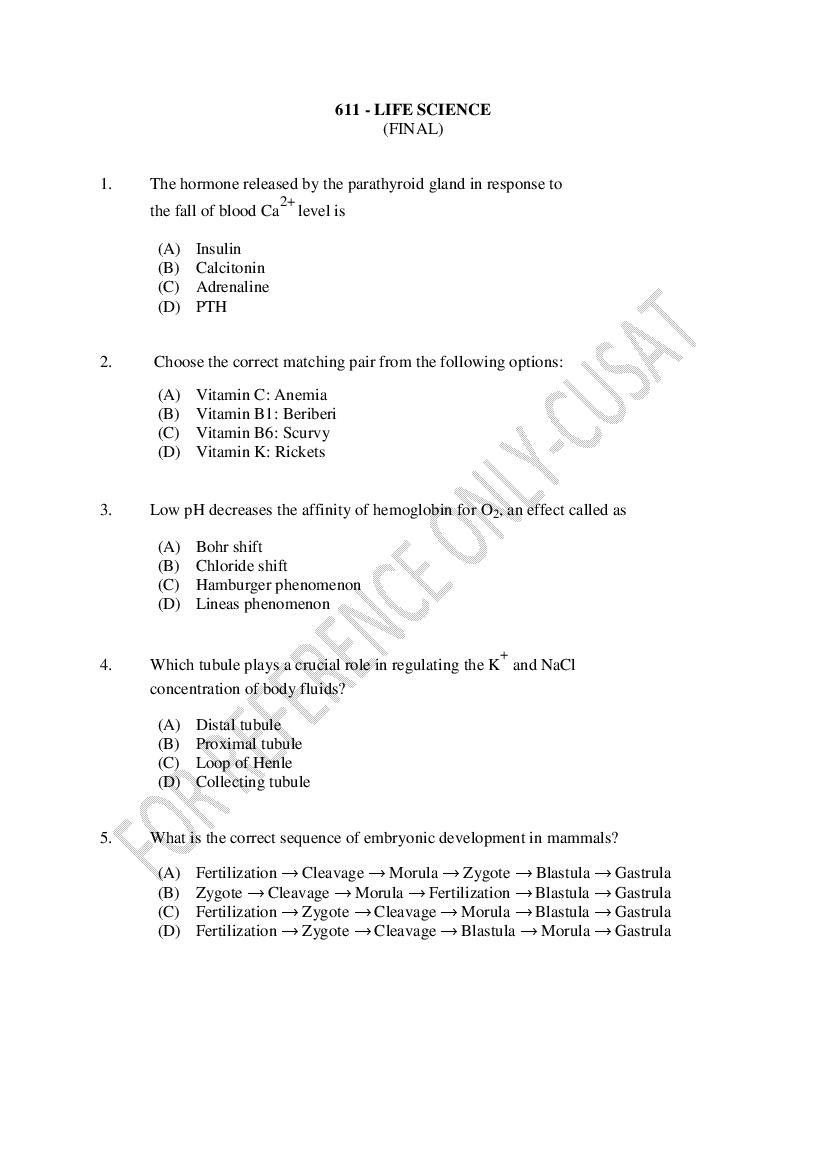
(FINAL)
1. The hormone released by the parathyroid gland in response to
2+
the fall of blood Ca level is
(A) Insulin
(B) Calcitonin
(C) Adrenaline
(D) PTH
2. Choose the correct matching pair from the following options:
(A) Vitamin C: Anemia
(B) Vitamin B1: Beriberi
(C) Vitamin B6: Scurvy
(D) Vitamin K: Rickets
3. Low pH decreases the affinity of hemoglobin for O2, an effect called as
(A) Bohr shift
(B) Chloride shift
(C) Hamburger phenomenon
(D) Lineas phenomenon
+
4. Which tubule plays a crucial role in regulating the K and NaCl
concentration of body fluids?
(A) Distal tubule
(B) Proximal tubule
(C) Loop of Henle
(D) Collecting tubule
5. What is the correct sequence of embryonic development in mammals?
(A) Fertilization → Cleavage → Morula → Zygote → Blastula → Gastrula
(B) Zygote → Cleavage → Morula → Fertilization → Blastula → Gastrula
(C) Fertilization → Zygote → Cleavage → Morula → Blastula → Gastrula
(D) Fertilization → Zygote → Cleavage → Blastula → Morula → Gastrula
Page 2
(A) Plasma B cell
(B) T helper cell
(C) T regulatory cell
(D) Natural killer cell
7. In mammals, circadian rhythms are coordinated by clustered neurons in the
hypothalamus, forming a structure called as
(A) Suprachiasmatic nucleus
(B) Motor neurons
(C) Sensory neurons
(D) Corpus Callosum
8. Nociceptors belong to which of the following category of receptors?
(A) Mechanoreceptors
(B) Chemoreceptors
(C) Pain receptors
(D) Thermoreceptors
9. Which of the following photoreceptor cells provide color vision?
(A) Rods
(B) Parenchyma
(C) Pericycle
(D) Cones
10. Fungi that form sheaths of hyphae over the surface of a root and typically grow in the
extracellular space of the root cortex are known as
(A) Arbuscular fungi
(B) Ectomycorrhizal fungi
(C) Coenocytic fungi
(D) Hyphae fungi
11. Transfer of genetic material between two bacterial cells is known as
(A) Transformation
(B) Translation
(C) Amplification
(D) Conjugation
Page 3
(A) Bacteria
(B) Bird
(C) Reptile
(D) Mammal
13. The innermost whorl of a flower is constituted by
(A) Carpel
(B) Sepal
(C) Tepal
(D) Stamen
14. Malathion is a/an
(A) Acetylcholinesterase inhibitor
(B) Voltage-gated Sodium channel inhibitor
(C) Chitin synthesis inhibitor
(D) Acetylcholine receptor inhibitor
15. The phenomenon where accumulated toxins become more concentrated in successive
trophic levels of a food web is known as
(A) Biological magnification
(B) Toxication
(C) Toxicity exaltation
(D) Detoxification
16. A strategy that modifies the environment to increase bioremediation by the existing
organism is known as
(A) Bioaugmentation
(B) Biostimulation
(C) Bioconcentration
(D) Bioaccumulation
17. On sequence analysis of a double-stranded DNA, the results showed the content of
Cytosine as 30%. What is the amount of A and T put together?
(A) 70%
(B) 40%
(C) 20%
(D) 30%
Page 4
helps the other species is known as
(A) Mutualism
(B) Predation
(C) Parasitism
(D) Commensalism
19. In angiosperms, after fertilization, the ploidy level of endosperm is
(A) 1n
(B) 2n
(C) 3n
(D) 4n
20. How many pairs of chromosomes does Drosophila melanogaster have?
(A) 4
(B) 8
(C) 2
(D) 6
21. Infectious proteins are known as
(A) Abzymes
(B) Prions
(C) Proviruses
(D) Viroids
22. Malpighian tubules are the organs found in
(A) Annelids
(B) Arthropods
(C) Platyhelminths
(D) Vertebrates
23. The fully processed eukaryotic mRNA protects itself from digestion by
5’-exoribonuclease due to the presence of
(A) 5’ cap
(B) 3’ poly-A tail
(C) 3’ cap
(D) 5’ poly-A tail
Page 5
(A) UUU and CUU
(B) UGA and UUU
(C) UAG and CUU
(D) UGA and UAG
25. During carboxylation in C3 plants, the very first product formed is
(A) Phosphoglyceraldehyde
(B) Oxaloacetic acid
(C) Malic acid
(D) Phosphoglyceric acid
26. The class of enzymes that catalyzes the reaction involving the addition of groups to
double bonds, or formation of double bonds by removal of groups are called as
(A) Lyases
(B) Oxidoreductases
(C) Transferases
(D) Ligases
27. The main repository of inorganic ions in the plant cell is
(A) Lysosomes
(B) Chloroplast
(C) Mitochondria
(D) Central Vacuole
28. A protein destined to be degraded through the proteasomal pathway is
first tagged with
(A) Aminopeptidase
(B) IgG antibody
(C) Rab protein
(D) Ubiquitin
29. G2/M class of cyclin contains
(A) Cyclin B
(B) Cyclin D
(C) Cyclin A
(D) Cyclin E
Page 6
(A) Nullisomy
(B) Trisomy
(C) Monosomy
(D) Disomy
31. The average molecular weight of a base pair is
(A) 660 dalton
(B) 1320 dalton
(C) 330 dalton
(D) 110 dalton
32. The homeobox region in Drosophila contains
(A) 160-nucleotide sequence
(B) 60-nucleotide sequence
(C) 180-nucleotide sequence
(D) 80-nucleotide sequence
33. Rice sheath blight disease is caused by
(A) Pyricularia oryzae
(B) Xanthomonas oryzae
(C) Sarocladium oryzae
(D) Rhizoctonia solani
34. All enzymes of the TCA cycle are located in the mitochondrial matrix except one,
which is located in inner mitochondrial membrane in eukaryotes and in the cytosol in
prokaryotes. This enzyme is
(A) Isocitrate dehydrogenase
(B) Malate dehydrogenase
(C) Succinate dehydrogenase
(D) Lactate dehydrogenase
35. For the synthesis of one glucose molecule, the number of ATP required is
(A) 9 ATP for the C3 cycle and 18 ATP for the C4 cycle
(B) 18 ATP for the C3 cycle and 30 ATP for the C4 cycle
(C) 32 ATP for the C3 cycle and 30 ATP for the C4 cycle
(D) 18 ATP for the C3 cycle and 32 ATP for the C4 cycle
Page 7
microscope is known as
(A) Polychromatin
(B) Euchromatin
(C) Heterochromatin
(D) Histochromatin
37. In human telomeres, which one of the following short nucleotide sequences are
repeated multiple times?
(A) AAACCC
(B) GGAACC
(C) ATCGCG
(D) TTAGGG
38. The half-life of Carbon-14 is
(A) 4.5 billion years
7
(B) 1.57 × 10 years
(C) 5,730 years
(D) 100 days
39. N-Formyl-methionine is the starting residue for protein synthesis in
(A) Archaea
(B) Fungi
(C) Bacteria
(D) Plants
40. The genetic condition where males carry one extra copy of the X chromosome apart
from XY is known as
(A) Edwards syndrome
(B) Klinefelter syndrome
(C) Turner syndrome
(D) Cri-du-chat syndrome
41. The large subunit of prokaryotic 70S ribosome consists of
(A) 16S rRNA
(B) 18S rRNA
(C) 28S, 5.8S and 5S rRNA
(D) 23S and 5S rRNA
Page 8
(A) E
(B) A
(C) C
(D) D
43. Chyme is
(A) a mixture of saliva and food in the shape of a ball
(B) a mixture of water, salts, cells and glycoprotein
(C) another name of bile
(D) a mixture of ingested food and gastric juice
44. The small, accessible part of an antigen that binds to an antigen receptor is called as
(A) Paratope
(B) Antibody
(C) Epitope
(D) Allotrope
45. Bicollateral vascular bundles are found in the family of
(A) Malvaceae
(B) Musaceae
(C) Cucurbitaceae
(D) Solanaceae
46. The largest operon of vir region in Ti plasmid of Agrobacterium radiobacter is
(A) vir C
(B) vir D
(C) vir E
(D) vir B
47. The defensive adaptation in animals where a harmless species mimics as
a harmful one is
(A) Mullerian mimicry
(B) Aposematic Coloration
(C) Cryptic Coloration
(D) Batesian mimicry
Page 9
(A) Life table
(B) Demography
(C) Immigration
(D) Survivorship Curve
49. Gaps between adjacent Schwann cells are called as
(A) Myelin sheath
(B) Nodes of Ranvier
(C) Oligodendrocyte
(D) Axon hillock
50. Histamine is released by which of the following cell?
(A) B lymphocyte
(B) Mast cell
(C) Neutrophil
(D) Eosinophil
51. Melatonin is produced by which of the following gland?
(A) Thymus
(B) Pituitary
(C) Pineal
(D) Pancreas
52. Lateral meristem consists of which of the following?
(A) Vascular bundle and cork cambium
(B) Vascular cambium and cork cambium
(C) Protoderm and Calyptrogen
(D) Vascular cambium and Calyptrogen
53. Which of the following is the sex-determination system in grasshoppers?
(A) X-Y
(B) Z-W
(C) X-O
(D) Z-O
Page 10
(A) Malvaceae
(B) Cyperaceae
(C) Brassicaceae
(D) Xyridaceae
55. Which of the following is a natural plant hormone?
(A) Indole-3-acetic acid
(B) Indole-3-butyric acid
(C) 1-Naphthaleneacetic acid
(D) 2,4-dichlorophenoxyacetic acid
56. Which of the following statements is NOT true about G proteins?
(A) G proteins become activated when bound to GTP
(B) G proteins function as GTPase enzyme
(C) G proteins are involved in a signal cascade
(D) G proteins become activated when bound to GDP
57. The most abundant glycoprotein in the extracellular matrix of most animal cells is
(A) Collagen
(B) Integrins
(C) Laminin
(D) Fibronectin
58. When a few individuals become isolated from a larger population, this smaller group
may establish a new population whose gene pool differs from the source population.
This is called as the
(A) Founder effect
(B) Bottleneck effect
(C) Natural selection
(D) Gene flow
59. Disjunction of the synapsed homologous chromosomes occur in
(A) Anaphase II
(B) Anaphase I
(C) Metaphase I
(D) Prophase I
Page 11
(A) G1 phase
(B) G2 phase
(C) M phase
(D) S phase
61. Among the following, which cell organelle is involved in apoptosis?
(A) Endoplasmic reticulum
(B) Mitochondria
(C) Golgi apparatus
(D) Centrosome
62. Calmodulin is a calcium-binding messenger protein of eukaryotic cells. A single
2+
calmodulin protein binds to which of the following number of Ca ions?
(A) 3
(B) 2
(C) 1
(D) 4
63. Left-handed α helix in Ramachandran plot will have the following values
(A) High Ψ and low Φ values
(B) High Ψ and Φ values
(C) Low Ψ and high Φ values
(D) Low Ψ and Φ values
64. The term “dodecyl” in Sodium dodecyl sulfate represents
(A) 10-carbon chain with an amino group
(B) 10-carbon chain with a hydroxyl group
(C) 12-carbon chain with an aromatic ring
(D) 12-carbon chain
65. In eukaryotic cells, the mRNA is transcribed from the nuclear DNA by
(A) RNA polymerase I
(B) RNA polymerase III
(C) RNA polymerase II
(D) RNA polymerase IV
Page 12
which of the following germ layer?
(A) Mesoderm
(B) Ectoderm
(C) Endoderm
(D) Meso-endoderm
67. Erythropoietin is mainly synthesized in
(A) Heart
(B) Liver
(C) Kidney
(D) Spleen
68. The speciation where gene flow is interrupted due to division of a population into
geographically isolated sub-populations is known as
(A) Allopatric
(B) Sympatric
(C) Parapatric
(D) Neopatric
69. Choanocytes are found in one of the following phyla
(A) Annelida
(B) Porifera
(C) Arthropoda
(D) Mollusca
70. Which of the following is used as a primary dye in acid-fast staining?
(A) Safranin
(B) Methylene blue
(C) Carbol fuchsin
(D) Eosine
71. Which of the following amino acids is coded by three codons (AUU, AUC, AUA)?
(A) Tryptophan
(B) Isoleucine
(C) Glycine
(D) Tyrosine
Page 13
(A) Homeothermic
(B) Poikilothermic
(C) Endothermic
(D) Isothermic
73. Monotremes are
(A) Mammals with a pouch
(B) Placental mammals
(C) Marine reptiles
(D) Egg-laying mammals
74. In the 1930s, which of the following organisms was used to formulate
the “one gene-one enzyme” hypothesis?
(A) Neurospora crassa
(B) Drosophila melanogaster
(C) Homo sapiens
(D) Penicillium chrysogenum
75. In the generalized life cycle of fungi, the union of the cytoplasm of
two-parent mycelia refers to
(A) Heterogamy
(B) Plasmogamy
(C) Karyogamy
(D) Oogamy
76. Skeletal muscle bundles are held together by a
common connective tissue layer known as
(A) Perimysium
(B) Fascia
(C) Aponeurosis
(D) Endomysium
77. The structural units of a compound eye of many insects,
crustaceans and polychaete worms are called as
(A) Ommatidia
(B) Rhabdom
(C) Cornea
(D) Simple eye
Page 14
have a distorted perception of reality is called as
(A) Depression
(B) Parkinson’s disorder
(C) Alzheimer’s disease
(D) Schizophrenia
79. The primary function of the sodium-potassium pump across the plasma membrane is
(A) to move sodium in and potassium outside the cell
(B) to move both sodium and potassium outside the cell
(C) to move sodium out and potassium inside the cell
(D) to move both sodium and potassium inside the cell
80. Which of the following represents the correct order of events during the reproductive
cycle of the human female?
(A) FSH rise, ovulation, follicular phase, luteal phase, menstruation
(B) Menstruation, FSH rise, LH surge, ovulation, luteal phase
(C) Follicular phase, luteal phase, LH surge, ovulation, menstruation
(D) Luteal phase, menstruation, FSH rise, ovulation, proliferative phase
81. The elastic tissue which connects the Cauda epididymis to the scrotal sac is known as
(A) Caput epididymis
(B) Scrotal ligament
(C) Gubernaculum
(D) Tendinous cord
82. The volume of air inhaled and exhaled with each breath during
normal breathing is called as
(A) Expiratory reserve volume
(B) Residual volume
(C) Inspiratory reserve volume
(D) Tidal volume
83. Which of the following breeds only once in its life time?
(A) Dispersed
(B) Clumped
(C) Iteroparous
(D) Semelparous
Page 15
(A) Terrestrial ecosystem
(B) Artificial ecosystem
(C) Aquatic ecosystem
(D) Natural ecosystem
85. The skeleton structure of all amino acids is same except for
(A) Lysine
(B) Proline
(C) Glycine
(D) Alanine
86. What is the protein found in nail, hair and horns?
(A) Collagen
(B) Keratin
(C) Hemoglobin
(D) Myoglobin
87. What bond stabilizes the double-helix of DNA?
(A) Hydrophobic bond
(B) Covalent bond
(C) Hydrogen bond
(D) Ionic bond
88. Identify the unsaturated fatty acid.
(A) Lauric
(B) Linoleic
(C) Palmitic
(D) Myristic
89. Megaloblastic anemia is caused by the deficiency of
(A) Thiamine
(B) Pyridoxine
(C) Niacin
(D) Folic acid
Page 16
(A) Retinol
(B) Pantothenic acid
(C) Pyridoxine
(D) Folic acid
91. What is the SI unit of enzyme activity?
(A) Km
(B) Kat
(C) Kcat
(D) Vmax
92. Which of the following equations shows the relationship between free energy change
(∆G ) and the change in entropy (∆S ), under constant temperature and pressure?
(A) ∆G = T ∆H − ∆S
(B) ∆G = T ∆H / ∆S
(C) ∆G = ∆H / T ∆S
(D) ∆G = ∆H − T ∆S
93. Which of the following is an example of amphibolic pathway?
(A) Glyoxylate
(B) Citric acid cycle
(C) Glycolysis
(D) Lipid metabolism
94. Which of the following was used in Engelmann’s experiment to
show photosynthetic activity?
(A) Spirogyra spp.
(B) Rhizopus stolonifer
(C) Cyanobacteria sp.
(D) Penicillium spp.
95. The priming function in glycogen synthesis is done by
which of the following molecules?
(A) Lysine
(B) Arginine
(C) Glycogenin
(D) Glutamate
Page 17
aggregate is known as
(A) HDL
(B) Chylomicrons
(C) VLDL
(D) LDL
97. Which of the following is the energy source for the brain during starvation?
(A) Fat
(B) Ketone bodies
(C) Protein
(D) Lipids
98. Which of the following pairs of amino acids is essential for infants?
(A) Methionine and Glycine
(B) Valine and Serine
(C) Arginine and Histidine
(D) Lysine and Leucine
99. Name the type of cell in which synthesis of urea cycle takes places.
(A) Pancreatic cell
(B) Bowman’s gland cell
(C) Urinary epithelium cell
(D) Hepatocyte
100. What is the end product of purine degradation in mammals?
(A) Guanine
(B) Inosine
(C) Uric acid
(D) Hypoxanthine
101. Which of the following genetic disorders is caused by
the deficiency of enzyme HGPRT?
(A) SCID
(B) Lesch-Nyhan syndrome
(C) Cystic fibrosis
(D) Down syndrome
Page 18
(A) Louis Pasteur
(B) Rudolf Virchow
(C) Anton van Leeuwenhoek
(D) Robert Hooke
103. Who discovered ribosome for the first time?
(A) George Emil Palade
(B) Theodor Schwann
(C) Anton van Leeuwenhoek
(D) Robert Hooke
104. What is the largest single membrane-bound intracellular compartment?
(A) Golgi apparatus
(B) Ribosome
(C) Nucleus
(D) Endoplasmic reticulum
105. The release of melanosomes from melanocytes is mediated by
(A) Autophagy
(B) Endocytosis
(C) Exocytosis
(D) Pinocytosis
106. Which of the following carry two nuclei?
(A) Slime molds
(B) Paramoecium
(C) Cyanobacteria
(D) Amoeba
107. Which of the following organelles is used for aerobic respiration and
ATP synthesis in Entamoeba histolytica?
(A) Hydrogenosome
(B) Mitochondria
(C) Mitosome
(D) Peroxisome
Page 19
(A) Peroxisome
(B) Mitochondria
(C) Chloroplast
(D) Thylakoid
109. Select the signal molecule that does NOT interact with cell surface receptor
(A) Insulin
(B) Glucagon
(C) Testosterone
(D) Gastrin
110. The process of nuclear division is known as
(A) Interkinesis
(B) Karyokinesis
(C) Polymerization
(D) Cytokinesis
111. The molecule used to determine the evolutionary relationship
between taxonomic groups is
(A) 23S rRNA
(B) 5S rRNA
(C) 18S rRNA
(D) 16S rRNA
112. Which of the following bacteria is pleomorphic?
(A) Mycobacteria
(B) Streptococcus
(C) Pseudomonas
(D) Corynebacterium
113. Name the acid present in the cell wall of a bacterium that helps in retaining its colour
during the acid-fast test
(A) Teichoic acid
(B) Malic acid
(C) Mycolic acid
(D) Tartaric acid
Page 20
(A) Eosin methylene blue agar
(B) MacConkey agar
(C) Blood agar
(D) Mannitol salt agar
115. The ability of an organism to resist infection by pathogen is called
(A) Allergy
(B) Hypersensitivity
(C) Infection
(D) Immunity
116. Which of the following antibodies gives primary immune reaction?
(A) IgA
(B) IgE
(C) IgG
(D) IgM
117. Which of the following cells is multipotent?
(A) Hematopoietic stem cell
(B) T-cell
(C) B-cell
(D) Monocytes
118. An example of non-professional antigen presenting cells is
(A) Macrophages
(B) B lymphocytes
(C) Fibroblast
(D) Dendritic cells
119. Who is known as the father of taxonomy?
(A) Aristotle
(B) Carl Linnaeus
(C) Earnst Haeckel
(D) Robert Whittaker
Page 21
(A) Angiosperm
(B) Bryophytes
(C) Pteridophytes
(D) Thallophyta
121. Which organisms have segmental nephridia for osmoregulation and excretion?
(A) Aschelminthes
(B) Annelida
(C) Platyhelminthes
(D) Arthropoda
122. The tendency of two or more than two genes to stay together
during inheritance is known as
(A) Crossing over
(B) Gene interaction
(C) Genetics
(D) Linkage
123. Which of the following is NOT a sex-limited ‘trait’?
(A) Baldness
(B) Milk production
(C) Musculature
(D) Pitch of voice
124. The pedigree analysis is a
(A) Linkage map
(B) Quantitative genetic analysis
(C) Polygene analysis
(D) Record of inheritance pattern
125. Alteration in which of the following chromosomes shows Down syndrome?
(A) Sex chromosome
(B) 18
(C) 21
(D) 13
Page 22
fragments is known as
(A) Replication
(B) Recombination
(C) Translation
(D) Transcription
127. Name the repair system for UV-mediated damage of DNA
(A) Nucleotide excision repair
(B) DNA glycosylase
(C) Exchange of homologous segments
(D) Photoreactivation
128. Which of the following is NOT a step of mRNA processing?
(A) Polyadenylation
(B) Splicing of introns
(C) 5’ capping
(D) RNA silencing
129. What is the detection technique of auxotrophs?
(A) Spread plating
(B) Replica plating
(C) Pure culture technique
(D) Hybridization
130. What is the site of spermatogenesis?
(A) Seminiferous tubules
(B) Epididymis
(C) Rete testis
(D) Vas deferens
131. Name the enzyme which cleaves dsDNA after recognizing
specific nucleotide sequences
(A) DNA polymerase
(B) Ligases
(C) RNase H
(D) Restriction endonuclease
Page 23
(A) Cosmids
(B) M13 phage
(C) Ti plasmid
(D) Resistance plasmid
133. Which of the following is the unit of a genetic map?
(A) Angstrom
(B) Nanometer
(C) Centimeter
(D) Centimorgan
134. What is supplemented with pro-vitamin A in order to improve its nutritional quality?
(A) Tomato
(B) Potato
(C) Rice
(D) Cotton
135. The asexual mode of embryo formation is
(A) Protoplast culture
(B) Callus culture
(C) Somatic embryogenesis
(D) Protoplast fusion
136. Who proposed the concept of ‘essential mineral nutrients’ of plants?
(A) Arnon and Stout
(B) Carl Linnaeus
(C) Aristotle
(D) Leonhart Fuchs
137. Which of the following enzymes does NOT need Manganese for its activity?
(A) Nitrogenase
(B) Arginase
(C) Superoxide dismutase
(D) Pyruvate carboxylase
Page 24
(A) Seismonasty
(B) Thigmonasty
(C) Nyctinasty
(D) Photonasty
139. Which of the following cells support, nourish and protect the neurons?
(A) Ganglia
(B) Perikaryon
(C) Glial cells
(D) Nissl bodies
140. Name the part of the eye which produces aqueous fluid that
fills the front part of the eye:
(A) Ciliary body
(B) Cornea
(C) Vitreous humor
(D) Uvea
141. What is the name of the gland which secretes melatonin?
(A) Pituitary gland
(B) Pineal gland
(C) Thyroid gland
(D) Hypothalamus
142. What is micturition?
(A) Discharge of feces
(B) Discharge of sweat
(C) Discharge of urine
(D) Discharge of sperm
143. Which of the following is the energy source of the sperm?
(A) Fructose
(B) Proteins
(C) Lipids
(D) Nucleic acids
Page 25
(A) Organogenesis
(B) Cleavage
(C) Spermiogenesis
(D) Embryogenesis
145. What is pedology?
(A) Study of climate
(B) Study of leaves
(C) Study of soil
(D) Study of the effect of light on plant growth
146. Genetically different population with the same physical features is known as
(A) Community
(B) Ecotype
(C) Ecads
(D) Ecosystem
147. Which of the following zones lies at the bottom of the sea?
(A) Benthic
(B) Littoral
(C) Pelagic zone
(D) Neritic zone
148. Which type of anemia is responsible for the disease thalassemia?
(A) Hemolytic anemia
(B) Aplastic anemia
(C) Hemorrhagic anemia
(D) Iron deficiency anemia
149. An apoenzyme is defined as
(A) a protein portion of an enzyme
(B) a non-protein group
(C) a complete, biologically active conjugated enzyme
(D) a prosthetic group
Page 26
(A) Gregor Johann Mendel
(B) Erich Tschemark
(C) Hugo de Vries
(D) Carl Correns
Page 27
Subject Name: 611 LIFE SCIENCE
SI No. Key SI No. Key SI No. Key SI No. Key SI No. Key
1 D 31 A 61 B 91 B 121 B
2 B 32 C 62 D 92 D 122 D
3 A 33 D 63 B 93 B 123 A
4 A 34 C 64 D 94 A 124 D
5 C 35 B 65 C 95 C 125 C
6 A 36 C 66 B 96 B 126 B
7 A 37 D 67 C 97 B 127 D
8 C 38 C 68 A 98 C 128 D
9 D 39 C 69 B 99 D 129 B
10 B 40 B 70 C 100 C 130 A
11 D 41 D 71 B 101 B 131 D
12 B 42 A 72 B 102 D 132 C
13 A 43 D 73 D 103 A 133 D
14 A 44 C 74 A 104 D 134 C
15 A 45 C 75 B 105 C 135 C
16 B 46 D 76 B 106 B 136 A
17 B 47 D 77 A 107 C 137 A
18 D 48 B 78 D 108 A 138 B
19 C 49 B 79 C 109 C 139 C
20 A 50 B 80 B 110 B 140 A
21 B 51 C 81 C 111 D 141 B
22 B 52 B 82 D 112 D 142 C
23 A 53 C 83 D 113 C 143 A
24 D 54 B 84 A 114 C 144 D
25 D 55 A 85 B 115 D 145 C
26 A 56 D 86 B 116 D 146 B
27 D 57 A 87 C 117 A 147 A
28 D 58 A 88 B 118 C 148 A
29 A 59 B 89 D 119 B 149 A
30 B 60 C 90 B 120 A 150 A
Document Details
| Board / Org | Cochin University |
| Exam | CUSAT Common Admission Test |
| Type | Question Paper |
| Pages | 27 |
| Updated | 22 Jul 2026 |