Tamil Nadu 12th Std Model Question Paper 2026 Computer Science
Finished viewing? Save it for later —
Download Tamil Nadu 12th Std Model Question Paper 2026 Computer Science (PDF · 11 pages)About Tamil Nadu 12th Std Model Question Paper 2026 Computer Science
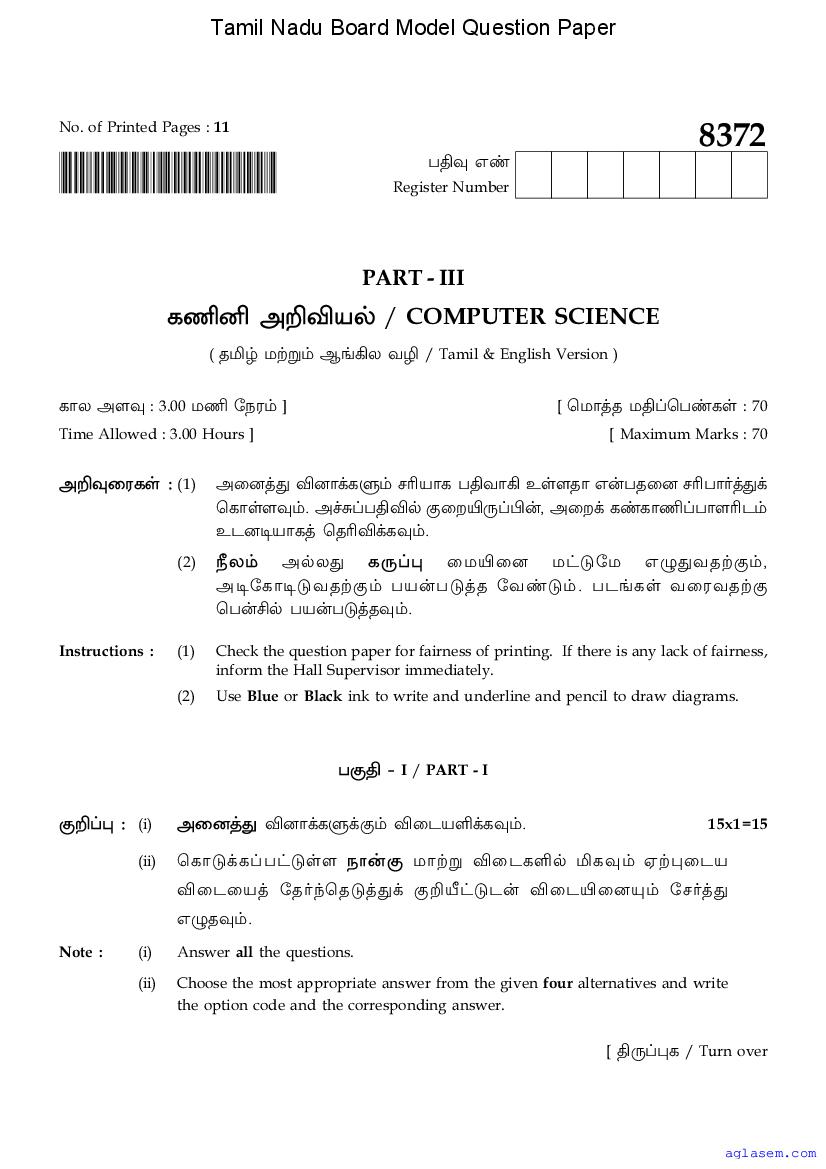
Tamil Nadu 12th Std Model Question Paper 2026 Computer Science is available here for free download. Published by Tamil Nadu Board for Class 12, this sample paper can be viewed online or downloaded as a PDF (11 pages). Candidates preparing for Class 12 can use Tamil Nadu 12th Std Model Question Paper 2026 Computer Science to understand the exam pattern, the type of questions asked, and the overall difficulty level.
Frequently Asked Questions
How can I download Tamil Nadu 12th Std Model Question Paper 2026 Computer Science?
Open this page and click the Download button to save Tamil Nadu 12th Std Model Question Paper 2026 Computer Science as a PDF. It is completely free on AglaSem Docs.
Is Tamil Nadu 12th Std Model Question Paper 2026 Computer Science free to download?
Yes. Tamil Nadu 12th Std Model Question Paper 2026 Computer Science can be viewed online and downloaded as a PDF free of cost on AglaSem Docs.
How many pages does Tamil Nadu 12th Std Model Question Paper 2026 Computer Science have?
Tamil Nadu 12th Std Model Question Paper 2026 Computer Science contains 11 pages, which you can read online or download together as a single PDF.
Where can I find more Class 12 study material?
You can find more Class 12 question papers, sample papers, syllabus, and answer keys on AglaSem Docs.
Tamil Nadu 12th Std Model Question Paper 2026 Computer Science – Text
Read the full text of this sample paper below — useful to quickly search, copy and reference the content online without downloading the PDF.
📄 View text version (11 pages)
Page 1
No. of Printed Pages : 11
8372
!8372ComputerScience! £vÄ Gs
Register Number
PART - III
PoÛ AÔ¯À / COMPUTER SCIENCE
( uªÌ ©ØÖ® B[Q» ÁÈ / Tamil & English Version )
Põ» AÍÄ : 3.00 ©o ÷|µ® ] [ ö©õzu ©v¨ö£sPÒ : 70
Time Allowed : 3.00 Hours ] [ Maximum Marks : 70
AÔÄøµPÒ : (1) AøÚzx ÂÚõUPЮ \›¯õP £vÁõQ EÒÍuõ GߣuøÚ \›£õºzxU
öPõÒÍÄ®. Aa_¨£vÂÀ SøÓ°¸¨¤ß, AøÓU PsPõo¨£õÍ›h®
EhÚi¯õPz öu›ÂUPÄ®.
(2) }»® AÀ»x P¸¨¦ ø©°øÚ ©mk÷© GÊxÁuØS®,
Ai÷PõikÁuØS® £¯ß£kzu ÷Ásk®. £h[PÒ ÁøµÁuØS
ö£ß]À £¯ß£kzuÄ®.
Instructions : (1) Check the question paper for fairness of printing. If there is any lack of fairness,
inform the Hall Supervisor immediately.
(2) Use Blue or Black ink to write and underline and pencil to draw diagrams.
£Sv & I / PART - I
SÔ¨¦ : (i) AøÚzx ÂÚõUPÐUS® Âøh¯ÎUPÄ®. 15x1=15
(ii) öPõkUP¨£mkÒÍ |õßS ©õØÖ ÂøhPÎÀ ªPÄ® Hئøh¯
Âøhø¯z ÷uº¢öukzxU SÔ±mkhß Âøh°øÚ²® ÷\ºzx
GÊuÄ®.
Note : (i) Answer all the questions.
(ii) Choose the most appropriate answer from the given four alternatives and write
the option code and the corresponding answer.
Page 2
1. ¤ßÁ¸® Gx uÛzußø©¯õÚ öuõh›¯À öuõSvPøÍU öPõshuõS® ?
(A) xøn {µÀPÒ (B) ö\¯ØTÖ
(C) Áøµ¯øÓ (D) öuõSvPÒ
Which of the following is a distinct syntactic block ?
(a) Subroutines (b) Function
(c) Definition (d) Modules
2. ¤ßÁ¸® G¢u ö\¯ØTÖ A¸Á©õUP® uµÄ ÁøPø¯ E¸Áø©UP¨
£¯ß£kQÓx ?
(A) Constructors (B) recursive (C) Destructors (D) Nested
Which of the following functions that build the abstract data type ?
(a) Constructors (b) recursive (c) Destructors (d) Nested
3. __________ Âv Áøµö¯Àø» ÷uh¨£h ÷Ási¯ Á›ø\ø¯ wº©õÛUP¨
£¯ß£kQÓx.
(A) LBEG (B) LEGB (C) GEBL (D) GBLE
The __________ rule is used to decide the order in which the scopes are to be searched.
(a) LBEG (b) LEGB (c) GEBL (d) GBLE
4. C¸©z ÷uhÀ __________ GßÖ® AøÇUP¨£k®.
(A) öuõhµØÓ ÷uhÀ (B) Á›ø\•øÓz ÷uhÀ
(C) £õv CøhöÁÎz ÷uhÀ (D) öuõhº ÷uhÀ
Binary search is also called as __________.
(a) Random search (b) Linear search
(c) Half-interval search (d) Sequential search
Page 3
5. G¢u ö\¯ØSÔ {£¢uøÚ ö\¯ØSÔ GßÖ® AøÇUP¨£kQÓx ?
(A) u¸UP (B) •®© ö\¯ØSÔ
(C) ©v¨¤¸zuÀ (D) öuõhº¦øh¯
Which operator is also called as conditional operator ?
(a) Logical (b) Ternary
(c) Assignment (d) Relational
6. ¤ßÁ¸® Gx Áøµ¯ÖUP¨£mh ©hUS BS® ?
(A) for (B) do...while (C) if...else (D) while
Which of the following is known as definite loop ?
(a) for (b) do...while (c) if...else (d) while
7. G¢u ]Ó¨¦ ö\õÀ ö\¯ØTÖ öuõSvø¯ •izx øÁUQÓx ?
(A) finally (B) define (C) def (D) return
Which of the following keyword is used to exit a function block ?
(a) finally (b) define (c) def (d) return
8. \µzvß RÌ JmhõÚx :
(A) ÷|º©øÓ AÀ»x Gvº©øÓ GsPÒ
(B) ÷|º©øÓ GsPÒ
(C) ÷|º©øÓ ©ØÖ® Gvº©øÓ GsPÒ
(D) Gvº©øÓ GsPÒ
The subscript of a string may be :
(a) positive or negative numbers
(b) positive numbers
(c) both positive and negative numbers
(d) negative numbers
Page 4
9. ¤ßÁ¸ÁÚÁØÖÒ Gx RÌUPsh ø£zuõß {µ¾UPõÚ öÁαhõS® ?
str1=“Computer Science”
print(str1[::-1])
(A) ecneicS retupmoC (B) Computer Science
(C) eniS eumC (D) Cmue Sine
Which of the following is the output of the given Python code ?
str1=“Computer Science”
print(str1[::-1])
(a) ecneicS retupmoC (b) Computer Science
(c) eniS eumC (d) Cmue Sine
10. CÚUSÊ EÖ¨¦PÒ G¢u ö\¯ØSÔ°ß ‰»® AqP¨£kQÓx ?
(A) # (B) & (C) % (D) .
Class members are accessed through which operator ?
(a) # (b) & (c) % (d) .
11. ER ©õv›ø¯ E¸ÁõUQ¯Áº ¯õº ?
(A) Chend (B) Chen (C) Chand (D) E F Codd
Who developed ER model ?
(a) Chend (b) Chen (c) Chand (d) E F Codd
12. ÂÚÁÀPøÍ E¸ÁõUP¨ £¯ß£kÁx :
(A) MODIFY (B) SELECT (C) ALTER (D) ORDER BY
Queries can be generated using :
(a) MODIFY (b) SELECT (c) ALTER (d) ORDER BY
Page 5
13. HØPÚ÷Á EÒÍ ÷Põ¨¤À EÒÍ uµÄPÎÀ ]» ©õØÓ[PÒ ö\´Áx®, AÀ»x
÷©¾® uµøÁ ÷\º¨£øu²® __________ GßÖ AøÇUP»õ®.
(A) ©õØÓ® ö\´uÀ (B) £v¨¤zuÀ
(C) v¸zxuÀ (D) CÖv°À ÷\ºzuÀ
Making some changes in the data of the existing file or adding more data is called :
(a) Modification (b) Editing
(c) Alteration (d) Appending
14. Windows C¯UP •øÓø©²hß öuõhº¦ öPõÒÍ G¢u TÖ{ø» AÝ©vUQÓx ?
(A) csv TÖ{ø» (B) OS TÖ{ø»
(C) getopt TÖ{ø» (D) sys TÖ{ø»
The module which allows to interface with the Windows operating system is :
(a) csv module (b) OS module
(c) getopt module (d) sys module
15. ¤ßÁ¸® G¢u ]Ó¨¦ ö\õÀ |PÀPøÍz uºUS® ?
(A) Where (B) Distinct
(C) GroupBy (D) Remove
Which of the following keyword avoids the duplicate ?
(a) Where (b) Distinct
(c) GroupBy (d) Remove
Page 6
£Sv & II / PART - II
SÔ¨¦ : GøÁ÷¯Ý® BÖ ÂÚõUPÐUS Âøh¯ÎUPÄ®. ÂÚõ Gs 24 &US
Pmhõ¯©õP Âøh¯ÎUPÄ®. 6x2=12
Note : Answer any six questions. Question No. 24 is Compulsory.
16. Pair GßÓõÀ GßÚ ? GkzxUPõmk u¸P.
What is a pair ? Give an example.
17. Á›ø\¯õUP® GßÓõÀ GßÚ ?
What is sorting ?
18. RÌPõq® ø£zuõß {µ¼ß öÁαk GßÚ ?
for x in range(5,20,5):
print(x, end =‘ ’)
What is the output of the following Python code ?
for x in range(5,20,5):
print(x, end =‘ ’)
19. \µzøu xshõUSuÀ (Slicing) GßÓõÀ GßÚ ?
What is Slicing ?
20. AȨ¤°ß ÷|õUP® GßÚ ?
What is the purpose of Destructor ?
21. G¢u SQL TÖ, AmhÁønø¯ E¸ÁõUPÄ®, AÁØÔÀ ©v¨¦PøÍ ÷\ºUPÄ®
AÝ©vUS® ?
Which component of SQL lets insert values in tables and which lets to create a table ?
Page 7
22. cd PmhøÍ°ß £¯ß ¯õx ? GkzxPõmk u¸P.
What is the use of cd command ? Give an example.
23. Matplotlib &ø¯ GÆÁõÖ {ÖÁ»õ® ?
How will you install matplotlib ?
24. ¤ßÁ¸® ø£zuõß SÔ•øÓ°ß öÁαk ¯õx ?
str1=‘WELCOME’
print(str1.islower( ))
print(str1.lower( ))
What is the output of the following Python code ?
str1=‘WELCOME’
print(str1.islower( ))
print(str1.lower( ))
£Sv & III / PART - III
SÔ¨¦ : H÷uÝ® BÖ ÂÚõUPÐUS Âøh¯ÎUPÄ®. ÂÚõ Gs 33 &US
Pmhõ¯©õP Âøh¯ÎUPÄ®. 6x3=18
Note : Answer any six questions. Question No. 33 is Compulsory.
25. Impure ö\¯ØTÖÂß £UP ÂøÍÄPÒ ¯õøÁ ? GkzxPõmk u¸P.
What are the side effects of Impure function ? Give an example.
26. •ÊuÍõ¯ Áøµö¯Àø»ø¯ GkzxPõmkhß Áøµ¯ÖUPÄ®.
Define Global scope with an example.
Page 8
27. ø£zuõÛÀ £¯ß£kzu¨£k® ©v¨¤¸zuÀ ö\¯ØSÔPÒ ¯õøÁ ?
What are the assignment operators that can be used in Python ?
28. ceil( ), floor() ö\¯ØTÖPøÍ ÷ÁÖ£kzxP.
Differentiate ceil( ) and floor( ) functions.
29. ¤ßÁ¸® ø£zuõß List ö\¯ØTÖPÎß öuõh›¯ø» GÊxP.
(i) remove( )
(ii) pop( )
(iii) clear( )
Write the syntax of the following Python list functions.
(i) remove( )
(ii) pop( )
(iii) clear( )
30. Põºj]¯ß ö£¸UPø» ö£õ¸zu©õÚ GkzxPõmkhß ÂÍUSP.
Explain Cartesian product with a suitable example.
31. reader( ) ©ØÖ® DictReader( ) Cøh÷¯¯õÚ ÷ÁÖ£õmøh GÊxP.
Write the difference between reader( ) and DictReader( ).
32. fetchone( ) ©ØÖ® fetchmany( ) BQ¯ÁØÖUQøh÷¯¯õÚ ÷ÁÖ£õmøh SÔ¨¤kP.
Mention the difference between fetchone( ) and fetchmany( ).
Page 9
33. ¤ßÁ¸® ø£zuõß SÔ•øÓ°ß öÁαk GßÚ ?
squares=[ ]
for x in range(1,6):
s=x**2
squares.append(s)
print(squares)
What will be the output of the following Python code ?
squares=[ ]
for x in range(1,6):
s=x**2
squares.append(s)
print(squares)
£Sv & IV/ PART - IV
SÔ¨¦ : AøÚzx ÂÚõUPÐUS® Âøh¯ÎUPÄ®. 5x5=25
Note : Answer all the questions.
34. (A) pure ©ØÖ® impure ö\¯ØTÖPøÍ GkzxUPõmkhß ÂÍUSP.
AÀ»x
(B) uµÄ ©õv›°ß £À÷ÁÖ ÁøPPøÍ ÂÍUSP.
(a) Explain pure and impure functions with an example.
OR
(b) Explain the different types of data model.
35. (A) ø£zuõÛÀ EÒÍ £À÷ÁÖ ÁøP¯õÚ ö\¯ØSÔPøÍ ÂÍUSP.
AÀ»x
(B) £À÷ÁÖ ÁøP¯õÚ Pmk¨£õkPøͲ®, Auß ö\¯À£õkPøͲ® GÊxP.
(a) Explain the different types of operators in Python.
OR
(b) Write the different types of constraints and their functions.
Page 10
36. (A) ø£zuõÛÀ While ©hUS £ØÔ GkzxUPõmkhß ÂÍUSP.
AÀ»x
(B) ø£zuõÛß £À÷ÁÖ ÷Põ¨¦ •øÓø©PøͲ® Auß ö£õ¸øͲ®
£mi¯¼kP.
(a) Explain While loop in Python with an example.
OR
(b) Tabulate the different Python file modes with description.
37. (A) uØ_ÇØ] ö\¯ØTÖ £ØÔ GkzxUPõmkhß ÂÍUSP.
AÀ»x
(B) ø£zuõÛÀ sys, os, getopt TÖ{ø»PÎß ÷uøÁ GßÚ Gߣøu ÂÍUSP.
(a) Explain the recursive function with an example.
OR
(b) What is the purpose of sys, os, getopt, modules in Python ? Explain.
38. (A) ¤ßÁ¸® {µ¼ß öÁαk GßÚ ?
A={1,2,3,4,5}
B={4,5,6,7,8}
print(A|B)
print(A&B)
print(A-B)
print(B-A)
print(A^B)
AÀ»x
(B) ¤ßÁ¸® SQL ©v¨¥mk \õº¦PøÍ ö£õ¸zu©õÚ SQL ÂÚÁÀPÐhß Ti¯
ø£zuõß TØÔøÚ ÂÍUSP.
(i) AVG( )
(ii) COUNT( )
(iii) SUM( )
(iv) MAX( )
(v) MIN( )
Page 11
(a) Write the output of the following.
A={1,2,3,4,5}
B={4,5,6,7,8}
print(A|B)
print(A&B)
print(A-B)
print(B-A)
print(A^B)
OR
(b) Explain the following SQL aggregate functions with suitable Python statement with
SQL query.
(i) AVG( )
(ii) COUNT( )
(iii) SUM( )
(iv) MAX( )
(v) MIN( )
-o0o-
Document Details
| Board / Org | Tamil Nadu Board |
| Exam | Class 12 |
| Type | Sample Paper |
| Pages | 11 |
| Updated | 24 Sep 2026 |