MBOSE Class 12 Question Paper 2022 for Chemistry
Finished viewing? Save it for later —
Download MBOSE Class 12 Question Paper 2022 for Chemistry (PDF · 11 pages)About MBOSE Class 12 Question Paper 2022 for Chemistry
MBOSE Class 12 Question Paper 2022 for Chemistry is available here for free download. Published by Meghalaya Board for Class 12, this question paper can be viewed online or downloaded as a PDF (11 pages). Candidates preparing for Class 12 can use MBOSE Class 12 Question Paper 2022 for Chemistry to understand the exam pattern, the type of questions asked, and the overall difficulty level.
Frequently Asked Questions
How can I download MBOSE Class 12 Question Paper 2022 for Chemistry?
Open this page and click the Download button to save MBOSE Class 12 Question Paper 2022 for Chemistry as a PDF. It is completely free on AglaSem Docs.
Is MBOSE Class 12 Question Paper 2022 for Chemistry free to download?
Yes. MBOSE Class 12 Question Paper 2022 for Chemistry can be viewed online and downloaded as a PDF free of cost on AglaSem Docs.
How many pages does MBOSE Class 12 Question Paper 2022 for Chemistry have?
MBOSE Class 12 Question Paper 2022 for Chemistry contains 11 pages, which you can read online or download together as a single PDF.
Where can I find more Class 12 study material?
You can find more Class 12 question papers, sample papers, syllabus, and answer keys on AglaSem Docs.
MBOSE Class 12 Question Paper 2022 for Chemistry – Text
Read the full text of this question paper below — useful to quickly search, copy and reference the content online without downloading the PDF.
📄 View text version (11 pages)
Page 1
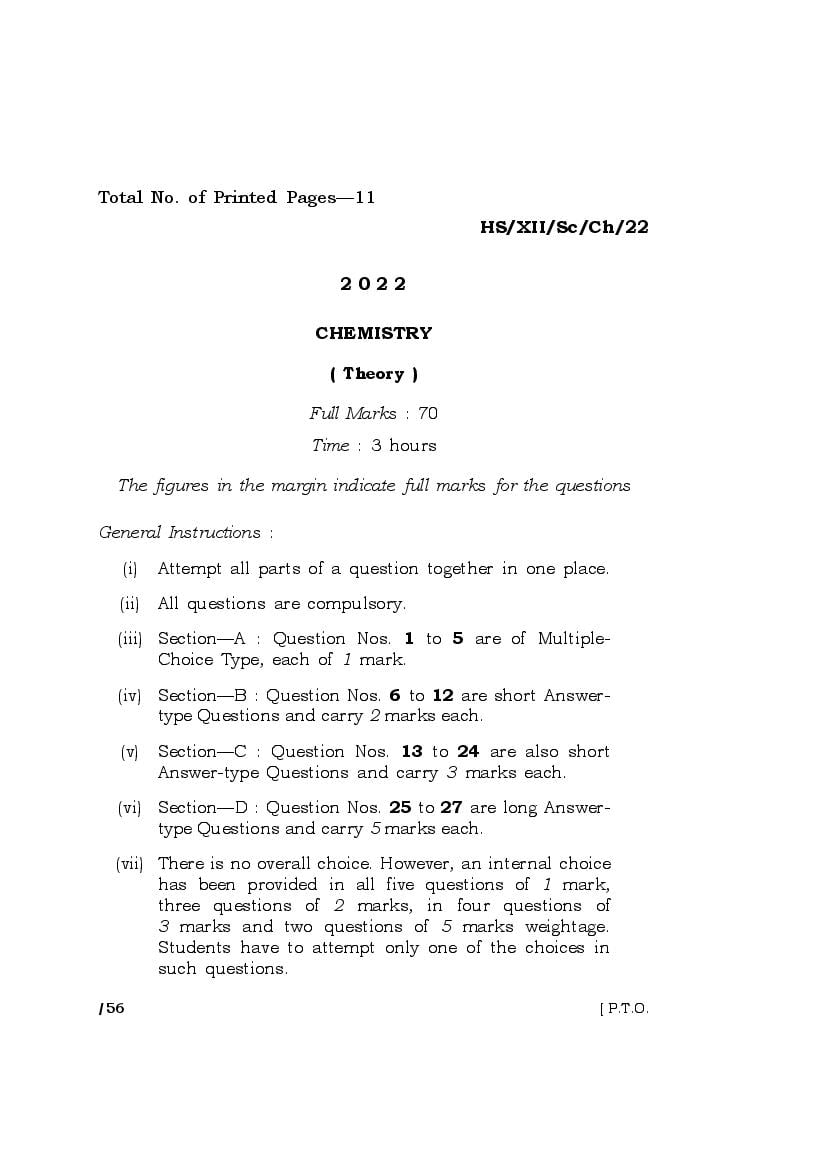
HS/XII/Sc/Ch/22
2022
CHEMISTRY
( Theory )
Full Marks : 70
Time : 3 hours
The figures in the margin indicate full marks for the questions
General Instructions :
(i) Attempt all parts of a question together in one place.
(ii) All questions are compulsory.
(iii) Section—A : Question Nos. 1 to 5 are of Multiple-
Choice Type, each of 1 mark.
(iv) Section—B : Question Nos. 6 to 12 are short Answer-
type Questions and carry 2 marks each.
(v) Section—C : Question Nos. 13 to 24 are also short
Answer-type Questions and carry 3 marks each.
(vi) Section—D : Question Nos. 25 to 27 are long Answer-
type Questions and carry 5 marks each.
(vii) There is no overall choice. However, an internal choice
has been provided in all five questions of 1 mark,
three questions of 2 marks, in four questions of
3 marks and two questions of 5 marks weightage.
Students have to attempt only one of the choices in
such questions.
/56 [ P.T.O.
Page 2
(viii) Use of non-programmable ordinary scientific
calculators and log tables are allowed.
(ix) Mobile phones and Pagers are not allowed inside the
Examination Hall.
SECTION—A
Choose and write the correct answers for the following in the
Answer Script :
1. NaCl does not show Frenkel defect because
(a) cations and anions have almost equal size
(b) there is large differences in size of cations and
anions
(c) cations and anions have low coordination number
(d) anions cannot be accommodated in voids 1
2. The colligative properties of a dilute solution depend
upon the
(a) nature of solute
(b) number of particles of solute
(c) number of particles of solvent
(d) nature of solvent 1
HS/XII/Sc/Ch/22/56 [ Contd.
Page 3
3. Shape selective catalysis is a reaction catalysed by
(a) zeolite
(b) enzymes
(c) platinum
(d) Ziegler-Natta catalyst 1
4. The reaction of ethylbromide with NaI in dry acetone
to give ethyliodide is called
(a) Finkelstein reaction
(b) Swarts reaction
(c) Wurtz reaction
(d) Wurtz-Fittig reaction 1
5. The correct order of boiling points for primary (1°),
secondary (2°) and tertiary (3°) alcohols is
(a) 1° > 2° > 3°
(b) 3° > 2° > 1°
(c) 2° > 1° > 3°
(d) 2° > 3° > 1° 1
HS/XII/Sc/Ch/22/56 [ P.T.O.
Page 4
SECTION—B
6. (a) How many atoms are there in a unit cell of a metal
crystallizing in f.c.c. structure? 1
(b) What type of impurity should be added to group–14
elements to convert into n-type semiconductor? 1
7. The rate constant for a reaction of zero order in A is
0·0030 mol L–1s–1. How long will it take for the initial
concentration of A to fall from 0·10 M to 0·075 M ? 2
8. Either
(a) Calculate the mole fraction of ethylene glycol
(C2H6O2) in a solution containing 20% of ethylene
glycol by mass. 2
Or
(b) 200 cm3 of an aqueous solution of a protein
contains 1·26 g of the protein. The osmotic
pressure of such a solution at 300 K is found to
be 2·57 × 10–3 bar. Calculate the molar mass of the
protein (R = 0·083 L bar mol–1 K–1). 2
9. X-ray diffraction studies show that copper crystallises
in an f.c.c. unit cell with cell edge of 3·608 × 10–8 cm.
In a separate experiment, copper is determined to have
a density of 8·92 g/cm3. Calculate the atomic mass of
copper. 2
HS/XII/Sc/Ch/22/56 [ Contd.
Page 5
10. Either
(a) Complete the following reactions : 1+1
(i)
(ii)
Or
(b) In the following pair of halogen compounds, which
compound will react faster by SN1 mechanism?
Why? 1+1
11. How will you carry out the following conversions?
(a) Propene to propan-1-ol 1
(b) Ethylchloride to propanoic acid ½+½=1
12. Either
(a) Why Zn2+ is colourless whereas Mn2+ is violet in
colour? 2
Or
(b) Explain why Cr+2 is a good reducing agent and Mn+3
is a good oxidising agent even though both ions
have the same d 4 configuration. 2
HS/XII/Sc/Ch/22/56 [ P.T.O.
Page 6
SECTION—C
13. (a) Differentiate between physisorption and chemi-
sorption. 2
(b) Out of MgCl2 and AlCl3 which one is more effective
in causing coagulation of negatively charged sol and
why? 1
14. Either
(a) Derive the integrated rate equation for the first-
order reaction. Hence prove that half-life period is
independent of initial concentration of the reactant. 3
Or
(b) Time for half-life change for a first-order reaction is
25 sec. Find the time taken for the completion of
99·9% reaction. 2
(c) Calculate the overall order of a reaction which has
the rate expression of
Rate = K [ A ]1/2 [B ]3/2 1
15. (a) What will happen to the vapour pressure of a pure
liquid on addition of non-volatile solute? 2
(b) State Henry’s law on solubility of a gas in liquid. 1
16. (a) How do you account for the reducing behaviour of
H3PO2 on the basis of its structure? 1
(b) Explain why phosphorus forms PCl5 whereas
N does not form NCl5. 1
(c) Why is H2O a liquid and H2S a gas? 1
HS/XII/Sc/Ch/22/56 [ Contd.
Page 7
17. (a) Why do transition elements show variable oxidation
states? 1
(b) What is lanthanoid contraction? 1
(c) Give the ionic equation when acidified KMnO4 reacts
with ferrous sulphate. 1
18. Either
(a) Write the IUPAC name of the following complex : 1
[Cr (NH3 )3 (H2O)3 ] C l3
(b) What are chelating ligands? 1
(c) Why are geometrical isomers not possible in
tetrahedral complexes? 1
Or
(d) Explain according to CFT [Ti (H2O)6 ]3 is coloured
while [Ti (H2O)6 ]4 is colourless. 2
(e) Draw the geometrical isomers of [Co(NH3 )4 Cl2 ]. 1
19. (a) Name the ore from which aluminium is extracted.
Write its composition. 1
(b) Write the chemical reaction which takes place in
Mond’s process for refining of nickel. 2
20. Either
(a) Arrange the following in increasing order of their
acid strength :
H2O, CH3OH, C2H5OH, C6H5OH 1
(b) Why electrophilic substitution in phenols takes place
at ortho- and para-position? 1
HS/XII/Sc/Ch/22/56 [ P.T.O.
Page 8
(c) Why are alcohols more soluble in water than
hydrocarbons of comparable molecular mass? 1
Or
(d) Give the chemical test to distinguish between phenol
and benzoic acid. 1
(e) Explain the following observations : 1+1
(i) The boiling point of ethanol is higher than that
of methoxy methane.
(ii) Phenol is more acidic than ethanol.
21. (a) What is carbylamine reaction? 1
(b) Why is aniline less basic than ethanamine? 1
(c) Write the product obtained in bromination of
aniline in aqueous medium. 1
22. Either
(a) What is glycosidic linkage? 1
(b) What are the products obtained on hydrolysis of
sucrose? 1
(c) Name the vitamin whose deficiency is responsible
for night blindness. 1
HS/XII/Sc/Ch/22/56 [ Contd.
Page 9
Or
(d) What is a reducing sugar? 1
(e) Which -amino acid is not optically active? 1
(f) Name the bases derived from purines and
pyrimidines. 1
23. (a) Name the monomers of bakelite. 1
(b) What is a biodegradable polymer? Give example. 1+1
24. (a) What are antacids? Give one example. 1
(b) Name two artificial sweetening agents. 1
(c) Write the difference between antiseptics and
disinfectants. 1
SECTION—D
25. Either
(a) Calculate the equilibrium constant of the reaction :
Cu(s) 2 Ag (aq) Cu2 (aq) 2 Ag(s)
Given E cell 0 · 46 V . 2
(b) State Faraday’s first law of electrolysis. 1
(c) How many coulombs of charge are required to
produce 20 g of Ca from CaCl2? 2
HS/XII/Sc/Ch/22/56 [ P.T.O.
Page 10
Or
(d) Define Kohlrausch’s law of independent migration
of ions. 1
(e) A solution of CuSO4 is electrolysed for 10 minutes
with a current of 1·5 amperes. What is the mass of
copper deposited at the cathode? (Given atomic
mass of Cu = 63 g mol–1) (1F = 96500 C mol–1) 2
(f) How much charge is required for the reduction of
1 mol of Cu2+ to Cu? 1
(g) Why does the conductivity of a solution decrease
with dilution? 1
26. (a) Identify the products A, B, C and D from the
following sequence of reactions : 1+1
(i)
(ii)
(b) Give the structure of the products expected from the
following reactions : 1+1
(i) 2-butanone is treated with Zn/Hg and conc. HCl.
(ii) Two molecules of benzaldehyde are treated with
conc. NaOH.
(c) Convert toluene to benzaldehyde. 1
HS/XII/Sc/Ch/22/56 [ Contd.
Page 11
27. Either
(a) Fluorine has only –1 oxidation state but other
halogens have oxidation states as +1, +3, +5, +7
also. Give reasons. 1
(b) What are interhalogens compounds? Why is I—Cl
more reactive than I2? 1+1
(c) Mention the conditions required to maximise the yield
of ammonia by Haber’s process. 2
Or
(d) Write down the steps involved in the manufacture of
HNO3 by Ostwald process. 2
(e) Noble Gases have very low boiling points. Why? 1
(f) What happens when—
(i) concentrated H2SO4 is added to calcium fluoride; 1
(ii) XeF4 is treated with H2O? 1
HS/XII/Sc/Ch/22/56 22K—4350
Document Details
| Board / Org | Meghalaya Board |
| Exam | Class 12 |
| Type | Question Paper |
| Pages | 11 |
| Updated | 22 Jul 2026 |