UGC NET 2021 Question Paper Linguistics Shift 2
Finished viewing? Save it for later —
Download UGC NET 2021 Question Paper Linguistics Shift 2 (PDF · 94 pages)About UGC NET 2021 Question Paper Linguistics Shift 2
UGC NET 2021 Question Paper Linguistics Shift 2 is available here for free download. Published by NTA for UGC NET, this question paper can be viewed online or downloaded as a PDF (94 pages). Candidates preparing for UGC NET can use UGC NET 2021 Question Paper Linguistics Shift 2 to understand the exam pattern, the type of questions asked, and the overall difficulty level.
Frequently Asked Questions
How can I download UGC NET 2021 Question Paper Linguistics Shift 2?
Open this page and click the Download button to save UGC NET 2021 Question Paper Linguistics Shift 2 as a PDF. It is completely free on AglaSem Docs.
Is UGC NET 2021 Question Paper Linguistics Shift 2 free to download?
Yes. UGC NET 2021 Question Paper Linguistics Shift 2 can be viewed online and downloaded as a PDF free of cost on AglaSem Docs.
How many pages does UGC NET 2021 Question Paper Linguistics Shift 2 have?
UGC NET 2021 Question Paper Linguistics Shift 2 contains 94 pages, which you can read online or download together as a single PDF.
Where can I find more UGC NET study material?
You can find more UGC NET question papers, sample papers, syllabus, and answer keys on AglaSem Docs.
UGC NET 2021 Question Paper Linguistics Shift 2 – Text
Read the full text of this question paper below — useful to quickly search, copy and reference the content online without downloading the PDF.
📄 View text version (94 pages)
Page 1
Topic:‐ GP_Set2_C
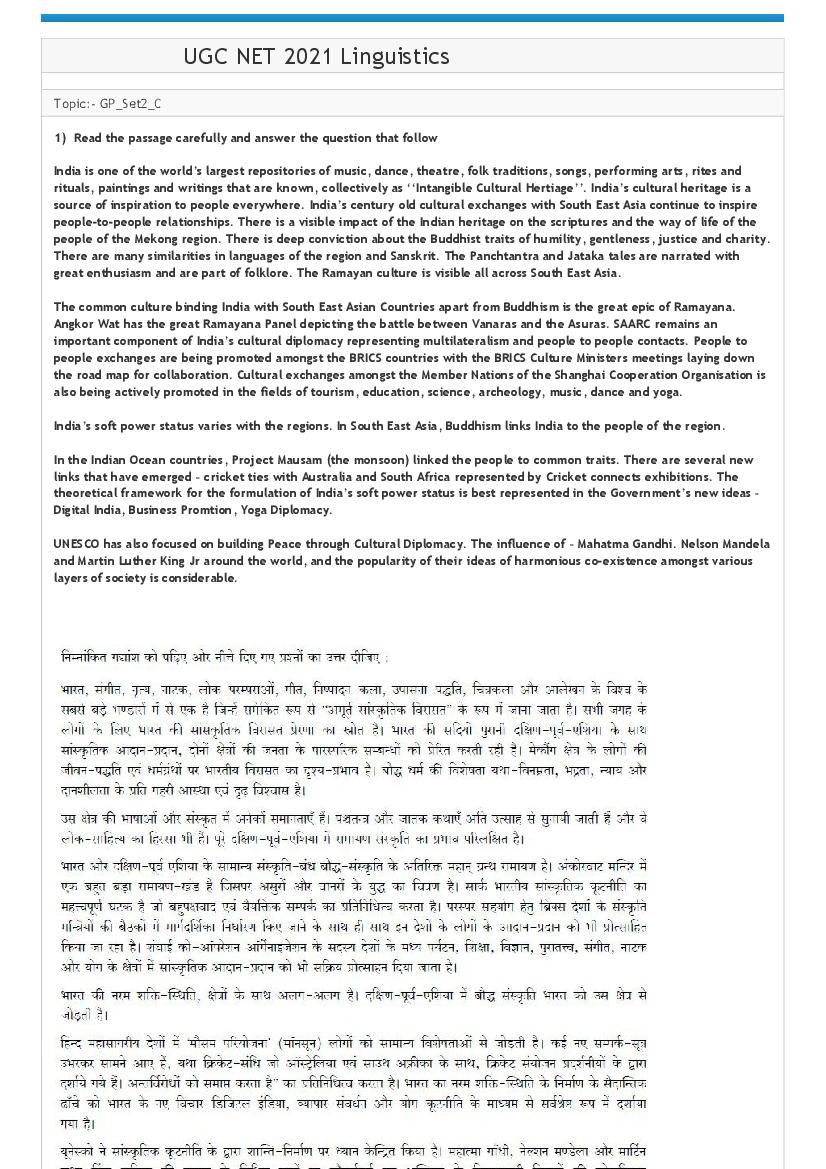
1) Read the passage carefully and answer the question that follow
India is one of the world’s largest repositories of music, dance, theatre, folk traditions, songs, performing arts, rites and
rituals, paintings and writings that are known, collectively as ‘‘Intangible Cultural Hertiage’’. India’s cultural heritage is a
source of inspiration to people everywhere. India’s century old cultural exchanges with South East Asia continue to inspire
people‐to‐people relationships. There is a visible impact of the Indian heritage on the scriptures and the way of life of the
people of the Mekong region. There is deep conviction about the Buddhist traits of humility, gentleness, justice and charity.
There are many similarities in languages of the region and Sanskrit. The Panchtantra and Jataka tales are narrated with
great enthusiasm and are part of folklore. The Ramayan culture is visible all across South East Asia.
The common culture binding India with South East Asian Countries apart from Buddhism is the great epic of Ramayana.
Angkor Wat has the great Ramayana Panel depicting the battle between Vanaras and the Asuras. SAARC remains an
important component of India’s cultural diplomacy representing multilateralism and people to people contacts. People to
people exchanges are being promoted amongst the BRICS countries with the BRICS Culture Ministers meetings laying down
the road map for collaboration. Cultural exchanges amongst the Member Nations of the Shanghai Cooperation Organisation is
also being actively promoted in the fields of tourism, education, science, archeology, music, dance and yoga.
India’s soft power status varies with the regions. In South East Asia, Buddhism links India to the people of the region.
In the Indian Ocean countries, Project Mausam (the monsoon) linked the people to common traits. There are several new
links that have emerged – cricket ties with Australia and South Africa represented by Cricket connects exhibitions. The
theoretical framework for the formulation of India’s soft power status is best represented in the Government’s new ideas –
Digital India, Business Promtion, Yoga Diplomacy.
UNESCO has also focused on building Peace through Cultural Diplomacy. The influence of – Mahatma Gandhi. Nelson Mandela
and Martin Luther King Jr around the world, and the popularity of their ideas of harmonious co‐existence amongst various
layers of society is considerable.
Page 2
(A) Ramayan
(B) Multilateral engagements
(C) Business Promotion
(D) People to people contacts
Choose the correct answer from the options given below :
(1) (A) and (D) only (2) (A), (C) and (D) only
(3) (B), (C) and (D) only (4) (B) and (D) only
[Question ID = 3557][Question Description = Q46_GP_20NOV_S2_SHAAN_Shift2]
[Option ID = 13691]
[Option ID = 13692]
[Option ID = 13693]
[Option ID = 13694]
2) Read the passage carefully and answer the question that follow
India is one of the world’s largest repositories of music, dance, theatre, folk traditions, songs, performing arts, rites and
rituals, paintings and writings that are known, collectively as ‘‘Intangible Cultural Hertiage’’. India’s cultural heritage is a
source of inspiration to people everywhere. India’s century old cultural exchanges with South East Asia continue to inspire
people‐to‐people relationships. There is a visible impact of the Indian heritage on the scriptures and the way of life of the
Page 3
There are many similarities in languages of the region and Sanskrit. The Panchtantra and Jataka tales are narrated with
great enthusiasm and are part of folklore. The Ramayan culture is visible all across South East Asia.
The common culture binding India with South East Asian Countries apart from Buddhism is the great epic of Ramayana.
Angkor Wat has the great Ramayana Panel depicting the battle between Vanaras and the Asuras. SAARC remains an
important component of India’s cultural diplomacy representing multilateralism and people to people contacts. People to
people exchanges are being promoted amongst the BRICS countries with the BRICS Culture Ministers meetings laying down
the road map for collaboration. Cultural exchanges amongst the Member Nations of the Shanghai Cooperation Organisation is
also being actively promoted in the fields of tourism, education, science, archeology, music, dance and yoga.
India’s soft power status varies with the regions. In South East Asia, Buddhism links India to the people of the region.
In the Indian Ocean countries, Project Mausam (the monsoon) linkded the people to common traits. There are several new
links that have emerged – cricket ties with Australia and South Africa represented by Cricket connects exhibitions. The
theoretical framework for the formulation of India’s soft power status is best represented in the Government’s new ideas –
Digital India, Business Promtion, Yoga Diplomacy.
UNESCO has also focused on building Peace through Cultural Diplomacy. The influence of – Mahatma Gandhi. Nelson Mandela
and Martin Luther King Jr around the world, and the popularity of their ideas of harmonious co‐existence amongst various
layers of society is considerable.
The common thread binding India and South East Asian Countries is/are
(A) Buddist tenets
(B) Yoga
(C) Cricket
(D) Ramayan
(E) Sanskrit
Choose the correct answer from the options given below :
Page 4
(3) (A) and (D) only (4) (A), (B), (D) and (E) only
[Question ID = 3558][Question Description = Q47_GP_20NOV_S2_SHAAN_Shift2]
1. 1 [Option ID = 13695]
2. 2 [Option ID = 13696]
3. 3 [Option ID = 13697]
4. 4 [Option ID = 13698]
3) Read the passage carefully and answer the question that follow
India is one of the world’s largest repositories of music, dance, theatre, folk traditions, songs, performing arts, rites and
rituals, paintings and writings that are known, collectively as ‘‘Intangible Cultural Hertiage’’. India’s cultural heritage is a
source of inspiration to people everywhere. India’s century old cultural exchanges with South East Asia continue to inspire
people‐to‐people relationships. There is a visible impact of the Indian heritage on the scriptures and the way of life of the
people of the Mekong region. There is deep conviction about the Buddhist traits of humility, gentleness, justice and charity.
There are many similarities in languages of the region and Sanskrit. The Panchtantra and Jataka tales are narrated with
great enthusiasm and are part of folklore. The Ramayan culture is visible all across South East Asia.
The common culture binding India with South East Asian Countries apart from Buddhism is the great epic of Ramayana.
Angkor Wat has the great Ramayana Panel depicting the battle between Vanaras and the Asuras. SAARC remains an
important component of India’s cultural diplomacy representing multilateralism and people to people contacts. People to
people exchanges are being promoted amongst the BRICS countries with the BRICS Culture Ministers meetings laying down
the road map for collaboration. Cultural exchanges amongst the Member Nations of the Shanghai Cooperation Organisation is
also being actively promoted in the fields of tourism, education, science, archeology, music, dance and yoga.
India’s soft power status varies with the regions. In South East Asia, Buddhism links India to the people of the region.
In the Indian Ocean countries, Project Mausam (the monsoon) linkded the people to common traits. There are several new
links that have emerged – cricket ties with Australia and South Africa represented by Cricket connects exhibitions. The
theoretical framework for the formulation of India’s soft power status is best represented in the Government’s new ideas –
Digital India, Business Promtion, Yoga Diplomacy.
UNESCO has also focused on building Peace through Cultural Diplomacy. The influence of – Mahatma Gandhi. Nelson Mandela
and Martin Luther King Jr around the world, and the popularity of their ideas of harmonious co‐existence amongst various
layers of society is considerable.
Page 5
(1) Digital India (2) Skill India
(3) Business Promotion (4) Yoga Diplomacy
[Question ID = 3559][Question Description = Q48_GP_20NOV_S2_SHAAN_Shift2]
1. 1 [Option ID = 13699]
2. 2 [Option ID = 13700]
3. 3 [Option ID = 13701]
4. 4 [Option ID = 13702]
4) Read the passage carefully and answer the question that follow
India is one of the world’s largest repositories of music, dance, theatre, folk traditions, songs, performing arts, rites and
rituals, paintings and writings that are known, collectively as ‘‘Intangible Cultural Hertiage’’. India’s cultural heritage is a
source of inspiration to people everywhere. India’s century old cultural exchanges with South East Asia continue to inspire
people‐to‐people relationships. There is a visible impact of the Indian heritage on the scriptures and the way of life of the
people of the Mekong region. There is deep conviction about the Buddhist traits of humility, gentleness, justice and charity.
There are many similarities in languages of the region and Sanskrit. The Panchtantra and Jataka tales are narrated with
great enthusiasm and are part of folklore. The Ramayan culture is visible all across South East Asia.
The common culture binding India with South East Asian Countries apart from Buddhism is the great epic of Ramayana.
Angkor Wat has the great Ramayana Panel depicting the battle between Vanaras and the Asuras. SAARC remains an
important component of India’s cultural diplomacy representing multilateralism and people to people contacts. People to
people exchanges are being promoted amongst the BRICS countries with the BRICS Culture Ministers meetings laying down
the road map for collaboration. Cultural exchanges amongst the Member Nations of the Shanghai Cooperation Organisation is
also being actively promoted in the fields of tourism, education, science, archeology, music, dance and yoga.
India’s soft power status varies with the regions. In South East Asia, Buddhism links India to the people of the region.
In the Indian Ocean countries, Project Mausam (the monsoon) linkded the people to common traits. There are several new
links that have emerged – cricket ties with Australia and South Africa represented by Cricket connects exhibitions. The
theoretical framework for the formulation of India’s soft power status is best represented in the Government’s new ideas –
Digital India, Business Promtion, Yoga Diplomacy.
UNESCO has also focused on building Peace through Cultural Diplomacy. The influence of – Mahatma Gandhi. Nelson Mandela
and Martin Luther King Jr around the world, and the popularity of their ideas of harmonious co‐existence amongst various
layers of society is considerable.
Page 6
(A) Archeology
(B) Folklore
(C) Tourism
(D) Yoga
(E) Education
Choose the correct answer from the options given below :
(1) (A), (C), (D) and (E) only (2) (A), (B), (C) and (E) only
(3) (A), (B) and (E) only (4) (B), (C), (D) and (E) only
[Question ID = 3560][Question Description = Q49_GP_20NOV_S2_SHAAN_Shift2]
Page 7
2. 2 [Option ID = 13704]
3. 3 [Option ID = 13705]
4. 4 [Option ID = 13706]
5) Read the passage carefully and answer the question that follow
India is one of the world’s largest repositories of music, dance, theatre, folk traditions, songs, performing arts, rites and
rituals, paintings and writings that are known, collectively as ‘‘Intangible Cultural Hertiage’’. India’s cultural heritage is a
source of inspiration to people everywhere. India’s century old cultural exchanges with South East Asia continue to inspire
people‐to‐people relationships. There is a visible impact of the Indian heritage on the scriptures and the way of life of the
people of the Mekong region. There is deep conviction about the Buddhist traits of humility, gentleness, justice and charity.
There are many similarities in languages of the region and Sanskrit. The Panchtantra and Jataka tales are narrated with
great enthusiasm and are part of folklore. The Ramayan culture is visible all across South East Asia.
The common culture binding India with South East Asian Countries apart from Buddhism is the great epic of Ramayana.
Angkor Wat has the great Ramayana Panel depicting the battle between Vanaras and the Asuras. SAARC remains an
important component of India’s cultural diplomacy representing multilateralism and people to people contacts. People to
people exchanges are being promoted amongst the BRICS countries with the BRICS Culture Ministers meetings laying down
the road map for collaboration. Cultural exchanges amongst the Member Nations of the Shanghai Cooperation Organisation is
also being actively promoted in the fields of tourism, education, science, archeology, music, dance and yoga.
India’s soft power status varies with the regions. In South East Asia, Buddhism links India to the people of the region.
In the Indian Ocean countries, Project Mausam (the monsoon) linkded the people to common traits. There are several new
links that have emerged – cricket ties with Australia and South Africa represented by Cricket connects exhibitions. The
theoretical framework for the formulation of India’s soft power status is best represented in the Government’s new ideas –
Digital India, Business Promtion, Yoga Diplomacy.
UNESCO has also focused on building Peace through Cultural Diplomacy. The influence of – Mahatma Gandhi. Nelson Mandela
and Martin Luther King Jr around the world, and the popularity of their ideas of harmonious co‐existence amongst various
layers of society is considerable.
The passage highlights
Page 8
(2) The role of culture for peace and harmonious relations with other countries
(3) India’s cultural hegemony
(4) India’s relations with BRICS countries
[Question ID = 3561][Question Description = Q50_GP_20NOV_S2_SHAAN_Shift2]
1. 1 [Option ID = 13707]
2. 2 [Option ID = 13708]
3. 3 [Option ID = 13709]
4. 4 [Option ID = 13710]
Topic:‐ GP_Set2_A
1)
Page 9
company?
(1) 119 : 145 (2) 116 : 135
(3) 119 : 135 (4) 119 : 130
[Question ID = 3562][Question Description = Q01_GP_20NOV_S2_SHAAN_Shift2]
1. 1 [Option ID = 13711]
2. 2 [Option ID = 13712]
3. 3 [Option ID = 13713]
4. 4 [Option ID = 13714]
2)
If 35% of the PCs sold by Company HP during November were sold at a discount, then how many PCs of Company HP during
that month were sold without a discount?
(1) 882 (2) 1635
(3) 1638 (4) 885
Page 10
1. 1 [Option ID = 13715]
2. 2 [Option ID = 13716]
3. 3 [Option ID = 13717]
4. 4 [Option ID = 13718]
3)
If the dealer earned a profit of Rs. 433 on each PC sold of Company DELL during October, then what was his total profit
earned on the PCs of that company during the same month?
(1) 6,49,900 (2) 6,45,900
(3) 6,49,400 (4) 6,49,500
[Question ID = 3564][Question Description = Q03_GP_20NOV_S2_SHAAN_Shift2]
Page 11
2. 2 [Option ID = 13720]
3. 3 [Option ID = 13721]
4. 4 [Option ID = 13722]
4)
The number of PCs sold of Company HP during July is approximately what percent (%) of the number of PCs sold of Company
HP during December?
(1) 110% (2) 140%
(3) 150% (4) 130%
[Question ID = 3565][Question Description = Q04_GP_20NOV_S2_SHAAN_Shift2]
1. 1 [Option ID = 13723]
2. 2 [Option ID = 13724]
3. 3 [Option ID = 13725]
4. 4 [Option ID = 13726]
5)
Page 12
(1) 10000 (2) 15000
(3) 10500 (4) 9500
[Question ID = 3566][Question Description = Q05_GP_20NOV_S2_SHAAN_Shift2]
[Option ID = 13727]
[Option ID = 13728]
[Option ID = 13729]
[Option ID = 13730]
Page 13
1) In which level of teaching promotion of critical thinking is the hall mark?
(1) Memory level (2) Understanding level
(3) Reflective level (4) Autonomous development level
[Question ID = 3567][Question Description = Q06_GP_20NOV_S2_SHAAN_Shift2]
1. 1 [Option ID = 13731]
2. 2 [Option ID = 13732]
3. 3 [Option ID = 13733]
4. 4 [Option ID = 13734]
2) The key behaviour of an effective teacher is marked by which of the following features? (A) Structuring (B) Teacher
task orientation (C) Instructional Variety (D) Lesson clarity (E) Probing Choose the correct answer from the options given
below :
(1) (A), (B) and (C) only (2) (A), (C) and (D) only
(3) (B), (C) and (D) only (4) (C), (D) and (E) only
[Question ID = 3568][Question Description = Q07_GP_20NOV_S2_SHAAN_Shift2]
[Option ID = 13735]
[Option ID = 13736]
[Option ID = 13737]
[Option ID = 13738]
3) Match List I with List II gives their characteristic features.
List I List II
(Modes of Evaluation) (Characteristic Features)
(A) Formative Evaluation (I) Compares one student with another student
(B) Summative Evaluation (II) Compares the progress of a student against prespecified standards
(C) Criterion‐referenced Evaluation (III) Used primarily for motivational and monitoring purposes of learning
(D) Norm‐referenced Evaluation (IV) Used primarily for gradation of progress made
Choose the correct answer from the options given below :
(1) (A)‐(IV), (B)‐(III), (C)‐(I), (D)‐(II) (2) (A)‐(III), (B)‐(IV), (C)‐(II), (D)‐(I)
Page 14
[Question ID = 3569][Question Description = Q08_GP_20NOV_S2_SHAAN_Shift2]
1. 1 [Option ID = 13739]
2. 2 [Option ID = 13740]
3. 3 [Option ID = 13741]
4. 4 [Option ID = 13742]
4) Given below are two statements :
Statement I : One of the basic principles of progressive view of teaching is that education should be life itself rather than a
preparation for living.
Statement II : According to reconstructionist view of education the new social order must be ‘genuinely democratic’.
In the light of the above statements, Choose the correct answer from the options given below :
(1) Both Statement I and Statement II are true. (2) Both Statement I and Statement II are false.
(3) Statement I is true but Statement II is false. (4) Statement I is false but Statement II is true.
[Question ID = 3570][Question Description = Q09_GP_20NOV_S2_SHAAN_Shift2]
1. 1 [Option ID = 13743]
2. 2 [Option ID = 13744]
3. 3 [Option ID = 13745]
4. 4 [Option ID = 13746]
5) Given below are two statements : One is labeled as Assertion A and the other is labeled as Reason R.
Assertion (A) : ‘Teaching’ involves critical and creative interchanges between teacher and learner and hence it is different
from ‘instruction’ and ‘training’.
Page 15
In the light of the above statements, Choose the most appropriate answer from the options given below :
(1) Both (A) and (R) are correct and (R) is the correct explanation of (A). (2) Both (A) and (R) are correct but (R) is NOT
the correct explanation of (A).
(3) (A) is correct but (R) is not correct. (4) (A) is not correct but (R) is correct.
[Question ID = 3571][Question Description = Q10_GP_20NOV_S2_SHAAN_Shift2]
1. 1 [Option ID = 13747]
2. 2 [Option ID = 13748]
3. 3 [Option ID = 13749]
4. 4 [Option ID = 13750]
6) In which of the following researches, attempts are made to establish context‐free generalizations?
(1) Phenomenology (2) Grounded theory
(3) Symbolic interactionism (4) Experimental Studies
[Question ID = 3572][Question Description = Q11_GP_20NOV_S2_SHAAN_Shift2]
1. 1 [Option ID = 13751]
2. 2 [Option ID = 13752]
3. 3 [Option ID = 13753]
4. 4 [Option ID = 13754]
7) Identify the main features of ‘qualitative research’ from the following :
(A) It is concerned with understanding the phenomena from the participant’s perspective
(B) It assumes that there are social facts with a single objective reality
(C) Researcher becomes immersed in the situation, present or past
(D) Researcher is detached from the study to avoid bias
(E) There is greater flexibility in both the methods and research process
Choose the correct answer from the options given below :
(1) (A), (C) and (E) only (2) (A), (B) and (C) only
(3) (B), (C) and (D) only (4) (C), (D) and (E) only
Page 16
1. 1 [Option ID = 13755]
2. 2 [Option ID = 13756]
3. 3 [Option ID = 13757]
4. 4 [Option ID = 13758]
8) Match List I with List II :
List I List II
Methods of research Features emphasized
(A) Experimental (I) Primary and secondary sources tapped with emphasis on internal criticism
(B) ExPost Facto (II) Status of facts and conditions are ascertained
(C) Descriptive (III) A variable is manipulated to see its effect on other variable
(D) Historical (IV) The differences are noted and factors causal or otherwise are determined
Choose the correct answer from the options given below :
(1) (A)‐(I), (B)‐(II), (C)‐(III), (D)‐(IV) (2) (A)‐(II), (B)‐(I), (C)‐(IV), (D)‐(III)
(3) (A)‐(III), (B)‐(IV), (C)‐(II), (D)‐(I) (4) (A)‐(IV), (B)‐(III), (C)‐(I), (D)‐(II)
[Question ID = 3574][Question Description = Q13_GP_20NOV_S2_SHAAN_Shift2]
1. 1 [Option ID = 13759]
2. 2 [Option ID = 13760]
3. 3 [Option ID = 13761]
4. 4 [Option ID = 13762]
9) Given below are two statements :
Statement I : Data analysis in research being a technical job, ‘research ethics’ does not matter.
Statement II : ICT is helpful almost at all stages of research.
In the light of the above statements, Choose the correct answer from the options given below :
(1) Both Statement I and Statement II are true. (2) Both Statement I and Statement II are false.
(3) Statement I is true but Statement II is false. (4) Statement I is false but Statement II is true.
Page 17
1. 1 [Option ID = 13763]
2. 2 [Option ID = 13764]
3. 3 [Option ID = 13765]
4. 4 [Option ID = 13766]
10) Given below are two statements : One is labeled as Assertion A and the other is labeled as Reason R.
Assertion (A) : When Null Hypothesis (H0) is rejected, researcher’s hypothesis (H1) is accepted.
Reason (R) : Null Hypothesis (H0) is a chance hypothesis and as such (H1) being true, the researcher’s hypothesis lies in the
domain of acceptability.
In the light of the above statements, Choose the most appropriate answer from the options given below :
(1) Both (A) and (R) are correct and (R) is the correct explanation of (A). (2) Both (A) and (R) are correct but (R) is NOT
the correct explanation of (A).
(3) (A) is correct but (R) is not correct. (4) (A) is not correct but (R) is correct.
[Question ID = 3576][Question Description = Q15_GP_20NOV_S2_SHAAN_Shift2]
1. 1 [Option ID = 13767]
2. 2 [Option ID = 13768]
3. 3 [Option ID = 13769]
4. 4 [Option ID = 13770]
11) Which of the following is an exclusive example of Non‐verbal cue that includes the pitch, rate, volume and use of
pauses?
(1) Linear Model of Communication (2) Interactional Model
(3) Non‐Verbal Cues (4) Para‐Language
[Question ID = 3577][Question Description = Q16_GP_20NOV_S2_SHAAN_Shift2]
1. 1 [Option ID = 13771]
2. 2 [Option ID = 13772]
3. 3 [Option ID = 13773]
4. 4 [Option ID = 13774]
Page 18
Assertion (A) : In the context of communication, the perceptual process creates, semantic‐noise also called word‐noise.
Reason (R) : The various meanings either cannotative or denotative are sources of semantic noise.
In the light of the above statements, Choose the most appropriate answer from the options given below :
(1) Both (A) and (R) are correct and (R) is the correct explanation of (A).
(2) Both (A) and (R) are correct but (R) is NOT the correct explanation of (A).
(3) (A) is correct but (R) is not correct.
(4) (A) is not correct but (R) is correct.
[Question ID = 3578][Question Description = Q17_GP_20NOV_S2_SHAAN_Shift2]
[Option ID = 13775]
[Option ID = 13776]
[Option ID = 13777]
[Option ID = 13778]
13) Given below are two statements :
Statement I : Appropriate word choice is an essential of effective oral communication.
Statement II : Facial expression and postures fall under visual communication.
In the light of the above statements, Choose the correct answer from the options given below :
(1) Both Statement I and Statement II are true. (2) Both Statement I and Statement II are false.
(3) Statement I is true but Statement II is false. (4) Statement I is false but Statement II is true.
Page 19
1. 1 [Option ID = 13779]
2. 2 [Option ID = 13780]
3. 3 [Option ID = 13781]
4. 4 [Option ID = 13782]
14) Identify the barriers to communication from the list given below :
(A) Time and distance
(B) By‐passed instructions
(C) Encoding of thoughts and ideas
(D) Decoding of thoughts and ideas
(E) Logical sequence
Choose the correct answer from the options given below :
(1) (A) and (B) only (2) (B) and (C) only
(3) (C) and (D) only (4) (D) and (E) only
[Question ID = 3580][Question Description = Q19_GP_20NOV_S2_SHAAN_Shift2]
[Option ID = 13783]
[Option ID = 13784]
[Option ID = 13785]
[Option ID = 13786]
15) Match List I with List II :
List I List II
Types of Communication Main features
(A) Downward Communication (I) Grows primarily to meet organizational/member’s need for communication
(B) Upward Communication (II) It forms a useful link in decision making for task coordination
(C) Horizontal Communication (III) Provides management with feedback about current issues and problems
(D) Grapevine Communication (IV) It is the most common communication system in an organization
Choose the correct answer from the options given below :
(1) (A)‐(I), (B)‐(II), (C)‐(IV), (D)‐(III) (2) (A)‐(II), (B)‐(I), (C)‐(III), (D)‐(IV)
(3) (A)‐(III), (B)‐(IV), (C)‐(I), (D)‐(II) (4) (A)‐(IV), (B)‐(III), (C)‐(II), (D)‐(I)
Page 20
1. 1 [Option ID = 13787]
2. 2 [Option ID = 13788]
3. 3 [Option ID = 13789]
4. 4 [Option ID = 13790]
16) If the cost price is 25% of selling price, then what is the profit percentage?
(1) 100 (2) 200
(3) 300 (4) 400
[Question ID = 3582][Question Description = Q21_GP_20NOV_S2_SHAAN_Shift2]
1. 1 [Option ID = 13791]
2. 2 [Option ID = 13792]
3. 3 [Option ID = 13793]
4. 4 [Option ID = 13794]
17) A seller mixes 26 kg rice of a price of Rs. 20/kg, with 30 kg of different variety rice of a price of Rs. 36/kg. He sells
both the mixed rices at Rs. 30/kg. What will be the profit in percentage?
(1) 5% (2) 10%
(3) 15% (4) 20%
[Question ID = 3583][Question Description = Q22_GP_20NOV_S2_SHAAN_Shift2]
1. 1 [Option ID = 13795]
2. 2 [Option ID = 13796]
3. 3 [Option ID = 13797]
4. 4 [Option ID = 13798]
18) A milk man purchases milk at Rs. X per litre and sells it at Rs. 2X per litre. Still he mixes 2 litres of water with every 6
litre of pure milk. What is his profit percentage?
(1) 33.33 (2) 66.66
(3) 133.33 (4) 166.66
[Question ID = 3584][Question Description = Q23_GP_20NOV_S2_SHAAN_Shift2]
1. 1 [Option ID = 13799]
2. 2 [Option ID = 13800]
3. 3 [Option ID = 13801]
Page 21
19) The average monthly income of P and Q is Rs. 5,050/‐. The average montly income of Q and R is Rs. 6,250/‐ and that
of P and R is Rs. 5,200. What will be the monthly income of P?
(1) Rs. 3,000/‐ (2) Rs. 3,500/‐
(3) Rs. 4,000/‐ (4) Rs. 4,500/‐
[Question ID = 3585][Question Description = Q24_GP_20NOV_S2_SHAAN_Shift2]
1. 1 [Option ID = 13803]
2. 2 [Option ID = 13804]
3. 3 [Option ID = 13805]
4. 4 [Option ID = 13806]
20) The average of 4 terms is 20, and the first term is 1/3rd of sum of the remaining 3 terms. What will be the value of
first term?
(1) 15 (2) 20
(3) 25 (4) 30
[Question ID = 3586][Question Description = Q25_GP_20NOV_S2_SHAAN_Shift2]
1. 1 [Option ID = 13807]
2. 2 [Option ID = 13808]
3. 3 [Option ID = 13809]
4. 4 [Option ID = 13810]
21)
Page 22
1. 1 [Option ID = 13811]
2. 2 [Option ID = 13812]
3. 3 [Option ID = 13813]
4. 4 [Option ID = 13814]
22)
[Question ID = 3588][Question Description = Q27_GP_20NOV_S2_SHAAN_Shift2]
1. 1 [Option ID = 13815]
2. 2 [Option ID = 13816]
Page 23
4. 4 [Option ID = 13818]
23)
[Question ID = 3589][Question Description = Q28_GP_20NOV_S2_SHAAN_Shift2]
1. 1 [Option ID = 13819]
2. 2 [Option ID = 13820]
3. 3 [Option ID = 13821]
4. 4 [Option ID = 13822]
24) ‘‘All radically egalitarian societies are societies that do not preserve individual liberties’’.
Which of the following statements is true with reference to the above statement?
(1) ‘‘No radically egalitarian societies are societies that preserve individual liberties’’ is obverse of the given statement and
it is logically equivalent.
(2) ‘‘No radically egalitarian societies are societies that preserve individual liberties’’ is obverse of the given statement and
it is not logically equivalent.
(3) ‘‘Some radically egalitarian societies are societies that preserve individual liberties’’ is converse of the given statement
and it is logically equivalent.
(4) ‘‘Some radically egalitarian societies are not societies that preserve individual liberties’’ is converse of the given
statement and it is logically equivalent.
Page 24
1. 1 [Option ID = 13823]
2. 2 [Option ID = 13824]
3. 3 [Option ID = 13825]
4. 4 [Option ID = 13826]
25) Two propositions are contradictories if :
(1) One is denial or negation of the other
(2) If they can both be true but cannot both be false
(3) If they have different subject and predicate term and differ from each other in both quality and quantity
(4) If they have the same subject and predicate terms but differ from each other only in quantity but not in quality
[Question ID = 3591][Question Description = Q30_GP_20NOV_S2_SHAAN_Shift2]
1. 1 [Option ID = 13827]
2. 2 [Option ID = 13828]
3. 3 [Option ID = 13829]
4. 4 [Option ID = 13830]
26) What is the binary equivalent of the decimal number 67.625?
(1) 1000010.110 (2) 1000011.110
(3) 1000010.101 (4) 1000011.101
[Question ID = 3592][Question Description = Q31_GP_20NOV_S2_SHAAN_Shift2]
[Option ID = 13831]
[Option ID = 13832]
[Option ID = 13833]
[Option ID = 13834]
27) Identify the correct order of the following different types of computer components ranked from fastest to slowest in
terms of access time.
(A) RAM
(B) Optical Drive
(C) CPU Cache
(D) SSD
Choose the correct answer from the options given below :
(1) (B), (D), (A), (C) (2) (C), (D), (A), (B)
(3) (A), (B), (C), (D) (4) (C), (A), (D), (B)
Page 25
1. 1 [Option ID = 13835]
2. 2 [Option ID = 13836]
3. 3 [Option ID = 13837]
4. 4 [Option ID = 13838]
28) Given below are two statements :
Statement I : The abbreviation ‘MOOC’ stands for ‘Massive Open Online Courses’.
Statement II : The abbreviation ‘SWAYAM’ stands for ‘Study Webs of Active‐Learning for Young Academic Minds’,
In the light of the above statements, Choose the correct answer from the options given below :
(1) Both Statement I and Statement II are true. (2) Both Statement I and Statement II are false.
(3) Statement I is true but Statement II is false. (4) Statement I is false but Statement II is true.
[Question ID = 3594][Question Description = Q33_GP_20NOV_S2_SHAAN_Shift2]
1. 1 [Option ID = 13839]
2. 2 [Option ID = 13840]
3. 3 [Option ID = 13841]
4. 4 [Option ID = 13842]
29) Which of the following statements are related to the role of ICT in citizen services?
(A) Access to public documents
(B) On‐line payments
(C) Better medical education across the country
Choose the correct answer from the options given below :
(1) (A), (B) and (C) (2) (A) and (C) only
(3) (B) and (C) only (4) (A) and (B) only
Page 26
1. 1 [Option ID = 13843]
2. 2 [Option ID = 13844]
3. 3 [Option ID = 13845]
4. 4 [Option ID = 13846]
30) Match List I with List II :
List I List II
(Computer Terms) (Description)
(A) HTML (I) Semantic Web
(B) Web 2.0 (II) Use of Internet to make phone calls
(C) Web 3.0 (III) Language used to create web pages
(D) VOIP (IV) Collaborative web
Choose the correct answer from the options given below :
(1) (A)‐(III), (B)‐(IV), (C)‐(I), (D)‐(II) (2) (A)‐(III), (B)‐(I), (C)‐(IV), (D)‐(II)
(3) (A)‐(II), (B)‐(IV), (C)‐(I), (D)‐(III) (4) (A)‐(IV), (B)‐(III), (C)‐(I), (D)‐(II)
[Question ID = 3596][Question Description = Q35_GP_20NOV_S2_SHAAN_Shift2]
1. 1 [Option ID = 13847]
2. 2 [Option ID = 13848]
3. 3 [Option ID = 13849]
4. 4 [Option ID = 13850]
31) Given below are two statements :
Statement I : Noise Pollution has an adverse impact on hearing ability as well as psychological well being of a person.
Statement II : Human perception of noise levels is linear.
In the light of the above statements, Choose the correct answer from the options given below :
(1) Both Statement I and Statement II are true. (2) Both Statement I and Statement II are false.
(3) Statement I is true but Statement II is false. (4) Statement I is false but Statement II is true.
Page 27
1. 1 [Option ID = 13851]
2. 2 [Option ID = 13852]
3. 3 [Option ID = 13853]
4. 4 [Option ID = 13854]
32) Which country is in the process of setting up the largest integrated solar‐wind energy park of 30 GW capacity?
(1) China (2) India
(3) Australia (4) Saudi Arabia
[Question ID = 3598][Question Description = Q37_GP_20NOV_S2_SHAAN_Shift2]
1. 1 [Option ID = 13855]
2. 2 [Option ID = 13856]
3. 3 [Option ID = 13857]
4. 4 [Option ID = 13858]
33) Given below are two statements : One is labeled as Assertion A and the other is labeled as Reason R.
Assertion (A) : There has to be an integrated approach to achieve the targets of Sustainable Development Goals (SDGs).
Reason (R) : Many of the SDGs are interconnected.
In the light of the above statements, Choose the most appropriate answer from the options given below :
(1) Both (A) and (R) are correct and (R) is the correct explanation of (A).
(2) Both (A) and (R) are correct but (R) is NOT the correct explanation of (A).
(3) (A) is correct but (R) is not correct.
(4) (A) is not correct but (R) is correct.
[Question ID = 3599][Question Description = Q38_GP_20NOV_S2_SHAAN_Shift2]
[Option ID = 13859]
Page 28
[Option ID = 13861]
[Option ID = 13862]
34) Given below are two statements : One is labeled as Assertion A and the other is labeled as Reason R.
Assertion (A) : Mankind’s interaction with Earth has led to a highly complex and diverse ecosystem to an increasingly
degraded environment.
Reason (R) : Many of the changes taking place in Earth’s environment are irreversible.
In the light of the above statements, Choose the most appropriate answer from the options given below :
(1) Both (A) and (R) are true and (R) is the correct explanation of (A).
(2) Both (A) and (R) are true but (R) is NOT the correct explanation of (A).
(3) (A) is true but (R) is false.
(4) (A) is false but (R) is true.
[Question ID = 3600][Question Description = Q39_GP_20NOV_S2_SHAAN_Shift2]
[Option ID = 13863]
[Option ID = 13864]
[Option ID = 13865]
[Option ID = 13866]
35) What percentage of India’s land is vulnerable to earthquakes?
(1) ~ 57% (2) ~ 42%
(3) ~ 37% (4) ~ 28%
[Question ID = 3601][Question Description = Q40_GP_20NOV_S2_SHAAN_Shift2]
1. 1 [Option ID = 13867]
2. 2 [Option ID = 13868]
3. 3 [Option ID = 13869]
4. 4 [Option ID = 13870]
Page 29
(1) Monocultural values (2) Multicultural values
(3) Regionalisation (4) Self centredness
[Question ID = 3602][Question Description = Q41_GP_20NOV_S2_SHAAN_Shift2]
1. 1 [Option ID = 13871]
2. 2 [Option ID = 13872]
3. 3 [Option ID = 13873]
4. 4 [Option ID = 13874]
37) CBCS stands for
(1) Choice Based Central Schemes (2) Choice Based Credit System
(3) Central Board of Credit Schemes (4) Credit Board of Central Sponsors
[Question ID = 3603][Question Description = Q42_GP_20NOV_S2_SHAAN_Shift2]
1. 1 [Option ID = 13875]
2. 2 [Option ID = 13876]
3. 3 [Option ID = 13877]
4. 4 [Option ID = 13878]
38) COVID‐19 acronym stands for
(1) Corona Virus Disease 2019
(2) Corona Virus Disease strain 19
(3) Corona Virus Disaster 2019
(4) Corona Virus Disease 2020
[Question ID = 3604][Question Description = Q43_GP_20NOV_S2_SHAAN_Shift2]
[Option ID = 13879]
[Option ID = 13880]
[Option ID = 13881]
[Option ID = 13882]
39) NITI Aayog is
(1) National Institution for Transforming India (2) National Institute of Technology Integration
(3) National Institute of Technological Innovation (4) National Institute of Transformation and Innovation
Page 30
1. 1 [Option ID = 13883]
2. 2 [Option ID = 13884]
3. 3 [Option ID = 13885]
4. 4 [Option ID = 13886]
40) Match List I with List II :
List I List II
(Days Celebrated) (When)
(A) Earth Day (I) 24 January
(B) UNO Day (II) 5th June
(C) Environment Day (III) 24th October
(D) International Day of Education (IV) 22nd April
Choose the correct answer from the options given below :
(1) (A)‐(I), (B)‐(III), (C)‐(II), (D)‐(IV) (2) (A)‐(IV), (B)‐(III), (C)‐(I), (D)‐(II)
(3) (A)‐(II), (B)‐(IV), (C)‐(I), (D)‐(III) (4) (A)‐(IV), (B)‐(III), (C)‐(II), (D)‐(I)
[Question ID = 3606][Question Description = Q45_GP_20NOV_S2_SHAAN_Shift2]
1. 1 [Option ID = 13887]
2. 2 [Option ID = 13888]
3. 3 [Option ID = 13889]
4. 4 [Option ID = 13890]
Topic:‐ 31Linguistics_A
1) Unlike bees and birds, the human beings can moniter what they transmit in their speech. This property is referred as
(1) Displacement (2) Discreteness
(3) Feedback (4) Specialization
[Question ID = 5742][Question Description = Q01_Linguistics_SHAAN_20NOV_S1_Shift2]
[Option ID = 22416]
Page 31
[Option ID = 22418]
[Option ID = 22419]
2) _______________ sounds are made with an oral tract constriction which is less than that required to produce friction.
(1) Consonantal (2) Approximant
(3) Sanorant (4) Strident
[Question ID = 5743][Question Description = Q02_Linguistics_SHAAN_20NOV_S1_Shift2]
[Option ID = 22420]
[Option ID = 22421]
[Option ID = 22422]
[Option ID = 22423]
3) Which of the following sets of distinctive features cannot distinguish between the four major classes of speech sounds,
i.e., consonants, vowels, liquids and glides?
(1) ± Vocalic and ± Consonantal (2) ± Vocalic and ± Syllabic
(3) ± Syllabic and ± Approximant (4) ± Continuant and ± Obstruent
[Question ID = 5744][Question Description = Q03_Linguistics_SHAAN_20NOV_S1_Shift2]
[Option ID = 22424]
[Option ID = 22425]
[Option ID = 22426]
[Option ID = 22427]
4) ‘Pitch’ of a sound is
(1) auditory property of the sound which enables a listener to place it on a scale of high to
low
(2) auditory property of the sound which enables a listener to infer a sound on a scale of loudness
(3) measured in terms of ‘frequency’, number of cycles per second as an exact correlate of pitch in ‘mels’
(4) a feature that can be studied on the waveform
Page 32
[Option ID = 22428]
[Option ID = 22429]
[Option ID = 22430]
[Option ID = 22431]
5) Spectrum of a sound is closer to the auditory reality because it gives a visual representation of the constituent
frequencies in terms of their
(1) waveforms
(2) frequencies and intensities on X axis and Y axis
(3) frequency, intensity and time
(4) frequencies and time on X and Y axis
[Question ID = 5746][Question Description = Q05_Linguistics_SHAAN_20NOV_S1_Shift2]
[Option ID = 22432]
[Option ID = 22433]
[Option ID = 22434]
[Option ID = 22435]
6)
Once an inflectional affix is added to a form of word;
(1) The word can further be derived
(2) It becomes easy to recognize the root word
(3) No further derivation of that word is possible
(4) It finalizes the concatenation process of the word
[Question ID = 5747][Question Description = Q06_Linguistics_SHAAN_20NOV_S1_Shift2]
[Option ID = 22436]
[Option ID = 22437]
Page 33
[Option ID = 22439]
7) In an explicator compound verb construction the V1 (from the sequence of V1 + V2) is known as
(1) Grammaticalized verb (2) Vector verb
(3) Polar verb (4) Light verb
[Question ID = 5748][Question Description = Q07_Linguistics_SHAAN_20NOV_S1_Shift2]
[Option ID = 22440]
[Option ID = 22441]
[Option ID = 22442]
[Option ID = 22443]
8) The word ‘deadline’ is an example of a compound noun in English which is classified as
(1) Exocentric compound (2) Endocentric compound
(3) Copulative compound (4) Right headed endocentric
[Question ID = 5749][Question Description = Q08_Linguistics_SHAAN_20NOV_S1_Shift2]
[Option ID = 22444]
[Option ID = 22445]
[Option ID = 22446]
[Option ID = 22447]
9) The forms such as UNESCO, NATO, AIIMS and ISRO are examples of
(1) Blending (2) Acronyms
(3) Abbreviation (4) Clippings
[Question ID = 5750][Question Description = Q09_Linguistics_SHAAN_20NOV_S1_Shift2]
[Option ID = 22448]
[Option ID = 22449]
[Option ID = 22450]
[Option ID = 22451]
10) A morph which does not get realized as a morpheme is known as
Page 34
(3) Empty morph (4) Allomorph
[Question ID = 5751][Question Description = Q10_Linguistics_SHAAN_20NOV_S1_Shift2]
[Option ID = 22452]
[Option ID = 22453]
[Option ID = 22454]
[Option ID = 22455]
11) The term ‘concatenation’ in morphology refers to
(A) The Reduplication of morphemes in the words
(B) The circumfixation of morphemes in the word
(C) Numbers of inflections and derivations in the word
(D) Linking morphemes together in the word
(E) Separating the morphemes in the word
Choose the correct answer from the options given below :
(1) (A) and (B) only
(2) (B) and (C) only
(3) (A) and (C) only
(4) (C), (D) and (E) only
[Question ID = 5752][Question Description = Q11_Linguistics_SHAAN_20NOV_S1_Shift2]
[Option ID = 22456]
[Option ID = 22457]
[Option ID = 22458]
[Option ID = 22459]
Page 35
(1) Subject of a clause can be suppressed
(2) Direct object of a clause can be suppressed
(3) Indirect object of a clause can be suppressed
(4) The dependent clause can be suppressed
[Question ID = 5753][Question Description = Q12_Linguistics_SHAAN_20NOV_S1_Shift2]
[Option ID = 22460]
[Option ID = 22461]
[Option ID = 22462]
[Option ID = 22463]
13) From the perspective of grammatical analysis as part of a two‐way classification of syntactic construction using
distributional criteria, which of the following is endocentric
(1) the boy ate a mango
(2) the fierce yellow giant kicked the dwarf
(3) on the cake
(4) the big house
[Question ID = 5754][Question Description = Q13_Linguistics_SHAAN_20NOV_S1_Shift2]
[Option ID = 22464]
[Option ID = 22465]
[Option ID = 22466]
[Option ID = 22467]
14) Which of the following is a functional phrase?
(1) IP (2) NP
(3) VP (4) PP
[Question ID = 5755][Question Description = Q14_Linguistics_SHAAN_20NOV_S1_Shift2]
[Option ID = 22468]
Page 36
[Option ID = 22470]
[Option ID = 22471]
15) In generative grammar, ‘The assumption that the car was not working’ is a/an
(1) Sentence (2) Verb phase
(3) Complex noun phrase (4) Prepositional phrase
[Question ID = 5756][Question Description = Q15_Linguistics_SHAAN_20NOV_S1_Shift2]
[Option ID = 22472]
[Option ID = 22473]
[Option ID = 22474]
[Option ID = 22475]
16) Grammatically plural nouns that have no corresponding singular form, such as scissors, glasses are known as
(1) Polar antonyms (2) Plesionymy
(3) Pluralia tantum (4) Polarity
[Question ID = 5757][Question Description = Q16_Linguistics_SHAAN_20NOV_S1_Shift2]
[Option ID = 22476]
[Option ID = 22477]
[Option ID = 22478]
[Option ID = 22479]
17) An expression that refers to something that people hesitate to mention lest it cause offence, but which lessens the
offensiveness by referring indirectly in some way, is known as,
(1) Equipollent antonyms (2) Equipollent opposition
(3) Euphemism (4) Dysphemism
[Question ID = 5758][Question Description = Q17_Linguistics_SHAAN_20NOV_S1_Shift2]
[Option ID = 22480]
Page 37
[Option ID = 22482]
[Option ID = 22483]
18) A “Proposing” is a type of sentence in which lexically governed or subcategorized phrasal constituents appear to the
(1) Right of its canonical position (2) Above its canonical position
(3) Left of its canonical position (4) Below its canonical position
[Question ID = 5759][Question Description = Q18_Linguistics_SHAAN_20NOV_S1_Shift2]
[Option ID = 22484]
[Option ID = 22485]
[Option ID = 22486]
[Option ID = 22487]
19) ________ law covers three interrelated changes in the series of stops from
Proto‐Indo‐European to Proto‐Germanic : Voiceless stops > Voiceless fricatives,Voiced stops > Voiceless stops, voiced
aspirated stops > Plain voiced stops.
(1) Neogrammarian (2) Grimm’s
(3) Verner’s (4) Grassmann’s
[Question ID = 5760][Question Description = Q19_Linguistics_SHAAN_20NOV_S1_Shift2]
[Option ID = 22488]
[Option ID = 22489]
[Option ID = 22490]
[Option ID = 22491]
20) The assumption of __________ is extremely valuable to the application of the comparative method.
(1) social motivation (2) suddenness
(3) regularity (4) diffusion
[Question ID = 5761][Question Description = Q20_Linguistics_SHAAN_20NOV_S1_Shift2]
[Option ID = 22492]
Page 38
[Option ID = 22494]
[Option ID = 22495]
21) The English word ‘meat’ that meant ‘food’ in general earlier, refers to ‘food of flesh’ now, and it is an example of a
semantic change called
(1) widening (2) narrowing
(3) metaphor (4) metonymy
[Question ID = 5762][Question Description = Q21_Linguistics_SHAAN_20NOV_S1_Shift2]
[Option ID = 22496]
[Option ID = 22497]
[Option ID = 22498]
[Option ID = 22499]
22) In some English dialects, the change of the word chimney to chimley is an example of
(1) metathesis (2) coalescence
(3) assimilation (4) dissimilation
[Question ID = 5763][Question Description = Q22_Linguistics_SHAAN_20NOV_S1_Shift2]
[Option ID = 22500]
[Option ID = 22501]
[Option ID = 22502]
[Option ID = 22503]
23) In sociolinguistics a group of instutionalized social situations typically constrained by a common set of behavioural rules
is called
(1) Domain (2) Compound
(3) Identity (4) Contact
[Question ID = 5764][Question Description = Q23_Linguistics_SHAAN_20NOV_S1_Shift2]
[Option ID = 22504]
Page 39
[Option ID = 22506]
[Option ID = 22507]
24) Accomodation theory in sociolinguistics aims at
(1) explaining why people modify their style of speaking to become more like or less like their
addressee
(2) explaining why people accomodate other people of higher social status
(3) explaining the syntax of code‐mixed grammar
(4) explaining the features of middle and lower middle class language
[Question ID = 5765][Question Description = Q24_Linguistics_SHAAN_20NOV_S1_Shift2]
[Option ID = 22508]
[Option ID = 22509]
[Option ID = 22510]
[Option ID = 22511]
25) Which of the following is not true for ELAN?
(1) It is a part of EXMARaLDA
(2) ELAN allows researchers to time align transcrist and recordings
(3) It allows a researcher to make numerous dependent and independent annotations on any word,
utterance
(4) It allows different speakers to be transcribed on different tiers, and several coding tiers can be added
[Question ID = 5766][Question Description = Q25_Linguistics_SHAAN_20NOV_S1_Shift2]
[Option ID = 22512]
[Option ID = 22513]
[Option ID = 22514]
[Option ID = 22515]
26) Chambers and Trudgill (1998) introduced the term NORM to describe the typical informant of traditional dialect
Page 40
(1) Normal speaker, different from speakers whose speech is affected
(2) Normal ordinary Rustic Men
(3) Non‐Native Ordinary Resident or Motivator
(4) Non‐mobile older Rural Males
[Question ID = 5767][Question Description = Q26_Linguistics_SHAAN_20NOV_S1_Shift2]
[Option ID = 22516]
[Option ID = 22517]
[Option ID = 22518]
[Option ID = 22519]
27) A grammatical pattern in which the subject of an intransitive clause is treated in the same way as the direct object of
a transitive clause, and differently from transitive subject is known as
(1) Transitivity (2) Accusitivity
(3) Causativity (4) Ergativity
[Question ID = 5768][Question Description = Q27_Linguistics_SHAAN_20NOV_S1_Shift2]
[Option ID = 22520]
[Option ID = 22521]
[Option ID = 22522]
[Option ID = 22523]
28) A non‐finite verb form which mainly masks the adverbial subordination in most South Asian languages is known as
(1) Past participle (2) Present participle
(3) Conjunctive participle (4) Future participle
[Question ID = 5769][Question Description = Q28_Linguistics_SHAAN_20NOV_S1_Shift2]
Page 41
[Option ID = 22525]
[Option ID = 22526]
[Option ID = 22527]
29) In most Dardic languages including Kashmiri the voiced aspirates
(1) have preserved aspiration (2) have lost aspiration
(3) have reduced aspiration (4) have extra aspiration
[Question ID = 5770][Question Description = Q29_Linguistics_SHAAN_20NOV_S1_Shift2]
[Option ID = 22528]
[Option ID = 22529]
[Option ID = 22530]
[Option ID = 22531]
30) In Hindi, Urdu a compound verb is formed by putting
(1) A polar and a vector verb together (2) A vector and a polar together
(3) A vector and a vector together (4) A polar and a polar together
[Question ID = 5771][Question Description = Q30_Linguistics_SHAAN_20NOV_S1_Shift2]
[Option ID = 22532]
[Option ID = 22533]
[Option ID = 22534]
[Option ID = 22535]
31) Just as spoken languages use phonemic features to produce meaningful words, sign languages use manual features as
phonemic features. They are
(1) The handshape used to make the sign
(2) The location of the sign in space and orientation of the palms of the hands
(3) The type of movement made by the hands
(4) All of the above
Page 42
[Option ID = 22536]
[Option ID = 22537]
[Option ID = 22538]
[Option ID = 22539]
32) If in a study, the points of difference between two languages are identified and then these are emphasised as potential
areas of difficulty in learning those languages, it is called
(1) Discourse Analysis (2) Error Analysis
(3) Contrastive Analysis (4) Language Analysis
[Question ID = 5773][Question Description = Q32_Linguistics_SHAAN_20NOV_S1_Shift2]
[Option ID = 22540]
[Option ID = 22541]
[Option ID = 22542]
[Option ID = 22543]
33) Most scholars hold the view that :
(1) first and second languages are learnt in the same way
(2) first and second language are learnt in entirely different way
(3) there are some differences between first and second language learning
(4) first and second language are learnt simultaneously
[Question ID = 5774][Question Description = Q33_Linguistics_SHAAN_20NOV_S1_Shift2]
[Option ID = 22544]
[Option ID = 22545]
[Option ID = 22546]
[Option ID = 22547]
34) If language is considered as only what is observable and measurable, it is the view of
(1) Mentalism (2) Behaviourism
(3) Nativism (4) Cognitivism
Page 43
[Option ID = 22548]
[Option ID = 22549]
[Option ID = 22550]
[Option ID = 22551]
35) In its original intention, the ___________ test requires the construction of an artificial cognitive agent with a language
behaviour so natural that it cannot be distinguished from that of a human.
(1) Zipf (2) Diagnostic Rhyme
(3) Turing (4) AB
[Question ID = 5776][Question Description = Q35_Linguistics_SHAAN_20NOV_S1_Shift2]
[Option ID = 22552]
[Option ID = 22553]
[Option ID = 22554]
[Option ID = 22555]
36) In order to avoid unnecessary “word material” headlines are known to have a tendency for
(1) Zeugma (2) Semantic anomaly
(3) Syllepsis (4) Telegraphic style
[Question ID = 5777][Question Description = Q36_Linguistics_SHAAN_20NOV_S1_Shift2]
[Option ID = 22556]
[Option ID = 22557]
[Option ID = 22558]
[Option ID = 22559]
37) Read the following statement carefully and choose the most appropriate answer that refers to the phatic function :
(A) A person goes to a Municipality Office for getting permission to construct a cow‐shed, meets the officer in‐charge
and says, “Good Morning Sir!”
(B) A person goes to a Municipality Office and work the security guard as to whom he should meet for getting
permission to construct a cow‐shed
(C) A person goes to a Municipality Office, gets permission to construct a cow‐shed and says to the officer, “Thank you
very much Sir!”
(D) A person goes to a Municipality Office for getting permission to construct a cow‐shed, and asks an employee of that
Page 44
Choose the most appropriate answer from the options given below :
(1) (A) only
(2) (A), (B) only
(3) (A), (B), (C) only
(4) (A), (B), (C), (D) only
[Question ID = 5778][Question Description = Q37_Linguistics_SHAAN_20NOV_S1_Shift2]
[Option ID = 22560]
[Option ID = 22561]
[Option ID = 22562]
[Option ID = 22563]
38)
Page 45
[Option ID = 22564]
[Option ID = 22565]
[Option ID = 22566]
[Option ID = 22567]
39) In Inflectional and Derivational morphology
(A) ‘– er’ in ‘worker’ is a derivational suffix
(B) ‘– s’ in ‘this machine works well’ is an inflectional suffix
(C) ‘– s’ in ‘teachers’ ‘transit house’ is a derivational suffix
(D) ‘– ing’ in ‘this is a working lunch’ is a derivational suffix
Choose the most appropriate answer from the options given below :
(1) (A) and (D) Only
(2) (B) and (D) Only
(3) (A), (B) and (D) Only
(4) (B) and (C) Only
Page 46
[Option ID = 22568]
[Option ID = 22569]
[Option ID = 22570]
[Option ID = 22571]
40) Which of the following is an adjunct in the string ‘the book of poems with the red cover’?
(A) the book
(B) of poems
(C) the book of poems
(D) with the red cover
Choose the most appropriate answer from the options given below :
(1) (A) and (B) Only
(2) (B) and (C) Only
(3) (B) Only
(4) (D) Only
[Question ID = 5781][Question Description = Q40_Linguistics_SHAAN_20NOV_S1_Shift2]
[Option ID = 22572]
[Option ID = 22573]
[Option ID = 22574]
[Option ID = 22575]
Page 47
(A) X m‐commands Y
(B) Y m‐commands X
(C) No barrier intervenes between X and Y
(D) Barriers need to be present between X and Y
(E) The maximal projection doxminating X, dominates Y as well
Choose the correct answer from the options given below :
(1) (A) and (B) Only
(2) (B) and (C) Only
(3) (A), (C) and (E) Only
(4) (B), (D) and (E) Only
[Question ID = 5782][Question Description = Q41_Linguistics_SHAAN_20NOV_S1_Shift2]
[Option ID = 22576]
[Option ID = 22577]
[Option ID = 22578]
[Option ID = 22579]
42) Which of the following is true for procrastinate?
(A) All movements should occur as soon as possible
(B) An operation should take place only when it is needed and not before
(C) It prefers derivations which prefer movements until after spell‐out
(D) Post ponement of movement until after spell‐out is preferred so that the results of the movement do not affect PF
Choose the correct answer from the options given below :
(1) (A) Only
(2) (A), (B) and (C) Only
(3) (B), (C) and (D) Only
(4) (A) and (D) Only
Page 48
[Option ID = 22580]
[Option ID = 22581]
[Option ID = 22582]
[Option ID = 22583]
43) Which one of the following is TRUE?
(A) “Person deixis” involves the speaker known as the first person, the addressee, and other significant
participants
(B) Spatial deixis manifests itself in the form of locative adverbs, and demonstratives
(C) Temporal deixis functions to locate points or intervals on the time axis
(D) Social deixis is exemplified by certain uses of pronouns
Choose the most appropriate answer from the options given below :
(1) (A) and (B) Only
(2) (A), (B) and (C) Only
(3) (B), (C) and (D) Only
(4) (A), (B), (C), (D)
Page 49
[Option ID = 22584]
[Option ID = 22585]
[Option ID = 22586]
[Option ID = 22587]
44) Which of the following is correct?
(A) Locutionary Acts were explained by Austin
(B) Perlocution acts are performed by means of body language
(C) Illocutionary acts are not internal to locutionary act
(D) The illocutionary acts can not be performed via different locutionary act
Choose the most appropriate answer from the options given below :
(1) (A) Only
(2) (B) and (A) Only
(3) (C) and (D) Only
(4) (B) and (D) Only
[Question ID = 5785][Question Description = Q44_Linguistics_SHAAN_20NOV_S1_Shift2]
[Option ID = 22588]
[Option ID = 22589]
[Option ID = 22590]
[Option ID = 22591]
45) The German word ‘Stammbaum’ refers to which of the following one or ones?
Page 50
(B) Family tree and language diversification
(C) Dialect geography and wave theory
(D) Isoglosses and focal area
Choose the most appropriate answer from the options given below :
(1) (A), (C) Only
(2) (B) Only
(3) (B) and (C) Only
(4) (A) and (D) Only
[Question ID = 5786][Question Description = Q45_Linguistics_SHAAN_20NOV_S1_Shift2]
[Option ID = 22592]
[Option ID = 22593]
[Option ID = 22594]
[Option ID = 22595]
46) Out of the following which two are the first two steps in the application of the compartive method?
(A) Assemble cognates
(B) Determine the status of similar correspondences
(C) Establish sound correspondences
(D) Reconstruct the proto‐sounds
Choose the most appropriate answer from the options given below :
(1) (A) and (B) Only
(2) (A) and (C) Only
(3) (A) and (D) Only
(4) (B) and (D) Only
Page 51
[Option ID = 22596]
[Option ID = 22597]
[Option ID = 22598]
[Option ID = 22599]
47) The English word ‘salary’ is derived from Latin ‘salarium’ meaning a soldier’s allotment of salt which then become a
soldier’s wage, and finally, refers to wages in general in English. What kind of semantic change is it?
(A) Displacement
(B) Synecdoche
(C) Widening
(D) Narrowing
Choose the most appropriate answer from the options given below :
(1) (A) and (B) Only
(2) (B) and (D) Only
(3) (C) Only
(4) (D) Only
Page 52
[Option ID = 22600]
[Option ID = 22601]
[Option ID = 22602]
[Option ID = 22603]
48) Which of the following are true for Auxiliary language?
(A) It is an additional language used for wider communication in a community or across
communities
(B) Swahili and German fulfill this function in many African Countries
(C) Speakers often have limited proficiency in the auxiliary languages
(D) It is never functionally restricted
Choose the most appropriate answer from the options given below :
(1) (A), (B) and (C) Only
(2) (A) and (C) Only
(3) (C) and (D) Only
(4) (B) and (D) Only
[Question ID = 5789][Question Description = Q48_Linguistics_SHAAN_20NOV_S1_Shift2]
[Option ID = 22604]
[Option ID = 22605]
[Option ID = 22606]
[Option ID = 22607]
49) Which of the following are true for channel cues?
(A) They are paralinguistic features which signal a shift in interview situation
Page 53
(C) Labov insisted that each contextual style had to be accompanied by appropriate channel cues
(D) In particular, speech rate and laughter were not considered as channel cues
Choose the most appropriate answer from the options given below :
(1) (A), (B) and (C) Only
(2) (B), (C) and (D) Only
(3) (A) and (D) Only
(4) (B) and (D) Only
[Question ID = 5790][Question Description = Q49_Linguistics_SHAAN_20NOV_S1_Shift2]
[Option ID = 22608]
[Option ID = 22609]
[Option ID = 22610]
[Option ID = 22611]
50) Which of the following is true for Labov’s New York departmental stores study?
(A) Labov believed that r‐pronunciation before vowels was being re‐introduced into New York speech from
above
(B) The introduction of r‐pronunciation after vowels was a feature of the yonger people rather than of older
people
(C) This feature was more likely to occur as the formality level in speech increased and would be more likely at
the ends of words (floor) than before consonants (fourth)
(D) He set out to test his hypothesis by walking around three New York departmental stores which were
demarcated by the social‐class group to which they catered
(E) From the shop assistant Labov would seek a careful repetition of ‘fourth floor’ by pretending not to hear the
initial response’
Choose the correct answer from the options given below :
(1) (A) and (B) Only
(2) (B), (C), (D) and (E) Only
(3) (A), (C), (D) and (E) Only
(4) (A), (D) and (E) Only
Page 54
[Option ID = 22612]
[Option ID = 22613]
[Option ID = 22614]
[Option ID = 22615]
51) Which of the following is/are not true about absolute ‘universal’?
(A) All languages have consonant and vowel sounds
(B) All languages distinguish nouns from verbs
(C) All languages mark subject agreement on the verb
(D) All languages have ways to form questions
Choose the most appropriate answer from the options given below :
(1) (A) and (B) Only
(2) (A), (B) and (D) Only
(3) (B) and (D) Only
(4) (A), (C) and (D) Only
Page 55
[Option ID = 22616]
[Option ID = 22617]
[Option ID = 22618]
[Option ID = 22619]
52) Which of the following statements is true?
(A) The vowel / a / has developed a rounded and backed pronunciations in the east, the northwest and konkani
(B) The loss of aspiration in the Dardic group languages results in unaspirated voiced stops
(C) Hindi has / X / in its phonological system
(D) Aspirated voiced stops in Hindi has lost its aspiration in word initial position
Choose the most appropriate answer from the options given below :
(1) (A) Only
(2) (A) and (B) Only
(3) (D) Only
(4) (A), (B) and (C) Only
[Question ID = 5793][Question Description = Q52_Linguistics_SHAAN_20NOV_S1_Shift2]
[Option ID = 22620]
[Option ID = 22621]
[Option ID = 22622]
[Option ID = 22623]
Page 56
(A) The V2 is called a light verb
(B) The V2 is called a polar verb
(C) The V2 is called an explicator verb
(D) The V2 is called a grammaticalized verb
(E) The V2 is called a de‐lexicalized verb
Choose the correct answer from the options given below :
(1) (B), (C), (D), (E) Only
(2) (A), (D), (E) Only
(3) (A), (B), (C), (D) and (E) Only
(4) (A), (C), (D), (E) Only
[Question ID = 5794][Question Description = Q53_Linguistics_SHAAN_20NOV_S1_Shift2]
[Option ID = 22624]
[Option ID = 22625]
[Option ID = 22626]
[Option ID = 22627]
54) Read the following statements carefully and choose the most appropriate answer with reference to ‘error’ :
(A) There is no difference between ‘mistake’ and ‘error’
(B) Errors belong to the level of ‘competence’
(C) Mistakes are systematic when errors are not
(D) Errors are systematic when mistakes are not
Choose the most appropriate answer from the options given below :
(1) (A) Only
(2) (B) and (C) Only
(3) (B) and (D) Only
(4) (A) and (D) Only
Page 57
[Option ID = 22628]
[Option ID = 22629]
[Option ID = 22630]
[Option ID = 22631]
55) CHILDES is
(A) A computer program for teching children new words
(B) Child directed speech by adults
(C) A computerized database of child speech transcript
(D) An electronic child language database
Choose the most appropriate answer from the options given below :
(1) (A) and (C) Only
(2) (C) and (D) Only
(3) (A), (C), (D) Only
(4) (B) Only
Page 58
[Option ID = 22632]
[Option ID = 22633]
[Option ID = 22634]
[Option ID = 22635]
56) Choose the correct answer :
(A) Symbolic representation can be a powerful source of meaning in advertisements
(B) Symbols are associations of ideas
(C) Symbols are culturally agreed conventions so it is perfectly possible that it may not give the same meaning in
another culture
(D) For all the above reasons symbols are not very useful for advertisers
Choose the most appropriate answer from the options given below :
(1) (A) and (D) Only
(2) (A), (B) and (D) Only
(3) (A), (B) and (C) Only
(4) (A), (B), (C) and (D) Only
[Question ID = 5797][Question Description = Q56_Linguistics_SHAAN_20NOV_S1_Shift2]
[Option ID = 22636]
[Option ID = 22637]
Page 59
[Option ID = 22639]
57) Match List I with List II :
List I List II
(A) Forensic Linguistics (I) Language and Literature
(B) Socio Linguistics (II) Language and Society
(C) Neuro Linguistics (III) Language and Brain
(IV) Application of linguistics to
(D) Stylistics
criminology issues
Choose the correct answer from the options given below :
(1) (A)‐(I), (B)‐(II), (C)‐(III), (D)‐(IV)
(2) (A)‐(III), (B)‐(II), (C)‐(I), (D)‐(IV)
(3) (A)‐(IV), (B)‐(II), (C)‐(III), (D)‐(I)
(4) (A)‐(III), (B)‐(IV), (C)‐(II), (D)‐(I)
[Question ID = 5798][Question Description = Q57_Linguistics_SHAAN_20NOV_S1_Shift2]
[Option ID = 22640]
[Option ID = 22641]
[Option ID = 22642]
[Option ID = 22643]
58) Match List I with List II :
List I List II
(I) Stop consonant + vowel
(A) F0 – Fundamental tone
sequence
(B) F1– First formant (II) Voice – vocal card vibration
(C) F2– Second formant (III) Vowel height
Page 60
(IV) Vowel : front‐back
steadystate
Choose the correct answer from the options given below :
(1) (A)‐(II), (B)‐(III), (C)‐(IV), (D)‐(I)
(2) (A)‐(I), (B)‐(II), (C)‐(IV), (D)‐(III)
(3) (A)‐(II), (B)‐(I), (C)‐(III), (D)‐(IV)
(4) (A)‐(IV), (B)‐(III), (C)‐(II), (D)‐(I)
[Question ID = 5799][Question Description = Q58_Linguistics_SHAAN_20NOV_S1_Shift2]
[Option ID = 22644]
[Option ID = 22645]
[Option ID = 22646]
[Option ID = 22647]
59) Match List I with List II :
List I List II
(I) Left – headed endocentric
(A) Blue tooth
compound
(II) Right – headed endocentric
(B) Walking stick
compound
(C) Boy friend (III) Copulative compound
(D) Attorney General (IV) Exocentric compound
Choose the correct answer from the options given below :
(1) (A)‐(I), (B)‐(II), (C)‐(III), (D)‐(IV)
(2) (A)‐(IV), (B)‐(III), (C)‐(II), (D)‐(I)
(3) (A)‐(IV), (B)‐(II), (C)‐(III), (D)‐(I)
(4) (A)‐(III), (B)‐(II), (C)‐(IV), (D)‐(I)
Page 61
[Option ID = 22648]
[Option ID = 22649]
[Option ID = 22650]
[Option ID = 22651]
60) Match List I with List II :
List I List II
(A) Copy theory (I) replaces trace theory
(II) needs to be checked off as soon
(B) Last resort
as it enters the derivation
(III) a syntactic operation which is
(C) Strong feature applicable only when other options are
prohibited
(IV) must apply at least once, and if
its single application is sufficient for
(D) Spell – out
the derivation to converge, economy
considerations should block
Choose the correct answer from the options given below :
(1) (A)‐(I), (B)‐(II), (C)‐(III), (D)‐(IV)
(2) (A)‐(I), (B)‐(III), (C)‐(II), (D)‐(IV)
(3) (A)‐(III), (B)‐(IV), (C)‐(I), (D)‐(II)
(4) (A)‐(IV), (B)‐(I), (C)‐(II), (D)‐(III)
Page 62
[Option ID = 22652]
[Option ID = 22653]
[Option ID = 22654]
[Option ID = 22655]
61) Match List I with List II :
List I List II
(A) John Chewed it with his teeth (I) Improbability
(B) The balloon rose ever lower (II) Zeugma
(C) John expired the same day as
(III) Dissonance
his driving licence
(D) The puppy finished off a whole
(IV) Pleonasm
bottle of whisky
Choose the correct answer from the options given below :
(1) (A)‐(I), (B)‐(II), (C)‐(III), (D)‐(IV)
(2) (A)‐(II), (B)‐(III), (C)‐(IV), (D)‐(I)
(3) (A)‐(III), (B)‐(IV), (C)‐(II), (D)‐(I)
(4) (A)‐(IV), (B)‐(III), (C)‐(II), (D)‐(I)
[Question ID = 5802][Question Description = Q61_Linguistics_SHAAN_20NOV_S1_Shift2]
Page 63
[Option ID = 22657]
[Option ID = 22658]
[Option ID = 22659]
62) Match List I with List II :
List I List II
(A) I broke this tooth first and then
(I) Empathetic
that one next
(B) He looked down and saw the gun
: this was the murder weapon, he (II) Discourse deictic
realized
(C) It sounded like this : whoosh (III) Transposed
(D) He went and hit that man (IV) Gestural contrastive
Choose the correct answer from the options given below :
(1) (A)‐(IV), (B)‐(III), (C)‐(II), (D)‐(I)
(2) (A)‐(I), (B)‐(II), (C)‐(III), (D)‐(IV)
(3) (A)‐(II), (B)‐(III), (C)‐(IV), (D)‐(I)
(4) (A)‐(III), (B)‐(II), (C)‐(I), (D)‐(IV)
[Question ID = 5803][Question Description = Q62_Linguistics_SHAAN_20NOV_S1_Shift2]
[Option ID = 22660]
[Option ID = 22661]
[Option ID = 22662]
[Option ID = 22663]
63) Match List I with List II :
List I List II
Page 64
(B) Lexical diffusion (II) pidgin
(C) A linguistic feature that marks
the boundary of an area in which it is (III) Neogrammarian hypothesis
used
(D) A minimal contact language (IV) William Wang
Choose the correct answer from the options given below :
(1) (A)‐(II), (B)‐(I), (C)‐(IV), (D)‐(III)
(2) (A)‐(III), (B)‐(IV), (C)‐(I), (D)‐(II)
(3) (A)‐(I), (B)‐(III), (C)‐(II), (D)‐(IV)
(4) (A)‐(II), (B)‐(IV), (C)‐(III), (D)‐(I)
[Question ID = 5804][Question Description = Q63_Linguistics_SHAAN_20NOV_S1_Shift2]
[Option ID = 22664]
[Option ID = 22665]
[Option ID = 22666]
[Option ID = 22667]
64) Match List I with List II :
List I List II
(I) phone call, business meeting,
(A) Genre
lesson, blog
(II) holidays, sport, sociolinguistics,
(B) Topic
politics
(C) Setting (III) at home, in classroom, in office
(D) Key (IV) serious, jocular, sarcastic
Choose the correct answer from the options given below :
(1) (A)‐(I), (B)‐(II), (C)‐(III), (D)‐(IV)
(2) (A)‐(II), (B)‐(III), (C)‐(IV), (D)‐(I)
(3) (A)‐(III), (B)‐(IV), (C)‐(I), (D)‐(II)
Page 65
[Question ID = 5805][Question Description = Q64_Linguistics_SHAAN_20NOV_S1_Shift2]
[Option ID = 22668]
[Option ID = 22669]
[Option ID = 22670]
[Option ID = 22671]
65) Match List I with List II :
List I List II
(I) Statements about forms that
(A) Formal universals relate to the presence of one property
to the presence of other property
(II) Statements on the features of
(B) Substantive universals
language that are exceptionless
(III) Statements on the elements of
grammar that are posited as universals
(C) Absolutive universals
such as verb, noun, subject and
object etc.,
(IV) Statements on the rules of
(D) Implicational universals
grammer
Choose the correct answer from the options given below :
(1) (A)‐(III), (B)‐(II), (C)‐(IV), (D)‐(I)
(2) (A)‐(IV), (B)‐(III), (C)‐(II), (D)‐(I)
(3) (A)‐(I), (B)‐(II), (C)‐(IV), (D)‐(III)
(4) (A)‐(II), (B)‐(I), (C)‐(IV), (D)‐(III)
Page 66
[Option ID = 22672]
[Option ID = 22673]
[Option ID = 22674]
[Option ID = 22675]
66) Match List I with List II :
List I List II
(A) Interlanguage (I) Ivan Pavlov
(B) Introducing applied linguistics (II) Alan Davies
(C) Classical conditioning (III) Larry Selinker
(D) Language testing (IV) S. Pit Corder
Choose the correct answer from the options given below :
(1) (A)‐(IV), (B)‐(I), (C)‐(II), (D)‐(III)
(2) (A)‐(III), (B)‐(IV), (C)‐(I), (D)‐(II)
(3) (A)‐(I), (B)‐(III), (C)‐(II), (D)‐(IV)
(4) (A)‐(I), (B)‐(II), (C)‐(IV), (D)‐(III)
Page 67
[Option ID = 22676]
[Option ID = 22677]
[Option ID = 22678]
[Option ID = 22679]
67) Match List I with List II :
List I List II
(A) In Generative phonology
diacritic features are
introduced into the
(I) Refrential function
derivation of formatives to account
for the apparently exceptional
behaviour of segments
(B) Hello,....Can you hear me? (II) Emotive function
(C) Chandigarh is two hundred and
(III) Metalingual function
sixty five kilometers from Delhi
(D) Oh! it's still a long way from
(IV) Phatic function
home
Choose the correct answer from the options given below :
(1) (A)‐(III), (B)‐(I), (C)‐( II), (D)‐(IV)
(2) (A)‐(I), (B)‐(II), (C)‐(III), (D)‐(IV)
(3) (A)‐(II), (B)‐(III), (C)‐(IV), (D)‐(I)
(4) (A)‐(III), (B)‐(IV), (C)‐(I), (D)‐(II)
[Question ID = 5808][Question Description = Q67_Linguistics_SHAAN_20NOV_S1_Shift2]
Page 68
[Option ID = 22681]
[Option ID = 22682]
[Option ID = 22683]
68) Arrange the following chronologically :
(A) Grice, H.P : Meaning
(B) Grice HP : Presupposition and conversational implicature
(C) Grice HP : Vacuous names
(D) Grice, HP : Logic and conversation
(E) Grice, HP : Studies in the ways of words
Choose the correct answer from the options given below :
(1) (A), (B), (C), (D), (E)
(2) (E), (D), (C), (B), (A)
(3) (B), (C), (D), (A), (E)
(4) (A), (D), (C), (B), (E)
[Question ID = 5809][Question Description = Q68_Linguistics_SHAAN_20NOV_S1_Shift2]
[Option ID = 22684]
[Option ID = 22685]
[Option ID = 22686]
[Option ID = 22687]
69) Put the following concepts in an order that reflects their evolution over a period of time :
(A) Mother tongue
(B) Need to communicate
(C) Two languages in contact
(D) Pidginization
Page 69
Choose the correct answer from the options given below :
(1) (B), (D), (C), (A), (E)
(2) (C), (B), (D), (E), (A)
(3) (D), (A), (C), (B), (E)
(4) (A), (C), (B), (D), (E)
[Question ID = 5810][Question Description = Q69_Linguistics_SHAAN_20NOV_S1_Shift2]
[Option ID = 22688]
[Option ID = 22689]
[Option ID = 22690]
[Option ID = 22691]
70) In what order do the following occur in optimality theory?
(A) Selection takes place through the use of Well‐formedness constraints
(B) Low ranked constraints may be violated by higher‐ranked constraints
(C) The candidate representation which best satisfies the ranked constraint hierarchy is the output
form
(D) Well‐formed constraints are ranked in a hierarchy of relevance on a language particular basis
(E) An input representation is associated with a class of candidate output representations
Choose the correct answer from the options given below :
(1) (D), (C), (B), (A), (E)
(2) (A), (C), (E), (D), (B)
(3) (B), (D), (A), (C), (E)
(4) (E), (A), (D), (B), (C)
Page 70
[Option ID = 22692]
[Option ID = 22693]
[Option ID = 22694]
[Option ID = 22695]
71) Arrange the following in chronological order :
(A) Steven Abney: The English Noun pharse in its sentential aspect
(B) Noam Chomsky: Remarks on nominalization
(C) Juan Uriagreka: Rhyme and Reason: An indroduction to minimalist syntax
(D) J.F. Ross: Constraints on variables in syntax
(E) R.B. Lees: The Grammar of English Nominalizations
Choose the correct answer from the options given below :
(1) (A), (B), (C), (D), (E)
(2) (C), (A), (E), (D), (B)
(3) (E), (D), (B), (A), (C)
(4) (D), (C), (A), (B), (E)
[Question ID = 5812][Question Description = Q71_Linguistics_SHAAN_20NOV_S1_Shift2]
Page 71
[Option ID = 22697]
[Option ID = 22698]
[Option ID = 22699]
72) Arrange the following teaching methods and hypotheses in terms of their appearance from the earliest to the latest :
(A) Error Analysis
(B) Communicative Language Teaching
(C) Contrastive Analysis
(D) Input Hypothesis
(E) Monitor Model
Choose the correct answer from the options given below
(1) (D), (C), (B), (A), (E)
(2) (A), (C), (D), (B), (E)
(3) (B), (A), (C), (E), (D)
(4) (C), (A), (B), (E), (D)
[Question ID = 5813][Question Description = Q72_Linguistics_SHAAN_20NOV_S1_Shift2]
[Option ID = 22700]
[Option ID = 22701]
[Option ID = 22702]
[Option ID = 22703]
73) Arrange the following in chronological order :
(A) Rene Appel and Pieter Muysken. ‘Language contact and Bilingualism’
(B) John B. Pride and Janet Holmes ‘Sociolinguistics’
(C) Lesely Milroy ‘Language and Social Networks’
Page 72
(E) S.G. Thomason. ‘Language contact : An Introduction’
Choose the correct answer from the options given below
(1) (D), (B), (C), (A), (E) (2) (C), (D), (E), (B), (A)
(3) (A), (E), (D), (B), (C) (4) (B), (C), (D), (A), (E)
[Question ID = 5814][Question Description = Q73_Linguistics_SHAAN_20NOV_S1_Shift2]
[Option ID = 22704]
[Option ID = 22705]
[Option ID = 22706]
[Option ID = 22707]
74) Arrange the following in chronological order :
(A) Chatterji, S.K. : Indo Aryan and Hindi
(B) Grierson, George : Linguistic Survey of India
(C) Hook, Peter : India as a Semantic Area
(D) Colin P, Masica : The Indo‐Aryan Languages
(E) Turner, R.L : A comparative dictionary of Indo‐Aryan Languages
Choose the correct answer from the options given below :
(1) (A), (B), (C), (D), (E) (2) (E), (D), (C), (B), (A)
(3) (A), (B), (C), (E), (D) (4) (B), (A), (C), (D), (E)
Page 73
[Option ID = 22708]
[Option ID = 22709]
[Option ID = 22710]
[Option ID = 22711]
75) Statement I : At the peak of his career, Hockett was best known for his textbook “A Course in modern linguistics”.
Statement II : It was written to explore frontiers and indulge in flights of fancy.
In the light of the above statement, Choose the most appropriate answer from the options below :
(1) Both Statement I and Statement II are correct (2) Both Statement I and Statement II are incorrect
(3) Statement I is correct but Statement II is incorrect (4) Statement I is incorrect but Statement II is correct
[Question ID = 5816][Question Description = Q75_Linguistics_SHAAN_20NOV_S1_Shift2]
Page 74
[Option ID = 22713]
[Option ID = 22714]
[Option ID = 22715]
76) Given below are two statements : One is labelled as Assertion A and the other is labelled as Reason R.
Assertion (A) : The English word ‘biotech’ is an example of blending process.
Reason (R) : The English words ‘biology’ and technology are blended to give ‘biotech’.
In the light of the above statements, Choose the correct answer from the options below
(1) Both (A) and (R) are true and (R) is the correct explanation of (A)
(2) Both (A) and (R) are true and (R) is NOT the correct explanation of (A)
(3) (A) is true but (R) is false
(4) (A) is false but (R) is true
[Question ID = 5817][Question Description = Q76_Linguistics_SHAAN_20NOV_S1_Shift2]
[Option ID = 22716]
[Option ID = 22717]
[Option ID = 22718]
[Option ID = 22719]
77) Statement I : A clitic, which is a reduced form of a free morpheme (word), does not have to occur at the place where
its non‐reduced form could occur.
Statement II : A clitic is a type of obligatorily bound morph which is generally distinguished from an affix on the basis of its
function.
In the light of the above statements, Choose the most appropriate answer from the options given below.
Page 75
(2) Both Statement I and Statement II are incorrect
(3) Statement I is correct but Statement II is incorrect
(4) Statement I is incorrect but Statement II is correct
[Question ID = 5818][Question Description = Q77_Linguistics_SHAAN_20NOV_S1_Shift2]
[Option ID = 22720]
[Option ID = 22721]
[Option ID = 22722]
[Option ID = 22723]
78) Statement I : A binding is a relation in which the antecedent is in an A‐position (Agreement Position).
Statement II : A‐Bar binding is a relation in which the antecedent is in an A‐bar position(non‐argument position).
In the light of the above statements, Choose the correct answer from the options given below:
(1) Both Statement I and Statement II are true
(2) Both Statement I and Statement II are false
(3) Statement I is true but Statement II is false
(4) Statement I is false but Statement II is true
Page 76
[Option ID = 22724]
[Option ID = 22725]
[Option ID = 22726]
[Option ID = 22727]
79) Given below are two statements : one is labelled as Assertion A and the other is labelled as Reasons R.
Assertion (A) : The grammatical relation between the terms must be specified
Reason (R) : The grammatical relations can be specified in a semantically neutral way
In the light of the above statements, Choose the most appropriate answer from the options given below :
(1) Both (A) and (R) are correct and (R) is the correct explanation of (A)
(2) Both (A) and (R) are correct and (R) is NOT the correct explanation of (A)
(3) (A) is correct but (R) is not correct
(4) (A) is not correct but (R) is correct
[Question ID = 5820][Question Description = Q79_Linguistics_SHAAN_20NOV_S1_Shift2]
[Option ID = 22728]
[Option ID = 22729]
[Option ID = 22730]
Page 77
80) Given below are two statements: one is labelled as Assertion A and the other is labelled as Reason R.
Assertion (A) : A typical dictionary definition of metaphor is “the use of word or phrase to mean something different from
the literal meaning.
Reason (R) : Lakoff has argued metaphor is all pervasive in language and so it deserves more constructive consideration.
In the light of the above statements, choose the most appropriate answer from the options given below :
(1) Both (A) and (R) are correct and (R) is the correct explanation of (A)
(2) Both (A) and (R) are correct and (R) is NOT the correct explanation of (A)
(3) (A) is correct but (R) is not correct
(4) (A) is not correct but (R) is correct
[Question ID = 5821][Question Description = Q80_Linguistics_SHAAN_20NOV_S1_Shift2]
[Option ID = 22732]
[Option ID = 22733]
[Option ID = 22734]
[Option ID = 22735]
81) Given below are two statements: One is labelled as Assertion A and the other is labelled as Reason R.
Assertion (A) : Borrowed words are usually remodelled to fit the phonological and morphological structure of the borrowing
language.
Reason (R) : The strongest evidence for loan word identification and the direction of borrowing comes from phonological
criteria.
In the light of the above statements, choose the most appropriate answer from the options given below :
(1) Both (A) and (R) are correct and (R) is the correct explanation of (A)
(2) Both (A) and (R) are correct but (R) is NOT the correct explanation of (A)
Page 78
(4) (A) is not correct but (R) is correct
[Question ID = 5822][Question Description = Q81_Linguistics_SHAAN_20NOV_S1_Shift2]
[Option ID = 22736]
[Option ID = 22737]
[Option ID = 22738]
[Option ID = 22739]
82) Given below are two statements :
Statement I : Aptitude is essentially composed of three main abilities (i) phonetic coding ability (ii) language analytic
ability, and (iii) memory ability
Statement II : Language analytic ability includes “grammatical sensitivity” and “inductive language learning”!
In the light of the above statements, choose the most appropriate answer from the options given below
(1) Both Statement I and Statement II are correct
(2) Both Statement I and Statement II are incorrect
(3) Statement I is correct but Statement II is incorrect
(4) Statement I is incorrect but Statement II is correct
Page 79
[Option ID = 22740]
[Option ID = 22741]
[Option ID = 22742]
[Option ID = 22743]
83) Given below are two statements :
Statement I : Comprehensive language documentation includes an outline of the sociolinguistic context in which a
given language is used, as well as audio (and if possible, video) recordings of a wide range of different language
genres and domains of usage
Statement II : Language documentation differs from traditional linguistic discriptions which have focused almost
exlusively on the grammatical and lexical aspects of a language, and paid little attention to patterns of sociolinguistic
variation
In the light of the above statements, Choose the correct answer from the options given below
(1) Both Statement I and Statement II are true
(2) Both Statement I and Statement II are false
(3) Statement I is true but Statement II is false
(4) Statement I is false but Statement II is true
[Question ID = 5824][Question Description = Q83_Linguistics_SHAAN_20NOV_S1_Shift2]
[Option ID = 22744]
[Option ID = 22745]
Page 80
[Option ID = 22747]
84) Given below are two statements :
Statement I : Almost all Indian languages which have SOV as basic word order have post‐positions.
Statement II : Persian, a language with SOV as basic word order, has pre‐position.
In the light of the above statements, Choose the most appropriate statement answer from the options given below :
(1) Both Statement I and Statement II are correct
(2) Both Statement I and Statement II are incorrect
(3) Statement I is correct but Statement II is incorrect
(4) Statement I is incorrect but Statement II is correct
[Question ID = 5825][Question Description = Q84_Linguistics_SHAAN_20NOV_S1_Shift2]
[Option ID = 22748]
[Option ID = 22749]
[Option ID = 22750]
[Option ID = 22751]
85) Given below are two statements :
Statement I : Total loss of communication ability due to injury to certain parts of the brain is referred to as Global
Aphasia.
Statement II : Childhood aphasia can occur as a developmental disorder without any injury to the brain.
In the light of the above statements, Choose the most appropriate statement answer from the options given below :
(1) Both Statement I and Statement II are correct
(2) Both Statement I and Statement II are incorrect
(3) Statement I is correct but Statement II is incorrect
(4) Statement I is incorrect but Statement II is correct
Page 81
[Option ID = 22752]
[Option ID = 22753]
[Option ID = 22754]
[Option ID = 22755]
86) Given below are two Statments :
Statement I : Phonic substance refers to speech seen as a set of physically definable articulatory, acoustic, auditory
properties.
Statement II : Phonic substance caustitutes an empirical datum to which theories of language must ultimately relate.
In the light of the above statements, Choose the correct answer from the options given below:
(1) Both Statement I and Statement II are true
(2) Both Statement I and Statement II are false
(3) Statement I is true but Statement II is false
(4) Statement I is false but Statement II is true
Page 82
[Option ID = 22756]
[Option ID = 22757]
[Option ID = 22758]
[Option ID = 22759]
87) Given below are two statements :
Statement I : A phoneme is the basic form of a sound as sensed mentally rather than spoken or heard.
Statment II : Each phoneme‐ a mental abstraction in itself‐ is mainfested aurally by one or more sounds, called allophones,
which are perceivable sounds corresponding to the phoneme in various environments.
In the light of the above statements, Choose the most appropriate answer from the options given below :
(1) Both Statement I and Statement II are correct
(2) Both Statement I and Statement II are incorrect
(3) Statement I is correct but Statement II is incorrect
(4) Statement I is incorrect but Statement II is correct
[Question ID = 5828][Question Description = Q87_Linguistics_SHAAN_20NOV_S1_Shift2]
[Option ID = 22760]
[Option ID = 22761]
[Option ID = 22762]
[Option ID = 22763]
Page 83
Assertion (A) : Lexical phonology accounts for alternations such as that of [t] and [s] in the words President (prezid∂nt)
and Presidency [prezidensi] respectively.
Reason (R) : Changes such as that between [t] and [th] as in the words photograph [fowt∂graf] and photographer
[(f∂th⊃gr∂f∂r)] respectively are viewed as post‐lexical or as applying outside the lexicon.
In the light of the above statements, choose the correct answer from the options given below :
(1) Both (A) and (R) are true and (R) is the correct explanation of (A)
(2) Both (A) and (R) are true and (R) is NOT the correct explanation of (A)
(3) (A) is true but (R) is not false
(4) (A) is false but (R) is true
[Question ID = 5829][Question Description = Q88_Linguistics_SHAAN_20NOV_S1_Shift2]
[Option ID = 22764]
[Option ID = 22765]
[Option ID = 22766]
[Option ID = 22767]
89) Give below are two statements: one is labelled as Assertion A and the other is labelled as Reason R.
Assertion (A) : Source filter theory/model is an acoustic model of speech production.
Reason (R) : Source refers to the waveform of vibrating vocal cards, whereas the oral chamber is the resonance
filter.
In the light of the above statements, choose the correct answer from the options given below :
(1) Both (A) and (R) are true and (R) is the correct explanation of (A)
(2) Both (A) and (R) are true and (R) is NOT the correct explanation of (A)
(3) (A) is true but (R) is false
(4) (A) is false but (R) is true
Page 84
[Option ID = 22768]
[Option ID = 22769]
[Option ID = 22770]
[Option ID = 22771]
90) Given below are two statements :
Statement I : Although the Kolhapur corpus of Indian English was initially planned to make it maximally comparable to
the Brown Corpus and the LOB Corpus, there were some deviations in the Kolhapur Corpus from these two Corpora due
to some practical problems
Statement II : One deviation of Kolhapur Corpus from the Brown and LOB Corpus was synchroncity, the Brown Corpus
and the LOB Corpus stored texts published in 1961, the Kolhapur Corpus stored samples of English texts published later
in 1978
In the light of the above Statements, Choose the most appropriate answer from the options given below
(1) Both Statement I and Statement II are correct
(2) Both Statement I and Statement II are incorrect
(3) Statement I is correct but Statement II is incorrect
(4) Statement I is incorrect but Statement II is correct
Page 85
[Option ID = 22772]
[Option ID = 22773]
[Option ID = 22774]
[Option ID = 22775]
Topic:‐ 31Linguistics_B
1) Read the following paragraph carefully and answer the five question that follow :
Adults have metalinguistic knowledge: conscious, analytic, knowledge of their use of language, and often also formal
knowledge of the terminology of grammar. This gives them the means to learn in conscious and analytic ways seemingly
quite different from those of children. They are also able, to some extent, to monitor their speech‐comparing their
utterances with their conscious knowledge, and correcting accordingly. The learning style of children is more intuitive and,
it is reasonable to say, more ‘natural’.
The different learning styles of adults and children have been distinguished as ‘learning’ and ‘acquisition’. The conscious
and analytical approach of adults has been termed language learning, and the unconscious and spontaneous approach of
children language acquisition.
Some language teachers doubt whether adults, in speaking, can actually apply such rules as (for English speakers learning
Spanish) ‘The allophone of/d/ after vowel is [ð] or even ‘use a with human direct objects’. But learning such rules and using
them in doing classroom practice and homework may be useful as a way to obtain experience with the language, and
practice which child learners obtain naturally.
In the passage, the term ‘Intuitive has been associated with learning/acquisition of
(1) Children
(2) Adults
(3) Both adults and children
(4) Sometimes adults and sometimes children
Page 86
[Option ID = 22776]
[Option ID = 22777]
[Option ID = 22778]
[Option ID = 22779]
2) Read the following paragraph carefully and answer the five question that follow :
Adults have metalinguistic knowledge: conscious, analytic, knowledge of their use of language, and often also formal
knowledge of the terminology of grammar. This gives them the means to learn in conscious and analytic ways seemingly
quite different from those of children. They are also able, to some extent, to monitor their speech‐comparing their
utterances with their conscious knowledge, and correcting accordingly. The learning style of children is more intuitive and,
it is reasonable to say, more ‘natural’.
The different learning styles of adults and children have been distinguished as ‘learning’ and ‘acquisition’. The conscious
and analytical approach of adults has been termed language learning, and the unconscious and spontaneous approach of
children language acquisition.
Some language teachers doubt whether adults, in speaking, can actually apply such rules as (for English speakers learning
Spanish) ‘The allophone of/d/ after vowel is [ð] or even ‘use a with human direct objects’. But learning such rules and using
them in doing classroom practice and homework may be useful as a way to obtain experience with the language, and
practice which child learners obtain naturally.
In the passage, the author feels that learning rules
(1) May be useful for adults
(2) May be useful for children
(3) May be useful for both adults and children
(4) May not be useful for both adults and children
Page 87
[Option ID = 22780]
[Option ID = 22781]
[Option ID = 22782]
[Option ID = 22783]
3) Read the following paragraph carefully and answer the five question that follow :
Adults have metalinguistic knowledge: conscious, analytic, knowledge of their use of language, and often also formal
knowledge of the terminology of grammar. This gives them the means to learn in conscious and analytic ways seemingly
quite different from those of children. They are also able, to some extent, to monitor their speech‐comparing their
utterances with their conscious knowledge, and correcting accordingly. The learning style of children is more intuitive and,
it is reasonable to say, more ‘natural’.
The different learning styles of adults and children have been distinguished as ‘learning’ and ‘acquisition’. The conscious
and analytical approach of adults has been termed language learning, and the unconscious and spontaneous approach of
children language acquisition.
Some language teachers doubt whether adults, in speaking, can actually apply such rules as (for English speakers learning
Spanish) ‘The allophone of/d/ after vowel is [ð] or even ‘use a with human direct objects’. But learning such rules and using
them in doing classroom practice and homework may be useful as a way to obtain experience with the language, and
practice which child learners obtain naturally.
Given below are two statements :
Statement I : In the passage the author feels that both adults and children acquire/ learn language the same way
Statement II : According to the passage ‘Acquisition’ is the learning style of children
In the light of the above statements, Choose the most appropriate answer from the options given below:
(1) Both Statement I and Statement II are correct
(2) Both Statement I and Statement II are incorrect
(3) Statement I is correct but Statement II is incorrect
(4) Statement I is incorrect but Statement II is correct
Page 88
[Option ID = 22784]
[Option ID = 22785]
[Option ID = 22786]
[Option ID = 22787]
4) Read the following paragraph carefully and answer the five question that follow :
Adults have metalinguistic knowledge: conscious, analytic, knowledge of their use of language, and often also formal
knowledge of the terminology of grammar. This gives them the means to learn in conscious and analytic ways seemingly
quite different from those of children. They are also able, to some extent, to monitor their speech‐comparing their
utterances with their conscious knowledge, and correcting accordingly. The learning style of children is more intuitive and,
it is reasonable to say, more ‘natural’.
The different learning styles of adults and children have been distinguished as ‘learning’ and ‘acquisition’. The conscious
and analytical approach of adults has been termed language learning, and the unconscious and spontaneous approach of
children language acquisition.
Some language teachers doubt whether adults, in speaking, can actually apply such rules as (for English speakers learning
Spanish) ‘The allophone of/d/ after vowel is [ð] or even ‘use a with human direct objects’. But learning such rules and using
them in doing classroom practice and homework may be useful as a way to obtain experience with the language, and
practice which child learners obtain naturally.
Given below are two statements:
Statement I: All Adults always have a conscious knowledge of their language and they also always have a strong grasp of
formal grammar of the language they are learning.
Statement II: Children as well as adults have a conscious and spontaneous approach to language acquisition.
In the light of the above statements, choose the most appropriate answer from the options given below:
(1) Both Statement I and Statement II are correct (2) Both Statement I and Statement II are incorrect
(3) Statement I is correct but Statement II is incorrect (4) Statement I is incorrect but Statement II is correct
Page 89
1. 1 [Option ID = 22788]
2. 2 [Option ID = 22789]
3. 3 [Option ID = 22790]
4. 4 [Option ID = 22791]
5) Read the following paragraph carefully and answer the five question that follow :
Adults have metalinguistic knowledge: conscious, analytic, knowledge of their use of language, and often also formal
knowledge of the terminology of grammar. This gives them the means to learn in conscious and analytic ways seemingly
quite different from those of children. They are also able, to some extent, to monitor their speech‐comparing their
utterances with their conscious knowledge, and correcting accordingly. The learning style of children is more intuitive and,
it is reasonable to say, more ‘natural’.
The different learning styles of adults and children have been distinguished as ‘learning’ and ‘acquisition’. The conscious
and analytical approach of adults has been termed language learning, and the unconscious and spontaneous approach of
children language acquisition.
Some language teachers doubt whether adults, in speaking, can actually apply such rules as (for English speakers learning
Spanish) ‘The allophone of/d/ after vowel is [ð] or even ‘use a with human direct objects’. But learning such rules and using
them in doing classroom practice and homework may be useful as a way to obtain experience with the language, and
practice which child learners obtain naturally.
According to the passage, adults
(A) have‐knowledge which is metalinguistic
(B) are able to monitor their speech, to some extent
(C) have a ‘natural’ learning style
(D) are analytical in their approach to learning a language
Choose the most appropriate answer from the options given below:
(1) (A) and (B) only (2) (A), (B) and (C) only
(3) (B) and (C) only (4) (A),(B) and (D) only
Page 90
1. 1 [Option ID = 22792]
2. 2 [Option ID = 22793]
3. 3 [Option ID = 22794]
4. 4 [Option ID = 22795]
Topic:‐ 31Linguistics_C
1) Read the following paragraph carefully and answer the five question that follow:
Earlier, we focused on the `scientific' analysis of linguistic meaning, particularly in relation to translation equivalence at the
level of individual words and phrases. In this unit, we continue the discussion of equivalence but widen the focus on
meaning and define it in terms of broader contextual categories such as culture and audience in both ST and TT.
Specifically, we will deal with the process of translation, the problems of establishing equivalent effect in translation and
how this factor, which draws heavily on context, affects meaning and determines the choice of translation method.
We also argued that to insist on full translatability across languages and cultures is to risk being incomprehensible (i.e.
producing TTs that are confusing at best). Similarly, to insist on full comprehensibility in translation is to perpetuate the
myth that there is no real difference between translation and other forms of communication. A more reasonable position to
take is perhaps to see translatability and comprehensibility in relative terms. These two principles are not always in conflict,
constantly pulling in opposite directions. In practice, an important assumption which translators entertain seems to be one
epitomized by something. Nida said many years ago, echoing Jakobson (1959): ‘Anything which can be said in one language
can be said in another, unless the form is an essential element of the message’ (Nida and Taber 1969:4).
In the passage, the author plans to continue the discourse on equivalence and defining it in terms of
(1) Culture and material in ST (2) Material in TT
(3) Both culture and material in ST and TT (4) Both culture and audience in ST and TT
Page 91
1. 1 [Option ID = 22796]
2. 2 [Option ID = 22797]
3. 3 [Option ID = 22798]
4. 4 [Option ID = 22799]
2) Read the following paragraph carefully and answer the five question that follow:
Earlier, we focused on the `scientific' analysis of linguistic meaning, particularly in relation to translation equivalence at the
level of individual words and phrases. In this unit, we continue the discussion of equivalence but widen the focus on
meaning and define it in terms of broader contextual categories such as culture and audience in both ST and TT.
Specifically, we will deal with the process of translation, the problems of establishing equivalent effect in translation and
how this factor, which draws heavily on context, affects meaning and determines the choice of translation method.
We also argued that to insist on full translatability across languages and cultures is to risk being incomprehensible (i.e.
producing TTs that are confusing at best). Similarly, to insist on full comprehensibility in translation is to perpetuate the
myth that there is no real difference between translation and other forms of communication. A more reasonable position to
take is perhaps to see translatability and comprehensibility in relative terms. These two principles are not always in conflict,
constantly pulling in opposite directions. In practice, an important assumption which translators entertain seems to be one
epitomized by something. Nida said many years ago, echoing Jakobson (1959): ‘Anything which can be said in one language
can be said in another, unless the form is an essential element of the message’ (Nida and Taber 1969:4).
The passage points to an earlier analysis in relation to equivalence at:
(A) lexical level
(B) phrasal level
(C) sentential level
(D) discourse level
Choose the most appropriate answer from the options given below
(1) (A) and (B) only (2) (B) and (C) only
(3) (C) and (D) only (4) (A) and (D) only
[Question ID = 5838][Question Description = Q97_Linguistics_SHAAN_20NOV_S1_Shift2]
1. 1 [Option ID = 22800]
2. 2 [Option ID = 22801]
3. 3 [Option ID = 22802]
Page 92
3) Read the following paragraph carefully and answer the five question that follow:
Earlier, we focused on the `scientific' analysis of linguistic meaning, particularly in relation to translation equivalence at the
level of individual words and phrases. In this unit, we continue the discussion of equivalence but widen the focus on
meaning and define it in terms of broader contextual categories such as culture and audience in both ST and TT.
Specifically, we will deal with the process of translation, the problems of establishing equivalent effect in translation and
how this factor, which draws heavily on context, affects meaning and determines the choice of translation method.
We also argued that to insist on full translatability across languages and cultures is to risk being incomprehensible (i.e.
producing TTs that are confusing at best). Similarly, to insist on full comprehensibility in translation is to perpetuate the
myth that there is no real difference between translation and other forms of communication. A more reasonable position to
take is perhaps to see translatability and comprehensibility in relative terms. These two principles are not always in conflict,
constantly pulling in opposite directions. In practice, an important assumption which translators entertain seems to be one
epitomized by something. Nida said many years ago, echoing Jakobson (1959): ‘Anything which can be said in one language
can be said in another, unless the form is an essential element of the message’ (Nida and Taber 1969:4).
ST in the passage means
(1) Standard text (2) Source text
(3) Specific target (4) Source target
[Question ID = 5839][Question Description = Q98_Linguistics_SHAAN_20NOV_S1_Shift2]
1. 1 [Option ID = 22804]
2. 2 [Option ID = 22805]
3. 3 [Option ID = 22806]
4. 4 [Option ID = 22807]
4) Read the following paragraph carefully and answer the five question that follow:
Earlier, we focused on the `scientific' analysis of linguistic meaning, particularly in relation to translation equivalence at the
level of individual words and phrases. In this unit, we continue the discussion of equivalence but widen the focus on
meaning and define it in terms of broader contextual categories such as culture and audience in both ST and TT.
Specifically, we will deal with the process of translation, the problems of establishing equivalent effect in translation and
how this factor, which draws heavily on context, affects meaning and determines the choice of translation method.
We also argued that to insist on full translatability across languages and cultures is to risk being incomprehensible (i.e.
producing TTs that are confusing at best). Similarly, to insist on full comprehensibility in translation is to perpetuate the
myth that there is no real difference between translation and other forms of communication. A more reasonable position to
take is perhaps to see translatability and comprehensibility in relative terms. These two principles are not always in conflict,
constantly pulling in opposite directions. In practice, an important assumption which translators entertain seems to be one
epitomized by something. Nida said many years ago, echoing Jakobson (1959): ‘Anything which can be said in one language
can be said in another, unless the form is an essential element of the message’ (Nida and Taber 1969:4).
Page 93
(1) Better acceptance (2) Wider acceptance
(3) Incomprehensibility (4) Writer’s block
[Question ID = 5840][Question Description = Q99_Linguistics_SHAAN_20NOV_S1_Shift2]
1. 1 [Option ID = 22808]
2. 2 [Option ID = 22809]
3. 3 [Option ID = 22810]
4. 4 [Option ID = 22811]
5) Read the following paragraph carefully and answer the five question that follow:
Earlier, we focused on the `scientific' analysis of linguistic meaning, particularly in relation to translation equivalence at the
level of individual words and phrases. In this unit, we continue the discussion of equivalence but widen the focus on
meaning and define it in terms of broader contextual categories such as culture and audience in both ST and TT.
Specifically, we will deal with the process of translation, the problems of establishing equivalent effect in translation and
how this factor, which draws heavily on context, affects meaning and determines the choice of translation method.
We also argued that to insist on full translatability across languages and cultures is to risk being incomprehensible (i.e.
producing TTs that are confusing at best). Similarly, to insist on full comprehensibility in translation is to perpetuate the
myth that there is no real difference between translation and other forms of communication. A more reasonable position to
take is perhaps to see translatability and comprehensibility in relative terms. These two principles are not always in conflict,
constantly pulling in opposite directions. In practice, an important assumption which translators entertain seems to be one
epitomized by something. Nida said many years ago, echoing Jakobson (1959): ‘Anything which can be said in one language
can be said in another, unless the form is an essential element of the message’ (Nida and Taber 1969:4).
Given below are two statements
Statement I: Translatability and comprehensibility are always opposing each other
Statement II: Anything that can be said in one language can be said in another, provided form is an essential is an important
aspect of the message
In the light of the above statements, choose the most appropriate answer from the options given below
Page 94
(3) Statement I is correct but Statement II is incorrect (4) Statement I is incorrect but Statement II is correct
[Question ID = 5842][Question Description = Q100_Linguistics_SHAAN_20NOV_S1_Shift2]
1. 1 [Option ID = 22816]
2. 2 [Option ID = 22817]
3. 3 [Option ID = 22818]
4. 4 [Option ID = 22819]
Document Details
| Board / Org | NTA |
| Exam | UGC NET |
| Type | Question Paper |
| Pages | 94 |
| Updated | 22 Jul 2026 |