CUSAT CAT 2022 Question Paper LLM LP Ph.D LLM LPR Ph.D
Finished viewing? Save it for later —
Download CUSAT CAT 2022 Question Paper LLM LP Ph.D LLM LPR Ph.D (PDF · 32 pages)About CUSAT CAT 2022 Question Paper LLM LP Ph.D LLM LPR Ph.D
CUSAT CAT 2022 Question Paper LLM LP Ph.D LLM LPR Ph.D is available here for free download. Published by Cochin University for CUSAT Common Admission Test, this question paper can be viewed online or downloaded as a PDF (32 pages). Candidates preparing for CUSAT Common Admission Test can use CUSAT CAT 2022 Question Paper LLM LP Ph.D LLM LPR Ph.D to understand the exam pattern, the type of questions asked, and the overall difficulty level.
Frequently Asked Questions
How can I download CUSAT CAT 2022 Question Paper LLM LP Ph.D LLM LPR Ph.D?
Open this page and click the Download button to save CUSAT CAT 2022 Question Paper LLM LP Ph.D LLM LPR Ph.D as a PDF. It is completely free on AglaSem Docs.
Is CUSAT CAT 2022 Question Paper LLM LP Ph.D LLM LPR Ph.D free to download?
Yes. CUSAT CAT 2022 Question Paper LLM LP Ph.D LLM LPR Ph.D can be viewed online and downloaded as a PDF free of cost on AglaSem Docs.
How many pages does CUSAT CAT 2022 Question Paper LLM LP Ph.D LLM LPR Ph.D have?
CUSAT CAT 2022 Question Paper LLM LP Ph.D LLM LPR Ph.D contains 32 pages, which you can read online or download together as a single PDF.
Where can I find more CUSAT Common Admission Test study material?
You can find more CUSAT Common Admission Test question papers, sample papers, syllabus, and answer keys on AglaSem Docs.
CUSAT CAT 2022 Question Paper LLM LP Ph.D LLM LPR Ph.D – Text
Read the full text of this question paper below — useful to quickly search, copy and reference the content online without downloading the PDF.
📄 View text version (32 pages)
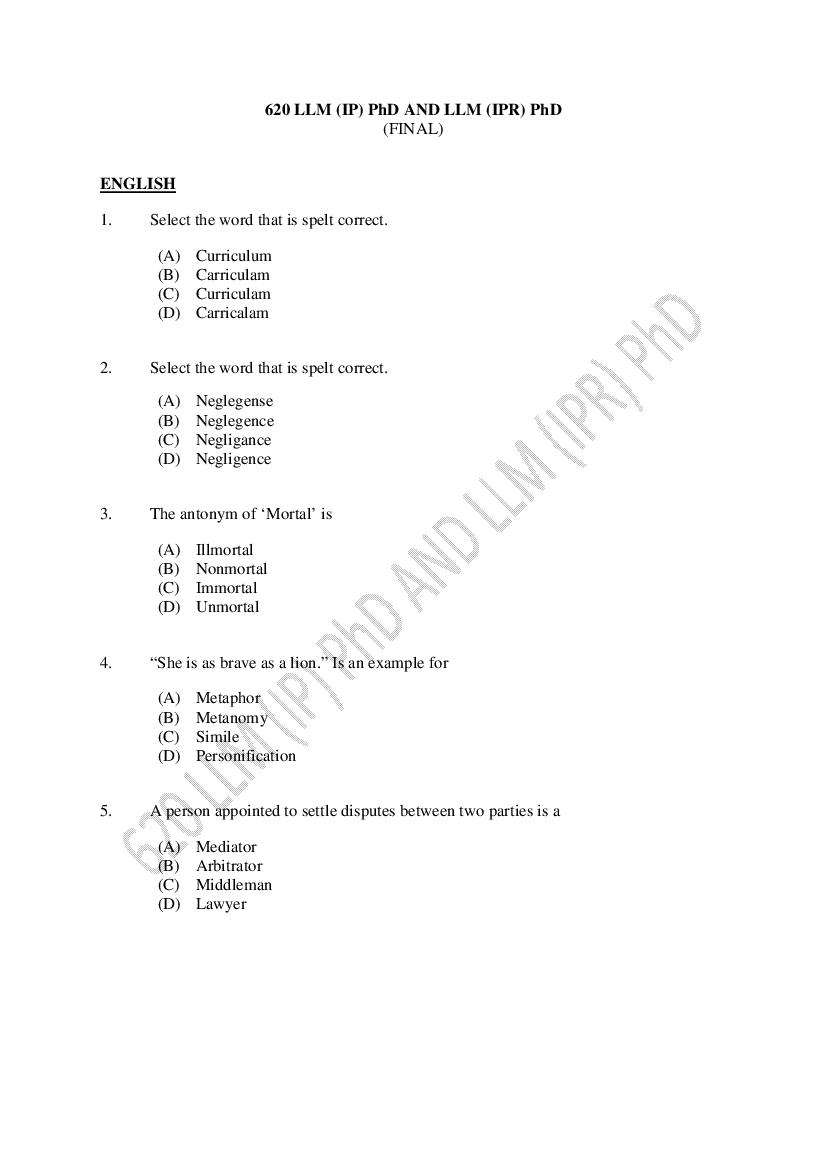
Page 1
(FINAL)
ENGLISH
1. Select the word that is spelt correct.
(A) Curriculum
(B) Carriculam
(C) Curriculam
(D) Carricalam
2. Select the word that is spelt correct.
(A) Neglegense
(B) Neglegence
(C) Negligance
(D) Negligence
3. The antonym of ‘Mortal’ is
(A) Illmortal
(B) Nonmortal
(C) Immortal
(D) Unmortal
4. “She is as brave as a lion.” Is an example for
(A) Metaphor
(B) Metanomy
(C) Simile
(D) Personification
5. A person appointed to settle disputes between two parties is a
(A) Mediator
(B) Arbitrator
(C) Middleman
(D) Lawyer
Page 2
De novo
(A) Further
(B) New
(C) Prime
(D) Against
7. Choose the correct meaning of the following phrase.
Intra Vires
(A) Within the Powers
(B) Outside the Powers
(C) Powerless
(D) Powerful
8. Choose the correct meaning of the following phrase.
In Camera
(A) Outside the court
(B) Secret hearing
(C) Records of Proceedings
(D) Recording of trial
9. Choose the correct meaning of the following phrase.
Actus reus
(A) Guilty mind
(B) Guilty act
(C) Good act
(D) In good faith
10. Choose the correct meaning of the following phrase.
Corpus
(A) Mind
(B) Body
(C) Army
(D) Force
Page 3
In the Medical Profession men ……………….. women by two to one.
(A) outclass
(B) outnumber
(C) supersede
(D) overcome
12. Choose the right answer to fill in the blank.
Many People think that it is ……………….. to use complicated and little-
known works.
(A) important
(B) sensitive
(C) skilled
(D) clever
13. She felt like fish out of water. The underlined idiom means
(A) Death
(B) Coming out of water
(C) Unable to breathe
(D) Out of comfort zone
14. Choose the right answer to fill in the blank.
He was not listening ……………….. I was saying.
(A) that
(B) which
(C) to what
(D) what
15. Which among the following is a simple sentence?
(A) I like coffee and Mary likes tea.
(B) I’m on diet, yet I want a dessert.
(C) She is beautiful.
(D) She is beautiful, so I like her.
Page 4
The arrow pierced ……………….. the bird.
(A) into
(B) through
(C) in
(D) on
17. Choose the grammatically correct sentence.
(A) Rain is coming
(B) Rain is falling
(C) Rain is pouring
(D) It is raining
18. Choose the right answer to fill in the blank.
He must refrain ……………….. immoral conducts.
(A) off
(B) through
(C) from
(D) against
19. Choose the right answer to fill in the blank.
Drinking country liquor at a marriage is a custom ……………….. certain tribes.
(A) in
(B) among
(C) between
(D) with
20. The expansion of e. g. is
(A) Example
(B) Example given
(C) Exempli gratia
(D) Exemplie gratia
Page 5
Dr S Radhakrishnan, the illustrious philosopher statesman of India, was one of the greatest
sons of our motherland. He cautioned the world against the domination of science in society.
It is erroneous to claim that scientific knowledge would bring with it, perpetual progress and
a steady improvement in human relations. The recent period of great scientific achievements
has also increased human misery: two world wars, concentration camps, and atomic
destruction, cold war and deadly wars in the Middle East, Persian Gulf and at many other
places in the world. Growth in human wisdom has not been commensurate with the increase
in scientific knowledge and power. The fear of universal destruction hangs over the world.
There is a feeling of disenchantment, anxiety and even despair. Science has failed to liberate
man from the tyranny of his own nature. Mankind is passing through a critical period and an
education of the human spirit has become essential. In order to remake society, man has to
remake himself. If humanity is to survive, man must integrate his knowledge with social
responsibility.
21. Dr S Radhakrishnan has
(A) emphasised that science should be banished from the society
(B) opposed the teaching of science in educational institutions
(C) favoured scientific thinking in life
(D) counselled that preponderance of science in life does not
necessarily generate happiness
22. The recent pass of tremendous scientific progress has
(A) made the world a very happy place
(B) led to global warming
(C) brought about internal transformation in men
(D) shown that human wisdom has not kept pace with
galloping scientific knowledge
23. Man is despaired of science because
(A) science has given too much knowledge
(B) science has brought him excessive material comforts
(C) he has become a captive of science
(D) he is confronted with the nightmare of total annihilation of the world
24. Man can save humanity only if he
(A) abandons science
(B) brings about an internal transformation in himself
(C) makes his life more comfortable with scientific gadgets
(D) goes back to nature and primitive times
Page 6
(A) science is the only saviour that shall lead humanity forward
(B) science can bring about an end to all the wars
(C) social change comes with the advancement of science
(D) human wisdom must grow proportionately with growth of knowledge to evolve
a creative integration to help mankind
26. Choose the word opposite in meaning to the given word.
INFIRMITY
(A) Employment
(B) Indisposition
(C) Strength
(D) Weakness
27. Choose the word opposite in meaning to the given word.
FEASIBLE
(A) Useful
(B) Impractical
(C) Uneven
(D) Important
28. Choose the word opposite in meaning to the given word.
METICULOUS
(A) Forgetful
(B) Destructive
(C) Careless
(D) Flagrant
29. Choose the word opposite in meaning to the given word.
SYNTHETIC
(A) Natural
(B) Plastic
(C) Cosmetic
(D) Apathetic
Page 7
(A) Bees
(B) Cows
(C) Sheep
(D) Animals
31. Choose the correct article.
…………brave soldier lost …………arm in the risky operation.
(A) The ,a
(B) The, an
(C) A, a
(D) A, the
32. Choose the correct article.
…………problem facing us is …………universal one.
(A) The, an
(B) A, an
(C) The, a
(D) A, the
33. Choose the correct preposition.
The very nature of society is inimical…………freedom.
(A) of
(B) to
(C) with
(D) on
34. Choose the correct preposition.
Hitherto, responsibility had been vested …………professional administrators.
(A) with
(B) in
(C) for
(D) of
Page 8
They ……………….. her and trusted her for years.
(A) know
(B) had known
(C) knew
(D) known
36. Change the active voice into passive voice:
I will clean the house every Saturday.
(A) The house cleaned by me every Saturday.
(B) The house will cleaned by me every Saturday.
(C) The house will be cleaned by me every Saturday.
(D) Every Saturday I clean the house.
Directions: Read the Passage and answer the following questions.
It is no longer enough for us to talk about providing for universal access to education.
Making available schooling facilities is an essential prerequisite, but is insufficient to ensure
that all children attend school and participate in the learning process. The school may be
there, but children may not attend or they may drop out after a few months. Through school
and social mapping, we must address the entire gamut of social, economic, cultural and
indeed linguistic and pedagogic issues, factors that prevent children from weaker sections and
disadvantaged groups, as also girls, from regularly attending and complementing elementary
education. The focus must be on the poorest and most vulnerable since these groups are the
most disempowered and at the greatest risk of violation or denial of their right to education.
The right to education goes beyond free and compulsory education to include quality
education for all. Quality is an integral part of the right to education. If the education process
lacks quality, children are being denied their right. The Right of Children to Free and
Compulsory Education Act lays down that the curriculum should provide for learning
through activities, exploration and discovery. This places an obligation on us to change our
perception of children as passive receivers of knowledge, and to move beyond the convention
of using textbooks as the basis of examinations. The teaching-learning process must become
stress-free; and a massive programme for curricular reform should be initiated to provide for
a child-friendly learning system that is more relevant and empowering. Teacher
accountability systems and processes must ensure that children are learning. And that their
right to learn in a child-friendly environment is not violated. Testing and redesigned to ensure
that these do not force children to struggle between school and tuition centres, and bypass
childhood.
Page 9
under the Right to Education?
1. Sending of children to school by all parents.
2. Provision of adequate physical infrastructure in schools.
3. Curricular reforms for developing child-friendly learning system.
Select the correct answer using the code given below.
(A) 1 only
(B) 1 and 2 only
(C) 3 only
(D) None of the above
38. With reference to the above passage, the following assumptions have been made.
1. The Right to Education guarantees teachers' accountability for the learning
process of children.
2. The Right to Education guarantees 100% enrolment of children in the schools.
3. The Right to Education intends to take full advantage of demographic dividend.
Which of the above assumptions is/are valid?
(A) 1 only
(B) 2 and 3 only
(C) 3 only
(D) 1, 2 and 3
39. According to the passage, which one of the following is critical in bringing
quality in education?
(A) Ensuring regular attendance of children as well as teachers in school
(B) Giving pecuniary benefits to teachers to motivate them
(C) Understanding the socio-cultural background of children
(D) Inculcating learning through activities and discovery
40. What is the essential message in this passage?
(A) The Right to Education now is a Fundamental Right
(B) The Right to Education enables the children of poor and weaker
sections of the society to attend schools
(C) The Right to Free and Compulsory Education should include quality
education for all
(D) The Government as well as parents should ensure that all children
attend schools
Page 10
41. The financial year in which tax is levied is called
(A) previous year
(B) accounting year
(C) calendar year
(D) assessment year
42. Sarva Shiksha Abhiyan covers
(A) all children in the age group 3-10
(B) all children in the age group 4-8
(C) all children in the age group 5-15
(D) all children in the age group 6-14
43. Shanthi Swarup Bhatnagar Awards are given for the person who shown exemplary
performance in the field of
(A) Sports
(B) Politics
(C) Science and Technology
(D) Literature
44. The engineering discipline that involves construction of molecularly sized computing
devices is called
(A) Nanotechnology
(B) Molecular processing
(C) Silicon grafting
(D) Nanoscience
45. United Nation’s Framework Convention also known as ‘Earth Summit’
was held in 1992 at
(A) New York
(B) Paris
(C) Rio de Janeiro
(D) Adelaide
46. The Capital of Lakshadweep is
(A) Minicoy
(B) Kavaratti
(C) Amini
(D) Nagarcoil
Page 11
(A) K.S. Puttaswamy vs. Union of India
(B) ADM, Jabalpur vs. Shivkanth Shukla
(C) Kesavananda bharati vs. State of Kerala
(D) Ramesh Chadra Sahoo vs. State of Madhya Pradesh
48. IRCTC means
(A) Indian Rail Company and Ticket Collection
(B) Indian Road Communication to Cities
(C) Indian Railway Catering and Tourism Corporation
(D) Indian Railway Certificate for Ticket Collectors
49. Who amongst the following is the author of the book “To a Hunger Free World”?
(A) A.P.J Abdul Kalam
(B) Ashok Lahiri
(C) Amartya Sen
(D) M.S Swaminathan
50. An account in which trading of shares is done in their electronic form is known as
(A) Demat Account
(B) NRI Account
(C) NRIO Account
(D) Current Account
51. The much discussed Tehri Dam Project is located in which of the following states?
(A) Madhya Pradesh
(B) Rajasthan
(C) Haryana
(D) Uttarakhand
52. In India, there are three crop seasons. Two of them are Kharif and Rabi,
name the third one?
(A) Barsati
(B) Grama
(C) Zaid
(D) Khari
Page 12
(A) 2000
(B) 2002
(C) 2001
(D) 1999
54. Which party was formed by Subhash Chandra Bose in the year 1939 after the broke
away from the congress?
(A) Indian Federation Party
(B) Azad Hind Fauj
(C) Revolutionary Front
(D) Forward Bloc
55. The Author of the Book, “An Era of Darkness” is
(A) Margaret Atwood and Bernardine
(B) Raghu Karnad
(C) Amitabh Bagchi
(D) Shashi Tharoor
GENERAL APTITUDE IN INTELLECTUAL PROPERTY LAW
56. Novartis v. Union of India was decided by the Supreme Court in
(A) 2009
(B) 2010
(C) 2013
(D) 2015
57. WIPO Copyright Treaty is convened in
(A) 1994
(B) 1996
(C) 2002
(D) 2005
58. TRIPs consists of
(A) four parts
(B) six parts
(C) seven parts
(D) nine parts
Page 13
(A) copyright law
(B) patents
(C) designs
(D) trademarks
60. The term of Patent protection is
(A) 7 years
(B) 14 years
(C) 20 years
(D) 50 years
61. PCT means
(A) Patent Cooperation Treaty
(B) Patent Counselling Treaty
(C) Patent, Copyright and Trademarks
(D) None of the above
62. Doha Declaration deals with
(A) TRIPs and public health
(B) protection of indigenous people
(C) artificial intelligence
(D) technology transfer
63. WIPO is an acronym for
(A) World Indo- Pak Organisation
(B) West Indian Property Organisation
(C) World Intellectual Property Organisation
(D) World Intellectual Property Order
64. Following the ……………….. of multilateral negotiations under the General
Agreement on Tariffs and Trade, the Agreement on Trade Related Aspects of
Intellectual Property Rights (TRIPS) was arrived at
(A) Uruguay round
(B) Budapest round
(C) Strasbourg round
(D) Washington round
Page 14
(A) address of the computer over internet
(B) address of the house
(C) address of the person
(D) address of the computer
66. FRAND is an acronym for
(A) Fair, Reasonable and Non-Discriminatory
(B) Friendly, Reasonable and Non-Discriminatory
(C) Fair, Reasonable and Discriminatory
(D) Free, Reasonable and Non-Discriminatory
67. A trademark is registered for
(A) 10 years which period cannot be renewed
(B) 15 years in total
(C) 10 years which period can be renewed
(D) 12 years in total
68. Industrial design protects
(A) shape and configuration of article
(B) mechanical feature of an article
(C) Both (A) and (B)
(D) None of the above
69. “DUS” (Distinctiveness, Uniform and Stable) criteria has been laid as a pre-requisite
for protection of
(A) Artistic work
(B) Invention
(C) Design
(D) Plant Variety
70. Agreement on Trade-Related Aspects of Intellectual Property Rights (TRIPS) is an
International agreement that ……………….. for all World Trade Organization
Countries.
(A) maximum standards for protection of intellectual property
(B) sets minimum standards for intellectual property protection
(C) basic standards
(D) basic limitations
Page 15
(A) Right to paternity
(B) Right to integrity
(C) Both (A) and (B)
(D) None of the above
72. The proposer of personality theory is
(A) Hegel
(B) Austin
(C) Lock
(D) Bentham
73. The International Recognition of the Deposit of Microorganisms for the Purpose of
Patent Procedure is governed by
(A) Rome Treaty
(B) Budapest Treaty
(C) Berne Treaty
(D) Paris Convention
74. The criteria of patentability in India are
(A) Novelty
(B) Inventive step
(C) Capable of industrial application
(D) All the above
75. Madrid Protocol deals with
(A) copyright
(B) patents
(C) trade marks
(D) designs
ANALYTICAL AND REASONING ABILITY
76. How many times are an hour hand and a minute hand of a clock at right angles during
their motion from 1.00 p.m. to 10.00 p.m.?
(A) 9
(B) 10
(C) 18
(D) 20
Page 16
(A) 30
(B) 25
(C) 45
(D) 55
1 1
78. + + ......... = 1
2 3
5
(A)
6
1
(B)
6
2
(C)
3
1
(D)
3
79. 0.1 × 0.01 × 0.001 = ………………..
(A) 0.0001
(B) 0.000001
(C) 0.00001
(D) 0.0000001
80. If FISH is written as EHRG in a certain code,
how would JUNGLE be written in that code?
(A) ITMFKD
(B) ITNFKD
(C) KVOHMF
(D) TIMFKD
81. P,Q, R, S, and T are sitting in a Straight line facing north. P sits next to S but not to T.
Q is sitting next to R who is on the extreme left corner. Who sits to the left of S if T
does not sit next to Q?
(A) P
(B) Q
(C) R
(D) T
Page 17
(A) 36
(B) 32
(C) 30
(D) 28
83. If a person is standing at the sixth number in the queue from both ends, then the total
number of persons in the queue is
(A) 9
(B) 11
(C) 12
(D) 13
84. ‘FI’ is related to ‘LO’ in the same way as ‘PS’ is related to
(A) VY
(B) UZ
(C) WZ
(D) UX
85. Direction: In the question below is given a statement followed by two conclusions
numbered I and II. You have to assume everything in the statement to be true, then
consider the two conclusions together and decide which of them logically follows
beyond a reasonable doubt from the information given in the statement.
Statement: All young scientists are open minded.
No open minded men are superstitious.
Conclusion: I. No scientist is superstitious
II. No young people are superstitious
(A) Only conclusion I follows
(B) Only conclusion II follows
(C) Either conclusion I or II follow
(D) Neither conclusion II nor I follow
86. In a class of 35 students, Kunal is placed seventh from the bottom whereas Sonali is
placed ninth from the top, Pulkit is placed exactly in between the two. What is
Kunal’s position from Pulkit?
(A) 9
(B) 10
(C) 11
(D) 13
Page 18
Fifty books belonging to different subjects, viz History (8) Geography (7) Literature (13)
Psychology (8) and Science (14) are placed on a shelf. They are arranged in an alphabetical
order, subject to the condition that no two books of the same subjects are placed together so
long as books of other subjects are available. Unless otherwise mentioned all counting is
done from the left.
th
87. Which subject does the 40 book belong to?
(A) Science
(B) Psychology
(C) History
(D) Literature
88. What is the position of the last book in Psychology?
th
(A) 36
th
(B) 37
th
(C) 38
th
(D) 39
th
89. Counting from the right, to which subject does the 39 book belong?
(A) History
(B) Psychology
(C) Geography
(D) Science
90. Mr. A, Miss. B, Mr. C, and Miss. D are sitting around a table and
discussing their trades.
1. Mr. A sits opposite to cook
2. Miss. B sits right to the barber
3. The washer man is on the left of the tailor
4. Miss. D sits opposite Mr. C
What are the trades of A and B?
(A) Tailor and Barber
(B) Tailor and Cook
(C) Barber and Cook
(D) Washer man and Cook
Page 19
numbered I and II. You have to assume everything in the statement to be true, then
consider the two conclusions together and decide which of them logically follows
beyond a reasonable doubt from the information given in the statement.
Statement: All men are dogs
All dogs are cats
Conclusion: I. All Men are cats
II. All cats are men
(A) Only Conclusion I follows
(B) Only Conclusion II follows
(C) Either Conclusion I or II follows
(D) Neither Conclusion I nor II follows
92. Direction: In the question below is given a statement followed by two conclusions
numbered I and II. You have to assume everything in the statement to be true, then
consider the two conclusions together and decide which of them logically follows
beyond a reasonable doubt from the information given in the statement.
Statement: All Coins are crows
Some crows are pens
Conclusion: I. No pen is coin
II. Some coins are pens
(A) Only Conclusion I follows
(B) Only Conclusion II follows
(C) Either Conclusion I or II follows
(D) Neither Conclusion I nor II follows
93. Direction: In the question below is given a statement followed by two conclusions
numbered I and II. You have to assume everything in the statement to be true, then
consider the two conclusions together and decide which of them logically follows
beyond a reasonable doubt from the information given in the statement.
Statement: No women can vote
Some women are politicians
Conclusion: I. No politician can vote
II. Some politicians can vote
(A) Only Conclusion I follows
(B) Only Conclusion II follows
(C) Either Conclusion I or II follows
(D) Neither Conclusion I nor II follows
Page 20
numbered I and II. You have to assume everything in the statement to be true, then
consider the two conclusions together and decide which of them logically follows
beyond a reasonable doubt from the information given in the statement.
Statement: All teachers are good
Some women are teachers
Conclusion: I. All good teachers are women
II. Some women are good teachers
(A) Only Conclusion I follows
(B) Only Conclusion II follows
(C) Either Conclusion I or II follows
(D) Neither Conclusion I nor II follows
95. Direction: In the question below is given a statement followed by two conclusions
numbered I and II. You have to assume everything in the statement to be true, then
consider the two conclusions together and decide which of them logically follows
beyond a reasonable doubt from the information given in the statement.
Statement: Lawyers married only fair girls
Manthara is fair
Conclusion: I. Manthara was married to a lawyer
II. Manthara was not married to a lawyer
(A) Only Conclusion I follows
(B) Only Conclusion II follows
(C) Either Conclusion I or II follows
(D) Neither Conclusion I nor II follows
96. Direction: In the following question, a statement is given followed by two
assumptions/conclusions. You are to consider each statement and the assumptions
that follow and decide whether the assumption is/are implicit in the statement.
Statement: A good system of education in a country is the flower of Economic
development; it is also its seed.
Assumption: I. Economic development leads to educational development in a
country.
II. Educational development leads to economic development in a
country.
(A) Only I is implicit
(B) Only II is implicit
(C) Both I and II are implicit
(D) Neither I nor II is implicit
Page 21
assumptions/conclusions. You are to consider each statement and the assumptions that
follow and decide whether the assumption is/are implicit in the statement.
Statement: Each nation must maintain an army.
Assumption: I. It makes people strong.
II. It is indispensable for the defence of the nation.
(A) Only I is implicit
(B) Only II is implicit
(C) Both I and II are implicit
(D) Neither I nor II is implicit
98. Direction: In the following question, a statement is given followed by two
assumptions/conclusions. You are to consider each statement and the assumptions
that follow and decide whether the assumption is/are implicit in the statement.
Statement: All watches sold in that shop are of high quality. Some of the Titan
watches are sold in that shop.
Assumption: I. Some of the Titan Watches are of high standard.
II. None of the Titan watches is of high Standard.
(A) Only I is implicit
(B) Only II is implicit
(C) Both I and II are implicit
(D) Neither I nor II is implicit
99. Direction: In the following question, a statement is given followed by two
assumptions/conclusions. You are to consider each statement and the assumptions
that follow and decide whether the assumption is/are implicit in the statement.
Statement: Spicy food damages the liver. The patient is advised to take a liver –
tonic.
Assumption: I. The patient takes spicy food.
II. A healthy liver is necessary to digest fat.
(A) Only I is implicit
(B) Only II is implicit
(C) Both I and II are implicit
(D) Neither I nor II is implicit
Page 22
assumptions/conclusions. You are to consider each statement and the assumptions
that follow and decide whether the assumption is/are implicit in the statement.
Statement: Happiness is to be shared. Unhappy people suffer.
Assumption: I. Unhappy people share sufferings.
II. Happy people do not suffer.
(A) Only I is implicit
(B) Only II is implicit
(C) Both I and II are implicit
(D) Neither I nor II is implicit
101. Direction: For the Assertion (A) and Reason (R) below, select the correct alternative
from the following:
A: The Indian Constitution came in to force from the 26th January 1950.
R: 26th January is celebrated as the Republic Day.
(A) Both A and R are true and R is the correct explanation of A
(B) Both A and R are true, but R is not the correct explanation of A
(C) A is true but R is false
(D) A is false but R is true
102. Direction: For the Assertion (A) and Reason (R) below, select the correct alternative
from the following:
A: There is no Vaccine for AIDS.
R: The AIDS virus changes its genetic code.
(A) Both A and R are true and R is the correct explanation of A
(B) Both A and R are true, but R is not the correct explanation of A
(C) A is true but R is false
(D) A is false but R is true
103. Direction: For the Assertion (A) and Reason (R) below, select the correct alternative
from the following:
A: Unpolished rice should be eaten.
R: Polished rice lacks Vitamin B.
(A) Both A and R are true and R is the correct explanation of A
(B) Both A and R are true, but R is not the correct explanation of A
(C) A is true but R is false
(D) A is false but R is true
Page 23
from the following:
A: River Narmada flows westward.
R: Narmada falls in to Bay of Bengal.
(A) Both A and R are true and R is the correct explanation of A
(B) Both A and R are true, but R is not the correct explanation of A
(C) A is true but R is false
(D) A is false but R is true
105. Direction: For the Assertion (A) and Reason (R) below, select the correct alternative
from the following:
A: Earthworms are not good for agriculture.
R: Earthworms Breakdown the soil into fine particles and make it soft.
(A) Both A and R are true and R is the correct explanation of A
(B) Both A and R are true, but R is not the correct explanation of A
(C) A is true but R is false
(D) A is false but R is true
106. Pointing to a photograph, a lady tells Ram, “I am the only daughter of this lady and
her son is your maternal uncle”. How the speaker is related to Ram’s Father?
(A) Sister-in-law
(B) Wife
(C) Aunt
(D) None of the above
107. Introducing a man, a woman said, “He is the only son of my mother’s mother”. How
is the woman related to the man?
(A) Mother
(B) Aunt
(C) Sister
(D) Niece
108. Shyam Said, “This girl is the wife of the grandson of my mother”. Who is Shyam to
the girl?
(A) Father
(B) Grandfather
(C) Husband
(D) Father-in-law
Page 24
wife of my husband”. How is the man on the stage related to Sunita?
(A) Son
(B) Husband
(C) Cousin
(D) Nephew
110. Direction: In the following question, find out the alternative which will replace the
question mark.
DNA : Genes :: RNA : ?
(A) Cells
(B) Tissues
(C) Amino Acid
(D) Hormones
111. Direction: In the following question, find out the alternative which will replace the
question mark.
Canada : Ottava :: Hungary : ?
(A) Budapest
(B) Dublin
(C) Durben
(D) Oslo
112. Direction: In the following question, find out the alternative which will replace the
question mark.
Botany : Flora :: Zoology : ?
(A) Fauna
(B) Biology
(C) Fossils
(D) Pathology
113. Direction: In the following question, find out the alternative which will replace the
question mark.
Dog : Bite :: Bee : ?
(A) Buzz
(B) Hiss
(C) Sting
(D) Eat
Page 25
then 15 km due south. How far is he from the starting point?
(A) 5 km
(B) 9 km
(C) 37 km
(D) 61 km
115. A piece of paper is cut and folded as shown below in the question figures. From the
given answer figures, indicate how it will appear when opened.
(A)
(B)
(C)
(D)
APTITUDE TO DO RESEARCH
116. Pure research is also known as
(A) fundamental research
(B) applied research
(C) exploratory research
(D) analytical research
117. Indian National Bibliography is published by
(A) National Library, Kolkata
(B) US Library, New Delhi
(C) Institute of Economic Granth, New Delhi
(D) Indian Law Institute, New Delhi
Page 26
(A) stratified sampling
(B) quota sampling
(C) multi stage sampling
(D) convenience sampling
119. A scale that has equal units of measurements is known as
(A) interval scale
(B) ratio scale
(C) ordinal scale
(D) normal scale
120. Use of facts or information already available and to analyze them to make a critical
evolution of material is
(A) descriptive research
(B) empirical research
(C) applied research
(D) analytical research
121. If the population from which a sampling is to be drawn does not constitute a
homogenous group then which sampling technique is applied?
(A) Random sampling
(B) Stratified sampling
(C) Quota sampling
(D) Cluster sampling
122. Observation interviews and questionnaire are the ways for collecting data for
(A) experimental research
(B) design research
(C) survey
(D) hypothesis testing
123. A design which deals with the technique by which the procedure specified in the
designs can be called out is called
(A) operational design
(B) observational design
(C) sampling design
(D) statistical design
Page 27
areas are randomly selected for the purpose of survey- it is called
(A) multistage sampling
(B) cluster sampling
(C) stratified sampling
(D) sequential sampling
125. Inferring about the whole population based on the observations made on a small part
is called
(A) deductive inference
(B) inductive inference
(C) pseudo-inference
(D) objective inference
126. The most important advantage of sampling method of data collection is
(A) increase accuracy
(B) the only method of data collection
(C) save time
(D) easy to handle the date
127. Which of the following statement is NOT true about Random Sampling?
(A) Random sampling is reasonably accurate
(B) Random sampling is free from personal biases
(C) An economical method of sampling
(D) Can be applied for all types of data collections
128. A researcher is said to be committed the Type I error when
(A) he reject a null hypothesis which is actually true
(B) he accept a null hypothesis which is actually false
(C) both the null and alternate hypothesis is rejected
(D) None of the above
129. Which of the following statements regarding hypothesis is true?
(A) Hypothesis relates variables to constants
(B) Hypothesis relates constants to constants
(C) Hypothesis relates constants to variables
(D) Hypothesis relates variables to variables
Page 28
(A) Survey
(B) Experiment
(C) Survey and experiment
(D) Survey and reference
131. We review the relevant literature to know
(A) what is already known about the topic
(B) what concepts and theories have been applied to the topic
(C) who are the key contributors to the topic
(D) All the above
132. Which of these is NOT a research question?
(A) Predicting an outcome
(B) Evaluating a phenomenon
(C) Developing good practice
(D) A hypothesis
133. Which of the following is NOT a data collection method?
(A) Research questions
(B) Unstructured interviewing
(C) Postal survey questionnaires
(D) Participant observation
134. Whereas quantitative research tends to bring out a static picture of social life,
qualitative research depicts it as
(A) symmetrical
(B) statistical
(C) processual
(D) proverbial
135. What is “ethno-statistics”?
(A) The study of the way statistics are constructed, interpreted and represented
(B) The study of the way ethnic minorities are represented in official statistics
(C) A new computer program designed to help lay people understand statistics
(D) An interpretivist approach made famous by the work of Garfinkel (1967)
Page 29
(A) Computer – Assisted Qualitative Data Analysis Software
(B) Complicated – Analytical Questions Deserving Answers Soon
(C) Constant – Aggravation Queried Directly And Swiftly
(D) Content – Analysis Qualification: Durkheim And Statistics
137. Research object falls into number of categories that include
(A) planning to get answers for what, why and where type of questions
(B) considering the logic, behind the methods we use in the context of the research
(C) formulative, concept, and planning for research methods
(D) exploratory, descriptive, diagnostic and experimentation research
138. Diagnostic research studies is a categories of research that aims to
(A) achieve new insights of a concept
(B) analyse characteristics of something
(C) determine the frequency with which something occurs
(D) test the relationship between variables
139. Analytical research is the type of research that
(A) is made for performing the basic or pure research; it is a theoretical research
(B) is intended for finding some solution to the problem considered
(C) includes fact-finding enquires and surveys
(D) uses available information as the base to make the further critical evaluation
140. The research participants are described in detail in which section of the research plan?
(A) Introduction
(B) Methodology
(C) Data analysis
(D) Discussion
141. Hypothesis in a quantitative research studies usually
(A) are very specific and stated prior to beginning the study
(B) are often generated as the data are collected, interpreted and analyzed
(C) are never used
(D) are always stated after the research study has been completed
Page 30
They are
(A) research question and research methodology
(B) research proposal and bibliography
(C) research method and schedule
(D) research question and bibliography
143. Closed ended questions are those that
(A) have a fixed range of possible answers
(B) prevent respondents from allocating themselves to category
(C) encourage detailed elaborate responses
(D) relate to the basic demographic characteristics of respondents
144. Hypothesis is usually implied rather than being explicit in which of the following
methods of research?
(A) Experimental method
(B) Descriptive survey method
(C) Ex post facto method
(D) Historical method
145. Field study is related to
(A) real life situations
(B) experimental situations
(C) laboratory situations
(D) None of the above
146. Testing hypothesis is a
(A) inferential statistics
(B) descriptive statistics
(C) data preparation
(D) data analysis
147. Determining the relationship between two or more variables occurs in
(A) correlational research
(B) action research
(C) naturalistic observation
(D) survey research
Page 31
(A) A way of conducting research that is not grounded in theory
(B) The choice between using qualitative or quantitative methods
(C) The style in which you present your research findings
(D) A framework for every stage of the collection and analysis of data
149. The core elements of a dissertation includes
(A) Introduction; Data Collection; Data Analysis; Conclusions and
Recommendations
(B) Executive Summary; Literature Review; Data Gathered; Conclusions;
Bibliography
(C) Introduction; Literature Review; Research Methodology; Results;
Discussions and Conclusions
(D) Research Plan; Research Data; Analysis; References
150. In which of the following methods, a deep, detailed and intensive study of a social
unit is required?
(A) Descriptive research
(B) Case Study research
(C) Ex-post facto research
(D) Experimental research
Page 32
Subject Name: 620 LLM (IP) PhD AND LLM (IPR) PhD
SI No. Key SI No. Key SI No. Key SI No. Key SI No. Key
1 A 31 B 61 A 91 A 121 B
2 D 32 C 62 A 92 C 122 C
3 C 33 B 63 C 93 C 123 A
4 C 34 B 64 A 94 B 124 B
5 B 35 C 65 A 95 C 125 A
6 B 36 C 66 A 96 C 126 C
7 A 37 C 67 C 97 B 127 D
8 B 38 D 68 A 98 A 128 A
9 B 39 D 69 D 99 A 129 D
10 B 40 C 70 B 100 D 130 C
11 B 41 D 71 C 101 B 131 D
12 D 42 D 72 A 102 C 132 D
13 D 43 C 73 B 103 A 133 A
14 C 44 A 74 D 104 C 134 C
15 C 45 C 75 C 105 D 135 A
16 B 46 B 76 C 106 B 136 A
17 D 47 A 77 C 107 D 137 D
18 C 48 C 78 B 108 D 138 C
19 B 49 D 79 B 109 A 139 B
20 C 50 A 80 A 110 C 140 B
21 D 51 D 81 A 111 A 141 B
22 D 52 C 82 C 112 A 142 A
23 D 53 A 83 B 113 C 143 A
24 B 54 D 84 A 114 A 144 D
25 D 55 D 85 D 115 B 145 A
26 C 56 C 86 B 116 A 146 A
27 B 57 B 87 D 117 A 147 A
28 C 58 C 88 C 118 A 148 D
29 A 59 A 89 A 119 A 149 C
30 A 60 C 90 B 120 D 150 B
Document Details
| Board / Org | Cochin University |
| Exam | CUSAT Common Admission Test |
| Type | Question Paper |
| Pages | 32 |
| Updated | 22 Jul 2026 |