SEBA Class 9 Class 10 Syllabus 2025 Commerce
Finished viewing? Save it for later —
Download SEBA Class 9 Class 10 Syllabus 2025 Commerce (PDF · 12 pages)About SEBA Class 9 Class 10 Syllabus 2025 Commerce
SEBA Class 9 Class 10 Syllabus 2025 Commerce is available here for free download. Published by Assam Board for Class 10, this syllabus can be viewed online or downloaded as a PDF (12 pages). Candidates preparing for Class 10 can use SEBA Class 9 Class 10 Syllabus 2025 Commerce to understand the exam pattern, the type of questions asked, and the overall difficulty level.
Frequently Asked Questions
How can I download SEBA Class 9 Class 10 Syllabus 2025 Commerce?
Open this page and click the Download button to save SEBA Class 9 Class 10 Syllabus 2025 Commerce as a PDF. It is completely free on AglaSem Docs.
Is SEBA Class 9 Class 10 Syllabus 2025 Commerce free to download?
Yes. SEBA Class 9 Class 10 Syllabus 2025 Commerce can be viewed online and downloaded as a PDF free of cost on AglaSem Docs.
How many pages does SEBA Class 9 Class 10 Syllabus 2025 Commerce have?
SEBA Class 9 Class 10 Syllabus 2025 Commerce contains 12 pages, which you can read online or download together as a single PDF.
Where can I find more Class 10 study material?
You can find more Class 10 question papers, sample papers, syllabus, and answer keys on AglaSem Docs.
SEBA Class 9 Class 10 Syllabus 2025 Commerce – Text
Read the full text of this syllabus below — useful to quickly search, copy and reference the content online without downloading the PDF.
📄 View text version (12 pages)
Page 1
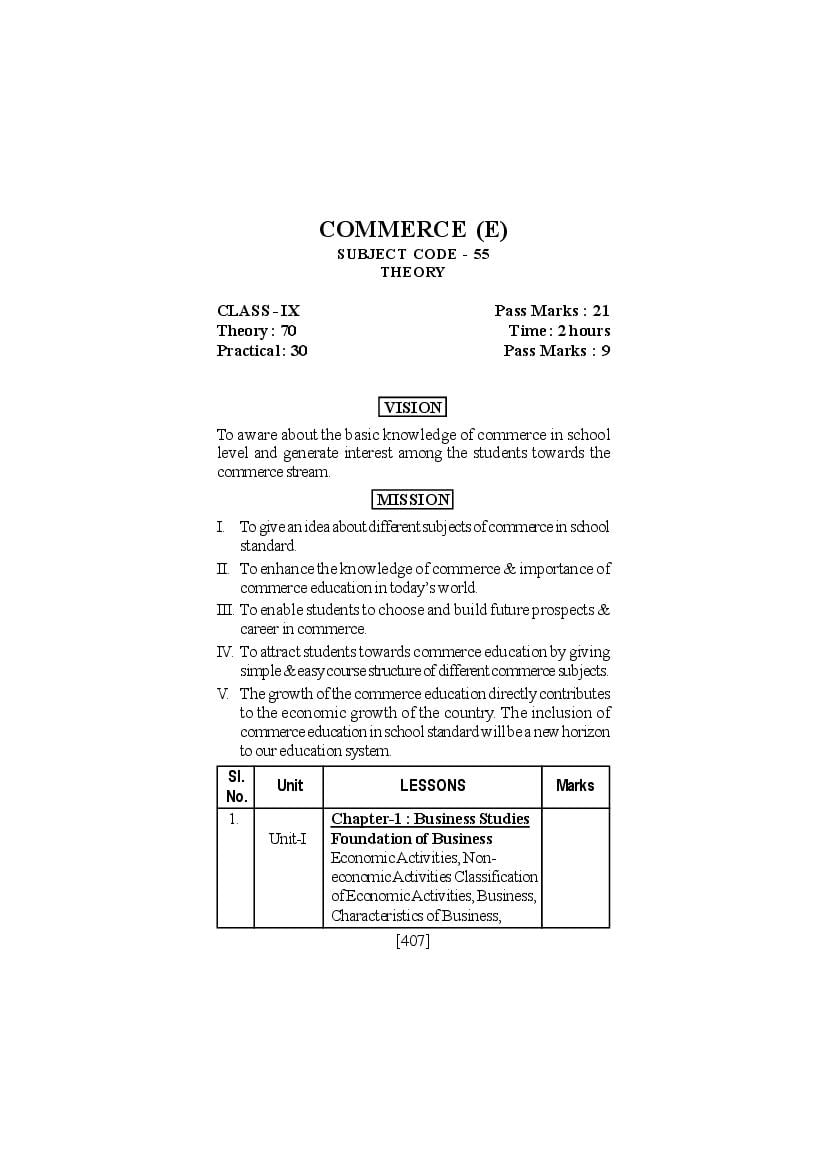
SUBJECT CODE - 55
THEORY
CLASS - IX Pass Marks : 21
Theory : 70 Time : 2 hours
Practical : 30 Pass Marks : 9
VISION
To aware about the basic knowledge of commerce in school
level and generate interest among the students towards the
commerce stream.
MISSION
I. To give an idea about different subjects of commerce in school
standard.
II. To enhance the knowledge of commerce & importance of
commerce education in today’s world.
III. To enable students to choose and build future prospects &
career in commerce.
IV. To attract students towards commerce education by giving
simple & easy course structure of different commerce subjects.
V. The growth of the commerce education directly contributes
to the economic growth of the country. The inclusion of
commerce education in school standard will be a new horizon
to our education system.
Sl.
Unit LESSONS Marks
No.
1. Chapter-1 : Business Studies
Unit-I Foundation of Business
Economic Activities, Non-
economic Activities Classification
of Economic Activities, Business,
Characteristics of Business,
[407]
Page 2
Unit LESSONS Marks
No.
Profession, Characteristics of
Profession, Employments,
Characteristics of Employment,
Features of Employment,
Industry, Types of Industry,
Commerce, Components of
Commerce, Trade, Auxiliaries to Trade
Unit-II Business Organisations
Sole Proprietorship
Hindu Undivided Family (HUF)
Business Partnership, Meaning of
Small-Scale Industry, Role of
Small Business in Rural Industries,
Problems of Small Business in India
Unit-III Present Modes of Business
e-Commerce, Meaning of
e-Business, e-Commerce versus
E-Business, Scope of e-Business
Differences between Traditional
Business and e-Business, Benefits
of e-Commerce / e-Business,
Method of Online Payments,
Safety and Security of
e-Transactions, Resources
required for e-business
2. Chapter-2 : Introductions to
book keeping & Accountancy
Unit-I Introduction
Book-keeping, Features of
Banking, Scope of Book-
keeping, Accounting,
Characteristics of Accounting,
[408]
Page 3
Unit LESSONS Marks
No.
Objectives of Accounting,
Process/Stages of Accounting,
Functions of Accounting,
Difference between Accounting
and Book-keeping, Advantages
of Accounting, Limitations of
Accounting, Accountancy,
Accounting Cycle, Phases/Steps
of Accounting
Unit-II Accounting Principles &
Concepts
Accounting Concept, Business
Entity, Concept, Going concern
Concept, Money Measurement
Concept, Cost Concept, Dual
Aspect Concept, Realisation
Concept (Revenue Recognition
Concept), Accrual Concept,
Accounting Period Concept,
Matching Concept
Unit-III Basic Accounting Terminology
Transactions, Goods, Services,
Book-keeping Journal, Ledger,
Capital, Drawings, Assets,
Liabilities, Debtors, Creditors,
Investment, Revenue, Expenses,
Profit, Loss, Stock, Discount, Cost
3. Chapter-3 : Banking
Unit-I Basic Concept of Banking
Introduction Evolution of Indian
Banking System, Definition of
Bank, Banking, Characteristics/
[409]
Page 4
Unit LESSONS Marks
No.
features of Banking, Functions of
Banking (Primary functions)
Functions of Banking (Secondary
functions), e-Banking, Central
Bank, Commercial Bank,
Development Banks, Investment
Bank/Industrial Bank, Co-
operative Bank (Regional Rural
Bank/ Agricultural Bank), Non-
Banking Financial Company,
Exchange Banks
4. Chapter-4 : Insurance
Unit-I Introduction to Insurance
Introduction, Characteristics of
Insurance, Types of Insurance-
Life Insurance, General Insurance,
Fire Insurance, Theft Insurance,
Marine Insurance, Principles of
Insurance, Principle of Utmost
Good faith, Principle of Insurable
Interest, Principle of Indemnity,
Principle of Warranty, Advantages
of Insurance
Unit-II Basic Insurance Terminology
Insured, Insurer, Insurance
Assurance, Premium, Indemnity,
Utmost good Faith, Insurable
Interest, Contribution, Reinsurance
Peril, Agent, Broker, Claim,
Warranty Risk, Grace period,
Assurance
Appendix
[410]
Page 5
SYLLABUS FOR CLASS IX
CHAPTER-1 : BUSINESS STUDIES
Unit-I Foundation of Business
Unit-II Business Organisation
Unit-III Present Modes of Business
CHAPTER-2 : INTRODUCTION TO BOOK-
KEEPING AND ACCOUNTANCY
Unit-I Meaning & Objectives
Unit-II Accounting Principles & Concepts
Unit-III Basic Accounting Terminology
CHAPTER-3 : BANKING
Unit-I Basic Concept of Banking
CHAPTER-4 : INSURANCE
Unit-I Introduction to Insurance
Unit-II Basic Insurance Terminology
* Questions from each Unit/Lesson will carry marks 2-10.
[411]
Page 6
THEORY
S. No. Chapter Section H.Y. Annual
1. Business Studies
2. Book-keeping & Accountancy
3. Banking
4. Insurance
Total 70 70
PRACTICAL
S. No. Chapter Section H.Y. Annual
1. Project Report on a retailer
working In the location school
2. Classroom assignments &
activities
3. Project Report on transport
facilities Available in the location
of student
4. Project report on economic
activities like fishery, poultry,
vegetables, Diary etc. working
in the location of student.
Total 30 30
* Questions from each Unit/Lesson will carry marks 2-10.
[412]
Page 7
SUBJECT CODE - 55
THEORY
CLASS - X Pass Marks : 21
Theory : 70 Time : 2 hours
Practical : 30 Pass Marks : 9
Sl.
UNIT / LESSONS Marks
No.
1. CHAPTER 1: BUSINESS
STUDIES
Unit-I Company business
Meaning of Company
Characteristics of Company
Advantages of Company
Disadvantages of Company
Unit-II Management
Introduction
Management v/s Administration
Importance of Management
Levels of Management
Role of Manager
Unit-III Entrepreneurship
Introduction
Role and importance of
entrepreneurship
Qualities of an entrepreneur
2. CHAPTER 2: BANKING
AND FINANCE
Unit-I Opening of bank account
Introduction
[413]
Page 8
UNIT / LESSONS Marks
No.
Types of accounts
Types of Demand Deposit
accounts
Types of Fixed Deposit accounts
Unit-II Negotiable instruments
Meaning of Negotiable
Instruments
Modes of Negotiation
Promissory Note
Bill of Exchange
Cheque
Unit-III Sources of finance
Introduction
Types of Capital
Difference between Fixed and
working capital
Sources of funds available to a
business
Unit-IV Insurance Agents
Meaning
Functions of Insurance Agents
Qualities of a good insurance
Agent
Types of Insurance Agents
Employment opportunities in
Finance
3. CHAPTER 3: BOOK
KEEPING AND ACCOUNTING
Unit-I Introduction
Meaning of Booking-Keeping
[414]
Page 9
UNIT / LESSONS Marks
No.
Characteristics of Book-Keeping
Process/Steps of Book-Keeping
Objectives of Book-Keeping
Advantages of Book-Keeping
Meaning of Accounting
Characteristics of Accounting
Objectives of Accounting
Book-keeping and Accounting
Unit-II Recording in the books
Introduction
Source documents
Journal
Double Entry System of
Book-keeping
Journalizing
Rules of Debit and Credit
Suitability of Modem/American
approach of Book-Keeping over
Traditional/English approach
Subsidiary Books
Ledger
Rules for posting transactions in
Ledger
Balancing of Ledger account
Trial Balance
Unit-III Receipts and Payments
Meaning of Receipts and
Payments
Not-for-Profit Organisation
Preparation of receipts and
[415]
Page 10
UNIT / LESSONS Marks
No.
payments account
Characteristics of receipts and
payments account
Cash book
Difference between Cash Book
and Cash account
Characteristics of Cash book
Types of Cash book
Single Column Cash book
Balancing of Cash book
Career prospects/job
opportunities in Accountancy
Appendix for practical + sample
questions
* Questions from each Unit/Lesson will carry marks 2-10.
[416]
Page 11
SYLLABUS FOR CLASS X
CHAPTER-1 : BUSINESS STUDIES : 30 Marks
Unit-I Company Business
Unit-II Management
Unit-III Entrepreneurship
CHAPTER-2 : BANKING AND FINANCE : 20 Marks
Unit-I Opening of Bank Account
Unit-II Negotiable instruments
Unit-III Sources of Finance
Unit-IV Insurance Agents
CHAPTER-3 : BOOK-KEEPING AND
ACCOUNTING : 20 Marks
Unit-I Introduction
Unit-II Recording in the Books
Unit-III Receipts and Payments
* Questions from each Unit/Lesson will carry marks 2-10.
[417]
Page 12
THEORY
S. No. Chapter Section Half Yearly Annual
1. Business Studies
2. Banking & Finance
3. Booking Keeping and
Accounting
Total 70 70
PRACTICAL
S. No. Chapter Section Half Yearly Annual
1. Project Report on steps of
registering a business firm
(company/partnership/
cooperative/government
company/HUF/sole-
proprietorship)
2. Case study on profile of a
successful entrepreneur
3. Project Report on steps
involved in opening
different types of bank
account (current/ savings /
recurring account)
4. Project Report on
estimation of capital
requirements for starting a
business (any business
type)
Total 30 30
* Questions from each Unit/Lesson will carry marks 2-10.
[418]
Document Details
| Board / Org | Assam Board |
| Exam | Class 10 |
| Type | Syllabus |
| Pages | 12 |
| Updated | 30 Apr 2026 |