PU CET PG 2019 Question Paper MSc_2Yr__Microbial Biotechnology_
Finished viewing? Save it for later —
Download PU CET PG 2019 Question Paper MSc_2Yr__Microbial Biotechnology_ (PDF · 10 pages)About PU CET PG 2019 Question Paper MSc_2Yr__Microbial Biotechnology_
PU CET PG 2019 Question Paper MSc_2Yr__Microbial Biotechnology_ is available here for free download. Published by Punjab University for PU CET PG, this question paper can be viewed online or downloaded as a PDF (10 pages). Candidates preparing for PU CET PG can use PU CET PG 2019 Question Paper MSc_2Yr__Microbial Biotechnology_ to understand the exam pattern, the type of questions asked, and the overall difficulty level.
Frequently Asked Questions
How can I download PU CET PG 2019 Question Paper MSc_2Yr__Microbial Biotechnology_?
Open this page and click the Download button to save PU CET PG 2019 Question Paper MSc_2Yr__Microbial Biotechnology_ as a PDF. It is completely free on AglaSem Docs.
Is PU CET PG 2019 Question Paper MSc_2Yr__Microbial Biotechnology_ free to download?
Yes. PU CET PG 2019 Question Paper MSc_2Yr__Microbial Biotechnology_ can be viewed online and downloaded as a PDF free of cost on AglaSem Docs.
How many pages does PU CET PG 2019 Question Paper MSc_2Yr__Microbial Biotechnology_ have?
PU CET PG 2019 Question Paper MSc_2Yr__Microbial Biotechnology_ contains 10 pages, which you can read online or download together as a single PDF.
Where can I find more PU CET PG study material?
You can find more PU CET PG question papers, sample papers, syllabus, and answer keys on AglaSem Docs.
PU CET PG 2019 Question Paper MSc_2Yr__Microbial Biotechnology_ – Text
Read the full text of this question paper below — useful to quickly search, copy and reference the content online without downloading the PDF.
📄 View text version (10 pages)
Page 1
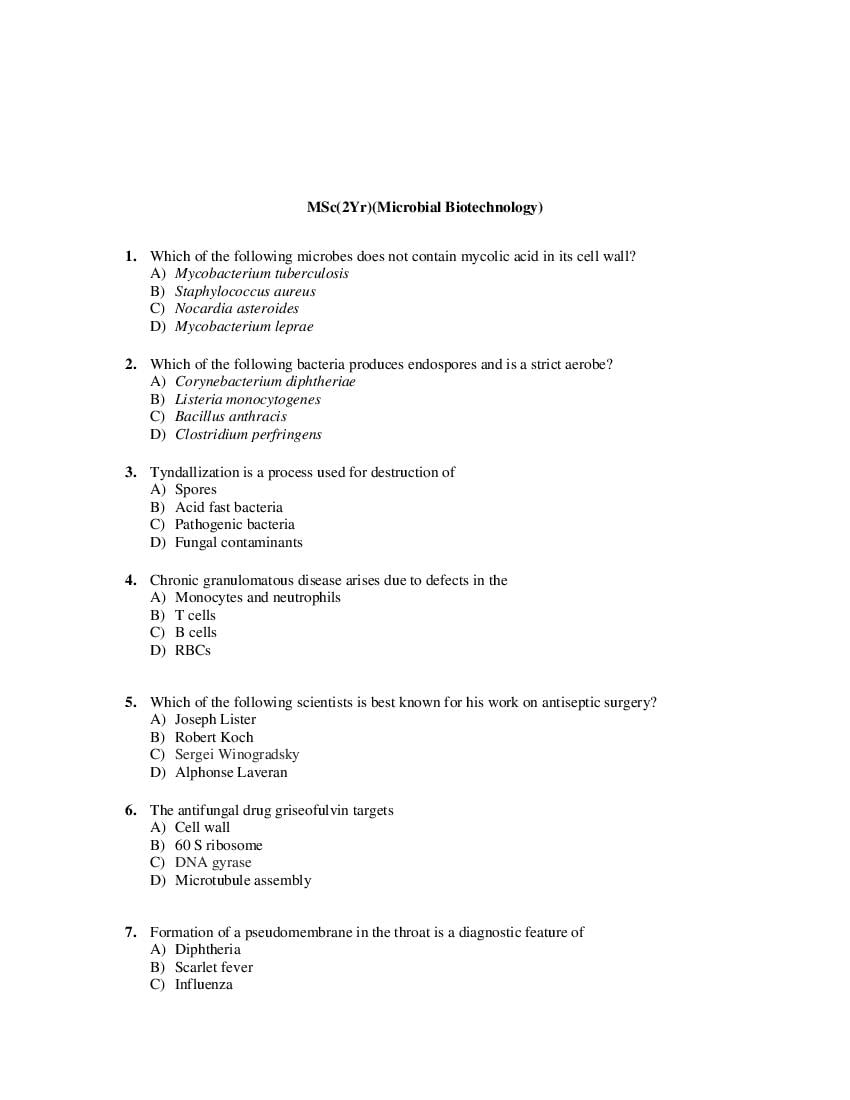
1. Which of the following microbes does not contain mycolic acid in its cell wall?
A) Mycobacterium tuberculosis
B) Staphylococcus aureus
C) Nocardia asteroides
D) Mycobacterium leprae
2. Which of the following bacteria produces endospores and is a strict aerobe?
A) Corynebacterium diphtheriae
B) Listeria monocytogenes
C) Bacillus anthracis
D) Clostridium perfringens
3. Tyndallization is a process used for destruction of
A) Spores
B) Acid fast bacteria
C) Pathogenic bacteria
D) Fungal contaminants
4. Chronic granulomatous disease arises due to defects in the
A) Monocytes and neutrophils
B) T cells
C) B cells
D) RBCs
5. Which of the following scientists is best known for his work on antiseptic surgery?
A) Joseph Lister
B) Robert Koch
C) Sergei Winogradsky
D) Alphonse Laveran
6. The antifungal drug griseofulvin targets
A) Cell wall
B) 60 S ribosome
C) DNA gyrase
D) Microtubule assembly
7. Formation of a pseudomembrane in the throat is a diagnostic feature of
A) Diphtheria
B) Scarlet fever
C) Influenza
Page 2
8. Lithotrophs are bacteria that use inorganic molecules as a source of
A) Carbon
B) Electrons
C) Energy
D) Water
9. If pH of a solution is 2, what is its pOH?
A) 5
B) 2
C) 12
D) 6
10. Growth yields are proportional to the concentration of most limiting nutrients. This is popularly
known as
A) Liebig’s law
B) Shelford’s law
C) Schaechter’s law
D) Kleiber's law
11. Which of the following groups of microbes will be most resistant to moist heat killing, assuming
that all are mesophiles?
A) Gram-positive bacteria
B) Gram-negative bacteria
C) Yeasts
D) Moulds
12. Arrange the following in increasing order of their reducing potential:
(i) FAD/FADH2, (ii) fumarate/succinate, (iii) NAD+/NADH, (iv) CoQ/CoQH2
A) iii, i, ii, iv
B) i, iii, ii, iv
C) iv, iii, i, ii
D) iv, i, ii, iii
13. In eukaryotic microbes, fatty acid oxidation and synthesis take place in _________ and
__________ respectively.
A) Cytoplasm and lysosomes
B) Mitochondria and cytoplasm
C) Cytoplasm and mitochondria
D) Both take place in cytoplasm
14. The common reaction centre chlorophyll in purple bacteria is
A) P680
Page 3
C) P870
D) P840
15. When a mutation results in a triplet coding for different but functionally equivalent amino acid, it
is called
A) Neutral mutation
B) Silent mutation
C) Transition
D) Transversion
16. During Hfr recombination, the recipient becomes
A) F+
B) F-
C) Hfr +
D) Either F+ or Hfr+
17. Bacterial artificial chromosomes are cloning vectors commonly based on
A) Cosmid
B) Phagemid
C) F factor
D) Bacterial genome
18. Mitochondria in eukaryotes may have arisen from an ancestor of
A) Rickettsia
B) Treponema
C) Chlamydia
D) Cyanobacteria
19. Sargassum is an example of
A) Red algae
B) Brown algae
C) Dinoflagellates
D) Euglenoids
20. Secondary steps in waste water treatment involve the removal of ______ by _______ processes
respectively
A) Organic matter, physical
B) Organic matter, biological
C) Inorganic matter, physical
D) Inorganic matter, biological
21. Which of the following antibody classes possesses a J chain?
A) IgA B) IgD C) IgE D) IgG
Page 4
______range
A) Yellow
B) Green
C) Blue
D) Pink
23. Somatic hyper mutation is important in the development of the following type of immune cells.
A) T cells
B) Macrophages
C) Neutrophils
D) B cells
24. Amongst the eukaryotic RNA polymerases, RNA polymerase I is localized in the
A) Nucleolus
B) Chromatin
C) Nuclear matrix
D) Cytoplasm
25. Salivary glands are primarily infected during which of the following viral infections?
A) Measles
B) Influenza
C) Herpes
D) Mumps
26. Granuloma formation is often associated with the following bacterial disease
A) Sore throat
B) Tuberculosis
C) Gastroenteritis
D) Pertussis
27. Which of the following is a common post-replication repair system?
A) Excision repair
B) Recombination repair
C) SOS repair
D) Mismatch repair
28. Pectinolysis will be more common in
A) Butter
B) Meats
C) Starchy foods
D) Fruits
29. Mycotoxins of the group fumonisins act by inhibiting
A) Sphingolipids
B) Proteins
Page 5
D) RNA
30. Butter milk and yogurt are produced through which types of lactic acid fermentation?
A) Both mesophilic
B) Both thermophilic
C) Mesophilic and thermophilic respectively
D) Thermophilic and mesophilic respectively
31. Rope spoilage of bread is commonly due to
A) Rhizopus
B) Aspergillus
C) Bacillus
D) Leuconostoc
32. Which of the following is a promising source of Vitamin A?
A) Penicillium
B) Rhodotorula
C) Streptococcus
D) Rhizopus
33. Which of the following is the smallest of all amino acids?
A) Glycine
B) Histidine
C) Proline
D) Alanine
34. A culture system is which particular nutrients are regularly added to the culture system without
removal of spent media is called ________ culture
A) Chemostat
B) Continuous
C) Batch
D) Fed-batch
35. Which of the following is a neurotoxin?
A) Tetanus toxin
B) Shiga toxin
C) Exotoxin A
D) Cholera toxin
36. One gene one enzyme hypothesis was proposed by
A) Beadle and Tatum
B) Meselson and Stahl
C) Hershey and Chase
D) Griffith
37. In recent months, illegal use of which of the following GM crops has been reported in India?
Page 6
B) Bt brinjal
C) Flavr savr tomatoes
D) GM maize
38. Wobble hypothesis is linked with
A) Degeneracy of the DNA code
B) Post-translational protein processing
C) Semi-conservative DNA replication
D) Protein folding
39. Which of the following statements about membrane proteins is not correct?
A) Integral membrane proteins have transmembrane domains rich in hydrophobic amino acids.
B) Integral membrane proteins have ends rich in hydrophilic amino acids.
C) Transmembrane porins have hydrophilic amino acids that point inwards in the β-barrels
D) Integral membrane proteins are anchored to the lipid bilayer by ionic bonds.
40. Ras protein is a
A) Tyrosine kinase
B) Serine-threonine kinase
C) GTPase
D) Phosphatidylinositol kinase
41. Which of the following methods is commonly used to introduce genes into plant cells?
A) Microinjection
B) Electroporation
C) Transformation of competent cells
D) Gene gun
42. p53 normally promotes
A) Apoptosis
B) DNA replication
C) Cell division
D) RNA synthesis
43. Which would be the best chromatography technique to separate a protein that binds strongly to its
substrate?
A) Cation exchange chromatography
B) Affinity chromatography
C) Gel filtration
D) Anion exchange chromatography
44. In two-dimensional gel electrophoresis system, the second step involves separation of proteins
based on their
A) Molecular weight
B) Charge to mass ratio
C) Isoelectric point
D) Protein-specific antibodies
45. In PCR, the advantage of Pfu over Taq polymerase is
A) High efficiency
Page 7
C) Cheaper synthesis
D) Lower error rate
46. If an mRNA is 312 nucleotide in length, including start and stop codon, it will transcribe a protein
about ______ amino acids in length
A) 110 B) 106 C) 103 D) 120
47. Which of the following is the most abundant protein in nature?
A) Rubisco
B) Chlorophyll
C) Insulin
D) Myoglobin
48. Allosteric regulation acts by
A) Reversible binding through formation of non-covalent bond
B) Reversible binding through formation of covalent bond
C) Irreversible binding through formation of covalent bond
D) Irreversible binding through formation of non-covalent bond
49. Which of the following determine the overall shape of a bacterial cell?
A) Cell membrane
B) Nuceloid
C) Cell wall
D) Cytoskeleton
50. Which of the following eukaryotic cell wall components are nitrogenous compounds?
A) Glucans
B) Cellulose
C) Lignin
D) Chitin
51. Which of the following are mineralized biological structures?
A) Glycosaminoglycans
B) Chitin
C) Pectins
D) Diatom cell walls
52. Which of the following is not a technique for tissue homogenization?
A) Bead beating
B) Dehydration
C) Sonication
D) Grinding
53. In an ecosystem, biomass will be minimal at which of the following trophic levels?
A) Carnivores
B) Herbivores
C) Primary producers
D) Both B and C
54. Northern blotting detects
A) DNA
Page 8
C) Proteins
D) Lipids
55. Trickling filters are used for
A) Wine production
B) Waste water treatment
C) Acetic acid synthesis
D) Manufacturing of drugs
56. Prions are infectious particles containing only the
A) Proteins
B) DNA
C) RNA
D) Lipids
57. Guanosine is a
A) Purine
B) Pyrimidine
C) Nucleotide
D) Nucleoside
58. Which of the following structural forms of DNA is a left-handed helix?
A) Z form
B) A form
C) B form
D) X form
59. Cybrids are plant hybrids produced by fusion of
A) Two cytoplasts
B) Protoplast and nucleus
C) Protoplast and cytoplast
D) Two protoplasts
60. The antibiotic that inhibits protein synthesis
A) Ciprofloxacin
B) Polymyxin
C) Amikacin
D) Rifampicin
61. The housekeeping sigma factor for E. coli is
A) Sigma 54
B) Sigma 70
C) Sigma 38
D) Sigma 24
62. Thick filaments in skeletal muscles are composed of
A) Tropomyosin
B) Actin
C) Troponin
D) Myosin
Page 9
A) B cells
B) T cells
C) Macrophages
D) Neutrophils
64. The points at which crossing-over takes has taken place between homologous chromosomes are
named
A) Synaptonemal complexes
B) Centromeres
C) Chiasmata
D) Interkinins
65. An interaction between non-allelic genes in which one locus prevents expression of an allele at
another locus, but not vice versa is called
A) Epistasis
B) Complementation
C) Collaboration
D) Modification
66. The gliding bacteria that aggregate to form spore-releasing fruiting bodies under harsh conditions
are
A) Actinomycetes
B) Myxobacteria
C) Rickettsia
D) Chlamydia
67. Serum sickness is an example of ________ hypersensitivity.
A) Type I B) Type II C) Type III D) Type IV
68. The famous quote “In the field of observation, chance favors only prepared minds.” was given by
A) Charles Darwin
B) Robert Hooke
C) Louis Pasteur
D) Robert Koch
69. Gray ring is used in which of the following microscopes?
A) Phase contrast microscope
B) Scanning electron microscope
C) Transmission electron microscope
D) Confocal microscope
70. Production of secondary metabolites is associated with ______ phase of bacterial growth curve
A) Lag B) Log C) Stationary D) Death
Page 10
A) pBR322
B) pUC19
C) pACYC177
D) M13
72. In commensalism,
A) Both participants are benefitted
B) One is benefitted, other remains unaffected
C) One is benefitted, other is harmed
D) Growth of one participant is completely dependent on the other
73. Under conditions of antigen excess, the complexes between IgA and a tetravalent antigen will
have the composition
A) Ag2Ab1
B) Ag4Ab1
C) Ag4Ab3
D) Ag2Ab7
74. Which of the following organisms is an obligate intracellular parasite?
A) Rickettsia prowazekii
B) Myocobacterium tuberculosis
C) Salmonella typhi
D) Shigella flexneri
75. Kojic acid is a major secondary metabolite in
A) Penicillium
B) Aspergillus
C) Micrococcus
D) Leuconostoc
x-x-x
Document Details
| Board / Org | Panjab University |
| Exam | PU CET PG |
| Type | Question Paper |
| Pages | 10 |
| Updated | 22 Jul 2026 |